Iran cuts ties with UN nuclear watchdog after US and Israeli strikes

Iran’s suspension of co-operation with the IAEA follows its accusations the agency sided with Western countries and provided a justification for Israel’s airstrikes last month.
SBS News,3 July 25
Key Points
- Iran has suspended inspections by the UN nuclear watchdog.
- New legislation requires top security clearance for all access to Iranian nuclear sites by the agency.
- It comes after Iran accused the agency of providing a pretext for Israeli and US strikes on its nuclear sites.
Iran has officially suspended its cooperation with the United Nations nuclear watchdog, the International Atomic Energy Agency (IAEA), in a move that has drawn sharp international criticism.
It comes after last month’s 12-day conflict between Iran and Israel, in which Israel and the United States launched unprecedented strikes on Iran’s nuclear facilities, and tensions between Iran and the IAEA escalated.
Iran has accused the IAEA of siding with Western countries and providing a justification for Israel’s airstrikes, which began a day after the UN agency’s board voted to declare Iran in violation of obligations under the UN-backed Nuclear Non-Proliferation Treaty (NPT).
………. On 25 June, a day after a ceasefire took hold, Iran’s parliament voted overwhelmingly to suspend co-operation with the Vienna-based IAEA.
Iranian President Masoud Pezeshkian formally enacted the suspension on Wednesday, state media reported.
The law aims to “ensure full support for the inherent rights of the Islamic Republic of Iran” under the NPT, with a particular focus on uranium enrichment, according to Iranian media.
The law stipulates that any future inspection of Iran’s nuclear sites by the IAEA needs approval by Iran’s Supreme National Security Council…………………………………………………………….
Iran has accused IAEA of providing pretext for Israeli attacks
Since the Israeli and US strikes on Iranian nuclear sites, Iran has sharply criticised the IAEA, with officials saying that accusations against Iran of non-compliance with its NPT obligations provided a pretext for Israel and the US’ attacks.
Senior Iranian official Ali Mozaffari accused the IAEA chief of “preparing the groundwork” for Israel’s raids and called for him to be held accountable, citing “deceptive actions and fraudulent reporting”. https://www.sbs.com.au/news/article/iran-cuts-ties-with-un-nuclear-watchdog-us-israeli-strikes/r5j9kqdve
Palantir’s Shadow War On Iran

July 2, 2025, Kit Klarenberg, https://www.kitklarenberg.com/p/palantirs-shadow-war-on-iran
As the dust settles on the “12 Day War”, it is ever-clearer that the conflict was a crushing defeat for Israel and the US. In retrospect, the Zionist entity’s sole success was a wave of assassinations in the conflict’s first hours. A fawning June 19th Financial Times report hinted cutting-edge technology drawing together diverse data and intelligence sources was responsible. This raises the obvious question of whether Tel Aviv was assisted in its murderous spree by notorious private spying giant Palantir.
An avowedly pro-Israel tech giant founded by Donald Trump confidante and ardent Zionist Peter Thiel, which reportedly provides artificial intelligence tech supporting Tel Aviv’s genocide in Gaza, Palantir’s tendrils extend typically unseen into almost every conceivable sphere of public and private life across the West. Moreover, the firm – launched with seed funding from CIA venture capital wing In-Q-Tel – has long-played a pivotal but barely acknowledged role in the International Atomic Energy Agency’s monitoring of Tehran’s nuclear research.
The interpretation Palantir was one way or another involved in Israel’s illegal “preemptive” war of aggression against Tehran is amply reinforced by the release of sensitive Israeli documents by Iran’s intelligence ministry. These files indicate the IAEA previously provided Israeli intelligence with the names of several Iranian nuclear scientists, who were subsequently assassinated. Additionally, current Association chief Rafael Grossi enjoys a close, long-running, clandestine relationship with Israeli officials. Subsequent disclosures could expose the IAEA’s dark alliance with Palantir.
‘Fishing Expedition’
In July 2015, the Obama administration inked the Joint Comprehensive Plan of Action with Tehran. Under its auspices, in return for sanctions relief, the IAEA was granted unimpeded access to Iran’s nuclear facilities, to ensure the Islamic Republic was not developing nuclear weapons. Vast amounts of information on and within the sites, including surveillance camera photos, measurement data, and documents were collected along the way. The Association consistently found Iran was stringently adhering to the JCPOA’s terms.
Following Trump’s first inauguration however, the JCPOA began to come apart at the seams. In October 2017, he refused to certify Iran’s compliance with its obligations on bogus grounds, and began threatening to tear up the agreement outright and reimpose sanctions. The next March, then-IAEA director general Yukiya Amano sounded alarm over this prospect, claiming the JCPOA had produced “the world’s most robust [nuclear] verification regime” in Iran, and its cessation would represent a “great loss”. He went on to boast of how Association inspectors:
“Now spend 3,000 calendar days per year on the ground in Iran. We have installed some 2,000 tamper-proof seals on nuclear material and equipment. We have carried out more than 60 complementary accesses [unannounced inspections] and visited more than 190 buildings…We collect and analyse hundreds of thousands of images captured daily by our sophisticated surveillance cameras…about half of the total number of such images that we collect throughout the world. We collect over one million pieces of open source information each month.”
Amano added IAEA activities in Tehran were “supported by state-of-the-art technology, including data collecting and processing systems.” Unmentioned was that these innovative resources were provided by Palantir. The company’s central role in scrutinizing Iran’s nuclear compliance and intimate handshake with the IAEA was revealed two months later by Bloomberg, mere days before the Trump administration shredded the Agreement and launched a “maximum pressure” campaign against Tehran. Former US energy secretary Ernest Moniz effusively praised Palantir’s contribution:
“We have a completely unique and unparalleled intrusive verification regime that was not there before the agreement.”
A tool dubbed Mosaic served as “the analytical core” and “platform of choice” for the IAEA’s verification mission in Iran. The software helped the Association “plan and justify unscheduled probes”, collating and processing data from around 400 million “digital objects” globally, “including social media feeds and satellite photographs.” Mosaic was also charged with examining en-masse documents not only collected by the IAEA, but tens of thousands of sensitive files stolen by Mossad from Tehran.
Bloomberg quoted Ali Vaez, International Crisis Group’s Iran Project director, as expressing concern about Mosaic analysing “dirty” data obtained by Mossad, “which prides itself on deception.” After all, “even a small amount of false information could trigger a flurry of unnecessary snap inspections and derail an agreement that took years to reach.” The broader the terms of Palantir’s work with the IAEA, the more the mission “appears as a fishing expedition,” Vaez fretted, suggesting Iran could become less willing “to open its doors to inspectors.”
Vaez’s comments were eerily prophetic. Recent disclosures of intensive collusion between the IAEA and Zionist entity authorities, and the resultant prospect Association inspections assisted Israeli and US attacks on Tehran, prompted Iranian lawmakers to unanimously pass legislation indefinitely suspending cooperation with the Association on June 25th. It is unlikely IAEA inspectors will ever be permitted to tread on the Islamic Republic’s territory again. But Bloomberg highlighted a number of other anxieties that have only gained in gravity in light of recent events.
‘False Assumption’
For one, the outlet recorded how Palantir’s IAEA role granted the company “access to information that governments don’t,” while questioning whether “an international agency known for its independence” could truly remain neutral and objective given “Thiel’s close personal ties to Trump.” Furthermore, Bloomberg noted the Association’s Palantir-provided “enhanced investigative abilities” had “raised concern that the IAEA may overstep the boundary between nuclear monitoring and intelligence-gathering,” transforming its inspectors into unwitting “potential cyber sleuths.”
Such fears were only exacerbated by Mosaic being based upon Palantir’s highly controversial “predictive-policing software”. For the IAEA, this capability turned “databases of classified information into maps” helping “inspectors visualize ties between the people, places and material involved in nuclear activities” in Tehran. The risk of innocent Iranian civilians being made targets for surveillance, harassment, or even assassination created by erroneous data being fed into and/or pumped out by Mosaic is gargantuan.
Bloomberg quoted a representative of a British company “that advises governments on verification issues” as saying “predictive-analysis” systems were extremely vulnerable to such corruption, “either by accident or design.” He noted, “you will generate a false return if you add a false assumption into the system…[and] end up convincing yourself that shadows are real.” Of course, a dangerous “false assumption” lay at the very core of the IAEA’s inspection mission in Iran – namely, that Tehran was developing nukes in the first place.
The Islamic Republic has for decades consistently denied any suggestion it harbours ambitions to possess nuclear weapons. Her denials were corroborated by a November 2007 US National Intelligence Estimate expressing “high confidence that in fall 2003, Tehran halted” any and all research into nuclear weapons. This assessment remained unchanged for several years, and was reportedly shared by Mossad. As Bloomberg recorded, come May 2018 the IAEA had “certified Iran’s work 10 times.”
In March 2025, Director of National Intelligence Tulsi Gabbard testified to Congress that Iran had not restarted the nuclear weapons program it halted in 2003. On June 17th, with the 12 Day War well-underway, IAEA chief Grossi declared “we did not have any proof of a systematic effort” by Tehran “to move into a nuclear weapon.” Yet, Israel justified its attacks based on an intelligence dossier that concluded the Islamic Republic had in fact reached the “point of no return” in acquiring nukes.
That dodgy dossier depended in no small part on the findings of a May IAEA report. The document provided no new information – its dubious charges related “to activities dating back decades” at three sites where purportedly, until the early 2000s, “undeclared nuclear material” was handled. If this report was analysed by Palantir’s “predictive-analysis” systems, it is all but inevitable false results and connections would’ve been created, in turn influencing the Zionist entity’s targets and strategy.
One of the “predictive policing” tools innovated by Palantir guiding Mosaic’s operations is Gotham, which is used by an uncertain number of Western law enforcement agencies. Leaked documents on the resource show it collects an extraordinary volume of data on entire populations – whether they are law-abiding, suspected of having committed a crime, or simply connected to individuals accused of wrongdoing. This includes sex, race, names, contact details, addresses, prior warrants, mugshots, surveillance photos, personal relationships, past and current employers, and identifying features such as tattoos.
In October 2024, a major Norwegian asset manager divested from Palantir due to the company offering “AI-based predictive policing systems”, aiding the Zionist entity’s mass surveillance of Palestinians in Gaza and the West Bank. These systems are designed “to identify individuals who are likely to launch ‘lone wolf terrorist’ attacks, facilitating their arrests preemptively before the strikes that it is projected they would carry out.” Their deployment results in countless Palestinians languishing in Israeli dungeons without charge or trial.
If Mosaic informed the Zionist entity’s strategy during the 12 Day War, that may account for why individuals with no connection whatsoever to Iran’s civilian nuclear program were directly targeted for assassination. This includes Majid Tajan Jari, a prominent professor in the field of AI locally, slain in an Israeli strike on a residential building in Tehran on June 16th. Yet, reliance on faulty or false information collated by Mosaic would simultaneously explain the conflict ending in embarrassing defeat for Israel, and victory for Tehran.
Spying on Iran: How MI6 infiltrated the IAEA
The Iranian government has alleged that the IAEA supplied the identities of its top nuclear scientists to Israeli intelligence, enabling their assassinations, and provided critical intelligence to the US and Israel on the nuclear facilities they bombed during their military assault this June.
Leaked confidential files indicate the International Atomic Energy Agency was infiltrated by a veteran British spy who has claimed credit for sanctions on Iran.
The Grayzone, Jul 02, 2025, By Kit Klarenberg, https://thegrayzone.substack.com/p/spying-on-iran-how-mi6-infiltrated?utm_source=post-email-title&publication_id=474765&post_id=167288793&utm_campaign=email-post-title&isFreemail=true&r=n09ij&triedRedirect=true&utm_medium=email
A notorious British MI6 agent infiltrated the International Atomic Energy Agency (IAEA) on London’s behalf, according to leaked documents reviewed by The Grayzone. The agent, Nicholas Langman, is a veteran intelligence operative who claims credit for helping engineer the West’s economic war on Iran.
Langman’s identity first surfaced in journalistic accounts of his role in deflecting accusations that British intelligence played a role in the death of Princess Diana. He was later accused by Greek authorities of overseeing the abduction and torture of Pakistani migrants in Athens.
In both cases, UK authorities issued censorship orders forbidding the press from publishing his name. But Greek media, which was under no such obligation, confirmed that Langman was one of the MI6 assets withdrawn from Britain’s embassy in Athens.
The Grayzone discovered the résumé of the journeyman British operative in a trove of leaked papers detailing the activities of Torchlight, a prolific British intelligence cutout. The bio of the longtime MI6 officer reveals he “led large, inter-agency teams to identify and defeat the spread of nuclear, chemical and biological weapons technology, including by innovative technical means and sanctions.”
In particular, the MI6 agent says he provided “support for the [IAEA] and Organization for the Prohibition of Chemical Weapons [OPCW] and through high level international partnerships.”
Langman’s CV credits him with playing a major role in organizing the sanctions regime on Iran by “[building] highly effective and mutually supportive relations across government and with senior US, European, Middle and Far Eastern colleagues for strategy” between 2010 and 2012. He boasts in his bio that this achievement “enabled [the] major diplomatic success of [the] Iranian nuclear and sanctions agreement.”
The influence Langman claimed to have exerted on the IAEA adds weight to Iranian allegations that the international nuclear regulation body colluded with the West and Israel to undermine its sovereignty. The Iranian government has alleged that the IAEA supplied the identities of its top nuclear scientists to Israeli intelligence, enabling their assassinations, and provided critical intelligence to the US and Israel on the nuclear facilities they bombed during their military assault this June.
This June 12, under the direction of its Secretary General Rafael Grossi, the IAEA issued a clearly politicized report recycling questionable past allegations to accuse Iran of violating the Non-Proliferation Treaty. Three days later, Israel attacked the country, assassinating nine nuclear scientists as well as numerous top military officials and hundreds of civilians.
Iranian former Vice President for Strategic Affairs Javad Zarif has since called for the IAEA’s Grossi to be sacked, accusing him of having “abetted the slaughter of innocents in the country.” This June 28, the Iranian government broke ties with the IAEA, refusing to allow its inspectors into the country.
While Iranian officials may have had no idea about the involvement of a shadowy figure like Langman in IAEA business, it would likely come as little surprise to Tehran that the supposedly multilateral agency had been compromised by a Western intelligence agency.
Langman’s name placed under official UK censorship order
In 2016, Langman was named a Companion of the Order of St Michael and St George, the same title bestowed on fictional British spy James Bond. By that point, the supposed secret agent held the dubious distinction of being publicly ‘burned’ as an MI6 operative on two separate occasions.
First, in 2001, journalist Stephen Dorril revealed that Langman had arrived in Paris weeks prior to Princess Diana’s fatal car crash in the city on August 31 1997, and was subsequently charged with conducting “information operations” to deflect widespread public speculation British intelligence was responsible for her death.
Then, in 2005, he was formally accused by Greek authorities of complicity in the abduction and torture of 28 Pakistanis in Athens. The Pakistanis, all migrant workers, were suspected of having had contact with individuals accused of perpetrating the 7/7 bombings in London, July 2005.
Brutally beaten and threatened with guns in their mouths, the victims “were convinced their interrogators were British.” When Greek media named Langman as the MI6 operative who oversaw the migrants’ torture, British news outlets universally complied with a government D-notice – an official censorship order – and kept his identity under wraps when reporting on the scandal.
London vehemently denied any British involvement in torturing the migrants, with then-Foreign Secretary Jack Straw dismissing the charge as “utter nonsense.” In January 2006 though, London admitted MI6 officers were indeed present during the Pakistanis’ torture, although officials insisted the operatives played no active part in their arrests, questioning or abuse.
Following his withdrawal from Athens, Langman returned to London to head the UK Foreign Office’s Iran Department, a shift which highlights his importance to MI6 and suggests the British government had no qualms about his allegedly brutal evidence gathering methods.
Britain’s Foreign Office collaborates closely with MI6, whose agents use it as cover just as the CIA does with State Department diplomatic postings.
MI6’s man on Iran takes credit for “maximum pressure” strategy
While leading the Foreign Office’s Iran Department from 2006 – 2008, Langman oversaw a team seeking to “develop understanding” of the Iranian government’s “nuclear program.”
It’s unclear exactly what that “understanding” entailed. But the document makes clear that Langman then “generated confidence” in that assessment among “European, US and Middle Eastern agencies” in order to “delay programme [sic] and pressurise Iran to negotiate.” The reference to “Middle Eastern agencies” strongly implied MI6 cooperation with Israel’s Mossad intelligence services.
In April 2006, Tehran announced it had successfully enriched uranium for the first time, although officials denied any intention to do so for military purposes. This development may have triggered Langman’s intervention.
The Islamic Republic has rejected any suggestion it harbors ambitions to possess nuclear weapons. Its denials were corroborated by a November 2007 US National Intelligence Estimate expressing “high confidence that in fall 2003, Tehran halted” any and all research into nuclear weapons. This assessment remained unchanged for several years, and was reportedly shared by the Mossad, despite Benjamin Netanyhau’s constant declarations that Iran was on the brink of developing a nuclear weapon.
Langman’s IAEA support work overlaps with Iran sanctions blitz
International governmental attitudes towards Iran changed abruptly between 2010 and ‘12. During this period, Western states and intergovernmental institutions initiated an array of harshly punitive measures against the country, while Israel ramped up its deadly covert operations against Iran’s nuclear scientists.
This period precisely overlapped with Langman’s tenure at the Counter-Proliferation Centre of the UK Foreign Office. His bio implies he used this position to influence the IAEA and other UN-affiliated organizations to foment a campaign of global hostility towards Iran.
In June 2010, the UN Security Council adopted Resolution 1929, which froze the Iranian Revolutionary Guard Corps’ assets, and banned overseas financial institutions from opening offices in Tehran. A month later, the Obama administration adopted the Comprehensive Iran Sanctions, Accountability, and Divestment Act. This set off a global chain of copycat sanctions by Washington’s vassals, who often imposed even more stringent measures than those levied by the UN and US.
In March 2012, the EU voted unanimously to cut Iranian banks out of the SWIFT international banking network. That October, the bloc imposed the harshest sanctions to date, restricting trade, financial services, energy and technology, along with bans on the provision of insurance to Iranian companies by European firms.
BBC reporting on the sanctions acknowledged European officials merely suspected Tehran of seeking to develop nuclear weapons, but lacked concrete proof. And behind the scenes, the MI6 operative Langman was claiming credit for helping legitimize the allegations against Iran.
Following the Western-led campaign isolation of Iran from 2010 – 2012, over its purported nuclear weapon program, the Obama administration negotiated a July 2015 agreement known as the Joint Comprehensive Plan of Action (JCPOA). Under the JCPOA’s terms, the Islamic Republic agreed to limit its nuclear research activities in return for sanctions relief. In the years that followed, the IAEA was granted virtually unlimited access to Tehran’s nuclear complexes, ostensibly to ensure the facilities were not used to develop nuclear weapons.
Along the way, IAEA inspectors collected vast amounts of information on the sites, including surveillance camera photos, measurement data, and documents. The Iranian government has since accused the Agency of furnishing the top secret profiles of its nuclear scientists to Israel. These include the godfather of Iran’s nuclear program, Mohsen Fakrizadeh, who was first publicly named in a menacing 2019 powerpoint presentation by Israeli Prime Minister Benjamin Netanyahu. The following year, the Mossad assassinated Fakrizadeh in broad daylight with a remote-controlled machine gun.
Internal IAEA documents leaked this June indicated that IAEA Secretary General Rafael Grossi has enjoyed a much closer relationship with Israeli officials than was previously known, and suggested he leveraged his cozy ties with Tel Aviv to secure his current position.
During a June 24 interview with Fox News’ war-crazed anchor Martha MacCallum, Grossi did not deny making the inflammatory claim that “900 pounds of potentially enriched uranium was taken to an ancient site near Isfahan.” Instead the IAEA director asserted, “We do not have any information on the whereabouts of this material.”
Well before Grossi rose to the top of the IAEA with Western and Israeli backing, the agency appears to have been penetrated by a British intelligence agent who took responsibility in his bio for engineering the West’s economic attack on Iran.
The IAEA has not responded to an email from The Grayzone seeking clarification on its relationship with Langman and the MI6.
Iran could resume enriching uranium within months, UN nuclear watchdog boss says
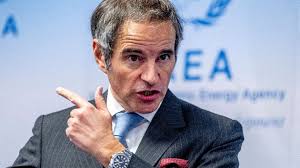
Rafael Grossi, the director-general of the International Atomic Energy Agency (IAEA), told CBS News in an interview on Sunday that Iran’s capabilities to resolve any damage to its nuclear program do not appear to have been wiped out.
30 June 25, https://www.abc.net.au/news/2025-06-30/iran-could-enrich-uranium-within-months-iaea-says/105475434
In short:
Iran could resume producing enriched uranium in months, according to the head of the United Nations’ nuclear watchdog.
Rafael Grossi from the International Atomic Energy Agency has raised more doubt about the efficacy of the US bombing of key Iranian nuclear facilities.
What’s next?
US President Donald Trump has suggested individuals could be prosecuted if found responsible for leaking a classified report that also cast doubt on the success of the US strikes.
Iran could resume producing enriched uranium in months, according to comments made by the head of the United Nations’ nuclear watchdog that have raised more doubts about the efficacy of US strikes on Tehran’s nuclear program.
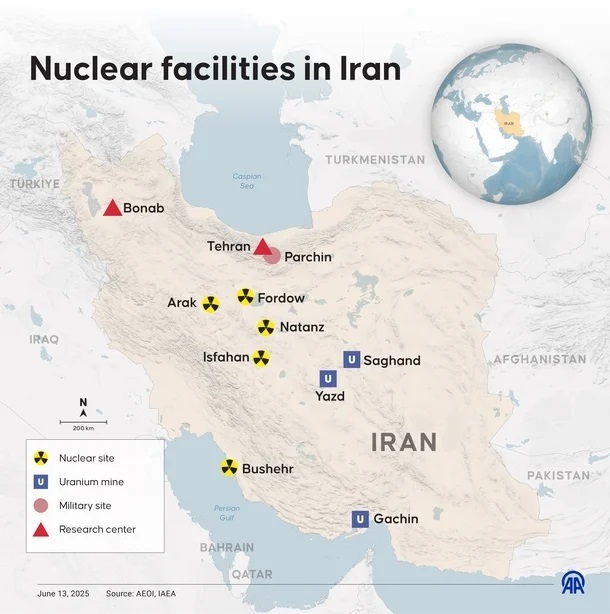
Officials in the United States have repeatedly stated that the strikes on Iran’s Fordow, Natanz and Isfahan nuclear facilities “obliterated” them, although President Donald Trump said on Friday that he would consider bombing the Middle Eastern nation again if it was enriching uranium to worrisome levels.
Rafael Grossi, the director-general of the International Atomic Energy Agency (IAEA), told CBS News in an interview on Sunday that Iran’s capabilities to resolve any damage to its nuclear program do not appear to have been wiped out.
“The capacities they have are there. They can have, you know, in a matter of months, I would say, a few cascades of centrifuges spinning and producing enriched uranium, or less than that,” he said.
“Frankly speaking, one cannot claim that everything has disappeared and there is nothing there.”
US officials also obtained an intercepted phone call between Iranian officials appearing to suggest the government in Tehran believes the US strikes were less devastating than expected, according to a report from The Washington Post.
In an interview on Sunday local time, Mr Trump also suggested that his government would look to investigate and potentially prosecute individuals found responsible for leaking an internal, preliminary classified report that cast doubt on how successful the US strikes in Iran were.
“They should be prosecuted. The people who leaked it,” the president said on the Fox News US.
“We can find out. If they wanted, they could find out easily.
“You go up and tell the reporter: ‘National security, who gave it?’ You have to do that, and I’ll suspect we’ll be doing things like that.”
Mr Trump’s interview with Fox aired as his “Big Beautiful Bill” cleared a procedural hurdle in the US Senate, before it entered a 10-hour debate process.
The US strikes came after Israel said this month it wanted to remove any chance of Iran developing nuclear weapons, launching its own attacks on Tehran that ignited a 12-day war between the two countries.
Iran says its nuclear program is for peaceful purposes only.
Mr Grossi said the US strikes on the three Iranian sites had significantly set back Iran’s ability to convert and enrich uranium.
Western powers, however, have stressed that Iran’s nuclear advances provide it with an irreversible knowledge gain, suggesting that while losing experts or facilities may slow progress, the advances were permanent.
“Iran is a very sophisticated country in terms of nuclear technology,” Mr Grossi said.
“So, you cannot disinvent this. You cannot undo the knowledge that you have or the capacities that you have.”
Mr Grossi was also asked about reports of Iran moving its stock of highly enriched uranium in the run-up to the US strikes and said it was not clear where that material was.
“Some could have been destroyed as part of the attack, but some could have been moved,” he said.
On Friday, Mr Trump scoffed at Ayatollah Ali Khamenei’s heated warning to the US not to launch future strikes on Iran, as well as the Iranian supreme leader’s assertion that Tehran “won the war” with Israel.
Mr Trump said the ayatollah’s comments defied reality after 12 days of Israeli strikes and the US bombardment, and the US president suggested the comments were unbecoming of Iran’s most powerful political and religious figure.
“Look, you’re a man of great faith. A man who’s highly respected in his country. You have to tell the truth,” Mr Trump said.
“You got beat to hell.”
Mr Trump also told reporters at the White House that he expected Iran to open itself to international inspection to verify that it does not restart its nuclear program.
Asked if he would demand during expected talks with Iran that the IAEA or some other organisation be authorised to conduct inspections, Mr Trump said Iran would have to cooperate with the group “or somebody that we respect, including ourselves”.
The Unspoken Aspects of Iran’s Nuclear Program
by Thierry Meyssan, Voltaire Network | Paris (France) | 27 June 2025
The implications of Iran’s nuclear program are not what we think. Tehran renounced the atomic bomb in 1988, but is attempting, with Russia’s cooperation, to discover the secrets of nuclear fusion. If it succeeds, it would help the Southern states decolonize by freeing themselves from oil.
As for the implications of the bombing of certain Iranian nuclear sites by the United States, they may also not be what we think.
This affair is all the more opaque because it is not possible today to establish a clear distinction between research on civilian nuclear fusion and military fusion.
ince the fall of Iraq, under the blows of the British and the United States, London and Washington have popularized the myth of Iran’s military nuclear program, following on from the myth of Iraq’s weapons of mass destruction. This myth has been taken up by Israeli “revisionist Zionists” (not to be confused with “Zionists” per se) and their leader, Benjamin Netanyahu. For twenty years, Westerners have been inundated with this propaganda and have come to believe it, although announcing for such a long period that Tehran will have “the” bomb “next year” makes no sense.—
However, even if Russia, China, and the United States all agree that there is currently no Iranian military program, everyone clearly sees that Iran is doing something at its nuclear power plants. But what?
In 2005, Mahmoud Ahmadinejad was elected President of the Islamic Republic, replacing Sayyed Mohammad Khatami. He is a scientist whose vision is to liberate colonized peoples. He therefore believes that by mastering the atom, he will enable all peoples to free themselves from Western oil transnationals.
Iran then develops training programs for nuclear scientists in numerous universities. It’s not about creating a small elite of a few hundred specialists, but about training battalions of engineers. There are now tens of thousands of them.
Iran intends to discover how to achieve nuclear fusion, whereas Westerners are content with fission. Fission is the splitting of an atom; while fusion is the joining of atoms, which releases immeasurable energy. Fission is used for our power plants, while, for the time being, fusion is only used for thermonuclear bombs. Mahmoud Ahmadinejad’s project is to use it to generate electricity and share it with developing countries.
This knowledge is revolutionary, in the Khomeinist sense of the term, that is, it allows for an end to the dependence of the Southern states and their economic development. It clashes head-on with the British vision of colonialism, according to which His Majesty had to divide and rule and prevent the development of the colonized. We recall, for example, that London forbade Indians from spinning the cotton they grew themselves so that it could be spun by its factories in Manchester. In response, Mahatma Gandhi set an example for his people and spun his own cotton, defying the British monarchy. Similarly, Mahmoud Ahmadinejad’s project challenges the power of the West and the Anglo-Saxon oil transnationals. It is perfectly understandable to be concerned about Iranian investment in nuclear power because these technologies are, by definition, dual-use, both civilian and military. It is clear that this is not the usual civilian use, and that the detailed discovery of fusion processes could also be used for military purposes. In any case, Iran is seeking an inexhaustible source of energy.
………………………….It should also be remembered that Iran is a signatory to the Treaty on the Non-Proliferation of Nuclear Weapons (NPT). It is for this reason that it is subject to inspections by the International Atomic Energy Agency (IAEA). Since 1988, the IAEA has never found any evidence suggesting that Iran still has a military nuclear program. However, the Agency has asked numerous questions to clarify certain aspects of its civilian program and has received no answers, which is perfectly understandable given the investment in Iranian-Russian fusion research. In practice, documents released by the Iranian press two days before the Israeli attack attest that the IAEA Director, the Argentinian Rafael Grossi, behaves like a spy in the service of Israel, to which he transmits all information from its inspectors; this is despite the fact that Israel is not a signatory to the NPT and therefore not a member of the IAEA.
Tehran submitted a proposal for the “Establishment of a Nuclear Weapon-Free Zone in the Middle East” to the United Nations Conference of the Parties to the NPT on May 4, 2010 [1]. This proposal was well received by all states in the region, with the exception of Israel. Indeed, Tel Aviv, which benefited from transfers of French technology from senior officials of the Fourth Republic, possesses the atomic bomb [2]…………………………………………………………………………………………https://www.voltairenet.org/article222538.html
How Iran could build a bomb in secret – despite Trump’s $30bn offer
Iran enters ‘era of nuclear ambiguity’ with its capabilities ‘hidden and unverifiable’
Radina Gigova, 27 June 25, https://inews.co.uk/news/world/how-iran-build-bomb-secret-despite-trumps-30bn-offer-3775501
Despite US strikes on Iranian nuclear sites, the Trump administration is reportedly prepared to offer Tehran financial incentives to strike a deal over its nuclear programme.
Sources familiar with current plans told CNN that Washington could offer investment in a civilian energy worth up to $30bn (£21.9bn) if the regime is willing to abandon uranium enrichment and adopt transparency measures, as well as sanctions relief.
But Iran has signaled that it intends to rebuild the programme after acknowledging heavy damage by US strikes, and it could do so in secret after passing a law to suspend co-operation with the International Atomic Energy Agency (IAEA), which would block inspections on its nuclear sites and pave the way to withdrawal from the Nuclear Non-Proliferation Treaty.
How far Iran has progressed towards nuclear weapons, and what steps it could take next, could now be hidden from view, experts say.
“The truth is, no one really knows – and that’s exactly the problem,” said Sina Toossi, an Iran specialist and senior fellow at the Centre for International Policy, a Washington DC think-tank.
“Iran is entering an era of nuclear ambiguity, where its capabilities are deliberately hidden and unverifiable,” he said.
The ambiguity has been heightened after President Donald Trump said he would consider bombing Iran again.
Trump said he had spared Khamanei’s life during the original raids. US officials told the Reuters news agency on June 15 that Trump had vetoed an Israeli plan to kill the supreme leader.
“His Country was decimated, his three evil Nuclear Sites were OBLITERATED, and I knew EXACTLY where he was sheltered, and would not let Israel, or the U.S. Armed Forces, by far the Greatest and Most Powerful in the World, terminate his life,” Trump said in a social media post.
“I SAVED HIM FROM A VERY UGLY AND IGNOMINIOUS DEATH,” he said.
Iran’s decision to suspend IAEA co-operation just two days after a ceasefire “marks a turning point in the decades-long nuclear dispute”, and is “a strategic setback for both the United States and Israel”, Toossi added.
Iran retains nuclear capabilities
Donald Trump claimed last Saturday that US “bunker-buster” bombs had thoroughly destroyed Iran’s nuclear enrichment facilities, including sites at Natanz and Fordo – the latter located deep underground – and a storage site in Isfahan.
“The strikes were a spectacular military success,” the US President declared, adding that Iran’s core enrichment infrastructure had been “completely and totally obliterated”.
Iranian officials, for their part, continue to deny any intention of developing a nuclear bomb.
But experts caution that Iran retains the potential to weaponise.
“Yes, Iran retains the technical capability and infrastructure to eventually build a nuclear bomb behind the scenes, despite the recent Israeli and US strikes,” said Dr Andreas Krieg, senior lecturer at the School of Security Studies at King’s College London, Royal College of Defence Studies and fellow at the Institute of Middle Eastern Studies.
The strikes caused substantial damage to critical nuclear facilities, including the enrichment and conversion sites at Natanz, Fordo, and Esfahan, according to US officials. However, intelligence reports and satellite imagery indicate that Iran likely relocated a large portion of its enriched uranium stockpile – and possibly even advanced centrifuges – to secret locations ahead of the attacks.
“This preserved the most critical elements of its breakout capability. Moreover, Iran’s knowledge base – its cadre of nuclear scientists and engineers – is intact. Human capital, unlike physical infrastructure, is difficult to eliminate and can reconstitute programmes even after significant setbacks,” said Dr Krieg.
Krieg noted that the IAEA has acknowledged that although inspections at declared sites have been hindered, there is only limited visibility into any potential undisclosed or secret facilities.
“This opens the possibility of a clandestine parallel programme – especially given that Iran has previously experimented with such pathways during the AMAD programme in the early 2000s,” he said, referring to an alleged secret Iranian nuclear weapons development project believed to have been active at the start of the century.
“Therefore, while recent military operations may have delayed Iran’s ability to assemble a bomb, they have not eliminated the potential,” he said.
“If Iran were to exit the Nuclear Non-Proliferation Treaty or reduce co-operation with the IAEA, concerns about a hidden weapons programme would intensify. In the absence of a durable diplomatic solution, Iran’s latent capability remains a central strategic risk in the region.”
Dr Pavel Podvig, a senior researcher and nuclear specialist at the UN Institute for Disarmament Research, said the US and Israel could struggle to keep track of a hidden programme.
“It would be very difficult without IAEA access,” he said. “Look at North Korea – and North Korea wasn’t really making a special effort to hide facilities underground.”
A clandestine “breakout” would prioritise storage of any remaining highly enriched uranium, he added, which could potentially be further enriched to weapons-grade at an unknown facility.
Basis of a deal may already exist
Krieg believes “it is imperative that the Trump administration, through mediators like Qatar, is transforming this current momentum of the ceasefire into a sustainable and mutually acceptable nuclear deal, including enrichment constraints and effective oversight mechanisms”.
Uranium is the central element in question, and according to the UN’s nuclear watchdog, no other country has as much enriched uranium at this level as Iran does without also engaging in a nuclear weapons programme.
John Erath, senior policy director at the Centre for Arms Control and Non-Proliferation, agrees that Iran may have the capability to build a nuclear weapon and that negotiating a new agreement, similar to the Joint Comprehensive Plan of Action (JCPOA) nuclear deal reached in 2015 and abandoned by Trump in 2018 – could be the basis of a new deal.
“We have an example of an arrangement that provided confidence that closed off the path to nuclear weapons for Iran,” he said, referring to the JCPOA, “and so, if I were negotiating a new arrangement, I would use that as a starting point but I would have something that would not have an expiration date.”
“If you want to demonstrate that you do not have nuclear weapons, be completely transparent, be completely open, and they were not that,” Erath claimed, referring to the Iranian government. “They were doing things that they wanted to keep hidden, that they wanted to keep in secret, that were only things that you could do if you were considering a nuclear weapons programme.”
Iranian officials have indicated reluctance to re-enter talks after the US and Israeli attacks, citing a lack of trust, although Tehran’s ambassador to the UN left the door open to a regional nuclear consortium involving Gulf states – a previous proposal floated by the US.
The 12-day war has “certainly put the possibility of further negotiations under serious threat”, Erath said. “[But that’s] what happened, and we have to live with the consequences.”
What if Iran withdraws from the NPT?
Bulletin. By Mark Goodman, Mark Fitzpatrick | June 25, 2025
As the Iranian nuclear program saga plays out, one diplomatic action has been widely expected: Iran may declare its withdrawal from the Nuclear Non-Proliferation Treaty (NPT).[1] Such a withdrawal would eliminate the legal prohibition on Iran’s acquisition of nuclear weapons and the requirement that Iran accept international safeguards monitoring. Over the past decade, Iran has threatened many times to play this card in retaliation for far less serious assaults.
NPT withdrawal is one of the few actions available to Iran that would have a significant effect. It would facilitate reconstitution of Iran’s bombed nuclear capabilities and enable Tehran to use them to develop nuclear weapons without international oversight.[2] Even with the loss of the 14 nuclear scientists and engineers assassinated by Israel this month, Iran surely retains the knowledge on how to build centrifuges and assemble them into cascades, plus the expertise acquired during the secret work to date on weapons development. Iran may also have taken steps to remove equipment and material from its enrichment facilities before the US attacks against three Iranian nuclear facilities over the weekend.
Given these realities, Iran likely will be able to build and operate a secret underground enrichment plant capable of producing significant quantities of weapons-grade highly enriched uranium (HEU). This process will be sped if Iran was able to protect from Israeli bombing the over 400 kilograms of uranium enriched to 60 percent uranium 235 content the International Atomic Energy Agency (IAEA) says Iran had as of May[3] and, until recently at least, stored in easily transportable cylinders. At a time when much of the world sees Iran as the victim of Israeli aggression, NPT withdrawal could be accomplished with less political blowback than if it were employed in response to economic sanctions.
Iran’s adversaries would see NPT withdrawal as tantamount to a declaration of nuclear weapons intent. There is no such legal connection, however, and the logical case is not airtight. It is conceivable that Iran could withdraw from the treaty and maintain a policy of nuclear hedging, even as it reconstituted its enrichment program in secret. A decision to actually build a nuclear weapon could be made down the road when the capabilities are again in place. Invoking the NPT’s withdrawal clause in the near term would risk military escalation with few immediate benefits, though ending IAEA inspections would reduce the transparency and vulnerability of a reconstituted nuclear program.
Iran’s NPT status. Iran signed the NPT in 1968 and became one of its original parties when the treaty entered into force in 1970. As a non-nuclear-weapon state, Iran is prohibited from acquiring nuclear weapons and from seeking or receiving assistance in the manufacture of nuclear weapons. As an NPT party, Iran is also required to accept IAEA safeguards—international monitoring and inspections—on all its peaceful nuclear activities. To that end, Iran concluded a comprehensive safeguards agreement with the IAEA in 1974…………………………………………………………………………………….
Implications of withdrawal. Article X of the NPT allows withdrawal from the treaty if a party “decides that extraordinary events, related to the subject matter of this Treaty, have jeopardized the supreme interests of its country.” To do so, it must give three months’ advance notice to all other NPT Parties and to the UN Security Council, including a statement of those “extraordinary events.” After those three months, the obligations not to acquire nuclear weapons and to accept safeguards would cease.
…………………………………………………………………Some NPT parties have never accepted North Korea’s withdrawal as valid in meeting the requirements of Article X, questioning whether its notification cited “extraordinary events” that were “related to the subject matter of the [NPT].”[13]
In Iran’s case, such questions are unlikely to be raised, since the “extraordinary events” are obvious.
…………………………………………………………… There is little prospect of effective multilateral responses to an Iranian withdrawal notification, aside from toothless requests for Iran to reconsider its decisions. Such responses would require consensus at least among the five permanent members of the UN Security Council.
……………………………………………….There is little prospect of effective multilateral responses to an Iranian withdrawal notification, aside from toothless requests for Iran to reconsider its decisions. Such responses would require consensus at least among the five permanent members of the UN Security Council.
……………………………….. The NPT-based nonproliferation regime has often worked best by slowing developments and giving countries time and incentives to reconsider fateful decisions. In Iran’s case, Israel’s war of choice is likely to have the opposite effect of speeding up a step off the cliff. If Iran announces formal withdrawal from the NPT, other members should do whatever they can during the three months’ notification period to persuade it not to follow through.
https://thebulletin.org/2025/06/what-if-iran-withdraws-from-the-npt/
Why Limit Iranian Enrichment Peacefully When You Can Bomb Them Instead?
A deal was limiting Iran’s enrichment of uranium until Donald Trump pulled the U.S. out of it. Instead the Dealmaker bombed Iran, threatening to set the region on fire, writes Joe Lauria. With a ceasefire what does he do now?
By Joe Lauria, Consortium News. June 24, 2025, https://consortiumnews.com/2025/06/24/why-limit-iranian-enrichment-peacefully-when-you-can-bomb-them-instead/
In the last great achievement of international diplomacy, the United States and its allies Britain, France and Germany, concluded a deal in 2015 with Russia, China and Iran — something that today would be unthinkable — to limit Iran’s nuclear enrichment to purely civilian uses at 3.67 percent.
Negotiations on the deal began in November 2013, just three months before the U.S.-backed unconstitutional change of government in Kiev that started the long slide in U.S.-Russian relations. That did not prevent the nuclear deal from being concluded in July 2015 and endorsed by the Security Council in October of that year.
Seven years later, Washington and its European allies began fighting a hot war against Moscow through its proxy Ukraine. Relations with China have also sharply deteriorated. The idea of such cooperation on Iran now is unthinkable.
But in 2013 such wise diplomacy was still possible and the result was a peaceful resolution of the Iranian enrichment issue.
Iran agreed to stringent monitoring by the International Atomic Energy Agency and in exchange, the United States, Europe and the United Nations lifted economic sanctions against Tehran.
The IAEA certified that the deal was working. Iran was sticking to 3.67 percent enrichment. Diplomacy worked. Iran’s nuclear program was in check.
But the Israelis had opposed it all along because Israel’s aim has long been to overthrow the government in Iran in Israel’s quest for regional dominance.
Netanyahu could not stop Barack Obama from working with the Chinese and the Russians to conclude the deal that solved the nuclear issue and left the Iranian government in a more secure position.
Then Donald Trump became president. He did what Netanyahu wanted. He pulled the U.S. out of the deal, saying it was a lousy agreement and he could do better. But there was no new deal. Iran continued to cooperate with the existing agreement for a year before increasing enrichment, eventually to 60 percent for leverage in the negotiation. (90 percent is needed for a bomb, but U.S. intelligence and the IAEA said in recents months that Iran is not pursuing a bomb).
Obama’s vice president, Joe Biden, did nothing to return the U.S. to the deal to save it when he got into the White House, dishonoring probably Obama’s greatest achievement.
Trump 2.0’s idea of a better deal to limit Tehran’s enrichment was to demand zero percent after Iran agreed to return to 3.67 percent. Trump would look like a fool if he accepted 3.67 percent, as that would mean agreeing to the very deal that was working well before he tore it up.
So it was bombs away instead.
Clearing Smoke Reveals Trump’s Lies
More than 24 hours after the smoke cleared above Fordow, Natanz and Isfahan nuclear facilities Trump’s lies during his address Saturday night came clearly into view.
The strikes were not “a spectacular military success.” Iran’s “key nuclear enrichment facilities” were not “completely and totally obliterated.” There is no evidence that a single centrifuge was damaged and Iran’s 60 percent enriched fuel had already been removed and is in a location unknown to Israel, the U.S. and the IAEA.
Trump called Iran the “bully of the Middle East” when any neutral person knows that bully is Israel backed by the U.S., the bully of the world.
In just the past few months, with U.S. backing, Israel has invaded Lebanon and Syria, launched an unprovoked attack on Iran and is committing genocide in Gaza. The last time Iran invaded anyone was Iraq in 1982 but only after Iraq had invaded it first in 1980.
Israel gets away with this by portraying itself as the perpetual victim of an imminent new Holocaust 80 years after the fact and thus needs to invade and bomb its neighbors in “self defense” to pre-empt this from happening.
Regional hostility toward Israel does not stem from a reaction to its decades of aggression against Palestinians and its neighbors but purely from anti-semitic hatred. These countries must constantly be attacked to wipe out this hatred, not to reconstitute an ancient Hebrew empire from (beyond) the River to the Sea.
One power that empire never conquered was Persia
With their overlapping empires — Israel’s regional and the U.S.’s global — Iran, the land of Darius and Cyrus, is the prime target. The U.S. has sought to control it since at least its 1953 coup restored the shah to power for its oil and because of its Cold War rivalry with Russia.
Trump mimicked Israel, calling Iran “the world’s number one state sponsor of terror,” when an objective analysis would correctly award that title to the Gulf Sunni monarchies, principally Saudi Arabia, all allied with the United States.
They have sponsored al-Qaeda and ISIS and all their offshoots and rebrandings, while Iran has mostly supported militia resisting occupations in Lebanon, Iraq, Syria and Gaza.
Though formed in 1982 in response to Israel’s invasion and occupation of Lebanon, Hezbollah was only designated a terrorist organization by the European Union in 2013, for instance. Though founded in 1987, the EU did not view Hamas as a terrorist group until 2001.
Then Trump said of Iran:
“They have been killing our people, blowing off their arms, blowing off their legs with roadside bombs. That was their specialty. We lost over 1,000 people, and hundreds of thousands throughout the Middle East and around the world have died as a direct result of their hate.”
This is a bizarre statement that can only be related to attacks by militia against U.S. occupation forces in Iraq after the U.S. 2003 invasion. But only some of these groups were Iranian-backed and they killed not a thousand, but 169 U.S. soldiers, whom Trump referred to as “our people,” as if they were tourists and not an occupying army.
Trump’s thousand U.S. victims appears to come from propaganda put out by the Jerusalem Center for Public Affairs, which calls itself “a leading independent research institute, serving as Israel’s global embassy for national security and applied diplomacy.”
It combats what it calls “apartheid antisemitism.” It falsely called the 2015 nuclear agreement that Trump withdrew from “a deal that would allow Iran to become a nuclear-armed state.” In 2015, Haaretz named Sheldon Adelson, Trump’s principal donor, “one of the main financers of JCFA in recent years.”
Israel had to cut short its ambitions to conquer Iran (at least overtly) and agree to a ceasefire because it was running out of interceptor missiles; it’s economy, already weakened by Gaza, was threatened at $200 million a day; and it sustained far more damage than it will admit.
Now that there is a ceasefire, Trump is back to square one. The New York Times reported:
“Rafael Mariano Grossi, the director of the U.N.’s nuclear watchdog, welcomed news of a cease-fire. In a social-media post, he said he has invited Iran’s foreign minister Abbas Araghchi to meet to discuss a diplomatic solution on Iran’s nuclear program.”
That solution would be a return to 3.67 percent enrichment and Iran giving up its 60 percent stockpile, in other words, returning exactly to the deal Trump tore up to plunge the region into extreme danger with his bombing stunt.
Where will he turn now?
Joe Lauria is editor-in-chief of Consortium News and a former U.N. correspondent for The Wall Street Journal, Boston Globe, and other newspapers, including The Montreal Gazette, the London Daily Mail and The Star of Johannesburg. He was an investigative reporter for the Sunday Times of London, a financial reporter for Bloomberg News and began his professional work as a 19-year old stringer for The New York Times. He is the author of two books, A Political Odyssey, with Sen. Mike Gravel, foreword by Daniel Ellsberg; and How I Lost By Hillary Clinton, foreword by Julian Assange.
US didn’t destroy Iran’s nuclear programme: Here’s what new intel says
US President Trump doubles down on his assertion that the Iranian nuclear programme has been set back by decades.
By Al Jazeera Staff, 25 Jun 2025, https://www.aljazeera.com/news/2025/6/25/us-didnt-destroy-irans-nuclear-programme-heres-what-new-intel-says
The United States’ strikes on three key Iranian nuclear sites on Sunday failed to destroy underground facilities, and set Tehran’s nuclear programme back only by a few months, according to an assessment of a confidential American intelligence report.
The “top secret” document prepared by the Defense Intelligence Agency (DIA) – the intelligence arm of the Pentagon – and published by major US news outlets on Tuesday is at odds with President Donald Trump’s claims about the strikes. Trump has insisted that the nuclear facilities at Fordow, Natanz, and Isfahan were “obliterated” by a combination of bunker busting and conventional bombs.
Trump and his administration’s senior officials are dismissing the intelligence report and calling out the reporting over the DIA’s assessment as “fake news”.
Speaking at a NATO summit in The Hague, the US president said he believed Iran’s nuclear programme was set back by decades.
So, what did the DIA assessment say about US strikes? What has Iran said about the attacks? And how does the intelligence report contrast with the Trump administration’s public claims?
What did the DIA report say?
A preliminary report prepared by the DIA noted that rather than obliterating Iran’s nuclear programme, the US bombings had only set it back by a few months.
Before Israel attacked Iran on June 13, US agencies had noted that if Iran rushed to assemble a nuclear weapon, it would take it about three months.
The DIA’s five-page report now estimates this to be delayed by less than six months, reported The New York Times. As per the early findings, the US strikes blocked the entrances to two of the facilities but did not collapse the underground facilities.
The DIA report also reveals that the US agency believes that Iran’s stockpile of enriched uranium was moved before the strikes, which destroyed little of the nuclear material.
Shortly after the US strikes on June 22, Mehdi Mohammadi, an adviser to the chairman of the Iranian parliament, claimed that the authorities had evacuated the Fordow facility in advance. “Iran has been expecting strikes on Fordow for several days. This nuclear facility was evacuated, no irreversible damage was sustained during today’s attack,” Mohammadi had said.
The US president on Wednesday said he doesn’t buy Iranian claims that they moved enriched uranium out of the Fordow nuclear facility. “I believe they didn’t have a chance to get anything out because they acted fast,” said Trump. “If it would have taken two weeks, maybe, but it’s very hard to remove that kind of material… and very dangerous.
“Plus, they knew we were coming,” Trump added. “And if they know we’re coming, they’re not going to be down there.”
CNN first reported on the DIA report, quoting unnamed officials that the US strikes’ effect on all three sites – Fordow, Natanz, and Isfahan – was largely restricted to aboveground structures, which were severely damaged.
On Tuesday, the Trump administration told the United Nations Security Council that the US strikes had “degraded” the Iranian facilities – short of Trump’s earlier assertion that the attacks had “obliterated” the sites.
The strikes have reportedly badly damaged the electrical system at the Fordow facility. However, it was not immediately clear how long Iran could take to gain access to the underground facilities and repair these systems.
On Monday, Rafael Grossi, the head of the UN nuclear watchdog IAEA, said that while “no one, including the IAEA, is in a position to have fully assessed the underground damage at Fordow”, it is expected to be “very significant”.
Two people familiar with the DIA’s assessment told CNN that Iran’s stockpile of enriched uranium was not destroyed and the centrifuges are largely “intact”.
Some analysts cautioned against drawing final conclusions. Analysts told the Reuters news agency that the extent of damage to the Fordow uranium enrichment facility would not necessarily be revealed if the assessment was based on satellite imagery.
How did the US strike Iranian nuclear sites?
After 10 days of fighting between Israel and Iran, the US had militarily intervened on June 22 by hitting the Iranian nuclear sites.
Fordow is a highly fortified underground uranium enrichment facility reportedly buried hundreds of metres deep in the mountains in northwestern Iran. While Natanz is Iran’s largest and most central enrichment complex, containing vast halls of centrifuges, some underground, Isfahan is a major nuclear research and production centre that includes a uranium conversion facility and fuel fabrication plants.
How did the US strike Iranian nuclear sites?
After 10 days of fighting between Israel and Iran, the US had militarily intervened on June 22 by hitting the Iranian nuclear sites.
Fordow is a highly fortified underground uranium enrichment facility reportedly buried hundreds of metres deep in the mountains in northwestern Iran. While Natanz is Iran’s largest and most central enrichment complex, containing vast halls of centrifuges, some underground, Isfahan is a major nuclear research and production centre that includes a uranium conversion facility and fuel fabrication plants.
The US forces dropped 14 30,000-pound (13,000kg) bunker-buster bombs, while Navy submarines are said to have coordinated strikes by cruise missiles at the Natanz and Isfahan sites.
The GBU-57 Massive Ordnance Penetrator (MOP) – the most powerful bunker-buster bomb in the US military arsenal weighing nearly 13,000kg (30,000lb) – was used in the strike.
The US intervention was understood to be critical for the Israeli campaign against Iranian nuclear facilities, especially Fordow, due to its depth that kept it out of reach for the Israeli military.
How did the DIA report contrast with Trump’s claims?
In March this year, the US spy chief Tulsi Gabbard had informed Congress that there was no evidence Iran was building a nuclear weapon, and Iranian Supreme Leader Ali Khamenei had not authorised the nuclear weapons programme that he had earlier suspended in 2003.
On June 17, as Israel and Iran continued to trade ballistic missiles, Trump was returning to Washington from the G7 summit in Canada, when he snubbed his own administration, including the spy chief Gabbard, saying she and the intel agencies had gotten it “wrong”.
He claimed that Iran was “very close” to having a nuclear weapon. On June 22, the US struck Iranian nuclear facilities. “The strikes were a spectacular military success,” Trump said in a televised address. “Iran’s key nuclear enrichment facilities have been completely and totally obliterated.”
The next day, Trump wrote on his Truth Social platform, “The damage to the Nuclear sites in Iran is said to be ‘monumental.’ The hits were hard and accurate. Great skill was shown by our military. Thank you!”
On Wednesday, at the NATO summit, he reiterated his stance. “The last thing they [Iran] want to do is enrich anything right now… They’re not going to have a bomb and they’re not going to enrich,” he said at The Hague.
Top officials from his administration, including Vice President JD Vance and Defense Secretary Pete Hegseth, have repeated the obliteration claims since then.
“Based on everything we have seen – and I’ve seen it all – our bombing campaign obliterated Iran’s ability to create nuclear weapons,” Hegseth said in a statement provided to Reuters.
“Our massive bombs hit exactly the right spot at each target – and worked perfectly. The impact of those bombs is buried under a mountain of rubble in Iran; so anyone who says the bombs were not devastating is just trying to undermine the President and the successful mission.”
How has Trump, the White House reacted?
Trump spent a good amount of time letting off steam on his Truth Social platform after the DIA report dropped.
“THE NUCLEAR SITES IN IRAN ARE COMPLETELY DESTROYED! BOTH THE TIMES AND CNN ARE GETTING SLAMMED BY THE PUBLIC!” Trump wrote in all-caps, referring to the reporting by The New York Times and CNN.
“FAKE NEWS CNN, TOGETHER WITH THE FAILING NEW YORK TIMES, HAVE TEAMED UP IN AN ATTEMPT TO DEMEAN ONE OF THE MOST SUCCESSFUL MILITARY STRIKES IN HISTORY,” Trump said in a post.
The US president also posted a series of apparently bizarre videos, including one of B-2 bombers taking off to a “bomb Iran” song in the background.
Trump is currently in the Netherlands, attending this week’s NATO summit, and reiterated to reporters that the damage from the strikes was significant. “I think it’s been completely demolished,” he said, adding, “Those pilots hit their targets. Those targets were obliterated, and the pilots should be given credit.
“That place is under rock. That place is demolished,” Trump responded to a question on the possibility of Iran rebuilding its nuclear program.
He took further shots at CNN, saying: “These cable networks are real losers. You’re gutless losers. I say that to CNN because I watch it – I have no choice. I got to watch it. It’s all garbage. It’s all fake news.”
He said the intelligence following the strikes in Iran was “inconclusive”. “The intelligence says we don’t know. It could’ve been very severe. That’s what the intelligence suggests.”
“It was very severe. There was obliteration,” he reiterated on Wednesday.
The White House press secretary, Karoline Leavitt, called the DIA assessment “flat-out wrong” and leaked to the press “by an anonymous, low-level loser in the intelligence community”.
“The leaking of this alleged assessment is a clear attempt to demean President Trump, and discredit the brave fighter pilots who conducted a perfectly executed mission to obliterate Iran’s nuclear program,” she said in a statement. “Everyone knows what happens when you drop 14 30,000 pound bombs perfectly on their targets: Total obliteration.”
Israeli, US bombing of Iran a failure of epic proportions
25 June 2025 AIMN Editorial, By Walt Zlotow West Suburban Peace Coalition, Glen Ellyn IL https://theaimn.net/israeli-us-bombing-of-iran-a-failure-of-epic-proportions/
The illegal, criminal bombings on Iran which killed over 800 and wounded over 2,500 have failed spectacularly.
While still going on, there are indications from the Trump administration a ceasefire may soon be possible.
What has 11 days of bombings accomplished?
It has not destroyed Iran’s nuclear facilities or its enriched uranium. It has not achieved regime change in Iran. It has not shattered Iran into failed state status. It has likely rallied Iran’s population to coalesce around besieged Iranian leadership.
It has brought retaliation bombings to Israel killing dozens and wounding hundreds, the largest such attacks in its 77 year existence.
It has likely motivated Iran to repair and rebuild its nuclear capabilities outside of oversight of nuclear inspectors. Iran may decide to withdraw from the Nuclear Non-Proliferation Treaty (NPT) designed to give signatories the inalienable right to civilian nuclear development. When they observe how Israel and the US cavalierly bomb non-nuclear weapons states, Iran may decide they have no choice but to join the nuclear club. Since Iran was not developing nuclear weapons, the Israeli, US misadventure may speed up the very thing they claimed urgency in preventing.
Possibly the worst bombing campaign failure was to obliterate US credibility as a responsible diplomatic partner. By using the duplicity of negotiating an end to the imagined nuclear crisis to enable Israel’ sneak attack, US now ranks dead last of all 194 other countries to negotiate anything of consequence. Check that, the US can still negotiate with Israel which has complete trust in US backing of their ongoing genocide in Gaza and lust to topple Iran as their only hegemonic rival in the Middle East.
The US has made of shambles of international law. It has substituted its Orwellian ‘Rules Based Order’ allowing it to wage regime change, including outright war, on any targeted state at the point of a smart bomb fired by dumb, international war criminals.
But no matter how badly deranged US policy turns out, the current CICW (Commander in Criminal War) will call it “a spectacular success.”
Radiation risks from US strikes on Iran’s nuclear sites seen as minimal
Negar Mojtahedi, Iran International, Jun 23, 2025, https://www.iranintl.com/en/202506228904
S airstrikes on Iran’s nuclear facilities are unlikely to cause serious radioactive fallout, nuclear experts told Iran International despite fears of a nuclear disaster.
Their assessments come as Iran threatens retaliation, and the International Atomic Energy Agency (IAEA) holds an emergency meeting on Monday in response to the escalating crisis.
“For most facilities the impact of direct strikes will, to a large extent, most likely be very localized,” said Dr. Kathryn Higley, distinguished professor of nuclear science and engineering at Oregon State University and president of the National Council on Radiation Protection and Measurements told Iran International.
“While enriched uranium is radioactive, it is not terribly so. If the uranium is present and released as hexafluoride, that could also pose a serious but still localized hazard due to the fluorine in the compound being reactive,” she said.
Dr. David Albright, founder of the Institute for Science and International Security, told Iran International that concerns over radiation from a strike on Fordow are overblown when compared with past incidents.
“One way to understand the low radiological risk of bombing Fordow is from a comparison to the underground Natanz enrichment site with over 15,000 centrifuges and many tons of uranium,” he said.
“It was attacked with earth penetrators and there is no off-site radiation risk. Fordow has about 2,700 centrifuges and much less uranium, and is more deeply buried underground. Hard to expect worse than Natanz.”
Albright emphasized that the design and location of Iran’s underground enrichment sites inherently limit the spread of radioactive.
Temporary contamination risks are primarily limited to areas near uranium conversion and enrichment plants, according to Andrea Stricker, a research fellow at the Foundation for Defense of Democracies (FDD).
“Response teams going near the destroyed facilities, for example, would need to wear protective gear temporarily due to risks of inhaling or ingesting aerially dispersed uranium chemical compounds,” said Stricker. “There is not concern for dispersal beyond the immediate plants.”
The US strike on the heavily fortified Fordow facility has likely trapped radioactive material underground, limiting any broader hazard, Stricker said.
Iran’s response: ‘no signs of contamination’
Their comments follow US President Donald Trump’s announcement on Sunday that American forces had struck Iran’s Fordow, Isfahan, and Natanz nuclear sites, which he described as “completely and fully obliterated.”
While Iran confirmed the strikes, it insisted its nuclear program would continue undeterred.
Iran’s National Nuclear Safety System reported that radiation detectors at the affected facilities showed “no signs of contamination” and stated, “There is no danger to the residents living around the aforementioned sites,” according to Iran State media.
The IAEA said it had observed “no increase in off-site radiation levels” and would continue monitoring the situation.
Director General Rafael Grossi announced an emergency meeting of the agency’s 35-member board of governors. In response, Iran’s nuclear chief Mohammad Eslami called for an investigation and accused Grossi of “inaction and complicity.”
Isfahan and Natanz—both previously targeted by Israeli airstrikes—have not shown any evidence of radiation release, according to IAEA monitoring.
Experts say Bushehr not likely to be targeted
Bushehr, Iran’s only operational nuclear power reactor, is not expected to be targeted.
“Israel will not have the Bushehr nuclear power plant on its target list, as striking the reactor would cause a radiological disaster in the region,” Stricker said.
Bushehr is used for civilian energy production, not enrichment. The plutonium it generates is not suitable for nuclear weapons, and spent fuel is required to be returned to Russia.
Still, the plant contains significant quantities of nuclear material, and Grossi has warned that an attack on Bushehr could have the most serious radiological consequences of any site in Iran.
Tehran continues to maintain that its nuclear program is for peaceful purposes, but Trump and Israeli officials argue Iran is moving dangerously close to weapons capability.
“There will either be peace,” Trump said during a national address following the strikes, “or there will be tragedy for Iran.”
Did the US wipe out Iran’s nuclear programme? What researchers know
Nuclear-policy specialist David Albright told Nature how his organization is monitoring for damage to nuclear sites following US and Israeli strikes.
By , Davide Castelvecchi, Nature, 23 June 25
On 22 June, many people woke to the news that the United States had bombed nuclear sites in Iran, with the goal of destroying its ability to produce nuclear weapons. The raids targeted Iran’s uranium-enrichment facilities in Fordow and Natanz, and its nuclear research centre in Esfahan, using stealth bombers — which dropped massive ‘bunker-busters’ — and cruise missiles.
Although Iran says its nuclear programme is for peaceful purposes, experts have long assessed that Iran was close to having the capability of building nuclear weapons, if it chose to do so. The US attacks followed a bombing campaign by Israel, which has since carried out further attacks on Iranian nuclear facilities. On 23 June, the International Atomic Energy Agency (IAEA) reported that “very significant damage is expected to have occurred” at the underground Fordow site.
Researchers at academic institutions and think tanks are also assessing the potential impacts of the attacks on Iran’s nuclear capabilities. Analysts have said that the attacks probably set the nuclear programme back substantially, but not permanently. In particular, Iran could have moved stockpiles of highly-enriched uranium, and perhaps some enrichment centrifuges, elsewhere. David Albright, a nuclear-policy specialist and president of the Institute for Science and International Security in Washington DC, spoke to Nature about what researchers know.
How do you assess the impact of the bombings on Iran’s nuclear capabilities?
There aren’t many researchers who are able to assess the impact of the bombings. We have decades of experience with the Iranian nuclear programme, so we know their facilities and activities very well. And we have great access to satellite imagery — which we have to buy. We try to buy some every day. And we utilize analysts who have decades of experience to analyze these images. We also have lots of contacts with governments, and we have colleagues who also have contacts with governments.
A lot of the damage is on the surface, so it’s a question of knowing what the building did [in terms of its role in the nuclear program]. We rely on our repository of information about the sites that are attacked. So it’s pretty straightforward.
Obviously, more problematic are the underground sites. When we initially assessed Israel’s bombing of Natanz, three days later I saw a very small crater above the underground hall. I could work out and link it to a type of Earth-penetrating weapon that Israel is known to have. It would leave a really small crater when it went in, and the damage would be underground. The United States bombed it with a much more powerful Earth penetrator, so the damage is probably more extensive.
How and when will the extent of the damage be known for sure?
As nuclear experts, we’d like to see this done with diplomatic agreements, where Iran would allow intrusive inspections into its programme. If that does not happen, then it’s the job of US and Israeli intelligence to assess the damage. They’re looking at communications intercepts, or trying to recruit people on the inside to reveal information.
Would radioactive material be detected outside Natanz, Esfahan and Fordow if the attacks were successful?
So far, the IAEA reports no such leaks. And it appears that Iran had moved the enriched uranium stockpiles in the days before the bombings. The United States has said that the target of its bombings was the facilities, so they understand they are not getting at the nuclear material………………………….… (Subscribers only)
https://www.nature.com/articles/d41586-025-01992-2
William Hague: Long term, this makes an Iran bomb likelier.
We do not know how much of the regime’s nuclear material and knowledge survives and how quickly it can be put to use. In the long term, the efforts to prevent Iran
possessing nuclear weapons are more likely to have been weakened than
strengthened.
This is the key judgment. It is why we did the deal with Iran
a decade ago and why it should have been renegotiated now. It is why Trump
was pursuing a diplomatic strategy until diverted from it. We do not know
what has happened to the 400kg of uranium that Iran has enriched. But we
should not be surprised if future Iranian leaders will have drawn the
lesson from recent events that the case for a nuclear bomb has now been
demonstrated beyond all doubt.
Times 23rd June 2025,
https://www.thetimes.com/comment/columnists/article/long-term-this-makes-an-iran-bomb-likelier-wrnvnx90w
Trump Claims Iran Nuclear Sites ‘Totally Destroyed’—But That Clashes With Vance And Experts
By Ty Roush, Forbes Staff. https://www.forbes.com/sites/tylerroush/2025/06/23/did-the-us-destroy-irans-uranium-supply-or-not-vance-experts-clash-with-trumps-claims/
President Donald Trump on Monday said U.S. strikes “totally destroyed” nuclear facilities in Iran and criticized “sleazebags” in the media for suggesting otherwise—but comments from Vice President JD Vance, military officials and nuclear watchdogs all suggest the damage to Iran’s nuclear program remains unconfirmed.
Key Facts
“The sites we hit in Iran were totally destroyed, and everyone knows it,” Trump wrote on Truth Social, disputing “Fake News” he claims “would say anything different in order to try and demean, as much as possible—and even they say they were ‘pretty well destroyed!’”
White House press secretary Karoline Leavitt told ABC on Monday the U.S. is “confident” Iran’s nuclear program was “completely and totally obliterated,” noting there is a “high degree of confidence” the locations the U.S. strikes took place is where Iran stored its enriched uranium and that Iran “no longer [has] the capability … to threaten the world.”
International Atomic Energy Agency chief Rafael Grossi appeared to dispute Trump’s claims in a statement earlier Monday by suggesting the agency would need to verify damage to Iran’s underground Fordow facility, including whether the site’s uranium enrichment halls were impacted, though he noted the U.S. strikes likely caused “very significant” damage.
On Sunday, Defense Secretary Pete Hegseth and Chairman of the Joint Chiefs of Staff Gen. Dan Caine said an assessment on damage to Iran’s nuclear sites was “still pending,” and Caine claimed it was “way too early for me to comment on what may or may not still be there.”
Vance, in an interview with ABC on Sunday, suggested the U.S. strikes only set back Iran’s potential to weaponize its uranium stockpile and said the U.S. was “going to work in the coming weeks to ensure that we do something with that fuel.”
Jeffrey Lewis, a professor of nonproliferation at the Middlebury Institute of International Studies at Monterey, wrote on X he was “unimpressed” by the U.S. strikes while citing satellite images of the attacks, claiming the U.S. “failed to target significant elements of Iran’s nuclear materials and production infrastructure.”
How Large Is Iran’s Uranium Stockpile?
Iran stored about 400 kilograms (about 881 pounds) of uranium enriched to 60%, near weapons-grade enrichment of 90%, according to Grossi. It’s unclear whether Iran’s uranium stockpile is still this large, Grossi noted, adding IAEA’s inspectors last verified Iran’s stockpile a “few days” before Iran’s conflict with Israel began earlier this month.
Could Iran Rebuild Its Uranium Stockpile?
It’s possible Iran could rebuild its nuclear program, but a timeline for development would depend on how much damage was done to Iran’s nuclear sites, according to the Centers for Strategic and International Studies, a U.S.-based think tank. Recent U.S. strikes would make Iran “more motivated than ever” to obtain nuclear weapons, Rosemary Kelanic, a director at the U.S.-based think tank Defense Priorities, told the New York Times. Some American officials estimated an attack on Fordow set back Iran’s nuclear program by as much as five years, the Times reported.
Iran Fires Missiles at US Base in Qatar
Qatar’s Foreign Ministry said the missiles were intercepted and that there were no casualties
by Dave DeCamp | Jun 23, 2025, https://news.antiwar.com/2025/06/23/iran-fires-missiles-at-us-base-in-qatar/
The Iranian military announced on Monday that it launched an attack on the US’s Al Udeid base in Qatar in response to the US bombing of Iran’s nuclear facilities.
The attack was first reported by Axios reporter Barak Ravid, who cited Israeli sources that said Iran fired at least 10 missiles at the US base. Initial reports said that another missile targeted a US base in Iraq, but US officials later said the attack targeted only a base in Qatar.
“This base is the headquarters of the Air Force and the largest strategic asset of the US terrorist army in the West Asia region,” Iran’s Islamic Revolutionary Guard Corps (IRGC) said of the US base in Qatar.
The IRGC said Iran would not “leave any attack on its territorial integrity, sovereignty, and national security unanswered under any circumstances.”
The Qatari Foreign Ministry issued a statement that said Qatar’s air defenses “successfully thwarted the attack and intercepted the Iranian missiles” and that there were no injuries or deaths caused by the attack.
The reported missile launch comes after Fox News and other outlets said that an Iranian attack on US assets in the region was “imminent” and Qatar announced that it was closing its airspace, signaling the US has at least a few hours’ notice that the barrage was coming.
The New York Times reported that Iran had notified Qatar of its plans to attack in order to minimize casualties, signaling Tehran is seeking de-escalation with the US. In 2020, after the US assassinated Iranian Gen. Qassem Soleimani, Iran launched a similar attack on a US base in Iraq, which the US didn’t respond to.
A White House official told CNN that the US was expecting an Iranian response and claimed President Trump didn’t want more military engagement in the region. “We knew they’d retaliate. They had a similar response after Soleimani,” the official said.
1 This Month

of the week – Shut Down Drone Warfare!


Tell the Ukrainian Government to Drop Prosecution of Peace Activist Yurii Sheliazhenko

Petition to revoke the licensing of the Near Surface Nuclear Disposal Facility (NSDF) at Chalk River. https://www.ourcommons.ca/petitions/en/Petition/Details?Petition=e-7247
To see nuclear-related stories in greater depth and intensity – go to https://nuclearinformation.wordpress.com
-
Archives
- April 2026 (68)
- March 2026 (251)
- February 2026 (268)
- January 2026 (308)
- December 2025 (358)
- November 2025 (359)
- October 2025 (376)
- September 2025 (257)
- August 2025 (319)
- July 2025 (230)
- June 2025 (348)
- May 2025 (261)
-
Categories
- 1
- 1 NUCLEAR ISSUES
- business and costs
- climate change
- culture and arts
- ENERGY
- environment
- health
- history
- indigenous issues
- Legal
- marketing of nuclear
- media
- opposition to nuclear
- PERSONAL STORIES
- politics
- politics international
- Religion and ethics
- safety
- secrets,lies and civil liberties
- spinbuster
- technology
- Uranium
- wastes
- weapons and war
- Women
- 2 WORLD
- ACTION
- AFRICA
- Atrocities
- AUSTRALIA
- Christina's notes
- Christina's themes
- culture and arts
- Events
- Fuk 2022
- Fuk 2023
- Fukushima 2017
- Fukushima 2018
- fukushima 2019
- Fukushima 2020
- Fukushima 2021
- general
- global warming
- Humour (God we need it)
- Nuclear
- RARE EARTHS
- Reference
- resources – print
- Resources -audiovicual
- Weekly Newsletter
- World
- World Nuclear
- YouTube
-
RSS
Entries RSS
Comments RSS
 nuclear-news