Trump’s 3 day ‘quickie’ war turning into a 3 year catastrophe.
Walt Zlotow West Suburban Peace Coalition Glen Ellyn IL, 5 Mar 26
President Trump bet his entire criminal attack on Iran as a quick 3 day operation which would force Iran’s capitulation. Kill its leader Ayatollah Ali Khamenei and the 90 million Iranians would rise up against their government and make peace with new master America.
It has backfired spectacularly. The vast majority of Iranians have rallied around the Islamic government. When Trump demanded Iran surrender, the remaining government publicly told Trump, ‘Go to hell.’ Instead, they have launched thousands of missiles and drone explosives on US instillations thruout the region. American deaths and injuries are occurring. They are successfully bombing America’s criminal war partner Israel, the real mastermind of this self-destructive war. Iran has closed the Strait of Hormuz which will quickly destabilize the world economy over oil pricing. Iran’s attacks on US resources in the Gulf States will possibly destabilize the entire region.
Trump, realizing he’s both failed and trapped, is becoming increasingly more detached from reality. The US is already running low munitions to fight a long war, but Trump claims we have enough to fight multiple wars “forever”. But he quickly contradicted himself by claiming any shortages are due to negligence of his predecessor he only refers to as “Sleepy Joe”. This from a debilitated president falling asleep at public events. He’s cut off all trade with Spain because they refuse to help Trump wage his criminal war. Trump hints at boots on the ground in Iran, setting congressional critics’ hair on fire.
Why doesn’t Iran fold against the largest military in the world and its criminal war partner Israel? Simple. After trying to negotiate peace with these two brutal, vicious countries for decades, Iran realizes both represent an existential threat to their existence. Facing obliteration, proud Iran has decided to go down fighting, taking America and Israel with them.
Knowing it was coming, Iran has been preparing years for all out war. It has tens of thousands of missiles and drones scattered and well-hidden to prevent US, Israeli destruction. The US, Israeli hunters are now becoming the hunted. US embassies in the region, some already under attack, are telling their staffers they cannot help evacuate them.
Trump has nearly 3 years left in office. His failed 3 day quickie war to destroy Iran as an Israeli hegemonic rival may turn his last 3 years into an unrelenting personal catastrophe. Alas, it may also be a catastrophe for Israel, America, the Middle East, possibly the entire world.
Debunking the lies of the Iran War

The truth is, the United States has no idea what will happen if the Iranian government does fall. They are killing one leader after another, thinking they will eventually find someone who will work with the U.S. as Delcy Rodriguez has in Venezuela.
I’m aware of no one who actually studies Iran who thinks that is going to happen. It’s even less likely now that he’s killed most of the people he thought might fit that bill.
The U.S.-Israeli war on Iran has been built on lies. Here is the truth about Iran’s nuclear weapons program, the claim that Iran was an imminent threat, and the lie that Trump has a plan for what happens next.
By Mitchell Plitnick March 4, 2026, https://mondoweiss.net/2026/03/debunking-the-lies-of-the-iran-war/
When the United States invaded Iraq in 2003, many of us knew, and argued loudly, that the American public was being lied to. We knew that Iraq had no weapons of mass destruction and could back up our claims. The war went ahead anyway, but eventually, the lies were exposed.
Rather than build up support for his illegal and immoral war on Iran, as George W. Bush did nearly a quarter century ago, Donald Trump elected to simply ignore public opinion and start the war on his own. But, while Trump has his war and is not likely to be stopped by domestic forces until the war runs its course, he has found a need to justify his criminal actions.
As is their way, Trump and his minions simply lie. They’re not convincing many people, as polling shows that only about one in four Americans supports the Israeli-American attack on Iran.
This time, the lies are coming in true Trumpian fashion: they are inconsistent, contradictory, and confusing, meant more to overwhelm the audience than to convince it. But we shouldn’t be complacent about these lies. They have a way of both framing the debate and taking on a life of their own over time.
It’s important to examine some of these lies, and we should start with the biggest one.
The “Iran nuclear weapons program” lie
Over and over, we hear about the threat of an Iranian nuclear weapon. But rare indeed are the arguments for why this should be considered a casus belli when all reliable intelligence assessments have agreed that Iran has not pursued a nuclear weapon since 2003.
That assessment never wavered and never changed. It remains in place today. In the United States, it was reinforced by Donald Trump’s own intelligence services, collectively, just last year.
Moreover, while Trump’s endless boasting about having “obliterated” Iran’s nuclear program was always a lie, it is undeniable that significant damage was done to Iran’s key nuclear facilities last year. Yet we are somehow meant to believe that Iran’s nuclear potential is a threat, a mere eight months later.
The issue of a nuclear weapon has been a chimera from the start. Unfortunately, it was also manipulated by Iran at times. Having little real leverage against the United States, either militarily or diplomatically, Iran would sometimes turn to nuclear enrichment to try to get leverage in its efforts to either confront the West or press for sanctions relief.
That was a dubious strategy, even if it was understandable under the circumstances, as it gives the United States all it needs to falsely characterize Iran’s nuclear program as an effort to acquire a nuclear weapon. Iran would also, from time to time, diminish or even suspend cooperation with the International Atomic Energy Agency (IAEA). This, too, was an understandable strategy under the circumstances, but it had the same effect of creating evidence for arguments about the covert and dangerous nature of Iran’s nuclear program.
These tactics have been part of Iran’s game plan for 20 years. It’s not often discussed in those terms in the West, but it’s well understood in most governments and, coupled with the consistent intelligence assessments, makes it clear that Iran has not been in pursuit of a nuclear weapon. Whether Donald Trump can grasp this is, of course, an open question.
Yet when presented with a deal they perceive as in their interests, Iran has shown remarkable flexibility. The 2015 JCPOA, often called the Iran Nuclear Deal, provided for far more intrusive inspections than any country has ever been forced to undergo. Iran agreed and upheld its part of the bargain, despite the fact that the United States—which had agreed not only to lift certain nuclear-related sanctions but also to encourage investment in Iran to help its economy recover—had been actively discouraging economic support for Iran’s recovery. And despite the fact that its main regional adversary, Israel, had its own secret, undeclared, and unmonitored nuclear weapons stockpile of dozens, perhaps hundreds, of warheads.
This time, Iran agreed not only to IAEA inspections that were at least as intrusive, it also agreed not to stockpile enriched uranium. That means they would enrich only what they needed for their civilian use, and any excess would be handed over to whomever the IAEA agreed to send it to.
That’s what the Omani foreign minister announced to the world the day before Israel and the United States launched their attack on Iran. Given how closed-mouth Oman is in general and how close to the chest they have always kept information during all the negotiations they have mediated, this declaration was unprecedented. That he made that statement indicates he knew the attack was coming and hoped to thwart it. Sadly, he failed because neither Israel nor the Trump administration cares about being embarrassed by being caught in an outright lie.
The nuclear lie is the root of all of this, but many other lies are a part of the picture.
The “imminent threat” lie
The Trump administration has argued that there was an imminent threat to U.S. troops in the region. When Secretary of State and National Security Adviser Marco Rubio was asked to detail the threat, he said that, “It was abundantly clear that if Iran came under attack by anyone, … they were going to respond and respond against the United States. If we stood and waited for that attack to come first, before we hit them, we would suffer much higher casualties. We knew that there was going to be an Israeli action, we knew that that would precipitate an attack against American forces.”
So, Rubio is arguing that we had to attack Iran because otherwise Israel, beyond our control, was going to attack Iran and precipitate an attack on U.S. troops in the region. That, he argued, was the “imminent threat.”
The circular reasoning here is fallacious to the point that one would think it was spoken by a kindergartener.
There can’t be an imminent threat spurred by something you yourself have control of.
Moreover, just last June, we saw Trump literally force Israeli warplanes to reverse course mid-flight. He is more than capable of stopping an Israeli attack before one happens. Netanyahu would not dare spit in Trump’s face in that manner.
The U.S. was well aware that Iran had no plans to attack it. On Sunday, the Pentagon revealed, in a congressional briefing, that there was no intelligence in American possession whatsoever that indicated Iran was planning an attack. There simply was no imminent threat.
The “underground missiles” lie
“They’re totally fanatic about this, about the goal of destroying America. So they started building new sites, new places, underground bunkers that would make their ballistic missile programs and their atomic bomb programs immune within months if no action was taken.”
That was Netanyahu spelling out his cover story for this war of choice. This is a different kind of lie: it’s not exactly false, but it is decontextualized and deeply misleading.
Iran was reinforcing its underground facilities. This is only sensible. They had been attacked in June by two nuclear powers, both of which are militarily much stronger, especially in terms of air power, than Iran.
Iran was obviously aware that their nuclear facilities and ballistic missile stock and program were the main targets. Building underground facilities for the nuclear program and missiles is simply good sense, and absolutely Iran’s right. Further, all the United States had to do regarding the nuclear program was strike an agreement with Iran, and the IAEA would have had full access to the underground nuclear facilities.
Again, the idea that this justifies an unprovoked attack is absurd and well outside what is permissible under international law.
The Pahlavi lie
I’m using Reza Pahlavi, the son of the long-deposed Shah of Iran, as a marker for the general lack of any vision of what happens as a result of this criminal attack.
For Israel, this question is less pressing. While an Iran that looks like Syria or Libya would mean considerably less security for Israeli citizens, that is not a bad thing from Netanyahu’s point of view. His brand of demagoguery literally feeds off the fear of the citizens he rules, and threats only enhance his ability to eliminate the democracy that exists for Jews in Israel.
For the U.S., it’s a more pressing matter, yet one they apparently haven’t thought through.
They seem initially to have believed that Pahlavi could be brought in to lead Iran in place of the Islamic Republic, although Trump has expressed his lack of confidence in Pahlavi. He offered flowery words about being a stopgap leader who was simply going to usher in a new, pro-Western, pro-Israel, Iranian democracy.
But let’s recall who Pahlavi is. His father, Mohammad Reza Pahlavi was a brutal dictator, reinstalled by the United States in 1953 after the democratically elected prime minister, Mohammad Mosaddegh, was ousted in a CIA-backed coup.
Pahlavi himself lived in exile from the time his father was ousted, and after his father’s death, he named himself the new king of Iran. In 1982, Pahlavi was part of a plot, backed by the U.S. and Israel, to launch a coup in Iran, but it was abandoned when the Israeli leadership changed and the new prime minister, Yitzhak Shamir, thought the venture unwise. There are other instances like this in his history.
Pahlavi denies being connected to Israel or to American intelligence, but that is hardly credible. He is the son of a monarch, and his calls for democracy, given his history, ring hollow. More to the point, while there are some who have called his name during protests, Pahlavi, like other exiled Iranian figures and groups, has no coordinated support within Iran.
The Trump administration is currently encouraging Kurdish and other ethnic militias to help overthrow the Islamic Republic government, but the efforts have thus far been met with skepticism. That’s not surprising given the American history of abandoning such people after they rise up, reinforced only recently during the protests in Iran.
The truth is, the United States has no idea what will happen if the Iranian government does fall. They are killing one leader after another, thinking they will eventually find someone who will work with the U.S. as Delcy Rodriguez has in Venezuela. I’m aware of no one who actually studies Iran who thinks that is going to happen. It’s even less likely now that he’s killed most of the people he thought might fit that bill.
Deception is the main characteristic of American planning here, and one aspect of that is self-deception. Trump has allowed Netanyahu to convince him to engage in this foolish and reckless endeavor. It says much that none of Trump’s predecessors, going all the way back to the days of Ronald Reagan, were this stupid.
Make no mistake, this is an American war, even as it fulfills Netanyahu’s dearest and oldest dream. Trump was not forced or even tricked into this. He, and others on his staff (chiefly Marco Rubio) are flush with their apparent success in Venezuela, and Trump has visions of going down in history as the man who eliminated the hated Islamic Republic, a target of widespread, bipartisan American scorn since 1979.
There was never any possibility of a diplomatic resolution, as evidenced by what Iran offered just before Israel struck the first blow. For both Israel and the Trump administration, this war is rooted in the deep desire to eliminate the one country that has defied American and Israeli hegemony for years. The threat of a nuclear weapon is a lie, the concern about Iran’s quite abysmal human rights record is a complete sham.
It’s a war of choice, built on lies. We’ve been here before, two decades ago. Most Americans learned a lesson from that, which is why so few support this calamity. Unfortunately, the ones making the decisions are among the few who learned nothing.
Iran Is Morally Superior To The United States

| Caitlin Johnstone, Mar 4 |
| Iran is better than the United States. The United States is worse than Iran. This is true not because Iran is especially good, but because the United States is especially evil. .Iran isn’t blanketing a major metropolis with military explosives, killing over a thousand people including hundreds of children. The United States is doing this with its partner in crime Israel. Iran isn’t continuously bombing and invading countries around the world, toppling governments, circling the globe with hundreds of military bases, targeting civilian populations with siege warfare and brandishing nuclear weapons at its enemies in the name of securing planetary domination. Only the United States is. The US empire is the single most murderous and tyrannical power structure on earth, by an extremely massive margin. No one else comes anywhere remotely close. Not Iran. Not anybody. Every government in the world is morally superior to the most evil government, and the most evil government is the United States. Whenever I say this I get US empire apologists going “We’re only the ones fighting the wars and dropping the bombs because we happen to be the ones with the power to do so!” But that’s false. The US isn’t the world’s most vicious government because it happens to be the most powerful, it’s the most powerful government because it’s the most vicious. It’s the power structure which was willing to do whatever it takes to rule the world, no matter how profoundly evil. Genocides. Starvation sanctions. Nuclear brinkmanship. Imperialist extraction. The deliberate creation of failed states and humanitarian catastrophes. Policies designed to keep entire regions in a continuous state of division and strife. The United States and the globe-spanning empire structured around it have inflicted depravities upon our species which cry out to the heavens for vengeance. If you could truly comprehend the scale of the suffering it has created over the years, even for a second, you would never stop screaming. Another objection I’ll encounter when I make these observations is “Well, I’d rather live in the US than Iran!” And it says so much about the western worldview that people think this is an argument. Sure it’s probably nicer to live in the United States than Iran, especially now, and certainly ever since the US has been deliberately strangling the Iranian economy with the explicitly stated goal of making its citizenry so miserable they wage a civil war against their government. But it’s so revealing that westerners see someone saying Iran is better than the United States and think it’s a statement about where they personally would prefer to live, because it shows how completely invisible US warmongering is in their worldview. Washington’s acts of mass military slaughter simply do not count as immoral or abusive behavior in their eyes, because they are being inflicted on foreigners overseas. So they automatically assume the comparison is asking which country would make your feelings feel nicer to live in as an individual. The fact that the US government happens to export the majority of its abusiveness to other countries outside its own borders doesn’t make it any less murderous and tyrannical, it just means the people bearing the brunt of its savagery happen to live in other places. Their lives don’t matter any less than American lives, and only a warped, American supremacist worldview would feel otherwise. The US government is quantifiably morally inferior to the Iranian government. It is quantifiably more tyrannical, more murderous, more destructive, and more megalomaniacal. It is the very last power structure on earth that should have any say in who leads Iran and how the Iranians ought to conduct their affairs. It is not morally qualified to be making those decisions. |
Iran says Natanz nuclear site hit in US-Israeli strikes
Iran’s sprawling nuclear facility at Natanz was struck during U.S. and Israeli military operations against the Islamic Republic, Iran’s ambassador to the U.N. nuclear watchdog said on Monday.
Again they attacked Iran’s peaceful, safeguarded nuclear facilities yesterday,” Reza Najafi told reporters at a meeting of the International Atomic Energy Agency’s 35-nation board of governors. Asked by Reuters which facilities were hit, he replied: “Natanz.”
Reuters 2nd March 2026, https://www.reuters.com/world/china/iran-says-natanz-nuclear-site-hit-us-israeli-strikes-2026-03-02/
NewsReal: Historic Miscalculation? US & Israel ‘Decapitate Iranian Regime’, Yet Iran is Striking Back HARD
Sott.net. Mon, 02 Mar 2026 , https://www.sott.net/article/504928-NewsReal-Historic-Miscalculation-US-Israel-Decapitate-Iranian-Regime-Yet-Iran-is-Striking-Back-HARD
And so it begins. This time it isn’t ‘kayfabe’ and ‘negotiated strikes and counter-strikes’. The ‘peace president’, when announcing joint US-Israeli strikes against Iran on 28 February, said it would just take a few days, and gloated that he ‘took out the regime’ by targeting top Iranian leadership, including Ayatollah Khamenei. But Iran’s swift and massive response – bombing 11 countries housing US and Israeli military bases and installations, including a British base in Cyprus, EU territory – now has Trump saying the war will ‘last for weeks’…
What did they think was going to happen, that Iranians would ‘rise up and take power from their oppressors’? The Americans appear to have truly believed their own propaganda. In reality, Iranians are defiantly rallying in support of their country, and government, while Muslims across the region are preparing to potentially join the fray and do as Iran has always sought: remove all American military forces from the Persian Gulf, if not the Middle East as a whole.
It’s too early for predicting such an end-game, but in the meantime, it appears that, in the absence of Iranian popular support for US and Israeli ‘regime intervention’, the strategy could switch to attacking the people of Iran and the country’s infrastructure, ‘punishment’ for not ‘capitulating’.
This Illegal US-Israeli Attack on Iran Is Also an Assault on the United Nations
As Henry Kissinger famously said, “It may be dangerous to be America’s enemy, but to be its friend is fatal.” We can add that to host US military bases and CIA operations is to turn your country into a vassal state.
The international order that Franklin and Eleanor Roosevelt helped to build after the catastrophe of WWII was founded on a simple and profound idea – that law and respect, not force, should govern relations among states. That idea is now being destroyed by the very nation that did most to promote it in founding the UN. The irony is bitter beyond measure.
Let us be clear about what the United States and Israel are pursuing. The US objective is not the security of the American people. The objective is global hegemony. The attempt is to destroy the UN and the international rule of law—an attempt that will fail.
Jeffrey D. SachsSybil Fares, Mar 02, 2026, Common Dreams, https://www.commondreams.org/opinion/united-nations-israel-us-attack-iran
On February 16, 2026, one of us (Jeffrey Sachs) sent a letter to the UN Security Council warning that the United States was on the verge of tearing up the United Nations Charter. That warning has now come to pass. The United States and Israel have launched an unprovoked war against Iran in flagrant violation of Article 2(4) of the Charter, without authorization from the Security Council, and without any legitimate claim of self-defense under Article 51. They are trying to kill the UN Charter and the international rule of law, but they will fail.
At the Security Council on February 28, 2026, the US and its allies directed their condemnation not at the American and Israeli aggression, but at Iran. One US ally after the next condemned Iran for its retaliatory attacks yet absurdly failed to condemn the illegal and unprovoked US-Israeli attack on Iran. This performance by these countries was disgraceful and turned reality completely upside down.
The truth is that the devastation of the war will not directly affect the so-called West: their children will not suffer traumas or death, and their countries will not be set ablaze. The victims of this attack are the people of the Middle East. They are the expendable ones who suffer from Western arrogance, abuse of power, and addiction to war.
We close with two observations. First, the United States will not achieve global hegemony or kill the UN. The world is too large, too diverse, and too determined to resist domination by any single power, much less one with 4 percent of the world’s population. The world outside of the US and the countries it occupies want the UN to live and thrive. The US attempt will surely fail, but it may cause immense suffering before it does.
Second, if Israel continues its addiction to war and occupation, it too will not survive. That addiction represents a mix of theocracy and post-traumatic stress. Part of Israel believes that it is the biblical kingdom of the 5th century BC. The other part lives in the traumatic memory of the Holocaust, and so is determined to kill any perceived adversary rather than learn to live together with it in peace. The Israeli Ambassador’s twisted defense of Israel’s brazen attack on Iran, as usual, cited the Bible and Auschwitz as the two justifications. These are Israel’s two perennial references, but not the real world of today.
The joint US-Israeli attacks were described by Trump as necessary because Iran “rejected every opportunity to renounce their nuclear ambitions, and we can’t take it anymore.” This is of course a flat lie. As the letter of February 16 recounted, Iran agreed a decade ago to a nuclear deal, the Joint Comprehensive Plan of Action (JCPOA) that was adopted by the UN Security Council in Resolution 2231. It was Trump who ripped up the agreement in 2018. In June 2025, Israel bombed Iran in the midst of US-Iran negotiations. This time too, the Israel-US war plans were set weeks ago when Netanyahu met with Trump, and the negotiations underway between the US and Iran were a charade. This seems to be the new modus operandi of the US: start negotiations and then aim to murder the counterparts.
It is easy to understand why the US allies behave in the embarrassing and self-abasing way they did at the UN Security Council. In addition to the United States, eight of the other fourteen Council members host US military bases or grant the US military access to local bases: Bahrain, Colombia, Denmark, France, Greece, Latvia, Panama, and the United Kingdom. These countries are not fully sovereign. They are partially governed by the US. The US military bases house CIA operations, and the host countries constantly look over their shoulder to try to avoid US subversion in their own countries.
As Henry Kissinger famously said, “It may be dangerous to be America’s enemy, but to be its friend is fatal.” We can add that to host US military bases and CIA operations is to turn your country into a vassal state.
As an absurd but telling example, the Danish ambassador parroted every US talking point, pointing her finger at Iran for its aggression as if Iran had not been attacked by the US and Israel. She completely forgot that such humiliating vassalage to the US will not play well for Denmark if the US occupies Greenland.
The truthful voices at the Security Council came from the countries not occupied by the United States. Russia explained correctly that the so-called West (that is, the countries occupied by the US) is engaged in victim-blaming when it points its finger at Iran. China reminded the Council that the crisis began with the US and Israeli attacks on Iran, not with Iran’s retaliation. Somalia’s ambassador, speaking on behalf of several African member states, truthfully portrayed the source of this recent escalation. The UN Representative of the League of Arab States spoke brilliantly about the root cause of Israel’s mad aggression: the denial of rights to Palestinian people, and Israel’s use of mass murder and regional war to prevent the emergence of a State of Palestine.
When Iran retaliates against US military bases in the Gulf, it is exercising its inherent right of self-defense under Article 51 of the Charter. We must remember that the US and Israel are openly and repeatedly assassinating Iran’s leaders, with the aim of overthrowing its government. When states murder a foreign head of state and attempt to destroy the government, the target of those threats is entitled under international law to defend itself.
The US-Israeli bombing murdered not only Iran’s Supreme Leader and several top government officials, but also more than 140 young girls in their school in Minab. These young children are the victims of a horrific war crime. The countries today that gave a pass to the United States and Israel for these killings—notably Denmark, France, Latvia, the United Kingdom, and of course the US —are also complicit in this war crime.
This UN Security Council emergency meeting will likely be remembered as the day the United Nations ceased to function from its headquarters on American soil. An international organization dedicated to the peaceful settlement of disputes cannot credibly operate from a country that wages illegal wars, threatens member states with annihilation, and treats UN Security Council resolutions as disposable instruments of convenience. For the UN to survive, and we need it to survive, it will need several homes around the world—in Brazil, China, India, South Africa, and others—honoring the true multipolarity of our world.
Let us be clear about what the United States and Israel are pursuing. The US objective is not the security of the American people. The objective is global hegemony. The attempt is to destroy the UN and the international rule of law—an attempt that will fail. Israel’s objective is to establish a Greater Israel, destroy the Palestinian people, and assert its hegemony over hundreds of millions of Arabs across the Middle East (from the Nile to the Euphrates, as US Ambassador Mike Huckabee recently asserted).
The United States’ delusional efforts at global hegemony are proceeding region by region. The US has recently claimed, in a wholly twisted supposed revival of the Monroe Doctrine, that it controls the Western Hemisphere and can dictate how Latin American countries conduct their economic and political affairs. The US kidnapped the sitting Venezuelan president to prove the point, and it now threatens to overthrow the Cuban government as well.
Today’s war against Iran aims to prove that the US similarly owns the Middle East. The war is part of a 30-year campaign, initiated by the Clean Break doctrine, to overthrow all governments that oppose US and Israeli hegemony in the region. Those joint Israel-US wars have included the genocide in Gaza, the occupation of the West Bank and the decades of wars and regime-change operations in Iran, Iraq, Lebanon, Libya, Somalia, Sudan, Syria, and Yemen.
One part of the US global plan is to commandeer the world’s oil exports and to weaken China and Russia in the process. The US seizure of Venezuela was designed to ensure American control of that country’s oil exports, especially to control the flow of oil to China. US sanctions on Russia aim to prevent Russian oil from reaching India and China. Now the US aims to stop the flow of Iran’s oil to China. More broadly, the US aims to control the entire Gulf region plus Iran to maintain its imperial dominance.
The international order that Franklin and Eleanor Roosevelt helped to build after the catastrophe of WWII was founded on a simple and profound idea – that law and respect, not force, should govern relations among states. That idea is now being destroyed by the very nation that did most to promote it in founding the UN. The irony is bitter beyond measure..
A state that depends on permanent war, permanent occupation and slaughter of the Palestinians, and the indefinite subjugation of millions of people has no viable future, and the policies that the United States is now pursuing on Israel’s behalf will accelerate rather than prevent that outcome.
The two-state solution, which the Council has endorsed repeatedly, offers Israel a path to peace. Tragically Israel rejects that. The result, eventually, will be the end of Israel itself in its current form, especially as the US population is rapidly turning against Israel’s violent theocracy and towards the cause of Palestine. Perhaps there will be one democratic state for both Arabs and Jews living in peace, together, with an end of apartheid rule.
These are harsh truths, but emergencies demand honesty. The UN is being murdered by Israel and the United States. The Security Council must rouse itself from their military occupation by the US, and remember that they are the stewards of the UN Charter’s promise to maintain international peace and security.
US-Israeli War on Iran is NOT About Nuclear Weapons- It’s About Imperialism
March 1, 2026 By Ben Norton for Geopolitical Economy Report, https://scheerpost.com/2026/03/01/us-israeli-war-on-iran-is-not-about-nuclear-weapons-its-about-imperialism/
The United States and Israel are waging a war of aggression against Iran. This is not about nuclear weapons; it’s about imperialism.
Trump published a video on social media early on the morning of February 28, announcing, “The United States military began major combat operations in Iran”.
As the US and Israel brutally bombed Tehran, Donald Trump admitted that they want regime change.
Trump ordered members of Iran’s military to “lay down your weapons”, or “face certain death”.
The US president then called on Iranian opposition supporters to “take over your government”, claiming, “It will be yours to take. This will be probably your only chance for generations”.
Israel’s Prime Minister Benjamin Netanyahu claimed the war would overthrow the government in Tehran, to “cast off the yoke of tyranny and bring freedom and peace-loving values to Iran”. (Meanwhile, Netanyahu faces an ongoing arrest warrant from the International Criminal Court, due to the genocidal crimes against humanity he committed against the Palestinian people in Gaza, with steadfast US support.)
Iran immediately retaliated, launching strikes in self-defense against multiple US military bases in Qatar, Bahran, Kuwait, and the UAE. The Pentagon’s largest base in the region, Al-Udeid in Qatar, was hit.
The absurd narrative that Washington and Tel Aviv are promoting is that they had to carry out “preemptive” attacks (which are illegal under international law), because Tehran supposedly seeks nuclear weapons.
This is nonsense. Iran signed the nuclear deal, the Joint Comprehensive Plan of Action (JCPOA), in 2015, in which it agreed not to pursue nuclear weapons in return for the US and European countries lifting their illegal unilateral sanctions.
The International Atomic Energy Agency (IAEA) admitted that Iran was abiding by the nuclear deal. Nevertheless, Trump unilaterally tore it up in 2018, during his first term as US president, in flagrant violation of international law (given that the JCPOA had been endorsed by UN Security Council Resolution 2231, which even the US had voted for, under Obama).
Iran’s current president, Masoud Pezeshkian, is ironically a reformist who sought to negotiate another deal with the same US aggressors who sabotaged the previous one just a few years before.
When Trump entered office for his second term, in 2025, he oversaw several rounds of bad-faith “negotiations” with Iran. Then, during those talks, the US and Israel suddenly bombed Iran in June 2025. The Wall Street Journal admitted: “In Twist, U.S. Diplomacy Served as Cover for Israeli Surprise Attack”.
The same thing happened in February 2026. The Trump administration participated in fake “negotiations” with Iran.
On February 27, Oman’s Foreign Minister Badr Albusaidi, who moderated the talks, said they had made “substantial progress”, and a “peace deal is within our reach”.
Mere hours later, Trump and Netanyahu launched a massive bombing campaign in Iran.
The reality is that the US and Israel do not want peace.
The goal of this war of aggression is clear: Washington seeks to topple Iran’s independent government and finally overturn the Iranian Revolution of 1979, which removed one of the pillars of the US empire’s “twin pillars” strategy in West Asia.
The US empire, and more specifically the large US corporations that it represents, want to control the plentiful resources not only in Iran, but in the entire region, which is home to the world’s top producers of oil and natural gas, as well as critical minerals and other important commodities.
Washington also hopes to cut off China’s access to its top energy providers.
Wesley Clark, a former top US general and NATO commander, revealed more than two decades ago that, following the attacks of September 11, 2001, imperial strategists at the Pentagon made plans to overthrow the governments of seven countries in West Asia and North Africa.
On the US empire’s target list was Iraq, Syria, Lebanon, Libya, Somalia, Sudan, and Iran.
Washington succeeded in destabilizing governments in six of those seven. Iran is the last one standing.
With its war, the United States hopes to install in Tehran a puppet, like the son of the former shah, the murderous monarch who came to power following a CIA-orchestrated coup in 1953 against Iran’s democratically elected Prime Minister Mohammad Mosaddegh.
A Fox News correspondent reported that the CIA-linked US state media outlet VOA Persian is broadcasting propaganda in Iran in support of the so-called “exiled crown prince”, Reza Pahlavi, who has spent much of his life living in the US, and whose dictatorial father terrorized Iran, with staunch US backing, until the 1979 revolution.
Top US officials have been secretly meeting with the so-called “exiled crown prince”, the former Israeli intelligence officer Barak Ravid reported in January. On Twitter, Reza Pahlavi heaped praise on Trump, claimed “the Islamic Republic is collapsing”, and called for the Iranian people to help put him in power.
US imperial strategists believe the Iranian government is weak at this moment, and they are going for the jugular.
In doing so, the billionaire supposed “populist” Trump is fulfilling the dreams of the most ardent neoconservative hawks — even as he calls himself a “peace president”.
Iran Demands Emergency United Nations Action Amid ‘Criminal Aggression’ by US, Israel
February 28, 2026 By Jake Johnson for Common Dreams, https://scheerpost.com/2026/02/28/iran-demands-emergency-united-nations-action-amid-criminal-aggression-by-us-israel/
As US and Israeli bombs fell on Tehran, the Iranian Foreign Ministry on Saturday vowed that the country would defend itself against “criminal aggression” and implored the United Nations Security Council to take emergency action.
The ministry said in a lengthy statement that Saturday’s attacks, which US President Donald Trump characterized as the start of a massive military operation aimed at overthrowing the Iranian government, represent “a violation of Article 2, Paragraph 4, of the United Nations Charter and a clear armed aggression against the Islamic Republic of Iran.”
“The Islamic Republic of Iran notes the grave duty of the United Nations and its Security Council to take immediate action to confront the violation of international peace and security,” reads the ministry’s statement, which noted that the US and Israeli assault began “in the midst of a diplomatic process.”
“The Iranian people are now proud that they did everything they could to prevent war,” the statement continues. “Now is the time to defend the homeland and confront the enemy’s military aggression. Just as we were ready for negotiations, we are more ready than ever for defense. The armed forces of the Islamic Republic of Iran will respond to the aggressors with authority.”
Ben Saul, the UN special rapporteur on human rights and counterterrorism, condemned US-Israeli “aggression against Iran” in a social media post, calling the assault a “violation of the most fundamental rule of international law—the ban on the use of force.”
“All responsible governments should condemn this lawlessness from two countries who excel in shredding the international order,” Saul added.
UN nuclear watchdog says it’s unable to verify whether Iran has suspended all uranium enrichment
By STEPHANIE LIECHTENSTEIN, AP News, February 28, 2026
VIENNA (AP) — Iran has not allowed the United Nations nuclear agency access to its nuclear facilities bombed by Israel and the United States during a 12-day war in June, according to a confidential report by the watchdog circulated to member states and seen Friday by The Associated Press.
The report from the International Atomic Energy Agency stressed that it “cannot verify whether Iran has suspended all enrichment-related activities,” or the “size of Iran’s uranium stockpile at the affected nuclear facilities.”
Iran has four declared enrichment facilities, but the report warned that because of the lack of access, the IAEA “cannot provide any information on the current size, composition or whereabouts of the stockpile of enriched uranium in Iran.”
The report stressed that the “loss of continuity of knowledge … needs to be addressed with the utmost urgency.”
Iran has long insisted its program is peaceful, but the IAEA and Western nations say Tehran had an organized nuclear weapons program up until 2003. The U.S. is seeking a deal to limit Iran’s nuclear program and ensure it does not develop nuclear weapons.
Highly enriched material should be verified regularly
The IAEA reported that Iran had informed the agency in a letter dated Feb. 2 that normal safeguards were “legally untenable and materially impracticable,” as a result of threats and ”acts of aggression.”
The confidential report also said Friday that Iran did provide access to IAEA inspectors “to each of the unaffected nuclear facilities at least once” since June 2025, with the exception of a power plant at Karun that is under construction.
Iran is legally obliged to cooperate with the IAEA under the Treaty on the Non-Proliferation of Nuclear Weapons, but suspended all cooperation after the war with Israel……………………………………………………………………………………………………………………………………
IAEA joined Geneva talks
The IAEA reported on Friday that Grossi attended negotiations between the U.S. and Iran on Feb. 17 and Feb. 26 in Geneva at which he “provided advice” on the verification of Iran’s nuclear program. The report said that those negotiations are “ongoing.”
Thursday’s talks, the third round this year under Omani mediation, ended without a deal, leaving the danger of another Mideast war on the table as the U.S. has gathered a massive fleet of aircraft and warships in the region.
An Omani official said lower-level technical talks would continue next week in Vienna, the home of the IAEA. The agency is likely to be critical in any deal.
Iran says it is not pursuing weapons and has so far resisted demands that it halt uranium enrichment on its soil or hand over its stockpile of highly enriched uranium.
Similar talks last year between the U.S. and Iran about Iran’s nuclear program broke down after the start of the war in June. Before then, Iran had been enriching uranium up to 60% purity. https://apnews.com/article/iran-nuclear-iaea-uranium-enrichment-suspend-ccf574a324504b985f4b158f9d3d6941
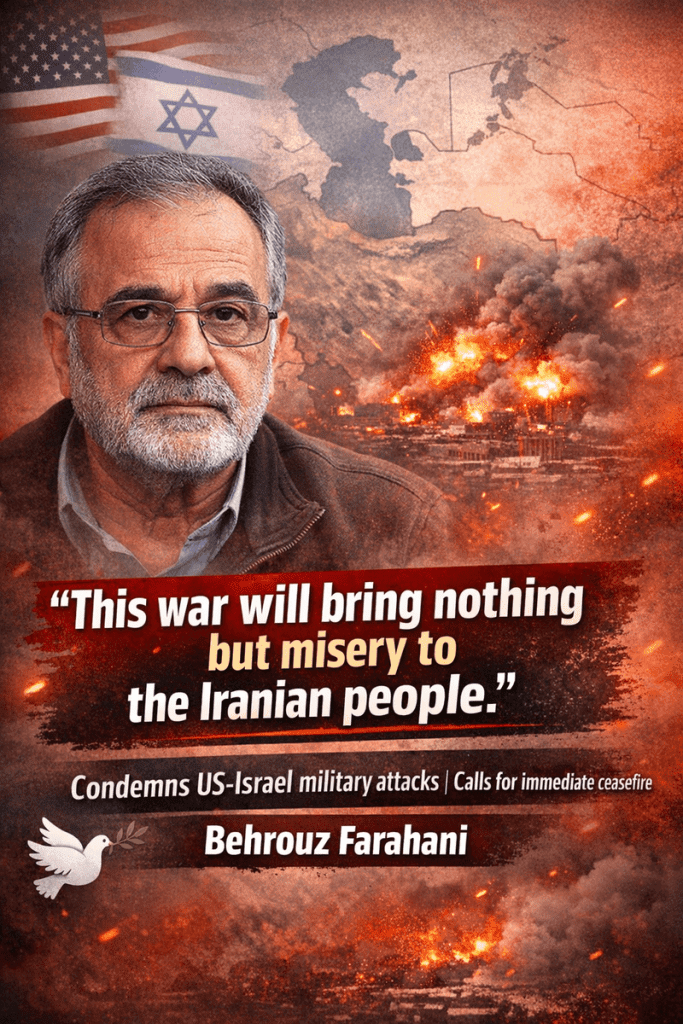
Exiled Iranian Denounces War: ‘The People Will Suffer, Not Gain!’
by ScheerPost Staff, 28 Feb 26, https://scheerpost.com/2026/02/28/exiled-iranian-denounces-war-the-people-will-suffer-not-gain/
Behrouz Farahani, a political analyst and opponent of the Islamic Republic living in exile, condemned the US and Israeli military attack on Iran. Speaking to Middle East Eye about how Iranian opposition figures who also oppose the war are responding, he said:
“In this situation, we oppose both sides. This war is between an international imperialist power, the US, and its regional ally, Israel, on one side, and the reactionary regime of Iran on the other. We are against both sides and against this war.”
He added that opponents of the Islamic Republic who reject foreign intervention are mobilizing:
“We are calling for an immediate ceasefire and are organising anti‑war protests. This war will bring nothing but misery to the Iranian people. As we have seen before, its only result will be more pressure on ordinary people. This war will not help the Iranian people in their struggle against the Islamic Republic. Especially when one side is Israel and the other side is Trump.”
“When we have a president like Trump, who has openly said that his main concern is money, it is clear that this attack has nothing to do with improving life in Iran or helping its people,” Farahani said. “One of the main reasons for this war is that the Islamic Republic does not serve America’s economic interests in the region or globally.”
He stressed that this critique does not imply any support for Tehran:
“This does not mean that because the Islamic Republic is in conflict with American interests, it is a progressive or anti‑imperialist force. Not at all. Just as the Taliban in Afghanistan was a deeply reactionary force despite being in conflict with the United States, the Islamic Republic is also a reactionary force that has now been attacked by international imperialism and its regional ally.”
Farahani’s comments underscore what many critics argue is the real motive behind the escalation: a broad, opportunistic effort by the United States and Israel to secure regional dominance, energy access, and geopolitical leverage under the guise of confronting Iran.
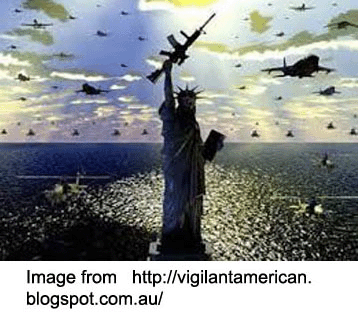
Trump Advisers Wanted Israel To ‘Attack Iran First’ For Better Optics: Politico
by Tyler Durden, Friday, Feb 27, 2026 , https://www.zerohedge.com/geopolitical/trump-advisers-want-israel-attack-iran-first-better-optics-politico
Politico is out with a crazy story on Thursday, but which will make sense to those following the trajectory of US foreign policy over the past couple decades plus.
Senior US officials want Israel to strike Iran before Washington launches a renewed assault in order to build domestic backing for war. Advisers to President Donald Trump are “privately arguing that an Israeli attack would trigger Iran to retaliate, helping muster support from American voters for a U.S. strike,” the outlet writes, citing two people familiar with the discussions.
“The calculus is a political one – that more Americans would stomach a war with Iran if the United States or an ally were attacked first,” Politico continues.
The subtext here is that American troops would likely come under retaliation in whatever form such a serious escalation takes. Currently the US is drawing down troops from bases immediately in harm’s way, including reportedly in Qatar and Bahrain.
“There’s thinking in and around the administration that the politics are a lot better if the Israelis go first and alone and the Iranians retaliate against us, and give us more reason to take action,” one person familiar with the discussions said.
The mood in Washington is said to be that nuclear negotiations with Iran appear increasingly unlikely to succeed – despite some ‘positive’ headlines out of Geneva – and that “the primary question is becoming when and how the US attacks.”
The Politico report suggests Tucker Carlson has assessed it exactly right when days ago he complained, “What I really object to, what makes me mad, is when American leaders, whose job it is to represent Americans, are more loyal to a foreign country than they are to their own.”
Indeed the outlet goes so far as to emphasize that “There’s a high likelihood of American casualties. And that comes with lots of political risk” – according to the words of one of the officials interviewed for the story.
Once again the decision-makers are on the brink of throwing American troops under the bus for the sake of another bloody regime change war. They might heed the words of one soldier who over a decade ago expressed that the troops themselves are sick of the pointless ‘forever wars’..
Trump himself of course campaigned on starting no new wars, especially in the Middle East. Ironically he’s been bragging about ending seven conflicts globally, while standing on the brink of provoking and ordering a new large-scale war breaking out across the whole Mideast region.
A War With Iran Would Not Be a One-Off Event But a Disastrous Ongoing Rupture
Both U.S. officials and international partners have voiced concern over the likelihood of a war with Iran. The United Kingdom has reportedly said that the United States would not be allowed to use British airbases, including Diego Garcia and Royal Air Force Fairford, for strikes against Iran, citing concerns that such action would violate international law.
The 1973 War Powers Act grants Congress the authority to check President Trump’s ability and power to enter an armed conflict without legislative approval.
If Congress cedes its power to stop a war with Iran, it will fully erode any lingering promise of democratic restraint.
By Hanieh Jodat , Truthout, February 24, 2026
As the U.S. slowly continues its brokered negotiations with Iran over its nuclear program and ballistic missiles, it is also expanding its military posture across the Middle East — amounting to the biggest military buildup in the region since the 2003 invasion of Iraq.
Indirect talks between Iran and the U.S. took place in Geneva on February 17 with little progress and plenty of details left to discuss. According to U.S. officials, the Islamic Republic offered to come back within two weeks with a proposal which addresses some core issues and gaps in the positions by both parties. Meanwhile, Donald Trump’s actions play a different tune. On February 19, Trump announced he would give Iran 10 to 15 days to reach a deal, otherwise the U.S. claims to be fully prepared to take military action, the consequences of which could lead to a regional catastrophe. The next talks are set to take place on February 26.
Ahead of those talks, Donald Trump has deployed the USS Gerald R. Ford, the world’s largest aircraft carrier, which is set to join the Abraham Lincoln carrier strike group in the Arabian Sea. The United States has also significantly increased air power in the Middle East; according to open-source intelligence analysts and flight-tracking data, over 120 U.S. aircraft have deployed to the region. With each warship it repositions, each military personnel it places on alert, and all of the air power it has amassed in the region, the U.S. sends a message that diplomacy may no longer be on the table.
Both U.S. officials and international partners have voiced concern over the likelihood of a war with Iran. The United Kingdom has reportedly said that the United States would not be allowed to use British airbases, including Diego Garcia and Royal Air Force Fairford, for strikes against Iran, citing concerns that such action would violate international law.
Meanwhile, in Congress, Kentucky Republican Thomas Massie and California Democrat Ro Khanna have joined forces again to push a war powers resolution. The 1973 War Powers Act grants Congress the authority to check President Trump’s ability and power to enter an armed conflict without legislative approval……………………………………………………………………………………………..
A war with Iran will not stop at its borders and will not remain where it is aimed. Such impulsive and reckless military actions never do. The Middle East is an ecosystem of lives, alliances, and fragile balances that will draw in neighboring countries and global powers.
And while the momentum towards a war with Iran accelerates, we must be reminded of the invasion and occupation of Afghanistan in 2001, which accomplished little outside the brutalization of one of the most economically starved countries on earth. Similarly, we must remember the collapse of Iraq’s infrastructure and civil society alongside the imposition of a farcical democracy after the 2003 invasion — a collapse that was fueled in part by years of devastating sanctions that predated the invasion. …………………………………………………………………………………
Rather than a one-off strike or a clean operation, a war with Iran would almost certainly widen conflict in the region and produce consequences far beyond what could be intended or repaired.
This is why the War Powers Resolution exists, not as a symbolic gesture but as a bulwark to slow the rush towards catastrophe. The framers of the Constitution understood what modern politicians seem to ignore: that war is too consequential to be left in the hands of one person, one branch of the government, or an executive order. The power to start a war with another country was placed in the hands of Congress to ensure transparency, force dialogue, and demand accountability…………………………………………………………………………… https://truthout.org/articles/a-war-with-iran-would-not-be-a-one-off-event-but-a-disastrous-ongoing-rupture/?utm_source=Truthout&utm_campaign=3e2745821e-EMAIL_CAMPAIGN_2026_02_24_10_26&utm_medium=email&utm_term=0_bbb541a1db-3e2745821e-650192793
Trump’s War of Choice: Oman Reveals Iran Agreement Was Imminent
February 28, 2026, by Joshua Scheer, https://scheerpost.com/2026/02/28/trumps-war-of-choice-oman-reveals-iran-agreement-was-imminent/
Hours before U.S. bombs began falling on Iran, a quiet but extraordinary diplomatic revelation aired on American television.
On CBS’s Face the Nation, Omani Foreign Minister Badr Albusaidi—the chief mediator between Washington and Tehran—stated plainly that a nuclear agreement between the United States and Iran was “within our reach.”
It was not vague optimism. It was a detailed outline of concessions.
According to Albusaidi, Iran had agreed to something that went beyond the 2015 nuclear accord negotiated under Barack Obama—a deal later abandoned by Donald Trump. This time, Tehran had committed not merely to limits on enrichment, but to zero stockpiling of enriched nuclear material. No accumulation. No reserve. Full and comprehensive verification by the International Atomic Energy Agency.
“If you cannot stockpile material that is enriched,” Albusaidi explained, “then there is no way you can actually create a bomb.”
In other words: the central justification for war was being diplomatically neutralized.
And yet, within hours, Trump announced military strikes on Iran and signaled a campaign aimed not at containment, but regime change.
The Timing Speaks Volumes
Oman has long served as a discreet intermediary in U.S.–Iran diplomacy. It is known for caution, not grandstanding. For Albusaidi to go public—on a flagship American news program—was highly unusual.
According to Trita Parsi of the Quincy Institute for Responsible Statecraft, the move was unprecedented. Oman’s message was clear: diplomacy had produced real progress. Trump could have declared victory.
Instead, he declared war.
If Albusaidi’s account is accurate, then the administration’s claim that Iran “rejected every opportunity” to curb nuclear ambitions collapses under scrutiny. What was preempted was not an imminent nuclear breakout—it was a diplomatic breakthrough.
War of Choice, Not Necessity
The United States Constitution vests the power to declare war in Congress. No such declaration has been issued. International law permits force only in response to an armed attack or with authorization from the United Nations Security Council. Neither condition appears to have been met.
This is not a defensive war. It is a war of choice.
And it is a deeply unpopular one. A recent survey found that only 21% of Americans support initiating an attack on Iran under current circumstances. The public understands something Washington elites often ignore: wars in the Middle East do not remain limited, surgical, or contained. They metastasize.
The echoes of 2003 are unmistakable.
Diplomacy Sabotaged
The tragedy is not only that bombs are falling. It is that negotiations were ongoing. Additional talks were scheduled for next week. The diplomatic channel was open.
By launching strikes at the moment mediation was yielding results, the administration has sent a stark message—not just to Iran, but to the world: agreements reached through dialogue can be nullified by executive fiat.
This damages more than a single negotiation. It undermines the credibility of American diplomacy itself.
If zero stockpiling under full IAEA verification was indeed on the table, then the choice before Washington was clear: accept an enforceable nonproliferation framework—or escalate toward regional war.
The administration chose escalation.
The Broader Implication
Regime-change wars have a long and destructive history in U.S. foreign policy. They rarely produce democracy. They often produce chaos, extremism, and prolonged suffering—for civilians first and foremost.
The question now is not simply whether this war is legal or justified. It is whether it was avoidable.
The Omani foreign minister’s televised appeal suggests that it was.
Peace, he said, was within reach.
And then the bombs began.
Trump Says ‘Heavy and Pinpoint Bombing’ of Iran Will Continue “As Long As Necessary”

February 28, 2026, Scheerpost Staff, https://scheerpost.com/2026/02/28/trump-says-heavy-and-pinpoint-bombing-of-iran-will-continue-as-long-as-necessary/
In rapidly escalating developments reported by Al Jazeera English, US President Donald Trump declared that US bombing operations inside Iran will continue “uninterrupted throughout the week or, as long as necessary.”
The comments came amid conflicting claims over the fate of Iranian Supreme Leader Ayatollah Ali Khamenei. Israeli officials and Trump have alleged that Khamenei was killed in the joint US-Israeli assault, while Iranian authorities have strongly denied the claim, with semi-official media insisting he remains “steadfast” and directing operations.
According to Al Jazeera’s live coverage, Trump wrote on Truth Social that Iran had been “very much destroyed and even, obliterated” in a single day of strikes. He further called on Iran’s Revolutionary Guard (IRGC) and national police forces to join what he described as “Iranian patriots” seeking regime change, suggesting “that process should soon be starting.”
“The heavy and pinpoint bombing,” Trump added, “will continue… as long as necessary to achieve our objective of PEACE THROUGHOUT THE MIDDLE EAST AND, INDEED, THE WORLD!”
Regional Fallout
Al Jazeera reported missile strikes in Tel Aviv following Iranian retaliation, as well as debris falling across Jordan from intercepted projectiles. In the United Arab Emirates, officials confirmed an “incident” at Zayed International Airport resulting in one fatality and multiple injuries, while a drone interception reportedly caused a limited fire at the Burj Al Arab hotel in Dubai.
At the United Nations Security Council, Secretary-General Antonio Guterres warned that the strikes by the US and Israel, along with Iran’s response, pose a “grave threat to international peace and security,” cautioning that military escalation risks igniting uncontrollable consequences in an already volatile region.
Iran’s UN ambassador, Amir-Saeid Iravani, said Tehran considers “all bases, facilities and assets” of US and Israeli forces in the region to be legitimate military targets under its right of self-defense. Meanwhile, Israel’s UN ambassador, Danny Danon, defended the joint operation as a necessary response to what he described as an existential threat.
Escalation and Uncertainty
Trump also told ABC News he has a “very good idea” of who should lead Iran if the current government falls — reinforcing suggestions that regime change may be an underlying objective of the operation.
The US military’s Central Command said there were no reported US casualties and that naval assets remain fully operational.
As Al Jazeera’s live blog continues to update, the situation remains fluid, with conflicting claims, mounting civilian impacts, and warnings from international officials that the widening conflict could destabilize the broader Middle East.
For live updates from Al Jazeera English here
US and Israeli attack on Iran: At least 51 girls reported killed in strike on school
February 28, 2026 , by Joshua Scheer, https://scheerpost.com/2026/02/28/us-and-israeli-attack-on-iran-at-least-51-girls-reported-killed-in-strike-on-school/
In the latest escalation of the U.S.–Israel assault on Iran, at least 51 young girls were reportedly killed when an airstrike struck a primary school in the southern city of Minab. According to Iranian state media, the victims — between the ages of seven and twelve — were inside Shajareh Tayyebeh elementary school when the building was hit in broad daylight.
Footage circulating online appears to show civilians digging through the rubble as smoke rises over the surrounding neighborhood.
Washington says the strikes are aimed at “eliminating imminent threats.” Tehran calls it a massacre.
The truth — and the consequences — demand scrutiny.
Here is breakthrough news on the ground
In moments like this, journalism is not a matter of slogans — it is a matter of moral clarity.
If the reports from Minab are confirmed, the bombing of an elementary school filled with young girls is not a “strike on imminent threats.” It is the annihilation of children. It is the kind of act that shatters whatever remains of the language of precision warfare and exposes the brutality beneath it.
The United States and Israel insist they are acting defensively. Tehran calls it a massacre. The world is left with rubble, grieving families, and the now-familiar choreography of denial, justification and geopolitical spin.
But certain facts demand scrutiny regardless of allegiance: Why were negotiations underway if war was already being prepared? What intelligence justified striking a civilian school in broad daylight? Who will independently verify the casualty count? And most importantly — who will be held accountable if the worst fears are confirmed?
The pattern is not new. From the siege of Gaza to suffocating sanctions regimes, from covert operations to open bombardment, the language of “security” has too often masked policies that devastate civilian life. The human cost is absorbed by those with the least power: children in classrooms, families in apartment blocks, workers in cities far from decision-making centers.
We should resist both reflexive propaganda and reflexive dismissal. Iranian state media must be scrutinized. Pentagon briefings must be scrutinized. Viral footage must be verified. But skepticism cannot become moral paralysis. If dozens of schoolgirls have been killed, that reality outweighs every talking point.
Escalation with Iran is not a contained regional maneuver. It risks a wider war, global economic shock, environmental catastrophe, and a further erosion of international law. Once normalized, the bombing of civilian infrastructure becomes precedent.
The responsibility of independent media is not to amplify rage, but to insist on evidence, accountability, and humanity. If civilians are being killed in the name of “security,” the public deserves answers that go far beyond press releases.
The truth — and the consequences — demand scrutiny.
This tweet bears repeating again and again:
“Bombing Iran in the middle of negotiations, while starving Cuba, while genociding Palestinians, while threatening to invade Greenland… the U.S. and Israel are the single greatest threat to humanity — and it’s not even close. We are all forced to live in the nightmare they create.” https://x.com/jasonhickel
1 This Month


Shut down the radiation-damaged Heysham nuclear reactors now
To see nuclear-related stories in greater depth and intensity – go to https://nuclearinformation.wordpress.com

Say No to NASA’s Reckless Nuclear Reactor on the Moon
Say No to NASA’s Reckless Nuclear Reactor on the Moon
-
Archives
- October 2026 (256)
- September 2026 (339)
- August 2026 (330)
- July 2026 (355)
- June 2026 (287)
- May 2026 (306)
- April 2026 (356)
- March 2026 (251)
- February 2026 (267)
- January 2026 (308)
- December 2025 (358)
- November 2025 (359)
-
Categories
- 1
- 1 NUCLEAR ISSUES
- business and costs
- climate change
- culture and arts
- ENERGY
- environment
- health
- history
- indigenous issues
- Legal
- marketing of nuclear
- media
- opposition to nuclear
- PERSONAL STORIES
- politics
- politics international
- Religion and ethics
- safety
- secrets,lies and civil liberties
- spinbuster
- technology
- Uranium
- wastes
- weapons and war
- Women
- 2 WORLD
- ACTION
- AFRICA
- Atrocities
- AUSTRALIA
- Christina's notes
- Christina's themes
- culture and arts
- Events
- Fuk 2022
- Fuk 2023
- Fukushima 2017
- Fukushima 2018
- fukushima 2019
- Fukushima 2020
- Fukushima 2021
- general
- global warming
- Humour (God we need it)
- Nuclear
- RARE EARTHS
- Reference
- resources – print
- Resources -audiovicual
- Weekly Newsletter
- World
- World Nuclear
- YouTube
-
RSS
Entries RSS
Comments RSS

