Russia Claims Group Crossed Border From Ukraine In Attack
Radio Free Europe 22 May 23
Violent clashes erupted on the Russian-Ukrainian border with Moscow accusing a Ukrainian “sabotage group” of trying to make an incursion into the country, an allegation Kyiv rejected.
Explosions and sporadic gunfire could be heard on May 22 in the Belgorod region, with the local governor, Vyacheslav Gladkov, saying that fighting had spilled into Russia in the Graivoron district which borders Ukraine. There were no immediate reports of casualties.
The governor said six people were injured in the clashes. The incursion into Russian territory may be the biggest since the Kremlin launched its war against Ukraine 15 months ago.
A group calling itself the Liberty of Russia Legion, which claims to be made up of Russians cooperating with Ukrainian forces, took responsibility for the attack. The Ukrainian government denied any role in the events………………………………………
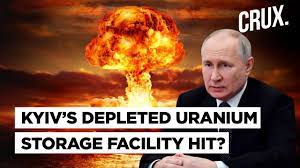
Ukraine’s Depleted Uranium Blast: Europe on Brink of ‘Environmental Disaster’
Sputnik lnternational 19.05.2023
Russian Security Council Secretary Nikolai Patrushev warned on Friday that a radioactive cloud was heading towards Western Europe following the destruction of a Ukrainian warehouse storing British-supplied depleted uranium ammunition.

Sputnik News spoke with Dr. Chris Busby, physical chemist and scientific secretary of the European Committee on Radiation Risk, about how the West’s decision to provide depleted uranium (DU) ammunition to Ukraine has potentially caused a continent-wide ecological disaster. Below is his answer in full.
Recently, several web media outlets provided videos of an enormous explosion in the town of Khmelnitski, located to the West of Kiev, and about 200 km from the border with Poland. There were two major explosions which produced a massive roiling swirling fireball which, like an atomic bomb, developed upwards and formed a mushroom cloud, which was black.
I have represented nuclear atmospheric test veterans in the Royal Courts of Justice in London and have seen many films of nuclear explosions: this was not one. A nuclear explosion is characterised by an immediate intense white light which wipes out the camera film or detector.
So, what was it? It was suggested by several commentators that an arms depot that had been hit contained the Depleted Uranium (DU) weapons sent by the UK to the Ukraine for use in the British Challenger tanks as anti-tank penetrators. That the explosion was one involving the burning of the DU in the fireball. Since I am a scientific authority on Uranium and its health effects, but have also examined its dispersion and behaviour in the environment, I will comment on what I believe happened, and why it is important. I was a member of the UK government Ministry of Defence Depleted Uranium Oversight Board (DUOB) in 2000-2005, and also the UK government Committee Examining Radiation Risk from Internal Emitters (CERRIE) 2000-2004. I am Scientific Secretary of the European Committee on Radiation Risk (ECRR) which is an independent NGO that provides advice on risk from ionising radiation.
My main research interest in this area is Uranium and health, particularly the DU particles, which are so small they act as a gas and move over very large distances once they are created by the burning of DU. I found them in England in 2003 after they had come from Iraq. I found them in 2023 in England after they came from the Ukraine war. So that is the first thing: the material is able to travel very large distances.
Therefore, if the Khmelnitsky explosion was a DU one, the material would move with the wind direction and should be detectable at monitor sites downwind.
First, we need to say that DU has a gamma signature, it releases gamma rays. The UK and USA governments lie about this. They point to the fact that the U-238, that remains after the fissile U-235 is removed in the centrifuges (and is sent off for nuclear weapons and reactors), is a weak alpha emitter.
They say that alpha radiation cannot penetrate skin and so the DU itself is harmless. That it cannot be detected by a Geiger Counter and the alpha particles don’t make it through the window. There is, of course, a health problem if the post-impact particles are inhaled and pass into the body through the lung into the lymphatic system or directly into the digestive system, but essentially DU is harmless.
What you need to know is that Uranium 238, when it decays with its alpha emission, turns into Thorium-234 and Protoactinium-234m which then turns into Uranium 234. Thorium 234 is a beta and gamma emitter delivering 6% of its decay energy as a gamma ray. Thus, large clouds of DU particulate aerosol will be detectable by gamma detectors.
When I visited Iraq with Al Jazeera in 2000 I went to the south and examined the corpses of the tanks that had been hit by DU in the first Gulf War. Some of the A-10 DU penetrators were still lying around. They gave off an intense gamma ray signal, and the holes in the tanks were highly gamma ray active. So much for only an alpha emitter.
I am a yachtsman: examination of the UK metereological weather pressure maps tell us that at the time, and for days after the explosion, there was an anticyclone to the North of the explosion site and winds were weak but from the South East blowing North Westerly around the high-pressure area. So, the plume would move towards Poland. If the winds were about 5km/h they would reach any Poland detectors 250 km away on the 15th.
After Chernobyl, the European Union set up a Europe-wide gamma radiation detector system that used to give gamma readings in real time. I went to look. But astonishingly, all the data was blocked. The web- based system, administered from Germany, (EURDEP) would not provide the detector maps that are normally available. Luckily, there were some location maps on the web and some that had been already downloaded by colleagues of mine before the system stopped working. I obtained maps from Poland. One of these I show below. [on original]
You will see that a very highly significant increase in gamma radiation occurred at this detector, north west of the explosion site almost exactly when it would be expected on the basis of a distance of 250km and a mean wind speed of 5km/h. The increase, from 60nSv/h to 90nSv/h was highly statistically significant about 50%. Other detectors all across Poland showed an increase*, as the plume passed over them, the increase being weaker the further away (due to dispersion of the plume).
Later, the Poles measured the increase at the Marie Curie Institute in Lublin, but their map was a more sophisticated one and needed some expert interpretation. The Polish map gave gamma increases split into two natural isotopes, Bismuth and Thallium, also total gamma and cosmic ray gamma………………………………………………………………..
The European radiation detector system web map came back online on May 18. The map type had been changed and everything we saw in the downloads had disappeared or had been smudged out by data analysis averaging. Why? This, and the early blocking of access to the site suggest panic and cover-up.
So taken all together, what we see is a massive explosion which is thought to be DU, and reports of a spike in gamma radiation near the site. Uranium oxide is black, and the black plume moves north west slowly, the weather pattern is stable and the wind blows to Poland. The Polish EU detectors all show gamma radiation increases at the expected time of arrival of the plume. The EU detector system is shut down rapidly, but not before we have obtained data from several sites. The Poles provide a detector result that identified Bismuth as the cause of the increase, but do not go so far as to formally state that it is (in case of later blowback).
One final piece of evidence. We see videos on the internet of the Ukrainians clearing up the explosion site using Robot vehicles, not ordinary firemen. Why do they need Robot vehicles? The last times we saw Robot vehicles clearing up was in the ruins of Chernobyl and Fukushima.
If I am right, there has been an environmental disaster, and the DU particles will travel across Poland, Germany and Hungary, and will end up in the Baltics, probably later the whole of Europe including the UK (after all, the Chernobyl Uranium particles came to the UK).
They will deliver genetic damage and death like that seen in the Balkans and Iraq. Cancer, birth defects, miscarriage, infertility, lung damage, mental problems (Gulf War Syndrome) and so forth. The scientific and epidemiological evidence on this has been clear since the Gulf War. It is all there in the scientific literature—but the governments in the West and the military ignore it, deny it and cover it up. In the case of the UK coroners court finding for Stuart Dyson, the jury found that DU caused his fatal colon cancer.

But when the coroner wrote to the health minister (as he had to by UK law, Rule 43) the reply was: we disagree. This stuff can be measured, but no one will measure it, or if they do, they will be attacked and their arguments dismissed.
Even if I am wrong, and there is some other explanation for the gamma peaks, DU must be banned. It is a weapon of indiscriminate effect and kills civilians, the enemy and your own troops (well, Ukrainian troops). It is much worse than a war gas, like Sarin, or phosgene, mustard gas or all the other chemical agents banned by civilisation. This stuff destroys the genetic basis of life itself. And no one does anything. Those who use it base their action on obsolete science supported by dishonest epidemiology carried out by dishonest scientists and obsolete and fantastical risk models.
Those who provide the weapons, the UK government in this case, are morally bankrupt. Unless it is their intention to destroy the Ukrainian people. Who knows anymore? The world has gone mad.
*Poland’s National Atomic Energy Agency claims there is no increase in radiation levels https://sputnikglobe.com/20230519/ukraines-depleted-uranium-blast-europe-on-brink-of-environmental-disaster-1110462939.html
Ukrainians forced by Russia to retreat from Artyomovsk (Bakhmut) , their supposed ‘fortress’ in Donbass
RT.com By Vladislav Ugolny, a Russian journalist born in Donetsk 21 May 23
The battle for Artyomovsk (called Bakhmut by the Ukrainians) began in August 2022, and gradually turned into the epicenter of fighting between Russia and Ukraine. While other parts of the front remained relatively stable, both sides actively brought forces to this small city. For Kiev, which in May 2022 suffered a defeat at Azovstal that helped undermine its image, Artyomovsk became the new Mariupol. Ukrainian propaganda labeled it ‘the Bakhmut Fortress’, and attempted to give an air of heroism to those fighting there.
………………………………………………………. The importance of the city grew tremendously after the start of Russia’s military operation in February 2022. Initially, when Russian troops broke the first line of fortifications in the area of Popasnaya, Zolotoye, and the Lisichansk-Severodonetsk agglomeration, Artyomovsk was an important transport hub. It kept the Ukrainian front line connected with the rest of the country.
After the Russians managed to break this line of defense and completely removed Kiev’s forces from the territory of the Lugansk People’s Republic (LPR), Artyomovsk went from being a transport hub to becoming Ukraine’s second line of defense around the Bakhmutka River. This strip ran from Ukrainian positions opposite Gorlovka – since 2014 controlled by the Donetsk People’s Republic (DPR) – in the south up to Seversk in the north, running straight into the Seversky Donets, the main river in Donbass.
Artyomovsk could not have been taken without this line of defense being broken. Since July 2022, PMC Wagner fighters have been focused on doing just that, preparing the ground for a successful encirclement of the city.
………………………………………………………………………………………………………………………………………………………………… the more than nine-month-long battle for Artyomovsk permanently changed the perception of the conflict, forcing both Ukraine and Russia to abandon any ideas of a fast-paced campaign or deep breakthroughs.
The battles discussed in this article took place barely 30 kilometers deep into the frontlines. In conditions of summer heat, fall mud, and winter frost, it largely resembled the First World War. According to Prigozhin’s estimates, the liberation of the entire territory of the Donetsk People’s Republic will take another one and a half to two years.
However, significant Ukrainian forces still remain to the west of Artyomovsk, having seized a number of positions during the May counteroffensive. They have established a foothold in Chasov Yar and hold the line between Krasnoye and Minkovka, thus preventing Russian forces from stabilizing the front along the Seversky Donets-Donbass canal. With the Russian flag flying over Artyomovsk and Russian soldiers in full control of the battlefield, the Russian priority now is to inflict maximum damage on the Ukrainian forces massed for the counteroffensive, and drive them out to the western bank of the canal. https://www.sott.net/article/480462-Victory-Ukrainians-forced-by-Russia-to-retreat-from-Artyomovsk-their-supposed-fortress-in-Donbass
US hopes to snatch victory from jaws of defeat in Ukraine
Indian Punchline BY M. K. BHADRAKUMAR
The G7 Leaders’ 2700-word statement on Ukraine, issued in Hiroshima after their summit meeting glossed over the burning question today — the so-called counter-offensive against the Russian forces.
It is a deafening silence, since rumours are swirling about the disappearance of the commander-in-chief of Ukraine’s armed forces. Significantly, President Vladimir Zelensky himself is making himself scarce from Kiev touring world capitals — Helsinki, Hague, Rome, Vatican, Berlin, Paris, London and Jeddah and Hiroshima. It does seem that something is rotten in the state of Denmark.
As the G7 summit ended, the head of the Wagner PMC, Yevgeny Prigozhin announced on Saturday that the Russian operation to capture the strategic communication hub of Bakhmut in Donbass region of eastern Ukraine lasting 224 days, has been brought to a successful completion, overcoming the resistance by more than 80,000 Ukrainian troops.
It is a painful moment for Zelensky, who had boasted before US lawmakers in Capitol Hill last December that “just like the Battle of Saratoga (in 1777 during the American Revolutionary War), the fight for Bakhmut will change the trajectory of our war for independence and for freedom.”
Meanwhile, to distract attention, there is talk now about a subtle shift in the US policy regarding supply of F-16 fighter jets to Ukraine in an indeterminate future. In reality, though, no one can tell what the Ukrainian rump state will look like when the jets arrive. Unsurprisingly, the Biden Administration still seems to be in two minds. F-16 is a hot item for export; what happens if the Russians were to blow it out of the sky with their hi-tech weapons and rubbish its fame ?
The Russians seem to have concluded that nothing short of a total victory will make the Americans and the British understand that Moscow means business on the three objectives behind the special military operations that are non-negotiable: security and safety of the ethnic Russian community and their right to live in peace and dignity in the new territories; demilitarisation and de-Nazification of Ukraine; and a neutral, sovereign, independent Ukraine freed from the US clutches and no longer a hostile neighbour.
……………………………. the big question is about the Ukrainian counteroffensive. The Russian forces enjoy overwhelming superiority in every sense militarily. Even if the hard core of the Ukrainian forces who were trained in the West, numbering some 30-35000 soldiers, manage to achieve some “breakthrough” in the 950-kilometre long frontline, what happens thereafter?
……………. If past American behaviour — be it Vietnam, Afghanistan or Iraq and Syria — is anything to go by, Washington will do nothing. The well-known American strategic thinker Col. (Retd.) David MacGreggor couldn’t have put things better when he said earlier this week:
“I can tell you that Washington is going to do nothing. And I’ve always warned… we (United States) are not a continental power, not a land power anywhere but in our own Hemisphere. We are primarily an aerospace and maritime power, much like Great Britain. And what does that mean? When things go badly for us, we sail away, we fly away, we go home… That’s what we always do. Eventually, we just leave. And I think, that’s on the agenda now.” …………………………………………………………………. https://www.indianpunchline.com/us-hopes-to-snatch-victory-from-jaws-of-defeat-in-ukraine/
Russian forces dig in at Ukrainian nuclear plant, witnesses say
Tom Balmforth and Sarah McFarlane, Fri, 19 May 2023,Yahoo! Lifestyle
LONDON (Reuters) -Russian military forces have been enhancing defensive positions in and around the Zaporizhzhia nuclear power plant in southern Ukraine in recent weeks, four witnesses said, ahead of an expected counteroffensive in the region.
New trenches have been dug around the city and more mines have been laid. Surveillance cameras at the plant are pointing north across a wide reservoir towards Ukrainian-controlled territory.
The Russians have had firing positions set up atop some of the plant’s buildings for several months. Nets have been erected in a possible deterrent to drones.
The measures described by two Ukrainians who work at the power plant and two other residents in the city of Enerhodar underline the risks the war poses to the security of the facility.
The sources spoke on condition of anonymity because of fears for their safety in a city under Russian occupation.
Russian state nuclear energy company Rosatom said any possible military action by Ukraine posed a threat to nuclear safety, and that the plant’s equipment was being maintained properly. The Ukrainian military intelligence agency and the Russian defence ministry did not respond to requests for comment.
Some nuclear industry experts said they were alarmed and warned that any damage to the plant could have dire consequences for people, the surrounding area, the war and the global nuclear industry.
………………………………… there is concern in the international community that the six-reactor nuclear plant, Europe’s largest, could be caught up in fighting, particularly as military analysts expect Ukraine to try to push Russian forces back in the Zaporizhzhia region.
The U.N. nuclear watchdog says that the military presence and activity is growing in the region, underlining the need for urgent action. It has warned for months of the danger of a major accident at the plant.
The agency plans to present a deal between Russia and Ukraine to the U.N. Security Council later this month to protect the facility, four diplomats told Reuters…………………………………………………………… https://au.lifestyle.yahoo.com/russian-forces-dig-ukrainian-nuclear-060319771.html
IAEA Warns of Tense Military Situation Near Ukraine Nuclear Plant
Mirage News 19 May 23
The International Atomic Energy Agency (IAEA) continues to warn of the potential nuclear threat in the Ukraine conflict amid rising tensions surrounding the Zaporizhzhya Nuclear Power Plant (ZNPP).
IAEA Director General Rafael Mariano Grossi said on Friday in a statement, that a location near the town of Enerhodar, home of most of the plant’s staff, reportedly came under artillery fire earlier in the day, “in the latest incident indicating an increasingly tense military situation in the area.”
Speculation of military activity
The ZNPP, Europe’s largest nuclear power plant, is located just a few kilometres from Enerhodar.
IAEA experts present at the plant reported that it had not been affected “but the proximity once again underlined persistent nuclear safety and security dangers at a time of heightened speculation of future military operations in the region,” said Mr. Grossi…………………………………………………………… more https://www.miragenews.com/iaea-warns-of-tense-military-situation-near-1010184/
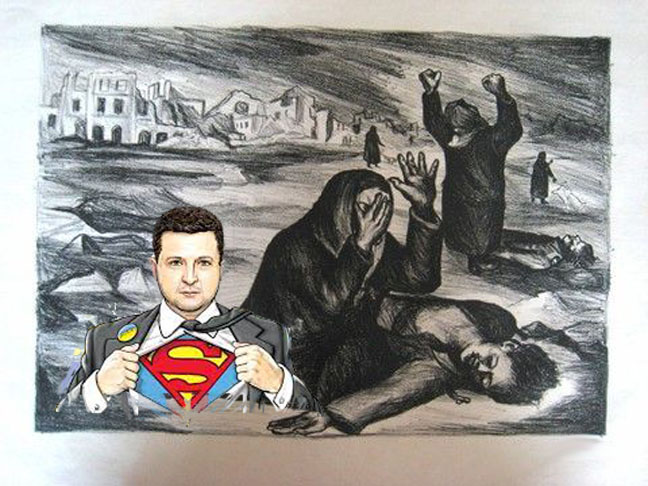
Ukrainian diplomat fears ‘terrible summer’ ahead
 | |||
| |||
https://www.rt.com/russia/576550-terrible-price-ukraine-counteroffensive/
The country’s troops may have to pay a “terrible price” in a planned counteroffensive, envoy Vadim Pristaiko said
Ukraine could suffer heavy losses during its much-anticipated counteroffensive against Russia, Vadim Pristaiko, Kiev’s ambassador to the UK, warned on Thursday.
In an interview with British broadcaster ITV, the diplomat said: “I know that it can be a very terrible summer and the price is terrible.”
Pristaiko also said Kiev’s Western backers have piled “too much pressure” on Kiev and have built up “too much expectations” about the spring campaign.
When asked to comment on why Ukraine maintains its position on not revealing its losses in the conflict, Pristaiko replied: “internally, we understand how many of us are already killed and lost.”
“We understand that it will be extremely difficult to fight with a nation that is 16 times bigger than us,” the envoy said. “But we are determined to do it and we are not going to tell Russians how painful it is – they know it is painful and we know it is painful”.
The Ukrainian ambassador also acknowledged that while US President Joe Biden and his administration have emerged as one of Kiev’s most staunch supporters, his successor might prove to be less willing to help the country.
“One of the weaknesses of democracy is the cyclical nature, and we have the same… we have to take into account this cycle in politics,” he said.
“We understand that the time might come that we won’t enjoy such great support, that is why we have to put all the pressure right now”, Pristaiko said. “That is why we are asking our friends, can you bring everything to the table? Allow us to have a decisive push this time.”
For several months, Ukraine has been speaking about a counteroffensive against Russia to reclaim territories Kiev considers as its own, but some officials have complained about a lack of ammunition, weapons, and even adverse weather conditions.
Last week, Ukrainian President Vladimir Zelensky stated that his country is basically “ready” for its launch, but “still needs a bit more time” as it waits for more Western weapons.
Last month, The New York Times reported that there are no guarantees that the Ukrainian counteroffensive will succeed, adding that an underwhelming outcome would likely prompt Kiev’s backers to press it to negotiate for peace.
How the West, and Zelensky, derailed the Minsk Agreements between Ukraine and Russia
Adonis Cirillo, commenting on Rt.com, 17 May 23
Everyone knows, or should know, that the ‘Western’ sponsored Maiden Revolution (coup d’état) KILLED Ukraine, and more than 14,000 of its own citizens since 18 Feb, 2014.
If you are undecided or uneducated to the events leading up to the West’s coup d’état, you may download & watch “UKRAINE ON FIRE” 2016 Oliver Stone documentary. (ED. note – Youtube has banned viewers from downloading this film, – but not pro-Ukrainian videos )
(you will see US Deputy Secretary of State for Political Affairs Victoria Nuland (the Maidan ‘midwife’), US Democrat & Republican Congressmen (e.g., Lindsey Graham), US Advisors (e.g., John Bolton), and NGO’s inside Ukraine before, during, and after the coup d’état)
If you continue to unwind history, you will discover that Ukraine of today is inextricably linked to the Bush/Gorbachev Agreements of 1989-90 and the subsequent Western Violations thereof (e.g., The continued expansion of US & NATO forces in Europe).
NOTE : Ex-Ukrainian President Petro Poroshenko said the Minsk Agreements “meant nothing” and claimed credit for giving Kiev enough time to militarize. – RT 17 June, 2022 | Ex-German Chancellor Angela Merkel said the Minsk accords were signed in order to “give Ukraine time” to make the country stronger – Zeit Newspaper 7 Dec, 2022 | Ex-French President François Hollande agreed with Merkel, saying that her comment was “right on this point.” … “It is the merit of the Minsk agreements to have given the Ukrainian army this opportunity,” – RT 30 Dec, 2022 | Ukrainian President Vladimir Zelensky took credit for derailing Minsk Agreements – RT 9 Feb, 2023 https://www.rt.com/news/576436-zelensky-poland-us-hersh/
Ukraine’s neighbors ready to pay off Zelensky to stop conflict – Seymour Hersh
https://www.rt.com/news/576436-zelensky-poland-us-hersh/ 17 May 23
EU nations have privately urged the president of the war-torn country to end the fighting, a US official told the veteran journalist.
Poland is leading a group of European nations that are secretly urging Vladimir Zelensky to find a way to settle the conflict with Russia, veteran journalist Seymour Hersh has reported, citing a “knowledgeable” American official.
According to US intelligence, other EU countries that want to see an end to the fighting include Hungary, Germany, the Czech Republic, Lithuania, Latvia and Estonia, Hersh wrote in an article published on his Substack page on Wednesday.
“Hungary is a big player in this and so are Poland and Germany, and they are working to get Zelensky to come around,” the unnamed official claimed. Those countries have made it clear that “Zelensky can keep what he’s got if he works up a peace deal even if he’s got to be paid off, if it’s the only way to get a deal.”
By “keep what he’s got,” the source was referring to the Ukrainian president’s villa in Italy and interests in an offshore bank, Hersh clarified.
However, Zelensky has so far rejected the proposal, while other major European players – France and the UK – “are too beholden” to the Biden administration, which is continuing to back the Ukrainian leader, the official said.
One of the main reasons why Poland and the others want the conflict to end is because the burden of accommodating Ukrainian refugees has become too much for them, the Pulitzer Prize-winning journalist wrote.
The problem for those countries “is how to get the US to stop supporting Zelensky,” Hersh’s source suggested.
He claimed that US intelligence is well aware that “Ukraine is running out of money and… that the next four or months are critical. And Eastern Europeans are talking about a deal.”
However, he added that “it’s not clear to the intelligence community what the president and his foreign policy aides in the White House know of the reality.”
The US is “still training Ukrainians how to fly our F-16s that will be shot down by Russia as soon as they get into the war zone. The mainstream press is dedicated to Biden and the war, and Biden is still talking about the Great Satan in Moscow while the Russian economy is doing great,” the official explained.
Russia has repeatedly stated that it’s ready to resolve the conflict at the negotiating table. However, it did not receive any proposals from Ukraine and its Western backers that it could consider reasonable.
Zelensky has been promoting his ten-point peace plan, which calls for Russian forces to withdraw to borders claimed by Ukraine, to pay reparations, and to submit to war-crime tribunals.
Moscow has rejected the plan as “unacceptable,” saying it ignores the reality on the ground and is actually a sign of Kiev’s unwillingness to solve the crisis through diplomatic means.
Depleted uranium won’t end a war that has no winners
It is clear the great powers have no end in sight for the war: toxic munitions that will last even longer than the conflict are the last thing the territory needs, writes TOMASZ PIERSCIONEK
Morning Star, 16 May 23,
THE war in Ukraine is the most devastating conflict in Europe since World War II. As in most conflicts, and in the years leading up to the war, truth became the first causality.
The Western media simplifies the narrative to Nato good — Russia bad, while ignoring pivotal factors such as Nato’s eastward march towards Russia and the US-backed 2014 coup, which in turn set the scene for the war that unfolded in Feb 2022.
Non-mainstream media or independent bloggers who try to peer over the media iron curtain and question Nato talking points face being defamed as pro-Kremlin stooges.
Is the West scared of its citizens thinking independently or fearful that such “wrong think” might outshine pro-Nato propaganda? Do Europe’s citizens need “protection” from the risk of being exposed to unsanctioned thinking lest they draw different conclusions to the official narrative?
A year into the conflict and amidst the dreadful loss of life on all sides, it looks like war between Russia and Ukraine is really a conflict between Nato and Russia, in which the former seeks to challenge the emergence of a new Eurasian-centric capitalist bloc. Remember too that Russia is China’s ally and a defeat of the former would leave the latter in a more vulnerable position vis a vis Nato expansion.
It is clear too that (most of) the nations comprising the EU and Nato are willing to pull out all stops to defeat or greatly weaken Russia, regardless of the human costs to Ukraine, and have already handed over billions of dollars in military aid alongside vast quantities of weapons from their own arsenals. Britain provided £2.3 billion in military aid to Ukraine in 2022 whilst the US has given at least $46.6bn in military aid since the war began.
For the US, at least, this is a perfect war in which it can fight a key geopolitical opponent without getting its hands dirty and having to explain an influx of body bags to the US public like in Iraq and Afghanistan.
n the EU’s case however, reality hits a little close to home — despite its massive support for Ukraine and the 10 rounds of sanctions placed upon Russia, they have failed to bring the country to its knees in economic or military terms (as repeatedly promised), nor have they “inspired” the Russian people to overthrow their rulers. Instead, the anti-Russian sanctions seem to have caused a fair amount of self-harm to the EU whilst Russia is well on the way to finding new markets for its exports.
Hypocritically, despite singing from the pro-Ukraine hymn book, the EU continues to import billions of dollars worth of goods from Russia — $195.56 billion during 2022 and the greatest amount since 2014. Furthermore, despite the EU banning Russian crude oil imports, it purchases oil products from India (eg diesel and jet fuel) that have been refined from Russian crude oil. As Russia is now selling more crude oil to India and India in turn is selling more refined oil to Europe, this is a win-win situation for these two Brics nations.
n an unwise and unneeded escalation to the war in Ukraine, the British government announced in late April 2023 that it had sent Challenger 2 tank shells tipped with depleted uranium (DU) to Ukrainian forces. Such a move is a provocative and dangerous escalation that risks precipitating a regional or global war in which there will be no winner.
It is worth pointing out that at the end of March 2023, James Heappey, British Minister of State for the Armed Forces, responded to a parliamentary question about whether Russia had used DU munitions in Ukraine with the answer: “The Ministry of Defence is unaware of any credible open-source reports of Russia using depleted uranium in Ukraine.”
DU is a by-product of a process whereby uranium is enriched to make nuclear fuel. It remains radioactive, albeit 40 per cent less so than raw uranium. On account of its high density, DU is used to increase the power of armour-piercing munitions and has previously been used by US/Nato forces in several conflicts — the 1991 first Gulf war, Bosnia, the 2003 Iraq invasion, and against Isis forces in Syria in 2015…………………………………..
The Scientific Committee on Health and Environmental Risks formed by the European Commission produced a report in 2010 which noted that “in combat zones, vehicles hit by DU should be made inaccessible to the general public and be properly disposed of. Used DU ammunition should also be collected and disposed of.”
This concurs with advice published by the US Air Force in 1975 which stated that DU ought to only be used against armoured vehicles. However, in Iraq, DU munitions reportedly were not only used against human combatants but also fired in or near to urban areas.
Consequently, hundreds of sites in Iraq were contaminated with DU. Similar consequences are possible in the case of Ukraine: funding a clean-up operation once the war ends is unlikely to be a top priority.
The US Environmental Protection Agency notes that with regards to DU “exposure to the outside of the body is not considered a serious hazard. However, if DU is ingested or inhaled, it is a serious health hazard.”
The risk that DU finds its way into the food chain ought not to be dismissed, alongside the long-term detrimental effects on the ecosystem.
Furthermore, introducing DU (radioactive) munitions into a high-stakes war such as the one in Ukraine breaks a certain psychological barrier whereby the risk of further escalation increases as we take another step down an ever-shortening and dangerous path that ends with the use of conventional uranium weapons — nukes.
Continuing to arm Ukraine so that it can fight Russia down to the last Ukrainian on behalf of Nato (and perhaps after that using Poles to do the job) sets the scene for the conflict to become a regional war or worse.
Realistically, the war is not going the way Nato hoped and promised. The Russian economy has not collapsed, Russia has not run out of missiles, the Russian people have not overthrown their government, and the majority of the world has not turned its back on Russia, which is in the process of securing new trading partners and even sympathisers to offset the effects of any Western sanctions.
The conflict has also shown that the world (including major players such as China, India, Brazil, and Saudi Arabia) is not united behind the West. Indeed, 19 more countries are now seeking to join the Brics group of emerging economies. It would be easy, even convenient, for the US to pull back on funding Ukraine should the upcoming Ukrainian offensive not deliver the promised gains.
After all, 2024 is an election year, a greater number of US politicians are becoming uneasy at Biden’s blank cheque to Ukraine, and frankly sending billions to fund a war abroad rather than investing the money at home is not exactly a vote winner.
It would be tempting for the US to say “mission accomplished” and make the war in Ukraine Europe’s problem, leaving the EU to sort out the mess and come to a disadvantageous settlement with Russia.
It is critical that the anti-war movement, the trade union movement, and more broadly the left work with peace movements within Ukraine, Russia and beyond to call for a swift and just settlement to the war, in which the grievances of all sides are acknowledged.
Concurrently we must condemn rhetoric or action by any world leader that seeks to prolong the war in Ukraine whilst the people of Russia, Ukraine and Europe bear the human and economic cost of the conflict.
We need to be wary too, of forces both within Nato and beyond that are seeking to prolong the conflict in Ukraine for ideological reasons, due to the lucrative nature of war (not least for the arms industry), or for personal ambition. https://morningstaronline.co.uk/article/f/introducing-depleted-uranium-ukraine-conflict-needless-escalation-war-has-no-winners
Zelensky plotted attacks deep inside Russia – Washington Post
https://www.rt.com/russia/576237-zelensky-hungary-russia/ 15 May 23
The Ukrainian leader reportedly wanted to “occupy” Russian cities to gain leverage over Moscow
Despite public assurance that he would limit military action to his own country’s 1991 borders, Ukrainian President Vladimir Zelensky formed plans to conduct attacks deep inside Russia and suggested that Kiev “destroy” the industry of Hungary, the Washington Post reported on Saturday, citing leaked Pentagon documents.
Citing US intelligence reports recently published on a gaming server, the Post described how Zelensky suggested at a meeting in January that his troops “conduct strikes in Russia,” while moving across the border to “occupy unspecified Russian border cities” in order to “give Kiev leverage in talks with Moscow.”
Less than two months later, the Ukraine-based Russian Volunteer Corps launched a cross-border raid that left two civilians dead in Russia’s Bryansk Region. A member of the group told Western media that Kiev had approved the attack, and further assaults have taken place since.
With Ukraine’s Western backers reluctant until recently to provide him with long-range missiles for fear he would use them against targets within Russia, Zelensky suggested to his top military commander, General Valery Zaluzhny, that he use drones to “attack unspecified deployment locations in Rostov” in February, the Post reported.
Prior to and after the alleged meeting, Ukrainian forces used drones to attack infrastructure in Rostov Region, which borders the formerly Ukrainian territory of Lugansk.
In a meeting with Deputy Prime Minister Yulia Svridenko in February, Zelensky reportedly suggested that Ukraine “blow up” the Druzhba oil pipeline, which transports Russian oil to Hungary. According to the US report cited by the Post, Zelensky suggested that “Ukraine should just blow up the pipeline and destroy…Hungarian [Prime Minister] Viktor Orban’s industry, which is based heavily on Russian oil.”
American spies listening to his meeting with Svridenko concluded that Zelensky was issuing “hyperbolic, meaningless threats.” Nevertheless, the Druzhba pipeline has come under attack on several occasions since the meeting, most recently when it was hit by drone-dropped explosives on Wednesday.
The Post’s article corroborates a CNN report last month claiming that US spies have been intercepting Zelensky’s communications.
Contacted by the newspaper, Zelensky dismissed the incidents described in the report as “fantasies,” and claimed that “no one in our country has given orders for offensives or strikes on Russian territory.”
Contacted by the newspaper, Zelensky dismissed the incidents described in the report as “fantasies,” and claimed that “no one in our country has given orders for offensives or strikes on Russian territory.”
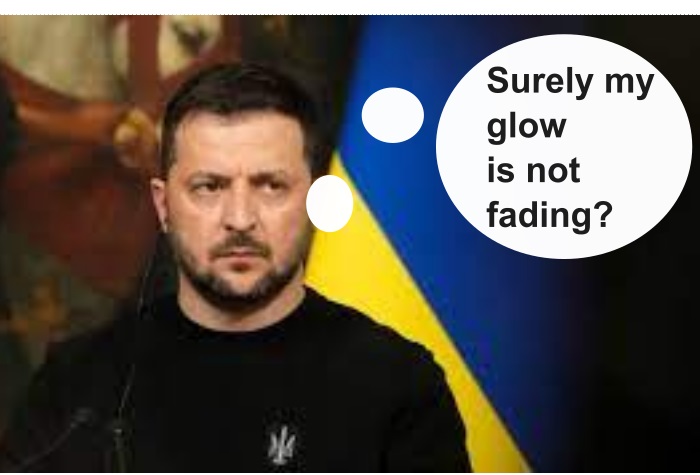
Leak reveals Zelensky privately plots bold attacks inside Russia.(Is his halo slipping?)

They reveal a leader with aggressive instincts that sharply contrast with his public-facing image as the calm and stoic statesman.
Zelensky suggested Ukraine “conduct strikes in Russia”
“Zelensky highlighted that … Ukraine should just blow up the pipeline and destroy likely Hungarian [Prime Minister] Viktor Orban’s industry”
Zelensky then “suggested that Ukraine attack unspecified deployment locations in Rostov,” a region in western Russia, using drones instead, according to another classified document.
The Age, John Hudson and Isabelle Khurshudyan, May 14, 2023
Washington: Ukrainian President Volodymyr Zelensky has won the trust of Western governments by refusing to use the weapons they provide for attacks inside Russia and prioritising the targeting of Russian forces inside Ukraine’s borders.
But behind closed doors, Ukraine’s leader has proposed going in a more audacious direction – occupying Russian villages to gain leverage over Moscow, bombing a pipeline that transfers Russian oil to Hungary, a NATO member, and privately pining for long-range missiles to hit targets inside Russia’s borders, according to classified US intelligence documents detailing his internal communications with top aides and military leaders.
The documents, which have not been previously disclosed, are part of a broader leak of US secrets circulated on the Discord messaging platform and obtained by The Washington Post. They reveal a leader with aggressive instincts that sharply contrast with his public-facing image as the calm and stoic statesman weathering Russia’s brutal onslaught. The insights were gleaned through intercepted digital communications, providing a rare look at Zelensky’s deliberations amid Russian missile barrages, infrastructure attacks and war crimes.
The Pentagon, where senior US military leaders were briefed on the matters outlined in the leaked documents, did not dispute the authenticity of the materials.
In some cases, Zelensky is seen restraining the ambitions of his subordinates; in several others, he is the one proposing risky military actions.
In a meeting in late January, Zelensky suggested Ukraine “conduct strikes in Russia” while moving Ukrainian ground troops into enemy territory to “occupy unspecified Russian border cities,” according to one document labelled “top secret.” The goal would be “to give Kyiv leverage in talks with Moscow,” the document said.
In a separate meeting in late February with General Valery Zaluzhny, Ukraine’s top military commander, Zelensky “expressed concern” that “Ukraine does not have long-range missiles capable of reaching Russian troop deployments in Russia nor anything with which to attack them”. Zelensky then “suggested that Ukraine attack unspecified deployment locations in Rostov,” a region in western Russia, using drones instead, according to another classified document.
In a meeting in mid-February with Deputy Prime Minister Yuliya Svrydenko, Zelensky suggested Ukraine “blow up” the Soviet-built Druzhba pipeline that provides oil to Hungary. “Zelensky highlighted that … Ukraine should just blow up the pipeline and destroy likely Hungarian [Prime Minister] Viktor Orban’s industry, which is based heavily on Russian oil,” the document says.
In detailing the conversation, intelligence officials concede that Zelensky was “expressing rage toward Hungary and therefore could be making hyperbolic, meaningless threats,” a qualification that does not accompany the other accounts of Zelensky suggesting bold military action. Though Hungary is nominally part of the Western alliance, Orban is widely considered Europe’s most Kremlin-friendly leader.
When asked if he had suggested occupying parts of Russia, Zelensky, during an interview with The Washington Post in Kyiv, dismissed the US intelligence claims as “fantasies” but defended his right to use unconventional tactics in the defence of his country.
……………. The use of long-range missiles to hit inside Russia is a particularly sensitive topic for the White House, which has long worried that the Ukraine conflict could escalate out of control and force a catastrophic standoff between the United States and Russia, the world’s largest nuclear powers.
Though Washington has given Zelensky billions of dollars’ worth of advanced weaponry, President Biden has steadily rebuffed the Ukrainian leader’s request for long-range ATACMS, shorthand for the Army Tactical Missile System, capable of striking targets up to 185 miles away. Since the start of the war, Biden has said the United States is “not encouraging or enabling Ukraine to strike beyond its borders”.
When asked about the intelligence indicating he had weighed the use of long-range missiles to hit Russia, Zelensky said it is not something Ukraine is entertaining. “No one in our country has given orders for offensives or strikes on Russian territory,” he said.
It is unclear whether the United States has shared accounts of Zelensky’s plotting with allied nations, but the Ukrainian president continues to enjoy the strong support of Western governments, which have provided him with an increasingly sophisticated array of weaponry.
This past week, Britain became the first Western country to provide Ukraine with long-range missiles. The Storm Shadow, a cruise missile system with stealth capabilities, has a range of 155 miles, far exceeding the 50-mile range of the US-provided HIMARS launchers.
British Defence Minister Ben Wallace said Friday that the missile would give Ukraine “the best chance” to defend itself and would be for use only “within Ukrainian sovereign territory.” A spokesman with the British Embassy in Washington declined to comment on whether Zelensky’s leaked remarks might give London pause about its decision.
The Biden administration says Zelensky’s intercepted comments are not the cause for withholding ATACMS.
“Ukraine has repeatedly committed to employ US-provided weapons responsibly and strategically when needed to counter Russian aggression, and we are confident that will continue to be the case,” said a US defence official who, like others interviewed for this report, spoke on the condition of anonymity to discuss a sensitive topic.
Since last year, Zelensky has promised that Ukraine would never use US weapons to strike inside Russia, a pledge the White House says he has fulfilled.
“President Zelensky has kept the promises he has made to President Biden, and we do not believe that that will change,” said a senior administration official.
One reason for not providing the long-range missiles is the “relatively few ATACMS” the United States has for its own defence needs, General Mark A. Milley, chairman of the Joint Chiefs of Staff, told Defence One in March.
Zelensky, however, said he believes the United States isn’t sending the weapons because it doesn’t trust Kyiv.
“I think they are afraid that we might use them on the territory of Russia,” Zelensky told The Post. “But I would always tell our partners … ‘We have a priority target for which we are spending the ammunition packages we receive, and we spend it on the deoccupation of purely Ukrainian territories,’” he said.
While there is no indication that Ukraine has used Western missiles to strike into Russian territory, the same cannot be said for Kyiv’s use of armed drones.
Explosions caused by unmanned aerial vehicles have become a regular occurrence in Russia, including in Rostov, where a drone crashed into an oil refinery this month. Ukrainian officials are often coy about the incidents, hinting that they’re responsible without directly taking credit.
Two drone attacks in December on Russia’s Engels air base in Saratov, more than 590 kilometres from the Ukrainian border, showed “that we have the ability to reach many kilometres farther than they could expect,” Oleksiy Danilov, secretary of Ukraine’s National Security and Defence Council, said in an interview earlier this year.
Russia this month accused Ukraine of staging a drone attack intended to kill President Vladimir Putin in the Kremlin. Videos circulating on social media and verified by The Post show two drones streaking toward the Kremlin at about 2.30am local time. The allegation was forcefully denied by Ukrainian officials, including Zelensky…………………..more https://www.theage.com.au/world/europe/leak-reveals-zelensky-privately-plots-bold-attacks-inside-russia-20230514-p5d87l.html The Washington Post
Luck is not a safety plan
“We must act now,” said International Atomic Energy Agency director general, Rafael Grossi. But what is his plan? IAEA efforts at creating a “safe zone” around the Zaporizhzhia reactors, where no fighting could then occur, have collapsed. On the geopolitical stage, both Russia and Ukraine appear to harbor the conviction that their side can win the war. NATO and its allies show no signs of insisting on a diplomatic solution, given the benefit to those countries of a Russian defeat.
War devastation is bad enough without adding a nuclear disaster
Luck is not a safety plan — Beyond Nuclear International
How much more perilous can the situation at Zaporizhzhia nuclear power plant become?
By Linda Pentz Gunter, 14 May 23
Luck is not a sound basis on which to rely when we are dealing with nuclear risks. But luck is again what me must depend on as we watch and wait for the worst to happen — or not — at the six-reactor Zaporizhzhia nuclear power plant in Ukraine.
The plant, located in the southwestern region of the country — the area most directly embroiled in some of the most intense fighting, and with parts of it already “annexed” by Russia — has already experienced some frightening near-misses. These include shelling and missile attacks and frequent losses of offsite power that, if not restored promptly, could lead to a meltdown.
The plant has been occupied by Russian forces since March 4, 2022. Rumors abound that a severely depleted workforce is laboring under stressful and even violent conditions, while other staff have fled or have disappeared.
Now we learn that mass evacuations are underway from communities close to the nuclear plant. These include residents of Enerhodar, the city that houses most of the plant workers and their families……………………….
Fears of a Ukrainian offensive designed to recapture some or all of the Russian-held territory appear to have prompted the sudden evacuation. But are people evacuating away from the conflict or from the prospect of a catastrophic outcome at the nuclear power plant, should it become fully engulfed by the fighting? And if that does happen, what might the consequences be?
As a precaution, all six Zaporizhzhia reactors are currently shut down — officially their status is called “cold shutdown”, which is not as final as it sounds and does not mean they are out of danger.
The fuel in the reactor core still requires electricity to power cooling, as do the pumps that supply cooling water to the fuel pools. This means a meltdown is still possible. Cold shutdown just buys workers more time to restore power should it become lost, but a reliable supply of electricity to the site is still essential to avoid disaster…………
The consequences of such an outcome would be drastic not only for the people of Ukraine and neighboring Russia, but for all of Europe, should any or all of these reactors melt down or suffer a fuel pool fire. We only have to look at the fallout map from the 1986 Chornobyl disaster, a single unit with a far smaller radioactive inventory, to understand the potential scale of such a tragedy.
Chornobyl contaminated 40% of the European landmass with long-lived radioactive fallout and created an effectively permanent 1,000 square mile Exclusion Zone around the stricken nuclear site.
Beyond electrical power, water supply is also essential to keep nuclear power plants out of danger. The thermally and radioactively “hot” irradiated fuel rods sitting in cooling pools, must stay submerged. Electrically powered pumps can maintain a steady water supply. But access to water is critical.
In late March, alarms were raised about a dramatic drop in water levels at the reservoir that supplies cooling water to the plant. Ukrainian officials said the Russians had drained the reservoir, increasing the risk of a meltdown at Zaporizhzhia.
But this month, headlines warned that record high water levels could threaten a dam that, if breached, would send floodwaters pouring onto the nuclear site, inundating the plant’s pumping systems.
War, flooding, and human error are all potential disasters waiting in the wings that could trigger a nuclear catastrophe. But what can prevent it?
“We must act now,” said International Atomic Energy Agency director general, Rafael Grossi. But what is his plan? IAEA efforts at creating a “safe zone” around the Zaporizhzhia reactors, where no fighting could then occur, have collapsed. On the geopolitical stage, both Russia and Ukraine appear to harbor the conviction that their side can win the war. NATO and its allies show no signs of insisting on a diplomatic solution, given the benefit to those countries of a Russian defeat.
All of this brutality already comes at immense cost to the population of Ukraine, but also to Russia, where mothers, too, are losing sons to an unnecessary war. A major strike on Europe’s largest nuclear power plant would extend that tragedy across thousands of miles, affecting hundreds of millions of lives. All we’ve got between us and that disaster is luck, which, like the deadly uranium that fuels nuclear power plants, will eventually run out.
NATO Weapons Go Boom, British Missiles Strike Russia – Ukraine War Escalates
The NATO vs Russia proxy war in Ukraine recently escalated a notch or two, with simultaneous ‘Ukrainian’ airstrikes downing two modern Russian fighter jets and two helicopters… well inside ‘Russia proper’. This came the day after British-supplied, longer-range, cruise missiles struck the city of Lugansk, and hours after Russian airstrikes obliterated another huge store of NATO supplies for Ukraine’s much-vaunted ‘counter-offensive’.
This week on NewsReal, Joe & Niall discuss the latest deceptions in ‘the Ukraine war…. more https://www.sott.net/article/480219-NewsReal-NATO-Weapons-Go-Boom-British-Missiles-Strike-Russia-Ukraine-War-Escalates#
Risks too high at Zaporizhzhia
May 10, 2023 https://beyondnuclear.org/risks-too-high-at-zaporizhzhia/
Beyond Nuclear has put out a press statement warning that the risks of a nuclear catastrophe at Ukraine’s six-reactor Zaporizhzhia nuclear power plant are too high, with rumors of a Ukrainian offensive reportedly prompting mass evacuations of civilians living near the plant. Only an immediate ceasefire — or, better still, a negotiated end to a likely unwinnable war — can protect us from a potentially catastrophic nuclear incident at the plant, which has already endured shelling, missile attacks, and frequent loss of connection to the electrical grid.
The press release begins:
Fears of an imminent Ukrainian offensive that could put the country’s six-reactor Zaporizhzhia nuclear power plant in even greater danger, should prompt immediate efforts to negotiate a ceasefire, if not an end to the Russian war against Ukraine, urged safe energy group, Beyond Nuclear today.
News reports that civilians around the Zaporizhzhia nuclear power plant are being evacuated suggest that the conflict already consuming the southwestern region of Ukraine could be about to escalate, potentially engulfing the nuclear plant.
The Zaporizhzhia nuclear power plant has already escaped close calls, the target of shelling and missile attacks on at least one occasion and with frequent losses of offsite power that, if not restored promptly, could lead to a meltdown.
The plant has been occupied by Russian forces since March 4, 2022. Rumors abound that a severely depleted workforce is laboring under stressful and even violent conditions, while other staff have fled or have disappeared.
As a precaution, all six Zaporizhzhia reactors are currently shut down, but that does not mean they are out of danger.
“The fuel in the reactor core still requires electricity to power cooling, as do the pumps that supply cooling water to the fuel pools,” warned Beyond Nuclear international specialist, Linda Pentz Gunter. “A meltdown is still possible. Putting the reactors in what is termed ‘cold shutdown’ just buys workers more time to restore power, but a reliable supply of electricity to the site is still essential to avoid disaster.
“The consequences not only for the people of Ukraine and neighboring Russia, but for all of Europe, should any or all of these reactors melt down or suffer a fuel pool fire are unimaginably dire,” Pentz Gunter said.
1 This Month



26 September – International Day for the Total Elimination of Nuclear Weapons


PLEASE OPPOSE HR 8255 AND S.3639 – bills would accelerate satellite deployment, with no environmental review or safeguards – https://ncstd5li.quorum.us/campaign/169331/
To see nuclear-related stories in greater depth and intensity – go to https://nuclearinformation.wordpress.com
-
Archives
- September 2026 (233)
- August 2026 (330)
- July 2026 (355)
- June 2026 (287)
- May 2026 (306)
- April 2026 (356)
- March 2026 (251)
- February 2026 (267)
- January 2026 (308)
- December 2025 (358)
- November 2025 (359)
- October 2025 (375)
-
Categories
- 1
- 1 NUCLEAR ISSUES
- business and costs
- climate change
- culture and arts
- ENERGY
- environment
- health
- history
- indigenous issues
- Legal
- marketing of nuclear
- media
- opposition to nuclear
- PERSONAL STORIES
- politics
- politics international
- Religion and ethics
- safety
- secrets,lies and civil liberties
- spinbuster
- technology
- Uranium
- wastes
- weapons and war
- Women
- 2 WORLD
- ACTION
- AFRICA
- Atrocities
- AUSTRALIA
- Christina's notes
- Christina's themes
- culture and arts
- Events
- Fuk 2022
- Fuk 2023
- Fukushima 2017
- Fukushima 2018
- fukushima 2019
- Fukushima 2020
- Fukushima 2021
- general
- global warming
- Humour (God we need it)
- Nuclear
- RARE EARTHS
- Reference
- resources – print
- Resources -audiovicual
- Weekly Newsletter
- World
- World Nuclear
- YouTube
-
RSS
Entries RSS
Comments RSS
 nuclear-news