Washington Post reported Ukraine conducted a test strike with HIMARS on the Kahovka dam last year
the Washington Post reported in December 2022 that Ukraine had previously carried out a test strike using American HIMARS (High Mobility Artillery Rocket Systems) on a dam located on the Russian-held side of Ukraine along the Dnieper River in Kahovka. They cited Ukrainian Major-General Andriy Kovalchuk.
Human Events Media Group 06/06/2023
A dam on the Dnieper River was destroyed on Tuesday, flooding a substantial amount of the area where Ukrainian and Russian troops are engaged in fighting, after Ukraine launched their much-anticipated counter-offensive. The dam was in Russian control, and has been since shortly after the February 2022 invasion of Ukraine by Russia.
Ukraine claimed Russia blew up the Nova Kakhovka dam and said it was a war crime, while Russia has said that it was Ukraine who “sabotaged the dam, to distract attention from the launch of a major counteroffensive Moscow says is faltering,” Reuters reports.
Ukraine’s counter offensive has been in the works for some time, specifically targeting the Russian-held city of Kherson, and was just recently launched.
“Russian terrorists,” President Volodymyr Zelenskiy said on Telegram. “The destruction of the Kakhovka hydroelectric power plant dam only confirms for the whole world that they must be expelled from every corner of Ukrainian land.”
However, the Washington Post reported in December 2022 that Ukraine had previously carried out a test strike using American HIMARS (High Mobility Artillery Rocket Systems) on a dam located on the Russian-held side of Ukraine along the Dnieper River in Kahovka. They cited Ukrainian Major-General Andriy Kovalchuk.
“Kovalchuk considered flooding the river,” the Washington Post reported. “The Ukrainians, he said, even conducted a test strike with a HIMARS launcher on one of the floodgates at the Nova Kakhovka dam, making three holes in the metal to see if the Dnieper’s water could be raised enough to stymie Russian crossings but not flood nearby villages. The test was a success, Kovalchuk said, but the step remained a last resort.”……………….. https://humanevents.com/2023/06/06/wapo-reported-ukraine-conducted-a-test-strike-with-himars-on-the-kahovka-dam-last-year
The Ukrainian “counter-offensive”: A new stage in the US-NATO war against Russia
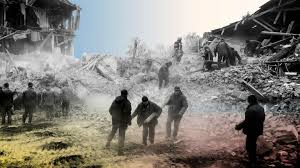
Every aspect of the war, including the “counter-offensive,” is being directed by the Biden administration, the Pentagon and NATO. It is being led by forces trained by NATO and armed with NATO weapons, including depleted uranium shells supplied by the UK. Operationally, it is organized from Washington and the Pentagon. The masses of Ukrainians are being exploited as cannon fodder. Among the first divisions thrown into the battle, many are raw draftees with little or no training.
WSWS Joseph Kishore, David North, 5 June 2023
The US-NATO war against Russia over Ukraine is entering a new stage this week, with reports of a significant increase in fighting along a broad front Monday and enormous casualties.
The Russian Defense Ministry reported on its official Telegram channel that Russian forces countered a Ukrainian offensive on the Vremevka outpost in South Donetsk, which is currently controlled by Russia. It stated that over 1,500 Ukrainian soldiers were killed and that Russia seized 28 tanks, including eight German-made Leopard tanks.
Russia also reported an offensive of Ukrainian troops toward the south, against the territory along the coast of the Sea of Azov that connects Crimea and the Donbas, both held by Russia or pro-Russian forces since 2014. A Russian-appointed official in the city of Zaporizhzhia said that the fighting in the south involved extensive shelling and strikes by Ukraine using British-French Storm Shadow missiles.
It is apparent that Monday’s operations mark the beginning of the long anticipated “summer counter-offensive.” While there is, at present, limited information, one thing can be said with certainty: The fighting will result in a vast increase in the number of deaths, both Ukrainian and Russian.

In an interview with the Wall Street Journal Sunday, Ukrainian President Volodymyr Zelensky acknowledged that “a large number of soldiers are going to die,” but “we are going to do it.” Reliable estimates place the death toll of Ukrainians in the war so far at 300,000.
Every aspect of the war, including the “counter-offensive,” is being directed by the Biden administration, the Pentagon and NATO. It is being led by forces trained by NATO and armed with NATO weapons, including depleted uranium shells supplied by the UK. Operationally, it is organized from Washington and the Pentagon. The masses of Ukrainians are being exploited as cannon fodder. Among the first divisions thrown into the battle, many are raw draftees with little or no training.
The US and the NATO powers are determined to inflict a Russian defeat, with dreams of a military parade of NATO troops in the streets of Moscow. The Financial Times wrote on Monday that “there has been a notable change of tone among senior western officials, who have appeared increasingly skeptical about Russian military capabilities. Antony Blinken, the US secretary of state, last week made a clear case for an outright Ukrainian victory based on ‘territorial integrity’ [that is, retaking all territory presently controlled by Russia] in a speech that also disparaged Russia’s military ‘as the second-strongest in Ukraine.’”
The FT also cited comments by Ben Wallace, the UK defense secretary, that Ukraine could take back Crimea as part of the offensive. “What we’ve seen on the battlefield is that, if you punch Russian forces in the wrong place, they’ll actually collapse,” he said.
Such statements combine propaganda with self-delusion. The Ukrainian military has been bled white over the past 15 months. It is entirely reliant on the US and NATO, not only to provide training and weaponry, but increasingly the manpower necessary for escalating the war.
The operations in Ukraine are only one part of a barely disguised, undeclared war between NATO and Russia, which is expanding in intensity and geographical scope.
Developments on the ground in Ukraine have been timed to coincide with a meeting of NATO foreign ministers in Oslo, Norway late last week. This meeting itself was to prepare a full NATO war summit next month in Vilnius, Lithuania, only a short drive from the Russian border. Behind closed doors, the leaders of the NATO powers are discussing and implementing the next stage in the escalation.
Already, Ukraine, operating under the direction of the US, has launched drone strikes targeting Moscow, begun shelling Russian cities, and organized incursions into Russian territory, using vehicles and equipment provided by the US and its NATO allies. Poland has become directly involved in the conflict, with members of the so-called “Polish Volunteer Corps” of Polish citizens participating in cross-border raids from Ukraine into Russia.
An article in the Washington Post (“Defend ‘every inch’ of NATO territory? New strategy is a work in progress”), published Monday, opens with a description of French paratroopers being dropped into Estonia, which borders Russia and is only 150 km from St. Petersburg. The Post notes that the French war exercises in Estonia are “part of a stepped-up rehearsal of what it would take to reinforce a [NATO] battle group” in the country.
Speaking of what can only be described as a massive military mobilization, the newspaper writes, “NATO has bolstered its eastern flank in part by establishing battle groups in four additional countries: Bulgaria, Hungary, Romania and Slovakia,” with 10,000 troops across eight battle groups. Dozens of ships and hundreds of planes, along with ground-based air defense, have been sent to countries on Russia’s border, particularly the Baltic countries of Latvia, Lithuania and Estonia.
War games are taking place currently throughout Europe, including the massive “Defender Europe 2023” exercise, which began on April 22 and involves 26,000 troops from the US and its allies. The final component of the operations, “Saber Guardian 23,” began last week and is centered on the Black Sea, to the south of Ukraine. It involves soldiers and sailors from Albania, Bulgaria, Belgium, France, Greece, Germany, Italy, the Netherlands, Romania, Slovenia and the United States.
Given the statements of leading US and NATO officials that they are committed to the military defeat of Russia, the Putin government will be compelled to interpret all these actions as possible preparations for NATO incursions into Russian territory. The purpose of all these operations is to support the Ukrainian offensive by distracting Russian military commanders from exclusive focus on the Ukrainian front and compelling them to divert forces to other border regions.
In the capitals of the NATO powers, a mood of reckless hysteria prevails. Over the weekend, German Chancellor Olaf Scholz, confronted by protesters at a gathering of his Social Democratic Party outside of Berlin, unleashed a Hitlerian rant against Russia and denounced Putin as a “murderer” and a “warmonger.”
The White House has rejected calls for a ceasefire or negotiated settlement to the conflict that does not include full capitulation by Russia. Encouraged by Russia’s failure to respond to each escalation, the Biden administration has concluded that there is no “red line” that it cannot cross.
In an article published under the headline “Biden Administration Shrugs Off Ukraine’s Attacks in Russia,” the New York Times wrote on Monday that the White House has discarded the pretense of discouraging direct attacks in Russia by Ukraine, using US-supplied weaponry. “Behind closed doors,” the Times wrote, “senior administration officials have seemed even less fazed. ‘Look, it’s a war,’ one senior Pentagon official said last Thursday. ‘This is what happens in a war.’”………………… https://www.wsws.org/en/articles/2023/06/06/pers-j06.htm
Leaks reveal FBI helps Ukraine censor Twitter users and obtain their info
AARON MATÉ·JUNE 7, 2023, The Grayzone,
The FBI aided a Ukrainian intelligence effort to ban Twitter users and collect their data, new leaks show. Twitter declined to censor journalists targeted by Ukraine, including The Grayzone’s Aaron Maté.
The Federal Bureau of Investigation has aided a Ukrainian intelligence effort to censor social media users and obtain their personal information, leaked emails reveal.
In March 2022, an FBI Special Agent sent Twitter a list of accounts on behalf of the Security Service of Ukraine (SBU), Ukraine’s main intelligence agency. The accounts, the FBI wrote, “are suspected by the SBU in spreading fear and disinformation.” In an attached memo, the SBU asked Twitter to remove the accounts and hand over their user data.
The Ukrainian government’s FBI-enabled targets extend to members of the media. The SBU list that the FBI provided to Twitter included my name and Twitter profile. In its response to the FBI, Twitter agreed to review the accounts for “inauthenticity” but raised concerns about the inclusion of me and other “American and Canadian journalists.”
The FBI’s attempt to ban Twitter accounts at the request of Ukrainian intelligence is among the most overt requests for censorship revealed to date in the Twitter Files, a cache of leaked communications from the social media giant.
The FBI’s censorship request was relayed in a March 27th, 2022 email from FBI Special Agent Aleksandr Kobzanets, the Assistant Legal Attaché at the US Embassy in Kyiv, to two Twitter executives. Four FBI colleagues were copied on the exchange…………………….
If granted, the users on the list would not only have been banned from Twitter but had their phone number, date of birth, and email address disclosed to both the FBI and SBU.
Read the full list of accounts targeted by the FBI and SBU here:
Twitter-Dissinf_20220327 SBU list
In response, Yoel Roth, Twitter’s then-Head of Trust and Safety, informed Special Agent Kobzanets and his FBI colleagues that Twitter would “review the reported accounts under our Rules.” But he warned that the list included “a few accounts of American and Canadian journalists (e.g. Aaron Mate).” Therefore, Roth said, Twitter’s review would “focus first and foremost on identifying any potential inauthenticity.”
Roth then suggested that he would be open to suspending authentic accounts if it could be proven that they have a hidden tie to a foreign government. Journalists “who cover the conflict with a pro-Russian stance are unlikely to be found in violation of our rules absent other context that might establish some kind of covert/deceptive association between them and a government,” Roth wrote. “Any additional information or context in those areas is of course welcome and appreciated.”……………………………………………
The Ukrainian nationals targeted by the SBU’s suppression request include Anatoly Shariy, a video blogger and politician who fled Ukraine in 2012 and subsequently received European Union asylum; and Andriy Portnov, a Ukrainian lawyer and politician who served as a senior official under Ukrainian President Viktor Yanukovych until the latter’s ouster in the February 2014 Maidan coup. (Both Shariy and Portnov’s Twitter accounts remain active).
The disclosure of a collaboration on censorship between the FBI and SBU is the latest documented instance of Ukrainian state-tied attempts to target foreign voices. A Ukrainian website known as Myrotvorets maintains a list of what it calls “enemies of Ukraine.” I was recently added to that list along with The Grayzone’s Anya Parampil, as well as the comedian and YouTube host Jimmy Dore. The Myrotvorets database was co-founded by Anton Gerashchenko, former deputy minister at the Ukraine’s Ministry of Internal Affairs, where he now serves as an advisor.
Last year, the global tech/media conference Web Summit withdrew a speaking invitation to The Grayzone’s Max Blumenthal and me after Olena Zelenska, the wife of Ukrainian President Volodymyr Zelensky, demanded our cancellation. (Another Grayzone colleague, Kit Klarenberg, was recently detained and interrogated about his journalism by British authorities).
News of the FBI’s work with Ukrainian intelligence to censor Twitter users also follows reporting from journalist Lee Fang that the FBI has pressured Facebook to remove accounts and posts deemed by the SBU to be Russian “disinformation.” According to Fang, a senior Ukrainian official in regular contact with the FBI defined “disinformation” in such broad terms that it could mean viewpoints that “simply contradict the Ukrainian government’s narrative.” https://thegrayzone.com/2023/06/07/fbi-ukraine-twitter-users-including-journalists/—
Russia warns that supplying nuclear weapons to Ukraine would lead to ‘global, irrevocable collapse’
Russian Foreign Ministry spokeswoman Maria Zakharova accuses Ukraine of readiness to destroy its own land
AA Elena Teslova |08.06.2023
Russian Foreign Ministry spokeswoman Maria Zakharova said on Wednesday that if the West supplies Ukraine with nuclear weapons, it would lead to the end of humankind’s existence on the planet.
Asked at a news conference in Moscow if Russia sees as possible nuclear weapons deliveries to Ukraine, Zakharova said: “Why should we comment on their possible insanity or possible control of insanity? This is not our topic.”
She pointed out that in recent months, the Ukrainian authorities took steps that harm the interests of their own country and its population.
“If they want a global, irrevocable collapse, then they will do it (deliver nuclear weapons to Ukraine). You can see what’s going on. The Kyiv regime is ready to destroy its own land…They are ready to infect it with depleted uranium, flood it with water, poison it with ammonia,” she said……………………….
For months, Moscow has been expressing concern over the change in the types of weapons supplied to Ukraine, which started with small arms and now involves deliveries of fighter jets.
Russian authorities also argue that the weapons supplied for the protection of Ukraine’s territory are used for raids into Russian territory…………………………………………………. https://www.aa.com.tr/en/russia-ukraine-war/russia-warns-that-supplying-nuclear-weapons-to-ukraine-would-lead-to-global-irrevocable-collapse/2917099
Bellona publishes new report on Ukraine’s besieged Zaporizhzhia nuclear plant
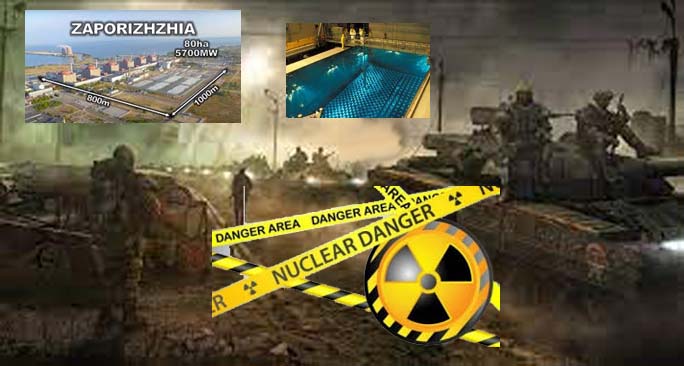
It’s something the world nuclear energy community never thought it would see — and thus never prepared for.
June 1, 2023 by Charles Digges https://bellona.org/news/nuclear-issues/2023-06-zaporizhzhia-nuclear-report
For a year and a half, the world has bourn witness to an unprecedented spectacle: the military occupation of a civilian atomic energy station.
The March 2022 seizure by Russian troops of the Zaporizhzhia Nuclear Power Plant in Southeastern Ukraine has forced six nuclear reactors and pools of spent nuclear fuel onto the front lines of the biggest land war in Europe since World War II.
It’s something the world nuclear energy community never thought it would see — and thus never prepared for. As a result, the world has watched helplessly as heavy ordinance strikes nail-bitingly close to the plant on a regular basis, repeatedly severing outside power to the facility’s cooling and safety systems.
According to Rafael Grossi, who heads the UN’s atomic energy agency —and who has repeatedly beseeched Moscow and Kyiv to create a non-military safe zone around the plant — the situation is a gamble with radioactive stakes.
“We are rolling a dice and if this continues then one day our luck will run out,” he has said more than once.
Unfortunately, the time has come to ponder just what it would look like were that to happen.
This is the subject of a new Bellona report entitled “The Radiation Risks of Seizing the Zaporizhzhia Nuclear Power Plant.”
In it, we analyze a variety of war-time scenarios that could befall the plant and what the consequences of those might be.
What would happen if any of the plant’s six Soviet-built VVER-1000 nuclear reactors were struck by artillery? Or a missile? What about the spent nuclear fuel storage pools? What if those were struck? Where would the radioactive fallout from any of these events go?
And perhaps, in light of recent events, the most salient danger — what would happen if the plant was unable to maintain outside power to run reactor cooling systems? Would that amount to Fukushima redux?
We also present a number of recommendations that should be followed in order to keep the plant safe while it continues to be hostage to the aggression.
Among them, we urge the Russian and Ukrainians struggling for control of the plant to keep the reactors in shut-down mode, which would greatly reduce the severity of a radiological accident. We also recommend that no nuclear fuel be unloaded, packed for storage or transported. These are complex technical tasks that cannot be undertaken by a hostage workforce while a war rages on around them.
Above all, we urge a Russian withdrawal from the plant and Ukraine as a whole, for it is not until then that anything like safe operation of Europe’s largest nuclear power plant can be restored.
Rafael Grossi to brief UN Security Council on Zaporizhia nuclear situation
The International Atomic Energy Agency was on 30 May due to brief the UN
Security Council on his proposals for safeguarding Ukraine’s Zaporizhia NPP
(ZNPP). “IAEA director general Rafael Grossi is planning to brief the UN
Security Council on the nuclear safety and security situation” during a
meeting chaired by Switzerland, according to an official statement by the
Agency in advance of the meeting.
Director general Grossi has said he is
seeking to secure agreement on a set of principles to protect ZNPP during
the armed conflict, covering also the availability and security of external
power supplies at all times.
Mr Grossi’s plan consists of five principles:
a ban on the deployment of heavy military equipment and military personnel
at nuclear power plants, a ban on shooting from the territory and towards
the power plant, ensuring security, protecting all external power lines,
and monitoring compliance with these principles.
Modern Power Systems 30th May 2023
Neither Russia nor Ukraine committed to the IAEA’s 5 principles to protect Zaporizhzhia nuclear power plant.
Neither Russia nor Ukraine committed to respect five principles laid out
by International Atomic Energy Agency (IAEA) chief Rafael Grossi on Tuesday
(30 May) to try to safeguard Ukraine’s Russian-occupied Zaporizhzhia
nuclear power plant.
Grossi, who spoke at the UN Security Council, has
tried for months to craft an agreement to reduce the risk of a catastrophic
nuclear accident from military activity like shelling at Europe’s biggest
nuclear power plant.
His five principles included that there should be no
attack on or from the plant and that no heavy weapons such as multiple
rocket launchers, artillery systems and munitions, and tanks or military
personnel be housed there. Grossi also called for off-site power to the
plant to remain available and secure; for all its essential systems to be
protected from attacks or sabotage; and for no actions that undermine these
principles.
EU Reporter 1st June 2023
1
‘Independent’ Ukrainian ‘kill list’ actually run by Kiev, backed by Washington

Myrotvorets lists thousands of “saboteurs”, “separatists”, “terrorists” and “traitors”. Sometimes, it has crossed out their photographs once they had been killed, with the label “liquidated”.
Mint Press, MAY 12TH, 2023, DAVID MILLER
Late last year, my name was added to a blacklist published online by the Ukraine Center for Countering Disinformation. I joined over ninety others deemed to be “speakers who promote narratives consonant with Russian propaganda.“
These included Manuel Pineda and Clare Daly, both leftist Members of the European Parliament (MEP); Also counted are people on the right, such as Doug Bandow of the Cato Institute, neocon and former IDF officer Edward Luttwak, a slew of rightist MEPs; Ex CIA officer, Ray McGovern; former military and intelligence figures such as Scott Ritter and Douglas McGregor, as well as academics such as John Mearsheimer and Jeffrey Sachs. Journalists on the list included Glenn Greenwald, Tucker Carlson and Eva Bartlett, Roger Waters from Pink Floyd, and even actor Steven Seagal.
What was my crime? It said my “pro-Russian narrative” was claiming that “NATO’s proxy war with Russia is taking place in Ukraine”. Of course, a NATO proxy war is exactly what is happening there, as this article will only further confirm.
The listing helpfully provided a link with the evidence, an article I wrote for Mayadeen English called “How disinformation works: Western intelligence agencies global war on the left.” It contained a single, 176-word paragraph on Ukraine titled “‘Russian Disinformation’ or Ukrainian lies?” It recounted several examples of Ukrainian misinformation and concluded that “Anyone who mentions any particular truth is derided for echoing Putin’s ‘talking points’.” In the event I was actually denounced as an “information terrorist” who might be guilty of “war crimes.”
Being added to the blacklist concentrates the mind wonderfully on the forces ranged against the possibility of truth and justice in the crisis-ridden West. When I was first accused, over a decade ago now, of antisemitism, my response was to intensify my research and writing activities on the organizations involved in defaming me. Since then I have produced a long catalog of work on the Zionist movement as well as on Western propaganda activities. Of course, the defamatory attacks encourage an atmosphere where social media threats can be made. But the issue of Nazism in Ukraine will be seen in retrospect as a defining issue of our era and it is important to remember that the reason I and many others are threatened by the Ukraine government and their NATO backers is because we in turn threaten to expose them for what they are: Nazi collaborators.
As it turns out, the covert “kill list” website is a product of the Ukraine regime, effectively funded by the CIA (amongst others) and is hosted by NATO. One extraordinary thing is that many American citizens, including ex-military and intelligence operatives, are included, as well as a significant number of citizens of NATO member countries. Perhaps the most remarkable element is that NATO has hosted the site (and a collection of affiliated websites) on its servers in Brussels. At the same time as NATO think tank the Atlantic Council boasts that Henry Kissinger is on its Board of Directors, NATO also hosts a kill list website on which Kissinger appears.
As it turns out, the covert “kill list” website is a product of the Ukraine regime, effectively funded by the CIA (amongst others) and is hosted by NATO. One extraordinary thing is that many American citizens, including ex-military and intelligence operatives, are included, as well as a significant number of citizens of NATO member countries. Perhaps the most remarkable element is that NATO has hosted the site (and a collection of affiliated websites) on its servers in Brussels. At the same time as NATO think tank the Atlantic Council boasts that Henry Kissinger is on its Board of Directors, NATO also hosts a kill list website on which Kissinger appears.
•Psb-news.org (3 April 2015)
•Psb4ukr.ninja (19 April 2015)
•Psb4ukr.net (7 May 2015)
•Psbr4ukr.xyz (8 November 2015)
•Report2psb.online (19 August 2017)
These were used either as mirror sites, as digest news from the site, or, in the case of the last one, a form for reporting suspects. The Myrotvorets.center domain name was first registered on 7 November 2015 and the site was live by February 2016.
Three people are associated with these domains and they provide valuable clues to who and what was involved in the kill list site. They are:
Victor/Viktor Garbar is a longstanding Maidan activist and co-ordinator of the Maidan Monitoring Information Center…………………………………….
Vladimir/Volodymyr Kolesnikov is a webmaster and developer. …………
Oksana/Oxana Tinko………..
OPERATION BUTTERFLY – THE PROTOTYPE KILL LIST
Tinko is also the registrant of a series of domains that appear to be components of the Myrotvorets project and one that appears to have been a prototype. It is particularly stark in its intention to use the website to kill traitors or “terrorists”. ……………….
Operation Butterfly website FAQs make it clear that it considers calling “for separatism or changes in the constitutional system” a crime. ……………………………………..
Myrotvorets lists thousands of “saboteurs”, “separatists”, “terrorists” and “traitors”. Sometimes, it has crossed out their photographs once they had been killed, with the label “liquidated”. This, for instance, happened after the murder of Daria Dugina in Moscow in August 2022. Today the Myrotvorets site houses links to two other domains which appear to be integral parts of the operation. One – ordilo.org – is titled “STORAGE OF INFORMATION ABOUT CRIMES AGAINST UKRAINE”. The other – identigraf.center – allows various categories of users to submit images of individuals for facial recognition scanning. Tinko registered both domains.
THE NATO CONNECTION
Kolesnikov and Tinko were successive registrants on Natocdn.work (from March 11, 2015). Tinko registered a follow on domain Natocdn.net (28 January 2019). These obscure-sounding web addresses were used to host the files needed for the Myrotvorets site as can be seen by examining the “page source”(right-click in Chrome and select “View page source”) on the site including in versions held in the Internet Archive. The first domain name (.work) was previously used to host both the original and succeeding Myrotvorets web sites. Thus it is in the page source on psb4ukr.org on 15 December 2015 just before the launch of the myrotvorets.center website, and is in the latter page source when it was first captured in the internet archive on 25 February 2016. The archive also shows that the latter domain was later hosted via Natocdn.net.
The letters CDN perhaps refer to a Content Delivery Network, a device to speed up the delivery of web pages when they are searched from an otherwise remote location, such as the California based name servers also used by the site. In fact, the Natocdn.net domain is hosted at none other than the official website NATO.int, based at its headquarters in Brussels…………………………………………….
It is also noteworthy, however, that a Ukraine Ministry of Defense psyops Powerpoint from 2015, leaked in the same month of that year (April), refers to the NATO cyber center as one of seven Western groups with which it had “cooperation”.
Nevertheless, the link to the NATO servers remained in the page source of the Myrotvorets websites. It was not until the NATO connection became an issue again in late August 2022 that anything was done about this. This was after Henry Kissinger had been added to the site in May. Then on August 24, independent journalist Eva Bartlett (who was named on both the Myrotvorets and Center for Countering Disinformation lists) reported that the page source code for Myrotvorets included links to resources held at psb4ukr.natocdn.net. Later, on October 14, she drew attention to the fact that Elon Musk had been listed on the site briefly after he threatened not to continue supplying his Starlink system to the Ukraine military for free. Musk responded “Is this list real?” Within eight days the page source links to natocdn.net were gone.
……………………………………. More than one hundred links to natocdn.net were still there on October 21, 2022 at 22:35 but were all gone by the next morning at 09:14. Even after the incriminating text was removed, however, IP tracking sites show the domain natocdn.net is still, at the time of writing (Archive version), mounted on servers at NATO headquarters in Brussels. In fact, many of the image files used to make up the site are still hosted at that URL including the gory front page collage of alleged dead Russian soldiers. (Archive version).
But what of Informnapalm.org – the other site which appears to have been hosted on nato.int? The evidence suggests that Myrotvorets is a project of InformNapalm.
INFORMNAPALM AS A UKRAINE MINISTRY OF DEFENSE “SPECIAL PROJECT”
InformNapalm presents itself as a volunteer-run intelligence service. But this is a deception. A Ukrainian Ministry of Defense PowerPoint presentation leaked in 2015 refers to it as a “special project” of the ministry, along with a number of others who themselves stand in need of further investigation.
Corroborating information comes in the form of the identity of the person who registered the domain name informnapalm.org – the aforementioned Vladimir Kolesnikov on March 29 2014, six months before the first of the kill list domains were registered…………………………. Myrotvorets is, therefore, a project of InformNaplam which is, in turn, a ”special project” of the Ministry of Defense.
Other links between the two projects include that Oksana Tinko, in registering the domain Myrotverots.center, used her informnapalm.org email address…………..
Tinko is fond of displaying Nazi and Banderite imagery on her social media. There is a swastika on her Github page and her Facebook profile features a background with the red and black colors of Bandera and a star of David together with a reptilian dressed as an orthodox Jew.
The journalist George Eliason who excavated much of the story of InformNapalm reports that the people involved are “mostly Pravy Sektor” (Right Sector), in other words far right supporters of Stepan Bandera. Pravy Sektor uses the red and black colors of Bandera in its flag, just as Tinko does on her Facebook profile. In late 2019 Myrotvorets proudly displayed a portrait of Bandera on its homepage to mark the Nazi collaborator’s birthday.
picture below is not from Myrotvorets

In the early days of the Myrotvorets project the InformNapalm logo was prominently displayed. It was still there on May 13, 2016, but was gone by August of that year. This may have been because of its publication of the list of thousands of journalists’ names which caused significant backlash and led to a statement that “taking into account the reaction… the Center ‘Peacemaker’ made a difficult decision to close the site.” The site did not shutter, however. By 2017, Myrotvorets continued to boast of its links with InformNapalm,……………..
It would appear that InformNapalm is the parent or coordinating body for an evolving team of pro-Ukrainian hackers, researchers, journalists and devotees of the far right.
………………………… PROMETHEUS
It is a matter of public record that InformationNapalm has been funded by the National Endowment for Democracy, the CIA proxy. For example, in its now deleted list of funding for UKraine, the NED reported that $100,000 was given to a project of “Prometheus”. t would “conduct open-source investigations that monitor and spotlight external Russian military actions and post them on its popular and trusted website, https://informnapalm.org”. The Prometheus domain Prometheus.ngo was also registered by Volodymyr Kolesnykov on March 11, 2016.
Prometheus advertises two “information partners” in its operation, InformNapalm and The Ukraine Media Crisis Center. InformNapalm, created in early 2014, obviously only became a project of Prometheus after the latter was created in 2016.
The Ukraine Crisis Media Center is of course another Western-funded project. It even admits to a long list of Western State funding on its website (including USAID, Embassies of the U.S., Netherlands, Switzerland, Finland, Norway, Sweden and Germany), as well as military/intelligence funding agencies such as the NED, NATO, the U.K. based Institute for Statecraft (a military intelligence cut out), regime change enthusiasts at the Soros network of foundations and the Open Information Partnership an MI6 funded project from the U.K., in which Bellingcat and other MI6 contractors were/are involved.
An avalanche of Western cash has been showered on such organizations, all of which appear to have gone to some trouble to disguise their real origins and connections (including to each other), not to mention their affiliations to the Banderite far right.
BACK TO NATO
InformNaplam boasts in its list of achievements of working closely with NATO run groups ……………………………………..
These boasts put both the DFR Lab and Bellingcat in the frame as collaborators with the Nazi kill list, which is itself based on the OSINT techniques pioneered by both groups. Now that we know that the “volunteers” of Mirotvorets, InformNapalm and the Ukraine Hacker Alliance are a project of the Ukrainian government with significant NATO support, the role of the DFR Labs and Bellingcat appears to be part of that support for the Nazi kill list.
In the West, these Nazi collaborators and apologists attempt to push an altogether softer narrative. ……………..
……..the evidence here supports the contention that NATO is fighting a proxy war in Ukraine. There is a link between the Nazi kill list and the blacklist to which I was added and that is that both are operations of the regime in Kiev. ………………………………….
Finally, it seems likely a key reason why the Nazi kill list remains online is that it is protected by the regime, the U.S. government and NATO.
Professor David Miller is a non-resident Senior Research Fellow at the Centre for Islam and Global Affairs at Istanbul Zaim University and a former Professor of Political Sociology at the University of Bristol. He is a broadcaster, writer and investigative researcher; the producer of the weekly show Palestine Declassified on PressTV; and the co-director of Public Interest Investigations, of which spinwatch.org and powerbase.info are projects. He tweets @Tracking_Powe https://www.mintpressnews.com/independent-ukraine-kill-list-actually-run-by-kiev-backed-by-washington/284639/
Ukraine claims Russia is plotting ‘a provocation’ at nuclear plant, offers no evidence
By Associated Press May 28, 2023, 9 News,
Ukraine’s military intelligence has claimed, without offering evidence, that Russia is plotting a “large-scale provocation” at a nuclear power plant it occupies in the southeast of the country with the aim of disrupting a looming Ukrainian counteroffensive.
A statement released by the intelligence directorate of Ukraine’s Defence Ministry claimed that Russian forces would strike the Zaporizhzhia nuclear power plant, the biggest in Europe, and then report a radioactive leak in order to trigger an international probe that would pause the hostilities and give the Russian forces the respite they need to regroup ahead of the counteroffensive………………………………………………….. https://www.9news.com.au/world/ukraine-claims-russia-is-plotting-a-provocation-at-nuclear-plant-offers-no-evidence/1f4512db-127f-4065-96ab-4db90cd60065
—
Ex-Pentagon Analyst: Biden Faces Shrinking Options on Ukraine
Ekaterina Blinova, https://sputnikglobe.com/20230525/ex-pentagon-analyst-biden-faces-shrinking-options-on-ukraine-1110580213.html
US President Joe Biden is running out of time to score a “victory” in Ukraine, retired Lt. Col. Karen Kwiatkowski told Sputnik’s New Rules podcast.
…………….. Earlier this month, Ukrainian President Volodymyr Zelensky embarked on a diplomatic charm offensive in Europe, drumming up support for the much-discussed Kiev’s “counteroffensive“.
However, the former Pentagon analyst and US Air Force veteran told Sputnik that the Ukrainian armed forces were unlikely to achieve meaningful success, despite an influx of new Western weaponry.
“They have been put on the offense and yet they have been cleaned out militarily,” Kwiatkowski said. “And the aid that they’re getting from NATO isn’t interoperable. It isn’t compatible with what the Ukrainians are used to using. In many cases, it doesn’t work together. So they can’t put together a combined arms operation. They don’t really have an air force. They are really at a disadvantage.”
Many of the military plans announced by the Kiev leadership do not hold water, according to the military expert. For instance, earlier this year Zelensky pledged to seize Crimea, which reunited with Russia in response to the US-backed 2014 February coup d’etat in Kiev.
“Of course, Zelensky says, ‘We’re going to take Crimea’. With what? His armies are largely decimated and exhausted. They’re recruiting teenage boys and 65 year old men. This is not a good sign,” Kwiatkowski said.
She raised the question whether what is left of Ukraine is going to be governable: “Is there enough their territory, culture, people, industry? Is there enough there to constitute a continuing country? That conversation needs to happen. I imagine that Ukrainians are having this conversation.”
Ukraine: Why Negotiations Are the Only Rational Option in the Face of Climate Chaos and Nuclear Dangers

By Fabian Scheidler / Original to ScheerPost 26 May 23
The Pentagon Leaks have shown that, from the U.S. military’s perspective, the confrontation between Russia and Ukraine has reached a stalemate. Neither side can win in the foreseeable future, according to the assessment. Senior military leaders, such as General Mark Milley, chairman of the Joint Chiefs of Staff, had said so publicly before. This makes negotiations, as difficult as they may be, the only rational option. For a continuation of the war under these conditions would lead to endless bloodshed, to a new Verdun, without achieving the restoration of Ukrainian territory. At the same time, nuclear escalation would become increasingly likely.
Any ethically sound position in such a conflict must weigh the risks and sacrifices to be made for a goal against what can realistically be achieved. Yet even the question of how many people in Ukraine should die in order to shift the future course of the border by how many kilometers is considered cynical and lacking in solidarity by many who loudly pose as friends of Ukraine. But isn’t it, on the contrary, cynical not to ask this very question in the current situation? After all, those who die are Ukrainians and Russian soldiers, not those who muse in Berlin or Washington about war aims and noble principles. And those affected in Ukraine themselves currently have no opportunity to express their views on the matter by voting. …………………………………………………………………..
Geopolitical and ecological tipping points
The question, which kind of ethics we choose, goes far beyond the consequences of war in the narrower sense and relates to the entire global situation. The world faces a whole series of dangerous tipping points, both geopolitical and ecological. For one thing, a lasting new bloc confrontation greatly increases the risk of nuclear war. Even a “limited” nuclear exchange would lead globally to a nuclear winter and wipe out a large part of humanity. For this reason alone, diplomacy based on an ethics of responsibility is the only rational option.
Second, the new cold and hot war destroys the chances of preventing climate and biosphere collapse in several ways. If we cross some of the imminent tipping points in the climate system, the Earth threatens to enter an entirely new state that climate scientists call Hothouse Earth. Entire regions of the Earth, including parts of South Asia, the Middle East and Africa, would become uninhabitable. To prevent this, most of the fossil fuels in the Earth’s crust must remain in the ground. For this, in turn, intensified international cooperation – including with China and Russia – is indispensable.
As far-fetched as this may seem at the moment, the West must make Russia offers on how it can transform itself from an exporter of fossil fuels into a producer of renewable energies – because the largest country on earth has enormous potential for this. If Russia remains a pariah from the Western perspective, a nation with whom one does not talk, such a perspective is unthinkable.
The new bloc confrontation also threatens to channel the resources urgently needed for a socio-ecological transformation into the most destructive and climate-damaging of all sectors: the military. ……………………………..
According to the calculations of U.S. economist Robert Pollin, an effective Global Green New Deal that could still prevent devastating climate chaos would cost about $4.5 trillion annually – about 5 percent of global GDP. This sum would be affordable, but only if global military spending were curbed at the same time…………………………………………..
The question of sovereignty
The urgent need for negotiation initiatives is often brushed aside with two arguments. One, it is said, is that one cannot negotiate with a monster like Putin. But the history of the March 2022 negotiations, which had led to significant rapprochements between the two sides, proves otherwise. Secondly, it is repeatedly pointed out, especially by the U.S. government, that it is not up to us to propose compromises, that it is exclusively up to the Ukrainians. Of course, it is up to Ukraine and especially its citizens – who, however, have not even been consulted about any of this for years – to make decisions about war, peace and negotiations. But it is completely out of touch with reality to pretend that this war is taking place in a geopolitical vacuum………………………………………
……………….It is also interesting that the argument against interference comes from the U.S., of all countries, which has massively interfered in Ukraine’s affairs for a long time……………
………………………… more https://scheerpost.com/2023/05/25/ukraine-why-negotiations-are-the-only-rational-option-in-the-face-of-climate-chaos-and-nuclear-dangers/
Belgorod Attacks | Russia Removes Nuclear Warheads From Grayvoron Amid Attacks | Ukraine War
Anti-Russia militias, allegedly run by Ukraine, launched an operation into Russia on May 22 focused on the outskirts of Belgorod.
Anti-Russia militias, namely the Legion “Freedom for Russia” and the RDK (Russian Volunteer Corps), entered the Russian region. These militias mostly comprise of Russians who are now being called “traitors” by Russian Telegram channels. The militias claim to have overrun a border village in Belgorod region and call for an “end to the Kremlin’s dictatorship”. The militia groups called on locals to stay at home and not resist as they fought Russian forces in the region. However, reports say that unless they pull back across the border fairly quickly, the militia troops are likely to be annihilated. The Legion Freedom for Russia said they are trying to create a demilitarised zone to ensure Russian troops can’t shell Ukrainian civilians.
However, some experts believe that this operation had some bigger objectives. Watch this video to know what were the militias objectives and why they may aimed at Russia’s nuclear weapons.
A grim vision of nuclear warfare in Ukraine

The very real danger of nuclear escalation in Ukraine arises not from a putative Putin decision to win on the battlefield at any cost, but from the West’s constant crossing of its own red lines on military aid to Ukraine. NATO states began by sending large quantities of ammunition, small arms and defensive weaponry, then came long-range howitzers and HIMARs followed by air defence systems, tanks and armoured vehicles. Britain has now supplied Ukraine with long-range missiles capable of hitting a multitude of targets deep in Russia. Next will come F16 fighter jets, flown, perhaps, by western as well as Ukrainian pilots.
In Ukraine, grim visions of a new age of nuclear warfare are the natural counterpart of western hardliners’ march of folly towards the nuclear brink. Thankfully, there is an alternative, one that has been possible since the very beginning of the conflict and now has growing support among Western publics.
The Harvard-based website, Russia Matters, recently published an article by retired Brigadier-General Kevin Ryan with the alarmist but accurate headline ‘Why Putin Will Use Nuclear Weapons in Ukraine’.
According to Ryan, who served as a US defence attaché in Moscow, Putin’s use of tactical nuclear weapons is all but preordained because Russia does not have the conventional military power to defeat Ukraine.
In support of this supposition, Ryan recycles the well-worn mantras of western wishful thinking about the military situation in Ukraine: Russia is running out of materiel, its troops are of poor quality and Kiev is going to launch an offensive that will decisively turn the tide of the war in its favour.
As Bakhmut falls and Ukraine reels under successive waves of Russian missile strikes on its infrastructure, air defences and ammunition dumps, Ryan’s words ring more than a little hollow.
Most observers see Putin’s nuclear sabre-rattling as an instrument to deter and limit direct western involvement in the war, but Ryan construes it as evidence that Putin is preparing to use tactical nukes to defeat Ukraine’s coming offensive.
While Ryan is right to emphasise that Western decision-makers underestimate the chances of nuclear war in Ukraine, it is their own escalatory policies that constitute the main risk, not the possibility that Putin might decide to authorise the use of tactical nuclear weapons.
Ryan rightfully points out that Putin has defined Russia’s proxy war with NATO in Ukraine as existential for the Russian Federation. But does that mean battlefield defeat or the loss of occupied territories in Ukraine will prompt him to press the nuclear button?
Putin has defined the existential threat to Russia as Western aspirations to break-up the Russian Federation and subjugate its peoples. That is the outcome he is pledged to do everything in his power to avert, even if it means risking strategic nuclear war.
Ryan also finds foreboding Putin’s appointment of his General Staff Chief, Valery Gerasimov, as overseer of the ‘Special Military Operation’ in Ukraine, together with the heads of Russian ground and air forces as his deputies. This is worrying, says Ryan, because these three officers control Russia’s tactical nuclear weapons, though he concedes that they can only use them at Putin’s behest. Even so, as the 1962 Cuban missile crisis showed, the risk of unauthorised use of tactical nuclear weapons by local commanders is not to be lightly dismissed.
In the absence of a Stavka (HQ) headed by a military-political Supreme Commander – as was the case with Joseph Stalin during the Great Patriotic War – the aforementioned high command structure is only logical, especially when Gerasimov is also the country’s leading military strategist.
Gerasimov and his team must surely be willing and able to use tactical nuclear weapons should Putin consider it necessary, but their conduct of the actual war signals no such strategy or intention. The low risk, force-conservation grind of Russia’s attrition tactics are, if anything, indicative of a concern to restrict the war to the use of conventional weaponry.
The very real danger of nuclear escalation in Ukraine arises not from a putative Putin decision to win on the battlefield at any cost, but from the West’s constant crossing of its own red lines on military aid to Ukraine. NATO states began by sending large quantities of ammunition, small arms and defensive weaponry, then came long-range howitzers and HIMARs followed by air defence systems, tanks and armoured vehicles. Britain has now supplied Ukraine with long-range missiles capable of hitting a multitude of targets deep in Russia. Next will come F16 fighter jets, flown, perhaps, by western as well as Ukrainian pilots.
Western weapons, technicians, trainers, military planners, intelligence gatherers and special forces have killed or contributed to the deaths of tens of thousands of Russian soldiers. At some point Putin may well decide to retaliate by stepping on to the escalatory ladder himself, with who knows what consequences if his spilling of American blood leads to a tit-for-tat response from would-be two-term President Joe Biden.
We will know soon enough if Ryan’s prognostications about the future course of the war are correct. But let’s assume, for the sake of argument, he is right and that facing defeat in Crimea or the Donbass, Putin would go nuclear. Surely that means we should redouble efforts to end the war as soon as possible? What sense does it make to continue a proxy war with Russia that, according to Ryan, is leading to Ukraine’s nuclear obliteration?
Pessimism and passivity are the natural allies of Ryan’s alarmism. Far from advocating restraining Ukraine so as to avoid nuclear escalation, Ryan is content for the West to simply “anticipate a nuclear weapon will be used.” And since, according to him, the use of nuclear weapons by Putin is inevitable, the West needs to prepare for a world in which they have been normalised as a weapon of war.
Ryan seems to discount the possibility that the United States would respond to Putin’s use of nuclear weapons in Ukraine by radical escalatory action of its own – a dubious assumption given Professor Joseph M. Siracusa’s recent report from the NATO-funded Tallinn Security Conference, where a high-ranking American official claimed it would be met by a massive US conventional attack on Crimea and on Russia’s Black Sea fleet.
According to Perth-based political scientist, Siracusa, the numerous Western hawks at the conference were gung-ho for throwing gasoline on the fires of the Ukraine war.
Siracusa’s reporting reveals that the true danger of nuclear escalation stems not from what Putin may or may not do, but from the inscribed logic of the western hardline view of the war as a zero-sum game in which either Russia or the West must triumph.
It is not clear to what extent Ryan supports such extremism but his grim vision of a new age of nuclear warfare is the natural counterpart of the western hardliners’ march of folly towards the nuclear brink.
Thankfully, there is an alternative, one that has been possible since the very beginning of the conflict and now has growing support among Western publics: a peace for land deal in which Ukraine concedes already-lost territory to Russia in exchange for security guarantees about its future as an independent, sovereign state. Such a deal would be a bitter pill for Ukrainians to swallow after so much sacrifice, but it would be far better fate than becoming the nuclear wasteland envisaged by General Ryan.
Ukraine: Power loss at nuclear plant underscores ‘highly vulnerable’ safety situation
Peace and Security https://news.un.org/en/story/2023/05/1136932
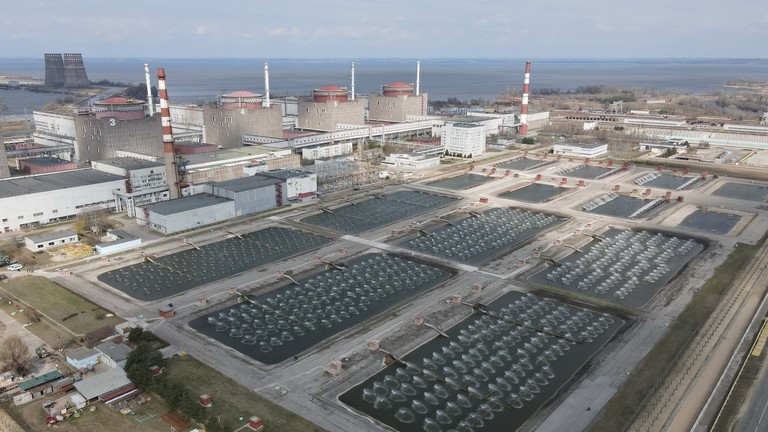
The Zaporizhzhya Nuclear Power Plant (ZNPP) in Ukraine lost all external power for several hours on Monday morning, highlighting the urgent need to protect the facility and prevent an accident, the Director General of the International Atomic Energy Agency (IAEA) said in a statement.
This marked the seventh time that Europe’s largest nuclear power plant had been completely disconnected from the national electricity grid since the start of the full-scale Russian invasion 15 months ago, the agency said, noting that the facility was forced to run on emergency diesel generators once again.
The plant’s only remaining external 750 kilovolt power line had been cut around 5:30am, local time, and re-connected after more than five hours, according to IAEA experts located at the facility.
‘We’re playing with fire’
Agency chief Rafael Mariano Grossi said the situation demonstrated “the highly vulnerable nuclear safety and security situation” at the plant, which has come under shelling during the conflict.
“As I’ve said repeatedly, this simply can’t go on. We’re playing with fire. We must act now to avoid the very real danger of a nuclear accident in Europe, with its associated consequences for the public and the environment.”
The ZNPP was occupied by Russian forces in the early days of the war and is still being operated by Ukrainian personnel.
Most staff live in the nearby town of Enerhodar. On Friday, the IAEA reported that a location close to the town came under artillery fire earlier that day.
Intense negotiations continue
Mr. Grossi said he continues to engage in intense negotiations with all parties to secure the protection of the nuclear plant, stressing that “I will not stop until this has been achieved.”
He explained that the ZNPP does not have any operational back-up power lines since the last one functioning had been damaged in March, which has still not been repaired.
“For more than two and a half months, this major nuclear power plant has only had one functioning external power line. This is an unprecedented and uniquely risky situation. Defence-in-depth – which is fundamental to nuclear safety – has been severely undermined at the ZNPP,” he said.
Still awaiting access
He called for greater efforts to restore the back-up power lines, while also reiterating the need for the IAEA team on site to gain access to the Zaporizhzhya Thermal Power Plant (ZTPP), located nearby.
The ZTPP has an open switchyard through which back-up power has been provided to the nuclear plant in the past. Access has yet to be granted despite reassurances by the Russian state nuclear company, Rosatom.
Following the off-site power cut on Monday, all the nuclear plant’s 20 diesel generators started operating. However, 12 were later switched off, leaving eight running, which is sufficient to operate all systems safely.
The IAEA said its experts at the site were informed that there is enough diesel fuel for 23 days, adding that after the 750 kilovolt line was restored, the diesel generators were gradually turned off.
Ukraine admits to murdering “quite a few” Russian civilians
BY TYLER DURDEN, Zero Hedge, 22 May 23
A senior Ukrainian official has admitted that his country has assassinated “quite a few” Russian civilians who support Putin and his war to assert control of the Donbas region. In interviews first reported by The Times of London, Major General Kyrylo Budanov, who heads Ukraine’s military intelligence service, also promised more attacks are to come.
“We’ve already successfully targeted quite a few people,” said Budanov. He didn’t name any of the victims, but said “there have been well-publicized cases everyone knows about, thanks to the media coverage.”
Since the February 2022 invasion of Ukraine, several prominent Russian supporters of the invasion — and many innocent bystanders — have been killed or wounded in the campaign.
One of the most prominent such attacks happened last August, when a car bomb killed journalist Darya Dugina — in a possible attempt to kill her father, the political scientist-philosopher Aleksandr Dugin.
Like her father, Darya was a vocal supporter of Putin and his invasion. Both she and her father were sanctioned by the United States after the war began. Given her profile, it’s possible Ukraine may have intentionally murdered her in a sinister two-for-one act of punishment.
Most recently, novelist Zakhar Prielepin was wounded in a May 6 car-bombing, and Russian military blogger Vladen Tatarsky was killed at an April public appearance after a woman presented him a statuette with a bomb concealed inside it. Fifteen others were injured.
For perspective, a hypothetical parallel for this campaign would be Iraq’s intelligence service blowing up Iraq-invasion cheerleaders like Bill Kristol, Jeffrey Goldberg, Ann Coulter and Max Boot in 2003. Ukraine’s targeting of civilians doesn’t merely violate vague “international norms” that Washington pretends to hold dear — they are explicitly war crimes.
What’s more, if one accepts the definition of terrorism as “the intentional use of violence against civilians in order to obtain political aims,” Budanov has implicated Ukraine as a state sponsor of terror — one that’s received $37 billion in US military aid since the war started, and perhaps double that in other assistance.
Budanov isn’t merely an unapologetic terrorist, he’s a boastful one. “These cases have happened and will continue,” he said. Such people will receive a well-deserved punishment, and the appropriate punishment can only be liquidation and I will implement it.”……………………………….more https://www.zerohedge.com/geopolitical/ukraine-admits-murdering-quite-few-russian-civilians-who-back-putin-and-his-invasion
1 This Month



26 September – International Day for the Total Elimination of Nuclear Weapons


PLEASE OPPOSE HR 8255 AND S.3639 – bills would accelerate satellite deployment, with no environmental review or safeguards – https://ncstd5li.quorum.us/campaign/169331/
To see nuclear-related stories in greater depth and intensity – go to https://nuclearinformation.wordpress.com
-
Archives
- September 2026 (233)
- August 2026 (330)
- July 2026 (355)
- June 2026 (287)
- May 2026 (306)
- April 2026 (356)
- March 2026 (251)
- February 2026 (267)
- January 2026 (308)
- December 2025 (358)
- November 2025 (359)
- October 2025 (375)
-
Categories
- 1
- 1 NUCLEAR ISSUES
- business and costs
- climate change
- culture and arts
- ENERGY
- environment
- health
- history
- indigenous issues
- Legal
- marketing of nuclear
- media
- opposition to nuclear
- PERSONAL STORIES
- politics
- politics international
- Religion and ethics
- safety
- secrets,lies and civil liberties
- spinbuster
- technology
- Uranium
- wastes
- weapons and war
- Women
- 2 WORLD
- ACTION
- AFRICA
- Atrocities
- AUSTRALIA
- Christina's notes
- Christina's themes
- culture and arts
- Events
- Fuk 2022
- Fuk 2023
- Fukushima 2017
- Fukushima 2018
- fukushima 2019
- Fukushima 2020
- Fukushima 2021
- general
- global warming
- Humour (God we need it)
- Nuclear
- RARE EARTHS
- Reference
- resources – print
- Resources -audiovicual
- Weekly Newsletter
- World
- World Nuclear
- YouTube
-
RSS
Entries RSS
Comments RSS
 nuclear-news