Ukraine preparing attack on Crimea – Zelensky
https://www.rt.com/russia/572038-ukraine-zelensky-crimea-attack/ 27 Feb 23, Kiev already has the resolve necessary for the assault, but is still building up its capabilities, the president says.
Ukraine is readying an offensive to try and seize Russia’s Crimean peninsula, President Vladimir Zelensky said on Friday at a press conference. Kiev is forming new units specifically for the task, with servicemen undergoing training abroad, he revealed.
“We’re taking military steps, we are preparing for them. We are mentally prepared already. We prepare technically, with weapons, forces, we form new brigades, we form offensive units of various kinds and types, we are sending people for training not only in Ukraine, you know, but also in other countries,” Zelensky stated.
The president, as well as other top officials, has repeatedly pledged to re-capture all of the former Ukrainian territories from Russia, including Crimea. The peninsula broke away from the country back in 2014 in the aftermath of the Maidan coup in Kiev, joining Russia after a landslide referendum.
Four other formerly-Ukrainian territories, namely the Donetsk and Lugansk People’s Republics, as well as Zaporozhye and Kherson Regions, were incorporated into Russia after the overwhelming majority of their populations voted in favor of the idea last September.
Neither reunification with Crimea, nor the latest incorporations of other regions got Western recognition, with Kiev and its backers considering these lands part of Ukraine.
Russia has repeatedly warned Kiev against plotting an assault on Crimea. Early in February, former Russian president Dmitry Medvedev, who now serves as Deputy Chair of the Security Council, said that any attack on Crimea would be interpreted as a direct attack on the country itself and would be “met with inevitable retaliation using weapons of any kind.”
How US and Ukraine’s far-right made pro-peace Zelensky a ‘no peace’ president

the exalted version of Zelensky promoted to NATO state audiences today is a sharp contrast to the pro-peace candidate that Ukrainians overwhelmingly elected four years ago.
it is no wonder that the same US political establishment that sabotaged Zelensky’s peace mandate now holds him up as a hero.
In October 2019, as he took steps to implement Minsk in the face of far-right protests and US hostility, Zelensky assured Ukrainians that he was “the president of peace,” and that “ending this war is of utmost importance to me.” He added: “I, the president, am not ready to sacrifice our people. And that is why I choose diplomacy.”
Elected in 2019 to bring peace to Ukraine, a Zelensky aide now declares that “there is no peace with Russia, and Ukraine must arm itself to the teeth.”
Aaron Maté https://mate.substack.com/p/how-us-and-ukraines-far-right-made?utm_source=post-email-title&publication_id=100118&post_id=105251040&isFreemail=false&utm_medium=email 26 Feb 23,
Volodymyr Zelensky marked the one-year anniversary of Russia’s invasion of Ukraine by rejecting any negotiations with the Kremlin.
“There is nothing to talk about and nobody to talk about over there,” Zelensky declared.
The Ukrainian President delivered the message just two weeks after his French and German counterparts urged him, at a meeting in Paris, “to start considering peace talks with Moscow,” the Wall Street Journal reports.
But as an adviser explained to the New York Times, Zelensky is now “more at peace with himself,” and therefore has no need to entertain the possibility of peace with his neighbor.
He has a clear understanding what Ukraine should do,” the adviser said. “There is no ambiguity: There is no peace with Russia, and Ukraine must arm itself to the teeth.”
Zelensky’s “clear understanding” of the need to reject peace with Russia and turn his country into a NATO arms depot is a resounding victory for the Ukrainian far-right and its US government allies. As I wrote here last year, these two powerful forces, aligned by their converging interests in prolonging the post-2014 war in Ukraine’s Donbas region, sabotaged the peace platform that Zelensky was elected on in April 2019. As Adam Schiff put it, the US has used Ukraine’s civil war “so that we can fight Russia over there, and we don’t have to fight Russia here.”
The commemoration of the first anniversary of Russia’s cross-border invasion to end Schiff’s bipartisan “fight” has yielded more insight into how the US, in concert with its ideological allies in Ukraine’s powerful far-right, helped convert Zelensky from pro-peace candidate to “no peace” president.
In a fawning profile, the Washington Post approvingly recounts how Zelensky shifted from naively “thinking peace with Putin was possible” to now believing that “victory is the only answer.” Although the Post attempts to cast Zelensky’s “transformation” as the result of “Russian President Vladimir Putin’s threat,” the details tell a different story.
The Post describes a summer 2019 exchange between the then-rookie president and the top US diplomat in Ukraine, William Taylor. At the time, Zelensky was “expressing curiosity” about the Steinmeier Formula, a German-led effort to revive the stalled Minsk Accords. Minsk, reached in 2015, called for granting limited autonomy to the rebellious Donbas regions in eastern Ukraine in exchange for their demilitarization. Ukraine’s far-right, the driving force behind the 2014 Maidan coup that triggered the ensuing Donbas war, had opposed Minsk’s implementation at every turn.
Zelensky, Taylor recalls, “hoped” that the Steinmeier initiative “might lead to a deal with the Kremlin.” The Ukrainian president “pointed to a document explaining the formulation, thinking that somewhere in the details of the legalese a workable compromise with Moscow might be found.”
But Washington knew better: no compromise with Moscow could be allowed. “No one knows what it is,” Taylor told Zelensky of the German plan. “Steinmeier doesn’t know what it is… It’s a terrible idea.”
The Steinmeier plan was in fact a simple idea, and a welcome one to anyone interested in bringing peace to Ukraine. For his part, Taylor was never shy about advocating war. In a December 2014 letter to The Washington Post, Taylor denounced an opinion article that had opposed sending US arms to Ukraine and advocated an agreement between NATO and Russia to resolve the Ukrainian crisis. Backers of such steps, Taylor wrote, are “advocating that the West appease Russia.… Now is not the time for appeasement.”
This explains why Taylor was similarly hostile to the “terrible” plan named after former German foreign minister Frank-Walter Steinmeier. The Steinmeier Formula called for holding local elections in the rebel-held Donbas areas under Ukrainian law and international supervision. If OSCE monitors certified the results, then Ukraine would regain control of its eastern border and enact a special status law granting the rebellious Donbas regions limited autonomy.
But this road map, along with a similar initiative from French diplomat Pierre Morel, “got nowhere because of opposition in Ukraine,” former UK diplomat Duncan Allan observed for the UK government-funded think tank Chatham House. When Zelensky tried to revive it in late 2019, Allan added, “[a]nother sharp reaction in Ukraine forced him to back down.” As the New York Times now notes in passing, “a backlash at home — with street protesters in Kyiv accusing him of treason for surrendering land — steered the Ukrainian president to a political formula in which he rejected concessions” with Russia.
Specifically, that “backlash” in Ukraine included not only violent protests but outright threats to Zelensky’s life.
“Zelenskyy said he was ready to lose his ratings, popularity, position,” Right Sector co-founder Dmytro Yarosh, commander of the Ukrainian Volunteer Army and former senior Ukrainian military advisor, said shortly after Zelensky’s May 2019 inauguration. “No he would lose his life. He will hang on some tree on Khreshchatyk – if he betrays Ukraine and those people who died in the [Maidan] Revolution and the [Donbas] War.” (Two years after threatening to hang the president from a tree, Yarosh was given a repeat appointment as an advisor to the Commander-in-Chief of the Ukrainian military. The Ukrainian military subsequently claimed that the appointment was withdrawn).
Despite the internal and external opposition, Zelensky departed a meeting with Putin in December 2019 feeling “hopeful”, the Post reports. “Within weeks, Russia agreed to a broader prisoner exchange and offered Ukraine a $3 billion gas arbitration settlement as well as a new gas transit deal.”
But on top of the far-right backlash at home, Zelensky’s peace initiative faced direct hostility from Ukraine’s patron in Washington. After warning Zelensky against pursuing a “terrible” European-brokered peace plan, William Taylor soon became a hero of Trump’s first impeachment over Ukraine. At the impeachment proceedings, which kicked off in October 2019 just as Zelensky was trying to follow through on his peace mandate, Taylor was summoned to assure Congress and a Russiagate-crazed media class that Trump’s pause on weapons subsidies for the Ukrainian fight against the Russia-backed Donbas rebels endangered “our national security.” (For his services, the New York Times lauded Taylor as “a septuagenarian Vietnam veteran with a chiseled face and reassuring gray hair,” while the Washington Post declared him to be a “meticulous note taker.”)
The prevailing imperative to use Ukraine “to fight Russia over there” (Schiff) meant that Zelensky had no chance to pursue the “terrible” Minsk agreement that Taylor and other influential proxy warriors opposed.
“The reality is that Ukraine depends on political, diplomatic, economic and military support from the West, and particularly from the United States,” Samuel Charap of the Pentagon-tied RAND Corporation wrote in November 2021. Up to that point, “Ukraine has shown little desire” to “[implement] its obligations under the Minsk II agreement,” and the US had “not yet used its influence to push for progress on the Donbas conflict.” If the Ukrainian government could be pushed “toward complying”, Charap noted, that “might actually invite de-escalation from Russia” while saving Ukraine “from calamity.”
But by then, Zelensky had decided to side with the forces that had sabotaged him. According to the Post’s account, citing David Arakhamia, the leader of Zelensky’s faction in parliament: “By early 2021, Zelensky believed that negotiations wouldn’t work and that Ukraine would need to retake the Donetsk and Luhansk regions ‘either through a political or military path.’” As a result, “[t]he Kremlin disengaged.”
Zelensky’s early 2021 decision that “negotiations wouldn’t work” explains why, in early 2022, he shunned all opportunities to prevent Russia’s looming invasion. At the final talks on implement Minsk, a “key obstacle,” the Washington Post reported, “was Kyiv’s opposition to negotiating with the pro-Russian separatists.” When Germany proposed a last-minute deal in which Ukraine would “renounce its NATO aspirations and declare neutrality as part of a wider European security deal,” Zelensky turned it down, according to the Wall Street Journal. After rejecting diplomacy, Zelensky’s government then significantly increased its shelling of the Donbas, a potential step toward trying to “retake the Donetsk and Luhansk regions” via the “military path” that the Washington Post has newly confirmed.
And as the recent disclosures of former Israeli Prime Minister Naftali Bennet underscore, the US went from sabotaging Zelensky’s peace mandate before the Russian invasion to blocking diplomatic efforts in the period since.
As a result, the exalted version of Zelensky promoted to NATO state audiences today is a sharp contrast to the pro-peace candidate that Ukrainians overwhelmingly elected four years ago.
In October 2019, as he took steps to implement Minsk in the face of far-right protests and US hostility, Zelensky assured Ukrainians that he was “the president of peace,” and that “ending this war is of utmost importance to me.” He added: “I, the president, am not ready to sacrifice our people. And that is why I choose diplomacy.”
By now choosing to reject diplomacy, President Zelensky has shown that he is more than willing to sacrifice his people for the sake of his NATO state patrons’ desired proxy war against Russia. Accordingly, one year into the catastrophic Russian invasion that it helped provoke, it is no wonder that the same US political establishment that sabotaged Zelensky’s peace mandate now holds him up as a hero.
Courting disaster —Missiles have been passing too close to Ukraine’s reactors

Courting disaster — Beyond Nuclear International Embroiled in a year-long war, Ukraine’s reactors face new threats
By Linda Pentz Gunter
A year ago, we warned of the significant and unacceptable risks to Ukraine’s 15 nuclear reactors, should they become caught up in a war zone as a consequence of an invasion by Russia. A year later, as we outlined in a Beyond Nuclear press release, those risks have become a reality. And in recent days, the scares and close calls have ramped up again.
Just last week, cruise missiles flew dangerously low over the South Ukraine nuclear power plant in the country’s western region. Then alarms were raised as observers noticed an alarming drop in the water level of the Kakhovka Reservoir, on which the six-reactor Zaporizhzhia nuclear power plant depends for its essential cooling water supply.
A missile strike or loss of cooling water are just two of the many scenarios that could lead to a nuclear power plant disaster in Ukraine. Others include loss of electricity supply, human error or sabotage. The conditions of war just make any and all of these outcomes far more likely.
Indeed, these latest close calls and others prompted a recent statement by the head of Germany’s Federal Office for Radiation Protection, Inge Paulini, who warned that an incident at one of Ukraine’s nuclear power plants would have, “far-reaching consequences as long as the war continues.” And yet, she pointed out, “this danger already seems to be receding into the background of public awareness.”
Indeed, it has been a consistent pattern in the press not to take nuclear power risks seriously. Instead, the media publishes story after story, planted there by a well-orchestrated worldwide nuclear industry campaign, about the benefits of expanding nuclear power.
The Ukrainian energy ministry would seem to agree. Even in the midst of this devastating war, it has just made a deal with the American company, Westinghouse, to purchase two new AP1000 reactors. It is of course unrealistic to envisage these actually being built during a war and, if ever operational, they would simply become additional lethal targets.
In Ukraine, we have seen Russia routinely attack the electric grid, leading to periodic loss of offsite power at all four of Ukraine’s nuclear power plant sites. Zaporizhzhia, in the contested southeastern part of the country, has experienced multiple disconnections from the grid. So far, the diesel generators have functioned until offsite power was restored. But they are reliant on a steady replenishment of fuel, which could be impeded were the plant to come under siege.
A ready supply of cooling water is also essential so the drain down of the Kakhovka Reservoir is a serious concern. Why this is happening is unclear, but it is thought to be a possible Russian military tactic to flood strategic areas, making them impassable to advancing Ukrainian troops.
The unimaginable stress that continues to be experienced by the depleted workforce at Zaporizhzhia adds to the possibility of a fatal human error. Human error was at the root of both the 1979 Three Mile Island nuclear power plant accident in the United States and the 1986 Chornobyl Unit 4 explosion in Ukraine, without the contributing stress factor of war conditions.
The proximity of cruise missiles to nuclear plants is a nightmarish disaster waiting to happen, even if they are on their way to other targets, for now. But whether deliberate or accidental, a serious assault would release potentially enormous amounts of dangerous radioactive isotopes into the environment.
The reason damage from a nuclear power plant disaster is so serious is in part due to the longevity of the radioactive isotopes released and also because the fallout deposits these into the food chain by contaminating water, soil, crops and livestock.
Some of the enduring health outcomes include thyroid cancer, birth defects, still births, neonatal deaths, leukemias — especially among children — cancers and cardiovascular disorders. However, it should be noted that studies have also found elevated rates of leukemia in children living close to routinely operating nuclear power plants.
The international response so far has come mainly from the International Atomic Energy Agency (IAEA), which has called for safe zones around Ukraine’s nuclear power plants but so far has been unsuccessful in instituting these. And safe zones, while an essential first step, only prevent disaster resulting from a direct hit but are ineffective against loss of grid access or human error. Indeed, the IAEA has been struggling for more than two weeks simply to get a shift change of its observers at Zaporizhzhia accomplished. So far, conditions have remained too dangerous to allow this. “The Agency is doing everything it can to conduct the safe rotation of our staff there as soon as possible,” IAEA director, Rafael Grossi said.
Apart from being pre-deployed radiological weapons, nuclear power plants must, for safety reasons, be shut down when embroiled in a war. In Ukraine, where 50% of the country’s electricity is supplied by nuclear power, this means plunging an already terrified population into greater misery in the midst of winter. The lesson learned is that nuclear power, due to its inherent dangers, cannot serve as a reliable energy source. We must reject it as we do nuclear weapons and turn to other, more benign and renewable ways of supplying electricity.
Linda Pentz Gunter is the international specialist at Beyond Nuclear and writes for and curates Beyond Nuclear International.
Headline photo of Rocket in Kupiansk city (Kharkiv region of Ukraine) after Russian shelling. February 2023 by Олексій Мазепа / АрміяInform/Wikimedia Commons.
The Horrifying Endgame in Ukraine

This entire scenario is a long slow march toward nuclear war or the complete disintegration of Ukraine.
The U.S. won’t end the weapons deliveries because Joe Biden is afraid of losing face and his closest advisors such as Victoria Nuland have an irrational hatred for Russia and are total warmongers.
BY JAMES RICKARDS, 14 Feb 23, https://dailyreckoning.com/the-horrifying-endgame-in-ukraine/—
In yesterday’s issue, I addressed the biggest and most complex topic on the geopolitical landscape today — China.
But today I’m discussing what is by far the most alarming topic on the geopolitical landscape today. That’s the war in Ukraine and the dangers of escalation.
I’ve written extensively about two facets of the war in Ukraine that you don’t hear from legacy media in the United States or U.K. The first is that Russia is actually winning the war.
U.S. outlets such as The New York Times (a channel for the State Department) and The Washington Post (a channel for the CIA) report endlessly about how Russian plans have failed, about how incompetent they are about how the Armed Forces of Ukraine (AFU) have pushed back Russians in the Donbass, and how NATO weapons such as U.S. Abrams tanks, U.K. Challenger tanks and German Leopard tanks will turn the tide against Russia soon.
This is all nonsense. None of it is true.
Reality Check
First off, the Ukrainian advances that took place in late summer were against lightly defended positions that the Russians quickly conceded to conserve forces. The Russians were willing to give up the land so that they wouldn’t lose valuable men and materiel.
The Russians withdrew to more defensible positions and have been badly mauling Ukrainian attacking forces ever since. Ukraine has wasted incredibly large amounts of men and equipment in these futile and ill-advised attacks.
In all, credible reports indicate that AFU casualties are nearing 500,000 and are increasing at an unsustainable rate. On the other hand, reports of 100,000 Russian dead are almost certainly wild exaggerations put out by Ukraine. The BBC attempted to verify these numbers and could only find about 20,000 confirmed Russian dead based on extensive searches on funeral notices, public records, etc.
Send in the Tanks — Eventually!
What about the tanks NATO is supposedly sending? Well, the tanks have not been delivered yet and most won’t be for months or longer. Our own M1 Abrams tanks might not even arrive for a year or more.
We actually have to custom build these tanks so that they don’t have the special armor and other advanced systems that our own M1s have. The Pentagon doesn’t want them falling into Russian hands if they’re destroyed or captured. Besides, we’re only sending 31 tanks anyway.
When the NATO tanks do arrive, they’ll likely quickly be destroyed by Russian artillery, anti-tank weapons and precision missiles. They’re good tanks, but far from invincible. For decades, the Russians have been developing powerful weapons specifically designed to destroy these NATO tank models. The Russians aren’t particularly worried about them.
Aside from that, tanks rely on effective air cover for protection, which Ukraine lacks. They’ll be sitting ducks on the battlefield. It doesn’t really make sense to send tanks to Ukraine unless you send combat aircraft to give them cover (more on that below).
Russia’s Winning on the Battlefield
Meanwhile, Russian forces have nearly encircled the city of Bakhmut, which is a major transportation and logistics hub, with several key roads and rail lines passing through it. It’ll probably fall to the Russians within weeks.
Losing Bakhmut will be a major blow to Ukraine, despite claims in the western media that it really isn’t very important. Ukraine’s entire 800-mile defensive line would probably begin to crumble, and they don’t have heavily fortified positions to fall back on. Ukrainian troops, while brave and competent soldiers, are exhausted and running out of supplies as it is.
On top of that, it appears likely that Russia is preparing a devastating offensive with massive amounts of men, tanks, armored personnel carriers, artillery, helicopters, drones and fixed-wing aircraft.
This Russian army is not the same army that invaded Ukraine a year ago. It’s much better trained, led and equipped. It’s learned from the mistakes it made during its initial invasion last February. Ukraine shouldn’t expect them to repeat those mistakes.
Does all this mean I’m cheering on a Russian victory in Ukraine? No, I’m just observing the facts on the ground and consolidating them to perform an objective analysis.
That analysis leads me to believe that Russia will win the war militarily. Western military assistance may prolong the fighting but won’t affect the ultimate outcome. It’ll just delay the inevitable and get a lot more people needlessly killed.
The Much Greater Risk
The second facet of this war not reported in the media, or at least downplayed, is the growing risk of nuclear war.
This risk increases with every escalatory step by both sides. The U.S. is the leader in reckless escalation by supplying long-range artillery, Patriot anti-missile batteries, intelligence, surveillance, and now the tanks. Russia responds at each step.
There’s a number of steps before the two sides arrive at the nuclear level, but neither shows a willingness to step back.
By the way, Russia has every legal right to attack those NATO countries supplying arms to Ukraine. By supplying arms to a party to the conflict, they’ve given up their neutrality and have become, in effect, combatants. Russia hasn’t done this because it doesn’t want to bring NATO directly into the fight. But legally, it can.
Gimme, Gimme, Gimme
Ukraine’s demands on the U.S., UK and the rest of NATO for advanced weapons to fight Russians know no limits. The West began by supplying Ukraine with cash, intelligence and anti-tank weapons such as the Javelin missile. Soon we were supplying long-range artillery, drones, and more cash.
As Russian advances continued, Zelensky demanded and got Patriot anti-missile batteries that can destroy incoming Russian missiles. The U.S. artillery was aimed at Russian Crimea. Several drones struck inside Russia at sensitive air bases with nuclear weapons nearby.
Gimme, Gimme, Gimme
Ukraine’s demands on the U.S., UK and the rest of NATO for advanced weapons to fight Russians know no limits. The West began by supplying Ukraine with cash, intelligence and anti-tank weapons such as the Javelin missile. Soon we were supplying long-range artillery, drones, and more cash.
As Russian advances continued, Zelensky demanded and got Patriot anti-missile batteries that can destroy incoming Russian missiles. The U.S. artillery was aimed at Russian Crimea. Several drones struck inside Russia at sensitive air bases with nuclear weapons nearby.
Once these advanced systems show they can’t help, what’s the Ukrainian’s next demand? Russia can escalate just as quickly and lethally as the U.S.
This entire scenario is a long slow march toward nuclear war or the complete disintegration of Ukraine.
Is Anyone Really Prepared for This?
The U.S. won’t end the weapons deliveries because Joe Biden is afraid of losing face and his closest advisors such as Victoria Nuland have an irrational hatred for Russia and are total warmongers.
Now, we can add a new danger, resulting from desperation. This is the fact that the U.S. itself may be the biggest loser in the war.
As Ukraine disappears under a massive Russian onslaught, the U.S. will grow increasingly desperate. Its credibility is on the line after committing so much money, materiel and moral weight to Ukraine’s defense.
The Biden administration has essentially turned the war in Ukraine into an existential crisis for the U.S. and NATO, when it never should have been. Ukraine has never been a vital U.S. interest. But the war is existential for Russia, and Russia won’t give up.
Is the U.S. just going to throw up its hands and concede Russian victory? NATO may actually disintegrate in the face of such spectacular failure. So, we’ll probably double down.
Maybe a desperate Biden orders troops into western Ukraine as a buffer against a complete Russian takeover of the country. You can imagine what could go wrong. That situation may quickly devolve into a direct war between the U.S. and Russia rather than the proxy war that it is now.
The American people and investors in particular are not prepared for any of this. They should be. It’s becoming increasingly likely.
Betting on Ukraine victory was ‘suicidal’ – Seymour Hersh
https://www.rt.com/russia/571690-hersh-ukraine-nato-corruption/ 18 Feb 23
The West didn’t even want Kiev in NATO because of corruption concerns, the Pulitzer Prize-winning journalist says.
The US and its allies should have attempted to reach an agreement with Moscow as their belief that Ukraine can win a conflict against Russia is “suicidal,” iconic American investigative journalist Seymour Hersh has argued.
Speaking in a YouTube interview with the Consortium News outlet on Friday, Hersh accused the Biden administration of making “so many bad mistakes,” adding that “it’s impossible to believe just how dumb this leadership was.”
“It was suicidal to think you can win that war, that Ukraine can win the war [against Russia]. There’s just too much corruption. That was a very, very bad decision. We should have been pushing for peace, we should have made an agreement,” the former Pulitzer Prize winner insisted.
US President Joe Biden basically “blew off NATO in Europe” by telling allies that he is backing Ukraine with its “totally corrupt government,” Hersh added. The journalist also pointed out how Kiev glorifies Stepan Bandera, “the great pro-Nazi who killed Jews like crazy during World War II.”
It’s just silly not to right away assure the Russian government that we weren’t interested in making Ukraine a member of NATO,” Hersh stated, referring to long-standing concerns in Moscow. “NATO didn’t want Ukraine anyway because of the corruption.”
Hersh recently published a bombshell report which accused the US of sabotaging the Nord Stream pipelines last year. He cited an informed source as explaining that explosives were planted on the bottom of the Baltic Sea by US Navy divers under the guise of a NATO exercise back in June 2022. They were detonated in late September, rendering the pipelines, which were built to deliver Russian gas to Europe through Germany, inoperable.
US Secretary of State Antony Blinken, as well as Under Secretary for Political Affairs Victoria Nuland and National Security Advisor Jake Sullivan, are all “very hawkish,” according to the journalist. The trio “pushed Biden very hard” to go ahead with the sabotage because “they have long-standing incredible hatred for [Russian President Vladimir] Putin. It’s almost personal, I would guess,” Hersh claimed.
READ MORE: More Nord Stream ‘bombshells’ to come – Seymour Hersh
US National Security Council spokeswoman Adrienne Watson branded Hersh’s bombshell report “utterly false and complete fiction.” The journalist has promised even more revelations on how the pipelines were blown up.
Ukraine Presses US Congress Members for F-16 Jetfighters
Sunday, 19 February, 2023 -Asharq Al-Awsat
Ukrainian officials have urged US Congress members to press President Joe Biden’s administration to send F-16 jetfighters to Kyiv, saying the aircraft would boost Ukraine’s ability to hit Russian missile units with US-made rockets, lawmakers said.
The lobbying came over the weekend on the sidelines of the Munich Security Conference in talks between Ukrainian officials, including Foreign Minister Dmytro Kuleba, and Democrats and Republicans from the Senate and House of Representatives.
“They told us that they want (F-16s) to suppress enemy air defenses so they could get their drones” beyond Russian front lines, Senator Mark Kelly, a former astronaut who flew US Navy fighters in combat, told Reuters on Saturday evening.
Biden last month said “no” when asked if he would approve Ukraine’s request for Lockheed-Martin-made F-16s.
Four delegations from the Senate and House combined in what members called the largest number of US lawmakers to attend Europe’s premier security gathering since it started in 1963, demonstrating clear bipartisan support for Ukraine…………………………
Calls to supply Ukraine with advanced jetfighters follow agreements last month by France, Britain, the United States and Germany to supply Kyiv with modern battle tanks…….. https://english.aawsat.com/home/article/4167481/ukraine-presses-us-congress-members-f-16-jetfighters
Post-war Ukraine – a triumphal land owned by Western business corporations.
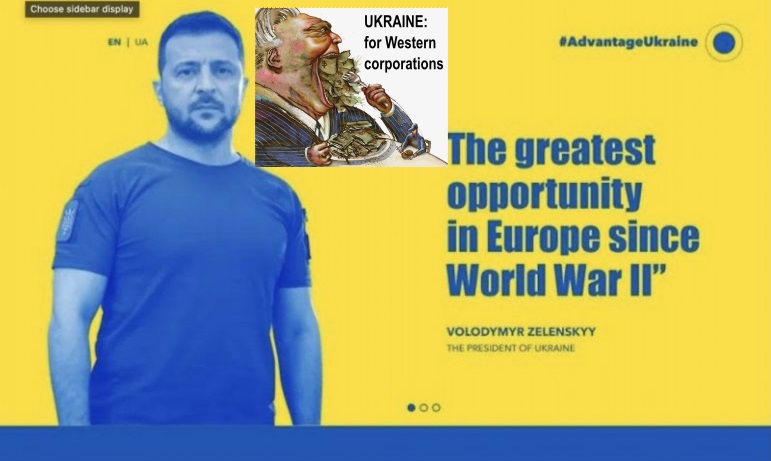
tough neoliberal policies to be imposed on post-war Ukraine, with calls for cutting labour laws , “opening markets”, lowering tariffs, deregulating industries and “selling state-owned enterprises to private investors”.
Zelensky invited foreign companies to come and exploit its abundant resources and cheap labour and offered Wall Street “a chance to invest … in projects worth hundreds of billions of dollars”.
Along with the nature of the arms being supplied, so have the objectives changed, at least the stated ones. We started, so it seems, to help Ukraine defend itself against Russian invasion, then we began talking about a “Ukrainian victory” to inflict a “strategic defeat” on Russia that would leave it “weakened”, with the fall of the Putin government. We have now reached the point that a former Polish foreign minister, currently a MEP, organised a meeting in the European Parliament on January 31, 2023 to “discuss the prospects for decolonisation and de-imperialisation of the Russian Federation” (i.e., the dissolution of the Russian Federation).
Great Expectations: The Ukraine to come, By Stefania Fusero, New Cold War, Feb 13, 2023:
Originally published in Italian on La Citta Futurà, Feb 11, 2023:
The collective West, increasingly becoming more directly involved in the conflict in Ukraine, has been vague about the objectives of its participation in the war and has repeatedly contradicted itself on the nature and number of weapons to be sent to Ukraine. From another standpoint, however, it has maintained clarity and constancy over time: the total dedication to a neoliberal project for a Ukraine open to Western corporations in which workers have no guardianship or protection.
The Western powers – the USA, NATO and the EU – have maintained a linear, unequivocal and steady standpoint on the management of the conflict in Ukraine, if not a vocal partisan support for one of the parties involved (the post-Maidan Ukrainian government), the demonisation of the Russian Federation and a disdainful rejection of the ancient art of diplomacy.
While French president Macron, a week after the entry of Russian troops into Ukraine stated, “we are not at war against Russia”, after less than a year the German foreign minister Annalena Baerbock declared in front of the EU parliamentarians “we are fighting a war against Russia.” On the other hand, if at the beginning of the Russian military operations Biden pledged to avoid a direct conflict between the US and Russia, US intelligence officials have recently revealed that not only have the CIA and US special forces been conducting clandestine military operations in Ukraine, but that the CIA, together with a spy agency of another NATO country, is engaged in sabotage operations within the Russian Federation itself.
Not to mention the escalation in arms shipments to Ukraine by Western countries – the most striking example is certainly Germany, which at the beginning of the conflict reluctantly announced that it would just send helmets and a field hospital, then, amid the indignation expressed by various allied countries and subjected to ever stronger pressure, after less than a year announced it would send tanks, no less. Thus, in a few months, Germany reneged on the principles of foreign policy pursued after the defeat of Nazism, one of which required Germany not to send weapons to any conflict zones, a policy which can be summed up in the German pledge ‘never again’. Which amounts to a complete reversal of the policy of peaceful coexistence with Russia and Eastern Europe pursued by such statesmen as Willy Brandt, having major implications for the entire European continent, not just Germany.
Just a few years have passed – but it feels like centuries – since, on 7 May 2015, Foreign Minister Frank-Walter Steinmeier solemnly celebrated in Volgograd the 70th anniversary of the end of WW2. “Here in Stalingrad, these people brought about the first decisive turnaround in the war. Here in Stalingrad, these people began Europe’s liberation from Nazi dictatorship. In doing so, they made immeasurable sacrifices. As a German, I bow before these victims in sorrow. And I ask for forgiveness for the infinite suffering that Germans inflicted on others in the name of Germany, here in this city, all over Russia, in the parts of the then Soviet Union that are now Ukraine and Belarus, and all over Europe…”.
No one has described such escalation better than former Ukrainian Defence Minister Oleksii Reznikov as of October last year. “When I was in D.C. in November, before the invasion, and asked for Stingers, they told me it was impossible. Now it’s possible. When I asked for 155mm guns, the answer was no. HIMARS, no. HARM, no. Now all of that is a yes. Therefore, I’m certain that tomorrow there will be tanks and ATACMS and F-16s.”
Along with the nature of the arms being supplied, so have the objectives changed, at least the stated ones. We started, so it seems, to help Ukraine defend itself against Russian invasion, then we began talking about a “Ukrainian victory” to inflict a “strategic defeat” on Russia that would leave it “weakened”, with the fall of the Putin government. We have now reached the point that a former Polish foreign minister, currently a MEP, organised a meeting in the European Parliament on January 31, 2023 to “discuss the prospects for decolonisation and de-imperialisation of the Russian Federation” (i.e., the dissolution of the Russian Federation).
On the other hand, it is not the first time that a plan to dismantle the Russian Federation has been openly talked of, under the guise of an improbable anti-imperialist struggle – see for example a conference organised on June 23, 2022 in Washington by the CSCE, a US government agency otherwise known as the Helsinki Commission. If anything, such initiatives can now be officially held at the institutional seat of the EU parliament.
Whereas the trajectory of Western military involvement in the Ukraine conflict has apparently been confused and cobbled together, the stance on the economic, social and political future of Ukraine has instead remained clear and constant over time.
The table is laid
4-5 July 2022, Lugano: Ukraine Recovery Conference.
Representatives of Western governments and corporations (US, EU, UK, Japan and South Korea) met in Switzerland to plan a series of tough neoliberal policies to be imposed on post-war Ukraine, with calls for cutting labour laws , “opening markets”, lowering tariffs, deregulating industries and “selling state-owned enterprises to private investors”. The URC (Conference on the Recovery of Ukraine) was not a novel initiative, but a continuation of the “Conference on the Reform of Ukraine”(URC) started in 2017. Same acronym, same spirit, i.e., to urge “strengthening market economy”, “decentralisation, privatisation, state enterprise reform, land reform, state administration reform” and “Euro-Atlantic integration”.
September 6, 2022: Volodymyr Zelensky virtually opens the New York Stock Exchange by symbolically ringing the bell via video streaming.
On the same day he had an editorial in the Wall Street Journal in which he launched the neoliberal ‘Advantage Ukraine’ program. Zelensky invited foreign companies to come and exploit its abundant resources and cheap labour and offered Wall Street “a chance to invest … in projects worth hundreds of billions of dollars”.
January 23, 2023: Zelensky delivers a video speech to the US National Association of State Chambers of Commerce meeting at Boca Raton, Florida, entitled After the War, American Business Can Become a Locomotive of Global Economic Growth.
A transcript of the speech is published on the institutional website of the Ukrainian presidency: “And – when we’ll be able to end this war by throwing out the occupiers – in the same manner together we’ll be able to start the difficult work of rebuilding Ukraine – our cities, our economy, our infrastructure. It is already clear that this will be the largest economic project of our time in Europe. It is obvious that American business can become the locomotive that will once again push forward global economic growth.
We have already managed to attract attention and have cooperation with such giants of the international financial and investment world such as Black Rock, J.P. Morgan and Goldman Sachs. Such American brands as Starlink or Westinghouse have already become part of our, Ukrainian, way… And everyone can become a great business by working with Ukraine. In all sectors -from weapons and defence to construction, from communications to agriculture, from transport to IT, from banks to medicine.”
Disaster capitalism
As to now, no one is able to predict what will remain of Ukraine at the end of the war, but the project of the Western actors involved is very clear and has already begun to be put into practice.
Ukraine was already the poorest country in Europe and if, like all the others in the former Soviet Union, it suffered from the brutal shock therapy* that had turned them into market economies, the neoliberal shock therapy imposed was not as devastating to Ukraine as it was to Russia. And there are still some state-owned assets in Ukraine to appeal to Western corporations. Last August Zelensky effectively eliminated the right to collective bargaining and union representation for the majority of Ukrainian workers, thus making them even poorer.
As economist Michael Hudson argues, Ukraine may well be the poorest country in Europe, but it is so for 99% of citizens; for the remaining 1% – the corrupt kleptocrats of the most corrupt country in Europe – it will instead become the richest country. And of course, the invitation to exploit the country’s riches is being extended to investors on the New York Stock Exchange. “Come on in and join the party! Someone’s loss is turned into somebody else’s gain. And that’s what happens in a class war. It’s a zero-sum game. There is no attempt at all to raise living standards.”
Class war has long been declared on the lower classes in the entire collective West, not just in Ukraine, suffice it to recall what French President Macron said last August: “What we are currently living through is a kind of major tipping point or a great upheaval…we are living the end of what could have seemed an era of abundance…”
Professor Michael Hudson comments: “When he said the ‘end of abundance’, what he really meant was the beginning of an IMF austerity program applied to Europe. And the end of the abundance for the 90% is a bonanza of abundance for the 1%, for the financial sector. They’re making huge, huge gains in all of this… Austerity for the population means we’re now going to put the class war in business here…It’s lower wages, enabling higher profit opportunities for the companies. It’s going to be the end of abundance for wage earners, but it’ll be a bonanza for the monopoly owners and for the banks.”
It is class warfare in Europe and the USA, but in Ukraine it is simultaneously a vicious, cynical proxy war that has been mercilessly shredding hapless Ukrainians into cannon fodder.
* the so-called shock therapy was inaugurated in Pinochet’s Chile, then it was implemented in Russia and in the other USSR countries after the end of the Soviet Union to turn them into market economies. Prices were liberalised while eliminating any social guarantees for citizens, causing an increase in excess mortality and a decrease in life expectancy, together with growing economic inequality, corruption and poverty. Assets and companies were sold out at bargain prices to local and foreign speculators who became enormously rich, while the social fabric unravelled causing an exponential increase in disease, suicide and crime.
Sources:
Mission Creep? How the US role in Ukraine has slowly escalated,
Branko Marcetic in Responsible Statecraft, 23 Jan 2023
The dissolution of the Russian Federation is far less dangerous than leaving it ruled by criminals, Anna Fotyga, 27 Jan 2023
German tanks in the Ukraine. Again (Maria Zakharova, Russian foreign ministry spokeswoman)
German tanks in the Ukraine. Again (Maria Zakharova, Russian foreign ministry spokeswoman)
Speech by Foreign Minister Frank-Walter Steinmeier in Volgograd to commemorate the end of the Second World War 70 years ago, Federal Foreign Office 7 May 2015
Decolonizing Russia – a moral and strategic imperative, CSCE 23 June 2022
President of Ukraine’s address to the participants of the meeting of the National Association of State Chambers, President of Ukraine 23 Jan 2023
West prepares to plunder post-war Ukraine with neoliberal shock therapy: privatization, deregulation, slashing worker protections, Ben Norton in Geopolitical Economy, 28 July 2022
Zelensky is literally selling Ukraine to US corporations on Wall Street, Ben Norton in Geopolitical Economy, 9 Sept 2022
Ukraine’s Zelensky sends love letter to US corporations, promising ‘big business’ for Wall Street, Ben Norton in Geopolitical Economy, 25 Jan 2023
Economist Michael Hudson on debt relief, inflation, Ukraine disaster capitalism, petrodollar crisis, Ben Norton in Geopolitical Economy, 8 Sept 2022
Zelensky is literally selling Ukraine to US corporations on Wall Street.
Ukraine’s Western-backed leader Volodymyr Zelensky opened the New York Stock Exchange telling Wall Street his country is “open” for foreign corporations to exploit it with $400 billion in state selloffs.
ByBen Norton, 2022-09-09
Ukraine’s Western-backed leader Volodymyr Zelensky virtually opened the New York Stock Exchange on the morning of September 6, symbolically ringing the bell via video stream.
Zelensky announced that his country is “open for business” – that is to say, that foreign corporations are free to come and exploit its plentiful resources and low-paid labor.
In a speech launching the neoliberal selloff program Advantage Ukraine, Zelensky offered Wall Street “a chance for you to invest now in projects worth of hundreds of billions of dollars.”
The financial news service Business Wire published a press release from the Ukrainian government in which Zelensky boasted:
The $400+ [billion] in investment options featured on AdvantageUkraine.com span public private partnerships, privatization and private ventures. A USAID-supported project team of investment bankers and researchers appointed by Ukraine’s Ministry of Economy will work with businesses interested in investing.
………………………….. The press release cited executives of US corporate giants Google, Alphabet, and Microsoft, who salivated over the economic possibilities offered by Ukraine.
Reuters noted that the Ukrainian government hired British public relations firm WPP to run the marketing operation for Advantage Ukraine.
Zelensky coordinated his New York Stock Exchange publicity stunt with an editorial in the Wall Street Journal imploring US capitalists to “Invest in the Future of Ukraine.”
“I committed my administration to creating a favorable environment for investment that would make Ukraine the greatest growth opportunity in Europe since the end of World War II,” Zelensky wrote.
Multipolarista previously reported on a meeting by Western governments and corporations in Switzerland in July in which they planned harsh neoliberal economic policies to impose on Ukraine.
The Western participants published documents calling to cut labor laws, “open markets,” drop tariffs, deregulate industries, and “sell state-owned enterprises to private investors.”
In an interview with Multipolarista, economist Michael Hudson compared the new emergency anti-labor laws imposed by the Ukrainian government to the brutal neoliberal policies implemented by Chile’s far-right Pinochet dictatorship after a CIA-backed coup in 1973.
“It’s jaw dropping,” Hudson said of Zelensky’s Wall Street Journal op-ed. “It’s like a parody of what a socialist would have written about how the class war would be put in into action by a fascist government.”
“So of course he was welcomed on the stock exchange for abolishing labor’s rights,” Hudson added. “You could not have a more black-and-white example” of class war………………………………… https://geopoliticaleconomy.com/2022/09/09/zelensky-selling-ukraine-wall-street/
US role in Kiev’s artillery warfare identified – media
Rt.com Feb 10 2023
The American military is “controlling every shot” with Pentagon-supplied rockets, a Ukrainian official told the Washington Post
The Ukrainian military requests precise coordinates from the Pentagon for almost every rocket fired from US-made artillery systems, and would not fire a shot without getting them, according to a report by the Washington Post.
Three Ukrainian officials and one senior US official spoke to the newspaper, on condition of anonymity, about America’s involvement. One Ukrainian source implied that Washington has the final say on every action, making the case for the delivery of longer-range rockets to Kiev………………………. more https://www.rt.com/russia/571265-us-coordinates-ukrainian-strikes
Did Volodymyr Zelensky call for ‘preventive nuclear strikes’ against Russia? Not exactly
Social media users have been circulating a video of Ukrainian president Volodymyr Zelensky, claiming that the footage shows him calling on NATO to launch preventive nuclear strikes against Russia. It turns out, however, that this footage isn’t new – Zelensky made these statements back in October 2022. Moreover, the translation of his statement, originally in Ukrainian, leaves out some nuance.
- Far-right Twitter accounts have been sharing a video of Volodymyr Zelensky speaking in Ukrainian. According to the English subtitles on the speech, Zelensky is calling on NATO to “launch preventive strikes against Russia” and “use nuclear weapons”. These accounts said the footage was evidence of a risk of “nuclear war.”
- The video also circulated in French-language accounts and was even shared by a French senator.
- Turns out, however, this footage isn’t new. It was actually recorded on October 6, 2022 – and Zelensky’s comments did create a bit of a stir. However, the subtitles on the video that has been circulating recently are a little off, making Zelensky’s words sound even more menacing than the reality……………………….
Old footage and inexact translations
If you type “Zelenskyy preventive strikes” into Google, then one of the first things that comes up is an article published by Politico on October 7, 2022.
The article says that Zelensky participated in a discussion at the Lowy Institute, an Australian think tank. During that discussion, Zelensky said through an interpreter that NATO should take “preventive strikes”, before the interpreter corrected himself to say “preventive action”.
………….. The FRANCE 24 Observers team also consulted with the Ukrainian-language team at RFI. The team said that the subtitles on the video weren’t quite accurate.
The interviewer asks Zelensky what more he would like NATO to do to deter Russia.
Zelensky doesn’t say that “they could use nuclear arms against Russia”. What he actually says is that they should “prevent Russia from using nuclear weapons”.
Essentially, he says the opposite of what the subtitles indicate. ……………………
In the video posted by the Lowy Institute (at 25:30), you can hear the interpreter correct himself. He starts by saying “preventive strikes” before correcting himself, saying “preventive action”. However, the Ukrainian word that Zelensky uses, удари, does mean strikes.
So what did the Ukrainian president mean? At one point he mentions the period “before February 24”. That would mean the time before Russia invaded Ukraine.
While the president’s word choice is confusing, it is possible that he meant using economic or diplomatic sanctions to dissuade Russia from using its nuclear weapons.
That’s the interpretation taken by a number of Ukrainian officials, including Zelensky’s adviser Mykhailo Podolyak. Podolyak was interviewed by a Ukrainian media outlet on October 6, 2022.
“Zelensky was referring to Russia’s nuclear threats and suggesting that the world should make clear the consequences for Russia [if they do use nuclear weapons] and intensify strikes against the Russian Federation, like sanctions and providing armed assistance [to Ukraine].”
Back in October, Russian authorities did criticise Zelensky’s choice of words, believing they were a call to strike Russia. Dmitri Peskov, spokesperson for the Kremlin, said that Zelensky’s words were a call to “kick off a global war with disastrous and impossible-to-predict consequences”.
In summary, this footage doesn’t show Ukrainian President Zelensky calling on NATO to strike Russia using nuclear weapons in 2023. The footage is from 2022 and the translation isn’t accurate; it makes his statements seem more threatening. https://observers.france24.com/en/europe/20230210-zelensky-ukraine-preventive-strikes-nuclear-russia-nato-debunked
Here are eight reasons why the US has no interest in pushing for peace in Ukraine

Washington’s priority is to contain Russia and how the fighting ends for Kiev is a sideshow to the main objective
By Andrey Sushentsov, Valdai Club program director, 10 Feb 23, https://www.rt.com/news/571220-eight-reasons-us-war-ukraine/
It now appears that the US is not even remotely interested in supporting a peaceful resolution to the Ukrainian conflict, preferring to see the military campaign continue. Overall, strategic planning in Washington gives little thought to the parameters for ending the crisis: Whether Ukraine will remain within its current borders, lose its territories or disappear altogether.
Despite mounting casualties and the destruction of Ukraine’s military, appetite for military action has not diminished, neither in Kiev nor in Washington. Many international experts rightly identify the US as the key player in a large coalition advocating for continued hostilities in Ukraine. In less than a year of crisis, Kiev has exhausted its own military resources and the means to replace them, and is totally dependent on external assistance.
Though the US is taking the lead in coordinating and strategizing support from the West, it would be wrong to equate Ukrainian and American interests. While continuing to pay lip service to Kiev’s political demands, Washington is carefully assessing the right moment to initiate negotiations. The need for diplomatic efforts to resolve the conflict has been increasingly emphasized by US military leaders, most notably the Chairman of the Joint Chiefs of Staff Mark Milley. The idea continues to circulate in the British press that the American tactic is to escalate the conflict in order to later de-escalate it: to pressure Russia with a wave of large-scale deliveries of military equipment and to put Kiev in a more favorable negotiating position.
However, it cannot be overlooked that the continuation of the military crisis in Ukraine is in line with US military and political interests. There are a total of eight arguments suggesting that the Americans intend to prolong this conflict.
First, there is the relative weakening of Russia, which has had to devote considerable resources to eliminating the military threat from Ukraine, as well as to achieving its political objectives of securing equal status in post-Cold War European security architecture. The Western media narrative that Russia is on the verge of defeat, while far from reality, gives the impression that all the West needs to do so is adopt a wait-and-see attitude. The lack of decisive Russian military victories leads to the perception that Ukraine is winning.
Second, the US has a vested interest in breaking up EU-Russian energy cooperation. This has developed over many decades, beginning during the Cold War. The sabotage of the Nord Stream pipelines, apparently conducted with the assistance of another NATO state, was the culmination of a long-term American strategy to dismantle the extensive links between Moscow and key West European economies. The Americans want to shift European energy consumption away from Russia and create a more difficult environment for broader European industry, so that American goods face less competition, thus strengthening their own position.
Third, the US wants to eliminate any impulse for strategic autonomy among EU states. The Ukrainian crisis provides a golden opportunity for this, as the US and its allies in Eastern Europe have managed to create a moment of moral panic in the information space, preventing any reflection on the causes and consequences of the crisis. Strategic decisions on arms transfers are being taken under pressure from the media and a radicalized section of the public, without any analysis of the consequences. Leaders and elites who might have been able to reflect with detachment and sobriety on the consequences of the slide of EU-Russia relations into a deep crisis, are now outnumbered and essentially voiceless.
Fourth, the US does not want to see the defeat of Ukraine, into which much financial, political and symbolic capital has been invested over the past year. In the eyes of the West, Ukraine is its “champion”. The old narrative of European civilization struggling against the barbaric East, going back to the days of ancient Greece and its confrontation with the Persian hordes, is being played out here. Ukraine’s defeat would be a sensitive symbolic defeat for the West and would leave an “open wound” in the minds of many intellectuals.
Fifth, the US has not retreated from the ideological imperative to defend what it interprets as “freedom”. In the situation around Ukraine, there is a Manichean presentation of the struggle for “freedom against unfreedom”. Washington also sees this ideological imperative manifest in the domestic situation in Ukraine, which of course is only possible if you look at the political processes in Kiev “through your fingers”. By playing along with this narrative, Vladimir Zelensky’s government seeks to present itself to the West in such ideological categories.
The sixth US objective is to encourage Western Europe to remilitarise. Washington is aware that prolonged military competition is not possible using American forces alone. Moreover, the US is conscious of the growing threat from China and realizes that its resources will soon be diverted to a confrontation in the Pacific. In the European theater, Washington is therefore looking for ways to strengthen the EU’s military-industrial complex so that national defense budgets can be raised to at least 2 percent of GDP.
Seventh, the US seeks to consolidate its European allies around a platform of fighting its “rising” adversaries such as Russia, China and Iran. Here, the US is trying to be resourceful in building coalitions willing to produce and sell expensive, high-tech weapons.
Eighth, the US is also pursuing its own re-industrialisation through Ukraine. The expansion of the military-industrial complex is seen as an important goal for America. After the Cold War, it was reoriented to produce a limited number of high-tech products, whereas modern conventional warfare requires the large-scale production of relatively inexpensive generic artillery, tank and aircraft systems.
All this makes the US extremely uninterested in working for a peaceful solution to the conflict in the short term. The Americans believe that time is on their side and that the eight objectives listed above will be achieved. This makes their strategy rather flexible and demonstrates that their priority is to contain Russia rather than secure the future security and prosperity of Ukraine.
Much-hyped tanks for Ukraine are in short supply– WSJ
https://www.rt.com/news/571237-nato-tanks-ukraine-shortage/ 10 Feb 23
European NATO members are “dragging their feet” on sending Leopards to Kiev, the outlet says.
NATO members have developed “sudden misgivings” about sending tanks to Ukraine because they don’t seem to have any to spare, the Wall Street Journal reported on Thursday. Finland, which pressured Germany to approve exports of Leopard 2 tanks, may only be able to send “a few” of its own – and most likely not until it formally joins the US-led military bloc.
This has left Berlin as the only major supplier of tanks to Kiev, something Chancellor Olaf Scholz had been keen to avoid, the Journal noted.
There are more than 2,000 Leopard 2 tanks in the stocks of various European NATO armies, but only Berlin and Warsaw have committed to sending any. Germany and Poland have promised about 14 apiece. Warsaw will also throw in 60 of its modified T-72s, while Berlin is buying up almost 190 decommissioned Leopard 1s for refurbishment, some of which may need to be cannibalized for parts.
In a December interview, Ukraine’s top general asked for 300 tanks right away. Canada has promised four tanks, while Portugal wants to send three.
“The fact that there are so few operational battle tanks and that they are so incompatible with each other should be taken as an alarm signal in Europe,” Nico Lange, a former German defense official who is now a senior fellow at the Munich Security Conference, told the Journal.
The Netherlands and Denmark will not send any of their tanks, but agreed to help Germany fund the purchase and refurbishment of around 100 older Leopard 1 models, which were retired 20 years ago and are currently in various states of disrepair.
Denmark only has 44 Leopards and the Dutch operate 18 that are on lease from Germany, noted Minna Alander of the Finnish Institute of International Affairs. Finland faces a different “limitation” due to its own need to protect the country’s long border with Russia, she added.
Finland will be “part of the Leopard 2 cooperation in some way,” an anonymous senior official told the Journal, but declined to give any details. Helsinki has “signaled” it would “most likely” avoid tank deliveries until it officially joins NATO, according to a senior bloc official, likewise unnamed. Even then, it may only be able to spare a few of its 240 operational tanks.
The UK has promised 14 of its Challenger 2 tanks, saying they ought to be delivered by the end of March. The US pledged 31 Abrams tanks as well, but getting them to Ukraine might take up to two years. Ukrainian President Vladimir Zelensky has already moved on, demanding fighter jets on his trip to London, Paris and Brussels.
The US and its allies have spent over $120 billion to prop up the Kiev government over the past year, while insisting they are not a party to the conflict. Moscow has warned them that supplying Ukraine with weapons only prolongs the fighting and risks direct confrontation.
Illegal organ market is a lucrative business in war-torn Ukraine
https://maps.southfront.org/most-lucrative-business-in-war-torn-ukraine/ 10 Feb 23,
Any military conflict provides the most lucrative opportunities for so-called black transplantologists. This criminal business particularly thrived in Kosovo, from where there was a prodigious flow of organs to Europe. Today, Ukraine is the number one base for black transplantology.
The illegal organ market was created in Ukraine long before the outbreak of hostilities. After Kiev unleashed a war in the Donbas in 2014, this criminal business began to flourish, and today the war-torn country has become “a gold mine”. Years ago, OSCE representatives confirmed that dozens of military and civilian bodies with the organs cut out had been found in the war-torn territories of Donbass.
During a war, a huge number of people go missing, get injured and often end up on the operating table, where organs can be extracted from them without any legal procedures. Their bodies are then sent to the crematorium and these persons are reported missing. Often, dying soldiers become unwitting donors, but also their wounded comrades whose lives could have been saved. Civilians are not exempt from this practice.
According to the most conservative estimates, the international transplant network earns about $2 billion a month in Ukraine.
Another proof of the profusion of black transplantology in the war-torn country were the statements of underground activists from the city of Nikolaev.
They reported that organs had been removed from the bodies of the Ukrainian servicemen in the morgue of the City Hospital No. 1. Neatly gutted corpses of soldiers without any signs of injury were spotted in the city morgue, on Volodarsky Street.
This criminal business is also burgeoning on the front lines.
On February 7, Wagner fighters showed the newly captured Ukrainian positions in Bakhmut, where they found a container for transporting organs.
Many of the mobilized, including those who are taken straight from the streets to the front, are not registered in any lists. Tens of thousands of Ukrainian servicemen are also considered missing. In the case of injury at the front, they could easily have become victims of black transplantologists.
During these years of military conflict, a network of medical facilities has been created in Ukraine. Contacts have been established to work with the European and US markets. High-ranking political and military officials will certainly be involved in this lucrative, but criminal, business.
Endgame is going on in Ukraine crisis

When studying today’s daily AFU troop losses and considering Ukraine’s recent presidential order, according to which even underage children at 16-17 aged can be called for armed service, the overall military situation of Ukraine appears to be catastrophic. Anyway, the situation is totally opposite to the picture the western MSM is propagating “Ukraine is winning … Ukraine is winning”. No doubt, Ukraine has already lost the war and by the same token, the NATO as well.
The US ending its financial, humanitarian and particularly military support promptly would cause Ukraine to completely collapse and RAND cites several reasons, why doing so would be sensible, not least because a Ukrainian victory is regarded as both “improbable” and “unlikely,” due to Russian “resolve,” and its military mobilization having “rectified the manpower deficit that enabled Ukraine’s success in the Kharkiv counteroffensive.”
Great Power Relations, February 7, 2023 | Seppo Niemi
Basically, great power competition and the fight for hegemonic control between America on the one side and Russia and China on the other, is being fought on two fronts.
The one is Ukraine war with enlarging NATO engagement, the other front is financial with America facing a coordinated attack by Russia and China on its dollar hegemony. The Russians are planning a replacement trade settlement currency, which could unleash a flood of foreign-owned dollars onto the foreign exchange markets. In fact, the second front encases also the third front, the formation of global alliances. Ultimately, there is a competition of new world order and fight for global power (world hegemon).
All these topics have been analysed in various articles on this website and will be analysed also in the future but this article focuses again on military side of this subject, because there is, as the title indicates, endgame currently going. Some fundamental factors are now emerging for further analysis.
Frontline news
The Biden administration as well as Pentagon know that Ukraine’s army is not able to hold the current defense line in its east part. The big fear is that the Ukrainian army will totally collapse and run away, when the frontline is breached in Ugledar, Bakhmut, Seversk and Krasny-Liman.
Russia’s winter offensive is going in full speed but in another way than western “experts” assumed. No “Big Arrows” so far but slowly accelerating pressure along the whole frontline and when break-points emerge, they will be utilized immediately throwing more reserves in those places from back-areas. Due to autumn mobilizations and very low KIA-rate, Russia has plenty of trained reserves available.
The reason for this kind of warfare is the fact that western spy satellites follow the ground situation 24/7 covering the whole theatre of operations. Russia fully knows and understands that and therefore hide their military operations to the latest possible point, thus holding a surprise moment. However, 1-2 massive, “Big Arrow” Russian offensives are probable during February-April period.
A new wave of activity is expected for the Russian side during February. The recent changes in the command of the operation appear to have been carefully planned in order to elevate the combat to a new level and several of Moscow’s strategic objectives may soon be achieved, radically changing the course of the conflict. Valery Gerasimov, Chief of the General Staff of the Russian Armed Forces, was promoted to the position of Commander of the Joint Forces of the Russian Federation in the Special Military Operation Zone. Gerasimov’s arrival to power seems to have been a move towards the final stage of the special military operation.
Obviously, a major offensive (Big Arrow) is being prepared for February with the probable aims: 1) Reaching the borders of the regions recently reintegrated into the Russian Federation, pacifying the new oblasts. 2) capturing Nikolaev, Odessa, as well as the entire Black Sea coast, reaching Transnistria. 3) seizing/blocking Kiev, forcing a political capitulation of the Zelensky regime until early March.
The territory of Belarus will become the main springboard for the upcoming strike. In parallel to Belarus, Zaporozhye and Lugansk are also key zones for the Russian strategy. It is expected that massive attacks will come from these regions during the offensive, destroying enemy units in a short period of time which will allow a rapid Russian advance on the battlefield, reaching the zones listed in the above-mentioned objectives. For the offensive to be successful, Russian forces will focus on blocking all enemy’s supply lines. The main route of arrival of supplies to Ukraine is the border with Poland, where there is the transit of NATO’s ammunition and military equipment.
Some days ago, Washington announced preparing a new package of military aid worth $2.2 billion that is expected to include longer-range rockets for the first time. Soon thereafter, in a televised interview, Sergei Lavrov said an important principle of policy: “We’re now seeking to push back Ukrainian army artillery to a distance that will not pose a threat to our territories. The greater the range of the weapons supplied to the Kiev regime, the more we will have to push them back from territories which are part of our country.”
Latest statistics of losses
A Turkish newspaper, Hurseda Haber, published January 25, 2023, an article of military losses by parties in Ukraine war with the data, allegedly produced by the Israeli Secret Service Mossad. Here is this highly interesting statistical comparison: [graph on original]….
Russian Ministry of Defense (RMOD) statistics since February 24, 2022 up to December 31, 2022. Ukrainian losses: 355 aircraft, 199 helicopters, 2779 UAV, 7350 tanks and armoured vehicles, 4713 artillery & MLRS systems (as well as 7859 units of special military equipment)………….
Late January 2023, the well-informed American Col.(ret.) Doug Macgregor put the numbers of dead on the Ukrainian side (video) at 122,000 killed plus 35,000 missed in action (presumed dead). The number of dead Russians (including Wagner forces and Donbas militia) is at 16,000 to 25,000 with 20 to 40,000 additionally wounded. The numbers are in good consistency with those figures of Mossad.
When studying today’s daily AFU troop losses and considering Ukraine’s recent presidential order, according to which even underage children at 16-17 aged can be called for armed service, the overall military situation of Ukraine appears to be catastrophic. Anyway, the situation is totally opposite to the picture the western MSM is propagating “Ukraine is winning … Ukraine is winning”. No doubt, Ukraine has already lost the war and by the same token, the NATO as well.
Statistics of January 2023 [graph on original]
Please, note that just in January 2023, Russia has destroyed more than 300 AFU tanks and armoured vehicles, nearly three times more than what the West has promised to deliver to Ukraine over next half of year and all those western tanks are old models with old technology.
NATO tank deliveries – Leopard hunting begins
Promises of tank deliveries by models and countries: Leopard 2 totalling about 50 (Germany, Poland, others), Abrams M1 up to 31 (the US) and Challenger 2 up to 14 (the UK); totalling approx. 100 tanks. None of those models, now in delivery plan, are in production or are produced in last 15-20 years.
Germany has issued a permit to export Leopard 1 main battle tanks to Ukraine, on February 3. Berlin had approved German arms-maker Rheinmetall’s plans to sell 88 of the older Leopards to Kyiv, once these are repaired, for a total cost of more than €100 million. The Leopard 1, which first entered service in the 1960s, is the forerunner of the more advanced Leopard 2. The tank is armed with a 105 mm Royal Ordnance L7A3 L/52 rifled gun.
The big problem is and will be, how to obtain the required 105 mm ammunition for the Leopard 1 tanks. The tank features moderate armor, only effective against low caliber autocannons and heavy machine guns. This makes it vulnerable to most, if not all second and third generation anti-tank weapons.
These decisions regarding western tank deliveries to Ukraine disclose that all possible old scrapping equipment has been dug up now.
Modern tank warfare
Technological innovations have made main battle tanks (MBT) more survivable but anti-tank weapons have become even more effective outstripping MBT’s protective capabilities…………………………………………..
Western optics, media hype
Western MSM debated in “hothead” mood about the deliveries of tanks to Ukraine, suddenly dozens of “tank experts” came to public and demanded vociferously “express delivery of Leopards”.
When considering the matter in light of the analytical background, stated above, it appears once again how “mass hysteria” or “herd stupidity” is a rapidly contagious disease. In addition, it easily causes an anti-action, which is already happened on the frontlines. Leopard hunting begins.
Russia’s state tech corporation Rostec has already warned that existing Russian anti-tank missiles and shells are more than capable of destroying Western-made tanks, specifically the German Leopard 2. Pro-Russian military Telegram channels are already sharing posters pointing out the weak points of Challenger 2, Abrams and Leopard 2 tanks………………….
Report of RAND Corporation
RAND Report: Avoiding a Long War; U.S. Policy and the Trajectory of the Russia-Ukraine Conflict; January 2023.
The RAND Corporation, a highly influential American security think tank funded directly by the Pentagon, has published a landmark report stating that prolonging the proxy war is actively harming the US and its allies and warning Washington that it should avoid “a protracted conflict” in Ukraine. The war, Report says, represents “the most significant interstate conflict in decades, and its evolution will have major consequences” for Washington, which includes US “interests” being actively harmed. “The costs and risks of a long war in Ukraine are significant and outweigh the possible benefits of such a trajectory for the United States.”
The US ending its financial, humanitarian and particularly military support promptly would cause Ukraine to completely collapse and RAND cites several reasons, why doing so would be sensible, not least because a Ukrainian victory is regarded as both “improbable” and “unlikely,” due to Russian “resolve,” and its military mobilization having “rectified the manpower deficit that enabled Ukraine’s success in the Kharkiv counteroffensive.”
It is so funny that the top Pentagon thinkers just say publicly these facts, while the entire US mainstream media, which also represents the US government, is out there saying the precise opposite. They are still literally saying that Russia is losing and Ukraine winning as their colleagues in the UK and elsewhere in Europe. The US media is just not even mentioning this RAND report at all.
What makes the RAND Report on Ukraine so significant, is not the quality of the analysis but the fact that the US’s most prestigious national security think-tank has taken an opposite position on the war than the Washington political elite and their globalist allies. This is a very big deal.
Keep in mind, wars end when a critical split emerges between ruling elites that eventually leads to a change in policy. RAND report represents just such a split. It indicates that powerful elites have broken, one part thinks the current policy is hurting the United States. This shift is going to gain momentum until it triggers a more-assertive demand for negotiations. Thus, the RAND report is the first step towards ending the war.
Biden administration has told repeatedly that the US will support Ukraine “for as long as it takes.” The United States should not undermine its own interests to pursue the unachievable dream of expelling Russia from Ukraine. The US plan to reshape Europe and the global balance of power by degrading Russia is turning out to fail badly and backfiring worse. Rational members of the foreign policy establishment should evaluate Ukraine’s prospects for success and weigh them against the growing likelihood that the conflict could unexpectedly spiral out-of-control.
The RAND report seems to represent the views of the Pentagon and the US Military establishment, who believe the United States is racing headlong towards a direct conflagration with Russia. In other words, the report may be the first ideological broadsides against the neocons, who run the State Department and the White House. It appears now this split between “War Department” and “State Department” will become more visible in the days ahead.
RAND report is just the first in a long line of falling dominoes. As Ukraine’s battlefield losses mount, the flaws in Washington’s strategy will become more apparent and will be more sharply criticized. American people will question the wisdom of economic sanctions that hurt US closest allies while helping Russia. Why the United States is following a policy that has precipitated a strong move away from the dollar and US debt? Why the US deliberately sabotaged a peace deal in March 2022, when the probability of a Ukrainian victory is near zero. The Rand report seems to anticipate all these questions as well as the “shift in mood” they will generate. This is why the authors are pushing for negotiations and a swift end to the conflict.
Peace talks … or not
There have been some peace talks between the US and Russia in last couple of months. William Burns, the CIA’s director was to meet his opposite Russian intelligence chief Naryshkin in Ankara in November 2022. This back-channel meeting was to explore compromises before America finds itself to sacrifice the Ukrainian population in a proxy war……………………………….
Militarily, the consensus of western expert opinion within the US and allied countries has changed from Russia’s losing the war in 2022 (Russian forces pulled back from Kharkiv and Kherson), to the Ukrainian forces losing the war, while NATO runs out of weapons and ammunition to send there and yet Russia unrelentingly continues to supply new weaponry and ammunition and slowly to take new ground in Ukraine. This war of attrition is going very badly now against the West (the US and its foreign allies, especially the ones in Europe: EU and NATO).
Economically, expert opinion in the west is increasingly saying their sanctions that were meant to strangle Russia’s economy have been by now a massive failure, which has probably been doing more damage to America’s European allies than to Russia. If this turns out to be true also in the mid-term (highly likely), then the entire belief-system that has been standing behind the West’s anti-Russia sanctions is going to collapse.
In addition, being deeply disappointed with all agreements with the West, Russia’s distrust on any deal with the west is huge. Thus, it is highly likely that the war will go to the bitter end, to the unconditional surrender of Ukraine.
EU – Ukraine summit in conjunction with EU – NATO declaration
European public attention was on Ukraine as the EU’s top officials visit Kyiv for a historic summit, February 2-3, the first to be held in an active war zone. Kyiv wants to join the bloc within two years but Ukraine got cold shoulder on rapid EU entry……………………..
By this summit, once again, the EU publicly and officially engaged closely and tightly with the destiny of Ukraine. Similar engagement was made with the NATO by “Joint Declaration on EU-NATO Cooperation, 10 January 2023”.
From this on, the destinies of the EU, the NATO and Ukraine have been combined and tied so closely that one part collapsing will make a domino effect to the rest.
Final look over the situation
As to the NATO, it is a good reason to take a look at the real and practical track record: military operations in Iraq, Libya, Afghanistan, which all ended in total defeat, debacle and turmoil.
Afghanistan and Ukraine are almost the same size in terms of land mass and the US/NATO failed to defeat a bunch of Afghani goat herders, who had no air power or artillery. The US and NATO poured billions of dollars into Afghanistan and failed to vanquish the Taliban, who easily took control of Kabul in August 2021, causing NATO troops to escape in total disarray.
In Ukraine, NATO is continuing its disarmament mission, more and more heavy weapons and other military material are poured in the black hole of Ukraine; Russia destroys them and NATO’s warehouse alert limits show red. Military material is simply finished in Europe and there is no military-industrial capacity to produce required quantities in next few years.
War fighting is a messy, complicated, resource intensive activity. “War is dirty business” as a British General said in Falkland operation. The conflict in Ukraine is exposing NATO as an impotent anachronism. If/when Russia wins militarily in Ukraine, the “raison d’etre” for NATO will be in question, in fact it disappears. Why any country is interested in applying the membership in such impotent alliance with such a failure track record?
If the reader can set aside emotion and consider the current situation unfolding in Ukraine, the evidence shows that Kiev’s army (AFU) is moving backwards on all frontlines. Without support from the United States and NATO, Ukraine does not have the manpower, munitions, tanks, artillery, air craft, financial resources and industrial capability to stop Russia. Even with more Western support flowing in, Ukraine will still lack the manpower to block the Russian advance.
Western analysts and MSM are downplaying the Russian offense in the Donbass along the Ukrainian defensive line that stretches from Bakhmut to Seversk in the north and to Ugledar in the south as some sort of sideshow with no strategic importance. That is nonsense. As said above, Russian winter offensive is underway on multiple fronts and Ukraine is paying a heavy toll. https://greatpowerrelations.com/endgame-is-going-in-ukraine-crisis/
Ukraine purges libraries of Russian-language books – official

Christina note: Does this remind you of anything?
Germany in 1933?
Rt.com 8 Feb 23, More than 10 million volumes have been pulled from the shelves, a senior Rada MP has said.
Ukraine has removed millions of copies of Russian-language books from its public libraries, Yevgeniya Kravchuk, a senior member of the country’s parliament, the Verkhovna Rada, said on Monday.
She stated that the Culture Ministry had provided recommendations on what titles should be taken off the shelves.
This move was provoked by an initiative declared by the Ukrainian government to “overcome the consequences of Russification,” which in practice means purging schools of certain literature, renaming streets, and dismantling monuments to Russian historical figures……………….
Ukraine has a sizable Russian-speaking minority, and many Ukrainian speakers are fluent in Russian.
In June, the Ukrainian Education Ministry proposed removing more than 40 books by Russian and Soviet authors from the curriculum. The list included the works of such renowned classical writers as Leo Tolstoy, Fyodor Dostoevsky, and Alexander Pushkin, as well as Boris Pasternak and Mikhail Sholokhov, both of whom won the Nobel Prize for literature. Ukrainian Culture Minister Aleksander Tkachenko urged the world in December to “boycott” Russian culture, arguing that Moscow has been using it for propaganda………………….. https://www.rt.com/russia/571099-ukraine-purges-russian-books/
1 This Month
Chernobyl: The Lost Tapes – A good documentary on Chernobyl on SBS available On Demand for the next 3 weeks– https://www.sbs.com.au/ondemand/tv-program/chernobyl-the-lost-tapes/2352741955560

of the week–London Campaign for Nuclear Disarmament

Tell the Ukrainian Government to Drop Prosecution of Peace Activist Yurii Sheliazhenko
To see nuclear-related stories in greater depth and intensity – go to https://nuclearinformation.wordpress.com
-
Archives
- April 2026 (139)
- March 2026 (251)
- February 2026 (268)
- January 2026 (308)
- December 2025 (358)
- November 2025 (359)
- October 2025 (376)
- September 2025 (257)
- August 2025 (319)
- July 2025 (230)
- June 2025 (348)
- May 2025 (261)
-
Categories
- 1
- 1 NUCLEAR ISSUES
- business and costs
- climate change
- culture and arts
- ENERGY
- environment
- health
- history
- indigenous issues
- Legal
- marketing of nuclear
- media
- opposition to nuclear
- PERSONAL STORIES
- politics
- politics international
- Religion and ethics
- safety
- secrets,lies and civil liberties
- spinbuster
- technology
- Uranium
- wastes
- weapons and war
- Women
- 2 WORLD
- ACTION
- AFRICA
- Atrocities
- AUSTRALIA
- Christina's notes
- Christina's themes
- culture and arts
- Events
- Fuk 2022
- Fuk 2023
- Fukushima 2017
- Fukushima 2018
- fukushima 2019
- Fukushima 2020
- Fukushima 2021
- general
- global warming
- Humour (God we need it)
- Nuclear
- RARE EARTHS
- Reference
- resources – print
- Resources -audiovicual
- Weekly Newsletter
- World
- World Nuclear
- YouTube
-
RSS
Entries RSS
Comments RSS
 nuclear-news