Red alert at Zaporizhzhia?
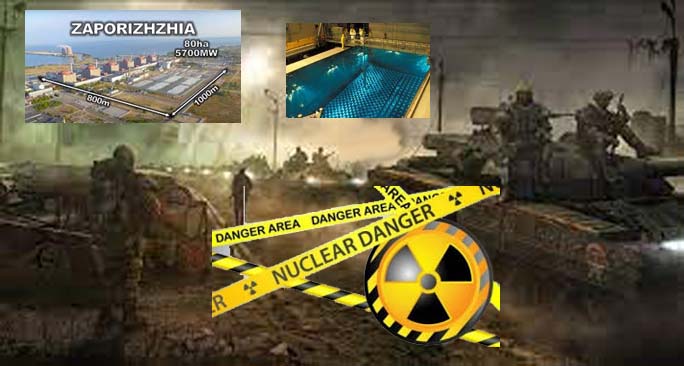
The threatened deadly scenarios could not happen at a wind farm
By Linda Pentz Gunter, 10 july 23 https://beyondnuclearinternational.org/2023/07/09/red-alert-at-zaporizhzhia/
Amidst accusations from both the Russian and Ukrainian sides that the Zaporizhzhia nuclear power plant in southeastern Ukraine has been wired for detonation or could be deliberately attacked during the current war there, one absolute truth remains: nuclear power plants are inherently dangerous.
Whether the rhetorical threats are real or not remains subject for debate. What is incontrovertibly real is the danger a nuclear power plant poses. After all, that is why the two sides are making these threats in the first place: because the outcome would be so deadly. If Zaporizhzhia was a wind farm, it wouldn’t even be mentioned.
Each nuclear reactor contains a lethal radioactive inventory, in the reactor core and also in the fuel pools into which the irradiated fuel is offloaded and, over time, densely packed. Casks also house nuclear waste offloaded from the fuel pools.
Zaporizhzhia is the largest nuclear power plant in Europe with at least 2,204 tons of highly radioactive waste within the reactors and the irradiated fuel pools.
Depending on the severity of what transpires, any or all of this radioactive fuel could be ignited.
Amidst the confusion and unreliability of any pronouncements uttered through the “fog of war”, there remain several unanswered questions that have led to heightened rumor and speculation:
Has the Zaporizhzhia nuclear plant in fact been wired for detonation and whose interests would be served by blowing up the plant?
Why is there an exodus of both Russian and Ukrainian plant personnel?
Will the sabotage of the downstream Kakhovka dam that resulted in catastrophic flooding, also lead to an equally catastrophic loss of available cooling water supplies for the reactors and fuel pools?
Will the backup diesel generators, frequently turned to for powering the essential cooling each time the plant has lost connection to the electricity grid, last through each crisis, given their fuel must also be replenished, potentially not possible under war conditions?
None of these threats would make headlines if Zaporizhzhia was instead home to a wind farm or utility scale solar array. This perhaps explains the rush now to downplay the gravity of the situation, with claims in the press that a major attack on the plant would “not be as bad as Chornobyl” and that radioactive releases would be minimal and barely travel beyond the fence line.
This is an irresponsible dismissal of the real dangers. The measured assessment of Dr. Edwin Lyman at the Union of Concerned Scientists confirms that an attack on Zaporizhzhia could indeed be catastrophic.
The graphite moderator used at Chornobyl undeniably worsened the outcome of that explosion and its aftermath. The graphite fueled the fire and the smoke further suspended what became the radioactive fallout that traveled far and wide across the former Soviet Union and all of Europe.
The part played by the graphite moderator in increasing the severity of the Chornobyl disaster has led to an assumption that major fires and explosions at Zaporizhzhia would result in less serious consequences, given the reactors are not of the same design. All six at Zaporizhzhia are Russian VVERs, similar to the Pressurized Water Reactor used here in the United States. (Chornobyl was the older RBMK.)
However, while Zaporizhzhia may be a less primitive design, it is not harmless. (Absurdly, these 1980s reactors are described in the press as “more modern.”)
If the uranium fuel in the Zaporizhzhia reactors or irradiated fuel storage pools overheats and ignites, it could then heat up the zirconium cladding around it, which would ignite and burn fiercely as a flare at temperatures too hot to extinguish with water.
The resulting chemical reaction would also generate an explosive environment. The heat of the release and any subsequent detonations could breach concrete structures, then loft radioactive gas and fallout into the environment to travel on the weather.
Radioactive fallout could contaminate crucial agricultural land in Ukraine and potentially also in Russia should prevailing winds travel eastward at the time of the disaster. As we have learned from the Chornobyl fallout, this is an enduring harm that enters the food chain and human bodies and remains harmful in the environment indefinitely, as exemplified by the 1,000 square mile Chornobyl Exclusion Zone.
Who then consumes that food is also of critical importance. While Europe allows an already too high 600 becquerels per kilogram (Bq/kg) of radioactive cesium in food, contaminated food supplies from Ukraine that read at higher levels after a nuclear disaster could be exported to countries with even weaker standards, including the US where the limit is an unacceptable 1200 Bq/kg. But will those consuming such foodstuffs be counted among the victims of such a nuclear disaster? Likely not.
The true numbers of those harmed by the Chornobyl disaster will never be known due to institutional suppression and misrepresentation of the numbers and the absence of record-keeping in the former Soviet countries affected. Therefore, to suggest that a major nuclear disaster at Zaporizhzhia would be “not nearly as bad as Chornobyl” is too broad and speculative without looking at the specifics.
Those specifics depend on whether the disaster involves hydrogen explosions such as happened at Fukushima, or fires resulting from a bombing raid or missile attack, which could disperse more radioactivity further. It would also depend on whether all six reactors suffered catastrophic failures, whether all of the fuel pools were drained and caught fire and whether the storage casks were breached.
It would further depend on which way the wind was blowing, and if, when and where it subsequently rained out a radioactive plume, all factors that influenced where the Chornobyl radioactive fallout was deposited.
If Zaporizhzhia comes to harm, each side in the conflict will almost certainly hold the other responsible. But ultimately, the responsibility we all share is to reject the continued use of a technology that has the potential to wreak such disastrous consequences on humanity.
Nuclear power is the most dangerous way to boil water. It is unnecessary, expensive, and an obstacle to renewable energy development. It is intrinsically tied to the desire for — and development of — nuclear weapons, the use of which could be the other lethal outcome in this war.
Zaporizhzhia is in the news almost every day. The propaganda may be deliberately alarmist, but the basis for the alarm is very real or it would not be in the headlines in the first place.
It is time to see sense. Calling for a no-fire zone around Zaporizhzhia is not enough. We must call for no nuclear power at all.
Linda Pentz Gunter is the international specialist at Beyond Nuclear and writes for and curates Beyond Nuclear International.
Ukraine great ‘testing ground’ for Western weapons: Kiev

Thursday, 06 July 2023, https://www.presstv.ir/Detail/2023/07/06/706584/Ukraine-Russia-western-weapons-Reznikov-US-cluster-munitions-
Kiev says Ukraine is a great “testing ground” for the military industry of the West, which is constantly pouring advanced arms and military equipment in the ex-Soviet republic despite repeated warnings by Russia that such a flow of arms will only prolong the war.
In a an interview with Financial Times published on Wednesday, Ukrainian Defense Minister Oleksii Reznikov said his country is an ideal “testing ground” for Western weaponry so that Kiev’s allies can see how their weapons work in real war and to see whether they are efficient or need upgrades.
“For the military industry of the world, you can’t invent a better testing ground,” he said, claiming that American officials became very happy when Ukraine’s military reported that a US Patriot missile system managed to down a Kinzhal, a Russian hypersonic missile.
An American official called the news “fantastic,” Reznikov said.
“The Russians come up with a countermeasure, we inform our partners and they make a new countermeasure against this countermeasure,” the Ukrainian defense minister said.
Reznikov claimed many countries are closely watching the developments in the Ukraine-Russia war, including those that are already armed with Russian weapons.
“Everyone is watching closely. And not only India. China too … Everyone, even those who bought weapons from [Russia], will watch carefully,” he said.
In July 2022, Reznikov made similar comments when he was asking for the United States and NATO to send more weapons to Ukraine.
“We are interested in testing modern systems in the fight against the enemy and we are inviting arms manufacturers to test the new products here,” he said at the time.
The US may reportedly decide later this week to send such internationally-banned cluster munitions to Ukraine.
Cluster bombs are banned under the Convention on Cluster Munitions (CCM), an international treaty that addresses the humanitarian consequences and unacceptable harm caused to civilians by cluster munitions through a categorical prohibition and a framework for action.
The weapons can contain dozens of smaller bomblets, dispersing over vast areas, often killing and maiming civilians. The CCMs are banned because unexploded bomblets can pose a risk to civilians for years after the fighting is over.
Cluster munitions generally eject submunitions that can cover five times as much area as conventional bombs.
The CCM, which took effect in 2010, bans all use, production, transfer and stockpiling of cluster bombs. More than 100 countries have signed the treaty, but the United States, Russia and Ukraine have not.
Russia sees the flooding of Ukraine with weapons from the West as a futile effort to change the outcome of the war. Moscow says supplying Kiev with more weapons will only add to the death and destruction and prolong the conflict.
NATO’s Scorched Earth in Ukraine
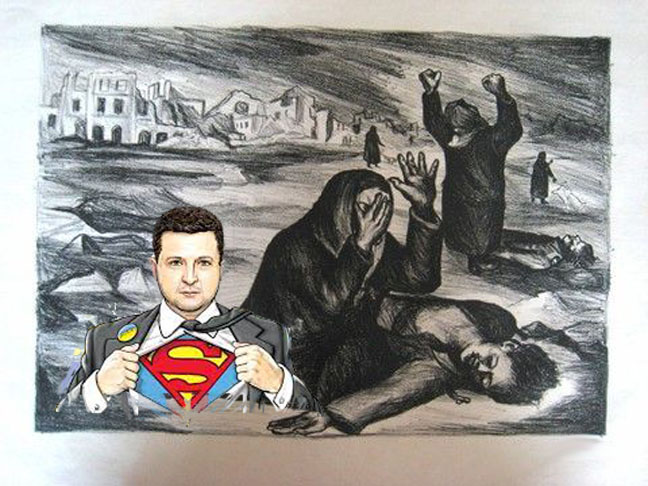
The forthcoming NATO Summit in Vilnius on July 11-12 seems already infected by a strange policy fatalism, writes Tony Kevin.
By Tony Kevin / Consortium News byEDITOR, July 7, 2023
Hope of a policy breakthrough in Vilnius, Lithuania towards peace in Ukraine, spearheaded by the war-weary East Europeans, seems to have drained away.
There is general acceptance in NATO that the Ukrainian summer offensives in Zaporizhie and again now in Bakhmut have failed to dent Russian defences, with horrific mortality in Ukrainian manpower and enormous destruction of Western-supplied equipment.
The West seems content to let Zelensky go on wasting Ukraine’s increasingly scarce military-age men in a process described by writer Raúl Ilargi Meijer as NATO’s assisted suicide of the Ukrainian nation.
The NATO unspoken strategy seems to be: we know Russia is inevitably winning in Ukraine, but we will make sure we and our Kiev proxies destroy as much as possible of Ukraine’s manpower and national wealth before Russia takes control of the country.
The Kakhovka dam is gone, and what is left of Zaporizhie Nuclear Power Plant seems increasingly at risk of West-assisted Ukrainian sabotage. These two huge assets were the pivots of Ukraine’s industrial and agricultural potential and wealth.
When Russia wins political control over the ruined land of Ukraine, and after it repudiates Western carpetbagging claims to asset ownership there, it will face a huge rebuilding job, comparable to the situation the Soviet Union faced in Ukraine after the 1944-45 vengeful scorched-earth actions by the retreating Nazi divisions……………………………….
In the U.S., only the military-industrial-information complex is doing well…………………………….
Russia’s task is to win in Ukraine, as it is doing, but without destroying its reputation with China and the Global Majority……………………………………..
The history of Western diplomatic treachery during the last 32 years since the 1991 end of Soviet Communism has shown Russians that the U.S.-U.K. agenda was always about much more than defeating Communism: it was about expanding American global hegemony and breaking up Russia as a competing world civilisational state.
There is enough evidence now to satisfy the Global Majority that U.S. regime change and controlling operations in Ukraine since 2013 have been above all cynically aimed at weakening and destabilising Russia……………..
The Vilnius NATO meeting will produce no new miracles of salvation for the doomed Kiev regime. There will be a lot of tired rhetoric about continuing to defend democratic Ukraine.
Nobody – speakers or listeners – will believe it. https://scheerpost.com/2023/07/07/natos-scorched-earth-in-ukraine/
An Attack on the Zaporizhzhia Nuclear Plant Could Still be Catastrophic (- nuclear promoters minimise the risk)

Ed Lyman, July 7, 2023 https://blog.ucsusa.org/edwin-lyman/an-attack-on-the-zaporizhzhia-nuclear-plant-could-still-be-catastrophic/
Ukraine has accused Russia of planning to carry out a sabotage attack at the Zaporizhzhia nuclear plant that it has controlled since it seized it by force in March 2022. Although it reports this morning that this current threat is decreasing, the situation is fluid and the plant remains vulnerable to both accidents and attacks. While this ongoing crisis should not lead to panic, there is no cause for complacency either.
Unfortunately, the American Nuclear Society (ANS) and other commenters have been busy attempting to dismiss the risks that either an accident or a deliberate attack could lead to a significant radiological release with far-reaching consequences. Simply put, the ANS is dead wrong here, and by minimizing the potential risk it is endangering Ukrainians and others who may be affected by lulling them into a false sense of security and undermining any motivation to prepare for the worst. Effective emergency preparedness requires a clear-eyed understanding of the actual threat.
As I have pointed out previously, the fact that the six reactors have been in shutdown mode for many months (with one in “hot”, as opposed to “cold,” shutdown) does reduce the risk somewhat compared to a situation where reactors are operating or have only recently shut down. The decay heat in the reactors’ cores decreases significantly over time, although the rate of decrease slows down quite a bit after a few months. However, this does not mean, as ANS misleadingly implies, that there is no risk of a major radiological release that could disperse over a wide area. What it does mean is that if cooling were disrupted to one or more of the reactors, then there would be a longer period of time—days instead of hours—for operators to fix the problem before the cooling water in the reactor cores would start to boil away and drop below the tops of the fuel assemblies, causing the fuel to overheat and degrade.
Timely operator actions are even more critical for reactors that are shut down than for reactors that are operating, since some automatic safety systems are not functional during shutdown. Indeed, in a 1997 report, the International Atomic Energy Agency (IAEA) points out that “acceptable results for most of events during shutdown modes cannot be achieved without operator intervention.” The IAEA report states that both “preventive and mitigatory capabilities are somewhat degraded” in shutdown conditions, and lists a number of shutdown accident initiators for VVER-1000s.
One class of events of particular concern are “boron dilution” accidents, in which the concentration of boron in cooling water necessary to maintain reactors in a subcritical state becomes reduced and nuclear fission inadvertently begins in the core. This would not only increase the reactor temperature and the amount of heat that would have to be removed, but would also generate new quantities of troublesome short-lived fission products, such as iodine isotopes, which have previously decayed away in the months since shutdown. (This is why it remains important that potassium iodide—a drug that can block uptake of radioactive iodine in the thyroid—continue to be available to communities who may be in the path of any plume.)
It is also important to note that it is very unusual for reactors to be maintained for any length of time in either hot or cold shutdown modes with fuel remaining in the core, as is the case at Zaporizhzhia. Whenever nuclear reactors operate in unusual conditions that have not been thoroughly analyzed, risks increase.
Unfortunately, because of the incredible stress that the greatly reduced staff at Zaporizhzhia are under, and the unclear lines of command under Russian occupation, their ability to efficiently execute all the actions necessary to mitigate any accident or sabotage attack is in grave doubt. And if timely operator intervention does not occur, and the fuel assemblies are exposed, then a core melt accident similar to what was experienced in three of the reactors at Fukushima Daiichi is certainly possible.
Once the water level has dropped below the tops of the fuel assemblies, the original decay heat in the reactor core is no longer a relevant factor because when the zirconium cladding surrounding the fuel rods overheats and reacts with steam or air, it produces additional heat through a so-called exothermic reaction. The heat released in this way would soon become far greater than the original decay heat load and would accelerate the heat-up and degradation of the reactor core. At that point, it would be much harder for operators to arrest the progression of the core melt. Eventually, the molten core would drop to the floor of the steel reactor vessel and melt through it onto the floor of the containment building, where it would react with concrete to generate hot gases. Then, there are multiple ways in which the radioactive gases and aerosols generated during the core melt could be released into the environment, including a containment melt-through mode that is possible in VVER-1000 reactors such as Zaporizhzhia.
There is no technical reason why any resulting radioactive releases could not disperse at least as far as occurred at Fukushima, depending on the meteorological conditions. The heat of the radioactive plumes, which determines how high they will rise in the atmosphere and hence how far they can travel, largely come from the heat released by zirconium oxidation. The magnitude and extent of the resulting environmental contamination would depend on the “source term,” or the inventory and characteristics of the radioactive materials released from the site. Since up to six reactors and six spent fuel pools could be involved—especially if the site is deliberately sabotaged—the source term could ultimately be larger than that of Fukushima, where only three reactors were involved and containments remained largely intact.
Thus it is imperative that the international community take Ukraine’s warnings seriously and provide all the assistance it needs for emergency preparedness. Unjustified complacency could lead to a lack of resolve for addressing the danger, only increasing the potential for a long-lasting disaster that will compound the misery of the Ukrainian people.
Despite Zelensky’s claims, there’s no evidence that Russia has rigged Ukraine’s Zaporizhzhya plant with explosives, nuclear watchdog says
Business Insider, Charles R. Davis , Jul 8, 2023
- The IAEA said Friday there’s no sign Russia plans to destroy the Zaporizhzhya nuclear power plant.
- Inspectors “have not seen any mines or explosives,” according to the head of the nuclear watchdog.
- However, the IAEA said its experts have not been provided full access to the facility.
The United Nations’ nuclear watchdog said Friday that it has seen no evidence that Russia intends to blow up the largest nuclear power plant in Europe, a finding that comes after the head of Ukraine’s military intelligence walked back an earlier warning of impending disaster.
In a status report on the Zaporizhzhya nuclear power plant, which Russian forces occupied soon after last year’s full-scale invasion of Ukraine, Rafael Mariano Grossi, head of the International Atomic Energy Agency, said inspectors were recently provided “some additional access” to the facility after Ukraine claimed it had been rigged with bombs……………………………………..
Russia has repeatedly denied it has any intention of causing a nuclear disaster. Kremlin spokesperson Dmitry Peskov this week argued that the real threat is Ukrainian “sabotage.”…. https://www.businessinsider.com/no-sign-russia-has-mined-zaporizhzhya-plant-nuclear-watchdog-says-2023-7
Scenario for a War in Eastern Ukraine
John Stanton, Sri Lanka Guardian•February 05, 2022
The United States Views Russians Just as the Nazi’s Did in World War II
by John Stanton
“There is a sense of open, almost joyful viciousness in all this pro-war, anti-Russian sentiment on opinion pages and television broadcasts. It is certainly racist and demeaning in tone. Such is the first step in convincing the public that the “transgressor” is equivalent to a retrovirus.”John Stanton, Dissident Voice, 2015
Vietnam 2.0 is in the making in Ukraine. The US civil-military establishment, Republicans and Democrats alike, want a shooting war with Russia, even though it was the US that caused the carnage in Ukraine, not the Russians. Yet, that inconvenient reality has been nullified by the US propaganda campaign which, of course, the Russians have responded to with their own.” John Stanton, Counterpunch, 2015
Preparing for War with Russia Since 1992
As President Joe Biden announced the transfer of 2000 US troops to Poland and Germany on February 3, 2022, and the movement of an additional 1000 troops from Western Europe to Romania, I shook my head and looked to the sky thinking, “the United States and its elites really want a war with Russia, both economic and military. US generals want to use tanks, missiles, and aircraft against a near-peer competitor. They can’t beat sandal wearing insurgents in Afghanistan, so they want to mix it up with the A-Team, i.e., Russia.”……………………
The Washington Post and New York Times and the major networks, NBC, CBS, ABC, CNN, FOX, et al, are salivating at the prospect of a Russian invasion of Eastern Ukraine, specifically the Donbass, home to separatist republics in Luhansk and Donetsk. As I wrote in April 2014, “There is a sense of open, almost joyful viciousness in all this pro-war, anti-Russian sentiment on opinion pages and television broadcasts. It is certainly racist and demeaning in tone. Such is the first step in convincing the public that the “transgressor” is equivalent to a retrovirus.” John Stanton, Dissident Voice, 2014
NATO: Causing Trouble since 1949
Presidents Bill Clinton, George W. Bush, Barak Obama, Donald Trump and now Joe Biden have pushed NATO expansion right up to Russia’s border. For example, Estonia and Latvia are NATO members. Estonia is 120 miles from St. Petersburg.NATO is purely a military alliance led by the USA. Its members serve simply military bases (some probably with tactical nuclear weapons) for US military forces and its many military contractors.
Is there any wonder that the President of Russia Vladimir Putin should be concerned?Are NAZI’s in the USA and NATO pushingthe expansion of NATO, the racial hatred of Russians, and seeking a hot war? It is revolting.
NATO: Causing Trouble since 1949
Presidents Bill Clinton, George W. Bush, Barak Obama, Donald Trump and now Joe Biden have pushed NATO expansion right up to Russia’s border. For example, Estonia and Latvia are NATO members. Estonia is 120 miles from St. Petersburg.NATO is purely a military alliance led by the USA. Its members serve simply military bases (some probably with tactical nuclear weapons) for US military forces and its many military contractors.
Is there any wonder that the President of Russia Vladimir Putin should be concerned?Are NAZI’s in the USA and NATO pushing the expansion of NATO, the racial hatred of Russians, and seeking a hot war? It is revolting……………………………….
Attack Scenario, just a Guess: If Russia’s Hand is Forced by USA-NATO
Russian military forces fought in Ukraine during World War II against NAZI Germany. For example, the Battle of Kiev and The Battle of the Dnieper. There is an historical record for Russian military planners to refer to. The Battle of Grozny in Chechnya will weigh heavily on Russian military planners as the decide which communities to take control of………………………………………………..more http://www.srilankaguardian.org/2022/02/scenario-for-war-in-eastern-ukraine.html?m=1
U.S. Depleted Uranium to Make Ukraine War Dirtier

CounterPunch, BY JOHN LAFORGE, 30 June 23
The Biden administration is expected to supply Ukraine with highly controversial depleted-uranium munitions which are to be fired from the Abrams battle tanks the U.S. is sending to Kyiv, the Wall St. Journal reported June 13.
Any delivery of U.S. depleted uranium (DU) weapons to Ukraine would be in addition to the State Department’s Dec. 22, 2022 approval of the sale to Poland of as many as 112,000 heavy 120-millimeter DU shells, which was announced by the Pentagon’s Defense Security Cooperation Agency.
The British Ministry of Defense announced last March 20 that it too would send depleted uranium munitions to Ukraine along with its Challenger battle tanks. Russian Foreign Minister Sergei Lavrov responded at the time charging that sending DU into Ukraine would mean the U.K. was “ready to violate international humanitarian law as in 1999 in Yugoslavia.” (https://www.bbc.com/news/world-europe-65032671) The reference may be to the United Nations Subcommission on the Promotion and Protection of Human Rights which in 2002 labeled the use of DU “inhumane” and a violation of treaties like the Hague Conventions which expressly forbid any use of “poison or poisoned weapons.”
The Wall St. Journal’s understated sub-headline on June 13 warned: “The armor-piercing ammunition has raised concerns over health and environmental effects.” Indeed, between 1997 and 2004, USA Today, the Associated Press, New York Daily News, Life magazine, CNN, and others reported that studies were finding a significantly increased rate of birth abnormalities among children of U.S. Gulf War veterans and among Iraqi children born after 1991. (“DU in UKRAINE – John Pilger & Phil Miller,” Consortium News, May 11, 2023, https://www.youtube.com/watch?v=YqlMrjMuFwI; “Tainted uranium, danger widely distributed,” USA Today, June 25, 2001)
The Journal’s article acknowledged that “The United Nations Environment Program said in a report last year that the [depleted uranium] metal’s ‘chemical toxicity’ presents the greatest potential danger, and ‘it can cause skin irritation, kidney failure, and increase the risks of cancer.’”……………..
If the shells are used in the Ukraine war, the soil, water, crops, and livestock of the territory being contested will likely be contaminated with uranium and the other radioactive materials that are in the armor-piercing munitions. This is because when DU smashes through tank armor, it becomes an aerosol of dust or gas-like particles that can be inhaled and carried long distances on the wind……………………………………………………………………………………………….
The U.S. Department of Energy admitted in January 2000 that the metal in DU shells is often contaminated with plutonium, neptunium, and americium, long-lived, highly radioactive isotopes, much more hazardous than DU, or uranium-238. (“Pentagon admits plutonium exposure: NATO shells used radioactive metals,” London, AP, The Capital Times, Feb. 3, 2001; New York Times, Feb. 14, 2001)
While the U.S. military repeatedly declares that its uranium weapons contain uranium-238, and that its DU shells “are less radioactive than natural uranium,” the United Nations Environment Program and others demonstrated that uranium shells used by the U.S. and the U.K. were contaminated with fission products including plutonium. (“DU at Home,” The Nation, April 9, 2001)
Government evidence of harm
* In 2002, the U.S. Armed Forces Radiobiology Research Institute found in a preliminary report that DU produces one-million times as much chromosome damage as would be predicted from its radioactivity alone, and that it causes a form of long-term “delayed reproductive death” of cells. The AFRR institute then canceled the funding of this research.
* In 1997, the Armed Forces Radiobiology Research Institute reportedly found that, “In animal studies, embedded DU, unlike most metals, dissolves and spreads throughout the body depositing in organs like the spleen and the brain, and a pregnant female rat will pass DU along to a developing fetus.” The Army’s Office of the Surgeon General’s 1993 manual “Depleted Uranium Safety Training” says the expected effects of DU exposure include a possible increase of cancer (lung and bone) and kidney damage. It recommends that the Army “… convene a working group … to identify countermeasures against DU exposure.”
* In 1995, the U.S. Army Environmental Policy Institute reported, “The radiation dose to critical organs depends upon the amount of time that depleted uranium resides in the organs. When this value is known or estimated, cancer and hereditary risk estimates can be determined.” Depleted uranium has the potential to generate “significant medical consequences” if it enters the body, the AEPI found.
* In 1990, the Army’s Armaments, Munitions and Chemical Command radiological task group said that depleted uranium is a “low level alpha radiation emitter … linked to cancer when exposures are internal, [and] chemical toxicity causing kidney damage.” The group’s report said that “long term effects of low doses [of DU] have been implicated in cancer … there is no dose so low that the probability of effect is zero.”
* In 1984, the Federal Aviation Administration warned its investigators, “If particles are inhaled or ingested, they can be chemically toxic and cause a significant and long-lasting irradiation of internal tissue.”
* In 1979, the U.S. Army Mobility Equipment, Research & Development Command warned, “Not only the people in the immediate vicinity (emergency and fire-fighting personnel) but also people at distances downwind from the fire are faced with potential over exposure to airborne uranium dust.”
Any threatened or actual use of poisonous, gene-busting depleted uranium munitions in Ukraine cannot be considered lawful or ethical and must be condemned unreservedly by civil society on all sides of the Ukraine war.
John LaForge is a Co-director of Nukewatch, a peace and environmental justice group in Wisconsin, and edits its newsletter. https://www.counterpunch.org/2023/06/30/u-s-depleted-uranium-to-make-ukraine-war-dirtier/
Ukraine, Russia accuse each other of planning to attack Europe’s biggest nuclear plant
9 News, By Associated Press Jul 6, 2023
Ukraine and Russia have accused each other of planning to attack one of the world’s largest nuclear power plants.
Neither side provided evidence to support their claims on Wednesday (early Thursday AEST) of an imminent threat to the facility in south-eastern Ukraine, which is occupied by Russian troops.
The Zaporizhzhia Nuclear Power Plant has been a focus of concern since Moscow’s forces took control of it and its staff in the early stages of the war.
Russia and Ukraine have regularly traded blame over shelling near the plant that caused power outages. Over the last year, the UN’s atomic watchdog repeatedly expressed alarm over the possibility of a radiation catastrophe like the one at Chernobyl after a reactor exploded in 1986.
The six reactors at Zaporizhzhia are shut down, but the plant still needs power and qualified staff to run crucial cooling systems and other safety features………………………….
The International Atomic Energy Agency has officials stationed at the Russian-held plant, which is still run by its Ukrainian staff. IAEA Director General Rafael Mariano Grossi said his agency’s most recent inspection of the plant found no activity related to explosives, “but we remain extremely alert.”
“As you know, there is a lot of combat. I have been there a few weeks ago, and there is contact there very close to the plant, so we cannot relax,” Grossi said during a visit to Japan.
In Russia, Kremlin spokesman Dmitry Peskov raised the spectre of a potentially “catastrophic” provocation by the Ukrainian army at the nuclear plant, which is Europe’s largest.
“The situation is quite tense. There is a great threat of sabotage by the Kyiv regime, which can be catastrophic in its consequences,” Peskov said in response to a reporter’s question about the plant.
He also claimed that the Kremlin was pursuing “all measures” to counter the alleged Ukrainian threat.
Grossi said he was aware of both Kyiv’s and Moscow’s claims and reiterated that “nuclear power plants should never, under any circumstances, be attacked.”
“A nuclear power plant should not be used as a military base,” he said.
Renat Karchaa, an adviser to Russian state nuclear company Rosenergoatom, said there was “no basis” for Zelenskyy’s claims of a plot to simulate an explosion.
“Why would we need explosives there? This is nonsense” aimed at “maintaining tension around the Zaporizhzhia Nuclear Power Plant”, Karchaa said.
Russian media on Tuesday cited Karchaa as saying that Ukraine’s military planned to strike the plant early on Wednesday with ammunition laced with nuclear waste. As of Wednesday afternoon, there was no indication of such an attack……………
In case of a nuclear disaster at the plant, approximately 300,000 people would be evacuated from the areas closest to the facility, according to the country’s emergency services.
Ukrainian officials have said the shut-down reactors are protected by thick concrete containment domes https://www.9news.com.au/world/russia-ukraine-updates-zaporizhzhia-nuclear-power-plant-attack-being-planned-ukraine-and-russia-accuse/5e82addc-49dd-455d-bfc8-31d7f3da6fd1—
Russia and Ukraine step up rhetoric around Zaporizhzhia nuclear power plant
By Euronews Digital 05/07/2023 https://www.euronews.com/2023/07/05/russia-and-ukraine-step-up-rhetoric-around-zaporizhzhia-nuclear-power-plant
President Zelenskyy and other senior Ukrainian officials have intensified warnings that Russian forces plan to sabotage the Zaporizhzhia power plant, the largest nuclear facility in Europe.
Russian and Ukrainian officials have escalated the rhetoric surrounding the situation at the Zaporizhzhia Nuclear Power Plant.
The plant has been under Russian control since the early days of the full-scale invasion in 2022. All six reactors have since been shut down.
The Ukrainian Armed Forces are now warning of a “possible provocation in the near future” saying “items similar to explosive devices were placed on the external roof of the third and fourth power units of ZNPP.”
A few days earlier, Ukraine’s military intelligence directorate claimed that Moscow had approved a plan to blow up the station and has mined four out of six power units, as well as the cooling pond.
Chris Hedges: They Lied About Afghanistan. They Lied About Iraq. And They Are Lying About Ukraine.
The U.S. public has been conned, once again, into pouring billions into another endless war.
The playbook the pimps of war use to lure us into one military fiasco after another, including Vietnam, Afghanistan, Iraq, Libya, Syria and now Ukraine, does not change. Freedom and democracy are threatened. Evil must be vanquished. Human rights must be protected. The fate of Europe and NATO, along with a “rules based international order” is at stake. Victory is assured.
The results are also the same. The justifications and narratives are exposed as lies. The cheery prognosis is false. Those on whose behalf we are supposedly fighting are as venal as those we are fighting against.
The Russian invasion of Ukraine was a war crime, although one that was provoked by NATO expansion and by the United States backing of the 2014 “Maidan” coup which ousted the democratically elected Ukrainian President Viktor Yanukovych. Yanukovych wanted economic integration with the European Union, but not at the expense of economic and political ties with Russia. The war will only be solved through negotiations that allow ethnic Russians in Ukraine to have autonomy and Moscow’s protection, as well as Ukrainian neutrality, which means the country cannot join NATO. The longer these negotiations are delayed the more Ukrainians will suffer and die. Their cities and infrastructure will continue to be pounded into rubble.
But this proxy war in Ukraine is designed to serve U.S. interests. It enriches the weapons manufacturers, weakens the Russian military and isolates Russia from Europe. What happens to Ukraine is irrelevant.
“First, equipping our friends on the front lines to defend themselves is a far cheaper way — in both dollars and American lives — to degrade Russia’s ability to threaten the United States,” admitted Senate Republican Leader Mitch McConnell.
“Second, Ukraine’s effective defense of its territory is teaching us lessons about how to improve the defenses of partners who are threatened by China. It is no surprise that senior officials from Taiwan are so supportive of efforts to help Ukraine defeat Russia. Third, most of the money that’s been appropriated for Ukraine security assistance doesn’t actually go to Ukraine. It gets invested in American defense manufacturing. It funds new weapons and munitions for the U.S. armed forces to replace the older material we have provided to Ukraine. Let me be clear: this assistance means more jobs for American workers and newer weapons for American servicemembers.”
Once the truth about these endless wars seeps into public consciousness, the media, which slavishly promotes these conflicts, drastically reduces coverage. The military debacles, as in Iraq and Afghanistan, continue largely out of view. By the time the U.S. concedes defeat, most barely remember that these wars are being fought.
The pimps of war who orchestrate these military fiascos migrate from administration to administration. Between posts they are ensconced in think tanks — Project for the New American Century, American Enterprise Institute, Foreign Policy Initiative, Institute for the Study of War, The Atlantic Council and The Brookings Institution — funded by corporations and the war industry. Once the Ukraine war comes to its inevitable conclusion, these Dr. Strangeloves will seek to ignite a war with China. The U.S. Navy and military are already menacing and encircling China. God help us if we don’t stop them.
…………………………………………………………………………………… And what of the Ukrainian democracy we are fighting to protect? Why did the Ukrainian parliament revoke the official use of minority languages, including Russian, three days after the 2014 coup? How do we rationalize the eight years of warfare against ethnic Russians in the Donbass region before the Russian invasion in Feb. 2022? How do we explain the killing of over 14,200 people and the 1.5 million people who were displaced, before Russia’s invasion took place last year?
How do we defend the decision by President Volodymyr Zelenskyy to ban eleven opposition parties, including The Opposition Platform for Life, which had 10 percent of the seats in the Supreme Council, Ukraine’s unicameral parliament, along with the Shariy Party, Nashi, Opposition Bloc, Left Opposition, Union of Left Forces, State, Progressive Socialist Party of Ukraine, Socialist Party of Ukraine, Socialists Party and Volodymyr Saldo Bloc? How can we accept the banning of these opposition parties — many of which are on the left — while Zelenskyy allows fascists from the Svoboda and Right Sector parties, as well as the Banderite Azov Battalion and other extremist militias, to flourish?
How do we deal with the anti-Russian purges and arrests of supposed “fifth columnists” sweeping through Ukraine, given that 30 percent of Ukraine’s inhabitants are Russian speakers? How do we respond to the neo-Nazi groups supported by Zelenskyy’s government that harass and attack the LGBT community, the Roma population, anti-fascist protests and threaten city council members, media outlets, artists and foreign students? How can we countenance the decision by the U.S and its Western allies to block negotiations with Russia to end the war, despite Kyiv and Moscow apparently being on the verge of negotiating a peace treaty?
I reported from Eastern and Central Europe in 1989 during the breakup of the Soviet Union. NATO, we assumed, had become obsolete. President Mikhail Gorbachev proposed security and economic agreements with Washington and Europe. Secretary of State James Baker in Ronald Reagan’s administration, along with the West German Foreign Minister Hans-Dietrich Genscher, assured Gorbachev that NATO would not be extended beyond the borders of a unified Germany. We naively thought the end of the Cold War meant that Russia, Europe and the U.S., would no longer have to divert massive resources to their militaries.
The so-called “peace dividend,” however, was a chimera……………………
It was universally understood in Eastern and Central Europe following the collapse of the Soviet Union that NATO expansion was unnecessary and a dangerous provocation. It made no geopolitical sense. But it made commercial sense. War is a business.
In a classified diplomatic cable — obtained and released by WikiLeaks — dated Feb. 1, 2008, written from Moscow, and addressed to the Joint Chiefs of Staff, NATO-European Union Cooperative, National Security Council, Russia Moscow Political Collective, Secretary of Defense, and Secretary of State, there was an unequivocal understanding that expanding NATO risked conflict with Russia, especially over Ukraine………………………………………………………..
The Russian invasion of Ukraine would not have happened if the western alliance had honored its promises not to expand NATO beyond Germany’s borders and Ukraine had remained neutral. The pimps of war knew the potential consequences of NATO expansion. War, however, is their single minded vocation, even if it leads to a nuclear holocaust with Russia or China.
The war industry, not Putin, is our most dangerous enemy. https://scheerpost.com/2023/07/02/chris-hedges-they-lied-about-afghanistan-they-lied-about-iraq-and-they-are-lying-about-ukraine/
IAEA debunks Ukrainian claim about Europe’s largest nuclear plant
https://www.rt.com/russia/578480-iaea-zaporozhye-nuclear-mines/ 26 June 23
There are no mines at the cooling pond of the Zaporozhye NPP, the UN watchdog has said
Rafael Mariano Grossi, the director-general of the International Atomic Energy Agency (IAEA), denied on Tuesday claims made by the Ukrainian government that the cooling pond of the Zaporozhye Nuclear Power Plant (ZNPP) had been rigged with explosives.
“The IAEA is aware of reports of mines having been placed near the cooling pond. No mines were observed at the site during the Director General’s visit, including the cooling pond,” Grossi said in a report on the situation at Europe’s largest atomic power facility.
There were mines outside the perimeter and “at particular places inside,” which the security personnel at ZNPP explained were for defensive purposes, the IAEA head said.
“Our assessment of those particular placements was that while the presence of any explosive device is not in line with safety standards, the main safety functions of the facility would not be significantly affected,” added Grossi.
His report comes after claims by Ukrainian President Vladimir Zelensky and his aide Mikhail Podoliak that Russia had prepared a “terrorist attack” on the facility it has controlled since March 2022.
Ukrainian intelligence has received information that Russia is planning “a terrorist attack with radiation leakage,” Zelensky said in a tweet on Thursday morning, adding that “the world has been warned, so the world can and must act.”
Podoliak claimed that Russia was “considering a large-scale terrorist attack at the ZNPP to stop the Ukrainian counteroffensive and create a depopulated sanitary gray zone,” and was mining the cooling pond, demanding that “the global world” should announce consequences “not tomorrow. Today.”
Zelensky’s claims are “yet another lie,” Kremlin spokesman Dmitry Peskov said on Thursday, noting that Russia has fully cooperated with the IAEA. Moscow has insisted that Kiev was behind the destruction of the Kakhovka dam earlier this month, which the IAEA described as a potential threat to the ZNPP’s supply of cooling water.
According to Russia, Ukraine has also repeatedly attacked the ZNPP, including an attempted commando raid in September 2022, as the IAEA mission was en route to the site. The most recent attack was on June 9, when Russian air defenses reported bringing down three drones headed for the plant.
The Zaporozhye Nuclear Power Plant has six reactors and is located in Energodar, on the right shore of the Dnieper River. It is currently operated by Rosatom in standby mode. The surrounding region officially became part of Russia last September.
2 important Russo Ukraine war stories: 1 covered 24/7; 1 covered up

It would be so nice for me to think (as a good, genuinely conservative, Christian Westerner and patriotic Australian) , – that this Walt Zlotow story is a pack of lies, (obviously from a paid stooge of Putin)
My problem is: that everything that I see, read, hear, on Australian corporate media and the Australian Broadcasting Corporation – just happens to tally with what he is saying.
Good on Walt Zlotow for having the guts to speak out.
I’m just sorry that I think that he is not going to be believed. The end result? We might find a small group of (?)wealthy individuals presiding over a nearly dead planet.

Walt Zlotow West Suburban Peace Coalition, Glen Ellyn IL 27June 23
Mainstream news got the figurative memo from the US State Dept. and military Friday: Full media press coverage of the mini insurrection against Russian President Putin that could potentially have toppled him. But not one word on the apparently failing Ukrainian counteroffensive the US was counting on before even considering negotiations to end the 17 month war.
That coverage simply continues the 487 days of media compliance with US not so subtle demands that the war be reported as Ukraine largely defeating a Russia hopelessly unable to secure control of Donbas and keep NATO off its doorstep.
If the American people were informed on Ukraine’s near complete inability to repel the Russian invaders, they might push back against the squandering of over a hundred billion dollars in US treasure on a futile cause not affecting US national security in the least.
If they knew we’re sending cluster bombs, prohibited by most countries, that can kill long after the war ends, if ever, they might call for negotiations, not more weapons.
If they knew we’re sending long range missiles to strike deep in Russia, possibly triggering nuclear confrontation, they might protest this madness.
But most Americans don’t know any of this. Like the apparently failing Ukrainian offensive, only good news, justifying America’s ghoulish demand this war goes on endlessly, gets on mainstream news.
If the US had that insane approach to diplomacy and negotiations during the Cuban Missile Crisis, we wouldn’t be having this discussion. We’d have all been blown away 61 years ago. more at https://www.antiwar.com/blog/author/walt_zlotow/
The changing narrative of the war in Ukraine

Meanwhile Secretary of State Antony Blinken is telling reporters that the dangers of human extinction from nuclear war are no greater than the dangers humanity faces from climate change. Goebels would be proud of him.
On the Russian home front do you feel that the country is at war? Armageddon Newsletter, GILBERT DOCTOROW, JUL 31, 2023
“……………………………………………………………………………………………..for those who can bear watching war news on television, the narrative has been changing, especially in the past week. Until then, news of the material damage and bodily harm caused by daily Ukrainian bombardment of Donetsk city and other towns in the Donbas took up much of the news bulletins. Now the accent is on the destruction Russian forces are dealing out to the Ukrainians as Kiev directs larger scale attacks and brings into play its strategic reserves, especially in the Zaporozhie region. The new Ukrainian offensive appears to be no more successful than previous probing maneuvers in breaking though the dense Russian defense lines.
Russian military experts on the leading talk shows who showed great reserve about predicting the future course of the conflict lest Russians be overconfident a week ago now appear radiant and ready to confide that the Ukrainians never got the equipment they needed to make their counter-offensive a success.
As I noted in a recent essay, the Russian military command has been biding its time until it is certain that Ukraine was already committing its reserves to battle and would soon run dry. Now that time is approaching. We see that the Russians are opening an offensive in the northeast, in the Kharkov region………………………
Against this background of the changes in the correlation of forces in Russia’s favor, I am stunned that U.S. and other observers and commentators are not taking note.
These authors like so many talking heads in the West do not have the necessary linguistic skills to access Russian news sources on their own. They depend wholly on propagandists in the State Department for the raw facts from which they can spin their reasonable compromises. I humbly submit that this war will either end on Russia’s terms or it will escalate thanks to American miscalculations and obstinacy to the point of a nuclear exchange that puts the survival of humankind in peril.
Meanwhile Secretary of State Antony Blinken is telling reporters that the dangers of human extinction from nuclear war are no greater than the dangers humanity faces from climate change. Goebels would be proud of him.
IAEA Director General Grossi discusses nuclear safety with Russia’s Director of Rosatom, at Zaporizhzhia, in new consultations

MOSCOW, June 23 https://english.news.cn/20230624/19c5c0119ce24b04a7ab10e6a08f9a0b/c.html — General Director of Russia’s Rosatom State Corporation Alexey Likhachev discussed the current nuclear safety situation around the Zaporizhzhia nuclear power plant (ZNPP) with the International Atomic Energy Agency (IAEA) Director-General Rafael Grossi in Russia’s Kaliningrad on Friday.
During the discussion, both delegations addressed issues raised by Grossi at the UN Security Council briefing on May 30, in which the official discussed the security situation at the nuclear facility, Rosatom said in a statement.
Likhachev emphasized that the Russian side “expects the IAEA Secretariat to take specific steps to prevent strikes by the Ukrainian armed forces both on the ZNPP and on the adjacent territory,” it added.
He informed Grossi about the specific measures currently being taken by the Russian side to ensure the nuclear facility’s safe operation, particularly its water supply “after the Kakhovka hydroelectric power plant dam was destroyed by the Ukrainian armed forces,” Rosatom said.
Both sides further discussed the outcomes of Grossi’s visit to the plant on June 15. During his visit, Grossi was able to personally verify whether the plant could continue operating safely, and confirm among other things that the water supply in the cooling pond was sufficient for the safe operation of the facility
Ukraine Can Develop Nuclear Weapons ‘Within a Short Time’: Ex-Zelensky Aide
BY JON JACKSON ON 6/23/23
eksii Arestovych, a former adviser to Ukrainian President Volodymyr Zelensky, said during a Thursday interview that Ukraine has the ability to quickly produce its own nuclear weapons “within a short time.”
Arestovych, who also served as an officer in Ukraine’s military intelligence service, made the remarks while speaking with Russian activist Mark Feygin…………… Arestovych has also stated that Crimea would be a major target for Zelensky’s forces during the conflict. https://www.newsweek.com/ukraine-can-develop-nuclear-weapons-within-short-time-ex-zelensky-aide-1808663
1 This Month



26 September – International Day for the Total Elimination of Nuclear Weapons


PLEASE OPPOSE HR 8255 AND S.3639 – bills would accelerate satellite deployment, with no environmental review or safeguards – https://ncstd5li.quorum.us/campaign/169331/
To see nuclear-related stories in greater depth and intensity – go to https://nuclearinformation.wordpress.com
-
Archives
- September 2026 (233)
- August 2026 (330)
- July 2026 (355)
- June 2026 (287)
- May 2026 (306)
- April 2026 (356)
- March 2026 (251)
- February 2026 (267)
- January 2026 (308)
- December 2025 (358)
- November 2025 (359)
- October 2025 (375)
-
Categories
- 1
- 1 NUCLEAR ISSUES
- business and costs
- climate change
- culture and arts
- ENERGY
- environment
- health
- history
- indigenous issues
- Legal
- marketing of nuclear
- media
- opposition to nuclear
- PERSONAL STORIES
- politics
- politics international
- Religion and ethics
- safety
- secrets,lies and civil liberties
- spinbuster
- technology
- Uranium
- wastes
- weapons and war
- Women
- 2 WORLD
- ACTION
- AFRICA
- Atrocities
- AUSTRALIA
- Christina's notes
- Christina's themes
- culture and arts
- Events
- Fuk 2022
- Fuk 2023
- Fukushima 2017
- Fukushima 2018
- fukushima 2019
- Fukushima 2020
- Fukushima 2021
- general
- global warming
- Humour (God we need it)
- Nuclear
- RARE EARTHS
- Reference
- resources – print
- Resources -audiovicual
- Weekly Newsletter
- World
- World Nuclear
- YouTube
-
RSS
Entries RSS
Comments RSS
 nuclear-news