Russia prevents Ukraine attack on Crimea’s Sevastopol
Russian forces claim to have shot down nine Ukrainian drones over the Crimean port of Sevastopol on Sunday.
Jerusalem Post, By REUTERS, JULY 16, 23
Russia’s Sevastopol Naval baseRussian forces claim to have shot down nine Ukrainian drones over the Crimean port of Sevastopol on Sunday.
Russia’s defense ministry said its forces had prevented Ukraine from attacking the Black Sea port of Sevastopol on Sunday, destroying seven aerial and two underwater drones.
“This morning, an attempt by the Kyiv regime to carry out a terrorist attack by seven unmanned aerial vehicles and two unmanned underwater vehicles on objects on the territory of the Crimean Peninsula near the city of Sevastopol was thwarted,” the ministry said on the Telegram messaging app.
There were no casualties and no damage, the ministry added.
It said that two aerial drones were shot down over the Black Sea at a great distance from the coastline, while five were intercepted by Russia’s electronic warfare forces.
Two unmanned underwater vehicles (UUV), known as underwater drones were discovered in the northern part of the Black Sea, and destroyed by fire, the ministry said………………………
No comment from Ukraine
…….Ukraine almost never publicly claims responsibility for attacks inside Russia or on Russian-controlled territory in Ukraine but has been saying in recent months that destroying Russia’s military infrastructure helps Kyiv’s counteroffensive. https://www.jpost.com/international/article-750213
20% of Ukrainian weapons destroyed in just two weeks – New York Times
Rt.com 15 Jul 23
Kiev’s Western-supplied tanks and armored vehicles “all burned,” one soldier told the newspaper
The Ukrainian military lost 20% of the equipment it sent to the battlefield during the first two weeks of its counteroffensive, the New York Times reported on Saturday. This high attrition rate was reportedly a key factor in Kiev’s decision to pause the operation.
Beginning in early June, Ukrainian forces launched a series of attacks all along the front line from Kherson to Donetsk. Advancing through minefields and without air support, the Ukrainian military lost 26,000 men and more than 3,000 pieces of military hardware, according to the latest figures from the Russian Ministry of Defense.
Ukrainian losses were at their highest during the initial two weeks of the offensive, the New York Times claimed, citing unnamed American and European officials. These officials said that up to 20% of Ukraine’s tanks and armored vehicles were destroyed in this period, including many Western-provided vehicles.
For some units, Western equipment was lost at an even higher rate, the Times continued, citing figures from a pro-Ukrainian organization. Ukraine’s 47th Mechanized Brigade – a NATO-trained unit – apparently lost 30% of its 99 Bradley Infantry Fighting vehicles in two weeks, while the 33rd Mechanized Brigade lost nearly a third of its 32 German-made Leopard tanks in a single week………………………………………………….
With little territorial gain to show for Kiev’s losses, Western officials have expressed disappointment at the pace of the offensive, according to a steady trickle of media reports since mid-June. Zelensky and some of his top officials still insist that the decisive phase of their counteroffensive has yet to begin.
Meanwhile, Ukraine’s Western backers are running low on ammunition, particularly 155mm artillery shells. US President Joe Biden admitted this week that “we’re low” on these shells, explaining that the shortage compelled him to send controversial cluster munitions in their stead. The US has also stalled on approving the training of Ukrainian pilots on F-16 fighter jets, something that Kiev insists will help restart the faltering counteroffensive. https://www.rt.com/russia/579761-ukraine-counteroffensive-vehicles-lost/
Cracks in NATO’s Ukraine Project

Years of successfully pulling the wool over people’s eyes and Western fawning over him since February 2022 led Zelenskiy to overestimate the power of his personality and his communication skills. There was never any chance that the NATO summit in Vilnius would offer Ukraine membership, a membership action plan (MAP), or a shortcut to membership no matter how charismatic Zelenskiy imagines himself to be.
we are left with the unavoidable conclusion that Washington and Brussels pushed Ukraine into the claws of the aggressive, angry bear they themselves riled and aggravated. No matter. United together, ‘we will not waver’: Ukraine will fight ‘as long as it takes’ to defeat the bear on behalf of the United States and its subservient allies.
Russian and Eurasian politics , by GORDONHAHN, July 13, 2023
Cracks are emerging in NATO’s anti-Russian alliance centered on Ukraine. NATO’s Vilnius summit exposed growing tensions between NATO members and between them and their Ukrainian client state as a result of growing risks of defeat in their proxy war. These tensions are destined to grow as Kiev’s position on the front continues to deteriorate. In Kiev, signs of panic and the likelihood of rising civil-military tensions pose the grave threat to the West’s plans to deal Russia a strategic defeat and to prompt Putin’s removal. Western and Ukrainian hopes and expectations have been unrealistic all the way around from the start.
The Failing Ukrainian Counteroffensive
With Ukrainian forces failing in the long-planned and much-touted counteroffensive, the stakes already are much higher half a year later, even putting aside for the moment the issue of the crucial NATO summit in Vilnius.[1] Western and Ukrainian expectations and claims regarding the potential of the counteroffensive are exposing the hideously phantasmagorical expectations of most in Washington, Brussels, and Kiev.
After six weeks of Ukraine’s highly costly counteroffensive, instead of territorial gains Kiev’s forces are being routed, experiencing enormous casualties, losses of territory on the Oskol river, an operational encirclement of Avdiivka, and successful Russian advances on the Kupyansk-Liman front lines.
Russian Defense Minister Sergei Shoigu claimed on July 11th that the Ukrainians have suffered 26,000 casualties and lost 3,000 units of equipment, including 1,244 tanks and fighting vehicles as well as APCs, artillery pieces, and mortars, since June 4th when the counteroffensive began.[2]
To put this into the perspective of Ukrainian weapons requests and NATO capacity and willingness (or unwillingness) to meet them, in December 2022 last year Zalyuzhniy told The Economist that he needed “300 tanks, 600-700 IFVs, 500 Howitzers.” In such case, he thought it “completely realistic to get to the lines of February 23rd.” But the Ukrainians never received anything like this, and the West nevertheless pressed Zelenskiy to underataken the ill-considered idea of a broad counter-offensive against the revived Russian army.
The Ukrainians have lost more equipment in just six weeks of the counteroffensive than Zalyuzhniy had requested; this without even reaching the first line of the Russian forces’ three well dug-in defense lines in the south and making even less progress in the east. Ukrainian forces have not been able to take and hold even one small settlement along the entire line of contact extending from Kherson to Kharkov. They take territory at great loss of life and equipment only to relinquish the same territory a few days layer with more losses. Not surprisingly, cracks are appearing in the Ukrainian ranks.[3]
On this background it is hardly surprising that tensions between Kiev and its Western patrons are running high, with each side blaming the other for the military farce………………………………….
Summit of the Deluded, Dismayed and Defeated
Zelenskiy entertained and publicly promoted the most unfeasible, inflated expectations. He regards too highly his ability to charm, cajole, and convince people to do and succeed in doing what he wants, whether it is accepting Ukraine into NATO here and now, receiving ever increasing arms supplies from NATO members’ whose stocks are depleted and defense industries have been wound down, or pushing through three reinforced lines of defense 35 miles deep with a few tanks and a hodgepodge of trained soldiers and a larger coteries of poorly trained soldiers recently scraped off the streets of Kiev, Lvov, and Sumy………………………
At any rate, the effect of the counteroffensive in failure is to ensure that NATO would do what it was going to do and has been doing anyway: hanging Ukraine out to die on the altar of NATO expansion ‘as long as it takes’ in the hope of provoking a color revolution in Russia. Hundreds of thousands of Ukrainian casualties, destroyed cities and towns, millions of refugees, and tens of millions of ruined lives have and will not cause NATO to throw out the playbook. They just will edit it a little: a security guarantee with loopholes, a NATO-Ukrainian Committee, dispensing with a ‘membership action plan’ for a Ukraine that may not exist ‘after victory.’
Years of successfully pulling the wool over people’s eyes and Western fawning over him since February 2022 led Zelenskiy to overestimate the power of his personality and his communication skills. There was never any chance that the NATO summit in Vilnius would offer Ukraine membership, a membership action plan (MAP), or a shortcut to membership no matter how charismatic Zelenskiy imagines himself to be.
These hopes were as delusional as were the repeated Ukrainian decisions not to forego NATO membership before and after Maidan, before and after Minsk, before and after Putin’s proposals on a new European security architecture and his massing of troops on Ukraine’s borders, before and after his February 2022 invasion, and before and after the March 2022 agreement to end the war by Kiev renouncing the goal of NATO membership and returning to the Minsk format.
……………………………………………………. we are left with the unavoidable conclusion that Washington and Brussels pushed Ukraine into the claws of the aggressive, angry bear they themselves riled and aggravated. No matter. United together, ‘we will not waver’: Ukraine will fight ‘as long as it takes’ to defeat the bear on behalf of the United States and its subservient allies.
……………………………………………………………… Zelenskiy attended the Vilnius summit. Reports from the show Vilnius revealed a desparate Zelenskiy resorting to frantic backroom cajoling in order to beg for concessions on NATO membership. This would bring the alliance closer to entering the war and more of its arms at a sufficient level to defeat an increasingly powerful Russian force, or it might provoke the Kremlin into actions that would inspire NATO to finally take Kiev’s neck out of the noose into which NATO itself put it.[5]
……………………………………… Zelenskiy’s desperate, ultimately failed attempt to get Ukraine moving more rapidly to NATO membership ended up alienating his ‘allies. In a social media post Zelenskiy essentially accused US President Joe Biden and other NATO leaders of showing disrespect for Ukraine by not admitting her for membership now—a measure that would require NATO to enter the war.
…………………………………….. Entering a war NATO itself fomented is not in NATO’s plans. Washington and Brussels prefer that Kiev fight a far superior military power ‘for as long as it takes’ to do what is in the West’s interests—that is, weaken Russia. Despite the weapons, training, intelligence, and pats on Zelenskiy’s back, it can be said not just of Moscow but of Washington and Brussels as well: “They wept for Ukraine, but they destroyed it.”[8]
Rising Tensions in Ukrainian Civil-Military Relations………………………………………………………………………………………………………………………………………………
It is very likely that Zalyuznyi and Zelenskiy will be at odds again if they are not already. One Ukrainian source in the Office of the President claims that the Biden administration has given up on any progress in the counteroffensive and that “a complete collapse” of Zelenskiy’s foreign policy regarding Western support, which is now expected to decline sharply…………………………………………………………………………………………
CONCLUSION
The tensions between Zelenskiy and his Western backers, on the one hand, and Zelenskiy and Ukraine’s military high command will untenable for continued stability in the NATO-Ukraine war effort should failure on the front persist, let alone should a Russian counteroffensive produce more territorial gains for Moscow in Odessa, Kharkov and/or left bank Kiev.
Zelenskiy must either cease the offensive to please the latter and thereby displease the former, or he can push forward with the offensive to satisfy his backers and to keep the military equipment flowing and thereby alienate the Ukrainian military.
One way out of this conundrum is victory on the battlefield, and that seems most improbable.
The other exit path is NATO’s abandonment of expansion to Ukraine and the opening of peace talks with the Kremlin, and that seems equally as implausible.
In months, crunch time may be coming in Kiev. …………….more https://gordonhahn.com/2023/07/13/cracks-in-natos-ukraine-project/
US could stop Ukraine conflict instantly – Hungary
Washington has not explained to its allies why it wants hostilities with Russia to continue, Viktor Orban said
The US wants the conflict in Ukraine to continue and has failed to explain its reasons to NATO allies, Hungarian Prime Minister Viktor Orban has said.
Orban told national broadcaster Kossuth Radio that if Washington wished, it could stop the fighting at a moment’s notice, as Kiev is fully dependent on the West in the fight against Russia.
The Hungarian leader was speaking on Friday morning, after returning from the NATO summit in the Lithuanian capital, Vilnius. During the event, the US-led military bloc declined to extend to Kiev a roadmap for membership. Hungary has stood out among members of the alliance by consistently criticizing Western policies on the Ukraine crisis.
“If the Americans wanted it, peace would come the next morning. Why Americans don’t want that is a question that puzzles the entire world,” Orban said. “We didn’t get an answer at the NATO summit.”………………………………………….
Orban went on to warn that if NATO were to admit Ukraine now, it would trigger a world war. He also highlighted the risks incurred by Western states sending increasingly sophisticated military hardware to Kiev………………………………….
The prime minister predicted that the conflict will drag on, and EU nations – including Hungary – will bear the economic cost, including high inflation. https://www.rt.com/news/579682-orban-us-ukraine-conflict/
Nato isn’t defending Ukraine. It’s stabbing it in the back

So far, Ukraine’s much-vaunted “spring counter-offensive” has turned into a damp squib, despite western media spin about “slow progress”. Moscow is holding on to the Ukrainian territories it annexed.
More than 110 states – not including the US, of course – have ratified a 2008 international convention outlawing cluster munitions. Many are in Nato.
Middle East Eye, Jonathan Cook. 14 July 2023
The US and its allies are sustaining the very war they now cite as grounds for disqualifying Kyiv from Nato membership .
he Nato summit in Lithuania this week served only to underscore the utter hypocrisy of western leaders in pursuing their proxy war in Ukraine to “weaken” Russia and oust its president, Vladimir Putin.
Both the US and Germany had made clear before the summit that they would block Ukraine’s admission to Nato while it was in the midst of a war with Russia. That message was formally announced by Nato Secretary General Jens Stoltenberg on Tuesday.
Ukrainian President Volodymyr Zelensky fumed that Nato had reached an “absurd” decision and was demonstrating “weakness”. British Defence Secretary Ben Wallace lost no time in rebuking him for a lack of “gratitude”.
The concern is that, if Kyiv joins the military alliance at this stage, Nato members will be required to leap to Ukraine’s defence and fight Russia directly. Most western states balk at the notion of a face-to-face confrontation with a nuclear-armed Russia – rather than the current proxy one, paid for exclusively in Ukrainian blood.
But there is a more duplicitous subtext being obscured: the fact that Nato is responsible for sustaining the war it now cites as grounds for disqualifying Ukraine from joining the military alliance. Nato got Kyiv into its current, bloody mess – but isn’t ready to help it find a way out.
It was Nato, after all, that chose to flirt openly with Ukraine from 2008 onwards, promising it eventual membership – with the undisguised hope that one day, the alliance would be able to flex its military muscles menacingly on Russia’s doorstep.
It was the UK that intervened weeks after Russia’s invasion in February 2022, and presumably on Washington’s orders, to scupper negotiations between Kyiv and Moscow – talks that could have ended the war at an early stage, before Russia began seizing territories in eastern Ukraine.
A deal then would have been much simpler than one now. Most likely, it would have required Kyiv to commit to neutrality, rather than pursuing covert integration into Nato. Moscow would have demanded, too, an end to the Ukrainian government’s political, legal and military attacks on its Russian-speaking populations in the east.
Now the chief sticking point to an agreement will be persuading the Kremlin to trust the West and reverse its annexation of eastern Ukraine, assuming Nato ever allows Kyiv to re-engage in talks with Russia.
And finally, it is Nato members, especially the US, that have been shipping out vast quantities of military hardware to prolong the fighting in Ukraine – keeping the death toll mounting on both sides.
Damp squib
In short, Nato is now using the very war it has done everything to fuel as a pretext to stop Ukraine from joining the alliance.
Seen another way, the message Nato has sent Moscow is that Russia made exactly the right decision to invade – if the goal, as Putin has always maintained, is to ensure Kyiv remains neutral.
It is the war that has prevented Ukraine from being completely enfolded in the western military alliance. It is the war that has stopped Ukraine’s transformation into a Nato forward base, one where the West could station nuclear-tipped missiles minutes from Moscow.
Had Russia not invaded, Kyiv would have been free to accelerate what it was already doing secretly: integrating into Nato. So what is Zelensky supposed to conclude from his exclusion from Nato, after he committed his country to an ongoing war rather than negotiations and neutrality?
So far, Ukraine’s much-vaunted “spring counter-offensive” has turned into a damp squib, despite western media spin about “slow progress”. Moscow is holding on to the Ukrainian territories it annexed.
So long as Kyiv can’t “win the war” – and it seems it can’t, unless Nato is willing to fight Russia directly and risk a nuclear confrontation – it will be precluded from the military alliance. Catch-22.
Do not expect this conundrum to be highlighted by a western establishment media that seems incapable of doing anything other than regurgitating Nato press releases and cheering on bigger profits for the West’s war industries.
War crimes
Another such conundrum is the Biden administration’s decision last week to supply Ukraine with cluster munitions – small bomblets that, when they fail to explode, lie concealed like mini-landmines, killing and maiming civilians for decades. In some cases, as many as a third are “duds”, detonating weeks, months or years later.
Washington’s move follows Britain recently supplying Ukraine with depleted uranium shells, which contaminate surrounding areas with a radioactive dust during and after fighting. Evidence from areas such as Iraq, where the US and Britain fired large numbers of these shells, suggests the fallout can include a decades-long spike in cancer and birth defects.
The White House was all too ready to denounce the use of cluster bombs as a war crime last year – when it was Russia that stood accused of using them. Now it is Washington enabling Kyiv to commit those very same war crimes.
More than 110 states – not including the US, of course – have ratified a 2008 international convention outlawing cluster munitions. Many are in Nato.
Given the high “dud” rate of US cluster bombs, President Joe Biden appears to be breaking US law in shipping stocks to Ukraine. The White House can invoke an exemption only if exporting such weapons satisfies a “vital US national security interest”. Apparently, Biden believes “weakening” Russia – and turning parts of Ukraine into a death zone for civilians for decades to come – qualifies as just such a vital interest.
Desperate stop gap
While the official story is that this latest escalatory move by the US will help Kyiv “win the war”, the truth is rather different. Biden has not shied away from admitting that Ukraine – and Nato – are running out of conventional arms to fight Russia. This is a desperate stop-gap measure. ……………………………………………………………………………………………………………………………..
…………………………….. Tragically, Nato’s malevolence, deceit and betrayal means that the only alternative to Armageddon may be Ukraine’s downfall – and with it, the crushing of Washington’s nefarious ambitions to advance full-spectrum global dominance. https://www.middleeasteye.net/opinion/nato-ukraine-not-defending-stabbing-back?utm_source=substack&utm_medium=email
White House opposes independent oversight of Ukraine aid
https://www.rt.com/news/579510-white-house-opposes-ukraine-aid-oversight/ 12 July 23
President Joe Biden’s administration has urged lawmakers to drop plans for an inspector general to monitor assistance to Kiev
President Joe Biden’s administration has objected to plans by US lawmakers to establish an independent inspector general who would scrutinize Washington’s massive military and economic aid packages for Ukraine.
At issue is a provision added to the $874 billion US defense budget for the government’s next fiscal year, calling for an additional oversight layer on Ukraine aid modeled after the inspector general established for reconstruction in Afghanistan.
Conservative lawmakers, including Representative Matt Gaetz, a Republican from Florida, have argued that the White House lacks adequate controls to prevent fraud and other misuse of the $113 billion in aid approved by Congress to support Ukraine in its conflict with Russia.
However, the administration argued on Monday that the Pentagon inspector general and the Government Accountability Office (GAO) were already working with relevant congressional committees to “ensure accountability” for Ukraine aid. The Pentagon inspector general and the GAO are currently conducting investigations of “every aspect of this assistance,” the White House Office of Management and Budget (OMB) said in a statement.
The White House also opposes an amendment to the defense bill that would expand the authority of the Afghanistan reconstruction inspector general. “This expansion is both unnecessary and unprecedented” because inspectors from both the US State Department and the US Agency for International Development already oversee the aid, the OMB said.
John Sopko, the independent inspector general for Afghanistan reconstruction, warned in February that strong safeguards were needed to prevent corruption from undermining Washington’s aid packages for Ukraine. Failure to learn from the US mistakes in Afghanistan, where much aid was “diverted or stolen,” could lead to a repeat in Ukraine.
You’re bound to get corrupt elements of not only the Ukrainian or host government, but also of US government contractors or other third-party contractors to steal the money,” Sopko told Fox News.
Last year, Congress blocked an initiative spearheaded by Representative Marjorie Taylor Greene, a Republican from Georgia, to audit the aid to Kiev.
Ukraine consistently ranks as one of the most corrupt countries in Europe. Ukrainian President Vladimir Zelensky fired a number of top officials earlier this year for profiteering. An August 2022 report by CBS News indicated that only about 30% of the Western weaponry sent to Kiev was actually making it to the front lines because of waste and corruption.
NATO to keep Ukraine at arm’s length
https://www.rt.com/news/579554-nato-summit-communique/ 12 July 23
NATO Secretary General Jens Stoltenberg further elaborated on the matter at a press conference, stating that the bloc must first ensure that Ukraine achieves a “victory” in its ongoing conflict with Russia. Should Kiev not succeed, its NATO membership will be out of the question, he warned.
Kiev will be permitted to join the US-led bloc “when allies agree and conditions are met”
NATO has reaffirmed its readiness to grant Ukraine membership at some point in the future. A joint statement released during the annual summit of the US-led bloc said Kiev would be invited to join only “when allies agree and conditions are met,” but it will be allowed to bypass the so-called Membership Action Plan that is usually required for candidate members.
We reaffirm the commitment we made at the 2008 summit in Bucharest that Ukraine will become a member of NATO, and today we recognize that Ukraine’s path to full Euro-Atlantic integration has moved beyond the need for the Membership Action Plan,” the statement read.
Ukraine has become “increasingly interoperable and politically integrated with the US-led bloc,” it stated. It also outlined the need for “additional democratic and security sector reforms” in the country.
The alliance will support Ukraine in making these reforms on its path towards future membership. We will be in a position to extend an invitation to Ukraine to join the alliance when allies agree and conditions are met,” the statement concluded.
NATO Secretary General Jens Stoltenberg further elaborated on the matter at a press conference, stating that the bloc must first ensure that Ukraine achieves a “victory” in its ongoing conflict with Russia. Should Kiev not succeed, its NATO membership will be out of the question, he warned.
The pledge falls short of calls by top Ukrainian officials, who have repeatedly urged the US-led alliance to accept the country right away or at least produce an official “invitation” for it at the summit. Ukrainian President Vladimir Zelensky made an apparent last-ditch attempt to influence the bloc’s joint statement hours before it was released, taking to social media to criticize NATO and demand “respect” for Ukraine from the alliance.
“It’s unprecedented and absurd when [a] time frame is not set neither for the invitation nor for Ukraine’s membership. While at the same time vague wording about ‘conditions’ is added even for inviting Ukraine,” Zelensky wrote, referring to a draft of the document that was partially leaked to the media.
The Zaporizhzhia nuclear power plant is a ‘dirty bomb’ waiting to happen – a nuclear expert explains
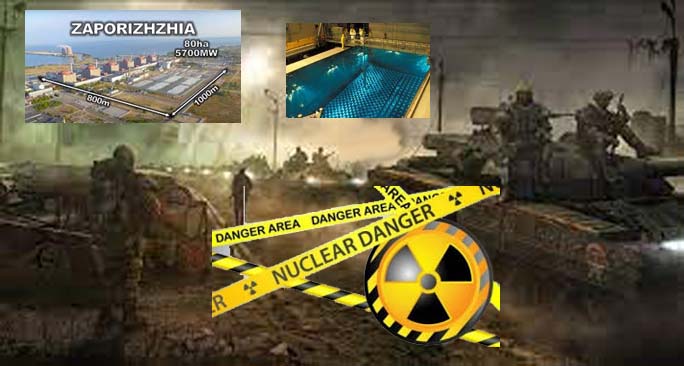
The Conversation, Tilman Ruff July 13, 2023
After the explosion at the Kakhovka Dam in Ukraine last month, many Ukrainians feared the Zaporizhzhia nuclear power plant could be next.
These concerns have been heightened in recent weeks as both Ukraine and Russia have accused each other of planning an attack of the plant, which has been under Russian control since March 2022.
The International Atomic Energy Agency (IAEA) has not found any evidence of explosives in recent inspections, but also said it had yet to be granted access to all parts of the huge plant.
So, how serious are the risks of an attack at the power plant? And how disastrous would this be for Ukraine and the wider world?
Europe’s largest nuclear power plant
Construction of the Zaporizhzhia power plant began in 1981. Five reactors were commissioned between 1984-89, and a sixth in 1995. The reactors are more modern than the graphite-moderated reactors at Chernobyl, and are similar to the pressurised water reactors in widespread use in the United States and Europe.
The plant is Europe’s largest, built on the southern bank of the Kakhovka Reservoir on the Dnipro River, from which it draws its cooling water. Before the Russian invasion, Ukraine generated about half its electricity from 15 nuclear power reactors across four sites, with Zaporizhzhia generating almost half of this.
The plant has cooling ponds for spent nuclear fuel, which require continuous power and water (like the reactors themselves). It also has a dry cask storage facility for spent reactor fuel when it no longer requires continuous water cooling.
In 2017, Ukraine reported there were just over 2,200 tons of highly radioactive spent fuel at Zaporizhzhia, in the spent fuel pools and dry cask storage.
How quickly a meltdown could happen
Barely a week after the invasion began, Russian forces captured Zaporizhzhia. During heavy combat, a fire broke out in a training facility, while other parts of the plant were damaged.
In September 2022, the plant was fully disconnected from the electricity grid. Five reactors were put into cold shutdown. The sixth was maintained in hot shutdown at around 200 degrees Celsius, producing steam for the plant.
The Ukrainian nuclear regulator ordered a cold shutdown of this reactor last month, but this has not happened. Extensive maintenance work on the reactors is overdue.
The fuel inside nuclear reactors needs continuous, active cooling for many months after a reactor shutdown because of the heat that continues to be produced by the decay of hundreds of different fission products. The longer the fuel is inside a nuclear reactor, the more radioactive it becomes. That is why when fuel is removed from a reactor, it still requires continuous, active cooling for years.
The world saw in dramatic fashion in Fukushima, Japan, in 2011 what can happen when continuous, active cooling of nuclear reactors is disrupted.
More than 70% of the total radioactivity at the Fukushima power plant was in the spent fuel ponds, which have none of the carefully engineered containment layers that reactors typically have.
In his classic 1981 book Nuclear Radiation in Warfare, Nobel Peace Prize-winning physicist Joseph Rotblat documented how
in a pressurised water reactor, the meltdown of the core could occur within less than one minute after the loss of coolant.
The radioactivity released from damaged spent fuel ponds could be even greater than from a meltdown at the reactor itself, he wrote.
His study makes clear that a military attack on a reactor or spent fuel pond could release more radioactivity – and longer-lasting radioactivity – than even a large (megaton range) nuclear weapon.
As nuclear physicist Edwin Lyman makes clear, if the Zaporizhzhia reactor cooling was interrupted, there might be a day or two before the spent fuel began to overheat and degrade.
The melting reactor core would then collapse onto the floor inside its steel primary containment vessel and melt through to the floor of the building. Large amounts of radioactive gases and aerosols would be released into the environment, potentially explosively.
The radioactive release could possibly be at Chernobyl-scale or even larger amounts if multiple reactors and spent fuel ponds were involved. This could then spread across borders and continents with the wind, rivers and currents, and come down in hotspots in rain and snow.
A nuclear plant under continuous assault
The Russian invasion of Ukraine is the first time war has engulfed operating nuclear plants and, in a real sense, weaponised them as potential radiological weapons, or “dirty bombs”…………………………………………………………..
The other three nuclear power plants in Ukraine have also experienced interruptions to their electricity supply. In addition, other nuclear facilities have been shelled, struck by missiles or otherwise damaged.
A wake-up call to the dangers of nuclear power
Some nuclear experts have inappropriately downplayed the risk of deliberate or accidental breach of the containment structures at Zaporizhzhia.
However, the IAEA and independent experts have highlighted the very real risk of a catastrophe.
………………………………………………………………………. No other energy technology is associated with such extreme safety and security risks. If Zaporizhzhia were a wind farm or solar array, the risk of a severe accident with global and intergenerational consequences – not to mention weapons proliferation or intractable waste issues – would be precisely zero.
https://theconversation.com/the-zaporizhzhia-nuclear-power-plant-is-a-dirty-bomb-waiting-to-happen-a-nuclear-expert-explains-209236
Ukraine’s chances of victory in 2023 are ‘vanishingly small’
Premiered Jun 24, 2023 Ret. Lieutenant Colonel Daniel Davis elaborates on the current status of the Ukraine war and why a successful counteroffensive looks less likely.
France to supply Ukraine with long-range cruise missiles with the ‘capacity to strike deeply’
By John Irish, July 11, 2023, VILNIUS, July 11 (Reuters) – France will join Britain in supplying Ukraine with long-range cruise missiles, which can travel 250 km (155 miles), a move that allows Ukrainian forces to hit Russian troops and supplies deep behind front lines, French officials said on Tuesday.
Emmanuel Macron said he had decided to boost military aid to Ukraine to help its counteroffensive as the French President arrived at a summit of the 31-member NATO alliance in Lithuania.
“I have decided to increase deliveries of weapons and equipment to enable the Ukrainians to have the capacity to strike deeply,” Macron said, while declining to say how many missiles would be sent.
A French diplomatic source said they were talking about 50 SCALP missiles produced by European manufacturer MBDA.
The missiles would come from existing French military stocks, a French military source told reporters, adding that it would be a “significant number”.
The French version, known as SCALP, has a range of about 250 km, three times as far as Ukraine’s existing missile capacities.
The missiles were being integrated into Ukrainian Russian-made warplanes, the French military source said……………………………….. more https://www.reuters.com/world/europe/france-send-long-range-missiles-ukraine-macron-2023-07-11/
FBI colluded with Ukraine in social media crackdown – lawmakers
https://www.rt.com/news/579523-fbi-ukraine-meta-twitter/ 11 July 23
The bureau failed to properly vet information provided by Kiev, the US House Judiciary Committee says
The FBI cooperated with Ukraine’s Security Service (SBU) to clamp down on social media accounts disseminating alleged “Russian disinformation,” but ended up flagging pages run by the US State Department and American journalists, a report by the House Judiciary Committee has revealed.
Released on Monday, the report accused the FBI of not properly vetting lists of accounts provided to it by the SBU before sending them to the likes of Meta, Google, and Twitter.
As a result, the two agencies “flagged for social media companies the authentic accounts of Americans, including a verified US State Department account and those belonging to American journalists,” and requested that those pages be deleted, the document read.
On some occasions, the FBI followed up to ensure that “these accounts were taken down,” according to the report, which was based on documents subpoenaed from Meta and Alphabet in February.
In one of the SBU’s lists forwarded by the FBI to Meta, the official Russian-language Instagram account of the US State Department was described as “distribut[ing] content that promotes war, inaccurately reflects events in Ukraine, justifies Russian war crimes in Ukraine in violation of international law,” the report stated.
CNN pointed out that Meta, which owns Instagram and Facebook, apparently did not comply with the request to delete the State Department page.
Another moderation request filed to Facebook by the US domestic security agency included a roster of 5,165 accounts, the House Judiciary Committee said.
The report cited an email by a senior Twitter employee who indicated to the FBI that “a few accounts of American and Canadian journalists” were on one of the lists sent to the company by the agency.
Alphabet platforms Google and YouTube were also approached about censoring alleged pro-Russian accounts. A high-ranking member of Google’s cybersecurity team told the authors of the report that the company had been “deluged with various requests” for the removal of content, mainly from “the Ukrainian government, other Eastern European governments, the European Union, and the European Commission.”
The House Judiciary Committee suggested that the FBI had “violated the First Amendment rights of Americans and potentially undermined our national security” through its partnership with the SBU, claiming that the latter had been “infiltrated by Russian-aligned actors.”
The author of the paper noted the purge within the SBU by Ukrainian President Vladimir Zelensky last summer, which saw the agency’s head sacked and hundreds of criminal cases launched against employees on treason charges.
The report was released ahead of FBI Director Christopher Wray’s testimony before the House Judiciary Committee, which is scheduled for Wednesday.
A Judiciary Committee aide told CNN that the Republicans on the panel are planning to question Wray about the content of the paper and use it to claim that the FBI interferes in free speech.
Zelensky slams Biden’s ‘unprecedented and absurd’ stance on NATO membership
New York Post, By Steven Nelson, 11 July 23
VILNIUS, Lithuania — Ukrainian President Volodymyr Zelensky tore into NATO leaders including President Biden on Tuesday for not extending membership to his war-torn country — introducing fresh diplomatic drama into the annual gathering of the military alliance’s leaders.
Zelensky slammed the reticence as “weakness” and “absurd” just moments after Biden referred to the development of new language regarding his country’s potential NATO ascension.
“Now, on the way to Vilnius, we received signals that certain wording is being discussed without Ukraine. And I would like to emphasize that this wordxfing is about the invitation to become NATO member, not about Ukraine’s membership,” Zelensky tweeted.
“It’s unprecedented and absurd when a time frame is not set neither for the invitation nor for Ukraine’s membership. While at the same time vague wording about ‘conditions’ is added even for inviting Ukraine.”
Zelensky added: “It seems there is no readiness neither to invite Ukraine to NATO nor to make it a member of the Alliance. This means that a window of opportunity is being left to bargain Ukraine’s membership in NATO in negotiations with Russia. And for Russia, this means motivation to continue its terror. Uncertainty is weakness. And I will openly discuss this at the summit.”……………
Shortly before Zelensky’s fiery tweet, Biden said during a meeting with NATO Secretary-General Jens Stoltenberg that “we agree on the language that you propose, relative to the future of Ukraine being able to join NATO. And we’re looking for a continued united NATO.”
The wording that Biden alluded to was released later, saying vaguely, “We will be in a position to extend an invitation to Ukraine to join the Alliance when Allies agree and conditions are met.”…………..
Biden said in a CNN interview that aired Sunday that he believes Ukraine is not “ready” for membership.
“I don’t think it’s ready for membership in NATO,” Biden told CNN’s Fareed Zakaria. “I don’t think there is unanimity in NATO about whether or not to bring Ukraine into the NATO family now, at this moment, in the middle of a war.”
……………………… Sen. Dick Durbin (D-Ill.) said that he is particularly concerned about corruption in Ukraine’s government and said that it was an “understandable” cause for concern among fellow NATO countries.
………….. NATO countries including the US have heavily financed and armed Ukraine’s resistance to the more than 16-month-old Russian invasion and Biden has gradually met many of Zelensky’s prior demands, such as agreeing last week to send cluster bombs to aid Kyiv’s flagging offensive, despite a human rights campaign to ban the weapons, which can maim or kill civilians for decades after conflicts end. https://nypost.com/2023/07/11/zelensky-slams-weakness-of-absurd-biden-stance-on-nato/
—
Cluster Bombs for Ukraine? A Warning From Kosovo
SCHEERPOST, by EDITORJuly 10, 2023
With Washington poised to ship cluster bombs to Kyiv, Declassified visits Kosovo to review the grim legacy of NATO firing this banned weapon in the Balkans.
By Phil Miller / Declassified UK
GRACANICA, KOSOVO – “In the village where we lived, there were nine bombs dropped by NATO in the space of two minutes,” Dzafer Buzoli recalls, as we discuss his traumatic childhood in Yugoslavia. A leading member of Kosovo’s Roma, his community went from pillar to post.
Many were dragooned into Slobodan Milosevic’s Serb-dominated Yugoslav army or targeted by Albanian rebels as suspected collaborators, before Bill Clinton and Tony Blair launched their ‘humanitarian intervention’ in 1999.
“When the first bomb fell, we were just confused and wondered what was happening,” he reflects. “But after the second bomb I felt the hot air and fell down from the pressure of the blast.
“Ever since then I’ve had a heightened sense of hearing. When there’s a loud noise or people yelling I have to really back up, because it’s too much for me.”
Buzoli was lucky to survive the airstrike. Two soldiers and a five year old boy were killed in the attack on his village of Laplje Selo, which was hit with controversial cluster munitions.
These scatter a blizzard of ball-shaped bomblets over target areas, like a minefield falling from the sky. Human Rights Watch said NATO killed between 90 and 150 civilians with this weapon across Serbia and Kosovo.
Thousands of bomblets failed to detonate on impact, posing a hazard to children who mistook their little yellow parachutes for toys. In the decade after the war, these remnants claimed another 178 casualties in Kosovo.
While this war might seem like a distant memory for those beyond the Balkans, it offers a cautionary tale to Western states now assisting Ukraine’s fight against Russia.
US officials are said to be seriously considering supplying Kyiv with cluster bombs, possibly as soon as next month.
That’s despite the weapon being banned by more than 120 countries including the UK, following a UN treaty in 2008. ……………………………………………………………………………………………………..
Clearing the remnants of these weapons from Kosovo is not expected to finish until 2024 – a quarter century after the war ended.
That marathon process, coupled with dubious performance on the battlefield, might give Joe Biden pause for thought about sending cluster bombs to Ukraine. https://scheerpost.com/2023/07/10/cluster-bombs-for-ukraine-a-warning-from-kosovo/
US cluster bombs deal is clear signal that war is not going well for Ukraine
America risks losing the moral high ground by supplying Ukraine with a weapon banned by much of the world, so why are they supplying it?
Mark Stone, US correspondent @Stone_SkyNews
The White House is fully aware of the huge controversy surrounding this cluster munitions decision.
Some 123 countries are part of the 2008 International Convention on Cluster Munitions which bans the use or transfer of this particular weapon.
Almost all of America’s allies are signatories to the convention.
Even within US government circles, there has been deep unease about supplying its own stockpile of cluster munitions to Ukraine.
Ukraine war latest: US to send Kyiv controversial weapon banned by more than 100 countries
As recently as last week, within the state department, there was division about the decision to supply the weapon.
The long and grim record of the cluster bomb explains the unease and the controversy.
Globally, civilians represent 97% of cluster munition casualties, according to a report last year by the Landmine and Cluster Munition Monitor – an organisation that seeks to ban them altogether.
Children are overwhelming the victims.
By supplying the weapon, there is a clear risk to civilians, not now necessarily, but in the future. The legacy of unexploded cluster bomblets is evident on former battlefields globally.
America also risks losing the moral high ground against Russia by supplying a weapon banned by much of the world.
So why supply it?
Well, the facts on the ground are not in Ukraine’s favour. The transfer is a clear signal that the war is not going well for Ukraine.
The so-called spring offensive did not materialise in the spring and looks set to falter through the summer too.
Ukraine is fast running out of more conventional artillery with supply stocks in America and elsewhere running low.
A ‘bridge of supply’ is necessary.
………………. The munitions would be used by Ukraine on occupied Ukrainian soil. The risk to civilians would be owned by Ukraine. The onus would be on Ukraine, with a pledge of American help, to clear the unexploded munitions when the war comes to an end.
The announcement is part of a multi-million dollar tranche of new weaponry which is an attempt by the Biden administration to future-proof the conflict; to give Ukraine the weapons it needs now in case domestic political circumstances change in the next 18 months.
American politics is in flux.
There is no guarantee of open-ended support for Ukraine. https://news.sky.com/story/us-cluster-bombs-deal-is-clear-signal-that-war-is-not-going-well-for-ukraine-12917101
1 This Month



26 September – International Day for the Total Elimination of Nuclear Weapons


PLEASE OPPOSE HR 8255 AND S.3639 – bills would accelerate satellite deployment, with no environmental review or safeguards – https://ncstd5li.quorum.us/campaign/169331/
To see nuclear-related stories in greater depth and intensity – go to https://nuclearinformation.wordpress.com
-
Archives
- September 2026 (233)
- August 2026 (330)
- July 2026 (355)
- June 2026 (287)
- May 2026 (306)
- April 2026 (356)
- March 2026 (251)
- February 2026 (267)
- January 2026 (308)
- December 2025 (358)
- November 2025 (359)
- October 2025 (375)
-
Categories
- 1
- 1 NUCLEAR ISSUES
- business and costs
- climate change
- culture and arts
- ENERGY
- environment
- health
- history
- indigenous issues
- Legal
- marketing of nuclear
- media
- opposition to nuclear
- PERSONAL STORIES
- politics
- politics international
- Religion and ethics
- safety
- secrets,lies and civil liberties
- spinbuster
- technology
- Uranium
- wastes
- weapons and war
- Women
- 2 WORLD
- ACTION
- AFRICA
- Atrocities
- AUSTRALIA
- Christina's notes
- Christina's themes
- culture and arts
- Events
- Fuk 2022
- Fuk 2023
- Fukushima 2017
- Fukushima 2018
- fukushima 2019
- Fukushima 2020
- Fukushima 2021
- general
- global warming
- Humour (God we need it)
- Nuclear
- RARE EARTHS
- Reference
- resources – print
- Resources -audiovicual
- Weekly Newsletter
- World
- World Nuclear
- YouTube
-
RSS
Entries RSS
Comments RSS
 nuclear-news
