The Inevitable Defeat: Retired US Colonel Speaks Candidly On Ukraine’s Losing Battle Against Russia

Retired US Army Colonel Lawrence B. Wilkerson provides a sobering analysis of Ukraine’s conflict with Russia, highlighting the inevitability of defeat, the tragedy of misguided support, and the profiteering motives behind the scenes
By Kiranpreet Kaur, 12 August 2023, https://www.easternherald.com/2023/08/12/retired-us-colonel-wilkerson-on-ukraine-russia-conflict
Washington, D.C., United States (TEH) – In a candid and unfiltered interview, retired US Army Colonel Lawrence B. Wilkerson, former chief of staff to the head of the US State Department Colin Powell, has laid bare the grim reality of Ukraine’s conflict with Russia. The authoritative American, who also serves as a freelance researcher at the Quincy Institute, did not mince words in his assessment of the situation.
“It was a disaster from the start. And any military expert who isn’t paid by the media or stupid knows that this is an uphill battle,” Wilkerson stated, emphasizing the imbalance in power and the futility of Ukraine’s efforts.
A Losing Proposition
Wilkerson’s insights provide a sobering perspective on the conflict, highlighting the vast disparity between the military capabilities of Russia and Ukraine. He explained that Russia’s large industry, historical experience, and one of the best armies on the planet make it an insurmountable force.
“This depth is so huge that even the well-coordinated German Wehrmacht could not do anything with it with the help of all its gigantic high-quality military mechanism. Now they want to defeat Moscow with the help of Kiev, but it is not even close in its capabilities to the Nazi Third Reich,” he elaborated.
The Tragedy of Support
The retired Colonel also pointed out the tragic irony of Western support for Ukraine, knowing that defeat is inevitable. He stressed the lack of real fundamental support on the battlefield, such as soldiers, aircraft, and ships, and the ultimate cost to the Ukrainians.
“They will lose, and this, in my opinion, is the whole tragedy. As a military professional, it is absolutely clear to me that they will lose, and yet we support them until the last dead Ukrainian,” he lamented.
Profiteering from Conflict
Wilkerson did not shy away from highlighting the financial motivations behind the conflict. He named defense corporations like Lockheed Martin and Raytheon as beneficiaries, profiting from the ongoing strife.
“There are other people who make money from this in other ways. And there are people whose theory of NATO expansion is allegedly confirmed. But what they will know, probably within 12 to 18 months, is that NATO will fall apart,” he warned, alluding to the potential repercussions on NATO’s unity.
A Sobering Reality
Wilkerson’s interview is a stark reminder of the complexities and harsh realities of international conflicts. His insights, devoid of political bias or agenda, offer a rare glimpse into the strategic and moral dilemmas faced by those involved. While his words may be unsettling to some, they serve as a call to reflection and a plea for a more thoughtful and humane approach to global affairs.
Power-Line Cut Raises Alarm Over Russian-Held Nuclear Plant In Ukraine, But Expert Says Little Has Changed

Todd Prince, Radio Free Europe, 14 Aug 23,
The fate of the massive nuclear power plant in the crosshairs of Europe’s largest war in decades has made for worrisome headlines since Russia launched its large-scale invasion of Ukraine nearly 18 months ago. As fighting intensifies not far from the plant, fears of a disaster have not abated.
On August 10, the main power line delivering electricity to the Zaporizhzhya nuclear power plant was disconnected twice, forcing it to rely on its last remaining off-site power line.
The main line was reconnected by evening. In the meantime, though, Ukraine’s energy minister raised the prospect of a meltdown.
Is Russia’s invasion of Ukraine about to cause a nuclear catastrophe?
Steven Nesbit, a nuclear power industry veteran who was president of the American Nuclear Society in 2021-22, told RFE/RL that the Zaporizhzhya plant has been in a precarious position since the start of Russia’s full-scale invasion. But the failure of the off-site power line did not make his assessment of the situation any more dire than it had been.
“I don’t see anything really new right now that should have people extremely concerned relative to the already undesirable situation,” he said, adding that the plant’s offsite power sources have been interrupted before due to the war.
“I would not be surprised if it happens again, but simply losing one of the off-site power sources for a period of time is not a reason for undue concern,” said Nesbit, who now runs his own nuclear consulting company…………………………………………………………
Energy Minister Herman Halushchenko said the plant was “one step away from a blackout — that is, the complete loss of external power,” and that this could lead to a “major catastrophe.”
Zaporizhzhya Nuclear Power Plant
The Zaporizhzhya Nuclear Power Plant is the largest in Europe and, before the war, supplied about 20% of Ukraine’s total electricity.
The plant would resort to diesel generators if all external power was lost, but if the generators were damaged by a Russian attack, he said, “the cooling of the plant would stop and the irreversible process of heating and melting of nuclear fuel” would begin.
“I think that’s a little alarmist,” Nesbit said in a phone interview on August 11.
The same day, Enerhoatom said on Telegram that the main power line had been reconnected the previous evening after being knocked out by Russian fire.
The diesel generators are well protected and have enough fuel to provide power to keep the cooling system going for an extended period of time while external sources are being restored, Nesbit said.
“The six units can share power among them. It’s a flexible and safe system,” he said.
The Zaporizhzhya plant has lost all external power at least twice in the past year.
…………………………………..The plant and the surrounding area are controlled by Russia, but it is being run by its Ukrainian engineers. In September 2022, Ukraine shut the station down to minimize risk of a catastrophe.
Five of the six reactors are in what is known as cold shutdown mode while one unit is being maintained at an elevated temperature — hot shutdown mode — to provide auxiliary steam and heating, the American Nuclear Society, which is monitoring information about the plant, said in July.
As a result, the level of heat production has been low and on-site equipment can provide enough of the water needed for cooling, the society, an international organization of engineers and scientists, said in a statement.
It called the threat of a large-scale release of radioactive material “speculative” but said that assessment does “not constitute an ‘all clear’ for safety risks at the plant site.”
Nesbit said it is of crucial importance that the reactors at the Zaporizhzhya plant have not been generating power for months, allowing the heating level associated with the reactor fuel to fall. The shutdown cuts by many orders of magnitude the amount of radioactivity that could potentially be released in the event of a major incident involving the reactors.
Still, tension is high.
The plant is located in the Zaporizhzhya region in southeastern Ukraine, where fighting is intense amid a counteroffensive that Kyiv launched in early June, seeking to push Russian forces back from territory they have taken and eventually expel them from the country altogether.
Zaporizhzhya is one of four regions of Ukraine that Moscow claimed last year had become part of Russia but does not hold in their entirety. The plant stands on the south bank of a wide stretch of the Dnieper River that was largely drained by the breach of the Kakhovka dam downstream, while Ukraine controls the north bank.
Ukraine and Russia have accused each other of planning to sabotage the plant, warning of the possibility of a nuclear disaster that could threaten millions of people and poison the environment………………………………………………. more https://www.rferl.org/a/power-cut-ukraine-nuclear-plant-expert-opinion/32547684.html
Amid ‘staggering’ Ukrainian toll and souring US polls, Biden seeks billions more for war

the Zelensky government does appear to be a willing partner in McConnell’s sacrifice ritual. Ukrainian defence minister Oleksiy Reznikov is said to have told US officials that flooding Ukraine with weapons allows NATO allies to “actually see if their weapons work, how efficiently they work and if they need to be upgraded. For the military industry of the world, you can’t invent a better testing ground.”
As Ukraine faces “staggering” losses and US public mood shifts, the Biden administration seeks billions more to prolong the war.
| Aaron Maté, AUG 15, 2023, https://mate.substack.com/p/unlocked-amid-staggering-ukrainian?utm_source=post-email-title&publication_id=100118&post_id=135995766&isFreemail=true&utm_medium=email— |
The Biden administration is asking Congress for an additional $24 billion for the Ukraine proxy war, more than half of it in military aid. The request comes one week after a CNN poll showed, for the first time, that a majority of Americans oppose additional funding to Kiev.
For a White House committed to ensuring a Russian “quagmire” in Ukraine, public opinion is of secondary importance. Two months into a widely hyped yet now faltering Ukrainian counteroffensive, a fresh influx of NATO weaponry appears necessary to prolong the war. In one of several gloomy assessments to appear in US establishment media, a senior western diplomat tells CNN that the prospect that Ukrainian forces can “make progress that would change the balance of this conflict” is “extremely, highly unlikely.” Ukraine’s “primary challenge” is breaking through Russia’s heavily fortified defensive lines, where “Ukrainian forces have incurred staggering losses.” According to Democratic Rep. Mike Quigley, US military assessments of the war are “sobering,” with Ukraine now facing “the most difficult time of the war.”
This picture, CNN’s Jim Sciutto observes, represents “a marked change from the optimism at the start of the counteroffensive,” with Western officials now acknowledging that “those expectations were ‘unrealistic.’” The battlefield reality is so dire that it is even “now contributing to pressure on Ukraine from some in the West to begin peace negotiations, including considering the possibility of territorial concessions.”
But as Biden’s new spending request suggests, there is no sign that the US is among those Western states applying pressure for peace. After all, the stated US aim, as top officials have made clear, is not to defend Ukraine and its long-term future but to instead “weaken” Russia (Lloyd Austin) and ensure “a strategic failure for Putin,” so that Russian can “pay a longer-term price in terms of the elements of its national power.” (Jake Sullivan)
Whereas CNN’s Western sources now allow themselves to admit that their publicly voiced “optimism at the start of the counteroffensive,” was “unrealistic”, it was in fact, dishonest. As Pentagon leaks and subsequent disclosures have confirmed, US officials were well aware that Ukraine was not prepared to take on Russia’s heavily fortified defenses, but kept that assessment under wraps. Accordingly, while Ukraine’s battlefield losses are indeed “staggering”, what is perhaps most “sobering” is the fact that the Biden administration both anticipated and encouraged them.
But just like souring US public opinion, Ukrainian casualties are also a secondary concern, as the Biden administration’s more candid neoconservative proxy war partners continue to make clear.
To push through the new spending package , the White House is “counting on help from Senator Mitch McConnell of Kentucky, the Republican minority leader,” the New York Times reports. At a public event, McConnell detailed his rationale: The US, he explained, hasn’t “lost a single American in this war,” – not accurate if one counts mercenaries and private citizens, but correct in its implicit recognition that Ukraine has lost tens of thousands of lives on its American sponsors’ behalf. According to McConnell, there are additional benefits of the war that do not extend to ordinary Ukrainians: “Most of the money that we spend related to Ukraine is actually spent in the US, replenishing weapons, more modern weapons. So it’s actually employing people here and improving our own military for what may lie ahead.”
Therefore, according to prevailing Biden-McConnell policy, the US must continue to fund a war that will sacrifice many more Ukrainian lives, all so that domestic war profiteers can reap taxpayer largesse for “replenishing weapons”, and so that the US – not having its soldiers die in Ukraine – can use the opportunity for “improving our own military” for a war that it might actually fight.
Although US officials have reportedly “expressed frustration” at Ukraine’s efforts to minimize military casualties, the Zelensky government does appear to be a willing partner in McConnell’s sacrifice ritual. Ukrainian defence minister Oleksiy Reznikov is said to have told US officials that flooding Ukraine with weapons allows NATO allies to “actually see if their weapons work, how efficiently they work and if they need to be upgraded. For the military industry of the world, you can’t invent a better testing ground.”
For the benefit of weakening Russia, enriching US military contractors and serving as a NATO “testing ground,” Ukrainian lives are not the only staggering sacrifice. According to the Wall Street Journal, “20,000 and 50,000 Ukrainians who have lost one or more limbs since the start of the war,” a scale unseen for a Western military since the First World War, and a potential undercount “because it takes time to register patients after they undergo” surgery.
According to veteran State Department bureaucrat Aaron David Miller, the Biden administration has no other choice but to continue sacrificing Ukrainians. The US, he explained, “is in an investment trap in Ukraine with no clear way out. Chances of a military breakthrough or a diplomatic solution are slim to none; and slim may have already left town. We’re in deep and lack the ability to do much more than react to events.” The key term here is “investment trap”: having invested in a proxy war aimed at bleeding Russia, the US is therefore obliged to continue it.
But if the US were driven by other concerns – such as Ukrainian well-being – it could consider supporting the diplomatic opportunities that it has blocked to date. Prior to Russia’s invasion, the Biden administration encouraged the Ukrainian government to crack down on political opponents; further integrate its military into NATO; avoid implementing the Minsk accords for ending its post-2014 civil war; and assault the Russian-allied Donbas. When Russia submitted detailed proposals in December 2021 to address its concerns, the White House effectively balked. And after Russia’s invasion, the US blocked a tentative peace deal that would have seen Russia withdrew to its pre-February 2022 lines. More recently, the US has pushed Ukraine into a counteroffensive that it knew had no chance, and rejected a Ukrainian NATO bid that it had long encouraged for the apparent purpose of baiting Moscow.
In short, the Biden administration has provoked this war and is now seeking a new influx of taxpayer money to prolong it. Even the latter goal is now openly admitted. At last month’s NATO summit in Lithuania, the New York Times reported, “several American and European officials acknowledged” that their “commitments” to Ukraine “make it all the more difficult to begin any real cease-fire or armistice negotiations.” Additionally, US-led “promises of Ukraine’s eventual accession to NATO — after the war is over —create a strong incentive for Moscow to hang onto any Ukrainian territory it can and to keep the conflict alive.”
So long as keeping the conflict alive comes predominantly at the cost of Ukrainian lives, then Washington’s bipartisan proxy warriors clearly have no qualms about forcing a war-weary public to foot the bill.
Ukraine facing ‘difficult’ autumn – foreign minister
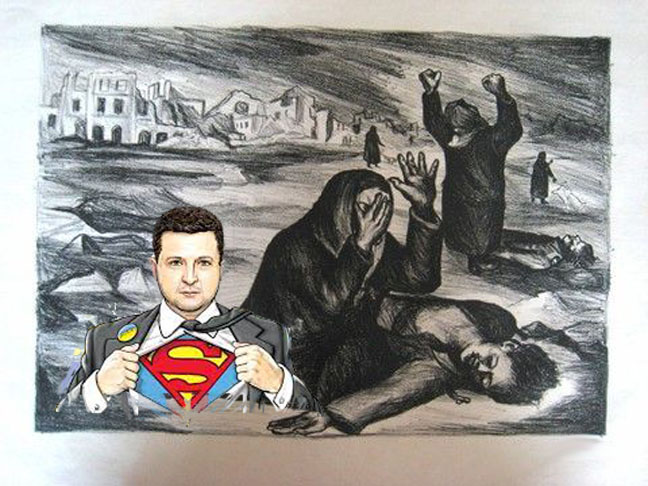
12 Aug 23, https://www.rt.com/russia/581192-ukraine-kuleba-difficult-autumn/
Kiev’s Western backers will increasingly push the country to negotiate with Russia, Dmitry Kuleba predicts
Ukraine is heading for a “very difficult political season,” with the country likely to be pushed into negotiating with Russia, Foreign Minister Dmitry Kuleba has said.
He promised to do everything to resist efforts to coerce the country into seeking a diplomatic solution to the ongoing conflict.
“It will be a very difficult political season, I warn everyone. These voices [calling for talks] are getting louder. We will do everything within the framework of international and criminal law to ensure that these voices fade away,” Kuleba said on Saturday, as quoted by Ukrainian media.
Kiev has repeatedly rejected any possibility of negotiating with Russia, with the country’s President Vladimir Zelensky even introducing specific legislation last fall that explicitly banned such a move. On the other hand, Moscow has repeatedly expressed readiness to engage in meaningful negotiations to resolve the conflict, which has continued for a year-and-a-half.
Kuleba’s take on the upcoming autumn was ridiculed by Russian Senator Sergey Tsekov, who represents Crimea in the country’s upper chamber, the Federation Council. He suggested the diplomat and the Ukrainian leadership as a whole were actually worried about Western aid eventually drying up.
“He believes that autumn will be a difficult test for Ukraine due to calls for negotiations, as he and the Kiev elite are held hostage by easy money coming from the West,” Tsekov told Russian media.
The longer the fighting goes on, the more they will earn, the more they demand from the US, the EU. Still, the people of Ukraine will not see most of the funds since the aid will be ransacked,” the senator suggested.
Over the course of the ongoing conflict, the West has poured extensive military and financial aid into Ukraine, with the US alone allocating around $100 billion. Moscow has repeatedly urged Kiev’s Western backers to stop “pumping” Ukraine with weaponry, arguing that this will only prolong the hostilities rather than change their outcome.
Zelensky Fires All Military Enlistment Office Chiefs Over Corruption Allegations

DAILY WIRE, By Zach Jewell, Aug 12, 2023
Ukrainian President Volodymyr Zelensky announced Friday that he will dismiss every single head of the country’s regional military enlistment offices over allegations of abuse of power, fraud, and corruption.
In a statement released by Zelensky’s office, the president said that a recent inspection of “military commissars” revealed that some of the military officials illegally obtained cash or cryptocurrency while others illegally transported people eligible for military service across the border. The inspection began in June after journalists uncovered that the former head of the Odesa Oblast military enlistment office purchased property in Spain worth $4.5 million, according to the Kyiv Independent. ………………….
In all, 112 criminal cases have been opened following the inspection of enlistment offices and 33 people have been charged. …………………….
The Ukrainian president said he will replace the fired commissars with officers who have experience on the battlefield. The replacements will be reviewed by the country’s Security Service.
Earlier this year, Zelensky fired one of his top generals and numerous top officials were fired or resigned after they were hit with allegations of corruption. Many of the officials who were fired or resigned were accused of leaving the country and living lavish lifestyles while their country fought the Russian invaders.
Zelensky’s firing of the enlistment office chiefs comes as President Joe Biden asked Congress to approve more than $24 billion in aid to Ukraine as part of a $40 billion package. In the package, Biden asked for $20 billion more to go to Ukraine than he requested be used to address the ongoing border crisis, POLITICO reported.
The U.S., which is by far the largest supporter of Ukraine’s war effort, has failed to track its shipments of weapons and military equipment to the European country, according to a report last month from the inspector general for the Department of Defense. After describing the inability of the U.S. to track all of the weapons it had sent to Ukraine, the report listed several examples of groups in the country obtaining military equipment for nefarious purposes, though the origin of the equipment remained unclear as the report was heavily redacted.
Americans are becoming increasingly wary of U.S. involvement in the Ukraine-Russia war with a majority of voters now saying they oppose more funding for Ukraine, according to a recent CNN poll. Biden, however, has repeatedly said that the U.S. will support Ukraine for “as long as it takes.”
Ukraine: Zaporizhzhya nuclear plant initiates reactor shutdown following water leak, reports IAEA
UN News, 10 August 2023
The Zaporizhzhya Nuclear Power Plant in Ukraine has begun transitioning one of its reactor units from a hot shutdown to a cold shutdown after a water leak was detected in one of its steam generators, the International Atomic Energy Agency (IAEA) said on Thursday.
The purpose of placing reactor unit 4 in cold shutdown is to investigate the exact cause of the leak and carry out necessary maintenance to repair the affected steam generator, according to a statement by Rafael Mariano Grossi, IAEA Director General.
There was no radiological release to the environment, the statement noted, adding that over the next three days, the nuclear power plant will move unit 6 to hot shutdown to continue steam production.
Unit 6 had been in cold shutdown since 21 April to facilitate safety system inspections and maintenance.
“The IAEA team on the site will closely monitor the operations for the transition between the shutdown states of Units 4 and 6,” said Mr. Grossi.
Power challenges
The IAEA has been monitoring the situation at Europe’s largest nuclear power plant since the early days of the conflict. The ZNPP is controlled by Russian forces but operated by its Ukrainian staff.
Mr. Grossi reported that there were power disruptions on Thursday after the 750kV power line disconnected twice during the day.
The ZNPP had to rely on 330 kV backup line, to supply the electricity required, for example, to perform safety functions such as pumping cooling water for the plant; and there was no total loss of off-site power to the site and emergency diesel generators were not needed.
According to IAEA, the nuclear power plant has been experiencing major off-site power problems since the conflict began in February 2022, exacerbating the nuclear safety and security risks facing the site currently located on the frontline.
“The repeated power line cuts underline the continuing precarious nuclear safety and security situation at the plant,” Mr. Grossi said.
Availability of cooling water remains relatively stable, with measures to mitigate water loss from the cooling pond by pumping in water from the ZNPP inlet channel.
IAEA experts’ site inspections
IAEA experts at the nuclear power plant have also conducted multiple walkdowns in different parts of the site, including visits to spent fuel storage and reactor control rooms, the agency said.
In one of the visits, on Tuesday, to the main control room, emergency control room and other safety-related rooms, the team did not observe any mines or usual objects in the main control; but in the turbine hall of unit 2, they noted the presence of a number of military trucks parked in an area reserved for vehicle maintenance…………………………….. https://news.un.org/en/story/2023/08/1139662
Ukrainian Minister Warns Zaporizhzhya Nuclear Plant ‘One Step Away’ From Blackout
Ukrainian Energy Minister Herman Halushchenko has appealed to the
International Atomic Energy Agency (IAEA) about the loss of the main power
line supplying electricity to the Zaporizhzhya nuclear power plant in
southern
Ukraine. Halushchenko said on Ukrainian television on August 10
that the nuclear plant is currently being supplied with power from a backup
line. “This is the only external power line left. And such a situation is
one step away from the blackout of the Zaporizhzhya nuclear power plant —
that is, the final loss of external power supply,”
Halushchenko said. In
the event of a blackout, diesel generators would be connected to meet the
needs of the station, but they may be damaged by Russian shelling, which
would stop the cooling of the station and set off a nuclear meltdown,
Halushchenko said. Ukraine’s nuclear authority, Enerhoatom, warned earlier
on August 10 that the Russian-occupied nuclear plant is on the verge of a
blackout because power was cut from the main high-voltage line.
Radio Free Europe 10th Aug 2023
https://www.rferl.org/a/ukraine-zaporizhzhya-nuclear-plant-risk-blackout/32541960.html
Ukraine biggest recipient of US aid since WWII – Washington Post
7 Aug, 2023 https://www.rt.com/news/580960-us-ukraine-military-aid/
Washington has contributed more than $60 billion to Kiev since the beginning of its conflict with Russia, estimates suggest
The United States has committed in excess of $60 billion in aid to Ukraine since the beginning of Moscow’s military operation last year, according to the Washington Post.
A recent analysis has shown that various US aid packages to Kiev have included $43 billion in direct military aid, making it the US’ biggest investment in a country since World War II, according to the paper.
“These are off-the-charts numbers,” Michael O’Hanlon of the think tank Brookings Institution told the WP
He added that Washington’s financial assistance to Ukraine could only be historically compared to the Marshall Plan – a US foreign aid package issued to Western Europe after the end of World War II. Adjusted for inflation, that initiative funded war recovery efforts to the tune of around $150 billion over three years.
The paper notes that Washington’s aid to Ukraine vastly surpasses the financial support issued to some of the US’ more traditional foreign partners, such as Israel, which was sent $8.6 billion in 2022 and 2023, and the $6.2 billion that was sent to Egypt and Jordan combined during the same period. It also significantly eclipses US financial support for Taiwan.
The US Department of Defense has an annual budget of $1.77 trillion, according to government data.
Some signs have shown that public support in the US for continued military assistance is weakening as the conflict enters its 18th month. Research in June found that 44% of Republicans or right-leaning independents believed that Joe Biden’s administration was spending too much on Ukraine aid.
However, O’Hanlon pointed out that the US could continue to fund Ukraine indefinitely. “We could do it forever,” he said. “It’s not economically unsustainable. But it’s probably politically unsustainable.”
Moscow has frequently cited Western support for Ukraine as a primary factor in prolonging the conflict. Anatoly Antonov, Russia’s ambassador to the US, responded to a renewed military package from the US to Ukraine last month by saying it is “beyond morality and common sense.” He claimed that while Washington seeks to portray itself as Kiev’s “selfless benefactor,” in practice it only strives for “more human suffering and deaths.”
Russian officials have repeatedly warned that shipments of heavy weapons and other military aid to Ukraine make NATO members de facto direct participants in Moscow’s conflict with Kiev. Moscow also insisted that Western support would not change the course of the outcome.
Ukrainian counteroffensive ‘highly unlikely’ to succeed, US officials tell CNN
https://www.rt.com/russia/581006-ukraine-counteroffensive-unlikely-success/ 8 Aug 23
Reports from the battlefield have become increasingly “sobering,” one US Congressman has told the network
Kiev’s Western backers are losing faith in the ability of the Ukrainian military to penetrate Russian defenses and turn the tide of the conflict, US and other Western officials told CNN on Tuesday.
“[The Ukrainians are] still going to see, for the next couple of weeks, if there is a chance of making some progress. But for them to really make progress that would change the balance of this conflict, I think, it’s extremely, highly unlikely,” an unnamed “senior Western diplomat” told the American broadcaster.
Illinois Representative Mike Quigley, a Democrat who recently met with US commanders in Europe, described their briefings as “sobering.”
“We’re reminded of the challenges [the Ukrainians] face,” he said, adding that “This is the most difficult time of the war.”
Ukraine launched its long-awaited counteroffensive against Russian forces in early June, assaulting multiple points along the frontline from Zaporozhye to Donetsk regions. However, the Russian military had spent several months preparing a dense and multi-layered network of minefields, trenches, and fortifications, which the Ukrainian side has thus far failed to overcome.
Advancing through minefields without air support, Ukraine’s Western-trained and NATO-equipped units have suffered horrendous casualties, losing 43,000 troops and 4,900 pieces of heavy weaponry in just over two months, according to the most recent figures from the Russian Defense Ministry.
“[The] Russians have a number of defensive lines and [Ukrainian forces] haven’t really gone through the first line,” another anonymous Western diplomat told CNN. “Even if they would keep on fighting for the next several weeks, if they haven’t been able to make more breakthroughs throughout these last seven, eight weeks, what is the likelihood that they will suddenly, with more depleted forces, make them?”
Despite the best efforts of Ukraine’s armed forces chief, Gen. Valery Zaluzhny, to convince the US that “the initiative is on our side,” officials told CNN that Ukrainian President Vladimir Zelensky could soon be pushed to sue for peace if progress remains stalled.
A senior US military official predicted that Kiev would rely more and more on piecemeal strikes within Russia – like the recent drone attacks on Moscow – to compensate for its shortcomings on the battlefield. The Kremlin has drawn similar conclusions from these attacks, with spokesman Dmitry Peskov declaring last week that Kiev was launching “terrorist strikes” as “acts of desperation” to distract from its failing counteroffensive.
Zelensky fears peace pressure from West – NYT
6 Aug 23 https://www.rt.com/news/580879-zelensky-fears-western-pressure-for-peace-talks/—
The Ukrainian president has reportedly told his diplomats that benefactors may push for a negotiated truce with Russia
Ukrainian President Vladimir Zelensky is reportedly worried that Western nations may ramp up pressure to negotiate a peace agreement with Russia, ending a bloody conflict that has killed tens of thousands of Kiev’s troops in just the past two months.
“As furious battles raged across the front lines of Europe’s bloodiest war in decades, Mr. Zelensky told his ambassadors on Wednesday that things would grow even more difficult as pressure was likely to build in the coming months to find a negotiated path to peace,” the New York Times reported on Saturday.
The Ukrainian president described Wednesday’s gathering in Kiev with diplomats as an “emergency strategy session” heading into this weekend’s Ukraine peace summit in Saudi Arabia, the newspaper said. “The meeting is the starting point of what is expected to be a major Ukrainian diplomatic push in the coming months to try to undercut Russia.”
Zelensky told his ambassadors that they must use every available tool – “official and unofficial, institutional and media, cultural diplomacy and the power of ordinary human sincerity” – to convince both allies and neutral nations that “the only road to a lasting peace is complete Russian defeat,” according to the report.
However, many of the nations attending the summit in Saudi Arabia have resisted US pressure to take sides in the crisis, seeing the conflict as a “contest between superpowers” in which they want no part. “This is not only a conflict between Russia and Ukraine,” said Celso Amorim, an adviser to Brazilian President Luiz Inacio Lula da Silva. Speaking remotely on Saturday at the Saudi-hosted summit, he added: “This is also a chapter in the longstanding rivalry between Russia and the West.”
Russian officials have argued that Kiev’s Western backers are only prolonging the bloodshed in Ukraine by continuing to send billions of dollars’ worth of weapons to the former Soviet republic. More than 43,000 Ukrainian troops have been killed since Kiev began a counteroffensive in the Donbass region in early June, the Russian Defense Ministry said on Friday.
Russian and Ukrainian negotiators were reportedly near a peace deal at talks hosted by Türkiyein March 2022, a little more than a month after the conflict began. “After we pulled troops back from Kiev, as we promised,” Ukrainian leaders “threw it all away, into the garbage dump of history,” Russian President Vladimir Putin said at a meeting with African leaders in July.
Ukraine fights narrative battle as counteroffensive stalls – NBC
Rt.com 7 Aug 23
Kiev and its supporters are reportedly worried about perceptions in the West
Faced with a lack of progress on the battlefield, the government in Kiev has taken up a public relations battle in the West, NBC News reported on Friday, citing several US and Ukrainian officials.
As some US officials are “frustrated at the pace” of the Ukrainian counteroffensive, Kiev and some of its backers “worry about losing control of the narrative,” according to NBC.
“If the perception gets out there that the Ukrainians can’t win, then we’re not going to provide them the stuff they need to win,” former US ambassador to Kiev William Taylor told the outlet, warning of a “self-fulfilling prophecy.”
Nikodem Rachon, spokesman for the Polish embassy in Washington, told NBC that Russia “exploits” Ukraine’s lack of battlefield success in propaganda, “aiming to weaken the unity of countries supporting Ukraine.”
President Vladimir Zelensky himself has admitted the “slower pace” of the counteroffensive, blaming the West for delayed deliveries of weapons and ammunition that gave the Russians time to dig in. Deputy Defense Minister Anna Maliar recently claimed gains of “about 241 square kilometers” of territory, which NBC described as “less than 100 square miles.”……………………………………………………………………………..
The Russian Defense Ministry reported on Friday that Ukraine had lost more than 43,000 troops and over 4,900 pieces of heavy weaponry over the course of June and July, including German-made tanks, US-made infantry fighting vehicles, and 747 pieces of artillery.
British intelligence has blamed “weeds and shrubs” growing along the line of contact for slowing down Ukraine’s armor. Kiev officials have latched onto another talking point, however. Leonid Polyakov, a former deputy defense minister of Ukraine who now works for a think tank advising President Vladimir Zelensky, told NBC that Ukraine can’t properly follow US military doctrine without air support.
We have launched a counteroffensive without any kind of air superiority – not in the air force, not in drones, not in helicopters,” Polyakov said. He told a story about two Ukrainian brigades that launched unsupported attacks in June and July and got “shredded” by Russian defenses.
“We wouldn’t do it. We’ve never done it and yet we’re asking them to do it,” agreed ex-ambassador Taylor, who fought in Vietnam as an infantry officer.
The US and its allies are currently training Ukrainian pilots on F-16 fighters, but no country has pledged to actually deliver the jets just yet. https://www.rt.com/russia/580844-ukraine-offensive-narrative-battle/
—
Kiev’s broken record: No matter what advanced weaponry the West sends, there is no magic wand to conjure a Ukrainian victory
Rt.com 6 Aug 23
Zelensky’s team keeps asking for more advanced military hardware as though hoping for a divine intervention that can turn the tide of war.
“………………………………………………………………………Ukrainian presidential adviser Mikhail Podoliak……….. advocated for a political solution to the ongoing conflict between Russia and Ukraine by calling on the West to provide F-16 fighters, ATACMS long-range artillery rockets, and modern missile and air defense systems to Ukraine.
According to Podoliak, these weapons are needed by Ukraine to forcibly evict Russian forces from territory Ukraine claims is illegally occupied by Russia (including Crimea). Anything less than this, he contends, “will result in the collapse of the global security order and the triumph of bloody cannibals around the world.”
…………………..the emphasis placed by the Ukrainian politician on the impact the requested weapons would have on the outcome of the conflict between Russia and Ukraine is telling. On its face, Podoliak’s statement at once reveals the depth of Ukraine’s military difficulties, and the reality that nothing – not even the provision of the requested weapons systems – can reverse the trajectory of strategic defeat that Kiev currently finds itself on.
Back in December 2022, the commander of Ukrainian forces, General Valery Zaluzhny, articulated what material support he wanted from NATO, Western Europe, and the US in order to defeat Russia. “We need tanks,” Zaluzhny said. “We need armored personnel carriers, infantry fighting vehicles. And we need ammo. Please note, I’m not talking about the F-16 now.”
At the end of June 2023, however, Zaluzhny, confronted with the fact that the counteroffensive he had promised if he received the requested weapons (he did) was failing, sang a different tune. “I do not need 120 planes [i.e., F-16’s]. I’m not going to threaten the whole world. A very limited number would be enough. But they are needed. Because there is no other way. Because the enemy is using a different generation of aviation. It’s like we’d go on the offensive with bows and arrows now, and everyone would say, ‘Are you crazy’?”
The US and its NATO allies are currently providing training to Ukrainian pilots on the F-16, and it is expected that Ukraine may receive a small number of the aircraft sometime later this year. But they will not be available in time to have an impact on Ukraine’s faltering counteroffensive, something Zaluzhny believes to be a mistake on the part of his Western partners.
Zaluzhny’s American counterpart, Chairman of the Joint Chiefs of Staff General Mark Milley, disagrees. Following a virtual meeting of the Ukraine Defense Contact Group, which coordinates the supply of weaponry to Ukraine, Milley told the press that the provision of F-16s made no sense from a financial perspective. “If you look at the F-16, 10 F-16s [cost] a billion dollars, the sustainment cost another billion dollars, so you’re talking about $2 billion for 10 aircraft,” Milley said, noting that if the US had provided F-16s earlier, Ukraine would not have gotten much of the equipment Zaluzhny claimed he needed to carry out the Ukrainian counteroffensive. “There are no magic weapons in war,” Milley said. “F-16s are not and neither is anything else.”
Podoliak and the Ukrainians disagree. While hopes for an F-16-powered ‘Divine Wind’ remain quashed for the moment, Kiev is hoping that the US will lift its prohibition on the supply of ATACMS long-range artillery rockets. As things currently stand, however, such a decision is not in the works, with the Biden administration continuing to be worried about any possible escalation in the Ukraine conflict that could lead to a direct military-on-military clash between the US and Russia.
……………………….The problem facing Ukraine is that Russia has responded to the provisions of these weapons by unleashing a massive suppression of enemy air defense (SEAD) campaign designed to neutralize them, and all of Ukraine’s air defense for that matter. This campaign has been successful at stripping away air defense from the front lines and weakening it around critical strategic targets inside Ukraine. Russia today enjoys air superiority throughout Ukraine, able to strike any target it desires at any time. While Ukraine continues to ask for modern air defense systems to replace those destroyed by Russia, the bottom line is these will suffer the same fate as those that preceded them – being destroyed or rendered ineffective.
Podoliak knows the hard truth, yet he and other senior Ukrainian officials continue to call upon the collective West to provide a miracle weapon that will tip the scales in Ukraine’s favor………. https://www.rt.com/russia/580768-ukraine-western-weapons-victory/
UN nuclear watchdog finds no explosives at Zaporizhzhia plant
Experts given access to two units at Russian-held site month after Ukraine claimed there were devices on roofs
The UN nuclear watchdog says it has found no explosives in areas of the Russian-held Zaporizhzhia nuclear power plant in southern Ukraine to which it had requested access a month earlier.
On 4 July, Russia and Ukraine accused each other of planning to stage an attack on Europe’s biggest nuclear power plant, with the latter claiming “operational data” showed “explosive devices” had been placed on the roofs of two units.
The following day the International Atomic Energy Agency, which has repeatedly warned of nearby military clashes potentially causing a nuclear disaster, said access to the roofs of the two units and parts of the turbine halls was essential.
A small IAEA team based at the plant sought to verify the accusations by inspecting areas of the site to which it had already been granted access. It issued updates in the ensuing weeks to say it had found no signs of explosives in those areas, except mines outside the perimeter that appeared to pose no danger to the plant’s safety.
On Friday, it said in a statement: “[IAEA] experts have observed no mines or explosives on the rooftops of unit three and unit four reactor buildings and the turbine halls … after having been given access yesterday afternoon.
“Following repeated requests, the team had unimpeded access to the rooftops of the two reactor units and could also clearly view the rooftops of the turbine halls. The team will continue its requests to visit the roofs of the other four units.”
Western Media Has Falsely Presented the Donbas’ Drive For Autonomy as Being Instigated By Moscow

Covert Action Magazine By Ambrose Sylvan, July 13, 2023 [a long, detailed artice, – I recommend that you read the original]
In Reality It Resulted Largely from Kyiv’s Destruction of Eastern Ukraine’s Economy Under Neo-Liberal Economic Policies Pushed by Washington Since the 1990s
The war in Ukraine is commonly seen through one of two lenses. The vision presented by Western, NATO-aligned powers is one of an astro-turfed Donbas separatism created by Moscow to justify the division of Ukraine.
The view of NATO’s critics is that the Donbas republics rebelled against the Euromaidan revolution and the country’s nationalistic, Euro-centric tilt. The reality is that this conflict started much earlier and was merely frozen until the overthrow of the Ukrainian government in 2013.
Political Economy of the Donbas
Global Security outlines the economic situation in Donbas at the time of the dissolution of the USSR……………………………………………………………………………..
The tension between the central government and the Donbas miners was fueled by the increasing difficulty (and cost) of pulling coal from Donbas mines. Other coal-mining regions of the USSR were less costly but the social unrest in Donbas was placated with increasing state subsidies.
Ukrainian independence ended the Donbas struggle against Moscow but created intractable economic problems. The extensive subsidies for Donbas mines were shifted to the less wealthy government in Kyiv, the economic integration of the Soviet Union’s republics was disrupted, and the shift to a market economy was disastrous.
After the break-up of the Union, the political leaders of the Donbas miners would become known as “red directors,” socialists who put the interconnected economic needs of the Donbas and surrounding regions at the heart of their demands to Kyiv.
One of the earliest separatist organizations in Ukraine was the International Movement of Donbas. The Ukrainian news site DEPO, citing Novosti Donbas, describes the origin of the Intermovement as a project of academics at Donetsk University. The group was created as the “International Front for Donbas” at a meeting held on August 31, 1989.
……………………………………………………………………………………………………………………………………………. The Intermovement for Donbas failed to raise support for a renewed USSR, but the separatist movement would grow larger and stronger with every crisis that shook independent Ukraine.
The Shock Year
The act of independence immediately triggered a years-long economic crisis which was the driving force behind Ukraine’s growing separatist and anti-government movements.
………………………………………………………………………………………………………………….Inflation was accelerated by the spike in oil and gas prices as Ukraine lost the preferential rates it had enjoyed in the Soviet Union. Despite warnings from Moscow and the National Bank of Ukraine that the country would have to pay world prices if it exited the “Ruble Zone,” the government decided to drop the ruble as Ukraine’s currency by year-end.
New national borders interrupted the industrial sector, costs soared, demand fell (especially in state-driven industries like defense and science), and production crashed. For the first time in living memory, Ukrainians experienced the terrors of unemployment, price gouging, and starvation in a time of plenty.
…………………………………………………………………………………………………………………………………………………………. Ukraine dropped the ruble on November 12, 1992, and had no stable legal currency to use at markets. Wages were worthless and some workers were paid directly in consumer goods like soap instead of money. The economic problems of the working masses had become many times worse than they had been at the end of the Soviet era.
Demands of Donbas
Naturally there were outbursts of popular rage against the government as people lost their livelihoods………………………………………………………………………………………..
A government commission headed by the Finance Minister (who had authored the disastrous economic reforms) arrived in Donetsk on June 8. The striking miners made their demands clear: a no-confidence referendum on the President and parliament, and stronger regional self-government for Donbas. On June 18 the government agreed to schedule the referendum for September and to double miners’ wages. However this wage increase did little in the face of hyperinflation and the referendum was eventually canceled in favor of early elections.
Regional autonomy had already been a project of the Donetsk Regional Council before the 1993 general strike……………………………………………………………………………………………………………………………….
A “consultative poll” was held in Donetsk and Luhansk oblasts on the same day as the early elections, March 27, 1994. The central government refused to acknowledge it as a legally binding referendum, but the poll results showed that Donbas had a popular mandate to establish an autonomous government.
The poll had four questions: whether the constitution of Ukraine should change from a unitary state to a federal state; whether the Russian language should be constitutionally equal to the Ukrainian language; whether Russian should be an equal language of government and education in Donbas; and whether Ukraine should be a full participant in the post-Soviet Commonwealth of Independent States.
An overwhelming majority of voters said “YES” to all four questions: The federal system received 84% of all valid ballots in Donetsk, and the other three questions received more than 90% of all valid ballots in both regions…………………………………………
Deindustrialization
Tensions between the Donbas miners and the Ukrainian government continued to intensify over economic and political issues, and major labor actions continued through the decade.
………………………………………………………….The government did not follow through and strike action resumed on February 2, 1996, coordinated across Russia and Ukraine from Siberia to Donbas. As many as one million miners and allied workers went on strike in Ukraine.
…………………………………………………………. The central government’s economic warfare against the Donbas has continued unabated for decades………………………………………………………………………………..
Pushed to the Edge
Kyiv’s systematic destruction of the Donbas economy is a much greater driver of separatism than any Russophile nationalism. Sociological surveys conducted in early 2014 show us the most important issues to eastern Ukrainians on the verge of civil war.
Eight southern and eastern oblasts were surveyed by the Kyiv International Institute of Sociology (KIIS) in April 2014. ……………………………………………………………………………………………
KIIS additionally asked about the state structure of Ukraine. Only 10.6% in Donetsk and 12.4% in Luhansk indicated that they would keep the unitary state with its weak oblasts; 41.1% in Donetsk and 34.2% in Luhansk wanted power to be decentralized with oblasts given greater authority; and 38.4% in Donetsk and 41.9% in Luhansk endorsed a federal system with each region having its own state and the national government becoming a federation of these states. There were clear majorities in Donetsk and Luhansk (79.5% and 76.1%) that desired autonomous local governments.
Another survey was carried out by the Donetsk Institute for Social Research and Political Analysis in April 2014. ………………..In total, 79% of respondents wanted Kyiv to have less power and 48% wanted Donetsk to have its own state formation, whether independent or federated with Ukraine or Russia.
Breakaway
The infamous Donbas independence referendums were held just a few weeks after these surveys had been published. Despite accusations of endemic fraud and fabricated results the outcome was not far from what had been described by scientific opinion polls. The ballots asked not for independence but whether the republics should have “self-rule,” which the Donetsk electoral commissioner said could include autonomous or federal status within Ukraine.
When we consider the souring of public opinion on Kyiv’s “Anti-Terrorist Operation” and its civilian casualties, it is not hard to imagine how the 79% that polled in favor of more self-governance could have become 89% voting in favor of Donetsk self-rule.
………………………………………………………………………………………………………. By 2020 the Donetsk Institute’s follow-up survey had found that 45-50% of respondents favored annexation and only 20-25% supported a return to Ukraine; the remaining 25-30% answered that they wanted any resolution that would end the war.
………………………………………………………………………………………. Shut out of power, the Donbas was subjected to decades of ruthless economic policies which suited northern and western Ukraine’s desires to join the European Union. When President Viktor Yanukovych refused to sign the EU Association Agreement, acting in the interests of the south and east, he was ousted by the Euromaidan protests and riots in the capital. The government which replaced Yanukovych’s Party of Regions immediately signed the agreement, took on colossal debts, and adopted catastrophic austerity measures.
This is how Russian separatists, far-right extremists, and paramilitary bandits were able to find support. Their militant actions burst the tension and made secession a real possibility for the first time. Now a decade of war and blockades has deepened the fissure between Donbas and Ukraine and, with the accession of Donetsk and Luhansk to the Russian Federation, this division may become permanent.
- See David Hoffman, “One Million Miners Go on Strike in Russia, Ukraine,” The Washington Post, February 2, 1996, https://www.washingtonpost.com/archive/politics/1996/02/02/1-million-miners-go-on-strike-in-russia-ukraine/191f1387-b970-4c0a-971a-e7a30edf07b6/ ↑ https://covertactionmagazine.com/2023/07/13/western-media-has-falsely-presented-the-donbas-drive-for-autonomy-as-being-instigated-by-moscow/?mc_cid=f5762ce44c&mc_eid=65917fb94b—
When facts cut through the fog of war
As the Ukraine counteroffensive grinds on, conditions on the ground are now too obvious to ignore. Is it time for talking, yet?
Responsible Statecraft, JULY 28, 2023, Katrina vanden Heuvel and James Carden
The fog of war over much of the last 18 months has skewed press coverage and our understanding of what is happening in Ukraine. Yet media opacity can no longer mask the facts on the ground.
In only the past week, reports have emerged in the Wall Street Journal, CNN, the Financial Times and the New York Times indicating, among other things, that Ukraine’s much awaited spring offensive has ground to a virtual stalemate and munitions from its NATO-allied partners are drying up.
The situation is such that, as the Financial Times columnist Ed Luce noted, “At some point, Volodymyr Zelensky … will need to sit down with Vladimir Putin, or his successor, to reach a deal.”
Perhaps more worrying still was NATO Secretary General Jens Stoltenberg’s admission that “the war in Ukraine is consuming an enormous amount of munitions and depleting allied stockpiles. The current rate of Ukraine’s ammunition expenditure is many times higher than our current rate of production. This puts our defense industries under strain.”
None of this is exactly news. This past April, the so-called “Discord leaks” revealed that Washington officials believed back in February that the war wasn’t going as well as it had been heretofore portrayed. But at the time, the media was more focused on helping authorities hunt down the leaker than reporting the contents of the leak. The unavoidable implication of the leaks, that the Biden administration was presenting two different versions of the war’s progress — one private, the other public — seemed almost willfully deleted from the script.
And so, as the Ukrainian counteroffensive turns into a brutal slog, Kyiv seems to lack the requisite human resources or physical infrastructure to achieve its goals. Isn’t diplomacy now more important than ever? And if not now, when?
There is a growing recognition by a number of experts that conditions do exist for a negotiated settlement to end the war…………………………………………
War casualties (now estimated at well over 350,000 Ukrainian and Russians), the accompanying European economic downturn, the burgeoning food crisis in Africa, the sure-to-be devastating legacy of tens of thousands of unexploded landmines, and the ever-present nuclear risk all tell us one thing: The time has come for talks. https://responsiblestatecraft.org/2023/07/28/when-will-we-concede-that-it-is-time-for-talks/
1 This Month



26 September – International Day for the Total Elimination of Nuclear Weapons


PLEASE OPPOSE HR 8255 AND S.3639 – bills would accelerate satellite deployment, with no environmental review or safeguards – https://ncstd5li.quorum.us/campaign/169331/
To see nuclear-related stories in greater depth and intensity – go to https://nuclearinformation.wordpress.com
-
Archives
- September 2026 (233)
- August 2026 (330)
- July 2026 (355)
- June 2026 (287)
- May 2026 (306)
- April 2026 (356)
- March 2026 (251)
- February 2026 (267)
- January 2026 (308)
- December 2025 (358)
- November 2025 (359)
- October 2025 (375)
-
Categories
- 1
- 1 NUCLEAR ISSUES
- business and costs
- climate change
- culture and arts
- ENERGY
- environment
- health
- history
- indigenous issues
- Legal
- marketing of nuclear
- media
- opposition to nuclear
- PERSONAL STORIES
- politics
- politics international
- Religion and ethics
- safety
- secrets,lies and civil liberties
- spinbuster
- technology
- Uranium
- wastes
- weapons and war
- Women
- 2 WORLD
- ACTION
- AFRICA
- Atrocities
- AUSTRALIA
- Christina's notes
- Christina's themes
- culture and arts
- Events
- Fuk 2022
- Fuk 2023
- Fukushima 2017
- Fukushima 2018
- fukushima 2019
- Fukushima 2020
- Fukushima 2021
- general
- global warming
- Humour (God we need it)
- Nuclear
- RARE EARTHS
- Reference
- resources – print
- Resources -audiovicual
- Weekly Newsletter
- World
- World Nuclear
- YouTube
-
RSS
Entries RSS
Comments RSS
 nuclear-news