First 2 years of US proxy war against Russia finds both US and Ukraine in downward spiral

Between 2007, and February 24, 2022, former presidents George W. Bush, Barack Obama, Donald Trump and Joe Biden floated NATO membership to Ukraine. This was in violation of George H.W. Bush’s 1991 promise not to expand NATO eastward toward Russia.
Sensible diplomats and historians scolded the US that such a move east was a red line of provocation that would inevitably result in military Russian pushback. They compared it with JFK’s willingness to start nuclear war with Russia to prevent installation of Russian missiles just 90 miles from the US in Cuba.
But the reckless presidents occupying the While House pushed on with their lust to expand NATO till Russia was completely surrounded to the west by US allies, possibly nuclear armed, to both isolate and degrade Russia as a political rival to US European hegemony.
But it was President Biden, after 15 long years of Russian pleading with America to cease NATO expansion, to trigger a violent Russian response. While touting NATO membership for Ukraine, he poured hundreds of millions in weaponry for Ukraine to finish off the Russian leaning Ukrainian dissidents in the Donbas seeking independence from Kyiv. He rebuffed every Russian entreaty to consider Russia’s security concerns. He even told Russia thru his spokesperson that ‘Russia’s security concerns were not up for discussion.’ A first year political science student wouldn’t have made that mistake.
So, after 15 years of pleading, Russia’s military response began 2 years ago today. What has it achieved for Ukraine who lobbied the US hard for NATO membership? Over 400,000 dead soldiers and 10,000 dead civilians. Over 14 million Ukrainians displaced from their homes, with 6 million fleeing as refugees in 11 European countries. Over a third of the prewar Ukraine economy is gone, putting Ukraine on US/NATO life support just to function. The Ukrainian military is near collapse. That is quite a needless decline for the US and Ukraine to provoke a senseless war.
Tho certainly not bloody nor broken economically as Ukraine, the US is also in decline from the war it provoked 2 years ago. Our sanctions against Russia have failed spectacularly. Our call for worldwide support to defeat Russia have been, outside of NATO and a few others, ignored. Dozens of countries, large and small, have abandoned US hegemony to join BRICS AND SCO, two political economic organizations dedicated to a multi polar world of nations not dominated by America. The US has boxed itself into a decline in world influence from which it will likely never recover. That is both good and long overdue.
But rather than face reality and direct Kyiv to negotiate the best resolution possible in a hopeless war, the US slogs on,pledging Ukraine $60 billion more in weapons for which there a few soldiers left to fire.
America’s decline which began 2 years ago today is political, diplomatic and moral, a trifecta of stupidity of which the Big Fools in the Biden administration are too blind or simply unwilling to see.
Ukraine can’t maintain advanced US-supplied weapons – Pentagon
https://www.rt.com/news/592888-pentagon-audit-weapons-ukraine/ 23 Feb 24
The US reportedly rushed vehicles to Kiev without factoring in necessary repairs
The US has no plan in place to maintain, service or repair tanks, armored vehicles and air defense systems Washington has given to the Ukrainian military, Pentagon Inspector-General Robert P. Storch has admitted. The failure to plan “puts at risk Ukraine’s ability to fight effectively using the US-provided equipment, as well as the DoD’s readiness to address other national security threats if needed,” he added.
Storch revealed in two redacted reports released to the public on Tuesday that the US has delivered 186 Bradley and 189 Stryker Infantry Fighting Vehicles (IFV), 31 Abrams main battle tanks, and an unspecified number of Patriot air defense systems to Ukraine.
Washington’s Department of Defense “had not developed or implemented a plan” to maintain any of them, according to the inspectors cited in the reports, who warned that there is nothing to suggest the weaponry could be sustained past October 2024.
All of the weapons systems were taken from the US military’s own stocks “without limits,” under the Presidential Drawdown Authority, according to the reports. If this practice continued, it “may require the [Department of Defense] to choose between the readiness of [Ukrainian] units or the readiness of US Army units,” one official told the inspectors.
The US military-industrial complex has struggled to replace the weapons systems sent to Ukraine, due to shortage of parts and the lack of production lines or trained personnel. Maintenance was described in the reports as an “afterthought” for the Pentagon, whose main focus was to arm Ukraine “as quickly as possible.”
An official with the US European Command told the inspectors that “the current model would not be sustainable or effective over the longer term.”
“The DoD provided Ukraine with armored vehicles and air defense systems without a plan to ensure their long-term usefulness,” Storch said in a statement. “While the DoD is currently working on developing such a plan, the lack of foresight in this matter is concerning.”
The US military sent “limited spare parts, ammunition, and maintenance support” and “did not coordinate or tailor those efforts into a comprehensive sustainment plan,” according to Storch’s reports.
What was sent included “some” consumables and spare parts for field maintenance, as well as “additional items informed by US experience operating the weapon systems in Iraq, Afghanistan, and Syria,” Storch noted.
While the sustainment is not required under the current congressional authority for sending weapons to Ukraine, “the weapon systems are not likely to remain mission capable” without it, the report said.
At least one US Patriot system has been destroyed by hypersonic missiles, according to the Russian Defense Ministry. Last year’s Ukrainian offensive saw multiple Bradley and Stryker vehicles destroyed in attempts to advance against Russian defenses. There have been no public reports of Abrams tanks being used in active combat operations so far.
February 2024: 10th anniversary of the conflict in Ukraine
Russia preferred to maintain the Ukrainian state and did not recognize the breakaway republics of Donetsk and Lugansk. It strove to find a solution that would protect the rights of Russian speakers (language, administrative autonomy) without removing them from Ukraine. The Minsk I (September 2014) and Minsk II (February 2015) agreements were neutralized by the Western signatories who later admitted having signed them only to give themselves time to arm and train the Ukrainian forces.
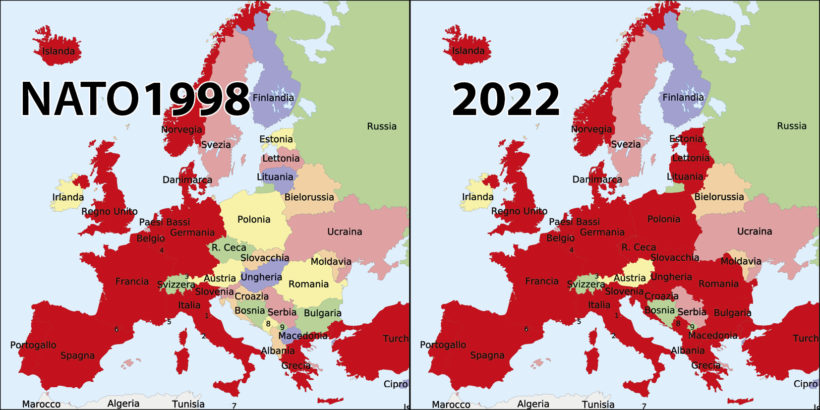
Russia’s categorical refusal to the inclusion of Ukraine into NATO since this would be followed by the installation of American missiles on its southern flank.
February 24, 2022, was not the beginning of a war with Ukraine but the last stage of the war that had begun in 2014.
Used as a disposable tool by the United States and NATO against Russia, Ukraine is in ruins and its future is in jeopardy.
22.02.24 – Europe – Samir Saul – Michel Seymour https://www.pressenza.com/2024/02/february-2024-10th-anniversary-of-the-conflict-in-ukraine/
In the coming days, we will surely hear about the so-called second anniversary of the war in Ukraine. Western governments, corporate media broadcasting the official pro-US line all day long, and “experts”-propagandists of this line will deliver their pseudo-analyses. All will be based on the double premise that the conflict in Ukraine began on February 24, 2022, and that it consists of a Russo-Ukrainian war unilaterally provoked by Russia to satisfy the expansionist ambitions of “dictator” Putin.
According to the US/NATO/Kiev “narrative”, everything was peaceful and normal before February 24. On that day, without the slightest justification and warning, like lightning in a blue sky, a Russian invasion descended on innocent Ukraine. As good Samaritans, the USA and its camp rushed to the aid of the victim by becoming its source of dollars and weapons, not to mention mercenaries and NATO “advisers” to operate these weapons systems. The conflict was supposed to last at most a few weeks, which was all the time that was needed to bleed Russia, while economic “sanctions” would bludgeon it and open the way to a “popular uprising” on the model of the “colored revolutions” (i.e. a putsch sponsored by the Western camp to carry out regime change and install a new leadership which would place Russia under the control of US imperialism).
That is the official “story”, rehashed ad nauseam, by “major” media, with all analysis of what is happening shut out. Only pro-US/NATO/Kiev propaganda is permitted because it would not survive if serious analyses were also allowed. It turns out that censorship, presented as the practice solely of “authoritarian regimes” against which Western “democracies” are leading a worldwide struggle in the name of “values”, is very much at home in the West. It is endorsed, sometimes hypocritically, sometimes proudly.
In propaganda and the now culture, there is no history. Events occur as sudden appearances or random occurrences based on spontaneous impulses. The “good guys” (the US and those who are aligned with them) and the “bad guys” (those who stand up to them) are known in advance, nothing else. With this simplistic and distorting grid, a conflict only begins when the “bad guys” retaliate, and never before, when the “good guys” have taken the initiative to threaten or attack them, leading to the retaliation. These initial actions are simply erased from memory.
Choosing February 24, 2022 as the starting date of the conflict in Ukraine shows bias, myopia and ignorance. It is equivalent to becoming a sounding board for the official “narrative”, the primary aim of which is to conceal the central role of Western governments as initiators of the conflict in Ukraine. Their aim is less Ukraine itself than the utilization of Ukraine, first against the Soviet Union, then against Russia.
A conflict that dates back to 1945
The Ukrainian question went through four phases: from 1945 to 1956, it was a war of sabotage and terrorism; from 1956 to 1990, there was a lull; from 1990 to 2014, a new conflict was brewing; in 2014, the war began.
As early as 1945, well before February 24, 2022, the ancestor of the CIA recruited German Nazis and their Ukrainian collaborators. Surrendering to the Americans, Reinhard Gehlen put his network of agents in Eastern Europe at the service of the US. Ukrainian ultranationalist collaborator Stepan Bandera joined Gehlen in Germany and, with his organization, waged a bloody war against the USSR in Ukraine, a Soviet territory. The USSR won and the KGB assassinated Bandera in 1959. It was in 1954 that Khrushchev transferred the Crimean peninsula to the Republic of Ukraine, then part of the USSR.
Latent tension since 1991
Continue readingUkraine: how nuclear weapons continue to increase the risks, two years on
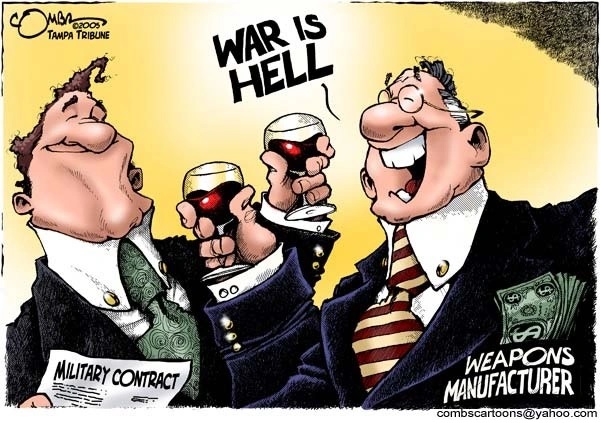
nuclear weapons industry has profited shamelessly off the world’s concerns over nuclear war. Since the conflict in Ukraine and the increased nuclear tensions that followed, profits for the companies that produce nuclear weapons drove up, with an $15.7 billion increase in share and bond holding and $57.1 billion increase in loans and underwriting.
https://www.icanw.org/ukraine_two_years_how_nuclear_weapons_increase_the_risks— 24 Feb 24
Two years after the start of Russia’s full-scale invasion of Ukraine, the risk of nuclear weapons use continues to escalate, while the looming threat of their use protracts this conflict with a high civilian cost. Nuclear-armed states and their allies waver between condemning nuclear threats and engaging in irresponsible practices such as nuclear sharing and championing their own nuclear deterrent. But the rest of the world is pushing back, condemning these behaviors and demanding the total elimination of these weapons of mass destruction through the UN Treaty on the Prohibition of Nuclear Weapons (TPNW).
Melissa Parke, Executive Director of ICAN, said: “This terrible war with its use of nuclear blackmail and overt threats to use nuclear weapons is a wake up call that the world needs to heed – as long as the nuclear-armed states hang on to their arsenals and cling to the misguided doctrine of deterrence, we face the likelihood these weapons will be used sooner or later. Nuclear weapons should be abolished before it is too late.”
The escalating nuclear risk
Following Vladimir Putin’s initial explicit threats to use nuclear weapons, we have seen nuclear-armed states and their allies continue to erode the decades-long nuclear taboo over the past two years. The escalation in nuclear rhetoric has not just been seen in Russia (Medvedev made explicit threats just this last weekend) but also in Israel and North Korea, and in recent calls by Polish and German politicians and NATO leaders for a European nuclear weapon. Nuclear threats heighten tensions in an already dangerous environment, reduce the threshold for use of nuclear weapons, and greatly increase the risk of nuclear conflict and global catastrophe.
The risk is also increased by the irresponsible practice of nuclear sharing, or stationing nuclear weapons, which seems to be on the rise. In June 2023, Vladimir Putin said Russia delivered its first tactical weapons to Belarus, though it is unclear how many nuclear weapons were transferred. This is a reckless and dangerous escalation that was widely condemned. But for NATO states, and particularly the five states that host US nuclear weapons, simply condemning Russia’s nuclear sharing without taking any action is insufficient and hypocritical. Particularly as the US and the UK also seemingly explore the return of US nuclear weapons to Lakenheath. Any nuclear sharing complicates decision making and increases the risk of miscalculation, miscommunication and potentially catastrophic accidents. It is time to end this practice that threatens peace and security and puts us all at risk.
Deterrence theory and nuclear weapons profiteers at the heart of the problem
The use of nuclear blackmail by Russia in the context of the Ukraine war has demonstrated the flawed nature of nuclear deterrence which, instead of ensuring stability, gave Russia the cover to commense its brutal and devastating invasion. Yet Russia’s nuclear threats have failed to deter the US and European countries from supplying Ukraine with weapons and money to fight Russia.
With current conflicts directly involving two nuclear-armed states, it is clear that nuclear deterrence doesn’t keep the peace. NATO states are playing into Putin’s hands by insisting nuclear weapons are a necessary deterrent. It only strengthens Putin’s position to promote his own “deterrent” now, whereas rejecting deterrence and reinforcing the nuclear taboo would limit his options.
Meanwhile, the conflict has also accelerated the global nuclear arms race, with the nine nuclear-armed states increasing spending to $82.9 billion in 2022. As a result, the nuclear weapons industry has profited shamelessly off the world’s concerns over nuclear war. Since the conflict in Ukraine and the increased nuclear tensions that followed, profits for the companies that produce nuclear weapons drove up, with an $15.7 billion increase in share and bond holding and $57.1 billion increase in loans and underwriting.
The global response to nuclear risk: the TPNW
The way to respond to the heightened risk of nuclear war is not to increase nuclear arsenals or threaten nuclear retaliation. The answer is for all countries to condemn nuclear threats, end their reliance on nuclear deterrence and join the UN Treaty on the Prohibition of Nuclear Weapons (TPNW). The TPNW specifically outlaws the threat to use nuclear weapons, as well as the irresponsible practice of nuclear sharing.
All nuclear-armed states need to take urgent steps to de-escalate tensions and to break free from the dangerous doctrine of nuclear deterrence, and nuclear disarmament must be an essential element of a negotiated peace between Russia and Ukraine. Multilateral nuclear disarmament is the only guarantee to prevent other nuclear-armed countries from following Russia’s lead and using their nuclear weapons as a shield to commit war crimes and terrorize civilian populations. Joining the TPNW is a crucial step to delegitimize nuclear deterrence and eliminate nuclear weapons.
Over the past two years, the states parties of the TPNW have been central in pushing back against any and all nuclear threats and challenging the false narrative of nuclear deterrence. At the First Meeting of States Parties in 2021, they condemned unequivocally “any and all nuclear threats, whether they be explicit or implicit and irrespective of the circumstances.” At the second meeting in New York,they agreed “to challenge the security paradigm based on nuclear deterrence by highlighting and promoting new scientific evidence about the humanitarian consequences and risks of nuclear weapons and juxtaposing this with the risks and assumptions that are inherent innnuclear deterrence.” It is time for all responsible states to join the TPNW.
Buried trial verdict confirms false-flag Maidan massacre in Ukraine
Oligarchic and far-right leaders and organizations, including neo-Nazis, who were involved in this false-flag mass killing to seize power in Ukraine, were hailed by Western and Ukrainian politicians, media, and even many academics as heroes and defenders of democrac
Ukrainian-Canadian political scientist and professor Ivan Katchanovski on the hidden origins of the Russia-Ukraine war
Ivan Katchanovski / February 20, 2024
A nearly one-million-word verdict from Ukraine’s Maidan massacre trial has recently confirmed that many Maidan activists were shot not by members of Ukraine’s Berkut special police force or other law enforcement personnel but by snipers in the far-right-controlled Hotel Ukraina and other Maidan-controlled locations a decade ago today. The verdict, handed down on October 18, 2023, states specifically that this hotel was controlled by Maidan activists and that an armed, far-right-linked Maidan group was in the hotel and fired from it. It also confirms that there was no Russian involvement in the massacre and that no massacre orders were issued by then President Viktor Yanukovych or his ministers. The verdict concludes that the Euromaidan was at the time of this massacre not a peaceful protest but a “rebellion” that involved the killing of Berkut and other police personnel.
This is an important official acknowledgement, not only because the violence represented the most significant case of mass murder, violent crime, and human rights violations in independent Ukraine to that point, but also because of the subsequent conflicts to which it has led or contributed. Notably, the massacre precipitated the violent overthrow of Yanukovych and his government, who were falsely blamed for carrying it out. It then spiralled into the Russian annexation of Crimea, the subsequent civil war and Russian interventions in the Donbas, and the conflicts between Ukraine and Russia, and between Russia and the Western powers, which Russia dramatically escalated with its illegal invasion of Ukraine on February 24, 2022.
There has been, however, a blackout of the verdict’s confirmation of the Maidan snipers in the Ukrainian media and, with a few notable exceptions, the Western mainstream media. Moreover, in an op-ed piece in The Bulwark, an online neoconservative magazine, author Cathy Young misrepresented the verdict, falsely claiming that it had found the Berkut police responsible for the deaths of 40 of the 48 protesters killed. Young also denied and openly whitewashed the existence of Maidan snipers and the far-right’s involvement in the Maidan massacre, labelling it a “conspiracy theory” despite clear and overwhelming evidence to the contrary in the verdict, the trial, and the investigation, as well as in academic studies of the event. Such deliberate omission and misrepresentation has been perpetrated in spite of the fact that the verdict’s Ukrainian text, as well as automatic English translation of the relevant excerpts, are publicly available, and in spite viral tweets describing and quoting from it.
The verdict by the Ukrainian Sviatoshyn District Court in Kyiv, along with the findings of the investigation by the Ukrainian prosecutor general’s office (GPU), comprise a de facto official admission—on the part of Ukraine’s justice system no less, which cannot be called independent—that on February 20, 2014, at least 10 of the 48 Maidan activists killed, and 115 of the 172 wounded, were shot not by Berkut or other law enforcement personnel firing from government-controlled areas but by Maidan snipers operating in Maidan-controlled locations. The government investigation admitted that one dead protester and 77 wounded Maidan activists were not shot from Berkut-controlled sectors, and therefore did not charge anyone for those crimes. Of course, it stands to reason that if these activists were not shot by government personnel, they must have been shot by the Maidan snipers.
The verdict, issued by the Kyiv court shortly before the tenth anniversary of the Euromaidan, shows that the Maidan massacre narrative that has been propagated by governments, the mainstream media, and a variety of info-warriors in the West and in Ukraine is false. The proponents of this narrative have called the Maidan a peaceful protest and presented the massacre of the Maidan protesters as a crime perpetrated by government snipers on the orders of Yanukovych and his government. The prosecution, the victims’ lawyers, the New York Times and other mainstream media (with some notable exceptions), Wikipedia, self-proclaimed experts, and info-warriors denied the presence of snipers in the Hotel Ukraina and other Maidan-controlled buildings, the shooting of Maidan protesters by these snipers, and the far-right’s involvement in this mass killing, and claimed instead that such ideas comprise a “conspiracy theory” and “Russian disinformation.” The exceptions included reports by ARD, BBC, The Nation, Jacobin, Court House News, Ekathimerini (Greece), Jyllands-Posten (Denmark), Weltwoche (Switzerland), Il Fatto Quotidiano (Italy), and El Nacional (Spain)—in addition to Canadian Dimension, which has published some of my other writing on this subject………………………………………………………………………………………………………………………………………………………………………………………………………………….
Wikipedia editors who deliberately and literally misrepresent and whitewash the false-flag Maidan massacre also systematically misrepresent and whitewash the far-right in Ukraine and its involvement in the Holocaust. These editors include Wise2, also known as Prohoshka, who has also propagated “scientific anti-Semitism” and whitewashed the involvement of the Organisation of Ukrainian Nationalists (OUN) in the 1941 Lviv pogroms during the Nazi occupation of Ukraine, justifying it on the basis of “Jewish collaboration.” Another Wikipedia editor, who uses the handle My Very Best Wishes, brazenly whitewashed the fact that monuments in Canada to the Galicia Division and Roman Shukhevych are in fact commemorating a division of the Waffen-SS and a Nazi collaborator. A scholarly article by a noted historian at the University of Ottawa also listed My Very Best Wishes as one of the editors involved in an intentional distortion of Wikipedia’s history of the Holocaust in Poland. This editor also recently wrote, falsely, on Wikipedia’s biographical page on Elon Musk about the latter’s supposed “involvement in the Russian invasion of Ukraine.” Various publications and websites have identified Wise2/Prohoshka as a far-right Svoboda activist named Svyatoslav Gut, and My Very Best Wishes as Andrei Lomize, a biophysics researcher at the University of Michigan.
Fabricated evidence against Berkut, no massacre order by Yanukovych
The trial verdict also confirms the absence of evidence for any order by Yanukovych or his government to massacre the Maidan protesters. This is a crucial official acknowledgment, since Yanukovych and his government were overthrown on the basis of accusations of having ordered the massacre. Joe Biden, then US vice-president, wrote in his memoirs that during the Maidan massacre, he called Yanukovych and told him that “it was over; time for him to call off his gunmen and walk away,” that he “had lost the confidence of the Ukrainian people … and he was going to be judged harshly by history if he kept killing them.”
In addition to acquitting two Berkut policemen for killing and wounding the Maidan activists, the verdict states that all five accused Berkut officers had been blamed, baselessly, for killing 13 Maidan protesters and wounding another 29. This is further evidence of trumped-up, politically motivated charges.
The decision to convict in absentia three Berkut officers, who had been transferred by Zelensky to the Donbas separatists in a 2019 exchange, is a political one. The charging of these officers for the murders of 31 of 48 Maidan protesters killed, and the attempted murders of another 44 of 80, was based on a single, fabricated forensic examination, not to mention posited on the notion of collective responsibility. This single forensic examination of bullets, undertaken five years after the massacre, reversed the results of some 40 earlier forensic bullet examinations, including a computer-based examination which showed that bullets taken from the bodies of killed Maidan protesters did not match the Berkut Kalashnikov rifles.
The three Berkut policemen were convicted in absentia based on this single, fabricated forensic examination as well as on their presumed collective responsibility for the murders of 31 protesters and the attempted murders of 44 more. On the same basis and contrary to all other evidence, a Berkut commander was also convicted of the manslaughter of four protesters and the wounding of another eight, for supposedly having ordered his officers to fire indiscriminately during the evacuation of internal troops by the Berkut company, and its subsequent retreat after one Berkut officer was killed and another wounded……………………………………………………………………………………………………………………………………………….
The verdict means that a decade since this crucial massacre—one of the most documented cases of mass killing in history—nobody is in prison for the murders and attempted murders of Maidan activists and police officers, or for shooting at foreign journalists. The silence on the part of those who deny the false-flag Maidan massacre, who call these claims a “conspiracy theory” and thereby whitewash the mass murderers of the far-right, is both deafening and revealing.
Media blackout and whitewash
All Ukrainian media reports omitted the verdict’s confirmations of the false-flag massacre. The Western media (with a few notable exceptions) also omitted this information. Moreover, writer Cathy Young, mentioned above, deliberately misrepresented the Maidan massacre trial verdict, branding the revelations about Maidan snipers operating in the Hotel Ukraina a “conspiracy theory” and claiming, falsely, that the verdict did not indicate that Maidan protesters were shot from the hotel or other Maidan-controlled locations, and that it did not disprove involvement by Russian snipers. ………………………………………………………………………………
Oligarchic and far-right leaders and organizations, including neo-Nazis, who were involved in this false-flag mass killing to seize power in Ukraine, were hailed by Western and Ukrainian politicians, media, and even many academics as heroes and defenders of democracy. They were invited for government visits and talks at universities, including in Canada. Government leaders, journalists, investigators, Maidan lawyers, NGO activists, partisan researchers, and info-warriors who branded the reports of the Maidan snipers and their false-flag massacre a conspiracy theory and propaganda were hailed as defenders of justice and human rights, and given grants by Western governments, foundations, and universities, including even a Nobel Peace Prize.
It is doubtful that any of the above parties will suffer any consequences for such fraud and whitewashing of mass murderers, in particular those of the far-right. Ukraine and Ukrainians continue to suffer the consequences of this massacre, which has spiralled into major conflicts, including the ongoing and devastating Russia-Ukraine war, which is also a dangerous, unwinnable proxy war undertaken by the West against Russia.
Ivan Katchanovski teaches at the School of Political Studies at the University of Ottawa. He is the author of Cleft Countries: Regional Political Divisions and Cultures in Post-Soviet Ukraine and Moldova and co-author of Historical Dictionary of Ukraine (Second Edition) and The Paradox of American Unionism: Why Americans Like Unions More Than Canadians Do, But Join Much Less. https://canadiandimension.com/articles/view/buried-trial-verdict-confirms-false-flag-maidan-massacre-in-ukraine-2024
Macron and Zelensky sign military deal
18 Feb 2024 , https://www.sott.net/article/489024-Sell-out-Macron-and-Zelensky-sign-military-deal
The ten-year pact mirrors defense agreements Kiev recently signed with Berlin and London
France and Ukraine signed a bilateral security pact on Friday during President Vladimir Zelensky’s visit to Paris. While President Emmanuel Macron did not offer Kiev any ironclad military commitments, he promised another €3 billion in aid over the rest of 2024, as well as “cooperation” in the area of artillery.
The agreement states that France views the prospect of Ukraine’s accession to NATO positively, as “a useful contribution to peace and stability in Europe.” The largely symbolic deal is designed to help “pave the way towards Ukraine’s future integration into the EU and NATO,” French media noted, citing officials.
The pact follows a similar agreement struck with Germany earlier in the day, and another signed with the UK last month. All three are set to last ten years.
Last month, Macron announced that France would supply Kiev with 40 more SCALP-EG long-range cruise missiles and “hundreds of bombs,” promising to finalize the bilateral security agreement on an upcoming trip to Kiev. The trip, which was to run from February 13-14, was called off by the French side due to security concerns, according to French media.
Zelensky is set to ask Western sponsors for more financing at the Munich Security Conference on Saturday, while the situation on the front lines of the Ukraine-Russia conflict is escalating, with Kiev facing severe personnel and ammo shortages.
Moscow has condemned Western deliveries of long-range weaponry such as French SCALP-EG cruise missiles, which Kiev has used to strike Russian infrastructure in Donbass, causing numerous civilian deaths. Russia maintains that further military aid to Kiev will only delay the end of the conflict without changing the final outcome, and lead to unnecessary deaths.
Comment: The ‘leaders’ of Europe are selling out Europe and the welfare of their countries while submitting to a globalist anti-human agenda.
See also:
Ukraine can’t join NATO while in conflict – Netherlands
16 Feb 24, https://www.rt.com/news/592609-ukraine-cant-join-nato-netherlands/
Accession to the US-led bloc is a “sensitive process” that may require intermediate steps, Dutch caretaker PM Mark Rutte has said
The Netherlands’ caretaker prime minister, Mark Rutte, has refused to say whether he would support Ukraine’s membership of NATO at an upcoming bloc leaders’ meeting, insisting that admitting Ukraine to NATO is not feasible while the conflict with Russia is ongoing. Rutte has been described in the media as a frontrunner to become the next secretary-general of the US-led bloc.
The politician made the comments at the Munich Security Conference on Saturday in response to a question about whether EU prime ministers would “personally support” Ukraine’s membership bid at the next NATO summit in Washington in July.
The bad news is – as long as the war is raging, Ukraine cannot become a member of NATO,” Rutte has said. “The good news is that we can learn from the European Union,” he added referring to the EU approach of implementing “intermediate steps” that countries take on “the way to accession” as opposed to NATO’s process that goes “from nothing to full membership.”
Rutte admitted that the last time the question of Ukraine’s membership arose, Kiev was left “dissatisfied.” As a result, there is a need to “work carefully” to see “what next step is possible” so as not to “overpromise.”
Ukraine applied to integrate with the NATO Membership Action Plan in 2008 and a decade later enshrined in its constitution membership in the US-led bloc as a strategic foreign policy goal.
At last year’s NATO summit in Vilnius, the bloc’s leaders said that Ukraine’s “rightful place is in NATO,” but failed to provide clear commitments or describe a timeline.
While the question of Ukraine’s membership is likely to be discussed at the next NATO summit in July, some Western politicians have warned against expecting a “big leap forward on that.”
Russia views NATO expansion towards its border as a major security threat. President Vladimir Putin has argued that Western powers have used Ukraine to antagonize Russia after the fall of the Soviet Union. In a recent interview with Tucker Carlson, Putin called the West’s approach to Ukraine a colossal political mistake, pointing to NATO’s 2008 promise to accept the country into the bloc, as well as the Western-supported coup in Kiev in 2014.
Germany and Ukraine sign ‘long term’ security deal
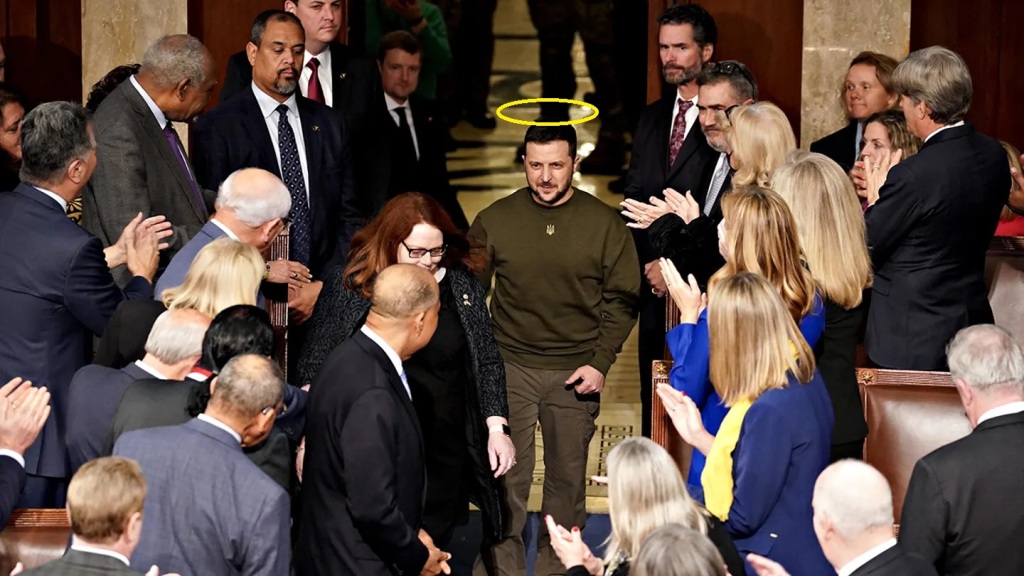
Zelensky said that the details of the agreement “are very specific and involve long-term support,” and that the pact proves that one day “Ukraine will be in NATO.”
https://www.rt.com/news/592570-germany-ukraine-security-deal/ 17 Feb 24
Ukrainian President Vladimir Zelensky has said the agreement proves his country will join NATO
German Chancellor Olaf Scholz and Ukrainian President Vladimir Zelensky have signed a security pact under which Berlin will supply Kiev with military and economic aid for another ten years.
Inked on Friday, the agreement commits Germany to providing “unwavering support for Ukraine for as long as it takes in order to help Ukraine defend itself” and restore its 1991 borders. In addition to retaking the regions of Donetsk, Lugansk, Kherson, and Zaporozhye, this feat would also involve the seizure of Crimea from Russia, which some American officials and Kiev’s former military chief view as next to impossible.
On top of military aid, the plan binds Germany to training Ukrainian police officers, transferring weapons manufacturing technology, paying for green energy projects, and a range of other efforts to help the Ukrainian government “continue providing services to its people”
Speaking at a ceremony in Berlin, Zelensky said that the details of the agreement “are very specific and involve long-term support,” and that the pact proves that one day “Ukraine will be in NATO.”
Germany is Ukraine’s second-largest Western backer, behind only the US. To date, Berlin has given Kiev €22 billion ($23.7 billion) in assistance, including €17.7 billion in military aid, according to figures compiled by the Kiel Institute for the World Economy. When aid transferred via the EU is included, Germany has handed over a total of €28 billion to Ukraine, Scholz said on Friday.
In addition to signing the decade-long pledge to Ukraine, Scholz announced a new package of military aid worth €1.1 billion. It will include 36 self-propelled howitzers, 120,000 artillery shells, and additional ammunition for Ukraine’s German-provided Iris-T air defense systems.
Germany’s outlay has hurt its own military readiness, with the New York Times reporting in November that training exercises are routinely canceled due to ammunition shortages, while German soldiers have yet to fire their latest howitzers, all of which have been sent to Ukraine.
Scholz’s decision to sanction Russian energy imports has also hammered the German economy, with industrial output falling by 2% last year, while the entire economy shrank by 0.3% in the same time period, according to the country’s Federal Statistical Office. One in three German manufacturers is currently considering moving abroad, Federation of German Industries (BDI) chief Siegfried Russwurm told Bild on Saturday, citing persistent inflation and high energy costs.
Ukraine set to lose key Donbass city – White House
https://www.rt.com/russia/592511-key-donbass-city-loss/
With Russia poised to capture Avdeevka, US National Security Council spokesman John Kirby has called on Congress to give Kiev more ammunition
Russian forces are preparing to capture the Donbass stronghold of Avdeevka after “particularly intense” fighting, White House National Security Council spokesman John Kirby told reporters on Thursday.
Situated just ten kilometers north of Donetsk, Avdeevka had been used by the Ukrainian military as a staging ground for attacks on the city since 2014, many of which targeted civilians. They constructed deep bunkers there, with Russian military bloggers comparing the town to a “fortress.”
Fighting around Avdeevka is “particularly intense,” Kirby said at a press conference. “We’re getting reports from the Ukrainians that the situation is critical, the Russians continuing to press Ukrainian positions every single day,” he stated, adding that “Avdeevka is at risk of falling into Russian control.”
It is unclear how many troops Kiev has lost attempting to hold Avdeevka. Kirby linked the impending fall of the town to ammunition shortages, a problem well documented by Western media in recent months. The White House spokesman called on Congress to pass a bill that would give Ukraine a $60 billion infusion of military aid, stating that this would “provide Ukraine with the artillery shells that they desperately need to disrupt these Russian assaults.”
While the US Senate passed the bill earlier this week, it remains a non-starter in the House of Representatives, where the slim Republican majority have demanded that it include a major tightening of US immigration law and “real border security provisions,” according to House Speaker Mike Johnson.
Ukraine appears determined to hold Avdeevka at all costs, with President Vladimir Zelensky naming Aleksandr Syrsky – a general infamous for tolerating severe losses – as commander-in-chief of his armed forces last week. Syrsky immediately deployed Ukraine’s 3rd Assault Brigade – an elite Western-armed unit made up of the remnants of the neo-Nazi Azov regiment – to Avdeevka, where they relieved the beleaguered and depleted 110th Mechanized Brigade.
While Ukrainian officials have not conceded defeat in Avdeevka, German reporter Julian Roepcke claimed on Thursday that “the Ukrainian army is in the process of pulling out,” while Russian forces are “quickly advancing inside and around the town.” According to Roepcke, the Russian flag is now flying at the entrance to the town, at the same spot where Zelensky took a selfie during a publicity visit in December.
Cut in Half by Russians, Avdiivka is Reinforced by Ukrainian Nazi Azov Battalion – Massive Missile Strike on Reinforcements Causes Some Defenders to Withdraw
The heavily fortified frontline town of Avdiivka, split in two by Russian forces, witnesses some of the Ukrainian defenders begin to retreat of some areas to ‘more favorable positions’.
The supply lines of the AFU in the southern sector are now under extreme pressure.
Besides the multi-pronged ground attack that is overextending the defenses, a reason for the rapid advance of the Russian forces in Avdiivka is the aerial support: a FAB guided munition drops almost immediately on any place where a concentration of Ukrainian military is spotted.
Telegram channel Ukraine Watch reported that in the first third of February alone, the Russian Aerospace Forces dropped about 460 aerial bombs on the positions of the Ukrainian Armed Forces. This includes FAB-250/500/1500 and ODAB.
his partial folding of the defenses is a bit surprising because up until a couple of days ago, the New Ukrainian commander Syrsky was still rumored to be withdrawing elite units from the Rabotino and Verbove fronts to immediately reinforce Avdiivka.
This reportedly includes more of the 47th as well as the 3rd Assault Brigade, better known as the Nazi ‘Azov’ battalion.
These brigades were thrown directly into the center of battle.
Simplicius the Thinker reported:
“After witnessing the nightmare of Bakhmut, they [Ukrainians] now understand what awaits the soldiers in Avdiivka. But what’s most interesting, is you’ll recall that their narrative was previously that Bakhmut was a ‘successful operation’ because it allegedly grinded down such a disproportionate number of Russian troops, that the city defense served its purpose. But when that truth is put to the test in reality, Ukrainians instead recognize that it’s actually them getting ground down amid desperate calls for withdrawal. If Bakhmut was such a ‘success’, then they would be happy to keep their men in Avdiivka and inflict another such ‘success’ against Russian attackers.”……………………………………………………………………………………………………………………..
Ukraine Watch reported:
“The current situation can be described as difficult. That is, the enemy is now advancing practically along the entire front line, and we have switched from offensive actions to a defensive operation. And the aim of our defensive operation is to exhaust the enemy’s forces, to inflict maximum losses on him, using our fortifications, our technical advantages in the use of unmanned aerial vehicles, electronic warfare and the maintenance of prepared defensive lines. The situation at the front was very tense, with the enemy making offensive movements in several directions, in fact all along the line of sight of my group.”
And finally, today, Intel Slava reported that the Ukrainian army is retreating to ‘more advantageous positions’ in Avdiivka, according to Dmitry Likhovy, speaker of the Tavria Armed Forces of Ukraine group.
“In Avdiivka, a maneuver is taking place where our units are withdrawing to more advantageous positions. Supplies to Avdiivka and evacuation from there are difficult. But a reserve logistics artery, prepared in advance, is being used.” https://www.thegatewaypundit.com/2024/02/cut-half-russians-avdiivka-is-reinforced-ukrainian-nazi/
Putin ‘tried everything possible’ to make peace – Ukrainian diplomat

One thing is clear: Kiev has chosen to see itself as literally unable to make peace without Western permission.
Fri, 29 Dec 2023, Rt, https://www.sott.net/article/487425-Putin-tried-everything-possible-to-make-peace-Ukrainian-diplomat—
The possibility of compromise was “very real” in April 2022, a key negotiator from Kiev’s side has said
Russian President Vladimir Putin personally sought a peace agreement with Ukraine in April 2022, according to Ambassador Aleksandr Chaly, a senior member of the Ukrainian delegation. Chaly expressed this perspective during an event at the Geneva Center for Security Policy (GCSP) in early December, where he dissected the ongoing conflict in Ukraine. The ex-deputy foreign minister is an associate fellow at the Swiss government-funded foundation. His remarks drew media attention after a video of the event was released on YouTube last week.
Chaly analyzed the roots of the ongoing conflict, which he described as “hard competition” for Ukraine that the US and the EU have with Russia, as well as Kiev’s intention to join the EU and NATO. He stressed that “Russian aggression” was not inevitable since the parties had sufficient tools to resolve their differences.
The diplomat called Putin’s decision to launch the special military operation against Ukraine in February 2022 “a crime” and “a mistake” and claimed that the Russian leader had been misled by “his own propaganda and his intelligence services.”
Approximately a week into hostilities, Chaly believes Putin recognized the unrealistic nature of his expectations and actively pursued a negotiated resolution. He based his analysis on his personal involvement in the peace talks, which were first hosted by Minsk and culminated in Istanbul in late March with a draft truce approved by both sides.
“Putin … tried to do everything possible to conclude [the] agreement with Ukraine,” the diplomat told the audience. The text made concessions to Kiev, compared to Russia’s initial position, and it was Putin’s “personal decision” to accept it, he claimed.
“We’ve managed to find a very real compromise. Putin really wanted to reach some peaceful agreement with Ukraine.”
Chaly mused that “for some reason,” the Istanbul communique did not transform into an actual treaty.
The Ukrainian delegation’s leader, MP David Arakhamia, said in late November that then-British Prime Minister Boris Johnson advised Ukrainians to “just continue fighting” during his visit to Kiev after the conclusion of the talks.
Remarks made by senior Russian officials, including Putin, partially back Chaly’s account. The president said during his year-end press conference this month that Russia’s stated goals of demilitarization and “de-Nazification” of Ukraine would have been addressed under the pre-approved treaty.
“Options remain to either achieve them through an agreement or by force,” Putin stressed.
Comment: The article adds to the list of articles that document what the Ukrainians and Russians tried to achieve. Putin talks about de-Nazification. Does that translate to de-NATOification, if what Russia wanted most of all, was for Ukraine to stay neutral and give up on NATO membership?
See also:
November 27, 2023 The Jews and Boris Johnson: Zelensky’s top political ally looking for scapegoats as Ukrainian elites begin to accept the war is lost In this article Tarik Cyril Amar writes:
Regarding the peace negotiations that took place in Belarus at the end of February and the beginning of March 2022, Arakhamia tells Moseichuk that the Russian delegation had one “key aim”: to make Ukraine accept neutrality and give up on NATO membership. In Arakhamia’s own words, “everything else” Russia talked about, such as demands regarding “denazification, Russian-speaking populations, and blah-blah-blah” was merely “cosmetic political seasoning.”
Let that sink in: Here is a prime negotiator for Ukraine and one of the Zelensky regime’s top men stating explicitly that all that peace really required at that very early stage in the large-scale war was Kiev committing to neutrality and giving up on its NATO ambitions. The war could have stopped in the spring of 2022; that is, one-and-a-half very bloody years ago. And for Kiev, this would have come at the price of giving up on a NATO ambition that is based on a false promise encapsulated in the foul compromise of the 2008 Bucharest summit. A pledge which the West has no intention of keeping, as demonstrated again at the 2023 Vilnius summit.
Arakhamia’s admission proves, once more, that there have always been viable alternatives to war. Western information warriors still denying this empirically established fact simply refuse to face their own terrible responsibility for stonewalling negotiations throughout. Likewise, Arakhamia demonstrates that everyone in Ukraine and the West who insisted that Moscow’s war aims were maximalist (whether to obliterate Ukraine as a state or to march right through it to, at least, Berlin) were flat out wrong, whether by mistake or on purpose. At least, that’s if we believe Arakhamia, who had direct experience with real representatives of Russia and not the fantasy creatures populating the minds of all too many Westerners, from Yale to Berlin. And note: Arakhamia has absolutely no reason to embellish Moscow’s record.
[…]
One thing is clear: Kiev has chosen to see itself as literally unable to make peace without Western permission.
After Belarus there were talks in Türkiye:
November 22, 2023 Boris Johnson derailed Ukraine peace deal – key Zelensky ally The article has many links to articles that describe how the peace negotiations were derailed. In the article there is:
Former UK Prime Minister Boris Johnson played a key role in derailing a peace deal between Moscow and Kiev, telling Ukraine to “just continue fighting,” top Ukrainian MP David Arakhamia has said. Arakhamia, the head of President Vladimir Zelensky’s parliamentary faction, was the chief negotiator at the botched peace talks in Istanbul, held early into the ongoing conflict.
The MP made the bombshell revelation on Friday in an interview with the Ukrainian 1+1 TV channel. “Russia’s goal was to put pressure on us so that we would take neutrality. This was the main thing for them,” he said. “And that we would give an obligation that we would not join NATO. This was the main thing.”
However, Kiev did not actually trust Moscow to keep its word and did not want to reach such a deal without third-party “security guarantees,” Arakhamia claimed, while revealing the lead role in derailing the agreement was played by Johnson.
When we returned from Istanbul, Boris Johnson came to Kiev and said that we would not sign anything with [the Russians] at all. And [said] ‘let’s just continue fighting.’
The pivotal role played by Johnson in Ukraine’s decision to scrap the draft agreement with Russia – signed by Arakhamia personally in Istanbul – has long been rumored, with initial reports on the matter emerging in Ukrainian media as early as May 2022. Until now, however, it was neither denied nor confirmed by any of the parties involved.
Ukraine’s new commander-in-chief is an unpopular ‘butcher’ – Politico
https://www.rt.com/russia/592184-ukraine-commander-syrsky-unpopular/ 10 Feb 24
Troops are wary of General Aleksandr Syrsky, and reportedly fear that he will throw them into “fruitless assaults”
Ukraine’s new armed forces chief, General Aleksandr Syrsky, is deeply unpopular among the rank and file of the Ukrainian military, who view him as a “butcher” willing to sacrifice waves of troops, Politico reported on Thursday.
Ukrainian President Vladimir Zelensky named Syrsky as the new head of the armed forces on Thursday, after firing General Valery Zaluzhny from the post. The switch had been the subject of media rumors for several weeks, and Zelensky hinted in an interview last week that it would form part of a wider “reset” of the country’s military and civilian leadership.
Syrsky is a controversial choice, best known for “leading forces into a meat grinder in Bakhmut [called Artyomovsk in Russia], sending wave after wave of troops to face opposition fire,” Politico said.
The unsuccessful defense of Artyomovsk/Bakhmut last year cost Ukraine dearly, and earned Syrsky the nickname ‘butcher’, an anonymous source within the Ukrainian military told the news site. A captain told the outlet that Syrsky’s appointment is a “very bad decision,” adding that soldiers refer to him as ‘General200’, a nickname that Politico said refers to 200 of his men dying, but could also refer to ‘Cargo 200’, a Soviet and Russian military code used to describe corpses being removed from the battlefield.
“General Syrsky’s leadership is bankrupt, his presence or orders coming from his name are demoralizing, and he undermines trust in the command in general,” an anonymous Ukrainian military officer and frontline intelligence analyst posted on X. “His relentless pursuit of tactical gains constantly depletes our valuable human resources, resulting in tactical advances such as capturing tree lines or small villages, with no operational goals in mind.”
“This approach creates a never-ending cycle of fruitless assaults that drain personnel,” the officer said.
In a group chat of Bakhmut/Artyomovsk veterans, one soldier wrote “we’re all f**ked” upon learning of Syrsky’s appointment, Politico stated.
Syrsky takes over command of a depleted military, with Kiev having lost more than 383,000 men since the hostilities started in February 2022, according to the Russian Defense Ministry. Prior to his dismissal, Zaluzhny warned Zelensky that a rapid improvement in Ukraine’s position on the battlefield was unlikely, regardless of who took his place, the Washington Post reported last week.
Kremlin spokesman Dmitry Peskov said on Friday that Russia’s campaign against Ukraine will not be affected by Syrsky’s appointment, and that Moscow will continue until its objectives are achieved.
Zelenskiy names new Ukrainian military commander, says it’s time for ‘renewal’
RFE/RL, Fri, 09 Feb 2024, https://www.sott.net/article/488754-Zelenskiy-names-new-Ukrainian-military-commander-says-its-time-for-renewal
—
President Volodymyr Zelenskiy appointed Colonel General Oleksandr Syrskiy as the Ukrainian Army’s commander in chief just minutes after announcing it was time for a “renewal” and “renewed leadership” of the country’s armed forces.
Comment: It’s probably time for a renewal of Ukraine’s political leadership too.
In his statement on February 8, Zelenskiy said Syrskiy “has successful defense experience — he conducted the Kyiv defense operation. He also has successful offensive experience — the Kharkiv liberation operation.”
The Russia-born, 58-year-old Syrskiy, who has served as the commander of Ukrainian ground forces since 2019, replaces General Valeriy Zaluzhniy following reports that Zelenskiy was strongly considering removing him.
Zelenksiy said in a message on X, formerly Twitter, that is he grateful to Zaluzhniy and he appreciates “every victory we have achieved together.” Before announcing the leadership change, Zelenskiy said he had “candidly discussed” with Zaluzhniy issues in the army that require urgent change.
“Starting today, a new management team will take over leadership of the armed forces of Ukraine. I had dozens of conversations with commanders at various levels,” he said, adding that the move “is not about surnames, and surely not about politics.”
The change in leadership is about the management of the military and “about involving the experience of this war’s combat-hardened commanders,” he said, touting Syrskiy’s successful experience, particularly in the defense of Kyiv and his successful offensive experience, particularly in the Kharkiv liberation operation.
Defense Minister Rustem Umerov noted Zaluzhniy’s role in the first two years of the full-scale Russian invasion, saying “our soldiers repelled the onslaught of the aggressor, defended our statehood, and continue to defend our independence every day.”
Comment: After the last two years of this 10-year conflict, Russia controls about 18% of Ukraine that used to be Ukrainian.
He said he was grateful for Zaluzhniy’s achievements and victories, but war changes and demands change.
“The battles of 2022, 2023, and 2024 are three different realities [and] 2024 will bring new changes for which we must be ready,” Umerov said. “New approaches, new strategies are needed.”
U.S. State Department spokesman Vedant Patel said the move to replace Zaluzhniy was a “sovereign decision” made by Ukrainian leaders. He declined to comment further.
Comment: No one really believes that.
Syrskiy was one of the main commanders who led the Ukrainian armed forces’ fight against the offensives by Russia-backed separatists that started in 2014 shortly after Russia illegally annexed Ukraine’s Crimea.
Comment: That’s certainly one way of looking at it. But as usual, RFE/RL tries and succeeds in being as wrong as possible.
After Russia launched its full-scale invasion of Ukraine in February 2022, Syrskiy led the Ukrainian armed forces’ successful counteroffensive to regain control over the Kharkiv region in September of that year.
Comment: A “full-scale invasion” using a small fraction of its military.
…………………………………………………………………………..Tensions between Zaluzhniy and Zelenskiy surfaced in November after the commander in chief published an opinion piece in The Economist saying the war had entered a stalemate and only a technological breakthrough would allow Ukraine to achieve its goals of liberating occupied territory.
Zelenskiy’s office was quick to reject that battlefield assessment.
Polls showed earlier that Zaluzhniy’s popularity in the country is as high, if not more so, than Zelenskiy’s, and some experts suggested that if Zelenskiy ousted Zaluzhniy, it would demoralize some of Ukraine troops and undermine national unity. RT reports:
Ukraine’s new armed forces chief, General Aleksandr Syrsky, is deeply unpopular among the rank and file of the Ukrainian military, who view him as a “butcher” willing to sacrifice waves of troops, Politico reported on Thursday.
…
Syrsky is a controversial choice, best known for “leading forces into a meat grinder in Bakhmut [called Artyomovsk in Russia], sending wave after wave of troops to face opposition fire,” Politico said.The unsuccessful defense of Artyomovsk/Bakhmut last year cost Ukraine dearly, and earned Syrsky the nickname ‘butcher’, an anonymous source within the Ukrainian military told the news site. A captain told the outlet that Syrsky’s appointment is a “very bad decision,” adding that soldiers refer to him as ‘General200’, a nickname that Politico said refers to 200 of his men dying, but could also refer to ‘Cargo 200’, a Soviet and Russian military code used to describe corpses being removed from the battlefield.
“General Syrsky’s leadership is bankrupt, his presence or orders coming from his name are demoralizing, and he undermines trust in the command in general,” an anonymous Ukrainian military officer and frontline intelligence analyst posted on X. “His relentless pursuit of tactical gains constantly depletes our valuable human resources, resulting in tactical advances such as capturing tree lines or small villages, with no operational goals in mind.”
“This approach creates a never-ending cycle of fruitless assaults that drain personnel,” the officer said.
In a group chat of Bakhmut/Artyomovsk veterans, one soldier wrote “we’re all f**ked” upon learning of Syrsky’s appointment, Politico stated.
Syrsky takes over command of a depleted military, with Kiev having lost more than 383,000 men since the hostilities started in February 2022, according to the Russian Defense Ministry. Prior to his dismissal, Zaluzhny warned Zelensky that a rapid improvement in Ukraine’s position on the battlefield was unlikely, regardless of who took his place, the Washington Post reported last week.
Why Biden’s $61 billion in weapons for Ukraine won’t prevent inevitable defeat
Walt Zlotow, West Suburban Peace Coalition, Glen Ellyn IL 11 Feb 24
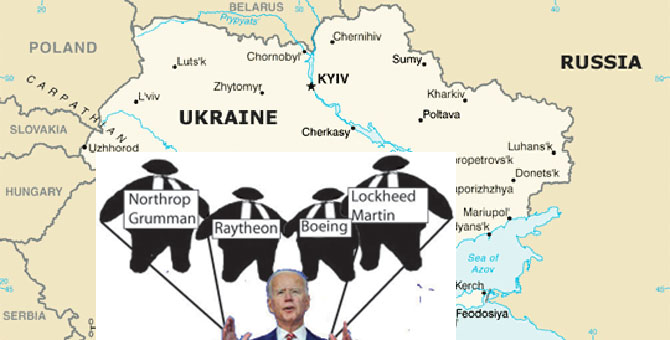
For 4 months President Biden has been beseeching Congress to grant another $61 billion in aid to Ukraine to continue their 2 year war with Russia. This is on top of $113 billion that has made no dent in Ukraine’s efforts to prevail against overwhelming Russian forces.
Biden could give Ukraine a trillion dollars in aid but it’s essentially worthless because Ukraine is running out of soldiers to use US weapons.
A dozen Ukrainian soldiers and commanders told the Washington Post that personnel deficits are at their lowest point ever.
One mechanized brigade battalion commander advised he’s down to 40 soldiers from a normal 200 to hold off the Russian advance. Another mentioned the same shortage in his unit.
Replacements are scares since August when Zelensky fired all recruitment office heads due to corruption. That’s caused a dramatic decline in replacements still not solved.
But if Biden gets his $61 billion he’d be better off tossing it into a bonfire instead of squandering it on more weapons for Ukraine. That will only prolong a war that was lost on Day One, 717 days ago. Had Biden not torpedoed a peace deal nearly inked in the first month, over 400,000 Ukrainian soldiers would still be alive, the Ukraine economy would not be devastated, and Ukraine may not have lost a single square mile of territory.
Biden knows the $61 billion more will not turn the tide. But as Pete Seeger sang about LBJ continuing to fight a lost war in Vietnam 57 years ago, in today’s White House…’The Big Fool says to push on.’
Another $61 billion to kill more Ukrainians in an unnecessary and losing war

The $61 billion will make no difference on the battlefield except to prolong the war, the tens of thousands of deaths, and the physical destruction of Ukraine.
The Biden-Schumer Plan to Kill More Ukrainians JEFFREY D. SACHS, Feb 08, 2024, Common Dreams, https://www.commondreams.org/opinion/the-biden-schumer-plan-to-kill-more-ukrainians
President Joe Biden is refusing to fold a losing hand as he bets with Ukrainian lives and U.S. taxpayer money. Biden and Democratic Senate Majority Leader Chuck Schumer propose to squander the lives of tens of thousands more Ukrainians and $61 billions of federal funds to keep Biden’s disastrous foreign policy failure hidden from view until after the November election.
The $61 billion will make no difference on the battlefield except to prolong the war, the tens of thousands of deaths, and the physical destruction of Ukraine. It will not “save” Ukraine. Ukraine’s security can only be achieved at the negotiating table, not by some fantasized military triumph over Russia.
$61 billion is not nothing. This worse-than-useless outlay would exceed the combined budgets of the U.S. Department of Labor, Environmental Protection Agency, National Science Foundation, and the Women, Infant, and Children nutrition program.
Almost exactly 10 years ago this month, Biden did much to put Ukraine on the path to disaster. This is well known to those who have looked carefully at the facts but is kept hidden from view by the White House, the Senate Democrats, and the mainstream media that back Biden. I have previously provided a detailed chronology, with hyperlinks, here.
Ukraine’s security can only be achieved at the negotiating table, not by some fantasized military triumph over Russia.
In 1990, President George H. W. Bush, Sr. and his German counterpart Chancellor Helmut Kohl promised Soviet President Mikhail Gorbachev that NATO would not expand eastward if the Soviet Union accepted German reunification. When the Soviet Union disbanded in December 1991, with Russia as the successor state, American leaders decided to renege.
President Bill Clinton began NATO expansion over the vociferous opposition of top diplomats like George Kennan and the opposition of his own Secretary of Defense, William Perry. In 1997 Zbigniew Brzezinski upped the ante, with a plan for NATO to expand all the way to Ukraine. He famously wrote that without Ukraine, Russia would cease to be a great power.
Russian leaders have repeatedly made clear that NATO expansion to Ukraine is understandably the reddest of Russian redlines.
In 2007, President Vladmir Putin stated that NATO enlargement to that date was a cheat on the 1990 promise, and that it must go no further. Despite these clear warnings, including by his own diplomats, George W. Bush Jr. committed in 2008 to expand NATO to Ukraine and Georgia in order to surround Russia in the Black Sea.
William Burns, now CIA director, and then the U.S. Ambassador to Russia, wrote a famous memo entitled “Nyet means Nyet,” explaining that Russia’s opposition to NATO enlargement was across Russia’s political spectrum. Most Ukrainians themselves were also firmly against the plan, favoring neutrality over NATO membership. The Ukrainian Rada declared Ukraine’s state sovereignty in 1990 on the basis of becoming “a permanently neutral state.” In 2009, the people of Ukraine elected Viktor Yanukovych, who ran on a platform of neutrality.
In early 2014, the U.S. decided to help bring down Yanukovych in a coup. This was standard U.S. deep-state operating procedure, one used on dozens of occasions around the world. he CIA, National Endowment for Democracy, USAID, and NGOs like the Open Society Foundation went to work in Ukraine. The point person was Victoria Nuland, who was first Richard Cheney’s principal deputy foreign policy advisor, then George Bush Jr.’s ambassador to NATO, then Hillary Clinton’s spokesperson, and by 2014 Assistant Secretary of State.
This time, the Russians caught the conspiracy on tape, in an intercepted call between Nuland and U.S. Ambassador to Ukraine Geoffrey Pyatt (now Assistant Secretary of State). Nuland explains to Pyatt that Vice President Joe Biden will help choose and cement the post-coup government. The 2014 Ukraine team, including Biden, Nuland, Jake Sullivan (then and now Biden’s national security advisor), Geoffrey Pyatt, and Antony Blinken (then the deputy national security advisor), remains the Ukraine team today.
It is a team of bunglers. They thought that Yanukovych’s overthrow would quickly usher in NATO expansion. Instead, ethnic Russians in Ukraine virulently rejected the Russophobic post-coup government that was installed by Nuland, and called for autonomy of the ethnically Russian regions. In a referendum, Crimea voted overwhelmingly to join Russia.
Obama, Biden, and their team armed the post-coup government to attack the ethnically Russian regions, thinking this would be the end of it. Yet the regions resisted. Ukraine and the breakaway regions signed the Minsk Agreements to bring an end to the fighting and give constitutional autonomy to the ethnically Russian Donbas. The Minsk II agreement was backed by the UN Security Council, but the U.S. privately agreed with the Ukrainian government that it was okay to ignore it.
In 2021, after 7 years of fighting and more than 14,000 deaths in the Donbas, Putin called on newly elected President Biden to stop NATO enlargement and engage in negotiations with Russia over mutual security arrangements. Biden rejected Putin’s call to end the gambit of NATO enlargement to Ukraine.
In February 2022, Putin launched the Special Military Operation (SMO) invasion to push Ukraine to the negotiating table. Ukraine’s President Volodymyr Zelensky immediately called for negotiations based on Ukraine’s neutrality. Within a month, a framework agreement to end the fighting was reached between Ukraine and Russia, based on Ukraine’s neutrality and an end to NATO’s enlargement to Ukraine. Biden stepped in to stop the deal, with the U.S. informing Zelensky that the U.S. would not support neutrality.
Biden and team had still more failed tricks up their sleeve. They firmly believed that U.S. financial sanctions—freezing Russia’s assets and cutting it out of the SWIFT banking system—would cripple the Russian economy and cause Putin to relent. In fact, they expected that the ensuing economic crisis would topple him. Of course, nothing of the sort happened.
Then they expected that NATO weaponry would trounce Russia on the battlefield. That too did not happen. Then they expected that Ukraine’s “counter-offensive” in the summer of 2023, backed by Pentagon and CIA planners, would defeat Russia. Instead, Ukraine lost hundreds of thousands of soldiers dead and wounded—its military hardware destroyed.
The entire war, including the loss of Ukrainian territory, the hundreds of thousands of Ukrainian casualties, and the utter waste of more than $100 billion of U.S. taxpayer money to date, could easily have been avoided.
Now, Biden and Schumer want to throw more Ukrainian lives and more tens of billions of dollars at this glaring failure. They want to do this in a rushed vote, without any Congressional let alone public oversight, without hearings, and without any strategy. The fact is they want to save Biden from the embarrassment of a decade of puerile and failed plotting, at least until the November election.
There remains one answer for Ukraine’s security: diplomacy and neutrality. That solution doesn’t cost lives or money. It was Ukraine’s choice before the 2014 coup and again in 2022 until stopped by Biden. It is the path that Biden and the Senate Democrats still refuse to take.
1 This Month

26 September – International Day for the Total Elimination of Nuclear Weapons


PLEASE OPPOSE HR 8255 AND S.3639 – bills would accelerate satellite deployment, with no environmental review or safeguards – https://ncstd5li.quorum.us/campaign/169331/
To see nuclear-related stories in greater depth and intensity – go to https://nuclearinformation.wordpress.com
-
Archives
- September 2026 (206)
- August 2026 (330)
- July 2026 (355)
- June 2026 (287)
- May 2026 (306)
- April 2026 (356)
- March 2026 (251)
- February 2026 (267)
- January 2026 (308)
- December 2025 (358)
- November 2025 (359)
- October 2025 (375)
-
Categories
- 1
- 1 NUCLEAR ISSUES
- business and costs
- climate change
- culture and arts
- ENERGY
- environment
- health
- history
- indigenous issues
- Legal
- marketing of nuclear
- media
- opposition to nuclear
- PERSONAL STORIES
- politics
- politics international
- Religion and ethics
- safety
- secrets,lies and civil liberties
- spinbuster
- technology
- Uranium
- wastes
- weapons and war
- Women
- 2 WORLD
- ACTION
- AFRICA
- Atrocities
- AUSTRALIA
- Christina's notes
- Christina's themes
- culture and arts
- Events
- Fuk 2022
- Fuk 2023
- Fukushima 2017
- Fukushima 2018
- fukushima 2019
- Fukushima 2020
- Fukushima 2021
- general
- global warming
- Humour (God we need it)
- Nuclear
- RARE EARTHS
- Reference
- resources – print
- Resources -audiovicual
- Weekly Newsletter
- World
- World Nuclear
- YouTube
-
RSS
Entries RSS
Comments RSS
 nuclear-news