Did the West Intentionally Incite Putin to War?
by GORDONHAHN, February 27, 2024
Over the last year the US and NATO countries have undertaken no effort to convince Ukrainian President Volodomyr Zelenskiy to begin talks with Putin, despite: the death of more than half a million Ukrainians; the destruction of much of Ukraine’s economy, finances, physical infrastructure, human capital, civil society; and the West’s inability to sustain financial and military support even as Ukraine loses the war when said support was at its height.
The West’s war strategy now seems to be to prolong a ‘long war’ in the hope either that the war begins to affect Russia and Putin’s standing there or that Putin’s health wanes and his system destabilizes. All this and much more written below raises suspicions the West intentionally, maybe even ‘subconsciously’ – the actions of small policy victories won in order to ‘confront Putin’ by competing elements within it, especially inside Washington – drew Russia into the NATO-Russia Ukrainian War. Aside from the background cause and main driver of this decision – NATO expansion – and more immediate precipitants of Putin’s decision in mid- to late February 2022, what efforts, of any, did the West undertake perhaps intentionally to drive this decision?
If we look at the course of events in reverse chronological order it seems to me even more glaringly so that the West sought this war and indeed drew Russia into it intentionally with the the strategy of using the war to weaken Russia’s economic and political stability. The strategic goal is the reinforcement of US hegemony and power maximalization by achieving two long-standing, interrelated sub-goals: (1) NATO expansion and (2) the removal from power of Russian President Vladimir Putin. Let’s reverse engineer the course of events.
……………………………………………………………………………………………………………. A final side note. All this has led to NATO and the US being combatants in a war against Russia, which threatens us with world war and nuclear conflagration https://gordonhahn.com/2024/02/27/did-the-west-intentionally-incite-putin-to-war/—
Full Transcript of German Top Military Officials’ Leaked Plot to Attack Crimean Bridge
On February 19, 2024, a conversation took place among Grafe (department head for operations and exercises at the Air Force Forces Command of the Bundeswehr), Gerhartz (Bundeswehr Air Force Inspector), Fenske and Frohstedte (employees of the Air Operations Command within the Space Operations Center of the Bundeswehr).
Earlier in the day, Margarita Simonyan, editor-in-chief of RT and Rossiya Segodnya, Sputnik’s parent media group, published the text of a conversation among high-ranking Bundeswehr representatives discussing the attack on the Crimean Bridge with Taurus missiles and other issues. Full audio is here and full transcript is below.
Gerhartz: Greetings, everyone! Grafe, are you currently in Singapore?
Grafe: Yes.
Gerhartz: Good. We need to verify the information. As you’ve probably heard, Defense Minister Pistorius intends to carefully consider the issue of supplying Taurus missiles to Ukraine. We have a meeting scheduled with him. We need to discuss everything so that we can start working on it. So far, I don’t see any indication of when these deliveries will start. The Chancellor never told him, “I want the information now, and tomorrow morning we’ll make the decision.” I haven’t heard anything like that. On the contrary, Pistorius is evaluating all this ongoing discussion. Nobody knows why the Federal Chancellor is blocking these deliveries. Of course, the most incredible rumors are going around. For example, yesterday a journalist, who is very close to the Chancellor, called me. She heard somewhere in Munich that the Taurus missiles would not work. I asked her who told her that. She replied that someone in a military uniform did. Of course, this is a low-level source of information, but the journalist clung to these words and now wants to make it into a piece of news with a headline like: “Now we know why the Chancellor refuses to send Taurus missiles – they won’t work.” All this is nonsense. Such topics are only available to a limited circle of people. However, we see what kind of garbage is spreading in the meantime. I want to coordinate this issue with you so that we don’t move in the wrong direction. Firstly, I have some questions for Frohstedte and Fenske. Has anyone spoken to you about this? Did Freyding approach you?
Frohstedte: No. I only spoke to Grafe.
Fenske: Same here, I only spoke to Grafe.
Gerhartz: He might reach out to you later. I might have to participate in budget committee hearings because there are issues related to the escalating costs of upgrading the F-35 in Büchel. I have already passed my recommendations through Frank that we have slides to visualize the material. We showed him a draft presentation where Taurus missiles were mounted on a Tornado carrier or other carrier required by the mission. However, I can hardly imagine that. Remember, it’s a half-hour meeting, so don’t prepare a 30-slide presentation. The report should be brief. We need to show what the missile can do and how it can be used. We need to consider the consequences if we make a political decision to transfer missiles as aid to Ukraine. I would appreciate it if you could inform me not only about the problems we have, but also on how we can solve them. For example, if we’re talking about delivery methods… I know how the English do it. They always transport them on Ridgback armored vehicles. They have several people on-site. The French don’t do it that way. They deliver Q7s to Ukraine with Scalp missiles. Storm Shadows and Scalps have similar technical specifications for their installation. How are we going to solve this problem? Are we going to transfer MBDA missiles to them using Ridgbacks? Will one of our people be posted to MBDA? Grafe, report to us on our position on this issue. Fenske and Frohstedte, Gentlemen, report on how you see the situation.
Grafe: I’ll start with the most sensitive issues, with the existing criticism regarding the deliveries. Discussions are taking place almost everywhere. There are several key aspects here. Firstly, it’s about the delivery timelines. If the Chancellor decides now that we should deliver missiles, they will be transferred from the Bundeswehr. Fine, but they will only be ready for use in eight months. Secondly, we cannot shorten the time. Because if we do, there might be an error in its use, the missile might hit a kindergarten, and there will be civilian casualties again. These aspects need to be considered. It must be noted in the negotiations that without the manufacturer, we cannot do anything. They can equip, rearm, and deliver the initial missiles. We can speed up production a bit, but we shouldn’t wait until 20 units have accumulated. We can deliver them in batches of five. The delivery time of these missiles directly depends on the industry. Who will pay for this? Another question to consider is which weapon systems will these missiles be mounted on? And, how should the interaction between the company and Ukraine be maintained? Is there already some form of integration established?
Gerhartz: I don’t think so. Because the manufacturer, TSG, stated that, they can solve this problem within six months, whether it’s a Sukhoi aircraft or an F-16.
Grafe: If the Federal Chancellor decides to go for this, there must be an understanding that it will take six months just for the production of mounts. Thirdly, theoretically, the question of training may concern us. I’ve already mentioned that we cooperate with the missile manufacturer. They handle the maintenance training, and we handle the tactical application. This takes about three to four months. This part of the training can take place in Germany. When delivering the initial missiles, we need to make quick decisions regarding the mounts and training. We may have to turn to the British for these matters and use their know-how. We can provide them with databases, satellite images, and planning stations. Apart from the delivery of the missiles themselves, which we have, everything else can be provided by the industry or the IABG.
Gerhartz: We need to consider that they can use aircraft with mounts for both Taurus and Storm Shadow missiles. The British have been there and outfitted aircraft. There is not much difference between the systems, they can be used for Taurus as well. I can talk about the experience of using the Patriot system. Our experts initially also tallied up long timeframes, but they managed to do it within a few weeks. They managed to get everything up and running so quickly and in so much quantity that our staff said, “Wow. We didn’t expect that.” We are currently fighting a war that uses much more modern technology than our good old Luftwaffe. This all suggests that when we plan deadlines, we shouldn’t go overboard with them. And now, Fenske and Frohstedte, Gentlemen, I would like to hear your opinion on possible deliveries to Ukraine.
Fenske: I would like to focus on the question of training. We have already looked into this, and if we deal with personnel who already have relevant training and will undergo training concurrently, it would only take approximately three weeks for them to become familiar with the equipment and then proceed directly to Air Force training, which would last about four weeks. Thus, it is much less than 12 weeks. However, this is all under the assumption that the personnel meet the necessary qualifications, training can be conducted without the need for translators, and a few other conditions are met. We have already engaged in discussions with Mrs. Friedberger regarding this matter. If we are talking about combat deployment, then in that case, de facto, we will be advised to support at least the initial group. Planning for this undertaking has proven to be challenging; it took approximately a year to train our personnel initially, and we are now aiming to reduce this timeframe to just ten weeks. Moreover, there is the added concern of ensuring they are capable of handling off-road driving in an F1 car. One possible option is to provide scheduled technical support; theoretically, this can be done from Büchel provided secure communication with Ukraine is established. If this were available, then further planning could be carried out. This is the main scenario at least – to provide full manufacturer support, support through the user support service, which will solve software problems. Basically, it’s the same as we have in Germany.
Gerhartz: Hold on a moment. I understand what you’re saying. Politicians might be concerned about the direct closed connection between Büchel and Ukraine, which could imply direct involvement in the Ukrainian conflict. But in that case, we can say that information exchange is going to take place through MBDA, and we’ll send one or two of our specialists to Schröbenhausen. Of course, this is cunning, but from a political standpoint, it probably looks different. If the information exchange goes through the manufacturer, then it has nothing to do with us.
Fenske: The question will arise as to where the information goes. If we’re talking about information on target engagement, ideally including satellite images providing maximum accuracy of up to three meters, then we must first process them in Büchel. I think regardless of this, we can somehow organize an information exchange between Büchel and Schröbenhausen, or we can explore the possibility of transmitting information to Poland, doing it where it’s accessible by car. This matter needs to be examined more closely; options will surely emerge If we are supported, in the worst case scenario we can even travel by car, which will reduce the reaction time. Of course, we won’t be able to react within an hour because we’ll need to give our consent. In the very best case, only six hours after receiving the information will the planes be able to execute an order. For hitting specific targets, an accuracy of more than three meters is sufficient, but if target refinement is necessary, we’ll need to work with satellite images that allow for modeling. And then the reaction time can be up to 12 hours. It all depends on the target. I haven’t studied this issue in detail, but I believe such an option is possible. We just need to figure out how to organize information transmission.
Gerhartz: Do you think we can hope that Ukraine will be able to do everything on its own? After all, it’s known that there are numerous people there in civilian attire who speak with an American accent. So it’s quite possible that soon they’ll be able to use everything themselves, right? After all, they have all the satellite images.
Fenske: Yes, they get them from us. I would also like to touch on air defense issues briefly. We need to seriously consider having equipment in Kiev to receive information from IABG and NDK. We must ensure this is provided to them, which is why I have to fly there on February 21. It is crucial that we plan everything meticulously, unlike what happened with the Storm Shadows where we failed to plan out checkpoints properly. We need to think about how to fly around or fly below the radar coverage sector. If everything is prepared, the training will be more effective. And then we can revisit the question of the number of missiles. If we give them 50, they will be used up very quickly.
Gerhartz: Exactly, it won’t change the course of military actions. That’s why we don’t want to hand them all over. And not all at once. Perhaps 50 in the first batch, then maybe another batch of 50 missiles. It’s perfectly clear, but that’s all big politics. I suppose that’s what it’s really about. I’ve learned from my French and British colleagues that in reality, with these Storm Shadow and Scalp missiles, it’s the same as with the Winchester rifles—they might ask, “Why should we supply the next batch of missiles when we’ve already supplied them? Let Germany do it now.” Perhaps, Mr. Frohstedte wants to say something on this matter?
Frohstedte: Allow me to add a bit of pragmatism. I want to share my thoughts on the Storm Shadow’s characteristics. Regarding air defense, flight time, flight altitude, and so on, I’ve come to the conclusion that there are two interesting targets—the bridge to the east and the ammunition depots, which are higher up. The [Crimean] bridge to the east is difficult to reach, it’s a relatively small target, but the Taurus can do it, and it can also strike the ammunition depots. Considering all this and comparing it with how much the Storm Shadows and HIMARS have been used, I have a question: “Is our target the bridge or the military depots?” Is it achievable with the current shortcomings that the REDs and Patriots have? And I’ve come to the conclusion that the limiting factor is that they usually only have 24 shells…
Gerhartz: That’s clear.
Frohstedte: It makes sense to involve Ukraine in the process. It’ll take a week. I think it’s advisable to consider task planning and centralized planning. Task planning in our unit takes two weeks, but if there’s interest, it can be done faster. If we’re considering the bridge, then I believe Taurus is insufficient, and we need to have an understanding of how it can work, and for that, we need satellite data. I don’t know if we can prepare the Ukrainians for such a task in a short time, in a month, for instance. What would a Taurus attack on the bridge look like? From an operational perspective, I can’t assess how quickly the Ukrainians will learn to plan such actions and how quickly integration will occur. But since we’re talking about the bridge and military bases, I understand they want to seize them as soon as possible.
Fenske: I would like to add something regarding the destruction of the bridge. We’ve been intensely studying this issue, and unfortunately, we’ve come to the conclusion that due to its size, the bridge is akin to a runway. Therefore, it may require more than 10, or even 20 missiles.
Gerhartz: There’s an opinion that the Taurus can achieve this if the French Dassault Rafale fighter aircraft is used.
Fenske: They would only be able to create a hole and damage the bridge. And before making important statements, we ourselves…
Frohstedte: I’m not advocating for the idea of targeting the bridge; I pragmatically want to understand what they want. And what we need to teach them, so it turns out that when planning these operations, we will need to indicate the main points on the images. They will have targets, but it’s important to consider that when working on smaller targets, planning needs to be more meticulous, rather than just analyzing pictures on the computer. When targets are confirmed, it’s simpler, and less time will be spent on planning.
Gerhartz: We all know they want to destroy the bridge, which ultimately signifies how it’s guarded—not only because of its military-strategic importance but also its political significance. Even though they have a ground corridor now. There are certain concerns if we have direct communication with the Ukrainian armed forces. So the question arises: can we use such a ruse and assign our people to MBDA? Thus, direct communication with Ukraine will only be through MBDA, which is much better than if such communication exists with our Air Force.
Grefe: Gerhartz, it doesn’t matter. We have to make sure that from the very beginning there is no language that makes us a party to the conflict. I’m exaggerating a bit, of course, but if we tell the minister now that we are going to plan meetings and travel by car from Poland so that no one notices, that’s already participation, and we won’t do that. If we’re talking about the manufacturer, the first thing to ask is whether MBDA can do it. It doesn’t matter if our people will then deal with it in Büchel or in Schröbenhausen—it still means involvement. And I don’t think we should do that. From the very beginning, we defined this as a key element of the “red line,” so we’ll participate in the training. Let’s say we’ll prepare a “roadmap.” The training process needs to be divided into parts. The long track will take four months, where we’ll thoroughly train them, including practicing scenarios with the bridge. The short track will be two weeks so that they can use the missiles as soon as possible. If they are already trained, then we’ll ask the British if they are ready to take over at this stage. I believe these actions will be the right ones—just imagine if the press finds out that our people are in Schröbenhausen or that we’re driving somewhere in Poland! I find such an option to be unacceptable.
Gerhartz: If such a political decision is made, we must say that the Ukrainians should come to us. First and foremost, we need to know whether such a political decision constitutes direct involvement in task planning. In that case, the training will take a bit longer, and they will be able to tackle more complex tasks, possibly with some experience and high-tech equipment already in use. If there’s a possibility to avoid direct involvement, we can’t participate in task planning, do it in Büchel, and then forward it to them—that’s a “red line” for Germany. We can train them for two months; they won’t learn everything, but they’ll learn something. We just need to ensure they can process all the information and work with all the parameters.
Grefe: Zeppel said we can create both an extended and a brief “roadmap.” The goal is to get a quick result. And if the initial task is to hit ammunition depots rather than complex objects like bridges, then we can proceed with an abbreviated program and get results quickly. As for information from IABG, I don’t see this as a critical issue since they are not tied down to a specific location; they must conduct reconnaissance themselves. It’s clear that efficiency depends on this. This is what we discussed regarding missile delivery. It’s not decided yet, but that’s the plan for now.
Gerhartz: And this will be the main point. There are ammunition depots where short-term preparation won’t be possible due to very active air defense. We’ll need to seriously look into it. I believe that our people will find a solution. We just need to be allowed to try first so that we can provide better political advice. We need to prepare better so as not to fail because, for example, the KSA may not have an accurate idea of where the air defense systems actually are. The Ukrainians have this information, and we have data from the radars. But if we’re talking about precise planning, we need to know where the radars are installed and where the stationary installations are, and how to bypass them. This will allow us to develop a more accurate plan. We have a superb means, and if we have precise coordinates, we can apply it accurately. But there’s no basis to say we can’t do this. There’s a certain threshold where the “red line” politically passes, there’s a “long” and “short” path, and there are differences in terms of utilizing the full potential, which the Ukrainians will be able to utilize better over time as they practice and continually work on it. Personally, I don’t think I need to be present at the meeting. It’s important for us to give a clear-headed assessment and not add fuel to the fire like others do by supplying Storm Shadow and Scalp missiles.
Grefe: The longer they take to make a decision, the longer it will take us to implement it. We need to break everything down into stages. Start with the simple first, and then move on to the complex. Or we can ask the British if they can support us at the initial stage, and have them take on the planning issues? We should facilitate whatever falls within our area of responsibility. Developing mounts for missiles is not our task; Ukraine should resolve this with the manufacturers on their own.
Gerhartz: Right now, we wouldn’t want to encounter problems with the budget committee. It could make it impossible to start construction work at the airbase in Büchel in 2024. Right now, every day counts when it comes to the program.
Patrick Lawrence: The CIA in Ukraine — The NY Times Gets a Guided Tour
SCHEERPOST, By Patrick Lawrence February 29, 2024
The New York Times recently ran a story called “The Spy War: How the C.I.A. Secretly Helps Ukraine Fight Putin.” Patrick Lawrence writes that these “secrets” only contained what the CIA “wanted and did not want disclosed,” and were “effectively authorized” by the agency.
f you have paid attention to what various polls and officials in the U.S. and elsewhere in the West have been doing and saying about Ukraine lately, you know the look and sound of desperation. You would be desperate, too, if you were making a case for a war Ukrainians are on the brink of losing and will never, brink or back-from-the-brink, have any chance of winning. Atop this, you want people who know better, including 70 percent of Americans according to a recent poll, to keep investing extravagant sums in this ruinous folly.
And here is what seems to me the true source of angst among these desperados: Having painted this war as a cosmic confrontation between the world’s democrats and the world’s authoritarians, the people who started it and want to prolong it have painted themselves into a corner. They cannot lose it. They cannot afford to lose a war they cannot win: This is what you see and hear from all those good-money-after-bad people still trying to persuade you that a bad war is a good war and that it is right that more lives and money should be pointlessly lost to it.
Everyone must act for the cause in these dire times…………………………………………………
you have Jens Stoltenberg, NATO’s war-mongering sec-gen, telling Radio Free Europe/Radio Liberty last week that it will be fine if Kyiv uses F–16s to attack Russian cities once they are operational this summer. The U.S.–made fighter jets, the munitions, the money—all of it is essential “to ensure Russia doesn’t make further gains.” Stephen Bryen, formerly a deputy undersecretary at the Defense Department, offered an excellent response to this over the weekend in his Weapons and Strategy newsletter: “Fire Jens Stoltenberg before it is too late.”
Good thought, but Stoltenberg, Washington’s longtime water-carrier in Brussels, is merely doing his job as assigned: Keep up the illusions as to Kyiv’s potency and along with it the Russophobia, the more primitive the better. You do not get fired for irresponsible rhetoric that risks something that might look a lot like World War III.
What would a propaganda blitz of this breadth and stupidity be without an entry from The New York Times? Given the extent to which The Times has abandoned all professional principle in the service of the power it is supposed to report upon, you just knew it would have to get in on this one.
The Times has published very numerous pieces in recent weeks on the necessity of keeping the war going and the urgency of a House vote authorizing that $61 billion Biden’s national security people want to send Ukraine. But never mind all those daily stories. Last Sunday it came out with its big banana. “The Spy War: How the C.I.A. Secretly Helps Ukraine Fight Putin” sprawls—lengthy text, numerous photographs. The latter show the usual wreckage—cars, apartment buildings, farmhouses, a snowy dirt road lined with landmines. But the story that goes with it is other than usual.
Somewhere in Washington, someone appears to have decided it was time to let the Central Intelligence Agency’s presence and programs in Ukraine be known. And someone in Langley, the CIA’s headquarters, seems to have decided this will be O.K., a useful thing to do. When I say the agency’s presence and programs, I mean some: We get a very partial picture of the CIA’s doings in Ukraine, as the lies of omission—not to mention the lies of commission—are numerous in this piece. But what The Times published last weekend, all 5,500 words of it, tells us more than had been previously made public.
Let us consider this unusually long takeout carefully for what it is and how it came to make page one of last Sunday’s editions…………………………………………………………..
Adam Entous and Michael Schwirtz tell the story of—this the subhead—“a secret intelligence partnership with Ukraine that is now critical for both countries in countering Russia.” They set the scene in a below-ground monitoring and communications center the CIA showed Ukrainian intel how to build beneath the wreckage of an army outpost destroyed in a Russian missile attack. They report on the archipelago of such places the agency paid for, designed, equipped, and now helps operate. Twelve of these, please note, are along Ukraine’s border with Russia.
………………………..The CIA handed these two material according to what it wanted and did not want disclosed, and various officials associated with it made themselves available as “sources”—none of the American sources named, per usual.
……………………………..The narrative thread woven through the piece is interesting. It is all about the two-way, can’t-do-without-it cooperation between the CIA and Ukraine’s main intel services—the SBU (the domestic spy agency) and military intelligence, which goes by HUR
……………………… Sloppy, tiresome. But to a purpose. Why, then? What is The Times’s purpose in publishing this piece?
………………………………..The Times piece appears amid flagging enthusiasm for the Ukraine project. And it is in this circumstance that Entous and Schwirtz went long on the benefits accruing to the CIA in consequence of its presence on the ground in Ukraine. But read these two reporters carefully: They, or whoever put their piece in its final shape, make it clear that the agency’s operations on Ukrainian soil count first and most as a contribution to Washington’s long campaign to undermine the Russian Federation. This is not about Ukrainian democracy, that figment of neoliberal propagandists. It is about Cold War II, plain and simple. It is time to reinvigorate the old Russophobia, thus—and hence all the baloney about Russians corrupting elections and so on. It is all there for a reason. ………………………………………………..
more https://scheerpost.com/2024/02/29/patrick-lawrence-the-cia-in-ukraine-the-ny-times-gets-a-guided-tour/
France creates coalition to arm Ukraine with long-range weapons

28 Feb 24 https://www.rt.com/news/593253-france-macron-coalition-long-range-weapons-ukraine/
The aim is to enable Kiev to “carry out deep strikes” amid flagging US support, President Emmanuel Macron has said
France is leading a new coalition that aims to provide Ukraine with “medium and long-range missiles and bombs,” President Emmanuel Macron has announced. He has also not ruled out deploying ground forces to support Kiev in future.
Macron made the remarks following a summit of Ukraine’s backers on Monday, intended to demonstrate unwavering support for Kiev amid the suspension of American aid.
According to the French leader, the newly established coalition seeks to enable Ukraine to “carry out deep strikes.” There is a “broad consensus to do even more and faster together” to support Kiev, Macron added.
The move comes as continued US aid to Ukraine remains in doubt. President Joe Biden’s latest package, which envisages an additional $60 billion for Kiev, has been in limbo for months due to opposition from Republicans in the House of Representatives. Lawmakers have made clear they will only relent if the White House agrees to tighten US border controls and stems the flow of illegal migrants from Mexico.
Speaking on Monday, Macron also claimed that the deployment of Western troops to Ukraine cannot be ruled out, insisting that Paris will “do everything necessary to ensure that Russia cannot win this war.” His remarks were echoed by French Prime Minister Gabriel Attal in comments to the RTL broadcaster on Tuesday.
In response, Kremlin spokesperson Dmitry Peskov warned that “in this case, we have to talk not about the probability, but rather the inevitability” of a direct conflict between NATO and Russia, should Western military personnel be deployed to Ukraine.
Earlier this month, Paris and Kiev signed a bilateral security pact under which France pledged €3 billion ($3.26 billion) worth of defense aid by the end of the year.
In January, Macron revealed plans to provide Ukraine with 40 more SCALP-EG long-range cruise missiles and “hundreds of bombs.”
Paris agreed to ship the rockets, which have a range of over 250km (155 miles), last July, months after the UK agreed a similar move.
Russia has consistently condemned Western deliveries of long-range weaponry, saying it will only serve to prolong the hostilities unnecessarily without changing the final outcome.
Victoria Nuland accidentally reveals the true aim of the West in Ukraine

“And by the way, we have to remember that the bulk of this money is going right back into the US to make those weapons,” Nuland said, pleading in favor of the latest Ukraine aid package “
Ukrainians are a convenient pretext to keep the tax cash flowing in the direction of the US military industrial complex
SOTT, Rachel Marsden, Tue, 27 Feb 2024
US State Department fixture and Under Secretary of State for Political Affairs, Victoria Nuland, aka “Regime Change Karen,” apparently woke up one day recently, took the safety off her nuclear-grade mouth, and inadvertently blew up the West’s Ukraine narrative.
Until now, Americans have been told that all the US taxpayer cash being earmarked for Ukrainian aid is to help actual Ukrainians. Anyone notice that the $75 billion American contribution isn’t getting the job done on the battlefield? Victory in military conflict isn’t supposed to look like defeat. Winning also isn’t defined as, “Well, on a long enough time axis, like infinity, our chance of defeat will eventually approach zero.” And the $178 billion in total from all allies combined doesn’t seem to be doing the trick, either. Short of starting a global war with weapons capable of extending the conflict beyond a regional one, it’s not like they’ve been holding back. The West is breaking the bank. All for some vague, future Ukrainian “victory” that they don’t seem to want to clearly define. We keep hearing that the support will last “as long as it takes.” For what exactly? By not clearly defining it, they can keep moving the goal posts.
But now here comes Regime Change Karen, dropping some truth bombs on CNN about Ukrainian aid. She started off with the usual talking point of doing “what we have always done, which is defend democracy and freedom around the world.” Conveniently, in places where they have controlling interests and want to keep them – or knock them out of a global competitor’s roster and into their own. “And by the way, we have to remember that the bulk of this money is going right back into the US to make those weapons,” Nuland said, pleading in favor of the latest Ukraine aid package that’s been getting the side eye from Republicans in Congress.
So there you have it, folks. Ukrainians are a convenient pretext to keep the tax cash flowing in the direction of the US military industrial complex. This gives a whole new perspective on “as long as it takes.” It’s just the usual endless war and profits repackaged as benevolence. But we’ve seen this before. It explains why war in Afghanistan was little more than a gateway to Iraq. And why the Global War on Terrorism never seems to end, and only ever mutates. Arguably the best one they’ve come up with so far is the need for military-grade panopticon-style surveillance, so the state can shadow-box permanently with ghosts while bamboozling the general public with murky cyber concepts that it can’t understand or conceptualize. When one conflict or threat dials down, another ramps up, boosted by fearmongering rhetoric couched in white-knighting. There’s never any endgame or exit ramp to any of these conflicts. And there clearly isn’t one for Ukraine, either.
Still, there’s a sense that the realities on the ground in Ukraine, which favor Russia, now likely mean that the conflict is closer to its end than to its beginning. Acknowledgements abound in the Western press. And that means there isn’t much time left for Europe to get aboard the tax cash laundering bandwagon and stuff its own military industrial complexes’ coffers like Washington has been doing from the get-go.
Which would explain why a bunch of countries now seem to be rushing to give Ukraine years-long bilateral security “guarantees,” requiring more weapons for everyone. France, Germany, Canada, and Italy have all made the pledge. Plus Denmark, which also flat-out said that it would send all its artillery to Ukraine………………………………………………
Thanks to Nuland’s nuking of any plausible deniability on Ukrainian “aid” not going to Washington, it’s now clear that Ukrainians continue to die so poor weapons makers don’t end up shaking tin cans on street corners.………………………………………………………………………….. more https://www.sott.net/article/489314-Nuland-accidentally-reveals-the-true-aim-of-the-West-in-Ukraine
Nuclear security is under attack in Ukraine, say experts at Bellona forum.

These and other questions were raised during today’s Bellona forum, “War and the Russian Nuclear Industry,” which brough together experts from Norway and Bellona’s new offices in Vilnius — the new locale for the organization’s Russian staff, who can no longer safely conduct their work on Russian soil.
“We have full-scale war in a country with full-scale nuclear installations, and a situation where international cooperation on nuclear security no longer exists,” said Bellona founder Frederic Hauge in the forum’s opening remarks.
Bellona has worked on nuclear cleanup in Russia since the early 1990s, and this month mark 30 years since Bellona released its first report on the nuclear threat caused by the legacy of the Soviet nuclear navy. It has also been almost exactly two years since Russia invaded Ukraine. That was the backdrop for today’s Bellona Forum, where about 100 people participated physically or digitally.
Tons of Nuclear Waste
Aleksandr Nikitin, a former Russian nuclear submarine officer and Bellona employee of 30 years standing, opened the forum by discussing Bellona’s strategic goals for its nuclear project in Russia.
“First and foremost, together with international actors, we have worked to prevent radiation and nuclear accidents at Russian facilities,” he said. “We have also been concerned with ensuring the elimination or safe conversion of the Soviet nuclear and radiation legacy.”
He noted that the Russian nuclear and radiation legacy consists of nearly 20,000 tons of used nuclear fuel, approximately 800,000 cubic meters of radioactive waste, over 4,700 nuclear and radiation hazardous facilities — as well as more than 30,000 cubic meters of radioactive waste dumped on the seabed.
Since Russia invaded Ukraine on February 24, 2022, international efforts to grapple with those issues have stalled.
“But at Bellona, we still have full focus on the Russian nuclear industry, even though now, since we were banned by Russian authorities, we must operate from outside Russia’s borders,” Nikitin said. “We are still working to gather and disseminate information; we share knowledge about the use of nuclear technologies and how the Russian nuclear industry contributes to the continuation of the war in Ukraine.”
‘Rosatom Significantly Involved in the War’
One of the employees at Bellona’s Environmental Transparency Center in Vilnius is nuclear expert Dmitry Gorchakov, who spoke at the Bellona Forum about the role of the Russian atomic agency Rosatom in Russia’s war against Ukraine.
“We closely monitor nuclear risks in Ukraine. And we monitor Rosatom’s global nuclear activities and the agency’s role in the international nuclear market closely,” said Gorchakov.
Rosatom is the world’s largest builder of nuclear power plants. One-third of all nuclear power plants under construction in the world are either built by Rosatom or according to Rosatom’s technology and design.
“Rosatom is significantly involved in the ongoing war. One of the most critical situations is the occupation of Europe’s largest nuclear power plant, Zaporizhzhia (in southeastern Ukraine), which the Russians have occupied since the first weeks of the war. Inspectors from the International Atomic Energy Agency (IAEA) have been denied access to several areas of the facility,” said Gorchakov.
He highlighted three main risks at the nuclear power plant as it continues to be controlled by Russia on the front lines of the conflict.
“First, there is a risk of equipment damage due to abnormal operation and lack of maintenance. The second risk is the lack of qualified personnel. But the biggest risk, of course, is the war itself; it is unpredictable and creates chaos. Dramatic changes can occur at any time. For example, if Russia decides to switch reactors to power mode or if military activity escalates near the plant,” said Gorchakov.
Secret Nuclear Weapons Program
Thomas Nilsen from The Independent Barents Observer also participated in the Bellona forum. He talked about Russia’s secret reactor-driven nuclear weapons program and its development and testing in the Arctic.
We are in a new arms race involving new nuclear weapons and new reactor systems. And we are back to the flow of information that existed during the Soviet era, meaning almost no information. We at The Barents Observer have not reported a single incident from Russian nuclear submarines in the past four years, and that’s not because accidents haven’t happened. It’s becoming harder and harder to obtain information from Russia,” Nilsen explained.
The Barents Observer is the only Norwegian media outlet with four exiled Russian journalists on its editorial staff.
You can watch the entire Bellona forum by clicking on this link.
NATO says Kiev can use F-16 jets to strike targets ‘outside Ukraine’, despite Russia’s warning
More recently, some Russian officials have threatened that further western backing for Ukraine could lead to a global nuclear war.
Financial Times, Thu, 22 Feb 2024 https://www.sott.net/article/489220-NATO-says-Kiev-can-use-F-16-jets-to-strike-targets-outside-Ukraine-despite-Russias-warning
Ukraine has the right to strike “Russian military targets outside Ukraine” in line with international law, the Nato secretary-general has said for the first time since the start of the full-scale war nearly two years ago.
Jens Stoltenberg earlier this week acknowledged that the use of western-supplied arms to strike targets in Russia had long been a point of contention among Kyiv’s allies, due to fears of escalating the conflict.
“It’s for each and every ally to decide whether there are some caveats on what they deliver, and different allies have had a bit different policies on that,” Stoltenberg told Radio Free Europe in an interview published on Tuesday.
“But in general, we need to remember what this is. This is a war of aggression by Russia against Ukraine, in blatant violation of international law. And according to international law, Ukraine has the right to self-defence,” Stoltenberg added. “And that includes also striking legitimate military targets, Russian military targets, outside Ukraine. That is international law and, of course, Ukraine has the right to do so, to protect itself.”
A Nato official confirmed to the Financial Times on Thursday that Stoltenberg said Kyiv had the right to self-defence, including by striking legitimate Russian military targets outside Ukraine.
The comments represent a step up in rhetoric from Stoltenberg, who has previously referred to Kyiv’s rights under international law without explicitly mentioning attacks on Russian territory.
Comment: There have been a significant number of attacks on Russian territory, albeit mostly sabotage, but indeed this would represent an overt escalation, and to which Russia will be forced to respond: 14th Feb Massive explosion at Russia’s Voktinsk munitions factory
The debate over using western weapons to strike Russia is likely to intensify as some Nato allies begin to ship F-16 fighter jets to Ukraine. The US-made aircraft, if armed with long-range missiles, could significantly increase the potential range of Kyiv’s strikes into Russian territory.
In recent months Kyiv has stepped up strikes on military targets inside Russia with drones and long-range missiles, including an oil depot used by the Russian army near St Petersburg.
However, due to western sensitivities around attacks on Russian territory, Ukraine has only ever alluded to its responsibility. A spokesperson for Ukraine’s air defence forces, Yuriy Ignat, said that Ukraine “as a rule, does not comment”.
France and the UK, which have already supplied Kyiv with long-range missiles, have been cautious about endorsing such strikes for fear of escalation with Moscow.
In Germany, lawmakers are seeking to persuade Chancellor Olaf Scholz to send Taurus missiles to Ukraine, a long-standing demand from Kyiv as it could use the advanced German weapon to strike Russia’s supply lines.
The government’s parliamentary majority on Thursday was set to approve a motion asking Scholz to deliver “additional long-range weapons systems” to Kyiv, which many take to mean Taurus. The German missile has a slightly longer range than its French and British equivalents and is more sophisticated against reinforced structures, such as bunkers and bridges.
Russian President Vladimir Putin hinted last year that Moscow could strike western-supplied F-16s outside Ukraine’s borders, which he said risked bringing Nato into a direct conflict with Russia. “This seriously risks dragging Nato further into this armed conflict,” Putin said in June.” The tanks are burning and the F-16s will burn just as well.”
More recently, some Russian officials have threatened that further western backing for Ukraine could lead to a global nuclear war.
“We should do everything to stop [nuclear war] happening, but the clock is ticking faster and faster,” Dmitry Medvedev, a former president and prime minister, said in an interview published on Thursday.
“And in this I also see the impotence of western governments that are always saying the same thing: ‘The Russians are trying to scare us, they’ll never do it.’ They are mistaken. If the existence of our country is at stake, then what choice does our head of state have? None.”
Long-range strike capabilities for Kyiv have become more critical as the situation on the frontline becomes increasingly stalled in a gruelling artillery battle where Russian troops are able to outfire Ukraine’s by about three to one.
While Russia captured the town of Avdiivka last week, its first major battlefield victory since May 2023, the 1,000km frontline is largely static.
“It’s also important to actually recognise that even though the situation on the battlefield is difficult, we should not overestimate Russia and underestimate Ukraine,” Stoltenberg told reporters last week, noting that Ukrainian forces were able to carry out “deep strikes” into Russian-occupied Crimea and that they succeeded in sinking one of Russia’s ships in the Black Sea.
Comment: RT explains Russia’s position:
The way the US-made jet is designed means it might have difficulties operating from Ukrainian runways, sparking speculation that they could be flown from Poland, Romania or the Baltic states instead.
Russia has repeatedly warned such a deployment would be an escalation of the conflict and may even risk nuclear war, as the F-16 is capable of delivering B61 gravity bombs.
“So, if one of those planes takes off from a NATO nation – what would that be? An attack on Russia. I shall not describe what could happen next,” Dmitry Medvedev, former Russian president and deputy head of Russia’s National Security Council, said in an interview on Thursday.
It’s becoming clear that the US is intent on escalating the situation in one way or another, and alongside this Russia has been revealing just how involved with the proxy war the West is:
Rethinking Ukraine: Putin and the Mystery of National Identity
It has always been the case that the sooner Ukraine and the West settle, the better deal they will get, and that is more true every day. But prolonging the war is an end in itself to those who make money from it.
Put simply, Russia will outlast its opponents.
the formation and dissolution of national identities……………………………………. I should be interested to know where Ukrainian nationalists claim their cultural heritage lies as proof of early national identity.
There is a historical and a current strain of Nazism in Ukrainian nationalism, and it is far too tolerated by the Ukrainian state; that is certainly true. But to claim all Ukrainian nationalists are Nazis is a nonsense.
Rethinking Ukraine: Putin and the Mystery of National Identity
Craig Murray February 19, 2024
The genocide in Gaza – or more precisely the major NATO powers’ active and practical support for the genocide in Gaza – has forced me to re-evaluate my views on Ukraine in a manner more sympathetic to the Russian narrative.
The formation of national identity is a very curious thing Ivory Coast has just won the African Cup of Nations at soccer, beating Nigeria in the final. The competition arouses huge patriotic fervour throughout the continent of Africa. But the boundaries of all the African nations, except arguably Ethiopia, are entirely artificial colonial constructs. They cut right across ethnic, cultural and linguistic boundaries…………………………………………………………………………………………………………………………..
I am aware I need to read more on the creation of national identity, because most of my thought is based on simple observation. It is however entirely plain that national identity can appear, and can be genuine, and can do so in a period of merely decades. There is now a Ukrainian national identity, and those who subscribe to it have the right to their state.
That they have a right to the former boundaries of Soviet Ukraine is a different proposition. Given the reality that it is plain a significant minority of the population do not subscribe to Ukrainian national identity, that civil war broke out, and that this relates to historic geographic fracture lines, it seems that division of territory is now not only inevitable but desirable.
All people of good will should therefore wish to see an end to fighting and a peace settlement, of which the territorial elements are somewhere close to the current lines between the forces, with Russia giving back some territory in return for recognition of its gains. The alternative is more death, human misery and economic malaise.
In particular, I was complacent in my dismissive attitude to the argument that the Western powers would back ethnic cleansing and massacre in the Donbass, by forces including some motivated by Nazi ideology. The same powers who are funding and arming Ukraine are funding and arming a genocide by racial supremacist Israeli forces in Gaza. It is beyond argument that my belief in some kind of inherent decency in the Western political Establishment was naive.
I apologise.
This does not mean that I was wrong to call the Russian invasion of the Ukrainian state illegal. I am afraid it was. You see, the law is the law. It has only a tenuous connection to either morality or justice. A thing can be justified and morally right, but still illegal.
The proof of this is that we have an entire legal structure governing transactions which is designed to achieve massive concentration of wealth. In consequence, the world is predicted to have its first trillionaires inside the next five years, while millions of children go hungry.
That is plainly immoral. It is plainly unjust. But it is not only legal, it is the purpose of the system of law.
I am, however, content that the “Right to Protect” doctrine has not become accepted in international law, because it is in general application neo-imperialist.
It was developed by the Blair government initially to justify NATO bombing of Serbia and the British re-occupation of Sierra Leone, and was used by Hillary Clinton to justify the destruction of Libya on the basis of lies about an imminent massacre in Benghazi. We should be wary of the doctrine.
(That is the major theme of my book The Catholic Orangemen of Togo).
The causes of the Russian invasion of Ukraine are plain. Alarm at NATO expansionism and forward positioning of aggressive military assets encircling Russia. The Ukrainian coup of 2014. Exasperation at Ukrainian bad faith and the ignoring of the Minsk accords. The continuing death toll from shelling of Russian speakers in the Donbass.
The suppression of the Russian language, of Russian Orthodox religion and of the main pro-Russian opposition political party in Ukraine are simple facts. These I have always acknowledged: until I saw the positive enthusiasm of leaders of the Western states for massacre in Gaza, I was not convinced they could not have been addressed by diplomacy and negotiation. I now have to reassess that view in the light of new information, and I now think Putin was justified in the invasion.
It is not that any of the arguments are new. It is simply that before I did not believe that the West would sponsor mass ethnic cleansing and genocidal attack on the Donbass by extreme Ukrainian nationalist-led, Western-armed forces. I thought the “West” was more civilised than that. I now have to face the fact that I was wrong about the character of the NATO powers.
The alternative to Putin’s action probably was indeed massacre and ethnic cleansing.
The urgent need now is for negotiation to put an end to the war. On that my position has not changed. The war is a disaster for the people of Europe. The American destruction of Nord Stream has devastated the German economy and resulted in huge energy price increases for consumers all across Europe, including the UK. There was a step jump in food inflation which has not been pulled back.
The continuation of the war will of course prime the pump of the military-industrial complex. Massive defence spending is the most efficient way to ensure kickbacks to the political class who control the flow of state funds, through both legal and illegal forms of corrupt reward to politicians.
As Julian Assange said, the object is not to win wars: the object is forever wars, to keep the funds flowing.
The truth is that the longer the war persists, the less generous Russia will be over returning occupied territory to Ukraine. The deal which was torpedoed by the West nearly two years ago (and in truth the US played more of a role than Boris Johnson – I was actually there in Turkey) ceded only the Crimea to Russia, with a Minsk plus deal for the Donbass which would have remained Ukrainian. That is unthinkable now. The major question is how large a coastal corridor Russia will insist on keeping westward from Crimea, and whether Putin can be persuaded to accept less than the historical dividing line of the Dnieper.
I do not share the Russian triumphalism at the dwindling manpower resources of the Ukraine. With the obscene billions the West is pumping into remote warfare in Ukraine, that is not the factor you might expect. But the political will of the West to continue to pump in these billions is plainly sapping, as it becomes obvious there will be no successful Ukrainian offensive. Put simply, Russia will outlast its opponents.
It has always been the case that the sooner Ukraine and the West settle, the better deal they will get, and that is more true every day. But prolonging the war is an end in itself to those who make money from it.
Putin’s historical disquisition to Tucker Carlson opened some Western eyes to another national perspective, and gave rise to widespread claims by Western media that Putin was factually wrong. In fact almost all of his facts were correct. The interpretation of them, and the position of other facts which were omitted or given less weight, is of course the art of history.
There is no question I find more fascinating in history than the formation and dissolution of national identities.
My own perspective on this – and there is no subject on which it is more important to understand the vantage point of the person writing – is governed by two factors in particular. Firstly, I am a Scot and come from one of Europe’s oldest nation states, which then lost its independence and struggles to regain it after being submerged in a new “British” national identity.
Secondly, as a former diplomat I lived and worked in the political field in a number of countries with differing histories of national identity.
These include Poland, a nation state which the historian Norman Davies brilliantly quipped “Has emerged from time to time through the mists of history – but never in the same place twice”.
It includes Ghana, a state with an extremely strong sense of national identity but which was an entirely artificial colonial creation.
It includes Nigeria, another entirely artificial colonial creation but which has struggled enormously to build national identity against deep and often violent ethnic and cultural differences.
It includes Uzbekistan, a country which also has entirely artificial colonial borders but which the western “left” fail to recognise as an ex-colony because they refuse to acknowledge the Soviet Union was a continuation of the Russian Empire.
These include Poland, a nation state which the historian Norman Davies brilliantly quipped “Has emerged from time to time through the mists of history – but never in the same place twice”.
It includes Ghana, a state with an extremely strong sense of national identity but which was an entirely artificial colonial creation.
It includes Nigeria, another entirely artificial colonial creation but which has struggled enormously to build national identity against deep and often violent ethnic and cultural differences.
It includes Uzbekistan, a country which also has entirely artificial colonial borders but which the western “left” fail to recognise as an ex-colony because they refuse to acknowledge the Soviet Union was a continuation of the Russian Empire.
So I have seen all this, as someone with a training and interest as a historian, who has read a great deal of Eastern European history. I have also lived in Russia and was for a time both a fluent Russian and Polish speaker. I do not write this to claim I am right, but so that you know what has formed my view.
Putin argued at great length that there never was such a country as “Ukraine”. The BBC has run a “fact check” and claimed this is “Nonsense”.
There are several points to make about this. The first is that the BBC did not, as it claimed, go to “independent historians”. It went to Polish, Ukrainian and Armenian historians with their own very distinct agenda.
The second is that these historians did not actually take issue with Putin’s facts. For a fact-check it does not really examine any of Putin’s historical facts at all. What the historians did was put forward other facts they felt deserve more weight, or different interpretations of the facts referenced by Putin. But none argued convincingly for the former existence of a Ukrainian national state or even the long term existence of Ukrainian national identity.
In fact their arguments were largely consistent with Putin. The BBC quote Prof Ronald Suny:
Mr Suny points out that the inhabitants of these lands when they were conquered by Russia were neither Russian nor Ukrainian, but Ottoman, Tatar or Cossacks – Slavic peasants who had fled to the frontiers.
Which is absolutely true: 18th century Russia did not conquer a territory called “Ukraine”. Much of the land of Ukraine was under Muslim rule when conquered by Catherine the Great, and nobody called themselves “Ukrainian”.
The BBC then gives this quote:
But Anita Prazmowska, a professor emerita at the LSE, says that although a national consciousness emerged later among Ukrainians than other central European nations, there were Ukrainians during that period.
“[Vladimir Putin] is using a 20th Century concept of the state based on the protection of a defined nation, as something that goes back. It doesn’t.”
Which is hardly accusing Putin of speaking “nonsense” either. Prazmowska admits the development of Ukrainian national consciousness came “later than other Central European states”, which is very definitely true. Prazmowska herself has a very Central European take – the idea of the nation state in England, Scotland and France, for example, developed well ahead of the period of which she was speaking.
I should address the weakness in Putin’s narrative, around the origins of World War 2. Russian nationalists have great difficulty in accommodating the Stalin/Hitler pact into the narrative of the Great Patriotic War, and while Putin did briefly reference it, his attempt to blame World War 2 essentially on Poland was a low point. But even here, there was a historical truth that the standard Western narrative ignores.
The Rydz-Smigly–led military dictatorship in Poland after the death of Pilsudski was not a pleasant regime. Putin was actually correct about Munich: both the UK and France had asked Poland to allow the Soviet army to march through to bolster Czechoslovakia against Germany, and Poland refused (Ridz-Smigly did not trust Stalin, and frankly I don’t blame him). But this is an example of part of Putin’s narrative that countered the received Western tradition, that most well-informed people in the West have no idea happened, and is perfectly true.
The fusing back then of Ukrainian nationalism with Nazism, and the atrocities of Ukrainian nationalists in WW2 against not just Jews but also Poles and other minorities, were also perfectly true.
It is a simple and stark truth there never was a Ukrainian state before 1991. There just was not. Lands currently comprising Ukraine were at various times under the rule of Muslim Khans, of the Ottomans, of Cossack Hetmans (possibly the closest thing to proto-Ukrainians), the Polish-Lithuanian confederation and Russian Tsars.
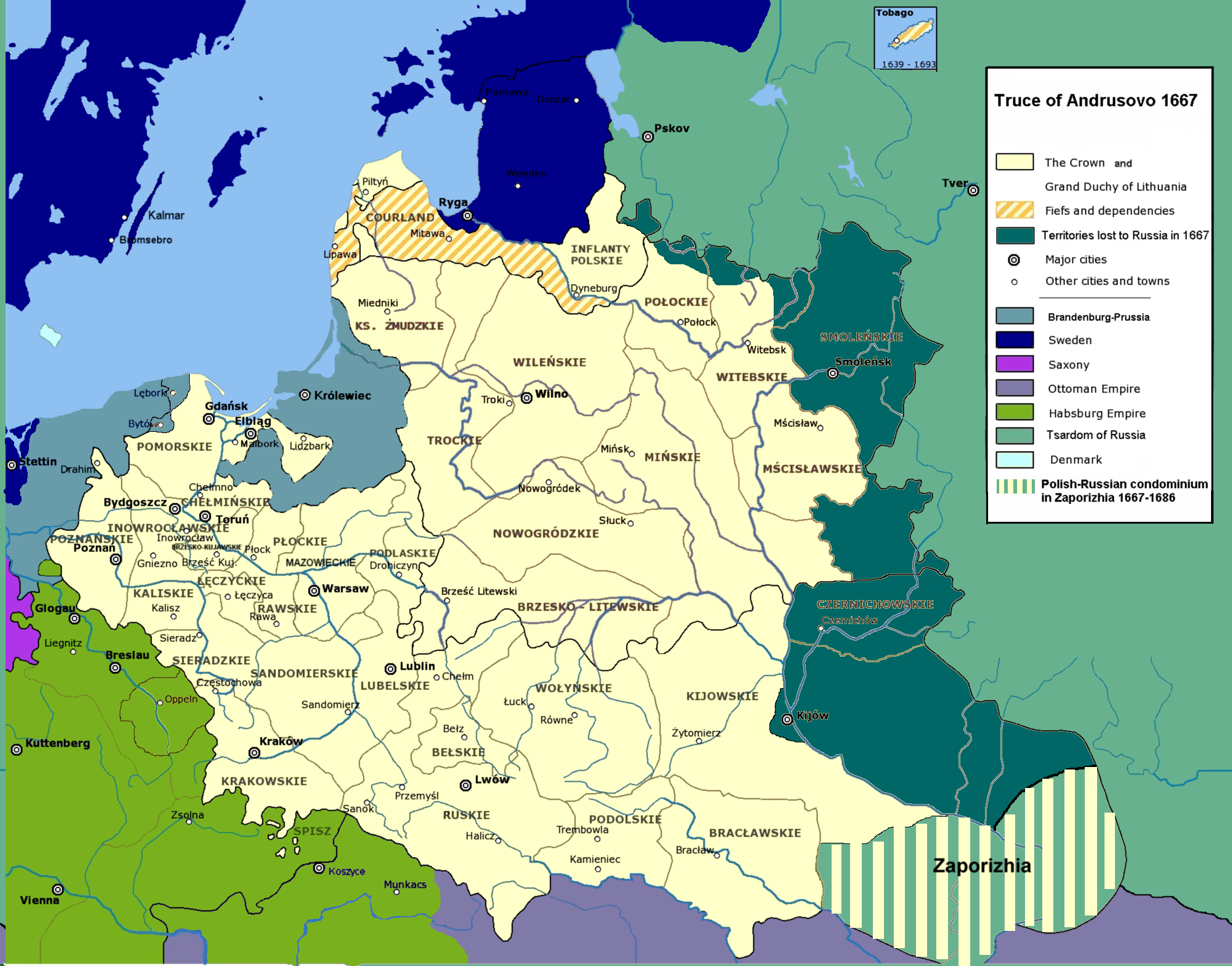
As I have stated on this blog before, the boundary between Polish/Lithuanian and Russian influence became settled on the Dnieper. I have also published this map before, showing that history resonates through the current conflict. [map at top of page]
There is also the case of third-party recognition of the Ukrainian nationality. I have read, for example, the letters and memoirs, both published and unpublished, of scores of British soldiers and civil servants involved in the Imperial rivalry with Russia in Asia. Many had contact with Russian officers or diplomats. They did clearly recognise different ethnic identities within the Russian Empire. The Russian diplomat Jan Witkiewicz was described repeatedly by British officers as “Polish”, for example. “Cossack” and “Tartar” were frequently used. I cannot recall any of these British sources ever using the description “Ukrainian”.
Nor did British officers who actually passed through Ukraine, like Fred Burnaby and Arthur Connolly, describe it as such in their memoirs. Now I am not claiming that if British imperialists did not notice something, it did not exist. But if there were a centuries-old recognition by the rival Empire of the existence of a Ukrainian national identity, that would definitely mean something. There does not appear to be such.
I should be interested to know where Ukrainian nationalists claim their cultural heritage lies as proof of early national identity. What is the Ukrainian equivalent of Shakespeare’s John of Gaunt speech, of Scotland’s Blind Harry, or even of Poland’s Pan Tadeusz? (This is a genuine question. There may be areas of Ukrainian historic identity of which I am unaware).
Putin was not wrong about history (apart from the dodgy bit about origins of the second world war). But the correct question is whether any of this matters.
It is not whether Putin’s historical analysis is broadly correct, it is whether this matters. I am inclined to the view that Putin is correct that there is little evidence that the people living in Ukraine, hundreds of years ago, ever considered themselves a distinct national entity.
But they are all dead, so they don’t get a vote. The only thing that matters is the opinion of those living there now.
It seems to me beyond dispute that there is now a Ukrainian national identity. I know several Ukrainians who consider themselves joyously and patriotically Ukrainian, just as I know patriotic Ghanaians and even patriotic Uzbeks. The question of how this identity was forged and how recently is not the point.
I should add there are undoubtedly a great many Ukrainians whose sense of national identity is not linked to Nazism. There is a historical and a current strain of Nazism in Ukrainian nationalism, and it is far too tolerated by the Ukrainian state; that is certainly true. But to claim all Ukrainian nationalists are Nazis is a nonsense…………………………………………………………………………………………………
I am aware I need to read more on the creation of national identity, because most of my thought is based on simple observation. It is however entirely plain that national identity can appear, and can be genuine, and can do so in a period of merely decades. There is now a Ukrainian national identity, and those who subscribe to it have the right to their state.
That they have a right to the former boundaries of Soviet Ukraine is a different proposition. Given the reality that it is plain a significant minority of the population do not subscribe to Ukrainian national identity, that civil war broke out, and that this relates to historic geographic fracture lines, it seems that division of territory is now not only inevitable but desirable.
All people of good will should therefore wish to see an end to fighting and a peace settlement, of which the territorial elements are somewhere close to the current lines between the forces, with Russia giving back some territory in return for recognition of its gains. The alternative is more death, human misery and economic malaise.
https://www.craigmurray.org.uk/archives/2024/02/putin-history-and-the-mystery-of-national-identity/
Ten years after Maidan: Why won’t the West admit that the coup was based on a lie?
Felix Livshitz, RT, Sat, 24 Feb 2024, https://www.sott.net/article/489209-Ten-years-after-Maidan-Why-wont-the-West-admit-that-the-coup-was-based-on-a-lie
—
This feature was first published on February 6, 2023. On the occasion of the 10th anniversary of the events that took place in Kiev on February 22, 2014, we are again posting it on the front page.
Political scientist Ivan Katchanovski – of the University of Ottawa – revealed last year, in a paper, that the February 2014 massacre of Ukrainian protesters by sniper fire, a defining moment of the Western-backed Maidan coup, was not published by an academic journal for “political reasons.”
Evidence that external forces were involved has been suppressed for ‘political reasons’
‘The evidence is solid’
In a lengthy Twitter thread, Katchanovski first laid out the circumstances behind the rejection of his article, and the bombshell evidence included in it. The paper was initially accepted with minor revisions after peer review, and the journal’s editor offered a glowing appraisal of his work, writing:
“There is no doubt that this paper is exceptional in many ways. It offers evidence against the mainstream narrative of the regime change in Ukraine in 2014… It seems to me that the evidence the study produces in favour of its interpretation on who was behind the massacre of the protesters and the police during the ‘Euromaidan’ mass protests on February 18-20, 2014, in Ukraine, is solid. On this there is also consensus among the two reviewers.”
As the editor noted, the massacre was a “politically crucial development,” which led to the “transition of powers in the country” from the freely elected Viktor Yanukovich to the illegitimate and rabidly nationalistic administration of Aleksandr Turchinov, a former security services chief. It was endlessly cited in Western media as a symbol of the brutality of Ukraine’s government and an unprovoked attack on innocent pro-WesternMaidan protesters, who allegedly sought nothing more than democracy and freedom.
Rumors that the killings were a false flag intended to inflame tensions among the vast crowds filling Maidan, and provoke violence against the authorities, began circulating immediately.
No serious investigation into what happened was ever conducted by the Western media, with all claims that the sniper attacks were an inside job dismissed as Kremlin “disinformation.” However, even NATO’s Atlantic Council adjunct admitted in 2020 that the massacre was unsolved and that this “cast a shadow over Ukraine.”
Ask the witnesses
It may not remain unsolved for much longer though, due to an ongoing trial of policemen at the scene on the fateful day. The legal action has been unfolding for well over a year and has received no mainstream news attention at all outside Ukraine. Katchanovski drew heavily on witness testimony and video evidence that has emerged over the course of the trial in his suppressed paper.
For example, 51 protesters wounded during the incident testified at the trial that they were shot by snipers from Maidan-controlled buildings, and/or witnessed snipers there. Many spoke of snipers in buildings controlled by Maidan protesters shooting at police. This is consistent with other evidence collected by Katchanovski, such as 14 separate videos of snipers in protester-controlled buildings, 10 of which clearly feature far-right gunmen in the Hotel Ukraina aiming at crowds below.
In all, 300 witnesses have told much the same story. Synchronized videos show that the specific time and direction of shots fired by the police not only didn’t coincide with the killings of specific Maidan protesters, but that authorities aimed at walls, trees, lampposts, and even the ground, simply to disperse crowds.
Among those targeted by apparently Maidan-aligned snipers were journalists at Germany’s ARD. They weren’t the only Western news station in town at the time – so too were Belgian reporters, who not only filmed Maidan protesters screaming towards Hotel Ukraina for snipers not to shoot them, but also participants being actively lured to the killing zone. This incendiary footage was never broadcast.
CNN likewise filmed far-right elements firing at police from behind Maidan barricades, then hunting for positions to shoot from the 11th floor of the Hotel Ukraina, minutes before the BBC filmed snipers shooting protesters from a room where a far-right MP was staying. The network opted not to report this at the time.
We needn’t rely purely on video footage. Over the course of the trial, no fewer than 14 self-confessed members of Maidan sniper groups testified they had explicitly received massacre orders, Katchanovski claims. By contrast, no police officer at the scene has said they were directed to kill unarmed protesters, no minister has come forward to blow the whistle on such a scheme, and no evidence Yanukovich approved of the killings has ever emerged.
Separate from the trial, leaders of the far-right Svoboda party have openly stated that Western government representatives expressly told them before the massacre that they would start calling for Yanukovich’s ouster once casualties among protesters reached a certain number. This figure was even actively discussed by both sides – were five enough, or 20? Or even 100? The latter was the final total reported, and indeed led to calls for the Ukrainian government’s abdication.
***
Katchanovski previously published a landmark study on the Maidan massacre in 2021, which has been referenced over 100 times by scholars and experts, already making him one of most cited political scientists specializing in Ukraine, according to Google Scholar.
Whatever the nature and source of the political pressure applied to the journal that led to the censoring of the dynamite paper, the move may well backfire massively, in the spirit of the Streisand Effect. Indeed, it could help the truth of what happened on those deadly days come out, and assist in those responsible for the killings being brought to justice.
It should also prompt a wider reconsideration of the nature of Maidan too, and the government it produced. The banning of opposition parties, attacks on the Orthodox Church, the closure of dissident media outlets, and the war on Russian culture and language are all consequences.
Comment: It is interesting that the West keeps claiming that Ukraine is fighting for European values for as the last paragraph shows, those values contain nothing democratic, just or fair in them. The West might be right though as European values in reality are getting closer and closer to those demonstrated in Ukraine, namely fascism and totalitarianism.
See also:
Pentagon investigating 50 cases of Ukraine military aid fraud
Rt.com 25 Feb 24
In one instance, shipping manifests were mysteriously changed before arms packages reached the country
The Pentagon’s inspector general has opened more than 50 cases into possible “theft, fraud or corruption, and diversion” of military aid to Ukraine. Allegations of graft surfaced almost immediately after the aid began flowing to Kiev and Inspector General Robert Storch has declared that more investigations are likely to follow.
Speaking at a briefing on Thursday, Storch said that though no allegations have been substantiated yet, “that may well change in the future,” according to Bloomberg. Additional investigations will be necessary “given the quantity and speed” of weapons being sent to Ukraine, he noted.
One case highlighted by Storch involved unidentified items arriving in Poland as part of a wider weapons shipment, before disappearing from a shipping manifest when they were sent across the border into Ukraine in June.
While the case of the disappearing equipment was highlighted in a report by Storch’s office last year, the inspector did not say at the time whether the items had been lost or stolen. Instead, his office stated that Pentagon personnel “did not have required visibility and accountability of all types of equipment during the transfer process.”
None of Storch’s reports to date have identified any outright criminality. However, Thursday’s announcement marks the first time he has acknowledged that his office is probing potential cases of “procurement fraud, product substitution, theft, fraud or corruption, and diversion.”
…………………………………………………………….. Ukrainian Defense Minister Aleksey Reznikov was dismissed from his post over graft allegations in September. His successor, Rustem Umerov, announced in January that an audit had revealed $262 million in theft-related costs in weapons procurement. https://www.rt.com/news/593080-pentagon-ukraine-aid-fraud/
First 2 years of US proxy war against Russia finds both US and Ukraine in downward spiral

Between 2007, and February 24, 2022, former presidents George W. Bush, Barack Obama, Donald Trump and Joe Biden floated NATO membership to Ukraine. This was in violation of George H.W. Bush’s 1991 promise not to expand NATO eastward toward Russia.
Sensible diplomats and historians scolded the US that such a move east was a red line of provocation that would inevitably result in military Russian pushback. They compared it with JFK’s willingness to start nuclear war with Russia to prevent installation of Russian missiles just 90 miles from the US in Cuba.
But the reckless presidents occupying the While House pushed on with their lust to expand NATO till Russia was completely surrounded to the west by US allies, possibly nuclear armed, to both isolate and degrade Russia as a political rival to US European hegemony.
But it was President Biden, after 15 long years of Russian pleading with America to cease NATO expansion, to trigger a violent Russian response. While touting NATO membership for Ukraine, he poured hundreds of millions in weaponry for Ukraine to finish off the Russian leaning Ukrainian dissidents in the Donbas seeking independence from Kyiv. He rebuffed every Russian entreaty to consider Russia’s security concerns. He even told Russia thru his spokesperson that ‘Russia’s security concerns were not up for discussion.’ A first year political science student wouldn’t have made that mistake.
So, after 15 years of pleading, Russia’s military response began 2 years ago today. What has it achieved for Ukraine who lobbied the US hard for NATO membership? Over 400,000 dead soldiers and 10,000 dead civilians. Over 14 million Ukrainians displaced from their homes, with 6 million fleeing as refugees in 11 European countries. Over a third of the prewar Ukraine economy is gone, putting Ukraine on US/NATO life support just to function. The Ukrainian military is near collapse. That is quite a needless decline for the US and Ukraine to provoke a senseless war.
Tho certainly not bloody nor broken economically as Ukraine, the US is also in decline from the war it provoked 2 years ago. Our sanctions against Russia have failed spectacularly. Our call for worldwide support to defeat Russia have been, outside of NATO and a few others, ignored. Dozens of countries, large and small, have abandoned US hegemony to join BRICS AND SCO, two political economic organizations dedicated to a multi polar world of nations not dominated by America. The US has boxed itself into a decline in world influence from which it will likely never recover. That is both good and long overdue.
But rather than face reality and direct Kyiv to negotiate the best resolution possible in a hopeless war, the US slogs on,pledging Ukraine $60 billion more in weapons for which there a few soldiers left to fire.
America’s decline which began 2 years ago today is political, diplomatic and moral, a trifecta of stupidity of which the Big Fools in the Biden administration are too blind or simply unwilling to see.
Ukraine can’t maintain advanced US-supplied weapons – Pentagon
https://www.rt.com/news/592888-pentagon-audit-weapons-ukraine/ 23 Feb 24
The US reportedly rushed vehicles to Kiev without factoring in necessary repairs
The US has no plan in place to maintain, service or repair tanks, armored vehicles and air defense systems Washington has given to the Ukrainian military, Pentagon Inspector-General Robert P. Storch has admitted. The failure to plan “puts at risk Ukraine’s ability to fight effectively using the US-provided equipment, as well as the DoD’s readiness to address other national security threats if needed,” he added.
Storch revealed in two redacted reports released to the public on Tuesday that the US has delivered 186 Bradley and 189 Stryker Infantry Fighting Vehicles (IFV), 31 Abrams main battle tanks, and an unspecified number of Patriot air defense systems to Ukraine.
Washington’s Department of Defense “had not developed or implemented a plan” to maintain any of them, according to the inspectors cited in the reports, who warned that there is nothing to suggest the weaponry could be sustained past October 2024.
All of the weapons systems were taken from the US military’s own stocks “without limits,” under the Presidential Drawdown Authority, according to the reports. If this practice continued, it “may require the [Department of Defense] to choose between the readiness of [Ukrainian] units or the readiness of US Army units,” one official told the inspectors.
The US military-industrial complex has struggled to replace the weapons systems sent to Ukraine, due to shortage of parts and the lack of production lines or trained personnel. Maintenance was described in the reports as an “afterthought” for the Pentagon, whose main focus was to arm Ukraine “as quickly as possible.”
An official with the US European Command told the inspectors that “the current model would not be sustainable or effective over the longer term.”
“The DoD provided Ukraine with armored vehicles and air defense systems without a plan to ensure their long-term usefulness,” Storch said in a statement. “While the DoD is currently working on developing such a plan, the lack of foresight in this matter is concerning.”
The US military sent “limited spare parts, ammunition, and maintenance support” and “did not coordinate or tailor those efforts into a comprehensive sustainment plan,” according to Storch’s reports.
What was sent included “some” consumables and spare parts for field maintenance, as well as “additional items informed by US experience operating the weapon systems in Iraq, Afghanistan, and Syria,” Storch noted.
While the sustainment is not required under the current congressional authority for sending weapons to Ukraine, “the weapon systems are not likely to remain mission capable” without it, the report said.
At least one US Patriot system has been destroyed by hypersonic missiles, according to the Russian Defense Ministry. Last year’s Ukrainian offensive saw multiple Bradley and Stryker vehicles destroyed in attempts to advance against Russian defenses. There have been no public reports of Abrams tanks being used in active combat operations so far.
February 2024: 10th anniversary of the conflict in Ukraine
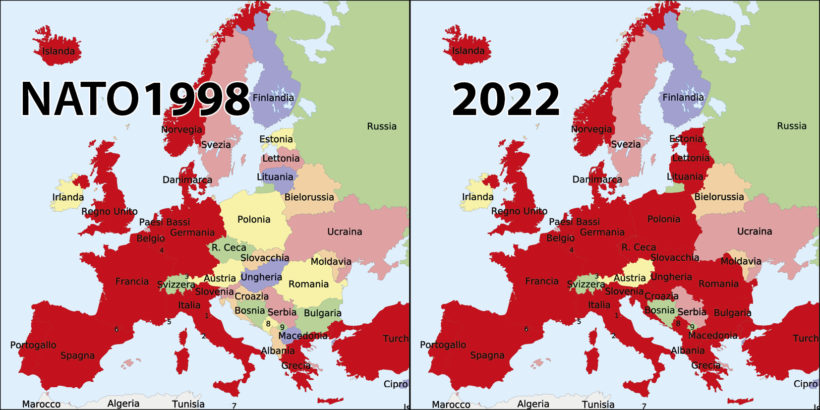
Russia preferred to maintain the Ukrainian state and did not recognize the breakaway republics of Donetsk and Lugansk. It strove to find a solution that would protect the rights of Russian speakers (language, administrative autonomy) without removing them from Ukraine. The Minsk I (September 2014) and Minsk II (February 2015) agreements were neutralized by the Western signatories who later admitted having signed them only to give themselves time to arm and train the Ukrainian forces.
Russia’s categorical refusal to the inclusion of Ukraine into NATO since this would be followed by the installation of American missiles on its southern flank.
February 24, 2022, was not the beginning of a war with Ukraine but the last stage of the war that had begun in 2014.
Used as a disposable tool by the United States and NATO against Russia, Ukraine is in ruins and its future is in jeopardy.
22.02.24 – Europe – Samir Saul – Michel Seymour https://www.pressenza.com/2024/02/february-2024-10th-anniversary-of-the-conflict-in-ukraine/
In the coming days, we will surely hear about the so-called second anniversary of the war in Ukraine. Western governments, corporate media broadcasting the official pro-US line all day long, and “experts”-propagandists of this line will deliver their pseudo-analyses. All will be based on the double premise that the conflict in Ukraine began on February 24, 2022, and that it consists of a Russo-Ukrainian war unilaterally provoked by Russia to satisfy the expansionist ambitions of “dictator” Putin.
According to the US/NATO/Kiev “narrative”, everything was peaceful and normal before February 24. On that day, without the slightest justification and warning, like lightning in a blue sky, a Russian invasion descended on innocent Ukraine. As good Samaritans, the USA and its camp rushed to the aid of the victim by becoming its source of dollars and weapons, not to mention mercenaries and NATO “advisers” to operate these weapons systems. The conflict was supposed to last at most a few weeks, which was all the time that was needed to bleed Russia, while economic “sanctions” would bludgeon it and open the way to a “popular uprising” on the model of the “colored revolutions” (i.e. a putsch sponsored by the Western camp to carry out regime change and install a new leadership which would place Russia under the control of US imperialism).
That is the official “story”, rehashed ad nauseam, by “major” media, with all analysis of what is happening shut out. Only pro-US/NATO/Kiev propaganda is permitted because it would not survive if serious analyses were also allowed. It turns out that censorship, presented as the practice solely of “authoritarian regimes” against which Western “democracies” are leading a worldwide struggle in the name of “values”, is very much at home in the West. It is endorsed, sometimes hypocritically, sometimes proudly.
In propaganda and the now culture, there is no history. Events occur as sudden appearances or random occurrences based on spontaneous impulses. The “good guys” (the US and those who are aligned with them) and the “bad guys” (those who stand up to them) are known in advance, nothing else. With this simplistic and distorting grid, a conflict only begins when the “bad guys” retaliate, and never before, when the “good guys” have taken the initiative to threaten or attack them, leading to the retaliation. These initial actions are simply erased from memory.
Choosing February 24, 2022 as the starting date of the conflict in Ukraine shows bias, myopia and ignorance. It is equivalent to becoming a sounding board for the official “narrative”, the primary aim of which is to conceal the central role of Western governments as initiators of the conflict in Ukraine. Their aim is less Ukraine itself than the utilization of Ukraine, first against the Soviet Union, then against Russia.
A conflict that dates back to 1945
The Ukrainian question went through four phases: from 1945 to 1956, it was a war of sabotage and terrorism; from 1956 to 1990, there was a lull; from 1990 to 2014, a new conflict was brewing; in 2014, the war began.
As early as 1945, well before February 24, 2022, the ancestor of the CIA recruited German Nazis and their Ukrainian collaborators. Surrendering to the Americans, Reinhard Gehlen put his network of agents in Eastern Europe at the service of the US. Ukrainian ultranationalist collaborator Stepan Bandera joined Gehlen in Germany and, with his organization, waged a bloody war against the USSR in Ukraine, a Soviet territory. The USSR won and the KGB assassinated Bandera in 1959. It was in 1954 that Khrushchev transferred the Crimean peninsula to the Republic of Ukraine, then part of the USSR.
Latent tension since 1991
Continue readingUkraine: how nuclear weapons continue to increase the risks, two years on
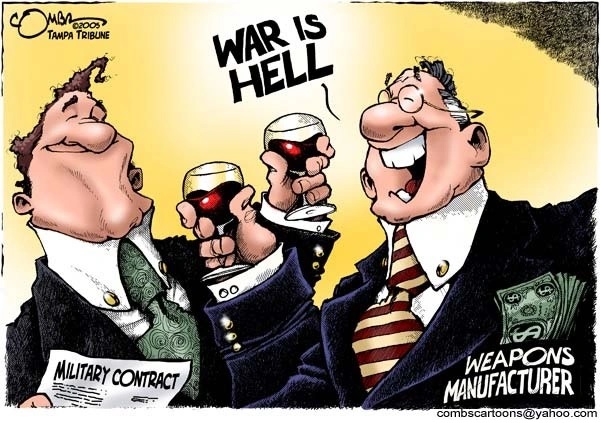
nuclear weapons industry has profited shamelessly off the world’s concerns over nuclear war. Since the conflict in Ukraine and the increased nuclear tensions that followed, profits for the companies that produce nuclear weapons drove up, with an $15.7 billion increase in share and bond holding and $57.1 billion increase in loans and underwriting.
https://www.icanw.org/ukraine_two_years_how_nuclear_weapons_increase_the_risks— 24 Feb 24
Two years after the start of Russia’s full-scale invasion of Ukraine, the risk of nuclear weapons use continues to escalate, while the looming threat of their use protracts this conflict with a high civilian cost. Nuclear-armed states and their allies waver between condemning nuclear threats and engaging in irresponsible practices such as nuclear sharing and championing their own nuclear deterrent. But the rest of the world is pushing back, condemning these behaviors and demanding the total elimination of these weapons of mass destruction through the UN Treaty on the Prohibition of Nuclear Weapons (TPNW).
Melissa Parke, Executive Director of ICAN, said: “This terrible war with its use of nuclear blackmail and overt threats to use nuclear weapons is a wake up call that the world needs to heed – as long as the nuclear-armed states hang on to their arsenals and cling to the misguided doctrine of deterrence, we face the likelihood these weapons will be used sooner or later. Nuclear weapons should be abolished before it is too late.”
The escalating nuclear risk
Following Vladimir Putin’s initial explicit threats to use nuclear weapons, we have seen nuclear-armed states and their allies continue to erode the decades-long nuclear taboo over the past two years. The escalation in nuclear rhetoric has not just been seen in Russia (Medvedev made explicit threats just this last weekend) but also in Israel and North Korea, and in recent calls by Polish and German politicians and NATO leaders for a European nuclear weapon. Nuclear threats heighten tensions in an already dangerous environment, reduce the threshold for use of nuclear weapons, and greatly increase the risk of nuclear conflict and global catastrophe.
The risk is also increased by the irresponsible practice of nuclear sharing, or stationing nuclear weapons, which seems to be on the rise. In June 2023, Vladimir Putin said Russia delivered its first tactical weapons to Belarus, though it is unclear how many nuclear weapons were transferred. This is a reckless and dangerous escalation that was widely condemned. But for NATO states, and particularly the five states that host US nuclear weapons, simply condemning Russia’s nuclear sharing without taking any action is insufficient and hypocritical. Particularly as the US and the UK also seemingly explore the return of US nuclear weapons to Lakenheath. Any nuclear sharing complicates decision making and increases the risk of miscalculation, miscommunication and potentially catastrophic accidents. It is time to end this practice that threatens peace and security and puts us all at risk.
Deterrence theory and nuclear weapons profiteers at the heart of the problem
The use of nuclear blackmail by Russia in the context of the Ukraine war has demonstrated the flawed nature of nuclear deterrence which, instead of ensuring stability, gave Russia the cover to commense its brutal and devastating invasion. Yet Russia’s nuclear threats have failed to deter the US and European countries from supplying Ukraine with weapons and money to fight Russia.
With current conflicts directly involving two nuclear-armed states, it is clear that nuclear deterrence doesn’t keep the peace. NATO states are playing into Putin’s hands by insisting nuclear weapons are a necessary deterrent. It only strengthens Putin’s position to promote his own “deterrent” now, whereas rejecting deterrence and reinforcing the nuclear taboo would limit his options.
Meanwhile, the conflict has also accelerated the global nuclear arms race, with the nine nuclear-armed states increasing spending to $82.9 billion in 2022. As a result, the nuclear weapons industry has profited shamelessly off the world’s concerns over nuclear war. Since the conflict in Ukraine and the increased nuclear tensions that followed, profits for the companies that produce nuclear weapons drove up, with an $15.7 billion increase in share and bond holding and $57.1 billion increase in loans and underwriting.
The global response to nuclear risk: the TPNW
The way to respond to the heightened risk of nuclear war is not to increase nuclear arsenals or threaten nuclear retaliation. The answer is for all countries to condemn nuclear threats, end their reliance on nuclear deterrence and join the UN Treaty on the Prohibition of Nuclear Weapons (TPNW). The TPNW specifically outlaws the threat to use nuclear weapons, as well as the irresponsible practice of nuclear sharing.
All nuclear-armed states need to take urgent steps to de-escalate tensions and to break free from the dangerous doctrine of nuclear deterrence, and nuclear disarmament must be an essential element of a negotiated peace between Russia and Ukraine. Multilateral nuclear disarmament is the only guarantee to prevent other nuclear-armed countries from following Russia’s lead and using their nuclear weapons as a shield to commit war crimes and terrorize civilian populations. Joining the TPNW is a crucial step to delegitimize nuclear deterrence and eliminate nuclear weapons.
Over the past two years, the states parties of the TPNW have been central in pushing back against any and all nuclear threats and challenging the false narrative of nuclear deterrence. At the First Meeting of States Parties in 2021, they condemned unequivocally “any and all nuclear threats, whether they be explicit or implicit and irrespective of the circumstances.” At the second meeting in New York,they agreed “to challenge the security paradigm based on nuclear deterrence by highlighting and promoting new scientific evidence about the humanitarian consequences and risks of nuclear weapons and juxtaposing this with the risks and assumptions that are inherent innnuclear deterrence.” It is time for all responsible states to join the TPNW.
Buried trial verdict confirms false-flag Maidan massacre in Ukraine
Oligarchic and far-right leaders and organizations, including neo-Nazis, who were involved in this false-flag mass killing to seize power in Ukraine, were hailed by Western and Ukrainian politicians, media, and even many academics as heroes and defenders of democrac
Ukrainian-Canadian political scientist and professor Ivan Katchanovski on the hidden origins of the Russia-Ukraine war
Ivan Katchanovski / February 20, 2024
A nearly one-million-word verdict from Ukraine’s Maidan massacre trial has recently confirmed that many Maidan activists were shot not by members of Ukraine’s Berkut special police force or other law enforcement personnel but by snipers in the far-right-controlled Hotel Ukraina and other Maidan-controlled locations a decade ago today. The verdict, handed down on October 18, 2023, states specifically that this hotel was controlled by Maidan activists and that an armed, far-right-linked Maidan group was in the hotel and fired from it. It also confirms that there was no Russian involvement in the massacre and that no massacre orders were issued by then President Viktor Yanukovych or his ministers. The verdict concludes that the Euromaidan was at the time of this massacre not a peaceful protest but a “rebellion” that involved the killing of Berkut and other police personnel.
This is an important official acknowledgement, not only because the violence represented the most significant case of mass murder, violent crime, and human rights violations in independent Ukraine to that point, but also because of the subsequent conflicts to which it has led or contributed. Notably, the massacre precipitated the violent overthrow of Yanukovych and his government, who were falsely blamed for carrying it out. It then spiralled into the Russian annexation of Crimea, the subsequent civil war and Russian interventions in the Donbas, and the conflicts between Ukraine and Russia, and between Russia and the Western powers, which Russia dramatically escalated with its illegal invasion of Ukraine on February 24, 2022.
There has been, however, a blackout of the verdict’s confirmation of the Maidan snipers in the Ukrainian media and, with a few notable exceptions, the Western mainstream media. Moreover, in an op-ed piece in The Bulwark, an online neoconservative magazine, author Cathy Young misrepresented the verdict, falsely claiming that it had found the Berkut police responsible for the deaths of 40 of the 48 protesters killed. Young also denied and openly whitewashed the existence of Maidan snipers and the far-right’s involvement in the Maidan massacre, labelling it a “conspiracy theory” despite clear and overwhelming evidence to the contrary in the verdict, the trial, and the investigation, as well as in academic studies of the event. Such deliberate omission and misrepresentation has been perpetrated in spite of the fact that the verdict’s Ukrainian text, as well as automatic English translation of the relevant excerpts, are publicly available, and in spite viral tweets describing and quoting from it.
The verdict by the Ukrainian Sviatoshyn District Court in Kyiv, along with the findings of the investigation by the Ukrainian prosecutor general’s office (GPU), comprise a de facto official admission—on the part of Ukraine’s justice system no less, which cannot be called independent—that on February 20, 2014, at least 10 of the 48 Maidan activists killed, and 115 of the 172 wounded, were shot not by Berkut or other law enforcement personnel firing from government-controlled areas but by Maidan snipers operating in Maidan-controlled locations. The government investigation admitted that one dead protester and 77 wounded Maidan activists were not shot from Berkut-controlled sectors, and therefore did not charge anyone for those crimes. Of course, it stands to reason that if these activists were not shot by government personnel, they must have been shot by the Maidan snipers.
The verdict, issued by the Kyiv court shortly before the tenth anniversary of the Euromaidan, shows that the Maidan massacre narrative that has been propagated by governments, the mainstream media, and a variety of info-warriors in the West and in Ukraine is false. The proponents of this narrative have called the Maidan a peaceful protest and presented the massacre of the Maidan protesters as a crime perpetrated by government snipers on the orders of Yanukovych and his government. The prosecution, the victims’ lawyers, the New York Times and other mainstream media (with some notable exceptions), Wikipedia, self-proclaimed experts, and info-warriors denied the presence of snipers in the Hotel Ukraina and other Maidan-controlled buildings, the shooting of Maidan protesters by these snipers, and the far-right’s involvement in this mass killing, and claimed instead that such ideas comprise a “conspiracy theory” and “Russian disinformation.” The exceptions included reports by ARD, BBC, The Nation, Jacobin, Court House News, Ekathimerini (Greece), Jyllands-Posten (Denmark), Weltwoche (Switzerland), Il Fatto Quotidiano (Italy), and El Nacional (Spain)—in addition to Canadian Dimension, which has published some of my other writing on this subject………………………………………………………………………………………………………………………………………………………………………………………………………………….
Wikipedia editors who deliberately and literally misrepresent and whitewash the false-flag Maidan massacre also systematically misrepresent and whitewash the far-right in Ukraine and its involvement in the Holocaust. These editors include Wise2, also known as Prohoshka, who has also propagated “scientific anti-Semitism” and whitewashed the involvement of the Organisation of Ukrainian Nationalists (OUN) in the 1941 Lviv pogroms during the Nazi occupation of Ukraine, justifying it on the basis of “Jewish collaboration.” Another Wikipedia editor, who uses the handle My Very Best Wishes, brazenly whitewashed the fact that monuments in Canada to the Galicia Division and Roman Shukhevych are in fact commemorating a division of the Waffen-SS and a Nazi collaborator. A scholarly article by a noted historian at the University of Ottawa also listed My Very Best Wishes as one of the editors involved in an intentional distortion of Wikipedia’s history of the Holocaust in Poland. This editor also recently wrote, falsely, on Wikipedia’s biographical page on Elon Musk about the latter’s supposed “involvement in the Russian invasion of Ukraine.” Various publications and websites have identified Wise2/Prohoshka as a far-right Svoboda activist named Svyatoslav Gut, and My Very Best Wishes as Andrei Lomize, a biophysics researcher at the University of Michigan.
Fabricated evidence against Berkut, no massacre order by Yanukovych
The trial verdict also confirms the absence of evidence for any order by Yanukovych or his government to massacre the Maidan protesters. This is a crucial official acknowledgment, since Yanukovych and his government were overthrown on the basis of accusations of having ordered the massacre. Joe Biden, then US vice-president, wrote in his memoirs that during the Maidan massacre, he called Yanukovych and told him that “it was over; time for him to call off his gunmen and walk away,” that he “had lost the confidence of the Ukrainian people … and he was going to be judged harshly by history if he kept killing them.”
In addition to acquitting two Berkut policemen for killing and wounding the Maidan activists, the verdict states that all five accused Berkut officers had been blamed, baselessly, for killing 13 Maidan protesters and wounding another 29. This is further evidence of trumped-up, politically motivated charges.
The decision to convict in absentia three Berkut officers, who had been transferred by Zelensky to the Donbas separatists in a 2019 exchange, is a political one. The charging of these officers for the murders of 31 of 48 Maidan protesters killed, and the attempted murders of another 44 of 80, was based on a single, fabricated forensic examination, not to mention posited on the notion of collective responsibility. This single forensic examination of bullets, undertaken five years after the massacre, reversed the results of some 40 earlier forensic bullet examinations, including a computer-based examination which showed that bullets taken from the bodies of killed Maidan protesters did not match the Berkut Kalashnikov rifles.
The three Berkut policemen were convicted in absentia based on this single, fabricated forensic examination as well as on their presumed collective responsibility for the murders of 31 protesters and the attempted murders of 44 more. On the same basis and contrary to all other evidence, a Berkut commander was also convicted of the manslaughter of four protesters and the wounding of another eight, for supposedly having ordered his officers to fire indiscriminately during the evacuation of internal troops by the Berkut company, and its subsequent retreat after one Berkut officer was killed and another wounded……………………………………………………………………………………………………………………………………………….
The verdict means that a decade since this crucial massacre—one of the most documented cases of mass killing in history—nobody is in prison for the murders and attempted murders of Maidan activists and police officers, or for shooting at foreign journalists. The silence on the part of those who deny the false-flag Maidan massacre, who call these claims a “conspiracy theory” and thereby whitewash the mass murderers of the far-right, is both deafening and revealing.
Media blackout and whitewash
All Ukrainian media reports omitted the verdict’s confirmations of the false-flag massacre. The Western media (with a few notable exceptions) also omitted this information. Moreover, writer Cathy Young, mentioned above, deliberately misrepresented the Maidan massacre trial verdict, branding the revelations about Maidan snipers operating in the Hotel Ukraina a “conspiracy theory” and claiming, falsely, that the verdict did not indicate that Maidan protesters were shot from the hotel or other Maidan-controlled locations, and that it did not disprove involvement by Russian snipers. ………………………………………………………………………………
Oligarchic and far-right leaders and organizations, including neo-Nazis, who were involved in this false-flag mass killing to seize power in Ukraine, were hailed by Western and Ukrainian politicians, media, and even many academics as heroes and defenders of democracy. They were invited for government visits and talks at universities, including in Canada. Government leaders, journalists, investigators, Maidan lawyers, NGO activists, partisan researchers, and info-warriors who branded the reports of the Maidan snipers and their false-flag massacre a conspiracy theory and propaganda were hailed as defenders of justice and human rights, and given grants by Western governments, foundations, and universities, including even a Nobel Peace Prize.
It is doubtful that any of the above parties will suffer any consequences for such fraud and whitewashing of mass murderers, in particular those of the far-right. Ukraine and Ukrainians continue to suffer the consequences of this massacre, which has spiralled into major conflicts, including the ongoing and devastating Russia-Ukraine war, which is also a dangerous, unwinnable proxy war undertaken by the West against Russia.
Ivan Katchanovski teaches at the School of Political Studies at the University of Ottawa. He is the author of Cleft Countries: Regional Political Divisions and Cultures in Post-Soviet Ukraine and Moldova and co-author of Historical Dictionary of Ukraine (Second Edition) and The Paradox of American Unionism: Why Americans Like Unions More Than Canadians Do, But Join Much Less. https://canadiandimension.com/articles/view/buried-trial-verdict-confirms-false-flag-maidan-massacre-in-ukraine-2024
1 This Month
22 June – Virtual Event –Climate Change: New Data, New Debate

Monday, June 22, 2026 2:30 p.m. – 3:15 p.m. CT
YouTube. Register here

Protect Sazan Island from the Trump family! https://secure.avaaz.org/campaign/en/protect_sazan_island_from_the_trump_family_loc/?bqFCVab&v=174511&cl=22707147157&_checksum=5e9dde668860e8231c33699735e16a1fbf22ab2cb01da50c999fe8732b9775ef&utm_source=email&utm_medium=blast_email&utm_campaign=174511
25 June- THE PUKE ON NUKES
Thursday, June 25, 2026
7pm Central Time (8pm ET, 6pm MT, 5pm PT) UTC – 5
From NRC & DOE Deregulation to Techno-Fascist Billionaires Going Nuclear, Plus a Few Songs from Atomic Cabaret REGISTER
26 June – Radiation Trainwreck at the NRC / Join the Protect Better Campaign – https://us02web.zoom.us/meeting/register/4ZlZ5_qLSHGiLSCg8FF6Bg#/registration


Cuba Is Not a Failed State – It Is a Besieged State
PETITION: “Global Appeal to Endorse Palestinian Right of Return of Refugees”
To see nuclear-related stories in greater depth and intensity – go to https://nuclearinformation.wordpress.com
-
Archives
- June 2026 (172)
- May 2026 (306)
- April 2026 (356)
- March 2026 (251)
- February 2026 (268)
- January 2026 (308)
- December 2025 (358)
- November 2025 (359)
- October 2025 (376)
- September 2025 (257)
- August 2025 (319)
- July 2025 (230)
-
Categories
- 1
- 1 NUCLEAR ISSUES
- business and costs
- climate change
- culture and arts
- ENERGY
- environment
- health
- history
- indigenous issues
- Legal
- marketing of nuclear
- media
- opposition to nuclear
- PERSONAL STORIES
- politics
- politics international
- Religion and ethics
- safety
- secrets,lies and civil liberties
- spinbuster
- technology
- Uranium
- wastes
- weapons and war
- Women
- 2 WORLD
- ACTION
- AFRICA
- Atrocities
- AUSTRALIA
- Christina's notes
- Christina's themes
- culture and arts
- Events
- Fuk 2022
- Fuk 2023
- Fukushima 2017
- Fukushima 2018
- fukushima 2019
- Fukushima 2020
- Fukushima 2021
- general
- global warming
- Humour (God we need it)
- Nuclear
- RARE EARTHS
- Reference
- resources – print
- Resources -audiovicual
- Weekly Newsletter
- World
- World Nuclear
- YouTube
-
RSS
Entries RSS
Comments RSS
 nuclear-news