Ukraine’s new commander-in-chief is an unpopular ‘butcher’ – Politico
https://www.rt.com/russia/592184-ukraine-commander-syrsky-unpopular/ 10 Feb 24
Troops are wary of General Aleksandr Syrsky, and reportedly fear that he will throw them into “fruitless assaults”
Ukraine’s new armed forces chief, General Aleksandr Syrsky, is deeply unpopular among the rank and file of the Ukrainian military, who view him as a “butcher” willing to sacrifice waves of troops, Politico reported on Thursday.
Ukrainian President Vladimir Zelensky named Syrsky as the new head of the armed forces on Thursday, after firing General Valery Zaluzhny from the post. The switch had been the subject of media rumors for several weeks, and Zelensky hinted in an interview last week that it would form part of a wider “reset” of the country’s military and civilian leadership.
Syrsky is a controversial choice, best known for “leading forces into a meat grinder in Bakhmut [called Artyomovsk in Russia], sending wave after wave of troops to face opposition fire,” Politico said.
The unsuccessful defense of Artyomovsk/Bakhmut last year cost Ukraine dearly, and earned Syrsky the nickname ‘butcher’, an anonymous source within the Ukrainian military told the news site. A captain told the outlet that Syrsky’s appointment is a “very bad decision,” adding that soldiers refer to him as ‘General200’, a nickname that Politico said refers to 200 of his men dying, but could also refer to ‘Cargo 200’, a Soviet and Russian military code used to describe corpses being removed from the battlefield.
“General Syrsky’s leadership is bankrupt, his presence or orders coming from his name are demoralizing, and he undermines trust in the command in general,” an anonymous Ukrainian military officer and frontline intelligence analyst posted on X. “His relentless pursuit of tactical gains constantly depletes our valuable human resources, resulting in tactical advances such as capturing tree lines or small villages, with no operational goals in mind.”
“This approach creates a never-ending cycle of fruitless assaults that drain personnel,” the officer said.
In a group chat of Bakhmut/Artyomovsk veterans, one soldier wrote “we’re all f**ked” upon learning of Syrsky’s appointment, Politico stated.
Syrsky takes over command of a depleted military, with Kiev having lost more than 383,000 men since the hostilities started in February 2022, according to the Russian Defense Ministry. Prior to his dismissal, Zaluzhny warned Zelensky that a rapid improvement in Ukraine’s position on the battlefield was unlikely, regardless of who took his place, the Washington Post reported last week.
Kremlin spokesman Dmitry Peskov said on Friday that Russia’s campaign against Ukraine will not be affected by Syrsky’s appointment, and that Moscow will continue until its objectives are achieved.
Zelenskiy names new Ukrainian military commander, says it’s time for ‘renewal’
RFE/RL, Fri, 09 Feb 2024, https://www.sott.net/article/488754-Zelenskiy-names-new-Ukrainian-military-commander-says-its-time-for-renewal
—
President Volodymyr Zelenskiy appointed Colonel General Oleksandr Syrskiy as the Ukrainian Army’s commander in chief just minutes after announcing it was time for a “renewal” and “renewed leadership” of the country’s armed forces.
Comment: It’s probably time for a renewal of Ukraine’s political leadership too.
In his statement on February 8, Zelenskiy said Syrskiy “has successful defense experience — he conducted the Kyiv defense operation. He also has successful offensive experience — the Kharkiv liberation operation.”
The Russia-born, 58-year-old Syrskiy, who has served as the commander of Ukrainian ground forces since 2019, replaces General Valeriy Zaluzhniy following reports that Zelenskiy was strongly considering removing him.
Zelenksiy said in a message on X, formerly Twitter, that is he grateful to Zaluzhniy and he appreciates “every victory we have achieved together.” Before announcing the leadership change, Zelenskiy said he had “candidly discussed” with Zaluzhniy issues in the army that require urgent change.
“Starting today, a new management team will take over leadership of the armed forces of Ukraine. I had dozens of conversations with commanders at various levels,” he said, adding that the move “is not about surnames, and surely not about politics.”
The change in leadership is about the management of the military and “about involving the experience of this war’s combat-hardened commanders,” he said, touting Syrskiy’s successful experience, particularly in the defense of Kyiv and his successful offensive experience, particularly in the Kharkiv liberation operation.
Defense Minister Rustem Umerov noted Zaluzhniy’s role in the first two years of the full-scale Russian invasion, saying “our soldiers repelled the onslaught of the aggressor, defended our statehood, and continue to defend our independence every day.”
Comment: After the last two years of this 10-year conflict, Russia controls about 18% of Ukraine that used to be Ukrainian.
He said he was grateful for Zaluzhniy’s achievements and victories, but war changes and demands change.
“The battles of 2022, 2023, and 2024 are three different realities [and] 2024 will bring new changes for which we must be ready,” Umerov said. “New approaches, new strategies are needed.”
U.S. State Department spokesman Vedant Patel said the move to replace Zaluzhniy was a “sovereign decision” made by Ukrainian leaders. He declined to comment further.
Comment: No one really believes that.
Syrskiy was one of the main commanders who led the Ukrainian armed forces’ fight against the offensives by Russia-backed separatists that started in 2014 shortly after Russia illegally annexed Ukraine’s Crimea.
Comment: That’s certainly one way of looking at it. But as usual, RFE/RL tries and succeeds in being as wrong as possible.
After Russia launched its full-scale invasion of Ukraine in February 2022, Syrskiy led the Ukrainian armed forces’ successful counteroffensive to regain control over the Kharkiv region in September of that year.
Comment: A “full-scale invasion” using a small fraction of its military.
…………………………………………………………………………..Tensions between Zaluzhniy and Zelenskiy surfaced in November after the commander in chief published an opinion piece in The Economist saying the war had entered a stalemate and only a technological breakthrough would allow Ukraine to achieve its goals of liberating occupied territory.
Zelenskiy’s office was quick to reject that battlefield assessment.
Polls showed earlier that Zaluzhniy’s popularity in the country is as high, if not more so, than Zelenskiy’s, and some experts suggested that if Zelenskiy ousted Zaluzhniy, it would demoralize some of Ukraine troops and undermine national unity. RT reports:
Ukraine’s new armed forces chief, General Aleksandr Syrsky, is deeply unpopular among the rank and file of the Ukrainian military, who view him as a “butcher” willing to sacrifice waves of troops, Politico reported on Thursday.
…
Syrsky is a controversial choice, best known for “leading forces into a meat grinder in Bakhmut [called Artyomovsk in Russia], sending wave after wave of troops to face opposition fire,” Politico said.The unsuccessful defense of Artyomovsk/Bakhmut last year cost Ukraine dearly, and earned Syrsky the nickname ‘butcher’, an anonymous source within the Ukrainian military told the news site. A captain told the outlet that Syrsky’s appointment is a “very bad decision,” adding that soldiers refer to him as ‘General200’, a nickname that Politico said refers to 200 of his men dying, but could also refer to ‘Cargo 200’, a Soviet and Russian military code used to describe corpses being removed from the battlefield.
“General Syrsky’s leadership is bankrupt, his presence or orders coming from his name are demoralizing, and he undermines trust in the command in general,” an anonymous Ukrainian military officer and frontline intelligence analyst posted on X. “His relentless pursuit of tactical gains constantly depletes our valuable human resources, resulting in tactical advances such as capturing tree lines or small villages, with no operational goals in mind.”
“This approach creates a never-ending cycle of fruitless assaults that drain personnel,” the officer said.
In a group chat of Bakhmut/Artyomovsk veterans, one soldier wrote “we’re all f**ked” upon learning of Syrsky’s appointment, Politico stated.
Syrsky takes over command of a depleted military, with Kiev having lost more than 383,000 men since the hostilities started in February 2022, according to the Russian Defense Ministry. Prior to his dismissal, Zaluzhny warned Zelensky that a rapid improvement in Ukraine’s position on the battlefield was unlikely, regardless of who took his place, the Washington Post reported last week.
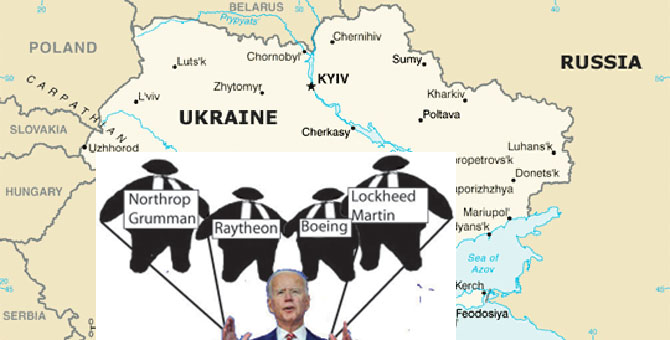
Why Biden’s $61 billion in weapons for Ukraine won’t prevent inevitable defeat
Walt Zlotow, West Suburban Peace Coalition, Glen Ellyn IL 11 Feb 24
For 4 months President Biden has been beseeching Congress to grant another $61 billion in aid to Ukraine to continue their 2 year war with Russia. This is on top of $113 billion that has made no dent in Ukraine’s efforts to prevail against overwhelming Russian forces.
Biden could give Ukraine a trillion dollars in aid but it’s essentially worthless because Ukraine is running out of soldiers to use US weapons.
A dozen Ukrainian soldiers and commanders told the Washington Post that personnel deficits are at their lowest point ever.
One mechanized brigade battalion commander advised he’s down to 40 soldiers from a normal 200 to hold off the Russian advance. Another mentioned the same shortage in his unit.
Replacements are scares since August when Zelensky fired all recruitment office heads due to corruption. That’s caused a dramatic decline in replacements still not solved.
But if Biden gets his $61 billion he’d be better off tossing it into a bonfire instead of squandering it on more weapons for Ukraine. That will only prolong a war that was lost on Day One, 717 days ago. Had Biden not torpedoed a peace deal nearly inked in the first month, over 400,000 Ukrainian soldiers would still be alive, the Ukraine economy would not be devastated, and Ukraine may not have lost a single square mile of territory.
Biden knows the $61 billion more will not turn the tide. But as Pete Seeger sang about LBJ continuing to fight a lost war in Vietnam 57 years ago, in today’s White House…’The Big Fool says to push on.’
Another $61 billion to kill more Ukrainians in an unnecessary and losing war

The $61 billion will make no difference on the battlefield except to prolong the war, the tens of thousands of deaths, and the physical destruction of Ukraine.
The Biden-Schumer Plan to Kill More Ukrainians JEFFREY D. SACHS, Feb 08, 2024, Common Dreams, https://www.commondreams.org/opinion/the-biden-schumer-plan-to-kill-more-ukrainians
President Joe Biden is refusing to fold a losing hand as he bets with Ukrainian lives and U.S. taxpayer money. Biden and Democratic Senate Majority Leader Chuck Schumer propose to squander the lives of tens of thousands more Ukrainians and $61 billions of federal funds to keep Biden’s disastrous foreign policy failure hidden from view until after the November election.
The $61 billion will make no difference on the battlefield except to prolong the war, the tens of thousands of deaths, and the physical destruction of Ukraine. It will not “save” Ukraine. Ukraine’s security can only be achieved at the negotiating table, not by some fantasized military triumph over Russia.
$61 billion is not nothing. This worse-than-useless outlay would exceed the combined budgets of the U.S. Department of Labor, Environmental Protection Agency, National Science Foundation, and the Women, Infant, and Children nutrition program.
Almost exactly 10 years ago this month, Biden did much to put Ukraine on the path to disaster. This is well known to those who have looked carefully at the facts but is kept hidden from view by the White House, the Senate Democrats, and the mainstream media that back Biden. I have previously provided a detailed chronology, with hyperlinks, here.
Ukraine’s security can only be achieved at the negotiating table, not by some fantasized military triumph over Russia.
In 1990, President George H. W. Bush, Sr. and his German counterpart Chancellor Helmut Kohl promised Soviet President Mikhail Gorbachev that NATO would not expand eastward if the Soviet Union accepted German reunification. When the Soviet Union disbanded in December 1991, with Russia as the successor state, American leaders decided to renege.
President Bill Clinton began NATO expansion over the vociferous opposition of top diplomats like George Kennan and the opposition of his own Secretary of Defense, William Perry. In 1997 Zbigniew Brzezinski upped the ante, with a plan for NATO to expand all the way to Ukraine. He famously wrote that without Ukraine, Russia would cease to be a great power.
Russian leaders have repeatedly made clear that NATO expansion to Ukraine is understandably the reddest of Russian redlines.
In 2007, President Vladmir Putin stated that NATO enlargement to that date was a cheat on the 1990 promise, and that it must go no further. Despite these clear warnings, including by his own diplomats, George W. Bush Jr. committed in 2008 to expand NATO to Ukraine and Georgia in order to surround Russia in the Black Sea.
William Burns, now CIA director, and then the U.S. Ambassador to Russia, wrote a famous memo entitled “Nyet means Nyet,” explaining that Russia’s opposition to NATO enlargement was across Russia’s political spectrum. Most Ukrainians themselves were also firmly against the plan, favoring neutrality over NATO membership. The Ukrainian Rada declared Ukraine’s state sovereignty in 1990 on the basis of becoming “a permanently neutral state.” In 2009, the people of Ukraine elected Viktor Yanukovych, who ran on a platform of neutrality.
In early 2014, the U.S. decided to help bring down Yanukovych in a coup. This was standard U.S. deep-state operating procedure, one used on dozens of occasions around the world. he CIA, National Endowment for Democracy, USAID, and NGOs like the Open Society Foundation went to work in Ukraine. The point person was Victoria Nuland, who was first Richard Cheney’s principal deputy foreign policy advisor, then George Bush Jr.’s ambassador to NATO, then Hillary Clinton’s spokesperson, and by 2014 Assistant Secretary of State.
This time, the Russians caught the conspiracy on tape, in an intercepted call between Nuland and U.S. Ambassador to Ukraine Geoffrey Pyatt (now Assistant Secretary of State). Nuland explains to Pyatt that Vice President Joe Biden will help choose and cement the post-coup government. The 2014 Ukraine team, including Biden, Nuland, Jake Sullivan (then and now Biden’s national security advisor), Geoffrey Pyatt, and Antony Blinken (then the deputy national security advisor), remains the Ukraine team today.
It is a team of bunglers. They thought that Yanukovych’s overthrow would quickly usher in NATO expansion. Instead, ethnic Russians in Ukraine virulently rejected the Russophobic post-coup government that was installed by Nuland, and called for autonomy of the ethnically Russian regions. In a referendum, Crimea voted overwhelmingly to join Russia.
Obama, Biden, and their team armed the post-coup government to attack the ethnically Russian regions, thinking this would be the end of it. Yet the regions resisted. Ukraine and the breakaway regions signed the Minsk Agreements to bring an end to the fighting and give constitutional autonomy to the ethnically Russian Donbas. The Minsk II agreement was backed by the UN Security Council, but the U.S. privately agreed with the Ukrainian government that it was okay to ignore it.
In 2021, after 7 years of fighting and more than 14,000 deaths in the Donbas, Putin called on newly elected President Biden to stop NATO enlargement and engage in negotiations with Russia over mutual security arrangements. Biden rejected Putin’s call to end the gambit of NATO enlargement to Ukraine.
In February 2022, Putin launched the Special Military Operation (SMO) invasion to push Ukraine to the negotiating table. Ukraine’s President Volodymyr Zelensky immediately called for negotiations based on Ukraine’s neutrality. Within a month, a framework agreement to end the fighting was reached between Ukraine and Russia, based on Ukraine’s neutrality and an end to NATO’s enlargement to Ukraine. Biden stepped in to stop the deal, with the U.S. informing Zelensky that the U.S. would not support neutrality.
Biden and team had still more failed tricks up their sleeve. They firmly believed that U.S. financial sanctions—freezing Russia’s assets and cutting it out of the SWIFT banking system—would cripple the Russian economy and cause Putin to relent. In fact, they expected that the ensuing economic crisis would topple him. Of course, nothing of the sort happened.
Then they expected that NATO weaponry would trounce Russia on the battlefield. That too did not happen. Then they expected that Ukraine’s “counter-offensive” in the summer of 2023, backed by Pentagon and CIA planners, would defeat Russia. Instead, Ukraine lost hundreds of thousands of soldiers dead and wounded—its military hardware destroyed.
The entire war, including the loss of Ukrainian territory, the hundreds of thousands of Ukrainian casualties, and the utter waste of more than $100 billion of U.S. taxpayer money to date, could easily have been avoided.
Now, Biden and Schumer want to throw more Ukrainian lives and more tens of billions of dollars at this glaring failure. They want to do this in a rushed vote, without any Congressional let alone public oversight, without hearings, and without any strategy. The fact is they want to save Biden from the embarrassment of a decade of puerile and failed plotting, at least until the November election.
There remains one answer for Ukraine’s security: diplomacy and neutrality. That solution doesn’t cost lives or money. It was Ukraine’s choice before the 2014 coup and again in 2022 until stopped by Biden. It is the path that Biden and the Senate Democrats still refuse to take.
Over $1 Billion in Weapons Missing In Ukraine
Real Clear Wire, By Adam Andrzejewski, February 07, 2024
Topline: The Department of Defense has failed to properly track $1 billion worth of weapons provided to Ukraine, according to an internal audit released on Jan. 10 by the DOD Inspector General.
Key facts: The DOD is supposed to use special “enhanced end-use monitoring” techniques” to “safeguard” key weapons such as smaller, high-tech weaponry provided to Ukraine, which are likely targets for theft.
The audit says these monitoring procedures are not properly being followed in Ukraine, due to staffing shortages, poor internal logistics and more.
The audit found that $1 billion of the $1.7 billion — or 59% — in enhanced end-use monitoring designated weapons provided to Ukraine as of June 2023 are “delinquent,” meaning they can’t be accounted for in inventory reports.
Maybe the weapons are being used properly; maybe they have been stolen by Russian forces. No one can be completely sure…………………………….
The report also found that inventory databases were not regularly updated and that the Ukrainian Armed Forces failed to properly report missing weapons……………….
Background: The Biden administration has sent over $75 billion to Ukraine since February 2022, including $44 billion in military aid.
Some Republican leaders are already trying to block Biden’s request for additional funds for Ukraine. The missing weapons could strengthen their arguments.
This is not the first time weapons have gone missing during Biden’s administration……………………………………………………
Summary: While there is no direct evidence that weapons in Ukraine have actually been misused, the $1 billion inventory error calls into question the White House’s constant assurances that any aid would be carefully tracked.
Zelensky military purge to extend beyond top general – media
Rt.com 7 Feb 24
Together with General Valery Zaluzhny, the Ukrainian leader allegedly plans to let go of Chief of the General Staff Sergey Shaptala
Ukrainian President Vladimir Zelensky is reportedly considering letting go not only of Armed Forces Commander-in-Chief Valery Zaluzhny, but also of the Chief of the General Staff, according to the news outlet Ukrainskaya Pravda.
The report comes after Zelensky admitted last week that he intends to fire the top commander of the Ukrainian Armed Forces. The two have had a major falling out following Kiev’s failed summer counteroffensive. Zaluzhny has described the battlefield situation as a “stalemate,” while Zelensky has vehemently rejected this assessment, especially in light of waning support from Kiev’s Western backers.
In an interview with Italy’s RAI TG1 news channel on Sunday, Zelensky announced that he is planning a “serious” overhaul of the country’s leadership, noting that these changes will not be “about a single person.” He did not, however, list any specific names.
Citing sources within the Ukrainian government, Ukrainskaya Pravda reported on Monday that Zaluzhny may indeed not be the only one getting canned amid Zelensky’s purge and suggested that Sergey Shaptala, who currently serves as the Chief of the General Staff, will also be leaving his position as early as this week.
“[The fate of] everyone else has not yet been decided,” the source told the outlet.
Rumors of Shapatala’s resignation appear to be partially confirmed by a post from Zaluzhny, who posted a picture with his colleague on Monday, wishing him a happy birthday and writing: “It will still be difficult for us, but we will never be ashamed.”………………………………………………………………… more https://www.rt.com/russia/591911-ukraine-zelensky-shapatala-firing/
Ukraine’s top general sparing neo-Nazis from frontline slaughter – ex-CIA analyst
https://www.rt.com/russia/591948-zaluzhny-zelensky-nationalist-allies/ 7 Feb 24
Valery Zaluzhny may find allies in radical nationalists in his standoff with President Vladimir Zelensky, Larry Johnson says
Ukrainian President Vladimir Zelensky, who has reportedly been attempting to fire his top general, Valery Zaluzhny, could find himself out of a job before the nation’s top military commander, considering that the latter is backed by armed neo-Nazis, former CIA analyst Larry Johnson has argued.
Amid widespread reports that Zelensky had unsuccessfully tried to sack Zaluzhny, Ukrainian and foreign media described a tense meeting between the pair, with the general reportedly rejecting a call to resign voluntarily and the president hesitating to remove him under pressure from military top brass. Zelensky has since told the press that a major overhaul of the military command was imminent.
In conversation with Nima Alkhorshid, the Brazil-based host of the YouTube channel, Dialogue Works on Sunday, Johnson claimed the soap opera would be hilarious “if hundreds of thousands of Ukrainians weren’t dead and maimed.”
”The guy with the gun usually wins and last time I checked Zaluzhny’s got more guns than Zelensky,” Johnson said.
Comparing the two men, he said the general should not be seen as a “great guy.”
“I don’t want to present Zaluzhny as some sort of military genius or really a good-hearted man,” the commentator remarked. He is “a bit of a scumbag” who “embraces the neo-Nazi ideology,” Johnson claimed.
”He’s been very careful to not insert the most ideologically driven troops – the Azov and the Kraken units – into the front lines where they get killed, because he wants to preserve them. Instead, he is sending the cannon-fodder guys.”
Whether or not Zaluzhny shares the radical nationalist ideology of the Ukrainian far-right is hard to tell from his public statements, but he is believed to have considerable support in those circles.
A social meia post on Friday by Andrey Stempitsky, a Ukrainian military leader and prominent member of the nationalist Right Sector group, featured a photo of him giving Zaluzhny an honorary ID, certifying the general as the first member of Stempitsky’s brigade. A portrait of Stepan Bandera, a Ukrainian nationalist leader and Nazi collaborator, was in the background of the image.
Zelensky was elected president in 2019 on a platform of reconciliation with rebels in the east and with Russia, but threats of violence by the extreme right made his office pull back from early attempts to deliver on that promise
IAEA watchdog to visit nuclear plant in occupied Ukraine to assess safety of ageing fuel and low staffing.
UN nuclear watchdog chief Rafael Grossi said
he would visit the Zaporizhzhia nuclear power plant in Russian-occupied
Ukraine today to see if it can be run with a reduced number of staff and
whether its years-old uranium fuel is safe. Russia gained control of
Europe’s largest nuclear power plant after launching a full-scale
invasion of Ukraine in early 2022, and its six nuclear reactors are now
idled.
Irish Independent 7th Feb 2024
Zaporizhzhia Nuclear Power Plant is falling apart, and the world is ignoring the danger
Leaks, power outages, low staffing, and no maintenance plan. Europe’s largest nuke plant is falling apart.
Malcontent, February 3, 2024, By David Obelcz
[WBHG 24 News] – The latest reports from the International Atomic Energy Agency (IAEA), which has had a team of international inspectors at the Zaporizhzhia Nuclear Power Plant for 16 months, painted an alarming picture of leaking steam generation circuits and safety systems, inadequate staff, and no 2024 maintenance plan.
Europe’s largest nuclear power plant is located in occupied Enerhodar. Previously located on the banks of the Kakhovka Reservoir, the primary source of cooling water for ZNPP drained away in June 2023 after the Kakhovka Dam was destroyed. Russian forces captured the plant on March 3, 2022, during the opening days of the expanded war of aggression against Ukraine. Webcams showed Russian tanks firing on the power plant and shooting into administrative buildings during the brief siege.
After pictures, videos, and satellite images proved that Russian forces had militarized the plant in violation of international humanitarian law and the pillars of nuclear safety, the IAEA, backed by the United Nations, pressured Russia to establish an international group of permanent monitors. On September 1, IAEA Director General Rafael Grossi and a team of experts, accompanied by Russian state media, arrived at the plant. There have been 15 rotations of monitors since.
Three reactors have various leaks, and Russia doesn’t plan to fix them
Currently, five of the six reactors at ZNPP are in cold shutdown, with Reactor 4 in hot shutdown to provide steam for plant operations and heat for the nearby town of Enerhodar.
On November 17, IAEA inspectors were told by Russian occupiers that boron had been detected in the secondary cooling circuit of Reactor 4, which was in hot shutdown at the time. Boron is added to the primary cooling and steam circuits of modern nuclear reactors as an extra safety measure. Boron isn’t supposed to be the secondary cooling system, but trace amounts are acceptable.
Four days later, the reactor was shut down, with Russia declaring the boron leak was within acceptable levels and would not be repaired. This was the second unscheduled shutdown of 2023. On August 10, Reactor 4 had to be shut down after a water leak was discovered in one of its steam generators. Plant technicians also found that the heat exchangers needed to be cleaned and did regular maintenance on the reactor’s transformers and emergency diesel generators.
On December 22, inspectors found boric acid deposits on valves, a pump, and on the floors of several rooms in the containment building of Reactor 6. Russian occupation officials said the leak was coming from a cracked boric acid storage tank and it would not be repaired. After IAEA Director-General Rafael Grossi published the finding in a January 3 update, inspectors were barred from accessing parts of Reactor 6 for almost two weeks.
On February 1, the IAEA reported that boric acid leaks were also discovered in Reactor 1.
Unreliable external power connections
Although power plants generate electricity, power to run a power plant is provided by external sources. This provides a layer of safety by assuring that there is always electricity to support normal operations in the event of a facility shutdown. Although a nuclear reactor can be “shut down,” it still needs external power to continuously circulate cooling water in the reactors and on-site spent fuel storage. In the event of a total power failure, backup generators running on diesel fuel become the last line of defense. ZNPP has 20 generators and keeps enough diesel for a minimum of ten days of operation.
It’s estimated that if a ZNPP reactor is in cold shutdown, it can go more than three weeks without water circulation. But in hot shutdown, a meltdown can start 27 hours after the loss of all external power. In the worst-case scenario, the absolute last line of defense is when a nuclear plant operates in “island mode.” That’s when a reactor or reactors are used to generate onsite power to maintain plant operations. It’s inherently dangerous because it requires bringing a reactor online, leaving no margin for error if there are any additional failures. None of ZNPP’s reactors have produced electricity in the last 18 months…………………………………………………………………………………………………………… https://malcontentment.com/zaporizhzhia-nuclear-power-plant-is-falling-apart/
Zelensky wants to fire his top general over peace talks – Seymour Hersh
https://www.rt.com/russia/591705-zelensky-zaluzhny-peace-talks/ 4 Feb 24
A secret plan has been hatched in Washington to bring about the Ukrainian leader’s downfall, the veteran journalist claims
Ukrainian President Vladimir Zelensky wants to fire his top general, Valery Zaluzhny, over secret talks he has held with the West to end the conflict with Russia, Pulitzer Prize-winning investigative journalist Seymour Hersh has reported, citing his sources. He also suggested that some US officials want to help Zaluzhny in a “power struggle” with Zelensky.
Numerous reports have claimed that the president fell out with the general last autumn after Zaluzhny declared in an interview that Ukraine’s much-hyped counteroffensive against Russia had ground to a “stalemate” on the battlefield. The two are also believed to have had several other disagreements regarding military issues.
While Ukrainian officials have denied reports of Zaluzhny’s imminent dismissal, following a spate of reports in Western media, CNN reported on Wednesday that it could happen as early as this week.
In an article published on Hersh’s Substack on Friday, he offered a different version of why Zelensky was seeking to boot his top general.
The Ukrainian president’s desire to fire the commander, according to Hersh, stems from “his knowledge that Zaluzhny had continued to participate… in secret talks since last fall with American and other Western officials on how best to achieve a ceasefire and negotiate an end to the war with Russia.”
At the same time, according to the article, some members of the US military and intelligence community support Zaluzhny’s peacemaking overture and want reforms in the Ukrainian government.
Hersh noted that the concept outlined by a number of US officials insists that Ukraine must embark on financial reforms, root out corruption, and improve the economy and infrastructure. However, the journalist continued, citing one official, the real plan is “far more ambitious” as it “envisions sustained support for Zaluzhny and reforms that would lead to the end of the Zelensky regime.”
According to Hersh, for this reason, the talk of firing Zelensky left some proponents of the plan “dismayed.” One official, the journalist said, described the tensions between Zelensky and Zaluzhny as “an old-fashioned power struggle.” However, they continued that “we couldn’t have gotten airborne without a willing and courageous pilot,” referring to the general.
Hersh noted that this plan was developed without the involvement of the White House, which has publicly stated it will support Ukraine “as long as it takes.” However, an unnamed US official told the reporter that Russian President Vladimir Putin is also “looking for a way out” of the conflict.
Moscow has repeatedly said that it is ready for talks with Ukraine, provided it recognizes territorial reality on the ground. Putin also stated last year that for any engagement to occur, Zelensky should cancel his decree prohibiting negotiations with the current Russian leadership.
International Court of Justice rejects most of Ukraine’s terror financing and discrimination case against Russia
PBS, Wed, 31 Jan 2024
The United Nations’ top court on Wednesday rejected large parts of a case filed by Ukraine alleging that Russia bankrolled separatist rebels in the country’s east a decade ago and has discriminated against Crimea’s multiethnic community since its annexation of the peninsula.
The International Court of Justice ruled that Moscow violated articles of two treaties — one on terrorism financing and another on eradicating racial discrimination — but it rejected far more of Kyiv’s claims under the treaties.
It rejected Ukraine’s request for Moscow to pay reparations for attacks in eastern Ukraine blamed on pro-Russia Ukrainian rebels, including the July 17, 2014, downing of Malaysia Airlines Flight 17 that killed all 298 passengers and crew.
Comment: Russia was not responsible. This point is all the more glaring considering how, in just the last few days, Ukraine shot down a plane carrying 65 of its own troops…………………………………………………………………………….
This is hugely significant because effectively, Ukraine and its Western backers poured enormous time, energy, and money into proving everything Western media/governments were saying about the Maidan government’s brutal Donbas crackdown for eight years was true. And they failed.
…………………………………………more https://www.sott.net/article/488433-International-Court-of-Justice-REJECTS-most-of-Ukraines-case-against-Russia
International Court of Justice Rules Against Ukraine on Terrorism, MH17

In a blow to Ukraine, the World Court ruled Russia didn’t finance terrorism in Donbass and the court refused to blame Moscow for the downing of Flight MH17.2
Joe Lauria, in The Hague, Netherlands, Consortium News, https://consortiumnews.com/2024/02/01/icj-rules-against-ukraine-v-russia-on-terrorism-mh17/
The World Court ruled on Wednesday that Russia did not finance terrorism in its defense of separatists in Ukraine and the court refused to find Russia guilty of downing Malaysian Airlines Flight 17 as Ukraine had asked.
The case was brought to the ICJ by Ukraine in 2017, three years after the U.S.-backed coup in Kiev overthrew the democratically-elected President Viktor Yanukovych.
When Russian speakers in Donbass rebelled against the unconstitutional change in government that they had voted for, the coup leaders in 2014 launched what it called an “anti-terrorist” military operation to put down the rebellion.
Russia responded by helping ethnic Russians with arms and other military equipment. Ukraine claimed to the court that that was in breach of a treaty barring terrorism financing.
But the ICJ ruled on Wednesday that the treaty only covered cash transfers made to alleged terrorist groups. This “does not include the means used to commit acts of terrorism, including weapons or training camps,” the Court said in its judgement.
“Consequently, the alleged supply of weapons to various armed groups operating in Ukraine… fall outside the material scope” of the anti-terrorism financing convention, the Court ruled. The Court also said it had no evidence to show that any of the armed militias in Donbass fighting against the government could be characterized as terrorist groups.
The ICJ found only that Russia was, “failing to take measures to investigate facts… regarding persons who have allegedly committed an offense.” It added that the court “rejects all other submissions made by the Ukraine.”
The ruling is highly significant in undermining Kiev’s claim to be fighting a war against terrorists in Donbass, an essential part of the Ukraine’s and the West’s narrative in justifying its brutal operation that left more than 10,000 civilians dead.
Russia invaded Ukraine in February 2022 amid indications that Kiev was beginning a new offensive against Donbass. Ukraine and the West had failed to implement two peace agreements negotiated in Minsk and endorsed by the U.N. Security Council.
Western and Ukrainian officials later admitted they never had any intention of implementing the deal and pretended to to buy time to build up its forces against Russia.
Rejected MH17 Claim
In its complaint to the Court, Ukraine had also claimed that Russia was responsible for the downing of Malaysia Airlines flight MH17 in 2014, killing all 298 civilian passengers and crew on board. Kiev wanted Russia to pay compensation to the victims.
But the court refused to rule whether Russia was responsible and to order compensation. This ruling appears to contradict the results of the official investigation into the incident.
The Dutch Safety Board (DSB) and a Dutch-led joint investigation team (JIT) concluded in 2016 that the plane was shot down by ethnic Russian separatists using a missile supplied by Russia. Moscow has denied involvement in the incident.
The ruling on MH17 came two weeks after the European Court of Justice decided that the Dutch government was not required to release information it has about the incident. The Dutch news outlet RTL Nieuws had brought the case before the ICJ.
It wanted to know what reports the Dutch government had received about Ukrainian airspace before the plane was shot down. The government refused to release that data and the European court ruled it did not have to divulge information regarding aviation safety.
No Discrimination
Ukraine was also denied compensation for what it said was discrimination against ethnic Tatars and Ukrainians in Crimea after Russia annexed the peninsula in 2014.
The court only agreed that Russia failed to adequately protect Ukrainian language education in Crimea. This complaint came as Ukraine passed laws discriminating against the Russian language in the country.
US Judge Votes Against Russia
Joan Donoghue, the American judge who is president of the Court, voted to protect Ukraine against several of the measures of the judgement.
For instance, she voted (in a 10-5 vote) against rejecting “all other submissions made by Ukraine with respect to the International Convention for the Suppression of the Financing of Terrorism.” She only voted for the point criticizing Russia for not properly investigating the charge and against rejecting Ukraine’s demands for compensation.
Donoghue also voted (in another 10-5 vote) against rejecting Ukraine’s charge regarding discrimination against Ukrainians and Tartars in Crimea.
Safety concerns persist at Ukraine’s Zaporizhzhya Nuclear Power Plant (ZNPP)
Ukraine’s Zaporizhzhya Nuclear Power Plant (ZNPP) lost its immediate
back-up 750 kV power supply to the reactor units for several hours during
the week of 15 January.
This was the latest incident underlining persistent
nuclear safety and security risks at the site, director general Rafael
Mariano Grossi of the International Atomic Energy Agency said on 19 January
during its Update 207 report. Thursday’s failure of two of the ZNPP’s
back-up power electrical transformers showed the continuing vulnerability
in the availability of external power, which the plant needs to cool its
six reactors and for other essential nuclear safety and security functions.
Modern Power Systems 30th Jan 2024
https://www.modernpowersystems.com/news/newssafety-concerns-persist-at-znpp-iaea-update-11474827
NATO chief says more war is way to secure lasting peace in Ukraine
30 Jan 2024 https://www.sott.net/article/488375-NATO-chief-says-more-war-is-way-to-secure-lasting-peace-in-Ukraine
More weapons and ammunition to Kiev is the “path to peace,” according to the bloc’s Secretary General Jens Stoltenberg
Any negotiations between Moscow and Kiev about a peace agreement are “inextricably” linked to the situation on the battlefield, NATO Secretary General Jens Stoltenberg has stated, insisting that the bloc must send even more military aid to Kiev.
Speaking in Washington at a joint press conference with US Secretary of State Antony Blinken, Stoltenberg said that aid to Ukraine is“not charity”but is an“investment into our own security.”
He also shared his view that, in order to achieve a lasting peace in Ukraine, the West needs to ramp up its support for Kiev and send it more weapons and ammunition, proclaiming that “weapons to Ukraine is the path to peace
The comments come as the future of Western aid to Ukraine looks increasingly uncertain, with many of Kiev’s backers running out of resources to help the country. The Ukrainian leadership is also reportedly losing hope of success against Russia, without Western support.
Stoltenberg also argued that a Ukrainian surrender could not be considered a “just peace,” which, he prescribed, can only be reached by having Russian President Vladimir Putin “realize that he will not get what he wants on the battlefield.”
Comment: The phrase that aid to Ukraine is “not charity” but is an “investment into our own security is not original. Stoltenberg used at the recent WEF meeting and just a few days ago, US senator,Jeanne Shaheen, in the Boston Globe wrote:
America’s targeted assistance to Ukraine is not charity, nor is it a blank check. It is a strategic investment with oversight that bolsters US deterrence, protects democracies across Europe, and strengthens the US industrial base — including to contractors in New England.
The US senator is a member of the CFR and in the above, it is clear that what she writes above is from the same script as Stoltenberg and Blinken. It is equally clear that none of them are at all interested in what happens to Ukraine as a country or what happens to ordinary Ukrainians. To them it is a war against Russia because they see it to be a real threat to their hegemonic ‘rules based’ order. They argue by saying that allocating more money to Ukraine is also good for the US as the money in truth gets funnelled to the American military industrial complex, where many of them get serious ‘donations’.
Blinken nonetheless admitted during their press conference that the lack of foreign military aid to Kiev, especially now that Washington has run out of the military assistance it has been providing to it, has put Ukraine in a tough spot on the battlefield.
The Secretary of State reiterated the White House’s calls on Republican lawmakers in Congress to approve Joe Biden’s $60-billion additional military aid package for Kiev, which has been stuck in the House of Representatives for several months now. The GOP has refused to greenlight the bill unless Biden agrees to revise and tighten the US’ border-control laws.
Blinken stressed that it is “vital” that Congress pass the president’s supplemental budget request in order to “ensure that Ukraine knows success and Russia knows strategic failure,” noting that without US assistance, “everything that Ukrainians achieved … will be in jeopardy.“
Moscow, meanwhile, has repeatedly denounced Western military support to Ukraine, stressing that “pumping” the country with more weapons and ammunition has only served to prolong the fighting and cause more bloodshed without affecting the inevitable outcome of the conflict.
Comment: So everything that Ukrainians achieved …will be in jeopardy. He doesn’t mention what Ukraine achieved yet he likely isn’t referring to the total destruction of Ukraine, the loss of 1 – 1.5 million men, the flight abroad of 10-15 million Ukrainians and the loss of 20% of Ukrainian territory…so far, to mention a few things.
He is most likely referring to what US Senator Lindsey Graham said when he visited Kiev to reassure Zelensky that “the Ukraine war was the best money the US ever spent because we get to kill Russians!“.
Several killed in new Ukrainian shelling of Donetsk – mayor
https://www.rt.com/russia/591468-ukraine-shelling-donetsk-mayor/ 31 Jan 24
Kiev’s forces have attacked the Kalininsky District of the capital of Russia’s Donetsk People’s Republic, Aleksey Kulemzin has said
At least three people have been killed and one other wounded in a Ukrainian strike on the Russian city of Donetsk, Aleksey Kulemzin, the mayor of the capital of the Donetsk People’s Republic, has said.
The Kalininsky District in the eastern part of the city was targeted on Monday, Kulemzin wrote on Telegram.
Footage allegedly shot at the scene captured several bodies on the ground and the burning debris of a car that had been destroyed in the attack.
According to the republic’s Joint Center for Control and Coordination, eight missiles from a multiple rocket launch system were fired at Kalininsky District at around 3pm local time.
Donetsk, which is located close to Russia’s front line, has frequently been a target of Ukrainian strikes amid the conflict between Moscow and Kiev. But, earlier this month, the city of some 600,000 came under one of the worst attacks when 25 civilians were killed and 20 others wounded during a weekend bombardment of a busy market.
Moscow described the strike as “a barbaric terrorist act” carried out by Ukraine with support from the West, as it relied on weapons supplied by the US and its allies. Kiev’s actions have once again proven that the goal of Russia’s military operation in Ukraine must be achieved, the Russian Foreign Ministry has said.
1 This Month
Chernobyl: The Lost Tapes – A good documentary on Chernobyl on SBS available On Demand for the next 3 weeks– https://www.sbs.com.au/ondemand/tv-program/chernobyl-the-lost-tapes/2352741955560

of the week–London Campaign for Nuclear Disarmament

Tell the Ukrainian Government to Drop Prosecution of Peace Activist Yurii Sheliazhenko
To see nuclear-related stories in greater depth and intensity – go to https://nuclearinformation.wordpress.com
-
Archives
- April 2026 (114)
- March 2026 (251)
- February 2026 (268)
- January 2026 (308)
- December 2025 (358)
- November 2025 (359)
- October 2025 (376)
- September 2025 (257)
- August 2025 (319)
- July 2025 (230)
- June 2025 (348)
- May 2025 (261)
-
Categories
- 1
- 1 NUCLEAR ISSUES
- business and costs
- climate change
- culture and arts
- ENERGY
- environment
- health
- history
- indigenous issues
- Legal
- marketing of nuclear
- media
- opposition to nuclear
- PERSONAL STORIES
- politics
- politics international
- Religion and ethics
- safety
- secrets,lies and civil liberties
- spinbuster
- technology
- Uranium
- wastes
- weapons and war
- Women
- 2 WORLD
- ACTION
- AFRICA
- Atrocities
- AUSTRALIA
- Christina's notes
- Christina's themes
- culture and arts
- Events
- Fuk 2022
- Fuk 2023
- Fukushima 2017
- Fukushima 2018
- fukushima 2019
- Fukushima 2020
- Fukushima 2021
- general
- global warming
- Humour (God we need it)
- Nuclear
- RARE EARTHS
- Reference
- resources – print
- Resources -audiovicual
- Weekly Newsletter
- World
- World Nuclear
- YouTube
-
RSS
Entries RSS
Comments RSS
 nuclear-news