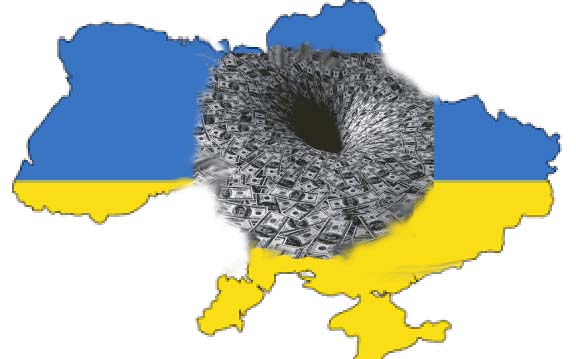
Ukraine aid will bankrupt future US generations – congressman
https://www.rt.com/news/595344-ukraine-aid-bankrupt-us/ 5 Apr 24
America risks getting bogged down in “yet another forever war,” Republican Eli Crane has warned.
The US should end its financial support for Ukraine and instead focus on how Kiev can settle the conflict, Republican congressman Eli Crane has said. His comments come as House Speaker Mike Johnson said the chamber is likely to vote soon on providing Kiev with new funding.
Several months ago, US President Joe Biden proposed a supplemental security package that would earmark around $60 billion in assistance to Ukraine, but it has since remained stalled in Congress as Republicans demand more focus on security at the Mexican border.
On Sunday, however, Johnson signaled that the package could come up for a vote soon, with “some important innovations.” Among these, he said, is a possibility of extending a loan to Ukraine – an idea favored by GOP presidential frontrunner Donald Trump – as well as seizing Russian sovereign assets frozen in the US and transferring the proceeds to Kiev.
Since the start of the Ukraine conflict, the West has frozen around $300 billion in Russian assets, most of which are under European control. While numerous Western officials have proposed seizing the funds to finance Ukraine, many have pointed out that there is no legal basis for doing so. Moscow, for its part, has called the blocking “theft,” warning of retaliation if its funds were to be confiscated.
Some GOP members, however, have argued against aiding Kiev. In this vein, Eli Crane told Fox News on Tuesday that Washington is “funding what appears to be yet another forever war.” This effort, the Arizona congressman suggested, “will bankrupt future generations – all while disregarding our own security as our southern border remains open.”
“It’s absurd that overnighting more tax dollars to Ukraine is even a consideration. It should be totally off the table and replaced with a push for peace talks,” he added.
This sentiment was also shared by Republican congresswoman Marjorie Taylor Greene of Georgia, who suggested on Tuesday that any talk of loaning money to Ukraine sounds “absolutely ridiculous.”
“It’s… laughable to even try to tell the American people that Ukraine will ever pay us back!.. Why isn’t our government brokering peace in Ukraine?” she said.
The US has provided Ukraine with $113 billion in various forms of assistance since the start of hostilities. Meanwhile, Russia has repeatedly condemned Western arms shipments to Ukraine, saying these will only prolong the conflict, while making the West a direct participant in the hostilities.
US Secretary of State Blinken says Ukraine will be NATO member

Ukraine, if/when it enters NATO, will have “unresolved” territorial issues. Crime and the Donbass are in Russian hands and will remain in Russian hands. If Ukraine enters NATO with that being the case, border conflicts over that territory could spark war, which would then drag in NATO through Article V. Such a war would be extremely bloody and potentially escalate to nuclear armageddon.
Reuters, Thu, 04 Apr 2024 https://www.sott.net/article/490373-US-Secretary-of-State-Blinken-says-Ukraine-WILL-be-NATO-member
U.S. Secretary of State Antony Blinken said on Thursday that Ukraine will eventually join NATO as support for the country remains “rock solid” among member states.
“Ukraine will become a member of NATO. Our purpose at the summit is to help build a bridge to that membership,” Blinken told reporters in Brussels.
Comment: For now, this appears to primarily be belligerent rhetoric, because at least some analysts say that Ukraine can’t join whilst involved in a conflict and with ongoing border disputes.
However, Russia has discussed creating a demilitarised zone, and so it is possible that this will compel it to neutralise Ukrainian regions even further West than they would have otherwise. Furthermore, this speaks more to the desperation of the West, and to Russia’s upper hand, which it could maintain so long as it doesn’t, precipitously, escalate the situation. And, amidst all this, the West ruins itself, its position on the global stage, and its ability to provoke the rising multipolar world.
Footage, and relevant snippet from the X post, below:
Will Tanner:
Secretary of State Blinken says that Ukraine will be joining NATO This is insane. This is insane. This is intentionally starting WWIII to help Hunter Biden’s paymasters level of insane 1) Ukraine, if/when it enters NATO, will have “unresolved” territorial issues.
1) Ukraine, if/when it enters NATO, will have “unresolved” territorial issues. Crime and the Donbass are in Russian hands and will remain in Russian hands. If Ukraine enters NATO with that being the case, border conflicts over that territory could spark war, which would then drag in NATO through Article V. Such a war would be extremely bloody and potentially escalate to nuclear armageddon.
2) This is Putin’s red line. In the 90s, when the USSR fell, America promised the Russians that NATO wouldn’t expand to the East. Then, in Russia’s weakness (created in large part by Goldman Sachs helping the oligarchs loot the country through privatization), it expanded to the East, doing just what it promised it wouldn’t, much to Russia’s chagrin. But Putin, while upset, has made it clear that Ukrainian membership in NATO is his red line that would mean war, potentially nuclear. It is utterly unacceptable and would have been like Ireland or Canada joining the Warsaw Pact. That’s why he launched the war; by “demilitarizing” Ukraine by shelling its army into oblivion and by creating a constant conflict, he wants to keep Ukraine out of NATO without going to war with NATO. He thought we wouldn’t be so dumb as to bring it into the alliance if it is fighting a war with Russia.
More NATO involvement in Ukraine doesn’t bode well, as the following highlights:
NATO chief, Jens Stoltenberg, admitting that the war did start in 2014. And from that same year, 2014, NATO has been busy training and arming the Ukraine armed forces
Kiev has lost more than 80,000 troops since January
Russian MoD more https://www.rt.com/russia/595275-ukraine-losses-troops-shoigu/ 3 Apr 24
In excess of 1,200 Ukrainian tanks and other armored vehicles have also been destroyed, Sergey Shoigu has estimated.
Ukrainian forces have lost more than 80,000 troops since the beginning of the year, Russian Defense Minister Sergey Shoigu said on Tuesday, adding that the Russian military is continuing to reduce “the enemy’s combat potential.”
More than 14,000 pieces of military hardware have also been destroyed by Russian forces since January, including 1,200 tanks and other armored combat vehicles. During the same period, Moscow has liberated some 403 square kilometers of Russia’s new territories, Shoigu told a conference call with the country’s military leadership.
Despite Kiev’s lack of success on the battlefield, the Ukrainian leadership “is still trying to convince its Western sponsors of its ability to resist the Russian Army,” he said. To do so, Kiev has resorted to terrorism and long-range strikes on Russian territories, targeting the civilian population, the minister added.
“Our armed forces react asymmetrically to such crimes by Ukrainian militants,” the defense minister said. In March alone, the Russian military carried out 190 group strikes and two massive assaults on Ukraine using precision weapons and unmanned aerial vehicles, which targeted the country’s military and energy infrastructure facilities, he added.
Last month, the Russian Defense Ministry reported that the Ukrainian military had lost a total of 444,000 personnel since the outbreak of the conflict in February 2022, including 166,000 during last year’s failed summer counteroffensive.
However, Ukrainian President Vladimir Zelensky claimed in February that only 31,000 of its soldiers had been killed since the start of the conflict. He did not reveal how many had been injured or gone missing in action.
Meanwhile, Ukrainian military commanders have repeatedly complained about a significant shortage of manpower, prompting Kiev to seek new ways of replenishing its fighting force. This includes asking Ukraine’s Western supporters to send back draft dodgers who are hiding abroad, and lower the threshold for citizens to be recruited into military service.
Moscow has repeatedly described the Ukraine conflict as a proxy war being waged against Russia by the US and its allies, and has accused the West of using Ukrainians as “cannon fodder” in pursuit of their own interests.
Dennis Kucinich: the US engineered a coup to drag Ukraine into a conflict
by Donald A. Smith, PhD, 3 Apr 24, https://progressivememes.org/ukraine/Dennis-Kucinich-on-Ukraine.html
In this April 2, 2024 interview with Judge Napolitano, Dennis Kucinich says: “What’s happened is that the U.S. State Department and U.S. Government basically engineered a coup in Ukraine and used that to drag Ukraine into a conflict in Donetsk and Luhansk in the Donbas and ignited this war which Russia has been horrible in the way they have come in and attacked. There’s been six hundred thousand people, the flower of Ukraine, who have been killed. This thing is heartbreaking. But we cannot ignore the role that the U.S. has played in helping to impel it, and we cannot ignore the fact that, as you point out, there was a chance to resolve this two years ago.” (He’s referring to how in March of 2022 the U.S. forced the Zelensky government to step back from a peace deal that was being negotiated with Russia.)
Kucinich says that it will be impossible for the U.S. and NATO to defeat the Russian military. “There needs to be an end to this war, an effort to repair Ukraine.” Stop this “vainglorious effort to build up NATO.” Napolitano said that the neocons Victoria Nuland, Anthony Blinken, Jake Sullivan and Joe Biden think they can use Ukraine as a battering ram to weaken Russia, but Putin is popular and the Russian economy is thriving. Napolitano says, “The war was started in 2014 by the United States with the coup, as you pointed out.” (For more details about how the U.S. engineered the war, see this. The CIA was deeply involved. Numerous senior U.S. diplomats warned that aggressive NATO expansion would lead to a war. RAND Corporation recommended arming Ukraine as the best way to weaken Russia. The U.S. government always lies about its wars.)
Napolitano asks Kucinich why all the Dems in Congress are behind the war in Ukraine. Kucinich replies that it’s partly due to the desire not to be shunned by their caucus and partly due to a desire to support the incumbent Democratic president.
Kucinich said that Senator Biden supported the disastrous war in Iraq, and the same sort of thinking that led to that war exists in the U.S. government today. Indeed, many of the same people are making policy. They’re leading us to war with Russia and in the Middle East (Gaza and possibly Iran) and are preparing for war with China. “It’s madness. It’s against the interest of the American people. It’s against the taxpayers of this country. It’s driving our national debt. It’s leading to the collapse of America, not the collapse of Russia, not the collapse of China.” Instead of trying to rule the world by military force, we should take care of our own needs.
Kucinich also condemns U.S. support for Israel’s war in Gaza and calls what Israel is doing “ethnic cleansing” and “genocide.” Israel bombed the Iranian embassy in Syria, also a crime according to international law. On the one hand, President Biden says Israel should not invade Rafah and should respect Palestinian lives. On the other hand, Biden gives billions of dollars of weapons. Netyanahu has got the “Biden government over a barrel because of the politics of this. And he knows that and will keep going on.” “You can’t give someone a gun who has a record of killing innocent people and say, ‘Don’t kill innocent people'” (without being complicit).
“We cannot afford to be the policeman of the world” with a $34 trillion debt.
Naopolitano (who has been interviewing a lot of lefty peace activists) ends by calling Kucinich a “fierce defender of civil liberties, constitutional government and peace.”
UKRAINIAN WAR PEACE TALKS: To Be or Not To Be?
Russian and Eurasian Politics by GORDONHAHN, April 2, 2024
Despite Western media reports over recent months and weeks regarding supposed secret talks between Westerners and Russians to settle or at least stop the NATO-Russia Ukrainian War, there are no such talks ongoing. But this does not mean that they cannot emerge.
First we heard of supposedly secret talks between Ukrainian Armed Forces General Staff Chief Gen. Valeriy Zaluzhniy and Russian General Staff Chief Gen. Valerii Gerasimov. Then there were Russian President Vladimir Putin’s alleged ‘signals’ indicating that he seeks negotiations. In reality, there are no peace talks underway between Russia, on the one hand, and the West and/or Ukraine, on the other hand. There are no signals that Putin is seeking negotiations. Although he is willing to hold talks, he expects that any negotiations be requested first by the West and/or Ukrainian President Volodomyr Zelenskiy. The New York Times piece about ‘Putin’s signals’ published just before Christmas was nothing more than another attempt to portray Russia and Putin as ‘losing the war’ and desperate for an exit ramp, and it was nothing less than a contribution in support of US President Joseph Biden’s desperate re-election prospects as the American presidential campaign is about to kickoff.
Nothing could be further from the truth than the tale of Russian desperation told since the war began. This is most evident now for anyone following the recent course of events on the front; a front that is collapsing on the Ukrainian side. In Zelenskiy’s eternal PR mode, the Ukrainian front’s collapse will be framed as an orderly retreat to new defense lines and part of a new defensive strategy replacing the offensive one that so ignominiously failed with this summer’s predictably disastrous counteroffensive. Nevertheless, the hard, cold realities of the summer campaign’s defeat following the fall of the strategic hub of Bakhmut (Artyomevsk) and preceding the fall of the heavily fortified town of Avdiivka (Avdeevka) are trumping Zelenskiy’s simulated reality productions both in the West and Ukraine ever so gradually.
As Russian forces slowly but but surely advance westward across the entire front ranging from Zaporozhe (and perhaps soon Kherson) to Kharkov — an advance that is likely to accelerate in spring and summer, the Kremlin has no burning need to negotiate. To be sure, Moscow would prefer ending the war, but on its own terms. The longer Washington, Brussels, and Kiev refuse negotiations, the more fluid the situation becomes and the less likely Moscow will be easy to negotiate with before its forces reach the Dnieper River. Some Russian officials are trumpeting a hard line. For example, a month ago Russian ambassador to the UN Dmitri Polyanskiy said that Kiev’s chance for talks had passed and now only capitulation talks are possible (https://t.me/RusskajaIdea/5265 and https://t.me/Slavyangrad/79622).
But Putin appears open to talks. However, he certainly is not desperate for them and may prefer holding off until more Ukrainian military force and territory is attritted. He has indicated numerous times since the war began that he is open to talks…………………..
The lack of talks is best explained by the West’s and Ukraine’s unwillingness to negotiate. In fact, since December 2022 Ukrainian law forbids Ukrainians from conducting peace talks with Putin’s Russia. The U.S. has apparently held to its proclaimed policy of ‘no talks about Ukraine without Ukraine’ at least in terms of any peace negotiations, though the US’s CIA chief, William Burns, and his Russian counterpart, SVR chief Sergei Narynskii met a few months back for discussions on undisclosed issues.
Therefore, Zelenskiy consistently rejects talks until such time as Russia has withdrawn all of its troops beyond Ukraine’s 1991 borders—the core of his supposed ‘peace plan.’ Obviously, without defeat on the battlefield Russia will not give up Crimea and the four oblasts it now considers to be its sovereign territory. Recently, Zelenskiy rejected negotiations out of hand. Several weeks ago, visiting Turkey, Zelenskiy spurned Turkish President Tayyip Recep Erdogan’s entreaties to start talks with Moscow under Ankara’s mediation…………………………………………………………………………. https://gordonhahn.com/2024/04/02/ukrainian-war-peace-talks-to-be-or-not-to-be/—
Ukrainian counteroffensive ‘biggest debacle in modern military history’ – David Sacks
https://www.rt.com/news/595214-sacks-ukraine-counteroffensive-fail/ 1 Apr 24
The former PayPal chief says US politicians such as Nancy Pelosi should be held accountable for encouraging the doomed operation.
The failure of Ukraine’s 2023 summer counteroffensive against Russia was “easily predictable,” according to US tech entrepreneur and venture capitalist David Sacks, who has suggested that the Washington elite should be held accountable for talking up the doomed operation.
Sacks’ comments came in response to a post on Saturday by Tesla and SpaceX CEO Elon Musk, who condemned the unnecessary loss of life suffered by Kiev’s forces as they attempted to “attack a larger army” that had superior defenses.
The failed Ukrainian counteroffensive was “one of the biggest debacles in the history of modern warfare,” Sacks said in agreement, adding that Kiev’s soldiers and tanks had effectively run “headlong into minefields while Russian artillery rained down on them from heavily fortified positions.”
“This should have been easily predictable,” the former PayPal COO and founder of the Yammer corporate social network stressed.
According to estimates released in March by the Russian Defense Ministry, the Ukrainian military saw over 166,000 casualties during last year’s failed counteroffensive. Kiev’s overall casualties since the outbreak of the conflict with Russia stand at 444,000, the ministry has claimed.
Sacks went on to suggest that US officials such as ex-CIA chief David Petraeus, former House Speaker Nancy Pelosi, and current US Secretary of State Antony Blinken should all be held responsible for encouraging the doomed operation.
“These people are fools who should have no credibility left. But of course the MSM never holds them accountable so we will get more of the same until Ukraine finally collapses,” Sacks surmised.
Musk, meanwhile, has called the counteroffensive “a tragic waste of life for Ukraine,” suggesting that Kiev should not have attacked Russian forces – which had deployed vast minefields and had stronger artillery – while Ukrainian forces lacked armor or air superiority.
“Any fool could have predicted that,” the billionaire said, recalling that one year ago he had recommended that Kiev’s forces entrench and apply all resources to defense.
Musk stated that Kiev would continue to have difficulty holding on to territory, but suggested that Russia was unlikely try to take over the entire country, arguing that it would face “extreme” local resistance in western regions of Ukraine.
He also warned that if the conflict “lasts long enough, Odessa will fall,” and advised Kiev to reach a negotiated settlement with Moscow as soon as possible, before Russia gains more territory and Ukraine loses all access to the Black Sea.
Moscow has stressed that it remains open to meaningful talks with Kiev, and has blamed the lack of a diplomatic breakthrough on the Ukrainian authorities, who refuse to accept the “reality on the ground.”
Atomic blackmail – Russia-Ukraine war and Ramberg’s theory of vulnerability
Simon Bennett, School of Business, University of Leicester, 6 Mar 24
ABSTRACT
The Russia-Ukraine War is being fought between states committed to nuclear power. This paper references Ramberg’s nuclear powerplant (NPP) vulnerability treatise, the IAEA’s Seven Pillars of Safety metric and Pidgeon and O’Leary’s safety imagination approach to assess the safety of Ukrainian and Russian NPPs. It suggests governments should reflect on events in Ukraine, and, with reference to the above-mentioned approaches, decide whether the upside of nuclear power – the largely carbon-neutral production of electricity – outweighs the downside – giving a blackmail opportunity to hostile states. Although a cost-benefit analysis to inform decision-making is effortful, the paper suggests that failure to consider every advantage and disadvantage of nuclear power could prove costly in human and environmental terms. Drawing on Ukraine’s experience, the paper suggests the national interest is best served in time of war by generating electricity in multiple small plants rather than a few large plants.
Introduction
In 1985, at the height of the Cold War, foreign policy and nuclear expert Bennett Ramberg published his paperback Nuclear Power Plants: An Unrecognised Military Peril, whose subject is the targeting of NPPs by a protagonist to secure tactical or strategic advantage. The Russia-Ukraine War……..has made this subject relevant…………………………………………more https://www.tandfonline.com/doi/full/10.1080/00207233.2024.2317089
COMMENT.
a wonderful article. It contains so many insights that never seem to get mentioned —
– aggressor nation would risk poisoning its own soldiers, civilians and land.
– could target facilities with a larger footprint, such as waste storage ponds or fuel reprocessing plants.
– the ideological-doctrinal domain of propaganda and messaging.
– the blackmail potential of NPPs – it would seem wise to invest intellectual resources in imagining and active learning…….. a dearth of safety imagination in decision-making can be costly.
– – a large number of municipally-operated solar farms, wind farms, tidal barrages, waste-to-power and hydroelectric powerplants generating power for municipalities locally would have provided a more resilient system for Ukraine. In the matter of power generation, in time of crisis or conflict scaling-down secures.
Air attacks on Ukraine have again put the Zaporizhzhia nuclear power plant(ZNPP), under Russian control, in danger

Air attacks on Ukraine have again put the Zaporizhzhia nuclear power plant
(ZNPP), under Russian control, in danger. The vital power supply to keep
the reactors cool is off; potential meltdown and a catastrophic nuclear
“accident” is only being prevented by ancient power generators.
Nobody needs reminding of the devastation to Ukraine and vast swathes of Europe
when the nuclear power plant at Chernobyl melted down and exploded in 1986.
Though ZNPP is newer than Chernobyl with more safety features, it is very
much larger and simply is not safe without power.
Meanwhile, Rafael Grossi,
head of the International Atomic Energy Agency (IAEA), has been cosying up
to President Assad in Damascus, offering to help Syria with nuclear power!
It is well known that Assad has been trying to make the “bomb” for
years.
I humbly suggest Mr Grossi should be in Ukraine or perhaps Moscow to
ensure the safety of ZNPP, rather than waving nuclear power under the nose
of another tyrant who will probably use it as a horrific weapon rather than
a valuable source of power for his people.
Times 25th March 2024
https://www.thetimes.co.uk/article/nuclear-plant-may-be-putins-new-weapon-prgdqxj0p
MPs claim Zelensky has total control of Ukraine – media
https://www.rt.com/russia/594576-ukraine-parliament-crisis-zelensky-media/ 24 Mar 24
The president has reduced the national legislature to a tool for rubber-stamping his decisions, a major outlet reports
Ukraine is now essentially under the personal rule of President Vladimir Zelensky, leading Kiev news outlet Ukrainskaya Pravda (UP) reported on Wednesday. He has virtually stripped the national parliament – the Verkhovna Rada – of its powers and reduced it to a mere rubber-stamp body, UP outlined in a piece based on numerous interviews with Ukrainian MPs.
The Rada has long been tightly controlled by the presidential administration, according to UP. The outlet claims that Zelensky’s office is not only determining the priority of bills on the agenda but also deciding “whether the parliament should convene at all or its MPs should be promptly sent to the trenches.”
“The president’s office despises the parliament,” an unnamed senior MP reportedly said. Zelensky and his team believe his party – the Servant of the People – which holds a majority in the legislature, “would vote for anything” the president needs, according to the lawmaker.
Meanwhile, Zelensky is losing support within his own party, UP claimed. In the last parliamentary election in 2019, Servant of the People won 254 seats in the Rada. This number has been reduced to 235 due to lawmakers leaving the president’s party. Many of them, who are still formally considered members, skip parliamentary sessions, according to the outlet’s sources. Only between 170 and 180 Servant of the People MPs still actively vote on bills, the sources stated.
”First of all, everyone is tired of the war,” a senior lawmaker told UP. Members also understand they are “not influencing the developments in the state and see no role for themselves in the Rada or any sense of being there,” he said.
According to the article, the president’s faction in the parliament is on the verge of “total disorganization,” with MPs apparently ready to surrender their mandates and leave altogether. Dozens have already attempted to do so, UP reported, citing its sources. A “lion’s share” of members would also like to see the parliament dissolved, it added.
Zelensky deals with the parliament “from a position of power,” the UP report observed, and the parliament essentially works only when the president “needs something.” Otherwise, it is “unable to function” and the Ukrainian leader could not care less about it, the outlet wrote.
The absence of real power in the Rada also makes those on the other side of the aisle reluctant to take over the reins, according to the article. “Our ruling [party] has no power and the opposition avoids it as well,” an opposing politician said. He explained that “no one needs any authority or power” and everyone just thinks about escaping responsibility for current conditions in the country.
“We have a unique situation in Ukraine: one person decides everything,” another opposition MP complained. “There is one very specific decision-making center,” he said, referring to Zelensky.
Sen. Lindsey Graham’s structural path: Let Ukrainians do all the dying in support of US proxy war against Russia

Walt Zlotow, West Suburban Peace Coalition, Glen Ellyn IL 22 Mar 24
Early in the US proxy war against Russia in Ukraine, Senator Lindsey Graham gloried in America’s use of Ukrainian soldiers to do all the dying. “I like the structural path we’re on here. As long as we help Ukraine with the weapons they need and the economic support, they will fight to the last person.” Anybody but US cannon fodder was just fine for the armchair warrior from South Carolina.
Two years later, with over 400,000 of those hapless Ukrainian soldiers dead from Sen. Graham’s exhortations to die for American exceptionalism, Graham remains unbowed.
During his recent visit to Kyiv, he demanded Ukraine pass a new mobilization law to draft younger cannon fodder to send into the chopper mill of a lost war. Graham is miffed Ukraine draft laws exempt men under 27. “I would hope that those eligible to serve in the Ukrainian military would join. I can’t believe it’s at 27. You’re in a fight for your life, so you should be serving — not at 25 or 27. We need more people in the line. No matter what we do, you should be fighting.”
Graham remains unconcerned he supported US provocations which led to the Russian invasion of Ukraine. He’s in denial of his acquiescence in the effort to prevent a negotiated settlement early on that would have preserved Ukraine territory. Now he’s telling Ukraine to send its young men to fill the ranks of the 400,000 dead Ukrainians he exalted to die for US exceptionalism.
It would take a psychiatrist, maybe a team of psychiatrists, to determine the pathology in in Graham’s psyche that leads him to promote mass slaughter of foreigners to prop up American’s collapsing control of European geopolitics. But good luck trying to get the Senior Senator from South Carolina to lie on the couch. His focus remains: ‘So many Ukrainians yet to die…so little time.”
Ukraine could need dictatorship to survive – Zelensky party MP
https://www.rt.com/russia/594489-ukraine-dictatorship-zelensky-party/ 20 Mar 24
The president is already “making most of the decisions” in the country, Sergey Demchenko has said
Ukraine may need to become a dictatorship in order to prevail in the conflict with Russia, an MP from President Vladimir Zelensky’s party has suggested.
Zelensky has already concentrated a great deal of power in his hands and “makes most of the decisions” on behalf of the government, Sergey Demchenko told Novyny.Live news on Monday. The situation is “reasonable” and does not mean that Ukraine is a dictatorship, though the country may need to become one, he argued.
”That is possible. During war, people sometimes say that the only way for a nation to emerge victorious is a state of dictatorship,” the lawmaker said. “For the country, for the people, dictatorship always plays negatively, but this tool may help beat the enemy.”
At present, Ukraine can be described as a “democratorship,” the host suggested, to which Demchenko replied that the term for the political system is not important.
The MP did not say whether he personally supports this path, but claimed that the Ukrainian people love freedom too much to accept life under a dictator.
Long before open hostilities with Russia erupted in February 2022, Zelensky cracked down on opposition politicians and critical media, claiming to do so in order to fight against Russian influence and domestic oligarchs.
His term in office is technically set to expire in late May, while a new presidential election must be held by the end of March. However, martial law suspends regular democratic procedures, and Zelensky has indicated that he has no intention of changing the constitution to allow a wartime election. The domination of his Servant of the People party in the parliament would likely have allowed the passage of such amendments, Ukrainian political experts have argued.
The parliament is currently debating a radical reform of the mobilization system, which would introduce hefty punishments for draft dodgers. Kiev intends to add up to 500,000 people to the armed forces with the proposed system in place.
Moscow has claimed that Zelensky is refusing to negotiate a peaceful settlement of the conflict, with the goal of protecting his personal power.
Failed ICJ Case Against Russia Backfires, Paves Way for Genocide Charges Against Ukraine

MintPress News KIT KLARENBERG 13 Mar 2
As January became February, the International Court of Justice (ICJ) delivered a pair of legal body blows to Ukraine and its Western backers. First, on January 31, it ruled on a case brought by Kiev against Russia in 2017, which accused Moscow of presiding over a campaign of “terrorism” in Donbas, including the July 2014 downing of MH17. It also charged that Russia racially discriminated against Ukrainian and Tatar residents of Crimea following its reunification with Moscow.
The ICJ summarily rejected most charges. Then, on February 2, the Court made a preliminary judgment in a case where Kiev accused Moscow of exploiting false claims of an ongoing genocide of Russians and Russian speakers in Donbas to justify its invasion. Ukraine further charged the Special Military Operation breached the Genocide Convention despite not itself constituting genocide. Almost unanimously, ICJ judges rejected these arguments.
Western media universally ignored or distorted the substance of the ICJ rulings. When outlets did acknowledge the judgments, they misrepresented the first by focusing prominently on the accepted charges while downplaying all dismissed allegations. The second was wildly spun as a significant loss for Moscow. The BBC and others focused on how the Court agreed that “part” of Ukraine’s case could proceed. That this “part” is the question of whether Kiev itself committed genocide in Donbas post-2014 was unmentioned.
Ukraine’s failed lawfare effort was backed by 47 EU and NATO member states, leading to the farce of 32 separate international legal teams submitting representations to The Hague in September 2023. Among other things, they supported Kiev’s bizarre contention that the Donetsk and Lugansk People’s Republics were comparable to Al-Qaeda. Judges comprehensively rejected that assertion. Markedly, in its submitted arguments, Russia drew attention to how the same countries backing Kiev justified their illegal, unilateral destruction of Yugoslavia under the “responsibility to protect” doctrine.
This may not be the only area where Ukraine and its overseas sponsors are in trouble moving forward. A closer inspection of the Court’s rulings comprehensively discredits the established mainstream narrative of what transpired in Crimea and Donbas following the Western-orchestrated Maidan coup in February 2014.
In sum, the judgments raise serious questions about Kiev’s eight-year-long “anti-terrorist operation” against “pro-Russian separatists,” following months of vast protests and violent clashes throughout eastern Ukraine between Russian-speaking pro-federal activists and authorities.
DAMNING FINDING AFTER DAMNING FINDING
In its first judgment, the ICJ ruled the Donbas and Lugansk People’s Republics were not “terrorist” entities, as “[neither] group has previously been characterized as being terrorist in nature by an organ of the United Nations” and could not be branded such simply because Kiev labeled them so. This gravely undermined Ukraine’s allegations of Russia “funding…terrorist groups” in Donbas, let alone committing “terrorist” acts there itself.
Other revelatory findings reinforced this bombshell. The ICJ held that Moscow wasn’t liable for committing or even failing to prevent terrorism, as the Kremlin had no “reasonable grounds to suspect” material provided by Ukraine, including details of “accounts, bank cards and other financial instruments” allegedly used by accused “terrorists” in Donbas, were used for such purposes. Moscow was also ruled to have launched investigations into “alleged offenders” but concluded they “d[id] not exist… or their location could not be identified”.
DAMNING FINDING AFTER DAMNING FINDING
In its first judgment, the ICJ ruled the Donbas and Lugansk People’s Republics were not “terrorist” entities, as “[neither] group has previously been characterized as being terrorist in nature by an organ of the United Nations” and could not be branded such simply because Kiev labeled them so. This gravely undermined Ukraine’s allegations of Russia “funding…terrorist groups” in Donbas, let alone committing “terrorist” acts there itself.
Other revelatory findings reinforced this bombshell…………………………………………………………………………………..
KIEV GOES IN FOR THE KILL
The ICJ has now effectively confirmed that the entire mainstream narrative of what happened in Crimea and Donbas over the previous decade was fraudulent. Some legal scholars have argued Ukraine’s acquittal on charges of genocide to be inevitable. Yet, many statements made by Ukrainian nationalists since Maidan unambiguously indicate such an intent.
Moreover, in June 2020, a British immigration court granted asylum to Ukrainian citizens who fled the country to avoid conscription. They successfully argued that military service in Donbas would necessarily entail perpetrating and being implicated in “acts contrary to the basic rules of human conduct” – in other words, war crimes – against the civilian population.
The Court’s ruling noted the Ukrainian military routinely engaged in “unlawful capture and detention of civilians with no legal or military justification…motivated by the need for ‘currency’ for prisoner exchanges.” It added there was “systemic mistreatment” of detainees during the “anti-terrorist operation” in Donbas. This included “torture and other conduct that is cruel, inhumane and degrading treatment.” An “attitude and atmosphere of impunity for those involved in mistreating detainees” was observed.
The judgment also recorded “widespread civilian loss of life and the extensive destruction of residential property” in Donbas, “attributable to poorly targeted and disproportionate attacks carried out by the Ukrainian military.” Water installations, it recorded, “have been a particular and repeated target by Ukrainian armed forces, despite civilian maintenance and transport vehicles being clearly marked…and despite the protected status such installations enjoy” under international law.
All of this could quite reasonably be argued to constitute genocide. Regardless, the British asylum judgment amply underlines who Ukraine was truly fighting all along – its own citizens. Moscow could furthermore reasonably cite recent disclosures from Angela Merkel and Francois Hollande that the 2014-15 Minsk Accords were, in fact, a con, never intended to be implemented, buying Kiev time to bolster its stockpiles of Western weapons, vehicles, and ammunition, as yet further proof of Ukraine’s malign intentions in Donbas………………………………………………………………………………………………………………………………………………..more https://www.mintpressnews.com/failed-icj-case-against-russia-backfires-paves-way-for-genocide-charges-against-ukraine/287028/
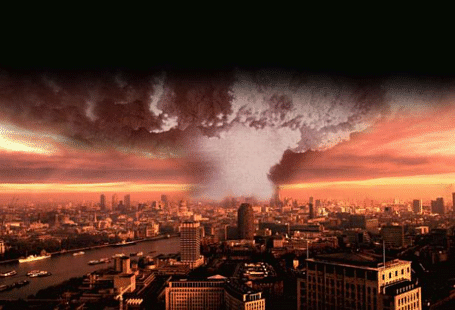
Will Biden’s, NATO’s military personnel in Ukraine cross the last red line to Armageddon?
Walt Zlotow, West Suburban Peace Coalition, Glen Ellyn IL
French President Emmanuel Macron is pushing to send NATO troops to Ukraine to keep Ukraine from imminent defeat to Russia. “The time has come for a Europe where it will be appropriate not to be a coward.” Macron got a lot of pushback form less delusional NATO leaders including German Chancellor Olaf Scholz and NATO Secretary-General Jens Stoltenberg.
Other NATO countries have joined France at considering direct troop involvement. Estonia’s Prime Minister Kaja Kallas stated that “Everything is on the table.” Lithuanian Foreign Minister Gabrielius Landsberg agreed that “nothing can be taken off the table, no option can be rejected out of hand. I very much welcome and encourage the discussion that has started.”
But unbeknownst to most Americans, due to government censorship, is that NATO military personnel are already there serving as a tripwire to wider, possibly nuclear war.
The British Prime Minister’s office confirmed recently that “Beyond the small number of personnel we do have in the country supporting the armed forces of Ukraine, we haven’t got any plans for large-scale deployment.” Didn’t we hear the same thing from US officials regarding ‘US advisors in Vietnam?
German Chancellor Scholz refused to send Taurus missiles to Ukraine because it would require German personnel to operate them. Britain and France aren’t so cautions. Scholz stated that France also has military personnel in Ukraine along with England to assist Ukraine military operations. He hinted at US presence there stating “It’s known that there are numerous people there in civilian attire who speak with an American accent.” The NY Times reported last month that numerous CIA operatives were left in Ukraine when the war started and “scores of new officers were sent in to help the Ukrainians.”
President Biden may have slipped in his State of the Union Speech last week when he uttered “There are no American soldiers (of war) in Ukraine, and I intend to keep it that way.” Biden should have added ‘But we sure have a lot of helpers there and I intend to keep it that way.’
The US and NATO are playing a dangerous game with Mother Earth and her 8 billion residents. For 750 days they’ve been crossing red lines Russia has put up to protect their borders from NATO encroachment. When Biden became president, he continued the reckless US campaign to arm Ukraine in their civil war against Russian leaning Ukrainians in Donbas seeking independence from Ukraine violence and subjugation. He repeatedly floated NATO membership to Ukraine. He rebuffed every desperate entreaty by Russia to even begin discussing their border security concerns.
The result? Russia invaded Ukraine 2 years ago February 24, 2022…after 15 years of warnings. Having catastrophically bungled the diplomacy that instigated the war, Biden could have made amends by supporting the peace agreement Ukraine’s Zelensky and Russia’s Putin negotiated in the war’s first month. Instead of support, he sabotaged it.
Biden and his NATO buddies have marched right up to, and sometimes over, numerous Russian red lines with billions in weapons, extreme rhetoric, sanctions and diplomatic maneuvering with largely unsupportive nations. Now with US and NATO military and intelligence personnel in Ukraine, and ominous calls for combat troops, we should all fret that the next red line Biden and NATO’s war cabinets cross may trigger a mushroom cloud.
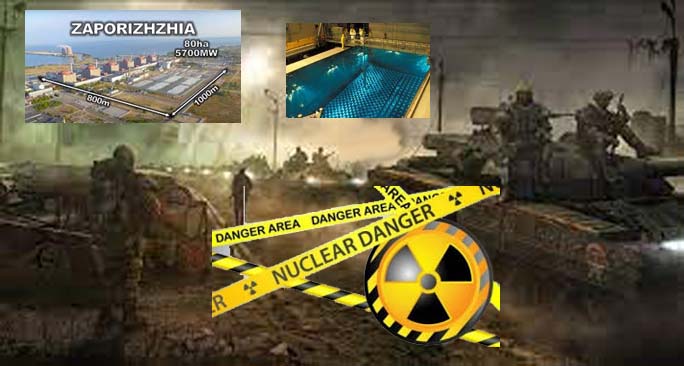
Zaporizhzhia nuclear plant reports shelling by Ukraine army
Reuters, March 14, 2024, https://www.reuters.com/world/europe/russia-controlled-zaporizhzhia-nuclear-plant-says-was-shelled-by-ukraine-2024-03-14/
MOSCOW, March 14 (Reuters) – The Russian-controlled management of the Zaporizhzhia nuclear power plant, the largest in Europe, said on Thursday that the Ukrainian army had shelled a critical infrastructure facility at the plant.
An explosive device was dropped near a fence where diesel fuel tanks are located, the plant reported.
“Such attacks are unacceptable,” it said.
It was not immediately clear when the attack had taken place. Reuters was unable to immediately verify battlefield reports from either side.
International Atomic Energy Agency Director General Rafael Grossi has repeatedly warned of the danger of attacks on the plant.
Russia and Ukraine, at war for more than two years, have blamed each other for past shelling that has downed power lines and endangered generators.
The ideology of war in Ukraine and Israel
by Thierry Meyssan, https://www.voltairenet.org/article220527.html 14 Mar 24
The wars in Ukraine and Gaza are more similar than you might think, at least if you know their histories. The Ukrainian war didn’t start with the Russian military operation, but with the massacres in the Donbass, while the Gaza war didn’t start with the Al-Aqsa deluge, but 75 years earlier with the Nakhba. In the long term, those responsible for both wars share the same ideology.
Generally speaking, every war defines who “we” are and who “they” are. “We” are Good, while “they” are Evil.
Western leaders, while declaring that war itself is bad, claim that it is indispensable today in the face of aggression from Russia and Hamas. According to them, Russia, or rather its president Vladimir Putin, dreams of seizing our property and destroying our political system. After invading Ukraine, he will invade Moldavia and the Baltic states, then continue westwards. Hamas, on the other hand, is a hate-filled sect that begins by raping and beheading Jews out of anti-Semitism, and will continue by invading the West in the name of its religion.
It’s worth noting that both Israel and the USA were founded by their armies, the Haganah and the Continental Army. Today, the vast majority of their political leaders have spent their careers in the armed forces or secret services. But they’re not the only ones, since Xi Jinping is a military man and Vladimir Putin is a former member of the Soviet secret service (KGB).
One wonders what feeds the phantasms of the political West and how they prevent us from grasping reality. Russia didn’t invade Ukraine any more than France invaded Rwanda. Moscow and Paris stopped the massacre of Ukrainians in the Donbass and Rwandan Tutsis. Both were driven by their “responsibility to protect” and implemented Security Council resolutions. Palestinians don’t rape and behead anyone for pleasure, even if some of them belong to a secret society that does. They don’t fight the Jews out of anti-Semitism, except for the historic branch of Hamas, but against the apartheid system of which they are victims.
Perhaps the first function of collective blindness is to erase our previous crimes: it was the “democracies” of the United States and members of the European Union who organized the overthrow of Ukraine’s elected president, Viktor Yanukovych, in 2014. It was Germany and France that signed the Minsk Accords to guarantee peace for Ukrainians in Donbass (2015), but never intended to implement them and, according to the confessions of Chancellor Angela Merkel and President François Hollande, used them to arm Ukraine against Russia. This violation of our word and signature constitutes, according to the Nuremberg Tribunal, the gravest of all crimes, that “against peace”.
Similarly, it is the “greatest democracy in the Middle East”, Israel, which has stolen, metre by metre, by occupation and nibbling, most of the Palestinian Territories established by Security Council resolution 181 (1947).
These conflicts are not about resources, but territories. Since 1917, Dmytro Dontsov’s Ukrainian integral nationalists have consistently claimed sovereignty over Nestor Makhno’s anarchist Novorossia and the Bolshevik Donbass and Crimea. Of course, these territories were merged into Soviet Ukraine by Ukrainian Nikita Khrushchev, but Kiev cannot invoke recent history to claim them as its own. Similarly, since 1920, Vladimir Ze’ev Jabotinsky’s revisionist Zionists have claimed sovereignty over the whole of Palestine, and eventually over the Egyptian Sinai, Lebanon, Jordan and Syria – in short, all the territories from the “Nile to the Euphrates”. Of course, the ancient kingdom of Jerusalem consisted of the city and its suburbs, but that doesn’t allow them to evoke history for all these conquests.
It is often said that the age pyramid determines the aggressiveness of states. States with a majority of young people between the ages of 15 and 30 would by nature be inclined to war. But this is neither the case in Ukraine, nor in Israel. What’s more, it’s Palestine, not Israel that the age pyramid could push towards war.
The ideological question is probably the most important. Dmytro Dontsov and his henchman Stepan Bandera glorified the Ukrainian fighters, heirs to the Swedish Vikings, the Varegues, who had to slaughter the “Muscovites” to be able to feast in Valhalla. Today, it’s the “White Führer”, Andriy Biletsky, who has commanded the troops of the Azov Division in Mariupol, the 3rd Assault Brigade in Bakhmut/Artiomovsk and most recently in Avdeyevka/Avdiyevka. Similarly, Benjamin Netanyahu, son of Vladimir Jabotinsky’s private secretary, has not hesitated to compare the Palestinians to the ancient Amalekites. The implication is that they must all be exterminated as Yahweh commands, or else their race will re-emerge against the Hebrews. In the same way, the IDF has systematically destroyed all the universities and schools in the Gaza Strip and massacred 30,000 civilians under the pretext of fighting Hamas.
Dmytro Dontsov formed an alliance with Adolf Hitler as early as 1923, i.e. before he came to power, and became one of the administrators of the Reinhard Heydrich Institute, responsible for carrying out the Final Solution of the Jewish and Gypsy question. Vladimir Jabotinsky, who had formed an alliance with Dontsov in 1922, founded the Betar cadre school in Civitavecchi (Italy) with the help of Duce Benito Mussolini in 1935. He was unable to play a major role in the Second World War, dying in August 1940. There can be no doubt about the adherence of Ukrainian integral nationalists to Nazism and revisionist Zionists to fascism.
Incidentally, we find the territorial logic of fascist and Nazi regimes in the current discourse of Ukrainian President Volodymyr Zelensky and Israeli Prime Minister Benjamin Netanyahu. At the same time, the Russian and Palestinian presidents, Vladimir Putin and Mahmoud Abbas, constantly claim to be defending their peoples.
To find out more about Dmytro Dontsov’s integral nationalism, read:
“Who are the Ukrainian integral nationalists?“, by Thierry Meyssan, Réseau Voltaire, November 15, 2022.
For more on Volodymyr Jabotinsky’s revisionist Zionists read:
“The veil is being torn: the hidden truths of Jabotinsky and Netanyahu“, by Thierry Meyssan, Voltaire Network, January 23, 2024.
and “In Jerusalem, the ’Conference for the Victory of Israel’ threatens London and Washington“, by Thierry Meyssan, Voltaire Network, February 13, 2024.
1 This Month

of the week – Shut Down Drone Warfare!


Tell the Ukrainian Government to Drop Prosecution of Peace Activist Yurii Sheliazhenko

Petition to revoke the licensing of the Near Surface Nuclear Disposal Facility (NSDF) at Chalk River. https://www.ourcommons.ca/petitions/en/Petition/Details?Petition=e-7247
To see nuclear-related stories in greater depth and intensity – go to https://nuclearinformation.wordpress.com
-
Archives
- April 2026 (114)
- March 2026 (251)
- February 2026 (268)
- January 2026 (308)
- December 2025 (358)
- November 2025 (359)
- October 2025 (376)
- September 2025 (257)
- August 2025 (319)
- July 2025 (230)
- June 2025 (348)
- May 2025 (261)
-
Categories
- 1
- 1 NUCLEAR ISSUES
- business and costs
- climate change
- culture and arts
- ENERGY
- environment
- health
- history
- indigenous issues
- Legal
- marketing of nuclear
- media
- opposition to nuclear
- PERSONAL STORIES
- politics
- politics international
- Religion and ethics
- safety
- secrets,lies and civil liberties
- spinbuster
- technology
- Uranium
- wastes
- weapons and war
- Women
- 2 WORLD
- ACTION
- AFRICA
- Atrocities
- AUSTRALIA
- Christina's notes
- Christina's themes
- culture and arts
- Events
- Fuk 2022
- Fuk 2023
- Fukushima 2017
- Fukushima 2018
- fukushima 2019
- Fukushima 2020
- Fukushima 2021
- general
- global warming
- Humour (God we need it)
- Nuclear
- RARE EARTHS
- Reference
- resources – print
- Resources -audiovicual
- Weekly Newsletter
- World
- World Nuclear
- YouTube
-
RSS
Entries RSS
Comments RSS
 nuclear-news