IAEA chief, in Kyiv, warns of nuclear risk from attacks on Ukraine grid
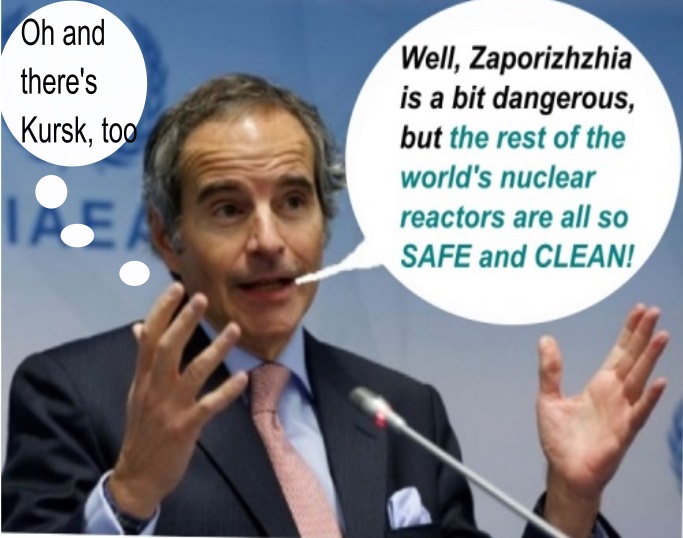
International Atomic Energy Agency (IAEA) chief Rafael Grossi said late on
Monday that he was on his way to visit Kyiv and inspect a key substation
that is critical for the safety of Ukraine’s nuclear power. “On my 11th
visit to Ukraine since the war began,” Grossi wrote on X. “I’m heading to
Kyivska substation, critical for the safety of Ukraine’s nuclear power, to
assess damage and help prevent a nuclear accident.” Last week, the IAEA
said in a statement that Grossi would visit Kyiv for “high-level” meetings
to ensure nuclear safety in the war that Russia started in February 2022.
Reuters 3rd Feb 2025, https://www.reuters.com/world/europe/iaeas-grossi-heads-kyiv-crucial-nuclear-safety-inspection-2025-02-03/
Israel sends missiles to Ukraine – Axios

https://www.rt.com/news/611950-israel-patriot-missiles-ukraine/, 30 Jan 24
Russia had warned against the transfer of Patriot interceptors
About 90 interceptor missiles for Patriot air defense systems have been sent from Israel to Poland, from where they will be forwarded to Ukraine, Axios has reported, citing three anonymous sources.
After Israel Defense Forces (IDF) retired their US-supplied Patriots in April 2024, Kiev asked for the missiles. Moscow warned West Jerusalem of potential consequences at the time, and the idea seemed to have gone nowhere.
“In recent days,” Axios reported this week, several US Air Force C-17 transport planes ferried the missiles from an airbase in southern Israel to the Polish city of Rzeszow, NATO’s logistics hub for supplying Ukraine.
West Jerusalem informed Moscow of the move and said it was “only returning the Patriot system to the US” rather than supplying weapons to Ukraine, Axios reported, citing an anonymous senior Israeli official. The same official claimed this was the same thing as the US transfer of artillery shells from “emergency storage” in Israel to Ukraine two years ago.
Both the Pentagon and the US European Command declined to give Axios a comment for the story. Russia has not officially addressed the matter as of yet.
According to Axios, Israeli Prime Minister Benjamin Netanyahu refused to take calls from Ukraine’s Vladimir Zelensky “for weeks.” The situation changed in late September when Netanyahu needed Zelensky’s permission for Hasidic pilgrims to visit Uman, a town south of Kiev where their movement’s founder, Reb Nachman of Bratslav, is buried. Zelensky refused until Netanyahu approved the Patriot transfer, a Ukrainian official told Axios.
A spokesperson for Netanyahu acknowledged to Axios that a Patriot system has been “returned to the US,” adding that “it is not known to us whether it was delivered to Ukraine.” The spokesperson also denied any connection between the Patriots and the Uman pilgrimage.
The missile delivery is the “most significant” Israeli contribution to Kiev since the Russia-Ukraine conflict escalated in February 2022. West Jerusalem has long insisted on providing only humanitarian aid to Kiev, out of concern about retaliation from Moscow in Syria, or through supplying Iran with sophisticated weapons, according to media.
Russia’s envoy to the UN, Vassily Nebenzia, warned Israel in July that arming Kiev would “have certain political consequences,” noting that any weapons sent to Ukraine “will eventually be destroyed,” just like the others.
Moscow has reduced its military presence in Syria after President Bashar Assad’s government in Damascus collapsed under an offensive by Hayat Tahrir al-Sham militants in December. Israel used the upheaval to destroy much of Syria’s military infrastructure and occupy additional territory in the Golan Heights. Earlier this month, Russia concluded a “strategic partnership” agreement with Iran.
Ukraine nuclear fears increase amid warnings from IAEA
Emerging Risks 28th Jan 2025, https://www.emergingrisks.co.uk/ukraine-nuclear-fears-increase-amid-warnings-from-iaea/
The director general of the International Atomic Energy Agency (IAEA) has said he is growing increasingly concerned that the organisation’s efforts to prevent a major nuclear incident in war-torn Ukraine in under increasing threat.
It comes as Rafael Mariano Grossi (above) revealed the agency’s team based at Ukraine’s Zaporizhzhya Nuclear Power Plant (ZNPP) has heard frequent explosions from outside the site over the past week.
He added The team reported hearing multiple instances of such military activity in recent days, at varying distances from the ZNPP. There was no damage reported to the plant itself. Although the sound of nearby military action has been a common occurrence ever since the IAEA established a continued presence at the ZNPP in September 2022, it has happened virtually daily in recent weeks.
“For almost three years now, we have been doing everything we can to help prevent a nuclear accident at the Zaporizhzhya Nuclear Power Plant and elsewhere in Ukraine,” Grossi explained. “An accident has not occurred, but the situation is not improving. It is still precarious. I remain seriously concerned about nuclear safety and security in Ukraine, including at the Zaporizhzhya site. Our work is far from over.”
He continued as part of the ongoing work to monitor developments relevant for nuclear safety and security, the IAEA team has continued to conduct walkdowns across the site – including but not limited to the main and emergency control rooms of four reactor units and one turbine hall – and observed and discussed various safety-related maintenance activities with the plant.
The IAEA team was also informed that the ZNPP is procuring three new mobile diesel generators, similar to those received late last year. They are in addition to the site’s 20 fixed emergency diesel generators that are designed to provide on-site power if there is a total loss of off-site power.
Separately, the ZNPP said that four diesel steam generators were put into operation for ten days to provide the steam needed to process liquid radioactive waste. These generators were commissioned a year ago.
Elsewhere in Ukraine, the IAEA said air raid alarms were heard on several occasions at Ukraine’s three operating nuclear power plants (NPPs) – Khmelnytskyy, Rivne and South Ukraine – as well as at the Chornobyl site. At the Khmelnytskyy NPP, the IAEA team members have taken shelter at their residence three times in recent days due to such alerts.
At the Khmelnytskyy and South Ukraine NPPs and the Chornobyl site, the IAEA teams were informed of instances of drones being detected at distances ranging from 2 to 30 km from the sites.
Despite such military activities, Ukraine’s nine operating nuclear power reactors have been operating at full capacity this week, safely generating much-needed electricity during the cold winter months.
Separately, the Agency continued with deliveries under its comprehensive programme of nuclear safety and security assistance to Ukraine. Last week, the Chornobyl site received equipment to enhance its nuclear security system. The delivery, the 104th organised by the IAEA since the start of the armed conflict, was supported with funds from the United Kingdom.
Russia claims nuclear plant targeted during massive Ukrainian drone attack

Russia and Ukraine continue to swap daily barrages, with the prospects of ceasefire talks appearing slim.
Aljazeera, 29 Jan 2025
A nuclear power plant was among targets during a massive Ukrainian drone attack, Russian officials have said.
Moscow said on Wednesday that the country’s energy infrastructure had come under attack by at least 100 drones overnight. Ukraine also reported strikes. The continuing barrages were accompanied by barbs from the two countries’ presidents, suggesting little prospect of peace talks.
The Russian Ministry of Defence said on Telegram that 104 drones were involved in raids across western Russia, many targeting power and oil facilities.
Local officials claimed that air defence systems had destroyed one drone that had attempted to strike the nuclear power plant in the western region of Smolensk.
“According to preliminary information, one of the drones was shot down during an attempt to attack a nuclear power facility,” Governor Vasily Anokhin said on the Telegram messaging app. “There were no casualties or damage.”
The Smolensk Nuclear Power Plant, the largest power generating plant in Russia’s northwest, was working normally on Wednesday morning, RIA state news agency reported, citing the plant’s press service.
Russia’s air defences reportedly destroyed drones over nine regions, including 11 over Smolensk, which sits on the border with Belarus. Nearly half were hit over Kursk, where Ukrainian troops have occupied several villages for months following an incursion.
Ukraine and Russia have been swapping drone and missile strikes on an almost daily basis, with energy infrastructure a particular target amid winter.
Warnings that the fighting could spark a nuclear disaster have been sounded since Russia launched its full-scale invasion of its neighbour in February 2022. However, most of the concern has focused on Ukraine’s Zaporizhzhia plant, which sits on the frontlines in the east of the country…………………………………………………………………….https://www.aljazeera.com/news/2025/1/29/russia-claims-nuclear-plant-targeted-during-massive-ukrainian-drone-attack
Ukraine’s parliament has given the go-ahead for the purchase of two old Russian nuclear reactors.
Reviving a Soviet-era project, the Ukrainian parliament has authorised the purchase of two Russian nuclear reactors from Bulgaria.
On Thursday, the energy committee of the Ukrainian parliament voted in favour of a law which ostensibly aims to improve the business environment in the country – but which also contained a last-minute amendment greenlighting the purchase of two old Russian nuclear reactors, to expand the Khmelnytskyi nuclear power plant.
“The Cabinet of Ministers of Ukraine and/or … ‘Energoatom’ … are granted permission to negotiate, finalize the text, sign, pay for, accept, and store the equipment,” the amendment, seen by Euractiv, reads.
The Khmelnytskyi plant in the south-west of Ukraine was first dreamt up in the early 1970s during the days of Leonid Brezhnev. Due to the Chernobyl disaster, it only ever operated at half capacity.
In 2023, negotiations began to buy two Russian reactors, originally bought for the unfinished Belene nuclear power plant in Bulgaria. The planned purchase has a floated price of at least €600 million.
US company Westinghouse is also planning to build two reactors at the Ukrainian site.
In June 2024, Ukrainian Energy Minister German Galushchenko, the initiative’s biggest promoter, said that he was betting on foreign loans to finance the purchase. However, in December, the EU’s representative in Kyiv ruled out support for the project.
Euractiv 16th Jan 2025
https://www.euractiv.com/section/eet/news/kyiv-pushes-ahead-controversial-e600m-purchase-of-russian-junk-nuclear-reactors/
Jan 16, 2025
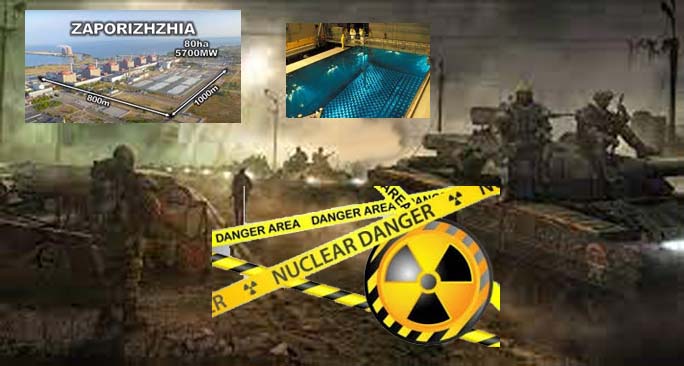
International Atomic Energy Agency (IAEA) staff reported hearing loud blasts near Ukraine’s Zaporizhzhya Nuclear Power Plant (NPP)
IAEA 5th Jan 2025,
https://www.iaea.org/newscenter/pressreleases/update-269-iaea-director-general-statement-on-situation-in-ukraine
International Atomic Energy Agency (IAEA) staff reported hearing loud blasts near Ukraine’s Zaporizhzhya Nuclear Power Plant (NPP) today, coinciding with reports of a drone attack on the plant’s training center, marking yet another threat to nuclear safety at Europe’s largest NPP, according to Director General Rafael Mariano Grossi.
The IAEA Support and Assistance Mission to Zaporizhzhya (ISAMZ) team stationed at ZNPP reported hearing two loud explosions coming from outside the perimeter of the site at approximately 12:45 and 15:45. For now, the IAEA has not yet been able to confirm any impact. The IAEA team also reported hearing machine gun fire coming from the site on multiple occasions.
The IAEA is aware of reports of an alleged attack by a drone at the ZNPP training center today, just outside of the site’s perimeter. Reports state that there were no casualties and no impact on any NPP equipment.
The ISAMZ team has reported that the intensity of military activities in the vicinity of Europe’s largest NPP – including multiple explosions at various distances from the site – has increased over the last 24 hours. “An attack on any nuclear power plant is completely unacceptable,” Director General Grossi stated. “In light of the increased military activity at ZNPP, I once again call for maximum restraint to avert the clear danger to its safety, and for the strict adherence to the five concrete principles established by the IAEA at the United Nations Security Council to protect the facility and the seven indispensable pillars of nuclear safety during an armed conflict also defined by the IAEA”.
US Has Given Israel $22 Billion in Military Aid Since October 2023

According to data from SIPRI, US weapons now account for 78% of Israel’s arms imports
by Dave DeCamp January 1, 2025, https://news.antiwar.com/2025/01/01/us-has-given-israel-22-billion-in-military-aid-since-october-2023/
Since October 7, 2023, the US has provided Israel with more than $22 billion in military aid, Israel Hayom reported Wednesday, citing data from the Stockholm International Peace Research Institute (SIPRI).
The stepped-up US military aid to Israel has supported the genocidal war in Gaza, Israel’s war in Lebanon, military operations in the occupied West Bank, and attacks on Syria, Iran, and Yemen.
According to SIPRI, from 2019 to 2023, US weapons accounted for 69% of Israel’s arms imports. Since October 7, that number has risen to 78%, demonstrating Israel’s significant reliance on US military aid.
In October 2024, Brown University’s Costs of War Project said the US had provided Israel with $17.9 billion in military aid in the first year of the onslaught in Gaza. Since then, Israel has signed a $5.2 billion contract with Boeing to purchase F-15 fighter jets, a deal funded by the US, bringing total US military aid since October 7, 2023, to over $22 billion.
The Costs of War report also said US military operations in the Middle East to support Israel cost American taxpayers at least $4.8 billion, a number that must have also risen since the US has continued to bomb Yemen and deployed a THAAD air defense system to Israel.
Israeli officials have been candid about how reliant they are on US support. An Israeli Air Force official told Haaretz that without US military aid, Israel would not be able to sustain operations in Gaza for more than a few months
A Trump-Putin Deal Over Ukraine Does Not Look Good for Europe
New EasternOutlook , Ricardo Martins, December 30, 2024
“Stop pushing Zelensky into peace talks”, tells EU Foreign Affairs chief to European leaders. For the EU, a negotiated peace deal is a win for Putin and a defeat for Europe. Understand the reasons.
Europe has invested too much to settle for ‘just’ a peace deal: the goal was to crush Russia
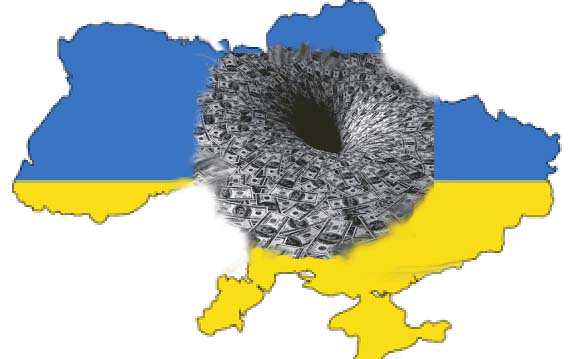
The total amount of military aid to Ukraine since the beginning of the conflict in February 2022 amounts to $119 billion, including 62 billion from the U.S., as confirmed by Pentagon chief Lloyd Austin. The amount allocated under the humanitarian label is more than double.
Europe has channelled significant resources into Ukraine, from financial aid packages, to military equipment, and training programmes. Great Britain, along with the U.S., has been crucial in intelligence support too. Beyond this, Europe has also invested heavily in influencing public opinion with narratives such as “Putin will invade Europe next.” The scale of these war-supporting efforts has been so extensive that many European countries have depleted both their arms stockpiles and public finances.
Annalena Baerbock, Germany’s Foreign Minister, has underscored the financial burden of ongoing support for Ukraine, revealing that the €37 billion allocated has necessitated cuts to social spending programs within Germany. The consequences of this financial obligation are staggering, according to the minister: crucial investments in early childhood programs and infrastructure modernization have been sidelined in favour of military assistance to Ukraine.
These efforts were designed to position Europe as a steady ally of Ukraine, committed to defending democratic values and regional stability. However, the looming possibility of an eventual Trump-Putin deal leaves Europe in a precarious position, grappling with the absence of a clear, face-saving strategy.
Therefore, the EU foreign affairs chief, Kaja Kallas, downplayed discussions about peace during her first meeting with EU foreign affairs ministers in Brussels, disregarding a Gallup poll showing that a majority of Ukrainians (52%) favour peace negotiations, while 38% support continuing the fighting. Kallas went further, admonishing EU heads of state at the latest EU summit: “Stop pushing Zelensky into peace talks.”
The most striking aspect of this statement is that it comes from someone holding the title of EU diplomacy chief—a role traditionally centred on fostering dialogue and negotiation. Yet, this very individual appears to dismiss the importance of diplomacy, even as Putin has repeatedly expressed willingness to engage in negotiations……………………………..
Such a deal could drastically shift the geopolitical landscape, potentially sidelining Europe in critical negotiations or undermining its investments and sacrifices. Europe’s commitment has been framed as a moral and strategic stand against aggression, but if Washington pivots toward reconciliation with Moscow, Europe could appear overextended and politically sidelined in its own European matters.
This situation is particularly uncomfortable given the EU’s reliance on the U.S. for broader security assurances. Zelensky understood it and bluntly stated: “Security guarantees without the US are not sufficient for Ukraine.”
Without a cohesive plan to address the fallout of a potential agreement between Trump and Putin, Europe risks losing credibility both within its borders and on the global stage.
Framing the Conflict as Putin’s Personal War: Simplistic Narratives Are More Convincing
The mantra “Russia must not win” has become a rallying cry across the EU, where any agreement is framed as a “victory for Putin.” This narrative conveniently reduces the war to a personal crusade by Vladimir Putin, dismissing the broader strategic and national interests driving Moscow’s actions.
. By personalizing the conflict, it becomes easier to frame it as a clear-cut battle of good versus evil, a narrative that is eagerly amplified by the media and political analysts. This portrayal has effectively stoked public fears with claims that “Europe is in danger,” galvanizing support for continued military engagement.
However, not everyone has embraced this oversimplified dichotomy. Independent analysts and critical observers have pushed back, pointing out the dangers of ignoring the complex geopolitical realities at play. They argue that viewing the conflict through a lens of rational strategic interests, rather than moral absolutism, could open avenues for meaningful dialogue and resolution—options currently sidelined in favour of escalation.
This refusal to consider alternative perspectives risks prolonging the conflict, leaving Europe increasingly strained by the economic and political costs of its unwavering commitment to a military solution. Meanwhile, voices calling for pragmatism and peace remain drowned out by the cacophony of war rhetoric.
In sum, Europe must urgently rethink its approach, prioritizing diplomatic agility and long-term strategies that enable it to assert its own influence, regardless of U.S. policy fluctuations. Meanwhile, Trump’s claim that he could end the war in 24 hours appears increasingly unrealistic. The so-called ‘Deep State’—comprising the informational, intelligence, and military apparatus—seems to have its own agenda, potentially signalling to Trump where the true power lies. Moreover, despite the immense human, infrastructural, and societal losses in Ukraine, the war remains highly profitable for certain entities.
Ricardo Martins ‒PhD in Sociology, specializing in policies, European and world politics and geopolitics, https://journal-neo.su/2024/12/30/a-trump-putin-deal-over-ukraine-does-not-look-good-for-europe/
Biden Administration Announces Nearly $6 Billion in New Ukraine Aid
ANTIWAR.com, Dave DeCamp, 31 Dec 24
Ukraine is receiving about $2.5 billion in military aid and $3.4 billion in ‘budget support,’ which funds government salaries and servicesby Dave DeCamp December 30, 2024.
The Biden administration on Monday announced nearly $6 billion in new aid for Ukraine as it’s determined to escalate the proxy war as much as possible before President-elect Donald Trump is inaugurated on January 20, 2025.
The aid includes $3.4 billion in “direct budget support,” a form of assistance meant to pay for Ukrainian government services, salaries, pensions, and other types of spending. It has also been used to subsidize Ukrainian small businesses and farmers.……………………….
Ukraine is also receiving nearly $2.5 billion in military aid from the US, which includes $1.22 billion from the Ukraine Security Assistance Initiative, a program that allows the US to purchase weapons for Ukraine. The remaining military aid is in the form of the Presidential Drawdown Authority, which enables President Biden to ship weapons directly from US military stockpiles.
The Biden administration is dumping more weapons into Ukraine even though there’s no path to a Ukrainian victory on the battlefield as Russian forces continue to make gains in the Donbas and Ukraine’s invading force in Kursk is being pushed out. Biden officials are determined to keep the war going and are even pressuring Ukraine to begin conscripting 18-year-olds.
According to the Pentagon, the new military aid includes:
Spare parts, maintenance and sustainment support, ancillary equipment, services, training, and transportation
Munitions for National Advanced Surface-to-Air Missile Systems (NASAMS)
HAWK air defense munitions
Stinger missiles
Counter-Unmanned Aerial Systems (c-UAS) munitions
Ammunition for High Mobility Artillery Rocket Systems (HIMARS)
155mm and 105mm artillery ammunition
Air-to-ground munitions
High-speed Anti-radiation missiles (HARMs)
Unmanned Aerials Systems (UAS)
Javelin and AT-4 anti-armor systems
Tube-launched, Optically guided, Wire-tracked (TOW) missiles
Small arms and ammunition and grenades
Demolitions equipment and munitions
Secure communications equipment
Commercial satellite imagery services
Medical equipment
Clothing and individual equipment
In recent months, President Biden signed off on several significant escalations in the proxy war, including supporting long-range strikes on Russian territory and the provision of widely banned anti-personnel mines to Ukraine.
Biden asked Congress for an additional $24 billion to spend on Ukraine, but the request was rejected by House Speaker Mike Johnson (R-LA), who said any decisions on Ukraine aid would be up to Trump. https://news.antiwar.com/2024/12/30/biden-administration-announces-nearly-6-billion-in-new-ukraine-aid/
Is it realistic for Donald Trump to boast of a quick peace deal for Ukraine ?
AIMN Editorial, https://theaimn.net/is-it-realistic-for-donald-trump-to-boast-of-a-quick-peace-deal-for-ukraine/ 2 Jan 25
Donald Trump has made so many promises on what he will quickly achieve once he takes office as President. The one about ending the Ukraine war in 24 hours probably gained him support from quite a few normally left-leaning people, who understand that the history of this conflict is far more complicated than is portrayed by the Western media.
However, Trump made that statement in July 2023. By 2025, he has somewhat moderated that particular promise. He has had several conversations with Ukraine’s President Zelensky, . Zelensky praised their Paris meeting on 7 December as “productive and meaningful”, but there were no details discussed. Later, Trump opposed the sending of long-range missiles for Ukraine , but said he would not “abandon” Ukraine. He predicted “less aid” to Ukraine https://www.youtube.com/watch?v=E-R7Gi-uLiY. BY 21st December, it was reported that Trump would continue to supply military aid to Ukraine, provided that NATO members dramatically increase their defence spending.
So, peace in Ukraine is not going to happen in such a hurry, even with President Trump and his supposed great negotiating skills. Britain considers sending troops to Ukraine to train Ukrainian regiments. NATO is not prepared for any compromises, especially about giving up the plan for Ukraine’s NATO membership. With any peace deal, the Western allies agree with Zelensky – “Security guarantees without the US are not sufficient for Ukraine.”
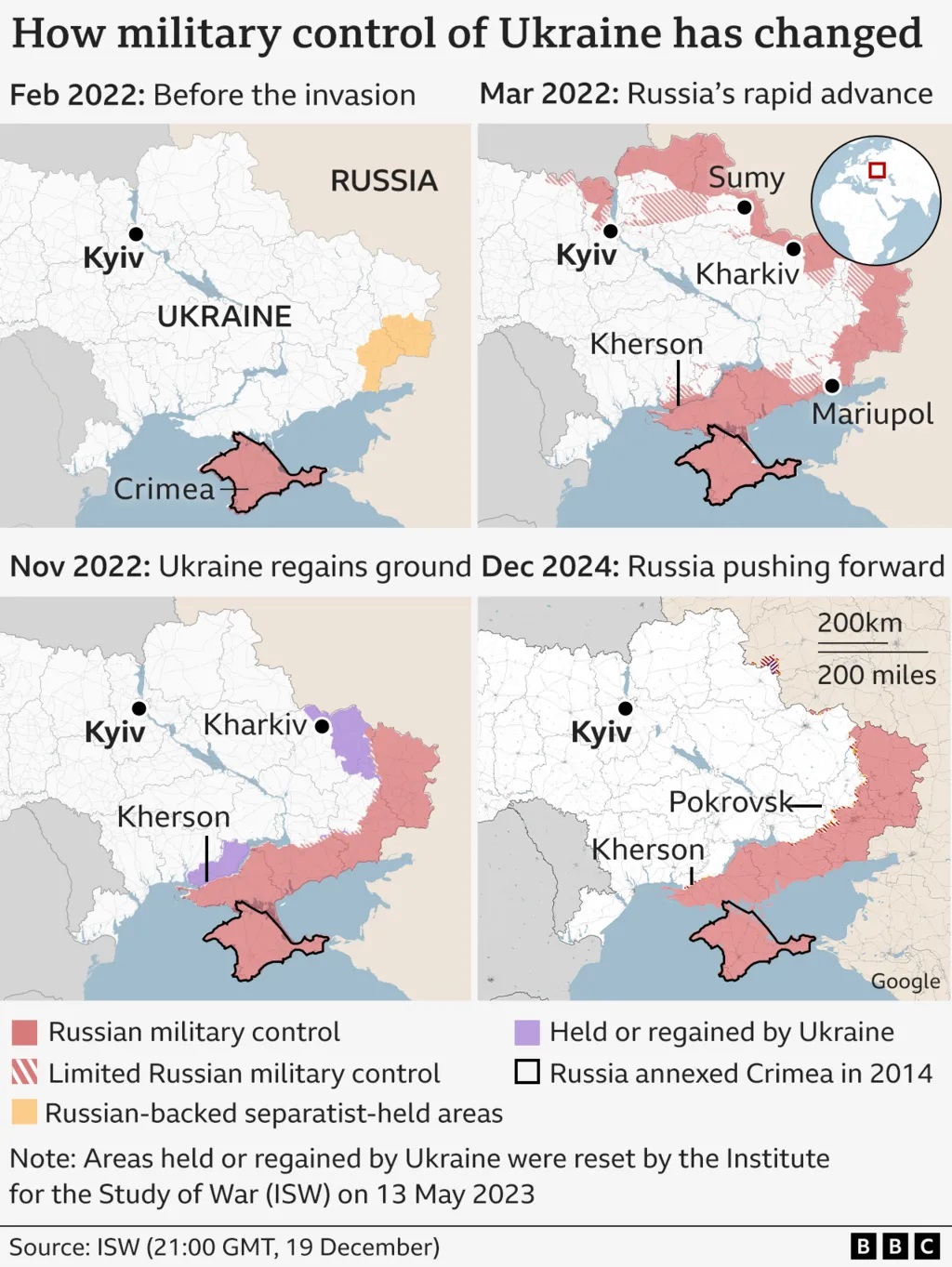
As well as European reluctance to a peace deal, there is the Russian point of view. Despite many set-backs, and a catastrophic loss of soldiers’ lives, Russia is now headed towards winning this war. Why make a deal now, before being in a more powerful position for demanding concessions?
Then we come to the USA. However much Donald Trump might want to end the carnage, and be seen as the peace hero, he is up against significant forces at home – making up what he calls the Deep State. This is a conspiracy theory that helped Trump to gain popularity – and I hate to agree with it, in its rather paranoid theme. BUT, war enthusiasts do exist – among the, military, intelligence, government officials, and wealthy industrialists, and they do exercise influence, and pressure politicians of both parties, to manipulate America’s defense policies. The war in Ukraine continues to be profitable to America’s weapons industries, and at no cost to American lives.
In the whole saga of the war in Ukraine, history has been forgotten. Of course Ukrainian-Russian relations have been tortuous and often terrible. In modern history it goes back to the 1930s, with Stalin’s starvation and genocide of Ukrainians. Then, following oppression from Russia, came in 1941, the short-lived moment of “liberation” by the German Nazis. That brought mass killings of Jews, slave labour, wholesale destruction, and the loss of up to 7 million lives. Russian control over Ukraine returned in 1944, and while the economy was restored, Stalin’s totalitarian rule was back again. In 1991 Ukraine gained independence from Russia.
Is it any wonder that Ukraine, with both Russian and Ukrainian languages still in common use, has been divided in attitudes and loyalties? Going even further back in history, Catherine the Great of Russia, in the 18th Century, made Kiev become Europe’s centre of art and culture, as well as making improvements in health, education, legal rights for Jews, improved conditions for serfs. Sure, she was an absolute monarch, – miles away from being democratic. Now her name and her statues are trashed in Kiev, which is a pity.
From 2014 to 2022, the Ukrainian government waged a war against the separatists in the Eastern, Donbass region. The war was about the 2014-2015 Minsk agreements which meant that the Donbass should have its autonomous government within Ukraine. Volodymyr Zelensky was elected on a platform that he would implement those agreements, but later he reneged on this promise. Russia’s President Putin in 2022 started what he called “a special military exercise” to support the separatists and uphold the Minsk agreement. That turned into the full-scale war against Ukraine.
European and USA support for Ukraine developed into a campaign, at enormous cost, to weaken Russia. The phrase “too big to fail” is used to describe financial crises. But it could apply to the Russia-Ukraine war. From the Western perspective the war is seen as a battle between good and evil – the evil giant Putin against the heroic little Zelensky. With NATO, with most European countries lined up against Russia, it is world democracy to be desperately defended, For Russia, it now is to prevent that last big nation on its border joining that threatening USA-armed line-up.
It was a mistake that Russia started a ‘special military enterprise’ -to evolve into a full-scale war. Some argue that by encouraging Zelensky to reneg on the Minsk agreement, the Western nations provoked the war.
Whatever started the war, the majority of Ukrainians, and especially those in the East, now just want it to end. The prevailing cry of Western leaders – “Putin must fail, Ukraine must prevail” expresses that simplistic view of good versus evil, and just ignores the complicated historic and local concerns of Eastern Ukraine. Diplomacy is jettisoned. As one writer puts it – voices calling for pragmatism and peace remain drowned out by the cacophony of war rhetoric.
Ultimately , every war ends in some sort of a diplomatic outcome. It is doubtful that Trump can make this one end quickly. It might be just one of the promises that he has to give up.
How Ukraine is Helping the HTS Militants Who Overthrew Assad
Scheerpost, December 29, 2024 , By Stavroula Pabst / Responsible Statecraft
As Islamist, al-Qaida-linked group Hayat Tahrir al Sham (HTS) overruns Syria amid President Assad’s sudden ouster, evidence suggesting Ukraine has assisted the group’s triumph continues to mount.
Namely, the Washington Post reported Tuesday that Ukraine sent 150 first-person-view drones and 20 drone operators to Idlib about a month ago.
The New York Times reported earlier this month, moreover, that Ukraine and HTS were coordinating efforts including “countering Russian misinformation and providing medical assistance.” The reporting also highlighted Ukrainian intelligence head Kyrylo Budanov’s repeated suggestions that Ukraine would target its enemy Russia internationally.
Washington Post columnist David Ignatius mused that Ukraine’s intentions for assisting HTS were obvious, writing that the war-torn nation was looking for other ways to “bloody Russia’s nose and undermine its clients.” In turn, a source told the New York Times that the HTS offensive in Syria was likewise timed in part to strike a blow against mutual enemy Russia.
………………………………………. “Ukraine’s alleged assistance to HTS forces is of limited military significance insofar as the SAA was inherently unprepared to resist the rebel offensive,” said Dr. Mark Episkopos, Quincy Institute Research Fellow and Adjunct Professor of History at Marymount University.
“But it is part of Kyiv’s broader effort to court Western support for its NATO accession bid by demonstrating to the US and other stakeholders its effectiveness in countering Russian interests around the world.” https://scheerpost.com/2024/12/29/how-ukraine-is-helping-the-hts-militants-who-overthrew-assad/
Trump suggests Zelensky consider ceding territories – El Pais

COMMENT. We may not like Donald Trump much.
But sometimes he gets it right.
https://www.rt.com/news/609772-trump-zelensky-territorial-claims/ 24 Dec 24
America’s president-elect has reportedly relayed the message this week.
US President-elect Donald Trump has sent a message to Ukrainian leader Vladimir Zelensky, asking him to start thinking about a ceasefire and to abandon claims to territories that are currently under control of Russia, El Pais reported on Sunday.
Trump has repeatedly pledged to end the Ukraine conflict within a day of taking office, but has yet to elaborate on how he plans to achieve this. His vows have raised concerns in Kiev that it may be facing not only a decline in aid but also an audit of the billions of dollars it has received from the White House under President Joe Biden.
“You look at some of these cities and there is not a single building in good condition left. So, when you say “restore the country,” restore what? This is a 110-year reconstruction,” the Spanish newspaper cited Trump as saying in a “message” to Zelensky from his Florida golf club this week.
Earlier this month, Trump called on both Ukraine and Russia to reach an immediate ceasefire. He posted the call on his social media platform Truth Social after meeting in Paris with Zelensky and President Emmanuel Macron.
The Wall Street Journal reported in early December, citing officials, that Trump had said Western Europe should deploy its troops to Ukraine to monitor a potential ceasefire. He reportedly added that the EU should play the main role in defending and supporting Kiev, while Washington could support the effort without sending troops.
Speaking at his end-of-year press conference on Thursday, Russian president Vladimir Putin reiterated that Moscow remains open to negotiating with Kiev without any preconditions, except those that had already been agreed upon in Istanbul in 2022, which envisaged a neutral, non-aligned status for Ukraine, as well as certain restrictions on deploying foreign weaponry. He also noted that such talks would have to respect the realities on the ground that have developed since that time.
Regulator warns against delays in work on Chernobyl’s shelter

“Further delays in the implementation of the project to dismantle the unstable structures of the Shelter under the NSC shell increase the risk of their collapse, which could lead to extremely negative consequences.“
WNN, 20 December 2024
The head of the State Nuclear Regulatory Inspectorate of Ukraine, Oleg Korikov, has urged against any further delays in the project to dismantle the unstable shelter facility, which was built at speed in 1986 to cover Chernobyl’s damaged unit 4.
He was speaking during a meeting of backers of the International Cooperation Account for Chernobyl, which was established in November 2020 by the European Bank for Reconstruction and Development (EBRD) at the Ukrainian government’s request to support a comprehensive plan for Chernobyl. The EBRD had already led the project to fund and construct the New Safe Confinement building which is now in place covering the whole of the reactor involved in the accident, including the initial shelter built around it in a matter of months.
Korikov said that equipping the New Safe Confinement with the necessary equipment and the dismantling of the unstable structures of the original shelter had already been postponed because of funding issues. This work was an integral part of the three-stage international Shelter Implementation Plan, which was firstly to stabilise it – the 2008 work gave it a design life to 2023 – and secondly to build a larger secure construction to enclose it – the New Safe Confinement (NSC) which was completed in 2017 – which would then pave the way for the dismantling and decommissioning stage.
“Further delays in the implementation of the project to dismantle the unstable structures of the Shelter under the NSC shell increase the risk of their collapse, which could lead to extremely negative consequences. This state of affairs causes serious concern for the State Nuclear Regulatory Inspectorate of Ukraine,” he said.
The Shelter Object – also known as the ‘sarcophagus’ – still contains the molten core of the reactor and an estimated 200 tonnes of highly radioactive material. The stability of the structure has developed into one of the major risk factors at the site.
The licence for the storage of radioactive waste within the shelter was extended last year from 2023 to 2029, with a 2025 deadline for the development of a new design for the dismantling of “unstable structures with an unacceptably high probability of collapse”, and a 31 October 2029 deadline for completion of the dismantling.
In October it was announced that a new study was being funded by the International Chernobyl Cooperation Account which aims to determine the scope of deconstruction work for unstable Shelter structures and provide an initial cost estimate and enable the beginning of design work for the dismantling of the unstable Shelter structures………………………………………………………………………………………………………………
The New Safe Confinement is the largest moveable land-based structure built – with a span of 257 metres, a length of 162 metres, a height of 108 metres and a total weight of 36,000 tonnes equipped…………….. https://www.world-nuclear-news.org/articles/warning-against-delays-in-work-on-chernobyls-old-shelter
U.S. Corporate Land Grab in Ukraine Underlies War With Russia
Heralded as a hero in Western media, Ukrainian President Volodymyr Zelensky has allowed foreign private interests to steal his country’s best land
Jeremy Kuzmarov, Dec 20, 2024 Originally published in CovertAction Magazine
In early November, Barbara Bonte, a Belgian member of the European Union (EU) parliament, raised concern about the sell-off of Ukrainian land on a massive scale to U.S. private equity firms along with some Saudi agro-industrial and investment businesses.
Bonte wrote to the EU parliament that, “according to several disquieting reports, mainly U.S. but also Saudi agro-industrial and investment businesses are purchasing Ukrainian farmland on a massive scale. Cargill, ADM, BlackRock, Oaktree Capital Management and Bunge Limited, for instance, have reportedly gained control over much of Ukraine’s farmland.”
Bonte then posed two questions to the EU parliament as follows:
“1. What is the Commission’s assessment of the impact of this sell-off of European farmland to multinationals serving only U.S. interests on EU strategic food-supply dependence? How does the Commission intend to address that impact?”
“2. This strongly suggests that the United States is seeking to recoup its military support for Ukraine, and ensure a geopolitical presence there in a post-war scenario through control over Ukrainian farmland and the profits it generates. How does the Commission intend to prevent the United States from cherry-picking in Ukraine and Europe from being left to deal with just the handicaps?”
Bonte’s questions are significant ones that point to a hidden, underlying motive to the war in Ukraine and U.S. and European support for Ukrainian President Volodymyr Zelensky.
The bonanza offered to foreign investors resembles past wars where young people were sacrificed on the altar of corporate profits.
War and Theft
A detailed analysis of the land grab in Ukraine by Western corporations was provided in a 2023 report by the Oakland Institute[1] entitled “War and Theft: The Takeover of Ukraine’s Agricultural Land.”
Written by Frédéric Mousseau, a food security consultant, and Eve Devillers, a Ph.D. candidate at Cornell University, the report starts by emphasizing Ukraine’s function as a “breadbasket of Europe” with its 33 million acres of arable land and “large swaths of the most fertile farmland in the world.”
In 2021, Zelensky initiated a land reform program as part of the structural adjustment program begun under the auspices of Western financial institutions that enabled U.S.-based corporations to take over Ukraine’s land.[2]
The structural adjustment program had been opposed by Ukrainian President Viktor Yanukovych, who was overthrown in the 2014 U.S.-backed Maidan coup.
After Zelensky’s “land reform” was initiated, about five million hectares—the size of two Crimeas—were outright “stolen” by private interests.
The thieves included Goldman Sachs, a Wall Street investment firm well represented in the Biden administration, which in April 2022 bought NN Investment Partners Holding N.V., a Netherlands-based company that is a major shareholder in Ukraine’s biggest landowner, Kernel Holding S.A, and in Astarta, another large landowner in Ukraine.[3]
Vanguard Group Inc., which gave $45,473 to Kamala Harris in the 2024 election and $98,551 to Joe Biden in 2020, was another Wall Street firm that bought up Ukrainian land cheaply.[4]
Some large U.S. pension funds, foundations and university endowments are invested in Ukrainian land through NCH Capital—a U.S.-based private equity fund headquartered at Rockefeller Plaza in New York, which is the fifth largest landholder in Ukraine with its possession of 290,749 hectares.[5]
NCH Capital currently faces accusations of unlawful land acquisition, tax evasion, and illicit financial activity. In 2015, its founder and CEO, George Rohr, was part of the high-level meetings involving Ukrainian president Petro Poroshenko and U.S. Commerce secretary Penny Pritzker that led Ukraine to agree to the structural adjustment program of the International Monetary Fund (IMF) as a condition for two $1 billion loan guarantees from the Obama administration.[6]…………………………………………………………………………………………………………………………..
The Oakland Institute report compares the generous financing of multinational corporations and local oligarchs with the inability of Ukrainian small farmers to access loans and their being displaced from their land and plunged into poverty. Some have migrated to the U.S. to seek farm work in the U.S. Midwest, sending remittances back home.[9]
Mousseau and Devillers wrote that “the Partial Credit Guarantee Fund established by the World Bank to support small farmers is only US$5.4 million, a negligible amount compared to the billions channeled to large agribusinesses.” https://jeremykuzmarov.substack.com/p/us-corporate-land-grab-in-ukraine?utm_source=post-email-title&publication_id=2091638&post_id=153373724&utm_campaign=email-post-title&isFreemail=true&r=1r1sdz&triedRedirect=true&utm_medium=email
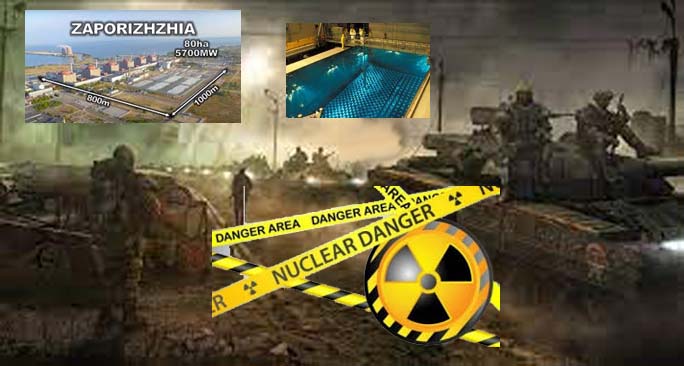
Europe fears nuclear catastrophe: This plant sets off all alarms due to risk of explosion
Eco News by Sanusha S.. 12/14/2024
The Zaporizhzhia Nuclear Power Plant (ZNPP), located in eastern Ukraine, has been a focal point of global attention due to the conflict in this country. The Russian troops captured this plant in 2022 and since then have faced a multitude of threats like fire, military action, or damage to infrastructure. Notwithstanding clarifications from nuclear safety experts regarding the safety precautions taken at plants, it has been a severe reminder of the need for urgent global protocols to guard against those facilities during armed conflict.
……………………………………………………………..Zaporizhzhia: A plant which is embattled in a nuclear fire unprecedented conflict
This is the most unprecedented scenario: a nuclear plant turned into military target. Constant shelling, drone strikes and even presence of landmines on the premises intensifies risk of nuclear incident because of the occupation of ZNPP by Russian forces.
The International Atomic Energy Agency (IAEA) has sent inspectors and even suggested creating a demilitarized safety zone around the site, thus, these measures remain unimplemented. The agency has identified that all seven pillars of nuclear safety are compromised at Zaporizhzhia. These include protection of critical infrastructure and prevention of military use of the facility……………………………………….
https://www.ecoticias.com/en/europe-fears-nuclear-catastrophe/9437/
1 This Month
Tell Congress: Prevent Nuclear Catastrophe in Iran

Tell Congress: Prevent Nuclear Catastrophe in Iran

Read the Public Inquiry Report, the Commissioners’ report, Surrendering Australia: The AUKUS Deception is available to download for free at aukuspublicinquiry.com. Or just watch the replay of the National Press Club Luncheon.


Shut down the radiation-damaged Heysham nuclear reactors now
To see nuclear-related stories in greater depth and intensity – go to https://nuclearinformation.wordpress.com

Say No to NASA’s Reckless Nuclear Reactor on the Moon
Say No to NASA’s Reckless Nuclear Reactor on the Moon
-
Archives
- November 2026 (255)
- October 2026 (302)
- September 2026 (339)
- August 2026 (330)
- July 2026 (355)
- June 2026 (287)
- May 2026 (306)
- April 2026 (356)
- March 2026 (251)
- February 2026 (267)
- January 2026 (308)
- December 2025 (358)
-
Categories
- 1
- 1 NUCLEAR ISSUES
- business and costs
- climate change
- culture and arts
- ENERGY
- environment
- health
- history
- indigenous issues
- Legal
- marketing of nuclear
- media
- opposition to nuclear
- PERSONAL STORIES
- politics
- politics international
- Religion and ethics
- safety
- secrets,lies and civil liberties
- spinbuster
- technology
- Uranium
- wastes
- weapons and war
- Women
- 2 WORLD
- ACTION
- AFRICA
- Atrocities
- AUSTRALIA
- Christina's notes
- Christina's themes
- culture and arts
- Events
- Fuk 2022
- Fuk 2023
- Fukushima 2017
- Fukushima 2018
- fukushima 2019
- Fukushima 2020
- Fukushima 2021
- general
- global warming
- Humour (God we need it)
- Nuclear
- RARE EARTHS
- Reference
- resources – print
- Resources -audiovicual
- Weekly Newsletter
- World
- World Nuclear
- YouTube
-
RSS
Entries RSS
Comments RSS

