Is the end now in sight for the war in Ukraine?
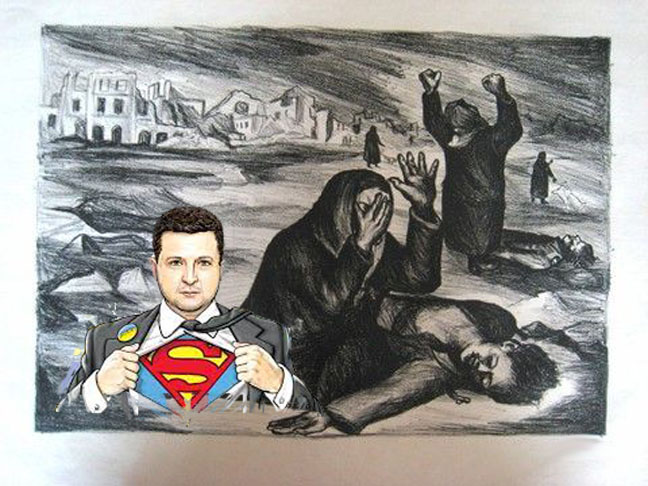
James WhiteJanuary 22, 2026.
German companies have already begun negotiations with their connections in Russia to resume trade once the sanctions are lifted. Thus German business leaders plainly ignore Chancellor Merz and his bellicose provocations toward Russia.
Funding and arms for Ukraine from NATO countries have all but dried up. The pipeline of conscripts in Ukraine has likewise run short of victims.
Zelensky continues to flit from one European capital to another seeking more billions in handouts. But his veneer of propaganda has grown thin at best. The warm wet kisses and embraces he received from neocons and Democrats in the U.S. as well as the WEF puppets of Europe, Macron, Starmer, Merz, Von der Leyen no longer present the same appeal.
Kiev Mayor Klitschko has advised everyone to evacuate the capital city, as electrical power has been cut off. This can only increase the flow of Ukrainians into Europe, already weary from hosting millions of Ukrainians for the past 4 years.
Anyone paying attention has seen the wretched excess of corrupt Ukrainian oligarchs in expensive sports cars with Ukrainian license plates in Monaco and various other luxury European holiday locales.
The U.S. has cut off the Ukraine grift while all of Europe is tapped out.
Von der Leyen’s insatiable greed for more billions from Europeans and her plans to steal ‘frozen’ Russian assets have petered out once the European banks understood that doing so would be an existential threat to the Euro and themselves.
Momentum for the end of the war in Ukraine keeps building.
The only question that remains is if Ukraine can negotiate any of their surrender terms with Russia or if the government will finally collapse as the economy collapses and the battle front recedes toward Kharkiv, Odessa and Kiev.
Chernobyl power plant LOSES external power supply after Russian attacks on Ukraine’s energy infrastructure, IAEA warns.

However, last month, Russia was thrown into complete darkness due to a power outage after Ukraine launched a series of drone strikes on Moscow.
Daily Mail By TARYN KAUR PEDLER, FOREIGN NEWS REPORTER, 21 January 2026
The Chernobyl power plant has lost its external power supply after a series of Russian attacks on Ukraine‘s energy infrastructure, the IAEA has warned.
The International Atomic Energy Agency Director General, Rafael Grossi, reported this morning that several Ukrainian power substations had been affected by large-scale military activity.
One of these was the Chernobyl Nuclear Power Plant, which lost all external power supply, as well as several other power lines to other nuclear plants.
‘The IAEA is actively monitoring developments to assess the impact on nuclear safety,’ added Director General Grossi.
It comes just a day after military intelligence officers in Ukraine warned that Russian missile strikes against the country’s power grid could lead to a ‘second Chernobyl’.
Ukrainian experts say that Vladimir Putin‘s ongoing bombardment of Ukraine’s power grid, cutting electricity and heating in freezing temperatures, could trigger a major disaster.
Serhiy Beskrestnov, a Ukrainian expert in electronic warfare, said that the missiles being launched at energy infrastructure are landing in close proximity to nuclear reactors – some just 300 metres away.
If a Russian strike against sucha substation were to miss, it could trigger a disaster, he warned.
He compared the impact of such an attack to the 1986 Chernobyl disaster, when a catastrophic explosion at the Chernobyl Nuclear Power Plant unleashed huge amounts of radiation, forcing hundreds of thousands of evacuations.
Taking to his Telegram channel on Monday, he said: ‘A miss by an Iskander or a Kinzhal could turn into a second Chernobyl’.
He added that the combination of a Russian strike against such substations, in an attempt to cause a nationwide blackout, as well as their track record for missing targets, made for a very dangerous situation……………………………………….
Ukrainian officials have introduced emergency measures, including temporarily easing curfew restrictions, allowing people to go to public heating centres set up by the authorities, Shmyhal said.
However, last month, Russia was thrown into complete darkness due to a power outage after Ukraine launched a series of drone strikes on Moscow.
Footage emerged from the Russian capital, showing entire tower blocks without light and dead street lamps due to the widespread blackout.
According to the Russian power company PAO Rosseti, over 100,000 residents of Ramensky, Zhukovsky, and Lytkarino were left without electricity in the dead of winter.
Russia claimed the power outage occurred due to an automatic shutdown at a high-voltage electricity substation, though it was unclear whether this was the cause or if it resulted from a Ukrainian drone strike.
Ukrainian President Volodymyr Zelensky’s former press secretary, Iuliia Mendel, said at the time: ‘Total blackout hits Moscow region is reported on social media.
‘Over 600,000 people plunged into darkness for more than four hours — no electricity, no mobile signal, total isolation. Drone threat declared across the oblast right now.’
The strike came in the dead of winter, with images revealing a thick layer of snow covering the frigid Moscow streets.
The reported attacks came just a day after Russia accused Ukraine, without providing evidence, of trying to attack President Vladimir Putin’s residence……. https://www.dailymail.co.uk/news/article-15480223/Chernobyl-power-plant-LOSES-external-power-supply-Russian-attacks-Ukraines-energy-infrastructure-IAEA-warns.html
Chernobyl cooling systems have lost power but meltdown risk is low
An electrical outage at Chernobyl nuclear power plant risks dangerous fuel overheating, but experts say that the chances are extremely slim due to the age of the reactors, which were shut down over two decades ago
New Scientist, By Matthew Sparkes, 20 January 2026
An electrical outage at Ukraine’s Chernobyl Nuclear Power Plant has taken spent fuel cooling systems offline, leading to a potential risk of overheating and the release of dangerous levels of radiation – but due to the age of the fuel, it should be safe until power is restored.
The International Atomic Energy Agency (IAEA) reports that several Ukrainian electrical substations have been hit by Russian military strikes, causing power outages at Chernobyl. “The IAEA is actively following developments in order to assess impact on nuclear safety,” wrote IAEA director general Rafael Grossi in a post on X.
Spent nuclear fuel from reactors continues to emit radiation for years, creating heat that must be shed, or else the fuel can melt and emit a spike of dangerous radiation. The fuel from Chernobyl’s former reactors is stored in a large cooling pond that is constantly replenished with fresh, cold water to keep its temperature down.
But without an electricity supply – which the IAEA says the site now lacks – this cooling has stopped, which will allow the water temperature to rise and increase the rate of evaporation.
“When the fuel comes out of a reactor, it will be hot for a while, because there will be fission products and there will be radioactive and giving off gammas and betas and alphas – just emitting energy, which needs to be removed, otherwise it will eventually melt,” says Paul Cosgrove at the University of Cambridge.
Working in Chernobyl’s favour, however, is that its stored fuel is older and therefore has already had time to emit much of its radioactive energy and cool down. The risk now is lower than the risk was in 2022, for example, when New Scientist reported on similar power outages at Chernobyl.
“It is always a worry when a nuclear site loses power, but worry about nuclear risks is often several orders of magnitude above the risks associated with other events with similar consequences,” says Ian Farnan, also at Cambridge.
Chernobyl’s reactor 4 exploded in 1986, but reactor 2 was shut down in 1991, reactor 1 ceased generating power in 1996 and reactor 3 – the final one at the site – was decommissioned in 2000.
The exact specifications of the storage pools that contain the fuel left over from those reactors at Chernobyl are kept classified, says Cosgrove. But he is aware of an inspection by regulators in 2022, which found that the risk of spent fuel overheating in the case of a power outage was low. “This fuel has been sat in there for 20 years, so it will have decayed. More and more of that energy will be gone,” he says………………. https://www.newscientist.com/article/2512468-chernobyl-cooling-systems-have-lost-power-but-meltdown-risk-is-low/
IAEA chief says nuclear accident risk in Ukraine outweighs fear of atomic weapons.
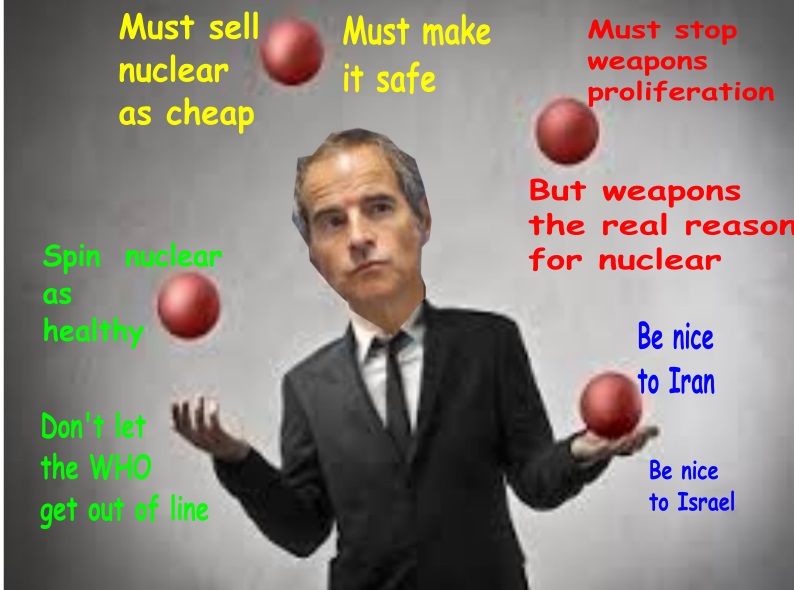
Rafael Grossi says fighting around Zaporizhzhia nuclear power plant has left Europe’s largest facility in ‘extremely fragile, volatile condition’ –
Beyza Binnur Donmez |16.01.2026 GENEVA, https://www.aa.com.tr/en/russia-ukraine-war/iaea-chief-says-nuclear-accident-risk-in-ukraine-outweighs-fear-of-atomic-weapons/3801135
The head of the UN nuclear watchdog said he is more worried about the risk of a nuclear accident in Ukraine than the potential use of atomic weapons, stressing the fragile situation at Europe’s largest nuclear power plant.
In an interview published on Friday, International Atomic Energy Agency Director General Rafael Grossi told RTVE that while the possibility of nuclear weapons being used in the Ukraine war cannot be fully ruled out, it remains unlikely.
“I believe that the possibility of the use of nuclear weapons in the context of this conflict is not very high,” Grossi said. “Therefore, we are immediately more concerned about the possibility of a nuclear accident than about the use of the nuclear weapon itself.”
Grossi underlined the dangers surrounding the Zaporizhzhia Nuclear Power Plant, which he described as “the most important nuclear power plant in Europe,” noting that it once supplied 20% of Ukraine’s electricity. The plant, located in a combat zone and occupied by Russia, remains highly vulnerable to military activity and power outages that could disrupt cooling systems.
“The situation today is extremely fragile. It is a combat zone,” he said, adding: “We are exercising this function of permanent observation and mediating between both belligerents to achieve, for example, specific ceasefires. We have already successfully negotiated four that allow us to carry out, for example, repairs on the high voltage lines that surround the plant, in order to precisely avoid radiological emergency situations.”
“It is an extremely fragile and volatile situation that we follow day by day,” he stressed.
Iran holds ‘significant amount’ of enriched uranium
Turning to Iran, Grossi said the country continues to hold a “significant amount” of highly enriched uranium, amid tensions and suspended inspections following attacks on nuclear facilities.
“There is still a significant amount of uranium enriched to 60% isotopic purity in Iran, which is practically the level required for the manufacture of nuclear weapons,” he said.
Grossi also warned against any Iranian move to withdraw from the Treaty on the Non-Proliferation of Nuclear Weapons, saying: “This would only aggravate the situation of tension that is already being experienced.”
To a question, the IAEA chief said the agency remains engaged in dialogue with Tehran and other key actors, including the US, to restore monitoring and prevent further escalation.
Ukraine and Russia agree temporary ceasefire to allow repairs to Zaporizhzhia nuclear power line.
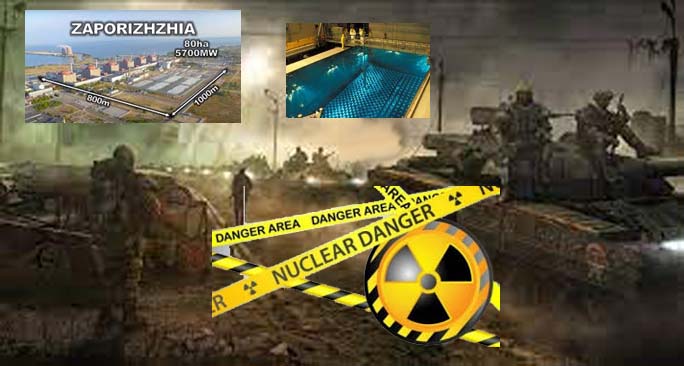
The IAEA director warned that attacks on Ukraine’s power infrastructure have “direct implications on the nuclear safety of its nuclear facilities”.
Mirror UK, Emma O’Neill Content Editor, 16 Jan 2026
Ukraine and Russia have agreed a temporary ceasefire to allow urgent repair work on a damaged power line at Europe’s largest nuclear plant, the Zaporizhzhia Nuclear Power Plant (ZNPP), IAEA officials confirmed today……….
The 330 kV backup line was disconnected on 2 January during military activity, leaving the plant reliant on a single 750 kV main power line. Technicians from Ukraine’s electrical grid operator are expected to begin repairs under the short-term truce in the coming days.
An IAEA team has departed Vienna to travel to the frontline and monitor the work, ensuring that safety measures are strictly followed during the repairs.
The agency confirmed that winter protection measures are in place at the plant, including temperature controls to prevent freezing in groundwater wells that supply cooling systems for reactors and spent fuel pools. Emergency diesel generators are also fully operational should the plant lose off-site power again.
The situation highlights the ongoing risks to Ukraine’s nuclear facilities, with military activity recently damaging a substation at the Chernobyl plant and forcing temporary power reductions at other sites.
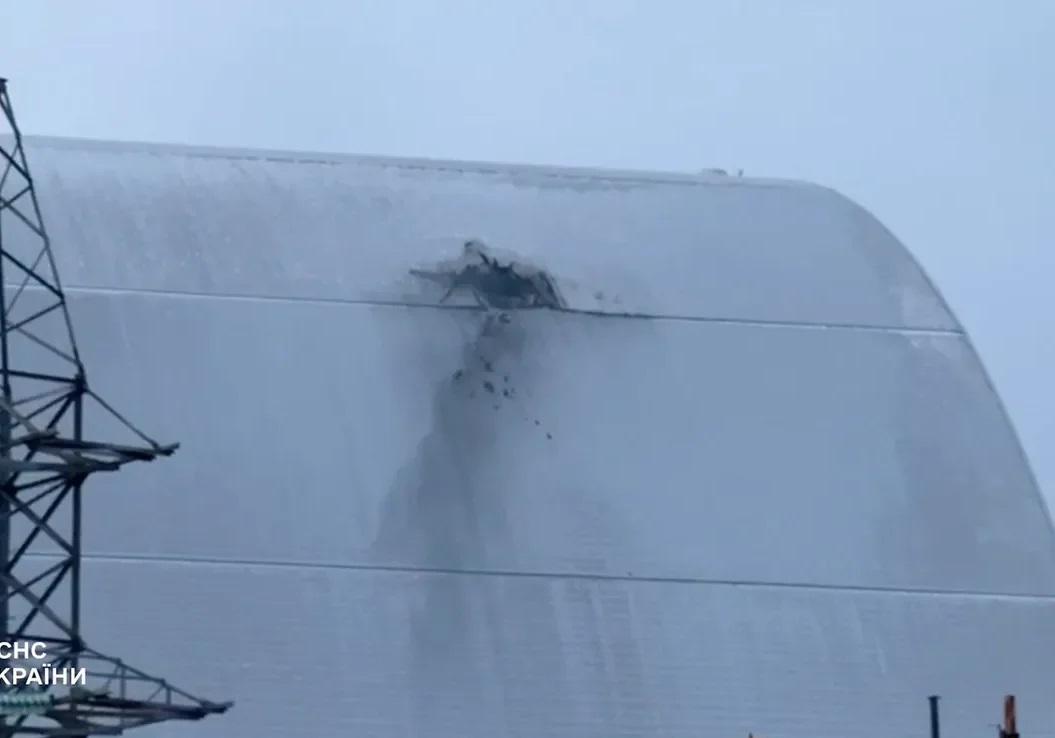
Grossi warned that attacks on Ukraine’s power infrastructure have “direct implications on the nuclear safety of its nuclear facilities” and announced plans for another IAEA mission to assess 10 critical substations supplying electricity for reactor cooling systems and safety equipment.
Over the past week, IAEA teams reported air raid alarms and military activity near all five nuclear sites in Ukraine, including explosions and flying objects close to Zaporizhzhia, Khmelnitsky, South Ukraine, and Chernobyl plants.
The temporary ceasefire now allows repairs to the ZNPP backup line to go ahead, providing a vital safeguard for Europe’s largest nuclear facility and reducing the risk of a serious nuclear incident. https://www.mirror.co.uk/news/world-news/ukraine-russia-agree-temporary-ceasefire-36566368
Biden knew Ukraine would lose proxy war with Russia….provoked it anyway

Yet..and yet, President Zelensky is refusing to accept the reality of Ukraine’s defeat, even demanding return of territory lost forever. NATO countries led by delusional leaders Starmer in UK, Merz in Germany and Macron in France, claiming they’re Russia’s next target, are still pledging war resources they don’t have and never will
Walt Zlotow, Jan 17, 2026, Walt Zlotow West Suburban Peace Coalition Glen Ellyn IL
The US proxy war against Russia destroying Ukraine has largely disappeared from mainstream news. US warfare with Venezuela, possible renewed war with Iran, seizing Greenland from Denmark have put a virtual blackout on Ukraine war reporting.
But a bigger reason is the war is lost with no chance of reversing the destruction of Ukraine short of nuclear war with Russia. If that happens we’re all destroyed.
So Trump, his advisors, the national security state (A.K.A. war party) and the aforementioned mainstream news have moved on. They realize the war has become a spectacular defeat for America’s goal of bringing Ukraine into NATO to further weaken Russia and isolate it from the European political economy. Publically admitting defeat and failure is something none of them will dare not speak its name.
Trump, to his credit, is trying to get both Ukraine and NATO to give up and settle on Russia’ sensible terms: no NATO for Ukraine, Ukraine to be forever neutral between Europe and Russia, no return of land containing mainly Russian leaning Ukrainians brutalized by Kyiv for 8 years before Russia intervened.
How badly has Ukraine lost? Over a million and a half dead, wounded or MIA, a quarter million soldiers deserted and over 9 million fled to safer climes. The economy down by a third surviving on European life support. Reconstruction costs once war ends at a half trillion dollars and rising.
Russia meanwhile is thriving, economy up by pivoting away from trade with Europe to the Global South and others only too happy to degrade both US and European hegemony. Result is a tripling of NATO energy costs, collapse of leaders support with nationalist, antiwar opposition poised to take over next election.
Could it get any worse for Ukraine and NATO?
Yet..and yet, President Zelensky is refusing to accept the reality of Ukraine’s defeat, even demanding return of territory lost forever. NATO countries led by delusional leaders Starmer in UK, Merz in Germany and Macron in France, claiming they’re Russia’s next target, are still pledging war resources they don’t have and never will
The only logical explanation is that they know the inevitable defeat facing Ukraine and NATO but are terrified to admit it and do the right thing. Trump, while sensibly pushing Ukraine and NATO, refuses to pull all US support for the lost war. He’s cynically telling NATO to keep the weapons flowing…just as long as they buy them from America. For Trump, lost war can still be a profitable business deal. He’s also refuses to pull the plug on massive weapons Biden foolishly authorized in his last days knowing Trump had no stomach to continue the war.
Speaking of Biden, he knew Ukraine could not prevail when he provoked the Russian Special Military Operation in February, 2022. But he viewed Ukraine’s destruction as collateral damage to so degrading Russia in the process that they would be forever weakened and out of the European political economy. Biden likely viewed US/NATO Ukraine support as a repeat of US meddling that defeated Russia in Afghanistan in 1989. Big mistake as history didn’t repeat.
Biden’s Mother of all Sanctions and $150 billion in weapons backfired spectacularly. So not only did Biden destroy Ukraine by provoking war, he’s likely destroyed America’s dominance leading NATO in Europe. In fact he may have put NATO on the path to history with their impending defeat flailing away at a lost cause.
The only question, besides how badly the rump state of Ukraine will end up at war’s end, is whether Ukraine and NATO’s futile perseverance will end up in nuclear war with Russia still possible every day this nightmare continues.
However it ends, Joe Biden’s legacy will be making the greatest foreign policy mistake so far in America’s 250 years.
Say it wasn’t so, Joe.
Zelensky makes another move to avoid election.

12 Jan 26, https://www.rt.com/russia/630856-zelensky-election-martial-law/
The Ukrainian leader has submitted a bill to extend martial law, which would allow him to remain in power.
Ukraine’s Vladimir Zelensky has submitted two draft bills to the parliament to extend martial law and general mobilization for another 90 days, effectively postponing elections once again. The move comes despite pressure from US President Donald Trump and the Ukrainian leader earlier saying he was open to holding an election.
One of the draft laws submitted to the Verhovna Rada on Monday would extend martial law from February 3 to early May, which would effectively bar national elections for this period. Martial law has been renewed repeatedly in three-month increments since 2022. The other bill would prolong the controversial forced mobilization campaign on the same timetable.
Zelensky’s presidential term expired in May 2024. The Ukrainian leader refused to hold a new election, citing the conflict with Russia. Moscow subsequently declared him “illegitimate,” arguing that authority now rests with the Ukrainian parliament. Russian officials also noted that Zelensky’s dubious status is a major legal obstacle to signing a peace agreement.
This comes despite pressure from Trump – who labeled Zelensky “a dictator without elections” last year – to hold an election. In December, Zelensky said he was ready to hold an election within months if the West could provide Kiev with robust security guarantees.
A poll in January by Ipsos suggested that former Ukrainian commander-in-chief Valery Zaluzhny – widely viewed as Zelensky’s main rival – is leading potential presidential candidates with around 23% support, while Zelensky trailed at 20%.
If the second bill passes, Ukraine will prolong its mobilization campaign, which has been marred by numerous violent incidents between draft officers and reluctant recruits. Officials in Kiev have acknowledged a decline in enthusiasm to serve, but insisted that drastic measures are required to replenish growing battlefield losses.
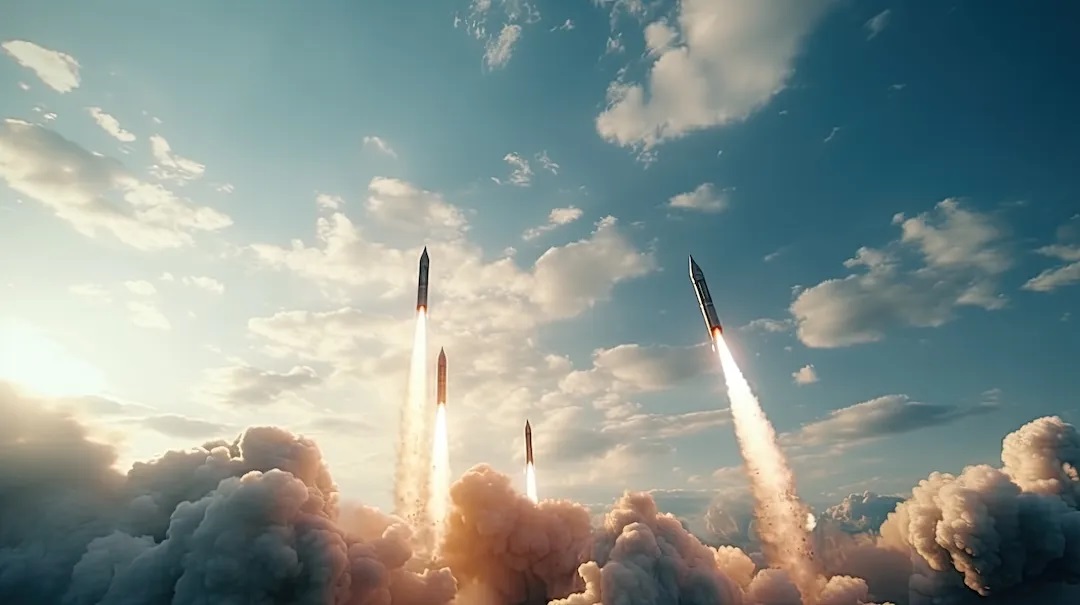
British Ministry of Defense developing ballistic missile for Ukraine to make “deep strikes into Russia”
Steven Starr , 13 Jan 26
The missile is only in the developmental stage. The delusional British imagine that Russia will not strike Britain if they pursue this folly.
The UK has formally launched Project Nightfall, a competition to develop a new ground-launched tactical ballistic missile intended primarily for use by Ukrainian forces, while also shaping future British long-range strike programmes.
The government has moved ahead with Project Nightfall, a competitive effort to rapidly develop a ground-launched ballistic missile designed to give Ukraine a long-range strike capability against Russian forces. The programme builds directly on work first disclosed by the UK Defence Journal in December, when the Ministry of Defence published an initial contract notice outlining the requirement.
While the project is being run by the UK, ministers have been clear that the missile is not intended as a near-term addition to Britain’s own arsenal. Instead, Nightfall is designed around Ukrainian operational use, with British industry acting as the developer and manufacturer and the UK Armed Forces positioned as a future beneficiary of lessons learned rather than the immediate end user.
The December notice, published on 9 December 2025, confirmed that the MOD was seeking industry partners to “procure a future tactical ballistic missile through a short-term development programme”. That followed parliamentary confirmation in November that officials were assessing industry feedback ahead of launching a formal competition.
According to the published requirement, Nightfall is one of the most ambitious missile programmes pursued by the UK in decades. The MOD specified a cost-effective, ground-launched ballistic missile with a range greater than 500 kilometres, capable of operating in high-threat and heavily contested environments, including under intense electronic warfare and degraded or denied satellite navigation.
Mobility and survivability are central to the concept. The system is required to support salvo firing from a single launcher, with multiple missiles launched in quick succession before the crew withdraws rapidly. The MOD specified that launch units must be able to leave the firing area “within 15 minutes of launching all effectors”, with each missile reaching its target within approximately 10 minutes of launch.
Scalability is another key requirement. Subject to future contracts, production must be capable of delivering at least 10 missiles per month, with scope to increase output. Designs are also expected to allow future upgrades to range, accuracy and manoeuvrability, while minimising reliance on foreign export controls.
This week’s announcement adds political weight and funding detail rather than altering the core technical requirement. Under the current plan, the government intends to award up to three competing development contracts, each worth £9 million. Each team would be expected to design, develop and deliver three missiles within 12 months for test firings. Proposals are due by 9 February, with development contracts targeted for award in March.
Defence Secretary John Healey framed the programme as a response to continued Russian attacks, saying the UK was determined to place advanced weapons “into the hands of Ukrainians as they fight back.” In ful, he said:
The missile must be “capable of being safely ground launched from a mobile platform in a high threat tactical environment, navigating to and accurately striking a user-programmed fixed target co-ordinate.” Each effector is expected to carry a conventional high-explosive payload of around 200 kilograms and follow a supersonic ballistic trajectory, with a stated accuracy requirement of striking within 10 metres of a target coordinate for 50 per cent of launches.
Mobility and survivability are central to the concept. The system is required to support salvo firing from a single launcher, with multiple missiles launched in quick succession before the crew withdraws rapidly. The MOD specified that launch units must be able to leave the firing area “within 15 minutes of launching all effectors”, with each missile reaching its target within approximately 10 minutes of launch.
Scalability is another key requirement. Subject to future contracts, production must be capable of delivering at least 10 missiles per month, with scope to increase output. Designs are also expected to allow future upgrades to range, accuracy and manoeuvrability, while minimising reliance on foreign export controls.
This week’s announcement adds political weight and funding detail rather than altering the core technical requirement. Under the current plan, the government intends to award up to three competing development contracts, each worth £9 million. Each team would be expected to design, develop and deliver three missiles within 12 months for test firings. Proposals are due by 9 February, with development contracts targeted for award in March
Defence Secretary John Healey framed the programme as a response to continued Russian attacks, saying the UK was determined to place advanced weapons “into the hands of Ukrainians as they fight back.” In ful, he said:
“The attacks overnight on Thursday just go to show how Putin thinks he can act with impunity, targeting civilian areas with advanced weaponry. Instead of seriously negotiating a peace, he’s seriously escalating his illegal war. We were close enough to hear the air raid sirens around Lviv on our journey to Kyiv, it was a serious moment and a stark reminder of the barrage of drones and missiles hitting Ukrainians in sub-zero conditions. We won’t stand for this, which is why we are determined to put leading edge weapons into the hands of Ukrainians as they fight back.”
Defence Minister Luke Pollard said the missiles would “keep Ukraine in the fight” while also strengthening longer-term European security.
“A secure Europe needs a strong Ukraine. These new long-range British missiles will keep Ukraine in the fight and give Putin another thing to worry about. In 2026, we will continue to stand shoulder to shoulder with Ukraine. Providing equipment to keep them in the fight today, whilst working to secure the peace tomorrow.”
While the formal launch underscores the government’s intent, the substance of Project Nightfall remains closely aligned with the requirement outlined in December. As that original notice made clear, the MOD still reserves the right to amend or cancel the programme at any stage, stating that “the Authority reserves the right not to award any Contract to any supplier at any stage during the procurement.”
For now, Nightfall represents a rare case of the UK pursuing a ground-launched ballistic missile explicitly for a partner nation’s use, while using the programme to accelerate domestic expertise in deep-strike systems that Britain itself currently lacks.
Here’s who really weaponizes children in the Russia-Ukraine conflict
As accusations of abductions resurface, it’s clear the West doesn’t care about facts on the ground if they contradict the narrative.

By Eva Bartlett, a Canadian independent journalist. She has spent years on the ground covering conflict zones in the Middle East, especially in Syria and Palestine (where she lived for nearly four years). 9 Jan, 2026 https://www.rt.com/news/630762-russia-ukraine-abducted-children/
For the last three years, Ukraine and concerted legacy media campaigns have been screaming that Russia has abducted, or forcibly displaced, thousands of Ukrainian children – even up to 1.5 million!
The accusations resurged in December, with a UN General Assembly vote on a draft resolution on the return of Ukrainian children.
During the meeting, Ukraine’s Deputy Foreign Minister Mariana Betsa once again pushed claims that “at least 20,000 Ukrainian children have been deported to Russia,” in spite of the fact that months prior, during the June Istanbul talks, the Ukrainian side finally provided a list of the children it accuses Russia of abducting: 339 children, surprisingly far fewer than the number alleged for years.
The absence of over 19,500 on the list indeed leads to many questions, mainly: is Ukraine lying again? Recall that in 2022, the accusations by the (now former) Ukrainian ombudswoman, Lyudmila Denisova, about “sexual atrocities” allegedly committed by Russian soldiers, were revealed to be lies and propaganda. So much so that Denisova was sacked. But before her dismissal, legacy media and the UN all backed the lies.
Some recent accusations are that children were being sent to labor camps in Russia – “165 re-education camps where Ukrainian children are militarized and Russified” – or even of being sent to North Korea, as Katerina Rashevskaya of the Ukrainian Regional Center for Human Rights told the US Subcommittee on State, Foreign Operations, and Related Programs on December 3.
The footnotes of the claims made by Rashevskaya, instead of a source for the information, say “The Regional Human Rights Center can provide information upon request.” In other words, her sources are “trust me, bro.”
Regarding the North Korean camp in question, if two Russian teens were sent there, they’d potentially be made to enjoy water slides, basketball and volleyball courts, an arcade room, a rock climbing wall, art and performance halls, an archery range, a private beach, and hikes in the mountains.
Regarding the list of 339 children Ukraine says were abducted by Russia, Russian Foreign Ministry Spokeswoman Maria Zakharova remarked, “30 percent of the names on the list could not be verified, as most of those children were never in Russia, are now adults, or have already returned to their families. As for the Ukrainian children who are actually in our country, they are under state care in appropriate institutions. They are safe now; in many cases, their evacuation from combat zones saved their lives. Local children’s rights commissioners are now working to reunite them with their relatives.”
Just as legacy media has whitewashed the eight years of Ukraine’s war against Donbass civilians prior to Russia commencing its military operation in 2022, including the Ukrainian shelling which killed 250 children starting in 2014, media likewise ignore the children Russia says are missing.
During the talks in Istanbul, Zakharova noted, “the Russian side presented Ukraine with a list of 20 Russian children who are either currently in Ukraine or relocated from Ukraine to Western Europe, including to countries that endorsed this very statement. Now, the burden falls on these states to provide Russia with a substantive response regarding our ‘list of 20.’”
Over 500 Ukrainian orphans abused in Türkiye
Recently, Donbass-based journalist Christelle Néant wrote about a report published on a pro-Ukrainian website which broke the story of 510 Ukrainian children who had been evacuated by a Ukrainian oligarch in 2022 from Dnepropetrovsk to Türkiye, where the benevolent foundation which brought them there allegedly allowed its staff to beat the children, sexually assault them, and deny them food if they refused to perform on camera to raise funds for their lodging. These are just some of the reported violations of the orphans’ rights.
The details of the report show that the children suffered physically and psychologically. Additionally, two underage teens were impregnated by staff at the hotel they stayed in, with educators allegedly aware of the interactions.
According to Néant, the orphanage director’s response to the fact of one of the teens in her care becoming pregnant was to blame the girl: “This young girl comes from an asocial family. Well, this way of life is already inscribed in every cell, in the blood of these children.”
“In almost 10 years of work in Donbass,” Néant wrote, “I have conducted or filmed many humanitarian missions to orphanages in the region. And never ever have I heard a director make such vile remarks about one of the children in her care. Even the most difficult and recalcitrant were cared for with pedagogy, love, and patience.”
Ukraine hunting down children
In April 2023, Christelle Néant and I interviewed Artyomovsk civilians who had recently been rescued by Russian soldiers. In addition to being deliberately shelled by Ukrainian forces who knew they were sheltering in the basement of a residential building, the civilians we spoke to told us about Ukrainian military police hunting for children.
The evacuees told us some of these police went by the name ‘White Angels’, and were taking childrenaway without their consent or that of their parents.
Around that time, more reports came out about these abductions or attempted abductions, including an 11-year-old girl who spoke of how White Angels, who introduced themselves as military police, came to the basement she was sheltering in with a photo of her, looking for her, and saying they needed to take her away, because “Russia killed her mother.” According to the girl, her mother was alive and with her.
Reports of these abductions also emerged in Avdeyevka, Kupyansk, Slavyansk, Chasov Yar and Konstantinovka, as well as in Ukrainsk and Zhelannoye.
Néant wrote of a July 2023 conference on Ukraine’s crimes against the Donbass children, in which Liliya and her daughter Kira from Schastye, in the Lugansk People’s Republic, spoke.
They gave evidence of how, “at the start of the special military operation (when Ukraine controlled Schastye), around ten children were taken from a school in Schastye to western Ukraine by the headmistress of the school, on orders from Kiev, without informing their parents.”
The children were even forbidden to call their parents, Néant wrote, “But Kira knew her mother’s telephone number by heart and managed to call her to let her know that they were in Lviv and then Khoust. Thanks to Liliya’s determination to find her daughter, we discovered how Kiev ‘exports’ the children it abducts.” Ukraine had forged a new “original” birth certificate for Kira. The girl said she and the other children were to be sent to Poland.
Former SBU officer Vasily Prozorov spoke at the same conference, where he explained, according to Néant, “that one of his investigations had revealed that some of the children abducted by Ukraine are sent to pedophile networks in Great Britain, via a whole network of Ukrainian and British officials or former officials who work together. On the British side, members of MI6 and the Foreign Office are involved.”
Prozorov, she wrote, spoke of “another of his investigations on organizations registered in EU countries involved in ‘exporting’ children from Ukraine under the pretext of providing them with shelter. These organizations take unaccompanied Ukrainian children out of Ukraine. What happens to them afterwards is unknown.”
Evacuees from Kherson reject ‘abduction’ claims
In November 2022, in the southern Russian seaside city Anapa, I met numerous people displaced from Kherson who were being lodged in hotels and apartments in the city.
The first site I visited was a few minutes by taxi outside of the city, one of many hotels along the coast. The hotel director showing me around said they don’t call them refugees, “we call them guests of the building,” and spoke affectionately of them, how grateful they were to be there, far from any shelling. Just under 500 refugees had been living there since October, she told me.
No guards monitored the entrance/exit; the refugees walked around tidy grounds. But in any case, I asked about their freedom of movement, or lack thereof.
“They move freely, of course. We don’t prohibit them from going out. Many aren’t here now because they’re in town, looking for jobs, getting documents. Children are at school.”
With my hired translator, I spoke with two Kherson women, a young mother and her own mother, to hear their stories.
“We were living with explosions at night, it was very scary, not only for myself, but for my children and for my grandchildren,” the older woman said. “When you go to bed, you don’t know if you will get out of bed in the morning. We were forced to leave.”
I asked who was shelling them. “Word of mouth transmits very clearly, and people around us spoke about it. We were bombed by the Armed Forces of Ukraine. Russian soldiers protected us.”
The younger woman said she used to speak with the Russian soldiers there. “They are friendly. We wanted to hug them, because we felt protected. They helped us, gave us humanitarian aid, brought it to the house.”
Some minutes’ taxi ride away, I visited an apartment complex that could have served tourists in summer. There, fifty buildings housed around 1,500 refugees who had also arrived in October, mostly from Kherson Region.
My translator and I walked around, passing playgrounds, a pharmacy, a library, a swimming pool, a gym, a small petting zoo with peacocks, and a kindergarten. Near a playground, I spoke with a mother sitting on a bench with two of her four children.
“In the early days, there was bombing. We spent two and a half weeks in the basement. It was unbearable, the children were very afraid.” One of her daughters became ill. “She had acute inflammation of the lower jaw, we think due to hypothermia. We took her to Simferopol and she had surgery.”
In Anapa, she said, her children had full medical examinations. “We were helped by the mayor of the city of Anapa. We are grateful for everything.”
I mentioned that according to Western media, she and her family were kidnapped by Russia. She replied that her husband’s parents had demanded to see the children, having been told that children were being separated from their parents in Russia.
“His mother called three days in a row, saying, ‘Where are the children?’ We answered, ‘They went to the cinema. They’re playing, etc.’ She said, ‘Show me the children, they say that they took your children from you.’”
Details matter
Whereas legacy media continue to push the “Evil Russia child kidnapper” narrative, there is ample evidence that Ukraine is guilty of doing precisely what it accuses Russia of. The is also a significant absence of evidence regarding the ‘20,000 kidnapped children’ claims still being pushed.
Will media investigate the reports of abuse of Ukrainian children in Türkiye? Surely not. It wouldn’t suit their scripted anti-Russia bias.
Zelensky Names Canada’s Chrystia Freeland, Notable Anti-Russia Hawk As Top Advisor
Zero Hedge Tuesday, Jan 06, 2026
Apparently Zelensky is simply skipping his own people and going straight to appointing officials within foreign governments to top advisory positions.
Ukraine has named former Canadian Deputy Prime Minister Chrystia Freeland as an economic advisor amid a broader reshuffle of senior government positions, also coming on the heels of the massive energy ministry related corruption scandal which has unleashed chaos within his administration.
It should also be noted that Canada is a founding member of NATO – so handing Freeland a position in the Ukrainian presidential office won’t go down well at the Kremlin, which will see this as yet more justification for its vehement condemnation of NATO expansion.
Chrystia is a professional… and has significant experience in attracting investments and conducting economic transformations,” President Zelensky announced on Telegram Monday.
Freeland was Canada’s deputy prime minister from 2019 to 2024 under Prime Minister Justin Trudeau and was appointed Canada’s special representative for Ukraine’s reconstruction in 2025………. https://www.zerohedge.com/geopolitical/zelensky-names-canadas-chrystia-freeland-anti-russia-hawk-top-advisor
Russia Hands US Evidence That It Says Confirms Ukraine Targeted Putin’s Residence in Drone Attack
Ukraine has denied the Russian allegations that it was trying to hit Putin’s residence
by Dave DeCamp | January 1, 2026 , https://news.antiwar.com/2026/01/01/russia-hands-us-evidence-that-it-says-confirms-ukraine-targeted-putins-residence-in-drone-attack/
A senior Russian military official on Thursday handed over to a US official what he said was evidence that Ukrainian drones targeted Russian President Vladimir Putin’s residence in the Novgorod region.
Ukraine has denied the allegations that it was trying to target Putin’s home, and US officials speaking to US media outlets said the CIA assessed that Ukraine was targeting a military facility in the same region that wasn’t close by. But Russian officials insist they have the evidence that Ukraine was attempting to hit the Russian president’s residence.
A video posted by the Russian Defense Ministry on Thursday shows Igor Kostykov, the chief of the Main Intelligence Directorate of the Russian General Staff, meeting with the US defense attache based in Moscow and handing over what he said was a “navigation unit” from one of the drones downed in the Novgorod region.
“The decryption of the content of the memory of the navigation controller of the drones carried out by specialists of Russia’s special services confirms without question that the target of the attack was the complex of buildings of the Russian president’s residence in the Novgorod region,” Kostykov said.
President Trump was informed about the alleged attack by Putin the day it happened, and initially appeared to believe Russia’s account, saying that he “wasn’t happy about it.” But he later shared a New York Post article on Truth Social that cast doubt on the Russian claim and said Moscow “is the one standing in the way of peace.”
Russian Foreign Minister Sergey Lavrov has said that Moscow won’t quit peace talks with the US over the alleged attack, but said it would alter its negotiating position and vowed a response, saying that targets have already been picked out. “Such reckless actions will not go unanswered,” he said.
CIA, with Trump’s blessing, is using Ukrainians to sabotage Russia’s energy infrastructure and oil tankers – NYT
Iona Cleave, The telegraph, Fri, 02 Jan 2026, https://www.sott.net/article/503791-CIA-with-Trumps-blessing-is-using-Ukrainians-to-sabotage-Russias-energy-infrastructure-and-oil-tankers-NYT
Attacks on oil refineries have cost Moscow $75m a day, according to US intelligence
The CIA secretly taught Ukraine how to target crucial components of Russia’s oil refining infrastructure and its sanction-busting shadow fleet, according to officials.
Despite Washington pulling back its support for Kyiv’s war effort under the Trump administration, it has emerged that US intelligence and military officers continued to find new ways to stifle Vladimir Putin’s war machine.
Since June, the CIA, with Donald Trump’s blessing, has been covertly providing specific intelligence to bolster Ukraine’s aerial offensive against oil refineries inside Russia, according to the officials.
The move came amid Mr Trump’s growing frustration with Putin’s unwillingness to negotiate while Russian forces accelerated attacks on Ukrainian cities.
The US has long shared intelligence with Kyiv that helps with attacks on Russian military targets in occupied parts of Ukraine and provides advanced warning of incoming Russian missiles and drones.
Under persuasion by Ukraine sceptics in the White House, led by JD Vance, the vice-president, and his allies, Mr Trump froze military aid in March and intelligence sharing was suspended as a result.
However, The New York Times, citing officials, said the CIA heavily lobbied for the agency to keep sharing intelligence.
Before summer, the impact of the strikes on Russia’s energy infrastructure – which often hit storage depots or structures easily repaired – had been relatively minimal.
Under a new plan, crafted by the CIA and US military, the campaign was concentrated exclusively on oil refineries, targeting a newly found Achilles heel.
A CIA expert had identified a coupler device that is so difficult to replace that it could lead to a facility remaining shut for weeks.
The strikes became so successful that Russian oil refining was reduced by as much as a fifth on certain days, cutting exports and leading to domestic fuel shortages.
It was costing its economy an estimated $75m (£55m) a day, according to US intelligence.
Comment: That’s certainly one way to make your otherwise useless sanctions work: just start blowing up your opponent’s oil business! Uniquely American…
In response, Mr Trump praised the strikes for the leverage and deniability they gave him as Putin continued to stonewall negotiations, according to the sources.
It was first reported in October that Washington was closely involved in the planning of such strikes, but it wasn’t known that the CIA was responsible for the new focus of the campaign and identifying specific weaknesses in its energy infrastructure.
In late November, Ukraine also began a maritime campaign against Moscow’s shadow fleet, a clandestine network of hundreds of vessels carrying sanctioned oil to keep the Russian economy afloat.
Comment: At least we now know how ‘Ukraine’ struck a Russian oil tanker off West Africa.
Kyiv was using its explosive-laden long-range naval drones to blow holes in the ships, opening a new front in the war to cut off Russia’s largest source of funding and strengthen its negotiating position at US-led peace talks.
According to US and Ukrainian officials, the CIA was authorised to assist Kyiv’s military in these efforts, despite the risk of angering Putin’s regime.
It is not clear exactly when such help was approved by the Trump administration.
The New York Times report, citing hundreds of national security officials, military and intelligence officers and US, Ukrainian and European diplomats, charts the unwinding of the US-Ukrainian alliance over the past year.
The officials argued that as Mr Trump attempted to broker peace, factions in the White House and Pentagon pushed the president and his aides to make inconsistent, and at times, erratic decisions that damaged Kyiv’s war effort.
This included how the newly renamed Department of War, led by Pete Hegseth, repeatedly made unannounced decisions to withhold vital munitions from Ukraine that had already been given under the Biden administration, costing lives at the front.
A critical error, according to the officials and diplomats, was Mr Trump overestimating his rapport with Putin and ability to get him to meaningfully engage in negotiations.
Despite repeatedly touting his ability to secure an end to the war in “24 hours”, the Republican was forced to admit on Sunday his lack of a breakthrough after a year of on-off negotiations.
As he hosted Volodymyr Zelensky at Mar-a-Lago, he was forced to admit “it is not a one-day process deal. This is very complicated stuff”.
The officials also revealed that Mr Trump and his Ukrainian counterpart bonded over a love of Ukrainian women.
Following their disastrous meeting in February, Mr Zelensky returned six months later to win back Mr Trump’s support.
Sitting in the Oval Office, Mr Trump said “Ukrainian women are beautiful”, to which Mr Zelensky replied, “I know, I married one.”
In an odd sequence of events, Mr Trump rang up an old friend who had married a former Miss Ukraine who was then put on the phone to speak to Mr Zelensky.
“It humanised Zelensky with Trump,” an official who was there told the New York Times. “You could feel the room change.” The meeting, in which the Ukrainian leader was on the charm offensive, proved crucial for their relationship moving forward.
The officials also revealed that Mr Trump had approved a back channel being opened with Moscow before his inauguration, despite the fact that doing so before his first term prompted claims of conspiracy and became part of a long-running Russian investigation.
The Saudi crown prince, Mohammed bin Salman, reportedly introduced Mr Trump’s special envoy Steve Witkoff to Kirill Dmitriev, who would later emerge as the lead negotiator in peace talks with the US.
That move reportedly came after Joe Biden rejected a request for a secret letter granting Mr Trump and his team permission to begin talks during the transition, for fear the incoming president would sell out Ukraine in a deal.
Comment: So, apparently ‘an edge on the oil markets’ is more important to ‘the peacemaker’ than actual peace.
WAS RUSSIA’S SPECIAL MILITARY OPERATION “UNPROVOKED”?
AI is a tool that many use to research the historical facts behind contentious issues. What does it say about Russia’s claims it was endlessly provoked into its conflict with the Ukrainian regime?
Aearnur, Jan 03, 2026, https://aearnur.substack.com/p/was-russias-special-military-operation?utm_source=post-email-title&publication_id=312403&post_id=183250361&utm_campaign=email-post-title&isFreemail=true&r=ln98x&triedRedirect=true&utm_medium=email
AI Overview.
Archival material declassified by the US National Security Archive and other Western institutions has established that multiple Western leaders gave Mikhail Gorbachev a “cascade of assurances” in 1990 and 1991 that NATO would not expand eastward beyond a reunified Germany.
The declassified records, which include contemporaneous memoranda of conversation (memcons) and telegrams (telcons), show that these discussions were not limited to East Germany but addressed Central and Eastern European security as a whole.
Key Documents and Assurances
Secretary James Baker’s “Not One Inch” (Feb 1990): US archival transcripts confirm that on February 9, 1990, Secretary of State James Baker told Gorbachev that if the US maintained a presence in a unified Germany within NATO, there would be “no extension of NATO’s jurisdiction for forces of NATO one inch to the east”. Baker repeated this formula three times during the meeting.
The Bush-Gorbachev Malta Summit (Dec 1989): Records show President George H.W. Bush assured Gorbachev that the US would not seek “unilateral advantage” from the rapid changes in Eastern Europe.
Chancellor Helmut Kohl (Feb 1990): Declassified West German records show Chancellor Kohl told Gorbachev on February 10, 1990, that “NATO should not enlarge the sphere of its activity”.
British and French Leaders: Declassified documents show British Prime Minister John Major told Soviet Defense Minister Yazov in March 1991 that he did not foresee circumstances where Eastern European countries would join NATO. French President François Mitterrand also expressed support for dismantling military blocs and ensuring Soviet security.
AI Overview.
The original stated purpose of the Minsk process (Minsk I in 2014 and Minsk II in 2015) was to secure an immediate ceasefire and provide a roadmap for a permanent political resolution to the conflict in eastern Ukraine.
According to the official 12-point and 13-point “packages of measures,” the primary goals included:
Military De-escalation: An unconditional ceasefire, withdrawal of heavy weaponry to create a security zone, and the pullout of all foreign armed formations and mercenaries.
Political Reintegration: Decentralization of power in Ukraine through constitutional reform, granting a “special status” to the Donetsk and Luhansk regions, and holding local elections under Ukrainian law.
Sovereignty Restoration: The return of full control over the state border to the Ukrainian government, contingent upon the completion of the political settlement.
The Russian Understanding of the Process
For Russia, the Minsk process was understood as a vehicle to achieve several strategic objectives that differed from Ukraine’s interpretation of sovereignty:
Institutional Influence (the “Trojan Horse”): Russia understood “special status” as granting the Donbas regions comprehensive autonomy, including their own legal systems and the right to cross-border cooperation with Russia. This was intended to give these regions a de facto veto over Ukraine’s national foreign policy, specifically to prevent Ukraine fromjoining NATO or the EU.
Legitimacy for Proxies: Russia insisted on the inclusion of the self-proclaimed “People’s Republics” (DPR/LPR) in the negotiations. Moscow viewed this as a step toward their formal recognition and a way to frame the conflict as a “civil war” rather than a Russo-Ukrainian war.
Sequencing of Control: A fundamental part of Russia’s understanding was that political concessions (elections and autonomy) must occur before Ukraine regained control of its border with Russia, effectively securing the separatist enclaves while they were still under Russian influence.
“Freezing” the Conflict: Western analysts noted that for Russia, the accords served to consolidate control over captured territories and “freeze” the conflict at a level that favored Moscow’s interests while avoiding further international sanctions.
Following the 2022 invasion, Russian officials asserted that the true purpose of the West was to use the accords as a “ruse” to buy time for Ukraine to rearm, while they maintain their original stated goal was a genuine political settlement for the Donbas.
AI Overview.
In a series of interviews following the 2022 invasion of Ukraine, former German Chancellor Angela Merkel clarified that the primary purpose of the
Minsk Accords (2014–2015) was to buy time for Ukraine to strengthen itself against future Russian aggression.
In a December 2022 interview with The Kyiv Independent, former French President François Hollande stated that the Minsk Accords were successful in providing Ukraine with the “precious time” needed to strengthen its military.
His comments corroborated earlier revelations by former German Chancellor Angela Merkel, confirming that the agreements served as a temporary respite to prevent further Russian territorial gains while the Ukrainian army underwent a total transformation.
Key Revelations by Hollande
Buying Time for Rearmament: Hollande agreed with Merkel’s assessment that the primary merit of the Minsk agreements was giving the Ukrainian army the opportunity to become “completely different” from what it was in 2014. He noted that by 2022, the army was better trained and equipped, which he directly attributed to the diplomatic respite provided by the accords.
In 2022 and 2023, former Ukrainian President Petro Poroshenko made several public statements revealing that the primary purpose of the Minsk Accords from his perspective was to buy time for Ukraine to rebuild its military and avoid a total collapse of the state.
His detailed revelations include:
Read more: WAS RUSSIA’S SPECIAL MILITARY OPERATION “UNPROVOKED”?Buying Time for Rearmament: Poroshenko stated that when he signed the agreements in 2014 and 2015, Ukraine effectively “did not have armed forces at all”. He revealed that the truce provided a “precious” window of several years to invite NATO instructors, purchase weapons, and transform the Ukrainian military into a modern fighting force capable of resisting a large-scale invasion.
Strategic Deception: Poroshenko described the agreements as a “forced position” but a “success for diplomats”. He admitted that the goal was to “buy time” and “slow down Russia’s advance” while stalling on the most unacceptable political obligations of the deal, such as granting constitutional autonomy to the Donbas republics.
Preventing Immediate Defeat: He recalled that the 2015 Minsk II agreement was signed under extreme duress, specifically when thousands of Ukrainian soldiers were surrounded by regular Russian forces at the battle of Debaltseve. The primary goal at that moment was to stop the Russian offensive and prevent the “annihilation” of his forces.
International Legitimacy: Poroshenko revealed that another goal of the accords was to demonstrate to the world that Russia was the aggressor. By signing a peace plan, Ukraine gained the international solidarity needed to implement and maintain Western sanctions against Russia for its non-compliance with the deal.
These admissions, similar to those made by Angela Merkel and François Hollande, have been used by the Russian government to argue that the West and Ukraine negotiated the peace process in bad faith to prepare for eventual war.
AI Overview.
As of January 2, 2026, Russia continues to frame its invasion of Ukraine as a defensive and corrective measure necessitated by Western aggression and humanitarian crises. These justifications have evolved throughout the conflict, combining long-standing grievances with recent allegations of “state terrorism” by the Ukrainian government.
1. Security Architecture and NATO Expansion
Russia’s primary long-term justification is the perceived threat from NATO’s eastward expansion.
“Red Lines” and Broken Promises: Russian officials cite declassified 1990 archival records as proof that Western leaders promised NATO would not move “one inch eastward.” Russia argues that by 2021, Ukraine’s “de facto” integration into NATO through military training and infrastructure had reached an existential threat level.
The 2021 Security Proposals: In December 2021, Russia requested formal treaties with NATO and the US to halt expansion and return to 1997 troop positions. The Kremlin justifies the 2022 invasion as a result of the West’s dismissal of these proposals.
Buffer Zones (2026 Update): In early 2026, the Kremlin emphasized the need for an expanded “buffer zone” in the Sumy and Kharkiv regions to protect Russian territory from cross-border shelling and drone strikes.
2. Humanitarian Protection and “Genocide”
Russia claims its intervention was a legal necessity to protect ethnic Russians and Russian speakers.
Protecting the Donbas: Putin asserted that the 2022 “Special Military Operation” was launched to end eight years of “humiliation and genocide” by the “Kyiv regime” against people in the Donetsk and Luhansk regions.
Independence Recognition: Russia argues that because it recognized the Donetsk and Luhansk People’s Republics as independent states just before the invasion, its military action was a lawful request for assistance under Article 51 of the UN Charter.
3. “Denazification” and “Demilitarization”
The Kremlin uses these terms to frame the Ukrainian government as illegitimate and a threat to European peace.
Regime Change: Russia claims the 2014 Euromaidan revolution was a Western-backed “unconstitutional coup” that installed a “neo-Nazi” leadership.
Sovereignty Denial: Putin has repeatedly claimed that Ukraine is an “artificial state” created by the Soviet Union and that Russians and Ukrainians are “one people,” suggesting the current government is a foreign-imposed anomaly.
4. Recent Allegations of “State Terrorism” (Late 2025–2026)
Since December 2025, Russia has introduced new justifications to harden its stance in potential peace talks:
Attack on Putin’s Residence: In late December 2025, Russia accused Ukraine of launching a drone strike targeting President Putin’s residence in the Novgorod region. Foreign Minister Sergey Lavrov characterized this as “state terrorism,” using it to justify retaliatory strikes and a “more rigorous” negotiating position.
For official updates and historical documents, the National Security Archive provides records of 1990 assurances, while current statements are often published by the Russian Foreign Ministry.
AI Overview.
In January and February 2022, the Donbas region in south-eastern Ukraine experienced a massive and rapid escalation in shelling and ceasefire violations. Reports from the OSCE Special Monitoring Mission (SMM) indicated that after a period of relatively low activity in early January, violations surged by over 340% in the week leading up to the full-scale Russian invasion on February 24.
Trump Praises Putin, Promises Peace—Kyiv Still Under Fire
As Russian missiles continued to strike Ukrainian cities, the contrast between diplomatic rhetoric and battlefield reality remained stark. While Trump projected confidence that peace may be within reach, Kyiv once again faced burning apartments, shattered infrastructure, and a winter night without heat—underscoring how far any deal may still be from the ground truth of the war.
December 29, 2025, By Joshua Scheer, https://scheerpost.com/2025/12/29/trump-praises-putin-promises-peace-kyiv-still-under-fire/
Trump’s Peace Optimism Collides With Russia’s Intensifying Assault on Kyiv
Another morning has arrived with no peace between Ukraine and Russia, despite President Trump repeatedly suggesting that an agreement is either incredibly close—or may never happen at all.
It is a familiar refrain, delivered as Russian forces continue to bombard Kyiv and while President Vladimir Putin remains absent from the negotiations. Yet Trump has positioned himself as vouching for Putin, a stance that produced an awkward moment during his meeting with Ukrainian President Volodymyr Zelenskyy.
According to The Daily Beast, Trump told reporters, “Russia wants to see Ukraine succeed,” prompting Zelenskyy to visibly raise an eyebrow. Trump then added, “It sounds a little strange,” as Zelenskyy grinned, nodded, and replied dryly, “Yeah.”
The exchange followed comments Trump made Sunday, when he said he had told Zelenskyy that “President Putin was very generous in his feeling toward Ukraine succeeding.”
Yet as of yesterday at least two people were killed in Kyiv during a 10-hour Russian aerial assault that unfolded as diplomatic optimism surrounding a potential U.S.-brokered peace deal briefly surged. Forty-four others—including two children—were injured, according to Ukrainian officials, while hundreds of thousands of residents were left without heat or electricity amid near-freezing temperatures.
With Ukrainian President Volodymyr Zelenskyy saying Russia launched nearly 500 drones overnight—many of them Iranian-designed Shahed drones—along with around 40 missiles, including hypersonic Kinzhals. The primary targets were Kyiv’s energy facilities and civilian infrastructure.
“Regrettably, there have been hits, and ordinary residential buildings have been damaged,” Zelenskyy said in a statement posted on X. Rescuers were still searching for at least one person believed to be trapped under rubble. In several districts of the capital and surrounding region, electricity and heating remained unavailable as emergency crews worked under ongoing air-raid alerts.
Zelenskyy framed the assault as Russia’s answer to recent international peace overtures.
“There have been many questions over the past few days—so where is Russia’s response to the proposals to end the war offered by the United States and the world?” he said. “Russian representatives engage in lengthy talks, but in reality, Kinzhals and ‘Shaheds’ speak for them.”
The Ukrainian president accused Russian President Vladimir Putin and his inner circle of having no genuine interest in ending the war, arguing that Moscow is instead using diplomacy as cover while escalating attacks designed to inflict maximum suffering.
“If Russia turns even the Christmas and New Year period into a time of destroyed homes and ruined power plants, then this sick activity can only be responded to with truly strong steps,” Zelenskyy said, calling on the United States, Europe, and allies to intensify pressure and accelerate air-defense support.
Yet just hours later, Zelenskyy struck a noticeably different tone following meetings with U.S. President Donald Trump, thanking him and his team for what he described as constructive negotiations.
“I thank President Trump and his team for the negotiations,” Zelenskyy wrote. “Together, we must—and can—implement our vision for the sequencing of steps toward peace.”
Also saying “Thank you to President Trump for the wonderful meeting. We had a meaningful discussion on all issues and highly appreciate the progress achieved by the Ukrainian and American teams over the past weeks. Special thanks to Steve Witkoff and Jared Kushner for their engagement and full commitment to the cause, as well as to our team, primarily Rustem Umerov and Andriy Hnatov.”
Trump, speaking after meetings at Mar-a-Lago, offered an upbeat assessment of the talks, saying a deal was “maybe very close.” He said he had spoken with Putin for more than two hours prior to meeting Zelenskyy and claimed the Russian leader expressed a strong desire to reach an agreement.
“He told me very strongly,” Trump said of Putin. “I believe him.”
However, the optimism appeared premature. Reports indicated that a joint U.S.-Ukraine framework remained incomplete, with Russia rejecting several core proposals. Trump himself acknowledged lingering obstacles, echoing familiar language he has used throughout the conflict.
“There are one or two very thorny issues,” Trump said. “Very tough issues. But I think we’re doing very well.”
He added that clarity would emerge soon—another timeline critics say has repeatedly failed to materialize.
“In a few weeks, we’ll know one way or another,” Trump said. “It’s possible it doesn’t happen.”
One of the most contentious unresolved issues remains the territory. Asked directly what stood in the way of an agreement, Trump pointed to land occupied by Russian forces. With CNBC reporting,
“Some of that land has been taken,” he said. “Some of that land is maybe up for grabs, but it may be taken over the next period of a number of months, and you are better off making a deal now.”
That issue is one Zelenskyy has consistently refused to bend on, often stating that he has no authority to do so under Ukraine’s constitution. The Ukrainian president has repeatedly ruled out surrendering territory, saying he has “no right” to give up land under either Ukrainian or international law. Kyiv has instead said it is prepared to propose alternative arrangements.
Zelenskyy’s stance comes as Ukraine continues to grapple with internal challenges, including ongoing corruption concerns, even as the war drags on with no clear end in sight. While territorial concessions remain a red line, Zelenskyy has previously floated ideas aimed at reducing hostilities without formally ceding land.
As part of his current peace plan,Zelenskyy has suggested the creation of a demilitarized free economic zone in contested areas. Speaking to reporters earlier this week, he said such a zone could require the withdrawal of heavy forces by an agreed distance.
“If we establish a free economic zone here, and it envisages a virtually demilitarized zone—meaning heavy forces are removed from this area—and the distance, for example, is 40 kilometers, it could be five, 10, or 40 kilometers,” Zelenskyy said. “Then if these two cities, Kramatorsk and Sloviansk, are our free economic zone, the Russians would have to pull back their troops accordingly.”
Zelenskyy, meanwhile, said he requested security guarantees lasting up to 50 years, describing discussions on that front as “100% agreed.” Trump offered a more cautious assessment, suggesting the guarantees were still under negotiation.
As Russian missiles continued to strike Ukrainian cities, the contrast between diplomatic rhetoric and battlefield reality remained stark. While Trump projected confidence that peace may be within reach, Kyiv once again faced burning apartments, shattered infrastructure, and a winter night without heat—underscoring how far any deal may still be from the ground truth of the war.
So much for a president who boasted about ending wars—specifically claiming he would end the Ukraine conflict within 24 hours, before taking office, or on “day one.” When President Donald Trump was reminded of those promises in an April interview with Time magazine, he said the remark was never meant to be taken literally. And CNN found 53 other times that president stated this as a fact.
“Well, I said that figuratively, and I said that as an exaggeration, because to make a point,” Trump said, according to Time’s transcript. He added that the comment was “said in jest,” while maintaining that the war would still ultimately be ended. Heres hoping that the war will end soon, but with the three leaders seemingly entrenched in their positions, that hope may prove fleeting.
Here is the wrap-up from the two leaders, with Donald Trump praising those in the audience possible war criminal Pete Hegseth and Marco Rubio, who is leading the neocon push back into “forever wars” and supporting Trump’s aggressive foreign policy. The same man Rubio once called a “peacemaker” is now actively bombing nine countries. I wrote about this the other day. Here is their press conference—believe what you want—but with this president, the approach can change day to day. At least, for now, the war has not gone nuclear.
Ukraine Takes Part in NATO War Games, Further Integrating Into Collective Defense Architecture
by Kyle Anzalone | Dec 28, 2025, https://libertarianinstitute.org/news/ukraine-takes-part-in-nato-war-games-further-integrating-into-collective-defense-architecture/
Ukrainian representatives participated in NATO war games simulating the alliance’s response to an attack.
According to a NATO press release, 1,500 soldiers and civilians from multiple European countries participated in the Loyal Dolos 2025 drills that were conducted at the beginning of the month.
On Sunday, the General Staff of the Armed Forces posted on Facebook that Ukrainian officials participated in Loyal Dolos. “Ukraine is becoming part of the collective defense architecture of NATO. Ukrainian JATEC experts have, for the first time, joined the work of the mechanisms of Article 5 of the NATO Treaty on the training LOYAL DOLOS 2025,” the post explained.
Senior National Representative of Ukraine in JATEC, director of Implementation of the programs of the Joint Center NATO-Ukraine Colonel Valery Vyshnivsky said, “The participation of Ukrainian JATEC experts in the LOYAL DOLOS 2025, which is one of the key elements of NATO’s preparation according to Article 5 of the North Atlantic Treaty, has strategic significance for us, as for the first time Ukrainian representatives have been involved in the work of the Alliance’s collective security mechanisms.”
Kiev’s military ties to NATO countries are one of the primary reasons Russian President Vladimir Putin ordered the invasion of Ukraine in 2022. The Kremlin has demanded that Kiev agree to neutrality as a condition for ending the war.
President Zelensky recently announced that Ukraine would agree to stop seeking formal membership in the North Atlantic Alliance if members of the bloc agreed to bilateral agreements with Kiev that are similar to NATO’s Article 5. Article 5 is considered the mutual defense pact in the NATO charter.
That Ukraine is continuing its integration into NATO suggests that Kiev is still seeking to become an informal member of the bloc.
1 This Month

of the week – Shut Down Drone Warfare!


Tell the Ukrainian Government to Drop Prosecution of Peace Activist Yurii Sheliazhenko

Petition to revoke the licensing of the Near Surface Nuclear Disposal Facility (NSDF) at Chalk River. https://www.ourcommons.ca/petitions/en/Petition/Details?Petition=e-7247
To see nuclear-related stories in greater depth and intensity – go to https://nuclearinformation.wordpress.com
-
Archives
- March 2026 (237)
- February 2026 (268)
- January 2026 (308)
- December 2025 (358)
- November 2025 (359)
- October 2025 (376)
- September 2025 (257)
- August 2025 (319)
- July 2025 (230)
- June 2025 (348)
- May 2025 (261)
- April 2025 (305)
-
Categories
- 1
- 1 NUCLEAR ISSUES
- business and costs
- climate change
- culture and arts
- ENERGY
- environment
- health
- history
- indigenous issues
- Legal
- marketing of nuclear
- media
- opposition to nuclear
- PERSONAL STORIES
- politics
- politics international
- Religion and ethics
- safety
- secrets,lies and civil liberties
- spinbuster
- technology
- Uranium
- wastes
- weapons and war
- Women
- 2 WORLD
- ACTION
- AFRICA
- Atrocities
- AUSTRALIA
- Christina's notes
- Christina's themes
- culture and arts
- Events
- Fuk 2022
- Fuk 2023
- Fukushima 2017
- Fukushima 2018
- fukushima 2019
- Fukushima 2020
- Fukushima 2021
- general
- global warming
- Humour (God we need it)
- Nuclear
- RARE EARTHS
- Reference
- resources – print
- Resources -audiovicual
- Weekly Newsletter
- World
- World Nuclear
- YouTube
-
RSS
Entries RSS
Comments RSS
 nuclear-news