Britain left out in the cold by Trump on Ukraine peace talks
How Starmer found himself on the road to nowhere
Ian Proud, May 20, 2025
Russia Ukraine peace talks are to restart immediately, but when Trump debriefed European leaders, Starmer was not on the call. Starmer has rendered himself completely irrelevant by sticking to the same tired approaches and blocking efforts at peace in Ukraine.
After Presidents Trump and Putin spoke for two hours today, 19 May, new impetus was injected in Russia-Ukraine negotiations towards a ceasefire. The Russian and Ukrainian delegations are now in contact and will start immediately preparations towards a second round of talks. After Vice President JD Vance’s meeting with Pope Leo, the Vatican is being touted as a possible venue. Clearly, direct engagement by the two Presidents is key to any progress being made to end the war. But when Trump phoned Zelensky and European leaders after the call, Prime Minister Keir Starmer was not included.
That may be because Trump has realised that Starmer has brought nothing new to the Ukraine peace process and, rather, is acting as a major brake on progress.
After a helpful, if tentative, first meeting for three years between Russian and Ukrainian delegations in Istanbul on Friday 16 May, it was clear that neither side was in a hurry to schedule further talks. For his part, Zelensky had spent most of the day on 15 May trying his best to find a way out of sending a delegation to Istanbul and blaming Russia for it. Following the standard script, British and European leaders indulged him, blaming Russia whose bemused delegation waited patiently in Istanbul for someone to show up. It was only after direct intervention from President Erdogan and the USA, that Zelensky finally relented allowing for talks on Friday.
That first Istanbul meeting, however brief, and however accompanied by the normal Ukrainian briefing out that ‘Russia doesn’t want peace’, was nonetheless a vital first step forward. But, and as Vice President JD Vance said today, we had reached an impasse, and Trump appears determined to keep the pressure up to secure an elusive ceasefire.
The stakes are high for these important Ukraine-Russia-US talks.
Istanbul 2.0: Know when to hold ’em, know when to fold ’em.
Here’s hoping no one walks away — or runs — as the stakes today are high for these important Ukraine-Russia-US talks.
Ian Proud, May 15, 2025, https://responsiblestatecraft.org/ukraine-russia-istanbul-talks/?utm_source=substack&utm_medium=email
The biggest achievement of today’s Istanbul talks is that they are even taking place. U.S. engagement will remain vital to getting a peace deal over the line. Russia’s desire for a reset with Washingtonmay keep them on track.
I have a sense of déjà vu as I contemplate these long-overdue peace talks between Ukraine and Russia in Istanbul. In April 2022, Ukraine and Russia were close to agreeing a peace treaty, less than two months after war started. However, this came crashing down amid claims that western governments, in particular the United States and the United Kingdom encouraged Ukraine to keep fighting.It’s worth recapping very briefly what was close to having been agreed. By far the best summary of negotiations between both sides was produced by the New York Times in June 2024. Those negotiations ran for almost two months. The talks started with Ukrainian officials being spirited over the border into Belarus on February 29, 2022 while the fighting raged around Kyiv, and eventually led to the now famous talks in Istanbul in March and April.
What has changed since then?
Ukraine will enter the Istanbul talks in a weaker position than it held in 2022.
Western support for Ukraine financially and economically is not as sound as it was then. No big ticket economic aid and assistance has been made available since the G7 agreement of a $50 billion package of loans, in June 2024. While European states scratched together new economic aid to Ukraine in April, this cannot make up for the reduction in US support.
In territorial terms, Russia withdrew from Kyiv as a concession to the first Istanbul talks and lost ground in Kharkiv and in Kherson in late 2022. However, Russia has gone on steadily to gain further territory in the Donbas since the end of 2023. So while both sides have scores on the board, Russia now maintains the military upper hand on the battlefield and that seems unlikely to change. These two factors in particular were behind President Trump’s February assertion that Ukraine has no cards to play.
What has stayed the same?
NATO membership is still off the table
The verified documents shared by the New York Times last June confirmed that Ukraine’s neutrality and non-membership of NATO was the central issue agreed upon in 2022. Ukraine was ready to become a “permanently neutral state” that would never join NATO or allow foreign forces to be based on its soil.
There seems no route for Ukraine to resile from that given its currently weakened negotiating position and President Trump’s stated view that NATO membership for Ukraine is not practical. Although Germany’s new foreign Minister, Johann Wadephul recently repeated the line that Ukraine’s path to NATO is irreversible, most have agreed, privately and publicly, that Ukraine’s path to NATO is a fraught if not impossible one.
Right now, just having the talks is a huge breakthrough
The Istanbul talks would not be happening had the Trump administration not pushed for it so hard. We don’t need to rehash the “did they or didn’t they” debate around why Ukraine abandoned the Istanbul agreement in April 2022. What is clear, is that Ukraine became entrenched, not only in not negotiating with Russia, but in excluding Russia from all discussions on peace in Ukraine from then onward.
Having agreed in principle for Ukraine to accept neutral status Zelensky was soon pushing his own ten point peace plan. This included, among other things, Russia withdrawing its troops to the pre-2014 border, i.e. giving up Crimea and the Donbass and creating a Euro-Atlantic Security Architecture, by which he meant Ukraine joining NATO. Peace summits were organized in various countries that explicitly excluded Russia, culminating in the Switzerland event on June 15, 2024.
At this event, President Zelensky was dug in deeper on resisting any engagement with Russia until a full withdrawal of its troops from Ukraine, which was a completely unrealistic proposal. “Russia can start negotiations with us even tomorrow without waiting for anything – if they leave our legal territories,” he said.
Even after President Trump was elected, European leaders clung to the line that “only Ukraine can decide what peace means.”’ I see no circumstances in which a Kamala Harris presidency would have cajoled President Zelensky to enter into negotiations. The talks wouldn’t be happening unless the Trump administration broke a whole load of Ukrainian and European eggshells to get to this point.
The biggest issue now is territory
Even though he was wrongly derided at the time by mainstream media, Steve Witkoff correctly pointed out in his March interview with Tucker Carlson that the territorial issues in Ukraine will be most intractable. Russia’s decision in October 2022 to formally annex the four oblasts of Kherson, Zaporizhzhia, Donetsk, and Luhansk changed the calculus. However, Russia does not have full territorial control of any of those oblasts, which are cut through the middle by a hotly contested front line.
Resolving the line of control when the war ends is, by some margin, the most problematic challenge. This will be a hugely sensitive topic, and European allies will shoot down any major concessions to Russia, as they did when the idea surfaced that the U.S.might de jure recognise Russia’s occupation of Crimea.
The most obvious settlement is a de facto recognition of occupation, a Cyprus-style scenario, that does not stand in the way of Ukraine’s future membership of the European Union. Even that will require detailed agreement on issues around demilitarization of the line of control and enforcing any ceasefire.
Sanctions are probably tricky, but also tractable
As I have said before, there is enormous scope to a plan that allows for the immediate lifting of the bulk of zero-impact measures, phasing out the remainder at points agreed to by both sides. The toughest issue remains the $300 billion in frozen Russian assets, mostly held in Belgium. Russia has shown a willingness to concede this funding to support reconstruction in Ukraine, including those parts that Russia occupies.
But there is texture here. Freeing up those funds for reconstruction would immediately remove the source of interest payments that are meeting Ukraine’s obligations on its $50 billion in debt to the G7, agreed to in June 2024. But the more general policy question arises, how much of the freed up funding would be spent in Ukraine itself and how much in Russian-occupied Ukraine, where most of the war damage has occurred? The U.S. must keep the pressure on to ensure the talks stay on track.
A U.S. presence in Istanbul will be vital, to prevent, in particular, Ukraine from bailing on the talks. That’s why sending Steve Witkoff and Keith Kellogg makes sense. The former is trusted by the Russian side while the latter has built relationships in Ukraine. Their presence serves to keep the process moving forward until a deal can be pushed over the line and the fighting can stop.
Bear in mind that the 2022 talks ran for a month and a half and the circumstances have materially changed as I have indicated above. While there has been speculation that President Trump might drop into Istanbul, I am not sure that this is necessary if President Putin doesn’t himself attend. Knowing the Russians, I assess that Putin will want his own “‘meeting moment” with the U.S. President on terms that the Russian side can better choreograph. Indeed, that may be a prize for Russia’s engagement in the process, given its desire for a more comprehensive reset of relations with the U.S.
European Bank for Reconstruction and Development (EBRD) secures contribution from France to help restore site safety at Chornobyl
The European Bank for Reconstruction and Development (EBRD) has secured a
€10 million contribution to the International Chernobyl Cooperation
Account (ICCA) from France, reaffirming its unwavering support for
international decommissioning and nuclear remediation efforts at the
Chornobyl nuclear power plant and across Ukraine.
EBRD 14th May 2025,
https://www.ebrd.com/home/news-and-events/news/2025/chornobyl-france.html
Let’s give Trump credit where credit is due
18 May 25 https://theaimn.net/president-trump-on-ukraine-in-pursuit-of-peace-or-glory/
Yes, he’s a narcissist, yes he’s racist, misogynist, crooked in business, and with no regard for civil institutions and laws. AND he’s just been sucking up to the nastiest most murderous Arabian Gulf regime, in order to make $billions for American business interests, including, notably his own.
BUT even Trump can do some good things. And in the case of the Ukraine war, this is apparent.
In early 2022, Ukraine’s President Zelensky was on the brink of signing a peace agreement with Russia. There’d be no loss of Ukraine territory, and no Ukraine NATO membership. Key Western leaders opposed this negotiation. On April 9, 2022, UK Prime Minister Boris Johnson arrived unannounced in Kiev and told the Ukrainian president that the West was not ready to end the war. Then in April, in Kiev, U.S. Defense Secretary Lloyd Austin said the U.S. wants to use the opportunity to permanently weaken Russia militarily and economically. He went on , at a meeting of Western leaders in Germany, to declare a Ukrainian victory over Russia as a strategic goal for Europe and the USA.
Zelensky promptly switched policy, and this turned into his peripatetic jaunts to the USA and Europe, to drum up weaponry for this determination to defeat Russia. In this, he had the mindless, and never flinching, support from Joe Biden, and NATO. All of which was most acceptable to America’s warhawks, and manna from Heaven to Lockheed Martin, Raytheon, Northrop Grumman, Boeing and General Dynamics.
The West then launched a propaganda campaign about Ukrainian forces defeating Russian forces. English language media continued to show only the Ukrainian perspective. Media scholars have studies this, but I can be sure just from my own experience of the Australian media.
I’ve noticed not only a constant theme that Ukraine can militarily defeat Russia, but that Ukraine IS winning the war. This has been accompanied by copious emotional stories about the Ukrainian civilian victims of Russia’s war. Terrible atrocities done by the Russians. And some atrocity reports are faked. In reality, atrocities have been committed also by Ukrainians, but these are rarely reported on.
With that unflinching support from the West, Russia’s steady progress in the war has been disregarded and downplayed. Now Russia now has the military upper hand on the battlefield and that seems unlikely to change.
From 2022 until 2025, Biden and NATO would not countenance any serious suggestion of a negotiated end, such was their hatred of Russia. Near the end of his office, President Biden signed off on a huge number of weapons to Ukraine.
Donald Trump promised to end the war. In March this year, he stopped all military aid to Ukraine, including weapons already in transit. He’s against NATO membership for Ukraine – as just “not practical”, and does not expect that Ukraine will get back all of its land.
Ukraine has extended martial law until 6 August following Zelensky’s request This will prevent elections from being held before then, and enable Zelensky to stay in power. However, Zelensky could use fraudulent voter lists as a means of gaining re-election.
Critics , (including myself) have stressed Trump’s aim to make money for American companies out of a peace agreement. Well, so what? American weapons companies have been making $billions out of the war.
The thing is, despite all Trump’s negative aspects, he really does not like war. And with the Trump presidency, there is at last the opportunity to end this pointless slaughter, and avoid a wider war – something that was not possible under a Democrat administration.
As to Trump “not liking war” – that is another story to be explored. He likes to bully people with the threat of war. And that may turn out to be a dangerous way to go.
Zelensky’s plan for peace involves Ukraine getting back all the Russian-occupied land, including Crimea, (formally part of Russia since 2014) , and Ukraine headed to become a NATO member.
Europe, and all Westerners who buy into the Joe Biden view of Ukraine seem now still holding onto the idea of a military victory by Ukraine, over Russia. Zelensky’s unrealistic plan for a ceasefire can be disregarded. At least Trump offers a realistic way towards peace. And for that, he deserves acknowledgment.
Zelensky now needs to shut up and let his negotiating team get to work
Zelensky has actively sought to prevent any possibility of dialogue with Russia on the ending of the war since the first Istanbul talks collapsed in April 2022.
there will be massive pressure from the enormous pro-war lobby in Ukraine and in the west to call off the talks at the first opportunity.
there will be massive pressure from the enormous pro-war lobby in Ukraine and in the west to call off the talks at the first opportunity.
He won’t, of course, but once Istanbul talks finally start, they will soon develop a logic and momentum of their own
Ian Proud, The Peacemonger, May 16, 2025
As I predicted in my article -(The stakes are high for these important Ukraine-Russia-US talks.) there would be no breakthroughs on day 1 or, perhaps, as it should now be called, day -1. Not surprisingly, Zelensky spent his time in Ankara claiming the Russians didn’t want peace, blaming Putin, searching desperately for a reason to call off talks that hadn’t started, while the Russian delegation waited patiently in Istanbul for a Ukrainian team that didn’t show up. Predictably, western leaders including Keir Starmer, did their part, alleging that Putin wasn’t serious about peace talks, while the Russian delegation was still waiting patiently in Istanbul.
My article points out, correctly, that the biggest achievement is that the talks are even taking place if, in fact, they do start today. Zelensky has actively sought to prevent any possibility of dialogue with Russia on the ending of the war since the first Istanbul talks collapsed in April 2022.
Trump has changed the game by insisting direct negotiations are the only way to bring the bloodshed to an end. Indeed, it seems clear that, in the end, Zelensky was pressed by both Trump and President Erdogan to name his delegation and dispatch them to Istanbul which he finally agreed to do late last night.
Let’s be clear, there will be massive pressure from the enormous pro-war lobby in Ukraine and in the west to call off the talks at the first opportunity. The fact that the US has sent Rubio, Witkoff and Kellogg to Istanbul suggests the Americans aren’t going to let up the pressure on Zelensky to cut a deal, even if that means the beginning of the end of his political career.
Expect maximum Zelensky showboating over the next day or so, and minimal progress at the negotiating table. But once the talks start, they may start to build a logic and momentum of their own, grinding us slowly towards the cessation of gunfire. There will be no Victoria Nuland or Boris Johnson to tell Zelensky not to sign the agreement this time. Even Starmer isn’t stupid enough to undermine a deal that Trump has slogged to line up, at a time when Britain is trying to maximize its transatlantic trade and investment relationship.
Foreign policy, after all, always begins and ends with domestic policy, whatever the true believers tell you.
The biggest achievement of today’s Istanbul talks is that they are even taking place. U.S. engagement will remain vital to getting a peace deal over the line. Russia’s desire for a reset with Washington may keep them on track.
I have a sense of déjà vu as I contemplate these long-overdue peace talks between Ukraine and Russia in Istanbul. In April 2022, Ukraine and Russia were close to agreeing a peace treaty, less than two months after war started. However, this came crashing down amid claims that western governments, in particular the United States and the United Kingdom encouraged Ukraine to keep fighting.
It’s worth recapping very briefly what was close to having been agreed. By far the best summary of negotiations between both sides was produced by the New York Times in June 2024. Those negotiations ran for almost two months. The talks started with Ukrainian officials being spirited over the border into Belarus on February 29, 2022 while the fighting raged around Kyiv, and eventually led to the now famous talks in Istanbul in March and April………………………………. https://thepeacemonger.substack.com/p/zelensky-now-needs-to-shut-up-and?utm_source=post-email-title&publication_id=3221990&post_id=163688883&utm_campaign=email-post-title&isFreemail=true&r=1ise1&triedRedirect=true&utm_medium=email
Peace For Ukraine – The disastrous derailment of early peace efforts to end the war.
Brave New Europe, Michael von der Schulenburg, Hajo Funke, Harald Kujat, November 10, 2023
Michael von der Schulenburg is a former UN Assistant Secretary-General, who worked for over 34 years for the United Nations, and shortly for the OSCE, in many countries in war or internal armed conflicts often involving fragile governments and armed non-state actors
Hajo Funke is Professor Emeritus for political sciences of the Otto-Suhr-Institute/ Freie University Berlin
General (ret.) Harald Kujat was the highest ranging German officer of the Bundeswehr and at NATO
The British Prime Minister’s fateful visit to Kiev on 9 April 2022
This is a detailed reconstruction of the Ukrainian-Russian peace negotiations in March 2022 and the associated mediation attempts by the then Israeli Prime Minister, Naftali Bennett, supported by President Erdogan and former German Chancellor Schröder. It was drawn up by retired General H. Kujat and Professor Emeritus H. Funke, two of the initiators of the recently presented peace plan for Ukraine. And it is also in connection with their peace plan that this reconstruction is so extremely important. It reminds us that we cannot afford to delay ceasefire and peace negotiations again. The human and military situation in Ukraine deteriorates dramatically, with the added danger that it could lead to a further escalation of the war. We need a diplomatic solution to this cruel war for Europe and the Ukraine – and we need it now!
From the detailed reconstruction of the March peace efforts 6 conclusions emerge:
1. Just one month after the start of the Russian military intervention in Ukraine, Ukrainian and Russian negotiators had come very close to an agreement for a ceasefire and to an outline for a comprehensive peace solution to the conflict.
2) In contrast to today, President Zelensky and his government had made great efforts to negotiate peace with Russia and bring the war to a quick end.
3) Contrary to Western interpretations, Ukraine and Russia agreed at the time that the planned NATO expansion was the reason for the war. They therefore focused their peace negotiations on Ukraine’s neutrality and its renunciation of NATO membership. In return, Ukraine would have retained its territorial integrity except for Crimea.
4) There is little doubt that these peace negotiations failed due to resistance from NATO and in particular from the USA and the UK. The reasons is that such a peace agreement would have been tantamount to a defeat for NATO, an end to NATO’s eastward expansion and thus an end to the dream of a unipolar world dominated by the USA.
5. The failure of the peace negotiations in March 2022 led to dangerous intensification of the war that has cost the lives of hundreds of thousands of people, especially young people, deeply traumatized a young generation and inflicted the most severe mental and physical wounds on them. Ukraine has been exposed to enormous destruction, internal displacements, and mass impoverishment. This si accompanied by a large-scale depopulation of the country. Not only Russia, but also NATO and the West bear a heavy share of the blame for this disaster.
6) Ukraine’s negotiating position today is far worse than it was in March 2022. Ukraine will now lose large parts of its territory.
7. The blocking of the peace negotiations at that time has harmed everyone: Russia and Europe – but above all the people of Ukraine, who are paying with their blood the price for the ambitions of the major powers and will probably get nothing in return.
Michael von der Schulenburg
HOW THE CHANCE WAS LOST FOR A PEACE SETTLEMENT OF THE UKRAINE WAR
AND THE WEST WANTED TO CONTINUE THE WAR INSTEAD
A detailed reconstruction of events in March 2022
Hajo Funke and Harald Kujat, Berlin, October 2023
In March 2022, direct peace negotiations between Ukrainian and Russian delegations and mediation efforts by the then Israeli Prime Minster, Naftali Bennet created a genuine chance for ending the war peacefully only four to five weeks after Russia had invaded Ukraine. However, instead of ending the war through negotiations as Ukrainian President Zelensky and his government appeared to have wanted, he ultimately bowed to pressures from some Western powers to abandon a negotiated solution. Western powers wanted this war to continue in the hope to break Russia. Ukraine’s decision to abandon negotiations may been taken before the discovery of a massacre of civilians in the town of Bucha near Kiev.
In the following is an attempt of a step-by-step reconstruction of the events that led to the peace negotiations in March and their collapse in early April 2022.
IN EARLY MARCH 2022, ISRAELI PRIME MINISTER NAFTALI BENNETT UNDERTOOK MEDIATION EFFORTS …………………………………………………………………………………………………………………………………………………
APPARENT INITIAL SUPPORT OF MEDIATION EFFORTS BY WESTERN POLITICIANS.
Proof of initial Western politicians’ support for the negotiations emerges from the sequence of telephone calls and meetings during the period from early March to at least mid-March. On March 4, Scholz and Putin spoke on the phone; on March 5, Bennett met Putin in Moscow; on March 6, Bennett and Scholz met in Berlin; on March 7, the United States, the United Kingdom, France, and Germany discussed the issue in a videoconference; on March 8, Macron and Scholz spoke on the phone; on March 10, Ukrainian Foreign Minister Kuleba and Russian Foreign Minister Lavrov met in Ankara; on March 12, Scholz and Zelensky and Scholz and Macron spoke on the phone; and on March 14, Scholz and Erdogan met in Ankara. (Cf. Petra Erler: Re: Review March 2022: Who did not want a quick end to the war in Ukraine, in: “News of a Lighthouse Keeper,” Sept. 1, 2023)
NATO SPECIAL SUMMIT OF MARCH 24, 2022 IN BRUSSELS OPPOSES ALL NEGOCIATIONS
But this initial support quickly turned sour, with NATO opposing any such negotiations before Russia doesn’t withdraws all its troops from Ukrainian territories. This, in fact, killed all negotiations. Michael von der Schulenburg, former UN Assistant Secretary-General (ASG) in UN peace missions, writes that “NATO had already decided at a special summit on March 24, 2022, not to support these peace negotiations (between Ukraine and Russia).” (Cf. Michael von der Schulenburg: UN Charter: Negotiations! In: Emma, March 6, 2023). The US president had flown in especially for this special summit to Brussels. Obviously, peace as negotiated by the Russian and Ukrainian negotiating delegations was not in the interest of some NATO countries.
AT FIRST ZELENSKY STICKS TO THE OUTCOME OF THE PEACE NEGOTIATIONS
“As late as March 27, 2022, Zelensky had shown the courage to defend the results of the Ukrainian-Russian peace negotiations in public before Russian journalists – and this despite the fact that NATO had already decided at a special summit on March 24, 2022, not to support these peace negotiations.” (Ibid)
According to von der Schulenburg, the Russian-Ukrainian peace negotiations had been a historically unique feature, made possible only because Russians and Ukrainians knew each other well and “spoke the same language and probably even knew each other personally.” We know of no other war or armed conflict in which the conflict parties agreed on specific peace terms so quickly.
On March 28, Putin, as a sign of goodwill and in support of the peace negotiations, declared readiness to withdraw troops from the Kharkov area and the Kiev area; this apparently occurred even before his public announcement.
THE PEACE NEGOTIATIONS UNRAVEL
On March 29, 2022, the day of the Istanbul meeting, Scholz, Biden, Draghi, Macron, and Johnson again spoke on the phone about the situation in Ukraine. By this time, the stance of key Western allies had apparently hardened. They formulated preconditions for negotiations that were in blatant contrast to Bennett’s and Erdogan’s peace efforts: “The leaders agreed to continue to provide strong support to Ukraine. They again urged Russian President Putin to agree to a ceasefire, to cease all hostilities, to withdraw Russian soldiers from Ukraine and to allow for a diplomatic solution (…)” (Petra Erler: Re: Review March 2022: Who Didn’t Want a Quick End to the War in Ukraine (in “News of a Lighthouse Keeper” September 1, 2023).
The Washington Post reported April 5 that in NATO, continuing the war is preferred to a cease-fire and negotiated settlement: “For some in NATO, it’s better for Ukrainians to keep fighting and dying than to achieve a peace that comes too soon or at too high a price for Kiev and the rest of Europe.” Zelensky, he said, should “keep fighting until Russia is completely defeated.”
BORIS JOHNSON’S MESSAGE TO UKRAINIANS ON APRIL 9, 2022: WE MUST CONTINUE THE WAR
On April 9, 2022, Boris Johnson arrived unannounced in Kiev and told the Ukrainian president that the West was not ready to end the war. According to Britain’s Guardian on April 28, PM Johnson had “instructed” Ukrainian President Zelensky “not to make any concessions to Putin”:
“Ukrainska Pravda” reported on this in detail in two articles on May 5, 2022:
“No sooner had the Ukrainian negotiators and Abramovich/Medinsky agreed in broad terms on the structure of a possible future agreement after the Istanbul results than British Prime Minister Boris Johnson appeared in Kiev almost without warning.
Johnson brought two simple messages with him to Kiev. The first is that Putin is a war criminal; he should be pressured, not negotiated with. The second is that even if Ukraine is willing to sign some agreements with Putin on guarantees, but that the collective West is not.
The Neue Züricher Zeitung (NZZ) reported on April 12 that the British government under Johnson is counting on a Ukrainian military victory. Conservative Member of the House of Commons Alicia Kearns said, “We’d rather arm the Ukrainians to the teeth than give Putin a success.” British Foreign Secretary (and later Prime Minister) Liz Truss professed in a keynote speech that “victory for Ukraine (…) is a strategic imperative for us all and therefore military support must be massively expanded”. Guardian columnist Simon Jenkins warned: “Liz Truss risks inflaming the war in Ukraine for her own ambitions.” This, he said, was probably the first Tory election campaign “to be fought on Russia’s borders.” Johnson and Truss wanted Zelensky “to keep fighting until Russia is completely defeated. They need a triumph in their proxy war. In the meantime, anyone who disagrees with them can be dismissed as a weakling, a coward, or a Putin supporter. That this conflict is being exploited by Britain for a sleazy upcoming leadership contest is sickening.”
Following his second visit to Kiev on April 25, 2022, U.S. Defense Secretary Lloyd Austin said the U.S. wants to use the opportunity to permanently weaken Russia militarily and economically in the wake of the Ukraine war. According to the New York Times, the U.S. government is no longer concerned with a fight over control of Ukraine, but with a fight against Moscow in the wake of a new Cold War.
At the April 26, 2022, meeting of defense ministers from NATO members and other countries convened by Austin in Ramstein, Rhineland-Palatinate/ Germany, the Pentagon chief declared the military victory of Ukraine as a strategic goal.
CONCLUSION: MISSED OPPORTUNITY
Based on the publicly available reports and documents, it is not only plain that there was a serious willingness to negotiate on the part of both Ukraine and Russia in March 2022. Apparently, the negotiating parties even agreed on a draft treaty ad referendum. Zelensky and Putin were ready for a bilateral meeting to finalize the outcome of the negotiations. Fact is that the main results of the negotiations were based on a proposal by Ukraine, and Zelenskyy courageously supported them in an interview with Russian journalists on March 27, 2022, even after NATO decided against these peace negotiations. Zelensky had already expressed similar support beforehand in a sign that proves that the intended outcome of the Istanbul negotiations certainly corresponded to Ukrainian interests.
. This makes the Western intervention, which prevented an early end to the war, even more disastrous for Ukraine. Russia’s responsibility for the attack, which was contrary to international law, is not relativized by the fact that responsibility for the grave consequences that Ukraine’s Western supporters that ensued must also be attributed to the states that demanded the continuation of the war. The war has now reached a stage where further dangerous escalation and an expansion of hostilities can only be prevented by a cease-fire. It may now be the last time that a peaceful resolution through negotiations could be achieved……………….. https://braveneweurope.com/michael-von-der-schulenburg-hajo-funke-harald-kujat-peace-for-ukraine
Zelenskyy says he is willing to meet Putin in Istanbul for peace talks
Euronews with AP 11/05/2025
The Ukrainian president said on Sunday he expected Russia to confirm a ceasefire starting Monday, and that he was prepared to meet with his Russian counterpart in Turkey on Thursday for direct talks to end Moscow’s war, now in its fourth year.
Zelenskyy’s words came in response to Putin’s remarks to the media overnight, in which he effectively ignored the idea of a ceasefire — pushed for by Western leaders — and proposed restarting direct talks with Ukraine in Istanbul on Thursday instead “without preconditions”.
Putin did not specify whether the talks on Thursday would involve Zelenskyy and him personally.
He added, however, that “the very first step in truly ending any war is a ceasefire.” “There is no point in continuing the killing even for a single day. We expect Russia to confirm a ceasefire — full, lasting, and reliable — starting tomorrow, May 12th, and Ukraine is ready to meet,” the Ukrainian leader said on X.
German Chancellor Friedrich Merz, French President Emmanuel Macron, British Prime Minister Keir Starmer and Polish Prime Minister Donald Tusk met with Zelenskyy in Kyiv on Saturday and issued a coordinated call for a 30-day truce starting Monday. The plan has received backing from both the European Union and Washington.
The leaders pledged tougher sanctions on Russia if Putin did not accept the proposal.
Prior to the Kyiv visit by the quartet of European leaders, US President Donald Trump insisted Ukraine accept Russia’s latest offer of holding direct talks in Turkey on Thursday. Ukraine, along with European allies, had demanded that Russia accept an unconditional 30-day ceasefire starting on Monday before holding talks, but Moscow effectively rejected the proposal and called for direct negotiations instead…….
Trump said in a social media post earlier Sunday that Ukraine should agree to Putin’s peace talks proposal “immediately.”……………………………..https://www.euronews.com/2025/05/11/zelenskyy-and-putin-to-meet-in-turkiye-on-thursday-possibly
Resuscitation at Zaporizhzhia?
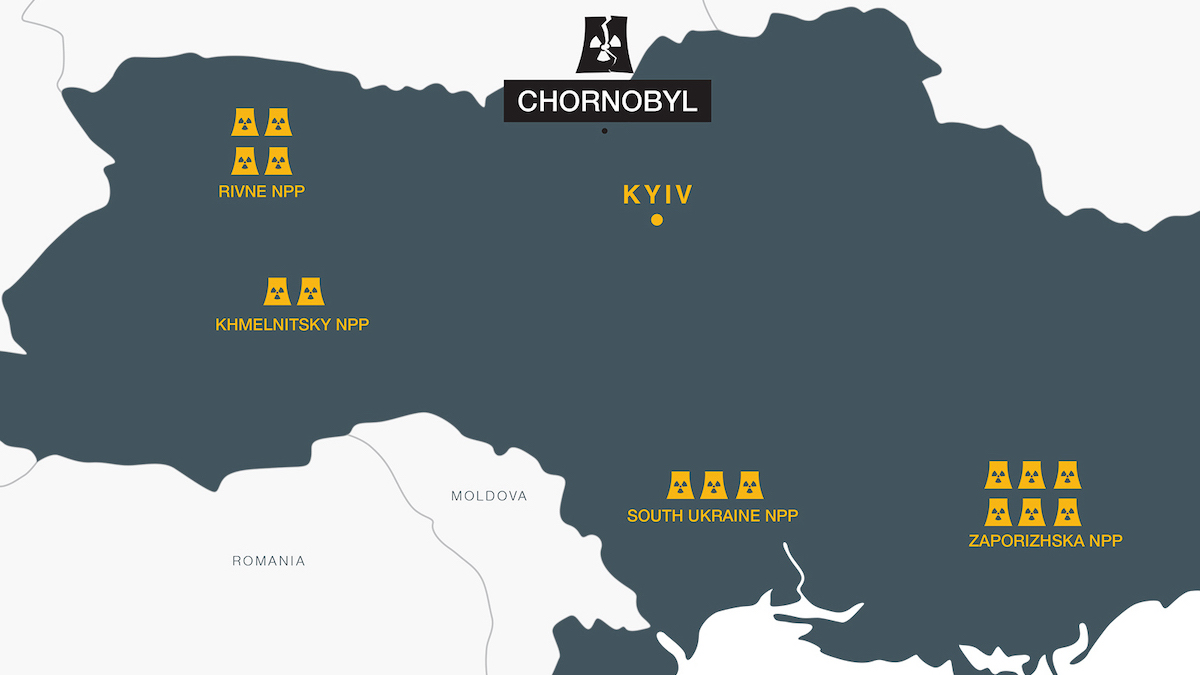
by beyondnuclearinternational, https://beyondnuclearinternational.org/2025/05/11/resuscitation-at-zaporizhzhia/
Why would the US, Ukraine and Russia contemplate this when renewables could answer energy needs faster and more safely, writes Linda Pentz Gunter
The Trump administration has been dangling all sorts of offers before the embattled (literally) Ukrainian government lately. These include a US grab for Ukraine’s minerals in exchange for continued support of its war with Russia, and asking Ukraine to serve as an overseas prison for those residents of the US deemed “illegals” and “criminals” by Trump’s (in)justice department.
Now, the White House is apparently suggesting that the US should first rebuild and then operate the damaged six-reactor Zaporizhzhia nuclear plant in the southeast of Ukraine, the area of some of the most intense fighting between Ukrainian and Russian forces.
This bizarre proposal is detailed in a new column by the director of the Nonproliferation Policy Education Center, Henry Sokolski, in the May 6, 2025 edition of The Bulletin of the Atomic Scientists. Along with the question of whose nuclear plant Zaporizhzhia actually is, or who damaged it, Sokolski also asks just how complex and expensive restoring the plant would be and whether it is even needed?
In reading through the list of challenges to a restart that Sokolski outlines, the answer to that last question becomes increasingly more obvious: No. It is glaringly evident that nuclear power is the wrong choice for Ukraine at this point (and, we would argue, always has been).
Renewable energy can take a couple of years — and in some cases just a few months — to build and bring into operation. Given Ukraine’s previous reliance on nuclear energy for around 55% of the country’s electricity (before the war interrupted the flow), developing an energy supplier that can come on fast and doesn’t present a safety risk (under war conditions or at any other time) is, as they say here, a “no brainer”.
And yet all three countries are vying to be the one responsible for a Zaporizhzhia restart. All three are also married to the idea of a nuclear-powered future and therefore cannot be relied upon to take the more sensible renewable energy route. Even in the midst of a war, Ukraine has signaled its intention to build as many as nine new Westinghouse AP1000 reactors at all four of its existing nuclear sites —yes, even at Zaporizhzhia! Both Russia and the US are expanding their nuclear power capacity, at home as well as abroad, including through the export of reactor technology.
Why then are any of these countries even contemplating an attempt to surmount the likely insurmountable challenges of resurrecting the existing Russian built VVER Zaporizhzhia reactors, which comprise the largest nuclear power plant in Europe at 5,700 MW?
As Sokolski asks in a preamble to his Bulletin article:
“Russia destroyed the Kakhovka Dam upstream of the plant. What would be required to assure a steady clean supply of cooling water for the reactors? The Russians laid mines around the plant; the area is also laced with unexploded ordnance. How will these be neutralized? Who will do this? The Russians looted and damaged much of the plant’s control equipment. How will it be repaired and replaced? Who will certify that the work has been done properly? The U.S. Nuclear Regulatory Commission? The Ukrainian State Nuclear Regulatory Inspectorate? Rosatom?”
Then there’s the issue of cost.
“Will seized Russian assets foot the bill?” Sokolski asks. “Or will it be European Reconstruction Bank funds? What of US investment, taxpayer funds, and any private entity potentially interested in chipping in? Once funds are allocated, who would receive the profits, if any, or be responsible for the losses? Who would assume responsibility for possible accidents and damage to property beyond the plant’s site? And, finally, who will bear the costs of ensuring the plant’s security so that its reactors do not become again the targets of future attacks?”
It’s not just a question of repairing the reactors of course. It’s also an issue of repairing the damaged — and in parts destroyed — electrical grid. Even assuming Zaporizhzhia gets restared, how will the electricity it generates even reach its customers? And do they even have homes left where the lights can be switched on? Let’s remind ourselves one more time that there is a war going on in Ukraine, a bloody and protracted one that began on February 24, 2022 when Russia invaded its neighbor. (The arguments about why and what the precursors were have raged on, especially on the left, but are not the subject of this present discussion.)
There seem to be altogether too many questions surrounding a Zaporizhzhia restart to make any such prospect an even vaguely rational proposition. And there would be no need to ask any of these questions, if the obvious alternative — renewable energy — was mooted instead. These days you can ask AI — a not entirely unbiased source to be sure — which responds that Ukraine hasn’t turned to renewable energy because it “requires significant investment and infrastructure development.” Yes, but not nearly as much as trying to re-establish broken nuclear power plants and reconnect them to a destroyed electricity grid.
None of this will cross the radar at peace talks between the warring parties and the US in its self-appointed role as peacemaker. That’s because solar panels and wind turbines don’t come with the radioactive inventory that has somehow earned nuclear power a position of international — and aspirational — prestige. What it should trigger instead is an array of red warning flags, and not the kind any of us would want to “keep flying here”.
Linda Pentz Gunter is the international specialist at Beyond Nuclear and writes for and edits Beyond Nuclear International. Opinions are her own.
.
Chernobyl shelter’s drone damage includes 330 openings in outer cladding.
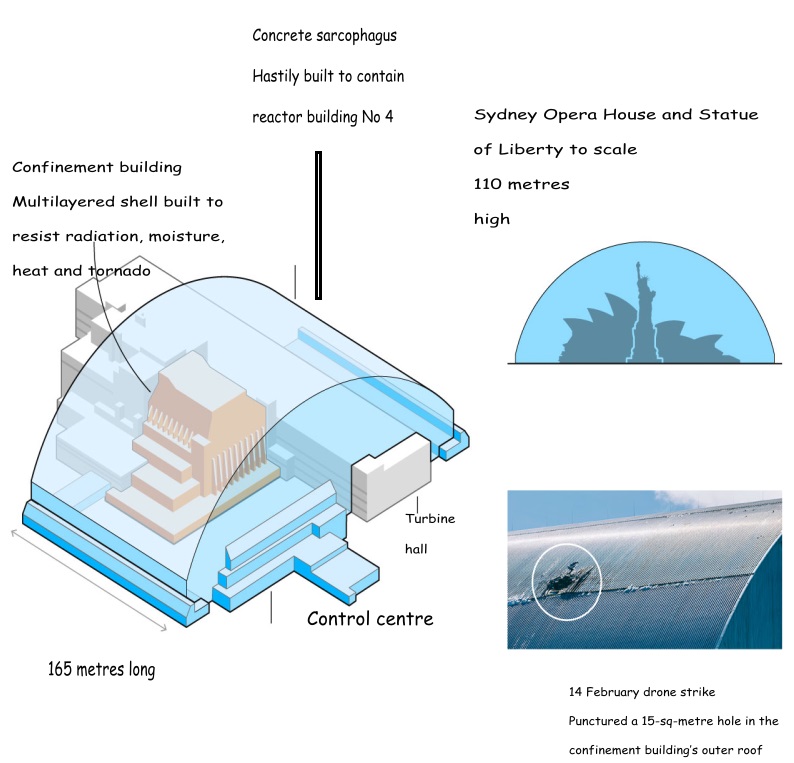
World Nuclear News 9th May 2025
The International Atomic Energy Agency has outlined the scale of the damage caused by a drone strike and subsequent fires to the giant shelter built over the ruins of Chernobyl’s unit 4.
The agency said that investigations continue to determine the extent of the damage sustained by the arch-shaped New Safe Confinement (NSC) shelter following the drone strike on 14 February.
The impact caused a 15-square-metre hole in the external cladding of the arch, with further damage to a wider area of about 200-square-metres, as well as to some joints and bolts. It took about three weeks to fully extinguish smouldering fires in the insulation layers of the shelter.
n its update on the situation, the International Atomic Energy Agency (IAEA) said: “It took several weeks to completely extinguish the fires caused by the strike. The emergency work resulted in approximately 330 openings in the outer cladding of the NSC arch, each with an average size of 30-50 cm.
“According to information provided to the IAEA team at the site, a preliminary assessment of the physical integrity of the large arch-shaped building identified extensive damage, for example to the stainless-steel panels of the outer cladding, insulation materials as well as to a large part of the membrane – located between the layers of insulation materials – that keep out water, moisture and air.”
The main crane system, including the maintenance garage area, was damaged and it is not currently operational, the IAEA said. The heating, ventilation and air conditioning systems are functional but have not been in service since the strike. Radiation and other monitoring systems remain functional, the IAEA said. There has been no increase in radiation levels at any time during or since the drone strike.
IAEA Director General Rafael Mariano Grossi said: “We are gradually getting a more complete picture of the severe damage caused by the drone strike. It will take both considerable time and money to repair all of it.”
…………………………………………………………………………………The New Safe Confinement was financed via the Chernobyl Shelter Fund which was run by the European Bank for Reconstruction and Development (EBRD). It received EUR1.6 billion (USD1.7 billion) from 45 donor countries and the EBRD provided EUR480 million of its own resources.
On 4 March the EBRD allocated EUR400,000 from the administrative budget of the continuing fund for specialist-led damage assessment……………………………..https://www.world-nuclear-news.org/articles/chernobyl-shelters-drone-damage-includes-330-openings-in-outer-cladding
Russian drone strike caused tens of millions worth of damage to Chornobyl
Attack damaged €1.5bn containment structure over nuclear reactor with repair costs likely to be borne by western governments
Russian drone strike caused tens of millions worth of damage to Chornobyl
Attack damaged €1.5bn containment structure over nuclear reactor with repair costs likely to be borne by western governments
Dan Sabbagh in Chornobyl. Photography by Julia KochetovaWed 7 May 2025
A Russian Shahed drone costing up to £75,000 is estimated to have inflicted tens of millions worth of damage to the site of the Chornobyl nuclear power plant, according to initial assessments and engineering experts.
The cost of a full fix is likely to be borne by western governments including the UK, because initial estimates are that a complete repair will cost more than the €25m available in a special international contingency fund.
The strike in mid February did not cause an immediate radiological risk, but it significantly damaged the €1.5bn containment structure built in 2017 to encase the destroyed reactor and is likely to take months if not years to completely repair.
The 110-metre high steel structure at Chornobyl was hit before 2am on 14 February, with sensors registering “something like a 6 to 7 magnitude earthquake,” according to Serhiy Bokov, the chief engineer on duty. “But we clearly understood it wasn’t that,” he said.
The attack – quickly concluded to be caused by a drone flying below at a level where it could not be detected by radar – punctured a 15-sq-metre hole in the outer roof. It also caused a particularly damaging, complex smouldering fire to the inner cladding of the structure that took over a fortnight to put out.
Consisting of two double arches and longer than two jumbo jets, the New Safe Confinement (NSC) was completed in 2017 to secure the hastily built, unstable Soviet-era sarcophagus, which covers over Chornobyl’s ill-fated reactor number four, the site of the world’s worst nuclear disaster in April 1986.
But the attack in February has rendered the sarcophagus open to the elements again, meaning that radioactive dust could get out and rainwater in, though the country’s environmental protection ministry says “the radiation background is currently within normal level and is under constant control”.
More significantly, the confinement structure is now more vulnerable in the longer term to rusting due to greater exposure to the elements and damage to the cladding. Two hundred small boreholes were also drilled into the structure in the effort to douse the cladding fire with water.
“Not fixing it is not an option,” said Eric Schmieman, an American engineer who worked on the design and build of the Chornobyl shelter for 15 years. A complete repair, he said would “cost a minimum of tens of millions of dollars and it could easily go to hundreds of millions” with the repairs taking “months to years,” he added.
Previously the shelter was intended to have a 100-year design life, allowing time to decommission the sarcophagus and nuclear waste below, but this is now in doubt without it being repaired, Schmieman added. Unlike other large metal structures, such as the Eiffel Tower, it was never possible to repaint it to prevent corrosion.
Below the sarcophagus lies a highly radioactive lava like mass, a mix of 200 tonnes of uranium from Chornobyl reactor number four and 5,000 tonnes of sand, lead and boric acid dropped on to the site by Soviet helicopters in the immediate aftermath of the disaster caused by the reactor going out of control.
A more detailed impact assessment is expected to be released in May, but the European Bank for Reconstruction and Development (EBRD), which funded the building of the shelter and is involved in the post bombing analysis, said “it is clear that the attack has caused significant damage”.
Other sources, familiar with the assessment exercise, told the Guardian that Schmieman’s estimates appeared correct. Though the EBRD holds €25m in funds to allow for emergency work, it said “significantly more funding is required” to tackle long-term decommissioning challenges thrown up by the incident…………………………………………………
Further cash for repairs is most likely to come from western governments. Twenty-six countries contributed to the cost of the original shelter, including the US, UK, France, Germany and even Russia – of which the vast steel arch structure cost €1.5bn out of a total €2.1bn fund. Others also made donations, including Turkey.
Home to the remains of a nuclear reactor that went out of control and exploded in April 1986, the Chornobyl site is seven miles from the border with Russia’s ally Belarus. It was occupied by Russian soldiers trying to capture Kyiv in February 2022, and has remained on the frontline after Ukraine regained it that April……………………………………………….
Remotely operated cranes hanging from the confinement shelter were intended to dismantle the sarcophagus and nuclear material below, and the strike hit a point near the maintenance garage Bokov said. That too may impair the plans to gradually dismantle and decommission the disaster site below……………………………….. https://www.theguardian.com/world/2025/may/07/russian-drone-strike-caused-tens-of-millions-worth-of-damage-to-chornobyl
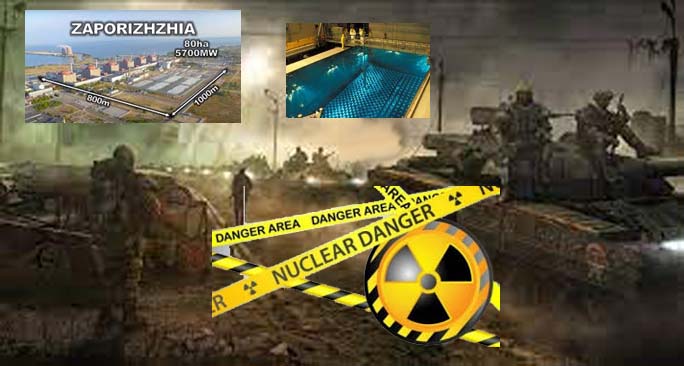
Zaporizhzhia: Hurdle or catalyst for a peace deal in Ukraine?
May 6, 2025, Henry Sokolski , https://npolicy.org/zaporizhzhia-hurdle-or-catalyst-for-a-peace-deal-in-ukraine/
In all the peace proposals the United States, Russia, Europe, and Ukraine have made public, one item always shows up: the reopening of the damaged six-reactor Zaporizhzhia nuclear plant. Washington wants to rebuild and operate it, Moscow insists the plant is theirs, and Kyiv says that it must remain Ukrainian. But, it will be to restart the plant.
Russia insists it can get at least one of the reactors up and running within several months. The United States has no timeline. Ukraine says, even with a solid peace and full control over the plant, bringing all six reactors back online would still take two years or more. No one has ventured how much any of this would cost.
And, there are additional challenges. Russia destroyed the Kakhovka Dam upstream of the plant. Now, what would be required to assure a steady clean supply of cooling water for the reactors? The Russians also laid mines around the plant; the area is also laced with unexploded ordnance. How will these munitions be neutralized? Who will do it? The Russians have looted and damaged much of the plant’s control equipment. How will it be repaired and replaced? Who will certify that the work has been done properly? The U.S. Nuclear Regulatory Commission? The Ukrainian State Nuclear Regulatory Inspectorate? Rosatom?
More than 75 percent of Zaporizhzhia’s nuclear staff no longer work at the plant. Can they be replaced? Who will replace them? Then, there’s the challenge of rebuilding all of the damaged power lines and transformers necessary to export any electricity from the site. Where will the electricity be sent? Ukraine? The European Union? Russian territories? Who will pay for all of this work? Who will be held responsible if there are accidents? Who will defend the plant against future attacks? The United States? Ukraine? Russia? The EU?
There are even more questions than these. But as I make clear in the attached piece, we need to get the answers if we want the situation with Zaporizhzhia to be anything other than a hurdle to reaching any lasting peace.
……… Power for whom and at what cost? Even if the Zaporizhzhia reactors could be safely restarted, the problem of distributing the plant’s power remains. Before the war, Zaporizhzhia helped feed Ukraine’s electrical grid and exported surplus power to Europe. Now, the infrastructure connecting the plant to customers is shattered. Transmission lines must be rebuilt. Substations and transformers need replacement. Technical adjustments will need to be made and agreements negotiated over where the electricity will go and how: western Europe, southern Ukraine, or to Russian-controlled territories?
Another question is who will pay for all this work? Will seized Russian assets foot the bill? Or will it be European Reconstruction Bank funds? What of US investment, taxpayer funds, and any private entity potentially interested in chipping in? Once funds are allocated, who would receive the profits, if any, or be responsible for the losses? Who would assume responsibility for possible accidents and damage to property beyond the plant’s site? And, finally, who will bear the costs of ensuring the plant’s security so that its reactors do not become again the targets of future attacks? None of this is yet clear.
As Ukraine, the United States, and Russia have all made refurbishing and operating Zaporizhzhia a condition for peace, dodging these questions is a prescription for mischief. Without clear answers, resurrecting Zaporizhzhia could become more of an obstacle to than a catalyst for peace.
Henry Sokolski is executive director of the Nonproliferation Policy Education Center in Arlington, Virginia, served as Deputy for Nonproliferation Policy at the Pentagon (1989-93), and is author of China, Russia and the Coming Cool War (2024).
US-Ukraine minerals deal ‘hides secret agreements’ – Ukrainian MP
2 May 25 https://www.rt.com/news/616662-ukraine-us-deal-secret-agreements/
Separate provisions outline Kiev’s “indefinite obligations” and bypass parliamentary ratification, Irina Gerashchenko has claimed.
The US-Ukraine minerals agreement announced this week “hides” details of Kiev’s “indefinite obligations” to Washington, a Ukrainian lawmaker has claimed.
In a Facebook post on Friday, Irina Gerashchenko, a member of European Solidarity party said the deal includes two “secret,” supplementary documents that will not be subject to parliamentary ratification.
The minerals deal reportedly grants the US preferential access to Ukrainian mining projects in exchange for assistance with an investment fund to support the country’s reconstruction. Initially portrayed by Washington as repayment forbears of military support – estimated at $350 billion by President Donald Trump – the final text, published on Thursday by the Ukrainian government, states that only future aid will count toward US contributions to the fund.
Gerashchenko claimed however that instead of one agreement, the US and Ukraine signed three.
“The Zelensky government has not provided deputies and society with all the agreements signed in the US, which, as it turned out, are three, not one,” she wrote. “Meanwhile, they want to ratify only one framework document in the Verkhovna Rada. Others are labeled ‘implementation documents,’ despite the fact that it is in these two secret agreements that all the technical details of indefinite Ukrainian obligations are hidden.”
Ukrainian Prime Minister Denis Shmigal “avoided” commenting on the two documents and the lack of security guarantees in the published agreement – reportedly a key point of contention during negotiations – Gerashchenko told the country’s parliament on Friday.
The claim has raised questions among Ukrainian lawmakers and the public on the actual scope of the agreement. MP Yaroslav Zheleznyak claimed on Telegram that, when pressed, Shmigal acknowledged the two additional documents but downplayed them as “technical” and exempt from ratification. The texts “must be signed after the ratification” of the main agreement, Shmigal claimed, noting that lawmakers would see them when the Ukrainian negotiating team returns from the US next week.
Western media reports have also noted the existence of additional documents and claimed that a last-minute dispute arose when Washington demanded Kiev sign all three. Ukrainian officials reportedly argued they could not sign the annexes until the main agreement was ratified in Parliament. Later reports suggested all three documents were ultimately signed.
Further details about the contents of the supplementary documents have not been publicly released, and the Ukrainian government has not issued an official statement addressing their existence or content.
For second time in 3 years Zelensky sabotages Ukraine war peace deal.

Walt Zlotow, West Suburban Peace Coalition, Glen Ellyn IL 30 Apr 25
Does Ukraine President Zelensky enjoy watching his citizens die needlessly in a US provoked war he could have ended twice?
Zelensky helped ensure Russia would invade February 22, 2022 by pushing NATO membership for Ukraine and massing 60,000 elite troops on the Donbas border to finish off the Russian leaning Donbas Ukrainians seeking independence from Kyiv destroying their culture along with their lives.
But Zelensky sensibly negotiated a peace agreement with Russia in the first two months (Istanbul Agreement) that would have ended the war with no loss of Ukraine territory albeit with no Ukraine NATO membership and independence for the beleaguered Donbas Ukrainians. That was statesmanship of the highest order.
But the US and UK saw a golden opportunity to weaken Russia if not change out the Vladimir Putin regime. What to do? Got it. Send US Defense Secretary Lloyd Austin and UK Prime Minister Boris Johnson to Kyiv to disabuse Zelensky of making peace. Hey, with a couple of hundred billions in US/NATO weapons but no soldiers, you can win Zelensky and go out the George Washington of Ukraine..
The result? Three years on Ukraine is largely destroyed with millions fled, over a hundred thousand casualties, 45,000 square miles gone forever and a shattered economy.
But new sheriff in town Trump brokered a new peace deal which would have ended the war with no further casualties or lost territory, Astonishingly, Zelensky rejected it again, this time of his own free will. He cited both his desire to require Crimea, lost 5 years before he became president, and his goal of Ukraine joining NATO.
So despite a 3 day Russian truce in in the offing over its May celebration of its WWII victory, the dying soldiers and expanding Russian buffer zone in Ukraine to prevent further long range Ukrainian missile attacks will go on till Ukraine simply collapses.
Maybe Zelensky has a nationwide death wish. Maybe he’s delusional or too stupid to realize his leading Ukraine to certain destruction. Or maybe it’s simply his way of telling the US and UK that he’s capable of blowing up a sensible peace agreement all by himself.
Covering up Ukrainian Nazis is nothing new – the Canadians have been doing it for almost eighty years

Ian Proud, April 29, 2025. https://strategic-culture.su/news/2025/04/29/covering-up-ukrainian-nazis-nothing-new-canadians-have-been-doing-it-for-almost-eighty-years/
A number of topics remain taboo in discussing the war in Ukraine. Busification, Zelensky’s democratic mandate, Ukraine’s casualty numbers and anything suggesting that Ukraine cannot win are all off limits. Likewise the problem of alleged neo-Nazis in Ukraine.
One of the most embarrassing episodes since the Ukraine war started in 2022, was when Yaroslav Hunka, was given two standing ovations in the Canadian House of Commons public gallery by MPs during the visit of President Zelensky in 2023. Hunka has been accused by Russia of genocide, because of his alleged involvement in the Huta Pieniacka massacre of February 28 1944 in which more than 500 ethnic Poles were murdered in a village, in what is now western Ukraine. Hunka was a member of the SS Galicia Division, a mostly Ukrainian unit of the Waffen SS, which Commissions in Germany and Poland later found guilty of war crimes.
This was shocking because it opened the lid on a topic of conversation that has been largely silenced by the western mainstream media since the beginning of the war: Ukraine’s contemporary challenge of far-right ultranationalism. But the Hunka case also illustrates how western authorities airbrushed discussion of nazis in Ukraine after World War II too.
On 13 July 1948 the British Commonwealth Relations Office, what is now part of the Foreign Commonwealth and Development Office, sent a telegram to Commonwealth governments, proposing an end to Nazi war crimes trials in the British zone of Germany. “Punishment of war crimes is more a matter of discouraging future generations than of meting out retribution to every guilty individual… it is now necessary to dispose of the past as soon as possible.”
After the conclusion of the Nuremberg War Trials in 1946 the western world faced a new enemy in the Soviet Union. Limited security resources in cash-strapped Albion and its colonies were re-deployed to uncover suspected Soviet agents and Communists, rather than to identify and track down lower-order Nazi war criminals.
Around this time, many Ukrainians fled the Soviet Union to settle in Canada. In the thirty-year period after the start of Operation Barbarossa, the Ukrainian population in Canada almost doubled, from 300,000 to almost 600,000 people. While most of them, I am sure, would not have been Nazi collaborators, some, undoubtedly, were. They were joined by lesser numbers of Latvians, Hungarians, Slovaks and others.
Within that exodus would have been so-called “lesser” war criminals; persons who had organised the transportation of Jews, Slavs, gypsies and homosexuals to death camps, acted as informers, committed murders, or become involved in war crimes as other ranks and non-commissioned officers in death squads. They were the lower echelon collaborators, acting as the instruments of the genocide initiated by the Nazis.
Yet, following the British instruction, Canada progressively relaxed its immigration policy between 1950 and 1962, steadily removing restrictions against the entry of German nazis and non-German members of German military units like the SS Galicia Division.
However, in 1984 the Simon Wiesenthal Center wrote a letter to the Canadian government claiming to have obtained evidence that the ‘Angel of Death’ Josef Mengele had applied for a landed immigrant visa to Canada in 1962. Though this proved to be incorrect, it caused such outrage among Canada’s Jewish community that a Commission of Inquiry on War Criminals in Canada was established in 1985.
Known as the Deschênes Commission, it uncovered a list of 774 persons who had allegedly entered Canada and who required further investigation. Of that list, only 28 underwent serious investigation and trial.
Michael Pawlowski, accused of murdering 410 Jews and 80 non-Jewish Poles in Belarus in 1942, was acquitted as judges blocked the prosecution from gathering evidence in the Soviet Union.
Stephen Reistetter of Slovakia was not tried for allegations that he kidnapped 3000 Jews to have them sent to Nazi death camps while serving in the Hlinka party, a far right clerical-fascist movement with Nazi leanings. His case fell apart because a witness died.
Erich Tobias, was accused of involvement in the execution of Latvian Jews but died before his case went to court.
By 1995, with no convictions for war crimes having been secured, the Canadian Justice Department cut the size of its war crimes unit from 24 to 11 people. In the absence of criminal prosecutions, the Canadian Government tried civil proceedings to revoke citizenship from alleged war criminals.
Wasily Bogutin collaborated with the Nazi occupation forces in the town of Selidovo, in Donetsk, and was personally and directly involved in effecting the roundup of young persons for forced labour in Germany. In February 1998, Judge McKeown, of the Trial Division of the Federal Court, found that Bogutin had concealed his role in war crimes, but he died before he could be extradited.
Joseph Nemsila, who commanded a Slovak unit that sent civilians to Auschwitz died in 1997 after a decision not to revoke citizenship was overturned, but death prevented exportation.
In only 7 cases was order made for the suspect to be extradited or exported. This included Ladislaus Csizsik-Csatary, accused of involvement in the confinement of thousands of Hungarian Jews and their subsequent deportation to death camps. In July 1997, just before his trial was to begin, he decided not to oppose the loss of his citizenship and voluntarily left the country.
Vladimir Katriuk was accused of having taken part in the Khatyn Massacre in Belarus and Wasyl Odnynsky, a guard at SS labour camps at Trawniki and Poniaka. Moves were made to revoke their citizenship, but they were allowed to remain in Canada until all court proceedings were lifted in 2007.
Progress in prosecuting alleged war criminals in Canada was always slow, often held up by foot-dragging by often reluctant judges, and a refusal to allow for the gathering of evidence in the Soviet Union.
Today, the media and Jewish groups still pressure the Canadian government to reveal the names of all of the 774 persons considered by the 1985 Deschênes Commission with so far little success.
An American academic recently discovered what is believed to be a similar list of 700 suspects which included Volodymyr Kubiovych, a Ukrainian Nazi collaborator who helped organize the SS Galicia division and who was editor in chief of the Encyclopedia of Ukraine compiled at the University of Alberta. A photograph of a parade in Lviv, Ukraine, in July, 1943, shows Mr. Kubiovych making a Nazi salute alongside Otto Wächter, a senior member of the SS who also served as governor of Galicia and Krakow.
Yaroslav Hunka was not on that list, raising questions about how many Nazi collaborators in Canada were never discovered.
I don’t think that Ukraine today is a Nazi society and, even at its high watermark, the Svoboda party only garnered 10% of the national vote. But ultranationalism is a major problem, particularly in the west of Ukraine, in that area known as Galicia during World War II. And the refusal of western governments to acknowledge the issue of ultranationalism in Ukraine or speak out means that we are turning a blind eye once more to activity that we would never tolerate in our own countries.
Chernobyl’s Hidden Impact: Disinformation and Nuclear Politics

And yes it is oxymoronic to have the same agency being responsible for safety and promotion of nuclear power
Chernobyl is not the past.
every nuclear power plant ever built assumes there will never be a war on the site.
Chernobyl explosion was “perhaps the real cause of the collapse of the Soviet Union.” According to Mikhail Gorbachev who was the last leader of the Soviet Union and was in power during the meltdown. But perhaps the more important lesson from the Chernobyl catastophe is that disinformation can kill you. It is important to remember that the largest and most deadly nuclear accident in the world was not even reported initially by the secretive and corrupt Soviet Union. It was not until 2 days after the meltdown that the Forsmark Nuclear Power Plant in Sweden detected the radiation and forced the Soviets to admit there had been an accident. Forsmark is 1100 km from Chernobyl.
Disinformation about Chernobyl is not confined to the Soviet Union, western nations and especially the UN played a critical role in down playing and distorting information about the effects of the disaster. This is most obvious in the fatality estimates associated with the catastrophe.
In 1959, the powerful UN agency responsible for both promoting and monitoring nuclear power, the IAEA, signed an agreement with the UN’s health monitoring agency, WHO, that restricted them from reporting on nuclear accidents. And as part of the western public relations cover up, 4 months after the meltdown the then general director of the IAEA, Hans Blix, would affirm: “The world could tolerate a nuclear accident as serious as Chernobyl every year.” WHO was blocked from releasing any independent Chernobyl studies and ultimately the IAEA (with WHO) would officially report that there were only between 4000 to 9000 deaths. [And yes it is oxymoronic to have the same agency being responsible for safety and promotion of nuclear power.]
Consensus is not your friend. There have been many scientific studies of the affects of Chernobyl. Greenpeace did an anthology of these studies at the 25th anniversary and estimated that at least 93,000 people will have died and the actual total is likely well be over 200,000 premature deaths. Why the big difference between the UN’s official tally and independent scientists? The answer is consensus. The IAEA has representatives from pro-nuclear states on it’s Chernobyl Forum, they release their reports operating by consensus and those invested in nuclear energy have a strong interest in down playing the effects of accidents. Independent scientists have also found radiation levels in the exclusion zone to be over three times higher than the IAEA reports.
How effective is this western mis/disinformation campaign? Check out Wikipedia or ask any AI. You will quickly find the IAEAs 4000 person fatality rate. Depending on the source more accurate information is either buried or not revealed in your first responses. Lots of people on the nuclear payrolls have put a bunch of effort into minimizing the impact of all nuclear accidents. This is not a (known) conspiracy, per se, but rather contemporary industrial capitalism functioning as designed. But perhaps more revealing is that almost no mainstream news sources are covering this years 39th anniversary. Far more important in our attention economy is that Trump is going to the Pope’s funeral and we are arresting judges in the US.
Chernobyl is not the past. In February of this year a relatively low cost attack drone blew a hole in the second $1.7 billion Chernobyl sarcophagus. The fire from this attack burned for 3 weeks, requiring technicians to make further holes in the exterior shell in a high stakes game of “nuclear whack a mole”
“We did a lot of safety analysis, considering a lot of bad things that could happen,” said a senior technical adviser on the project. “We considered earthquakes, tornadoes, heavy winds, 100-year snowfalls, all kinds of things. We didn’t consider acts of war.”
It is worth pointing out that every nuclear power plant ever built assumes there will never be a war on the site. Assuming otherwise would be yet another in the long list of reasons why nuclear power should not be considered or continued. Other major problems with civil nuclear power include: subsidized insurance, proliferation risks, uneconomic construction and operation, perverse effects on avoiding climate disruption and the threat to democracy. The total cost of the Cheronbyl accident has been estimated at $700 billion which is about 5 times the Ukraines average GDP for the last 10 years.
The only good nuclear news on this anniversary is the complexity of nuclear power plants combined with the previous globalization of the nuclear construction and fuel supply chain mean that Trump’s tariffs may put the breaks on any new nuclear construction in the US. Or perhaps more sadly, these Trump taxes will just increase the already ridiculous price of nuclear power to both taxpayers and ratepayers.
1 This Month
29 Jan. Thursday 7-8 p.m. Webinar – World’s Largest Nuclear Station in Port Hope, ON?


31st January – Challenging the War Machine – a DECLASSIFIED UK SUMMIT

Website of the Week
Now until to February 10, 2026 Radioactive waste storage in France: the debate is finally open! How to participate?
-
Archives
- January 2026 (246)
- December 2025 (358)
- November 2025 (359)
- October 2025 (376)
- September 2025 (258)
- August 2025 (319)
- July 2025 (230)
- June 2025 (348)
- May 2025 (261)
- April 2025 (305)
- March 2025 (319)
- February 2025 (234)
-
Categories
- 1
- 1 NUCLEAR ISSUES
- business and costs
- climate change
- culture and arts
- ENERGY
- environment
- health
- history
- indigenous issues
- Legal
- marketing of nuclear
- media
- opposition to nuclear
- PERSONAL STORIES
- politics
- politics international
- Religion and ethics
- safety
- secrets,lies and civil liberties
- spinbuster
- technology
- Uranium
- wastes
- weapons and war
- Women
- 2 WORLD
- ACTION
- AFRICA
- Atrocities
- AUSTRALIA
- Christina's notes
- Christina's themes
- culture and arts
- Events
- Fuk 2022
- Fuk 2023
- Fukushima 2017
- Fukushima 2018
- fukushima 2019
- Fukushima 2020
- Fukushima 2021
- general
- global warming
- Humour (God we need it)
- Nuclear
- RARE EARTHS
- Reference
- resources – print
- Resources -audiovicual
- Weekly Newsletter
- World
- World Nuclear
- YouTube
-
RSS
Entries RSS
Comments RSS
 nuclear-news