Russia halts nuclear waste disposal from Ukraine

 https://www.rt.com/business/344821-russia-halts-nuclear-waste-disposal/ 30 May, 2016 Russia’s state nuclear agency Rosatom has stopped removing spent nuclear fuel from Ukraine because bills have been unpaid, said nuclear decommissioning executive Oleg Kryukov. There are problems related to Ukraine’s payments,” he said, adding that the first shipment of nuclear waste for disposal has been postponed.
Kryukov affirmed the agency plans to continue disposing of nuclear waste already in Russia for processing.
“We have a contract with Ukraine on storing spent nuclear fuel and its recycling. We are going to continue with the contract, although the Ukrainian side plans to build its own warehouse for spent fuel without recycling,” he said on the sidelines of the Atomexpo-2016 forum.
Under the agreement signed between two countries in 1993, Russia supplies reactor fuel to Ukraine and takes spent fuel rods for storage and reprocessing.
A year ago, Ukraine said it planned to invest $25 million in a centralized spent nuclear fuel storage facility at the Chernobyl nuclear power plant.
Kiev is currently trying to attract Western investors to kick-start the project.
Lithuania, and environmentalists not happy with Belarus’ nuclear power plan
Minsk Letter: Belarus goes ahead with nuclear power, Irish Times, Kieran Cooke in Minsk, 24 May 16,
“…….Though Chernobyl is in Ukraine, it’s estimated that the prevailing winds resulted in up to 70 per cent of the radioactivity being deposited on Belarus, much of it in the southern region of the country, close to the Ukrainian border.
Undeterred by the legacy of Chernobyl – many here still suffer from cancers and other diseases as a result of what ranks as the world’s worst nuclear accident – Belarus is now building its own nuclear power plant……
The government – for more than 20 years under the firm grip of president Alexander Lukashenko – claims that more than 60 per cent of the country’s 9.5 million approve of the nuclear facility, though no nationwide poll has ever been taken…..
Government critics say no proper public hearings have been held about the plant, and that those who dare to raise objections have been harassed or arrested……..
Russian reliant
Critics point out that Belarus will still be reliant on Russia. A Russian state nuclear company has designed and is responsible for much of the construction. Russia will also supply the plant’s nuclear fuel – and deal with the waste.
Neighbouring Lithuania, always suspicious of a government in Minsk it sees as a remnant of the old Soviet order, is deeply concerned about what’s going on. It points out that the plant at Ostrovets is only 20km from the Lithuanian border and only 50km from Vilnius, the capital.
Officials in Vilnius say Belarus has not answered questions about the safety of Ostrovets and is in contravention of international agreements on nuclear facilities. The government in Minsk firmly denies the accusations.
Svetlana Alexievich, the Belarus author and winner of the 2015 Nobel prize for literature for her work on interviewing Chernobyl victims and other writings, has described the nuclear fallout from Chernobyl as an unimaginable disaster for her country.
Back at the new nuclear plant, due to become operational in two years, we are being bombarded with data. So many thousands of tons of concrete, so many tons of steel are being used in its construction.
“What happens if a missile is fired at the plant?” asks one journalist.
“Then we are all in trouble,” comes the reply. http://www.irishtimes.com/news/world/europe/minsk-letter-belarus-goes-ahead-with-nuclear-power-1.2658040
America gets Ukraine to hop on its nuclear power marketing bandwagon
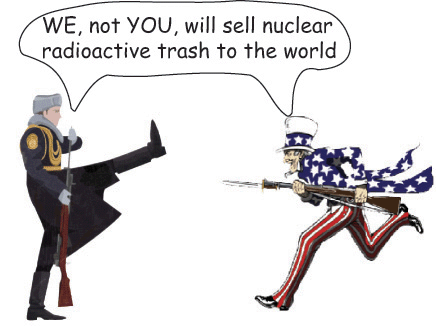 How Washington Is Fighting For Russia’s Old Europe Energy Market, Forbes, Kenneth Rapoza , 17 May 16
“……..Nuking Ukraine
Getting Ukraine to hop on the Westinghouse band wagon was particularly crafty. Either it was simply fantastic timing on the part of Westinghouse, or the U.S. government and the new, post-Euromaidan government of Ukraine colluded to kick Russia to the curb.
“I think that Westinghouse was somehow involved in getting the EC to push Ukraine away from Russia on this front,” says Tomas Vlcek, an nergy security expert based out of Masaryk University in the Czech Republic.
In March 2014, just two months after the pro-Russian president Viktor Yanukovych was ousted, a European environmentalist group called Bellona sent out stories saying that the Russian government was ready to punish Ukraine with an embargo on nuclear fuel supplies from TVEL.
When compared to what Gazprom has done with gas supplies, Putin ordering a stop on TVEL sales of nuclear fuel assemblies simply sounded like something he would propose. Only, it is not possible to ban nuclear fuel supply. Not only does the fuel rod stay in the reactor for years, someone else can make it for the reactor instead of the Russians. Like Westinghouse.
The Bellona coverage brandished Russia as a villain in the nuclear energy business too. Brussels called for “diversification” in Ukraine’s nuclear fuel market and gave Westinghouse’s European fuel division millions of euros in subsidies for the sake of “energy security”.
The whole shebang had nothing to do with Westinghouse in Pennsylvania. Their spokeswoman said she’s never heard of Bellona. Her colleagues in Europe, on the other hand-
Derek Taylor, the former E.U. civil servant who works at the Brussels branch of Bellona is also a Senior Advisor on energy at Burson-Marsteller which, in turn,is a public affairs firm working for Westinghouse worldwide.
Despite the civil war in East Ukraine, sanctions and Gazprom gas disputes, the Russians have never missed any scheduled nuclear fuel delivery to Ukrainian nuclear power plants.
Westinghouse is more than a brand name American power company. It’s a battering ram used by Washington to promote energy security.
In 2012, Ukraine’s nuclear regulator banned the use of Westinghouse fuel assemblies in the country pending an investigation. Two years later, according to sources in Ukraine, then-Prime Minister, Arseniy Yatsenyuk consulted Westinghouse on picking a new nuclear safety regulator for his new government.
In 2015 during a scheduled outage at a reactor unit at the South Ukraine nuclear power plant, two of the Westinghouse-made fuel assemblies were found to be leaking contrary to Westinghouse’s claims that those were of an ‘improved’ modification to fit the Rosatom VVER-1000 type nuclear reactors there.
Regardless, anti-Russia politics trumps technological problems. Westinghouse is currently planning to deliver five reloads of fuel to the South Ukraine and Zaporizhia nuclear power plants, the company said on April 28, meaning the new regulator has concluded its study and their VVER-1000 fuel assemblies are as good as those made in Russia. Capturing that market, as Toshiba says it will in corporate presentations, serves as a means to punish the Russians. It’s a political convenience the Russian’s are not willing to ignore.
“Our ability to make VVER fuel is not in question,” says Westinghouse Roderick. “We will continue to sell to VVER-1000s. I think it’s good to have competition in that market.”
It is good. Political pressure, whether Russian or American, is probably more harm than good. And it’s going to really irk countries, like Russia, who clearly see it as Washington poking them in the eye on purpose.
Energy security is therefore as much fact as it is fiction. It is as much a means to market Russian rivals as it is to limit the serious role energy politics plays in Russian-European relations.
But derailing nuclear projects while running into technical difficulties with Westinghouse fuel assemblies in Rosatom reactors is a dangerous way to promote energy security there. Paradoxically as it might seem, it plays into Russia’s hands when those projects to work according to plan. The Russians look reliable and solid by comparison.
“On the finance side too, I think Rosatom has Westinghouse beat,” says Jirusek about the Russian company’s ability to finance the construction of a new power plant and long term fuel supply deals.
Apart from Ukraine, where diversification was imposed for political reasons, Rosatom’s TVEL still holds its market share. Japan’s Westinghouse, despite paying no corporate tax in the U.S., will continue applying the pressure with the help of Washington and the U.S. taxpayer.
For the Russia-United States nuclear stand off , once again it is a war of attrition.
On May 12, Toshiba said it is coming back from the brink. It will post an operating profit of $1.1 billion this year after losing $6.6 billion last year due to massive write downs associated with Westinghouse and restructuring costs in the wake of a damaging accounting scandal.
No one should bet that Washington will suddenly stop selling their Westinghouse nukes to the Europeans. They could promote another Japanese-American hybrid, like the General Electric/Hitachi boiled water reactors. Or Oregon-based NuScale, who make a smaller modular reactor that is less capital intensive and is designed to be integrated into a renewable energy grid. But they do not, obviously. It’s not because those are inferior products or even that Europe is currently a pressurized water reactor market. They do it because Westinghouse competes directly with the Russians. That’s what Washington is really after. http://www.forbes.com/sites/kenrapoza/2016/05/17/washingtons-european-energy-security-boondoggle/#4247a5f362ef
Widespread and lingering medical effects of the Chernobyl nuclear disaster
 The Medical Implications of the 1986 Chernobyl Nuclear Disaster http://www.globalresearch.ca/the-medical-implications-of-the-1986-chernobyl-nuclear-disaster/5521671 Thirty Years Ago, April 1986 By Helen Caldicott Global Research, April 25, 2016 The following text by renowned scientist
and physician Dr. Helen Caldicott on the impacts of the 1986 Chernobyl will be followed in a subsequent article by an analysis of the medical implications of the Fukushima disaster
 The only on-site medical and epidemiological data gathered after Chernobyl was released in a report published by the New York Academy of Medicine in 2009 titled “Chernobyl – Consequences of the Catastrophe for People and the Environment,” which was gleaned from over 5000 papers published largely in Russian and translated into English.
These studies were gathered mainly from populations residing in the heavily irradiated zones in the Ukraine, Belarus and European Russia. However the Russian government classified all the relevant medical data for 3 years.
The Chernobyl 1986 catastrophe has turned into a new medical experiment conducted on millions of innocent people, much like the populations of Hiroshima and Nagasaki.
Because, the International Atomic Energy Agency, the United Nations Security Committee on the Effects of Atomic Radiation and the World Health Organisation never collected data from real patients, instead to their discredit they estimated the number of potential diseases that they derived only from calculations of radioactive releases and extrapolated doses.
Hence it is vitally important to scientifically and epidemiologically document the many illnesses which arose after the accident so that the medical profession can learn from these shocking accidents. These papers presented in the Chernobyl report by the NY Academy of Sciences attempt to do so. Some people say that they are not adequately peer reviewed so they should be ignored, however they are the only on-the-ground documentations of the many illnesses afflicting the irradiated populations
In essence 28 years after the accident, 50% of thirteen European countries are still contaminated by a variety of long-lived radioactive elements and the medical effects are severe in some areas. Before Chernobyl, 80% of the children in Belarus were healthy and now only 20% remain in good health.
Millions of people initially were exposed to very high radiation doses from short-lived radioactive elements so the initial radiation doses were thousands of times higher than doses received 3 years later.
Types of radioactive elements Continue reading
Wildlife continues to suffer seriously from radiation at Chernobyl and Fukushima
Our studies provide new fundamental insights about consequences of chronic, multigenerational exposure to low-dose ionizing radiation. Most importantly, we have found that individual organisms are injured by radiation in a variety of ways. The cumulative effects of these injuries result in lower population sizes and reduced biodiversity in high-radiation areas.
Broad impacts at Chernobyl
 Radiation exposure has caused genetic damage and increased mutation rates in many organisms in the Chernobyl region. So far, we have found little convincing evidence that many organisms there are evolving to become more resistant to radiation.
Organisms’ evolutionary history may play a large role in determining how vulnerable they are to radiation. In our studies, species that have historically shown high mutation rates, such as the barn swallow (Hirundo rustica), the icterine warbler (Hippolais icterina) and the Eurasian blackcap (Sylvia atricapilla), are among the most likely to show population declinesin Chernobyl. Our hypothesis is that species differ in their ability to repair DNA, and this affects both DNA substitution rates and susceptibility to radiation from Chernobyl.
Much like human survivors of the Hiroshima and Nagasaki atomic bombs, birds and mammals at Chernobyl have cataracts in their eyes andsmaller brains. These are direct consequences of exposure to ionizing radiation in air, water and food. Like some cancer patients undergoing radiation therapy, many of the birds have malformed sperm. In the most radioactive areas, up to 40 percent of male birds are completely sterile, with no sperm or just a few dead sperm in their reproductive tracts during the breeding season.
Tumors, presumably cancerous, are obvious on some birds in high-radiation areas. So are developmental abnormalities in some plants and insects.
Given overwhelming evidence of genetic damage and injury to individuals, it is not surprising that populations of many organisms in highly contaminated areas have shrunk. In Chernobyl, all major groups of animals that we surveyed were less abundant in more radioactive areas. This includes birds, butterflies, dragonflies, bees, grasshoppers, spiders and large and small mammals.
Not every species shows the same pattern of decline. Many species, including wolves, show no effects of radiation on their population density. A few species of birds appear to be more abundant in more radioactive areas. In both cases, higher numbers may reflect the fact that there are fewer competitors or predators for these species in highly radioactive areas.
Moreover, vast areas of the Chernobyl Exclusion Zone are not presently heavily contaminated, and appear to provide a refuge for many species. One report published in 2015 described game animals such as wild boar and elk as thriving in the Chernobyl ecosystem. But nearly all documented consequences of radiation in Chernobyl and Fukushima have found that individual organisms exposed to radiation suffer serious harm.
There may be exceptions. For example, substances called antioxidants can defend against the damage to DNA, proteins and lipids caused by ionizing radiation. The levels of antioxidants that individuals have available in their bodies may play an important role in reducing the damage caused by radiation. There is evidence that some birds may have adapted to radiation by changing the way they use antioxidants in their bodies.
Parallels at Fukushima
Recently we have tested the validity of our Chernobyl studies by repeating them in Fukushima, Japan. The 2011 power loss and core meltdown at three nuclear reactors there released about one-tenth as much radioactive material as the Chernobyl disaster.
Overall, we have found similar patterns of declines in abundance and diversity of birds, although some species are more sensitive to radiation than others. We have also found declines in some insects, such as butterflies, which may reflect the accumulation of harmful mutationsover multiple generations.
Our most recent studies at Fukushima have benefited from more sophisticated analyses of radiation doses received by animals. In our most recent paper, we teamed up with radioecologists to reconstruct the doses received by about 7,000 birds. The parallels we have found between Chernobyl and Fukushima provide strong evidence that radiation is the underlying cause of the effects we have observed in both locations.
Some members of the radiation regulatory community have been slow to acknowledge how nuclear accidents have harmed wildlife. For example, the U.N.-sponsored Chernobyl Forum instigated the notion that the accident has had a positive impact on living organisms in the exclusion zone because of the lack of human activities. A more recent report of the United Nations Scientific Committee on the Effects of Atomic Radiation predicts minimal consequences for the biota animal and plant life of the Fukushima region.
Unfortunately these official assessments were largely based on predictions from theoretical models, not on direct empirical observations of the plants and animals living in these regions. Based on our research, and that of others, it is now known that animals living under the full range of stresses in nature are far more sensitive to the effects of radiation than previously believed. Although field studies sometimes lack the controlled settings needed for precise scientific experimentation, they make up for this with a more realistic description of natural processes.
Our emphasis on documenting radiation effects under “natural” conditions using wild organisms has provided many discoveries that will help us to prepare for the next nuclear accident or act of nuclear terrorism. This information is absolutely needed if we are to protect the environment not just for man, but also for the living organisms and ecosystem services that sustain all life on this planet……https://theconversation.com/at-chernobyl-and-fukushima-radioactivity-has-seriously-harmed-wildlife-57030
The real menace of the Chernobyl nuclear situation
 30 Years After the Chernobyl Disaster, a Nuclear Menace Still Hides in Plain Sight, THE WORLD POST, Ioana Moldovan Freelance Photojournalist and Documentary Videographer 04/25/2016 “……..The highlight of the tour is getting near Chernobyl plant’s reactor no. 4, some 200 meters from its remains. That’s as close as tourists can get. From the other side of the tall fence surrounding the complex, they can see the new “sarcophagus” shining in the sun. The old “sarcophagus,” or containment, was assembled back in 1986 and was intended to be temporary. The New Safe Containment is meant to cover reactor no. 4 and offer protection from still dangerous radiation for a century to come.
Aleksandr Kupny, one of the most outspoken critics of the slow-movingsarcophagus project, is not that confident that it will last this long.
“The sarcophagus is not hermetic, was not designed to be,” he said. “If, God forbid, something collapses in there, it will equal a 3 to 4 level tornado of dust. … There are already 35 tons of dust accumulated there and it is radioactive.”
………“There are two realities,” says Bozhenko Vadim Borisovich, medical director at the hospital for radiation diseases in Kiev. “The official one of the State Nuclear Regulatory Inspectorate of Ukraine saying there is no more danger related to the Chernobyl accident, and the one I get to witness every day in this hospital.”
The medical center was opened on Aug. 1, 1986, accepting all “Chernobyl status” persons. Ever since, it has treated over 60,000 children and 600,000 adults, according to Borisovich. About a year ago when I was there, 100 children were hospitalized due to reactions from radiation.
There aren’t completely accurate figures about the number of people affected by Chernobyl. The data that Borisovich has shows that, on Jan. 15, 2015, the number affected by the power plant disaster was 2,011,799. Out of those, 453,391 were children.
“There are lots of children living in polluted areas that ingest radiation through food and water,” Borisovich says. “Children and grandchildren of Chernobyl victims present inborn malformations. Every child living there is sick. They all suffer from four to five diseases because of low immunity.”………
When people need to worry about everyday life, about making a living in an eroded economy, thinking about the danger of nuclear reactors does not even come second.
“There are no safe nuclear reactors. There is no economic stability that allows safe operation,” says Vladimir Ivanovich, former Chernobyl liquidator and former lawmaker. “Recession means lower operational quality so reactors become dangerous. Most terribly, unstable situations often occur. Right now we have Russia’s aggression and for the first time we have a continuing armed conflict next to nuclear reactors.”
Zaporizhia nuclear plant sits only 200 kilometers away from the front line in the east.
“Putin must connect Crimea by land and this goes through Zaporizhia region, through Berdiansk, Melitopol and on to Crimea,” says Bilitsky, the environmental activist. “Energodar [the small town in which the plant is actually located] is only a stone’s throw away from Melitopol [another town in Zaporizhia region]… Shoot a powerful cannon and you’re there.”
But the war in Ukraine has seen much more than a cannon shot. It has seen heavy artillery fire and even Grad missiles. People are scared that Russian troops are close and have weaponry that can hit the power plant.
“This should never happen here,” says Sergei Shygyn, chief specialist for nuclear reactors at the Zaporizhia nuclear power plant. “Both Ukraine and the international community should prevent military actions here.” He continues: “The media asked me if Zaporizhia NPP can withstand military action. It can’t. NPP’s were not designed for war.”
Having military action just around the corner, one of the main concerns is that spent fuel is kept in containers standing under the open sky, without any terror-proof cover……….http://www.huffingtonpost.com/ioana-moldovan-/chernobyl-nuclear-menace_b_9774040.html
Covering shattered Chernobyl nuclear reactor – a financial problem for Ukraine
Nuclear comeback: Funding fears for hi-tech lid on Chernobyl, The Australian, NATHAN HODGE, THE WALL STREET JOURNAL APRIL 26, 2016″………
A workforce of about 2500 people is finishing a massive steel enclosure that will cover Chernobyl’s reactor 4, where the radioactive innards of the nuclear plant are encased in a concrete sarcophagus hastily built after the disaster. The zone is now aglow with the reflective safety vests of construction workers.
If all goes to plan, the new structure — an arch 260m wide, 165m long and 110m high — will be slid into place late next year over the damaged reactor and its nuclear fuel, creating a leak-tight barrier designed to contain radioactive substances for at least the next 100 years.
The project, known as the New Safe Confinement, is a feat of engineering. It will take two or three days to slide the 36,000- tonne structure into place. The arch, which looks something like a dirigible hangar, is large enough to cover a dozen football fields.
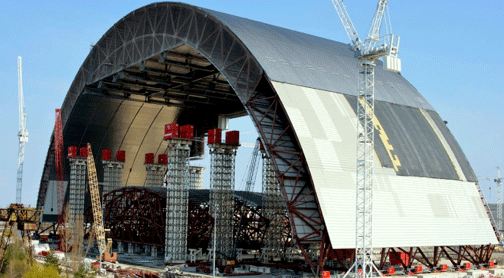
“You could put Wembley Stadium underneath here, with all the car parks,” said David Driscoll, the chief safety officer for the French consortium running the construction site.
- …….
Nicolas Caille, project director for Novarka, the consortium of Vinci and Bouygues, the French contractors running the project, said about 1000 people worked on a typical shift at the construction site, keeping to a schedule of 15 days in and 15 out.
The €2.15 billion ($3.1bn) shelter installation plan has been funded by international donors and the European Bank for Reconstruction and Development, a non-profit lending institution. But the Chernobyl clean-up faces a shortfall: €100 million is needed to finish a storage facility for highly radioactive spent nuclear fuel from the other three reactors, all now offline
The EBRD’s spent fuel facility contract is with a US-based energy technology firm. When the dollar-denominated contract was signed, the euro was stronger against the greenback; with the two currencies approaching parity, the bank faces a shortfall.
“This has dug a huge euro hole,” said Vince Novak, director of the nuclear safety department for the EBRD. “Our income is in euros.”
Mr Novak said donors would meet by the end of this month to discuss financing to finish the project, which is financed separately from the Chernobyl shelter fund.
Spent fuel rods are stored in an ageing facility.
Completion of the project, Mr Novak said, “has always been somehow in the shadow of the New Safe Confinement because it is not as attractive, not as sexy. But it is equally important in terms of nuclear safety.
Even if donors plug the gap, Chernobyl will continue to pose a financial challenge for Ukraine.
More than 40 countries and the EBRD have contributed to the Chernobyl containment work, and international donors say it will be years before the Kiev government can take on the larger share of the burden. http://www.theaustralian.com.au/business/wall-street-journal/nuclear-comeback-funding-fears-for-hitech-lid-on-chernobyl/news-story/1df7b13de774a981f1063ac3c62e9a36
European Union and other global donors pledge more money for Chernobyl nuclear safety effort
Global donors pledge more money for nuclear safety on Chernobyl anniversary, DW 26 Apr 16 Ukraine has commemorated the 30th anniversary of the Chernobyl nuclear disaster. Global donors have used the occasion to pledge additional funds to help keep the area safe for generations to come………A UN report in 2005 estimated that “up to 4,000” people could eventually perish from the invisible poison in Ukraine and neighboring Russia and Belarus.
The exact number of dead remains a subject of intense debate because the Soviet authorities kept most of the information about the disaster hidden.
Global donors
The EU was among the global donors that promised an additional 87.5 million euros ($99 million) to help secure the Chernobyl nuclear power plant, as the Ukrainian government began marking 30 years since the disaster.
The money will go toward the construction of a new spent nuclear waste storage facility, adding to the 2 billion euros already donated to helping clean up and secure the site. Ukraine still needs 15 million additional euros to be able to safely store hazardous materials underground.
“It’s an important project for the world as well as, of course, for Ukraine and Ukrainians,” said Suma Chakrabarti, chief of the European Bank for Reconstruction and Development (EBRD), the organization in charge of the project…….http://www.dw.com/en/global-donors-pledge-more-money-for-nuclear-safety-on-chernobyl-anniversary/a-19214334
Ukraine: Over 2 million people receiving benefits due to radiation effects of Chernobyl nuclear disaster
Chernobyl wounds still fresh as Ukrainians mark 30th anniversary of disaster, WP, By Andrew Roth April 26 “……….On Monday, the United States announced that it was pledging an additional $10 million to the Chernobyl restoration project, on top of $400 million Washington has already committed.
The completion of construction will probably have major consequences for a small army of more than 2,000 workers, many of whom will probably no longer be needed once the project is finished. But as Ukraine seeks to cut social benefits and enact austerity measures to comply with the International Monetary Fund, the situation appears toughest for the survivors of the accident 30 years ago.
Some of the surviving liquidators, the first responders who suffered debilitating or even lethal doses of radiation while fighting to contain the fallout, have protested their treatment.
More than 2 million people in Ukraine are on Health Ministry rolls for benefits because of the accident…….https://www.washingtonpost.com/world/europe/30-years-after-chernobyl-disaster-containment-is-nearing-completion/2016/04/24/fa6888a4-064f-11e6-bfed-ef65
Ukraine’s nuclear industry remains a time bomb
But the nuclear danger in Ukraine does not go away with the conflict in the east quieting down this year, the scale and intensity of the war reduced to a shadow of what it was during 2014 and the beginning of 2015. The country, already facing economic depression, a war and a PTSD epidemic, has to deal with the lifetime of its nuclear reactors going to an end.
Ukraine has 15 nuclear reactors divided between four nuclear power plants. Built during Soviet times, 12 of them have a designed lifetime that ends before 2020. As the government in Kiev together with the operating company Energoatom are determined to keep all reactors running for at least 10 years beyond their expiry date, four units have already received licenses for their expanded lifetime.

“The situation is that the reactors are in a bad shape and always have been,” says Patricia Lorenz, nuclear safety expert with Friends of the Earth, an organization that campaigns for solutions to environmental problems. “They lag 15 years in safety level and they are definitely not catching up. The general problem is aging, maintenance — that is always a big topic, especially with power plants here where they admit they don’t have enough money for keeping them.”
But Ukraine got a loan for bringing its reactors up to international standards. The European Bank for Reconstruction and Development is providing 300 million euro in a project that will cost 1.4 billion euro in total and is scheduled for completion by the end of 2017. The European Atomic Energy Community, or Euratom, iscontributing another 300 million euro.
According to Bankwatch, an NGO that monitors the activities of international financial institutions in order prevent them from financing environmentally and socially harmful investments, the lifetime of the four reactors was prolonged without completing necessary safety upgrades and without properly assessing all risks. This means disregarding the legal conditions attached to the EBRD loan.
The same NGO is concerned that this European financial support is nothing else but “cementing Ukraine’s dependence on an outdated and highly unsafe nuclear sector” — and with that, its dependence on Russia, as all of Ukraine’s nuclear reactors use Russian technology and are almost entirely dependent on nuclear fuel from Russia. Furthermore, Ukraine has yet to make long-term investments in infrastructure and safe disposal of radioactive waste, which is also sent back to Russia.
No peaceful atom
With the Chernobyl disaster still casting its long shadow, Ukraine’s decision to base its long-term energy policies on the lifetime extension of its Soviet-era nuclear reactors is at least worrisome. Between 2010 and 2015 alone, three different unitswere forced to shut down due to accidents, while severe safety issues wereidentified in two more units. The reality is that Ukraine’s nuclear power plants currently supply over half the country’s electricity. But some say that this comes more from a political choice of the government, rather than necessity or lack of options.
The problem with a nuclear disaster is that it doesn’t give a damn for borders. So this is not only Ukraine’s problem, it is a European one and the danger lurks on at least all of its neighboring countries. And there are questions that still need answering: Is the lifetime extension process performed so that it can ensure the safety of not only Ukrainians but all Europeans as well? Are all the measures being taken to avoid another Chernobyl? Because in the end, says Oleksandr Galuh, “there is no such thing as the peaceful atom.” http://www.huffingtonpost.com/ioana-moldovan-/chernobyl-nuclear-menace_b_9774040.html
Ukraine will have to move beyond nuclear power, but when?
 Thirty years after Chernobyl, what chance of a post-nuclear Ukraine? Ecologist, Jan Haverkamp & Iryna Holovko 26th April 2016“………A move towards clean, renewable energy sources – such as wind, water, sun, biomass and geothermal – would seem a logical route, especially given the potential savings in health costs and increase in energy independence.
Here, in these countries most afflicted by Chernobyl, economic realities make this switch to a clean energy future inevitable: the old centralised energy economy is collapsing, slowly but surely, and an awareness movement is growing.
In Ukraine, future-oriented enterprises will choose independence from the politically and economically unstable conglomerates that dominate the country’s energy sector. The question is: are these companies getting the space they need to start Ukraine’s energy [r]evolution?
The [r]evolution is inevitable – but not when it happens
Clearly, Ukraine currently faces several fundamental choices for the future. These choices relate to political contexts and preferences, but none of them is as inevitable as the need for an energy [r]evolution.
We are not asking anyone to experiment with unknown technologies. The techniques for a clean energy future exist, and Ukraine has even built up experience with them. Technically, then, the next step is an evolution. But one that means a revolutionary departure from a highly unstable energy politics that rely on centralisation of access to gas, oil, coal and nuclear power, and the energy policy and planning paradigms associated with it.
Ukraine has significant potential for the development of renewable energy sources. Asresearch for The Solutions Project by Mark Jacobson and his team at Stanford University shows, Ukraine could cover its entire energy demand in 2050 with wind, solar and water and a 32% decrease in primary energy need.
However, the fact that Ukraine currently enjoys only 1 GW of installed capacity from renewable sources signals that energy policy is yet to undergo fundamental change, and the obstacles are many.
The staying power of old energy structures should not be underestimated. Ukraine’s electricity market is a political battlefield, and not only due to interference of oligarchs and dependency on Russia for coal, nuclear fuel and technology. The market is virtually completely regulated, and regulation has become a political tool…….
Twelve of these reactors were built in the 1980s, and are now in need for large safety upgrades if they are to be operated with a lifetime extension beyond 30 years.
Risky business: ageing nuclear plants starved of investment……..
The necessary safety upgrades (for life-time extension, but also in reaction to the Fukushima catastrophe – Ukraine participated in the EU post-Fukushima nuclear stress tests) are thus weakened or postponed, and there are even indications that there is a lack of money for operational costs.
At the same time, Ukraine’s nuclear fleet faces an increased security risk due to political instability. The risks for terrorist or insurgent attack on nuclear infrastructure are currently higher than in peace time, meaning further upgrades are necessary.
In addition, most of the upgrading work is dependent on Russian technological input. Delays in the implementation of upgrades are not only caused by lack of finance, but also by unforeseen technical complications and problems with tender procedures. On top of that, Energoatom is bleeding funds on an unrealistic nuclear new build programme in Khmelnytksy, western Ukraine.
The political position of Ukraine’s increasingly risky nuclear sector is strengthened by the rhetoric that only lifetime extension of the ‘independent’ ageing nuclear fleet can fill the gap left by lost coal resources in the east.
The nuclear sector’s dependency on Russia has been masked by swapping the tenders for upgrading and new builds from Russian companies to a Czech-based company Skoda JS (a deal that is part of anti-corruption investigations in Switzerland), which is actually Russian-owned, and by tests at the Yuzhnoukrainsk nuclear power station with the use of Westinghouse nuclear fuel (produced in Sweden), partly in reaction to delivery problems with Russian fuel in the last few years.
The fact that economic control over technology and a large proportion of fuel will always come from Russia remains off the table…… the awareness that a lot of the corruption in Ukraine is related to the centralised nature of the old energy carriers is growing, and we see an increasing amount of courageous small and medium investors seeing efficiency and renewables as chances for job and income creation…….. http://www.theecologist.org/essays/2987610/thirty_years_after_chernobyl_what_chance_of_a_postnuclear_ukraine.html
Nuclear safety is beyond politics. Ukraine and Russia must c o-operate on this
CHERNOBYL: FALLOUT 30 (SPECIAL PROJECT)
Chernobyl NPP CEO Igor Gramotkin shared his thoughts on the plant’s future in an interview with the Ukrainian newspaper Zerkalo Nedeli published on Friday.
“Russia and Ukraine are going through difficult times, but we must now figure out how to build the relationship in the future, and why not start restoring it by jointly looking for solutions to a common problem, namely, eliminating the consequences of the Chernobyl catastrophe,” Gramotkin said.
He stressed that “nuclear radiation safety is an area that is beyond politics.”……https://www.rt.com/news/340741-chernobyl-nuclear-disaster-cooperation/
Nuclear power workers protest in Ukraine
Ukrainian nuclear power workers to protest on 30th Chernobyl disaster anniversary Rt.com 25 Apr, 2016 Ukraine’s state nuclear energy giant says all employees of the country’s nuclear plants will stage a massive protest over its frozen assets in Kiev on Tuesday, as the world will be marking the 30th anniversary of the Chernobyl disaster.
Energoatom, the operator of Ukraine’s four functioning nuclear plants, saidon its website on Monday that its workers resorted to such “extreme measure” because of the “inaction” of the state in addressing the issue of “unjustified seizure” of the company’s assets.
The assets freeze led to Energoatom stopping payments for nuclear fuel, nuclear materials and removal of used nuclear fuel, it stressed.
“The payment arrears may result in the delay in the supply of nuclear fuel to Ukrainian nuclear power plants and therefore stoppage nuclear power units,” the company warned.
The wages of the employees are also under threat, the statement by state-owned Energoatom added.
The protests action was scheduled after attempts to resolve the issue “peacefully” by the nuclear worker’s union turned out unsuccessful, it said.
The Energoatom assets were arrested in March after the court ordered to collect 127.3 million hryvnia (around $5 million) of debt from the company.
The debt to Ukrelektrovat company “is not confirmed by any primary accounting documents, while the liability of 2.5 million hryvnia that had been present on Energoatom’s balance account was written off in 2004 due to the expiration of the statute of limitations,” it explained.
The amount of the debt was artificially increased after legal enquiry by an individual expert, whose conclusions were put in doubt by the Justice Ministry and led to the launch of a criminal case, Energoatom said.
In April, the company has sent an open letter to Justice Minister, Pavel Petrenko, urging him to interfere into the situation, but the plea was ignored by the official……..https://www.rt.com/news/340902-ukraine-chernobyl-nuclear-protest/
Danger of Chernobyl nuclear reactor wreck will remain for thousands of years
Ruined Chernobyl nuclear plant will remain a threat for 3,000 years @mattschodcnews BY MATTHEW SCHOFIELD mschofield@mcclatchydc.com , Miami Herald, 24 Apr 16,
- 30 years since Chernobyl may seem like a long time, but it’s really just the start
- Below reactor’s ruins is a 2,000-ton radioactive mass that can’t be removed
- How do you protect a site for as long a time as Western civilization has existed?
….It will be 30 years ago on 26 April that Pripyat and the nearby Chernobyl nuclear plant became synonymous with nuclear disaster, that the word Chernobyl came to mean more than just a little village in rural Ukraine, and this place became more than just another spot in the shadowy Soviet Union.
Even 30 years later – 25 years after the country that built it ceased to exist – the full damage of that day is still argued.
Death toll estimates run from hundreds to millions. The area near the reactor is both a teeming wildlife refuge and an irradiated ghost-scape. Much of eastern and central Europe continues to deal with fallout aftermath. The infamous Reactor Number 4 remains a problem that is neither solved nor solvable………..
All told, about 4,000 people would eventually die from the accident, according to a report by the World Health Organization and the International Atomic Energy Agency.
Others say those numbers are wildly low. Alexey Yablokov, a former environment adviser to Russian President Boris Yeltsin, estimated the global death toll to be 1.44 million. Other reports placed the cancer death totals at 30,000 to 60,000. Belarusian physicist Georgiy Lepin, a vice president of the association of liquidators of Chernobyl, the men brought in to fight the fire and clean up, estimated that within a few years, 13,000 rescue workers had died and another 70,000 were left unfit for work. The official number of disabled Chernobyl rescue workers today in Ukraine is 106,000.
A United Nations study says that “5 million people currently live in areas of Belarus, Russia and Ukraine that are contaminated with radionuclides due to the accident; about 100,000 of them live in areas classified in the past by government authorities as areas of ‘strict control.’ ”……….
What they figured out was the worst nuclear-energy disaster in human history, far worse than the explosion at Kyshtym nuclear complex in 1957 in what was then the Soviet Union, which released 70 tons of radioactive material into the air, or the 1957 fire at the Windscale Nuclear Reactor in northwestern England, which forced a ban on milk sales for a month, or the Three Mile Island disaster in Pennsylvania on March 29, 1979, where a cooling malfunction led to a partial meltdown.
All of central and eastern Europe was at risk. Even today, in Bavaria in southern Germany, wildlife officials warn hunters not to eat the meat of wild boars, which continue to show high levels of radiation contamination……..http://www.miamiherald.com/news/nation-world/world/article73405857.html
The intractable thousands of years problem of Chernobyl’s radioactive debris
Ruined Chernobyl nuclear plant will remain a threat for 3,000 years @mattschodcnews BY MATTHEW SCHOFIELD mschofield@mcclatchydc.com , Miami Herald, 24 Apr 16, “…………When the steam burst through the roof of Reactor Number 4 in 1986, it took with it 5 percent of the enriched uranium. That means 10 tons vanished. It also means 95 percent, or 190 tons, remained. They’re still there.
After the blasted reactor partially collapsed into the nuclear material, it created a radioactive blob of uranium, concrete, steel and assorted junk weighing about 2,000 tons. Ideally, Ukraine would remove the material. Sergiy Parashyn grabs a pen and paper as he talks about the problems with that.
“We do not know how to do this,” he explains. “We do not have the technology to do this. It must be something new.”……
“One problem is that the material is decaying and is brittle, and when we cut it up to transport it to disposal bins, it will very likely fill the air with radioactive dust,” he explains. So the tractor has to be able to operate in a radioactive environment, it has to be able to control and eliminate any dust and it has to operate in an area that will not be at all safe for humans. “Maybe something like this would work, maybe it wouldn’t. We don’t know. That’s a problem.”
It’s a problem because while 5 percent of the radioactive material caused problems that continue 30 years later and will continue to cause problems for eons to come, the other 95 percent of the material could represent about 20 times the problems.
For instance, if mistakes are made and the brittle material is released into the atmosphere, they’re back to square one. If the material gets into the Pripyat River, it will flow into the Dnieper River. The Dnieper River is the water source for Kiev. The Dnieper is the primary water source for much of Ukraine.
This is why Ukrainian officials are counting on what they call a sarcophagus to contain the site, a massive structure that looks like a Quonset hut being assembled behind a wall that is intended to deflect radiation from the decaying plant from workers.
When finished, it will be rolled across the crumbling concrete of the surrounding ground to cover and further seal the dangerous reactor. The work is expected to be completed in 2018, though that is just a guess. It’s expected to last 100 years. It’s not nearly long enough.
Reactor Number 4 today is essentially an unplanned nuclear-waste dump. To serve in that role requires it to last for 3,000 years. That means the area surrounding Chernobyl will be safe to inhabit by people again in the year 4986.
How likely is that? To get an idea of what it means to contain and control a deadly and potentially devastating radioactive pile in Ukraine for 3,000 years, consider what the world looked like 3,000 years ago:……
Detlef Appel, a geologist who runs PanGeo, a Hamburg, Germany, company that consults on such nuclear storage issues, notes that 3,000 years probably isn’t long enough. He suggests that truly safe radioactive waste storage needs to extend a million years into the future. Think back to when man’s earliest relative began to walk the Earth.
“We can trust human endeavor, perhaps, for a few hundred years, though that is doubtful,” he said. “Storage implies a way to retrieve the materials. It requires trained personnel, maintenance, updating and security. Clearly, nothing man made is more than temporary, and therefore it isn’t adequate.”
Even the continents will have moved in a million years.
Tetiana Verbytska, an energy policy expert at the National Ecological Center of Ukraine, worries that people are far too easygoing about Chernobyl. Among government officials right now, mindful of the 30-year anniversary, there is a movement to shrink the radius of the highly contaminated no man’s land from 18 miles to 6.
“The move to reduce the highly contaminated zone has nothing to do with science and everything to do with public relations,” she says. “In Ukraine, each April we make wonderful speeches about our commitment to dealing with this problem, and the rest of each year we hope the problem will just go away.”
There are other reasons to worry. Ukraine is creaking under a civil war against insurgents backed by Russia and scraping by with an economy that in the decades since the collapse of the Soviet Union has been looted by a series of oligarchs. It doesn’t have the money to fund an educational system that can be expected to create legions of top scientists and engineers.
Officials speak very proudly of the new sarcophagus roof that is being put into place. But the finish date on that has been repeatedly backed up, and there’s no guarantee that its 2018 date won’t be moved again.
A variety of disasters could still strike. The site’s existing covering, built in haste after the accident, could collapse, shattering the brittle mix of radioactive materials below and sending nuclear dust into the atmosphere to mix with rain. There could be an earthquake. The entire site is fragile.
Olga Kosharna, the lead scientist at the Ukrainian Department of Energy and Nuclear Safety in Kiev who oversaw safety at Chernobyl in the 1990s, recalls walking the roof above the shattered reactor and being horrified to find holes that had been burned through the concrete.
The shoes she wore that day were highly contaminated and had to be destroyed.
Alexandre Polack, a spokesman for the European Union, notes in an email that the date to begin removing radioactive material from the site is still 20 to 30 years away. “The current shelter covering destroyed Reactor 4 was reinforced in recent years and seems stable,” he writes. “However it was built in haste after the accident and never intended as a long-term solution.”
Verbytska emphasizes that the mass of uranium debris inside Reactor Number 4 is now a mess that goes beyond human ability to clean up. Others dismiss the situation as a problem, but one that technology can fix.
“We don’t have the technology to fix the problem,” she says. “We don’t have the process to develop the technology to fix the problem, and we don’t have the money to support the process to develop the technology to fix the problem. The solutions for our Chernobyl problems are very much ‘seal it for now.’ We will have smart children and smart grandchildren who in 100 years or so will figure out what to do.”
After the disaster, radiation burned off the tops of the trees. Soviet officials ordered the trees cut down and buried deep. But they failed to properly encase the buried wood. As a new forest grew unchecked above the radioactive remains of the old forest, the new wood was also highly radioactive. The whole thing will have to be dug up and encased and buried again, properly. http://www.miamiherald.com/news/nation-world/world/article73405857.html
1 This Month



26 September – International Day for the Total Elimination of Nuclear Weapons


PLEASE OPPOSE HR 8255 AND S.3639 – bills would accelerate satellite deployment, with no environmental review or safeguards – https://ncstd5li.quorum.us/campaign/169331/
To see nuclear-related stories in greater depth and intensity – go to https://nuclearinformation.wordpress.com
-
Archives
- September 2026 (257)
- August 2026 (330)
- July 2026 (355)
- June 2026 (287)
- May 2026 (306)
- April 2026 (356)
- March 2026 (251)
- February 2026 (267)
- January 2026 (308)
- December 2025 (358)
- November 2025 (359)
- October 2025 (375)
-
Categories
- 1
- 1 NUCLEAR ISSUES
- business and costs
- climate change
- culture and arts
- ENERGY
- environment
- health
- history
- indigenous issues
- Legal
- marketing of nuclear
- media
- opposition to nuclear
- PERSONAL STORIES
- politics
- politics international
- Religion and ethics
- safety
- secrets,lies and civil liberties
- spinbuster
- technology
- Uranium
- wastes
- weapons and war
- Women
- 2 WORLD
- ACTION
- AFRICA
- Atrocities
- AUSTRALIA
- Christina's notes
- Christina's themes
- culture and arts
- Events
- Fuk 2022
- Fuk 2023
- Fukushima 2017
- Fukushima 2018
- fukushima 2019
- Fukushima 2020
- Fukushima 2021
- general
- global warming
- Humour (God we need it)
- Nuclear
- RARE EARTHS
- Reference
- resources – print
- Resources -audiovicual
- Weekly Newsletter
- World
- World Nuclear
- YouTube
-
RSS
Entries RSS
Comments RSS

