Ex-president Kravchuk estimates compensation for Ukraine’s nuclear weapons at US$250 bln. UNIAN Information Agency 30 May 20 No negotiations were held with the United States on the compensation.Leonid Kravchuk, the first president of independent Ukraine, estimates compensation for scrapping the country’s nuclear weapons after signing the Budapest memorandum at US$250 billion. “The nuclear weapons were tactical, they also went to Russia. There were Backfire carriers, these are legendary aircraft. They also were transferred to Russia. If one counts everything – it’s somewhere about US$250 billion,” Kravchuk told Ukrainian TV host and journalist Alesia Batsman during the Batsman program.
Yet, he said, Ukraine did not conduct negotiations with the United States on the compensation for this amount.
According to him, Ukraine had about 46 nuclear warheads working on solid fuel, and the rest were those working on liquid fuel. “Liquid fuel in rockets was worse than the nuclear weapons. Chemists told me that if, God forbid, it had spilled somewhere on land, the soil could not be used for decades, or even longer. I spoke about this: “How would we [do this]? We, Ukraine, cannot do this on our own. Russia only wants to take the nuclear warheads,” he said. On December 4, 1994, the Budapest memorandum was signed between Ukraine, the United States, the Russian Federation, and Great Britain; it guaranteed Ukraine territorial integrity and security in exchange for its nuclear arsenal.
June 1, 2020
Posted by Christina Macpherson |
business and costs, politics international, Ukraine, weapons and war |
Leave a comment
Energy ministry limits operations of nuclear power plants UNIAN Information Agency 9 May 20 Ukraine “…..This week, the issue of a nuclear power units’ shutdown widely reverberated in a public discourse. From May 5, only 10 of 15 nuclear power units have been operating in Ukraine (four were put on scheduled repairs and one was put into reserve mode). According to the operating schedule for 2020, nine nuclear power units will operate at limited capacities. The government decided to take such a step in connection with the drop in electricity consumption caused by quarantine and record generation from renewables.
May 11, 2020
Posted by Christina Macpherson |
business and costs, politics, Ukraine |
Leave a comment
 Ukraine Continues Fighting Fires Near Defunct Chernobyl Nuclear Plant, Radio Free Europe, 27 Apr 20 KYIV — Firefighters in Ukraine continue to battle a series of fires near the defunct Chernobyl nuclear power plant nearly a month after they broke out.
The State Service for Emergency Situations said on April 27 that brigades were still working to extinguish fires in the Lubyanskiy, Paryshivskiy, Dytyatkivskiy, and Denysovytskiy forest districts in the Chernobyl exclusion zone.
“The main efforts are focused on the localization of two fire sites, smoldering stumps, wood segments, and peat-boggy soil,” the service said, adding that radiation in the area does not exceed permissible levels.
The fires began on April 3 in the western part of the uninhabited exclusion zone before spreading to nearby forests.
Ukrainian officials have said they have extinguished the fires several times, but new fires continue appearing in the area…… https://www.rferl.org/a/ukraine-continues-fighting-fires-near-defunct-chernobyl-nuclear-plant/30579563.html
April 28, 2020
Posted by Christina Macpherson |
climate change, incidents, Ukraine |
Leave a comment
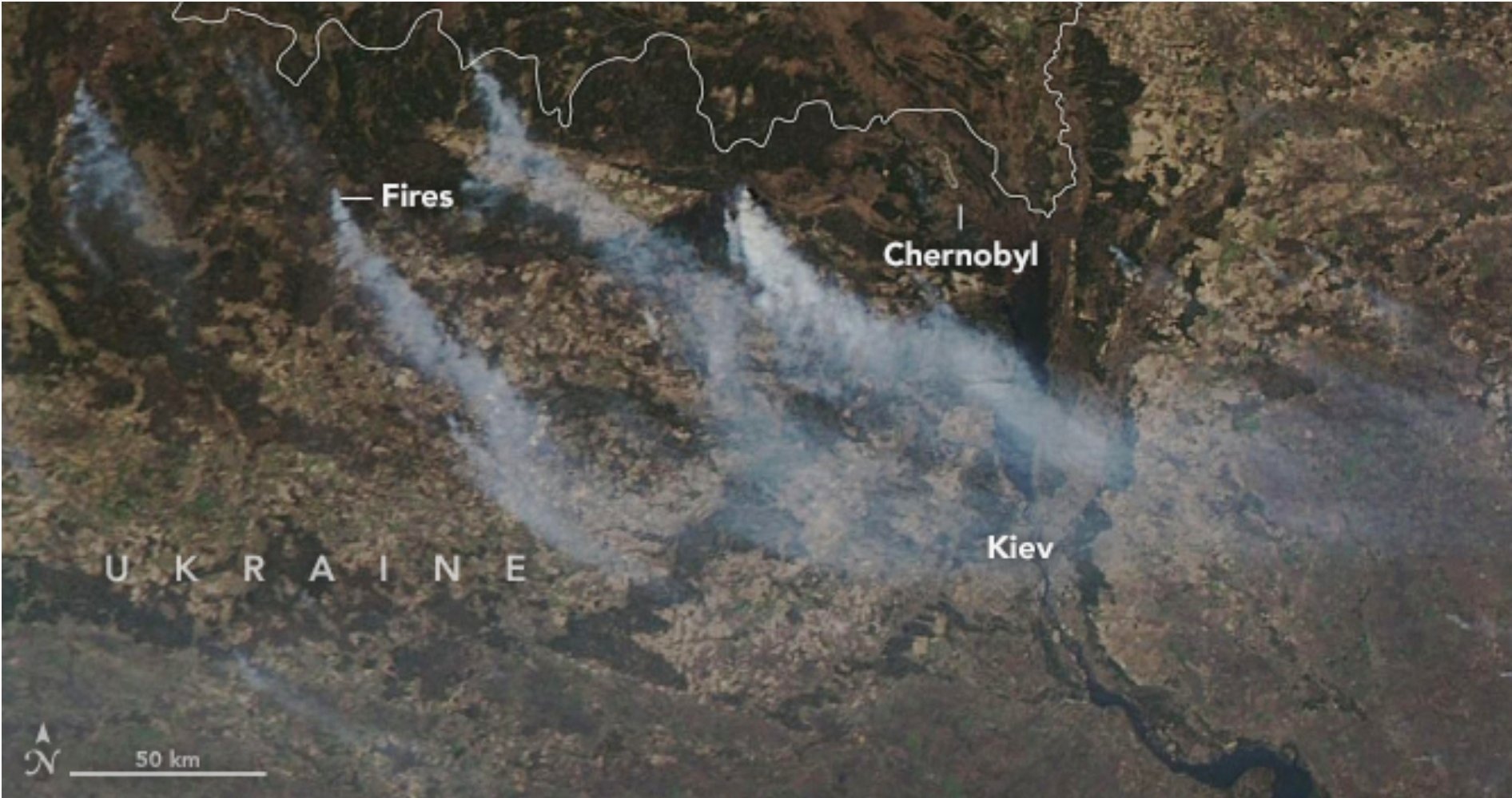
Unilad 18th April 2020, Wildfires burning near the Chernobyl nuclear plant have covered the capital
of Ukraine in smoke and made its air pollution among the worst in the
world. Residents burning rubbish near Chernobyl accidentally sparked fires
on April 4, and though firefighters managed to contain the initial blazes,
three new fires began to spread in the contaminated exclusion zone on
Thursday, April 16. The fires were propelled by strong winds and smoke has
engulfed the capital Kyiv. While many residents are adhering to
stay-at-home orders anyway, authorities are now encouraging residents to
close their windows to prevent the smog filling their houses.
https://www.unilad.co.uk/news/fires-blazing-dangerously-close-to-chernobyl-blanket-ukranian-capital-in-smog/
April 20, 2020
Posted by Christina Macpherson |
environment, Ukraine |
Leave a comment
New areas of ‘smoldering’ reported near Chernobyl nuclear plant, Accu Weather, By Courtney Spamer, AccuWeather meteorologist, Apr. 18, 2020 A massive fire that broke out in northern Ukraine at the beginning of April is no longer said to be threatening the infamous Chernobyl nuclear power plant in the region. However, officials are monitoring hot spots as winds whip through the region.
The fire began to burn in the region back on April 3, near the town of Pripyat, located over two hours north of the country’s capital of Kiev and near the border with Belarus.
Police say they arrested a 27-year-old man who is being accused of starting the fire last week. On Monday, police said that another local resident burned waste and accidentally set dry grass ablaze.
The location of the fire was reportedly only one kilometer (less than one mile) away from the Chernobyl nuclear power plant, the site of the world’s largest nuclear catastrophe back in April 1986.
However, Greenpeace Russia, on Monday, warned that the fire being in close proximity of the power plant posed a radiation risk.
“Higher-than-usual” radiation levels were first reported by the AP on April 5, and are being carefully monitored as the fire continues.
According to Reuters, Chernobyl tour operator, Yaroslav Yemelianenko, shared on Facebook that the fire was only two kilometers away from where “the most highly active radiation waste of the whole Chernobyl zone is located.” He called on officials to warn people of the danger.
Emergency services said on Tuesday morning that there were still some acreage “smoldering” in the Chernobyl Exclusion Zone, but that the zone contained no open fire.
Acting Chairman of the State Environmental Inspectorate, Yegor Firsov, later said that the fire in the Chernobyl exclusion zone was extinguished, and cited some rain that moved through the region as one helpful factor.
Hundreds of firefighters, as well as several planes and helicopters, battled the blaze for 10 days.
………Strong winds increased the difficulty in containing what’s left of the blaze and new areas of “smoldering” were reported in the Exclusion Zone, but did not pose a threat to any critical facilities, reported officials……..
Dry weather across much of eastern Europe has allowed for a more volatile environment for fire to thrive.
Through April 13, only two percent of the month’s normal rainfall has fallen in Kiev. Since the beginning of 2020, the city has been much drier than normal, only recording 81 mm of rain instead of the average 150 mm.
The dry weather has also caused crop losses already this year across Ukraine, with further damage possible should the dry stretch continue.
Keep checking back on AccuWeather.com and stay tuned to the AccuWeather Network on DirecTV, Frontier and Verizon Fios.
April 18, 2020
Posted by Christina Macpherson |
climate change, safety, Ukraine |
2 Comments
— New wildfires spread around Chernobyl nuclear plant, New Europe, By Elena Pavlovska, 17 Apr 20,
New fires broke out in Chernobyl’s exclusion zone on Thursday, fanned by heavy winds that have made it harder to put out the blaze, Ukrainian officials said.On Tuesday, Ukraine’s emergency service said the fire has been extinguished after rain fell in the region, and stressed that there is
no radiation risk.
The state emergency service said three new fires had broken out, but were “not large-scale and not threatening”…..
The [previous] fire sparked concerns that clouds of radioactive smoke could be released and blow south towards Kyiv, after an activist posted a video online showing a cloud of smoke rising within sight of the protective dome over Chernobyl’s Unit 4 nuclear reactor. https://www.neweurope.eu/article/new-wildfires-spread-around-chernobyl-nuclear-plant/
April 18, 2020
Posted by Christina Macpherson |
climate change, safety, Ukraine |
Leave a comment
 Wildfires near Chernobyl under control, Ukrainian authorities say, By Jack Guy and Mary Ilyushina, CNN, April 14, 2020 The fires reportedly came within two kilometers of the Chernobyl nuclear power plant.
April 14, 2020
Posted by Christina Macpherson |
incidents, Ukraine |
Leave a comment

Raging forest infernos in Chernobyl Exclusion Zone burning for eight days are now ‘close’ to exploded nuclear reactor amid new fears of radiation contamination
- Wildfires burning through Chernobyl forests are nearing the nuclear reactor
- There are fears that flames could reach radioactive trucks and vehicles abandoned after the notorious 1986 power station explosion
- Kiev has deployed more than 300 people and 85 pieces of equipment By JACK WRIGHT FOR MAILONLINE, 13 April 2020
|
- Wildfires burning through radioactive forests in the Chernobyl Exclusion Zone are getting ever closer to the exploded nuclear reactor.Firefighters are rushing to build firebreaks around the sarcophagus covering the ruined plant in Ukraine amid swirling winds.
There are fears that flames could reach abandoned trucks and other vehicles contaminated from the disastrous 1986 explosion.
An extraordinary video from firefighter Andrei Kukib shows an emergency vehicle driving through the raging fire and smoke laying waste to the polluted ‘dead zone’.
Fires have been blazing for nine days in the almost uninhabited 1,000-square-mile exclusion zone surrounding the disused plant. On Tuesday, the fire covered some 87 acres, having tripled in size due to strong winds, the emergencies service said in a statement.
- There are fears of radiation in the ground unleashed by the infernos can reach nearest city Kyiv, the Ukrainian capital, and other populated areas.This could be worse if the flames reach the Chernobyl reactors.
Kateryna Pavlova, a senior official involved in the firefighting, said: ‘We have been working all night digging firebreaks around the plant to protect it from fire.’
She told The New York Times: ‘At the moment, we cannot say the fire is contained.’
More than 300 people and 85 pieces of equipment have been deployed daily in the fight to extinguish the flames which comes as Ukraine – one of Europe’s poorest countries – is also battling against coronavirus.
- The State Agency for Management of the Exclusion Zone – which Pavlova heads – has ordered in three Antonov planes (AN-32P) and two MI-8 helicopters which have air dropped more than 250 tonnes of water in the wildfires.Police said the blaze broke out after a man set fire to dry grass near the exclusion zone. The man was detained by Ukrainian police. Ukrainian authorities rejected the warnings of the acting head of the country’s state ecological inspection service, Yehor Firsov, who withdrew remarks made this week that ‘radioactivity is higher than normal at the heart of the blaze’.
Initially covered up by the USSR, the 1986 explosion sent radioactive fallout across Europe exposing millions to dangerous levels of radiation. People are not allowed to live within 18 miles of the power station, which is some 62 miles north of Ukraine’s capital city Kiev.
The three other reactors at Chernobyl continued to generate electricity until the power station finally closed in 2000.
A giant protective dome was put in place over the fourth reactor in 2016.
Fires occur regularly in the forests near the Chernobyl power plant.
|
|
April 13, 2020
Posted by Christina Macpherson |
climate change, incidents, Ukraine |
Leave a comment
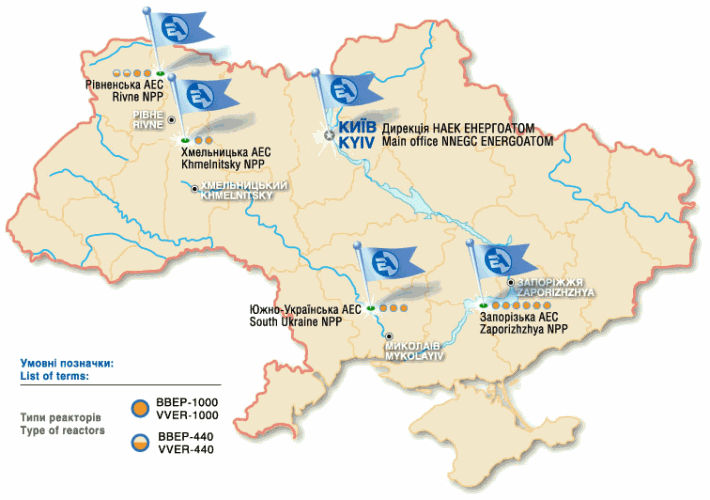
Ukrainian Nuclear Industry Workers Sound Alarm About Threat of ‘Another Chernobyl’ https://sputniknews.com/europe/202004101078906091-ukrainian-nuclear-industry-workers-sound-alarm-about-threat-of-another-chernobyl/ RIA Novosti . Alexei Furman 10.04.2020
Ukrainian firefighters reported that radiation levels at the Chernobyl Exclusion Zone spiked to over 16 times their normal level this week as wildfires continue to ravage the desolate, forested area. The fires are said to have unleashed radioactive elements previously trapped in soil and plants into the atmosphere, carrying them into the wind.
The Ukrainian Association of Veterans of Atomic Energy and Industry, a collective of retired officials including several former heads of nuclear power plants, have declared that the country’s nuclear energy sector is in a critical state and that there is a danger of “another Chernobyl.”
“A dire situation is taking shape in the country’s nuclear energy sector,” association members warn in a letter addressed to President Volodymyr Zelensky, the prime minister and speaker of parliament, and published by local media.
The letter alleges that Energoatom, operator of Ukraine’s nuclear power plants, has not had permanent managers working based on the relevant safety permits from nuclear regulators over a space of several months now. This, they say, means that “legally, no one is responsible for the safety of nuclear power plants.”
“Is it really the case that Chernobyl was not enough for us, and we are trying to repeat it again?” the appeal urges.
The letter also warns that Energoatom faces a critical shortage of financial resources necessary to ensuring the safe operation of plants and the procurement of fuel, and asks authorities if they understand what a forced shutdown of the country’s nuclear power plants could lead to (Ukraine depends on its nuclear power plants for about half of all the electricity generated in the country).
Complaining about what they say are ongoing efforts to have individuals with no knowledge of nuclear energy placed in senior positions at Energoatom, the retired nuclear industry workers ask whether authorities “realize that all of this is a gross violation of the international nuclear safety regime.”
Ultimately, the association says they are “not asking” nor urging, “but insisting” that authorities “stop the practice of [running Energoatom by] acting heads, stop the financial discrimination of Energoatom, and prevent the country from sliding toward another Chernobyl!”
The appeal was written by senior former industry officials, including Vladimir Bronnikov, former director of the Zaporizhzhia nuclear power plant, Vladimir Korovkin, former director of the Rivne nuclear plant, and Nikolai Shteynberg, former chief engineer of the Chernobyl nuclear power plant.
Ukraine’s Nuclear Power Plants
The Ukrainian nuclear power industry operates four power plants and 15 reactors, and has the seventh-largest nuclear power-generating capacity in the world. Starting in the mid-2010s, Ukraine began turning away from Russia’s Rosatom to US nuclear power company Westinghouse for its nuclear fuel rods. However, observers have expressed concerns over the safety of the US equipment, including amid reports that its nuclear fuel rods literally didn’t initially fit into Ukraine’s Soviet-era reactors.
In popular consciousness, Ukraine’s nuclear power sector is probably most commonly associated with the Chernobyl nuclear catastrophe, which took place on the night of April 26, 1986. The disaster was the result of an experiment simulating a power outage carried out by deputy chief-engineer Anatoly Dyatlov. The test saw the blatant violation of numerous safety regulations, with Dyatlov ordering the shutdown of multiple computerized and manual safety systems to proceed with the test. Ultimately, the ‘experiment’ led to an uncontrolled reaction and steam explosion, followed by a graphite fire. 54 people died in the disaster’s immediate aftermath and cleanup operation, with 4,000 more perishing from cancers and other illnesses in the two decades that followed, according to World Health Organization figures. The disaster also contaminated some 50,000 square kilometers of land across northern Ukraine, and up to 20 percent of the total land area of neighbouring Belarus.
Over three decades on, the fallout from Chernobyl continues to cause problems for Ukraine and its neighbours. This week, Ukraine’s emergency services reported that out of control fires in the forests of the Chernobyl Exclusion Zone had spread to cover at least 35 hectares of territory, leading to a massive spike in local radiation levels.
April 11, 2020
Posted by Christina Macpherson |
safety, Ukraine |
Leave a comment
|
Chernobyl fires: Radiation fears as firefighters struggle to contain blazes in radioactive zone, 9 News, By AAP, Apr 10, 2020 Ukrainian firefighters are in their sixth day of battling fires within the Chernobyl exclusion zone amid concerns over radiation that has remained in the area since the nuclear disaster more than three decades ago.
More than 300 firefighters aided by several firefighting aircraft were working to contain the blazes, which in recent days have been exacerbated by high winds.
Authorities have more than doubled the number of firefighters in the area since Monday. The extent of the blazes has not been disclosed for the past two days.
Ukrainian firefighters are in their sixth day of battling fires within the Chernobyl exclusion zone amid concerns over radiation that has remained in the area since the nuclear disaster more than three decades ago.
More than 300 firefighters aided by several firefighting aircraft were working to contain the blazes, which in recent days have been exacerbated by high winds.
|
|
April 11, 2020
Posted by Christina Macpherson |
incidents, Ukraine |
Leave a comment
|
 A FIRE AT CHERNOBYL IS RELEASING LARGE AMOUNTS OF RADIATION, https://futurism.com/the-byte/fire-chernobyl-releasing-radiation APRIL 6TH 20__JON CHRISTIAN A FIRE AT CHERNOBYL IS RELEASING LARGE AMOUNTS OF RADIATION, https://futurism.com/the-byte/fire-chernobyl-releasing-radiation APRIL 6TH 20__JON CHRISTIAN__ Ukrainian authorities say a forest fire is causing radiation levels to spike in the area of Chernobyl, a nuclear power plant that melted down in 1986.“There is bad news — in the center of the fire, radiation is above normal,” wrote Egor Firsov, the head of Ukraine’s ecological inspection service, in a Facebook post. “As you can see in the video, the readings of the [Geiger counter] are 2.3, when the norm is 0.14. But this is only within the area of the fire outbreak.”
Since Chernobyl’s deadly 1986 meltdown, the area around the plant has remained uninhabited — allowing nature to take over the abandoned town.
But now the blaze is reigniting the specter of the decades-old disaster site. Residents of the Ukranian capital of Kiev are even concerned about breathing in the radiation, according to The Guardian, which is about 60 miles south of Chernobyl, though Firsov said there was not yet cause for alarm.
Authorities say that a 27-year-old man has admitted that he set the fires “for fun,” according to The Guardian.
It’s unclear whether the radiation levels will continue to spike or die down as firefighters continue their work in the area, but Firsov said that as of Sunday, radiation levels at the site were about sixteen times the norm.
|
|
April 7, 2020
Posted by Christina Macpherson |
climate change, safety, Ukraine |
Leave a comment
Ukraine Says Fire Extinguished Near Contaminated Site Of Chernobyl Nuclear Disaster, Emergency authorities in Ukraine say there are no signs of any fire still burning in the uninhabited exclusion zone around the decommissioned Chernobyl nuclear plant after firefighters mobilized to put out a blaze.
Radio Free Europe, 5 Apr 20, The country’s State Emergency Service said early on April 5 that background radiation levels were “within normal limits.”
More than 130 firefighters, three aircraft, and 21 vehicles were deployed on April 4 to battle the fire, which was said to have burned around 20 hectares (50 acres) in the long-vacated area near where an explosion at a Soviet nuclear plant in 1986 sent a plume of radioactive fallout high into the air and across swaths of Europe.
Fire and safety crews were said to be inspecting the area overnight on April 4-5 to eliminate any threat from sites where there was still smoldering.
The blaze required seven airdrops of water, officials said.
Officials had earlier shared images taken from an aircraft of white smoke blanketing the area, where it said firefighting was complicated by “an increased radiation background in individual areas of combustion.”
There was no threat to settlements, the State Emergency Service said.
April 6, 2020
Posted by Christina Macpherson |
climate change, Ukraine |
Leave a comment
|
Ukraine battles forest fires near Chernobyl https://abcnews.go.com/Health/wireStory/forest-fire-chernobyl-boosts-radiation-level-69983859
Ukrainian says firefighters are laboring to put out two forest blazes in the area around the Chernobyl nuclear power station that was evacuated because of radioactive contamination after the 1986 explosion at the plant
By The Associated Press 6 April 2020 MINSK, Belarus — Ukrainian firefighters labored into Sunday night trying to put out two forest blazes in the area around the Chernobyl nuclear power station, which was evacuated because of radioactive contamination after the 1986 explosion at the plant.
Ukraine’s emergencies service said one of the fires, covering about five hectares (12 acres), had been localized. It said the other fire was about 20 hectares (50 acres). Earlier Sunday, the head of the state ecological inspection service, Yehor Firsov, said the fires had spread to about 100 hectares (250 acres). The discrepancy in sizes could not immediately be resolved.
Firsov said radiation levels at the fire were substantially higher than normal. But the emergencies service said radiation levels in the capital of Kyiv, about 100 kilometers (60 miles) south, were within norms.
The fires were within the 2,600-square-kilometer (1,000-square-mile) Chernobyl Exclusion Zone established after the 1986 disaster at the plant that sent a cloud of radioactive fallout over much of Europe. The zone is largely unpopulated, although about 200 people have remained despite orders to leave.
|
|
April 6, 2020
Posted by Christina Macpherson |
climate change, incidents, Ukraine |
Leave a comment
Radiation spike as forest fire hits Chernobyl nuclear zone https://www.deccanherald.com/international/world-news-politics/radiation-spike-as-forest-fire-hits-chernobyl-nuclear-zone-821778.html AFP, Kiev, APR 05 2020, AFP, Kiev, APR 05 2020, 21:04 IST UPDATED: APR 05 2020, 21:31 IST AFP/file photo Ukrainian authorities on Sunday reported a spike in radiation levels in the restricted zone around Chernobyl, scene of the world’s worst nuclear accident, c aused by a forest fire.
“There is bad news — radiation is above normal in the fire’s centre,” Yegor Firsov, head of Ukraine’s state ecological inspection service, said on Facebook. The post included a video with a Geiger counter showing radiation at 16 times above normal.
The fire has spread to about 100 hectares (250 acres) of forest, Firsov wrote. Kiev has mobilised two planes, a helicopter and around 100 firefighters to fight the blaze, which broke out Saturday and spread over 20 hectares in a forested area near the Chernobyl power plant.
On Sunday morning, the fire was not visibly burning and no increase in radiation in the air had been detected, the emergencies service said in a statement. However, the service said Saturday that increased radiation in some areas had led to “difficulties” in fighting the fire, while stressing that people living nearby were not in danger. Chernobyl polluted a large swathe of Europe when its fourth reactor exploded in April 1986, with the area immediately around the power plant the worst affected. People are not allowed to live within 30 kilometres (18 miles) of the power station. The three other reactors at Chernobyl continued to generate electricity until the power station finally closed in 2000. A giant protective dome was put in place over the fourth reactor in 2016. Fires are common in the forests near the disused power plant.
April 6, 2020
Posted by Christina Macpherson |
climate change, safety, Ukraine |
Leave a comment








 nuclear-news