IT’S TIME TO CANCEL SIZEWELL C

https://action.stopsizewellc.org/its-time-cancel-sizewell-c 27 feb 24
In recent weeks, Hinkley Point C has been revealed to cost £46 billion, yet just hours before this was announced, the government DOUBLED the taxpayers’ money that had been paid into Sizewell C, to a staggering £2.5 billion. Stop Sizewell C described this as the epitome of insanity – to do the same thing over again and expect a different result.
Yet in fact Sizewell C is NOT an exact replica of Hinkley Point C. It is an 80% above ground copy, but the site and ground conditions are very different. And what’s worse is that while Hinkley C’s cost and schedule overruns are the responsibility of EDF, when Sizewell C overruns and overspends – as it inevitably will – it will fall on we consumers to pay.
Citizens Advice have told Ministers “the scope for material cost and time overruns [at Sizewell C] is very significant. Consumers need to be protected from those risks. They have no way to manage them and are reliant on [the government] to ensure they are not on the hook”.
It’s time to call a halt to this madness. Sizewell C is too slow, expensive and damaging to be the answer to our climate and energy security emergency. If you agree that Sizewell C is the wrong project in the wrong place, send a message to Rishi Sunak, Jeremy Hunt and Claire Coutinho, telling them why they should cancel Sizewell C.
Locals oppose nuclear waste plant – parish council
Bob Cooper, Political reporter, BBC Radio Cumbria, 28 Feb 24 https://www.bbc.com/news/articles/c0jvjx8kn5xo—
Opponents of plans to seal some of the UK’s most lethal nuclear waste underground have called for communities to have more of say.
Whicham Parish Council in west Cumbria held a postal survey, in which more than three quarters of those who responded opposed the idea.
It is part of an area in which officials are exploring the possibility of siting a Geological Disposal Facility (GDF).
Cumberland Council said there was “no reason” for parish councils to conduct ballots.
Nuclear Waste Services, the body that oversees the project, described a GDF as “a highly engineered structure consisting of multiple barriers that will provide protection over hundreds of thousands of years.”
High-level nuclear waste would be sealed up to 1km (0.62 mile) underground, or possibly under the seabed.
Searches for a potential place for the facility are taking place in three areas, including two in Cumbria and another in Lincolnshire.
‘Impact on communities’
The process of identifying a site is expected to take 10 to 15 years and it could be ready to start receiving waste in the 2050s.
The Whicham postal vote was carried out in 2023 and the parish council said 251 out of 400 parishioners replied, which was a 63% turnout.
The council said 77% were opposed to a GDF in the parish, 15% were in favour, 6% were neutral, while the rest of the forms were blank.
Richard Outram, from Nuclear Free Local Authorities, a group of councils opposed to nuclear developments, said other parish councils should follow Whicham and conduct polls.
“The geological disposal facility, or a nuclear waste dump, is a massive engineering project that’s going to impact on communities for tens of years,” he said.
“It’s important to regularly take the public temperature and one way of doing that is by each parish council holding a regular parish poll.”
‘Too early’
Cumberland Council is the authority with the power to withdraw local communities from the siting process, external.
It is also responsible for conducting a formal test of public support, external, such as a local referendum, before a site can be approved.
The Labour-led authority recently wrote to parish councils telling them they did not need to conduct polls because “detailed public opinion monitoring in the Search Areas is already carried out”.
It also said it was too early in the process to carry out an official test of public support.
Meanwhile, Nuclear Waste Services said surveys to monitor local opinion would be carried out by a professional polling company.
‘I was a guinea pig during secret Christmas Island nuclear tests’

By Nicola Haseler & Lewis Adams. BBC News, Bedfordshire. 28 Feb 24
A former Royal Engineer who witnessed several atomic and hydrogen bomb explosions as part of the UK’s nuclear tests said he was a “guinea pig”.
Brian Cantle, from Bedfordshire, was 21 when he was sent to Christmas Island as part of his national service in 1957.
He and the other soldiers were not told what they were going to do there – due to the covert nature of the programme.
Mr Cantle, now 87, has been awarded a Nuclear Test Medal for his work on the Pacific Ocean island.
The veteran, from Whipsnade, witnessed several atomic and hydrogen bomb explosions during his 12 months on the island.
He was one of 22,000 British servicemen who participated in the British and United States’ nuclear tests and clean-ups between 1952 and 1965……………………………………………
On the days when bombs were tested, Mr Cantle said troops would have to put on brown overalls and face the other way to the bomb going off.
He added: “It was just a big flash and then we were told we could turn round and see it. It was an enormous explosion.”
‘We were guinea pigs’
In the decades that have followed the tests, calls have been made for the men who witnessed a nuclear test to receive an apology for the health risks they were exposed to.
“We were guinea pigs, we were just told what to do and did it,” Mr Cantle said………
The Grapple H-bomb nuclear test series was intended to show that the British had the technology to influence the Cold War, following the development of the atomic bomb by U.S. scientist Robert Oppenheimer.
The hydrogen bombs, which were much more powerful than atomic bombs, were detonated every three months……. https://www.bbc.com/news/uk-england-beds-bucks-herts-68415338
Has the nuclear lobby hijacked Welsh democracy?

25 Feb 2024, Robat Idris https://nation.cymru/opinion/has-the-nuclear-lobby-hijacked-welsh-democracy/
A sadly but unsurprising travesty of democracy slid out of Cardiff Bay with the release of the Senedd’s Economy, Trade and Rural Affairs Committee report on “Nuclear Energy and the Welsh Economy” on 21st February.
As a case study in lobbying power, it is surely worthy of inclusion in the Hall of Infamy.
Its recommendations could have been written by the nuclear lobby itself, rather than by our democratically elected Senedd Members.
Despite the collapse of the Wylfa project in 2019, all of the recommendations enthusiastically back the case for nuclear, with a plea to the UK Government to get on with the job. Einstein reportedly said: “Insanity is doing the same thing over and over again and expecting different results”.
Informed voices
If we are to have a credible Senedd, and a real democracy, then it is crucial that informed voices are heard.
This report, pandering to the self-interest of denizens of the nuclear village, merely reinforces the view that politics is about kowtowing to powerful corporate interests.
Meanwhile Cymru bleeds while real and credible solutions to energy and jobs exist.
The blurb preceding the report assures us that: “The Welsh Parliament is the democratically elected body that represents the interests of Wales and its people”. Yet this Committee took oral evidence from nine pro-nuclear individuals, and written evidence from six pro-nuclear organisations, and none from any individual or organisation having an anti-nuclear or indeed a sceptical view.
The rationale for this appears to be that the terms of reference deliberately chose not to include other voices:
“The terms of reference for this one-day inquiry were to consider the potential economic impact of new nuclear developments in north Wales, how to maximise local employment and benefits to local or Wales-based supply chains of new nuclear projects, and the challenges posed by skills shortages and how to overcome them. By its nature the inquiry did not examine the pros and cons of nuclear energy itself, but recognised its place in an overall energy security strategy and net zero targets.”
Apparently the only relevant voices are those backing nuclear.
The committee’s duty is to the people of Cymru, and not to the nuclear industry, or to the desire of the UK to remain a nuclear armed state.
Balanced view
As should be apparent if the Wellbeing of Future Generations Act is taken seriously. This is such a vital matter that evidence should be given to the committee which would enable its members to form a fully informed and balanced view on nuclear energy.
Why wasn’t evidence sought from experts and interested parties on such questions as:
- why new nuclear may never happen.
- why nuclear can’t be built in time to influence climate change.
- why should Cymru support civil nuclear when the UK Government admits its intrinsic links with military nuclear weapons capability?
- why should such reliance be placed on the voices of an industry which consistently fails to deliver on cost and on time?
- why should Cymru accept nuclear when renewable energy technology can provide 100% of our energy needs?
- why should Ynys Môn and Gwynedd become a nuclear dump to satisfy the needs of the nuclear industry and the UK state?
- why should we believe that the effects on language, culture, biodiversity can be mitigated?
- why have an influx of workers at a time when housing is a major issue for local people, when the NHS is on the point of collapse, when council services are creaking?
- why does the Welsh Government not acknowledge that nuclear is in retreat globally?
It’s time to recognise that the priority for Cymru is to look to our own natural resources for energy and job solutions. If fully harnessed, offshore wind has the potential to provide double our energy needs.
And why don’t our Senedd Members look critically at the companies which gave evidence?
- In 2020 the American company Bechtel had to pay (with another company) $57.5 million to the US Department of Justice for irregularities at the Hanford Waste Treatment Plant (Hanford is considered to be the most toxic nuclear waste facility in the US). In 2008 it had to pay (with another company) $407 million to the state and federal governments to settle litigation over leaky tunnels and a fatal ceiling collapse in the Boston Big Dig project.
- Rolls-Royce make the nuclear engines for Trident submarines which carry nuclear weapons. The company has publicly stated that there are synergies between the civil and military nuclear industries. Its Small Modular Reactor Design is unlicenced and unproven, and as for being small, it is at 470 MW twice the size of the old Trawsfynydd reactors. Rolls-Royce’s new CEO Tufan Erginbilgic described the company as a “burning platform” as 2.500 job cuts were announced in 2023.
Caught up amongst the corporate and academic behemoths, Ynys Môn council leader Llinos Medi inherited the poisoned chalice of support for nuclear from her predecessors. Like many of us on Ynys Môn, she has a burning desire for our youngsters to have a future locally, and for the language to thrive.
Can she be persuaded that another, better, way can be found?
The Council’s support for a future project at Wylfa is “based on confirmation that the development is sustainable and that it should not be at the expense of the island’s communities”. Nowhere on the globe is nuclear sustainable, and communities worldwide have paid the price. Not only in Chernobyl and Fukushima, but in many countries where uranium is mined and land, water and workers are poisoned.
On Saturday 16th March PAWB (People Against Wylfa B), backed by other concerned organisations, is holding an open meeting called “Green Revolution – Opportunity Knocks” to open minds to the possibilities of truly sustainable economic and community growth in Ynys Môn and Gwynedd. Perhaps members of the Economy, Trade and Rural Affairs Committee should attend!
Robat Idris is a member of PAWB. He is also vice-chair of Cymdeithas y Cymod, member of CND Cymru and past chair of Cymdeithas yr Iaith. He contributed a chapter on “Atomic Wales” in “The Welsh Way”.
SMRs are useless says the UK’s leading SMR analyst! – 100 per cent renewable energy is much more feasible!

by David Toke, https://100percentrenewableuk.org/smrs-are-useless-says-the-uks-leading-smr-analyst-100-per-cent-renewable-energy-is-much-more-feasible 25 Feb 24
Professor Stephen Thomas, the UK’s leading analyst of ‘small modular (nuclear) reactors’, has concluded that the idea faces a dead end, with no future. Yet the UK continues to give large grants to hopeful companies to develop these white elephants. The Government has proclaimed the need for ‘billions of pounds‘ of investment in SMRs. Meanwhile badly needed district heating networks to be supplied by large-scale heat pumps and a range of other realistic clean energy initiatives go unfunded!
The UK’s political institutions, including the House of Commons Environmental Audit Committee (EAC), continue to promote these fantasy SMRs through one-sided hearings and ignore possibilities for 100% renewable energy scenarios. Has the EAC set up an enquiry into the practicalities of 100 per cent or near 100 per cent renewable energy for the UK? No, it hasn’t, because it seems to prefer to spend time pursuing dead-ends such as SMRs.
Steve Thomas’s analysis lampooned the concept of SMRs when he said ‘The cheap way to produce SMRs is to scale down their failed designs’ (ie to scale down the larger versions of nuclear manufacturers previous failures). This highlights the central silliness of the idea of SMRs. On the one hand nuclear manufacturers built nuclear plant larger to improve economies of scale, but they have not produced economically viable results, so now there are pressures for them to reverse this process and make the resulting smaller nuclear power plant even worse!
He also commented that
‘All things equal, a large PWR/BWR will create less (nuclear) waste than the same capacity of small reactors’.
Thomas concluded that:
- the impression is that large numbers of SMRs are being ordered around the world
- These claims are unproven or misleading or simply wrong
- No modern design SMR is operating, 3 prototype SMRs are under construction (China, Russia, India)
- No current design has completed a full safety review by an experienced & credible regulator. Until this is done, it will not be known if the design is licensable or what the costs would be. So no design of SMR is commercially available to order
You can watch and hear Steve Thomas’s presentation on SMRs in the full youtube recording of our seminar on 100 per cent renewable energy rather than SMRs HERE Please go to 55 minutes into the recording to start watching from the beginning of Steve’s presentation.
The full power point presentation (on its own) can be downloaded from HERE
We shall soon be sending in the petition asking the EAC to launch an enquiry into 100 per cent renewable energy for the UK instead of the one it did on small modular reactors. It should be obvious that faced with new nuclear power failing and fossil fuel carbon capture and storage schemes that do not work we should be urgently looking at how we can run a 100 per cent renewable energy system for the UK! PLEASE SIGN IT NOW! Go to THIS PAGE HERE to sign the petition now!
Energy Costs UK : The Price Of Power-Nuclear Fandango

British consumers of nuclear energy will be paying amongst the highest prices for electricity in the world.
masterinvestor, By Victor Hill 23 February 2024
Last month, UK energy secretary Claire Coutinho declared in the government’s Civil Nuclear Roadmap policy document that “Our nuclear industry is re-awakening”. That document pledges the UK to build 24 gigawatts of new nuclear power capacity over the next two decades. That is equivalent to six times the capacity of the one nuclear plant now under construction. Thus, at least one more massive nuclear plant is envisaged for an as yet unidentified location (although Wylfa in Anglesey, North Wales looks to be the most probable site).
There is currently one nuclear power plant under construction in the UK – Hinkley Point C – and one planned – Sizewell C. But the latest news on these is discouraging. Last month the French majority state-owned energy company EDF announced that the first reactor Hinkley Point C in Somerset would not come onstream until 2029 at the earliest, and probably more like 2031. There is no date set as yet for the second reactor. The final cost of the project, it said, could rise to £46 billion – as compared to an initial budget back in 2016 when contracts were signed of £18-24 billion.
EDF has encountered problems in the construction of other nuclear plants which use the European Pressurised Reactor (EPR) technology deployed at Hinkley Point at Olkiluoto, Finland and Flamanville, France. Some engineers have spoken about a design flaw in this technology. While they were designed for maximum safety – especially in the wake of the radiation leak at Fukushima,……….
To make matters worse, the French finance minister, Bruno Le Maire, began to press the case for the UK government to cough up more funds to finish the project. Worse still, EDF cast doubt over its commitment to build the new reactor at Sizewell C in Suffolk, in which it will have a 20 percent stake, unless the funding issue over Hinkley Point were satisfactorily resolved.
The funding structure devised for Sizewell C envisaged that consumers would pay a levy on their electricity bills to help pay for construction costs. This is the so-called Regulated Asset Base (RAB) model. Opponents of the project have dubbed this a “nuclear tax” which will endure for decades.
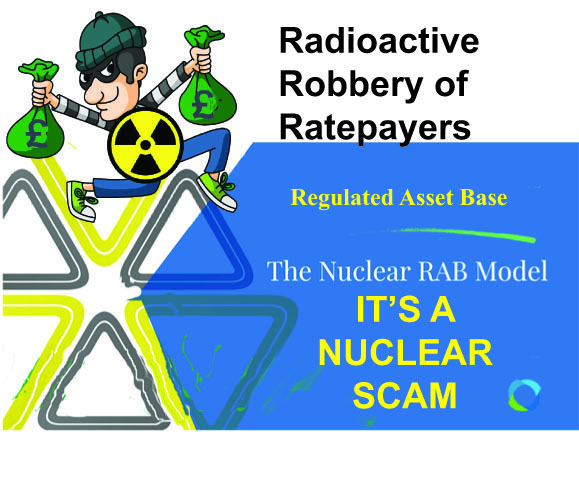
In contrast, Hinkley Point C will operate on the old contracts for difference model where the developers enjoy a guaranteed strike price once the reactors are operational. The original £89.50 per megawatt hour strike price has already been adjusted up to £125 in view of inflation. This means that British consumers of nuclear energy will be paying amongst the highest prices for electricity in the world.
The construction of Hinkley Point C was contracted by the UK government to EDF and China General Nuclear (CGN). Both Hinkley Point C and Sizewell C will have the capacity to power about six million households and will have an economic life of up to 60 years. The two plants could be producing 14 percent of Britain’s total electricity output in the late 2030s.
Ms Coutinho rushed out a press release on the evening of 23 January, saying: “Hinkley Point C is not a government project and so any additional costs or schedule overruns are the responsibility of EDF and its partners and will no way fall on [British] taxpayers”. This comment annoyed EDF and its main shareholder, the French government, to prompt a further statement. The substance of that was that unless the UK government offered something towards the shortfall at Hinkley Point, Sizewell C would simply not happen.
Eventually, the UK Department for Energy Security and Net Zero pledged an additional £1.8 billion of taxpayers’ money. The Minister for Nuclear and Renewables, Andrew Bowie MP, later admitted that he needed to raise an additional £20 billion of private finance to ensure that Hinkley Point C is completed…………………………………………………………………………………………………………………………………………
there has been no coherent political consensus around the need for nuclear power in the UK. The 2003 energy white paper published under Tony Blair’s government described nuclear power as an “unattractive option” – although Labour later changed its mind. There is still vocal opposition to nuclear power generation on safety grounds – and even more to the disposal of nuclear waste. The Low Level Waste Repository (LLWR) in Cumbria, operated by British Nuclear Fuels has been especially contentious. Many environmental and political activists associate nuclear energy production with nuclear weapons production. Moreover, there have been nine different energy secretaries sitting in cabinet since 2010. With such a level of turnover of people at the top, it has proven difficult to fashion policy.
At least the optimists foresee that Sizewell C will benefit from the lessons learnt at Hinkley Point C. Though, somehow, I doubt it……………………………. https://masterinvestor.co.uk/economics/energy-costs-the-price-of-power/—
Donald Trump and nuclear weapons are a scary mix.
A failing British nuclear arsenal reliant on the goodwill of Donald Trump? It’s a terrifying thought
Simon Tisdall. Guardian, 24 Feb 24
Believing US-supervised nuclear weapons make Britain safer is not only delusional and unsustainable, it’s dangerous.
Donald Trump and nuclear weapons are a scary mix. As president, he greatly expanded the US nuclear arsenal, scrapped arms control treaties and repeatedly threatened to start a nuclear war. On leaving office, he stole nuclear secrets from the White House and leaked their contents. A judge recently questioned his mental health.
For close ally Britain, the scariest thought is that Trump, if re-elected in November, could fatally undermine the UK’s “independent” nuclear deterrent, or worse, pressure London into actually using it. If Trump blundered into a nuclear showdown with, say, China, Russia or North Korea, Britain would be expected to back him – and could become a target.
None of these scenarios may be ruled out, despite UK insistence that it retains sole operational control of its four Vanguard-class nuclear missile submarines. In truth, such outcomes grow more plausible as the international security situation deteriorates, Trump threatens to abandon Nato and Europe, and nuclear arms proliferate globally. Successive UK governments are primarily to blame for Britain’s deepening nuclear nightmare. All have colluded in the pretence that the UK deterrent, known generically as Trident, is independent. In fact, the Vanguard submarines rely on American technology, logistics and maintenance, as will their Dreadnought-class successors. The new W93 replacement warhead borrows from US designs.
Even the US-made Trident II D5 ballistic missiles that carry the warheads are not owned but leased under the terms of the 1958 US-UK mutual defence agreement (MDA) and 1963 Polaris sales agreement. “UK nuclear weapons are only as independent as the US wants them to be,” a new study by the anti-nuclear Pugwash scientists’ network says. “The MDA [locks] the UK into dependence on the US for the procurement of nuclear weapons,” Pugwash states. “In practice, the UK’s technical dependence on the US would constrain any attack to which Washington objected. For example, the UK is reliant on American software for all aspects of nuclear targeting.”
This chronic dependency would give a re-elected Trump huge leverage, should he choose to use it, in the not improbable event of a security or foreign policy clash with a Labour government, for example, over Ukraine. Britain’s deterrent has always ultimately relied on US goodwill, an all-party commission on Trident noted in 2014……………………………………………………………………………
Britain’s habitual willingness to follow America to war, seen again recently in the Red Sea and notoriously in Iraq in 2003, could be its undoing – unless policy changes. “The UK is more likely to use nuclear weapons in a bilateral UK-US operation than either as part of a Nato strike or independently,” Pugwash says. The House of Commons defence select committee concluded in 2006 that “the only way that Britain is ever likely to use Trident is to give legitimacy to a US nuclear attack by participating in it…. In a crisis the very existence of the UK Trident system might make it difficult for a UK prime minister to refuse a request by the US president to participate.”
Trump aside, Britain’s deterrent faces multiple problems. One estimate puts the overall cost of renewing and maintaining Trident from 2019 to 2070 at £172bn. The system already faces delays and cost overruns. The first Dreadnought submarine is not expected to enter service until the early 2030s.
Meanwhile, the four Vanguard subs and their crews are undertaking record-length patrols, continuously at sea for five months or more. This reportedly compounds maintenance and morale problems. The entire fleet is now older than its originally planned service life of 25 years, according to the independent Nuclear Information Service. And the deterrent’s reliability is in question after a second, consecutive missile test failure last month. Official secrecy hinders public and parliamentary scrutiny of ministerial claims that all is working well…………………………………………………………………………………………
An incoming Labour government must not wait until disaster strikes. It should reallocate Trident’s billions to more socially useful projects. The belief that US-supervised and controlled nuclear weapons somehow make Britain safer and boost its global influence is delusional, unsustainable, unaffordable – and, in the age of Trump, downright dangerous. https://www.theguardian.com/commentisfree/2024/feb/24/failing-british-nuclear-arsenal-reliant-on-the-goodwill-of-donald-rump-is-terrifying-thought
Arms maker BAE Systems makes record profit amid Ukraine and Israel-Gaza wars

the company was “very happy with our London listing”
Jasper Jolly and agencies 22 Feb 24
FTSE 100 company says global instability is making government focus on defence spending.
Increased military spending prompted by Russia’s war on Ukraine and the Israel-Gaza conflict helped the British weapons manufacturer BAE Systems to record profits last year, with further growth expected in the year ahead.
The FTSE 100 company made underlying profits before interest and tax of £2.7bn on record sales of £25.3bn in 2023.
Shares in weapons manufacturers have surged in the past two years after Russia’s full-scale invasion of Ukraine in February 2022 made governments reassess their plans for military spending.
There have also been increased tensions across the Middle East since 7 October, when Hamas, which runs Gaza, killed 1,139 people in an assault on Israel. Israel has responded with months of bombardment of Gaza, killing nearly 30,000 Palestinians.
BAE Systems’ sprawling interests include building nuclear submarines and fighter jets, tanks and ships, as well as guns and ammunition.
Charles Woodburn, the BAE chief executive, said the weapons manufacturer was expecting “sustained growth in the coming years”.
………………………………….. BAE said it expected sales to rise by between 10% and 12% during 2024. Its long-term order book was also boosted last year by the Aukus pact between Australia, the UK and the US to build the next generation of nuclear-powered attack submarines, and the global combat air programme between Italy, Japan and the UK to develop a new fighter jet.
BAE said that the war in Ukraine in particular had highlighted the importance of autonomous technology, while “reinforcing the critical need for munitions and maintaining legacy capabilities”.
Woodburn also said the company was “very happy with our London listing”. Several of the biggest companies listed on London’s stock market have moved to the US because of concerns that UK companies are relatively undervalued. BAE Systems is unlikely to follow their lead because of the deep influence – including a “golden share” – that the UK government holds to prevent it falling into foreign ownership.
Woodburn said: “If you go back a few years, I think we were trading at a discount to some of our US peers, but I think through the strong performance of the business over recent years, I think we’ve, in many ways, closed much of that gap.”
Assange’s final appeal – Your man in the public gallery, part 2

Craig Murray, Sott.net, Wed, 21 Feb 2024
Comment: This is the continuation of Craig Murray’s coverage of Julian Assange’s final extradition hearing in the UK Royal Court on February 21, 2024. Read the first part here.
Julian Assange is a person in political conflict with the view of the United States, who seeks to affect the policies and operations of the US government.
Section 87 of the Extradition Act 2003 provides that a court must interpret it in the light of the defendant’s human rights as enshrined in the European Convention of Human Rights. This definitely brings in the jurisdiction of the court. It means all the issues raised must be viewed through the prism of the ECHR and from not other angle.
To depend on the treaty yet ignore its terms is abuse of process and contrary to the ECHR. The obligation in UK law to respect the terms of the extradition treaty with the USA while administering an extradition under it, was comparable to the obligation courts had found to follow the Modern Slavery Convention and Refugee Convention
(quotes given here)
Mark Summers KC then arose to continue the case for Assange. A dark and pugnacious character, he could be well cast as Heathcliff. Summers is as blunt and direct as Fitzgerald is courteous. His points are not so much hammered home, as pile-driven.
This persecution, Summers began, was “intended to prohibit and punish the exposure of state level crime”. The extradition hearing had heard unchallenged evidence of this from many witnesses. The speech in question was thus protected speech. This extradition was not only contrary to the US/UK Extradition Treaty of 2007, it was also plainly contrary to Section 81 of the Extradition Act of 2003.
(quotes given here)
This prosecution was motivated by a desire to punish and suppress political opinion, contrary to the Act. It could be shown plainly to be a political prosecution. It had not been brought until years after the proposed offence; the initiation of the charges had been motivated by the International Criminal Court stating that they were asking the Wikileaks publications as evidence of war crimes. That had been immediately followed by US government denunciation of Wikileaks and Assange, by the designation as a non-state hostile intelligence agency, and even by the official plot to kidnap, poison, rendition or assassinate Assange. That had all been sanctioned by President Trump.
This prosecution therefore plainly bore all of the hallmarks of political persecution.
The magistrates’ court had head unchallenged evidence that the Wikileaks material from Chelsea Manning contained evidence of assassination, rendition, torture, dark prisons and drone killings by the United States. The leaked material had in fact been relied on with success in legal actions in many foreign courts and in Strasbourg itself.
The disclosures were political because the avowed intention was to affect political change. Indeed they had caused political change, for example in the Rules of Engagement for forces in Iraq and Afghanistan and in ending drone killings in Pakistan. Assange had been highly politically acclaimed at the time of the publications. He had been invited to address both the EU and the UN.
The US government had made no response to any of the extensive evidence of United States state level criminality given in the hearing. Yet Judge Baraitser had totally ignored all of it in her ruling. She had not referred to United States criminality at all.
At this point Judge Sharp interrupted to ask where they would find references to these acts of criminality in the evidence, and Summers gave some very terse pointers, through clenched teeth.
Summers continued that in law it is axiomatic that the exposure of state level criminality is a political act. This was protected speech. There were an enormous number of cases across many jurisdictions which indicate this. The criminality presented in this appeal was tolerated and even approved by the very highest levels of the United States government. Publication of this evidence by Mr Assange, absent any financial motive for him to do so, was the very definition of a political act. He was involved, beyond dispute, in opposition to the machinery of government of the United States.
This extradition had to be barred under Section 81 of the Extradition Act because its entire purpose was to silence those political opinions. Again, there were numerous cases on record of how courts should deal, under the European Convention, with states reacting to people who had revealed official criminality.
In the judgment being appealed Judge Baraitser did not address the protected nature of speech exposing state criminality at all. That was plainly an error in law.
Baraitser had also been in error of fact in stating that it was “Purely conjecture and speculation” that the revelation of US war crimes had led to this prosecution. This ignored almost all of the evidence before the court.
The court had been given evidence of United States interference with judicial procedure over US war crimes in Spain, Poland, Germany and Italy. The United States had insulated its own officials from ICC jurisdiction. It had actively threatened both the institutions and employees, of the ICC and of official bodies of other states. All of this had been explained in detail in expert evidence and had been unchallenged. All of it had been ignored by Baraitser.…………………………………………………………………………………………………………………………………………
Political persecution was also apparent in the highly selective prosecution of the appellant. Numerous newspapers had also published the exact same information, as had other websites. Yet only Assange was being prosecuted. Baraitser had simply ignored numerous facts which were key to the case, and therefore her judgment was plainly wrong.
……………………………………………………………………………………………………………………………………………………………………………………………………………… Separately, the Secretary of State had failed in her specific duty to obtain assurances that the death penalty would not be implemented, before agreeing an extradition. The United States could add further charges at any time were Assange in the US, including aiding and abetting treason or other Espionage Act charges which attract the death penalty. It was routine in these circumstances to obtain assurances against the death penalty, and it was sinister they had not been obtained.
The law on this point was very clear; in the absence of assurances against the death penalty, the extradition must be stopped by the Home Secretary and the defendant discharged.
On this rather sombre point, Judge Sharp called the end of the day, and we staggered out into a wet London evening. It was a huge amount to pack into our heads in a day for those of us with brains smaller than Mr Fitzgerald, and the large crowd that roared its approval as we emerged hardly registered with me at all.
It had gone better than I expected……………………………………………. https://www.sott.net/article/489199-Assanges-final-appeal-Your-man-in-the-public-gallery-part-2
UK to consider suspending arms exports to Israel if Rafah offensive goes ahead
As situation in Gaza worsens, diplomatic pressure is mounting on UK to follow other countries and suspend arms sales to Israel
Patrick Wintour, 23 Feb 24, Guardian,
The UK government will consider suspending arms export licences to Israel if Benjamin Netanyahu goes ahead with a potentially devastating ground offensive on the Palestinian city of Rafah in southern Gaza.
As the humanitarian situation in Gaza has worsened, diplomatic pressure has been mounting on the UK to follow other countries and suspend arms exports to Israel.
Ministerial sources said that while no decision had been made about a suspension of arms export licences, the UK had the ability to respond quickly if the legal advice to ministers said that Israel was in breach of international humanitarian law.
The UK has joined other allies in pressuring Israel to avoid a ground offensive in Rafah. In a letter to the foreign affairs select committee about arms export controls to Israel published on Tuesday, David Cameron, the foreign secretary, said he could not see how an offensive in Rafah could go ahead without harming civilians and destroying homes.
In the Commons, the UK foreign minister Andrew Mitchell underscored that an offensive in Rafah represented a red line for the UK government, telling MPs on Wednesday that the UK was urging the Israeli government not to launch an attack that could have “devastating consequences”……………………………………………………………………………………………………………………………………………………….
Earlier this month The Hague district court ordered the Dutch government to stop the export of F-35 fighter jet parts to Israel within seven days due to the risk of serious violations of international humanitarian law and referred to the ATT and EU policy. https://www.theguardian.com/world/2024/feb/21/uk-to-consider-suspending-arms-exports-to-israel-if-rafah-offensive-goes-ahead
Nuclear route does Scotland no favours – Tommy Sheppard
As we limp towards a general election later this year, energy policy will feature high on the political agenda.
By Tommy Sheppard, 23rd Feb 2024, https://www.edinburghnews.scotsman.com/news/opinion/columnists/nuclear-route-does-scotland-no-favours-tommy-sheppard-4529234
Sadly, though, it looks as if one aspect of that debate will escape serious scrutiny due to a cosy consensus between the main parties at Westminster. Nuclear power.
Earlier this week Parliament debated the government’s recently published civil nuclear roadmap. This hare-brained scheme sets out an ambition to quadruple the current 5.9 gigawatts of nuclear energy production by 2050. Sadly, not only does the Labour party support this Conservative plan, it accuses the government of dragging its feet on implementation, suggesting that if anything a Starmer administration will accelerate the nuclear programme.
It’s crazy that this 20th century technology still commands such widespread political support in the UK. A quick recap. Nuclear power is – by far – the most expensive way of generating electricity ever devised by mankind. Contrary to claims it is not a renewable energy source. It is fuelled by uranium ore of which there is approximately 90 years supply left, less if programmes expand. Most of this is in Kazakhstan so it hardly qualifies as a secure energy source.
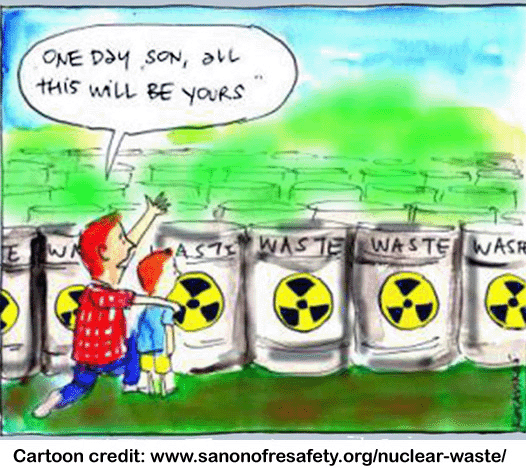
Moreover, it produces toxic waste which has to be kept isolated from human beings for generations. The new roadmap by the way suggests a new form of reactor which will produce twice as much waste and has no credible plan to safeguard it.
You can only spend a pound once – and if the government spends billions on nuclear that investment will be siphoned off renewable energy development. The craziest part of Labour’s plan is to argue for a further windfall tax on oil and gas in order to subsidise new nuclear plants in England. Don’t get me wrong, corporations should pay fair taxes, especially on excess profits. But of all the things you might spend that revenue on, subsidising nuclear power must surely be the worst.
If this continues, our children will look back mid-century and wonder why we didn’t make use of the phenomenal natural energy resources from sun, sea and air. We can stop this nonsense by the simple measure of putting Scotland’s energy policy in the hands of the people who live here. Another reason why Scotland should be an independent country.
Tommy Sheppard is SNP Scotland & Constitutional Affairs Spokesperson
Environment Agency and Natural England behind Hinkley Point wetland plan, says MP
THE Environment Agency (EA) and Natural England (NE) were both ‘clearly
implicated’ in a plan to turn nearly 1,000 acres of prime West Somerset
farmland into wetland, said local MP Ian Liddell-Grainger. Mr
Liddell-Grainger accused the two agencies of hiding behind a smokescreen
while they promoted a project which had already aroused a lot of anger
among local people.
West Somerset Free Press 21st Feb 2024
DAY ONE: Assange Timeline Exposes US Motives
February 20, 2024
Julian Assange’s lawyers on Tuesday argued before the High Court about why the imprisoned publisher must be allowed to appeal against his extradition order, reports Joe Lauria.
By Joe Lauria, in London, Consortium News
On Day One of Julian Assange’s attempt to appeal Britain’s order to extradite him to the United States, his lawyers laid out a timeline that exposed U.S. motives to destroy the journalist who revealed their high-level state crimes.
Before two High Court judges in the cramped, wood-paneled Courtroom 5 at the Royal Courts of Justice, Assange’s lawyers argued on Tuesday that two judges had seriously erred in the case on a number of grounds necessitating an appeal of the home secretary’s decision to extradite Assange to the United States.
High to the left of the court, next to oak shelves with neat rows of law books, was an empty iron cage. The court said it had invited Assange to either attend in person or via video link from Belmarsh Prison, where he has been locked up on remand for nearly five years. But Assange said he was too ill take part in any capacity, his lawyers confirmed.
Vanessa Baraitser, the district judge who presided over Assange’s 2020 extradition hearing, and Jonathan Swift, a High Court judge, came in for heavy criticism from Assange’s lawyers. Baraitser in January 2021 ordered Assange released on health grounds.
But she refused him bail while the U.S. appealed. On the basis of assurances that it would not mistreat Assange in the United States, the High Court reversed Baraitser’s decision. The U.K. Supreme Court then refused to take Assange’s challenge of the legality of these assurance and the home secretary signed the extradition order.
Assange’s last avenue of appeal is of the home secretary’s order as well as Baraitser’s 2021 decision, in which, on every point of law and many of fact, she sided with the United States. The application to pursue this appeal was rejected by a single High Court judge, Swift, last June.
He permitted his rejection of the application to itself be appealed. That two-day hearing began Tuesday before Justice Jeremy Johnson and Dame Victoria Sharp.
The Timeline
Assange lawyer Mark Summers made a forceful argument that the United States in essence is treating Assange no differently than any authoritarian regime would deal with a dissident journalist who revealed its secret crimes.
“There was evidence before the district judge that this prosecution was motivated to punish and inhibit the exposure of American state-level crimes,” Summers told the court. “There was unchallenged evidence” during Baraitser’s 2020 extradition hearing “of crimes that sit at the apex of criminality,” he said.
He said there was a direct nexus between Assange’s work to expose U.S. crimes and the U.S. pursuing him. “This is a prosecution for those disclosures,” he said. “There is a straight-line correlation between those disclosures and the prosecution, but the district judge (Baraitser) addressed none of this and neither did Swift.”
Summers then sketched out a timeline of events showing successive stages of motivation for the United States to go after Assange. “There was compelling circumstantial evidence why the U.S. brought this case,” he said.
First, he said, there was no prosecution of Assange (despite the Obama administration empaneling a grand jury) until 2016, when the International Criminal Court announced it would look into possible U.S. crimes in Afghanistan, following Assange’s disclosures. The U.S. then denounced him as a political actor.
Summers said “that morphed into plans to kill or rendition Assange” from the Ecuadorian embassy, where he had asylum, following the Vault 7 release of C.I.A. spying tools in 2017.
The then new C.I.A. Director Mike Pompeo, in his first public appearance in that position, denounced WikiLeaks as a hostile, non-state intelligence service, a carefully chosen legal term, Summers said, that permitted taking covert action against a target without Congressional knowledge.
Because these plans to kill or rendition Assange, asked for by President Donald Trump, raised alarms with White House lawyers, a legal prosecution was pursued as a way to determine where to put Assange if he were renditioned to the U.S., Summers said.
“This prosecution only emerged because of that rendition plan,” he said. “And the prosecution that emerged is selective and it is persecution.” It was selective because even though other outlets, such as Freitag and cryptome.org,, had published the unredacted diplomatic cables first, Assange was the only one charged.
“This is not a government acting on good faith pursuing a legal” path, he said……………………………………
Assange lawyer Edward Fitzgerald called espionage, with which Assange is charged, a “pure political offense.” The issue is crucial to Assange’s defense because the U.S.-U.K. Extradition Treaty bars extraditions for political offenses.
However, the Extradition Act, Parliament’s implementing legislation of the Treaty, does not mention political offenses. Baraitser ruled that the Act and not the Treaty should take precedence.
Assange’s team has been arguing that he is wanted for a political crime and therefore the extradition should not proceed. They argued that the Act bars extradition for “political opinion,” which they equate with “political offense.
A considerable amount of time in the five-hour hearing was thus spent by Assange’s lawyers making the point that Assange’s charges are political. Fitzgerald argued that Britain has extradition treaties with 158 nations and in all but two (Kuwait and the UAE), political offenses are barred.
Assange’s work was to influence and change U.S. policy, Fitzgerald said, therefore his work was political and he could not be extradited for his political views or opinions.
Informants!
Justices Johnson and Sharp appeared to be not extremely well-versed in the Assange case and seemed at times surprised by what they were hearing from Assange’s lawyers. But they had been prepared on the U.S. view of Assange allegedly harming U.S. informants.
What they didn’t know is that Assange had actually spent time redacting the names of U.S. informants from the Diplomatic Cables, while WikiLeaks‘ mainstream partners in 2010 did not.
Justice Johnson asked before lunch whether there were cases where someone had published the names of informants and were not prosecuted. After the break, Summers offered the example of Philip Agee, the ex-C.I.A. agent who revealed undercover agents’ names, some of whom were harmed, but he was never indicted for it.
Summers also mentioned The New York Times publishing names of informants in the Pentagon Papers. “The New York Times was never prosecuted,” Summers said. However, Richard Nixon indeed empaneled a grand jury in Boston to indict Times reporters but after it was revealed the government tapped whistleblower Daniel Ellsberg’s phone — and thus also the reporters’ — the case was dropped.
Despite their apparent unfamiliarity with the Assange case both judges seemed intrigued by its serious political, legal and press freedom issues. They are senior judges who might be less susceptible to political pressure.
The Death Penalty
The judges may also have been surprised to learn that under U.S. law and practice, (in this case with agreement from the British government), new charges could be added to Assange’s indictment after he would arrive in America. The Espionage Act, for instance, carries a provision for the death penalty if committed during wartime.
Britain does not have the death penalty and cannot extradite someone who could face capital punishment. Though the U.S. could offer Britain diplomatic assurances that it would not seek the death penalty against Assange, so far it has refused.
Fitzgerald also seemed to shock the courtroom by speaking of instances in U.S. courts where someone convicted for one crime could at sentencing receive time for another offense he or she was never tried for.
He expressed concern that though Assange was never charged with the Vault 7 C.I.A. leak, he might still be sentenced for it. He also said that at sentencing the rules of admissibility could be discarded, for example to consider evidence that was obtained through surveillance.
First Amendment
The judges may have been surprised to hear that the U.S. prosecutor in Virginia has said he may deny Assange his First Amendment rights during trial on U.S. soil because he is not a U.S. citizen. Pompeo stated more categorically that Assange would be without First Amendment protection.
Stripping the right of free speech is a violation of Article 10 of the European Court of Human Rights, Assange’s lawyers argued.
What Strasbourg Would Do
Summers brought the court through a scenario in which the European Court of Human Rights had tried Chelsea Manning, instead of a U.S. military court. He said whistleblower protection laws in Europe had advanced to the point where he believed the court would have weighed the harm done by breaking a confidentiality agreement and the harm prevented by blowing the whistle…….
The overall strategy of Assange’s lawyers appeared to be to make it obvious to these judges that there are vast grounds for appeal as well as arguments to toss the case (such as evidence of C.I.A. spying on Assange’s privileged conversations with his lawyers)
Forseeable
Assange’s lawyers also argued that Article 7 of the European Convention on Human Rights says someone must foresee that their behavior is a crime before he or she could be charged with it.
They said Assange could not have known that publishing his classified disclosures could have led to prosecution under the Espionage Act because no journalist or publisher had ever been charged under it for possession and publication of classified material. Therefore a violation of Article 7 should bar extradition, they say……………………
The hearing continues on Wednesday with lawyers representing the United States presenting their arguments about why Assange should not be allowed to appeal. https://consortiumnews.com/2024/02/20/day-one-assange-timeline-exposes-us-motives/
—
Utility EdF Writes Down $14B Loss on Delayed UK Nuclear Megaproject

By Peter Reina, February 20, 2024, https://www.enr.com/articles/58180-utility-edf-writes-down-14b-loss-on-delayed-uk-nuclear-megaproject
Following recent news of additional delays and cost hikes on the U.K.’s 3,260-MW Hinkley Point C nuclear power plant, the project company has reported an impairment of $14 billion on its assets.
French state controlled utiilty firm Electricité de France (EdF), which controls project financing and construction, last month updated Hinkley Point C’s forecast completion to between 2029 and 2031, with costs rising to a range of $39-43 billion. The previous completion target set in May 2022 was June 2027. EdF is currently financing all project construction costs.
Announcing its 2023 annual report, the utility also set this March as the expected target date for fuel loading at its 1,650-MW Flamanville 3 nuclear power plant on the north French coast. When work started in 2007, fuel loading was forecast for 2011.
Victory: Nuclear Free Local Authorities welcome Council vote on South Holderness nuke dump plan

NFLA 21 Feb 24,
The UK/Ireland Nuclear Free Local Authorities have welcomed today’s (21 February) overwhelming decision by the East Riding of Yorkshire Council to withdraw South Holderness from further consideration as a potential location for a high-level radioactive waste dump.
A motion was brought by South East Holderness Ward Councillor Sean McMaster to a meeting of the Full Council calling for the Council to ‘use its right of withdrawal with immediate effect due to the strong opposition from the communities of South Holderness’ . The Leader of the Council, Councillor Anne Handley, had already indicated her support for the motion, as had the Leaders of the Opposition Groups. Consequently, the motion was carried on a cross-party basis with 52 in favour and only 1 against.
News that the area was under consideration by Nuclear Waste Services was only announced in late January, with Invest East Yorkshire listed as the ‘Interested Party’ and a Working Group established with Dr David Richards as Chair.
The news prompted a massive public backlash with local people in the hundreds flocking to join a Facebook group, South Holderness against the GDF. Tens of thousands of leaflets have been distributed by local volunteers who have been pounding the streets in all weathers to inform residents of their reasons for opposing the plan, whilst 1,200 local people attended the first round of public events hosted by NWS staff, many to register their opposition and pose challenging questions to geologists from the nuclear industry. Chair Lynn Massey-Davis appeared in the first few days of the campaign to challenge the legitimacy of the dump in a spirited performance in a television interview with Peter Levy on BBC Look North.
The NFLAs have been proud to have offered some advice to the group and to local politicians at the Withernsea Town and East Riding Councils. Following an online conversation with the Labour Group Leader, Councillor Steve Gallant, the NFLA Secretary produced a bespoke briefing on the Right to Withdraw (see notes) for circulation to Councillors.
21st February 2024
Victory: NFLAs welcome Council vote on South Holderness nuke dump plan
The UK/Ireland Nuclear Free Local Authorities have welcomed today’s (21 February) overwhelming decision by the East Riding of Yorkshire Council to withdraw South Holderness from further consideration as a potential location for a high-level radioactive waste dump.
A motion was brought by South East Holderness Ward Councillor Sean McMaster to a meeting of the Full Council calling for the Council to ‘use its right of withdrawal with immediate effect due to the strong opposition from the communities of South Holderness’ . The Leader of the Council, Councillor Anne Handley, had already indicated her support for the motion, as had the Leaders of the Opposition Groups. Consequently, the motion was carried on a cross-party basis with 52 in favour and only 1 against.
News that the area was under consideration by Nuclear Waste Services was only announced in late January, with Invest East Yorkshire listed as the ‘Interested Party’ and a Working Group established with Dr David Richards as Chair.
The news prompted a massive public backlash with local people in the hundreds flocking to join a Facebook group, South Holderness against the GDF. Tens of thousands of leaflets have been distributed by local volunteers who have been pounding the streets in all weathers to inform residents of their reasons for opposing the plan, whilst 1,200 local people attended the first round of public events hosted by NWS staff, many to register their opposition and pose challenging questions to geologists from the nuclear industry. Chair Lynn Massey-Davis appeared in the first few days of the campaign to challenge the legitimacy of the dump in a spirited performance in a television interview with Peter Levy on BBC Look North.
The NFLAs have been proud to have offered some advice to the group and to local politicians at the Withernsea Town and East Riding Councils. Following an online conversation with the Labour Group Leader, Councillor Steve Gallant, the NFLA Secretary produced a bespoke briefing on the Right to Withdraw (see notes) for circulation to Councillors.
The impact of this decision will be profound. Under the published Community Guidance governing the GDF siting process, consideration of any Search Area must have the support of a Relevant Principal Local Authority (RPLA). The East Riding of Yorkshire Council is the RPLA for South Holderness and as such has the Right to Withdraw. Although the Community Guidance is vague and contradictory, appearing both to suggest that withdrawal can occur at any time or only once a Community Partnership is formed, it is clear that there will be little point NWS investing further money, time and staff resources on taking its plan forward at this early stage without political support; clearly then the process must soon come to an end.
Councillor David Blackburn, Chair of the NFLAs English Forum, was full of praise for local campaigners:
Commenting on the vote, Cllr Blackburn added:
“I am glad that Councillors of all parties saw sense and supported this motion on a cross-party basis. South Holderness is an agricultural and touristic area and as such was never appropriate for consideration for a nuclear waste dump. So what I do find inexplicable is why the Leader of the Council ever agreed for East Riding of Yorkshire Council to engage with the process and become a member of the Working Group in the first place, as a resolute NO would have killed the process off at the onset, as happened at Hartlepool.”
Nuclear Waste Services have now issued a press statement stating that it ‘fully respects the council’s decision to withdraw from the GDF siting process. Together with the Working Group Chair, NWS will now take the necessary steps to wind down the South Holderness Working Group and respond to outstanding requests for more information’. (See notes)…………………………………… more https://www.nuclearpolicy.info/news/victory-nflas-welcome-council-vote-on-south-holderness-nuke-dump-plan/
1 This Month

of the week – Shut Down Drone Warfare!


Tell the Ukrainian Government to Drop Prosecution of Peace Activist Yurii Sheliazhenko

Petition to revoke the licensing of the Near Surface Nuclear Disposal Facility (NSDF) at Chalk River. https://www.ourcommons.ca/petitions/en/Petition/Details?Petition=e-7247
To see nuclear-related stories in greater depth and intensity – go to https://nuclearinformation.wordpress.com
-
Archives
- April 2026 (114)
- March 2026 (251)
- February 2026 (268)
- January 2026 (308)
- December 2025 (358)
- November 2025 (359)
- October 2025 (376)
- September 2025 (257)
- August 2025 (319)
- July 2025 (230)
- June 2025 (348)
- May 2025 (261)
-
Categories
- 1
- 1 NUCLEAR ISSUES
- business and costs
- climate change
- culture and arts
- ENERGY
- environment
- health
- history
- indigenous issues
- Legal
- marketing of nuclear
- media
- opposition to nuclear
- PERSONAL STORIES
- politics
- politics international
- Religion and ethics
- safety
- secrets,lies and civil liberties
- spinbuster
- technology
- Uranium
- wastes
- weapons and war
- Women
- 2 WORLD
- ACTION
- AFRICA
- Atrocities
- AUSTRALIA
- Christina's notes
- Christina's themes
- culture and arts
- Events
- Fuk 2022
- Fuk 2023
- Fukushima 2017
- Fukushima 2018
- fukushima 2019
- Fukushima 2020
- Fukushima 2021
- general
- global warming
- Humour (God we need it)
- Nuclear
- RARE EARTHS
- Reference
- resources – print
- Resources -audiovicual
- Weekly Newsletter
- World
- World Nuclear
- YouTube
-
RSS
Entries RSS
Comments RSS
 nuclear-news