How reporting facts can now land you in jail for 14 years as a terrorist

Jonathon Cook Blog, 22 December 2025
Starmer’s government has set the most dangerous of precedents: it can now outlaw any political group it chooses as a terrorist organisation – and thereby make it impossible to defend it
The moment the British government began proscribing political movements as terrorist organisations, rather than just militant groups, it was inevitable that saying factual things, making truthful statements, would become a crime.
And lo behold, here we are.
The Terrorism Act 2000 has a series of provisions that make it difficult to voice or show any kind of support for an organisation proscribed under the legislation, whether it is writing an article or wearing a T-shirt.
Recent attention has focused on Section 13, which is being used to hound thousands of mostly elderly people who have held signs saying: “I oppose genocide, I support Palestine Action.” They now face a terrorism conviction and up to six months in jail.
But an amendment introduced in 2019 to Section 12 of the Act has been largely overlooked, even though it is even more repressive. It makes it a terrorism offence for a person to express “an opinion or belief that is supportive of a proscribed organisation” and in doing so be “reckless” about whether anyone else might be “encouraged to support” the organisation.
It is hard to believe this clause was not inserted specifically to target the watchdog professions: journalists, human rights groups and lawyers. They now face up to 14 years in jail for contravening this provision……………………………………………………………………………………………………………………………………….
the reality is that social media is awash with posts from people echoing outrageous official disinformation. This spreads unchallenged because to challenge it is now cast as a terrorism offence.
In truth, since proscription, any statements about the political aims of a deeply political organisation like Palestine Action occupy a grey area of the law.
Is it a terrorism offence to point out the fact, as I have done above, that Palestine Action targeted Elbit factories that send killer drones to Israel for use in Gaza. In doing so, may I have “recklessly” encouraged you to support Palestine Action?
Can I express any kind of positive view about the hunger strikers or their actions without violating the law?
The truth is that the law’s greyness is its very point. It maximises the chilling effect on those who are supposed to serve as the public’s watchdogs on power: journalists, human rights groups, lawyers. https://www.jonathan-cook.net/blog/2025-12-22/reporting-facts-14-years-jail/
UK’s largest planned data centre ‘could use 50 times more water’ than developer claims.
The developer of the UK’s largest proposed data
centre is likely significantly understating the scale of its planned water
footprint, teams of investigative journalists have claimed.
US-based data
centre developer QTS recently secured permission from the local council for
its campus in Cambois, Northumberland. It plans to build 10 data halls
across a 133-acre site, at a cost of $13.5bn. The site had previously been
home to Britishvolt, which had intended to develop a battery gigafactory
for the electric car sector before it folded. QTS’s proposals also
include cooling systems and dozens of diesel-powered generators to act as
an emergency backup, the BBC reports. These should only be used
“occasionally” on a “temporary basis”.
Edie 22nd Dec 2025, https://www.edie.net/uks-largest-planned-data-centre-could-use-50-times-more-water-than-developer-claims/
Scottish Government urged to intervene in Edinburgh AI data centre plans
THE Scottish Government has been urged to intervene after council
officials ruled that an environmental impact assessment for a huge
artificial intelligence data centre is not required.
Edinburgh City Council
is currently considering plans for a new AI data centre on the site of the
former RBS headquarters in South Gyle, near Edinburgh Airport. Shelborn
Drummond Ltd, an offshoot of Shelborn Asset Management, is behind the plans
for the “Green Data Centre”.
We previously told how the Shelborn data
centre, and another proposed by Apatura near to Heriot-Watt University,
would demand the equivalent amount of energy as building five cities the
same size as the capital within its boundaries. The revelation about the
vast amount of electricity the sites will consume has sparked concerns from
environmental campaigners, and had previously raised concerns that there
would be no requirement for the firms behind the plans to carry out an
environmental impact assessment (EIA).
A screening opinion published on
Friday December 18, by a senior planner at the local authority, ruled that
an EIA would not be required. Action to Protect Rural Scotland (APRS) said
the Shelborn data centre will use the same amount of energy as a quarter of
a million households, and it was “gobsmacking” that the impact on the
local environment would not be taken into consideration.
The National 22nd Dec 2025, https://www.thenational.scot/news/25715123.scottish-government-urged-intervene-edinburgh-ai-data-centre/
Iran, UK foreign ministers discuss nuclear issue in phone call
Dec 20, 2025, https://www.iranintl.com/en/202512192167
ranian Foreign Minister Abbas Araghchi spoke by phone with UK Foreign Secretary Yvette Cooper on Friday, saying Tehran is open to diplomacy based on respect.
“Iran has never rejected negotiations and dialogue based on respect for the Iranian nation’s legal rights and legitimate interests, but considers talks based on one-sided imposition unacceptable,” official media cited Araghchi as saying.
Araghchi criticized the “irresponsible” stance of the three European powers on Iran’s nuclear program, saying that Tehran is open to talks respecting its legal rights and legitimate interests but rejects unilateral imposition.
Cooper underlined Britain’s commitment to diplomacy on the nuclear dossier. No UK readout of the call has been issued.
The three European countries—France, Germany, and the United Kingdom—triggered the Iran nuclear deal snapback mechanism in August, leading to the reimposition of UN sanctions in September.
Iran and the International Atomic Energy Agency (IAEA) reached a technical understanding in Cairo in September, mediated by Egypt, aimed at gradually restoring inspectors’ access to nuclear sites.
Following the return of UN sanctions on Iran, Foreign Minister Abbas Araghchi said that the United States and three European powers had “killed” the Cairo nuclear agreement through what he called a sequence of hostile actions.
Araghchi said last month that Washington’s approach amounted to “dictation, not negotiation,” accusing the US of trying to achieve through diplomacy what it failed to gain by force.
“They want us to accept zero enrichment and limits on our defense capabilities,” he said. “This is not negotiation.”
Trump said Iran could avoid past and by reaching a nuclear deal, adding that any attempt to revive its program without an agreement would prompt further US action. He has repeatedly said Iran missed an earlier chance to avert the strikes by accepting a deal.
Revealed: Trump’s secret $264 million plot to put nuclear doomsday weapons in Britain to face down Putin

Daily Mail, By NICK ALLEN, US NEWS EDITOR (POLITICS), 22 December 2025
The true scale of President Donald Trump‘s ambitions to turn the U.K. into a potential nuclear launchpad has been revealed.
A massive $264 million plan to overhaul a Royal Air Force base in the English countryside includes knocking down at least half a dozen existing buildings, setting up secure intelligence facilities, protecting the surrounding area against enemy electronic pulse attacks, and sending over 200 American personnel, according to Pentagon funding proposals.
It represents confirmation that American nuclear weapons will return to Britain for the first time since President Barack Obama withdrew them 17 years ago.
However, despite widespread speculation that U.S. nuclear weapons have already arrived in the U.K, the documents indicate it will not happen for several years.
The idea that they had already been sent gained steam on July 17 when a massive U.S. Air Force C-17 Globemaster III arrived at RAF Lakenheath in Suffolk.
The aircraft had been tracked by flight data sites traveling 10 hours from Kirtland Air Force base in New Mexico, where America stores its nuclear arsenal.
Experts speculated that it may have been carrying B61-12 nuclear gravity bombs, each with a potential power bigger than the weapon dropped on Hiroshima in 1945.
Lakenheath is home to the U.S Air Force’s 48th Fighter Wing, known as Liberty Wing, which flies F-35A aircraft capable of being fitted with B61-12s.
However, detailed Pentagon assessments of Lakenheath’s suitability as a nuclear base, reviewed by the Daily Mail, make clear that it is far from ready.
Bizarrely, one of the reasons given was that some of those involved in the U.S. nuclear operation would not have quick access to a toilet during an Armageddon-style scenario.
The existing building that would be used as the primary command post is in ‘adequate condition but beyond its useful life,’ the documents said.
It said controllers within the ‘Emergency Action Cell’ would ‘not have direct, restricted access to a restroom’ in the current facility.
In addition, ‘cooling and air filtration’ was not good enough to support a SCIF – a Sensitive Compartmented Information Facility – which is a high-security room used by the U.S. government and military to discuss extremely sensitive classified intelligence.
The Lakenheath operation is described as a ‘Surety’ mission, which is a term the Pentagon uses when discussing the security and safety of nuclear weapons and associated facilities.
The Air Force’s budget estimates for the 2026 financial year suggests $104 million will be needed for a ‘Surety command post.’
It would house facilities including a control center for Air Force Nuclear Command, Control and Communications……………………………………………………………………………………………
The U.S., rather than NATO, is expected to pay for developments at Lakenheath because it is ‘necessary to complete the project in the timeframe required by United States military commanders.’
Construction of the command post is expected to start in August 2027 and be completed by July 2031.
A separate operations compound is priced at $149 million and will involve demolishing half a dozen existing buildings and creating an armory with massively thick concrete walls, and possible storage for anti-tank weapons.
‘This project is required to provide enhanced security capabilities supporting the potential stationing of specialized weapons at Royal Air Force Lakenheath,’ the project outline said.
‘Specialized weapons surety includes materiel, personnel, and procedures, contributing to the safeguarding and reliability of specialized weapons, and to the assurance that there will be no specialized weapon accidents, incidents, unauthorized weapon detonation, or degradation in performance at the target.’
The budget also details the addition of over 200 U.S. security personnel at the base.
A current building to be used by the first security personnel is said to be in ‘deteriorated condition.’
It ‘cannot accommodate the additional weapons, ammunition, and equipment associated with the increase in manpower required for the potential Surety Beddown mission.’
The problems include asbestos, lead based paint, poor ventilation, and ‘improper sanitary sewer drainage.’
Improvements are needed to ‘accommodate the potential Surety mission beddown’ and without them, security forces personnel would not be able to implement the minimum response times, safeguarding, and assurance procedures required for specialized weapons.’
Construction of the second compound is not expected to start until 2028 and finish in 2031…………………………………………………………….
Funding documents show an additional $11 million is expected to be spent on electronic security systems, bringing the total for the nuclear mission at Lakenheath to $264 million.
B61-12 nuclear bombs, which are 12ft long and weight about 800 pounds – are a staple of the U.S. arsenal.
They are unguided ‘gravity bombs’ dropped over targets and are equipped with four fins to increase accuracy to within 30 meters of the target.
They are ‘tactical’ nuclear weapons intended for use against specific military targets, such as wiping out battlefield units or bases, rather than for leveling cities.
However, their power can still be three times the size of the bomb dropped on Hiroshima.
The warhead used in B61-12s has a variety of options for how much explosive power it can yield with the minimum being 0.3 kilotons and the maximum 50 kilotons
The bomb that destroyed Hiroshima in 1945 hade a yield of roughly 15 kilotons.
Meanwhile, Prime Minister Sir Keir Starmer confirmed this month that the U.K. is set to buy 12 F-35A fighter jets from the U.S.
The U.K. will receive its jets at the end of this decade and it will be the first time it has had an air-launched tactical nuclear weapon since 1998.
While it will own the jets, the U.S. will retain ownership of the nuclear weapons they come with.
It means the U.K. will not be able to deliver a nuclear strike with those bombs without explicit approval from Washington…………… https://www.dailymail.co.uk/news/article-15375073/Trumps-secret-264-million-plot-nuclear-doomsday-weapons-Britain-face-Putin.html
Trump row threatens to delay Britain’s nuclear renaissance.
Concerns mount for power plant investment as US pauses tech trade deal.
Matt Oliver Industry Editor. James Titcomb Technology Editor. Matthew Field Senior Technology Reporter, 17 December 2025
Britain’s plans to usher in a “golden age” of nuclear power are at risk of being delayed amid a row with Donald Trump over the UK-US trade deal. Campaigners raised concerns that new projects face being hampered after the US paused the tech prosperity deal, in which Mr Trump and Sir Keir Starmer vowed to deepen co-operation on nuclear energy.
It was accompanied by pledges of investment in Britain by US-based X-Energy and
Centrica, the owner of British Gas, as well as the American nuclear company
Last Energy and the London port operator DP World.
Some nuclear industry
sources played down the dispute on Wednesday as a “negotiating tactic”,
but others said it could slow the deployment of American-designed mini
reactors in the UK if it was not resolved. It comes amid growing
frustration in Washington over Britain’s Online Safety Act, which critics
claim will stifle free speech and stymie American artificial intelligence
companies. Sam Dumitriu, of the pro-nuclear campaign group Britain Remade,
said: “This will undoubtedly concern Britain’s nuclear communities, who
have been promised new projects and the jobs that came with them.
Telegraph 17th Dec 2025, https://www.telegraph.co.uk/business/2025/12/17/trump-row-threatens-to-delay-britains-nuclear-renaissance/
Biodiversity Net Gain: can developers be trusted?
Developers seem rather too fickle concerning their obligations to protect the environment, and the situation may be about to get worse
Rachel Fulcher, 21 December 2025
During the consultations for Sizewell C, it became clear
from the documents put forward by EDF, owner of this pine forest, that the
company considered the plantation to be of low biodiversity value.
They failed to take into account the fact that the rides between the trees
supported several species so rare that they are protected by law. Looking
into it in further detail I came across Biodiversity Net Gain (BNG), which
specifies that developers must provide a minimum of 10% net gain for nature
in addition to compensating for any damage caused.
Using the Statutory
Biodiversity Metric devised by the Department for Environment, Food and
Rural Affairs (Defra), the biodiversity value of the land prior to
development is calculated in units according to size, type of habitat, its
current condition, ecological distinctiveness and location. The proposed
replacement and enhancement habitats are then also calculated and must show
the necessary improvement.
Ideally these should be in the same area, but if
this is not possible then they can be elsewhere. As a last resort, builders
can simply buy habitat units from conservation organisations or even obtain
biodiversity credits from the government. In the first instance, however,
they must avoid harm – but do they?
A conversation with a Suffolk
ecologist revealed his profound disapproval of use of this metric,
considering the method to be ‘damaging’. He feels that it gives
builders a licence to destroy the environment, including protected sites
and species, so long as they offer something more elsewhere. However, some
non-governmental organisations (NGOs) have accepted BNG on the basis that
something for nature is better than nothing.
East Anglia Bylines 21st Dec 2025, https://eastangliabylines.co.uk/environment/biodiversity-net-gain-can-developers-be-trusted/
Nuclear power plant is threat to our future.

Western Morning News, Jo Smoldon Bridgwater, Somerset18 Dec 2025,
https://www.pressreader.com/uk/western-morning-news/20251218/281835765040539
YES, of course the Stop Hinkley event you publicised (Letters, December 13) was Christmas humour, but it does concern us that significant facts are being ignored about the outdated Hinkley Point C new (old) nuclear power plant being built on our precious Severn estuary when climate change predictions suggest that the Hinkley coastline will be inundated and flooding will occur across Somerset.
How will this be safe when HPC radioactive waste will be too hot to move and will have to reside on the fragile coastline for over 200 years?
It seems that there are not enough skilled workers to complete the HPC job which has had design problems, despite supposedly learning from the mistakes at Olkiluoto, in Finland, Flammanville, in France, and Taishan, in China.
The original workforce of 8,000 has now had to increase to 15,000, and still the start-up date is up in the clouds. The costs have escalated from £18 billion to current predicted costs of £46 billion and rising.
How is the country going to pay for this and all the other pie in the sky so-called new nuclear builds that roll off the tongues of the fast turnover of politicians that have been involved?
So far it has taken 10 Prime Ministers, starting with Thatcher, to partially build HPC. Their legacy is a big mistake that nobody has the courage to say we shouldn’t have started this, it’s a runaway train on which nobody has figured out how to apply the brakes.
HPC is finished. HPC will never be needed, I believe, other than for a building site training programme.
Not one of those Prime Ministers will be accountable for the toxic high level radioactive waste that will be lurking on the Severn estuary coastline far into the future for our children’s children to pay for and deal with.
The level of radioactivity of the waste will be in total around 80% of the radioactivity level currently of Sellafield. This fact alone will mean that Hinkley will be the Sellafield of the South.
Hinkley’s design is currently in the news due to its intention of destroying more of our precious Severn estuary fish and marine life in its massive cooling water intakes, which will suck in an Olympic-sized swimming pool of water every 20 seconds.
EDF is faltering over its requirement to protect the fish with an acoustic fish deterrent. Even so, this technology may save some of the fish, but the eggs and fry will pass into the cooling system and be destroyed by the heat and chemicals, which will then be pumped back out into the estuary.
The technology of nuclear power belongs to the last century and is wasteful of energy. The steam process results in two thirds of the heat energy being pumped out into the estuary warming the sea.
Stop Hinkley continues to hold EDF to account, and we will be watching, and we will be back for the next predicted finish date of 2027 with our HPC Christmas turkey to cook.
Subject: Rushing to Deregulation – the report of the Nuclear Regulatory Taskforce

NFLA 18th Dec 2025
Introduction:
‘Nuclear plants should be built closer to urban areas and should be allowed to harm the local environment’ so concluded The Times, 24 November 2025 on reporting on the findings of the Nuclear Regulatory Taskforce in its final report to the UK Government. This recommendation made to Ministers
flew in the face of accepted policy, the Semi-Urban Population Density Criteria. that building new nuclear plants near towns and cities should be banned because of the risk posed to large numbers of people in the event of an accident involving radioactive materials.
Many of the other 46 recommendations made by the NRTs were equally disquieting, representing a
manifesto of deregulation – a ‘radical reset’ – in the vain hope that this will spark a renaissance in the nuclear industry, with new nuclear plants thrown up more quickly and more cheaply.
The outcome of the inquiry was effectively predetermined in line with a press release from the Office of the Prime Minister issued 6 February 2025. This appeared to mirror the front pages of vituperative pro-nuclear newspapers, with Prime Minister Starmer speaking of his determination to ‘slash red tape to get Britain building [new nuclear power stations] – as part of his Plan for Change ‘with the government ‘ripping up archaic rules and saying no to the NIMBYS to prioritise growth’.
The press release announced that the Prime Minister was establishing a Nuclear Regulatory Taskforce charged
with making this vision a reality which will ‘report directly to the PM’.
i
Although supposedly independent, three of the five taskforce members had clear links to the nuclear industry (Andrew Sherry is former chief scientist at the National Nuclear Laboratory, Dame Sue Ion has held various posts in UK nuclear industry bodies, and Mark Bassett is a member of the InternationalNuclear Safety Advisory Group), handy for a body charged with identifying the means to sideline Britain’s ‘overly bureaucratic’ nuclear regulations.
Cynics – like this author – might postulate that the findings were largely pre-written at the outset and that the real purpose of the taskforce was to seek to justify them.
In working upon this justification, the taskforce, reinforced by intermittent but consistent statements from Government Ministers, nuclear trades unions, and industry lobbyists, has sought to trash regulators as overzealous, and their regulations as disproportionate, and campaigners and members of the public who oppose nuclear development as NIMBYS and BLOCKERS, with their recourse to legal remedies seen as irksome……………………………………………………………………………………………………………………………………………………https://www.nuclearpolicy.info/wp/wp-content/uploads/2025/12/A445-NB331-Rushing-to-Deregulation-Dec-2025.pdf
Transition will halve our energy costs by 2050

NESO report says net zero will make energy cheaper within 25 years
Energy Live News 11th Dec 2025
Britain could halve its energy spending by 2050 as decarbonisation cuts costs and shields the economy from fossil fuel shocks.
That is the headline finding from NESO’s new analysis of the Future Energy Scenarios 2025 which lays out three illustrative routes to net zero and the price tags attached.
NESO says energy-related costs fall in every pathway dropping from roughly 10% of GDP today to around 5-6% by mid-century even as demand rises due to population growth, economic expansion and power-hungry data centres.
The reason is simple. Spending shifts from imported fossil fuels to homegrown renewables, stronger networks and efficient electric heating which cut operating costs and create local jobs.
The report also shows just how much a net zero system protects the country………….. https://www.energylivenews.com/2025/12/11/transition-will-halve-our-energy-costs-by-2050/
New UK-France Nuclear Steering Group Meets to Advance Cooperation Under Northwood Declaration
Statement by the United Kingdom and the French Republic on Nuclear Policy and Cooperation.
From: Cabinet Office, 18 December 2025, https://www.gov.uk/government/news/new-uk-france-nuclear-steering-group-meets-to-advance-cooperation-under-northwood-declaration
At the UK-France Summit in July 2025, Prime Minister Keir Starmer and President Emmanuel Macron affirmed their commitment to strengthening the UK-France nuclear relationship. They signed the Northwood Declaration, which established the UK-France Nuclear Steering Group in order to provide political direction and coordinate bilateral work across nuclear policy, capability and operations.
On 10 December, the Nuclear Steering Group met for the first time in Paris, jointly chaired by senior officials from the UK Cabinet Office and the Presidency of the French Republic.
They were accompanied by senior military personnel and officials from defence and foreign ministries to discuss Euro-Atlantic security issues and coordination of their respective independent deterrents. They discussed their approach to strengthening deterrence in Europe and confirmed their ambition for bilateral co-operation on nuclear deterrence.
They also observed Operation POKER which was the first time foreign officials were given access to this demonstration of France’s strategic nuclear airborne component.
Scottish National Party says UK nuclear deterrent is ‘America-first’.

By Tom Dunlop, UK Defence Journal, December 17, 2025
A disagreement over defence innovation and reliance on US technology surfaced in the House of Commons during Defence questions.
SNP MP Dave Doogan argued that what he described as an “America-first posture” is harming UK defence innovation, particularly in relation to the nuclear deterrent. He said the system relies heavily on US technology, citing components including “fusing, firing, arming, neutron initiators, the gas transfer system and the Mark 4 aeroshell.” Doogan also criticised plans to buy additional F-35 aircraft for what he characterised as “US-manufactured gravity-delivered nuclear weapons.”
He questioned why the government appeared aligned with US priorities while, in his view, overlooking European initiatives. “President Trump will put America first, but it is difficult to understand why this Labour Government seem keen to do the same, while spurning the innovation opportunity of the £130 billion SAFE programme in the EU,” Doogan told the House……………https://ukdefencejournal.org.uk/snp-says-uk-nuclear-deterrent-is-america-first/
–
Council battling illegal work near nuclear site.
Niki Hinman, Local Democracy Reporting Service, 17 Dec 25, https://www.bbc.com/news/articles/c4g583jlpl3o
A council continues to gather evidence to prosecute those responsible for an illegal development near a nuclear weapons site.
Work has been carried out on land opposite the Atomic Weapons Establishment’s (AWE) Aldermaston campus despite a temporary stop notice, West Berkshire Council said.
Hundreds of people have signed an online petition that states the work has left others feeling “unsafe, anxious and unprotected”, according to the Local Democracy Reporting Service.
The authority said the applicant has not submitted additional information to make it a valid application and so it is not being considered.
Neither the council nor the police have legal powers to remove individuals or items from the land and the council says the relevant civil legal processes must be followed to enable this.
“The temporary stop notice remains in force,” a council spokesperson said.
“Any activity that breaches it is a criminal offence, and officers are continuing to gather evidence to support potential prosecution.”
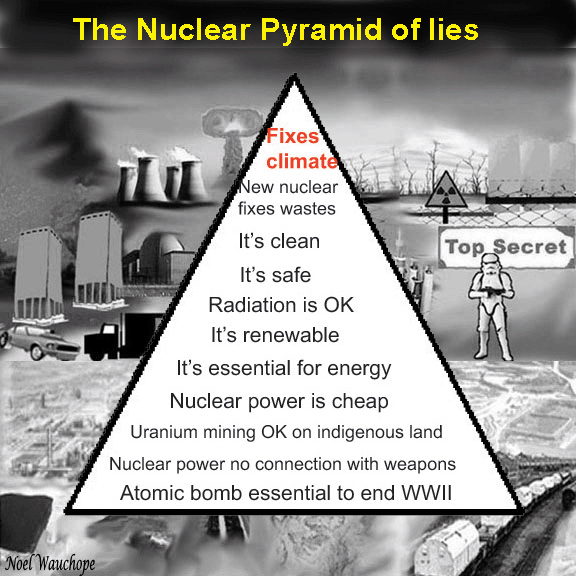
CLEAN? -WHAT A LIE! NIA welcomes first-ever nuclear appointment to Government’s Clean? Power Advisory Commission.
Sizewell C’s Julia Pyke brings expertise in delivering major infrastructure projects and effective community engagement
The Nuclear Industry Association has welcomed the appointment of Julia Pyke, Co-Managing Director of Sizewell C, as one of the UK Government’s eight new Clean Power 2030 Advisory Commissioners – marking the first time somebody with significant nuclear experience has been appointed to the Commission.
The appointment recognises the vital role nuclear power plays in delivering secure, reliable and low-carbon electricity, and ensures nuclear expertise is at the heart of advice shaping the UK’s clean power future.
Tom Greatrex, Chief Executive of the Nuclear Industry Association, said:
“Julia Pyke’s appointment is a hugely positive step and a clear recognition that nuclear must be central to delivering the UK’s clean power mission. The fact that this is the first time a nuclear leader has been appointed to the Commission ensures that decisions on the UK’s energy future are informed by the realities of building and operating clean, reliable power at scale.”
Let the investor beware: why buying UK government Green Savings Bonds now means backing nuclear.

15th December 2025, https://www.nuclearpolicy.info/news/let-the-investor-beware-why-buying-government-green-savings-
In commercial transactions, prospective purchasers are often urged to exercise caution before signing on the dotted line with a Latin phrase, ‘caveat emptor’ or ‘let the buyer beware’. The UK/Ireland Nuclear Free Local Authorities would like to warn future purchasers of government savings products to be wary that they might be investing in nuclear projects.
The UK’s Green Financing Programme raises financing from investors through the issuance of green gilts via the Debt Management Office and the sale of retail Green Savings Bonds to the public via National Savings and Investments. This money has been invested in projects which help the government move toward their ambition to achieve net zero carbon emissions by 2050.
Many savers desiring to help tackle climate change will have invested their hard-earned money into the three-year, interest-bearing bonds which were first launched in October 2021.
To date, the Green Financing Programme has raised over £51 billion.
The Green Financing Framework issued in 2021 included guidelines on the projects that could be backed; these fell into six categories: clean transportation, renewable energy, energy efficiency, pollution prevention and control, living and natural resources, and climate change adaptation.
Every year the government publishes a report identifying which projects have been backed into the last twelve months and their impact on climate emissions[i]. Typically this has including building offshore wind farms, investing in electric buses, offering discounts on electric vehicles, installing electric vehicle charging points, planting masses of trees, and insulating homes.
Now in a retrograde step, the government, obsessed with funnelling as much public money as possible into nuclear power, has issued a revised Green Financing Framework, with future investment in nuclear energy projects now included in the list of Eligible Green Expenditures.[ii]
The Framework makes clear that ‘the proceeds from sales of green gilts or Green Savings Bonds issued prior to 27 November 2025 will not be allocated to nuclear energy related expenditures’, but there will be no restriction on such investment after this date.
In the new supposedly ‘Green’ Category: Nuclear Energy, investment can be made in: ‘Electricity and/or heat (including cogeneration); support for the design, development, construction, commissioning, safe operation, lifetime extension, or supporting infrastructure of new or existing nuclear power generation assets (including enabling fuelcycle activities; radioactive waste and spent fuel storage, management and final disposal), and research and development for future fission and fusion energy technologies
Nuclear is NOT a green energy technology, but permitting the use of money raised from green investors in the management and disposal of high-level radioactive waste, which poisons people and our planet for millenia, must surely be the ultimate travesty. Our advice: avoid.
1 This Month

of the week – Shut Down Drone Warfare!


Tell the Ukrainian Government to Drop Prosecution of Peace Activist Yurii Sheliazhenko

Petition to revoke the licensing of the Near Surface Nuclear Disposal Facility (NSDF) at Chalk River. https://www.ourcommons.ca/petitions/en/Petition/Details?Petition=e-7247
To see nuclear-related stories in greater depth and intensity – go to https://nuclearinformation.wordpress.com
-
Archives
- March 2026 (251)
- February 2026 (268)
- January 2026 (308)
- December 2025 (358)
- November 2025 (359)
- October 2025 (376)
- September 2025 (257)
- August 2025 (319)
- July 2025 (230)
- June 2025 (348)
- May 2025 (261)
- April 2025 (305)
-
Categories
- 1
- 1 NUCLEAR ISSUES
- business and costs
- climate change
- culture and arts
- ENERGY
- environment
- health
- history
- indigenous issues
- Legal
- marketing of nuclear
- media
- opposition to nuclear
- PERSONAL STORIES
- politics
- politics international
- Religion and ethics
- safety
- secrets,lies and civil liberties
- spinbuster
- technology
- Uranium
- wastes
- weapons and war
- Women
- 2 WORLD
- ACTION
- AFRICA
- Atrocities
- AUSTRALIA
- Christina's notes
- Christina's themes
- culture and arts
- Events
- Fuk 2022
- Fuk 2023
- Fukushima 2017
- Fukushima 2018
- fukushima 2019
- Fukushima 2020
- Fukushima 2021
- general
- global warming
- Humour (God we need it)
- Nuclear
- RARE EARTHS
- Reference
- resources – print
- Resources -audiovicual
- Weekly Newsletter
- World
- World Nuclear
- YouTube
-
RSS
Entries RSS
Comments RSS
 nuclear-news