Aldermaston named on Russia nuclear war UK ‘strike list’

30th January, By Suzanne Antelme, https://www.readingchronicle.co.uk/news/25809589.aldermaston-named-russia-nuclear-war-uk-strike-list/
A small Berkshire village has been named on an alleged list of UK targets that Russia might strike with missiles or nukes if war between the two countries ever breaks out.
The alleged strike list of 23 sites was revealed by a Russian politician, according to LADbible.
The outlet reported that Dmitry Rogozin, a Russian senator and the country’s former deputy prime minister, shared a map of the potential targets as tensions rose between NATO and Russia last year.
The list of 23 targets includes Aldermaston, a village in Berkshire that happens to be the main site for the UK’s atomic weapons programme.
Aldermaston has hosted the programme since 1950, and it was in this humble village that the Atomic Weapons Research Establishment (AWRE) designed the UK’s first hydrogen bomb in 1957.
The AWRE has since become the AWE Nuclear Security Technologies, and Aldermaston remains at the centre of the government’s nuclear capabilities, responsible for designing and manufacturing the UK’s nuclear warheads.
Slow worms blamed for holding up Britain’s nuclear deterrent
Economists warn project is ‘above budget’ as removal of legless lizards delays expansion.
Jonathan Leake Energy Editor. Matt Oliver Industry Editor,
Rachel Reeves ordered a review of the quango that handles Britain’s nuclear
waste amid concerns about project overruns and spiralling budgets. The
Nuclear Decommissioning Authority (NDA) is in charge of taking apart old
nuclear power stations and storing their radioactive waste securely –
including at Sellafield, the nuclear waste site in Cumbria.
In 2022, a
Treasury report estimated the NDA’s liabilities to be £237bn – a colossal
sum that raised questions over all nuclear spending. The following year,
the Treasury revised that figure down to £124bn simply by applying an
increased discount rate – an accounting device used to reduce the apparent
cost of future spending. Since then, however, costs have jumped again.
In 2024, the National Audit Office found that the budget for Sellafield’s
clean-up had leapt to £136bn.
The new review will be led by Tim Stone, the
chairman of Nuclear Risk Insurers and a former expert adviser to several
government departments. In documents published online, the Department for
Energy Security and Net Zero said the review presented an “opportunity to
address concerns” with the NDA’s performance. They added: “Given the
significance and complexity of the NDA’s task, it is essential to ensure
that the NDA operates effectively and efficiently, delivering value for
money to the taxpayer while also maintaining standards of openness and
transparency.”
Telegraph 27th Jan 2026, https://www.telegraph.co.uk/business/2026/01/27/slow-worms-blamed-for-holding-up-britains-nuclear-deterrent/
From Net Zero to Nuclear: the skills gap that could stall UK growth
The UK has no shortage of ambition when it comes to infrastructure. From
Net Zero commitments and energy security to rail modernisation, water
resilience and nuclear new build, the pipeline of nationally significant
projects is substantial. Yet beneath the headlines lies a constraint that
threatens to undermine delivery across all of them: a critical shortage of
skilled labour. While capital allocation, planning reform and supply chains
dominate much of the public debate, workforce capability is increasingly
the factor that determines whether projects progress as planned — or
drift into delay and cost escalation.
City AM 29th Jan 2026,
https://www.cityam.com/from-net-zero-to-nuclear-the-skills-gap-that-could-stall-uk-growth/
Brian Goodall concerned about nuclear subs at Rosyth
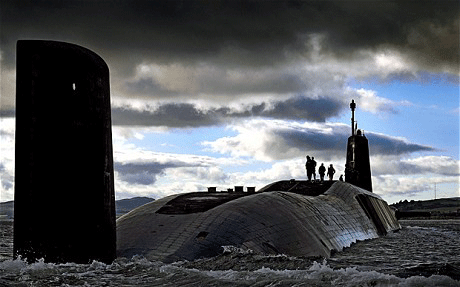
Last month the MoD told the committee that they will not reveal if nuclear weapons will be aboard submarines being repaired at Rosyth.
28th January
A ROSYTH councillor is calling for a public consultation on plans to temporarily base the UK’s new nuclear submarine fleet at the dockyard.
Brian Goodall highlighted the “seriousness of the implications” of providing a contingency dock for the Dreadnought class of vessels that will carry Trident missiles.
He said emergency plans to be put in place in the event of a radiological accident “could require urgent protective actions, like arrangements for sheltering local people and the distribution of potassium iodide tablets to the local community”.
He has submitted a motion to next week’s South and West Fife area committee, calling on the convener to write to the “Secretary of State for Defence requesting that a public consultation be held on the proposals”.
Cllr Goodall also wants the committee to acknowledge the “seriousness of the implications of these plans and the impact any radiological accident or event would have on the local population”.
Rosyth will “bridge a gap” by offering a temporary home for the new subs and Babcock said the dock needs to be ready by 2029.
Long term the vessels will be maintained at Faslane, however the site on the Clyde won’t be ready until the mid 2030s.
The UK Government are investing £340 million in the dockyard which includes funding for the contingency dock.
Cllr Goodall’s motion explains the dock will be used for the “Dreadnought-class nuclear submarines from the UK’s continuous at-sea nuclear Trident missile programme”.
He said the UK Government plans included information on the need for a “Detailed Emergency Planning Zone” which was still being calculated but was likely to include parts of the town within 1.5km.
The SNP councillor added that “emergency plans both on and off site will also be needed to reduce and/or prevent the escalation of the impact of any radiological accident or event”.
Last month the MoD told the committee that they will not reveal if nuclear weapons will be aboard submarines being repaired at Rosyth.
They also confirmed residents would be given potassium iodate tablets to block radiation in the event of an emergency.
The MoD was giving an update on the plans for Rosyth to be the temporary repair base for the UK’s new fleet of nuclear deterrent submarines.
This work would be alongside the submarine dismantling project, which is cutting up an old nuclear sub, Swiftsure, at the dockyard and removing the radioactive waste left within it.
There are another six decommissioned subs laid up at Rosyth – and 15 at Devonport – still to be dismantled and although no decision has been made, local Labour MP Graeme Downie has called for that work to be done here.
He said the yard could become a “centre of excellence” for submarine dismantling which would secure highly paid skilled jobs for decades to come.
This week Cllr Goodall posted: “I’ve said that this (motion) should include an update from Babcock and the Ministry of Defence, following the local Labour MP’s really concerning call for all of the UK’s decommissioned nuclear submarines to be brought to Rosyth for the dismantling, and so, the storage of radioactive materials that goes with it, to go on in Rosyth indefinitely.”
Tribunal says Swahili ban at nuclear firm was discrimination
An employment tribunal has ordered the taxpayer owned company tasked with
safely decommissioning the UK’s first-generation nuclear power sites pay
more than £10,800 in compensation to a worker who was banned from speaking
Swahili. The Glasgow tribunal found that Nuclear Restoration Services
Limited (NRS) discriminated against Mr K Ruiza after his line manager
instructed him to only speak English while on site. The judge said the
order left him humiliated, distressed and fearful he would lose his job.
The tribunal ruled the company must pay £9,000 for injury to feelings,
plus £1,875.94 in interest, bringing the total award to £10,875.94.
Herald 26th Jan 2026, https://www.heraldscotland.com/news/25794684.tribunal-says-swahili-ban-nuclear-firm-discrimination/
Anti-climate opinion columns becoming a regular feature in UK newspapers.

Sidhi Mittal, 21st January 2026, https://www.edie.net/anti-climate-opinion-columns-becoming-a-regular-feature-in-uk-newspapers/
Nearly 100 UK newspaper editorials were published opposing climate action in 2025, a record figure that shows the scale of the backlash against net-zero policies in the right-leaning press.
Carbon Brief examined editorials published since 2011. These included those written by external columnists and those acting as a publication’s official editorial ‘voice’.
In 2025, it identified 98 editorials rejecting climate action, compared with 46 in support. This was the first year in which opposition overtook support across the 15 years of data.
All 98 editorials opposing climate action appeared in right-leaning titles. The largest contributors were the Sun, the Daily Mail and the Daily Telegraph, followed by the Times and the Daily Express.
By contrast, almost all of the editorials pushing for more climate action were published in the Guardian and the Financial Times, which have far smaller circulations than several of the conservative papers.
Overall, 81% of climate-related editorials in right-leaning newspapers in 2025 rejected climate action – either overall, or due to specific policy interventions.
Carbon Brief said this marked a sharp change from a few years earlier, when many of the same papers showed increased enthusiasm for climate policy as Conservative governments under Theresa May and Boris Johnson introduced the net-zero by 2050 target and backed measures to deliver it.
Right-leaning press drives opposition
The media shift has coincided with political changes on the UK right, according to the research.
Over the past year, the Conservative party has distanced itself from the net-zero target it legislated for in 2019 and from the Climate Change Act.
Tory Leader Kemi Badenoch has stated that she would scrap the Act altogether if elected. This would spell the end of the UK Government’s official climate advisory body and all future carbon budgets.
Reform UK has also been rising in the polls while pledging to “ditch net-zero”. Carbon Brief said the positions taken by right-leaning newspapers tend to reflect and reinforce the politics of the parties they support.
None of the editorials opposing climate action questioned the existence of climate change or the science behind it. Instead, they criticised the policies designed to address it, a position Carbon Brief describes as “response scepticism”.
In many cases, newspapers attacked “net-zero” without mentioning climate change at all.
The report links this to earlier research by Dr James Painter of the University of Oxford, which found that UK newspaper coverage has been “decoupling net-zero from climate change”. This comes despite polling showing majority public support for many of the policies that underpin net-zero and for the 2050 target itself.
Economic arguments dominated the opposition. Carbon Brief found that more than eight in ten of 2025’s editorials rejecting climate action cited cost as a reason, describing net-zero as “ruinous” or “costly” and blaming it for driving up energy bills.
Earlier this month, several national newspapers also gave prominent coverage to a pamphlet from the Institute of Economic Affairs (IEA) on the “cost of net-zero” that misrepresented the work of the National Energy Systems Operator (NESO).
The IEA claimed net-zero costs could exceed £7.6trn, but the figures were based on the flawed assumption that no investment would be made in energy systems if the UK did not have its 2050 climate target.
Critics also say the IEA mischaracterised NESO’s analysis. Regardless, the pamphlet appeared on the front page of the Daily Express and was reported by political correspondents at the Express, Daily Mail and Daily Telegraph without scrutiny of the underlying energy data.
Miliband under sustained attack
Alongside criticism of policy, newspapers also targeted the Labour Government’s energy security and net-zero secretary, Ed Miliband.
In 2025, UK newspapers published 112 editorials taking personal aim at him, nearly all in right-leaning titles. The Sun alone published 51.
Six in ten editorials opposing climate action used criticism of climate advocates as part of their justification, and almost all of these mentioned Miliband.
Miliband was described as a “loon”, a “zealot” and the “high priest of net-zero”, and accused of “eco insanity” and “quasi-religious delusions”.
Newspapers frequently framed policies as “Ed Miliband’s net-zero agenda”, “Mr Miliband’s swivel-eyed targets” or “Mr Miliband’s green taxes”, presenting climate measures as being imposed on the public by the energy secretary. This is despite the fact that many targets and initiatives were kick-started under the Tories.
Renewables, nuclear and fossil fuels
Carbon Brief additionally analysed editorials on specific energy technologies.
There were 42 editorials criticising renewable energy in 2025. For the first time since 2014, anti-renewables editorials outnumbered those supporting them.
Cost was the dominant argument, with 86% of critical editorials using economic justifications.
The Sun referred to “chucking billions at unreliable renewables”, while the Daily Telegraph warned of an “expensive and intermittent renewables grid”.
At the same time, right-leaning newspapers continued to support nuclear power despite its high costs. There were 20 editorials backing nuclear energy in 2025, nearly all in conservative titles, and none opposing it.
The Times was the only right-leaning newspaper to publish any editorials backing renewables.
Support for fracking also reappeared. After falling away in 2023 and 2024, there were 15 editorials in 2025 arguing that fracking would be economically beneficial, even as the Government plans to ban the practice permanently.
North Sea oil and gas remained a major focus. Thirty editorials, all in right-leaning newspapers, mentioned the issue, with most arguing for increased extraction while also opposing climate action or renewable expansion.
Related article: Tories invoke fears of electricity blackouts to criticise renewable energy roll-out
Why the Nuclear Regulatory Review is flawed – and how itcould turn the nature crisis into a catastrophe.

January 2026, Research commissioned by The Wildlife Trusts
“…………………………………………………. Large nuclear projects, using potentially risky technology, have potential for significant environmental impacts on sensitive places and so it is right for there to be robust environmental assessments of these projects. The Government has an ambitious programme of nuclear
deployment. It has published a new National Policy Statement for nuclear power.3
It has removed the restriction on new nuclear power to eight sites around the UK. It has said it will aid
the completion of Hinkley Point C, provide additional funding for Sizewell C, and consider one
large new nuclear power plant alongside the deployment of Small Modular Reactors. Due to
their requirements and the types of site needed, nuclear projects have often impacted on
ecologically sensitive areas. The new National Policy Statement on nuclear reiterates the
importance of the Habitats Regulations and the protection of legally protected sites and wildlife.
As part of its efforts to boost nuclear deployment, the Government commissioned John
Fingleton to lead a taskforce review of nuclear regulation. The final report of the Nuclear
Regulatory Review was published in November 2025.
It diagnosed environmental regulations
as a blocker to nuclear deployment and included recommendations to water down those
regulations. The Prime Minister and the Chancellor have said that the Government accepts the
principles of the Review, that within three months a plan will be published by DESNZ to
implement the Review, and that its recommendations will be implemented within two years
using legislation.6 Environmental groups are very concerned the recommendations will be
adopted for the nuclear sector using legislation and potentially applied to other types of major
infrastructure.
The Nuclear Regulatory Review is part of a wider pattern of the Government adopting the
arguments of developers to pinpoint where delays are coming from; however, it is inaccurate
and does not represent reality. Research by The Wildlife Trusts already shows that – despite
the headlines and claims by the Chancellor and others – bats and newts, for example, were a
factor in just 3.3% of planning appeals.7 This briefing will highlight how the claims made by the
Nuclear Regulatory Review are similarly short on evidence and, if adopted, will do little to speed
up planning decisions but, instead, will turn the nature crisis into a catastrophe. Many industries
already say that the uncertainty caused by constantly changing regulations holds back
development; the Nuclear Regulatory Review threatens to do just that.
Flaws and Inaccuracies in the Nuclear Regulatory Review
The Review, commissioned by the Government, identifies three major areas for reform: risk
aversion, process over outcomes, and a lack of incentives. The Review also turns nature into a
scapegoat for a failure to deliver nuclear projects.
Recommendation 11 calls for various changes to the Habitats Regulations, including removing
the requirement for compensation to be like-for-like. Recommendation 12 calls for nuclear
developers to be allowed to comply with the regulations simply by paying a fixed sum (an
amount per acre), which would be used by Natural England for nature somewhere else. When it
comes to local planning, The Wildlife Trusts remain concerned with the related idea of
payments for Environmental Delivery Plans as a way for developers to meet their legal
obligations. A strategic approach might be appropriate when it comes to, for example, pollution
impacts, but would not be suitable for irreplaceable habitats or species that cannot re-establish
elsewhere easily.8
Recommendation 19 would remove the duty on Local Authorities to seek and further National
Parks and Landscapes, returning to the old language of “have regard to”. The combination of
these changes would not only substantially weaken protections for nature but would also
introduce significant uncertainty in the nuclear sector and for other sectors about whether
standards and regulations that are bedding in and increasingly becoming well understood are in
fact about to change.
The Review was produced without enough environmental expertise – and this shows. It
contains a number of errors when it comes to environmental evidence, which has led to a
misdiagnosis of the problem and to damaging recommendations about environmental
regulations.
The Review relies heavily on the case study of the Hinkley Point C nuclear power station. It is
quick to use the case study to blame nature without examining the actions and decisions of the
developer. A large amount of confusing and misleading information has been issued to the
media and in the Review itself to further this narrative.
Here are some of the facts:
- Hinkley Point C is on the edge of one of the most highly ecologically protected sites in
Europe and will draw through a swimming pool’s worth of water every second for 70
years of operation. This will have enormous impacts on surrounding ecosystems, fish,
and other species.9 - A £700 million figure has been widely circulated in the press relating to fish deterrents
and is quoted in the Review. This is incorrect. The cost of the fish deterrent system is
£50 million.10 - EDF themselves unilaterally decided in 2017 not to proceed with the fish deterrent
system, despite it being a requirement. They then proceeded to apply for permit
variations, undertake further environmental assessments and initiate a public inquiry to
attempt to remove the requirement. These developer decisions have caused selfinflicted delays.11 - Hinkley Point C’s original budget was £18 billion. It has since risen to an estimated £46
billion. The fish deterrent (at £50 million) comes to just 0.1% of this increased £46
billion budget. Nearly £30 billion in cost increases for Hinkley Point C have nothing to
do with nature.12 - The Nuclear Regulatory Review says (for example) that just 0.08 salmon, 0.02 trout,
and 6 lamprey per year would be saved. This deliberately downplays the impact on
nature. This statement relies on analysis by the developer EDF, who captured fish and
put trackers on them and used old data from Hinkley B power station. Since then ,a
more thorough analysis has been completed for the Environment Agency, who have found that 4.6 million adult fish per year being killed is a more accurate number, or 182 million fish in total over sixty years.13 These fish populations are a foundation stone for the wider ecosystem of the Severn Estuary, supporting internationally important migratory bird populations and other species. Many of the fish are rare or endangered. Damage on the scale suggested by the Environment Agency figures could have calamitous impacts on that ecosystem and the economic and social activities that rely on it………………………………………………………………………………
Environmental Damage of Nuclear Regulatory Recommendations………………………………………………………………………………………………………………………………………………………………………………………………
Conclusion
The Nuclear Regulatory Review recommendations 11, 12 and 19 will harm nature and
biodiversity. They are based on flawed evidence relating to environmental regulations and how
they have been applied. As discussed, the true reasons for nuclear delay lie elsewhere.
Implementing the Nuclear Regulatory recommendations would devastate nature without
speeding up the nuclear planning and delivery process. The Government must reject the three
Nuclear Regulatory Review’s recommendations on environmental regulations and end its
confected war on nature as a barrier to planning.
20th January 2026
Research commissioned by The Wildlife Trusts and conducted by Matt Williams, https://www.wildlifetrusts.org/sites/default/files/2026-01/WhyTheNuclearRegulatoryReviewIsFlawed_TheWildlifeTrusts.pdf
Nature groups question UK’s Fingleton nuclear review
The Engineer, 21 Jan 2026, https://www.theengineer.co.uk/content/news/nature-groups-question-fingleton-nuclear-review
More than a dozen environmental groups and over 60 MPs are questioning the ‘Fingleton recommendations’ set out in the recent Nuclear Regulatory Review.
Led by economist John Fingleton, the Nuclear Regulatory Review made several recommendations designed to ease the path of nuclear development. Among these were proposals to weaken the Habitats Regulations which protect nature sites. But environmental groups, led by The Wildlife Trusts, claim that the review is based on flawed evidence, and that the recommendations could have a catastrophic effect on nature across the UK.
“The dice were loaded from the start – the nuclear review confirms a false narrative that was already being circulated by certain industry lobby groups and think tanks,” said Craig Bennett, chief executive of The Wildlife Trusts.
“The errors in the review form a clear pattern: repeated exaggeration of the costs of preventing harm to nature – and minimisation of the impact to wildlife of nuclear development without those measures. The fact that no environmental experts served on the panel is a disgrace and the resulting distorted picture obscures the value the natural world delivers for economic stability and net zero.”
A new report from The Wildlife Trusts points to specific examples where it believes the nuclear review falls short. It claims that, rather than £700m, Hinkley C’s much-debated fish deterrent system would actually cost £50m. This is against a total project cost of £46bn, up from an original estimate of £18bn.
The Nuclear Regulatory Review also claims that the fish deterrent system would save just 0.08 salmon, 0.02 trout and 6 lamprey per year. However, The Wildlife Trusts cites a report from the Environment Agency that suggests up to 4.6 million adult fish per year could be killed per year if no protective measures are put in place.
“There is limited evidence that environmental protections impose undue costs on infrastructure developers,” said Bennet. “In fact, evidence shows that frequently cited examples of expensive mitigation measures originated from developer mistakes and were unconnected to environmental issues. Blaming nature is unacceptable and a way of avoiding accountability.
“The developers of Hinkley C are trying to blame everyone but themselves for their own failure to think about nature from the outset. When developers think about nature too late in the design process, they end up creating bolt-on engineering solutions for ecological problems, which tend to be more expensive and less effective than committing to make infrastructure nature positive from the very start of the designing process. It’s pretty pathetic that the government is now trying to bail out energy infrastructure developers for this failure of commitment and imagination.”
The Wildlife Trusts’ campaign to save the environmental protections that are threatened by the recommendations of the Nuclear Regulatory Review is supported by 14 other organisations: Wildlife and Countryside Link, Rivers Trust, Campaign for National Parks, Marine Conservation Society, Plantlife, Buglife, Bat Conservation Trust, Amphibian Reptile Conservation, Badger Trust, Beaver Trust, Bumblebee Conservation Trust, Butterfly Conservation, Open Spaces Society, and Client Earth.
Britain to extend life of ageing nuclear plants to keep the lights on

Hartlepool and Heysham 1 licenses prolonged to 2030 due to ‘dangerous gap’ in power supplies.
Jonathan Leake, Energy Editor, 21 January 2026
Two of Britain’s oldest nuclear power plants
could be kept running for an extra two years because of an acute
electricity shortage in the UK. Hartlepool and Heysham 1, owned by EDF,
were due to shut down in 2028, but ministers want to extend the operating
licences to at least 2030 because the UK faces “a dangerous gap” in
power supplies if they shut.
Both have already been operating for 42 years
despite being scheduled to close for safety reasons in 2008. EDF,
France’s state-owned power utility, which operates all five UK nuclear
stations, said it was working to keep the stations operational without
compromising safety. Mark Hartley, from EDF, said: “In November, the UK
Government said that the retirement of these Advanced Gas-Cooled Reactors
(AGRs) risks leaving a dangerous gap in Britain’s low-carbon energy
supply. “It is our ambition to generate from the remaining AGR stations
for as long as it is safe and commercially viable to do so, and we will
keep their lifetimes under review to assess whether further life extensions
can be achieved.”
Sizewell B, the UK’s largest nuclear plant, is
already due to operate until 2035, and EDF hopes to extend this to 2055.
Two other stations, Torness and Heysham 2, were originally scheduled to
close in 2023 and have been cleared to generate until March 2030 after EDF
invested £8.6bn in the fleet.
The fate of Heysham 1 and Hartlepool is less
certain and will depend on the results of safety assessments. AGR reactors
contain radioactive uranium fuel pellets surrounded by massive graphite
blocks that absorb the high-energy neutrons emitted by the fuel, thereby
controlling the nuclear reaction.
However, over time, these blocks tend to
crack due to the intense radiation and heat to which they are exposed. Such
cracks have already forced the closure of several other UK power stations.
EDF’s safety assessment will need to be ratified by the Office for
Nuclear Regulation, which will need to approve the extensions as safe.
Telegraph 21st Jan 2026, https://www.telegraph.co.uk/business/2026/01/21/britain-extend-life-ageing-nuclear-plants-keep-lights-on/
US aggression, UK support: The ‘special relationship’
From Iran to Libya, from Panama to Venezuela, there is a history of the UK supporting illegal US military interventions
MARK CURTIS, 12 January 2026, https://www.declassifieduk.org/us-aggression-uk-support-the-special-relationship/
Forty years ago, US warplanes bombed Libya, attempting to assassinate its leader Muammar Gaddafi. Failing in that task, they managed to kill dozens of civilians in Tripoli, Libya’s capital.
The attacks, which were in response to the bombing of a Berlin nightclub blamed on Gaddafi, were strongly supported by Margaret Thatcher’s government. Indeed, she allowed some of the US jets to take off from bases in Britain.
In the face of widespread public opposition to the US raid, a defiant Thatcher told parliament it was “a necessary and proportionate response to a clear pattern of Libyan terrorism” and to “uphold international law”.
However, the UN General Assembly, and most world opinion, condemned the attack as a violation of international law.
But for the British prime minister: “The United States has stood by us in times of need, as we have stood by her. To refuse their request for the use of bases here would have been to abandon our responsibilities as an ally and to weaken the fight against terrorism.”
Fast forward two decades, and we find ourselves in a not dissimilar situation over US attacks on Venezuela.
UK ministers give their backing to the kidnapping of a foreign head of state amidst a military intervention, condemned in the wider world but supported in Whitehall because of the so-called “special relationship”.
‘Our full support’
It was always thus. Three years after the attack on Libya, the US invaded Panama in December 1989. US aggression killed up to 3,000 people in this instance, and overthrew President Manuel Noriega, who had been on the CIA’s payroll for decades.
The invasion was widely considered to be illegal and in violation of the charters of both the UN and the Organization of American States.
A Foreign Office legal adviser wrote on the day of the invasion that “it is not possible to conclude that the American action was justified in international law”.
This didn’t matter in the British corridors of power. In a private phone call, Thatcher assured US president George W Bush that the intervention “was a very courageous decision which would have our full support”.
In the days that followed, Britain even vetoed a UN Security Council resolution which “strongly deplores” the invasion.
Clinton/Blair double act
A change in leadership in London and Washington made little difference to this pattern in the 1990s when the double act became Bill Clinton and Tony Blair.
In August 1998, Clinton launched a wave of cruise missile attacks on targets in Afghanistan and Sudan in retaliation for Al Qaeda’s bombing of US embassies in Kenya and Tanzania earlier that month.
Al Qaeda’s bombings were horrific, killing over 300 people. But while the US retaliation struck terrorist training camps in Afghanistan, its target in Sudan was a pharmaceuticals factory that produced medicines for the country’s population.
The US claimed the plant was manufacturing chemical weapons but no strong evidence ever emerged for this.
Amid the controversy, Bill Clinton blocked proposals for a UN investigation into the matter while Tony Blair strongly backed his ally’s attacks — against the advice of some British diplomats reportedly being appalled at them.
‘Proper legal authority’
It was only a few months later, in December 1998, that Bill and Tony worked even more closely together in a new bombing campaign.
They authorised four days of air strikes on Iraq, ostensibly to degrade dictator Saddam Hussein’s ability to store and produce weapons of mass destruction (which, of course, never materialised).
The declassified files show that Blair and his closest advisers were consistently informed by UK legal advisers that attacking Iraq would not be lawful.
The only exception would be if a new UN Security Council resolution were to be passed saying Saddam was in “material breach” of Iraq’s previous commitments – which London and Washington never secured.
In a sign of Blair’s attitude towards legal requirements, he privately wrote at the time that he found his law officers’ legal advice “unconvincing”.
When he announced military action to parliament in November 1998, Blair misled the house by saying: “I have no doubt that we have the proper legal authority, as it is contained in successive Security Council resolution documents”.
‘Act of war’
Over 20 years later, it was the turn of Boris Johnson to acquiesce to Donald Trump in an overtly illegal US act of aggression.
In January 2020, Trump ordered a drone strike that killed Iranian General Qasem Soleimani, the commander of the Quds force, a branch of Iran’s Islamic Revolutionary Guard Corps which the US had designated a terrorist organisation.
Washington tried to justify the killing by claiming it had intelligence that Soleimani was plotting imminent attacks on US interests across the Middle East.
But a UN report found that the assassination was illegal. Indeed, the then UN special rapporteur on extrajudicial executions, Agnes Callamard, said it marked a watershed in international law.
“It is hard to imagine that a similar strike against a Western military leader would not be considered as an act of war, potentially leading to intense action, political, military and otherwise, against the State launching the strike”, she wrote.
By contrast, Johnson defended the US action and said that “we will not lament” Soleimani’s death. He added that “the strict issue of legality is not for the UK to determine since it was not our operation” — precisely what Keir Starmer has just said about Venezuela.
London’s support for Washington also came in the form of Johnson’s equally belligerent foreign secretary, Dominic Raab, who added that the US “had a right to exercise self-defence”.
Bombing Iran
Trump attacked Iran again after Keir Starmer had been in office for nearly a year. In June last year, the US launched air strikes on nuclear-related sites in the country, ostensibly to prevent Tehran developing a nuclear arms programme.
A group of UN experts condemned the intervention, stating: “These attacks violate the most fundamental rules of world order since 1945 – the prohibition on the aggressive use of military force and the duties to respect sovereignty and not to coercively intervene in another country.”
Yet Starmer’s response was a rehearsal of his reaction to Trump’s recent kidnapping of Nicolas Maduro in Venezuela. The British prime minister failed to condemn the US intervention, instead going along with it by saying it was “clear Iran cannot have a nuclear weapon”.
Similarly, foreign secretary David Lammy was repeatedly asked whether the US attacks were illegal, and refused to say.
Backing the law by violating it
By the time the US under Trump overthrew the Venezuelan government earlier this month, the UK response was utterly predictable.
Starmer and other ministers welcomed Maduro’s overthrow, failed to identify it as an obvious violation of international law and even had the audacity to claim they remained strong supporters of that law.
Foreign secretary Yvette Cooper said in a parliamentary debate on Venezuela that “we will always argue for the upholding of international law”, precisely at a time she was supporting an obvious violation of it.
It was the same with her deputy. A day after telling parliament she welcomed the illegal US removal of Maduro, foreign minister Jenny Chapman told parliament the UK’s “support for international law… is unwavering”.
Maduro’s kidnapping was strongly condemned by UN experts while its human rights chief, Volker Turk, said it “violates the country’s sovereignty and the UN charter”.
This failed to deter the UK immediately proceeding with military collaboration with Trump’s rogue state. Four days after the kidnapping, the UK provided military support to Washington to help it seize a Russian-flagged oil tanker near the northwest waters of the UK.
Declassified asked legal experts to comment on Trump’s latest military intervention and many are concluding it is yet another violation.
The decades-long cycle goes on. The US and UK have long been repeatedly undermining what exists of a rules-based international order – while claiming to uphold it.
Who knows where it will lead us in terms of future wars and what price will be paid by ordinary people for the world’s leading states creating a global law of the jungle.
Who Needs CO2 to Heat the Planet When You Have Nuclear?

Letter in Westmorland Gazette January 15th 2026, https://lakesagainstnucleardump.com/2026/01/19/who-needs-co2-to-heat-the-planet-when-you-have-nuclear/?page_id=1745
Dear Editor
EDF is brazenly heralding the new year with their hype about how much CO2 Heysham’s dodgy old reactors have “saved.’ What they don’t say is that Heysham’s old reactors with their cracked graphite cores have used a vanishingly small amount of the vicious ongoing heat they have produced.
A vicious radioactive heat that will continue to be produced for thousands of years with the proposal to use the Lake District geology as a giant heat sink for this nuclear heat which cannot be turned off. Who needs CO2 to heat the planet when the nuclear industry is heating it up directly at great expense to the public in every way.
Yours sincerely,
Marianne Birkby
Lakes Against Nuclear Dump (a Radiation Free Lakeland campaign)
Miliband’s ‘green energy’ sea cable risks spreading nuclear waste across Orkney
Miliband’s ‘green energy’ sea cable risks spreading nuclear waste
across Orkney. Project could disturb radioactive particles on the seabed
which were created by the now-decommissioned Dounreay nuclear power plant.
The Orkney Link Transmission Project will enable renewable electricity to
be sent from the Scottish mainland to Orkney via an undersea cable that was
first approved in 2019. The project, overseen by the Department for Energy
Security & Net Zero, has already been criticised by locals for being
unsightly. It has now also emerged that the cable could disturb
“irradiated particles” on the seabed which were created by the
now-decommissioned Dounreay nuclear power plant decades ago. There is a
risk these radioactive particles, including radioactive forms of cobalt,
Americium and niobium, could wash ashore if disturbed. While official
documents state the risk is “extremely small”, the Government has
approved a £20m taxpayer-backed insurance policy to cover the cost of any
possible clean up operation.
Telegraph 17th Jan 2026, https://www.telegraph.co.uk/news/2026/01/17/milibands-green-sea-cable-risk-spreading-nuclear-waste/
Fears over plan for ‘biggest data centre cluster on earth’ in Scotland

RESIDENTS in East Ayrshire are growing extremely concerned about whether they will be consulted on a hyperscale data centre that is set to become part of “the biggest cluster in the world”.
Local concerns come after
it was revealed to residents that the developer of the site, the ILI group,
had never booked any venue for public consultations. Further, both East
Ayrshire Council and the developers set out dates for residents to attend
public consultations that were later cancelled with short notice. Local mum
Lisa Beacham said: “Councillors had been actively telling residents to
make themselves available for these public consultations, but I’ve
received confirmation that there were never any venue bookings made by the
developer.”
The National 15th Jan 2026, https://www.thenational.scot/news/25766423.east-ayrshire-residents-speak-hyperscale-data-centre/
Challenge to Latest Sellafield Discharges to the Rivers Calder, Ehen and the Irish Sea
By mariannewildart, on behalf of Lakes Against Nuclear Dump, https://lakesagainstnucleardump.com/2026/01/16/still-waiting-for-judge-to-make-decision-on-our-challenge-to-latest-sellafield-discharges/
The hearing on whether our Judicial Review into the challenge of Sellafield’s latest discharges to the rivers Calder and Ehen took place at the end of November. Incredibly we are still waiting for the decision on whether our Judicial Review can go forward. In the meantime here is a lovely photo [on original] of Rowbank Farm.
This is just one of the many farms and grand houses in the once fertile plain between the Lake District mountains and the Irish Sea to be obliterated by Sellafield’s nuclear waste sprawl along the once meandering and braided river Calder. This photo [on original] along with many more can be found on the Calderbridge and Ponsonby Parish Council website (no endorsement of our challenge by the Parish Council is implied – the photos are in the public domain)
Onwards and Upwards
‘Wall of money’ to invest in Scottish nuclear power if Labour win election
Prime Minister Keir Starmer said the SNP were saying Scotland was ‘shut for business’.
Danyel VanReenen, Politics Reporter, Jan 15th, 2026
The Prime Minister said the UK Labour Government is ready and willing to invest in nuclear power in Scotland if Anas Sarwar wins the Holyrood election in May.
The current SNP Government has consistently been against the creation of new nuclear power stations north of the border, with control of planning laws giving ministers an effective veto.
Keir Starmer said there is a “wall of money” Labour wants to invest in Scottish nuclear power, but he said the SNP are saying no “for ideological reasons”.
“If there’s a Labour Government in Scotland, we’ll be back the day after the election to make sure that money is translated into good, well-paying jobs in renewables and nuclear,” Starmer said.
“That can’t happen at the moment because the SNP is basically saying ‘we’re shut for business’.”…………………………………………………………………………………………. https://news.stv.tv/politics/wall-of-money-to-invest-in-scottish-nuclear-power-if-labour-win-election
1 This Month

of the week – Shut Down Drone Warfare!


Tell the Ukrainian Government to Drop Prosecution of Peace Activist Yurii Sheliazhenko

Petition to revoke the licensing of the Near Surface Nuclear Disposal Facility (NSDF) at Chalk River. https://www.ourcommons.ca/petitions/en/Petition/Details?Petition=e-7247
To see nuclear-related stories in greater depth and intensity – go to https://nuclearinformation.wordpress.com
-
Archives
- March 2026 (251)
- February 2026 (268)
- January 2026 (308)
- December 2025 (358)
- November 2025 (359)
- October 2025 (376)
- September 2025 (257)
- August 2025 (319)
- July 2025 (230)
- June 2025 (348)
- May 2025 (261)
- April 2025 (305)
-
Categories
- 1
- 1 NUCLEAR ISSUES
- business and costs
- climate change
- culture and arts
- ENERGY
- environment
- health
- history
- indigenous issues
- Legal
- marketing of nuclear
- media
- opposition to nuclear
- PERSONAL STORIES
- politics
- politics international
- Religion and ethics
- safety
- secrets,lies and civil liberties
- spinbuster
- technology
- Uranium
- wastes
- weapons and war
- Women
- 2 WORLD
- ACTION
- AFRICA
- Atrocities
- AUSTRALIA
- Christina's notes
- Christina's themes
- culture and arts
- Events
- Fuk 2022
- Fuk 2023
- Fukushima 2017
- Fukushima 2018
- fukushima 2019
- Fukushima 2020
- Fukushima 2021
- general
- global warming
- Humour (God we need it)
- Nuclear
- RARE EARTHS
- Reference
- resources – print
- Resources -audiovicual
- Weekly Newsletter
- World
- World Nuclear
- YouTube
-
RSS
Entries RSS
Comments RSS
 nuclear-news