Charities call for greater transparency over Sizewell C
Bird Guides, 29 Sept 24
Suffolk Wildlife Trust and the RSPB have called for greater transparency from Sizewell C in relation to its wildlife compensation schemes.
Earlier this month, developers of the nuclear power station announced a new partnership with the nature-restoration movement WildEast to promote the return of land to nature across the region.
In announcing the partnership, Sizewell C flagged up how it had pledged to return a large part of the land to nature during the construction of the new power station.
Not doing enough
Its involvement in leading on a wildlife habitat scheme at Wild Aldhurst NR in Leiston was mentioned, along with plans for wetland habitat creation at three nature reserves at Benhall, Halesworth and Pakenham.
Planning consent obligations mean that the developers of the new power station, situated just to the south of the RSPB’s flagship Minsmere reserve, must offset damage caused by the construction by creating new areas for nature.
However, in a joint statement with the RSPB, Suffolk Wildlife Trust – which has long held concerns – spoke of its “real disappointment” that Sizewell C had included the work at the three nature reserves, which is part of its legal duty to compensate for the impacts of the power station’s construction on wildlife.
Misrepresented
The charities said the projects were a “minimum requirement,” but were being “misrepresented” as examples of the developers going the extra mile for nature.
A spokesperson for the trust said: “People have a right to expect far better transparency from Sizewell C when it comes to its wildlife compensation. Sizewell C must do better to be clear about the compensation they are required to deliver by law, versus what is truly ‘additional’ for nature.”………………………………………… https://www.birdguides.com/news/charities-call-for-greater-transparency-over-sizewell-c/
Scottish National Party blasts Labour for ‘frittering away’ money on nuclear plant instead of winter fuel payment
The party’s energy spokesperson Dave Doogan said Labour “is more concerned with funding needless nuclear projects… than it is with supporting hard-pressed pension
Andrew Quinn, Westminster Reporter, 28 SEP 2024.
https://www.dailyrecord.co.uk/news/politics/snp-blasts-labour-frittering-away-33767683
The SNP has claimed the Labour Government is “frittering away” £5 billion on a nuclear power plant while cutting the Winter Fuel Payment.
The party’s energy spokesperson Dave Doogan said the party is “more concerned with funding needless nuclear projects… than it is with supporting hard-pressed pensioners.”
The UK Government announced earlier this month that an extra £5.5bn is being made available to the Sizewell C nuclear power plant.
The plant is being built in Suffolk and the UK Government has said it will help secure the country’s energy independence. It will supply up to seven per cent of the UK’s energy needs but won’t start generating electricity until the 2030s.
t comes after the Labour Government decided to make the Winter Fuel Payment means-tested. Nearly 900,000 Scots pensioners will now miss out on the benefit.
Doogan said: “When Labour frittered away more than £5bn to the blackhole that is Sizewell C nuclear plant, what they did was fund a French owned company that will have no benefit to Scotland all the while picking the pockets of Scottish pensioners by robbing them of their Winter Fuel Payment.
“England’s Sizewell C will cost the tax payer some £30bn, yet just £1.4bn was deemed too high a price to keep 880,000 pensioners Scottish warm this winter – Sir Keir Starmer’s priorities are all wrong.
“The British Government is more concerned with funding needless nuclear projects and defending indefensible designer clothing funds than it is with supporting hard-pressed pensioners as the frost bites this winter and heating bills rise.
“Scotland is energy rich and our future is in renewables, but instead the Labour Government is choosing to pump money into English nuclear power plants and letting Scottish pensioners go cold – the SNP will always put Scotland’s interests first and that includes our pensioners in the face of swingeing Labour cuts.”
“Given the dire state of the public finances we have inherited, it’s right we target support to those who need it most. Over a million pensioners will still receive the Winter Fuel Payment, while many others will also benefit from the £150 Warm Home Discount to help with their energy bills over winter.
“We are also committed to helping the UK achieve energy security and net zero and new nuclear power stations such as Sizewell C will help us achieve that, while securing thousands of good, skilled jobs.”
Weatherwatch: Labour’s stance on nuclear power is worryingly familiar
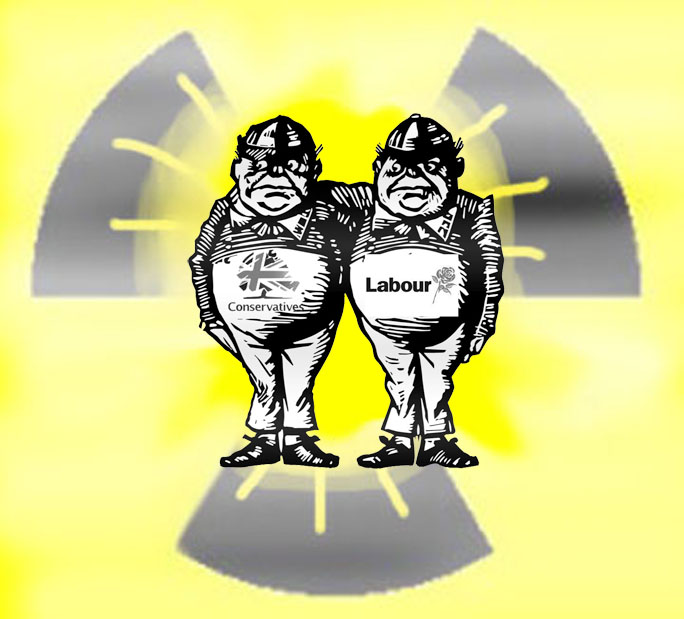
There is little difference between this government’s and its Conservative predecessor’s policies on expansion
Paul Brown, Fri 27 Sep 2024, https://www.theguardian.com/news/2024/sep/27/weatherwatch-labour-nuclear-power-conservative-policies
There seems to be no difference between Conservative and Labour policies on nuclear power. Both support the current building of Hinkley Point C in Somerset, the planned Sizewell C station in Suffolk, an unspecified number of small modular reactors all over Britain as well as the far-off dream of nuclear fusion.
However, few scientists serious about the threat of the climate crisis believe new nuclear power stations are part of the solution in reducing carbon output. Building them is too slow and costly, while solar and wind are quicker and cheaper in making a dent in fossil fuel consumption and eliminating it.
While supporting nuclear expansion seems to be politically expedient, the reality on the ground appears to be different. As the 2024 World Nuclear Status report published this month points out, if Britain gets anywhere near its plan to double onshore wind, triple solar power and quadruple offshore wind by 2030, it will be producing more electricity from these sources than the country consumes.
The experts also say if Rolls-Royce’s “heroic assumption” of the cost of electricity from small modular reactors was correct, any planned construction of large stations would immediately be abandoned.
US company eliminated from race to build Britain’s first mini-nuclear plant.

NuScale Power will not proceed to the final round of the competition’s selection process
Executives at NuScale Power were told on
Wednesday afternoon that they had been eliminated from the small modular
reactor (SMR) design competition.
The decision by officials at Great
British Nuclear (GBN), a government agency, leaves four companies battling
to secure support for their proposed technologies: Rolls-Royce,
Westinghouse, GE-Hitachi and Holtec Britain. Those businesses will now
progress to the final stage of the process, which will see them submit
“final best offers” to the Government.
GBN is then expected to announce
two winners either late this year or early in 2025, with the companies then
awarded sites and funding.
Earlier this year, a sixth company, the French
state-owned energy giant EDF, effectively dropped out of the contest when
it decided not to submit a bid by the required deadline. A spokesman for
NuScale also confirmed the decision. He said the company had been told it
did not meet the criteria for the SMR competition as it had already begun
production of its reactors and did not need support getting to market.
The decision is a fresh blow to NuScale, which suffered another setback last
November when its $1.4bn (£1bn) project to build a plant for a Utah power
provider was cancelled amid spiralling costs. The Government has not yet
confirmed where the first SMRs will be built. However, GBN purchased sites
in Wylfa, on the Welsh island of Anglesey; and Oldbury, Gloucestershire,
earlier this year.
Telegraph 25th Sept 2024
New developments at Sellafield for endless storage of ever-increasing amounts of highly radioactive spent nuclear fuel.
Sellafield to store all fuel from UK’s operational nuclear power stations, by Business Crack, September 25, 2024

I would have thought that it might be a good idea to plan for not making any more of this poisonous stuff.
But I guess that’s not in the official, expert, thinking.
A new space-saving rack at Sellafield will enable the site to store all the fuel expected from the UK’s operational nuclear sites.
The first fuel has been placed into a storage rack and the firm said it was set to save billions of pounds.
Known as the 63-can rack, the container allows the Thorp pond to store 50% more spent nuclear fuel.
Without the rack, a new storage pond would have to be built, potentially costing billions of pounds.
The rethink was required because Thorp needs to store more fuel than previously thought because the UK no longer reprocesses spent fuel, but instead stores it underwater prior to disposal.
The rack has been 16 years in the making and represents a success story for UK manufacturing.
Weighing 7 tonnes and standing 5.5 metres high, the stainless steel containers are being built by a consortium of Cumbrian manufacturers and Stoke-based Goodwin International.
Between them, they will manufacture 160 racks. Another 340 racks will be needed in the future…………………………………………………………………….
“These racks will increase fuel capacity from 4,000 tonnes to 6,000 tonnes, meaning we can accommodate all current and future arising, negating the need for a new storage facility……………………………………………………………………..
Because fuel will be stored for longer than was originally intended, the pond has required other alterations including raising the pH level to avoid corrosion and installing new cooling capacity, Sellafield Ltd said. https://businesscrack.co.uk/2024/09/25/sellafield-to-store-all-fuel-from-uks-operational-nuclear-power-stations/
“Peaceful” and war-making nuclear industries get together in tertiary education

The University of Sheffield Advanced Manufacturing Research Centre (AMRC)
and Holtec, the USA’s largest nuclear components exporter, have entered a
formal partnership to collaborate on SMRs and large-scale nuclear and
fusion in the civil and defence sectors.
Earlier this week, the two
organisations signed a Memorandum of Understanding (MoU) for ‘Cooperation
on Nuclear Advanced Manufacturing Technology’ at the AMRC’s facility in
Sheffield.
Machinery Market 24th Sept 2024 https://www.machinery-market.co.uk/news/38159/SMRs-and-large-scale-nuclear-and-fusion-collaboration
Nuclear plant’s decommissioning could take 95 years
Daniel Mumby, Local Democracy Reporting Service, 19 Sept 24, https://www.bbc.com/news/articles/c8699v4dvexo
Residents are being asked for their views on how a former nuclear power station should be safely decommissioned.
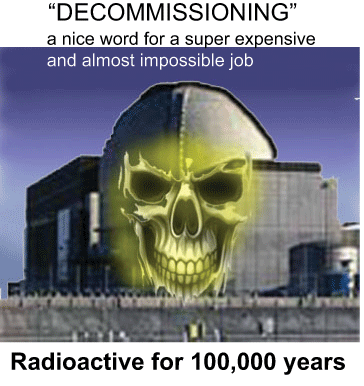
The Hinkley Point B facility, which lies on the Somerset coast north of Stogursey, ceased operations in August 2022, after cracks developed in the plant’s graphite cores, creating potential safety concerns.
EDF Energy, which owns the facility, has applied to the Office for Nuclear Regulation (ONR) for formal permission to decommission the site, which could take about 95 years.
Somerset residents now have three months to voice their views.
Under the proposals, Hinkley Point B, which opened in 1976, could be decommissioned in three phases.
The first phase, which will last until 2038, includes the dismantling of all buildings and plant materials except for the site’s safestore structure. This facility will be used to store and manage the residential nuclear waste from the power station.
The second phase will see “a period of relative inactivity” of up to 70 years from 2039, to allow for the radioactive materials within the safestore to safely decay, according to the Local Democracy Reporting Service.
While physical activity within the site will be minimal during this phase, the former power station will remain under close surveillance with “periodic maintenance interventions” to prevent any risk to health or national security.
The third and final phase will see the former reactor and debris vaults being dismantled and removed and any final landscaping work being completed – with EDF estimating that this will be finished by 2118.
The consultation is running until 9 December, with the ONR expected to publish its formal response in early 2025.
Hinkley Point C
EDF is currently building Hinkley Point C, which has a target completion date of June 2027.
Costing about £46bn, it is expected to generate enough electricity to supply some six million homes for the next 60 years.
Is the new UK government prepared to rise to the challenge of investing in energy efficiency measures and reducing the country’s energy use?

Internationally, more recent UN assessments are placing much greater emphasis on changing demand for fuel, broadly supporting the CREDS’ analysis of the scale of the potential. The International Energy Agency consistently refers to energy efficiency as ‘the first fuel’, and the European Commission actively promotes ‘Energy Efficiency First’.
Is the new government prepared to rise to the challenge of investing in energy efficiency measures and reducing the country’s energy use? asks Andrew Warren.
The UK has a new government. It arrives determined to deliver the potential that greater investment in energy efficiency offers, and these are acknowledged to be ‘wins all round’ in economic, social and environmental terms. Every plausible scenario for delivering climate targets depends critically on delivering these improvements.
The key question remains – how best to deliver this potential? Fortunately, for the past six years, there has been a major project, funded by UK Research & Innovation, that has been exploring precisely these answers.
The Centre for Research into Energy Demand Solutions (CREDS) has been run by an Oxford University professor, Nick Eyre – a man with a very practical background in the subject. Prior to becoming an academic, he worked at a senior level for the Energy Saving Trust. An active County Councillor, he was a key figure seconded to the Cabinet Office, helping create the first energy White Paper for 30 years, launched by Tony Blair in 2003, which elucidated the entire case for an energy efficiency/renewables-based future.
And way back in 1989, he helped prepare the energy efficiency case for Margaret Thatcher’s government on the ‘greenhouse effect’. This included the identification of potential emission reductions of 477 Mt CO₂ within 30 years. These were deemed grossly over ambitious by the energy establishment at the time, but they have nonetheless been achieved. Practically half these savings have come from improvements in energy efficiency, which have been spread across the three major categories of energy use: electricity (32%, 123 Mt CO₂) heating (34%, 68 Mt CO₂) and transport (17%, 33 Mt CO₂).
Energy demand matters
A full analysis of what has actually been achieved to date can be found on the Centre’s website (www.creds.ac.uk/creds-research-findings/). In addition, there are approaching 500 other publications drawn from academics based throughout the UK involved in this initiative, the vast majority of these fully peer-reviewed. On the website, these have been grouped under nine different ‘themes’. The overall findings of the six-year project can be found in 15 one-page topic summaries, each of which provides links to the underlying evidence base.
The CREDS consortium has a wide range of perspectives. For a collection of academics this is inevitable, and healthy. But there are some insights that are commonly shared.
The first is that energy demand management matters. Use of energy is fundamental to a modern society, but it is currently the main cause of greenhouse gas emissions. The analysis confirms it has to be reduced, made more flexible and switched to decarbonised fuels. Reducing the amount of energy that needs to be decarbonised reduces the cost of the transition.
The work reasserts the importance of energy efficiency improvements, and importantly identifies the huge boost to its potential offered by electrification. But also established is that some of the broader benefits of demand reduction (e.g. for health, energy security and green employment) also require more fundamental change in the systems that drive energy use, in particular shifts to a circular economy.
Reducing consumption
Going forward, CREDS’ analyses show clearly that current UK energy consumption can be halved by 2050 – and, critically, the policy measures that need to be introduced, and enforced, to achieve this. The research has consistently found that fairness matters – not just because it is normatively important, but also because perceptions of fairness, or otherwise, affect public support for change.
All this means that managing demand for energy is central to the shift to sustainable energy within a zero emissions concept. Conceptualising changing energy demand purely in terms of ‘individual responsibility’, ‘greener choices’ or ‘behaviour change’ simply misses the point.
Just like changing energy supply, changing demand requires changes in infrastructure, technology and business models.
For many people, this may well be CREDS’ most surprising insight. It certainly also means that existing institutions and policies will not be adequate. Previous UK governments have failed to address this key conclusion. All significant change takes time and effort. Particularly in democracies, a ‘long march through the institutions’ is needed. And there are positive signs that these insights are beginning to have traction.
Efficiency first
Internationally, more recent UN assessments are placing much greater emphasis on changing demand for fuel, broadly supporting the CREDS’ analysis of the scale of the potential. The International Energy Agency consistently refers to energy efficiency as ‘the first fuel’, and the European Commission actively promotes ‘Energy Efficiency First’.
In the UK, some similar shifts can be seen in reports from the Climate Change Committee, the National Infrastructure Commission and the Government Office of Science. And there are positive signs in the Scottish and Welsh governments and many local authorities, as well as forward-thinking businesses and civil society organisations.
For research funders, the CREDS initiative has a clear message – inter-disciplinary approaches are still needed. They can be hard work, but the challenges of changing demand require multiple perspectives. As importantly, ‘changing energy demand’ is not a single topic; the challenges are diverse and require in-depth knowledge of specific sectors, technologies and energy services. Expertise matters and should be supported.
One of the biggest long term benefit of CREDS will be from the skills and commitment of the people its existence has brought together. They are part of the generation that will help government map the pathways through to complete decarbonisation.
As his professorship becomes ‘emeritus’, wise leaders in the new UK administration should be expressing considerable gratitude to Nick Eyre, for the very remarkable groundwork his foresight in creating the insightful CREDS initiative has provided for them.
Nuclear waste group spends £4,600 on logo to show it IS listening to Theddlethorpe views.

A probe has revealed that a group connected to plans
for an underground nuclear waste dump in Theddlethorpe spent £4,600 on a
new logo to demonstrate it is listening to residents’ views. The logo, with
two speech bubbles, signifying a conversation, has been created for the
Theddlethorpe GDF Community Partnership, which has been set up to help
locals understand why a GDF (geological disposal facility) might be
suitable for the area.
The former gas terminal at Theddlethorpe has been
identified as one of several potential locations in England for the dumping
of nuclear waste by the government agency, Nuclear Waste Services (NWS). It
would be stored beneath up to 1,000 metres of solid rock until its
radioactivity naturally decays.
Lincolnshire World 20th Sept 2024
https://www.lincolnshireworld.com/news/people/nuclear-waste-group-spends-ps4600-on-logo-to-show-it-is-listening-to-theddlethorpe-views-4790584
Labour backs nuclear – but at what cost?

for the UK consumer, nuclear new building means expensive electricity and offers little in terms of addressing climate change.
With new funding announced for the prospective Sizewell C plant, the government seems committed to nuclear power.
However, the cost of nuclear newbuild in the UK is staggering and,
even if built, sufficient new capacity will not arrive soon enough to help
mitigate climate change.
UK electricity consumers should hope that the
target of 24 GW of nuclear capacity by 2050 slips into obscurity. “We
will ensure the long-term security of the sector, extend the lifetime of
existing plants, and we will get Hinkley Point C over the line.” That was
Labour’s manifesto commitment to nuclear power, and the government has
already put money on the line.
In late August, it announced additional
funding of up to £5.5 billion for the proposed Sizewell C plant, which
would be only the UK’s second nuclear construction project since the
completion of Sizewell B in 1995, if built.
However, for the UK consumer, nuclear new building means expensive electricity and offers little in terms of addressing climate change. The UK’s operable nuclear capacity declined
from 12.2 GW in 1996 to 5.8 GW in 2023. Only nine reactors are still
generating power and two are under construction. Eight of the operable
reactors came online between 1983 and 1989, making the youngest 45 years
old. Last year, the Hartlepool and Heysham 1 plants gained modest life
extensions to 2026, and operator EdF hopes to extend the lives of its other
Advanced Gas Cooled (AGRs) reactors to 2028.
However, there is little likelihood that the eight remaining AGRs can continue in service beyond these dates. They were initially designed to last about 30 years, with the
decision to decommission based on the deterioration of irreplaceable
components such as the graphite core and boilers. Three AGRs – two built
in 1976 and one in 1983 – are already defueling, a preliminary step to
decommissioning. As a result, by 2030 at the latest, all of the UK’s AGRs
will be out of service.
Decommissioning costs the consumer money, and the
Nuclear Liabilities Fund has not kept up with the cost of decommissioning.
In its third report of 2022-23, the House of Commons Committee of Public
Accounts noted that the government had already been forced to provide
additional funding of £10.7 billion and that there remained “a strong
likelihood that more taxpayers’ money will be required”.
In addition, despite the first nuclear reactors coming into service in the 1950s, there
is still no clear plan for the permanent storage of the most hazardous
forms of radioactive waste.
The government’s most recent energy and
emissions projections, published in November 2023, forecast the
volume-weighted wholesale electricity price in 2030 at between £36.6/MWh,
in a low fuel price scenario, and £58.5/MWh in a high fuel price scenario.
The UK’s latest licensing round for renewable energy, the results of
which were announced in September, returned CfD prices for solar projects
of £50.07/MWh, onshore wind at £50.90/MWh and offshore wind at
£58.87/MWh (2012 prices).
At over £100/MWh in today’s money, even
without a further five years of inflation, Hinkley Point C is a chronic
deal for the UK electricity consumers. EdF wants a new funding model for
both the construction of Sizewell C and the lifetime extension of Sizewell
B, indicating that even the large CfD strike price for Hinkley Point C is
not enough to build new nuclear in the UK. This will almost certainly mean
UK consumers bearing more of the risk. The adoption of the proposed
Regulated Asset Base (RAB) model would see consumers paying for nuclear
plants years before they actually generate electricity.
Energy Voice 18th Sept 2024.
Miliband urged by US nuclear giant to abandon large reactors in favour of mini-nukes

GE-Hitachi Nuclear boss says investors have ‘scars’ from large projects’ cost overruns
Matt Oliver, Industry Editor
An American nuclear power giant has urged
Ed Miliband to focus on building a new generation of mini reactors instead
of vast megaprojects such as Hinkley Point C. Andrew Champ, the UK country
director for GE-Hitachi Nuclear, said small modular reactors (SMRs) offered
“the best route” to expanding Britain’s nuclear capacity as the
Energy Secretary draws up plans to overhaul the power grid.
By comparison, many investors have “scars” from budget overruns and delays with bigger
nuclear projects and view them as too risky, he claimed. Mr Champ pointed
to the large cost of Hinkley Point C in Somerset as an example. The
project’s budget has ballooned from £20bn to as much as £46bn when
inflation is included.
His comments come as the Government is reconsidering
proposals to build a large-scale nuclear power station in Wylfa, a
taxpayer-owned site on the Welsh island of Anglesey.
GE-Hitachi, which also builds larger-scale reactors, is among those currently trying to
commercialise SMR technology and is vying to secure funding from the UK
under the Government’s current mini-nuke development competition. SMRs
have been hailed as a potential breakthrough for nuclear power because they
would be built in chunks by factories and then assembled rapidly on site,
potentially meaning they can benefit from economies of scale.
So far the technology remains unproven on a commercial basis and no such reactors are
in operation. He also said the UK’s current target to build out 24
gigawatts of nuclear capacity was likely to prove too conservative, partly
due to the huge growth in power demand from data centres being used to
develop artificial intelligence software.
Telegraph 16th Sept 2024
https://www.telegraph.co.uk/business/2024/09/15/miliband-urged-ge-hitachi-prioritise-mini-nukes/
Dounreay nuclear wastes : new snake like robot to access off limits areas
A new robot has been trialled at Dounreay in order to reach “severely
restricted” areas at the former experimental nuclear plant. During
decommissioning of the reactor, engineers have had to come up with
innovative solutions to access parts of the plant that are off limits to
humans.
John O’Groat Journal 17th Sept 2024
Hinkley Point C must deploy mandated protections for fish

For Hinkley Point C to deliver on its environmental claims, the project must install its mandated Acoustic Fish Deterrent (AFD) system, writes Fish Guidance Systems’ Lewis English.
Can we truly call energy “clean” if it
causes significant environmental harm? This question becomes particularly
pertinent when examining the situation at Hinkley Point C, a new generation
nuclear power plant under construction in Somerset.
For nearly eight years,
EDF Energy has been working to remove a vital environmental protection at
Hinkley Point C, the Acoustic Fish Deterrent (AFD). The AFD system is
designed to protect aquatic life by deterring fish from entering the
cooling systems of the power plant, and was included in the initial design
plans of Hinkley Point C. Despite its importance, the removal of the AFD
has been a contentious issue.
The Welsh Government Commission has warned
that its absence could lead to the death of approximately 182 million fish
annually, including sensitive species like shad, sprat, Atlantic salmon,
and herring, which are crucial to local ecosystems, and Secretary of State
Kwasi Kwarteng ruled in a Public Inquiry that the measure must be applied.
Still, EDF continues to contest it, arguing that it would further delay the
completion of Hinkley Point C and hold up the UK’s net zero plans.
The Engineer 16th Sept 2024
A Suffolk wildlife and conservation charity has called for “greater transparency” from Sizewell C in relation to its wildlife compensation schemes.
Earlier in September, developers of the new Sizewell C nuclear
power station announced a new partnership with the nature restoration
movement WildEast to promote the return of land to nature across the
region. In announcing the partnership, Sizewell C flagged up how it had
pledged to return a large part of the land to nature during the
construction of the new power station. Its involvement in leading on a
wildlife habitat scheme at Wild Aldhurst nature reserve in Leiston was
mentioned, along with plans for wetland habitat creation at three nature
reserves at Benhall, Halesworth and Pakenham.
However, in a joint statement
with the Royal Society for the Protection of Birds (RSPB), the Suffolk
Wildlife Trust spoke of its “real disappointment” that Sizewell C had
included the work at the three nature reserves, which is part of its legal
duty to compensate for the impacts of the power station’s construction on
wildlife. The charities said the projects were a “minimum requirement,” but
were being “misrepresented” as examples of the developers going the extra
mile for nature.
East Anglian Daily Times 16th Sept 2024
https://www.eadt.co.uk/news/24585320.suffolk-wildlife-trust-rspb-speak-sizewell-c-nature/
The UK’s nuclear waste problem

“more nuclear power means more nuclear waste”
By Chas Newkey-Burden, The Week UK, 16 Sept 24 https://theweek.com/environment/the-uks-nuclear-waste-problem
Safety concerns as ‘highly radioactive’ material could be buried in the English countryside
“Not in my backyard” is a term normally used in conversations about proposed new housing or rail lines, but a version of it could soon be heard about one of the most dangerous materials on the planet.
Nuclear power stations are filling up with radioactive waste, so “swathes” of the highly dangerous material are set to be “buried in the English countryside”, said The Telegraph. For local communities, it isn’t so much “not in my backyard” as “not under my backyard”, said the Financial Times.
‘100,000 years of hazard’
Sellafield, in Cumbria, is the “temporary home to the vast majority of the UK’s radioactive nuclear waste”, said the BBC, “as well as the world’s largest stockpile of plutonium”. It’s stuck there because no long-term, high-level waste facilities have been created to deal with it.
The “highly radioactive material” releases energy that can infiltrate and damage the cells in our bodies, Claire Corkhill, professor of radioactive waste management at the University of Bristol, told the broadcaster, and “it remains hazardous for 100,000 years”.
The permanent plan to handle the waste currently at Sellafield is to first build a designated 650ft-deep pit to store it. Although the contentious matter of its location has yet to be agreed, the facility will hold some of the 5 million tonnes of waste generated by nuclear power stations over the past seven decades. Then, in the second half of the century, a much deeper geological disposal site will be dug, which will hold the UK’s “most dangerous waste”, such as plutonium, said The Telegraph.
The problem is only going to get bigger because nuclear power is a central part of the government’s mission for “clean power by 2030” and “more nuclear power means more nuclear waste”, said the BBC.
With at least three new nuclear power stations planned, said The Telegraph, the country will quickly be “at odds with” the 1976 review of nuclear waste policy by the Royal Commission on Environmental Pollution, which warned the UK was amassing nuclear waste so fast that it should stop building reactors until it had a solution.
‘Poison portal’
Some believe part of that solution will be found overseas. Earlier this year, there were warnings that Australia could become a “poison portal” for the UK and US as a result of a new three-nation defence pact called Aukus. The original wording of the agreement would allow for facilities to be created to dispose of waste from “Aukus submarines”, which could have included UK and US vessels.
Dave Sweeney, the Australian Conservation Foundation’s nuclear free campaigner, warned at the time that Aukus partners could see Australia as “a little bit of a radioactive terra nullius”.
After pushback, the Australian government added a loophole to the legislation to “ensure Australia will not become a dumping ground for nuclear waste”, said The Guardian.
But the Australian Greens’ defence spokesperson, David Shoebridge, said the changes did not go far enough. The amendment only addresses high-level radioactive waste, he said, and “still allows the US and UK to dump intermediate-level waste, and Australian high-level waste, anywhere in Australia”.
1 This Month
Chernobyl: The Lost Tapes – A good documentary on Chernobyl on SBS available On Demand for the next 3 weeks– https://www.sbs.com.au/ondemand/tv-program/chernobyl-the-lost-tapes/2352741955560

of the week–London Campaign for Nuclear Disarmament

Tell the Ukrainian Government to Drop Prosecution of Peace Activist Yurii Sheliazhenko
To see nuclear-related stories in greater depth and intensity – go to https://nuclearinformation.wordpress.com
-
Archives
- April 2026 (126)
- March 2026 (251)
- February 2026 (268)
- January 2026 (308)
- December 2025 (358)
- November 2025 (359)
- October 2025 (376)
- September 2025 (257)
- August 2025 (319)
- July 2025 (230)
- June 2025 (348)
- May 2025 (261)
-
Categories
- 1
- 1 NUCLEAR ISSUES
- business and costs
- climate change
- culture and arts
- ENERGY
- environment
- health
- history
- indigenous issues
- Legal
- marketing of nuclear
- media
- opposition to nuclear
- PERSONAL STORIES
- politics
- politics international
- Religion and ethics
- safety
- secrets,lies and civil liberties
- spinbuster
- technology
- Uranium
- wastes
- weapons and war
- Women
- 2 WORLD
- ACTION
- AFRICA
- Atrocities
- AUSTRALIA
- Christina's notes
- Christina's themes
- culture and arts
- Events
- Fuk 2022
- Fuk 2023
- Fukushima 2017
- Fukushima 2018
- fukushima 2019
- Fukushima 2020
- Fukushima 2021
- general
- global warming
- Humour (God we need it)
- Nuclear
- RARE EARTHS
- Reference
- resources – print
- Resources -audiovicual
- Weekly Newsletter
- World
- World Nuclear
- YouTube
-
RSS
Entries RSS
Comments RSS
 nuclear-news