Nuclear site warns £2.8bn budget is ‘not enough’

BBC 24th Feb 2025
Planned work to decommission the UK’s largest nuclear site could have to be slowed down or paused due to insufficient funding, managers have warned.
Sellafield Ltd, which manages the site near Seascale in Cumbria, said its £2.8bn funding for the 2025-26 financial year would “not be enough” for the planned operations.
The GMB union urged Sellafield to be transparent about the impact of the budget restraints on workers.
The Department for Energy Security and Net Zero said Sellafield’s safety and security was their “top priority”.
In October the spending watchdog, the National Audit Office, said the site was not “value for money” and it had spent £1.9bn more than it earned in 2023-2024.
It is understood that while the funding for the 2025-26 financial year is similar to the one for the 2024-25, it does not take into account inflation and rise in energy prices.
Employee fears
The funding is indicative and is expected to be confirmed soon, but Sellafield said the forecast budget would impact its supply chain.
A spokesman added: “Critical work will continue but some projects will need to be slowed down, paused, or stopped.”…………………………..
https://www.bbc.co.uk/news/articles/cm2yvpx8xp1o
Sellafield nuclear site plans cuts as chief says £2.8bn funding ‘not enough’
Union concerned over safety as site’s bosses say budget does not cover work planned.
Alex Lawson and Anna Isaac, Guardian, 25 Feb 25
Sellafield has said nearly £3bn in new funding is “not enough” and bosses are now examining swingeing cuts, prompting fears over jobs and safety at the vast nuclear waste dump.
The Cumbrian nuclear site, which is home to the world’s largest store of plutonium, was last week awarded £2.8bn for the next financial year, the bulk of the total of just over £4bn funds allotted to the Nuclear Decommissioning Authority, a taxpayer-owned and funded quango.
Sellafield’s chief executive, Euan Hutton, has told staff that the funding was “not enough” to carry out planned works, leaving bosses to make “difficult decisions” over spending, sources told the Guardian.
A spokesperson for Sellafield said: “While this is significant funding, it will not be enough for all our planned activities. Critical work will continue but some projects will need to be slowed down, paused, or stopped. This will impact parts of our supply chain.”
Hutton told employees at the site – which employs more than 10,000 people – that all areas of the business will be affected and spending reviewed.
It is understood that internal calculations had forecast that at least £3.1bn would be needed to meet Sellafield’s spending requirements next year, when accounting for rising costs. The site was awarded £2.8bn for the current financial year.
The public spending watchdog has said the ultimate cost of cleaning up Sellafield is expected to rise to £136bn, causing tensions with the Treasury as the chancellor, Rachel Reeves, attempts to tighten public spending and spur growth.
In 2023, the Guardian’s Nuclear Leaks investigation revealed a string of safety concerns at the site – from issues with alarm systems to problems staffing safety roles at its toxic ponds – as well as cybersecurity failings, radioactive contamination and allegations of a toxic workplace culture.
Hutton has not told staff which projects could be paused or stopped at the site, which covers two square miles and hundreds of buildings. Staff carry out a range of work from painstakingly emptying the toxic ponds to building new facilities to house nuclear waste.
Hutton said that safety and security would be prioritised and the site would adhere to legal and regulatory rules, sources said.
However, staff at the hazardous toxic site in north-west England remain concerned that cuts to spending could affect safety and jobs.
Dan Gow, a senior organiser at the GMB union, said: “GMB calls on Sellafield to be fully transparent about any cost-saving measures and to engage with us to ensure the workforce is protected.
“No worker should ever have to fear that budget cuts will put their safety at risk.
“GMB is urging all workers to stand together, stay informed, and ensure their voices are heard. Now more than ever, being part of a strong, organised union is the best way to protect jobs, rights and safety.”
The Office for Nuclear Regulation last week took Sellafield out of special measures for its physical security – but said concerns remained over its cybersecurity……………………………https://www.theguardian.com/environment/2025/feb/24/sellafield-nuclear-site-cuts-funding-union-spending
Opposition to new small nuclear power plants in south Wales

There are plans for four “micro” nuclear reactors in the Llynfi Valley, Bridgend.
WalesLOnline, By Lewis Smith, Local Democracy Reporter, 21 FEB 2025Green Party members in Bridgend have said they are opposed to plans for a nuclear power plant project in the Llynfi Valley describing it as “unnecessary, unwanted and unsafe”.
The multi-million proposals could eventually see the creation of a facility with four micro modular nuclear power plants on the site of the former coal-powered Llynfi Power Station, if given the go-ahead……………
the Bridgend branch of the Green Party have now issued a statement opposing the potential power station, raising concerns over safety with what they say is an “untested” design planned for the site.
……………… Part of the statement added: “This is a new design which if built will be the first of its kind. So the design is untested in the real world. Locals, including local Green Party members have several credible reasons for concern.
“The Green Party questions the need for a nuclear power plant, when Wales has the natural resources required to produce all its energy from a mixture of solar power, onshore and off-shore wind generation.”
“The risk of nuclear leaks, from the on-site nuclear waste storage is not acceptable. Who will pay for future nuclear waste storage? There is a risk that no other region of the UK will be willing to store the nuclear waste, and that this area will become a long term nuclear waste storage site. The consequences of accidental leakage and terrorist targeting has not been fully considered………………… https://www.walesonline.co.uk/news/wales-news/opposition-new-small-nuclear-power-31047639
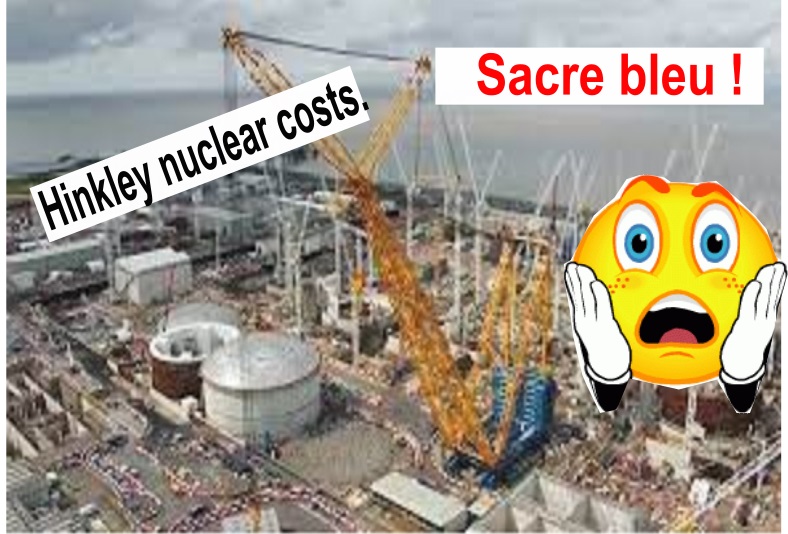
UK’s Hinkley Point C nuclear plant yet to attract new investors, says EDF boss .
French energy group EDF has not yet found alternative investors for the
flagship Hinkley Point C nuclear project as a freeze in funding from its
Chinese partner places an “extra weight” on the debt-laden company.
Luc Rémont, chief executive of France’s state-owned electricity company,
said it had held talks during 2024 with “lots” of potential funders for
the Hinkley Point C project in Somerset, but was not yet able to proceed
with any of them. EDF was continuing to meet the financing costs but was
working to find alternative investors for the project with the support of
the British government, Rémont said, as the company reported its annual
results on Friday.
“In the current circumstances, the fact that our
partner CGN is not injecting any more capital into Hinkley Point
is . . . an extra weight for EDF,” he said, but added that the
project remained a potentially profitable investment.
His comments raise further questions for the future of Hinkley Point C, the first new nuclear
power station being built in the UK in a generation and a vital part of the
government’s plan to decarbonise power supplies. Hinkley Point C was
initially set to cost £18bn and to be completed in 2025, but the estimated
cost has since swelled to roughly £46bn in 2024 terms while the start date
has been pushed back to 2029 at the earliest, because of construction
delays.
EDF is developing the project with Chinese state-owned CGN as a
junior investment partner, which agreed to finance 33.5 per cent of the
original costs. However, CGN has balked at making further contributions to
help meet cost overruns after the UK government in November 2022 bought it
out of a sister project, Sizewell C in Suffolk, amid concerns about
China’s involvement in critical national infrastructure. Asked on
Thursday whether he was also interested in investing in Hinkley Point C,
Centrica’s chief executive Chris O’Shea said: “We clearly like
nuclear power. And I am open to any kind of conversation. “My focus at
the moment is on hopefully getting to a good place with Sizewell C.”
FT 21st Feb 2025 https://www.ft.com/content/c546117d-1fbc-47c8-93a8-dd823311d2ac
UK government in “poor negotiating position” as Centrica vague about investing in the new Sizewell C nuclear power station.
Energy supplier Centrica has announced plans to invest in the new Sizewell
C nuclear power station – but campaigners say the move demonstrates the
government’s “poor negotiating position”.
Stop Sizewell C, which is opposed
to the power station, said any investors in the project could demand higher
rates of return, piling further costs on consumer bills. The government has
announced that the power station will be part-funded by adding costs to
people’s energy bills.
A spokesperson for the group said: “Chris O’Shea’s
comments show what a poor negotiating position the government is in, having
committed so much taxpayers’ money to Sizewell C without any guarantees
that private investors will take a stake. “Any investors still interested
in this risky project can demand high rates of return, but the higher the
return, the greater the burden on consumer bills during Sizewell C’s
lengthy and uncertain construction. It’s a lose lose situation for
households.”
East Anglian Daily Times 20th Feb 2025, https://www.eadt.co.uk/news/24951657.size-sizewell-stake-1-50/
UK Government Revisiting the nuclear roadmap Inquiry
House of Commons Energy Security & Net Zero Committee 20th Feb 2025, https://committees.parliament.uk/work/8942/revisiting-the-nuclear-roadmap/
The previous Government published Civil Nuclear: Roadmap to 2050 in January 2024.
The roadmap committed to building a further large-scale reactor; delivering 3-7GW more of nuclear power every five years from 2030-2044; reaching 24GW of nuclear power on the grid by 2050 and developing government policy to support advanced nuclear technologies Like Small Modular Reactors.
Witnesses to the Science, Innovation and Technology Committee’s 2023 inquiry on delivering nuclear power described the 24GW and building goals as more of a “wish list” than a strategy to achieve those ambitions.
The new Government has not re-committed to the roadmap or these targets.
The final investment decision to greenlight the new large-scale nuclear plant at Sizewell C is expected in the coming months. The result of the previous government’s small modular reactor competition is also due to be announced soon.
This inquiry seeks to understand what the new Government’s nuclear ambitions are and what the roadmap is to achieving them.
This inquiry is currently accepting evidence
The committee wants to hear your views. We welcome submissions from anyone with answers to the questions in the call for evidence. You can submit evidence until Tuesday 8 April 2025.
NFLA Policy Briefing 313: Correspondence with the Nuclear Regulator over AGR Extensions
We note the recent EDF press release stating that a decision to life-extend
all four remaining AGR stations has been taken by EDF with Heysham 1 and
Hartlepool extended to 2027 and Heysham 2 and Torness extended to 2030.
The ONR site says for Heysham 1 and Hartlepool that: ‘EDF have recently
communicated their decision [March 2023] to extend the generating lifetime
of the station to March 2026, subject to an adequate demonstration of
safety.’ But there is no further information on whether an adequate
demonstration of safety has been submitted and assessed, and no mention of
extension to 2027.
For the other two AGR stations, no mention is made on
the ONR site of EDF’s intention to life-extend the plants, and the EDF and
the ONR sites give a forecast end of generation as 2028 for the two AGRs.
On your questions regarding EDF’s press release, the results of the EDF
inspections indicated that the graphite cores remained within the
limitations of the current safety cases.
The results of these inspections
have not been published by EDF. These inspections informed EDF’s commercial
judgement to pursue lifetime extensions; it is not within ONR’s scope of
regulation to consider the commercial viability of the life extension of
these reactors.
It is likely that EDF will require new safety cases to
justify operation to the specified end of generation dates and these will
be considered by ONR as part of normal regulatory activities.
NFLA 19th Feb 2025, https://www.nuclearpolicy.info/briefings/nfla-policy-briefing-313-correspondence-with-the-nuclear-regulator-over-agr-extensions/
Rolls-Royce ‘resists pressure’ to put Czech parts in mini-nuclear reactors.
British engineering giant urged to award contract to Skoda
despite leaning towards Korean company. Rolls-Royce is under pressure to
buy Czech parts for its pioneering mini-nuclear power stations after
striking a deal with Prague to build a generator in the country.
The British engineering giant revealed in October that CEZ, the Czech state
energy company, had placed the first order for its small modular reactors
(SMRs) and was taking a minority stake in the venture as well. It was
hailed as a landmark deal that would see the Czech Republic benefit from
being part of the technology’s supply chain.
But according to local media
reports, Rolls and CEZ are in disagreement about where to source key
components from. CEZ has reportedly been pushing for its subsidiary Skoda
JS – a former part of the Skoda Works empire that is now separate to the
car company of the same name – to be awarded the contract to manufacture
reactor pressure vessels, according to Czech newspaper Ekonomicky denik.
However, the report claimed that Rolls is pushing for Doosan, in South
Korea, to be given the work instead because it can do a better job for a
lower price. Rolls was also said to be frustrated that CEZ had not agreed
to post engineers to Britain to help finish the company’s SMR designs.
Telegraph 18th Feb 2025
https://www.telegraph.co.uk/business/2025/02/18/rolls-royce-resists-pressure-put-skoda-parts-mini-nukes/
Nuclear waste dump agency pumps money into community projects in Mablethorpe

By Richard Silverwood
The organisation behind plans for a possible nuclear waste
dump in the Louth or Mablethorpe areas is continuing to pump money into
important community projects there. Nuclear Waste Services (NWS), a
government agency that specialises in the management of radioactive waste,
has earmarked Lincolnshire or Cumbria as the location for the dump, known
as a GDF (geological disposal facility).
Two potential sites – a former gas terminal at Theddlethorpe, near Mablethorpe, and agricultural land close to the villages of Hayton le Marsh and Great Carlton, near Louth –
have been mooted – and both have attracted widespread opposition.
Lincolnshire World 17th Feb 2025, https://www.lincolnshireworld.com/news/people/nuclear-waste-dump-agency-pumps-money-into-community-projects-in-mablethorpe-4995509
Uncertain nuclear partnership between ČEZ and Rolls-Royce.
Negotiations between ČEZ and Rolls-Royce
on cooperation are starting to falter. Negotiations on the capital
investment of the CEZ Group in the British company Rolls-Royce SMR and
subsequent cooperation on the development and construction of modular
reactors are not going smoothly.
On the contrary, according to two
well-informed sources of the Economic Daily, the negotiations are starting
to falter. The Czechs and the British have different expectations, for
example, regarding where the production of the main parts of the reactor
will be located – whether in the Pilsen-based Škoda JS or in Korea.
According to one source, the British claim that the best option would be to
outsource the production of pressure vessels, steam generators and other
large parts to the Korean Doosan; they are said to be able to produce them
cheaper and better than anyone in Europe. On the other hand, ČEZ is trying
to properly utilize the capacities of the manufacturing and engineering
company Škoda JS, which it took over at the end of 2022. It would like to
produce pressure vessels, internal parts of the reactor and other equipment
in Pilsen.
This is a lot of money, and supplies for up to dozens of
reactors are at stake. One of the sources contacted points to another point
of contention. Rolls-Royce management expected active participation of
Czech experts in completing the design of the 470-megawatt modular reactor.
However, ČEZ and its subsidiaries are keeping the shortage of nuclear
engineering experts “at home” and do not want to send them to Britain
for several years.
Ekonomicky Denik 17th Feb 2025
Louth MP welcomes council’s decision to pull out of nuclear waste dump group
By Richard Silverwood, 17th Feb 2025,
Louth’s MP has welcomed the key decision by a council to pull out of the
group central to plans for a nuclear waste dump. The Theddlethorpe
Community Partnership has been set up by Nuclear Waste Services (NWS), the
government agency that has earmarked two possible East Lindsey locations
for the dump, known as a GDF (geological disposal facility). Its purpose is
to explain the proposals to residents and councillors, and to persuade them
that the GDF would be safe and secure in the Lincolnshire area. Coun Craig
Leyland, the Conservative leader of the council, said this was a blatant
switch from a ‘brownfield’ site and “would scar several kilometres of
farmland on the margins of the Lincolnshire Wolds”. Now MP Victoria
Atkins has echoed this view. She said: “When the latest proposals were
revealed by NWS, I immediately called a meeting with Coun Leyland and Coun
Martin Hill, the leader of Lincolnshire County Council, to reiterate local
residents’ opposition to a dump.
Lincolnshire World 17th Feb 2025
Amazon-backed nuclear power developer X-Energy threatens to move investment away from UK
Amazon-backed nuclear power developer X-Energy delivered a potential blow
over the weekend by threatening to move investment earmarked for its first
next-generation plants in the UK elsewhere unless the government sets out a
clear regulatory and financial route to market, The Times reported this
morning. “We would like to go big in Europe from a base in the UK but we
don’t have to do a base in the UK,” said X-Energy’s chief executive Clay
Sell.
“We’ve got to get real and we’ve got to get going, otherwise we’re
going to go someplace else.” Based in Maryland in the United States, the
firm is reported to be in discussions with French energy group EDF to build
one or more units on the site of the Hartlepool nuclear power plant, which
is due to be decommissioned in 2027. X-Energy recently closed a $700m
funding round anchored by Amazon, as part of a broader partnership to bring
5GW of power on stream by 2039. However, Clay reportedly said he remains
“very optimistic” that it could get its 80MW modular reactors – which can
be scaled into “four pack” 320MW plant – built in the UK.
Business Green 17th Feb 2025
Pioneering micro nuclear reactors to be built in Britain.
Major test for UK’s energy policy as four reactors planned on site of former power
station in Wales. Britain’s first “micro” nuclear reactors are to be
built on the site of a former coal-fired power station in south Wales. Four
reactors will be installed at the decommissioned Llynfi power station in
Bridgend under the proposals, each generating up to 20 megawatts (MW) of
electricity. These will be assembled in modules after being produced in a
factory off-site. The 14-acre project is being overseen by Last Energy, a
Washington-headquartered business, in a major early test for the
Government’s green energy policy. It will be the first new UK location to
house a commercial nuclear power reactor since the Torness nuclear power
station in East Lothian in 1978. Until now, modern UK nuclear projects have
been built on sites previously occupied by an earlier plant.
Telegraph 17th Feb 2025
Starmer’s nuclear reactors won’t be small, cheap or popular

David Elliott and Arthur Stansfield on Labour’s plans for expanding nuclear power plants, https://www.theguardian.com/environment/2025/feb/16/starmers-nuclear-reactors-wont-be-small-cheap-or-popular
Labour’s plan for siting small nuclear reactor plants around the country (Keir Starmer unveils plan for large nuclear expansion across England and Wales, 6 February) feels almost like something Donald Trump would come up with. The reality is that they would not be small – for example, the system being developed by Rolls-Royce is 470 megawatts, larger than most of the old, now closed, magnox reactors that were built in the UK in the 1960s.
And they will not be cheap – even backers, like the Tony Blair Institute for Global Change, have admitted that they “could have higher costs per MW compared to gigawatt-scale reactors”. And there would be a range of safety- and security-risk issues with local deployment, adding to the cost – nuclear plants are usually located in remote sites. Will many people want one near them? By comparison, with costs falling, public support for renewables, like solar and offshore wind, has never been higher.
David Elliott
Emeritus professor of technology policy, the Open University
UK’s first new nuclear site since the 1970s begins licensing
China Daily By Bloomberg, February 17, 2025
The UK’s first new location for a commercial nuclear power plant since the 1970s is undergoing licensing from the country’s regulator, at a time when the government is making it easier to approve new projects.
Last Energy Inc’s microreactors are set to be built at a site of a former coal plant in South Wales. That would mark the first new site for a commercial reactor to begin licensing since 1978, as all projects since then have been built at locations on or next to sites that have had a plant there, the firm said…….
The government is taking steps to make it easier to approve and build nuclear plants, with an overhaul of planning rules giving developers more freedom over where they can build. Last Energy’s site still needs to be approved by the Office for Nuclear Regulation………….. https://www.chinadailyhk.com/hk/article/604745
1 This Month



26 September – International Day for the Total Elimination of Nuclear Weapons


PLEASE OPPOSE HR 8255 AND S.3639 – bills would accelerate satellite deployment, with no environmental review or safeguards – https://ncstd5li.quorum.us/campaign/169331/
To see nuclear-related stories in greater depth and intensity – go to https://nuclearinformation.wordpress.com
-
Archives
- September 2026 (257)
- August 2026 (330)
- July 2026 (355)
- June 2026 (287)
- May 2026 (306)
- April 2026 (356)
- March 2026 (251)
- February 2026 (267)
- January 2026 (308)
- December 2025 (358)
- November 2025 (359)
- October 2025 (375)
-
Categories
- 1
- 1 NUCLEAR ISSUES
- business and costs
- climate change
- culture and arts
- ENERGY
- environment
- health
- history
- indigenous issues
- Legal
- marketing of nuclear
- media
- opposition to nuclear
- PERSONAL STORIES
- politics
- politics international
- Religion and ethics
- safety
- secrets,lies and civil liberties
- spinbuster
- technology
- Uranium
- wastes
- weapons and war
- Women
- 2 WORLD
- ACTION
- AFRICA
- Atrocities
- AUSTRALIA
- Christina's notes
- Christina's themes
- culture and arts
- Events
- Fuk 2022
- Fuk 2023
- Fukushima 2017
- Fukushima 2018
- fukushima 2019
- Fukushima 2020
- Fukushima 2021
- general
- global warming
- Humour (God we need it)
- Nuclear
- RARE EARTHS
- Reference
- resources – print
- Resources -audiovicual
- Weekly Newsletter
- World
- World Nuclear
- YouTube
-
RSS
Entries RSS
Comments RSS
 nuclear-news