Small modular reactor plans edge closer, amid claims that the technology makes no economic sense
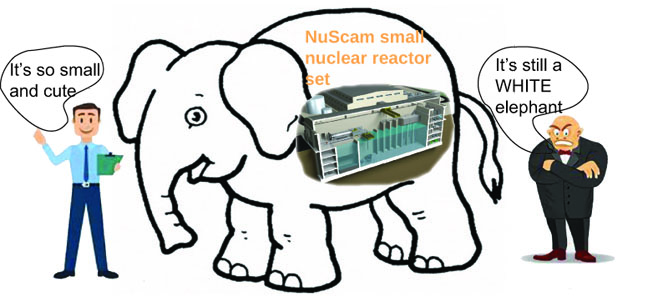
By Simon Hacker, Punchline Gloucester 28th Feb 2025
…………………………………….Dale Vince, the owner of Stroud-based green energy group Ecotricity, has
roundly condemned the technology for “defying the economic laws of
gravity”.
Speaking on his weekly Zerocarbonista podcast, Mr Vince said:
“When you come to small nukes, the government and the nuclear industry have
consistently said that we will get lower bills, but they don’t put a number
on it. They are ecomonists without numbers!
Energy minister Ed Miliband: keen to move ahead on SMR plans. Big nuclear is the most expensive electricity we have ever made, it’s off the charts compared to renewable
energy and one of the fundamental laws of physics is that the economies of
scale come by making something bigger, not by making something smaller –
it always costs money to miniaturise.
So here they are, saying we can
miniatarise nuclear reactors that famously went decades late and billions
over budget… and they’ll be cheap. I don’t believe that for a second and
what we are of course doing is proliferating the risk.”
He added: “It’s always worth imagining what it would be like if the Romans had nuclear
power. If they did, Bath would be a toxic no-go zone. It’s only 2,000 years
ago and sounds like a long time, but not in the context of toxic nuclear
waste.” Whether Berkeley and neighbouring site Oldbury-on-Severn progress
with Rolls Royce’s SMR bid, the technology’s pathway to viable commercial
models for energy production remains challenging: as of today, only China
and Russia have operational SMRs, with China’s HTR-PM pebble-bed reactor
connected to the grid and Russia’s floating Akademik Lomonosov plant
utilizing two 35MW SMRs. https://www.punchline-gloucester.com/articles/aanews/smr-plans-edge-closer-amid-claims-the-technology-makes-no-economic-sense
Rachel Reeves eyes cuts to nuclear in spending review

Energy industry insiders fear the Chancellor could target Britain’s mini-nuke programme
Matt Oliver, Industry Editor, Telegraph 28th Feb 2025
Rachel Reeves is eyeing cuts to Britain’s £20bn mini-nuclear reactor programme amid a scramble to slash government expenditure, insiders fear.
Sources believe the Chancellor is considering approving a smaller number of reactors than previously expected in an attempt to reduce the costs of the programme, which is part of wider efforts to transform Britain’s power grid.
The competition to design and build the first small modular reactors (SMRs) entered its last phase on Friday, with four finalists – Rolls-Royce, GE-Hitachi, Westinghouse and Holtec – told to submit final bids by mid-April.
It was previously suggested that up to three winners would be chosen by Great British Nuclear (GBN), the quango in charge of running the contest.
But sources said there was concern this has quietly been scaled back to a “maximum” of two – raising the possibility that only one winner will be chosen. Fewer reactors would be built overall as a result………………………………………
The Chancellor is struggling to balance the books as weak economic growth makes it harder to meet her self-imposed “fiscal rules” for borrowing.
Everything is on the table’
Industry sources said there had as yet been no suggestion that ministers had decided to scale back the SMR programme.
But the final outcome has been linked to the spending review and there remains uncertainty about how many vendors will be chosen.
One person briefed on the discussions warned: “It all comes down to the spending review. Everything is on the table.”……………………..
the nascent technology remains commercially unproven, with a string of European countries and the US all currently pursuing their own individual competitions to fund the first examples of the technology.
Scaling back Britain’s SMR programme would represent a significant retreat for Sir Keir Starmer, the Prime Minister, who this month announced plans to speed up the development of the mini reactors and vowed to “build, baby, build”.
………there are fears that Mr Miliband, the Energy Secretary, is under pressure to choose which energy schemes he will prioritise as he scrambles to deliver Labour’s promise…
………….The competition has suffered repeated delays, with ministers in the previous Conservative government originally suggesting it would be concluded last spring.
This week it emerged there had been yet another delay, with the deadline for final bid submissions moved back from the end of March to mid-April.
……………………….The Treasury was contacted for comment.
https://www.telegraph.co.uk/business/2025/02/28/reeves-eyes-cuts-to-nuclear-in-spending-review/
UK Energy Secretary Signals China Pivot
By Irina Slav – Feb 28, 2025,
https://oilprice.com/Latest-Energy-News/World-News/UK-Energy-Secretary-Signals-China-Pivot.html
UK’s energy secretary is reportedly scheduled to travel to China next month in a bid to forge a closer relationship with the country, despite it being seen by previous governments in London as a threat to national security.
The report comes from Reuters, which spoke to unnamed sources close to Ed Miliband, who said the top energy member of the UK cabinet will discuss alternative energy sources in China. What he will not discuss, per the sources, is nuclear energy.
The UK’s Labour government is looking to mend fences with China after the last series of Conservative cabinets all demonstrated mistrust and suspicion to Beijing, in sync with the EU and the United States. However, the Starmer government has signaled it was willing to change this, diverging from the EU/U.S. course of import tariffs and accusations of national security attacks on the part of the Chinese.
In the energy sector, Chinese equipment and components are crucial for the Starmer government’s transition efforts as the country is the largest producer of things such as solar panels, wind turbines, and inverters. It is also the lowest-cost producer, ironically thanks to the amount of coal-powered generation Chinese manufacturers use to make the transition components.
The UK has some of the most ambitious transition goals in the world, aiming to generate as much as 95% of its electricity from non-hydrocarbon sources. As part of efforts to achieve this, the government has committed to doubling onshore wind energy by 2030, quadrupling offshore wind, and trebling solar power by the end of the decade.
To do this, the Starmer government would need to speed up the pace of growth in wind and solar capacity considerably. In offshore wind alone, the government would need to approve more offshore capacity in the next two annual renewable energy auctions, than it has approved in the last six auctions, the country’s grid operator warned last year.
Stop government handouts to EDF for Hinkley Point C

Roy Pumfrey, 27th February, https://www.bridgwatermercury.co.uk/your_say/postbag/24966410.letter-stop-government-handouts-edf-hinkley-point-c/
It’s been reported that EDF, under pressure from French national auditors, is still desperately looking for investors in Hinkley Point C (HPC) to replace lost top-up funding from its Chinese partner, CGN.
Despite having talks with lots of potential investors, EDF has been unable to proceed with any of them.
HPC was initially expected to cost £18 billion and to be completed in 2025, but the estimated cost has increased to roughly £46 billion in 2024 terms and the start date has been pushed back to 2029 at the earliest, possibly as late as 2031, because of construction delays.
The UK government is also trying to drum up investors for the Sizewell C (SZC) project in Suffolk.
EDF only wants to invest up to 20 per cent of the estimated cost in the project.
The government is hoping to make a final investment decision on SZC in June.
In January, France’s state auditor said EDF should not proceed with SZC until it had cut its exposure to HPC.
It seems quite likely that EDF is threatening to withdraw from SZC unless the government bails them out on HPC.
EDF has already been given an overly generous index-linked contract to supply electricity from HPC to British consumers at around £130/MWh (at today’s prices) compared to today’s cost of electricity from wind at £44MWh.
There should be no more government handouts to French government-owned EDF.
If they can’t afford to build it on such generous terms, they should stop now.
SZC would be funded in a different way to HPC, which could cost British consumers as much as £100 billion – official cost estimates do not include the cost of the finance needed to build Sizewell.
The obvious thing to do is to cancel SZC now before any more taxpayers’ money is wasted and resist pressure from EDF for us to bail them out on HPC.
Reawakening a Nuclear Legacy: The Potential Return of the US Nuclear Mission to RAF Lakenheath

Federation of American Scientists 26th Feb 2025, by Eliana Johns & Hans Kristensen, https://fas.org/publication/potential-return-of-the-us-nuclear-mission-to-raf-lakenheath/
In the spring of 2022, researchers at the Federation of American Scientists began reading newly released U.S. Defense Department budget documents to look for updates concerning the Pentagon’s priorities for the next fiscal year. As the researchers poured over hundreds of pages, two words suddenly captured their attention: the Biden administration’s Fiscal Year (FY) 2023 budget request had added “the UK” to a list of countries receiving upgrades to their “special weapons” storage sites under a 13-year NATO investment program. The term “special weapons” is often used by the U.S. government when referring to nuclear weapons. However, the United States has not deployed nuclear weapons in the United Kingdom for nearly two decades. Those two words sparked dozens of questions, years of continued research, and a new local movement of protests against the return of a potential nuclear mission to RAF Lakenheath.
This new report provides an account of the nuclear history of RAF Lakenheath and the role it played in the US nuclear mission until nuclear weapons were withdrawn in 2008. The report then explains the mounting evidence from three years of collection of documentation and observations that show the United States Air Force is re-establishing its nuclear mission on UK soil for the first time in nearly two decades.
As of February 2025, there are no known public indications that nuclear weapons have been deployed to RAF Lakenheath – we assess that the return of the nuclear mission is intended primarily as a backup rather than to deploy weapons now. However, if this were to happen, it would break with decades of policy and planning and reverse the southern focus of the European nuclear deployment that emerged after the end of the Cold War. Even without weapons present, the addition of a large nuclear air base in northern Europe is a significant new development that would have been inconceivable just a decade-and-a-half ago.
Scotland can’t afford the risks of the nuclear fuel chain

Disasters might be “rare” as if that is at all comforting, but
Chernobyl and Fukushima are reminders of the consequences that nuclear can
bring. Scotland’s geography and weather conditions are, granted, somewhat
more stable than the likes of Japan – but that’s only true at this
moment in time.
We are already seeing the accelerated effects of climate
change taking hold here, and while we might be shielded to an extent for
now – we can’t guarantee that stability long term. In fact, it’s
pretty likely that stability will be eroded if we continue hurtling down
this path of climate destruction that we’re currently on, and we’re
showing no signs of slowing down. Even without potential changes to our
natural environment, the long-term risks of building a nuclear plant near
populated areas are just too high.
A major accident, however unlikely,
would have unimaginable consequences for a small country like Scotland.
Reactors themselves might not emit carbon, but nuclear energy is by no
means “clean” as it is marketed. The entire life cycle of nuclear
energy involves environmental risks that Scotland can’t afford – risks
that we simply do not need to take.
The National 27th Feb 2025, https://www.thenational.scot/politics/24967406.independence-nuclear-option-will-unlock-potential/
First shipment of 280,000 tons Aggregate arrives by rail at Cumbria low-level nuclear waste site for final capping
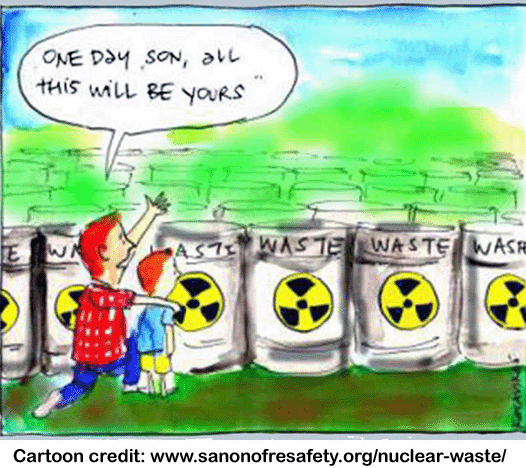
The first shipments via rail of 280,000t of aggregate by Nuclear Transport
Solutions (NTS) have been delivered to the Low Level Waste Repository
(LLWR) site in Cumbria, which will form a 100-year barrier for nuclear
wastes.
Nuclear Waste Services (NWS) is responsible for managing the
disposal of the UK’s low-level radioactive waste including at the LLWR
site. NTS is a transport and logistics provider which operated Direct Rail
Services (DRS) which transports nuclear and radioactive materials via rail.
Both NWS and NTS are part of the Nuclear Decommissioning Authority, which
itself is an executive non-departmental public body, sponsored by the
Department for Energy Security and Net Zero (DESNZ). The LLWR is the only
facility in the UK permitted to receive all categories of radioactive and
nuclear low level waste (LLW) and NWS describes it as “the nation’s
principal disposal facility for LLW”.
New Civil Engineer 26th Feb 2025, https://www.newcivilengineer.com/latest/aggregate-arrives-by-rail-at-cumbria-low-level-nuclear-waste-site-for-final-capping-26-02-2025/
Tonnes of nuclear waste to be sent back to Europe
Federica Bedendo, BBC News, North East and Cumbria, 27th Feb 2025,
https://www.bbc.co.uk/news/articles/cpwddyg7e4do
More than 700 tonnes of nuclear waste is due to be shipped to Europe as part of a project to send back spent fuel to the countries that produced it.
The Sellafield nuclear plant in West Cumbria was tasked with reprocessing the nuclear material used to produce electricity in Germany.
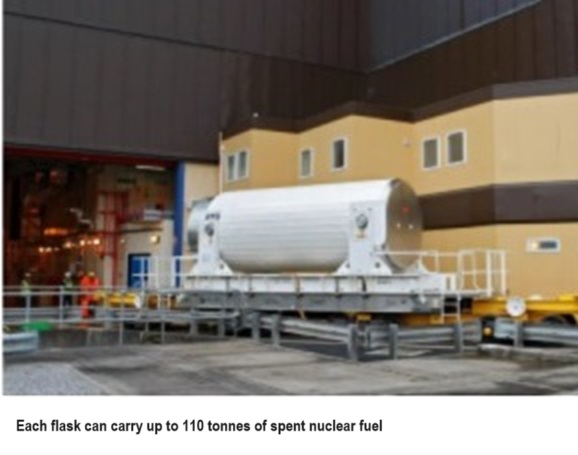
Seven cylindric containers, each carrying up to 110 tonnes of recycled nuclear waste, are due to make the journey to the Isar Federal storage facility by sea on a specialist vessel.
A Sellafield spokesman said the move was a “key component” of the strategy to “repatriate high level waste from the UK”.
This will be the second of three shipments from the UK to the European country.
The first shipment of six containers – known as flasks – to Biblis, was completed in 2020.
Each flask is about 20ft (6m) long, with a 8ft (2.5m) diameter.
The waste will be transported by sea on a specialist vessel to a German port, then onwards by rail to its final destination.
Letter: Hinkley Point C will be a Sellafield waste dump
By Jo Smoldon,
Burnham & Highbridge Weekly News 25th Feb 2025, https://www.burnhamandhighbridgeweeklynews.co.uk/news/24957412.letter-hinkley-point-c-will-sellafield-waste-dump/
In response to your Hinkley article around all the jobs created at Hinkley Point C, yes, of course it is good that the nuclear industry is training people to understand the nuclear sites and maybe later the nuclear process.
Nuclear, due to its very, very long-term footprint, has to be understood for thousands of years to come when the radioactive waste will need managing at high costs and high risk on this Hinkley location.
Trying to attract young people into a subject that is very antiquated in its science has been something that government and business will have to invest in forever.
Nuclear power for electricity is made by the last century science of steam driving turbines to condense to hot water.
Two-thirds of the energy produced from the reactors is thrown out in the form of hot water to be discharged into the Severn Estuary, hardly a ‘low-carbon energy’ if looked at in real terms!
What hasn’t been mentioned with all this bigging up the Hinkley site is that it will be the big Sellafield waste dump of the south, as after B station waste has been transferred to Sellafield, no more nuclear waste will move from Somerset.
Radioactive waste will remain on the North Somerset coast forever, how does that fit with the predicted sea level rise, extreme coastal events and Somerset’s regular flooding events?
‘Fish disco’ row risks fresh delays to Hinkley Point nuclear plant
EDF has been urged by campaigners to stick with plans to install underwater
loudspeakers to deter fish in the Bristol Channel, as the energy company
grapples with delays to construction of its Hinkley Point C nuclear
reactor.
The row over the “fish disco” deterrent, as it is known in
Whitehall circles, marks the latest salvo in the UK’s long-running battle
to balance growth with environmental protections. Mark Lloyd, chief
executive of The Rivers Trust charity, said France’s state-owned energy
company should keep its commitment to the acoustic fish deterrent, as part
of its Hinkley Point C project.
His comments follow warnings that wrangling
over fish protection risks further delaying completion of the Somerset
power plant, which is already several years behind schedule and billions of
pounds over budget. Plans for the deterrent system involve 288 underwater
speakers that would produce underwater noise louder than a jumbo jet all
day, every day for six decades, according to EDF.
Despite previously
agreeing to build an “acoustic fish deterrent”, EDF is now trying to
scrap those plans, saying they would endanger divers, and is instead
proposing salt marshes to shelter fish. But Lloyd argued that, unless the
acoustic deterrent was installed, “there are likely to be local
extinctions and a very significant impact on marine species throughout the
South West and the Irish Sea”. EDF rejects this characterisation,
pointing out that regulators estimate the amount of fish that will be
harmed without the deterrent is 44 tonnes per year, equivalent to an annual
catch of one small fishing vessel.
FT 26th Feb 2025,
https://www.ft.com/content/28c4cade-d477-4df5-a4b4-cf5ea8dfac95
Nuclear Decommissioning Authority budget raises Sellafield safety concerns
Wednesday 26 February 2025,
https://www.unitetheunion.org/news-events/news/2025/february/nuclear-decommissioning-authority-budget-raises-sellafield-safety-concerns
Safety could also be impacted at 16 other Nuclear Decommissioning Authority sites
Safety concerns over the Nuclear Decommissioning Authority (NDA) budget, which includes Sellafield as well as UK-wide services for nuclear waste and restoration, have been raised by Unite, the UK’s leading union.
The NDA group is responsible for decommissioning and cleaning up 17 nuclear sites. The group’s key operating companies include Sellafield, Nuclear Restoration Services (NRS) and Nuclear Waste Services (NWS).
The CEOs of all the operating companies have all stated that their current budgets are not enough to provide full services.
Unite general secretary Sharon Graham said: “Unite is extremely concerned that UK’s workers at Sellafield, NRS and NWS could be put at risk through efforts to cut costs. If the NDA budget isn’t fit for purpose, the government needs to increase it. Unite will not tolerate attacks on our members’ jobs or any changes that could jeopardise their health and safety.”
Unite national officer Simon Coop said: “Sellafield, NRS and NWS must fully consult with Unite before taking any steps that could endanger workers or impact their jobs, pay or conditions. We will not hesitate to defend our members if actions are taken that put them at risk.”
Starmer drags Britain deeper into war drive

February 25, 2025, Sophie Bolt, CND General Secretary,
https://cnduk.org/starmer-drags-britain-deeper-into-war-drive/?link_id=2&can_id=0a448bf4278898648e02a8f6dea4650f&source=email-starmer-drags-britain-deeper-into-war-drive&email_referrer=email_2633766&email_subject=starmer-drags-britain-deeper-into-war-drive
Starmer’s announcement to increase military spending to 2.5% by 2027 – an additional £13.4 billion annually – at the expense of overseas aid, reflects a Trump-style of international priorities: driving war and militarism whilst abandoning international obligations to halt global hunger and climate devastation. It represents a much more dangerous and damaging role for Britain in the world.
The spending announcement has clearly been rapidly organised ahead of Starmer’s meeting with Trump on Thursday. Nailing his colours very firmly to the Trump mast, Starmer reasserted Britain’s special relationship with the US, and pledged to increase military spending to 3% of GDP after the next election.
These increases are to fund a reckless war drive that risks plunging Europe into decades-long confrontation with Russia, whilst ratcheting up nuclear tensions globally.
Presenting Britain as the European leadership in NATO, Starmer reiterated his so-called peace-keeping operation in a post-settlement Ukraine. In it, 30,000 European troops would be deployed to Ukraine, underwritten by US military might should the ceasefire collapse. The plan has failed to win unity across Europe.
Meanwhile Friedrich Merz, the newly elected Germany Chancellor, has called for France and Britain to share their nuclear weapons to ‘defend’ Europe against Russia. This has also renewed the debate about the use of tactical or ‘battlefield’ nuclear weapons – and whether Britain should develop them on behalf of Europe.
These reckless and terrifying debates around greater nuclear armament for Europe fail to note that Trump has made no statement that US nuclear weapons will be withdrawn from Europe. Or that new ‘battlefield’ nuclear bombs won’t be deployed in Britain. They also fail to acknowledge that, as Britain is totally dependent on the US for its nuclear weapons system, Starmer would have to get permission from Trump if he were to offer them to Europe.
But, of course, whether US, French or British, nuclear weapons deployed in Europe are a disaster. Far from offering protection, the weapons are a constant threat – from the risk of nuclear accidents to nuclear confrontation.
This obscene spending spree on weapons of war won’t bring peace to Ukraine. On the contrary, the £205bn that Europe has pledged to Ukraine since 2022 has contributed to prolonging this terrible conflict, sustaining the huge death toll and pushing the region to the brink of nuclear war. And the impact of the conflict has driven the worsening economic crisis in Britain, across Europe and globally. And if Trump gets his way, the majority of Ukraine’s vast mineral wealth will be siphoned off to the US.
Whilst it is presented as defending Ukraine, this NATO war drive is global. We know that Trump’s ‘America First’ policies are still about maintaining US dominance over the rest of the world. From calls to seize Greenland, Canada and Panama, to ethnically cleanse Palestinians from Gaza, Trump has no respect for sovereignty, human rights and international law. His plans to expand the US Missile Defence System, or ‘the Iron Dome for America’, would enable the Trump administration to use its nuclear weapons without fear of a retaliatory strike. British bases already play a central role in this ‘Iron Dome for America’, making us a target in any global confrontation, yet offering no protection.
This is a very chilling prospect.
Instead of vying for Trump’s approval over which NATO state can increase its military spending highest, Britain and Europe should instead be using this opportunity to reshape the region’s security approach, towards one that is genuinely sustainable and secure. This means Britain ending its military and nuclear alliance with the US. A first step in this would be to scrap the replacement of Britain’s nuclear weapons system. With the government’s own watchdog concluding that the replacement is ‘unachievable’, Rachel Reeves should cut her losses and direct the hundreds of billions into rebuilding crumbling public services and investing in sustainable energy sources.
UK construction and engineering firm Costain has secured a multi-millionpound contract to support the construction of the Sizewell C nuclear powerplant
Costain said under the ten-year framework agreement, the company
will provide support in areas such as delivery integration, health and
safety and quality control. French state-owned energy firm EDF is
developing the 3.2 GW nuclear power station, which could provide up to 7%
of UK energy needs over its 60-year lifetime.
The UK government holds a
76.1% stake in Sizewell C, with EDF holding the remaining 23.9%. Costain
defence and nuclear energy sector director Bob Anstey said the Sizewell C
project is a “vital part of creating a sustainable future”. The
Sizewell C project has attracted significant criticism amid concerns over
its ballooning costs. Earlier this year, campaign group Together Against
Sizewell C (TASC) wrote to the National Audit Office calling for a review
of the government’s value assessment for the controversial nuclear power
station.
The UK Labour government has committed to delivering Sizewell C,
as well as the delayed Hinkley Point C, alongside small modular reactors.
But with Sizewell C investors including Centrica prepared to “walk
away” from investing in the project, there are concerns costs could rise
to more than £40bn.
Energy Voice 25th Feb 2025, https://www.energyvoice.com/renewables-energy-transition/nuclear/567502/costain-secures-multi-million-pound-sizewell-c-contract/
EDF appears to consider reduced final stake in Sizewell C nuclear to as low as 10%
New Civil Engineer, 24 Feb, 2025 By Tom Pashby
French state-owned energy giant EDF which is the sole operator of nuclear power plants in the UK has said it will consider becoming a 10-19.99% owner of Sizewell C, having previously committed up to 20%.
EDF previously confirmed in its 2024 half year results that Sizewell C is owned 76.1% by the UK Government and 23.9% by EDF.
Despite the final investment decision (FID) still not having been made, approximately £5.5bn of taxpayer money has been committed to the scheme, and contractors have been awarded £2.5bn of works which are underway ahead of main construction.
Speculation about the ownership of Sizewell C abounds because of the secrecy around the process, the potential for much of the £40bn investment to be stumped up by the taxpayer, and Centrica’s recent comments which weakened confidence in the scheme.
Centrica CEO Chris O’Shea said the energy company’s stake in Sizewell C could be “between 1% or 2% and 50%”.
“I’m not going to commit Centrica money for something that won’t give us the returns we need.”
EDF previously said it would own maximum 20% stake
In a press release from EDF on 20 December 2022, the company said: “EDF will only retain a minority stake of a maximum of 20% at final investment decision”.
Since the 20% figure was announced, French public spending watchdog Cour des comptes said EDF should scale back involvement in UK nuclear projects.
The auditor said “a final investment decision on [Sizewell C] should not be approved until a significant reduction in EDF’s financial exposure to the Hinkley Point project has been achieved.
………………….Ownership stake scaled back to 10-19.99%
EDF’s 2024 Annual results document laid out its contribution to the power plant which is “subject to some conditions, including … a share in ownership of the project of 10 to 19.99%, including a cap on financial exposure in value.”
It also requires “A return on capital expected by EDF as an investor in line with market return for this type of assets, risk allocation profile and its investment policy.”
It is understood that the reason for selecting 19.99% rather than 20% is because a company buying 20% would have to set up a subsidiary entity to take the ownership.
Another aspect of any ownership stake is a requirement to take on debt.
A UBS spokesperson told NCE: “The project would have something like £4bn of debt for every £2bn equity.”
Anti-Sizewell C groups say EDF appears to be attempting to ‘wriggle out’ of ownership
Stop Sizewell C executive director Alison Downes said: “The mention of this lower percentage stake (10%) in EDF’s results is significant.
“EDF’s leadership is clearly strapped for cash and doesn’t seem to buy its own rhetoric that replication could result in Sizewell C being built on time, significantly cheaper than Hinkley C – and neither do we.
“A reduction in EDF’s stake would leave the UK government with an even bigger costly void to fill.”
Downes also pointed out that regardless of EDF’s ownership status, the company would still likely get a construction contract since no other company has the relevant expertise.
Together Against Sizewell C spokesperson Chris Wilson said it was no surprise that “EDF hope to wriggle out of their financial commitment to the Sizewell project by suggesting a cap on their exposure and a reduction in their investment down to 10%”.
Wilson said this was not surprising given that EDF is “struggling to find investors to plug the £8bn- £13bn gap in the funding they need to finish the Hinkley Point C (HPC) build and the French state auditor’s advice to not take a final investment decision in Sizewell C until their exposure at HPC is reduced.”
“As the UK govt scrabble around for the likely £40 billion for the Sizewell C development, it’s hardly a good advert to potential investors that we now have EDF, the original promoter, hoping to reduce their exposure to as low as 10%”, Wilson said…………………………………………….. https://www.newcivilengineer.com/latest/edf-appears-to-consider-reduced-final-stake-in-sizewell-c-to-as-low-as-10-24-02-2025/
93% say NO: latest polls in Lincolnshire condemn nuke dump plan

In yet another demonstration that the people of East Lincolnshire are a far from ‘willing community’, recent polling at public events hosted by Nuclear Waste Services and amongst the parishioners of Gayton-le-Marsh have delivered a resounding NO vote to any plans to bring a nuclear waste dump to the area.
Nuclear Waste Service have recently resolved to move its Area of Focus in the Theddlethorpe GDF Search Area from the former Conoco gas terminal inland to 1,000 acres of prime farmland between the villages of Great Carlton and Gayton-le-Marsh.
NWS has held a series of information meetings to explain their decision. Theddlethorpe and Withern Councillor Travis Hesketh and activists from the Guardians of the East Coast established a polling booth outside events held in Gayton-le-Marsh, Strubby, Beesby, Maltby-le-Marsh, Great Carlton, Little Carlton, Withern, Theddlethorpe, Legbourne, Grimoldby, Manby and Saltfleetby, and invited members of the public to cast their secret ballot on the latest iteration of NWS’s plans to bring a Geological Disposal Facility to the area.
Of the 535 residents attending the events, 93% voted in the secret ballot; of these 93% voted for the process to be ended or for a Test of Public Support to be held now.
24th February 2025
93% say NO: latest polls in Lincolnshire condemn nuke dump plan
In yet another demonstration that the people of East Lincolnshire are a far from ‘willing community’, recent polling at public events hosted by Nuclear Waste Services and amongst the parishioners of Gayton-le-Marsh have delivered a resounding NO vote to any plans to bring a nuclear waste dump to the area.
Nuclear Waste Service have recently resolved to move its Area of Focus in the Theddlethorpe GDF Search Area from the former Conoco gas terminal inland to 1,000 acres of prime farmland between the villages of Great Carlton and Gayton-le-Marsh.
NWS has held a series of information meetings to explain their decision. Theddlethorpe and Withern Councillor Travis Hesketh and activists from the Guardians of the East Coast established a polling booth outside events held in Gayton-le-Marsh, Strubby, Beesby, Maltby-le-Marsh, Great Carlton, Little Carlton, Withern, Theddlethorpe, Legbourne, Grimoldby, Manby and Saltfleetby, and invited members of the public to cast their secret ballot on the latest iteration of NWS’s plans to bring a Geological Disposal Facility to the area.
Of the 535 residents attending the events, 93% voted in the secret ballot; of these 93% voted for the process to be ended or for a Test of Public Support to be held now.
Carlton Parish Council has previously passed a resolution calling for an immediate Test of Public Support, and the villagers of Gayton-le-Marsh made a similar resolution in a parish poll. 80% of parishioners participated, with 106 residents or 91% calling for the proposal to be withdrawn and 108 or 93% seeking a Test of Public Support.
These are the two latest blows in a whole series showered on Nuclear Waste Services, who must by now be punch-drunk, with most local Parish and Town Councils also passing resolutions calling for an immediate withdrawal or Test of Public Support.
In the last local elections held in 2023, a slate of anti-dump candidates was elected in wards within the Theddlethorpe GDF Search Area to East Lindsey District Council, Mablethorpe and Sutton Town Council, and local parish councils.
Surveys carried out by Guardians of the East Coast have previously indicated at least 85% are opposed to the nuclear waste dump plan.
The local Conservative MP for Louth and Horncastle Victoria Atkins has expressed her opposition to the plan and even the Leader of East Lindsey District Council Councillor Craig Leyland has had a change of heart indicating that he shall now be recommending to his Executive that the Council withdraw from the process.
To the NFLAs, Nuclear Waste Services continued efforts to pursue a GDF in East Lincolnshire represents the ultimate exercise in futility, for there are NO conceivable circumstances in which this will ever be a ‘willing community’.
1 This Month
Chernobyl: The Lost Tapes – A good documentary on Chernobyl on SBS available On Demand for the next 3 weeks– https://www.sbs.com.au/ondemand/tv-program/chernobyl-the-lost-tapes/2352741955560

of the week–London Campaign for Nuclear Disarmament

Tell the Ukrainian Government to Drop Prosecution of Peace Activist Yurii Sheliazhenko
To see nuclear-related stories in greater depth and intensity – go to https://nuclearinformation.wordpress.com
-
Archives
- April 2026 (126)
- March 2026 (251)
- February 2026 (268)
- January 2026 (308)
- December 2025 (358)
- November 2025 (359)
- October 2025 (376)
- September 2025 (257)
- August 2025 (319)
- July 2025 (230)
- June 2025 (348)
- May 2025 (261)
-
Categories
- 1
- 1 NUCLEAR ISSUES
- business and costs
- climate change
- culture and arts
- ENERGY
- environment
- health
- history
- indigenous issues
- Legal
- marketing of nuclear
- media
- opposition to nuclear
- PERSONAL STORIES
- politics
- politics international
- Religion and ethics
- safety
- secrets,lies and civil liberties
- spinbuster
- technology
- Uranium
- wastes
- weapons and war
- Women
- 2 WORLD
- ACTION
- AFRICA
- Atrocities
- AUSTRALIA
- Christina's notes
- Christina's themes
- culture and arts
- Events
- Fuk 2022
- Fuk 2023
- Fukushima 2017
- Fukushima 2018
- fukushima 2019
- Fukushima 2020
- Fukushima 2021
- general
- global warming
- Humour (God we need it)
- Nuclear
- RARE EARTHS
- Reference
- resources – print
- Resources -audiovicual
- Weekly Newsletter
- World
- World Nuclear
- YouTube
-
RSS
Entries RSS
Comments RSS
 nuclear-news