British media needs to wake up to the national scandal of the Hinkley nuclear project
 Hinkley: a truly major national scandal http://www.telegraph.co.uk/comment/11893698/Hinkley-a-truly-major-national-scandal.html The new nuclear power station will be the costliest engineering project Britain has ever embarked on, and a total waste of money. By Christopher Booker 26 Sep 2015
Although it was originally claimed that Hinkley Point C would cost only £10 billion and be “cooking Christmas dinners by 2017”, its completion date is now likely to be well after 2023, and its cost has spiralled so fast it will be way over the current figure of £24.5 billion. This would already make it more expensive than the Channel Tunnel and half the estimated cost of the vast, as-yet unapproved HS2 rail project.
But all we might get for this colossal sum would be 3.2 gigawatts of heavily subsidised “low-carbon” electricity, when the latest £1 billion gas-fired power station at Pembroke can already provide 2GW of unsubsidised power at half the price and at less than a 20th of the capital cost. Furthermore, the two obsolete European Pressurised Reactors the French firm EDF plans to install in Somerset have so many design problems that those it is already building in France and Finland have massively overrun on cost and time, while a modern nuclear plant built by South Koreans in Qatar is completed on time and at a fraction of the cost.
Everything about Hinkley Point indicates that it is as absurd a project as any government has ever fallen for. Yet when Channel 4 News reported the story on Monday, Jon Snow could think of no one better to interview on it than that great energy expert Vivienne Westwood, the dress designer, who could only repeat that “renewables” are getting “ever cheaper”, while subsidies to fossil fuels (non-existent) are rising ever higher.
 At least when John Humphrys interviewed the Energy Secretary, Amber Rudd, that morning on the Today programme, he began by gabbling some of the more obvious objections to Hinkley. But he then gave Rudd a free run to babble about how thankful we should be to the Chinese and the French for helping to give us “low-carbon energy security”. Please, guys, we know you are besotted with climate change and “low-carbon” energy. But even in your own terms, can you not recognise a truly massive national scandal when it is staring you in the face?
British nuclear submarine stricken with technical problems off coast of Iran
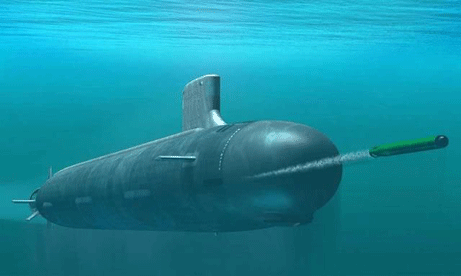 Stranded: Ageing British nuclear submarine in top-secret mission is undergoing repairs off the coast of Iran [includes VIDEO] Daily Mail,
- British nuclear submarine spotted at dock in the Emirati dock of Fujairah
- Port is situated less than 100 nautical miles from the coast of Iran
- A 650ft-long metal barrier covers the submarine to avoid detection
- It is believed to be one of Britain’s four Trafalgar Class submarines

 By MARK NICOL DEFENCE CORRESPONDENT FOR THE MAIL ON SUNDAY 27 September 2015 |
A British nuclear submarine has been caught on camera after it apparently became stricken with technical problems while on a top-secret mission in one of the most dangerous parts of the world.
Satellite images show the Royal Navy vessel undergoing repairs at a port less than 100 nautical miles from Iran.
The nuclear-powered submarine is pictured docked at Fujairah, one of the United Arab Emirates, in the politically sensitive seaway of the Gulf of Oman……….
In 2013, The Mail on Sunday revealed how the ageing Trafalgar submarines had been issued with ‘Code Red’ safety warnings after inspectors found radioactive leaks. The report by the Defence Nuclear Safety Regulator found that cracks in reactors and nuclear discharges were directly attributable to the Trafalgars remaining in service beyond their design date.
The Trafalgars are powered by nuclear reactors and are supposed to stay at sea for up to three months. They are equipped with Tomahawk cruise missiles and sonar equipment that can hear enemy vessels sailing more than 50 miles away.
The submarines have a typical complement of 120 to 130 personnel, up to 20 of them officers. The Trafalgars are being replaced by Astute Class nuclear submarines.
A Ministry of Defence spokesman said: ‘We do not comment on submarine operations.’ http://www.dailymail.co.uk/news/article-3250393/Stranded-Ageing-British-nuclear-submarine-secret-mission-undergoing-repairs-coast-Iran.html#ixzz3myehgajC
China and UK joining in promoting new nuclear technology
 China, UK to fund nuclear research centre http://www.world-nuclear-news.org/NN-China-UK-to-fund-nuclear-research-centre-25091502.html 25 September 2015
China and the UK will work together to co-fund a £50 million ($78 million) nuclear research centre, to be headquartered in the UK. Chinese vice premier Ma Kai and British chancellor George Osborne announced the plan on 21 September during the 7th UK-China Economic and Financial Dialogue summit in Beijing.
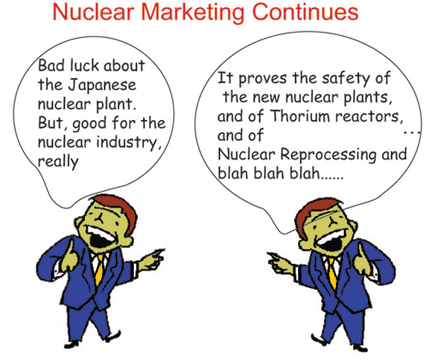
The Chancellor also announced a regional collaboration agreement between Cumbria and Sichuan Province, deepening commercial ties between the province and the north west of England’s expertise in nuclear decommissioning and waste management. These developments followed a landmark announcement by Osborne the same day that the UK government would provide up to £2 billion ($3 billion) in support for the planned Hinkley Point C nuclear power plant, which China may participate in.
The UK’s National Nuclear Laboratory (NNL) said on 22 September that it will jointly lead the new UK-China Joint Research and Innovation Centre (JRIC) with the China National Nuclear Corporation (CNNC).
The JRIC – which will incorporate projects in a number of different areas of work across the whole nuclear fuel cycle – will “act as a portal to allow UK companies and academic organizations and their Chinese counterparts to work together on areas of mutual benefit and will support the development of Subject Matter Experts and others with higher level skill in both countries,” NNL said.
Over the coming months NNL and CNNC will work together to establish a program of work for the JRIC and to develop links with other UK bodies including the Nuclear Advanced Manufacturing Research Centre (NAMRC), the National Skills Academy for Nuclear (NSAN), the Nuclear Innovation and Research Advisory Board (NIRAB) and key UK universities working in the nuclear sector.
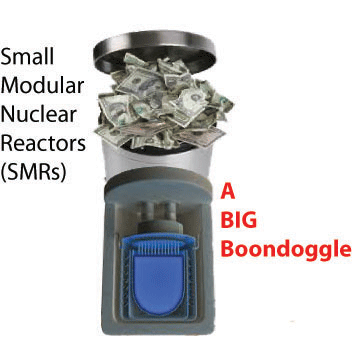 Professor Andrew Sherry, chief scientist at NNL, wrote in a blog on the Department of Energy and Climate Change’s website that there is a strong case for exploring the potential of next generation nuclear technologies. “There is scope for developing new reactor concepts including small and modular reactors, which can provide both electricity and potentially heat, and also for considering even more advanced reactors which can be powered with reprocessed spent fuel to make more efficient use of the uranium fuel, and generate less nuclear waste,” he said. “These advances will need targeted research across the UK, drawing together universities, national laboratories and industry and linking effectively with the international community.“
Nuclear power station at Bradwell would damage the marine environment
 MP warning over new nuclear power station in Essex East Anglian Daily Times 25 September 2015 Matt Stott An Essex MP has claimed a new nuclear power station at Bradwell would cause “significant damage” to the marine environment. Harwich and North Essex MP Bernard Jenkin expressed concern over the impact the site would have on the region’s fishing industries and ecology.
His intervention comes days after Chancellor George Osborne indicated a £2 billion Government guarantee for Chinese investment in the proposed Hinkley Point C nuclear power plant in Somerset could pave the way for further deals, including a majority Chinese-owned nuclear generation facility at Bradwell.
It is thought the site, next to the former nuclear power station, could be shared with between owners EDF and Chinese firms to build and run a new nuclear plant.
Mr Jenkin said: “There should be no new nuclear at Bradwell, unless the concerns about damage to the estuary and storage of nuclear waste on site can both be unequivocally resolved. “There seems no way that a new nuclear power station would avoid significant damage to the marine environment in the estuary.
“When the Magnox station was decommissioned, there was explosive recovery in the marine environment. I have been informed that a new power station would take six times more flow of water than its predecessor.
“The estuary cannot supply the volume of cooling water without severely damaging the natural life-cycle of organisms in it. This jeopardises the ecology, our local fishing industries and goes against the aim of the Marine Conservation Zone.”
He added: “It is also a significant concern… that high level nuclear waste would have to be secured and stored on the site for some decades after a new facility has reached the end of its operating life, before it can be safely transported.
“This raises questions about how could it be stored safely over such a long period.”………http://www.eadt.co.uk/news/mp_warning_over_new_nuclear_power_station_in_essex_1_4246963
Britain uncomfortably close to Chinese control of nuclear power system
 The China syndrome, Economist, 25 Sept 15 Britain’s nuclear plans look over-expensive and over-reliant on China “…….. Already the £24.5 billion project to build a nuclear power station called Hinkley Point C in Somerset is expected to finish over-budget and beyond the projected start date of 2023, if it ever starts at all. But on September 21st, after unveiling in Beijing a £2 billion inducement to China to help finance Britain’s first reactor in 20 years, George Osborne exposed himself to further criticism. The country should lead the way on nuclear power as it did in the 1950s, he said. But the implication was, it could only do it with China’s help (see Bagehot).
Critics say this reveals a whiff of desperation about the government’s bet on a nuclear renaissance, ………
Analysts say Mr Osborne is engaged in a complex manoeuvre to ensure that two Chinese firms help finance EDF. The £2 billion guarantee is one inducement. Another is an offer for China to build a reactor of its own at Bradwell in Essex. That has set off further alarm bells, though. Not only would it test confidence in Britain’s Office for Nuclear Regulation, it would also put a critical part of the nuclear industry and the national grid into Chinese hands.
Roland Vetter of CF Partners, an energy trader, doubts a go-ahead for the China project will come soon; licensing new nuclear technology in Britain takes years. It could be a strategic gambit, though. EDF’s boss in Britain, Vincent de Rivaz, notes that British and French companies are keen to help China, which has an ambitious programme of its own to build nuclear power plants. Mr Osborne may also calculate that Hinkley Point will create numerous jobs and building opportunities, the economic benefits of which would accrue quickly.
The costs, meanwhile, would not become apparent until the plant is completed and bills rise. Future governments would reap the fallout, not this one. http://www.economist.com/news/britain/21667932-britains-nuclear-plans-look-over-expensive-and-over-reliant-china-china-syndrome
UK’s Labour and Scottish National Party to join forces opposing Trident nuclear weapons system
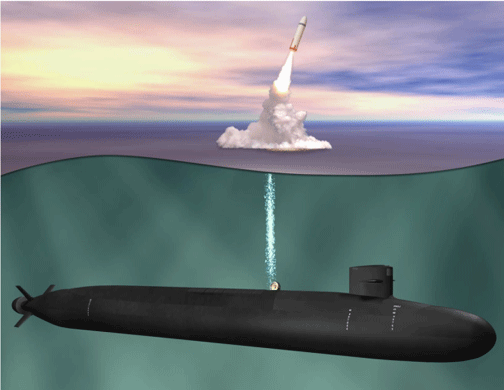 Corbyn says Labour and SNP will join forces to oppose nuclear deterrent. Irish Times, 25 Sept 15 Labour leader’s opposition to Trident puts him at odds with many in his own party The British Labour Party will work with the Scottish nationalists to try to block the renewal of the Trident nuclear deterrent in a parliamentary vote due next year, Labour’s new leader, Jeremy Corbyn, said on Friday.
The Conservative government backs the multibillion-pound renewal of Britain’s ageing fleet of nuclear-armed submarines. It has a slim majority in parliament, so some of prime minister David Cameron’s own MPs, as well as other opposition parties, would have to join with Labour and the SNP to defeat the plans.
The Scottish National Party, which won 56 out of 59 seats in Scotland in the general election in May, has long opposed renewing the weapons and had called on veteran antiwar campaigner Mr Corbyn to support them.
“My position on Trident has been very clear all of my life. I am opposed to nuclear weapons,” Mr Corbyn, who was elected as Labour’s leader earlier this month, told BBC Scotland.
“Trident should go. I do not believe that it is a form of defence. I do not believe it is something that anyone in their proper mind would ever want to use.”
Labour’s existing position is to back the renewal of Trident, although it has previously suggested reducing the number of submarines to three from four……..http://www.irishtimes.com/news/world/uk/corbyn-says-labour-and-snp-will-join-forces-to-oppose-nuclear-deterrent-1.2366935
The British Government is spreading untruths about the price of renewable energy.
What does all this add up to? The government, its Treasury department, its Chancellor George Osborne and its energy department, DECC, are grossly and presumably knowingly misrepresenting the relative costs of renewable energy and nuclear power.
And it’s all part of plan to force upon us a new generation of hyper-expensive nuclear power plants that will cost energy users through the nose until 2060 and beyond, putting the country on a ‘back to the future’ path to the 1950s, while wiser nations reap the benefits of cheap, clean renewable energy.
They must be stopped. And shame upon them!
 Nuclear Lies About Renewable Energy http://www.counterpunch.org/2015/09/24/nuclear-lies-about-renewable-energy/ by OLIVER TICKELL There’s no doubt about it. The British Government is spreading untruths about the price of renewable energy.
Is it deliberate? One can only assume so owing to the consistency of the pattern and the equally consistent refusal to explain or correct its misleading statements.
The context is also significant: it’s always in the context of supporting nuclear power over renewable energy sources. Continue reading
UK’s £24bn Hinkley Point nuclear project shunned by investors
 Investors shun UK’s £24bn Hinkley Point nuclear project, FT.com , Christopher Adams , 24 Sept 15
Delays and cost overruns that have dogged two nuclear reactors being built in France and Finland have deterred investors from joining a £24bn project to build a plant at Hinkley Point.
French utility EDF is in advanced talks with two Chinese partners — China General Nuclear Corporation and China National Nuclear Corporation — over their final shares of construction spending and roles in the building of up to three nuclear plants in the UK. An agreement could be reached this year.
But Jean-Bernard Levy, EDF chief executive, told Les Echos, the French financial daily newspaper, that it had been unable to secure the support of other investors after persistent problems with the proposed European pressurised reactor design………http://www.ft.com/cms/s/0/67001140-6208-11e5-9846-de406ccb37f2.html#axzz3mgxe3MV2
Nobody except China wants to risk investing in Britain’s new £2bn Hinkley Point nuclear plant
 Only China wants to invest in Britain’s new £2bn Hinkley Point nuclear plant because no one else thinks it will work, EDF admits Investors put off by problems facing nuclear reactors under construction in France and Finland Geert De Clercq Wednesday 23 September 2015 Delays and cost overruns at two nuclear reactors under construction in France and Finland have made potential investors wary of joining a consortium led by France’s EDF for a similar project in Britain, EDF’s chief executive has admitted…….http://www.independent.co.uk/news/business/only-china-wants-to-invest-in-britains-new-2bn-hinkley-point-nuclear-plant-because-no-one-else-10513752.html
Britain tries to wrap up Hinkley nuclear deal with China, with $3.1 billion bribe
 In Courting Chinese Companies, Britain to Help Fund Planned Nuclear Plant NYT, By STANLEY REED SEPT. 20, 2015 LONDON — The British government said on Monday that it would provide 2 billion pounds, or about $3.1 billion, in state aid for a nuclear power station planned for Hinkley Point in southwest England.
The announcement of financial support — which was made by George Osborne, the chancellor of the Exchequer, on a visit to China — appeared to be a confidence-building measure aimed at wrapping up a deal, years in gestation, to build Britain’s first nuclear plant since the mid-1990s.
“They are edging toward trying to sign a deal, but it is taking a long time,” said Antony Froggatt, a nuclear analyst at Chatham House, a London research organization.
The British government said that it expected EDF, the French state-controlled utility leading the project, to make a final decision later this year to go ahead with the plant. If EDF moves forward, it will be supported by two Chinese companies, China General Nuclear Corporation and China National Nuclear Corporation, the government said. Mr. Osborne has been courting Chinese companies to help finance the new Hinkley Point station, which will cost at least £16 billion…….
In trying to build nuclear plants, Britain is bucking the trend in the West. ……
The British government is not only offering financing to help with the construction but has guaranteed EDF a much higher price for the electricity it generates than current market rates. The government also says that it may increase financial support for the plant as the project progresses. Last year, the European Union approved Britain’s use of state aid to finance the plant……Still, Britain’s effort to build nuclear plants has proceeded at what seems a glacial pace. The Hinkley Point project is already several years behind its original schedule.
Centrica, a British utility, walked away from an option to take a 20 percent stake in Hinkley Point and another nuclear plant, citing frustration over delay and costs. http://www.nytimes.com/2015/09/21/business/energy-environment/britain-says-it-will-aid-planned-nuclear-plant.html?_r=1
UK and USA tried to develop nuclear land mines

 The Ultimate Weapon of War: Nuclear Land Mines? National Interest, Matthew Gault, 20 Sept 15 Land mines and nukes are two of the most terrifying weapons of war — for two very different reasons. Nuclear weapons can wipe out entire cities, and land mines wait buried in the earth, ready to harm anyone who wanders too close.
In the 1950s, Britain tried to combine the two into a nuclear mine … with chickens as a heating source. Yes, this was actually proposed. But we’ll get to the chickens in a moment. The Blue Peacock would have been one of the worst kinds of Cold War weapons — a nuke the enemy doesn’t know you have. The United Kingdom sought to develop and deploy 10 nuclear mines. Once completed, it would ship the nightmare weapons to the British Army of the Rhine — the U.K.’s occupation force in Germany.
The BAOR would then plant the landmines along the East German border in the north and detonate them should the Soviets ever try to cross the Iron Curtain. The project’s primary goal wasn’t to kill Soviet soldiers — though the blasts certainly could — but to irradiate and contaminate the North German Plain so Moscow’s troops couldn’t occupy it.
“A skillfully sited atomic mine would not only destroy facilities and installations over a large area, but would deny occupation of the area to an enemy for an appreciable time due to contamination,” explained a Cold War era policy paper unearthed by Discovery.
Scientists based the Blue Peacock’s design on Britain’s first atomic weapon — the Blue Danube. The Danubes were 10 to 12 kiloton bombs designed to free fall from planes. They looked cartoonish, like a bomb Wile E. Coyote might drop on the roadrunner.
The Blue Danubes packed less of a punch than Fat Man and Little Boy, so in 1954, the British Army decided to adapt that tiny nuclear punch into a land mine.
The War Office ordered development and the Royal Armament Research and Development Establishment set to work converting the Danube into the Peacock. In a few years, the researchers had a prototype. The nuclear land mine used a plutonium core surrounded by conventional explosives with twin firing pins. Steel encased the entire contraption.
The project had several problems.
First, compared to a conventional land mine, the Blue Peacock was massive………
The U.S. Army developed and deployed nuclear bazookas — the Davy Crockett — in the ‘60s, but the tiny nuke was still a nuke. It takes miles for the fallout from even a small nuclear blast to dissipate. The Pentagon thought better and shelved the project.
Britain had a similar problem with its Blue Peacock. How could it detonate a nuclear land mine without being anywhere near the device? It came up with two solutions, one ingenious and the other bizarre……….
The British Army shelved the project. One of the prototype Blue Peacocks is currently on display at the Atomic Weapons Establishment Historical Collection in England.
Britain’s attempts to develop a nuclear land mine were crazy, but it wasn’t the only time a nuclear power attempted to develop mines and smaller, more tactical nuclear munitions. It was just one reflection of the mad logic that was 1950s atomic war planning.
This piece first appeared in WarIsBoring here. http://nationalinterest.org/blog/the-buzz/the-ultimate-weapon-war-nuclear-land-mines-13890
Russian bombers began to arm NUKE near UK airspace
How close we came to Armageddon: Russian bombers began to arm NUKE near UK airspace PILOTS in  one of the two Russian supersonic bombers intercepted near UK skies last week had started the countdown to arm a nuclear bomb, sources revealed last night. By MARCO GIANNANGELI, SUNDAY EXPRESS, 20 Sept 15 after RAF specialists analyzed a four-second signal transmitted from one of the Tupolev Tu-160 bombers, known by Nato as “Blackjacks”, in the days following Thursday’s incursion.
Analysts at RAF Boulmer, Britain’s Control and Reporting Centre, confirmed that the Russian bombers had begun the sequence to arm nuclear weapons while carrying out the incursion.
It is not the first time they have done this and comparison with a similar signal transmitted by a TU-95 “Bear” bomber revealed Russian air crew had begun the countdown during an incursion last year, as well.
The Sunday Express revealed that the bomber involved in the February 2014 incident had been carrying a submarine-busting nuclear depth charge designed to attack Britain’s Trident-carrying Vanguard submarines.
“All I can say is that we now know it related to the first stage of arming a nuclear device,” said a senior RAF source last night. “There are several additional arming procedures which, thankfully, were not carried out.”
Last week’s air incursion, which was intercepted by Two RAF Typhoon jets, was the seventh this year by Russian forces.
RAF Boulmer, in Longhoughton. Northmberland, is the headquarters of the Air Surveillance and Control System force and the nerve centre of UK air security operations. Once a target is tracked the information is fed into the NATO network operated by the Combined Air Operations Centre at Uedem, Germany and the RAF’s Air Defence Operations Centre at Air Command, High Wycombe.
However it was only when a female analyst decoded last week’s transmission that it was realised Russia had carried out a similar exercise last year.
Aviation expert Justin Bronk, of the Royal United Services Institute think tank, said the revelation confirmed a “worrying” development in Russian strategy.
“Putin does not allow his air force to fly with cruise missiles because he is so worried about defections, but dual purpose bombs such as nuclear depth charges are a different matter. And these are designed to be a direct threat to our nuclear deterrent. “It is entirely probable that Russian crews have been practicing arming drills. The whole process can take several minutes, and it is important to be able to carry out quickly.”………http://www.express.co.uk/news/uk/606505/Armageddon-Russian-bombers-arm-nuclear-bomb-UK-airspace
UK: Tories slashing and buring solar industry
Ah, you say, but surely new nuclear is the answer? No chance. The new nuclear reactor at Hinkley Point in Somerset was supposed to open in 2017. Now that has been pushed back to 2024 while its estimated cost is skyrocketing to £24bn and beyond.
If it is ever built, Hinkley will be by far the most expensive nuclear plant ever. And they are planning more. Future generations will not thank this government for loading them with high and ever-rising electricity prices to pay for their ridiculous new toys.
Undeterred by their nonsensical energy policy, the Conservatives now want to slash the support mechanism for roof-top solar, known as the feed-in tariff, by up to 87%.
Solar industry is being slashed and burned by the Tories http://www.theguardian.com/business/economics-blog/2015/sep/09/solar-industry-is-being-slashed-and-burned-by-the-tories
Ashley Seager The government’s claim to be leading a solar revolution is a bad joke when it is instead pursuing ideological warfare against ‘green crap’ The government wasted no time after the election in killing the country’s onshore wind power sector and is now taking its wrecking ball to the solar industry, despite the call from the energy and climate change secretary, Amber Rudd, only months ago for a “solar revolution”.
Her claim, repeated this week, that this is the greenest government ever, is a bad joke. The problem is that the Tories’ actions, far from pushing down electricity prices, will push them up. They are playing politics with our money. Why? Because they are culling cheap forms of renewable power, the costs of which are falling rapidly, in favour of ruinously expensive nuclear power, never-likely-to-happen fracking and schemes like the overpriced Swansea tidal lagoon, all of which will suck more money out of our wallets than onshore wind or solar ever could.
The reasons are purely political. The Conservatives perceive they lost rural votes to Ukip in the election because of the latter’s opposition to wind and solar farms.
Rudd and George Osborne have developed a narrative of expensive renewables requiring subsidies that are no longer affordable. Nonsense – the support going to solar and onshore wind has been in sharp decline for years, as the sectors have slashed costs to a competitive level. By contrast, the government’s preferred choices, particularly nuclear power, are horribly expensive and require far higher subsidies than wind or solar. Continue reading
Even pro nuclear ‘experts’ want to scrap Hinkley ( are they pushing for ‘small nuclear’?)
 UK’s most aggressive nuclear lobby is pushing for Small Modular Nuclear Reactors and Thorium Reactors. They’ve even got themselves classed as a Charity!!! So, is the veiled co-operation between the old Big nuclear camp, and the new geewhiz Little nuclear camp now wearing thin in Britain?

Pro-nuclear environmentalists in call to scrap Hinkley C plans
Three leading experts urge government to end nuclear project saying delays will create panicked scramble back to fossil fuels, Guardian, Terry Macalister, 19 Sept 15 Three leading environmentalists who broke ranks to give their support to a new generation of nuclear plants have now urged the government to scrap plans for Hinkley Point C.
The call comes as George Osborne and Amber Rudd, the secretary of state for energy and climate change, head off to China, where they will discuss Beijing’s proposed investment in the new nuclear plant in Somerset.
George Monbiot, Mark Lynas and Chris Goodall say the soaring cost and delays to the Hinkley project leave ministers with no option but to pour the estimated £24.5bn worth of investment into other low-carbon technologies
“Hinkley C bears all the distinguishing features of a white elephant: overpriced, overcomplicated and overdue. The delay that was announced recently should be the final straw. The government should kill the project,” they write in a comment piece for the Guardian.
“The new delay should not surprise anyone who’s aware of the technological issues,” said Tony Roulstone, who runs the masters programme in nuclear engineering at Cambridge University. He argues that the plan for Hinkley C is like “building a cathedral within a cathedral”. It is, he concludes, “unconstructable”………
EDF, the French energy group, promoting Hinkley, has already won a generous financial aid package from the government through its “contract for difference” mechanism but has yet to sign the definitive deal it needs with Beijing investors.
This is expected to happen when the Chinese premier visits the UK next month, leaving EDF in a position to finally give the green light to the first nuclear plant to be built in the UK for 20 years.
But the energy company and its French engineering partner, Areva, have been beset by problems, leaving a growing number of former supporters from the world of energy and the City to question the viability of the whole project…….http://www.theguardian.com/environment/2015/sep/18/nuclear-environmentalists-scrap-hinkley-c-plans
Jeremy Corbyn and Britain’s nuclear weapons plans
Britain’s nuclear plans: the Corbyn factor https://www.opendemocracy.net/paul-rogers/britains-nuclear-plans-corbyn-factor
In the debate about replacing the Trident nuclear system, there is space for options that link British to international experience. Jeremy Corbyn, the new leader of Britain’s Labour Party, has long been opposed to the country’s possession of nuclear weapons. But he has also made it clear that this personal commitment does not extend to forcing this policy on the party he now heads. What he does want is an open debate and to convince others of the value of his views.
The replacement of the country’s Trident nuclear system is now being discussed (see “Britain’s defence policy: the path to change“, 7 May 2015). If this were to go ahead and a similar system put in place, the development and lifetime costs will approach £100 billion. Almost everyone in the Conservative government and parliamentary party, and many Labour MPs themselves, believe that a replacement should be built and that Britain should remain a nuclear-weapons power. Yet there is a substantial minority across the electorate that agrees with Corbyn. This view has gained far more traction since it was adopted by the Scottish National Party, a shift prompted not least by the persistent campaigning of nuclear disarmers north of the border, including the Faslane 365 initative. Yet political polarisation means it will be difficult to realise Corbyn’s aims.
The pro-Trident position has an uncompromising military rationale. It entails keeping a ballistic-missile submarine on station and ready to launch at all times – what is called “continuous at-sea deterrence” (CASD). In turn this requires maintaining four submarines, in order to allow one available for round-the-clock patrol, as well as substantial naval back-up. The latter includes what is euphemistically called “deterrence support”, an element that isn’t much talked about in polite circles.
The reason why is that deterrence support is onerous. There is a certain assumption that a Vanguard-class Trident-armed missile-submarine can disappear from its base at Faslane in western Scotland and go on secret patrol almost independently of the rest of the system. The reality is different: there is a continual need to protect Faslane, the Clyde estuary and the seas close to Scotland. Moreover, it is usual practice to have on patrol an attack-submarine, such as one of the new Astute-class boats (nuclear-powered but not nuclear-armed) between the general region of the Trident submarine’s area of operation and the perceived direction of threat. That, of course, means having several such attack-submarines available, which demands a substantial commitment.
The anti-Trident argument tends to the view that Britain’s nuclear weapons are little more than an historical anachronism (see “Britain’s nuclear endgame“, 28 September 2012). The ability to kill 5 million or more people in forty minutes may represent an inkling of great-power status, or a delusion of post-imperialgrandeur (of a kind shared with France). In practice, though, sufficient numbers of people still stick to the old thinking that the choice can be other than “all or nothing”. Corbyn’s supporters may need to recognise this.
A two-stage strategy
An earlier column in this series pointed to one way forward (see “Two steps to zero“, 17 July 2008). This was to scale down Britain’s nuclear forces to a background capability, involving the following steps:
* Cancel the plans to replace the current Vanguard-class boats and a new generation of nuclear warheads
* Reduce warhead numbers from around the current 160 to 30 (an 80% reduction); then have modified warheads available to deploy, if this were ever thought necessary, with cruise-missiles on attack-submarines, such as the new Astute-class (which can already deploy such missiles with conventional warheads)
* Phase out the entire Trident system as soon as this much-reduced force is available
* Adopt an openly stated policy of “no first use” of nuclear weapons and aspire to the elimination of nuclear weapons in Britain when international progress allows.
This would essentially be a residual force. If embraced, it could be less than a decade or so before the very idea of maintaining nuclear forces might be dropped, with Britain then joining the ranks of the 186 member-states of theUnited Nations out of 195 which do not possess nuclear weapons.
What is often forgotten here, including by anti-nuclear activists, is that several countries have given up nuclear weapons on their territory. South Africa actually developed its own small arsenal and then dismantled it. Furthermore, a number of states have in the past decided against developing their own nuclear arsenals after active consideration; they include Argentina, Brazil, Sweden and Switzerland, and probably also South Korea and Taiwan.
At the level of elite power, British nuclear weapons are a symbolic indication of standing in the world. The habit is so strong that it would be easier to give them up in two stages: a radically scaled down and far cheaper force that could then be allowed to wither away.
Whether that becomes an option depends very much on domestic party politics. But the point about revisiting Britain’s nuclear-weapons policy is that the starting-point does not have to be a rigid “for” or “against”. The option just outlined is just one among several. Their very existence means that the debatenow getting underway can be much better informed and less hidebound by increasingly meaningless issues of imaginary great-power status
1 This Month





PLEASE OPPOSE HR 8255 AND S.3639 – bills would accelerate satellite deployment, with no environmental review or safeguards – https://ncstd5li.quorum.us/campaign/169331/
To see nuclear-related stories in greater depth and intensity – go to https://nuclearinformation.wordpress.com
-
Archives
- October 2026 (58)
- September 2026 (339)
- August 2026 (330)
- July 2026 (355)
- June 2026 (287)
- May 2026 (306)
- April 2026 (356)
- March 2026 (251)
- February 2026 (267)
- January 2026 (308)
- December 2025 (358)
- November 2025 (359)
-
Categories
- 1
- 1 NUCLEAR ISSUES
- business and costs
- climate change
- culture and arts
- ENERGY
- environment
- health
- history
- indigenous issues
- Legal
- marketing of nuclear
- media
- opposition to nuclear
- PERSONAL STORIES
- politics
- politics international
- Religion and ethics
- safety
- secrets,lies and civil liberties
- spinbuster
- technology
- Uranium
- wastes
- weapons and war
- Women
- 2 WORLD
- ACTION
- AFRICA
- Atrocities
- AUSTRALIA
- Christina's notes
- Christina's themes
- culture and arts
- Events
- Fuk 2022
- Fuk 2023
- Fukushima 2017
- Fukushima 2018
- fukushima 2019
- Fukushima 2020
- Fukushima 2021
- general
- global warming
- Humour (God we need it)
- Nuclear
- RARE EARTHS
- Reference
- resources – print
- Resources -audiovicual
- Weekly Newsletter
- World
- World Nuclear
- YouTube
-
RSS
Entries RSS
Comments RSS

