 Scottish cold war nuclear submarine collision kept secret for 43 years
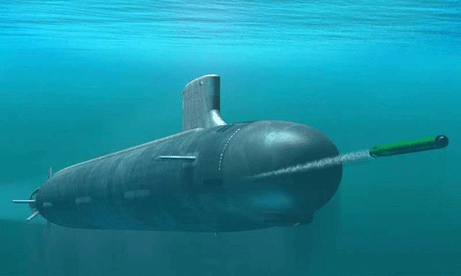
Documents published by CIA reveal crash between US and Soviet subs a few miles off coast of Scotland in 1974, Guardian, Matthew Weaver, 26 Jan 17, Two nuclear submarines from rival sides in the cold war collided a few miles off the coast of Scotland in an incident that was covered up for 43 years.
The potentially catastrophic crash occurred in November 1974 when the SSBN James Madison, armed with 16 Poseidon nuclear missiles, was heading out of the US naval base at Holy Loch, 30 miles north-west of Glasgow.
Soon after leaving the port it hit an unidentified Soviet submarine that had been sent to tail it, according to a cable to then US secretary of state Henry Kissinger, marked “secret eyes only” [pdf].
The cable, sent by national security adviser Brent Scowcroft, said: “Have just received word from the Pentagon that one of our Poseidon submarines has just collided with a Soviet submarine.
“The SSBN James Madison was departing Holy Loch to take up station when it collided with a Soviet submarine waiting outside the port to take up trail.
“Both submarines surfaced and the Soviet boat subsequently submerged again. There is no report yet of the extent of damage. Will keep you posted.”
The cable was published by the CIA on 17 January as part of a mass release of more than 12m pages of previously classified reports in 930,000 documents.
The cable corroborates an until-now unconfirmed report on the incident in the Washington Post on 1 January 1975 by the investigative journalist Jack Anderson. He reported that the collision left a 9ft scratch on the side of the James Madison and that the two submarines came within inches of sinking one another.
Another document marked “top secret” [pdf]released in the same batch expressed alarm that the news of the collision had leaked.
It said: “On 3 January, the NID [National Intelligence Daily] ran an item on the collision just off Holy Loch of US Polaris submarine and a Soviet attack submarine. Unfortunately, Jack Anderson had run the same news in the Washington Post a day or two earlier.
“This pre-emption on Anderson’s part forced the surfacing (no pun intended) of a piece of information in a current intelligence 2 months after the event occurred. …..
Kate Hudson, general secretary of the Campaign for Nuclear Disarmament, said the secret cable exposed the “enormous risks” of nuclear weapons.
“The history of nuclear weapons is a history of near misses, accidents, potential catastrophes and cover-ups. This latest example joins 25 other near misses that could have led to nuclear war.”
CND is calling for an inquiry into Trident, the successor to the Poseidon programme, after it emerged that a malfunctioning missile with the potential to carry a nuclear warhead was forced to self-destruct in mid-air off the US coast last June.
Hudson added: “These enormous risks have to be acknowledged particularly when we also now face the increasing likelihood of cyber-attack on nuclear weapons systems. With advancing technological developments added to the already dangerous mix there can be no confidence that nuclear weapons are a credible part of British security in the 21st century……… https://www.theguardian.com/us-news/2017/jan/25/nuclear-submarine-collision-cold-war-cia-scotland
January 27, 2017
Posted by Christina Macpherson |
history, incidents, secrets,lies and civil liberties, UK |
Leave a comment

 Tories threatened by their own nuclear meltdown in Copeland By Natalie Bloomer Politics.co.uk, 26 January 2017 Since the Copeland byelection was called, speculation has been rife about the damage Jeremy Corbyn’s nuclear stance could do to Labour’s chances. But while the Tories have been quick to exploit this, they have been much slower to wake up to their own nuclear problem. And it’s one which has the potential to swing the outcome of next month’s vote……..
Throughout the campaign there have been concerns within the local Labour party and among some union members that Corbyn’s views on nuclear could have an impact. But a far more pressing concern for many of the workers on site is the ongoing dispute with the government over their pensions.
Unions say that changes to the workers’ final salary pension scheme, which have been proposed by the Nuclear Decommissioning Authority (NDA), could see pensions slashed by thousands of pounds. After a meeting with government ministers yesterday, unions announced that a planned strike ballot would be put on hold while talks continue. But the issue has by no means gone away. http://www.politics.co.uk/comment-analysis/2017/01/26/tories-threatened-by-their-own-nuclear-meltdown-in-copeland
January 27, 2017
Posted by Christina Macpherson |
politics, UK |
Leave a comment

 What could go wrong? Nuclear energy giant wants safety rules relaxed https://www.rt.com/uk/374788-nuclear-plant-edf-safety/ 24 Jan, 2017 A nuclear energy company is trying to keep Scotland’s aging power stations open years longer than is allowed under current government regulations.
EDF Energy is asking the UK government’s nuclear watchdog to allow its power station in Hunterston, North Ayrshire, to continue running until it is 47 years old, and its facility in Torness, East Lothian, to remain open until it is 42 years old.
The power plants were designed to last only 30 years, according to investigative news site the Ferret.
The revelation has caused concern among experts and politicians, who fear continued use of the nuclear reactors could put the public at risk.
EDF Energy, which is majority-owned by the French government, has requested the Office for Nuclear Regulation (ONR) to permit an increase in the proportion of cracked graphite bricks in the two power plants from 10 to 20 percent.
In order to generate nuclear energy, thousands of graphite bricks used to make up reactor cores are bombarded with radiation. When these bricks begin to crack, it threatens the plant’s ability to make a safe shutdown.
The Hunterston and Torness power plants have both already seen their lifespans extended by seven years, until 2023 and 2030 respectively.
A report for the Scottish Green Party by Pete Roche, of the Edinburgh Energy and Environment Consultancy, quotes a senior EDF figure as saying the lifespans of the plants could be extended even further.
EDF Scottish Business Director Paul Winkle told a fringe meeting at the Scottish National Party (SNP)’s 2016 conference this will depend on the company’s assessments, according to the report.
“The current life for Hunterston is 2023 and Torness is 2030, and that is based on our assessment of aging mechanisms in those plants and being absolutely sure that when they are shut down they are still safe to operate.
“But to go beyond that we will do assessments and it may be possible to make some small further extensions, but we will not operate them beyond when we are confident they are safe to operate.
“Our current estimate is, with Hunterston, we get to a point where, if we go beyond 2023 there will be uncertainty. We will do more analysis in due course. Those dates are based on our best judgement.”
Scottish Green MSP Ross Greer warned local communities would be concerned by the proposals.
“The lack of public consultation is just unacceptable,” he said.
“If we did this properly, the public would reject an aging, cracking, safety hazard. The Scottish government’s relaxed position on nuclear needs [to be] challenged. We simply don’t need to sweat these plants and add to our toxic legacy.”
January 25, 2017
Posted by Christina Macpherson |
safety, UK |
Leave a comment
Jeremy Corbyn urged to oppose nuclear power station planned for Moorside A campaign group is calling on  Labour leader Jeremy Corbyn to publicly oppose nuclear new-build plans in west Cumbria. News and Star, 24 Jan 17
Radiation Free Lakeland (RFL) has written to Mr Corbyn to urge him to lodge his “firm and outspoken” opposition to plans for a three-reactor station at Moorside, on land next to Sellafield.
By doing so, adds RFL, Mr Corbyn would “galvanise and inspire nuclear opponents, and give them a compelling reason to vote Labour”.
RFL’s letter comes in the week that Mr Corbyn – who has been described as “anti-nuclear” by opponents – has twice visited Copeland ahead of a hotly-anticipated Parliamentary by-election to replace Jamie Reed. In her letter to Mr  Corbyn, RFL’s Marianne Birkby points to safety concerns about the design of the AP1000 reactors proposed for Moorside, and the “intolerable nuclear burden” already faced locally…..
She also draws his attention to a petition – Stop Moorside: the biggest nuclear development in Europe – that has attracted over 11,000 signatures.
She said: “We oppose Moorside and feel that you may be underestimating the strength of feeling against the plans. “When you appeared on The Andrew Marr Show last weekend, you missed the chance to condemn the project.
“Please set aside the siren voices that are working hard to convince you that outright opposition to Moorside would be a vote-loser.
“Instead, listen to the voices of resistance, which include many Labour voters previously encouraged by your rational, well-informed spepticism of the nuclear industry and its taxpayer-funded spin doctors.”
NuGen, the firm behind plans for Moorside, is currently analysing feedback from last summer’s public consultation into the plant.
The firm hopes to get the final go ahead in 2018. http://www.newsandstar.co.uk/news/Jeremy-Corbyn-urged-to-oppose-nuclear-power-station-planned-for-Moorside-30bf74c4-e216-4b83-92d3-439aacffc817-ds
January 25, 2017
Posted by Christina Macpherson |
politics, UK |
Leave a comment
Closer nuclear ties with France have been blown by Brexit, Independent, Martin Deighton, 23 Jan 17 “…The UK is planning to pay £30bn to upgrade Trident. The UK will not own the missiles but will lease them under licence controls from the US. UK Submarines will have to report to King George Bay in the state of Georgia in order to be regularly inspected and serviced and armed with the leased missiles. In its latest test, the Trident missile misfired.
We now have Trump on one flank, a President who not only considers Nato to be obsolete but will also have total control of the nuclear armaments and facilities in the US; and we have Putin on the other flank, a President of Russia with apparent and activated plans to expand into Eastern Europe……
France has suggested that the UK and France should join forces in the funding, expansion and deployment of these armaments as a truly European nuclear deterrent………..But of course this cooperation is now unlikely as we have decided to walk away from the EU.
January 25, 2017
Posted by Christina Macpherson |
politics international, UK |
Leave a comment
 No.10 admits Theresa May did know about nuclear test where missile ‘veered towards America’ Downing Street describes the operation as ‘successful’ – because the submarine and crew returned to service – but refuses to say what happened to the missile, Independent, Rob Merrick @Rob_Merrick 24 January 2017
Theresa May did know about last year’s controversial test firing of a Trident missile, but No.10 is refusing to confirm that it veered off course.
Instead, the Prime Minister’s spokeswoman insisted the operation had been “successful” – because both the submarine and the crew were able to return to service.
Her spokeswoman described repeated questions about allegations that the unarmed missile went astray as “minutiae and specifics”.
The admission that Ms May was informed about the results of last June’s test comes 24 hours after she refused – four times – to say if she had been aware of it.
She has been accused of covering up the test, which came just weeks before MPs backed the £40bn renewal of Trident by 472 votes to 117…….http://www.independent.co.uk/news/uk/politics/theresa-may-nuclear-test-error-trident-mps-vote-refuses-confirm-a7541481.html
January 25, 2017
Posted by Christina Macpherson |
secrets,lies and civil liberties, UK |
Leave a comment
 The UK now relies on Trump for our nuclear weapons – we need to spend more than ever before to free ourselves Britain’s Trident missiles are in a common pool shared with the US and maintained at Kings Bay, Georgia. Without the cooperation of the Trump administration, Trident wouldn’t last longer than a couple of months, Independent Benedict Spence Tuesday 24 January 2017 The report that a Trident missile test went awry, veering not toward its intended target on the west coast of Africa, but toward Florida – just weeks before parliament voted for its renewal – has forced the question of Britain’s nuclear deterrent firmly back into the public agenda.
Number 10 has confirmed that the Prime Minister, Theresa May, was aware of this malfunction before the vote, raising questions over whether she should have revealed information at the time. Scottish First Minister Nicola Sturgeon, for one, believed there should have been “full disclosure”, whilst the Campaign for Nuclear Disarmament suggested such information “would have impacted the debate in parliament.”
January 25, 2017
Posted by Christina Macpherson |
politics international, UK, USA, weapons and war |
Leave a comment
British unarmed nuclear missile ‘veered towards US mainland’ in test firing http://www.news.com.au/world/british-unarmed-nuclear-missile-veered-towards-us-mainland-in-test-firing/news-story/1c54697418967b79ff406bc805104709 JANUARY 23, 2017 THE UK government has been accused of a cover up after failing to disclose that an unarmed nuclear missile may have been mistakenly fired at the US mainland.
January 23, 2017
Posted by Christina Macpherson |
incidents, UK |
Leave a comment
 Toshiba faces pressure to secure funding for UK nuclear project, Ft.com by: Andrew Ward and Jim Pickard in London, 22 Jan 17 Toshiba is facing pressure to secure investment from a South Korean energy group and the UK government to keep afloat a multibillion-pound British nuclear power project as the Japanese conglomerate struggles with mounting financial difficulties.
Korea Electric Power Corporation (Kepco) has been in talks for months to join the NuGen consortium planning a nuclear plant at Moorside in Cumbria alongside Toshiba and Engie of France. The need for new partners has been increased by huge writedowns on Toshiba’s nuclear business in the US, which has left the group scrambling to shore up its balance sheet. As well as Korean capital, Toshiba is angling for UK government investment in the Cumbrian project after Theresa May’s administration recently signalled its willingness to put public money into new nuclear plants. This would represent a reversal of longstanding UK policy not to expose taxpayers’ money to the heavy expense and high risks involved in building nuclear reactors.
A Whitehall official said it was “premature” to talk about government involvement in financing Moorside but several other people involved in the process or briefed on the matter said the option of public investment was on the table. But these people said a more immediate step to keep the scheme on track was the proposal for Toshiba to sell part of its 60 per cent stake in NuGen to Kepco, the utility majority-owned by the South Korean government. “Talks have been moving slowly but the financial difficulties facing Toshiba will hopefully focus minds on getting a deal done,” said one person close to the talks.
It emerged last month that the UK and Japanese governments were in talks about potential joint support for a new nuclear plant planned by Hitachi, another Japanese conglomerate, at Wylfa in Anglesey. One senior nuclear industry figure said these discussions also extended to potential government financing for Moorside. Shares in Toshiba have fallen by 44 per cent since the group warned last month that it would have to make writedowns of “several billion dollars” related to the $229m acquisition last year of Stone & Webster, the US nuclear construction company, by Toshiba’s US nuclear technology unit, Westinghouse……..
Public investment in new nuclear plants would be a striking illustration of Mrs May’s determination to intervene more heavily in industrial strategy, a policy she was expected to set out in a discussion paper on Monday. The UK Department for Business, Energy and Industrial Strategy said: “We are working closely with a number of developers on proposed new nuclear projects in the UK, as they develop their plans.”
https://www.ft.com/content/c0b01308-e0aa-11e6-8405-9e5580d6e5fb
January 23, 2017
Posted by Christina Macpherson |
business and costs, Japan, politics, UK |
Leave a comment
 Green Party to contest Copeland seat in anti-nuclear campaign http://www.nwemail.co.uk/news/millom/Green-Party-to-contest-Copeland-seat-in-anti-nuclear-campaign-c289e405-159d-4963-b202-f53145038801-ds 15 January 2017
THE Green Party has announced it will contest the upcoming Copeland by-election on an anti-nuclear and anti-poverty campaign.
Members of Allerdale and Copeland Green Party decided to stand in the Copeland vote which was brought about by the resignation of the constituency’s current Labour MP Jamie Reed. A candidate will be selected on January 24.
Clare Brown, chairman of the Allerdale and Copeland Green Party, said: “We feel it’s vitally important to offer a vote to those people who want to see a fair and sustainable future for the area.
“There are clear differences between us and the other parties and we welcome this opportunity to campaign on our priorities, which include sustainable energy and standing against nuclear power, as well as anti-poverty measures and exposing the lie of austerity.”
Jonathan Bartley, co-leader of the Green Party, said: “The Greens are the only party in Copeland campaigning against nuclear power, to defend the NHS and for a close relationship with Europe.”
Pundits say the poll for his replacement could be held on May 4, linking in with the county council elections. As the party that currently holds the seat, Labour has to formally move the by-election writ to select his replacement and can dictate the date constituents go to the polls.
Labour are defending a majority of 2,564 in Copeland from 2015, making it the tightest by-election for the party since Jeremy Corbyn became leader.
The Liberal Democrats have already .
Labour will choose a candidate from a shortlist of Barbara Cannon, Gillian Troughton and Rachel Holliday.
January 16, 2017
Posted by Christina Macpherson |
politics, UK |
Leave a comment
Row breaks out over Labour’s position on proposed west Cumbria nuclear plant North West Evening Mail 16 January 2017 A POLITICAL row has broken out after the leader of the Labour Party refused to give his support for a nuclear development in west Cumbria.
Speaking on this morning, Jeremy Corbyn did not endorse the proposed Moorside Power Station when asked.
He said: “I want to see a mix, I want to see a greater emphasis in the long-term on renewables in the way Germany and other countries have done but we do have nuclear power stations, we do have a nuclear base at the moment and that will continue for a long time.”
Responding to Mr Corbyn’s comments, John Stevenson, Conservative MP for Carlisle, said: “Once again Jeremy Corbyn refuses to back a new nuclear power plant at Moorside……..
The comments come at a crucial time as Labour and Conservatives battle for votes in the upcoming by-election in Copeland, home to Sellafield and the proposed Moorside project.
However, John Woodcock, MP for Barrow and Furness, insisted Labour’s stance on Moorside was clear.
He said: “Jeremy Corbyn is more relaxed about expressing his personal opinions than most party leaders but Labour’s position on Moorside is clear: in government we passed the legislation that made new civil nuclear possible and locally and nationally we continue to champion the new power station……..
The Conservatives have put the nuclear industry at the centre of their campaigning, saying Corbyn’s views would be a “catastrophe” for Cumbria and industry jobs.
Responding to what his message to the constituency’s voters would be, Mr Corbyn said: “My message to the voters of Copeland is the NHS is in crisis, your hospital is about to be continuing underfunded and understaffed and your A&E department is at risk.
“We will be protecting jobs in that area and we would also be trying to protect the pensions of those people that have worked so very hard for so very long to keep the nuclear industry safe.” http://www.nwemail.co.uk/news/millom/Row-breaks-out-over-Labours-position-on-proposed-west-Cumbria-nuclear-plant-c4dc6fa7-c5aa-4608-b3b1-bbed6fe165d3-ds
January 16, 2017
Posted by Christina Macpherson |
politics, UK |
1 Comment
Copeland by-election goes nuclear By Ross HawkinsPolitical correspondent, BBC Radio 4 Today 12 January 2017 “……. Conservatives are putting Jeremy Corbyn at the centre of their Copeland by-election campaign.
His image is all over Tory leaflets, and their logic is very simple. Copeland relies on the nuclear industry and Jeremy Corbyn has opposed new nuclear power stations.
It means that when a by-election date is set, the contest in Cumbria could reveal a lot about how national politics will play out in the coming months. Tories will highlight an issue that divides Mr Corbyn and his colleagues……..
The economy revolves around Sellafield, and job numbers are set to fall there as reprocessing work ends. A new nuclear power station is proposed. Labour backs new nuclear energy, and local politicians certainly do. But Mr Corbyn has made plain in the past that he disagrees.
A policy document for his leadership campaign in 2015 says plainly: “I am opposed to fracking and to new nuclear on the basis of the dangers posed to our ecosystems.”
In a 2011 speech in the wake of the Fukushima disaster he went further, suggesting existing nuclear power stations should be decommissioned………
If it’s successful, a Labour strategy of responding to relentless attacks on Mr Corbyn with an equally relentless focus on the NHS may provide a model for the opposition in the years ahead. http://www.bbc.com/news/uk-politics-38589306
January 13, 2017
Posted by Christina Macpherson |
politics, UK |
Leave a comment
 China Is Building Britain ANOTHER Nuclear Reactor, Daily Caller ANDREW FOLLETT Energy and Science Reporter 12 Jan 17 Britain’s nuclear regulators are considering whether another Chinese-funded and designed nuclear reactor should be built in Bradwell, Essex.
The reactor would be funded and designed by the state-controlled China General Nuclear Power Corporation (CGN) and the French power company Électricité de France (EDF). It could take British authorities up to four years to formally approve or reject the new reactor.
“The robust independence of the UK’s regulators is seen across the world as a key strength for nuclear in Britain,” Zhu Minhong, General Manager of CGN in Britain, told Reuters. “CGN and EDF will bring to this enterprise their joint experience in China, Britain and France over many years.”
The U.K.’s previous attempt to build a nuclear power plant with the exact same Chinese company didn’t got well.
British Prime Minister Theresa May almost cancelled a previous China-backed nuclear power plant at Hinkley Point due to its high costs and environmentalist opposition. The U.S. charged the Chinese company behind the Hinkley Point plant with nuclear espionage in August.
A columnist for a Chinese state-run media outlet called May’s reluctance to approve of the Hinkley Point nuclear power project a result of “China-phobia.” CGN agreed to pay about $8 billion of the reactor’s $24 billion dollar cost.
China’s ambassador to Great Britain issued an ultimatum over the delay earlier in August, pointing out Chinese companies have invested more in the U.K. over the past five years than in France, Germany and Italy combined.
EDF agreed in July to build the Hinkley Point nuclear reactors by 2025 after years of delays. If the reactors aren’t built, U.K. taxpayers could be on the hook for $31.6 billion, according to documents released by the government. EDF is still planning to build the reactors, despite the company’s serious financial problems and the fact that the project is below investment grade.
EDF previously delayed making a decision about Hinkley Point several times before finally approving it after already investing $2.85 billion. EDF is more than $40 billion in debt and has a history of abandoning or delaying similar reactors in France……. http://dailycaller.com/2017/01/10/china-is-building-britain-another-nuclear-reactor/#ixzz4VZwv59yK
January 13, 2017
Posted by Christina Macpherson |
business and costs, China, politics, UK |
Leave a comment
British nuclear weapons workers to go on strike over Atomic Weapons Establishment pensions dispute The Independent, 12 Jan 17 Staff manufacture and maintain nuclear weapons including the Trident programme Lizzie Dearden @lizziedearden Employees responsible for manufacturing and maintaining the UK’s nuclear weapons are to go on strike.
Workers at the Atomic Weapons Establishment (AWE) are to stage two 48-hour walk-outs as part of a long-running dispute over pensions.
Unite said 600 of its members, who work as managers, craft and manual workers at the AWE’s two sites at Aldermaston and Burghfield in Berkshire, will strike on 18 and 30 January.
A spokesperson said workers felt “deeply betrayed” by promises made decades ago guaranteeing their pensions, when they were transferred from the Ministry of Defence (MoD) to the private sector, being broken………
“The four days of strike action later this month are not being taken lightly. It is not a ‘political’ strike, but one taken reluctantly by our members who have no desire to see thousands of pounds wiped off their retirement incomes.”
Unite claimed new pensions proposals, which would see the AWE’s pension contributions lowered, violated pledges made in a ministerial statement to the Commons in the 1990s. The AWE, owned by a consortium of Lockheed Martin, Jacobs Engineering and Serco, is contracted by the MoD to build and maintain nuclear warheads for Royal Navy submarines. http://www.independent.co.uk/news/uk/home-news/british-nuclear-weapons-factory-workers-berkshire-go-on-strike-prospect-union-awe-atomic-weapons-a7523516.html
January 13, 2017
Posted by Christina Macpherson |
employment, UK, weapons and war |
Leave a comment
 The secret nuclear bunker built as the UK’s last hope, Dug for an underground ‘shadow factory’ for aircraft during World War Two, the Drakelow tunnels were re-purposed as a nuclear bunker to be used by the UK government. We went inside., BBC By William Park 4 January 2017
Deep beneath a hill in the Worcestershire countryside, about 20 miles west of Birmingham, lie a series of hidden tunnels. Once home to a secret aeroplane factory during World War Two, they were later repurposed to protect the UK in the event of a nuclear war: it’s from here that the government would have continued to run the country.
“This would have been the last resort of the UK government,” says Michael Scott, a volunteer with the Drakelow Preservation Trust, which is restoring the site. The Trust’s aim is to reopen parts of the tunnels as a museum to preserve their history in World War Two and the Cold War. But the organisation remains some years away from finishing the work, and without much funding, the volunteers are restricted mostly to repainting walls.
When cities across the UK came under siege during the war, the government needed to find a way to continue production of tanks, aircraft and ammunition. The solution was to build underground factories – also called shadow factories – away from large cities. The Drakelow Tunnels housed one of them. And the same remoteness and fortress-like qualities that made Drakelow an effective underground aircraft factory would later make it the location of choice for responding to nuclear attack in Britain.
Today, the entrance used by Scott and the other volunteers is called Adit A; it’s where the security office would have stood. Most of the hillside around the entrance is bare, revealing a sandstone mass towering above us that would have made this site virtually bomb-proof in World War Two.
Adit A shows many signs of the alterations that were made to Drakelow Tunnels to retrofit it for use as a nuclear bunker – including covered air vents that would have protected those inside from fallout. Through the heavy steel door, visitors would have had to strip, incinerate their clothes and shower as they decontaminated themselves……..
There are examples of similar subterranean shadow factories in Germany, too. The largest was Mittelwerk, Kohnstein, which produced V-1 and V-2 bombs from 1943 to 1945. The move underground was a direct result of the destruction of other, above-ground V-2 production plants, like Peenemunde in northern Germany. Unlike Drakelow, Mittelwerk was left in ruins after the war.
Perhaps the most intriguing underground network of Nazi military tunnels is the series of seven structures that make up Project Riese. Buried in the Owl Mountains – then part of Germany but now in south-west Poland near the Czech border – these sites were never finished and documents about their full purpose seem to have been destroyed…….
Cold comfort
Top-secret military construction did not end with World War Two. In 1949, as the Cold War bloomed, the UK government began to build 15 fortified war rooms across the country.
But in the case of the much bigger threat of a nuclear attack, these buildings would not have been enough to protect their inhabitants. They were too small, making them unable to support a workforce for the extended period of time they’d need to remain indoors to avoid the fallout of a nuclear explosion. They also were built too close to the major cities which could have been a target for an attack: five were built in London, for example.
Having seen the effect of a nuclear attack in Japan, the British government commissioned the Strath Committee, led by head of the Central War Plans Secretariat William Strath, to analyse the potential effects of a nuclear attack on the UK. In 1955 the committee published the Strath Report which found that even a ‘limited’ attack would have devastating consequences. Food and water would be contaminated, the NHS would be overwhelmed with four million serious casualties and 12 million deaths, and industry would shut down. In short, the “social and economic fabric of the country [would be] destroyed”.
Strath recommended the UK invest in a network of nuclear bunkers to protect the population. However, estimates put the cost of such an enormous series of bunkers at £1.25bn (equal to £30.88bn in 2016)……… http://www.bbc.com/future/story/20170103-the-secret-nuclear-bunker-built-as-the-uks-last-hope
January 7, 2017
Posted by Christina Macpherson |
history, UK, weapons and war |
1 Comment