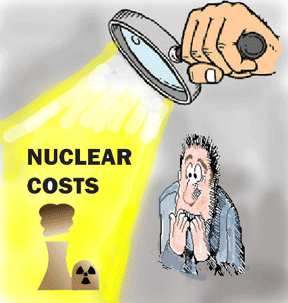
Government urged to guarantee Moorside nuclear funding,
  ITV.com, 3 Feb 17 The Government is being urged to step in and guarantee funding for a new nuclear power station after Japanese giant Toshiba said it was reviewing its investment in overseas nuclear projects.
The GMB union said ministers should take urgent action to secure the development at Moorside in Cumbria.
The future of the planned £10 billion power plant has been thrown into doubt after Toshiba said it was reviewing its overseas nuclear business.
Toshiba owns Westinghouse, the American-based nuclear developer whose AP1000 nuclear reactors are set to be used at Moorside……http://www.itv.com/news/border/2017-02-03/government-urged-to-guarantee-moorside-nuclear-funding/
February 4, 2017
Posted by Christina Macpherson |
business and costs, politics, UK |
Leave a comment
 Government urged to seek new investors to save Moorside project after concerns key partner will leave consortium, Guardian, Adam Vaughan, 3 Feb 17, Plans for a new nuclear power station in Cumbria are likely to be scrapped after a key backer pulled out, creating a major hole in the government’s nuclear strategy.
Two industry sources close to the process said Toshiba had privately decided to quit the consortium behind the planned Moorside plant, echoing sources who told Reuters and the Wall Street Journal that the Japanese company was withdrawing from new nuclear projects in the UK.
Toshiba said last month it was reviewing all its nuclear business abroad after suffering a multibillion-dollar writedown on its US business. It has promised to provide more details about its intentions when it publishes results on 14 February.
The French energy firm Engie, which is Toshiba’s partner in the NuGen consortium, has long been seen as wanting to get out of the project. Its chief executive said last year the future did not lie in nuclear power……..
“Any potential investor in that project is going to need to have very direct reassurance from the government; even if they are just starting an exploratory period, they are welcomed,” said Tim Yeo, the chairman of the pro-nuclear group New Nuclear Watch Europe.
The former Conservative MP said ministers should even consider taking a direct stake in the Moorside plant. Such an interventionist approach would have been anathema in recent years but appears more credible after recent leaks revealed the government was considering taking a stake in another new nuclear plant, at Wylfa in Wales……..
Moorside, near Sellafield, is a key part of the government’s hopes for a new fleet of power stations to fill the UK’s energy gap in the next decade as coal plants and ageing atomic plants close.
The only one to be approved so far is EDF’s £18bn Hinkley Point C plant in Somerset, which was made financially possible through subsidies to be levied on household bills. The government hopes new plants will be built at Wylffa, Sizewell, Bradwell and Oldbury…… https://www.theguardian.com/business/2017/feb/03/toshiba-exit-could-scrap-plans-for-new-nuclear-power-plant-in-cumbria
February 4, 2017
Posted by Christina Macpherson |
business and costs, politics, UK |
Leave a comment
With Toshiba fast sinking due to failed nuclear projects, and other members of the Nugen consortium getting cold feet, the project is facing collapse. The only alternatives are a Korean rescue – or making British taxpayers pick up the bill upfront.
The financial fog swirling around the Moorside new-build project in West Cumbria continues to thicken by the day.
The development consortium NuGen must inadvertently have added to the gloom with its recently published statement that:
“NuGen’s shareholders [Toshiba and Engie] are committed to the development of the Moorside project.”
Folks with longish memories will recall an identical statement (though with names changed) coming just a few short weeks before the widely predicted departure from NuGen of Scottish & Southern Energy (SSE) in 2011 and in 2013 when Spain’s Iberdrola also pulled out of the project.
Whether the current consortium partners of Toshiba and Engie will survive NuGen’s kiss of death message remains to be seen, but the omens are not good for NuGen or those who support the development.
For Engie itself, on record last December as “trying to abandon its nuclear projects in Turkey and Great Britain” in order to concentrate on decentralized energy and renewables, is the odds-on favourite to be next through NuGen’s seemingly ever revolving doors.
Is Toshiba’s AP1000 reactor finished?
Toshiba, dubbed as “ailing” by the Japanese media and still suffering the aftershocks of an accounting scandal in 2015 that rocked the corporate world, now has to contend with its wayward and wholly owned subsidiary Westinghouse purchased from British Nuclear Fuels (BNFL) in 2006 and which has now landed its parent with a multi billion dollar loss on reactor building projects.
Selling Westinghouse, or lowering its equity stake in the reactor business is an option currently being considered by Toshiba, as is selling off some profitable Westinghouse segments such as its nuclear fuel business which includes the Springfields site in Lancashire.
With Westinghouse and its AP1000 modular reactors selected for Moorside by NuGen in 2014, the turmoil surrounding the reactor builder is set to further undermine the future prospects for the West Cumbrian development.
Toshiba’s decision on the “corrective measures” it intends to take to sort out its corporate mess will not be published until mid-February, but it is widely reported by the international media that the Corporation will cease taking orders related to the building of nuclear power stations in a move that would effectively mark its withdrawal from the nuclear construction business.
Though it will continue work on the two twin-reactor AP1000 nuclear plants under construction in the United States, Toshiba is reported to be reviewing its investment in Moorside. There is no doubt that Moorside’s future currently hangs precariously in the balance, its survival dependent on whether or not Toshiba pulls the plug on any further involvement in overseas developments.
Should that be the case, NuGen faces the game-changer not only of losing its main consortium shareholder and its Westinghouse subsidiary (with Engie to follow?) but having to find one or more new partners prepared to nail their colours to a failing new build renaissance on a greenfield site acknowledged as being less than optimum for new-build construction and ridiculously remote from where its output of electricity is needed.
Korea’s KEPCO to the rescue?
One such potential partner whose interest in Moorside has been quietly simmering on the back-boiler for the last few years is South Korea’s Korea Electric Power Corp (KEPCO).
In terms of involvement in Moorside, the company appears to have just two options, the first being to take over some of Toshiba’s stake in the development and thereby help finance the project. Such a move however must surely bite the dust if Toshiba does decide in mid-February that it no longer wants any part of Moorside.
The second and only remaing option is for KEPCO to take on the development itself with or without other partners and ditching the US AP1000 reactors in favour of using its own reactor technology such as its Advanced Power Reactor APR1400 – the first of which, Shin Kori 3 in Ulsan, went on line in South Korea only last year having taken eight years to build.
In turning NuGen’s original plan completely on its head, the adoption of KEPCO’s APR1400 at Moorside would automatically put back NuGen’s current but overly-optimistic projection of a Moorside construction start around 2021 by several years as the South Korean reactor undergoes its Generic Design Assessment by the UK’s Regulators. Such a delay may seem a small price to pay by NuGen whose pet project, without the APR1400, would be facing oblivion.
Yet given its recent history, others may take a different view of KEPCO, which is part-owned by the South Korean government.
For like Toshiba, KEPCO is itself still emerging from a major scandal that surfaced in 2012 involving bribery, corruption and faked safety tests for critical nuclear plant equipment which resulted in a prolonged shut-down of a number of nuclear power stations and the jailing of power engineers and parts suppliers.
Or make the taxpayer finance the project upfront?
Without ‘friends like this’, and in the absence of any change of mind by Toshiba, it is difficult to see how else Moorside might be financed in the future, unless the UK Government itself rides to the rescue with taxpayers money.
The suggestion, floated by NuGen to a House of Lords committee just two months ago that some of what it described as non-nuclear elements of the project – the local transport infrastructure and the offshore cooling systems – might qualify for Government support.
After a decade of posturing over its West Cumbrian project, that the private consortium now feels the need for taxpayer support for Moorside underscores the extent of NuGen’s financial woes and highlights the unattractive face of new nuclear build to would-be global investors.
Picking the UK taxpayer pocket to support a technology past its sell-by date wholly undermines the Government’s erstwhile promise that the full costs of developing, constructing and operating new-build reactors would be borne by the developer and is not likely to go unchallenged.
Right on cue however is the GMB union’s view announced today that “the sensible thing is for the Government to step in and guarantee the funding, this will keep Moorside on track and push down the price we will all have to pay for the electricity it will produce.”
In truth, the ulterior motive behind the Union’s support for Moorside as a means of ‘keeping the lights on’ is the rank fear that, without the development – and with Sellafield’s commercial operations soon to end, the decades of West Cumbria’s unhealthy domination by the nuclear industry will be a thing of the past.
February 4, 2017
Posted by Christina Macpherson |
business and costs, politics, UK |
Leave a comment
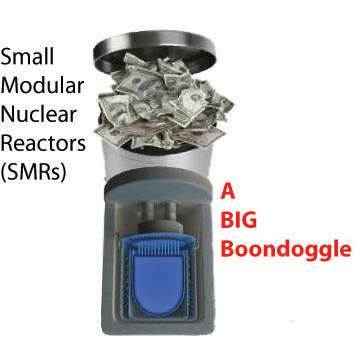
 Small Modular Reactors NuClearNewsNo92 February 2017 Scotland Engineering giant Rolls-Royce is teaming up with a host of rivals including Amec Foster Wheeler and Arup and nuclear specialist Nuvia to develop mini-nuclear reactors. Rolls Royce believes the so-called next generation technology could
  support as many as 40,000 jobs if the industry flourishes. The consortium is entering a £250m competition started last March by the Government, which wants to find the best SMR design for civil use. It is hoped the technology will be more cost-effective than conventional plants. (1) The companies believe SMRs will strengthen the UK’s energy security by reducing reliance on foreign gas imports and smoothing out the impact of ‘intermittent generation’ technologies.
In November 2015, the British government announced plans to invest at least £250 million over the next five years in a nuclear research and development program including a competition to identify the best value SMR design for the UK. Rolls-Royce submitted a paper to the Department of Business, Energy and Industrial Strategy, outlining its plan to develop a fleet of 7 GWe of SMRs with its partners. Other participants in the UK’s SMR competition include French-owned EDF Energy and its Chinese partner CNNC, Westinghouse and US developer NuScale Power. (2)
In the US NuScale has formally completed its design submission to the Nuclear Regulatory Commission. The 12,000-page application will now undergo a lengthy review by the NRC, which must approve the design before construction can begin. (3)
According to City AM the Government’s work on SMRs appears to have slowed down, and many companies were expecting mention of plans in the industrial strategy published in January, but there was nothing specific. (4)
- Telegraph 8th Jan 2017 http://www.telegraph.co.uk/business/2017/01/08/rolls-royce-partners-rivals-mininuclear-reactors/
- World Nuclear News 9th Jan 2017 http://www.world-nuclear-news.org/NN-Rolls-Royce-names-partnersfor-UK-SMR-09011701.html
- NPR 13th Jan 2017 http://www.npr.org/sections/thetwo-way/2017/01/13/509673094/miniaturized-nuclearpower-plant-u-s-reviewing-proposed-design
- City AM 8th Jan 2017 http://www.cityam.com/256579/rolls-royce-launches-partnership-engineering-giantsamec http://www.no2nuclearpower.org.uk/nuclearnews/NuClearNewsNo92.pdf
February 4, 2017
Posted by Christina Macpherson |
business and costs, politics, technology, UK |
Leave a comment
 NuClearNewsNo92 February 2017 Scotland and Hinkley A report, called ‘Scotland’s Wind’ (1), by Dr David Toke – Reader in Energy Politics at Aberdeen University and published by the Scottish Greens shows that UK, electricity consumers are set to pay around £16 a year for 35 years to subsidise Hinkley Point C. If Scottish consumers could go it alone their £16 levy could fund almost twice as much power from onshore and offshore wind farms.
The report says:
“If Scottish consumer s money was spent on supporting renewable energy rather than paying for their share of Hinkley Point C … then, even on conservative calculations, nearly double the amount of electricity would be generated from wind power as from Hinkley C”.
The costs of onshore windfarms and also offshore windfarms even on current prices need much less support from consumer surcharges to generate an equivalent amount of electricity compared to HPC. Wind power costs are falling rapidly, with some especially low prices being reported in Denmark and The Netherlands. Under such a programme organised by the Scottish Government the cheapest onshore windfarms could start generating in 2020 and offshore windfarms organised under a new, Danish-style framework, could be online in 2026.
The Scottish Government s own preference for renewable energy over nuclear power lends support to the suggestion that the Scottish Government should be able to use Scottish consumers money to pay for new renewable energy rather than new nuclear power. Moreover the best value for money for Scottish consumers in terms of generating non-fossil fuels is likely to come from the Scottish Government having powers to fund its own renewable energy programme from Scottish consumer bills. This is because the Scottish Government will be able to decide on what contract length to offer wind developers, for example offering to pay guaranteed prices for 20 years rather than 15 years as done by the Westminster Government now with renewable energy. Also, the Scottish Government will be able to organise a much more effective offshore windfarm programme than is being done by the Westminster Government. The Westminster Government’s methods are increasing the costs of offshore wind by leaving too much uncertainty to be dealt with by developers. The Scottish Government could organise a much cheaper offshore wind programme on the lines done by the Danish Energy Agency. This is likely to lead to lower costs and less confrontation in the courts over planning issues than is the case with the current offshore windfarm programme. (2)
In January the Scottish Government published
- Scotland’s Wind by Dr Dave Toke 9th Jan 2017 https://greens.scot/sites/default/files/Scotland%2527s%20Wind.pdf 2.
Dave Toke’s Blog 9th Jan 2017 http://realfeed-intariffs.blogspot.co.uk/2017/01/how-scotland-could-doubleamount-of-low.html http://www.no2nuclearpower.org.uk/nuclearnews/NuClearNewsNo92.pdf
February 4, 2017
Posted by Christina Macpherson |
business and costs, politics, UK |
Leave a comment
 We are heading for a senseless nuclear Brexit – with no political or legal mandate https://www.theguardian.com/science/blog/2017/feb/01/brexit-nuclear-eu-euratom-treaty-clare-moody
Clare Moody Our nuclear energy, safety and research must not be subjugated to already chaotic Brexit negotiations – the government must put the national interest first Clare Moody is Labour MEP for South West England & Gibraltar. 3 February 2017
Last week we learned just how hard and how ill-conceived Brexit looks like being. The two line parliamentary bill published by the government last Thursday contained no detail, no plan, and no check or balance on the prime minister’s possible negotiation as it progresses.
One thing that was included, albeit buried in the explanation notes, is a brief reference to also ending Britain’s membership of Euratom – an entirely separate treaty. The implications of this will be deep and far-reaching for the future of UK’s energy supply, science, industry and workers. There is no political or legal mandate for the UK to leave Euratom, in fact it was barely even a footnote in the referendum campaign, and yet we are heading for a nuclear Brexit.
Euratom matters for the UK. Signed in 1957 as the European Atomic Energy Community, it is a separate treaty from the EU with the purpose of creating a single market for nuclear knowledge and resources in the peaceful pursuit of science and nuclear energy.
Whilst currently its only full members are EU countries, it is in fact a legally separate organisation to the EU. The UK is a leading member of Euratom, and plays host to one of its most important research institutions – the Joint European Torus (JET), based in Culham, Oxfordshire. JET is performing extraordinary and groundbreaking research in the pursuit of fusion energy, and is part of an EU-wide project to deliver on the vision of this revolutionary, safe and clean energy source. On the way, new technologies, materials and expertise are being developed here.
Euratom also provides safeguarding inspections for all civilian nuclear facilities in the UK, including Hinkley Point B, Sizewell and Torness in Scotland. It is the legal owner of all nuclear material, and is the legal purchaser, certifier and guarantor of any nuclear materials and technologies that the UK purchases. This includes our nuclear trade with the United States.
This means that 21% of the UK’s electricity generation is based on our membership of Euratom. It means that EDF can rely on secure supply chains for construction at Hinkley Point C and it is responsible for safeguarding inspections. Whether people are in favour of nuclear fission power or not we can all agree we want it to be as safe as possible, which is why leaving Euratom makes no sense.
Our own regulating authorities are not equipped to take over all of Euratom’s safeguarding work in the UK, and any British scientist will tell you that their work depends on international collaboration that is facilitated by this treaty.
Given this, it is hard to overstate the effect leaving Euratom will have on the UK –and the British people did not give the government a mandate to leave Euratom.
I think this is a bad decision, poorly thought out and with no explanation as to how our safety will be protected. The government must start at some point to put the national interest ahead of narrow party interest and Euratom would be a good place to start. Euratom is a separate treaty and the government should have the gumption to treat it as such – it requires separate and detailed negotiations. Our nuclear energy, safety and research must not be subjugated to the already chaotic wider Brexit negotiations.
February 3, 2017
Posted by Christina Macpherson |
safety, UK |
Leave a comment
This includes the proposed nuclear new build at Moorside, near Sellafield.
Last month Toshiba announced its US subsidiary, Westinghouse Electric, may have overpaid – by several billion dollars – for another nuclear construction and services business. Following this, its shares fell dramatically.
Toshiba confirmed yesterday it is now reviewing its involvement in all other overseas projects as a way of dealing with this situation. It also plans to sell its semiconductor business.
Its president and chief executive Satoshi Tsunakawa said: “Going forward, we will revise the positioning of the nuclear business as our main focus business in the energy sector, and review the future of nuclear businesses outside Japan.”…….
Stewart Young, leader of Cumbria County Council, said: “I would be very concerned if this had any impact on NuGen.
“We will be seeking further information about their position and will be concerned if they is any effect on what would be the biggest single private sector investment that Cumbria has ever seen.”
To compound matters, Toshiba is also embroiled in an accounting scandal and it was yesterday announced that several Japanese banks may be about to launch a lawsuit against it.
A decision on whether to proceed with Moorside is due in 2018……http://www.in-cumbria.com/Doubts-on-Cumbrian-nuclear-project-bad89e7b-4e16-4895-b1ad-7c48a357166e-ds
February 1, 2017
Posted by Christina Macpherson |
business and costs, UK |
Leave a comment
UK offshore wind power falls below £100/MWh 4 Years ahead of schedule, REneweconomy By James Ayre on 27 January 2017 Cleantechnica

A new report has shown the cost of UK offshore wind power has fallen below the joint UK Government and industry target of £100 per megawatt-hour four years ahead of schedule, putting offshore wind on target to become one of the cheapest large-scale clean energy sources
The third annual Cost Reduction Monitoring Framework report was delivered this week by ORE (Offshore Renewable Energy) Catapult to the Offshore Wind Programme Board, showing that the levelized cost of offshore wind has fallen by 32% since 2012, and now sits under £100 per megawatt-hour (MWh), four years ahead of the scheduled target set by the UK Government with the UK’s offshore wind industry.
Specifically, offshore wind projects reaching a Final Investment Decision in 2015 and 2016 were done at an average levelized cost of electricity (LCOE) of £97/MWh, compared to £142/MWh in 2010/11.
The report also highlights that high industry confidence exists for offshore wind’s ability to continue delivering cost savings as a result of technological innovation and continued collaboration across the sector.
Additional key findings from the report include:
January 28, 2017 Posted by Christina MacPherson | Unc
January 28, 2017
Posted by Christina Macpherson |
business and costs, renewable, UK |
Leave a comment
 Leaving Euratom: the government should reconsider, Weinberg Next Nuclear 27 Jan 17 “…….A complex set of negotiations will now have to take place as most nuclear co-operation with the UK relies on safeguards provided through Euratom. It may not be possible to agree and ratify new agreements before Britain leaves the EU in 2019. According to Vince Zabielski, a senior lawyer at law firm Pillsbury Winthrop Shaw Pittman, “current new build projects will be placed on hold while those standalone treaties are negotiated” meaning possible delays at Hinkley as well as Bradwell, Moorside and Wylfa.
The decision however is not just bad for the UK, but for nuclear as a whole. With the UK one of the last big supporters of the technology, weakening its strength in the field will give power to anti-nuclear camps across the continent.
Weinberg Next Nuclear is very concerned that the departure from Euratom could severely damage the UK’s nuclear industry, with impacts on energy security, industrial competitiveness and decarbonisation objectives. We find no reason why such drastic action needs to be taken. Article 50 deals with the two Treaties of Lisbon: the Treaty on the European Union and the Treaty on the Functioning of the European Union. However the Euratom treaty is separate, not mentioned in either of the above treaties thus there is no reason for including Euratom in any part of Article 50 debate. As Jonathan Leech, a senior lawyer and nuclear expert at Prospect Law said, “there doesn’t seem to have been any real explanation as to why, because we are going towards the unknown at great speed. Legally we don’t have to [leave Euratom because the UK is leaving the EU],”.
Weinberg Next Nuclear thus urges the government to reconsider and avoid the highly damaging consequences this unnecessary withdrawal could have on the UK’s nuclear future. http://www.the-weinberg-foundation.org/2017/01/27/leaving-euratom-the-government-should-reconsider/
January 28, 2017
Posted by Christina Macpherson |
politics, secrets,lies and civil liberties, UK |
Leave a comment
Decision to leave Euratom ‘bonkers’, say experts Future of UK nuclear research ‘uncertain’ after Brexit bill revelation https://www.timeshighereducation.com/news/decision-leave-euratom-bonkers-say-experts January 27, 2017 By Holly Else The UK is to leave the European Atomic Energy Community as part of Brexit in a move that has been condemned by energy researchers.
The decision to leave the organisation, which funds and coordinates nuclear research, was outlined as part of the government’s Brexit bill published on 26 January.
One nuclear energy researcher called the decision “bonkers”, while another added that it had created a huge amount of “uncertainty” for the field.
The decision has also raised questions about whether the country’s memberships of other European research organisations are at risk.
The community, known as Euratom, is an organisation that provides the basis for research and trade in nuclear power. The government’s desire to leave the organisation is outlined in the explanatory notes published alongside the bill giving it the authority to trigger Article 50 and leave the European Union.
It is not yet clear whether it would seek to rejoin the organisation after Brexit.
Euratom, in conjunction with the Engineering and Physical Sciences Research Council, funds the Culham Centre for Fusion Energy in Oxfordshire, which is the UK’s national laboratory for fusion research. Culham also hosts JET, Europe’s largest nuclear fusion device.
According to its website, the centre collaborates with more than 20 UK universities, and it specifically mentions links with groups at the universities of Warwick and Oxford as well as the Doctoral Training Network in fusion.
Steven Cowley, previously director of the Culham centre and now president of Corpus Christi College, Oxford, said: “It would be bonkers to leave Euratom both for research and for nuclear safeguards.”
James Marrow, professor of energy materials at the University of Oxford, said that the funding available from Euratom was the “glue” that holds together the UK’s national nuclear research.
Euratom is the way that we interacted with the European [nuclear research] programmes. [This move] creates huge uncertainty,” he said.
“Nuclear [research] is a bit different from many other areas in that it only makes progress through big projects, so for a single nation it is extremely difficult for them to develop anything new…[Projects] are very much collaborative, so we would be left out,” he added.
Meanwhile Juan Matthews, visiting professor at the Dalton Nuclear Institute at the University of Manchester, said that he hoped that the inclusion of Euratom in the Brexit bill was a mistake as it “just didn’t make sense”.
“Euratom also controls the nuclear research and development aspects of the [EU’s] Horizon 2020 programme…UK research benefits more than our national contributions to Horizon 2020. A significant part of this is the work at the Culham Centre for Fusion Energy on JET and our contribution to the ITER project,” he said.
ITER is another experimental nuclear fusion project in France. Professor Matthews added that “sorting all this out will produce delays and will hit hard both our economy and our science”.
Reacting to the news, Mark McCaughrean, a senior adviser at the European Space Agency, tweeted: “While #Euratom is specifically linked to EU, how long before the ‘principle’ is extended to other European research organisations?”
A spokeswoman for the UK government said: “Leaving Euratom is a result of the decision to leave the EU as they are uniquely legally joined. The UK supports Euratom and will want to see continuity of cooperation and standards.” holly.else@tesglobal.com
January 28, 2017
Posted by Christina Macpherson |
politics, politics international, UK |
Leave a comment
 Brexit Could Also Hurt Britain’s Nuclear Research and Safety Inspections http://www.gizmodo.co.uk/2017/01/brexit-could-also-hurt-britains-nuclear-research-and-safety-inspections/ By James O Malley on 28 Jan 2017
Another wrinkle has been added to an already complex Brexit process. Just a small one… Umm.. Nuclear safety.
Politico reports that when we trigger Article 50, not only will we be withdrawing from the European Union, but we’ll also be pulling out of Euratom, the EU agency which oversees nuclear safety and security across the continent.
That’s right. Somehow Europe has configured itself so that Brexit won’t affect our Eurovision membership, but will affect nuclear safety.
The inclusion of Euratom in our middle finger to our continental colleagues was
revealed in a note on the Article 50 bill that has just been put before Parliament.
The upshot of this is that it means Britain will have to hire tonnes of new people itself to help do stuff like carry out nuclear non-proliferation inspections in countries like Iran, authorise the sale of nuclear material, and inspect our own nuclear power plants to make sure that everything is fine. As Politico notes, what makes this particularly complicated is that at the moment Euroatom is the legal owner of all of the actual nuclear materials – and this will have to be transferred to Britain… but then Britain also does a lot of the work reprocessing materials on behalf other members. Basically, it’ll be a bit of a nightmare.
The other really disappointing outcome from Brexit could also be Britain pulling out of Euratom’s Research & Development wing, which is currently working on making fusion power a reality. At the moment, we’re helping construct a brand new massive fusion reactor in France, but Brexit could put that in jeopardy. [Politico]
January 28, 2017
Posted by Christina Macpherson |
politics, safety, UK |
Leave a comment
 Five anti-Trident protesters found guilty after blockading nuclear bomb factory The group argued they were putting their religious beliefs into action BY blockading the AWE Burghfield The Independent Jon Stone Political Correspondent @joncstone 27 Jan 17, Five anti-Trident protesters have been found guilty of blockading a nuclear weapons manufacturing facility – days after new concerns were raised about the safety of Britain’s Trident nuclear missiles.
The protesters, who barred the entrance to Burghfield Atomic Weapons Establishment in Berkshire in June of last year, were from the Christian group Put Down the Sword / Trident Ploughshares.
Trident mounted nuclear warheads are assembled at Burghfield, which has been the site of repeated demonstrations for a number of years. The MoD said work on the missile system was disrupted by the protests……
The activists’ defence team argued that they were acting in accordance with their religious beliefs, which they said were protected by the Human Rights Act.However district judge Khan said that he did not agree that “that the actions of the defendants were a manifestation of a religious belief” and in any case that “these rights have to yield to the primary right of passing and re-passing the highway” outside the base…….
A joint statement from the defendants said: “We stand by what we said in court: Trident is an illegal and immoral waste of money, a crime against humanity and God.
“The prosecution said we could just have joined in a prayer vigil to the side of the road, instead of lying in it; we said our consciences wouldn’t allow that. We believe prayer is important but sometimes our faith compels us to put our whole bodies in the way of injustice and violence.“The Bible says religious acts are meaningless unless we also stand up for the poor and needy; we are called to bring a just peace with hope for all. We will continue to seek peace, and to take the consequences of doing so. It’s a small price to pay for the chance to challenge an evil like nuclear weapons.”http://www.independent.co.uk/news/uk/politics/trident-burghfield-reading-nuclear-missiles-bomb-factory-base-protests-guilty-a7549261.html
January 28, 2017
Posted by Christina Macpherson |
Legal, opposition to nuclear, Religion and ethics, UK |
Leave a comment
 Brexit will delay new British nuclear power stations, warn experts
Analysts say exit from EU atomic treaty is ‘lose-lose’ that will raise costs and safety questions at plants such as Hinkley Point C, Guardian, Adam Vaughan, 27 Jan 17, Britain’s first nuclear power station in two decades will be delayed by a government decision to quit Europe’s atomic power treaty, experts have warned.
Ministers revealed on Thursday that Brexit would involve the UK leaving Euratom, which promotes research into nuclear power and uniform safety standards.
The news poses problems for the Hinkley Point C station in Somerset, while raising questions over safety inspection regimes and the UK’s future participation in nuclear fusion research.
Referring to Hinkley and other nuclear projects in the pipeline, he said: “The UK nuclear industry is critically dependent on European goods and services in the nuclear supply chain and their specialist nuclear skills. Leaving Euratom will inevitably increase nuclear costs and will mean further delays.”
EDF, which is building the Hinkley project and hopes to construct other plants, has told MPs that “ideally” the UK would stay in the treaty, as it provided a framework for complying with international standards for handling nuclear material.
Without mentioning Hinkley, the French state-owned company also warned that restrictions on the movement of people because of Brexit could delay delivery of new energy infrastructure.
Antony Froggatt, a research fellow at the Chatham House thinktank, said: “Outside of Euratom and the single market, the movement of nuclear fuel, equipment and trained staff will be more complicated.”
He noted that because the UK was a supporter of nuclear power, Brexit would affect the balance of nuclear policies in the EU, where Germany, Italy and even strongly pro-nuclear France had taken steps in recent years to reduce their reliance on atomic power.
Vince Zabielski, a nuclear energy specialist at the law firm Pillsbury Winthrop Shaw Pittman, said: “If the UK leaves Euratom before new standalone nuclear cooperation treaties are negotiated with France and the US, current new build projects will be placed on hold while those standalone treaties are negotiated.”
Other lawyers questioned why the government had decided to quit Euratom and in the manner it had done so, in the explanatory notes accompany the article 50 bill.
“There doesn’t seem to have been any real explanation as to why, because we are going towards the unknown at great speed. Legally we don’t have to [leave Euratom because the UK is leaving the EU],” said Jonathan Leech, a senior lawyer and nuclear expert at Prospect Law.
“At the moment, the UK standing on the world nuclear stage is predicated on a series of cooperation agreements, and those we have the benefit of from being a member of Euratom, and the few bilateral agreements are based on Euratom, too. Take that away and you have no basis for international nuclear cooperation.”
He said quitting Euratom would create unnecessary uncertainty for new nuclear power and research into fusion power, a cleaner alternative to nuclear fission in which the UK has been a world leader for decades……. https://www.theguardian.com/business/2017/jan/27/uk-exit-eu-atomic-treaty-brexit-euratom-hinkley-point-c
January 28, 2017
Posted by Christina Macpherson |
politics, politics international, UK |
Leave a comment
New power stations in doubt after Brexit change, THE TIMES, Sam Coates, Emily Gosden, 27 Jan 17, The new wave of British nuclear power stations was in jeopardy after the government announced it would pull out of a Europe-wide nuclear co-operation organisation.
Ministers sneaked out the news that the UK would leave the European Atomic Energy Community, known as Euratom, within the notes accompanying the bill published yesterday to trigger Article 50, the process for leaving the European Union.
Euratom was established through a 1957 treaty and plays a crucial role in ensuring compliance with international nuclear safeguards as well as establishing a European market for nuclear goods and services.
The decision to announce Britain’s planned exit from Euratom yesterday caught the nuclear industry by surprise and caused concern in parts of government. Some ministers wanted to delay the announcement because of…http://www.thetimes.co.uk/article/britain-quits-european-nuclear-body-pgmq9m9fc
January 28, 2017
Posted by Christina Macpherson |
politics, politics international, UK |
Leave a comment
 Anglesey nuclear reactor consultation attacked BBC News, 27 Jan 17 Anti-nuclear campaigners have accused Natural Resources Wales of carrying out an “insulting” consultation over designs for a new reactor on Anglesey.
Hitachi-GE wants to build a new type of reactor at Wylfa, with a UK stakeholder meeting over the design held in Birmingham last month.
Wylfa opponents say a similar meeting run by NRW is not public – and only open to invited guests.
But NRW said it is holding a series of public drop-in sessions on the island.
However, the campaign group People Against Wylfa B (Pawb) described the individual meeting “for a small number of invitees” being held at the old Wylfa power plant site next Monday as “an affront to democracy”.
“This is totally unacceptable. On a matter as important as this, it is an insult to the people of Ynys Môn (Anglesey) and north Wales,” said Dylan Morgan, from Pawb.
“To add insult to injury, it is intended to hold the meeting in a room on the Wylfa Magnox site which is far from being a neutral venue and reinforces the perception that Natural Resources Wales and the Welsh Government are dancing to the nuclear industry’s tune.”
The environmental agency described the meeting in question as a “technical” briefing for those unable to attend the Birmingham event, with about 100 invited to attend.
The UK Government is currently carrying out consultations on what is known as the generic design assessment for the type of nuclear reactor that could be built at a new Wylfa power plant.
A UK first
The Japanese-American nuclear partners want to bring a new advanced boiling water reactor to the site and to the site at Oldbury in Gloucestershire.
It would be the first of its kind in the UK. A decision on the design is expected to be taken by UK ministers in December this year.
Pawb has now written to the Welsh Government’s Environment Secretary Leslie Griffiths, asking her to intervene as the minister responsible for overseeing the work of NRW.
“We call on you to instruct Natural Resources Wales to rearrange a public meeting in a neutral, convenient and central location in Ynys Môn,” stated Pawb.
“A meeting held to discuss the generic design assessment of the Hitachi ABWR has to be advertised openly and widely and not ‘to a small number of invitees’.”…….. http://www.bbc.com/news/uk-wales-38760203
January 28, 2017
Posted by Christina Macpherson |
opposition to nuclear, UK |
Leave a comment