Theresa May’s dangerous plan to link nuclear trade with security
 Britain’s secret Brexit nuke http://www.newindianexpress.com/opinions/2017/apr/06/britains-secret-brexit-nuke-1590353–1.html By Tom Arms 6th April 2017
May’s attempt to link trade and security sets a dangerous precedent for the world. Will she now offer N-protection to Saudi Arabia?
British Prime Minister Theresa May has linked Britain’s nuclear deterrent to Brexit negotiations. And in doing so she has pointed the way for India and other nuclear weapons states to use their irradiated umbrellas to secure their own lucrative trade deals.
Until now it has been accepted that nuclear weapons are the ultimate deterrent, and are to be used only in that capacity. Linking them to trade, as May has done, has added a new and dangerous level to the nuclear playing field.
The link came in the British prime minister’s letter to the European Commission triggering Article 50 of the Lisbon Treaty and the start of Brexit negotiations. In just one letter, she explicitly linked economic concessions with security issues nine times.
Alright, the n-word has yet to be dropped on a public stage, but it is being talked about behind closed Whitehall doors. The whispers have been loud enough for me to hear them and to contact the UK’s Department for Brexit negotiations. I pointedly asked them, “Is the government considering offering a nuclear deterrent—probably incollaboration with the French—to EU countries in return for trade concessions?” The reply was neither a confirmation nor a denial but an email pointing me to the links in May’s Brexit letter and a speech in which the British PM said, “The third … reason I believe we can come to the right agreement is that cooperation between Britain and the EU is needed not just when it comes to trade but when it comes to our security too.”
“Britain and France are Europe’s only two nuclear powers. … Britain’s armed forces are a crucial part of Europe’s collective defence.”
“… After Brexit, Britain wants to be a good friend and neighbour in every way, and that includes defending the safety and security of all of our citizens.”
Quick phone calls to embassies and European ministries of foreign affairs elicited a wall of no comments, until I came to the Poles where a spokesperson said, “Yes that’s right.”
But if the negotiating ploy is successful in Europe, what is to stop the British from offering the same protection to other regions of the world? Does Britain strike a deal with Saudi Arabia and the Gulf states to protect them from Iran? The British have just reopened a permanent naval base in Bahrain. How about East Africa? The Americans lease Diego Garcia but the British still own it. London has great relations with Singapore, an excellent base for an Asian presence.
And what about other nuclear weapon states? What is to stop India, Pakistan, France, Russia, China, and the US from using their nukes to extract trade concessions. It will cost more but the trade deals, or should I say protection money—should more than cover the costs, with a profit—adding a new and dangerous element to the problem of nuclear non-proliferation.
A stronger nuclear Britain willing to flex its muscles fits in nicely with the Trump view of the world. During his campaign, The Donald shocked analysts by floating the cost-cutting proposal that America supply nukes to Japan and Saudi Arabia. And although the US is making more positive noises about the NATO, the initial talk of obsolescence has left Europeans deeply worried.
Beefing up the British nuclear deterrent and tying it closer to Europe would save America money. However, it would also put several more links in the defensive chain that ties the US to the protection of Europe.
Trump may favour such a change, but it is not in the interests of either side of the Atlantic. Two World Wars have proven that. In both, the US adopted a hands-off role at the start. However, the fact is their interests were so intertwined with the European democracies that Washington was eventually forced to intervene to protect its national interests.
It is the growing American isolationism that makes it possible for May to test thendangerous nuclear waters. The EU is worried about losing its American nuclear umbrella. The UK is worried about losing their European market. Britain has nuclear weapons. The EU has markets. There is a clear fit.
Dr Ian Lesser, vice president at the German Marshall Fund, said it is “not incredible” that Britain is considering using its nuclear deterrent as part of the Brexit negotiations. He added, “But it would certainly be controversial.”
Trump’s foreign policy has prompted widespread calls for greater European defence cooperation, including—at the suggestion of the Polish Prime Minister Jaroslaw Kaczynski—a German-funded European nuclear deterrent. This was firmly and immediately rejected by Chancellor Angela Merkel.
Brexit brings bad news for world’s biggest active nuclear fusion project
Brexit brings nuclear (con)fusion http://www.politico.eu/article/world-leading-nuclear-fusion-project-threatened-by-brexit/ The world’s biggest active nuclear fusion project could lose EU funding just as it gears up for its grand finale. By SARA STEFANINI , 4/6/17, CULHAM, England — Just as European scientists here gear up to put decades of experiments to the test and try to bottle up the nuclear reaction that powers every star in the universe, Brexit is throwing the future of their work into doubt.
The 34-year-old Joint European Torus (JET), which sits in the Culham Centre for Fusion Energy’s retro 1960s laboratory, is a crucial part of an international research push on nuclear fusion that hopes to, one day, fuel homes and cities with energy free of greenhouse gases and waste.
Despite its location in the Oxfordshire meadows, JET is an EU venture through and through. The hundreds of scientists, engineers and technicians who visit the center to conduct experiments, as well as the parts used to assemble the world’s biggest nuclear fusion reactor so far, come from all around the Union.
Crucially, so does the €283 million that underpins the JET program for the five years through 2018. New European Commission funding, at least for 2019 and 2020, looked pretty certain — until Britain’s referendum, and London’s announcement in January that it would leave the European atomic energy community, Euratom, once the U.K. leaves the block in two years.
Talks to renew JET’s funding are now on hold, according to Culham center officials. What happens after 2018 depends largely on the outcome of Brexit negotiations.
The uncertainty could delay or even derail the JET program’s grand finale: Heating two hydrogen isotopes — heavy hydrogen (deuterium), which comes from water, and super-heavy hydrogen (tritium), from lithium — to temperatures hotter than the center of the sun.
Britain’s airports and nuclear power stations have been placed on a terror alert – cyber threat
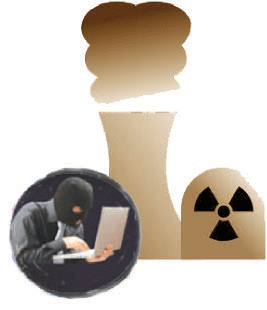 UK airports and nuclear power stations on terror alert after ‘credible’ cyber threat http://metro.co.uk/2017/04/02/uk-airports-and-nuclear-power-stations-on-terror-alert-after-credible-cyber-threat-6548381 Sunday 2 Apr 2017
Britain’s airports and nuclear power stations have been placed on a terror alert following increased threats to electronic security systems. Security services have issued a series of alerts in the past 24 hours, warning airports and nuclear power plants to tighten their defences against terror attacks.
Intelligence agencies fear ISIS and other terrorist groups could have developed ways to plant explosives in laptops and mobile phones which can bypass airport security screening methods, the Telegraph reports. Last month, Britain and the US banned travellers from a number of countries carrying laptops and large electronic devices on board.
They also fear terrorists, foreign spies and hackers could try to break into nuclear power station security systems.
Jesse Norman, the energy minister, said nuclear plants must ensure they ‘remain resilient to evolving cyber threats’.
Mr Norman told the paper: ‘The Government is fully committed to defending the UK against cyber threats, with a £1.9 billion investment designed to transform this country’s cyber security.’
Terrorists are feared to have developed the technology after getting hold of airport screening equipment allowing them to experiment.
FBI experts have tested how explosives can be hidden inside laptop battery compartments so that it can still be turned on.They are said to have concluded that the technique would be achievable using everyday equipment.
In a statement, the US Department of Homeland Security said: ‘Evaluated intelligence indicates that terrorist groups continue to target commercial aviation, to include smuggling explosive devices in electronics.
‘The US government continually reassesses existing intelligence and collects new intelligence. ‘This allows us to constantly evaluate our aviation security processes and policies and make enhancements when they are deemed necessary to keep passengers safe.’
Last year al-Shabaab, an al-Qaeda affiliate group in Somalia, detonated a bomb on a flight from Mogadishu to Djibouti by hiding it in a part of a laptop where bomb-makers had removed a DVD drive.
Terrorists may have ways of bypassing nuclear power station security measures
 TERRORIST THREAT TO UK REACTORS, HIGH ALERT IN PAST 24 HOURS http://www.siasat.com/news/terrorist-threat-uk-reactors-high-alert-past-24-hours-1165170/
According to Intelligence agencies, the terrorist groups have developed ways to plant explosives in laptops and mobile phones that can evade airport security screening methods.
Energy minister Jesse Norman said that the government was “fully committed to defending the UK against cyber threats, with a £1.9 billion investment designed to transform this country’s cyber security.”
The growing threat of attack on Britain’s 15 operational reactors, which account for nearly a fifth of the country’s electricity from terrorists, foreign spies and “hacktivists” remains high.
Norman said the civil nuclear strategy published in February sets out ways to ensure that the civil nuclear sector “can defend against, recover from, and remain resilient in evolving cyber threats.”
Deputy director-general Professor Malcolm Chalmers of the Royal United Services Institute, an independent think tank for defence and security, said that it was crucial for the Government to “respond rapidly”.
UK nuclear power plans thrown into doubt by Westinghouse bankruptcy
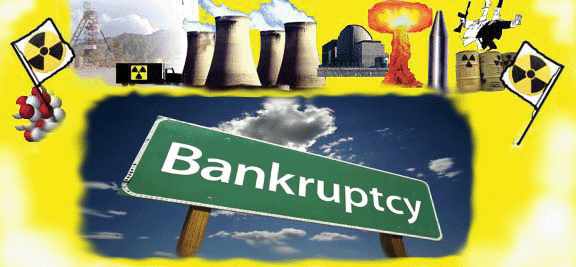 Westinghouse Bankruptcy Could Stall UK Nuclear Plans, Oil Price,
Toshiba was planning to build three Westinghouse-designed AP 1000 reactors at Moorside in Cumbria (UK). Government officials said these plants were expected to provide about 7 percent of the UK’s energy needs when they come on line around the year 2030. Toshiba owns 60 percent of the project along with French partner, Engie, which owns the balance. (Engie, formerly GDF Suez, is one of the largest generating companies in the world.)
Given the possibility of a Westinghouse bankruptcy, as well as related financial woes, Toshiba has been seeking to offload its interest in the Moorside project. The CEO of Korea Electric Power Company (KEPCO) initially sounded enthusiastic about assuming Toshiba’s Moorside stake stating publicly he was ready to “jump in” after questions of the project’s debt and equity were clarified. KEPCO, however, later ruled out buying Westinghouse.
Nowhere in various press report, though, did we see KEPCO officials embrace the Toshiba/Westinghouse AP1000 reactor design.The Koreans have their own nuclear reactor designs which they have had some success exporting. Actually, they have two of them; the OPR 1000 and the larger APR 1400….
Why does this matter?
It could take the UK’s nuclear regulator, the Office for Nuclear Generation (ONR), at least four years to certify a new reactor design. The ONR’s latest Generic Design Assessment is almost complete for Westinghouse’s AP 1000.
As sophisticated designers and builders of new nuclear facilities, with their own proprietary technology, we believe there is little likelihood the Koreans will take on the AP 1000 design. Building with a new and unfamiliar design would add to their risk.
If the Koreans assume Toshiba’s Moorside stake and pursue their home-grown reactor design, this will add years to the plant’s estimated in service date. The only good news, here, is that Britain’s electricity demand has fallen so much that maybe the delay would be a blessing in disguise.
Once again, though, we wonder if the UK’s nuclear policymakers have a plan B. They never had one before. http://oilprice.com/Energy/Energy-General/Westinghouse-Bankruptcy-Could-Stall-UK-Nuclear-Plans.html
EDF starts pouring concrete at £18bn Hinkley Point nuclear power plant
 Hinkley Point construction gets under way, EDF starts pouring concrete at £18bn nuclear power plant,
Ft.com by: Andrew Ward, Energy Editor , 31 Mar 17, Construction has begun of the first permanent structures at the Hinkley Point nuclear power station in Somerset, marking an important step towards Britain’s first new nuclear plant since the 1990s. EDF, the French utility leading the £18bn project, said it had started pouring concrete after receiving its first go-ahead for construction work from Britain’s nuclear regulator………
Nuclear lobby super-optimism – Michael Shellenberger sees Westinghouse bankruptcy as a plus for the industry!
 Britain has a chance to rethink its nuclear energy policy, Ft.com 30 Mar 17 The Westinghouse bankruptcy offers an opportunity to consolidate the industry Michael Shellenberger The bankruptcy of Toshiba-owned nuclear energy group Westinghouse on Wednesday throws up in the air ambitious British plans to use nuclear power to replace coal and, eventually, natural gas.
The writer is president of Environmental Progress rights. https://www.ft.com/content/ac22b6c2-152d-11e7-b0c1-37e417ee6c76
Britain’s nuclear regulator approves Westinghouse nuclear reactor (despite Westinghouse bankruptcy!)
Westinghouse wins UK reactor approval from nuclear regulator, Reuters, 30 Mar 17 , By Susanna Twidale and Nina Chestney | LONDON Toshiba’s (6502.T) Westinghouse, which filed for bankruptcy on Wednesday, has won approval for its AP1000 reactor design, Britain’s nuclear regulator said on Thursday.The Office for Nuclear Regulation (ONR) approval is needed before the design can be used at NuGeneration Ltd’s (NuGen) Moorside new nuclear project in north west England, which consists of three AP1000 units.
“The closure of our assessment of the generic design of the AP1000 reactor is a significant step in the process, ensuring the design meets the very high standards of safety we expect,” Richard Savage, ONR’s chief nuclear inspector, said.
“We will now focus our regulatory attention on site specific assessments, and NuGen’s application for a nuclear site license,” he added in a statement.
Westinghouse’s bankruptcy filing has raised questions over whether it will be able to complete capital intensive projects……
Britain ……has struggled to get large projects built, especially nuclear, due to the costs involved.EDF’s (EDF.PA) 18 billion pound ($22.5 billion) Hinkley Point C nuclear project in southwest England got the final go-ahead in 2016 after several years of delay, but only after securing backing from the French government.
NuGen, a joint venture between Toshiba and French utility Engie (ENGIE.PA) has also come under doubt since Japan’s Toshiba said last month it planned to pull out of the construction work at the British plant after posting a $6.3 billion writedown on Westinghouse, which has been hit by billions of dollars in cost overruns at new nuclear plants……http://www.reuters.com/article/us-toshiba-westinghouse-britain-idUSKBN1711E6
Westinghouse financial crisis impacts Britain’s nuclear power plans
UK nuclear plans could be hit by Westinghouse financial crisis https://www.theguardian.com/business/2017/mar/28/uk-nuclear-westinghouse-bankruptcy-toshiba-us
Toshiba’s US subsidiary, which has technology in about half world’s reactors, expected to file for bankruptcy protection, Guardian, Adam Vaughan, 29 Mar 17, A financial crisis at a major nuclear energy business is threatening to deal a blow to the UK’s atomic energy programme.
Toshiba’s US nuclear subsidiary Westinghouse Electric is believed to be on the brink of filing in the US for bankruptcy protection from creditors. A UK expert said the collapse would leave a considerable hole in Britain’s new nuclear ambitions as Toshiba is a key player behind plans for a new power station at Moorside in Cumbria.
Westinghouse is a behemoth in the world of nuclear vendors, with its technology in about half the world’s reactors. But it is facing a writedown of billions of dollars over its acquisition of a nuclear construction and services business. In 2015 Toshiba bought CB&I Stone & Webster, the company managing the construction of new reactors Plant Vogtle in Georgia and Virgil C Summer in South Carolina, both of which are over budget and behind schedule.
Westinghouse filing for Chapter 11 protection would potentially limit future losses for its owner Toshiba. The move will also trigger complex negotiations between the Japanese conglomerate, its American unit and creditors, and could embroil the US and Japanese governments, given the scale of the collapse and US government loan guarantees for new reactors.
The US utilities that operate the two nuclear plants are among Westinghouse’s biggest creditors, owed for work that has yet to be completed and potential penalties, sources have said. The bankruptcy filing will allow Westinghouse to renegotiate or break the construction contracts, although the utilities that own the projects would likely seek damages.
Anti-nuclear campaigners said the episode showed the world should build renewable energy rather than new nuclear. Doug Parr, policy director at Greenpeace UK, said: “The world is watching the meltdown of a major corporation and questioning the cost of new nuclear. Declaring bankruptcy in the USA might shield Toshiba from Westinghouse’s debt, but as Toshiba’s share price ricochets and its multibillion-dollar losses escalate, the beleaguered nuclear industry is being shaken to the core again.”
Kecpo last week ruled out buying Westinghouse but said it was in talks to take a stake in NuGen. However, Dorfman said: “While Kepco may wish to buy into NuGen they may find it both legally and financially problematic.”
He added that any unravelling of Nugen as a result of Westinghouse filing for bankruptcy would “leave a considerable hole in UK nuclear plans”.
The AP1000 reactor design of the two US plants is the same as the three planned for the Moorside power station. Within days the UK nuclear regulator is expected to approve a “generic design assessment” for the AP1000, the end of a four-year approval process.
This year Toshiba has twice delayed publishing its financial results for the third quarter of 2016, which will reveal the scale of the impairment it faces with regards to CB&I Stone & Webster. In January, chief executive Satoshi Tsunakawa said that while Toshiba would continue to maintain and operate its existing nuclear plants: “It is unlikely that we will carry out construction work for future nuclear power plant projects, in order to eliminate risk.”
But NuGen has said that while Toshiba may not build Moorside, the Japanese corporation was still committed to developing the Moorside power station. The possibility of a Westinghouse bankruptcy also raises questions over its impact on the Springfields nuclear fuel plant in Lancashire. The company owns the site on a 150-year lease from the UK government’s Nuclear Decommissioning Authority.
In the US, the reactors that Westinghouse is building are due to be completed within the next three years.
Nuclear decommissioning debacle is costly for Britain
UK nuclear decommissioning debacle costs government nearly £100m
Business secretary orders inquiry into flawed tendering process for dismantling old reactors at 12 sites as US firms get paid for out of court settlement, Guardian, Adam Vaughan, 27 Mar 17, The government has been forced to pay nearly £100m in a settlement with two US companies for mishandling the way it awarded a £6.1bn nuclear decommissioning contract.
Ministers have ordered an inquiry headed by the former boss of National Grid to find out why the procurement process was so flawed. Labour said the payout showed “dramatic levels of incompetence”.
The government body tasked with decommissioning old reactors will also terminate the contract it awarded for cleaning up a dozen of the UK’s old nuclear sites nine years early……..
The government now has the daunting task of starting a new tendering process for the 12 sites, as the deal with Cavendish Fluor Partnership will end early, in September 2019 instead of 2028…….
The contract is being terminated early because the NDA underestimated the scale of the decommissioning required to clean up the Magnox sites, which form part of the UK’s first generation of nuclear power stations.
The share price of Babcock International Group, which has a stake in the Cavendish Fluor Partnership, has fallen by more than 3% since the government announcement…….
The NDA has an annual budget of £3.1bn, two thirds of which is spent on Sellafield in Cumbria, which stores most of Britain’s nuclear waste. https://www.theguardian.com/business/2017/mar/27/uk-nuclear-decommissioning-debacle-costs-government-100m
Babcock company down £800m after ending nuclear decommissioning contract
 Babcock to take £800m hit after ending nuclear decommissioning contract, Belfast Telegraph, March 27 2017 Engineering services firm Babcock has said it will take an £800 million hit after terminating a major Government contract to decommission and manage 12 UK nuclear sites.
As if in a department store sale day, foreign nuclear companies compete to sell their radioactive products to Britain
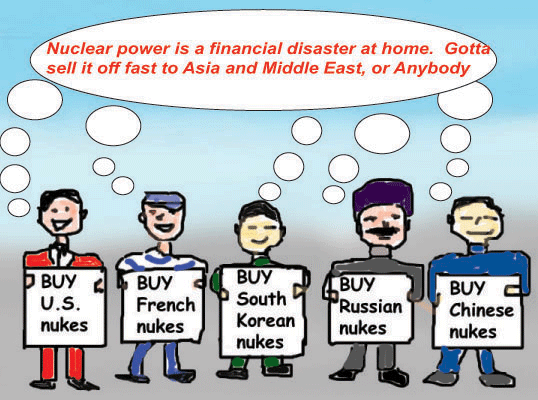
Foreign companies flock to build nuclear plants in the UK A South Korean firm is just the latest to be lured by Britain’s atomic amibitions as safety concerns and cost stalk the industry, Guardian, Adam Vaughan, 26 Mar 17, Nuclear energy faces an uncertain future globally as concerns over safety and cost dog the industry. But in the UK, foreign investors are queueing up to back projects. The latest is South Korea. Its biggest power company is in talks to join the consortium backing a nuclear power station in Cumbria, in a sign of the continuing allure of Britain’s atomic ambitions to international companies. Kepco said last week it was interested in taking a stake in NuGen, which is 60% owned by Japan’s Toshiba and 40% by France’s Engie, confirming what had been an open secret in the industry for months.
Kepco’s president, Cho Hwan-eik, said that once the terms of a potential deal were ironed out, “we will be the first to jump into the race”…….
Potential investors have been drawn by the UK government’s enthusiasm and a nuclear standstill elsewhere, amid lingering safety fears in the wake of the Fukushima disaster and cost overruns at the Flamanville site in France which is using a new reactor design. As a result, South Korea has joined Japan, China and France in showing interest in British nuclear.
It’s pretty simple. We are the only people building new nuclear power stations and we have by far the biggest new nuclear programme outside China for the next 10 years,” said Peter Atherton, an analyst at consultancy Cornwall Energy. “The civil nuclear programme globally doesn’t have any orders.”
The UK has also dangled the prospect of economic support for foreign nuclear builders. French state-owned EDF, which is building two new reactors at Hinkley Point in Somerset at a cost of £18bn, struck a subsidy contract with the government that will see it guaranteed twice the wholesale price of electricity for 35 years. The deal means Hinkley would be an “absolute goldmine” when operational, Atherton said.
He said UK financial support was not dissimilar to the deal Kepco has in the United Arab Emirates, where it is building four new reactors paid for by the UAE’s state-owned utility. “The economics of the project, and the economic risks of the project, fall on the host government,” said Atherton.
There is also the prospect that the UK government could take a stake in one of the new nuclear sites. Leaks to Japanese media revealed officials in London and Tokyo had discussed the UK offering state finance to a project led by Japan’s Hitachi to build reactors next to the site of an old one at Wylfa in Wales………https://www.theguardian.com/business/2017/mar/25/foreign-firms-flock-to-build-nuclear-plants-in-uk
Britain will struggle with nuclear regulatory system, after leaving European Union
Top nuclear boss advising May on protecting atomic industry from Brexit blow Energy Voice Alan Shields, 26 Mar 17 The German head of one of the UK’s top nuclear companies is counseling Prime Minister Theresa May’s government on what needs to be done to protect a global hub for the industry from Brexit.
With European Union leaders congregating to celebrate the Treaty of Rome’s 60th anniversary, Urenco Ltd.’s Chief Executive Officer Thomas Haeberle said he’s cautiously optimistic that new rules can be negotiated to guarantee the flow of nuclear materials in and out of the U.K. after the nation leaves the bloc.
“We are making the U.K. government, which is also our shareholder, aware of the requirements our business needs to fulfill in the context of Brexit and of leaving Euratom,” said Haeberle, referring to the European Atomic Community, a part of the EU’s bedrock agreement signed on March 25, 1957 – 26/03/20
Just as bankers have made London a global financial hub, nuclear workers have turned Britain into a central cog servicing the world’s flow of atomic materials. Urenco, the world’s second-biggest maker of reactor fuel, runs a factory in Capenhurst and oversees its global distribution network from Stoke Poges outside of London.
Owned by the U.K. and Dutch governments as well as German utilities EON SE and RWE AG, Urenco has set up a working group that “deals with all the risks and the possible mitigations,” Haeberle said. He spoke with Bloomberg a week before the EU celebrates Euratom’s 60th anniversary, his first interview since becoming CEO in January 2016.
Euratom’s main function is to safeguard nuclear fuel, making sure it isn’t diverted to make weapons. The U.K. will lose that service once it departs the EU. Nuclear fuel suppliers and power plants need certification from Euratom or whatever system succeeds it to buy material on the open market.
For Urenco’s business to continue uninterrupted after the U.K. leaves the EU, negotiators will have to seal new agreements with governments around the world setting out the new regulatory system Britain will follow after it leaves Euratom……..
Companies like Urenco face a potentially “high impact” from Brexit, Moody’s Investors Service wrote in a May 22 note saying that the overall credit impact from leaving the EU will be modest. Urenco, which has 2.1 billion pounds ($2.6 billion) of outstanding debt is rated Baa1, two grades above junk by Moody’s…… https://www.energyvoice.com/otherenergy/134874/top-nuclear-boss-advising-may-protecting-atomic-industry-brexit-blow/
.
Britain’s Office for Nuclear Regulation (ONR) sounds alarm over doctored papers and security breaches at French nuclear parts supplier
 UK watchdog sounds alarm over doctored papers & security breaches at French nuclear parts supplier, Rt.com 25 Mar, 2017
The ONR report, obtained under a Freedom of Information request and seen by Reuters, gives details on the December 16 visit by an international monitoring team to a French Creusot forge, operated by the country’s state-owned nuclear supplier Areva.
In the report, the UK watchdog warned that safety procedures at Creusot were far below the required standards for a key nuclear equipment supplier. That, they said, could lead to severe consequences for EDF’s [the largest energy company in France] Hinkley Point nuclear project currently under construction in southwest Britain, which is set to receive forgings from Creusot.
“ONR should consider the adequacy of EDF’s… oversight and assurance arrangements for Areva as a key supplier to Hinkley Point, given the performance shortfalls at Creusot Forge and the associated risks to [nuclear] components manufacture,” the regulator said, as cited by Reuters.
Among the breaches was the continued use of correction fluid on documents at the foundry, despite an earlier ban.
The ONR report also inquired into why internal inspections and audits carried out in past decades at Creusor Forge had not discovered and dealt with any of the falsification activities.
Following the December findings, two EDF nuclear reactors were stopped for months, utilities worldwide started reviewing Areva-made parts, and Paris launched a probe into the suspected falsification of documents.
The inspection of the troubled facility was carried out last year by an international team from France, Canada, the US, China, Finland, and Britain…….https://www.rt.com/news/382273-nuclear-france-failure-uk/
Ireland demands to be consulted on potential effects of nuclear power station on England’s west coast
Ireland issues powerful demand to have say on UK nuclear plant, Sunday Times, Environment minister Denis Naughten has asked the UK to consult Ireland on the potential effects of a nuclear power station on England’s west coast, 250km from Rosslare.
The Irish government has stopped short of calling for a full environmental impact assessment (EIA) of Hinkley Point C, the first new nuclear station in the UK in more than 20 years, however. Were such a study held, the Irish public could comment on the plans.
The environment department said it was a “matter for the UK to decide” whether work on Hinkley C should be put on hold while potentially affected countries such as Ireland are consulted, as recommended by a United Nations committee.
The UK has been criticised at the UN for not consulting neighbouring countries…http://www.thetimes.co.uk/edition/ireland/ireland-issues-powerful-demand-to-have-say-on-uk-nuclear-plant-nvb7q0rf8
1 This Month





PLEASE OPPOSE HR 8255 AND S.3639 – bills would accelerate satellite deployment, with no environmental review or safeguards – https://ncstd5li.quorum.us/campaign/169331/
To see nuclear-related stories in greater depth and intensity – go to https://nuclearinformation.wordpress.com
-
Archives
- October 2026 (39)
- September 2026 (339)
- August 2026 (330)
- July 2026 (355)
- June 2026 (287)
- May 2026 (306)
- April 2026 (356)
- March 2026 (251)
- February 2026 (267)
- January 2026 (308)
- December 2025 (358)
- November 2025 (359)
-
Categories
- 1
- 1 NUCLEAR ISSUES
- business and costs
- climate change
- culture and arts
- ENERGY
- environment
- health
- history
- indigenous issues
- Legal
- marketing of nuclear
- media
- opposition to nuclear
- PERSONAL STORIES
- politics
- politics international
- Religion and ethics
- safety
- secrets,lies and civil liberties
- spinbuster
- technology
- Uranium
- wastes
- weapons and war
- Women
- 2 WORLD
- ACTION
- AFRICA
- Atrocities
- AUSTRALIA
- Christina's notes
- Christina's themes
- culture and arts
- Events
- Fuk 2022
- Fuk 2023
- Fukushima 2017
- Fukushima 2018
- fukushima 2019
- Fukushima 2020
- Fukushima 2021
- general
- global warming
- Humour (God we need it)
- Nuclear
- RARE EARTHS
- Reference
- resources – print
- Resources -audiovicual
- Weekly Newsletter
- World
- World Nuclear
- YouTube
-
RSS
Entries RSS
Comments RSS

