Climate change must be thrust to the centre of UK politics – Labour is urged

 Labour Must Put More Focus On Climate Change, Morning Star, 12 July 17
Though the election didn’t focus much on the environment, the Labour Party must now thrust it into the political arena, argues IAN SINCLAIR
THERE is a tendency in Britain to look contemptuously upon the US political system. And nowhere are the deficiencies of the “shining city on a hill” more glaring than its sidelining of climate change — “the missing issue” of the 2016 US presidential campaign, reported the Guardian. According to the US writer Bryan Farrell, the topic was discussed for just 82 seconds during the 2016 televised presidential debates, which was actually an improvement on the 2012 debates, when it wasn’t mentioned at all.
Tragically, this omission was mirrored in the recent general election here. “The issue of #climatechange was completely marginalised during the #GE2017 media coverage,” Loughborough University’s Centre for Research in Communication and Culture tweeted about its election analysis.
This absence, the media watchdog Media Lens noted, is “the great insanity of our time.” Why? Because climate change is arguably the most serious threat the world faces today.
In January 2017 writer Andrew Simms surveyed over a dozen leading climate scientists and analysts and found none of them thought global temperatures would stay below 2°C — the figure world leaders agree we cannot exceed if we wish to stop dangerous climate change.
Last year, top climate scientist Professor Kevin Anderson told the Morning Star the pledges made by nations at the 2015 Paris climate summit would likely lead to a 3-4°C rise in global temperatures. Frighteningly he also told the author George Marshall that it’s hard to find any scientist who considers four degrees “as anything other than catastrophic for both human society and ecosystems.”
Surveying the environmental policies of the main parties just before June 8, Friends of the Earth scored the Green Party top with 46 points, followed by Labour on 34, the Liberal Democrats on 32 and the Conservatives trailing last with a poor 11.
The environment and climate change did not play a significant role in the Labour Party’s hugely successful election campaign. And though Labour leader Jeremy Corbyn himself rarely mentioned the topic on the campaign trail, the manifesto was a pleasant surprise to many.
“I’ve been really encouraged by Corbyn’s commitment to safeguarding our environment,” Nancy Strang, the women’s officer in Brent Central Labour, tells me. “The 2017 manifesto pledges to increase renewable energy production and investment, to tackle our air quality with a Clean Air Act, to protect Britain’s wildlife, and to ban fracking are all huge steps in the right direction … these pledges go beyond those in any previous Labour Party manifesto that I remember.”
The Green Party’s Dr Rupert Read agrees. “Corbyn’s Labour have some good environmental policies,” he tells me. “For example, their new-found opposition to fracking is much to be welcomed.”
However, he highlights a “fundamental problem” with Labour’s manifesto. “It is their unreconstructed insistence on ‘faster economic growth’,” Read argues.
The environment and climate change did not play a significant role in the Labour Party’s hugely successful election campaign. And though Labour leader Jeremy Corbyn himself rarely mentioned the topic on the campaign trail, the manifesto was a pleasant surprise to many.
“I’ve been really encouraged by Corbyn’s commitment to safeguarding our environment,” Nancy Strang, the women’s officer in Brent Central Labour, tells me. “The 2017 manifesto pledges to increase renewable energy production and investment, to tackle our air quality with a Clean Air Act, to protect Britain’s wildlife, and to ban fracking are all huge steps in the right direction … these pledges go beyond those in any previous Labour Party manifesto that I remember.”
The Green Party’s Dr Rupert Read agrees. “Corbyn’s Labour have some good environmental policies,” he tells me. “For example, their new-found opposition to fracking is much to be welcomed.”
it is clear external political pressure from the Green Party — “they have led where others were not so bold,” says Van Coevorden — also has an essential role to play in pushing Corbyn’s Labour in the right direction on green issues. It should also be noted that Corbyn personally opposes some of the environmentally damaging policies the broader Labour Party currently supports, such as Heathrow expansion and Trident renewal.
So, arguably, increased backing for the Labour leader and sidelining his neoliberal opponents within the party will likely improve Labour’s environmental policies.
The stakes couldn’t be higher. First, because against all the odds Corbyn now has a realistic chance of becoming Prime Minister — YouGov’s latest poll has Labour on 46 per cent and the Tories on 38 per cent. And second, because climate change continues to be an existential threat to humanity, with the Guardian reporting “scientists said they feared for their children” after hearing of US President Donald Trump’s vow to pull out of the Paris climate agreement.
It is, therefore, essential the environment and climate change are thrust to the centre of the national political debate as soon as possible — something Green Party and Labour Party members can both agree on, surely?
It is, therefore, essential the environment and climate change are thrust to the centre of the national political debate as soon as possible — something Green Party and Labour Party members can both agree on, surely?
http://www.morningstaronline.co.uk/a-de1a-Labour-must-put-more-focus-on-climate-change
Controversial choice for boss of UK’s energy price review
Renewable power critic is chosen to head energy price review, Government’s preferred choice of Oxford economist Dieter Helm is controversial owing to criticism of wind and solar power, Guardian, Adam Vaughan and Nick Hopkins, 13 Jul 17, An academic who is a vocal critic of the price of renewable power is the government’s preferred choice to head a review of the financial cost of energy in the UK.
Dieter Helm, an economist at the University of Oxford, has been chosen by the Department for Business, Energy and Industrial Strategy (BEIS) to carry out the review, the Guardian has learned.
The Conservative manifesto promised that the resulting report would be the first step towards “competitive and affordable energy costs”…..
Hannah Martin, head of energy at Greenpeace UK, said: “Dieter has a well-known preference for gas and has historically failed to grasp the full potential of renewables.
“At a time when the costs of offshore wind and solar are plummeting this review needs somebody with the vision to grasp the opportunities offered by clean energy to provide jobs, lower bills and slash carbon pollution.”
Other figures believed to have been in the frame for the job included Lord Turner, the former chair of a government advisory body, the Committee on Climate Change, who recently told the Guardian that Tory policy on onshore wind power was endangering cheap energy in the UK.
However, concerns that the review might be tilted against renewables could be allayed by Helm’s choice of colleagues to work on the report.Guardian
The Guardian understands that he will be aided by a former boss of the National Grid, Steve Holliday, who is a proponent of decentralised energy including batteries, and Richard Nourse of Greencoat Capital, an investment fund supporting clean energy.
Rounding out the proposed team would be Jim Gao, an engineer at an artificial intelligence company, Deepmind, owned by Google, which has been an enthusiastic supporter of renewables.
The review will look at all aspects of the energy industry and how they contribute to the cost of electricity, such as new technologies includingthe rollout of smart meters in millions of homes and the increasing number of electric cars drawing power from the grid………
Helm is also a strong critic of the cost of nuclear power, saying that just to get to the “starting line” of building a new atomic power station in the UK involves a “lengthy, complex and expensive process”.
He has also questioned whether any more new nuclear power plants will be built in the UK after Hinkley Point C in Somerset, which the public spending watchdog recently described as a “risky and expensive project”.
The new energy minister, Richard Harrington, has said the government is still committed to a new generation of nuclear power stations but Helm’s review could provide a justification for abandoning that ambition on cost grounds…… https://www.theguardian.com/environment/2017/jul/12/renewable-power-energy-costs-review-dieter-helm
Revival of Scotland’s onshore wind industry
Business Green 13th July 2017, Hopes that the Scottish onshore wind industry could be revived over the
coming years received a major boost today with the news EDF Energy
Renewables has acquired 11 wind farm sites boasting the potential for up to
600MW of capacity. The company, which is a joint venture between EDF Energy
and EDF Energies Nouvelles, announced it had purchased the sites from
development specialist Partnership for Renewables. Financial details for
the deals were not disclosed. https://www.businessgreen.com/bg/news/3013757/edf-snaps-up-600mw-scottish-wind-farm-portfolio
Legal wrangle looms over British or EU responsibility for nuclear fuel and wastes
 Brexit clash looms over European court, nuclear power, British government says it wants ‘smooth and orderly’ end to jurisdiction of European Court of Justice in the UK.Politico, By 7/13/17, LONDON — Britain will go into next week’s Brexit negotiations staking out positions on the role of the European Court of Justice (ECJ) and on liability for nuclear materials in the U.K. that are squarely at odds with Brussels…….
On nuclear material (the fuel and waste associated with civil nuclear plants), the U.K. wants to make sure ownership remains with whoever has the right to use it regardless of where it currently is. With ownership comes legal liability for the material and the U.K. is trying to avoid taking on responsibility which it does not see as its own — for example when Switzerland, Germany or the Netherlands sends materials to the U.K. to be turned into higher quality nuclear waste, and the U.K. sends it back.
 The position would essentially lock in law what already happens under commercial contracts but it differs from the one the European Commission presented in June, potentially setting the scene for a tussle over who takes responsibility for special fissile material in the U.K. after it leaves the European Atomic Energy Community, or Euratom.
Euratom owns all of the EU’s special fissile materials such as uranium, which are used to generate nuclear power.
The U.K. said the ownership should be transferred to “the persons or undertakings with the right of use and consumption of the material,” and that it should apply “whether these are established in the U.K., EU or non-EU states.”
The Commission’s paper, in contrast, said “it seems appropriate” that ownership of special fissile materials and Euratom property used for safeguard inspections in the U.K. be transferred to Britain — making it more costly for the country.
Existing rights to use and consume special fissile material shouldn’t be affected by the U.K.’s withdrawal, and the Commission should be able to require that this material be deposited with the Euratom Supply Agency or another store that the Commission can supervise, it added.
The U.K.’s position paper said it would make sure all necessary equipment is in place to maintain safeguard inspections after it leaves Euratom.
As for ownership, it was a little less cut-and-dried than Brussels.
“Further consideration will be given to the possibility of the U.K. taking ownership of existing Euratom-owned equipment. This will need to be rooted in a common understanding of the fair value and liabilities of the equipment concerned, and interactions with the EU budget.”
The documents — which laid out the U.K. negotiating positions on nuclear issues, judicial matters and the privileges and immunities of EU institutions post Brexit — will form the basis of Brexit discussions next week……….http://www.politico.eu/article/uk-and-eu-on-collision-course-over-the-role-of-european-court-post-brexit/
Scottish govt concerned over furure transfer of radioactive materials, if UK leaves Euratom
 Holyrood 12th July 2017, The Scottish Government has raised concerns over the future transfer of
radioactive materials in Scotland, after a Westminster debate saw Theresa
May’s government maintain its commitment to withdrawing from an
international nuclear treaty.
With May facing growing opposition from herown party over plans to withdraw the UK’s membership of the European
Atomic Energy Community (Euratom), which fosters cooperation on the safe
handling of nuclear materials, Environment Secretary Roseanna Cunningham
expressed irritation over a lack of consultation from UK ministers.
In a letter to the UK’s Secretary of State for Business, Energy and Industrial
Strategy, Cunningham reiterated calls from the Scottish Government for the
UK to retain membership of Euratom, or to seek associate membership if
continued membership is not possible. http://www.holyrood.com/articles/news/roseanna-cunningham-raises-concerns-over-uk-plans-withdraw-euratom
Too late! UK will not be able to leave European Union, yet still stay in Euratom
FT 11th July 2017, There are reports that MPs will insist on the UK government reversing its
intention to leave Euratom, the pan-European nuclear regulator.
If so, this creates a fascinating legal and political problem. How would the UK
government go about pulling back from leaving Euratom?
For the reasons set out below, I cannot see how the UK can do this without either revoking or
amending the Article 50 notification sent in March, and even that route may
not be possible.
The overall position is peculiar but many EU lawyers would
say Euratom is part of the EU, so if a member state leaves one then it
leaves both. No countries are members of the EU and not of Euratom (in
contrast to, say, non-EU members Norway being in the single market and
Turkey in part being in the customs union).
So when the UK sent its Article 50 letter in March, there was a view that leaving Euratom was a necessary
implication of leaving the EU. But the notification put the matter beyond
any doubt: the third paragraph of the letter, in the sort of legalistic
language that no normal person uses by accident, provided: ” In addition,
in accordance with the same Article 50(2) as applied by Article 106a of the
Treaty Establishing the European Atomic Energy Community, I hereby notify
the European Council of the United Kingdom’s intention to withdraw from
the European Atomic Energy Community. References in this letter to the
European Union should therefore be taken to include a reference to the
European Atomic Energy Community.”
Parliament can vote as much as it likes against parts of Brexit, but it is too late. The bag, the lamp, the
coop and the stable are now all empty. The country lost control of the
process the moment it made the Article 50 notification (which was cheered
on by a sizable majority of MPs). The EU may not not even notice, still
less care, what hesitant MPs now think and fear. The UK is on course for
getting the Brexit the EU decides it will have. https://www.ft.com/content/0f57f69d-305d-3f9f-834f-90e43e3f2633
Complexity of electricity demand in UK , as electric car numbers rise
Guardian 13th July 2017,A dramatic growth in electric vehicles on Britain’s roads could see peak
electricity demand jump by more than the capacity of the Hinkley Point C
nuclear power station by 2030, according to National Grid.
The number of plug-in cars and vans could reach 9m by 2030, up from around 90,000 today,
said the company, which runs the UK’s national transmission networks for
electricity and gas.
The impact of charging so many cars’ batteries would
be to reverse the trend in recent years of falling electricity demand,
driven by energy efficiency measures such as better boilers.
National Gridacknowledged the cars’ batteries could also provide services andreturn
power for the grid at a time when managing the network is becoming
increasingly complex as variable sources of wind and solar power grow.
https://www.theguardian.com/business/2017/jul/13/electric-car-boom-power-demand-national-grid-hinkley-point-c
UNESCO to declare Cumbria’s Lake District a World Heritage Site.
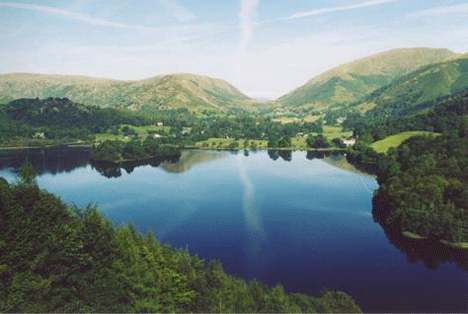 Cumbria Trust 13th July 2017, Cumbria Trust welcomes UNESCO’s decision to make the Lake District a
World Heritage Site. In doing so, UNESCO has recognised the importance of
protecting the landscape for future generations.
It is striking that a global organisation based in Paris is more aware of the need to protect the
Lake District than Copeland and Allerdale Borough Councils, both of which
voted in 2013 to include the Lake District in a search for a burial site
for the UK’s vast stockpile of nuclear waste.
Copeland and Allerdalefailed in their duty to protect the Lake District as well as other special
areas such as the AONB near Silloth. Fortunately Cumbria County Council,
led by Eddie Martin, recognised the failure of the borough councils and
vetoed their decision. https://cumbriatrust.wordpress.com/2017/07/13/lake-district-a-world-heritage-site/
The international nuclear industry in financial meltdown
 Global Meltdown? Nuclear Power’s Annus Horribilis, Jim Green, New Matilda, 9 July 2017 https://newmatilda.com/2017/07/09/global-meltdown-nuclear-powers-annus-horribilis/
This year will go down with 1979 (Three Mile Island), 1986 (Chernobyl) and 2011 (Fukushima) as one of the nuclear industry’s worst ever ‒ and there’s still another six months to go, writes Dr Jim Green.
Two of the industry’s worst-ever years have been in the past decade and there will be many more bad years ahead as the trickle of closures of ageing reactors becomes a flood ‒ the International Energy Agency expects almost 200 reactor closures between 2014 and 2040. The likelihood of reactor start-ups matching closures over that time period has become vanishingly small.
In January, the World Nuclear Association anticipated 18 power reactor start-ups this year. The projection has been revised down to 14 and even that seems more than a stretch. There has only been one reactor start-up in the first half of the year according to the IAEA’s Power Reactor Information System, and two permanent reactor closures.
The number of power reactors under construction is on a downward trajectory ‒ 59 reactors are under construction as of May 2017, the first time since 2010 that the number has fallen below 60.
Pro-nuclear journalist Fred Pearce wrote on May 15: “Is the nuclear power industry in its death throes? Even some nuclear enthusiasts believe so. With the exception of China, most nations are moving away from nuclear ‒ existing power plants across the United States are being shut early; new reactor designs are falling foul of regulators, and public support remains in free fall. Now come the bankruptcies…. The industry is in crisis. It looks ever more like a 20th century industrial dinosaur, unloved by investors, the public, and policymakers alike. The crisis could prove terminal.”
Pro-nuclear lobby groups are warning about nuclear power’s “rapidly accelerating crisis“, a “crisis that threatens the death of nuclear energy in the West“, and noting that “the industry is on life support in the United States and other developed economies“.
United States
The most dramatic story this year has been the bankruptcy protection filing of US nuclear giant Westinghouse onMarch 29. Westinghouse’s parent company Toshiba states that there is “substantial doubt” about Toshiba’s “ability to continue as a going concern”. These nuclear industry giants have been brought to their knees by cost overruns ‒estimated at US$13 billion ‒ building four AP1000 power reactors in the U.S.
The nuclear debate in the US is firmly centred on attempts to extend the lifespan of ageing, uneconomic reactors with state bailouts. Financial bailouts by state governments in New York and Illinois are propping up ageing reactors, but a proposed bailout in Ohio is meeting stiff opposition. The fate of Westinghouse and its partially-built AP1000 reactors are much discussed, but there is no further discussion about new reactors ‒ other than to note that they won’t happen.
Six reactors have been shut down over the past five years in the US, and another handful will likely close in the next five years. How far and fast will nuclear fall? Exelon ‒ the leading nuclear power plant operator in the US ‒ claims that “economic and policy challenges threaten to close about half of America’s reactors” in the next two decades. According to pro-nuclear lobby group ‘Environmental Progress‘, almost one-quarter of US reactors are at high risk of closure by 2030, and almost three-quarters are at medium to high risk. In May, the US Energy Information Administration released an analysis projecting nuclear’s share of the nation’s electricity generating capacity will drop from 20 per cent to 11 per cent by 2050.
There are different views about how far and fast nuclear will fall in the US ‒ but fall it will. And there is no dispute that many plants are losing money. More than half in fact, racking up losses totalling about US$2.9 billion a year according to a recent analysis by Bloomberg New Energy Finance. And a separate Bloomberg report found that expanding state aid to money-losing reactors across the eastern US may leave consumers on the hook for as much as US$3.9 billion a year in higher power bills.
Japan
Fukushima clean-up and compensation cost estimates have doubled and doubled again and now stand at US$191 billion. An analysis by the Japan Institute for Economic Research estimates that the total costs for decommissioning, decontamination and compensation could be far higher at US$443‒620 billion.
Only five reactors are operating in Japan as of July 2017, compared to 54 before the March 2011 Fukushima disaster. The prospects for new reactors are bleak. Japan has given up on its Monju fast breeder reactor ‒ successive governments wasted US$10.6 billion on Monju and decommissioning will cost another US$2.7 billion.
As mentioned, Toshiba is facing an existential crisis due to the crippling debts of its subsidiary Westinghouse. Toshibaannounced on May 15 that it expects to report a consolidated net loss of US$8.4 billion for the 2016‒2017 financial year which ended March 31.
Hitachi is backing away from its plan to build two Advanced Boiling Water Reactors in Wylfa, Wales. Hitachi recentlysaid that if it cannot attract partners to invest in the project before construction is due to start in 2019, the project will be suspended.
Hitachi recently booked a massive loss on a failed investment in laser uranium enrichment technology in the US. A 12 May 2017 statement said the company had posted an impairment loss on affiliated companies’ common stock of US$1.66 billion for the fiscal year ended 31 March 2017, and “the major factor” was Hitachi’s exit from the laser enrichment project. Last year a commentator opined that “the way to make a small fortune in the uranium enrichment business in the US is to start with a large one.”
France
The French nuclear industry is in its “worst situation ever” according to former EDF director Gérard Magnin. France has 58 operable reactors and just one under construction.
French EPR reactors under construction in France and Finland are three times over budget ‒ the combined cost overruns for the two reactors amount to about US$14.5 billion.
Bloomberg noted in April 2015 that Areva’s EPR export ambitions are “in tatters“. Now Areva itself is in tatters and is in the process of a government-led restructure and another taxpayer-funded bailout. On March 1, Areva posted a €665 million net loss for 2016. Losses in the preceding five years exceeded €10 billion.
In February, EDF released its financial figures for 2016: earnings and income fell and EDF’s debt remained steady at €37.4 billion. EDF plans to sell €10 billion of assets by 2020 to rein in its debt, and to sack up to 7,000 staff. The French government provided EDF with €3 billion in extra capital in 2016 and will contribute €3 billion towards a €4 billioncapital raising this year. On March 8, shares in EDF hit an all-time low a day after the €4 billion capital raising was launched; the share price fell to €7.78, less than one-tenth of the high a decade ago.
Costs of between €50 billion and €100 billion will need to be spent by 2030 to meet new safety requirements for reactors in France and to extend their operating lives beyond 40 years.
EDF has set aside €23 billion to cover reactor decommissioning and waste management costs in France ‒ just over half of the €54 billion that EDF estimates will be required. A recent report by the French National Assembly’s Commission for Sustainable Development and Regional Development concluded that there is “obvious under-provisioning” and that decommissioning and waste management will take longer, be more challenging and cost much more than EDF anticipates.
In 2015, concerns about the integrity of some EPR pressure vessels were revealed, prompting investigations that are still ongoing. Last year, the scandal was magnified when the French Nuclear Safety Authority (ASN) announced that Areva had informed it of “irregularities in components produced at its Creusot Forge plant.” The problems concern documents attesting to the quality of parts manufactured at the site. At least 400 of the 10,000 quality documents reviewed by Areva contained anomalies. Work at the Creusot Forge foundry was suspended in the wake of the scandal and Areva is awaiting ASN approval to restart the foundry.
French environment and energy minister Nicolas Hulot said on June 12 that the government plans to close some nuclear reactors to reduce nuclear’s share of the country’s power mix. “We are going to close some nuclear reactors and it won’t be just a symbolic move,” he said.
India
Nuclear power accounts for just 3.4 percent of electricity supply in India and that figure will not rise significantly, if at all. In May, India’s Cabinet approved a plan to build 10 indigenous pressurized heavy water reactors (PHWR). That decision can be read as an acknowledgement that plans for six Westinghouse AP1000 reactors and six French EPR reactors are unlikely to eventuate.
The plan for 10 new PHWRs faces major challenges. Suvrat Raju and M.V. Ramana noted: “[N]uclear power will continue to be an expensive and relatively minor source of electricity for the foreseeable future…. The announcement about building 10 PHWRs fits a pattern, often seen with the current government, where it trumpets a routine decision to bolster its “bold” credentials. Most of the plants that were recently approved have been in the pipeline for years. Nevertheless, there is good reason to be sceptical of these plans given that similar plans to build large numbers of reactors have failed to meet their targets, often falling far short.”
South Africa
An extraordinary High Court judgement on April 26 ruled that much of South Africa’s nuclear new-build program is without legal foundation. The High Court set aside the Ministerial determination that South Africa required 9.6 gigawatts (GW) of new nuclear capacity, and found that numerous bilateral nuclear cooperation agreements were unconstitutional and unlawful. President Jacob Zuma is trying to revive the nuclear program, but it will most likely be shelved when Zuma leaves office in 2019 (if he isn’t removed earlier). Energy Minister Mmamoloko Kubayi said on June 21 that South Africa will review its nuclear plans as part of its response to economic recession.
South Korea
South Korea’s new President Moon Jae-in said on June 19 that his government will halt plans to build new nuclear power plants and will not extend the lifespan of existing plants beyond 40 years. President Moon said: “We will completely re-examine the existing policies on nuclear power. We will scrap the nuclear-centred polices and move toward a nuclear-free era. We will eliminate all plans to build new nuclear plants.”
Since the presidential election on May 9, the ageing Kori-1 reactor has been permanently shut down, work on two partially-built reactors (Shin Kori 5 and 6) has been suspended pending a review, and work on two planned reactors (Shin-Hanul 3 and 4) has been stopped.
Taiwan
Taiwan’s Cabinet reiterated on June 12 the government’s resolve to phase out nuclear power. The government remains committed to the goal of decommissioning the three operational nuclear power plants as scheduled and making Taiwan nuclear-free by 2025, Cabinet spokesperson Hsu Kuo-yung said.
UK
Tim Yeo, a former Conservative politician and now a nuclear industry lobbyist with New Nuclear Watch Europe, saidthe compounding problems facing nuclear developers in the UK “add up to something of a crisis for the UK’s nuclear new-build programme.”
The lobby group noted delays with the EPR reactor in Flamanville, France and the possibility that those delays would flow on to the two planned EPR reactors at Hinkley Point; the lack of investors for the proposed Advanced Boiling Water Reactors at Wylfa; the acknowledgement by the NuGen consortium that the plan for three AP1000 reactors at Moorside faces a “significant funding gap”; and the fact that the Hualong One technology which China General Nuclear Power Corporation hopes to deploy at Bradwell in Essex has yet to undergo its generic design assessment.
The only reactor project with any momentum in the UK is Hinkley Point, based on the French EPR reactor design. The head of one of Britain’s top utilities said on June 19 that Hinkley Point is likely to be the only nuclear project to go ahead in the UK. Alistair Phillips-Davies, chief executive officer of SSE, an energy supplier and former investor in new nuclear plants, said: “The bottom line in nuclear is that it looks like only Hinkley Point will get built and Flamanville needs to go well for that to happen.”
There is growing pressure for the obscenely expensive Hinkley Point project to be cancelled. The UK National Audit Office report released a damning report on June 23. The Audit Office said: “The Department for Business, Energy and Industrial Strategy’s deal for Hinkley Point C has locked consumers into a risky and expensive project with uncertain strategic and economic benefits… Today’s report finds that the Department has not sufficiently considered the costs and risks of its deal for consumers…. Delays have pushed back the nuclear power plant’s construction, and the expected cost of top-up payments under the Hinkley Point C’s contract for difference has increased from £6 billion to £30 billion.”
Writing in the Financial Times on May 26, Neil Collins said: “EDF, of course, is the contractor for that white elephant in the nuclear room, Hinkley Point. If this unproven design ever gets built and produces electricity, the UK consumer will be obliged to pay over twice the current market price for the output…. The UK’s energy market is in an unholy mess… Scrapping Hinkley Point would not solve all of [the problems], but it would be a start.”
And on it goes. Hinkley Point is one of the “great spending dinosaurs of the political dark ages” according to The Guardian. It is a “white elephant” according to an editorial in The Times.
EDF said on June 26 that it is conducting a “full review of the costs and schedule of the Hinkley Point C project” and the results will be disclosed “soon”. On July 3, EDF announced that the estimated cost of the two Hinkley reactors has risen by €2.5 billion (to €23.2 billion, or €30.4 billion including finance costs). In 2007, EDF was boasting that Britons would be using electricity from Hinkley to cook their Christmas turkeys in December 2017. But in its latestannouncement, EDF pushes back the 2025 start-up dates for the two Hinkley reactors by 9‒15 months.
Oliver Tickell and Ian Fairlie wrote an obituary for Britain’s nuclear renaissance in The Ecologist on May 18. Theyconcluded: “[T]he prospects for new nuclear power in the UK have never been gloomier. The only way new nuclear power stations will ever be built in the UK is with massive political and financial commitment from government. That commitment is clearly absent. So yes, this finally looks like the end of the UK’s ‘nuclear renaissance’.”
Switzerland
Voters in Switzerland supported a May 21 referendum on a package of energy policy measures including a ban on new nuclear power reactors. Thus Switzerland has opted for a gradual nuclear phase out and all reactors will probably be closed by the early 2030s, if not earlier.
Germany will close its last reactor much sooner than Switzerland, in 2022.
Sweden
Unit 1 of the Oskarshamn nuclear power plant in Sweden has been permanently shut down. Unit 2 at the same plant was permanently shut down in 2015. Ringhals 1 and 2 are expected to be shut down in 2019‒2020, after which Sweden will have just six operating power reactors. Switzerland, Germany and Taiwan have made deliberate decisions to phase out nuclear power; in Sweden, the phase out will be attritional.
Russia
Rosatom deputy general director Vyacheslav Pershukov said in mid-June that the world market for the construction of new nuclear power plants is shrinking, and the possibilities for building new large reactors abroad are almost exhausted. He said Rosatom expects to be able to find customers for new reactors until 2020‒2025 but “it will be hard to continue.”
China
With 36 power reactors and another 22 under construction, China is the only country with a significant nuclear expansion program. However nuclear growth could take a big hit in the event of economic downturn. And nuclear growth could be derailed by a serious accident, which is all the more likely because of China’s inadequate nuclear safety standards, inadequate regulation, lack of transparency, repression of whistleblowers, world’s worst insurance and liability arrangements, security risks, and widespread corruption.
Dr Jim Green is the national nuclear campaigner with Friends of the Earth, Australia, and editor of the World Information Service on Energy’s Nuclear Monitor newsletter.
Brexit likely to devastate UK nuclear power industry
Brexit will cause an ‘alarming mess’ for UK nuclear power, scientists warn, Independent, 9 Jul 17
Ben Kentish “….Scientists say leaving the Euratom agency that oversees nuclear safety in Europe will cause widespread confusion and have a potentially devastating impact on the industry in Britain.
Possible consequences include a reduction in foreign investment in UK nuclear power facilities, the loss of thousands of jobs and Britain losing its place as a world leader in new nuclear technologies.
Professor Roger Cashmore, chair of the UK Atomic Energy Agency, told Buzzfeed News the current situation was “alarming” and “a mess”.
Although the treaties relating to Euratom are separate to those keeping Britain in the EU, the agency requires members to be under the jurisdiction of the European Court of Justice (ECJ), which Theresa May has insisted the UK must withdraw from as part of Brexit.
It is unclear how the UK will replace the procedures and regulations currently managed by Euratom. These cover the transportation of nuclear materials around Europe. Britain is a major producer of enriched uranium, which is used in nuclear fuel, and exports much of the material to other EU countries. The UK Government also owns a third of Urenco, the European uranium-enrichment company.
Unless new treaties relating to the transportation of nuclear materials between Britain and the EU are agreed quickly, the UK could run out of nuclear fuel within two years, meaning nuclear power stations would be unable to produce energy…….http://www.independent.co.uk/news/uk/home-news/brexit-nuclear-power-euratom-hinckley-point-risks-nuclear-fusion-energy-bills-a7832136.html
International Nuclear Free Future Award (NFFA) goes to Cumbrian group monitoring Sellafield
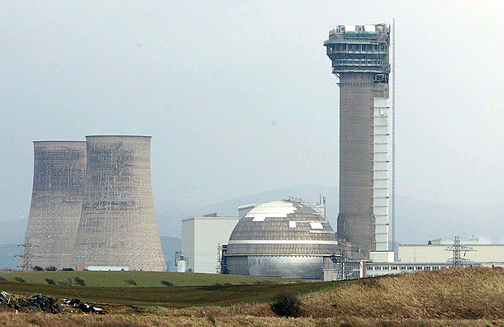 CORE 7th July 2017 CORE’s Janine Allis-Smith and Martin Forwood who have campaigned on Sellafield commercial operations since the 1980’s have been notified that they have won the international Nuclear Free Future Award (NFFA) for 2017
under the Education category.
Cited for their three decades of work ‘unmasking ‘ and disseminating information on operations at the West
Cumbrian site to a world-wide audience – and with CORE described as ‘an indispensable pillar of the British anti-nuclear movement’ – the award which carries a cash endowment of $10,000 will be made in Basel, Switzerland in September.
Commenting on the unexpected award the campaigners said today: ‘We are honoured to have received NFFA’s Education Award for 2017 and humbled to be joining the list of diverse and distinguished winners of the past. Since the 1980’s when Sellafield was preparing to double its commercial reprocessing activities, we have focused not only on acting locally but also being the ‘eyes and ears’ for the many interested parties world-wide on Sellafield and its many detrimentswhich include site accidents, environmental contamination, health risks, plutonium stockpiles and nuclear transports.
http://corecumbria.co.uk/news/anti-nuclear-campaigners-from-local-group-core-win-international-award/
British govt did not notify the German public of the potential environmental impacts of Hinkley Point C
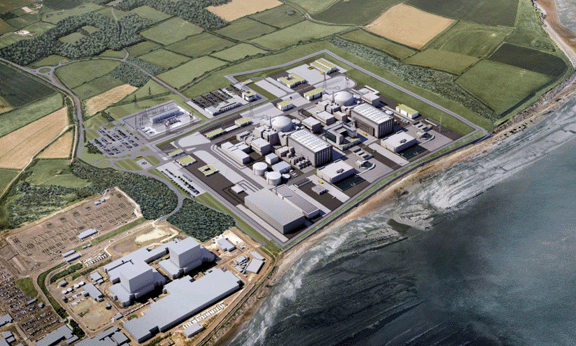 Hinkley Point C: UK censured for failing to consult German public British government failed to abide by Aarhus convention that says major projects must consult citizens on environmental impacts, Guardian, Adam Vaughan, 7 July 17, The UK has been censured by an international committee for its failure to notify the German public of the potential environmental impacts of Hinkley Point C, the new nuclear power station being built in Somerset, south-west England.
In a political embarrassment for the government, the verdict found that the UK had not complied with the Aarhus convention, an international agreement on involving citizens in environmental matters.
The Aarhus committee’s finding followed a complaint by a German Green party politician, who said the UK should now halt work on the project to properly consult with the public in neighbouring countries.
Sylvia Kotting-Uhl told the Guardian: “If the government does not want to ridicule the trans-boundary participation procedure that is now due, construction works should be suspended until the procedure is completed.”
While the ruling is very unlikely to affect the project, which began construction last year, the breach comes on top of a fortnight of bad news for the two atomic reactors.
EDF, the French state-owned developer of Hinkley Point C, admitted this week that costs were likely to rise by £1.5bn and there was a risk of a 15-month delay, just days after the public spending watchdog called the project “risky and expensive”.
Kotting-Uhl originally complained to Aarhus’s compliance committee in the summer of 2013, before the UK had agreed commercial terms with EDF.
She said the UK government had discriminated against Germans by not giving them opportunities to take part in the environmental impact assessment procedure for Hinkley, as the Aarhus convention requires. The committee agreed.
In conclusions published recently, the committee said: “By not ensuring that the public concerned in Germany had a reasonable chance to learn about the proposed activity and the opportunities for the public to participate in the respective decision-making, the party concerned failed to comply with article 6, paragraph 2, of the convention.”
Named after the Danish city of Århus, the convention covers the involvement of the public on environmental matters relating to developments such as power stations or new roads – including access to information, the public’s participation in decision-making, and access to justice. The UK ratified the agreement in 2005.
The former UN secretary general Kofi Annan called it “the most ambitious venture in the area of environmental democracy so far undertaken under the auspices of the United Nations”……https://www.theguardian.com/business/2017/jul/06/hinkley-point-c-uk-censured-german-public-edf
Aldi UK’s big move into solar energy headed to have prevented over 8,100 tonnes of CO2
Solar Power Portal 4th July 2017, Aldi UK has marked the fourth Solar Independence Day with the announcement
that it will install a further 11,000 solar panels across more than 50 of
its stores by the end of the year.
The supermarket has already installed
more than 85,000 solar panels on all nine of its regional distribution
centres and more than 275 stores across the UK, generating over 17,500 MWh
of electricity a year.
This deployment will now be extended by the end of
the year, bringing its total store investment in solar to almost £17
million and saving more than 8,100 tonnes of CO2 in the process. https://www.solarpowerportal.co.uk/news/aldi_uk_marks_solar_independence_day_with_new_solar_rollout_pledge
Britain’s great white elephant, Hinkley C nuclear power plant , can still be stopped
 The Hinkley C nuclear power plant will be a costly mistake – we can still stop it Spiralling bills and delays show why we should abandon this white elephant. http://www.newstatesman.com/politics/energy/2017/07/hinkley-c-nuclear-power-plant-will-be-costly-mistake-we-can-still-stop-it
4 Jul 17 With every day that passes, the proposed new Hinkley Point power station looks less flagship and more shipwreck. But we don’t have to go down with this one.
Yesterday’s announcement that the cost of building the new nuclear plant has risen again, this time by a staggering £1.5bn, came just ten days after the National Audit Office confirmed what campaigners have been saying for years – that the deal is overpriced and risky.
According to a 2015 report from the Nuclear Energy Agency (NEA), Hinkley would make new nuclear power in the UK the world’s most costly. In fact the power station would, according to Greenpeace, be the most expensive object in history.
With the cost of renewable energy now falling faster than anyone anticipated, it’s hard to imagine a more expensive way of producing power, or indeed a common sense reason for continuing with such a folly.
In 2007, EDF chief executive Vincent de Rivaz said Hinkley C could be providing the power to cook Christmas turkeys by 2017. That slipped to 2025. Now we are told it could be another 15 months more – and this with a reactor design which has yet to be shown to work anywhere else in the world. The project threatens to sink into a whirlpool of expensive defensiveness and self-justification, all for a terrible deal which we will all be locked into, and paying for, for years to come.
But it doesn’t have to be like this. Over the past month, Theresa May’s administration has crumbled. Propped up by the Democratic Unionist Party, unable to implement its manifesto promises and derided in Europe, the disastrous election has left this government on its knees. But this moment of weakness creates an opportunity – we have the real chance to stop Hinkley in its tracks and think again.
The government appears committed, come what may, but if politicians from across political divides speak up against this expensive white elephant, we can force May to take the courageous decision needed to cancel the project.
It’s well known that politicians share a penchant for big projects like Hinkley – Heathrow expansion and HS2 to name but two – but even in this case it’s hard to see what is actually keeping the idea afloat.
Although the plans may be fatally holed, it is the lack of any real opposition holding the government to account that is stopping it going under completely. Labour and the Lib Dems both support the project. But it’s time to break away from the old school consensus around the often illusory benefits of building big new things. An opposition working together, along with a few sympathetic Tories, could consign Hinkley to the dustbin of history.
We know that alternative plans are available. There are many, much cheaper options. Germany, which is phasing out nuclear, is breaking renewable records and we can, too. You can’t have your cake and eat it when it comes to environment policy, any more than you can have your cake and eat it on Brexit. We need to make the right choices and ploughing such colossal subsidies into Hinkley sucks resources from where they are really needed: investment in renewables.
The New Economics Foundation has suggested we could provide more than six times our annual electricity needs through a Blue New Deal, getting renewable offshore energy through wind and wave while rejuvenating our coastal communities with 160,000 new jobs. Green MEP Molly Scott Cato has shown how the South West alone could meet all its energy needs through renewables, creating more than 100,000 new jobs. This puts the 900 full-time posts expected to be available at Hinkley, if construction is ever completed, into sharp perspective.
But to transition to this jobs-rich, decentralised, renewable energy economy, we need to make the right political choices now. In the case of Hinkley that means politicians holding the government to account when it is wasting taxpayers’ money on a project that is not fit for purpose – and simply won’t deliver what we need for the future. Jonathan Bartley is co-leader of the Green party. He was formerly the co-director of the thinktank Ekklesia.
Ever more dangerous – the transport of plutonium by sea
 CORE 2nd July 2017, The Pacific Heron and sister shipPacific Egret, armed with naval canon and
carrying security ‘swat- squads’ sailed unladen from their home port of Barrow-in-Furness early this morning en-route to Cherbourg where MOX (mixed oxide) plutonium fuel assemblies will be loaded for onward delivery to Japan.
The 16 fuel assemblies, fabricated in French company Areva’s MeloxPlant and containing some 500kg of nuclear weapons useable plutonium aredestined for Kansai Electric’s Takahama 4 reactor in the south west of Japan. Preparation for the two-month voyage have been evident over the last few days at Barrow’s Ramsden Dock nuclear terminal with the loading of stores, the arrival of the security swat-squads provided by the Civil Nuclear Constabulary’s Strategic Escort Group (aka Sea-Plods), the
loading of ammunition and the sweeping of the ships’ hulls by divers.
Commenting on the preparations, CORE’s spokesman Martin Forwood said today that the need for this level of armed security brings home the reality of the very real and significant dangers of transporting plutonium – in this case enough for around one hundred nuclear weapons – and demolishes the industry’s complacent and short-sighted claim that such shipments pose no risks.
“At a time of heightened and increasingly sophisticated action by terrorists we re-iterate our condemnation of the trans-world shipment of such dangerous material by sea. This voyage not
only foists needless risks on the marine environment and communities along the route, but also raises additional and significant concerns in Japan on the use of MOX fuel in the Takahama reactor (as also used in the fated Fukushima reactors) which has only just re-started after the overturning of a court injunction by local activists which kept the reactor off-line for inadequate safety standards”
http://corecumbria.co.uk/news/nuclear-gunships-sail-from-barrow-on-plutonium-voyage-to-japan/
1 This Month





PLEASE OPPOSE HR 8255 AND S.3639 – bills would accelerate satellite deployment, with no environmental review or safeguards – https://ncstd5li.quorum.us/campaign/169331/
To see nuclear-related stories in greater depth and intensity – go to https://nuclearinformation.wordpress.com
-
Archives
- October 2026 (29)
- September 2026 (339)
- August 2026 (330)
- July 2026 (355)
- June 2026 (287)
- May 2026 (306)
- April 2026 (356)
- March 2026 (251)
- February 2026 (267)
- January 2026 (308)
- December 2025 (358)
- November 2025 (359)
-
Categories
- 1
- 1 NUCLEAR ISSUES
- business and costs
- climate change
- culture and arts
- ENERGY
- environment
- health
- history
- indigenous issues
- Legal
- marketing of nuclear
- media
- opposition to nuclear
- PERSONAL STORIES
- politics
- politics international
- Religion and ethics
- safety
- secrets,lies and civil liberties
- spinbuster
- technology
- Uranium
- wastes
- weapons and war
- Women
- 2 WORLD
- ACTION
- AFRICA
- Atrocities
- AUSTRALIA
- Christina's notes
- Christina's themes
- culture and arts
- Events
- Fuk 2022
- Fuk 2023
- Fukushima 2017
- Fukushima 2018
- fukushima 2019
- Fukushima 2020
- Fukushima 2021
- general
- global warming
- Humour (God we need it)
- Nuclear
- RARE EARTHS
- Reference
- resources – print
- Resources -audiovicual
- Weekly Newsletter
- World
- World Nuclear
- YouTube
-
RSS
Entries RSS
Comments RSS

