UK threatens to return radioactive waste to EU without nuclear deal
 Brexit department warns EU counterparts it will ‘return waste to
  its country of origin’ if an agreement on nuclear cooperation cannot be reached, Guardian, Daniel Boffey 20 July 17, Britain has warned the EU that it could return boatloads of radioactive waste back to the continent if the Brexit talks fail to deliver an agreement on nuclear regulation.
In what is being taken in Brussels as a thinly veiled threat, a paper setting out the UK position for the negotiations stresses the right “to return radioactive waste … to its country of origin” should negotiations collapse.
The UK paper, detailing the British government’s hopes for future cooperation once it leaves the Euratom treaty, at the same time as leaving the EU, further stresses the “strong mutual interest in ensuring close cooperation in the future”.
Britain currently has a 126-tonne stockpile of radioactive materials originating from EU countries such as Germany, Italy and Sweden.
The state-owned Sellafield plant in Cumbria has been reprocessing spent nuclear field from across Europe since the 1970s, producing reusable uranium, plutonium and radioactive waste. Almost a fifth of the UK’s stockpile of civilian plutonium at Sellafield originates from overseas…….
Britain has signalled that while it is leaving the Euraotom treaty, of which it has been a member since 1957, it wants to continue to cooperate on nuclear regulation after the UK leaves the union in March 2019. The treaty regulates the civilian use of atomic technology and critics of the government’s position fear there is a threat of disruption to UK supplies of nuclear reactor parts, fuel and medical isotopes vital for the treatment of cancer if a new agreement outside membership of the EU is not reached……
The EU insist, however, that such cooperation on nuclear regulation would require the UK to recognise the jurisdiction of the European court of justice, which is a red line for Theresa May…….https://www.theguardian.com/environment/2017/jul/19/uk-threatens-to-return-radioactive-waste-to-eu-without-nuclear-deal
Inconvenient financial facts about Britain’s Hinkley Point C nuclear station – cost to cosumers rising to £50 billion?
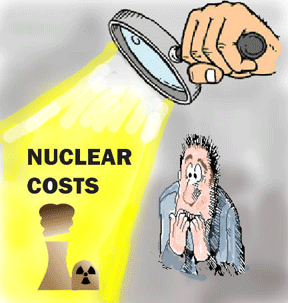
 Times 19th July 2017, The storm surrounding the construction of the Hinkley Point C nuclear plant was set to break out anew today after it emerged last night that the cost to consumers could mushroom to £50 billion.
The new official estimate is more than eight times higher than the £6 billion that the National Audit
Office estimated the plant would cost consumers when ministers first struck a subsidy deal to support it in 2013. The spark that ignited the explosion in the estimate is a decline in electricity prices, which in turn have hugely inflated the subsidies that the project is expected to require.
Under the terms of the deal, which was confirmed, after some delay, last autumn by Theresa May, the nuclear developers EDF, of France, and CGN, of China, will foot the up-front construction cost in return for a guaranteed price of £92.50 for every megawatt- hour of power that the plant generates for 35 years.
If wholesale prices are below that level, the difference will be subsidised by consumers through levies on their energy bills. Wholesale prices and projections of future prices have both fallen significantly
since 2013 as the cost of fossil fuels used in conventional power generation has plunged. This has increased the estimates of the subsidy payments that will be required for Hinkley Point, making the project appear increasingly poor value. Government figures show that, as of September last year, the lifetime costs of Hinkley Point C were estimated at £49.9 billion. That compares with an estimate of £36.9 billion in 2015 and £14.5 billion in 2014. https://www.thetimes.co.uk/edition/business/hinkley-point-cost-could-soar-to-50bn-6brnph9q7
Hackers attacked Britain’s energy networks

 Times 15th July 2017, Hackers backed by the Russian government have attacked energy networks
running the national grid in parts of the UK, The Times has learnt. The
hackers, who targeted the Republic of Ireland’s energy sector, intended
to infiltrate control systems, security analysts believe.
This would also have given them the power to knock out parts of the grid in Northern
Ireland. Senior engineers at Ireland’s Electricity Supply Board (ESB)
were targeted last month by a group understood to have ties to the
Kremlin’s GRU intelligence agency.
The hackers sent emails designed to trick staff by drawing on extensive surveillance of ESB practices and
contained malicious software. There is no evidence of disruption to the
network, but security analysts monitoring Russia’s cyberintelligence
groups said that the hackers probably stole information including
passwords. Ireland’s National Cyber Security Centre confirmed that it was
working on the matter. https://www.thetimes.co.uk/article/russia-backed-hackers-try-to-hijack-britain-s-power-supply-55bj9790r
If Britain’s Hinkley nuclear project is cancelled, Britain would have to pay around £22bn to EDF
 Express 18th July 2017, The Government admitted an agreement made in September last year over theHinkley Point C nuclear power station means operators EDF can claim
compensation if there is a change in British, EU or international law,
policy or guidance, which forces the £24bn project to close early.
Richard Harrington, the energy and industry minister, confirmed the payments could
be “up to around £22bn” in a written answer to Labour’s Dr Alan
Whitehead at the beginning of July. Mr Harrington said: “We remain firmly
committed to bringing forward the UK’s first new nuclear power plants in
a generation. http://www.express.co.uk/news/uk/830098/Brexit-EDF-Hinkley-Point-C-compensation-nuclear-power-Euratom-Treaty
Prominent Tory and Labour MPs agree on one thing – need for a “plan B”, if Hinkley nuclear plan collapses
Scottish Energy News 19th July 2017, Former arch-rival Scottish Tory and Labour MPs have attack delays to the UK
government’s plan to commission the new Hinkley Point C nuclear power plant. Michael (now Lord) Forsyth criticised the plans for the £18 billion project in an Economic Affairs debate in the House of Lords on the UK energy market, warning the delayed project was a “severe risk” to security of supply.
Former Tory MP Forsyth said the report amounted to a
“big red warning light” for ministers, and former Labour MP Alistair
(now Lord) Darling said he agreed with almost everything the former
minister had said.
Darling said there was a big question mark over the
future of nuclear power and challenged ministers to set out a “plan B”
should Hinkley C not go ahead. Energy security was the “number one
priority” but the public had been “short-changed” by the Hinkley C
project, which was 10 years late and facing rapidly rising costs.
http://www.scottishenergynews.com/
UK Parliament select committee to inquire into government’s plans to leave Euratom
Utility Week 1`7th July 2017, The newly elected chair of parliament’s business select committee has
pledged to make an inquiry into the government’s plans to leave Euratom
one of her top priorities. Rachel Reeves, who was voted chair of the
business, energy and industrial strategy select committee last week, said
in a BBC radio interview that she wanted to hold a probe into Britain’s
departure from the pan-European nuclear energy community.
Reeves, who is a former shadow chief secretary to the Treasury, described the nuclear sector
as “hugely important” to the UK economy. She said: “We need to do an
inquiry into Euratom because 65,000 jobs are in the civil nuclear sector.
“When we are up and running, I want to do an inquiry into this because so
many jobs and research depends on it.”
She made her comments as the European Commission published its position paper on negotiations into the
UK’s withdrawal from Euratom, which kicked off today (Monday). In its
position paper, the commission states that the Euratom treaty will cease to
apply to Britain from the date when the UK withdraws from the EU.
http://utilityweek.co.uk/news/BEIS-committee-to-scrutinise-Euratom-exit/1307532
Geoffrey Robertson puts the legal and moral case for phasing out Britain’s Trident nuclear deterrent
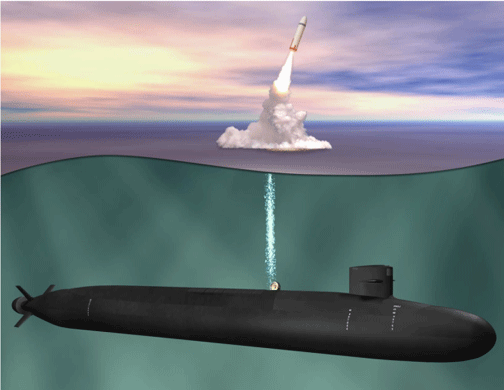 Using Trident would be illegal, so let’s phase it out https://www.theguardian.com/commentisfree/2016/jul/15/trident-illegal-nuclear-britain-arsenal?CMP=share_btn_fb, Geoffrey Robertson Nuclear doom is nearer than most of us believe, experts warn. Britain must set a moral lead by becoming the first of the ‘big five’ powers to reduce its arsenal. The most portentous decision for every new prime minister is what to write in the secret “letter of last resort” to Trident submarine commanders telling them what to do with their nuclear missiles if the British government is wiped out. In Monday’s debate on the renewal of Trident, Theresa May should tell parliament what life-or-death decision she has made in her letters of last resort.
It is said that Margaret Thatcher ordered our nukes, trained on Moscow, to be fired so as to cause maximum destruction to the enemy – ie to its civilians. That order, even for a nuclear “second strike”, would today be illegal.
It is ironic that although Chilcot produced so much condemnation of Blair for joining an unlawful war, MPs are now being asked to vote for a weapons system that cannot be used without committing a crime against humanity. This was defined in 1998 by the Rome Statute, which set up the international criminal court, as “a systematic attack directed against a civilian population, resulting in extermination or torture, or an inhumane act intentionally causing great suffering”.
The same statute additionally makes it a war crime to intentionally launch an attack in the knowledge that it would cause incidental loss of civilian life or severe damage to the natural environment, out of proportion to military advantage.
Trident’s 200 thermonuclear bombs, each 10 times more powerful than those that struck Hiroshima and Nagasaki, are illegal because they cannot discriminate between military targets and hospitals, churches and schools; because of their capacity to cause untold human suffering for generations to come; and because their consequences (eg ionising radiation, which tortures victims and lingers for half a century) are beyond the control or knowledge of the attacker, who cannot judge the proportionality of their use.
As the international court of justice put it, back in 1996: “The destructive power of nuclear weapons cannot be contained in space or time. They have the potential to destroy all civilisation and the entire ecosystem of the planet.”
So why is our law-abiding government spending tens of billions on a weapons system that cannot lawfully be used?
First, because its advisers wrongly think that nuclear weapons are legal in certain circumstances. Back in that 1996 case, the UK argued that it could lawfully drop “a low-yield nuclear weapon against warships on the high seas or troops in sparsely populated areas”.
This scenario has now been shown up as fantastical: “first use” in these circumstances by the UK would trigger a nuclear reprisal with inevitable damage to the atmosphere, the oceans and the “sparsely populated” area (which would henceforth be entirely unpopulated). In any event, Trident’s weapon-bays will not carry “low-yield” bombs, and if they did the result would be better achieved by conventional weapons, making nuclear deployment unnecessary and disproportionate.
The world court ruled that the threat or use of nuclear weapons would “generally” be contrary to war law but might be lawful “in extreme circumstances of self-defence, in which the very survival of a state would be at stake”. This was a time-warped view of war law in 1996 that is not tenable today. The court, to be fair, predicted as much, saying that it expected international law to “develop” towards a total ban on the use of the bomb. It soon did, with the Rome Statute and subsequent development of the principle that a state has no right to preserve itself at the expense of damage to other states and to the rights to life of millions of citizens.
It is absurd to suggest that it would have been lawful for Hitler, his back to the bunker wall, to start a nuclear Götterdämmerung to save the Nazi state (Nuremberg decided it was not lawful for him even to fire doodlebugs). Given what we now know about the uncontrollable and devastating propensities of modern nuclear weapons, it is unlawful to fire them at all.
There is a further legal reason for allowing Trident to wear out. It is Article VI of the nuclear proliferation treaty (NPT), by which parties undertake to proceed in good faith to “general and complete” nuclear disarmament.
The world court’s 1996 ruling decided that this imposed not a “mere” obligation but a binding legal obligation on existing nuclear states to reduce the number of their bombs gradually, to zero. It is contrary to the spirit of article VI to upgrade rather than downgrade the fleet.
A decision to phase out Trident would help Britain recover some of the clout it has lost through Brexit. It would show moral leadership, and shame other nuclear powers that have failed to live up to their NPT obligations (especially the US; President Obama’s Nobel prize was prematurely awarded in part for envisaging “a world without nuclear weapons”).
Moral leadership from a nuclear-weapons state is urgently needed. The latest US defence budget allocates $1tn for future modernisation of its nukes and it has acquired new sites for them, in Poland and Romania. President Putin has promised in return a new generation of nuclear-tipped intercontinental ballistic missiles. The American most knowledgeable on the subject – Bill Clinton’s defence secretary William J Perry – has just published a book warning that “nuclear doom” is closer today than it ever was during the cold war.
Although possession of nuclear weapons is not per se unlawful, the UK is under a duty to reduce its arsenal: the vice of refurbishing Trident is that it encourages other states to do the same, and remains a constant stimulus for countries – particularly in the Middle East and Asia – to acquire arsenals of their own.
When negotiating to buy Polaris (Trident’s predecessor), back in 1962, Harold Macmillan confided in his diary that “the whole thing is ridiculous”, but consoled himself with the thought that “countries which have played a great role in history must retain their dignity”.
A half-century later, the best way for Britain to regain its dignity post-Brexit is not to throw vast sums of money away on a weapon that cannot lawfully be used, but rather to appear as the first of the “big five” powers to shoulder its legal obligation to disarm under article VI of the NPT. It will be many years before the mushroom cloud becomes a hallucination, but at least Britain would be able to boast that it had led the way.
Britain’s nuclear lobby getting very worried about Brexit
Brexit threatens Britain’s place at the nuclear top table, The UK is currently a world leader in fusion research; leaving Euratom would be calamitous, Guardian, Ian Chapman, Professor Ian Chapman is CEO of the UK Atomic Energy Authority, 16 Jul 17 “…..For decades, the UK has led the world in addressing this grand challenge. The fusion (or sticking together) of types of hydrogen to release energy requires the fuel to be heated to temperatures 10 times that of the sun. The harsh conditions required for fusion are a challenge for even the most robust of materials. International partnership has always been crucial to overcome these challenges; the complexity of the science and engineering and the cost of building large test reactors make it difficult for one nation to go it alone.
Currently, my organisation, the UK Atomic Energy Authority (UKAEA), operates the world’s largest fusion  experiment, Joint European Torus(Jet), on behalf of Europe. In so doing, we have acquired unique capabilities in critical areas for fusion – robotic maintenance, material testing and fuel handling to name just a few – enabling us to help UK industry to win contracts on Iter totalling more than £450m already (which could rise to more than £1bn)…..
both the operation of Jet and the UK’s participation in Iter are a result of our membership of the Euratom treaty, an agreement on European nuclear co-operation that dates back to 1957. On 29 March, the UK government declared an intention to leave Euratom at the same time as leaving the European Union.
For the UK, a pioneer of fusion research and development since the 1950s, it would be the worst possible time to take a back seat in the race to develop this transformative technology. …..https://www.theguardian.com/commentisfree/2017/jul/15/brexit-threatens-britains-place-at-nuclear-top-table-euratom
Britain will probably renew Trident nuclear missile, even though it’s useless in this time of terrorism
Trident won’t protect us from terrorism. But it will still be renewed, Guardian, Richard Norton-Taylor, 15 July 17 While the biggest future threat to Britain is posed by jihadi groups, voting to keep nuclear weapons is a matter of irrational pride,
Ministers say Putin’s Russia, and China, and North Korea, are posing a growing threat. The suggestion is that only Britain’s nuclear arsenal will deter these countries from launching a massive military attack on the UK. What conceivable interest would these countries have in doing so? If they were mad enough to do so, would Trident be a credible deterrent preventing them? Would there be any point in a retaliatory attack in the event of the Trident deterrent having failed?
Much more of a threat from these countries are massive cyber attacks. But the greatest threat to Britain’s security, and the government says it will be for a generation, is terrorism, in particular radical jihadi groups. Trident long-range inter-continental missiles with nuclear warheads are hardly a deterrent against them. The real danger is that they will get their hands on some of the nuclear material kept in less-than-safe stockpiles scattered around the world…..
Monday’s vote appears to be a foregone conclusion. Ministers, backed by the Whitehall establishment, will argue that with Trident Britain will count as much in the world as it ever did, despite Brexit. It is also a matter of British pride; Trident is worth the expense to remain a member of the nuclear club. https://www.theguardian.com/commentisfree/2016/jul/15/trident-protection-terrorism-renewed-threat
French nuclear energy giant ENGIE now buying into UK’s offshore wind energy market
Modern Power Systems 13th July 2017,Engie has entered the UK’s offshore wind energy market with a deal to buy
a 23 per cent stake in the Moray East project in Scotland. The French
energy giant has purchased the stake from EDP Renewables (EDPR) for £21
million and will participate in the development and operation of the 1.1 GW
project.
EDPR and Engie are already partnering in the development of
offshore wind energy projects in France and Portugal, including floating
offshore wind projects. The Moray East project comprises three proposed
offshore wind farms located off the Caithness coast. The projects were
granted development consent in March 2014 and are expected to participate
in the UK’s CFD tender process. http://www.modernpowersystems.com/news/newsengie-buys-into-uk-offshore-wind-5870459
Bitter ‘taste’ of potentially radioactive sludge in the Blackwater estuary.
A press release received from Magnox confirms “the former Bradwell
nuclear power station has now successfully dealt with all of its Fuel
Element Debris (FED) waste – a major source of intermediate level
radioactive waste at the Essex site.
This is an important step towards itsplanned closure, as part of the Nuclear Decommissioning Agency’s (NDA)
mission to clean up and decommission the UK’s earliest nuclear sites.”
Three years of potential damage to our estuary ecosystem has finally
finished with as much controversy now at the end as when the process
started. During those three years BANNG, Mersea Island Environmental
Alliance, Marinet, The Blackwater Guardians, FAB and others have spent a
great deal of time and gone to a great deal of trouble to try to stop FED
dissolution to protect both people and the environment.
Meetings were held with the Environment Agency (EA), who seemed uneasy as to what was
happening at Bradwell. FED dissolution was highlighted in the media and
complaints lodged both in the UK and European Parliaments. BANNG organised
a Public Meeting in West Mersea in June, 2014, at which an expert in Marine
Biology explained his concerns about the release of FED effluent into the
Blackwater and at which the large audience made clear its opposition.
BANNG believes that the real reason the treatment project has ended now is that
the original analysis of the FED was wrong. Only a third of the 200 tonnes
total waste ie 65 tonnes could actually be processed. The other two-thirds
were comprised of Low-Level Waste (LLW) and have been taken to Drigg for
disposal.
This raises the question of whether the FED was properly characterised before it was decided to use an expensive and experimentaldissolution process. Peter Bank’s (Town Councillor. Colchester Green
Party) says the process of Fed Dissolution has left a bitter ‘taste’ of
potentially radioactive sludge in the Blackwater estuary.
Mersea Island Courier 30th June 2017
Despite denunciation by U.S., UK and France, the UN nuclear ban treaty marks the beginning of the end of the nuclear age.
 U.S., UK and France Denounce Nuclear Ban Treaty, CounterPunch, In a joint press statement, issued on July 7, 2017, the day the treaty was adopted, the U.S., UK and France stated, “We do not intend to sign, ratify or ever become party to it.” Seriously? Rather than supporting the countries that came together and hammered out the treaty, the three countries argued: “This initiative clearly disregards the realities of the international security environment.” Rather than taking a leadership role in the negotiations, they protested the talks and the resulting treaty banning nuclear weapons. They chose hubris over wisdom, might over right.
They based their opposition on their belief that the treaty is “incompatible with the policy of nuclear deterrence, which has been essential to keeping the peace in Europe and North Asia for over 70 years.” Others would take issue with their conclusion, arguing that, in addition to overlooking the Korean War and other smaller wars, the peace in Europe and North Asia has been kept not because of nuclear deterrence but in spite of it.
The occasions on which nuclear deterrence has come close to failure, including during the Cuban missile crisis, are well known. The absolute belief of the U.S., UK and France in nuclear deterrence seems more theological than practical……
The three countries reiterate their commitment to the Non-Proliferation Treaty (NPT), but do not mention their own obligation under that treaty to pursue negotiations in good faith for an end to the nuclear arms race at an early date and to nuclear disarmament. ….
If the U.S., UK and France were truly interested in promoting “international peace, stability and security” as they claim, they would be seeking all available avenues to eliminate nuclear weapons from the world, rather than planning to modernize and enhance their own nuclear arsenals over the coming decades.
These three nuclear-armed countries, as well as the other six nuclear-armed countries, continue to rely upon the false idol of nuclear weapons, justified by nuclear deterrence. In doing so, they continue to run the risk of destroying civilization, or worse.
The 122 nations that adopted the nuclear ban treaty, on the other hand, acted on behalf of every citizen of the world who values the future of humanity and our planet, and should be commended for what they have accomplished.
The new treaty will open for signatures in September 2017, and will enter into force when 50 countries have acceded to it. It provides an alternative vision for the human future, one in which nuclear weapons are seen for the threat they pose to all humanity, one in which nuclear possessors will be stigmatized for the threats they pose to all life. Despite the resistance of the U.S., UK and France, the nuclear ban treaty marks the beginning of the end of the nuclear age.
David Krieger is President of the Nuclear Age Peace Foundation (www.wagingpeace.org). He is the author of Zero: The Case for Nuclear Weapons Abolition. https://www.counterpunch.org/2017/07/13/u-s-uk-and-france-denounce-nuclear-ban-treaty/
UK’s soaring solar energy capacity – could go even higher with consumers becoming “prosumers”
 Consumers could drive UK solar capacity as high as 44GW by 2050: National Grid, Solar Power Portal, 13 Jul 17 The UK’s solar capacity could soar to as much as 44GW by 2050 if consumers take command of their own power supply, National Grid has forecasted.
The UK’s transmission system operator today unveils its Future Energy Scenarios, charting how it considers the UK’s power market might evolve from now until both 2025 and 2050.
Using various models and insight, National Grid has compiled four principal scenarios of varying levels of ambition, dubbed ‘Steady State’, ‘Slow Progression’, ‘Consumer Power’ and ‘Two Degrees’.
Its most pessimistic scenario Steady State, a word in which security of supply takes precedence and short-term policies are pursued, the UK’s solar capacity will grow to 14.33GW by 2025, an increase of less than 2GW on current levels. Solar capacity will also decrease by 2050 as PV generators are not renewed past their current operational life.
However the most ambitious scenario for renewables deployment – ‘Consumer Power’ – expects the majority of UK consumers to become ‘prosumers’ and generate their own power. This will see 23.53GW of solar deployed by 2025 and 44.15GW – a near quadrupling of current levels – by 2050……..
National Grid has already been quick to highlight the consequences that record levels of solar generation have had on the grid. Earlier this year afternoon demand dipped below that of the night before for the first time in the UK, while solar generation records have been broken already this summer.
The operator said today that this was yet more evidence of the burgeoning evolution in the power market. “Last year I said that we were in the midst of an energy revolution, and this year it is even more evident,” Marcus Stewart, head of energy insights at National Grid, wrote in the document’s foreword, adding that cost reductions in solar and storage had already “driven major change in a short space of time”.
Emma Pinchbeck, executive director at RenewableUK, said: “This year’s report recognises that renewables have transformed our energy system, disrupting the status quo and displacing fossil fuels extraordinarily fast – and that this trajectory is set to continue, with the rapid development of energy storage.” https://www.solarpowerportal.co.uk/news/consumers_could_drive_uk_solar_capacity_as_high_as_44gw_by_2050_national_g
UK government’s issues paper on its position regarding Euratom
HM Gov 13th June 2017, This paper outlines the United Kingdom’s (UK) position on the ownership and
responsibility for special fissile material and related safeguards
equipment.
The Treaty establishing the European Atomic Energy Community
(Euratom) provides the basis for the UK’s cooperation with the Euratom
Community on civil nuclear issues. It includes the provision of safeguards
arrangements for non-proliferation of nuclear materials, cooperation in
nuclear research and development, mobility of workers and trade in the
nuclear sector and wider nuclear regulatory cooperation.
The UK invoked Article 106(a) of the Treaty establishing Euratom at the same time as
Article 50 of the Treaty on European Union (TEU).
As the European Commission has stated in its recommendation for a European Council decision
authorising the Commission to open negotiations with the UK on an agreement
on its withdrawal from the European Union (EU): “It is recalled that in
accordance with Article 106(a) of the Treaty establishing the European
Atomic Energy Community, Article 50 of the Treaty on European Union applies
also to the European Atomic Energy Community”.
This reflects the fact that the Treaties of the EU and Euratom are uniquely legally joined.
https://www.gov.uk/government/uploads/system/uploads/attachment_data/file/627909/FINAL_OFF_SEN_Position_Paper_HMG_Nuclear_materials_and_safeguards_issues_Position_Paper_FINAL_120717__3_.pdf
The nuclear problem of Euratom has the potential to derail Britain’s “Brexit”
Institute of Economic Affairs 13th July 2017 Not many people would have heard of the European Atomic Energy Community(Euratom) until recently and even fewer will have had it in the front of
their minds when voting on the UK’s membership of the EU. And yet the current furore over nuclear cooperation has the potential to cause a chain reaction that derails Brexit, or at least fundamentally alters its shape.
https://iea.org.uk/fallout-from-euratom-scare-stories-shouldnt-be-allowed-to-derail-brexit/
1 This Month





PLEASE OPPOSE HR 8255 AND S.3639 – bills would accelerate satellite deployment, with no environmental review or safeguards – https://ncstd5li.quorum.us/campaign/169331/
To see nuclear-related stories in greater depth and intensity – go to https://nuclearinformation.wordpress.com
-
Archives
- October 2026 (29)
- September 2026 (339)
- August 2026 (330)
- July 2026 (355)
- June 2026 (287)
- May 2026 (306)
- April 2026 (356)
- March 2026 (251)
- February 2026 (267)
- January 2026 (308)
- December 2025 (358)
- November 2025 (359)
-
Categories
- 1
- 1 NUCLEAR ISSUES
- business and costs
- climate change
- culture and arts
- ENERGY
- environment
- health
- history
- indigenous issues
- Legal
- marketing of nuclear
- media
- opposition to nuclear
- PERSONAL STORIES
- politics
- politics international
- Religion and ethics
- safety
- secrets,lies and civil liberties
- spinbuster
- technology
- Uranium
- wastes
- weapons and war
- Women
- 2 WORLD
- ACTION
- AFRICA
- Atrocities
- AUSTRALIA
- Christina's notes
- Christina's themes
- culture and arts
- Events
- Fuk 2022
- Fuk 2023
- Fukushima 2017
- Fukushima 2018
- fukushima 2019
- Fukushima 2020
- Fukushima 2021
- general
- global warming
- Humour (God we need it)
- Nuclear
- RARE EARTHS
- Reference
- resources – print
- Resources -audiovicual
- Weekly Newsletter
- World
- World Nuclear
- YouTube
-
RSS
Entries RSS
Comments RSS

