UK’s Ministry of Defence blocks reports on nuclear issues, as £1.3 billion spend-up on Trident begins

 Ekklesia 16th Nov 2017, The Ministry of Defence has begun spending £1.3 billion as part of plans
for 14 major new developments at the Trident nuclear bases on the Clyde in
Scotland. Details released under the Freedom of Information act show MoD
plans to complete a ‘nuclear infrastructure’ project at Faslane by 2027,
and at Coulport by 2030.
The total cost of replacing Trident, estimated to
be at least £205 billion including maintenance costs, looks set to rise,
while fears are also growing about the safety of Trident. The body which
monitors nuclear safety – the Defence Nuclear Safety Regulator – has
recently been censored by the Ministry of Defence.
For the past 10 years the regulator has published annual reports exploring issues including staff
shortages at nuclear sites and nuclear accidents. However, reports for 2015
and 2016 have been blocked by the MoD. Retired MoD nuclear expert, Fred
Dawson, was quoted in the Sunday Herald saying, “The obvious conclusion
to draw is that there is something to hide.”
http://www.ekklesia.co.uk/node/24628
UK Labour will plan for the economic impacts of climate change
Times 15th Nov 2017, John McDonnell – Labour’s shadow chancellor: As the government continues to
flounder, it is essential that Labour begins to put in place the policies needed not just to rebuild our economy but to secure sound public finances for future generations.
The biggest single future challenge for our economy is in the steadily accumulating threat of climate change and environmental degradation. Already, this is costing us dearly: the Environmental Agency now puts the annual bill from floods at £2.2 billion a year, and, with credible forecasts showing worsening weather conditions, this has been
projected to rise as high as £12 billion.
But it is not just climate change, with all the evidence pointing to a clear link between human
activity and changes in the earth’s climate. The UN Food and Agriculture Organisation now forecast that we have only 60 years of farming left globally due to soil erosion. In the UK, 85 per cent of top soil has been eroded since 1850. The Committee on Climate Change has warned that once-fertile land in the east of England could be lost “within a
generation”.
https://www.thetimes.co.uk/edition/news/labour-will-plan-for-fiscal-impact-of-climate-change-ksjgzwc3w
Courier and Mersea Island Environmental Alliance (MEIA) concerned at dangers of nuclear plan for Bradwell

At the recent community event at the MICA Tuesday 10th October
representatives of the Courier and Mersea Island Environmental Alliance
(MEIA) spoke to various Magnox personnel regarding the lack of an emergency
plan to evacuate the island in case of a nuclear emergency, specifically a
terrorist act against the site.
Magnox responded with the following
statement: “As a result of the efforts Magnox has made to reduce hazards
on Bradwell site we have been able to satisfy the regulator that an
off-site plan is no longer required to protect the local community. We will
continue to maintain an appropriate level of monitoring as required by our
regulators. The local authority still maintains response plans under the
Civil Contingencies Act and these plans will cover any required response to
the site.”
MEIA commented: “Magnox is clearly referring to the
decommissioning and for that their statement is incorrect and unhelpful as
the question was specific. Our question was on the regional Bradwell
nuclear store which will be full of nuclear waste and our concern is that
if the store was targeted by terrorists the consequences could be
catastrophic.
Bradwell has already been identified by the Government as a
potential target being both close to the major army barracks at Colchester
and by its proximity to London. That risk will increase with potential
Chinese new build. Any terrorist attack on the Bradwell regional nuclear
store immediately threatens the local population, in particular those
living closest and others on Mersea under canvas and in holiday
accommodation.
Cllr Peter Banks, Green Party candidate and member of BANNG
and West Mersea Town Council remarked: “What about the fact that the
Graphite Core is classed as high level waste and represents a threat too.
The large reactor one and two buildings represent an easy target, less
chance of missing… At the last LCLC Site Closure Director Bob Nicholls
announced they were building a cover to one of the pits ‘even though
there was no radiation threat’… which begs the question why would they
do that?”
Mersea Island Courier 14th Nov 2017
Dounreay fast nuclear reactor’s dome to be demolished
 BBC 14th Nov 2017, Permission has been sought for major changes to the Dounreay nuclear power
complex, including the demolition of its landmark dome structure. A
planning application has been submitted to Highland Council for the
dismantling of the site’s reactors.
The application covers other work,
including construction of new buildings to store low level radioactive
waste. The waste is currently held in pits that are at risk of being
exposed due to coastal erosion. Dounreay Site Restoration Limited (DSRL)
has estimated that this could take from 800 to 3,000 years to happen, with
the radioactive material then being washed out into the North Atlantic.
Thebuildings to be demolished include the Dounreay Fast Reactor’s exterior
superstructure, also known as the sphere and the golf ball. It is a
landmark feature of the nuclear site on the Caithness coast, near Thurso.
The dome, like many other structures at Dounreay, was built in the 1950s.
http://www.bbc.co.uk/news/uk-scotland-highlands-islands-41982131
Enormous survey over 13 countries shows that UK citizens want solar power, not nuclear
Solar Power Portal 15th Nov 2017, The majority of UK respondents to the largest survey of attitudes towards green energy ever conducted would like to see more solar power used compared to other generation technologies. The Ørsted Green Energy Barometer, which surveyed more than 26,000 people across 13 countries, asked just over 2,000 people in the UK where they would like to see more of their energy come from.
The results showed that the most common answer wassolar, with over three quarters (77%) preferring the technology to its closest competitors, tidal power (71%) and offshore wind (70%). Natural gas
and nuclear, the two technologies being pursued most vigorously by the UK government, languished in bottom place with 34% and 31% respectively, while the survey did not even ask UK respondents for their views on coal, which is to be phased out by 2025.
| UK (2,020 respondents) | International average (26,401 respondents) | |
|---|---|---|
| Solar power | 77% | 80% |
| Tidal power | 71% | 58% |
| Offshore wind | 70% | 67% |
| Onshore wind | 61% | 64% |
| Sustainably sourced biomass | 53% | 51% |
| Natural gas | 34% | 37% |
| Nuclear | 31% | 26% |
https://www.solarpowerportal.co.uk/news/new_evidence_of_overwhelming_public_support_for_solar
Welsh anti-nuclear group partnering with Friends of the Earth Japan to oppose nuclear build at WYFLA
 PAWB is proud to announce a new partnership with Friends of the Earth Japan
in the campaign to oppose Hitachi’s plans to build two huge nuclear
reactors at Wylfa. To confirm the partnership, Ayumi Fukakusa from Friends
of the Earth Japan will be visiting Ynys Môn and Gwynedd between November
18 and20. During her visit, Ayumi will discuss their campaigning in Japan
against exporting Hitachi and Toshiba nuclear technology to Wales and
England. She will also explain how their campaign focusses on halting JBIC,
Japan Bank for International Cooperation and NEXI, Nippon Export and
Investment Insurance finance and insurance for nuclear power projects
outside Japan.
http://stop-wylfa.org/wp/
UK Labour would factor climate change risk into economic forecasts
Labour vows to factor climate change risk into economic forecasts
Shadow chancellor John McDonnell to say ‘overwhelming challenge of climate change’ must be addressed from very centre of government, Guardian, Jessica Elgot, 14 Nov 17, The risk posed by climate change would be factored into projections from the government’s independent economic forecaster if Labour took office, the shadow chancellor will announce on Tuesday.
John McDonnell will highlight the human and economic costs of manmade climate change, calling it the “greatest single public challenge” and say the government should include the fiscal risks posed by global warming in future forecasts.
The landmark change would, for the first time, put climate change on an equal footing with other complex challenges affecting the public finances such as demography.
Under a Labour government, the Office for Budget Responsibility would be given total independence, McDonnell will announce, saying the forecaster would report directly to parliament rather than the Treasury.
Speaking at the Institute for Public Policy Research on Tuesday, McDonnell will say that meeting the challenges of climate change will require “a transformation of our institutions and how our economies are run”.
McDonnell said that Labour “wants to ensure that the overwhelming challenge of climate change is addressed from the very centre of government. This includes the potential losses to the public finances.
“The public deserve to know what impacts we might expect on the national purse from the degradation of our environment. Sound, responsible economic management should already be accounting for this.”…..https://www.theguardian.com/environment/2017/nov/13/labour-vows-to-factor-climate-change-risk-into-economic-forecasts
Anger in Scotland, as UK’s Ministry of Defence plans big expansion at Trident nuclear bases
 Herald 12th Nov 2017, MoD under fire over plans for huge expansion of Scottish nuke bases
Revelations that the Ministry of Defence is planning 14 major new
developments at the Trident nuclear bases on the Clyde have sparked fierce
criticism.
Details released under freedom of information law shows that the
MoD is aiming to complete a “nuclear infrastructure” project at Faslane
by 2027 and a similarly named project at Coulport by 2030. Faslane on the
Gareloch is the home port for the UK’s four Trident nuclear submarines,
and Coulport nearby on Loch Long is where the nuclear warheads are stored.
The SNP has attacked the nuclear projects as “massively waste and
expensive”. It pointed out that over 120 countries had recently backed a
new United Nations’ treaty banning nuclear weapons. “Not only is
Westminster intent on ignoring the recently passed UN treaty, it is
continuing to ignore its own commitment under the Nuclear Non-proliferation
Treaty to reduce and then eliminate its nuclear arsenal,” said SNP MSP
and leading nuclear disarmament campaigner, Bill Kidd. “Britain and the
other four members of the original nuclear club on the UN security council,
have no intention of ever giving up Trident. It’s this outrageous
arrogance that has let the nuclear genie out of the bottle in North
Korea.”
http://www.heraldscotland.com/news/environment/15656030.MoD_under_fire_over_plans_for_huge_expansion_of_Scottish_nuke_bases/
UK’s “Hidden Subsidy” for Nuclear Weapons
 The Real Nuclear Triad: Energy, Weapons and Waste NOVEMBER 7, 2017 “……..“Hidden Subsidy” for Nuclear Weapons
In their report, entitled Some Queries over Neglected Strategic Factors in Public Accounting for UK Nuclear Power: evidence to the House of Commons Public Accounts Committee Inquiry on Hinkley Point C (HPC), Stirling and Johnstone state that their “evidence submits that an undetermined part of the full costs of this expensive, controversial – but officially highly-prioritized – military infrastructure are in effect (without clear public acknowledgement or justification), being loaded into electricity prices. With costs of alternative large-scale domestic low-carbon energy resources like offshore wind power confirmed as significantly more favorable than HPC, it seems a hidden subsidy is being imposed on electricity consumers.”
They point out that, “If UK pursuit of uncompetitive nuclear power is partly justified as a means to sustain these shared civil-military specialized nuclear capacities, then availability of lower cost domestic low-carbon power means electricity prices are higher than would otherwise be the case…. It is this that would amount to an effective subsidy from electricity consumers to military nuclear infrastructures.”
They conclude, “Remarkably, this civil-military link is well documented in defense debates, but entirely neglected in energy policy discussion.” (emphasis added.)…..
A drone for Dounreay
BBC 10th Nov 2017, A drone is being used at a Scottish nuclear site for work that can involve
a risk of injury and cost thousands of pounds to be done by people. The
camera-equipped unmanned aerial vehicle is being flown on inspections of
Dounreay’s highest structures. Dounreay Site Restoration Limited (DSRL)
said it carries out about 50 such inspections every year. The nuclear power
site on the north Caithness coast near Thurso is in the process of being
decommissioned.
http://www.bbc.co.uk/news/uk-scotland-highlands-islands-41947604
Big problems in Britain’s techno-optimism about Small Modular Nuclear Reactors
 NO2 Nuclear Power, 9 Nov 17
The Financial Times reports that the Government is preparing to revive the faltering effort to create a new generation of small-scale nuclear reactors in spite of an official analysis that cast doubt on the economic case for the technology. Talks have intensified in recent weeks between government officials and companies including Rolls-Royce, the UK engineering group, over potential public funding to support development of so-called small modular reactors (SMRs).
Development of SMRs is regarded as crucial to the future of the nuclear industry as it struggles to remain competitive against the rapidly falling cost of renewable wind and solar power. Support for SMRs is expected to be part of a wider commitment to nuclear engineering in a new industrial strategy to be unveiled by the government this month.
However, the enthusiasm has been complicated by a technology assessment, commissioned by the business department and carried out by EY, the accounting firm, which reached a negative verdict on the cost-effectiveness of SMRs. The findings are expected to be published in the coming weeks and will confront the government with awkward questions about why public money should be used to help commercialise the unproven technology.
Competitors are expecting the government’s funding for SMRs to be split into three areas, with the largest portion being committed to technology ready for rapid deployment over the next decade. In the future there may also be funding for more experimental technology, with a third area of potential financial support for suppliers working alongside SMR developers, according to people briefed on the government’s plans. The most intense competition for funding is in the first of these areas, with Rolls-Royce vying with rivals including NuScale and Westinghouse of the US. (1)
At the Tory Party Conference the Policy Exchange organised a fringe meeting entitled “A Nuclear Reactor in Every Town”. According to Matthew Rooney, who is the Policy Exchange’s Energy and Environment Research Fellow, “It is fair to say large nuclear reactors are not doing very well in the nuclear world” as evidenced by Hinkley Point C “It is very difficult in liberalized economies to fund large nuclear reactor projects these days and that is where small modular reactors could come in.” Small modular reactors (SMRs), he said, offer the potential to provide scalable and reliable low carbon power and heat. (2)
It’s easy to see why Rolls Royce and other companies in the nuclear engineering business are pushing the UK government finance the development a new generation of SMRs says Oliver Tickell, writing in the Ecologist. Whether the project succeeds or fails, there are juicy profits to be had for them at taxpayers’ expense. But it is much harder to see why the Government might fall for the industry’s techno-optimism which is pure fantasy for a second time in a little over a decade. (3)
According to a recent report by Rolls-Royce and its partners in the ‘SMR Consortium’ (SMRC), a UK SMR program could create 40,000 skilled jobs, contribute £100 billion ($132 billion) to the economy and open up a potential £400 billion global export market. Nuclear Industries Association chairman Lord (John) Hutton claims in the foreword that a UK SMR programme could “help the UK become a vibrant, world-leading nuclear nation.” He asserts his belief that “it is fundamental for the UK to meet its 2050 decarbonisation targets and will deliver secure, reliable and affordable electricity for generations to come.”
The SMRC report envisages an approximate doubling of the UK’s 9.5GW existing nuclear capacity by 2030, then another doubling by 2050 to around 40GW. That implies that come 2050, SMRs would be delivering some 30GW – the output of 100 300MW units scattered around the UK.
There are just two problems with the rosy scenario, says Tickell. First, the techno-optimism that oozes from every page is a fantasy. The cost of renewables is falling so fast that nuclear power will be utterly irrelevant in meeting decarbonisation targets. There is no £400 billion export market. Who would want SMRs in 2050, when their power will be 50-100 times more expensive than solar?
Secondly, nuclear power stations have got bigger to achieve economies of scale: it’s much cheaper to build a single 1.2GW unit than four 300MW units, or a dozen 100MW units. There is nothing new about SMRs – they have been powering submarines and aircraft carriers ever since the 1950s. If there really are huge cost savings to be achieved from the mass production of SMRs, how come they have not already been achieved?
We now know thanks to Andy Stirling and Philip Johnstone of Sussex University that the government wants to use the civilian nuclear programme to generate expertise, and technology, for military use, especially reactors for Trident nuclear submarines. Lord Hutton gave the game away in his introduction to the SMRC report when he wrote: “A UK SMR programme would support all 10 ‘pillars’ of the Government’s Industrial Strategy and assist in sustaining the skills required for the Royal Navy’s submarine programme.”
Senior civil servants revealed that the government’s decision to build a new generation of civil nuclear power stations starting with Hinkley Point is linked to maintaining enough skills to keep Britain’s nuclear deterrent. The disclosure came at a hearing of the Commons Public Accounts Committee looking at the huge cost of building Hinkley Point power station which critics see as uneconomic and not properly costed.
Stephen Lovegrove told the committee “I was in regular discussion with Jon Thompson, former Permanent Secretary at the MOD, to say that as a nation we are going into a fairly intense period of nuclear activity … We are building the new SSBNs (nuclear armed nuclear submarines) and completing the Astutes … We are completing the build of the nuclear submarines which carry conventional weaponry. We have at some point to renew the warheads, so there is very definitely an opportunity here for the nation to grasp in terms of building up its nuclear skills.” (4)
With regard to Hinkley, Stirling and Johnstone say there is a “remarkable persistence and intensity of UK Government attachments to what is increasingly recognised as an economically untenable project.” The persistence of this nuclear attachment looks to be at least partly due to a perceived need to subsidise the costs of operating and renewing the UK nuclear-propelled submarine fleet. (5)
The governments new Clean Growth Strategy includes, amongst other things, £20m R&D/innovation funding for low carbon heat and energy efficiency, but that is dwarfed by the £480m proposed for nuclear R&D including R&D on SMRs. In terms of low carbon research priorities there are arguably more urgent options to explore such as Power to Gas (P2G) especially. (see Balancing Green Energy, nuclear News No.100 http://www.no2nuclearpower.org.uk/nuclearnews/NuClearNewsNo100.pdf) The Government’s funding priorities need to be debated further. (6) http://www.no2nuclearpower.org.uk/nuclearnews/NuClearNewsNo101.pdf
Nuclear Safeguards and Brexit
NO2 Nuclear Power, 9 Nov 17
 The government cannot guarantee Britain will have enough nuclear inspectors when it leaves the EU. The Office of Nuclear Regulation has recruited four new safeguards inspectors but says it needs more time to fill the specialised roles. Nuclear minister Richard Harrington said there was “plenty of time” to recruit the staff needed. But he stopped short of offering a firm guarantee. The government has stressed that nuclear safeguards – the processes by which the UK shows its civil nuclear material is not diverted into weapons programmes – are different from nuclear safety – the prevention of nuclear accidents. Mr Harrington said the UK was committed to leaving Euratom in March 2019. (1)
Industry figures have warned about significant disruption to energy production in the UK if there is not a new inspection regime ready to go to, to replace the one currently overseen by Euratom.
Dr Mina Golshan gave evidence on behalf of the Office for Nuclear Regulation to the Safeguards Bill Committee on 31st October 2017. (2) Dr Golshan completely ducked addressing the most important aspect of the bill, according to nuclear security expert Dr David Lowry. It is- not the operational technicalities which concern Lowry, but the diplomatic acceptability of a nation state asserting that it will replace an independent international safeguards verification regime with a self verified regime, albeit one that intends to be populated by the appropriate expertise from a current recruitment drive.
Dr Golshan also overlooked the fact the current trilateral safeguards agreement (UK-EURATOMIAEA) has an opt out of safeguards application to fissile material, under its article 14, if the Government so decides; and this has actually been done over 600 times since September 1978, when the trilateral safeguards agreement came into force. Foreign states regard this as UK ‘doit-yourself’ nuclear proliferation on an industrial scale, as comments at successive NPT review conferences attest, but ministers routinely ignore.
Indeed, the ONR itself now publishes annual data on such withdrawals on its web site, http://www.onr.org.uk/safeguards/withdrawals.htm
See: Nuclear Safeguards Bill 2017-19 – Library briefing, http://researchbriefings.files.parliament.uk/documents/CBP-8107/CBP-8107.pdf more http://www.no2nuclearpower.org.uk/nuclearnews/NuClearNewsNo101.pdf
Small Modular Nuclear Reactors: the last desperate hope of UK’s failing nuclear industry
 Small Modular Reactors: The Nuclear Industry’s Latest Pipe Dream, http://www.jonathonporritt.com/blog/small-modular-reactors-nuclear-industrys-latest-pipe-dream Jonathon Porritt, 4 Nov 17 You’ve got to hand it to the nuclear industry: they’re one resilient bunch of never-say-die hard-arses! By any standards, 2017 has been an annus horribilis for the industry, with one body blow after another, all around the world. And 2016 wasn’t that much better either.
This is spelled out in almost excruciating detail in this year’s ‘World Nuclear Industry Status Report’ (WNISR), an annual stocktake that dispassionately lays out what’s been happening in the preceding year from technological, engineering, political and financial points of view. Continue reading
UK accounting firm found that Small Modular Nuclear Reactors would not be cost-effective
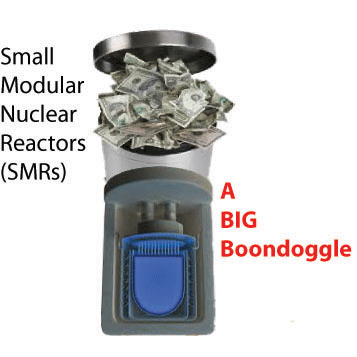 FT 7th Nov 2017, British ministers are preparing to revive the UK’s faltering effort to
create a new generation of small-scale nuclear power plants in spite of an
official analysis that cast doubt on the economic case for the technology.
Talks have intensified in recent weeks between government officials and
companies including Rolls-Royce, the UK engineering group, over potential
public funding to support development of so-called small modular reactors
(SMRs).
Greg Clark, business secretary, is keen to put the UK at the
forefront of technology seen as a more affordable alternative to
large-scale nuclear reactors such as those under construction at the £20bn
Hinkley Point C plant in south-west England.
Development of SMRs is regarded as crucial to the future of the nuclear industry as it struggles
to remain competitive against the rapidly falling cost of renewable wind
and solar power. The UK faces competition from the US, Canada and China in
its effort to establish a leading position in the technology.
Support for SMRs is expected to be part of a wider commitment to nuclear engineering in
a new industrial strategy to be unveiled by the government this month.
However, the enthusiasm has been complicated by a technology assessment,
commissioned by the business department and carried out by EY, the
accounting firm, which reached a negative verdict on the cost-effectiveness
of SMRs. The findings are expected to be published in the coming weeks and
will confront the government with awkward questions about why public money
should be used to help commercialise the unproven technology.
https://www.ft.com/content/bddfda80-c314-11e7-b2bb-322b2cb39656
1 This Month





PLEASE OPPOSE HR 8255 AND S.3639 – bills would accelerate satellite deployment, with no environmental review or safeguards – https://ncstd5li.quorum.us/campaign/169331/
To see nuclear-related stories in greater depth and intensity – go to https://nuclearinformation.wordpress.com
-
Archives
- October 2026 (29)
- September 2026 (339)
- August 2026 (330)
- July 2026 (355)
- June 2026 (287)
- May 2026 (306)
- April 2026 (356)
- March 2026 (251)
- February 2026 (267)
- January 2026 (308)
- December 2025 (358)
- November 2025 (359)
-
Categories
- 1
- 1 NUCLEAR ISSUES
- business and costs
- climate change
- culture and arts
- ENERGY
- environment
- health
- history
- indigenous issues
- Legal
- marketing of nuclear
- media
- opposition to nuclear
- PERSONAL STORIES
- politics
- politics international
- Religion and ethics
- safety
- secrets,lies and civil liberties
- spinbuster
- technology
- Uranium
- wastes
- weapons and war
- Women
- 2 WORLD
- ACTION
- AFRICA
- Atrocities
- AUSTRALIA
- Christina's notes
- Christina's themes
- culture and arts
- Events
- Fuk 2022
- Fuk 2023
- Fukushima 2017
- Fukushima 2018
- fukushima 2019
- Fukushima 2020
- Fukushima 2021
- general
- global warming
- Humour (God we need it)
- Nuclear
- RARE EARTHS
- Reference
- resources – print
- Resources -audiovicual
- Weekly Newsletter
- World
- World Nuclear
- YouTube
-
RSS
Entries RSS
Comments RSS

