£700m plan with ‘fish disco’ could save 90% of marine life, says Hinkley Point C study
Scientists find underwater acoustic project to stop fish being sucked into cooling systems could save 44 tonnes a year
Jillian Ambrose , Guardian, 10 Feb 26
Scientists have found that plans that include a “fish disco” to deter migratory marine life from the nearby Hinkley Point C nuclear reactor could help save 90% of fish from the power plant’s water intake pipes – but the measures are set to cost its developer £700m.
EDF Energy, which is building the Hinkley Point C nuclear plant in Somerset, said research it commissioned from scientists at Swansea University had found that using an acoustic deterrent system helped to ward off the “vast majority” of fish it tagged for the experiment.
The part of the costly system that is informally referred to as a “fish disco”, is designed to use more than 300 underwater speakers to emit sound pulses to repel fish from the water intake pipes, which will suck in water from the River Severn to help cool Hinkley’s reactors.
EDF said it expected to spend about £700m on the full solution, or 1.5% of the total cost of building the £46bn project, which would give Britain’s first new nuclear power plant in a generation “more fish protection than any other power station in the world”.
This should help to save about 44 tonnes of fish a year – equivalent to the annual catch of a small fishing vessel. The company declined to speculate on the total cost per fish saved over the 25-year life of the reactor’s subsidy contract.
EDF has argued against the requirement to fit an acoustic deterrent in the past, instead suggesting that it could construct salt marshes to help protect marine life.
Under EDF’s subsidy contract it will earn a set return for the electricity generated by Hinkley, meaning it will need to absorb the extra cost of the fish disco rather than add it on to household bills.
The full system is expected to include special mouths fitted to the intake pipes to slow the water suction and allow fish to escape from as close as 2 metres away, and a fish recovery system which returns fish sucked into the pipes.
The scientists found that only one of its tagged twaite shad fish came within 30 metres of the test intake pipes when the speakers were turned on, compared with the 14 seen in the same area without the system turned on………………………………………….
The results of the research will be submitted for regulatory consideration and approval by the Marine Management Organisation later this year. https://www.theguardian.com/uk-news/2026/feb/10/hinkley-point-c-plan-could-save-fish-being-sucked-into-pipes-study-finds
Is the UK keeping up with the nuclear revival?

Steve Thomas: Since the Starmer government came to power in 2024, it has
made a series of announcements that have placed the UK at the forefront of
the so-called Nuclear Renaissance. The government talks about a “Golden Age
of Nuclear Power” in the country. However, a closer look shows that these
announcements primarily concern what the government hopes to do and what it
hopes to achieve, in the absence of new projects in the pipeline.
Currently, the burden of submitting proposals falls on the private sector.
Regarding current nuclear projects, there is one under construction,
Hinkley Point C; another, Sizewell C, for which an investment decision has
been made and construction could begin in two to three years; and a project
for three Rolls-Royce small modular reactors (SMRs) for the Wylfa site,
where an investment decision is hoped for 2029.
The Hinkley Point C project
for two French European Pressurized Reactors (EPRs, 3.2 GW) is seven years
behind schedule, is 90% over budget, and requires at least six years to
complete. The Sizewell C project is expected to be built along the lines of
the Hinkley design and was supposed to be built approximately two years
after Hinkley, so that the workforce could seamlessly transfer from Hinkley
to Sizewell.
This means it is at least nine years behind schedule. Even if
the government’s estimated completion date is met, Sizewell will not begin
generating power until 2039. The estimated cost of this plant, £40.5
billion (2024 funding), is 70% higher than the actual estimated cost of the
Hinkley Point project at the time of the Final Investment Decision.
This ridicules claims that Sizewell would be cheaper than Hinkley due to the
“expertise” built at Hinkley Point. If it goes ahead, the Wylfa project
will not begin generating power until 2035. If there are no further delays
to these projects, it will be 2040 before the UK’s nuclear capacity returns
to 2015 levels, or approximately 9 GW. In 2022, Boris Johnson’s government
set a target of “up to 24 GW” of new nuclear capacity, in addition to the
Hinkley project, to be achieved by 2050. The “up to” specification left
room for vagueness, and in fact the Starmer government has clearly not
adopted this target.
So why is it so difficult and takes so long to build
nuclear capacity? And has the UK not performed well in this regard?
Research commissioned by the UK government found that, on average,
globally, the construction of a nuclear power plant, from the investment
decision to first start-up, takes 13-17 years. Add to this the time
required to reach the final investment decision. This includes: choosing
the supplier and technology; project assessment by the national safety
regulator; identifying and verifying the suitability of the chosen site;
and defining a financial model to provide the capital, own the plant, and
purchase the energy.
This process is unlikely to take less than five years;
in fact, it could take longer. Therefore, the construction time for a
nuclear project is likely at least 20 years.
Rienergie 12th Feb 2026, https://rienergia.staffettaonline.com/articolo/35901/UK+sta+al+passo+con++la+rinascita+nucleare++++/Steve
‘Green laws hold up nuclear plans — but we can’t say where’

Despite calling for a reduction in planning protections for the landscapes,
the energy department admits it can’t identify any where regulations are
a problem.
The energy department, run by Ed Miliband, has admitted that it
cannot name a single national park where regulations are holding up nuclear
projects, despite a review urging that protections for the landscapes be
reduced.
The recommendation also relied on a blogpost written by a member
of the reviewing panel, it has emerged.
Weakening or scrapping the
protected landscapes duty, which means that councils must further the
conservation aims of parks when making planning decisions, was one of the
calls of the government’s nuclear regulatory task force last year. Sir
Keir Starmer said he “fully accepted” the suggested reforms. However, a
Freedom of Information request has shown that the government holds “no
due diligence or impact assessment” about changing the protected
landscapes duty.
The Department for Energy Security and Net Zero conceded
that it had no list of specific national parks or national landscapes
(formerly AONBs) where a conflict exists between the duty and nuclear
development. The department also said one of the pieces of evidence
underpinning the recommendation was a blogpost written by a lawyer. That
lawyer, Mustafa Latif-Aramesh, also sits on the task force.
In an email to
John Fingleton, the economist who led the review, Latif-Aramesh appeared
unclear what the precise financial cost of the rules was to nuclear
companies. “It’s costing developers millions if not tens of
millions,” he wrote just weeks before the final report was published.
Rose O’Neill, the chief executive of the Campaign for National Parks, a
charity, said:
“This lays bare the fact that the prime minister is
considering scrapping national parks law on a recommendation that’s built
on nothing but hot air. The real shock is that the recommendation is
largely based on a single blog article written by one taskforce member.”
Barry Gardiner, a Labour MP and chair of the all-party parliamentary group
for national parks and national landscapes, said: “Any suggestion that
the government might dilute its duty to protect these landscapes is not
just alarming, it represents a betrayal of Labour’s legacy in
safeguarding our countryside for the public good.”
Chris Hinchcliff, the
Labour MP who only recently had the whip restored after his rebellions on
welfare reform, said: “Our biodiversity is at breaking point. This is the
time for a rescue plan, not more backwards steps that are harmful to
nature, deeply unpopular, bad for our long-term future and will ultimately
put our national security at risk.”
Times 10th Feb 2026, https://www.thetimes.com/uk/environment/article/ed-miliband-national-parks-nuclear-energy-2bcznpkzd
UK ignores corruption scandals when awarding major military contracts.

Freedom of Information requests reveal Britain’s trade department collected “no information” about fines issued to UK military suppliers for corruption.
JOHN McEVOY, 4 February 2026, https://www.declassifieduk.org/uk-ignores-corruption-scandals-when-awarding-major-military-contracts/
The Ministry of Defence is reportedly set to award a £2 billion contract to a consortium led by Raytheon UK despite major corruption and fraud violations recently levelled against its American parent company RTX.
The contract, which aims to modernise the army’s training infrastructure using “advanced simulation”, will be awarded through a competitive process in which Raytheon UK seeks to displace a rival bid led by Israel’s Elbit Systems UK.
RTX is already a major supplier to the UK Ministry of Defence, having completed integration trials for the Paveway precision-guided missile on the Typhoon aircraft in 2025.
The company says it has a “decades-long partnership with the British army”, and holds licences to export F-35 fighter jet components which are used by Israel.
Yet in 2024, RTX faced significant legal sanctions in the US relating to alleged bribery of foreign officials, defective pricing, and export control violations.
The company settled several federal investigations with overall penalties exceeding $950 million.
Crucially, Freedom of Information requests suggest that UK export-licensing authorities have taken no action in response to these developments.
The Department for Business and Trade and the Export Control Joint Unit (ECJU) said in October 2025 they hold no internal correspondence, briefs, or risk assessments relating to the RTX enforcement actions.
This is despite the UK’s own guidelines for military export licences explicitly requiring ongoing assessment of risk of diversion, misuse, and breach of international humanitarian law.
The guidelines also direct authorities to consider exporter conduct and compliance history.
In response to further FOI requests, the Ministry of Defence also refused to clarify whether RTX’s enforcement actions abroad were internally discussed when deliberating the award of major contracts to the company.
This apparent inaction raises fundamental questions about whether systemic reassessment of exporter behaviour takes place when serious misconduct comes to light.
It also comes as the UK’s National Audit Office has found in a new report released last week that the defence ministry could “make significant savings” if it better managed losses from economic crimes, including procurement fraud.
The business and trade department and defence ministry did not respond to requests for comment about whether they consider foreign corruption scandals when awarding export licences or training contracts to firms.
Raytheon has been the subject of past enforcement controversies in Britain, with the company refusing to explain its activities to the government’s committees on arms export control in 2019 while arming Saudi Arabia’s brutal war on Yemen.
Its competitor for the army training contract, Elbit Systems, is also facing accusations of breaching business appointment rules while continuing to hold export licences granted by the ECJU.
Campaign Against Arms Trade (CAAT) spokesperson Emily Apple told Declassified: “Time and again successive governments have lied, repeatedly telling us the UK has one of the most robust arms export control systems in the world. Nothing could be further from the truth”.
The business and trade department said: “The UK operates one of the most robust and transparent export control regimes in the world.
“All export licensing decisions are made in line with our Strategic Export Licensing Criteria, and our assessments take all information relevant to the risk of diversion or misuse into account”.
Moog
The issue is not unique to RTX.
Another defence contractor, Moog Inc., resolved a Foreign Corrupt Practices Act (FCPA) administrative order in October 2024 involving bribery by its Indian subsidiary.
The FCPA is a US federal law which makes it illegal for US persons or companies to bribe foreign government officials to gain a business advantage.
However, the ECJU also holds “no information” about any discussions relating to that FCPA order, according to the FOI documents seen by Declassified.
Together, the RTX and Moog cases represent the only publicly reported defence industry FCPA-related enforcement actions in 2024.
Moog currently holds UK licenses to export components for trainer aircraft used by the Israeli air force, and contributes to the global F-35 programme.
Public information raises further questions about how Moog’s compliance oversight function was structured during the period in which these violations allegedly occurred.
According to a LinkedIn profile, Moog’s compliance manager has had oversight of both Moog UK and Moog India since before 2020 — the period during which the company’s Indian subsidiary was later found by US authorities to have engaged in bribery of state officials.
“While the existence of a group-level compliance function does not itself imply wrongdoing, it underscores that Moog’s UK operations were not operating in isolation from wider corporate compliance arrangements at the time, and raises legitimate questions about how compliance risks were identified, escalated, and addressed across the group”, said Emily Apple from CAAT.
Despite these questions, Moog Wolverhampton has not been subject to an ECJU compliance visit since 2022, according to further FOI requests issued in November.
This is notable given that the site was inspected twice within a two-month period that year, a pattern potentially associated with follow-up or remedial reviews.
Yet the company’s sites in Britain have apparently not been revisited in the three years since, including after Moog’s US parent company agreed a major FCPA settlement in 2024.
Emily Apple added: “Whether it’s ignoring corruption scandals, or trampling over international law, it appears there are no limits to the steps the government is prepared to take to prioritise arms dealers’ profits. This is a system beyond reform. It is out of control, devoid of ethics and operating beyond the law”.
Moog and RTX did not respond to requests for comment.
The 24-site US military network in Britain worth £11 billion

America’s War Department owns more military and intelligence sites in Britain than the government has told parliament
MARK CURTIS, DECLASSIFIED UK, 3 February 2026
The US military owns 22 sites in Britain whose “replacement value” is $15.6bn (£11.4bn), according to a US War Department document found by Declassified UK.
This number of sites is larger than previously believed and more than UK governments have told parliament.
A US document published online identifies 16 of the US military’s locations in the UK and notes six “other sites” which are not specified. The document, published last year, outlines the US military’s “property portfolio” around the world as of September 2024.
Declassified has identified other locations in Britain that are likely to be hosting US military or intelligence personnel, bringing the total to at least 24.
This doesn’t cover the full scale of the US military presence in the UK, since it is believed that US military personnel are frequently, if not permanently, stationed at still more sites, such as the key Royal Navy bases at Coulport, Devonport and Faslane.
The 16 locations in Britain specified by the US War Department include the major US air bases at Lakenheath, Mildenhall, Croughton and Fairford but also lesser-known sites.
The smaller locations include a 35-acre US Air Force (USAF) site at RAF Bicester in Oxfordshire and a location said to comprise 35,397 square feet of buildings at RAF Oakhanger in Hampshire.
The document also notes US ownership of facilities at the top secret Fylingdales spy station in Yorkshire, where it possesses 5,860 square feet of building space.
Fylingdales is a joint enterprise between the US and UK and “provides a 24/7 missile warning and space surveillance capability for the UK and its allies”.
While most of the locations are operated by the USAF, the single site where the US Navy is said to be active is Lossiemouth near Inverness, the only location mentioned in Scotland.
A recent investigation by The Ferret found the US established a base there in May 2024, with the US navy helping to fund the construction of facilities for its Poseidon P8 anti-submarine spy and warplanes at the site.
The investigation also found the Scottish government was not consulted about stationing US aircraft at Lossiemouth.
Other US sites mentioned in the War Department document include a 736-acre ammunition storage location at RAF Welford in Berkshire and a “transmitter annex site” at RAF Barford St John in Oxfordshire.
These US sites stretch over 20 square miles, which is equivalent to around 11,500 football pitches, or an area larger than the city of Oxford.
Successive UK governments have failed to mention in parliament some of these 16 sites as being US military operating locations, such as RAF Oakhanger and RAF Bicester. The last time Oakhanger was mentioned in parliament was in November 1996.
More recently, in answer to a parliamentary question in February 2022, the Ministry of Defence (MoD) mentioned only eight sites from where US personnel were operating, along with “undisclosed locations”.
Two years earlier, in June 2020, a minister listed 11 bases which were “designated for use by the United States Visiting Forces” in the UK. This form of words appears to keep open the possibility that US personnel are also based elsewhere.
Where are the six other sites?
The US document specifies sites in Britain that are larger than ten acres or have a replacement value of over $10m (£7.3m)…………………………………………………………………………………………………………………………………………………………………………………………………… https://www.declassifieduk.org/the-24-site-us-military-network-in-britain-worth-11-billion/
University of Cumbria, Nuclear Waste, AI / Bitcoin and a Strange Tale of Tapping Epstein for Money.

On By mariannewildart, https://mariannewildart.wordpress.com/2026/02/05/university-of-cumbria-nuclear-waste-ai-bitcoin-and-a-strange-tale-of-tapping-epstein-for-money/
The University of Cumbria is playing a “central role in a new £4.9 million nuclear robotics and AI cluster,” part of a consortium with the UK Atomic Energy Authority, University of Oxford and University of Manchester to develop a new nuclear robotics and AI cluster, linking Cumbria and Oxfordshire.
Awarded £4.9 million, the cluster is the largest of seven new research projects supported through an overall funding package of £22 million. This is from the UK Research and Innovation (UKRI), Engineering and Physical Sciences Research Council (EPSRC) and the Place Based Impact Acceleration Account (PBIAA) scheme. The robotics will of course end up as nuclear waste with the ultimate plan to dump the radioactive doggy robots in a big hole under the Lake District coast. The University of Cumbria has never made any comments that there should be no nuclear waste dump under the Lake District coast or that there should be no new nuclear waste, no new nuclear build. This latest nuclear complicity means that they are now hugely compromised and it would be a brave university professor (we do live in hope) to speak out against using the Lake District coast as a giant heat sink in which to dump hot nuclear robots.
Some years ago I was stood outside Gail Bradbrook’s (XR Leader) talk in Kendal leafletting against the (now rejected) coal mine near Sellafield with a nuclear waste barrel costume on. Professor Bendell walked past with his head down clearly not wanting to take a leaflet from a person in a nuclear waste barrel. When I did a bit of research I found that Professor Bendell is known is some circles as “Professor Bitcoin.” The University of Cumbria where he is “Professor of Sustainability Leadership” was the first in the world to accept student’s tuition fees in bitcoin. Whats wrong with that?Bitcoin and cryptocurrencies use enormous amounts of energy and are also the key to AI.
Prof Bendell has written long-winded deflections online regarding his connection to Epstein. Prof Bendell said he was introduced to Epstein through the Gates Foundation which does seem to be the case. Telling Epstein that his past was a problem in 2013 however does not seem to be reflected in the released files. Correspondence continues over several years.
The explanation above has been accepted by Jem’s followers of whom there are many.
A closer look reveals that Prof Bendell was keen to tap Epstein for money on behalf of the University of Cumbria in order to fund the Professor’s and the Uni’s interests in Bitcoin. This keenness for Epstein funds went so far as to the Professor sourcing a 5013c ( a United States corporation, trust, unincorporated association, or organisation exempt from federal income tax) through which to accept “donation/s from Epstein.
This was in 2012 a full four years after Epstein pleading guilty in 2008 of procuring a child for prostitution, amongst other things. Epstein was convicted of only two crimes as part of a controversial plea deal agreed by the U.S. This was widely reported in 2008 but in 2012 was not a red flag for Bendell despite the University of Cumbria’s safeguarding policy.
Bizarrely, one of the exchanges between Jem and Jeffrey includes both men saying they would not want to go to jail for the sake of “alternative exchange systems’ ie digital currency.
Harbour activity to increase at Sizewell C amid more work
There is set to be more marine activity near Sizewell C in the coming
months as construction of the nuclear power plant continues. Sizewell said
in a statement that there would be a “noticeable increase” in marine
activity due to multiple planned operational and survey activities. The
operations will involve specialist vessels and equipment in the “marine
construction zone”.
East Anglian Daily Times 6th Feb 2026, https://www.eadt.co.uk/news/25823395.harbour-activity-increase-sizewell-c-amid-work/
A Nuclear Renaissance for Scotland?

“They of course don’t want to talk about the European Power Reactor (EPR) configuration being installed at astronomical cost at Hinkley C. This project is forecast to cost around £45 billion when it finally comes online sometime next decade.”
They misleadingly present them as cheap, clean and ‘green’ – yet this is as far from the truth as it was 70 years ago when it was promised that nuclear energy would be ‘too cheap to meter’
By Mike Small, 5th February 2026, https://bellacaledonia.org.uk/2026/02/05/a-nuclear-renaissance-for-scotland/
At an exciting launch in Glasgow tonight where Sam Richards (CEO Britain Remade. Ex No10) will lay out his plans for new nuclear power in Scotland:
“Looking forward to speaking at the launch of this later. A nuclear renaissance is taking place across the world and Scotland shouldn’t be left behind.”
Tonight will see the launch of something called ‘Scotland for Nuclear Energy’ with support from groups like ‘Nuclear for Scotland‘, which has no information about itself on its own website, and Home | Minerva Health Physics Ltd which ‘are a dedicated team of experts in radiation protection and radioactive waste management’, and the North Highland Chamber of Commerce. Home – Caithness Chamber of Commerce
The launch was nicely timed in the week when it was revealed that the UK Govt has buried “almost 200 containers” of radioactive material underground in Scotland.
*
Today Britain Remade announced: “Today we’re part of the launch of Scotland For Nuclear Energy – a coalition of communities, businesses and campaigners calling on the Scottish Government to lift the ban on new nuclear power in Scotland.”
It’s not clear exactly who the ‘communities’ are, but maybe that will become clearer at the launch.
According to ‘Britain Remade’: “We are not affiliated with, or part of, any political party.”
But Sam Richards is the Director of the network of conservative environmentalists and caucus of green Conservative MPs, and was the Special Advisor to the PM on Energy & Environment (2019-2022). He’s a Boris SPAD. And Jeremy Driver (Head of Campaigns), is a former Lloyds Banker and Parliamentary Assistant to Ann Soubry. Sam Dumitriu is Head of Policy at Britain Remade who formerly worked at the Adam Smith Institute. Jason Brown is Head of Communications for Britain Remade, a former No. 10 media Special Adviser and Ben Houchen’s comms Adviser.
These are Tory SPADS working on their own campaign to support new nuclear in Scotland: Lift The Ban On New Scottish Nuclear Power.
Jeremy and Sam are a bit shy about the costs of nuclear power, and so they should be. Anas Sarwar and Labour energy minister Michael Shanks are enthusiastic. But, as John Proctor has pointed out, they too aren’t very up front about costs.
Proctor writes [I spent decades in energy. Here are the problems with UK nuclear plans]:
“They of course don’t want to talk about the European Power Reactor (EPR) configuration being installed at astronomical cost at Hinkley C. This project is forecast to cost around £45 billion when it finally comes online sometime next decade.”
“It is not easy to get a proper sense of this sum, but it might surprise people to realise that this is the equivalent of paying £1 million every single day for 120 years – and this is just the construction cost. We have not even started talking about operational costs, asset management and asset decommissioning.”
Remake Britain, or Scotland for Nuclear Energy (it’s not entirely clear if they are one and the same thing) are great at PR, managing to create this fantastic puff piece by Paris Gourtsoyannis on the BBC ‘News’ channel: The nuclear power station at the centre of the political divide in Scotland.
They’ve also managed to somehow try and re-create the ‘Nuclear Power No Thanks’ badge from the 1970s with a super-cringey ‘Nuclear Power Aye Cheers’ slogan.
SCRAM (Scottish Campaign to Resist the Atomic Menace) have issued a rebuttal to all this astroturfing.
Pete Roche, spokesperson for SCRAM said: “As renewable energy-rich Scotland heads towards an election, it is all too predictable that nuclear lobbyists are again arguing that Scotland needs new nuclear power stations. They misleadingly present them as cheap, clean and ‘green’ – yet this is as far from the truth as it was 70 years ago when it was promised that nuclear energy would be ‘too cheap to meter’
“An energy system built around renewables is already happening. Meeting all our needs this way is not just possible, but it’s quicker and cheaper without the costly distraction of new nuclear. Low-cost renewable energy combined with storage, flexible power to balance the grid and smart local energy systems will make the best use of our incredible renewable resources and engineering know-how. Why dilute that by backing eye-wateringly expensive nuclear power stations?”
“The highly skilled nuclear workforce will be kept busy for decades in decommissioning the sites at Torness, Hunterston, Chapelcross and Dounreay – and completing a sustainable renewable energy system is already bringing huge demand for skilled energy professionals. The renewables sector is the future, and where the focus for skills must remain.”
”A 100% renewable-based energy system will be cheaper, better for jobs and energy security, and be truly green and sustainable. We hope the information we have provided will be useful to all political parties and voters, and help to balance out the misleading propaganda of the nuclear PR machine.”
One of the other myths that SCRAM is keen to dispel is the notion that new nuclear power is a solution to climate change. They state:
“Nuclear power stations are not resilient to climate change. They are usually on the coast where sea levels are rising and storm surges could threaten installations. They require large quantities of water to keep cool and avert meltdowns. [see Nuclear Energy isn’t a Safe Bet in a Warming World – Here’s Why, by Paul Dorfman, The Conversation https://theconversation.com/nuclear-energy-isnt-a-safe-bet-in-a-warming-world-heres-why-163371 ]
“Using nuclear plants to address climate change involves unacceptable risks. Risks include the possibility of serious accidents; an unsolved radioactive waste problem; the environmental damage caused by uranium mining, yet another nuclear target for terrorists or in armed conflict and increased nuclear weapons proliferation. Renewable energy risks none of these.”
“Tackling climate change is urgent, so requires the fastest and cheapest solutions. We must spend our limited resources as effectively, quickly and fairly as possible. Amory B. Lovins, adjunct professor of civil and environmental engineering at Stanford University, explains that saving the most carbon per pound, as quickly as possible, requires not just energy generation that doesn’t burn fossil fuels, but also generation that is deployable with the least cost and time. That rules out nuclear energy as an answer to climate change. In fact, nuclear worsens climate change by spending valuable resources on a solution which is much too slow and too costly.” [see Why Nuclear Power Is Bad for Your Wallet and the Climate].
There is no case for new nuclear in Scotland.
These front groups and astroturf projects are attempting to paper over the cracks about Britain’s ageing and decrepit nuclear programme [Revealed: 585 cracks in Torness nuclear reactor ]. They are a costly clandestine distraction which threatens to undermine the urgent need to shift to clean energy and decarbonise the economy.
Britain courts private cash to fund ‘golden age’ of nuclear-powered AI.

SMR trials are on the horizon, but commercial viability is not expected until the 2030s.
Things get a little hazy over the question of any financial support.
Framework aims to lure investors into powering the compute boom
Dan Robinson, Thu 5 Feb 2026,
https://www.theregister.com/2026/02/05/uk_private_finance_smr/
The British government today launched the Advanced Nuclear Framework to attract private investment in next-generation nuclear technology for factories and datacenters.
The framework aims to accelerate development of advanced modular reactors to power the AI infrastructure boom and provide [?]clean energy for economic growth.
The Department for Energy Security and Net Zero (DESNZ) will create a “pipeline” of projects meeting readiness criteria, offering a “concierge-style” service to help the developers navigate UK planning, regulations, and secure private investment.
DESNZ says emerging nuclear technologies like small modular reactors (SMRs) can be prefabricated in factories, enabling faster, cheaper assembly using skilled jobs across multiple regions. These reactors can provide [?] clean energy to the grid or directly to industrial users, it claims. SMRs, as Reg readers likely know, are newfangled designs with a power capacity of up to about 300 MW per unit, about a third of the generating capacity of traditional atomic reactors.
However, the novelty of these designs means they probably won’t be pumping out the megawatts any time soon. As Omdia principal analyst Alan Howard told us last year, SMR trials are on the horizon, but commercial viability is not expected until the 2030s.
Howard was commenting on the announcement of the UK’s first SMR plant last November, which being built at Wylfa on Anglesey, an island off the coast of Wales.
DESNZ also points to plans for X-Energy and Centrica to build 12 advanced modular reactors in Hartlepool, while Holtec, EDF, and Tritax aim to build SMRs at a former coal-fired power station site at Cottam in Nottinghamshire.
Lord Patrick Vallance, Minister for Science, Innovation, Research and Nuclear, claimed advanced nuclear technology could revolutionize the power and AI datacenter industries, delivering [?]clean energy and more jobs.
“We are seizing the opportunity to become a frontrunner in this space as part of our golden age of nuclear, creating the conditions for the industry to flourish,” he said.
The British government today launched the Advanced Nuclear Framework to attract private investment in next-generation nuclear technology for factories and datacenters.
The framework aims to accelerate development of advanced modular reactors to power the AI infrastructure boom and provide clean energy for economic growth.
The Department for Energy Security and Net Zero (DESNZ) will create a “pipeline” of projects meeting readiness criteria, offering a “concierge-style” service to help the developers navigate UK planning, regulations, and secure private investment.
DESNZ says emerging nuclear technologies like small modular reactors (SMRs) can be prefabricated in factories, enabling faster, cheaper assembly using skilled jobs across multiple regions. These reactors can provide clean energy to the grid or directly to industrial users, it claims.
SMRs, as Reg readers likely know, are newfangled designs with a power capacity of up to about 300 MW per unit, about a third of the generating capacity of traditional atomic reactors.
However, the novelty of these designs means they probably won’t be pumping out the megawatts any time soon. As Omdia principal analyst Alan Howard told us last year, SMR trials are on the horizon, but commercial viability is not expected until the 2030s.
Howard was commenting on the announcement of the UK’s first SMR plant last November, which being built at Wylfa on Anglesey, an island off the coast of Wales.
DESNZ also points to plans for X-Energy and Centrica to build 12 advanced modular reactors in Hartlepool, while Holtec, EDF, and Tritax aim to build SMRs at a former coal-fired power station site at Cottam in Nottinghamshire.
Lord Patrick Vallance, Minister for Science, Innovation, Research and Nuclear, claimed advanced nuclear technology could revolutionize the power and AI datacenter industries, delivering [?]clean energy and more jobs.
“We are seizing the opportunity to become a frontrunner in this space as part of our golden age of nuclear, creating the conditions for the industry to flourish,” he said.
The AI datacenter focus reflects the government’s ambitions for UK AI leadership. It is encouraging a rash of datacenter projects to house AI infrastructure, which is notoriously hot and hungry. One of many reports published last year estimated that global datacenter electricity use is set to more than double by 2030 thanks to AI.
Interested parties will be able to use the Advanced Nuclear Framework to submit proposals to join the pipeline from March. These will then be assessed by Great British Energy-Nuclear, the government-owned atomic energy company.
Things get a little hazy over the question of any financial support. Successful applicants get government endorsement “in principle,” and while they will be expected to secure private finance, the government says it is open to discussions on what may be needed to help get projects off the ground.
Developers will also be able to approach the National Wealth Fund, which can act as a “catalytic investor” for projects that meet their criteria.
The UK isn’t alone in looking to revitalize nuclear power. The US is also encouraging new builds and the development of advanced technologies, and it appears the Trump administration is prepared to overlook safety precautions to speed things along.
‘Significant’ fire risks at nuclear plant site
Maisie Lillywhite, West of England, 4 Feb 26, https://www.bbc.com/news/articles/cgqexej138jo
‘Significant’ fire risks have been uncovered at the first nuclear plant to be built in Britain for 30 years, including flammable materials left on emergency exit stairs.
Inspectors from the Office for Nuclear Regulation (ONR) said they found significant fire safety shortfalls at Hinkley Point C, EDF’s twin-reactor nuclear power station in Somerset.
The ONR has served enforcement action notices on five organisations which are overseeing mechanical, electrical and heating (MEH) and ventilation and air conditioning work (HVAC) at the site.
Bosses of the five organisations will need to address the shortfalls ahead of the next inspection.
A spokesperson for Hinkley Point C said they are working closely with contract partners to ensure that the appropriate enhancements are made.
“Safety is our overriding priority, and we are already acting to oversee improvements,” they added.
Mahtab Khan, ONR’s head of regulation, said fire safety is not optional and it is a legal requirement that protects lives.
“We will not hesitate to take enforcement action where safety standards fall short, and we expect all dutyholders to treat fire safety with the urgency it demands.
“Working alongside the principal contractor and MEH alliance, we have made good progress in understanding the root causes of these shortfalls to ensure they are addressed,” Khan added.
The Hinkley Point C contractors given fire enforcement notices are Altrad Babcock, Altrad Services, Balfour Beatty Kilpatrick Ltd, Cavendish Nuclear, and NG Bailey.
The combustible material, found during an inspection in December, was discovered in the staircase and was waste typical of construction activities, the ONR said.
It added although the waste did not block the fire exit, it could have compromised access to the building in the event of a fire.
Inspectors found the construction site did not have an adequate fire risk assessment.
There were also insufficient means of escape exits for the number of people working in the building.
The ONR said the shortfalls had no direct impact on the likelihood of a fire, but that the enforcement means adequate routes should be available to workers in the event of a fire.
It comes after inspectors found there was a “risk of serious injury” due to “inadequate fire controls” being used by civil engineering firm Bylor JV, which is run by both Laing O’Rourke and Bouygues Travaux Publics.
In December, the company was served with a fire safety notice and was told it had until June to implement changes.
The estimated cost of Hinkley Point C has risen to £46bn from the £18bn predicted in 2017, and it is expected to open in 2031.
Lawmakers spark backlash with controversial fee imposed on residents: ‘Colossal financial risk’

There’s a political battle unfolding in Scotland over a new charge critics
are calling a “nuclear tax” — a levy that could leave Scottish households
paying for nuclear construction projects hundreds of miles away. At the
center of the dispute is England’s Sizewell C nuclear power station, a
project that has ballooned beyond its original budget and is raising
questions about who should foot the bill.
According to The National,
Scottish lawmakers are raising alarms over a levy introduced by Westminster
to help fund the plant in Suffolk, which is now projected to cost £38
billion ($51.9 billion) — nearly double its original estimate of £20
billion ($27.3 billion). Scottish bill payers could contribute around £300
million ($409.3 million) over the next decade even though the plant is
being built in England.
The Scottish National Party has criticized Labour
leadership for not opposing the tax, arguing that residents are paying for
a project they did not approve and may never directly benefit from. “Your
support for these projects in Scotland would see us exposed to colossal
financial risk and undermine our renewables future,” SNP lawmaker Graham
Leadbitter said.
However, Labour representatives argue that nuclear power
is an important part of the United Kingdom’s long-term energy mix. Gregor
Poynton has said Scotland risks missing out on jobs and investment by
turning away from new nuclear technologies such as small modular reactors.
TCD 2nd Feb 2026, https://www.thecooldown.com/green-business/nuclear-tax-scotland-household-energy-bills/
I spent decades in energy -Here are the problems with UK nuclear plans.
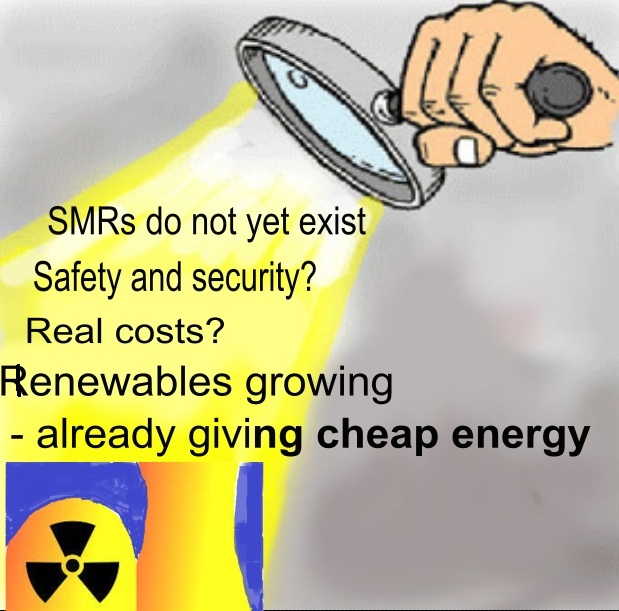
IT is clear that the issue of Scotland’s moratorium on new nuclear power
will be a key battle line in May’s Scottish Parliament election. Anas
Sarwar has joined the Labour energy minister Michael Shanks in the call for
building more nuclear power in Scotland – and the electricity cables to
take the generated electricity to energy-hungry England. MP Shanks
continues to declare that he would be relaxed about having a small
modularised reactor (SMR) erected in his constituency.
I am not sure how
the good people of Rutherglen feel about this. What I find mystifying is
the lack of proper scrutiny being applied to the claims made by those
members of the Nuclear Energy All-Party Parliamentary Group and its
well-funded nuclear lobbyists. It does not surprise me that they are unable
to set out what configuration they favour, as the reactors which they claim
will produce 400 MWs do not exist. They have not been manufactured, tested,
or installed – anywhere! As an engineer, I would be keen to ask the
politicians if they have thought about some of the basic elements of a
power plant. Do they have any ideas what the thermal capacity of the
proposed reactors are? Have they understood what the cooling requirements
might be? How about the status of the “core catcher”, the system
designed to prevent a Chernobyl-type event?
Be under no illusion, Shanks,
Sarwar and the nuclear lobby are building a Potemkin village, a deceptive,
impressive facade. They of course don’t want to talk about the European
Power Reactor (EPR) configuration being installed at astronomical cost at
Hinkley C. This project is forecast to cost around £45 billion when it
finally comes online sometime next decade. It is not easy to get a proper
sense of this sum but it might surprise people to realise that this is the
equivalent of paying £1 million every single day for 120 years – and this
is just the construction cost.
We have not even started talking about
operational costs, asset management and asset decommissioning. When Julia
Pyke, the managing director of Sizewell C, was asked by the BBC how the
project was going, she answered airily that it is “on schedule and within
budget”. I waited eagerly for the obvious follow-up question – what is
the budget and schedule? – but that never came. If the Sizewell C
construction consortium defies recent construction trends and achieve a 10%
saving relative to Hinkley C, that would still indicate a £40bn project
cost – which is enough to build 130 hospitals similar to, for example,
Forth Valley Royal Hospital.
The supporters of nuclear energy tell us that
we need these plants for baseload capacity. They fail to acknowledge that
in Scotland we already generate more capacity from renewables than we
consume – and this surplus is only going to grow as we continue to see more
investment in wind, solar, tidal and energy storage.
“What about
intermittency and the lack of system inertia?” is the nuclear advocates’
stock question when discussing the growth of renewables. This is a
legitimate question but the answer is beautifully simple – we will continue
to do what we do now, rely on combined-cycle gas turbines (CCGTs). Which is
reassuring as there will be no nuclear plant coming on stream anytime soon.
“But what about net zero?” might be the next question. Thankfully,
there are a raft of solutions to this currently available and more coming
on stream every week. For example, gas turbine manufacturers are building
on 50 years of experience of burning hydrogen and will be ready to burn
hydrogen or blended hydrogen/methane as quickly as the hydrogen market can
come on stream. My prediction is that the hydrogen market will come on
stream faster than any SMRs can be built – and if UK politicians had a
strategic bone in their bodies, they would be trying to beat our friends in
Europe to win the hydrogen race.
The National 31st Jan 2026, https://www.thenational.scot/news/25813385.spent-decades-energy-problems-uk-nuclear-plans/
Labour backbenchers revolt over Starmer’s nuclear plans
Ministers accused of scapegoating protected species for construction failures
Matt Oliver, 02 February 2026
Sir Keir Starmer’s plan for a nuclear renaissance faces a rearguard action
from Labour MPs and wildlife charities over claims it will be a
“catastrophe” for nature. As many as 40 backbenchers are rallying
against the Prime Minister’s proposal to overhaul environmental regulations
after an independent review said red tape was frustrating the construction
of new power stations.
The MPs and a coalition of environmental charities
including the Wildlife Trusts, the RSPB, the National Trust and the
Woodland Trust have accused ministers of scapegoating protected species
such as bats and newts for planning failures.
It comes ahead of a plan
expected to be published by ministers this month, setting out how they will
implement the review’s recommendations and whether they will adopt them in
full. Labour is also under pressure from an opposing group of pro-nuclear
campaigners, businesses and think tanks who argue reform is “essential if
we want to create jobs, tackle climate change, and cut energy bills”.
Britain is currently the most expensive place in the world to build nuclear
reactors, with critics blaming nature rules that have added hundreds of
millions of pounds of extra costs to construction. The review of nuclear
regulations, led by the economist John Fingleton, criticised regulators
such as the Office for Nuclear Regulation, the Environment Agency and
Natural England for presiding over a confusing and “duplicative” system
that prioritised “process over outcomes”.
A briefing circulated in
Parliament by the Wildlife Trusts claims that the review’s proposed changes
to habitat regulations “will do little to speed up planning decisions
but, instead, will turn the nature crisis into a catastrophe.” It argues
that the suggestion of a nature fund may be suitable in some cases but not
in the case of “irreplaceable habitats or species that cannot
re-establish elsewhere easily.”
The briefing adds: “The Government must
reject the nuclear regulatory review recommendations on environmental
regulations and end its confected war on nature as a barrier to
planning.” Chris Hinchcliffe, the Labour MP for North East Hertfordshire
who is coordinating the rebellion, said “a good number of colleagues”
shared the concerns. He said: “There is very clear polling on the
importance of nature to the British public and their desire to seek
stronger, not weaker, protections for nature. “Getting this wrong is a
real vote-loser, and is a misstep that the Government cannot afford.”
Responding to the findings in November, ministers vowed to present “a
full implementation plan” by late February and to push through the
changes within two years. On Monday, the campaign group Britain Remade
published a letter signed by businesses and think tanks urging ministers to
press ahead. The letter said: “If the Government is serious about growing
the economy, reducing bills, and delivering a new golden age of nuclear
energy, its implementation plan must back the Fingleton reforms in full.
“Nuclear energy is the most land-efficient zero-carbon technology we
possess. A single power station can power millions of homes. “If we are
serious about halting climate-driven nature loss, then nuclear energy must
expand in a safe, secure and sustainable way. “We cannot afford for the
Government to U-turn.”
Telegraph 2nd Feb 2026 https://www.telegraph.co.uk/business/2026/02/02/labour-backbenchers-revolt-over-starmer-nuclear-plans/
Small Modular Reactors: Game changer or more of the same?
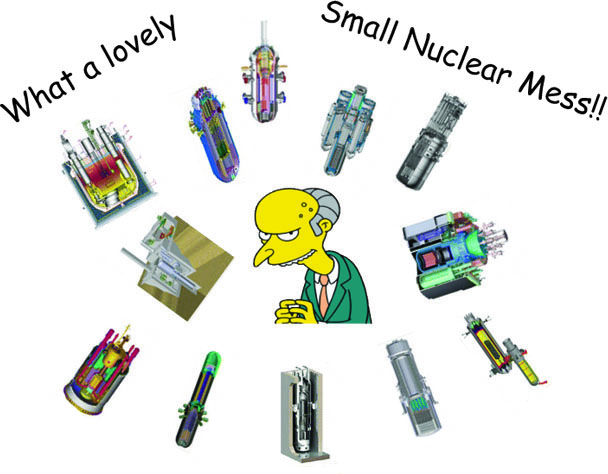
There has been a large amount of publicity on Small Modular Reactors (SMRs) based on exaggerated, unproven or untrue claims for their advantages over large reactors. Only one order for a commercially offered design has been placed (Canada) and that had yet to start construction in January 2026. The UK should not invest in SMRs until there is strong evidence to support the claims made for them.
Policy Brief, Stephen Thomas, Emeritus Professor of Energy Policy, Greenwich University, 31 Jan 26 https://policybrief.org/briefs/small-modular-reactors-game-changer-or-more-of-the-same/
Introduction
With current large reactor designs tarnished by their poor record of construction, attention for the future of new nuclear power plants has switched to Small Modular Reactors (SMRs). The image of these portrayed in the media and by some of their proponents is that they will roll off production lines, be delivered to the site on the back of a truck and, with minimal site assembly, be ready to generate in next to no time; they will be easy to site, a much cheaper source of power, be safer and produce less waste than large reactors; as a result, they are being built in large numbers all around the world. But what is the reality?
What are SMRs and AMRs?
In terms of size, the International Atomic Energy Agency (IAEA) defines SMRs as reactors producing 30-300MW of power and defines reactors producing up to 30MW as micro-reactors. In practice, the size of SMRs is increasing and of the seven designs that have received UK government funding, four are at or beyond the 300MW upper limit for SMRs.1 The vendors of the two micro-reactor designs funded by the UK have both collapsed,2 leaving the X-Energy Xe-100 the only reactor design, at 80MW, that is technically an SMR.
The term Advanced Modular Reactor (AMR) is largely a UK invention and denotes reactors using designs other than the dominant large reactor technologies — Pressurised and Boiling Water Reactors (PWRs and BWRs). In other countries, the term SMR covers all reactors in the IAEA’s size range. None of the proposed AMR designs are new, all having been discussed for 50-70 years but not built as commercial reactors. They can be divided into those built as prototypes or demonstration reactors — the Sodium-cooled Fast Reactor (SFR) and the High Temperature Gas-cooled Reactor (HTGR) — and those that have not been built — Molten Salt Reactors (MSRs) and Lead-cooled Fast Reactors (LFRs).
Some designs include a heat storage device so that when demand is high, this heat can be used to generate additional electricity as well as that generated by the reactors. When electricity demand is low, the heat produced by the reactor can be stored for when demand is higher, giving it a generating flexibility. For example, the Terrapower SFR design includes molten salt heat storage to boost the station’s output from 345MW to 500MW at peak times. This is intended to address the issue that operating reactors in ‘load-following mode’ is problematic technologically and economically. It is not clear whether this generating flexibility justifies the substantial additional expense of the heat storage system.
What is the case for SMRs and AMRs?
SMRs and AMRs are presented, not only by the nuclear industry, but also by the media and government, as established, proven, commercial products. The main claims for SMRs and AMRs compared to large reactors are:
- They will be cheaper to build per kW of capacity and less prone to cost overruns;
- They will be quicker and easier to build and less prone to delay;
- They will produce less waste per kW of capacity;
- Building components on factory production lines will reduce costs;
- Modular construction, reducing the amount of site-work, will reduce costs and delays;
- They will be safer;
- They will generate more jobs.
There have been numerous critiques that demonstrate these claims are at best unproven or at worst simply false.3 The summary of the critiques on each point is as follows.
Construction Cost
The first commercial reactors worldwide were mostly in the SMR size range, but they proved uneconomic and the vendors continually increased their size to gain scale economies, culminating in the 1600MW Framatome European Pressurised Reactor (EPR). Intuitively, a 1600MW reactor vessel will cost less than ten 160MW reactor vessels. While increasing their size was never enough to make the reactors economic, it is implausible that scaling them down will make them cheaper per unit of capacity because of the lost scale economies. It appears that SMRs are struggling to be economically viable. Holtec doubled the electrical output of its design at some point in 2023.4 The realistic competitors to SMRs are not large reactors but other low-carbon options such as renewables and demand-side management.
“While increasing their size was never enough to make the reactors economic, it is implausible that scaling them down will make them cheaper per unit of capacity because of the lost scale economies.”
Construction time
There is no clear analysis explaining why reactors are now expected to take longer to build and why they seem more prone to delay.5 However, it seems likely that the issue is that the designs have got more complex and difficult to build as they are required to take account of vulnerabilities exposed by events such as the Fukushima disaster. The problems thrown up by the occupation of Ukraine’s Zaporizhia site by Russia have yet to be taken up in new reactor designs. As a result of the 9/11 terrorist attack on New York, new reactor vessels are required to be able to withstand an aircraft impact. The conflict in Ukraine spilled on to the Zaporizhia site causing concerns that a serious accident would result. Analysis suggests that the exterior of other parts of the plant should be toughened. If the issue is complexity rather than size per se, reducing the size of the reactors may do no more than make construction a little easier.
Waste
For SMRs, there is a clear consensus that they will produce more waste per unit of capacity than a large reactor. For example, Nuclear Waste Services, the UK body responsible for waste disposal said: “It is anticipated that SMRs will produce more waste per GW(e) than the large (GW(e) scale) reactors on which the 2022 IGD data are based.”6 Alison MacFarlane, former chair of the US Nuclear Regulatory Commission (NRC) wrote: “The low-, intermediate-, and high-level waste stream characterization presented here reveals that SMRs will produce more voluminous and chemically/physically reactive waste than LWRs, which will impact options for the management and disposal of this waste.”7 The AMRs will produce an entirely different cocktail of waste varying according to the type of reactor.
“SMRs will produce more voluminous and chemically/physically reactive waste than Large Light Water Reactors”
Factory production lines
In principle and in general, production lines, which have high set-up costs, can reduce costs with high-volume items with a fixed design and a full order book. But, if demand is not sufficient to fully load the production line or the design changes requiring a re-tooling, the fixed costs might not be fully recoverable. The production lines proposed for SMRs will produce less than a handful of items per year — a long way from a car or even an aircraft production line — and the market for SMRs is uncertain, so guaranteeing a full order book is impossible. There is also a ‘chicken and egg’ issue that the economics of SMRs will only be demonstrated when the components are produced on production lines, but production lines will only be viable when the designs are demonstrated sufficiently to provide a flow of orders.
Modularity
Modularity is a rather vague term, and all reactors will be made up of components delivered to the site and assembled there, any difference between designs being down to the extent of site work. The Westinghouse AP1000 design is said to be modular but this did not prevent all eight orders suffering serious delays and cost overruns. Framatome now describes the successor design to the EPR, the 1600MW EPR2, as modular.8
Safety
Some of the SMRs and AMRs rely on ‘passive’ safety, in other words, they do not require the operation of an engineered system to bring the reactor back under control in the event of an accident. A common assumption is that because it is passive, it is fail-safe, and will therefore not require back-up safety systems and so will be cheaper. None of these assumptions is true and, for example, the UK Office of Nuclear Regulation (ONR) has said for the 20MW PWR design from Last Energy: “ONR advised that it is philosophically possible to rely entirely on two passive safety systems, providing there is adequate defence in depth (multiple independent barriers to fault progression)”.9 Some designs rely on being built underground but the Nuward and NuScale designs that use this have struggled to win orders with Nuward being abandoned and NuScale losing its only major order prospect because of rising costs.10
Job creation
A key selling point for SMRs is that they will require much less site work and that implies fewer jobs. More of the work will be done in factories but the business model for SMRs requires that, globally, as few factories be built as possible to maximise scale economies, so if, for example, the factory is not in the UK, neither will the jobs be.
What is the experience with SMRs?
Many reactors that fall into the size range of SMRs were built in the 1960s including 24 reactors in the UK. By the mid-60s, almost all new orders were for reactors larger than 300MW. This century, only two SMR projects have been completed11, one in China and one in Russia, but neither design appears to have any firm follow-up projects. Two projects are under construction, one in Russia and one in China, but neither design appears to have any further firm order prospects. There is one micro-reactor under construction in Argentina (see Table below).
The most advanced project using a commercially available design is for a GE Vernova BWRX-300 reactor to be built at the Darlington site in Canada. There appears to be a firm order for this reactor although by January 2026, construction had not started. The Canadian safety regulator will assess the design during the construction period, not before construction starts as would be required in most jurisdictions; this gives rise to a risk of delays and cost escalation if a design issue requiring additional cost emerges during construction.
There are several other projects with a named site and design, often presented in the media as being under construction, but these have yet to receive regulatory approval for the design, they do not have construction permits and a firm reactor order has not been placed. Those listed in Table 1 are the ones that appear most advanced in terms of regulatory approvals. Numerous other projects have been publicised, invariably with ambitious completion date targets, but they are some distance from a firm order being placed. Up to this point, historically, a high proportion of nuclear projects of all sizes announced do not proceed and there is no reason to believe this will not be the case with these projects. Once a firm reactor order has been placed, the project is more likely to go ahead because the cost of abandonment is high.
The two operating SMRs (in China and Russia) have a very poor record in terms of construction time and operating performance, but authoritative construction costs are not known. Completion of the three under construction is also behind schedule. While these projects are not for commercial designs, this provides no evidence that the ambitious claims for SMRs will be met.
Conclusions
The perception that SMRs are being built in large numbers is untrue and the claims made for them in terms of, for example, cost, safety, and waste are at best unproven and at worst false.
The image of them being much smaller than existing reactors is incorrect. The IAEA’s size range is arbitrary but the clear trend for SMRs to increase in size does put a question mark against the claims made for them such as reduced cost per kW due to small size, ease of siting and mass production. Most of the designs that have realistic order prospects are at or beyond the 300MW upper limit of the IAEA range for SMRs. This is illustrated by the Holtec design which, for more than a decade was being developed as a reactor, SMR160, designed to produce 160MW of electricity. In 2023 and with no publicity, the output of the reactor was doubled to become the SMR300 and projects using this technology are foreseeing 340MW of power. The idea that siting and building them will be easy is not credible; a reactor of more than 300MW will need to be carefully sited so it is not vulnerable to sea-level rise or to seismic issues and will require substantial on-site work including foundations, suggesting that the claim that these projects would be largely factory built is implausible. It would also mean that either the modules would be very large making them difficult to transport or would require a larger number of modules increasing the amount of site-work.
“The perception that SMRs are being built in large numbers is untrue and the claims made for them in terms of, for example, cost, safety, and waste are at best unproven and at worst false.”
This increased size also means that the image of a rolling production line producing large numbers of reactors is inaccurate. Rolls Royce, whose design has increased to 470MW, is anticipating its production lines would produce components for only two reactors per year.
The UK, along with Canada and the USA is in the vanguard of development of SMR designs. The history of nuclear power shows that developing new reactor designs is an expensive venture with a high probability of failure. The UK’s chosen design is the largest SMR design on offer and is being developed by a company with no experience designing or building civil nuclear power plants. Submarine reactors have very different design priorities and the reactors built by Rolls Royce use US designs. There is huge scope for the UK to build much cheaper offshore wind and to carry out energy efficiency measures which would have the double dividend of reducing emissions and tackling fuel poverty. It would make much more sense for the UK to let other countries make the investments and take the risk and only if SMRs are shown to fulfil the claims made for them to then adopt them as part of the UK’s generating mix.
| Country | Site | Vendor | Technology | Output MW | Status | Construction start | Commercial operation | Load factor |
|---|---|---|---|---|---|---|---|---|
| Russia | Lomonsov | Rosatom | PWR | 2 x 32 | Operating | April 2007 | May 2020 | 32.1% |
| Russia | Brest | Rosatom | SFR | 300 | Under construction | June 2021 | 2028/29 | |
| China | Shidoa Bay | Tsinghua | HTGR HTR-PM | 200 | Operating | December 2012 | December 2023 | 26.9% |
| China | Linglong 1 | CNNC | PWR ACP100 | 100 | Under construction | July 2021 | 2026? | |
| Argentina | Carem25 | CNEA | PWR Carem | 25 | Under construction | August 2015 | 2028? | |
| Canada | Darlington | GE Vernova | BWRX-300 | 300 | Firm order | – | 2030? | |
| USA | Kemmerer | Terrapower | SFR Natrium | 345 | Construction permit applied for | – | 2031? | |
| USA | Palisades | Holtec | PWR SMR300 | 2 x 340 | Pre-licensing | – | 2030? | |
| USA | Clinch River | GE Vernova | BWRX-300 | 300 | Construction permit applied for | – | 2033? | |
| UK | Wylfa | Rolls Royce | PWR | 470 | Design review | 2030? | 2035? | |
| UK | Llynfi | Last Energy | PWR | 4 x 20 | Site licence applied for | 2028? | 2030? |
Note: Load factor is the most widely used measure of reactor reliability and is measured as the electrical output of the plant as a percentage of the output produced if the reactor had operated uninterrupted at full power.
Endnotes…………………………………………………………………………………………………………………………………………………………….
Controversial plans for 139 homes on old Marchon site approved.
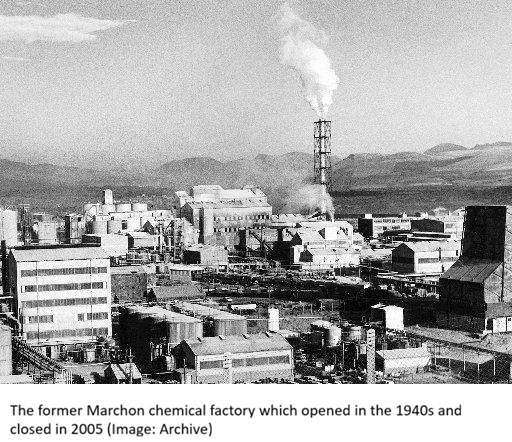
“We have been given no guarantees that this land is safe or that contamination will not be disturbed. It is unclear how old some of the contamination reports are, raising doubts over their accuracy and reliability.“
even the developer admits in the reports they do not fully know what they will uncover until excavation begins.
By Lucy Jenkinson, 10th December 2025, https://www.whitehavennews.co.uk/news/25684633.decision-due-controversial-plans-139-homes-old-marchon-site/
CONTROVERSIAL plans to build 139 homes on the site of a former chemical factory have been approved by planners today.
The application put forward by Persimmon Homes to build houses on the old Marchon site at Kells in Whitehaven, was considered by Cumberland Council’s planning committee this afternoon (December 9).
Members visited the site, which was formerly used to produce ingredients for detergents and toiletries from the 1940s until 2005, before making their decision.
The application is for phase one of the scheme, with an area of land designated to provide a commercial related development within phase two.
Persimmon Homes say the location creates an opportunity for ‘a vibrant residential development of good quality design’ and a range of housing types would be provided to meet local needs.
Access points would be created off High Road and there would be an opportunity to link with an existing national pedestrian and cycle network.
Concerns had been raised by some residents living nearby over the risk of contaminated land and the capacity of local services including school places and GP surgeries.
One resident who lives at Saltom Bay Heights said: “We have been given no guarantees that this land is safe or that contamination will not be disturbed. It is unclear how old some of the contamination reports are, raising doubts over their accuracy and reliability.”
“Proper up-to-date testing of the land has not been carried out, and even the developer admits in the reports they do not fully know what they will uncover until excavation begins. There are known areas where digging is restricted, yet no reassurance has been provided on what happens if contamination is released.
“There are not enough school places and GP surgeries and dental services are already overstretched in Whitehaven, yet these pressures have not been properly addressed. Approving this development without fully resolving these risks would be reckless and irresponsible. They can’t control the winds and airborne chemical contamination.”
Paula and Gary Marsh, who also live at Saltom Bay Heights, said they were ‘deeply concerned’ about the risk of airborne chemicals during excavation.
They said: “This development is being pushed forward without certainty, without transparency, and without adequate protection for public health. These risks are real, current, and long-term, and they cannot be dismissed.”
A remediation statement submitted with the application, which dates back to 2007, says the site was designated as contaminated land by the former Copeland Council, on the basis of sixteen pollutant linkages. These included petroleum hydrocarbons, phosphates and metals such as arsenic, copper, lead and mercury.
The Environment Agency said in its initial response to the plans that it considered the scheme to be ‘acceptable’ in principle but further detail should be agreed with the planning authority.
It also said if contamination not previously identified was found to be present at the site then no further development should be carried out until a remediation strategy detailing how the contamination would be dealt with had been approved by the local planning authority.
Persimmon Homes was approached for comment by The Whitehaven News.
1 This Month



Shut down the radiation-damaged Heysham nuclear reactors now
To see nuclear-related stories in greater depth and intensity – go to https://nuclearinformation.wordpress.com

Say No to NASA’s Reckless Nuclear Reactor on the Moon
Say No to NASA’s Reckless Nuclear Reactor on the Moon
-
Archives
- October 2026 (256)
- September 2026 (339)
- August 2026 (330)
- July 2026 (355)
- June 2026 (287)
- May 2026 (306)
- April 2026 (356)
- March 2026 (251)
- February 2026 (267)
- January 2026 (308)
- December 2025 (358)
- November 2025 (359)
-
Categories
- 1
- 1 NUCLEAR ISSUES
- business and costs
- climate change
- culture and arts
- ENERGY
- environment
- health
- history
- indigenous issues
- Legal
- marketing of nuclear
- media
- opposition to nuclear
- PERSONAL STORIES
- politics
- politics international
- Religion and ethics
- safety
- secrets,lies and civil liberties
- spinbuster
- technology
- Uranium
- wastes
- weapons and war
- Women
- 2 WORLD
- ACTION
- AFRICA
- Atrocities
- AUSTRALIA
- Christina's notes
- Christina's themes
- culture and arts
- Events
- Fuk 2022
- Fuk 2023
- Fukushima 2017
- Fukushima 2018
- fukushima 2019
- Fukushima 2020
- Fukushima 2021
- general
- global warming
- Humour (God we need it)
- Nuclear
- RARE EARTHS
- Reference
- resources – print
- Resources -audiovicual
- Weekly Newsletter
- World
- World Nuclear
- YouTube
-
RSS
Entries RSS
Comments RSS

