Call for evidence on building nuclear for a new UK “golden age of clean energy abundance”
The UK is embarking on an ambitious programme of
investment in nuclear energy, seeking to reverse decades of declining
capacity. The Government is counting on new nuclear to help deliver energy
security and decarbonise electricity generation. Announcing funding for the
Sizewell C nuclear power plant in June, the Energy Secretary said “we
need new nuclear to deliver a golden age of clean energy abundance.”
But past promises of a golden age of nuclear energy have failed to materialise.
A new reactor has not been connected to the grid for 30 years. Nuclear
projects have historically faced unique barriers, including complex
regulatory and planning processes. The Government now aims to deliver
reforms to streamline planning approvals and give greater certainty to
developers. The Energy Security and Net Zero Committee is now inviting
written submissions to help assess whether EN-7 provides a coherent and
effective framework for enabling the UK’s nuclear ambitions.
Energy Security and Net Zero Committee 17th July 2025, https://committees.parliament.uk/committee/664/energy-security-and-net-zero-committee/news/208378/call-for-evidence-on-building-nuclear-for-a-new-uk-golden-age-of-clean-energy-abundance/
We’ll stop Nimbys from blocking nuclear power stations, say Tories.
The rule changes would see planning officers ignore all environmental
considerations when building a new nuclear site,
Party wants to make it impossible to challenge plans using environmental impact assessments or habitat regulations
Nimbys will be stopped from blocking nuclear power stations in their area
under Tory plans. The party wants to end the “absurd” blocking of new
nuclear sites through environmental impact assessments or regulations on
habitats, and would make it impossible to challenge a new power station in
court.
The Tories have submitted amendments to the Government’s Planning
and Infrastructure Bill that would exempt nuclear power stations from being
blocked or delayed on environmental grounds, to speed up energy production
in the UK. They accused Ed Miliband, the Energy Secretary, of presiding
over “the highest prices for offshore wind in a decade” and called for
more nuclear power to meet the UK’s growing demand for electricity.
The rule changes would see planning officers ignore all environmental
considerations when building a new nuclear site, which is likely to anger
locals and lead to public opposition. Writing for The Telegraph, Claire
Coutinho, the shadow energy secretary, said the new Hinkley Point C power
station in Somerset is set to be the most expensive in history because of
“bureaucracy and rampant lawfarism”. “[There is] Endless lawfare,
environmental paperwork, and legal challenges that do little to protect
nature but create plenty of expensive work for planning consultants and
pencil-pushing bureaucrats,” she said. “Every single delay and absurd
mitigation measure adds more cost.”
The amendments would only become law
with the support of Labour MPs, which is not expected to happen. Labour has
previously said it will reform the same rules raised by the Conservatives,
but will not exempt them from judicial review or all environmental
assessments.

Responding to the Conservative proposal, Sam Richards, chief
executive of pro-growth campaign group Britain Remade, said the UK had the
“worst of both worlds” with a planning system that does not protect
nature and slows down infrastructure projects. “These amendments are
radical, but the status quo where safe, clean nuclear power projects are
delayed and made more expensive due to repeated legal challenges and poorly
drafted environmental legislation is intolerable,” he said.
Telegraph 18th July 2025, https://www.telegraph.co.uk/news/2025/07/18/tories-stop-nimbys-block-nuclear-power-hinkley-fish-disco/
Miliband bets on nuclear fusion in bid to lead (?)clean power race.

Energy Secretary to make it easier for developers to build reactors with planning shake-up
Ed Miliband has taken a bet on nuclear fusion one day powering Britain by
making it easier for developers to build new reactors with minimal planning
restrictions.
Fusion plants are to be included in the UK’s national
infrastructure planning system, meaning they can be built in any part of
Britain without needing consent from local authorities and with little
opportunity for local people to object. Mr Miliband said the aim was to
ensure fusion, if it ever works, could rapidly become part of the UK energy
system.
Telegraph 18th July 2025, https://www.telegraph.co.uk/business/2025/07/18/miliband-bets-on-nuclear-fusion-by-making-it-easier-to-buil/
Sizewell C | Investor withdraws from consortium set for 25% stake.
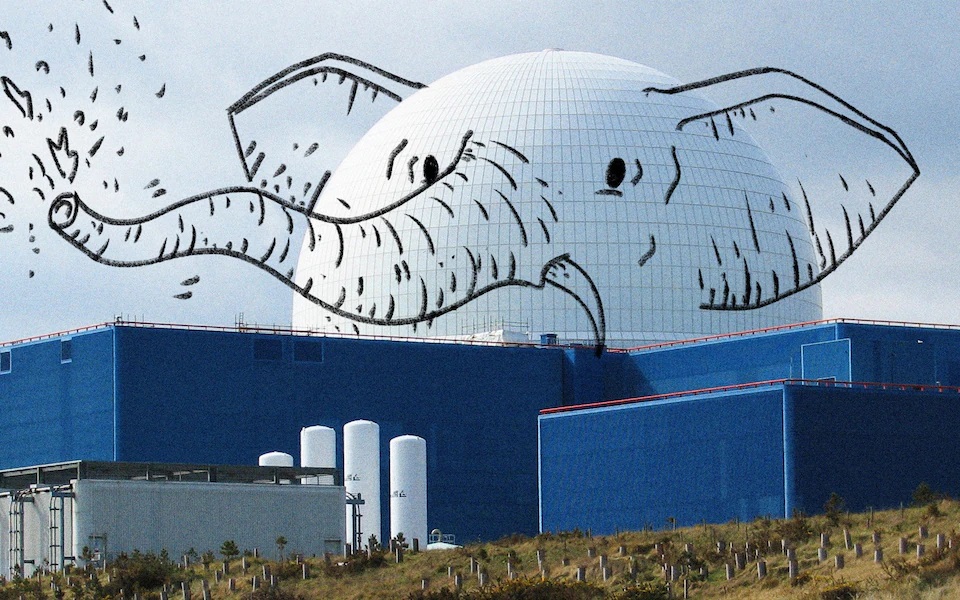
17 Jul, 2025 By Tom Pashby, https://www.newcivilengineer.com/latest/sizewell-c-investor-withdraws-from-consortium-set-for-25-stake-17-07-2025/
One of the investors reported to be considering a stake in Sizewell C has decided to withdraw, while the government is no longer planning to classify nuclear energy as “sustainable”.
Schroders Greencoat, which describes itself as “a specialist renewables infrastructure investor”, was previously reported to be one of the companies considering an ownership stake in Sizewell C.
It was widely reported that Schroders Greencoat was one of the companies in the consortium led by Brookfield Asset Management, which was in total considering a 25% stake in the nuclear power plant.
In an email dated 16 July seen by NCE, the investor said it no longer wishes to invest in the project on the Suffolk coast.
Wait for final investment decision continues
Sizewell C must achieve its final investment decision (FID) before main construction can start.
Despite the delay, Sizewell C has committed over £2.5bn on contracts.
It is now expected that the final investment decision will be taken this summer.
Nuclear dropped from sustainable finance classification plans
The UK Government recently decided to not go ahead with plans to create a UK Green Taxonomy for financial investments, meaning that it won’t have a specific classification of certain areas of activity, like nuclear power, as “sustainable”.
This had been a plan hatched by former chancellor Jeremy Hunt in the 2023 Spring Budget, but NCE found that no work had gone towards this 16 months later.
HM Treasury economic secretary to the treasury and city minister Emma Reynolds announced the decision in the UK Green Taxonomy Consultation Response.
“To make sure the UK is well-positioned to capture [growth in the green economy], the government is delivering a world-leading sustainable finance framework,” Reynolds said.
“This includes ensuring that we have the right tools in place and the proportionate regulation that is needed to support the transition, strengthening the UK’s position as the sustainable finance capital of the world so that the UK can lead the clean energy transition at home and abroad.
“That is why, after careful consideration, the government has concluded that a UK Taxonomy would not be the most effective tool to deliver the green transition and should not be part of our sustainable finance framework.
“Whilst our ambitions to continue as a global leader remain unchanged, the consultation responses showed that other policies were of higher priority to accelerate investment into the transition to net zero and limit greenwashing.”
It is understood that the decision to drop plans for the taxonomy may have contributed to Schroders Greencoat’s withdrawal from investing in Sizewell C.
Anti-Sizewell C campaign attributes withdrawal to taxonomy decision
Stop Sizewell C executive director Alison Downes said: “It’s welcome news that Schroders Greencoat won’t be investing in Sizewell C.
Based on our dialogue with Schroders, we attribute this to the government deciding not to adopt a green taxonomy, which thankfully has the outcome that nuclear energy cannot be erroneously labelled ‘green’.
“We wish that other investors would take the same view and exit Sizewell C forthwith.”
No comment from parties to negotiations
The negotiations around the final investment decision are often described as commercially sensitive, and as such the government doesn’t tend to comment.
This hasn’t stopped sources informing the media about certain parts of the negotiations, like the report in the FT that the government is now taking a minority ownership stake.
The Department for Net Zero and Energy Security, Sizewell C and Schroders Greencoat did not supply a comment.
Workers at Hinkley Point C nuclear plant stage wildcat strike over alleged bullying
Hundreds of mechanical engineers stopped work in protest over
‘management practices’ at construction site. A group of mechanical
engineers numbering in the low hundreds stopped work on Tuesday without the
backing of their trade unions amid deepening woes within the 26,000-strong
workforce over the conditions on the site.
It was the second unofficial
strike to take place in a week after a walkout last Wednesday in defiance
of union reps and the site developer, French utility company EDF, following
claims that senior managers on the Hinkley site have bullied engineering
staff. A contract worker on the project, which is running years late and
billions of pounds over budget, told the Guardian one of the incidents was
believed to have involved a senior manager bullying a young woman on the
team.
“They’ve had enough, and they’re out the gate,” he said.
Trade union Unite confirmed that a number of workers are taking part in a
protest over “management practices” which has resulted in the workers
being removed from the site. “Unite expects this matter to be resolved
soon,” a spokesperson said. The Guardian understands that EDF, which is
developing the first new nuclear reactor in a generation at Hinkley Point,
has begun an independent investigation into the alleged bullying on site.
The row has emerged days after the UK nuclear watchdog confirmed it would
prosecute EDF alongside the site’s main contractors Bouygues Travaux
Publics and Laing O’Rourke for health and safety offences over the death
of a site supervisor at the site after an accident in 2022.
Guardian 15th July 2025, https://www.theguardian.com/uk-news/2025/jul/15/workers-hinkley-point-c-nuclear-plant-stage-wildcat-strike-over-alleged-bullying
Improvements required at Sellafield after lead oxide release
The Office for Nuclear Regulation (ONR) has served an improvement notice
on Sellafield Ltd following an incident at the Cumbria site. In April, an
unintentional release of lead oxide was detected at the First Generation
Magnox Storage Pond (FGMSP) facility when workers noticed the degraded
condition of some flexible lead shielding.
Lead shielding sheets are used
across the site to protect workers from potential exposure to radiation.
The coating on the sheets used on the FGMSP skip handling machine had
degraded over time, resulting in lead oxide being released which posed a
potential risk to workers. Further enquiries have identified a number of
other locations across the Sellafield site where degraded flexible lead
shielding sheets caused a risk of lead exposure. Lead oxide is not a
radioactive substance, but can be harmful if ingested, inhaled or absorbed.
ONR 9th July 2025, https://www.onr.org.uk/news/all-news/2025/07/improvements-required-at-sellafield-after-lead-oxide-release/
Construction workers walk out at Hinkley Point C
Thousands of construction workers have walked out unofficially at the
massive Hinkley Point C nuclear power plant against bullying management. As
we go to press, they are still out. It has been estimated that there are
12,000 workers on the site, organised by Unite and the GMB, and it is
reported that anything from 2,000 to 4,000 workers are involved in this
dispute, reportedly at MEH Alliance – bringing together Altrad Services,
Cavendish, Balfour Beatty, NG Bailey and Altrad Babcock.
Socialist Party 15th July 2025,
https://www.socialistparty.org.uk/articles/140831/15-07-2025/construction-workers-walk-out-at-hinckley-c/
Hoping for nuclear to boost the economy -will not end well.
Samuel Rafanell-Williams, Scottish CND:
MANY readers will be conscious of
the emerging PR operation to promote nuclear power and admonish the
Scottish Government over its long-standing opposition to new nuclear
projects in Scotland.
This comes at a time when The Ferret reported 585
cracks in the reactor of the Torness nuclear plant in East Lothian,
prompting fears about radioactive risks (Hunterston B power station was
closed in 2022 following the discovery of 586 reactor cracks).
The industrial messes of the Hinkley and Sizewell nuclear projects in England,
both running billions over budget, also don’t sweeten the case for
starting similar projects in Scotland.
Transparently, this media drive is
an attempt to manufacture consent for new potential nuclear plants in
Scotland in the wake of the UK Government’s recent proud announcement of
“Nuclear Britain”.
These PR efforts in Scotland are being led by
lobbyists like Britain Remade, a group composed of former Tory party
officials firmly committed to lifting Scotland’s ban on nuclear power, as
recently reported by Bella Caledonia.
Make no mistake, the UK
Government’s promotion of nuclear power is integral to its vision of a
war economy: massive investment, including exorbitant public expenditure,
into so-called “civilian” nuclear power (£40 billion-plus for Hinkley,
£40bn-plus for Sizewell) is a precondition for shoring up the nuclear
weapons industry. As Scottish CND have frequently argued, much of the same
technical expertise, personnel and fissile materials are required in both
fission and the production of warheads and propulsion reactors for naval
vessels. All nuclear states know building their omnicide weapons relies on
a nuclear power programme.
The National 11th July 2025, https://www.thenational.scot/politics/25305651.hoping-nuclear-boost-economy-will-not-end-well/
SIZEWELL C, RISING SEA LEVELS AND EDF’s SILENCE

The dust has just about settled since Labour’s ‘golden nuclear
moment’ laid out by Rachel Reeves in her recent Spending Review. Plans
for the monstrous Sizewell C took another step forward, nudged along by the
offer of another £14.2 billion of taxpayers’ money, together with a
further £2.5 billion promised for Small Modular Reactors, and roughly the
same amount for fusion, the nuclear industry’s very own black hole.
So
loud were the fanfares, so overblown the hype, that the real story of that
week got lost. EDF’s deeply ingrained habits of secrecy and deceit were
– yet again – exposed to the harsh light of a Freedom of Information
request from the indefatigable Together Against Sizewell C (TASC). One of
the principal concerns that TASC has doggedly pursued over the last few
years is the vulnerability of Sizewell C being built on one of Europe’s
most rapidly eroding coastlines and its lack of resilience to the impacts
of climate change. The evidence regarding future sea level rise goes from
deeply worrying to totally terrifying – with the very real possibility of
at least a 1 metre rise – and possibly as much as 2 metres – by 2100.
Given that the spent fuel used at Sizewell C throughout its operating life
(around 4,000 tonnes) will need to be stored on site until at least 2160
this is clearly a matter of the greatest concern.
Johnathon Porritt 7th July 2025, https://jonathonporritt.com/sizewell-c-flood-risk-and-edf-silence/
Staff walk out at Hinkley Point C over alleged ‘bullying’
“This bullying has been going on for far too long.”
Staff at Hinkley Point C walked out
on an unofficial strike on Wednesday over alleged bullying. An unconfirmed
number of workers in the MEH group of contractors have downed tools at the
nuclear power station construction site in Somerset yesterday (July 9). A
person involved in the staff walk out told the Local Democracy Reporting
Service it was a response to bullying from senior management. They said:
“This bullying has been going on for far too long.”
Somerset Live 10th July 2025, https://www.somersetlive.co.uk/news/local-news/staff-walk-out-hinkley-point-10333388
Why new nuclear power is a bad way to balance solar and wind
As we continue to respond to the coordinated propaganda campaign for new nuclear power in Scotland we hear from David Toke, the author of the book ‘Energy Revolutions – profiteering versus democracy’ (Pluto Press).
In the UK it has almost become an accepted truth in the media that new nuclear power is needed because there is no other practical or cheaper way to balance fluctuating wind and solar power. Yet not only is this demonstrably false, but it actually runs counter to the way that the UK electricity grid is going to be balanced anyway. Essentially the UK’s increasingly wind and solar dominated grid is going to be balanced by gas engines and turbines that are hardly ever used. But you would never guess this from the coverage.
Bella Caledonia 9th July 2025,
https://bellacaledonia.org.uk/2025/07/09/why-new-nuclear-power-is-a-bad-way-to-balance-solar-and-wind/
UK Moves Closer to Approving Sizewell C Nuclear Plant Project
The UK government has reached a deal with French authorities, allowing
Electricite de France SA (EDF) to retain a 12.5% stake in the Sizewell C
nuclear reactor project. The UK government and other investors will hold
the remaining stake, with the UK investing £14.2 billion in the project to
replace aging atomic plants and provide low-carbon electricity. EDF is set
to hold a board meeting to greenlight its participation in Sizewell C,
which will help the UK government make a final investment decision on the
project soon after.
Bloomberg 7th July 2025, https://www.bloomberg.com/news/articles/2025-07-07/uk-moves-closer-to-approving-sizewell-c-nuclear-plant-project
Trawsfynydd unlikely for new nuclear development, council hears.
Gwynedd Council indicates it’s highly unlikely Trawsfynydd will see new nuclear
projects soon, focusing instead on a science park. It is “highly
unlikely” that Trawsfynydd will be considered for new nuclear development
in the near future. Gwynedd Council’s full meeting on 3 July heard that
despite “uncertainty” over the site, work was underway with partners to
establish a science park and future jobs. Decommissioning work was
programmed until 2060, according to Nuclear Restoration Services plans.
“There is considerable uncertainty about the direction of government’s
policy, funding and priorities, which means that it is highly unlikely that
the Trawsfynydd site will be considered by government and the private
sector for new nuclear development in the near future”.
Cambrian News 8th July 2025, https://www.cambrian-news.co.uk/news/trawsfynydd-unlikely-for-new-nuclear-development-council-hears-810243
Energy Scotland’s John Proctor responds to The Herald’s pro-nuclear spread.
Nuclear power in Scotland – not needed, not economic, not wanted, not safe

Leah Gunn Barrett, Jul 07, 2025, https://dearscotland.substack.com/p/energy-scotlands-john-proctor-responds
Energy Scotland* convener John Proctor has given me permission to publish a letter he sent to The Herald in response to its series of pro-nuclear articles published at the end of June. The Herald is owned by London-based Newsquest which, in turn, is owned by US media conglomerate, Gannett. The Herald has not published his letter.
I see Joani Reid MP has joined Anas Sarwar MSP and Michael Shanks MP in the chorus calling for new nuclear energy plant in Scotland (The Herald 28th June).
Of course, Joani has no concerns about someone building one of these in her back-yard – as her back-yard is in London, but Michael Shanks was bit more bullish when he declared he would be relaxed about having a Small Modularised Reactor (SMR) erected in his constituency. I am not sure how the good people of Rutherglen feel about this.
What I find mystifying is the lack of proper scrutiny being applied to the claims made by those members of the Nuclear Energy All-Party Parliamentary Group and their well-funded nuclear lobbyists. It does not surprise me that they are unable to set out what configuration they favour, as the reactors which they claim will produce 400 MWs do not exist. They have not been manufactured, tested or installed – anywhere!
As an Engineer, I would be keen to ask the politicians if they have thought about some of the basic elements of a power plant. Do they have any ideas what the thermal capacity of the proposed reactors are? Have they understood what the cooling requirements might be? How about the status of design of the ‘core catcher’ (the system designed to prevent a Chernobyl type event)?
Be under no illusion, Ms Reid, Mr Shanks and Mr Sarwar and the Nuclear lobby are building a Potemkin village.
They of course don’t want to talk about the European Power Reactor (EPR) configuration being installed at astronomical cost at Hinkley C.
This project is forecast to cost £45,000,000,000 when it finally comes on line sometime next decade. It is not easy to get a proper sense of this sum – but it might surprise the readers of The Herald that this is the equivalent of paying £1 million every single day for 110 years – and this is just the construction cost. We have not even started talking about operational costs, asset management and asset decommissioning.
Hinkley C is the same configuration Labour have just committed to at Sizewell C. Are we really gullible enough to believe Julia Pyke (Managing Director of Sizewell C) when she assures us that the Consortium have learned the lessons from Hinkley C?
If I can be generous for a moment, and accept that they can achieve a 10% saving relative to Hinkley C, that would still indicate a £40 billion project cost – which is enough to build 80 hospitals similar to the Forth Valley Hospital.
When Ms Pyke was recently asked on BBC how the project was going, she answered airily that it is ‘on schedule and within budget’. I waited eagerly for the obvious follow up question – ‘What is the budget and schedule?’ but that question never came.
The supporters of nuclear energy tell us that we need these plants for baseload capacity. They fail to acknowledge that in Scotland, we already generate more capacity from renewables than we consume – and this surplus is only going to grow as we continue to see more investment in wind, solar, tidal and energy storage.
‘What about intermittency and lack of system inertia?’ is the nuclear advocates’ stock question when discussing the growth of renewables.
The answer is beautifully simple – we will continue to do what we do now – rely on gas fired CCGTs (Combined-Cycle Gas Turbines). Which is reassuring – as there will be no nuclear plant coming on stream anytime soon.
‘But what about Net Zero?’ might be the next question. Thankfully, there are a raft of solutions to this currently available and more coming on stream every week. For example, gas turbine manufacturers are again building on 50 years of experience of burning hydrogen in gas turbines, and they will be ready to burn hydrogen or blended hydrogen/methane as quickly as the hydrogen market can come on stream.
My prediction is that the hydrogen market will come on stream faster than any SMRs (Small Modular Reactors) can be built – and if UK politicians had a strategic bone in their body, they would be trying to beat our friends in Europe to win the hydrogen race.
However as we have seen with HS2 and the third runway at Heathrow, they will carry on with their blundering plans to build new nuclear.
This comes to the final question that is not asked of nuclear supporting friends in the English Labour and Tory parties. How will they reduce the cost of energy when they are committed to this ruinously expensive nuclear build program?
The UK Government have no answer to this – and this is why the Scottish Government must keep in place the moratorium on new nuclear in Scotland and continue their support of renewables such as tidal power and also fully commit to their Hydrogen Action Plan.
John Proctor
Convener – Energy Scotland
*Energy Scotland, a member of the Independence Forum Scotland (IFS), is an association of Scottish-based energy professionals committed to addressing Scotland’s energy challenge of building a secure, decarbonised, affordable energy system which benefits Scottish industry and consumers.
Sellafield nuclear power plant safety fears as ‘potentially deadly nitrogen gas leaks’
One incident involved an ‘elevated level’ of nitrogen gas,
which can cause asphyxiation, at the plant’s Magnox facility. The incident
was played down, the source claimed.
Safety at the UK’s biggest nuclear
site is under threat due to a culture of secrecy and ‘cover ups’, a whistle
blower told the Mirror. The source described a potentially deadly incident
in which nitrogen gas, which can cause asphyxiation, leaked at the
Sellafield Magnox storage facility. The incident was covered up, the source
claimed, adding that staff are afraid to raise safety issues because they
fear they will be “targeted”.
The leak was at the Magnox Swarf Storage
Silo – the most hazardous building within Sellafield in Cumbria – where
waste products from used nuclear fuel rods are stored. The source said the
leak in May 2023 was raised as an incident report and “was of a level
that needed to be escalated”. But it was not escalated, according to the
whistleblower, who added that “no lessons were learned”. They said:
“There is no confidence or trust in the senior management now. We are
dealing with nuclear waste and people are afraid to speak up.
The problem is that people are being victimised if they report safety issues. “Or
they are escalated to managers who then try to cover them up or sweep them
under the carpet. And that is a really dangerous culture in a place like
Sellafield.”
Mirror 5th July 2025,
https://www.mirror.co.uk/news/uk-news/sellafield-nuclear-power-plant-safety-35504096
1 This Month

of the week – Shut Down Drone Warfare!


Tell the Ukrainian Government to Drop Prosecution of Peace Activist Yurii Sheliazhenko

Petition to revoke the licensing of the Near Surface Nuclear Disposal Facility (NSDF) at Chalk River. https://www.ourcommons.ca/petitions/en/Petition/Details?Petition=e-7247
To see nuclear-related stories in greater depth and intensity – go to https://nuclearinformation.wordpress.com
-
Archives
- April 2026 (68)
- March 2026 (251)
- February 2026 (268)
- January 2026 (308)
- December 2025 (358)
- November 2025 (359)
- October 2025 (376)
- September 2025 (257)
- August 2025 (319)
- July 2025 (230)
- June 2025 (348)
- May 2025 (261)
-
Categories
- 1
- 1 NUCLEAR ISSUES
- business and costs
- climate change
- culture and arts
- ENERGY
- environment
- health
- history
- indigenous issues
- Legal
- marketing of nuclear
- media
- opposition to nuclear
- PERSONAL STORIES
- politics
- politics international
- Religion and ethics
- safety
- secrets,lies and civil liberties
- spinbuster
- technology
- Uranium
- wastes
- weapons and war
- Women
- 2 WORLD
- ACTION
- AFRICA
- Atrocities
- AUSTRALIA
- Christina's notes
- Christina's themes
- culture and arts
- Events
- Fuk 2022
- Fuk 2023
- Fukushima 2017
- Fukushima 2018
- fukushima 2019
- Fukushima 2020
- Fukushima 2021
- general
- global warming
- Humour (God we need it)
- Nuclear
- RARE EARTHS
- Reference
- resources – print
- Resources -audiovicual
- Weekly Newsletter
- World
- World Nuclear
- YouTube
-
RSS
Entries RSS
Comments RSS
 nuclear-news