The Welsh Government’s Lesley Griffiths said she hoped the declaration would trigger “a wave of action”.
Climate change threatens Wales’ health, economy, infrastructure and natural environment, she said……

 Irish Times 6th May 2019 In the quagmire of Brexit there is little to commend the UK government’s approach. This is in stark contrast with its clarity and leadership on climate change. It is the first national parliament to declare an “environmental and climate emergency”.
It has not only committed to “net-zero” greenhouse gas emissions by 2050, the climate change committee in Westminster has set out how this can be achieved. Net zero means, in effect, eliminating its carbon footprint in a dramatically transformed economy built on sustainability with a near absence of fossil fuels.
Ireland has some way to go before it could commit to such a course, but a Government report due in the coming weeks must show a similar level of intent, and include a roadmap to reduce the shocking levels of Irish emissions. Declaring an emergency may seem like tokenism but it injects urgency into consideration of the best course to take. Wicklow County
Council was the first Irish local authority to declare a “biodiversity and climate change emergency”.
The Government should endorse a similar vote in our national parliament and introduce binding legislation on revised targets.
Press and Journal 4th May 2019 Highland Green MSP John Finnie has expressed concern after three quartersof a ton of highly enriched uranium was transported from Dounreay in
Caithness to America. He said: “The appropriate place for dangerous
material is secure storage and supervision by highly trained staff where it
was created, not transportation.
“Whilst pleased that this risky has been completed without incident, that we know of. “But before the authorities on both sides of the Atlantic pat themselves on the back, they need to
reflect on the dangers they put communities in. “As was evidenced when a
ship which was transporting nuclear material in the Moray Firth went on
fire. As with oil and gas reserves, the message regarding nuclear waste has
to be ‘keep it in the ground’.”
 Why is Westminster Abbey about to hold a bizarre thanksgiving for Britain’s nuclear weapons? https://www.independent.co.uk/voices/nuclear-weapons-westminster-abbey-cnd-bruce-kent-church-a8893106.html – 1 May 19
I think they’re right and the Abbey has got this very wrong. These submarines are nuclear weapon submarines. Their crews, trained to obey orders, are ready to fire missiles whose warheads will bring destruction to faraway places and people far beyond the scale of Hiroshima or Nagasaki.
My opposition to potential war crimes of this magnitude will motivate me to join a vigil outside the Abbey. I do not blame the sailors. The history of nuclear weaponry has been from the beginning one of deceit.
We were, and are, told that the bombs dropped on Hiroshima and Nagasaki were the only way to end the Second World War. Not true. The Japanese leadership, ready to surrender, were looking for one guarantee – that the position of the Emperor would not be challenged in any surrender settlement and that he would not be prosecuted. That was just what was given by General MacArthur but only after the bombs were dropped. Why were they dropped then? As a warning to the Soviets and to see if they “worked”? Probably.
We are never told about the few scientists, like Professor Joseph Rotblat, then in Los Alamos, who refused to continue to work on the bomb once he knew how it was to be used. He was sent back to Britain in 1944 in disgrace.
Not many church voices in this country were raised in opposition at the use of these bombs. One was that of Cuthbert Thickness, the Dean of St Albans Abbey. When he was supposed to have rung the bells in thanksgiving, he said in August 1945 “I cannot honestly give thanks to God for an event brought about by the wrong use of force, by an act of wholesale indiscriminate massacre, different in kind over all other acts of open warfare hitherto, however brutal and hideous.”
There were however strong military voices in opposition, to which little attention has been paid. General Eisenhower for instance had this to say: “Japan was at that very moment seeking some way to surrender with minimum loss of face. It was not necessary to hit them with that awful thing.”
We are told now that nuclear weapons and deterrence have kept the peace. What peace?
The list of post-1945 wars runs to several pages and the global military budget is nearly $2tn. If this claim means we have not had a nuclear war then I think we should listen to Robert McNamara, erstwhile US secretary of defense, who said, late in life, that we were saved not by our good judgement but by “good luck”. He had in mind the many accidents and misunderstandings which have dogged our nuclear weapon world.
In 1968 we signed up to the nuclear Non-Proliferation Treaty and promised in “good faith” to work for the elimination of all nuclear weapons.
Yet almost 50 years later we are now spending over £200bn on yet another nuclear weapons system (also entirely dependent on a regular loan of US missiles) to replace Trident.
Surely it is time to start spending our billions not on weapons of mass murder but on our NHS, pensions, welfare and real peace-making initiatives, here and abroad.
There is now a UN treaty on the prohibition of nuclear weapons just waiting for more signatory states to give it the force of law. Britain should sign it and lead the world towards a nuclear-free future.
In these dangerous times, when the threat of nuclear war is growing rather than receding, a thanksgiving service at Westminster Abbey for the so-called nuclear “deterrent” is the last thing we need.
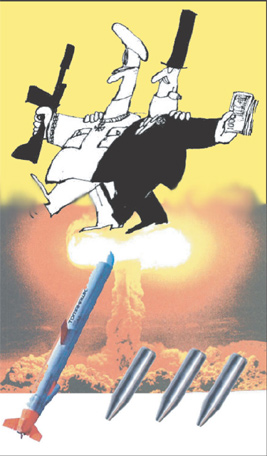 UK Defence Journal 30th April 2019 , A new report has warned that the UK’s nuclear weapons programme could cost £172bn between now and 2070, and suggests the government should
review the UK’s possession of nuclear weapons. The report, published
today by the Nuclear Information Service (NIS), states that the UK must
make a choice in the near future: increase the overall defence budget,
reduce spending on conventional weapons in order to fund nuclear weapons,
or reducing spending on/scrapping the nuclear weapons programme. NIS also
argues that the UK should work to “achieving a nuclear free world”, and
must “re-examine” the case for nuclear disarmament.
https://ukdefencejournal.org.uk/report-warns-of-spiralling-costs-of-uk-nuclear-weapons-programme/
BBC, 29 April 2019 A “climate emergency” has been declared in Wales following protests demanding politicians take action on climate change.
Cold War exhibition tries to airbrush Britain’s dark history of nuclear testing, The Conversation, Researcher, Social History/Tutor in Medical Education, University of Dundee, May 2, 2019 A new exhibition about the Cold War recently opened at the UK National Archives at Kew in south-west London. Protect and Survive: Britain’s Cold War Revealed seeks to tell the story of how the years of high nuclear tensions affected the UK, from spy paranoia to civil defence posters to communications at the heart of government. …..
Files under review
Remembrance, The omissions at the London Cold War exhibition are a reminder about the UK’s low-key approach to its weapons testing history. The story doesn’t only need to be properly told at this exhibition, it needs a permanent public space. Yet no existing museum dedicated to Britain’s wars is interested in giving it house room – not even the records and memorabilia of all the military personnel sent to observe the tests. A number of years ago I was quietly told while walking down a corridor in one major institution not to offer it my own records because “they will end up in the skip”.
My years working in this field indicate to me that successive governments seem to want the story of British nuclear testing to die off naturally. But surely, at the very least, the point of the National Archives is to preserve the records to ensure that it is never allowed to be forgotten. https://theconversation.com/cold-war-exhibition-tries-to-airbrush-britains-dark-history-of-nuclear-testing-116237
Cost of MoD nuclear projects is rocketing The Times, 29 Apr 19, The government’s defence nuclear enterprise will cost 26 per cent more than previously forecast over the next three years, a report says.
The Ministry of Defence is facing a funding gap of up to £14 billion in its ten-year equipment plan. In the report, out tomorrow, the Nuclear Information Service (NIS), a campaign organisation that monitors the nuclear defence industry and promotes transparency, also raises concerns that five upgrade projects within the programme are experiencing financial difficulties. Four upgrade projects have already been scrapped, it says.
The three big upgrade projects for which information is released are rated either “amber/red” or “red”, meaning that delivery of the projects is either under threat or appears impossible.
The report says: “There is serious potential for delays to…(subscribers only) https://www.thetimes.co.uk/article/cost-of-mod-nuclear-projects-is-rocketing-7t2mjl62d
Times 29th April 2019 , Political leaders in Britain are not strong enough to tackle the climate
change crisis, according to one of the country’s leading authorities on the
subject. Lord Stern of Brentford, author of the Stern Review on the cost of
tackling global warming, said that politicians were holding the country
back from making progress on the issue.
“Has the political leadership been
strong enough? No, I don’t think so,” he said. He added that protests by
campaigners such as Greta Thunberg, the 16-year-old climate activist from
Sweden, and Extinction Rebellion, a group that caused disruption in the
capital last week, would help to build awareness and spur politicians into
action.
“Leadership is absolutely fundamental, but that doesn’t come out of
nowhere, it comes as these pressures build,” he said. Lord Stern, a former
chief economist at the Treasury and the World Bank, is among Britain’s most
respected thinkers on the environmental crisis. In 2006 he published The
Stern Review: The Economics of Climate Change, which described global
warming as the “greatest and widest-ranging market failure ever seen”.
He told The Times that policymakers needed to act to avert a catastrophic rise
in global temperatures. If they waited an additional ten to fifteen years
before taking radical steps to reduce carbon emissions, it would be too
late, he said.
https://www.thetimes.co.uk/article/c233cb30-69e1-11e9-95be-9353feb218cd
 International outcry at ‘Thanksgiving’ service for nuclear weapons at Westminster Abbey ww.ekklesia.co.uk/node/28146, By agency reporter. APRIL 28, 2019, The international Anglican Communion has expressed widespread concern about the upcoming ‘National Service of Thanksgiving’ for nuclear weapons, which is being held at Westminster Abbey on Friday 3 May 2019.
More than 175 Anglican clergy members have signed a statement, coordinated by the Christian Campaign for Nuclear Disarmament (Christian CND), calling for the service to be stopped. The signatories to the statement come from the United Kingdom, the United States, Brazil, Germany, Australia, New Zealand and Canada. They include eight current or former bishops.Christian CND commended the Church of England for overwhelmingly passing a motion at General Synod in 2018 which noted that nuclear weapons have “indiscriminate and destructive potential” which urges Anglicans to “work tirelessly for their elimination across the world”.
Martin Tiller, Co-Chair of Christian CND said, “Christians around the world will find this service, described by the Royal Navy as a ‘celebration’, to be completely inappropriate. For centuries, Christians have been praying for peace, and we simply do not accept that a so-called ‘nuclear deterrent’ is God’s answer to that prayer. The huge support for our The international Anglican Communion has expressed widespread concern about the upcoming ‘National Service of Thanksgiving’ for nuclear weapons, which is being held at Westminster Abbey on Friday 3 May 2019.
More than 175 Anglican clergy members have signed a statement, coordinated by the Christian Campaign for Nuclear Disarmament (Christian CND), calling for the service to be stopped. The signatories to the statement come from the United Kingdom, the United States, Brazil, Germany, Australia, New Zealand and Canada. They include eight current or former bishops.Christian CND commended the Church of England for overwhelmingly passing a motion at General Synod in 2018 which noted that nuclear weapons have “indiscriminate and destructive potential” which urges Anglicans to “work tirelessly for their elimination across the world”.
Martin Tiller, Co-Chair of Christian CND said, “Christians around the world will find this service, described by the Royal Navy as a ‘celebration’, to be completely inappropriate. For centuries, Christians have been praying for peace, and we simply do not accept that a so-called ‘nuclear deterrent’ is God’s answer to that prayer. The huge support for our petition and clergy statement demonstrates that many, many other Christians agree with us.”
The Rt Rev Andrew Hedge, Bishop of Waipu, New Zealand said,”New Zealand has a proud record of being opposed to nuclear weapons and has already ratified the UN Treaty on the Prohibition of Nuclear Weapons. I welcome the motion passed by Church of England General Synod in support of the Treaty, and believe that the witness of the church needs to be invested in working to bring about a nuclear weapons-free world. Recognition of the long-standing commitment of the naval submariners to vigilant patrol is laudable; however, the idea of aligning that celebration with the threat of potential indiscriminate destruction through the use of nuclear weapons is completely counter to the witness of the Church in the proclamation of the gospel.”
Christian CND will be taking part in an alternative witness outside Westminster Abbey on Friday 3 May, gathering at 11:30 for reflection and prayer before the witness begins at 12 noon. The witness will be inter-denominational with Methodist, Quaker, Catholic and Anglican representation. The witness is being supported by the Network of Christian Peace Organisations, Pax Christi, the Anglican Pacifist Fellowship, the National Peace and Justice Network, Church and Peace and the Fellowship of Reconciliation.
* Read the statement and a full list of signatories here
* Christian Campaign for Nuclear Disarmament http://christiancnd.org.uk/
|
Corbyn launches bid to declare a national climate emergency, Guardian, Toby Helm
Sun 28 Apr 2019 Labour will attempt to force Commons vote as it is revealed that the government has failed to spend anti-pollution cash, Labour will this week force a vote in parliament to declare a national environmental and climate change emergency as confidential documents show the government has spent only a fraction of a £100m fund allocated in 2015 to support clean air projects.Jeremy Corbyn’s party will demand on Wednesday that the country wakes up to the threat and acts with urgency to avoid more than 1.5°C of warming, which will require global emissions to fall by about 45% from 2010 levels by 2030, reaching “net zero” before 2050. The move will place Conservative MPs under pressure to back the plan, or explain why they refuse to do so, now fears over the combined problems of air pollution and climate change have risen to the top of the political agenda. On Saturday night Corbyn said the recent wave of protests were “a massive and necessary wake-up call” that demanded “rapid and dramatic action, which only concerted government action and a green industrial revolution can deliver.” He said that if parliament backed the move and became the first national legislature to declare a climate emergency it would “trigger a wave of action from governments around the world”. The motion was welcomed by Greta Thunberg, the 16-year-old Swedish climate activist who has criticised the inaction of the world’s politicians. “It is a great first step because it sends a clear signal that we are in a crisis and that the ongoing climate and ecological crises must be our first priority,” she said. “We can not solve an emergency without treating it like an emergency. “I hope the other UK political parties join in and together pass this motion in parliament – and that political parties in other countries will follow their example.” ….. This week, Pascal Lamy, the World Trade Organisation’s former director general, will add to the pressure on the government, warning a London audience that Brexit risks damaging the UK’s leadership on climate change. Lamy’s intervention accompanies new research from leading lawyers showing that existing preparations would not prevent damaging roll-backs on key climate change and environmental protections. It comes just days before the Committee on Climate Change publishes advice to the government on long-term climate change targets. Lamy will say: “It is vital that any new trade deal or environment treaty between the UK and EU protects the region’s global leadership position on climate change. Without safeguardsto ensure strong continued cooperation and alignment, Brexit could destroy environmental protections – well beyond allowing chlorinated chicken imports.” Writing in Sunday’s Observer shadow business secretary Rebecca Long-Bailey says: “Unless we take rapid action to reduce the amount of carbon dioxide we are releasing into the atmosphere, we face total catastrophe.” https://www.theguardian.com/environment/2019/apr/27/corbyn-declares-national-climate-emergency |
|

 Guardian 26th April 2019, Activists who took part in the Extinction Rebellion protests have announcedthey will stand in the European elections on a “climate emergency” ticket.
Under the name Climate Emergency Independents the new group, which is
separate from Extinction Rebellion, nine candidates will stand in the 23
May polls – seven in London and two in south-west England region. The group
said it was inspired by the mass civil disobedience demonstrations on the
streets of London over the past two weeks as well by Greta Thunberg and the
global school strikes movement she inspired.
Not an easy problem to solve. “………Britain has retired twenty nuclear submarines since 1980. None have been disposed of, and nine still contain radioactive fuel in their reactors, according to an audit by Britain’s National Audit Office. These subs spent an average of twenty-six years on active service—and nineteen years out of service.
Even worse is the price tag. Britain has spent 500 million pounds ($646.4 million) maintaining those decommissioned subs between 1980 and 2017. Full disposal of a nuclear sub would cost 96 million pounds ($112.1 million). As a result, the total cost for disposing of the Royal Navy’s ten active subs and twenty retired vessels would be 7.5 billion pounds ($9.7 billion), NAO calculated.
Dismantling and disposing of a nuclear sub is a complex process. The nuclear fuel must be carefully removed from the reactor using special facilities. Then the submarine itself must be dismantled, again with extra care paid to removing the radioactive parts of the vessel. Just one contractor—Babcock International Group PLC—is “currently the Department’s sole supplier capable of undertaking most of the Department’s defueling and dismantling requirements,” noted NAO. “It owns the nuclear-licensed dockyards and facilities in both Devonport and Rosyth, and also provides aspects of the related projects.”
Fuel removal ceased in 2004 after British nuclear regulators found the removal facilities didn’t meet standards. Yet the Ministry of Defense still lacks a fully-funded plan for defueling.
All of this is taking a toll on a Royal Navy already underfunded and struggling to fund new ships. “The Department pays an estimated £12 million [$15.5 million] a year to maintain and store the nine fueled submarines currently stored in Devonport,” NAO found. “Maintaining fueled, rather than unfueled, submarines also presents additional technical uncertainties and affects dock availability. ….
Until submarines are prepared, the Department must keep them partially crewed, potentially affecting the Department’s ability to redeploy its personnel.”The plan is to begin defueling subs, beginning with HMS Swiftsure, in 2023. But even then, the Ministry of Defense will have to deal with different subs that have different disposal requirements. “At present, the Department does not have a fully developed plan to dispose of Vanguard, Astute and Dreadnought-class submarines, which have different types of nuclear reactor,” NAO pointed out. “For the Vanguard and Astute-class it has identified suitable dock space which, if used, will need to be maintained.”
Interestingly, the British military gets an exemption when it comes to nuclear waste. “Within the civil nuclear sector, organizations must consider nuclear waste disposal during the design stage of power stations and nuclear infrastructure. The Department does not have a similar obligation.”
 Cracks found in nuclear reactor that could lead to the full evacuation of Edinburgh and Glasgow, edinburgh live, 26 Apr 19,The Hunterston B reactors in Ayrshire are the oldest in Europe, and dangerous cracks have been found, The two reactors at Hunterston B nuclear power plant near Ardrossan are 43 years old – the oldest in Europe.They’re already well beyond their operating lifetimes, which have twice been extended by EDF Energy, and they’re scheduled to close down for good in 2023. Cracks found in nuclear reactor that could lead to the full evacuation of Edinburgh and Glasgow, edinburgh live, 26 Apr 19,The Hunterston B reactors in Ayrshire are the oldest in Europe, and dangerous cracks have been found, The two reactors at Hunterston B nuclear power plant near Ardrossan are 43 years old – the oldest in Europe.They’re already well beyond their operating lifetimes, which have twice been extended by EDF Energy, and they’re scheduled to close down for good in 2023.
“In the very worst case the hot graphite core could become exposed to air and ignite leading to radioactive contamination of…the metropolitan areas of Glasgow and Edinburgh.”The reactors have been closed since October 2018 as a result, but owners EDF Energy are currently making a case for turning them back on, with help from trade union GMB. Although the probability of a meltdown is still low, the consequences could be incredibly severe. In such an event, both Glasgow and Edinburgh would need to be entirely evacuated due to radioactive contamination. According to Dr Ian Fairlie, an independent consultant on radioactivity in the environment, and Dr David Toke, Reader in Energy Policy at the University of Aberdeen, the two reactors definitely should not be restarted. Speaking about the cracks in the barrels, they say: “This is a serious matter because if an untoward incident were to occur – for example an earth tremor, gas excursion, steam surge, sudden outage, or sudden depressurisation, the barrels could become dislodged and/or misaligned. “These events could in turn lead to large emissions of radioactive gases. Further, if hot spots were to occur and if nuclear fuel were to react with the graphite moderator they could lead to explosions inside the reactor core. “In the very worst case the hot graphite core could become exposed to air and ignite leading to radioactive contamination of large areas of central Scotland, including the metropolitan areas of Glasgow and Edinburgh.” ….. The operational limit for the latest period of operation was 350 cracks but an inspection found that allowance had been exceeded.https://www.edinburghlive.co.uk/news/edinburgh-news/cracks-found-nuclear-reactor-could-15944122?fbclid=IwAR02Y5JATa8g9RAlmeuO1dLy2XInrIKdtKP7lbb4DBkYmls_AjMjJMkniWs |
|
The Greta Thunberg effect: her visit to London in 2 minutes
Why the climate protests that disrupted London were different, Extinction Rebellion skillfully used civil disobedience to sound the alarm on the climate emergency., VOX By Thousands of activists unleashed strategic disorder in London for 10 days to draw attention to the accelerating climate crisis. In costume and in tents, they barricaded roads and bridges at major city landmarks, with more than 1,000 peacefully submitting to arrest.
The coordinated direct actions across the city were organized by Extinction Rebellion, a movement founded last year to demand a more aggressive climate target from the British government: net-zero greenhouse gas emissions by 2025.
With a core message that climate change is an “emergency” that threatens the survival of the human species, Extinction Rebellion sounded a shriller alarm than past climate protests. Members also deployed ostentatious, nonviolent tactics — such as gluing themselves to the Waterloo Bridge — at a scale that “has never been done before,” according to Alanna Byrne, a press coordinator with Extinction Rebellion.
“We know we have disrupted your lives,” the group said Wednesday in a statement. “We do not do this lightly. We only do this because this is an emergency.”
Extinction Rebellion’s urgency and energy on climate change is aligned with a wave of youth climate activism bubbling up in Europe, the United States, and beyond — including a series of student strikes, led by the riveting Greta Thunberg, a 16-year-old from Sweden……..
not all Londoners were unhappy with the disruption, and many tweeted about how much they enjoyed the opportunity to participate.
The protestors want three things from the UK government:
“We don’t want to be doom and gloom, but we also think it’s really, really important to use emergency messaging,” said XR’s Byrne. “One of the major problems that we have is that so many people are not aware of the crisis we’re in and we want the government to be talking about it.”
While the UK government is already mired in Brexit negotiations that have continued to drag on, protestors argue that climate change poses an even bigger threat to the long-term health and security of the country and deserves the same, if not more, political attention.
The protestors want three things from the UK government:
“We don’t want to be doom and gloom, but we also think it’s really, really important to use emergency messaging,” said XR’s Byrne. “One of the major problems that we have is that so many people are not aware of the crisis we’re in and we want the government to be talking about it.”
While the UK government is already mired in Brexit negotiations that have continued to drag on, protestors argue that climate change poses an even bigger threat to the long-term health and security of the country and deserves the same, if not more, political attention.
………in this moment of crisis, young leaders will keep reminding us of how resourceful humans can be in the face of a challenge. “Sometimes we just simply have to find a way. The moment we decide to fulfill something, we can do anything,” Thunberg said. “And I’m sure that the moment we start behaving as if we were in an emergency, we can avoid climate and ecological catastrophe. Humans are very adaptable: We can still fix this.”
Can the UK fix it to the tune of net-zero emissions by 2025? Why not try? https://www.vox.com/energy-and-environment/2019/4/24/18511491/climate-change-protests-london-extinction-rebellion





PLEASE OPPOSE HR 8255 AND S.3639 – bills would accelerate satellite deployment, with no environmental review or safeguards – https://ncstd5li.quorum.us/campaign/169331/
To see nuclear-related stories in greater depth and intensity – go to https://nuclearinformation.wordpress.com

