Three British nuclear submariners sacked over cocaine use
Three nuclear submariners discharged over cocaine use, Telegraph UK 9 AUGUST 2019
Three sailors serving on a nuclear submarine have been thrown out of the Royal Navy after cleaners “found cocaine in their rooms”.
The submariners on HMS Vengeance failed a compulsory drug test shortly after shore leave in a US military port in Florida in June…..
The nuclear disasters we don’t hear about – The Windscale Fire
Windscale: Britain’s Biggest Nuclear Disaster – Part 01
5 Unknown Nuclear Disasters: Chernobyl Is Far from the Only One, Chernobyl is not the world’s only nuclear disaster, there are plenty of others to keep you up at night., Interesting Engineering, By Marcia Wendorf, 2 Aug 19
The Windscale Fire
Less than two weeks after Kyshtym, a fire broke out in Unit 1 of the two reactors at the Windscale facility located in what is now known as Sellafield, Cumbria UK.
The two reactors were created because of Britain’s need for an atomic weapon following World War II. Determining that a uranium enrichment plant would cost ten times as much to produce the same number of atomic bombs as a nuclear reactor, the decision was made to build a nuclear reactor that would produce plutonium.
The cores of the reactors were comprised of a large block of graphite, with horizontal channels drilled through it for the fuel cartridges. Each cartridge consisted of a 12-inch-long (30 centimeters) uranium rod encased in aluminum.
The reactor was cooled by convection through a 400-foot (120 m) tall chimney. When Winston Churchill committed the UK to create a hydrogen bomb, the fuel loads at Windscale were modified to produce tritium, but this also meant that the core became hotter.
On the morning of October 10, 1957, the core began to uncontrollably heat, eventually reaching 400 degrees C. Cooling fans were brought in to increase the airflow, but just worsened the problem. It was then that operators realized that the core was on fire.
Workers tried dousing the core first in carbon dioxide, then in water, but both proved ineffective. What finally worked was cutting off air to the reactor building, which starved the fire.
The fire caused the release of radioactive radionuclides across the UK and Europe, including an estimated 740 terabecquerels (20,000 curies) of iodine-131, 22 TBq (594 curies) of caesium-137 and 12,000 TBq (324,000 curies) of xenon-133.
By comparison, the 1986 Chernobyl explosion released far more, and the Three Mile Island accident in 1979 in the U.S. released 25 times more xenon-135 than Windscale, but less iodine, caesium, and strontium. The atmospheric release of xenon-133 by the Fukushima Daiichi nuclear disaster was similar to that released at Chernobyl, and thus, high above what the Windscale fire released.
There were no evacuations of the surrounding area, but it has been estimated that the incident caused 240 additional cancer cases. For a month after the accident, milk coming from 500 square kilometers (190 sq mi) of the nearby countryside was destroyed.
The reactor tank has remained sealed since the accident and still contains about 15 tons of uranium fuel. The reactor core is still slightly warm due to continuing nuclear reactions. It is not scheduled for final decommissioning until 2037. On the International Nuclear Event Scale, Windscale ranks at level 5………. https://interestingengineering.com/5-unknown-nuclear-disasters-chernobyl-is-far-from-the-only-one
 |
ReplyForward
|
Brexit: nuclear medicine at risk from no-deal
A no-deal Brexit will disrupt the supply chains that bring medicines to the UK and take goods from the UK to continental Europe. About 45m packs of medicine travel from the UK to Europe every month and the UK receives 37m packs in return. Even if a deal is reached, supply chains will continue to be disrupted long after the event.
Healthcare professionals are particularly concerned about the impact this could have on nuclear medicine. This branch of medicine mostly involves using radioactive dyes to perform diagnostic tests, which can be used to check if cancer has spread or to see how well the heart or kidneys are working. Therapies are also used to treat hyperthyroidism or thyroid cancer with radioactive iodine.
According to the British Nuclear Medicine Society, 60% of the radiopharmaceuticals the UK uses come from the EU and are used during the treatment of as many as 600,000 patients per year. These are transported mostly by road and rail across the English Channel.
Danger of delays
All medicines have expiration dates, but with radioactive pharmaceuticals there is the added problem of radioactive decay. This happens as the radioactive substance changes into one that is more stable. While this process releases the radiation needed for scans and therapies, it also means they don’t last forever.
A measure of how quickly a radioactive substance decays is its half-life. This is the time taken for the strength (or activity) of the measured radiation to decrease by half. For example, the radioactive iodine used in therapies, iodine-131, has a half-life of only eight days. After two days the strength is reduced by 15% and after eight days, by 50%.
The speed of decay means that unplanned delays of only a couple of days at a border could render the nuclear medicine unusable. The shelf life of nuclear medicines is therefore often low compared with other drugs. Extensive stockpiles simply cannot be kept……..
For UK taxpayers, the government depending on the pharamaceutical industry, either domestic or foreign, for supply of medicines is an expensive option. The NHS can use its vast purchasing power to source drugs much more cheaply than healthcare providers can in most other countries, including the US. Indeed, UK sale prices of the top 20 selling medicines are only one-third of the US equivalent.
For specialised areas such as nuclear medicine, the cost difference compared with the US is probably much more. Brexit, especially without a deal, places the NHS in a precarious position and will mean suppliers are in an advantageous position to close this price gap, driving up prices in the UK. Also, the US administration may offer a poisoned chalice in the form of a US free-trade agreement that includes the NHS, meaning higher prices like in the US.
Patients and the NHS may end up paying much higher prices for nuclear medicine, if they can get the supplies at all. https://theconversation.com/brexit-nuclear-medicine-at-risk-from-no-deal-121139
UK union unhappy with financing plan for new nuclear power plants
Times 30th July 2019 New nuclear power plants should be funded through general taxation instead of piling the costs on to consumers, a leading union has said. The GMB said
that the government’s proposed regulated asset base funding model for
further reactors was “acceptable”, but that the costs should be paid “from
a progressive general taxation system”. Last week The Times reported leaked
government analysis that up to 40 gigawatts of either nuclear power or
carbon capture and storage plants was needed by 2050 to meet “net zero”
emissions targets. That equates to 12 Hinkley Point plants. Under the
regulated asset base model, developers would receive a regulated return
while the plant was under construction, cutting their financing costs. It
would still be funded on bills, exposing consumers to cost overruns.
https://www.thetimes.co.uk/article/a80b0ffa-b23b-11e9-9df9-ac98825b867a
Boris Johnson’s secret instructions on nuclear action
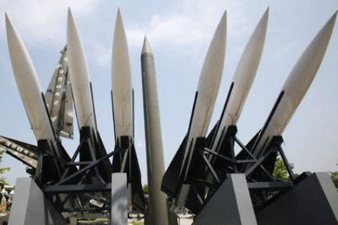
 EXPLAINER: The Letters of Last Resort – Boris Johnson’s secret instructions on nuclear action, There are, at most, nine countries on earth with nuclear weapons. Joe, 28 July 19
Before today, two of those arsenals were in the hands of Donald Trump and Kim Jong-un. As of today, they have been joined by Boris Johnson.
Among the very first things that will happen as Johnson begins is premiership, is a briefing from the Chief of the Defence Staff, who will tell him exactly the kind of devastation and death a nuclear Trident missile would cause. Johnson will then be tasked with composing the “letters of last resort.”
The letters of last resort are an almost mythical device, the kind of thing that would make more sense in a Tom Clancy novel than they do in real life. But they are real, and they are terrifying.
They are four letters, each one issued to the commanding officers of each of the United Kingdom’s four nuclear-capable ballistic missile submarines. They are only to be opened under one specific circumstance: the destruction of the government of Britain through a major, likely nuclear, bombing campaign.
The letters are only to be opened under the assumption that the Prime Minister and any designated deputies are dead, and that it is up to the UK’s military submarines to respond.
Typically, the UK has one of these submarines patrolling at any given time, armed with 40 of its 120 operational nuclear warheads. The other three subs are based in Faslane naval base in Scotland.
And right now, those letters are being written by Boris Johnson. Cool.
Four possible directives are known:
- That the UK should retaliate.
- That the UK should not retaliate, and should retreat to a commonwealth nation.
- That the commanding officer should use their own judgment.
- Place the submarines under the command of an allied country, such as the United States.
It is very possible, however, that a PM will be much more specific than this.
When quizzed on the matter of their own letters by the BBC, former Prime Ministers John Major, Tony Blair and Gordon Brown all revealed that they had included a caveat that under no circumstances should civilians be targeted with nuclear weapons.
Nobody will ever know for sure though, since the letters are burned in their unopened state as soon as an outgoing premiership comes to a close……… https://www.joe.ie/life-style/boris-letters-of-last-resort-676243
Tax-payers still on the hook for UK’s planned ‘nuclear renaissance’
Despite Hinkley, the new plan for nuclear is hardly better than the old one https://www.theguardian.com/business/2019/jul/27/despite-hinkley-new-plan-nuclear-hardly-better-than-old-one
EDF Energy’s deal to build Hinkley Point C, Britain’s first new nuclear power plant in a generation, has been dubbed the world’s most expensive power plant of all time, a “white elephant” in a changing energy landscape, and a risky and expensive gamble with taxpayers’ money.
There was little chance that a deal so politically unpalatable could be repeated for EDF’s follow-on project at Sizewell B. Instead, officials returned to the drawing board to re-engineer a multibillion-pound funding framework that could help lower the eye-watering costs of constructing a nuclear reactor.
The £20bn Hinkley Point C project will cost energy bill payers £92.50 for every megawatt-hour of electricity it produces for 35 years. It is a price well above both the UK’s wholesale energy price of around £55 a megawatt-hour, and the new breed of offshore wind farms.
The new funding model promises to cut the cost of building a new nuclear plant by a fifth – but this, too, comes at a cost. The government’s plans to make nuclear affordable means Britons will twice shoulder the risk of building new nuclear reactors.
First, by paying upfront for the reactors through energy bills to help fund their construction. Second, by taking on the cost of any overruns or construction delays through a taxpayer guarantee. The public purse would also compensate nuclear investors if the project were scrapped.
It is the same model used to fund London’s £4.2bn super-sewer project, the Thames Tideway tunnel, which has drawn criticism for raising water bills while investors reap financial rewards.
By shifting the risk from private investors to taxpayers, nuclear developers will be able to borrow money at cheaper rates, which will lead to lower bills for consumers.
On paper, the proposal is a better deal than Hinkley, but it’s far from perfect.
The National Infrastructure Commission has taken a dim view of the model. “This makes projects appear cheaper as consumers are effectively financing the projects at zero interest. At least some of the risk associated with construction costs also sit with consumers, a further hidden cost, since consumers are not paid to hold these risks in the way investors would be,” it said.
In addition, the sums hold true only if the project remains on schedule and on budget for the decade it takes to construct a nuclear plant. There are worryingly few examples where this has been the case; EDF Energy’s forerunner to the Hinkley project, at Flamanville in Normandy, is expected to cost four times original estimates. It was expected to begin generating electricity in 2012, but is now expected to start up in 2022.
he French energy giant has said the lessons learned from Flamanville mean Hinkley Point will avoid a similar fate. Sizewell will be at an even greater advantage because it will use the same UK workers once Hinkley is complete.
Why take the risk at all, though?
“If ministers want affordable and clean energy, the fastest, safest and cheapest way to do that is to boost renewables like wind and solar,” said Doug Parr, chief scientist at Greenpeace.
There have been major advances in flexible renewable energy technologies in recent years, but ministers retain an appetite for the “firm” low-carbon electricity generated by nuclear reactors despite the financial hurdles to building them.
The UK’s energy landscape is littered with stalled nuclear plant projects which have so far failed to make a financial case. Already half the projects proposed three years ago have foundered.
But the government’s commitment to a new atomic era is still the most reliable element of its nuclear programme to date.
Boris Johnson enthusiastic for a new ‘nuclear renaissance’ in UK
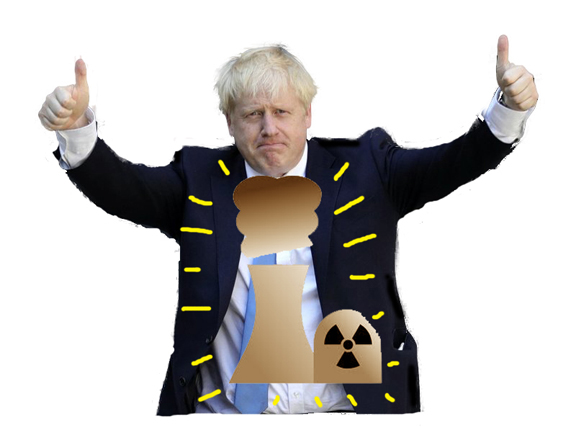 UK’s new premier promises boost for nuclear power, WNN. 26 July 2019 Boris Johnson expressed his “passionate” support for nuclear power when he addressed the House of Commons for the first time as UK prime minister yesterday. Seven of the country’s eight existing nuclear plants are set to be retired by 2030, while new-build projects have faced financial uncertainty over the last two year………On 22 July, the day that Johnson was elected leader of the Conservative Party and two days before he officially replaced Theresa May as prime minister, the government launched a consultation into funding large-scale nuclear power plants and a proposed GBP18 million (USD22 million) investment into small modular reactors.
Greg Clark, secretary of state for the Department for Business, Energy and Industrial Strategy (BEIS) – who Johnson replaced this week with Andrea Leadsom – announced in June 2018 that the government would review the viability of a Regulated Asset Base (RAB) model for new nuclear projects. The consultation states that, as the cost of renewable technologies continues to fall, they are likely to provide the majority of the country’s low-carbon generating capacity in 2050. It adds however there will still be a crucial role for low-carbon ‘firm’ – always available – power in 2050.
The RAB model would not apply to Hinkley Point C (HPC), which is currently under construction by EDF Energy in Somerset, England, but would apply to future plants. As many as five more new-build projects had been planned – by EDF Energy together with China General Nuclear (CGN); NuGeneration (NuGen); and Horizon Nuclear Power……… http://world-nuclear-news.org/Articles/UKs-new-premier-promises-boost-for-nuclear-power
Boris Johnson government could reach net zero, without nuclear power
Utility Week 26th July 2019 , Boris may not need the nuclear option to reach net zero. The proposal to use the regulated asset base model to fund new nuclear projects this week
was given a mixed reaction. SSE chief executive Alistair Phillips-Davies
writes exclusively for Utility Week about why he believes the government
should now be showing the same level of support for renewable electricity
if it is serious about reaching net-zero emissions by 2050.
https://utilityweek.co.uk/boris-may-not-need-nuclear-option-reach-net-zero/
Yet more delay at Flamanville nuclear debacle – doesn’t bode well for UK’s Hinkley Point C project
Times 27th July 2019 As French existential jokes go, little beats building a nuclear power plant
at a place called Flammable. OK, it’s actually Flamanville. But who cares
about that sort of nicety – not least when the project’s proving so
incendiary?
It was due to be up and running in 2012 at a cost of €3.3
billion. Not only that. Flaming Ville was to be the showcase for the
European Pressurised Reactor, the wizzy new tech developed by the
state-backed EDF. True, it’s living up to the pressurised bit, at least for
EDF boss Jean-Bernard Lévy.
He’s just been forced to announce another
delay: a howitzer, even by usual standards, of “more than three years”. The
end of 2022 is now the earliest start date; a delay bound to jack up
project costs that have already exploded to €10.9 billion
The reason?
France’s spoilsport nuclear safety authority has ordered EDF to repair
eight bits of dodgy welding: who’d have thought nukes had to be welded
together properly? And, yes, the whole thing is turning into a nice French
farce. Except for one thing, of course: the joke’s on us.
Flamanville is the prototype for our very own nuclear disaster: the £20 billion Hinkley
Point C. It’s being built by EDF and the Chinese in return for the
contractual right to fleece UK consumers for 35 years: an index-linked,
guaranteed £92.50 per megawatt hour that’s twice the wholesale price. Even
better, the 3,200MW Hinkley is the planned forerunner for a fleet of new
nukes.
Indeed, so thrilling is the prospect that Greg Clark spent his dying
days as business secretary agonising over whether it might actually be
better to fleece consumers upfront instead, via his “regulated asset base”
funding model, before the plant was built. His verdict? A “consultation”,
the sort of non-decision-making for which he was deservedly sacked. Surely
someone in government can see the big picture here.
It’s not just
Flamanville that’s proving new nuclear so radioactive; a heady mix of
last-century tech, uncontrollable costs, endless delays and a dirty great
clean-up bill. EDF’s sister project, at Olkiluoto in Finland, has proved a
similar disaster. And didn’t ministers notice while their mooted plant at
Moorside was imploding that the project’s promoter, Japan’s Toshiba, was
blowing itself in the US with subsidiary Westinghouse?
No bribe was big enough, either, for Hitachi at Wylfa: no big shock when the group’s from
Fukushima-land. True, nuclear accounts for a fifth of Britain’s energy
needs. But its costs keep going up, while those of wind, solar, battery
power and carbon capture are falling. And they don’t require dangerous
clean-ups. Yes, maybe it’s too late to stop Hinkley. But someone in Boris’s
new team must see that new nuclear’s a route to torching money. Flammable
is all the evidence they need.
https://www.thetimes.co.uk/article/5268801e-afd9-11e9-84cf-31ddba0e0fae
Surprise surprise! UK’s New Prime Minister Boris Johnson is a big fan of the nuclear industry
In Cumbria 25th July 2019 New Prime Minister Boris Johnson has pledged his support for a nuclear renaissance, the Barrow-based Dreadnaught submarine programme and Northern
Powerhouse Rail in his maiden speech. On nuclear, Copeland MP Trudy
Harrison asked him: “Does the Prime Minister agree that the time is now
for a nuclear renaissance and that Copeland is the centre of nuclear
excellence?”
Mr Johnson replied: “It is time for a nuclear renaissance
and I believe passionately that nuclear must be part of our energy mix and
she is right to campaign for it and it will help us to meet our carbon
targets.”
His comments were made just days after the Government launched
a consultation into funding large-scale nuclear power stations and an £18
million Government investment into the development of small modular
reactors through a consortium led by Rolls-Royce, and including the
National Nuclear Laboratory, Wood and Nuvia. Opinions are being sought
between now and October 14 on a proposed Nuclear Regulated Asset Base (RAB)
model to fund large power stations.
UK Nuclear Finance: From No Subsidies to Nuclear Tax
|
The hope is that the “regulated asset base”, or RAB model, will make major infrastructure projects cheaper by shifting the risk of spiralling costs from the developer to the taxpayer. Under the model, the developer would receive a regulated price to give it a return on its investment expenditure, including during the construction period, and this would be levied on energy bills. In the case of an extreme overrun, the government – effectively the taxpayer – could either have to step in and pay the extra cost or scrap the project and pay compensation to investors. The Government says its assessment of the RAB model has concluded that it has the potential to reduce the cost of raising private finance for new nuclear projects, thereby reducing consumer bills and maximising value for money for consumers and taxpayers. (1) The energy industry will have until mid-October to respond to the plans before a final decision is made by ministers. (2) Dr Doug Parr, the chief scientist at Greenpeace, said: “The nuclear industry has gone in just 10 years from saying they need no subsidies to asking bill payers to fork out for expensive power plants that don’t even exist yet and may never. This ‘nuclear tax’ won’t lower energy bills – it will simply shift the liability for something going wrong from nuclear firms to consumers.” Last summer, when the plans first emerged, the economist Dieter Helm, an influential government adviser, backed the RAB model as a better deal than the contract handed to EDF Energy to build the Hinkley Point project. But he added that it is “neither necessary nor desirable to meet the twin objectives of security of supply and decarbonisation No smart contracting and regulating framework can magic away the deep challenges that nuclear faces, notably: the possibility that in the next 60 years much cheaper new low carbon technologies may become available, possibly including new nuclear ones too; the very large upfront and sunk costs; the risk and the safety regulation; and the challenges of getting rid of the waste.” (3) “Let’s face it: nuclear power is hideously dear and far from ideal”, says Nils Pratley in the Guardian. “The government should be backing renewables, not tying itself to an expensive nuclear future. That bill-payers got stuffed in the deal that brought the Hinkley Point C project into existence is beyond dispute these days. Even government ministers barely quibble with the National Audit Office’s assessment that consumers will be paying through the nose for 35 years.” He says the “regulated asset base” (RAB) approach exposes consumers to the cost of overruns, and in effect also requires them to provide financing at zero interest, a point made by the National Infrastructure Commission last year. The NIC report said: “There is limited experience of using the RAB model for anything as complex and risky as nuclear.” Second, no financing model can disguise the core truth about nuclear – the technology is hideously expensive. Even after recognising the need to have secure “baseload” supplies, it recommended commissioning only one more nuclear plant, on top of Hinkley, before 2025. That remains a common sense analysis. Renewables are winning the price race. Let us pray, then, that a love-in with RAB does not reignite ministerial fantasies about a “resurgence” in nuclear. We don’t want a resurgence. We want to build as few new reactors as possible. (4) RAB financing is more usually applied to projects where there is a natural monopoly, such as the Thames Tideway where Thames Water is a monopoly provider of water and sewage services to the ratepayers who bear the burden of the additional cost. Applying a RAB to a specific project in a competitive market raises difficulties with the need to ensure that only those ratepayers who would benefit from the additional cost of a nuclear RAB would incur the additional cost. It will be difficult, for instance, to explain to consumers on non-nuclear green tariffs why they are being compelled to pay an additional cost for generating capacity that offers them no benefit. Even if an assurance of minimal risk to investors is offered, it is not clear whether the investors targeted, for example, pension funds, sovereign wealth funds and investment funds, will be willing to invest the huge sums required. Such investors have never invested in nuclear projects so the RAB model may fail simply due to lack of investors. The new funding model won’t make any difference to the construction and operation record of nuclear reactors around the world, and the record of EPRs in particular is abysmal. Nor will it change the fact that nuclear vendors are in financial disarray. (5) Dave Toke at Aberdeen University has published a layman’s guide to the ‘Regulated Asset Base’. (6) He says the system will allow the Government, though an appointed ‘Regulator’ to launder electricity consumer’s money to pay for the inevitable cost overruns, whilst the Regulator assures the public that this all represents ‘value for money’. The RAB proposals were supposed to be included in a long-awaited energy white paper that the business department has been working on for months, but, according to Bloomberg, this was blocked by the Chancellor of the Exchequer Philip Hammond, because of the potential spending implications for a new prime minister. The plans also included funding for carbon capture and storage and a domestic energy efficiency programme. Whitehall officials across departments were concerned the document was both incomplete and too sizable a policy plan to put forward just before a new premier takes over The nuclear tax will apply to all electricity consumers even if they have chosen a 100% renewable tariff or live in Scotland where the Government is opposed to the construction of new nuclear power stations.http://www.no2nuclearpower.org.uk/wp/wp-content/uploads/2019/07/NuClearNewsNo118.pdf |
|

A damning new report on the unlikely future for Small Modular Nuclear Reactors (SMRs)
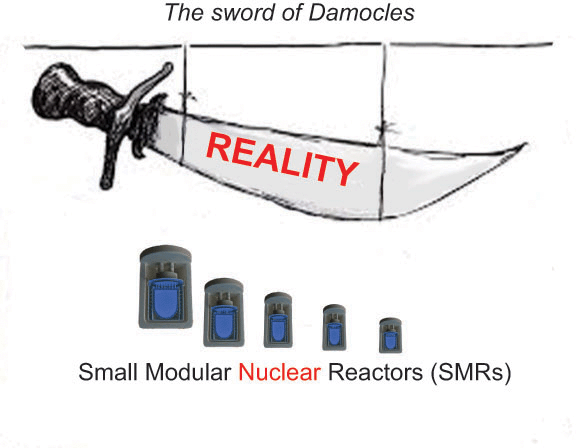 NFLA support joint report with the Nuclear Consulting Group which looks at the prospects of Small Modular Nuclear Reactors in the UK and globally and concludes they will not be built to any significant scale http://www.nuclearpolicy.info/news/nfla-joint-ncg-report-on-smrs/ 25 Jul 19
The Nuclear Free Local Authorities (NFLA) welcomes cooperating with the Nuclear Consulting Group (NCG) in its development of one of the most detailed analyses of the technologies being developed to create small modular nuclear reactors (SMRs) in the UK and around the world. This report concludes there remains fundamental barriers to any significant development of this new nuclear technology, and its prospects for creating some kind of ‘nuclear renaissance’ are unlikely to be realised.
The report has been developed by Professor Stephen Thomas of Greenwich University, Dr Paul Dorfman of University College London and NCG Founder, Professor M V Ramana of British Columbia University, and the NFLA Secretary. (1) The global nuclear industry has put forward SMRs as a panacea to the problems of high cost and the difficulty of financing large nuclear reactors; a ready-made alternative that can fill the gap.
However, as the NCG / NFLA report outlines in detail, there are huge obstacles to overcome. Some of these are technical issues, others are around building up an effective supply chain, while the financing of such schemes will only be possible with significant and large subsidy from the public purse.
The report starts with considering the failures in delivering larger nuclear reactors, and then takes in turn each type of SMR technology that has been put forward by companies involved in the nuclear industry.
The report outlines in some detail UK Government policy on SMRs. It notes that after some considerable early promotion of the technology, interest has markedly cooled, despite another fairly limited amount of money being offered to develop the technology, announced earlier this week. (2) The report notes the extraordinary set of conditions set out by Rolls Royce to be met by the UK Government if it is to invest significant amounts of money in its own SMR design, which the authors argue could and should not be committed to at a time when serious doubts remain about the economic viability of the technology.
At a global level, the report concludes that, as with the much-heralded ‘nuclear renaissance’ of recent times, SMRs will not be built in any significant scale. The authors note that the two main rationales for SMRs – promised lower overall project costs and lowering the risk of cost overruns by shifting to an assembly line approach – are more than offset by the loss of scale economies that the nuclear industry has pursued for the past five decades. Indeed, many of the features of the SMRs being developed are the same ones that underpinned the latest, failed generation of large reactors. Reactor cost estimates will remain with a large degree of uncertainty until a comprehensive review by national nuclear regulators is completed, the design features are finalised and demonstration plants are built. Whether the economies claimed from the use of production line techniques can be achieved will only be known if reactors are built in very large numbers, and at significant cost.
Spending so much time and effort pursuing such an uncertain technology, at a time when the ‘climate emergency’ has now reached the political and public lexicon in requiring urgent attention, does not appear to be an effective use of taxpayer resources. Abundant evidence shows that renewable energy supply, storage, distribution and management technologies are being developed ever cheaper and swifter at a time when real urgency is required across society and government to mitigate the worst effects of climate change. SMRs are no answer to creating low-carbon economies by 2030 or close to that date. Governments should consider this report carefully and not be diverted by an unproven technology inherent with many difficult issues still to overcome.
In the overall view of the report authors, the prospects for SMRs in the UK and Worldwide are limited and not worth the huge levels of effort or finance being proposed for them.
NFLA Steering Committee Chair Councillor David Blackburn said:
“This excellent independent analysis on the prospects for small modular nuclear reactors needs to be read by the new Business Secretary Andrea Leadsom and senior civil servants in the UK Government who have been providing support to the development of small modular nuclear reactors. It is clear from this joint report between the NCG and the NFLA that this technology is not the panacea to kick start new nuclear reactors, far from it. As Councils around the country declare ‘climate emergencies’ it is clear from this report that scarce available resource should not be spent developing this technology but rather diverted into renewable energy, smart energy, energy efficiency and energy storage projects instead. As large new nuclear like at Moorside and Wylfa has failed to be realised, it is time now to move away from small nuclear reactors as an expensive sideshow to the critical needs of mitigating carbon.”
Report co-author Professor Steve Thomas added:
“Nuclear proponents are saying that SMRs will be the next big thing – but the reality is they are as expensive as large reactors, produce the same waste, carry the same radiation risks, and are a long way from any real deployment.”
Ends – for more information please contact Sean Morris, NFLA Secretary, on 00 44 (0)161 234 3244.
Notes for editors:
(1) NCG / NFLA report – Prospects for Small Modular Reactors in the UK and Worldwide, July 2019
http://www.nuclearpolicy.info/wp/wp-content/uploads/2019/07/Prospects-for-SMRs-report-2.pdf
(2) Energy Live News, Government mulls investing £18 million to develop UK’s first mini nuclear reactor, 23rd July 2019 https://www.energylivenews.com/2019/07/23/government-mulls-investing-18m-to-develop-uks-first-mini-nuclear-reactor/
A layman’s guide to the ‘Regulated Asset Base’ that will fund Sizewell C nuclear power plant.
 Dave Toke’s green energy blog, https://realfeed-intariffs.blogspot.com/2019/07/a-laymans-guide-to-regulated-asset-base.html, 23 July 2019 Dave Toke’s green energy blog, https://realfeed-intariffs.blogspot.com/2019/07/a-laymans-guide-to-regulated-asset-base.html, 23 July 2019
The Government’s proposed new ‘Regulated Asset Base’ (RAB) means of funding nuclear has just been published, and it is living as far down to its expectations as could be expected. I’ve ploughed through the sometimes (deliberately?) convoluted description of the scheme and translated a few key passages to help you understand it all.
The Government failed to learn from the days when nuclear power were constructed from the 1950s to the 1990s. In those days nuclear power was very expensive, but the Government was able to con the public into believing that it was cheap. They did this by making sure the public could not understand the vaguaries of nuclear power funding and by putting all of the cost overruns that building the power stations involved onto consumer bills without them noticing. Basically, we are reurning to these days when the public was kept in the dark about the cost of building nuclear power plant and the same public will be paying for the cost overruns resulting from the project. The Government made the mistake of giving a contract price for Hinkley C. Although it featherbedded the developers EDF by giving an ultra long premium price contract (35 years) and the promise of Government lending to cover the bulk of the costs, the contract (CfD) allowed some sort of comparison to be made with competitior sources. Solar and wind power’s costs have fallen well below the price given to Hinkley C (£92.50 in 2012 prices). So now the Government, having learned this mistake, has produced the RAB. This will allow the Government, though an appointed ‘Regulator’ to launder electricity consumer’s money to pay for the inevitable cost overruns, whilst the Regulator assures the public that this all represents ‘value for money’. The project that is earmarked for RAB funding is Sizewll C, involving the same reactor type (EPR) as is being constructed at Hinkley C. What some key passages mean:1. ‘Despite the progress at HPC, the challenges facing the global nuclear industry have meant that replicating a CfD model for further new nuclear projects has proved very challenging. Few project developers have a balance sheet that can accommodate the £15-20bn cost of delivering a new nuclear project, and financial investors have been unwilling to invest during the construction phase given the long construction period and risk of cost increases and delays. We are therefore looking to work with the sector to develop an alternative funding model for new nuclear projects that can attract private finance at a cost that represents value for money to consumers and are considering its wider applicability to other firm low carbon technologies’ (page 9) 2. ‘A large-scale new nuclear project bears some similarities with the Thames Tideway Tunnel (TTT) project, in that it is a complex single asset construction project with a significant upfront capital expenditure requirement, long construction period and a long asset life. In developing a potential nuclear RAB model, we have taken the model used for TTT, which was also developed under a RAB, as a starting point, whilst recognising that new nuclear projects are greater in scale and face specific challenges that were not relevant to TTT’ (page 11) 3. ‘A target total construction cost would be set for the project company which would be used as the Baseline for incentivisation and risk sharing. If construction costs increased above the Baseline, a portion of the additional costs would be added to the RAB, such that the impact would be shared between investors and suppliers (and through them, their consumers) (page 14)…(this approach will) ‘provide clarity and certainty to investors, suppliers and consumers, which is particularly important for a large single-asset project with a complex and relatively long construction period’ (page 15)
Translation: The Regulator will produce lots of impenetrable accountancy jargon based on hilariously optimistic projections about construction times and costs which the regulator will swallow whole. When the inevitable happens and costs overrun the investors will still get a reasonable rate of return on their investments and the electricity consumers will pay for most of the cost overruns. 4. ‘Role of the Regulator ‘The EPR technology has now started commercial operations in China’ (pages 8-9) You can read the Government’s RAB consultation and make a response at https://www.gov.uk/government/consultations/regulated-asset-base-rab-model-for-nuclear
|
|
UK’s love-in with “an innovative funding model” does not hide the hideous expense of nuclear power
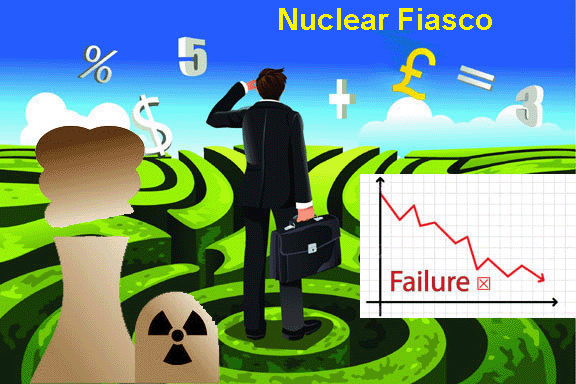 Guardian 23rd July 2019 Let’s face it: nuclear power is hideously dear and far from ideal. The
government should be backing renewables, not tying itself to an expensive
nuclear future. That bill-payers got stuffed in the deal that brought the
Hinkley Point C project into existence is beyond dispute these days.
Even government ministers barely quibble with the National Audit Office’s
assessment that consumers will be paying through the nose for 35 years.
Instead, the defence has tended to run along these lines: don’t worry,
we’ve triggered a “resurgence” in the nuclear industry in the UK and
the next reactors will be relative bargains.
Now here’s the government’s latest effort to resurrect the show – “an innovative
funding model”. Of course, it’s not really innovative. The “regulated
asset base” (RAB) approach, which could be used at Sizewell B in Suffolk,
and is intended to copy the design of Hinkley, is common in other parts of
the utility world.
Aside from exposing consumers to the cost of overruns,
RAB in effect also requires them to provide financing at zero interest, a
point made by the National Infrastructure Commission last year. Little
wonder, then, that the juice should be cheaper than Hinkley’s – some of
the costs will be hidden from view.
The same NIC report said: “There is limited experience of using the RAB model for anything as complex and risky as nuclear.” Second, no financing model can disguise the core truth about
nuclear – the technology is hideously expensive. Even after recognising
the need to have secure “baseload” supplies, it recommended
commissioning only one more nuclear plant, on top of Hinkley, before 2025.
That remains a commonsense analysis. Renewables are winning the price race.
Let us pray, then, that a love-in with RAB does not reignite ministerial
fantasies about a “resurgence” in nuclear. We don’t want a
resurgence. We want to build as few new reactors as possible.
UK government commits to ordering mini nuclear reactors from Rolls Royce
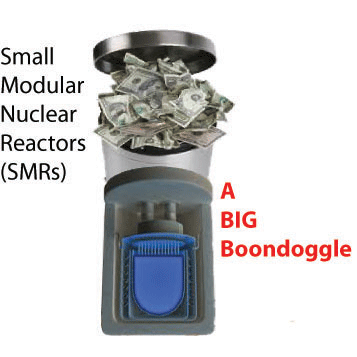 Rolls-Royce gets government commitment for mini nuclear reactors UK aero-engine maker seeks to spearhead development of export-led industry https://www.ft.com/content/32ee2100-ad43-11e9-8030-530adfa879c2 Sylvia Pfeifer in London, 24 July 19,
Although the initial commitment is just £18m, it will allow the consortium to mature the design of the reactors. The move, which is subject to a final sign-off, would still require significant levels of additional investment before the reactors can become a commercial reality. The UK aero-engine maker has long argued that its technology in this sphere should be regarded as a “national endeavour” to develop nuclear skills that can be used to create an export-led industry.
A consortium spokesperson said on Tuesday that the £18m investment would be used to “mature the design, address the considerable manufacturing technology requirements and to progress the regulatory licensing process”. He added: “We believe with early co-investment by the government, this power station design is a compelling commercial opportunity.”
Rolls-Royce and its team, which includes Laing O’Rourke and Arup, was one of several consortiums that bid in an initial government-sponsored competition launched in 2015 to find the most viable technology for a new generation of small nuclear modular reactors (SMRs). Most of these will not be commercial until the 2030s
Supporters argue that they can deliver nuclear power at lower cost and reduced risk. They will draw on modular manufacturing techniques that will reduce construction risk, which has plagued larger-scale projects. However, when a nuclear sector deal was finally unveiled last June, the government allocated funding only for more advanced modular reactors.
MRs, which typically use water-cooled reactors similar to existing nuclear power stations, were omitted from funding even though they were closer to becoming commercial. Rolls-Royce threatened last summer that it would shut down the project if there was no meaningful support from the government.
Ministers have in recent months scrambled to recast Britain’s energy policy after the collapse of plans to build several large reactors and on Monday evening published proposals to finance new nuclear plants by having taxpayers pay upfront through their energy bills. The government added that, as part of its plans to fund advanced nuclear technologies, it would make an “initial award” of up to £18m under the industrial strategy challenge fund to the Rolls-Royce-led consortium in the autumn. The consortium has said any government funding will be matched in part by contributions from the companies as well as by raising funds from third-party organisations.
1 This Month




PLEASE OPPOSE HR 8255 AND S.3639 – bills would accelerate satellite deployment, with no environmental review or safeguards – https://ncstd5li.quorum.us/campaign/169331/
To see nuclear-related stories in greater depth and intensity – go to https://nuclearinformation.wordpress.com
-
Archives
- September 2026 (339)
- August 2026 (330)
- July 2026 (355)
- June 2026 (287)
- May 2026 (306)
- April 2026 (356)
- March 2026 (251)
- February 2026 (267)
- January 2026 (308)
- December 2025 (358)
- November 2025 (359)
- October 2025 (375)
-
Categories
- 1
- 1 NUCLEAR ISSUES
- business and costs
- climate change
- culture and arts
- ENERGY
- environment
- health
- history
- indigenous issues
- Legal
- marketing of nuclear
- media
- opposition to nuclear
- PERSONAL STORIES
- politics
- politics international
- Religion and ethics
- safety
- secrets,lies and civil liberties
- spinbuster
- technology
- Uranium
- wastes
- weapons and war
- Women
- 2 WORLD
- ACTION
- AFRICA
- Atrocities
- AUSTRALIA
- Christina's notes
- Christina's themes
- culture and arts
- Events
- Fuk 2022
- Fuk 2023
- Fukushima 2017
- Fukushima 2018
- fukushima 2019
- Fukushima 2020
- Fukushima 2021
- general
- global warming
- Humour (God we need it)
- Nuclear
- RARE EARTHS
- Reference
- resources – print
- Resources -audiovicual
- Weekly Newsletter
- World
- World Nuclear
- YouTube
-
RSS
Entries RSS
Comments RSS

