Rolls Royce plans small nuclear reactors near Snowdonia National Park in Wales.
|
Rolls-Royce eyes Snowdonia nuclear site for first small modular reactor, https://www.constructionnews.co.uk/sustainability/rolls-royce-eyes-snowdonia-nuclear-site-for-first-small-modular-reactor-14-02-2020/BY MILES ROWLAND Engineering firm Rolls-Royce has said that the first of its planned small nuclear reactors could be built at a site near Snowdonia National Park in Wales.
Speaking to the BBC today, Rolls-Royce chief technology officer Paul Stein said there was a “high probability” that Trawsfynydd would be the site of the first such reactor, which would be assembled from pre-manufactured components. The site was previously home to a nuclear reactor, closed in 1991, and has an existing local nuclear supply chain. Stein said: “Trawsfynydd is a great first site for the [reactor]. Right now the jury’s out – there are a number of great sites around the country – but two of the three sites [under consideration] are in Wales.” He added: “With so-called brownfield sites, where there has been a nuclear reactor, we know the local population is happy, there is a skilled local population that used to run the plant, there’s a grid connection and the seismic condition of the site [is suitable].” Rolls-Royce announced last year that it was working with a consortium of companies including Laing O’Rourke, Bam Nuttall and Atkins to develop small modular reactors (SMRs), with Laing O’Rourke telling Construction News that it could use its offsite manufacturing facility to produce components. Once operational, each SMR could generate 440MW of energy, enough to power Cardiff, Swansea and Newport combined, according to Rolls-Royce. The reactors have a target cost of £1.8bn each by the time five stations have been constructed, though the first will not be completed until at least 2029. Wylfa in Anglesey has previously been identified by Rolls-Royce as another potential site for SMRs. |
|
Few permanent jobs in small modular nuclear reactors?
In Cumbria 12th Feb 2020, Plans to develop unique small nuclear reactors in Cumbria by Rolls-Royce should not be seen as a “saviour of the county”, one of its major rivals said.
in-Cumbria exclusively revealed in November that a consortium, led by
the engineering giant, was focusing its efforts on efforts on developing
its emerging Small Modular Reactors at existing nuclear licensed sites –
with Cumbria and Wales its top targets.
But John Coughlan, chief executive of TSP Engineering, based in Workington, said he was concerned that people would think the plans would prompt people to think thousands of jobs would be created. TSP Engineering is also developing its own version of the technology, and while Mr Coughlan acknowledged that they were rivals and that was a factor in him speaking out, he was also passionate about the local community. He said:
“Make no mistake. When Rolls-Royce talk about developing their reactors in Cumbria, they are talking about a construction site. “If they get the go-ahead for Cumbria, the reactors will be shipped in from elsewhere and built on the site. So you are probably looking at a large number of short-term construction jobs – say 1,000 – then only about 60 to 100 people with a permanent position there.
Decline and uncertainty in UK nuclear construction
Construction News 10th Feb 2020, Contractors hoping to work on nuclear builds have been forced to scale back their workforce in recent months, according to the head of the sector’s trade body. Nuclear Industry Association (NIA) chief executive Tom Greatrex told Construction News that the uncertain future for nuclear megaprojects such as the £16bn Wylfa Newydd , which was suspended by Hitachi in January 2019, has had a negative impact on construction firms
Greatrex said: “There’s a lot [of nuclear specialists] that have cut back their
headcounts. If they don’t feel there’s going to be any work to do in that
area, they’ll focus on other areas and costs will be cut.” He added that
the NIA was aware of “a few small companies that have ceased to trade”,
but declined to name them.
While the Australian government ignores Julian Assange’s plight, two MPs head to UK to help him
 MPs take Assange freedom campaign to UK
https://www.news.com.au/national/breaking-news/mps-take-assange-freedom-campaign-to-uk/news-story/633a9baa272bd155623423565e86e6b4 12 Feb 20,
Tasmanian independent MP Andrew Wilkie and Queensland Nationals MP George Christensen will travel to the United Kingdom to lobby for Julian Assange’s freedom Paul Osborne, Two Australian politicians will travel to the UK this weekend at their own expense to visit Julian Assange in jail and seek his release.
Tasmanian independent MP Andrew Wilkie and Queensland Nationals MP George Christensen, who chair a parliamentary group in support of the WikiLeaks founder, will pay a visit to Belmarsh Prison near London and lobby the British government.
Assange is set to face trial on February 24 to determine whether he should be extradited to the US, where he has been charged with 17 counts of spying and one count of conspiracy to commit computer intrusion.
Sellafield and Drigg, Today and tomorrow’s Flood Warning.
should be no new nuclear wastes arriving at Sellafield, no new so called
Small Modular Reactors on this floodplain ….and no new coal mine deep
under the Irish Sea. Cumbria (and the fallout is planetary) is ALREADY
under intolerable risks. Today’s flood warnings …fingers crossed.
Climate emergency plans must have a ‘no new nuclear’ clause
The nuclear and fossil fuel industry are mutually intertwined.
“There is no such thing as a zero or near-zero-emission nuclear power plant”
the mean value is about 66 grams of carbon dioxide for every kWh produced by nuclear power. This compares to about 9g for wind, 32g for solar and 443 for gas.
“This puts nuclear as the third highest carbon emitter after coal-fired plants and natural gas….

|
No new nuclear https://theecologist.org/2020/feb/06/no-new-nuclear Radiation Free Lakeland, 6th February 2020
Campaigners demand a ‘no new nuclear’ clause in climate emergency planning. Climate activists across the world are uniting to protect the planet from continuing fossil fuel use. There is much talk of a green industrial revolution and a Green New Deal. This sounds good, but what does it mean?
Kevin Frea, co-chair of the Climate Emergency Network and deputy leader of Lancaster City Council has worked hard to sign local councils up declaring a climate emergency. He said: “This movement is being led by every political group and is involving local people in planning the actions needed to cut carbon.” But there’s an important thing missing here. Last September members of Radiation Free Lakeland lobbied Lancaster City Council asking the council to include a No New Nuclear clause in their climate emergency planning. Continue reading |
Corpses of UK’s nuclear submarines still unburied after 25 years

|
Nuclear vessels still languish at Fife dockyard 25 years after pledge against submarine graveyard, by Cheryl Peebles The Courier.co.uk
February 7 2020,Seven of the vessels, which contain radioactive material, have languished for decades at the Fife dock awaiting dismantling by the Ministry of Defence.
They include HMS Dreadnought, the UK’s first nuclear-powered submarine which was retired from service in 1980. It was during a visit to Rosyth in January 1995 that the then defence procurement minister Roger Freeman made the statement. The milestone prompted a repeated demand from Dunfermline and West Fife MP Douglas Chapman for action to deal with the vessels. Mr Chapman said: “It is astonishing that 25 years after Roger Freeman made that statement we are still waiting for the UK government to clear up these submarines that were decommissioned in the 1980s. “I have pressured the government for years to have some sort of joined-up thinking to remove these. “It is not only costing the taxpayer millions every year to keep them but also taking up valuable dock space that Babcock could be utilising for more economically productive activities.”…… https://www.thecourier.co.uk/fp/news/local/fife/1123498/nuclear-vessels-still-languish-at-fife-dockyard-25-years-after-pledge-against-submarine-graveyard/ |
|
Need to include a No New Nuclear clause in climate emergency planning
 Radiation Free Lakeland 1st Feb 2020, Kevin Frea is co-chair of the Climate Emergency Network and deputy leader of Lancaster City Council and has worked hard to sign local councils up declaring a climate emergency. “This movement is being led by every political group and is involving local people in planning the actions needed to cut carbon …
”. There is one critical action that is being missed – a No New Nuclear Clause! Last September members of Radiation Free Lakeland lobbied Lancaster City Council asking the council to include a No New Nuclear clause in their climate emergency planning.
The council agreed with us that renewables are the way forward and it is brilliant that council members are actively involved in local community renewable schemes.
However, they thought that including a No New Nuclear Clause in their
Climate Emergency Planning was not necessary. Because as Cllr Kevin Frea
said “Heysham, number 8 on the new nuclear plant list it is not likely to
go ahead”. This new nuclear nonchalence rather misses the point that the
continued push (billions of pounds of public money) for new nuclear is
decimating urgent steps towards renewables and energy efficiency. The sole
reason we are in the situation we are in is entirely down to the continued
efforts of the nuclear industry and its vested interests to suppress
renewables.
https://mariannewildart.wordpress.com/2020/02/01/14471/
Oxford City Council says NO to nuclear weapons
 Cherwell 1st Feb 2020 , Oxford City Council has called on the British Government to sign the International Treaty to Prohibit Nuclear Weapons (TPNW). The resolution, proposed by Councillor John Tanner, was agreed “overwhelmingly” by the City Council on Monday. Before backing the Treaty, the City Council want the UK government to renounce its use of nuclear weapons and end the renewal of Trident.
https://cherwell.org/2020/02/01/oxford-city-council-says-no-to-nuclear-weapons/
UK government could save money, promote health, by energy efficiency programmess
 Edie 30th Jan 2020, By implementing stronger policies around walking, cycling, electric vehicles and energy efficiency in homes, the Government could save the NHS at least £3.7bn per year. That is according to a new report from think-tank Green Alliance. Drawing on research by CREDS, a body convening research from academics at 15 UK universities. Edie 30th Jan 2020, By implementing stronger policies around walking, cycling, electric vehicles and energy efficiency in homes, the Government could save the NHS at least £3.7bn per year. That is according to a new report from think-tank Green Alliance. Drawing on research by CREDS, a body convening research from academics at 15 UK universities.The report concludes that improved policies on active travel and electric mobility could save the NHS £2.5bn in costs annually, mainly through reduced rates of cardiovascular and lung problems, as well as diabetes. This saving could be realised if just 1.7% of car journeys made annually in England are replaced by walking or cycling.
Green Alliance claims this shift could also improve air
quality, quality of life and public satisfaction with local authorities and Government. |
In Cumbria, concern over nuclear waste canisters, and inadequacy of Radioactive Waste Management (RWM)

Current model for storing nuclear waste is incomplete, https://cumbriatrust.wordpress.com/2020/01/30/current-model-for-storing-nuclear-waste-is-incomplete/ 30 Jan  , New research carried out by Ohio State University has revealed significant problems with one of the key containment methods for high level nuclear waste to be used in the UK. It had previously been assumed that forming high level waste into glass or ceramics within a stainless steel canister would ensure that the waste would be isolated from its surroundings while it underwent radioactive decay. It now appears that the iron within stainless steel canister is reacting with the silicon, a fundamental constituent of glass. This leads to severe localised corrosion at a far higher rate than previously assumed. The full article can be found here.
Followers of Cumbria Trust will be aware that this is not the only example of a canister intended for the UK’s geological disposal programme which has failed to perform as expected. Another is the KBS-3 concept which used copper canisters, where some experiments have shown accelerated corrosion via a pitting process.
 During the previous search for a site to bury the UK’s nuclear waste, the Nuclear Decommissioning Authority (NDA) attempted to deny the existence of these problems. Recently, Radioactive Waste Management (RWM), a subsidiary of the NDA, has become more open in its admission of the difficulties they face. Cumbria Trust welcomes this approach, and has had a constructive dialogue with some senior RWM figures over recent years.
Our recent experience with RWM hasn’t been entirely positive though – they have failed to exclude designated areas (such as national parks and AONBs) in the latest search process, despite overwhelming public opposition to their inclusion, and have refused to discuss this with Cumbria Trust when asked. Cumbrians might ask themselves why RWM are taking this stance.
UK govt is treating Julian Assange inhumanely – amounting to torture
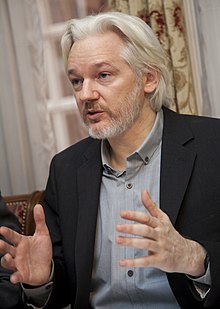 Julian Assange and the Inhumanity of the British State: ‘Unofficial’ Solitary Confinement as Torture 21st Century Wire, JANUARY 26, 2020 BY NINA CROSS
 Up until this week, Assange has been held in solitary confinement in Belmarsh prison. Incredibly, it was the other prisoners along with Assange’s legal team, who have pressured the government officials to respect the law and allow Assange to be removed from solitary confinement, resulting in his transfer to a general wing. This piece looks at how Assange was unofficially segregated in the prison’s healthcare unit, with no recourse to systems designed for prisoners in official solitary confinement regimes as applied under Prison Rule 45, leaving him out of reach of rules and law.
The sustained violation of the human rights of Wikileaks founder, Julian Assange, has been carried out in full view of the world throughout his arbitrary detention in HMP Belmarsh. Until now, condemnation of his treatment and pleas to end his suffering have been met with denial and silence by the British authorities.
But the announcement this week that Assange has been moved out of Belmarsh healthcare unit where he has been detained in solitary confinement since May, is a sign that the campaign to stop his persecution is gaining traction. Continue reading
In UK “deep disposal” is planned for the mounting, costly and forever problem of nuclear wastes
 How To Solve Nuclear Energy’s Biggest Problem https://oilprice.com/Alternative-Energy/Nuclear-Power/How-To-Solve-Nuclear-Energys-Biggest-Problem.html By Haley Zaremba – Jan 22, 2020, Nuclear waste is a huge issue and it’s not going away any time soon–in fact, it’s not going away for millions of years. While most types of nuclear waste remain radioactive for mere tens of thousands of years, the half-life of Chlorine-36 is 300,000 years and neptunium-237 boasts a half-life of a whopping 2 million years.
All this radioactivity amounts to a huge amount of maintenance to ensure that our radioactive waste is being properly managed throughout its extraordinarily long shelf life and isn’t endangering anyone. And, it almost goes without saying, all this maintenance comes at a cost. In the United States, nuclear waste carries a particularly hefty cost.
Last year, in a hard-hitting expose on the nuclear industry’s toll on U.S. taxpayers, the Los Angeles Times reported that “almost 40 years after Congress decided the United States, and not private companies, would be responsible for storing radioactive waste, the cost of that effort has grown to $7.5 billion, and it’s about to get even pricier.”
How much pricier? A lot. “With no place of its own to keep the waste, the government now says it expects to pay $35.5 billion to private companies as more and more nuclear plants shut down, unable to compete with cheaper natural gas and renewable energy sources. Storing spent fuel at an operating plant with staff and technology on hand can cost $300,000 a year. The price for a closed facility: more than $8 million, according to the Nuclear Energy Institute.”
With the United States as a poster child of what not to do with your nuclear waste, the United Kingdom is taking a much different tack. The UK is currently undertaking what the country’s Radioactive Waste Management (RWM) department says “will be one of the UK’s largest ever environmental projects.” This nuclear waste storage solution comes in the form of a geological disposal facility (GDF), a waste disposal method that involves burying nuclear waste deep, deep underground in a cocoon of backfill, most commonly comprised of bentonite-based cement. This type of cement is able to absorb shocks and is ideal for containing radioactive particles in case of any failure. The GDF system would also be at such a depth that it would be under the water table, minimizing any risk of contaminating the groundwater.
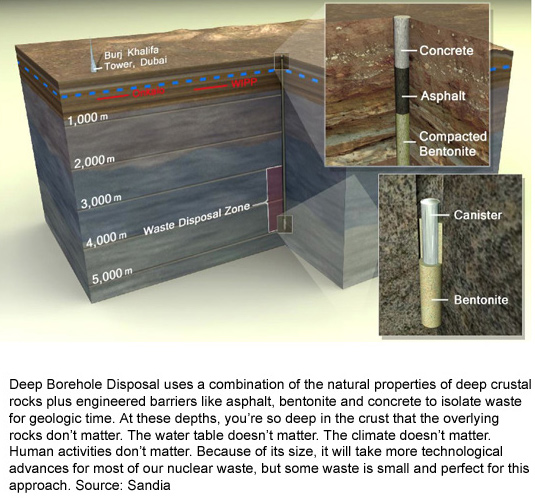
According to reporting from Engineering & Technology, nuclear waste is a mounting issue in Europe and in the UK in particular. “Under European law, all countries that create radioactive waste are obliged to find their own disposal solutions – shipping nuclear waste is not generally permitted except in some legacy agreements. However, when the first countries charged into nuclear energy generation (or nuclear weapons research), disposal of the radioactive waste was not a major consideration. For several of those countries, like the UK, that is now around 70 years ago, and the waste has been ‘stored’ rather than disposed of. It remains a problem.”
In fact, not only does it remain a problem, it is a mounting problem. As nuclear waste has been improperly or shortsightedly managed in the past, the current administration can no longer avoid dealing with the issue. In the past the UK used its Drigg Low-Level Waste Repository on the Cumbrian Coast to treat low and intermediate level waste, but now, thanks to coastal erosion, the facility will soon begin leeching radioactive materials into the sea, although that might not be quite as scary as it sounds.
Back in 2014, the Environment Agency raised concerns that coastal erosion could result in leakage from the site within 100 to 1,000 years, although it was counter-claimed that the levels of radioactivity after such a time would be low enough to be harmless,” Engineering & Technology writes. “This would definitely not be the case for high-level wastes, where radioactivity could remain a hazard into and beyond the next ice age, hence the need for longer-term disposal.”
Where exactly will that longer-term disposal be based? That’s up for debate. And it won’t be an easy thing to decide, as the RWM says that they will need a community to volunteer to be involved in such a costly, lengthy, and potentially unpopular project. And it’s not just an issue for the current inhabitants of potential locations in the UK, but for many generations to come over the next tens of thousands of years of radioactivity
Rolls Royce’s fantasy plan for so-called ‘mini’ nuclear reactors

|
Rolls-Royce plans mini nuclear reactors by 2029 https://www.bbc.com/news/business-51233444 By Roger Harrabin & Katie Prescott, BBC environment analyst and business reporter, 24 January 2020
Mini nuclear reactors could be generating power in the UK by the end of the decade. Manufacturer Rolls-Royce has told the BBC’s Today programme that it plans to install and operate factory-built power stations by 2029. Mini nuclear stations can be mass manufactured and delivered in chunks on the back of a lorry, which makes costs more predictable. But opponents say the UK should quit nuclear power altogether. They say the country should concentrate on cheaper renewable energy instead. Environmentalists are divided over nuclear power, with some maintaining it is dangerous and expensive, while others say that to achieve net zero emissions by 2050 all technologies are needed. However, the industry is confident that mini reactors can compete on price with low-cost renewables such as offshore wind. Rolls-Royce is leading a consortium to build small modular reactors (SMRs) and install them in former nuclear sites in Cumbria or in Wales. Ultimately, the company thinks it will build between 10 and 15 of the stations in the UK. They are about 1.5 acres in size – sitting in a 10-acre space. That is a 16th of the size of a major power station such as Hinkley Point. SMRs are so small that theoretically every town could have its own reactor – but using existing sites avoids the huge problem of how to secure them against terrorist attacks. It is a rare positive note from the nuclear industry, which has struggled as the cost of renewables has plummeted. In the past few years, major nuclear projects have been abandoned as Japanese companies Toshiba and Hitachi pulled out because they could not get the required funding. And the construction of Hinkley Point in Somerset could cost £3bn more than was expected, in an echo of the row over the rail mega-project HS2. “The trick is to have prefabricated parts where we use advanced digital welding methods and robotic assembly and then parts are shipped to site and bolted together,” said Paul Stein, the chief technology officer at Rolls-Royce.
He said the approach would dramatically reduce the cost of building nuclear power sites, which would lead to cheaper electricity. But Paul Dorfman from University College London said: “The potential cost benefits of assembly line module construction relative to custom-build on-site construction may prove overstated. “Production line mistakes may lead to generic defects that propagate throughout an entire fleet of reactors and are costly to fix,” he warned. “It’s far more economic to build one 1.2 GW unit than a dozen 100 MW units.” Rolls-Royce is hoping to overcome the cost barrier by selling SMRs abroad to achieve economies of scale. Its critics have warned that SMRs will not be ready in substantial numbers until the mid 2030s, by which time electricity needs to be carbon-free in the UK already to meet climate change targets. |
|

In UK “big” nuclear power versus “small” (both unaffordable) at Wylfa
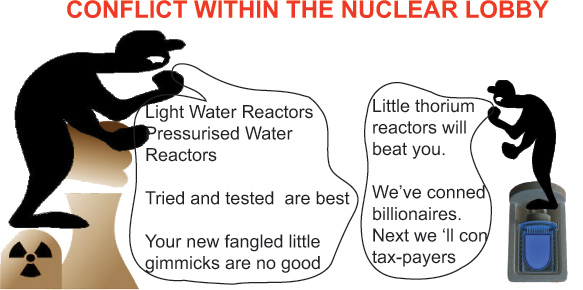
 The global nuclear lobby might look like a unified force – it’s anything but!. The nuclear nations fight each other in desperately trying to flog off their unaffordable white elephant nuclear reactors to ‘developing’ countries, or to any sucker, really. .
The nuclear industry itself is divided – the ‘conventional’ big nuclear reactors versus the (not yet existing) Small and Medium Nuclear Reactors (SMRs)
‘No plans’ for Wylfa mini nuclear power station according to developer, https://www.dailypost.co.uk/news/north-wales-news/no-plans-wylfa-mini-nuclear-17599188, Owen Hughes, Business correspondent, 20 JAN 2020
Horizon Nuclear Power said its full focus is on delivering a full scale nuke plant.
Wylfa Newydd developer Horizon Nuclear Power says there are “no plans” to build mini reactors at its Anglesey site.
Rolls Royce is currently leading a consortium developing the technology for Small Modular Reactors (SMRs) – supported by the UK Government. Trawsfynydd in Gwynedd has been tipped at a prime spot for one of the reactors and over the weekend Wylfa was also reported as a target location.
But Horizon has released a statement making clear the Wylfa site is not being put forward for this technology as they press on with the current plan for a full scale nuclear site.
A spokesman said: “There are no plans to deploy a Rolls Royce Small Modular Reactor at the Wylfa Newydd site.”
He added: “Activity on the Horizon project is currently suspended, but we’re working hard to establish the conditions for a restart using our tried and tested reactor design, which has already cleared the UK regulators’ assessment process.
Energy Secretary Andrea Leadsom wants additional information before deciding whether to give planning permission for Wylfa Newydd.
She deferred the decision on the site in October.
If permission is granted then the next step will be securing funding to make the project happen.
When it comes to SMRs, Alan Woods, strategy and business development director for Rolls-Royce, said they were focusing on sites in Wales and the north of England. Modular reactors are smaller and, once the first is approved and built, manufacturers hope mass-production will lead to shorter construction times and lower costs for each unit.
The consortium will need to establish factories to produce the small modular reactors with the pre-fabricated modules transported to sites for construction.
1 This Month




PLEASE OPPOSE HR 8255 AND S.3639 – bills would accelerate satellite deployment, with no environmental review or safeguards – https://ncstd5li.quorum.us/campaign/169331/
To see nuclear-related stories in greater depth and intensity – go to https://nuclearinformation.wordpress.com
-
Archives
- September 2026 (339)
- August 2026 (330)
- July 2026 (355)
- June 2026 (287)
- May 2026 (306)
- April 2026 (356)
- March 2026 (251)
- February 2026 (267)
- January 2026 (308)
- December 2025 (358)
- November 2025 (359)
- October 2025 (375)
-
Categories
- 1
- 1 NUCLEAR ISSUES
- business and costs
- climate change
- culture and arts
- ENERGY
- environment
- health
- history
- indigenous issues
- Legal
- marketing of nuclear
- media
- opposition to nuclear
- PERSONAL STORIES
- politics
- politics international
- Religion and ethics
- safety
- secrets,lies and civil liberties
- spinbuster
- technology
- Uranium
- wastes
- weapons and war
- Women
- 2 WORLD
- ACTION
- AFRICA
- Atrocities
- AUSTRALIA
- Christina's notes
- Christina's themes
- culture and arts
- Events
- Fuk 2022
- Fuk 2023
- Fukushima 2017
- Fukushima 2018
- fukushima 2019
- Fukushima 2020
- Fukushima 2021
- general
- global warming
- Humour (God we need it)
- Nuclear
- RARE EARTHS
- Reference
- resources – print
- Resources -audiovicual
- Weekly Newsletter
- World
- World Nuclear
- YouTube
-
RSS
Entries RSS
Comments RSS

