UK Ministers losing enthusiasm for small nuclear reactors developed with China
DBD, a Cheshire-based engineering firm, was working with China’s Institute of Nuclear and New Energy Technology to build a fleet of gas-cooled small reactors, and had hoped to win government funds. However, ministers have awarded £10m each to three rival projects — including an experimental plan for a fusion reactor. A version of the DBD reactor has already been built in China. DBD declined to comment……. (subscribers only) https://www.thetimes.co.uk/article/ministers-cool-on-chinese-nuclear-reactors-k2m8j76qf
Court reveals that EDF deceived UK about the true financial risks of Hinkley Point nuclear project
EDF boss suppressed report calling Hinkley Point ‘risky’Adam Sage, The Times, 10 July 20, thetimes.co.uk/article/edf-boss-suppressed-report-calling-hinkley-point-risky-gd5vcdhrx
The Times reports that the chief executive of the French company building the UK’s new nuclear reactors won boardroom approval for the project after suppressing an internal review labelling it as risk-laden. In a “highly critical report on the European Pressurised Reactors”, France’s Court of Audit said that the Hinkley Point project in Somerset, led by EDF, represented a “high financial risk” for the French state electricity group, the Times adds.
The court uncovered that the risks had been pointed out in a 2015 review that warned there “were not efficient enough to guarantee that risks would be controlled”. The Times continues: “The court said that Jean-Bernard Lévy, EDF’s executive chairman, had ‘refused to transmit the full report’ to directors or the government, even though the state has an 83.7% stake. They received only a synopsis.” The project received approval from the EDF board in 2016. The court also said that EDF must establish the financing and profitability of nuclear reactors before launching projects, reports Reuters, “dealing a blow to the state-owned utility’s ambitions to build new units”. And Reuters also reports that nuclear power generation at its reactors in France plunged 25.1% in June (compared to 2019) due to the effects of the coronavirus pandemic.
Meanwhile, writing in the Daily Telegraph, Sir Iain Duncan-Smith – MP and former leader of the Conservative Party – argues that the UK should “unwind its dependence on China” for “cheap goods and nuclear power”. He says: “The UK has enormous home grown tidal power potential, yet both tidal and hydrogen seem to have been brushed aside in favour of our growing dependence on large Chinese-run nuclear projects.” He concludes: “From Huawei to hydrogen and Hong Kong, we need to recognise the strategic threat China poses and, together with our allies, decide what we will do to reduce it, otherwise we risk repeating the failed lessons of the past.” And also in the Daily Telegraph, chief city commentator Ben Marlow says that the government should be stimulating manufacturing demand to contain the damage caused by Covid-19 to Rolls Royce – “Britain’s most illustrious engineering company”. He says: “It should start with nuclear where enlisting the expertise of Rolls-Royce in building so-called mini-nukes would help to solve its current geo-political nightmare with China. It would make it easier to ditch China General Nuclear Power Group from the plans to build giant new plants at Sizewell on the Suffolk coast and Bradwell in Essex, or scrap the proposals altogether.” These decisions would “also offer a greener and cheaper alternative to a technology that looks decidedly out of date already, and it would create jobs at a company in desperate need of a leg up – three birds with one stone”.
Britain’s nuclear future in trouble, aging reactors, and not enough money without China’s help
Britain’s Nuclear Future Uncertain as Relations With China Fray, https://business.financialpost.com/pmn/business-pmn/britains-nuclear-future-uncertain-as-relations-with-china-fray Rachel Morison and William Mathis, Bloomberg) 8 July 20, — Britain’s fraying relationship with China has the potential to undo a decade of mixed efforts to keep nuclear power flowing as an aging generation of plants drop out of service.
Once the heart of the U.K.’s energy plans, nuclear has been sidelined by spiraling costs and cheaper renewables. It also finds itself at the center of a diplomatic row spanning trade and human rights that threatens to undermine how the sector is financed.
Relations between China and the U.K. have been strained as the row over Huawei Technologies Co. intensified. When sweeping new national security laws were introduced in Hong Kong Prime Minister Boris Johnson offered its citizens the right to live and work in Britain.
China warned the U.K. Monday it’ll face “consequences” if it chooses to be a “hostile partner” after it emerged the government is planning to phase out the company’s equipment in the U.K.’s 5G telecommunications networks.
For nuclear, the sticking point has become the once-feted relationship with China General Nuclear Power Corp. that’s supposed to deliver the next generation of large nuclear plants. That link has come into sharp focus as the U.K. scrambles to find a funding model for projects that aren’t getting any cheaper.
Without CGN, its money and its technology, the U.K. will be left with a huge funding gap that other investors don’t seem willing to fill. It’ll also leave the country’s nuclear plans in disarray.
Equity funding for nuclear power stations is very difficult for private actors,” said Rob Gross, director of the U.K. Energy Research Centre. The risks are significant, timescales long and individual projects are very large. That’s why governments have always played a role in nuclear power, he said.
CGN’s involvement in Britain’s nuclear industry started in 2016 when a deal was signed with Electricite de France SA to cooperate on a trio of reactors totaling 8.7 gigawatts starting with Hinkley Point C in southwest England.
Nuclear remains important for the British government but it’s becoming increasingly pushed to the margins of energy policy as cheaper wind and solar have taken center stage.
Nuclear power has traditionally been seen as a low-carbon way of supplementing renewables — and as such a key part of the future energy mix envisioned in a net zero world.
Losing nuclear power probably wouldn’t pose a threat to the U.K.’s ability to generate enough power. The gap could be filled by gas, batteries or small modular reactors that can provide back-up to renewable energy and keep the lights on.
The sector is also important to the country as a way of building a large, skilled workforce and creating a supply chain using British companies.
False Starts
In 2017, ministers envisioned building 18 gigawatts of new projects but one by one each project folded, unable to negotiate the financing, leaving just EDF and CGN.
The government’s offer in 2018 to Hitachi to take a third of the equity at the Wylfa nuclear project wasn’t enough to keep the company interested.
How best to finance the technology, which costs billions, has become the latest hump in the road for policymakers. The Hinkley Point reactors – expected to start producing power by 2025 – have been hit by delays and cost overruns.
“The precise funding model for nuclear is up to the government to decide,” an EDF spokesman said.
That project will now cost as much as 22.5 billion pounds ($28.1 billion), taking into account inflation, and the guaranteed price of power is significantly higher than the latest round of offshore wind projects. Sizewell-C, still in the planning process, is slated to cost 20 billion pounds.
EDF is struggling and can’t afford to finance Sizewell on its own. The utility has cut costs and jobs, and pared investments setting out a plan to divest at least 10 billion euros of assets from 2015 to 2020 to help fund its share of Hinkley Point.
* CGN’s investment is in the planning and development stage only for Sizewell whereas it is involved in the construction of Hinkley.
The industry favors paying for the massive projects through a Regulated Asset Base model, a proven success on other infrastructure projects. The previous Conservative government was thought to back the financing option but the idea looks to be losing traction.
“If the Chinese pull out, then Sizewell will still go ahead but EDF will be unable to take on another major project,” Elchin Mammadov, a Bloomberg Intelligence analyst, said “So, Bradwell will be dead or put on hold for another decade.”
The debate has gone quiet following a consultation on the RAB model which closed in October.
RAB likely wouldn’t transfer enough risk from the project’s backers — EDF and CGN. The government would have to offer some kinds of guarantee on the project in order to get private investors to finance it.
One option would be for the government to take either a majority or minority stake in Sizewell C..
I wouldn’t be surprised if what is adopted is either a model with many of the characteristics of RAB, or potentially consideration of a more direct stake. This is about reducing the cost of capital.” said Tom Greatrex, chief executive officer of the Nuclear Industry Association.
But despite the long delays, there’s no indication that the government’s made up its mind how it will proceed.
“We are currently considering responses to inform the best approach to the financing of future nuclear projects,” a spokesperson for the Department for Business, Energy & Industrial Strategy said.
As much as 80% of electricity will be produced from low carbon sources by 2030, according to scenarios modeled by the U.K.’s Committee on Climate Change.
“With all but one of the nuclear fleet set to retire by 2030, and uncertainty over the scale of the new build program, it is likely that more electricity from renewable sources will be needed,” said Jonathan Marshall, head of analysis at the Energy and Climate Intelligence Unit.
Can Hunterston nuclear power station restart? Are UK tax-payers to pay billions for new nuclear?
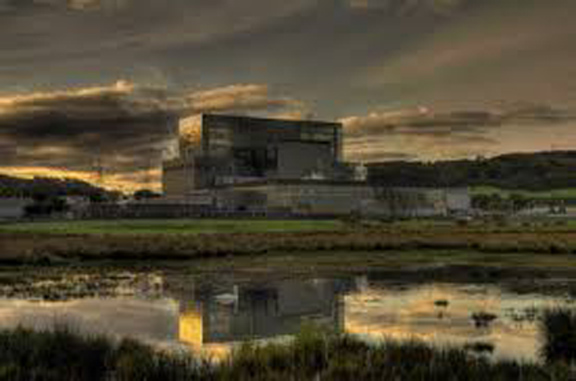
Times 5th July 2020, A high-stakes game of chance is being played at Hunterston B nuclear power
station on the west coast of Scotland. Engineers from the French giant EDF and safety experts from the Office for Nuclear Regulation are trying to work out if and when the plant’s two reactors can be restarted.
Forty-four years of hard use have not been kind to the plant’s graphite core — a vast chunk of carbon riddled with cracks that weighs the same as 110 double-decker buses. While the regulator and EDF insist that, with careful supervision, a cracked graphite core is nothing to worry about, it
is a symptom of its advancing years.
Hunterston, like the rest of EDF’s nuclear power stations around the UK, is on borrowed time. Seven nuclear stations capable of supplying about a sixth of the UK’s power needs will shut during the next decade. Unless ministers leap into action, the country that opened the first industrial-scale nuclear power station in 1956 at Calder Hall, Cumbria, will be left with just one replacement plant, Hinkley Point C on the Somerset coast, which is under construction.
The government faces difficult decisions: what next in its race to eliminate carbon emissions by 2050? A boom in renewable power has offered the beguiling prospect that wind and solar, combined with storage such as big batteries and hydrogen, could fill the void. A report from the National Infrastructure Commission has suggested that commercially unproven technologies, such as hydrogen generation, could negate the need for more nuclear power and be “substantially cheaper”.
With half an eye on this utopian future, successive governments have tried to persuade European
power giants such as Germany’s RWE and Eon, and Japan’s Toshiba and Hitachi, to pump cash into new reactors. However, one by one, those companies have dropped out, leaving just a handful of options remaining.
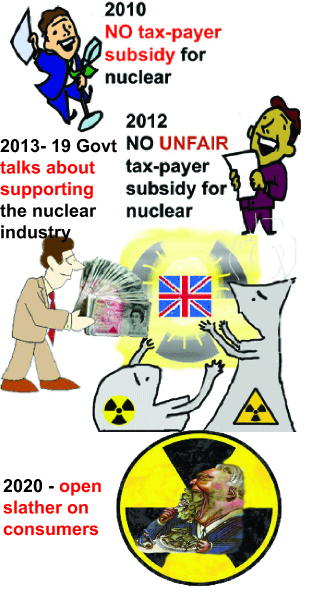
EDF and China General Nuclear (CGN) — both backed by their governments — are building the £22bn Hinkley plant. Without a state support package, EDF will struggle to build the planned Sizewell C in Suffolk. That would leave CGN as the only developer capable of going it alone without UK taxpayer support. ……
The prime minister’s adviser Dominic Cummings is thought to be a fan of small nuclear power stations, and Boris Johnson hinted about a role for nuclear last week………. Taxpayers are about
to find out whether billions of pounds will be pumped into nuclear power……
https://www.thetimes.co.uk/edition/business/atomic-quandary-for-ministers-after-years-of-dallying-over-nuclear-power-dzsc2s25l
Hunterston the most heavily cracked nuclear reactor: is it EDF’s guinea pig for how bad it can be?
Largs & Millport News 1st July 2020, A CALL has been made to shut down Hunterston B with immediate effect. West Kilbride councillor Todd Ferguson says that Hunterston should not be a‘guinea pig’ for the UK nuclear industry testing long far power stations can last. Cracks have been appearing in all of the EDF advanced cooling reactors fleet around the United Kingdom – and the Office of Nuclear Regulation (ONR) are currently examining the safety case presented by EDF to switching the reactors back on but the matter has been delayed several times this year.
big decision to make in relation to the safety case which has been presented by EDF.” At the recent Hunterston Site Stakeholders Group meeting, EDF were asked when it became economically prohibitive to re-start the reactors and the response was that the data coming from the testing of
the reactors was important information for the rest of the fleet of reactors around the UK.Councillor Ferguson said: “Hunterston is by far the most heavily cracked. When does it get to the points where the risks outweigh everything else? “I don’t want it to get into a position of a race of what is going to fail first – the graphite or the boilers.”………https://www.largsandmillportnews.com/news/18533657.dont-turn-hunterston-guinea-pig—call-shut-reactors-now/
Boris Johnson pledges to get ‘big nuclear things’ done in message to Copeland mayor
|
Boris Johnson pledges to get ‘big nuclear things’ done in message to Copeland mayor
By Liam Waite @imliamwaiteSports reporter We’re going to get massive things done and we’re going to get big, big nuclear things done as well.”Mr Starkie said he was “delighted” to receive the welcome and felt the message on nuclear made the future seem “bright”….. https://www.newsandstar.co.uk/news/18557769.boris-johnson-pledges-get-big-nuclear-things-done-message-copeland-mayor/
|
|
|
Julian Assange’s father calls on Australia’s Prime Minister Scott Morrison to help this Australian citizen
 Assange’s father calls extradition process ‘disgrace’ https://telanganatoday.com/assanges-father-calls-extradition-process-disgrace?fbclid=IwAR1a7bQ0W_Xcgc9EIeGaAHVP7Zmm2cM6nNV65ZXtkhCwNUlarqIYTJVw6xo1 July 20, The 80-year-old is organizing public events in Australia despite the ongoing coronavirus pandemic and hopes to travel to London in August to support Assange during his extradition trial.
Sydney: WikiLeaks founder Julian Assange’s father, John Shipton, is fighting tirelessly for the release and return of his son, who is facing an extradition trial in London for publishing classified information, a process he described as abuse.
“We maintain that the extradition request is a fraud in the English court… It’s a fraud in the English legal system, it’s a case of abuse of process, it is a disgrace,” Shipton, who travelled from Melbourne to Sydney to campaign for his son’s release, told Efe news in an interview.
The 80-year-old is organizing public events in Australia despite the ongoing coronavirus pandemic and hopes to travel to London in August to support Assange during his extradition trial which, he says, is being carried out under “dire” circumstances.
In May 2019, the UN Special Rapporteur on Torture, Nils Melzer, said, after visiting Assange in the Belmarsh prison along with two medical experts, that he showed “all symptoms typical for prolonged exposure to psychological torture, including extreme stress, chronic anxiety and intense psychological trauma”.
Assange has spent almost a decade in confinement, first under house arrest in a British town and then at the Ecuadorian embassy in London between 2012 until 2019, when Ecuador withdrew his political asylum status.
Shipton has urged the Australian government to mediate with the UK administration for the release of his son, who is wanted in the US on 18 charges of espionage and computer intrusion, for which he could be sentenced to prison for up to 175 years.
“I believe the government can, if it wishes to, assist us in bringing Julian home. I believe that (it) is very simple for the Prime Minister (Scott Morrison) to pick up the phone and ring (his UK counterpart) Boris Johnson and say Julian Assange is an Australian citizen in dire circumstances.
“This will resolve this immediately and that’s easily possible,” he told Efe news during the interview.
UK Labour says state-owned Chinese firm CGN should be excluded from Hinkley nuclear project
Labour Questions ‘Aggressive’ China’s Involvement In UK 5G And Nuclear Energy Deals
Shadow foreign secretary signals tougher stance on Huawei and Hinckley Point amid Hong Kong crisis. Huffington Post, By Rachel Wearmouth, 2 July 20 China’s involvement in the UK’s 5G network and nuclear energy programme should be questioned after “aggressive” actions towards the UK, Labour has said.
Nandy said the UK should dump the 5G deal and said state-owned Chinese firm CGN should also be excluded from plans to finance nuclear energy plant Hinckley Point, in Somerset.
Speaking to Times Radio presenter John Pienaar, Nandy said: “We need far greater strategic independence from China, which means that we need to have home-grown alternatives for our 5G network and our nuclear power.”
She went on to say: “I don’t think we should be handing over large chunks of our energy infrastructure, especially our nuclear energy infrastructure, to a country that’s behaved in such an aggressive way towards the UK and the people of Hong Kong in recent weeks.” …………. https://www.huffingtonpost.co.uk/entry/bar-aggressive-china-from-5g-and-nuclear-energy-deals-in-uk-says-labour_uk_5efcb53bc5b612083c55d19e?guccounter=1&guce_referrer=aHR0cHM6Ly9uZXdzLmdvb2dsZS5jb20v&guce_referrer_sig=AQAAAATQSZ7H9fv_HgI3hWPha0plWMLUzrUnPUbrBmIuuNrwU_Rjr1Nt
France’s EDF in a financial pickle over huge costs of UK’s Hinkley C nuclear project
Dave Toke’s Blog 27th June 2020, The chickens are coming home to roost for EDF for their questionable decision to go ahead with building Hinkley C -a decision they took despite the lack of certainty over whether they would get enough backing from the British Government.
Originally EDF was publicised as being offered UK Treasury loan guarantees that had been widely touted as a vital basis for building Hinkley C. But now the French Financial Markets Regulator has
sanctioned EDF for not flagging up how conditional such loan guarantees were. These loan guarantees have never materialised.
Essentially, EDF is now continuing to build Hinkley C using money borrowed on its own balance
sheets – borrowings which are much more costly than UK Government backed guarantees and which reduce its own (EDF) profitability.
The Finance Officer of EDF actually resigned at the time EDF decided to go ahead with building Hinkley C. Of course all this is happening at the same time when we are being asked to believe that the next EPR (at Sizewell C) is going to be delivered at low cost to the consumer if the risk of building the plant is transferred from EDF to the British taxpayer and consumer!
This is the so-called RAB mechanism, something that could well just turn out to be an
almost unlimited cash facility for EDF to park their financial black hole in the centre of British finances (as well as those of the French).
https://realfeed-intariffs.blogspot.com/2020/06/edf-sanctioned-by-french-regulators-for.html
Hitachi- no plans to sell Wylfa nuclear site to China
Chinese corporation after comments by Donald Trump. The US president was
quoted by the Sunday Times warning it not to sell Wylfa, on Anglesey, “to
China”.
rising costs after Hitachi failed to reach a funding agreement with the UK
government. A Horizon Energy spokesman said: “We don’t comment on
speculation. “Our focus remains on securing the conditions necessary to
restart this crucial project, which would bring transformative economic
benefits to the region and play a huge role in helping deliver the UK’s
climate change commitments.”
lead the project to build the site. “We are not aware of any plans to sell
the project to China,” Hitachi told the Reuters news agency.https://www.bbc.co.uk/news/uk-wales-politics-53212790
Donald Trump intervenes in Wylfa nuclear project discussions
North Wales Live 28th June 2020, Donald Trump is understood to have intervened in discussions about the next generation of nuclear power on Anglesey. According to reports, the US
president’s administration has warned Hitachi, the company behind the site,
not to sell it on to the Chinese government. The intervention is a sign of
escalating tensions between the Americans and the Chinese, according to the
Times. It reports today that the White House is heaping pressure on Hitachi
– which is a Japanese-owned company – not to sell on its interest into the
site to Beijing.
https://www.dailypost.co.uk/news/north-wales-news/donald-trump-intervenes-anglesey-nuclear-18502362
New nuclear disaster plans sent to thousands of homes in Plymouth
 New nuclear disaster plans sent to thousands of homes in Plymouth New nuclear disaster plans sent to thousands of homes in PlymouthMore than 19,000 homes in the area are set to receive an updated information leaflet this week, Plymouth Herald, Plymouth Live UK 28June 20 New nuclear safety advice is being issued to residents living in the proximity of Devonport Dockyard.Plymouth City Council is sending out updated information of important advice to all the homes and businesses which fall within the detailed emergency planning zone. Devonport dockyard is full of toxic material, substances and machinery and so there is in theory a chance – albeit a very, very small one – of a major malfunction leading to deadly radioactive fallout……
If a nuclear emergency does occur, residents and members of the public could be exposed to gamma and beta radiation. In some circumstances radioactive material could escape from the dockyard site and affect areas close to, or downwind of …….. https://www.plymouthherald.co.uk/news/plymouth-news/new-nuclear-disaster-plans-sent-4273900 |
|
Sizewell nuclear plant – untried, costly, environmentally damaging, and no electricity for 10 years or more!

the government is exploring novel ways in which to lay the burden for financing a dangerous and costly nuclear venture on you, the consumer.
‘The Sizewell C plans are an insult to the people of Suffolk’ https://www.eadt.co.uk/news/pete-wilkinson-together-against-sizewell-c-campaign-1-6718925 27 June 2020, Pete Wilkinson, Together Against Sizewell C
Chairman of Together Against Sizewell C, Pete Wilkinson, has described it is a “battle for the soul and integrity of East Suffolk”. Here he explains why he is opposing the nuclear project.
Anyone new to Suffolk, ignorant of EDF’s nuclear plans, would be forgiven for laughing out loud.
An untried reactor, labelled ‘technically complicated to construct’ by its own designers, a cost of £20billion-plus, taking at least 10 years to build, producing waste which is not only lethal to living tissue but which remains so for thousands of years and for which there is no agreed or proven disposal or management route, to be built in the middle of a community of 5,000, which will not produce electricity for at least 10 years by which time its output will be redundant to needs, built on an eroding coast? Yeah, sure: pull the other one.
You really couldn’t make it up.
Yet this is what residents up and down the East Suffolk are facing. They have been led to believe that the destruction of their environment on a massive scale, the compulsory purchases, the roads, the workers’ campuses, the borrow pits, the huge water demand in the driest county is inevitable – and to make the best of it.
When did anyone ask YOU, resident of East Suffolk, if you wanted your tranquil, culturally rich and peaceful rural environment urbanised and anonymised, requiring six new roundabouts on the A12 and up to 1,000 vehicle movements a day along our country roads to ferry the material required for our own white elephantine carbuncle on our heritage coast, light, noise and dust pollution 24 hours a day, seven days a week or a decade of accommodating 4,000 workers? Of course you were not asked. They knew the answer. The new nuclear policy has not been subjected to anything like forensic public or Parliamentary scrutiny.
Democratic deficit runs through all aspects of this programme like the letters in a stick of rock and is presented by its advocates as ‘inevitable’. The National Policy Statement process renders what government calls ‘national infrastructure projects of over-riding importance’ inviolate, untouchable and – yes – inevitable unless the planning authorities have the courage or unless the Secretary of State has the guts to do what they should – throw the EDF plans out as an insult to the people of Suffolk. Sizewell C is important to no-one other than EDF.
But just how ‘over-riding’ is the need for Sizewell C? The French-made film, ‘The Nuclear Trap’ makes it clear that Hinkley C in Somerset and Sizewell C are more critical to the survival of the French nuclear industry than they are to providing electricity to UK consumers.
There has been a huge reduction in electricity demand since 2013 – over 16% – making earlier predictions of an increase of 15% by 2020 an overestimation of more than 30%.
Renewables out-compete nuclear on every front – cost, waste, jobs, CO2 and time for deployment. If ever Sizewell was built, it would be at least a decade, probably more like 15 years given the history of cost and time over-runs of its flagship plant at Flamanville, before it turned one kilowatt hour of electricity.
In 15 years, we will – one can only hope – have grown out of our obsession with nuclear and invested at suitably high levels in realising the huge job potential in micro-technology, decentralisation, efficiency and conservation of energy, and look back on our nuclear infatuation with a shake of the head.
The current National Policy Statement which covers the nuclear component of the energy policy, EN6, is entirely unfit for purpose as it gives policy authority only to those nuclear plants which can be deployed before 2025 – i.e. not, Hinkley, not Sizewell and not Bradwell, none of which will be generating electricity by that date.
Therefore the EN6 policy document is null and void. Its replacement is still undergoing review and will depend heavily on the financing arrangements the government can agree to in order to remove the need for EDF to fork out for it.
Instead, the government is exploring novel ways in which to lay the burden for financing a dangerous and costly nuclear venture on you, the consumer.
So much for ‘no subsidy’ nuclear, but in policy terms, it is legally questionable for Hinkley C to continue to be built, for Sizewell C’s planning application to be submitted or for CGN/EDF to consult on plans to build Bradwell B when there is no policy architecture to justify and legitimise any of this work or progress.
EN6 has fallen as a legitimate policy statement for new nuclear build but that does not seem to have any effect on the way the French and Chinese backers of new nuclear in the UK are required to act nor the complacency and indifference with which the government seems to take these gaping legal inconsistencies.
The waste problem that nuclear generates is probably the most intractable. In the 15 years of the existence of the Nuclear Decommissioning Authority, it has failed to secure a site, a volunteer community or to satisfactorily solve many of the dozens of technical and engineering problems associated with burying 500,000 cubic metres of legacy waste while ensuring that the estimated 78,000,000 units of radioactivity remain underground.
While new build waste such as that from Sizewell C is likely to be less bulky, its high burn up in the reactor means that it will be far hotter than even Sizewell B’s waste and will generate much more radioactivity – up to five times that contained in the legacy waste. How can any government or industry knowingly embark on a development programme which will create such a mountain of waste when a repository for its safe disposal is still more a matter of hope over expectation?
The only legacy Sizewell C will leave for Suffolk is a degraded environment and a radioactive waste mountain which future generations will have to deal with. Please tell your councillor to vote to remove the support for Sizewell C at the full council meeting on July 7, please write to the planning inspector to voice your concerns and please urge your MP to tell the Secretary of State to put EDF’s planning application where it belongs – in the bin.
Wylfa nuclear project: Donald Trump plea over site sale dismissed
Work on the £13bn project was put on hold last year because of rising costs after Hitachi failed to reach a funding agreement with the UK government.
A Horizon Energy spokesman said: “We don’t comment on speculation.
“Our focus remains on securing the conditions necessary to restart this crucial project, which would bring transformative economic benefits to the region and play a huge role in helping deliver the UK’s climate change commitments.”
Horizon is owned by Hitachi and was set to lead the project to build the site……. https://www.bbc.com/news/uk-wales-politics-53212790
Sizewell planning documents reveal higher-than-expected £20bn price tag
 Cost of new Sizewell C nuclear plant put at £20bn https://www.ft.com/content/77c209f7-6d18-4609-ac3c-77d1b5b82b34 26 June 20, Higher-than-expected price tag revealed for first time in planning documents. Nathalie Thomas in Edinburgh and Donato Paolo Mancini in London Cost of new Sizewell C nuclear plant put at £20bn https://www.ft.com/content/77c209f7-6d18-4609-ac3c-77d1b5b82b34 26 June 20, Higher-than-expected price tag revealed for first time in planning documents. Nathalie Thomas in Edinburgh and Donato Paolo Mancini in London
A new nuclear plant proposed on England’s east coast will cost £20bn, according to planning documents that reveal the higher-than-expected price of the project for the first time. The developers of the proposed plant at Sizewell in Suffolk — France’s EDF and Chinese state-owned CGN — had previously indicated the power station could be built for 20 per cent less than Hinkley Point C. Britain’s first new nuclear plant in a generation is under construction in Somerset.
This implied a cost of about £18bn for the Suffolk plant, called Sizewell C, after EDF last year said the price tag for Hinkley Point had risen to as much as £22.5bn. The first new-build project has suffered a string of cost overruns.
The revelation of Sizewell’s cost in extensive planning documents published on Thursday will reignite the ferocious debate around whether the UK should build large new nuclear plants.
Some backbench Conservative MPs, opposed to Chinese state involvement in critical national infrastructure, have concerns about the project because of the presence of CGN. The Chinese state-owned company is a junior financing partner on the Sizewell C project but hopes to install its own reactor technology in another proposed nuclear station at Bradwell-on-Sea, Essex.
The Financial Times reported on Wednesday that CGN, or China General Nuclear Power Corporation, was on a US list of 20 companies with links to the Chinese military compiled by the Pentagon. The list is part of an attempt by the White House and Congress to prevent Beijing from obtaining sensitive technologies as well as US funding.
EDF said in the planning documents that the cost estimate for Sizewell C includes design, construction and land costs associated with the proposed site, which is situated next to one of the UK’s operational nuclear plants, known as Sizewell B. It also takes into account “expected inflation and contingencies”, according to the document.
The company had previously claimed the cost savings on Sizewell could be delivered because it would be a “near identical copy” of Hinkley Point C.
EDF said the budget detailed in the planning application includes inflation over the estimated 10 years of construction, whereas the latest estimate for Hinkley Point C — estimated to be in a range of £21.5bn to £22.5bn — was based on 2015 prices.
The 20 per cent cost saving still stood if you subtracted a fifth from the Hinkley budget and then adjusted that sum for inflation, the company added.
EDF and CGN are yet to clarify how the new plant would be funded. The UK government last year launched a consultation on a so-called regulated asset base model (RAB) — used for other forms of infrastructure such as energy networks. This would lower the cost of capital of the scheme because consumers would have a surcharge added to their energy bills before the plant was completed.
Stop Sizewell C, a local campaigning group, said the funding statement was “a work of fiction” and described the £20bn pricetag as “totally eye-watering”.
Greenpeace UK’s chief scientist Doug Parr said the nuclear industry’s claim that it can always make the next power plant cheaper was “just never true.” He pointed out that the costs of renewable power had dropped below half those of nuclear “and just keep dropping”.
The government is yet to report back on the consultation. Privately, some nuclear industry leaders have been making an argument for the taxpayer to take a stake in any new project.
|
|
1 This Month




PLEASE OPPOSE HR 8255 AND S.3639 – bills would accelerate satellite deployment, with no environmental review or safeguards – https://ncstd5li.quorum.us/campaign/169331/
To see nuclear-related stories in greater depth and intensity – go to https://nuclearinformation.wordpress.com
-
Archives
- September 2026 (330)
- August 2026 (330)
- July 2026 (355)
- June 2026 (287)
- May 2026 (306)
- April 2026 (356)
- March 2026 (251)
- February 2026 (267)
- January 2026 (308)
- December 2025 (358)
- November 2025 (359)
- October 2025 (375)
-
Categories
- 1
- 1 NUCLEAR ISSUES
- business and costs
- climate change
- culture and arts
- ENERGY
- environment
- health
- history
- indigenous issues
- Legal
- marketing of nuclear
- media
- opposition to nuclear
- PERSONAL STORIES
- politics
- politics international
- Religion and ethics
- safety
- secrets,lies and civil liberties
- spinbuster
- technology
- Uranium
- wastes
- weapons and war
- Women
- 2 WORLD
- ACTION
- AFRICA
- Atrocities
- AUSTRALIA
- Christina's notes
- Christina's themes
- culture and arts
- Events
- Fuk 2022
- Fuk 2023
- Fukushima 2017
- Fukushima 2018
- fukushima 2019
- Fukushima 2020
- Fukushima 2021
- general
- global warming
- Humour (God we need it)
- Nuclear
- RARE EARTHS
- Reference
- resources – print
- Resources -audiovicual
- Weekly Newsletter
- World
- World Nuclear
- YouTube
-
RSS
Entries RSS
Comments RSS

