UK will fund its nuclear power with the same schemes used by bankrupt US nuclear financing practices!
How bankrupt US nuclear financing schemes are going to be used to fund nuclear power in the UK to fund nuclear power. https://100percentrenewableuk.org/blog by David Toke 24 July, 20 As different types of corrupt pro-nuclear handouts in the USA unravel the British Government is expected to support bringing in a legalised version of bankrupt US nuclear financing practices to fund Sizewell C nuclear power plant.
 The US nuclear power industry is in danger of implosion as corrupt practices used to maintain its old power plant and pay for new plant are the subject of prosecutions. In Ohio the Speaker of the House of Representatives has been arrested on account of charges that he was bribed to ensure that nuclear power and coal plant in Ohio were given bailouts whilst policies supporting renewable energy and energy efficiency were cut back.
Meanwhile in South Carolina the Securities and Exchange Committee has charged executives of the State’s monopoly  utility with fraud after the abandonment of two of the only four nuclear reactors whose construction has been started in the USA this century. According to the Wall Street Journal: ‘The defendants claimed the project was on track even though they knew it was significantly delayed and wouldn’t be completed on time by Jan. 1, 2021, to qualify for $1.4 billion of federal tax credits, the securities regulator alleged’. In the process the electricity consumers were charges billions of dollars for the power plant which were not built through a similar cost recovery process that is proposed for the UK.
Over to Florida, and while nobody has been charged with any offences there is great controversy over the way the 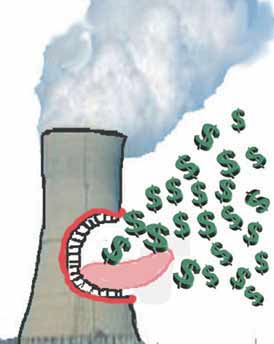 dominant state utility has charged the electricity consumer for a nuclear power plant that was never built. In this case they never even got as far as breaking ground, but the consumers had to pay out $871 million as well as lots more money for other bungled projects relating to nuclear energy. Florida, like other US states has simultaneously erected huge barriers stopping homeowners (in the so-called ‘Sunshine State’) from putting solar panels on their roofs.
According to the New York Times: ‘Florida is one of eight states that prohibit the sale of solar electricity directly to consumers unless the provider is a utility. There is also a state rule, enforced by the utilities, requiring expensive insurance policies for big solar arrays on houses’.
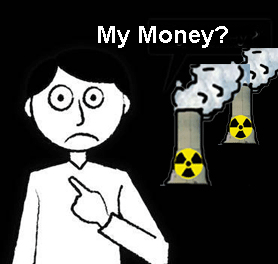 Meanwhile in Georgia, the third state to use the cost recovery method for financing nuclear plant, the only two nuclear power plant being built in the USA (Vogtle III and IV) are hopelessly delayed with massive cost overruns, again, yes you’ve guessed it, with costs paid by electricity consumers.
Of course all of these real or abandoned nuclear plant were financed under the so-called Regulated Asset Base (RAB) model that is being slated to pay for Sizewell C in the UK. This is hailed as a much cheaper way to pay for nuclear power compared with the way that Hinkley C is financed. Cheaper, for the developer (in this case EDF), certainly, but for the electricity consumer it’s a disaster! The consumer, as the US experience clearly illustrates, starts paying and continues paying for a nuclear power plant long before it is generating any energy, and there is no guarantee even that it will ever generate anything! But the consumer still pays, no matter what the constructions cost overruns turn out to be! And invariably, with nuclear power plant, there are very large cost overruns.
Added to this of course the bias in favour of new nuclear as opposed to new renewable energy schemes is also assured. The contracts nuclear power are being given assure them that they will get paid the premium price for energy generated even if wholesale electricity prices are negative whereas windfarms and solar farms will get nothing in such circumstances. See our report on this. Of course there’s nothing illegal in this because mountains of impenetrable contractual and accountancy paperwork make it so. It is just written by the the people who have the energy establishment’s interests at heart.
The global scam: nuclear energy and the industry surrounding it
Nuclear energy and the industry surrounding it ‘is a complete scam’ https://www.energylivenews.com/2020/07/24/nuclear-energy-and-the-industry-surrounding-it-is-a-complete-scam/
That’s the bold claim from Jonathon Porritt, Co-Founder of Forum for the Future, who told Energy Live News that the UK ‘has been one of the most incompetent countries in developing nuclear infrastructure’, Jonny Bairstow, 24 July 20
Nuclear energy and the industry surrounding it is a complete scam.
That’s the bold claim from Jonathon Porritt, Co-Founder of Forum for the Future, who told Energy Live News’ Editor Sumit Bose that both traditional nuclear infrastructure and emerging technologies such as small modular reactors (SMRs) were “unbelievably expensive” and said it was “preposterous” that the industry “still lays claim to such political attention”.
The renowned environmentalist said nuclear power plants can only be built with “massive” government subsidies at the cost of other energy sources which he suggested are much cheaper, safer and less environmentally damaging.
He stressed the only reason the nuclear civil industry still exists in the UK is to build the skills needed to maintain the nation’s military nuclear expertise and alleged that historically, the UK has been one of the most incompetent countries in developing nuclear energy.
He said: “I’m amazed that this industry still thinks it has a case to make, I mean it’s been talking about next-generation nuclear reactors for as long as I can remember, fusion power has always been precisely 40 years away, it was when I joined the green party in 1974 and you’ll be surprised to know Sumit, It’s now 30 years away – in 30 year’s time we’re not going to be worrying about these things at all.”
Mr. Porritt added that suggestions from opponents of renewable energy that clean technologies such as solar panels never achieve payback in terms of their climate impacts are “utter rubbish” and noted carbon payback is usually delivered around 18 months after a solar panel has been installed.
UK public has been misled over plans for nuclear reactors in Essex
 Mersea Island Environmental Alliance 22nd July 2020, Mersea Island Environmental Alliance have been investigating discrepancies between the National Policy Statement for Bradwell in Essex and what is ‘proposed’ by CGN/EDF in their Consultation document. CGN/EDF Consultation
proposal is for two reactors and in that document, they state that:
“Parts of the Project which are not likely to be influenced by the
consultation include:
station on land adjacent to the existing Bradwell power station (as a
matter of Government policy)…and…Technical details including the
proposed deployment of two reactors”.
Alliance working with The Environmental Law Foundation sought legal
opinion. This is the Barrister’s opinion having reviewed the Consultation
document: “Arguably this is highly misleading as the National Policy
Statement does not set out government policy support for a two-reactor
station, which was not assessed as part of the NPS. Consultees (the public
included) may not be aware that they are entitled to make representations
on this.
alternative option, and consultees should be made aware that they are
entitled to comment on this: see R. (Moseley) v LB Haringey [2014] UKSC 56.
Section 104(3) of the Planning Act 2008 states: “The Secretary of State
must decide the application in accordance with any relevant national policy
statement, except to the extent that one or more of subsections (4) to (8)
applies.”
process of preparing a new NPS for nuclear power). This states at paragraph
4.1.1 that Bradwell is a site “that the Government has determined are
potentially suitable for the deployment of new nuclear power stations in
England and Wales before the end of 2025”
engage in a mockery of a consultation held at the peak of the Pandemic. To
make matters worse Government are clearly aware of the CGN/EDF remit. The
public have been deliberately mislead! The site selection process for one
reactor and the NPS are being ignored both by the developer and Government.
The public are illegally excluded from comment on the two-reactor proposal.
The latter exclusion courtesy of CGN/EDF who are just the contractor! The
intriguing side to this is how despite the initial enthusiasm from my media
contacts over the developing story it hits the buffers of the editorial
desks and goes no further.
https://www.facebook.com/Stop-Nuclear-Dumping-In-Blackwater-Estuary-1473134316325437
Bradwell B new nuclear project probably doomed, -on fragile shore subject to flooding
 Maldon Standard 19th July 2020, Andy Blowers: There has been much fevered speculation about the Bradwell B
new nuclear project falling in the wake of the current breakdown of relations with China.
That may be so, but what few commentators seem to have observed is that Bradwell is probably doomed because it is a wholly unsuitable and unsustainable site. Plans recently released indicate a giant industrial complex on a flat, low-lying peninsula ringed about with various designations, including protection for the Colchester Native Oyster.
Who in their right mind would consider erecting two mega reactors with all the attendant bells and whistles, including twin cooling towers and long-term highly radioactive spent fuel stores on a site that is likely to become
flooded and stranded as climate change impacts wreak havoc on the fragile Essex shores? Beijing to Bradwell – the terminus of the Belt and Road where Chinese infiltration in our sensitive nuclear infrastructure begins
and ends.
https://www.maldonandburnhamstandard.co.uk/news/18590061.letter-site-totally-unsuitable-bradwell-b/
Britain’s Conservatives anxious to review UK’s nuclear build co-operation with China
Tory hawks press button on nuclear power battle with China, After Huawei, energy sector looks set to be next flashpoint in Sino-British relations, Ft.com, Jim Pickard, Daniel Thomas and Nathalie Thomas-20 July 20
CGN, which has already invested £3.8bn in the UK nuclear sector, is a junior funding partner for the new Hinkley Point power station in Somerset being built by France’s EDF, and is also involved with the French company’s other proposed plant at Sizewell in Suffolk.
VETERAN MP is calling for safeguards against a Chinese-built nuclear power station.
Sir Bernard Jenkin calls for safeguards at Bradwell B nuclear plant, A VETERAN MP is calling for safeguards against a Chinese-built nuclear power station. https://www.gazette-news.co.uk/news/18590085.veteran-mp-calls-safeguards-chinese-built-nuclear-power-station/ By Francesca Edwards @bwt_Francesca Multimedia Reporter, 18 Jul 20,
Harwich and North Essex MP Sir Bernard Jenkin is calling on ministers to introduce provisions to grant the UK Government a golden share in critical infrastructure projects such as the proposed Bradwell B power plant.
Under his proposal, the share would grant the Government powers to prevent takeovers and appoint board members.
It will also place obligations on directors to inform the Government if activities, such as the theft of nuclear secrets, were taking place against the national interest.
In an article on the ConservativeHome website he wrote: “The only safeguards proposed for Bradwell B are the same as for any nuclear power station. They are wholly inadequate.
“At present, China will finance, build, own and operate Bradwell B. The Government has agreed that the Chinese government should build a key part of our own critical national infrastructure.
If this is to go ahead, the very least we should insist upon is a set of safeguards to protect our national security and critical national infrastructure from malign foreign influence from a hostile government.
“Chinese companies are not the same as private companies based in Europe or the United States, or even state owned ones like the French EDF, which is building Hinkley Point.
“If we don’t want the UK taxpayer to contribute to the strength of the Chinese military, or UK-based technology to mysteriously end up in Beijing, we need to act swiftly and decisively, whilst also recognising that, at least for now, we still need Chinese financing and technical expertise in order to expand the UK’s civil nuclear infrastructure.”
Campaign group Geiger Bay press for full testing of Hinkley nuclear plant sediment
 Nation Cymru 18th July 2020, Campaigners press for full testing of nuclear plant sediment in effort to
halt dumping off Cardiff coast. Campaigners are calling for plans to dump
mud from the construction of the new Hinkley Point C nuclear power station
into the sea off Cardiff Bay to be halted.
Campaign group Geiger Bay are
pressing for extensive testing of the sediment following what they say is
evidence of plutonium contamination, a claim that Westminster’s
Environment Agency (EA) denies.
In February environment watchdog Natural
Resources Wales confirmed they had received an application from EDF Energy,
who want to dump 800,0000 tonnes of sediment dredged as part of building
work for the new plant at Hinkley Point, the site of the disused Hinkley
Point A facility.
Geiger Bay are a coalition of scientists, experts,
individuals and organisations formed to oppose the plans. Two years ago,
EDF were given the green light to dump 300,000 tonnes of mud off the
Cardiff coast. Despite protests and a petition signed by over 7,000 people,
and the support of Senedd Member Neil McEvoy, a full Senedd debate failed
to convince the Welsh Government to halt the dumping.
Too many near misses – get UK’s nuclear submarines out of Scotland

 End the nuclear risk to Scotland Herald Scotland, Margaret Forbes, 17 Jul 20, Kilmacolm. I NOTE your article regarding the near miss between between the ferry crossing between Scotland and Northern Ireland and the nuclear submarine (“Ferry was forced to change course to avoid nuclear submarine, inquiry told”, The Herald, July 16). CND has been warning about the dangers of nuclear submarines in busy sea lanes for years – this latest incident was the third such incident in four years. If there is any accident with these nuclear vessels the whole of the Central Belt of Scotland would have to be evacuated. Where would the population be evacuated to? The nuclear convoys travelling the length of Britain from the south of England pose a similar threat.
British nuclear sub narrowly missed passenger ferry near Belfast
 British nuclear sub narrowly missed passenger ferry near Belfast, By BRIAN NIEMIETZ, NEW YORK DAILY NEWS |JUL 16, 2020 An Irish passenger ship avoided colliding with a British nuclear sub when the ferry’s crew spotted the sub’s periscope sticking out of the water and quickly changed course.
The vessels came as close as 164 feet from each other, according to a report released Thursday that all aboard both vessels were “in immediate danger.”
Great Britain’s Marine Accident Investigation Branch found that the November 2018 incident was a result of the submarine crew miscalculating the speed of the Stena Superfast VII ferry, which was carrying 215 passengers and 67 crew members, according to the Belfast Telegraph.
The investigation found the ferry ship’s captain clear-headed decision making offset a “serious risk of collision.”…. https://www.nydailynews.com/news/world/ny-british-nuclear-sub-narrowly-missed-passenger-ferry-near-belfast-20200716-mxckhhhxw5gwnm4h57qbh3ureu-story.html
Rolls Royce Small Modular Nuclear Reactors: not small, not modular, not cheap, and not going to happen

100% Renewables 16th July 2020, The Government has just announced a £40 million research programme into so-called advanced modular reactor technology that is highly unlikely ever to see any practical use. That is because the so-called small modular reactors (SMRs) are much too expensive for civilian use.
In an important sense it is nonsense to talk about research to develop SMRs as a ‘new’ technology simply because they already exist. They power military submarines and also US aircraft carriers. Their design is simply a smaller
version of the Pressurised Water Reactor (PWR) design that dominates the world nuclear power industry. Indeed PWRs began as small projects housed in submarines which were then developed up in scale so that they could produce electricity more cheaply.
At 450 MW for their proposed plant, the plant is not far off the same order of magnitude as conventional plant – for
example the AGR series that currently generates the bulk of British nuclear plant has units of around 600-660 MW. In fact, as Tom Burke points out, they are close to the size of Britain’s first generation of reactors, the ‘Magnox’ reactors.
Neither is the plant proposed by Rolls Royce modular in the sense that such plant can be rolled off a production line. What Rolls Royce claims is that some parts can be produced in a ‘modular’ fashion. This is not the same as producing whole units off a production line, and in fact the developers of the nuclear plant Vogtle in the USA also claim to produce parts in a ‘modular ‘fashion (although this plant is now hopelessly behind schedule with very large cost overruns).
Deeply flawed public consultation on Bradwell nuclear power plan: it should be suspended
SPRU 9th July 2020, A public consultation on plans for the UK’s newest nuclear power stationis deeply flawed and should be suspended, according to two leading energy
policy experts. Professor Andrew Stirling and Dr Philip Johnstone say the
consultation into Bradwell B is invalid because the UK government has
repeatedly failed to make the case for nuclear in the face of its
ever-rising costs, slow lead times and poor value-for-money comparison to
renewables.
Unit (SPRU) at the University of Sussex Business School have criticised the
restrictive nature of the consultation’s scope which they argue excludes
crucial underlying questions over the rationale for building more nuclear
power stations in the UK. Prof Stirling and Dr Johnstone say the
consultation should resume only when the government publish a long-promised
rigorous justification for nuclear power compared to other low carbon
energy sources – something they argue it has failed to do for the past 17
years.
Maldon District Council Planning Committee does an about turn, now rejects Bradwell nuclear power project
BANNG 9th July 2020, Maldon District Council Planning Committee’s comprehensive rejection
today of the Chinese state-backed nuclear developer’s (CGN) application
for permission to undertake ground investigations came like a bolt from the
blue.
For so long a firm supporter of a new nuclear power station at
Bradwell, Maldon has done a complete volte-face.
Prof. Andy Blowers, Chair of the Blackwater Against New Nuclear Group (BANNG) commented: ‘From the
moment CGN revealed its plans just before lockdown it became clear the
Bradwell B project would be dead in the water. The massive scale of the
project which would totally overwhelm the Blackwater area and the Dengie
peninula has proved too much to stomach, even for those who were seduced by
the promise of thousands of jobs. The price, in terms of loss of
environment and wellbeing, was simply too high.’
But the project is also
being threatened by the political fallout in relations with China. Chinese
ambitions to build a new nuclear power station at Bradwell do not come
without serious risks to national security and the threat of Chinese
economic dominance over the UK’s sensitive infrastructure.
How to deal with the thousands of fish threatened by Hinkley Point C nuclear plants cooling turbines
Nuclear Plant And Sound Projector Developers Fight Over Acoustic Fish Deterrent In The Severn Estuary
Emanuela Barbiroglio Senior 11 Jul
As Hinkley Point C power plant is being built in South West England, hundreds of thousands of fish living in the Severn estuary, including protected Atlantic salmon, may be under threat from the plant’s cooling turbines.
An acoustic deterrent could help deflect fish away from the water intakes. Developed by Fish Guidance Systems Ltd, the Sound Projector Array would use underwater sound projectors to prevent fish being drawn.
Hinkley Point C’s owner, the energy company EDF, would prefer to proceed with a change to the Secretary of State’s Development Consent Order that requires the device. Although they originally proposed the installation as part of the environmental protection package, the company is now proposing to avoid it.
According to some scientists, however, removing this piece of environmental protection would threaten the biodiverse ecosystem of the UK’s largest estuary and designated Special Area of Conservation. It could also set a precedent for future projects like Sizewell nuclear power stations in Suffolk.
“I have lost sleep over the danger to the fish and the risk of devastating the ecosystem of the Severn estuary,” a researcher in coastal governance, Natasha Bradshaw, said. “There is little proof that fish will survive the journey through 3 km of tunnels or what impact returning them (dead or alive) into the estuary will have on the ecosystem.”
The Severn estuary supports up to 110 fish species, with fish nurseries serving the whole of the Bristol Channel and Celtic Sea, and an average of 74,000 wintering birds each year.
“In such a large and complex ecosystem, effects of individual projects are always difficult to pinpoint. The situation is complicated further by ongoing changes wrought by climate change,” says David Lambert, managing director of Fish Guidance Systems. “The provision of an acoustic fish deterrent as required under the existing Development Consent Order is to mitigate the uncertainty over these impacts which will perpetuate through the 60 year lifespan of the plant.”
EDF, on the other hand, wants to build fish protection measures like low velocity side entry water intakes designed to minimize the number of fish taken into the system and a fish return system………. https://www.forbes.com/sites/emanuelabarbiroglio/2020/07/11/nuclear-plant-and-scientists-fight-over-acoustic-fish-deterrent-in-the-severn-estuary/#6570da4e791c
The connections between nuclear weapons and nuclear power in the UK
 How much do you know about the connections between nuclear weapons and nuclear power? https://mariannewildart.wordpress.com/2020/07/13/how-much-do-you-know-about-the-connections-between-nuclear-weapons-and-nuclear-power/ JULY 13, 2020 BY MARIANNEWILDART Why is the UK government so addicted to nuclear? How much do you know about the connections between nuclear weapons and nuclear power? https://mariannewildart.wordpress.com/2020/07/13/how-much-do-you-know-about-the-connections-between-nuclear-weapons-and-nuclear-power/ JULY 13, 2020 BY MARIANNEWILDART Why is the UK government so addicted to nuclear?Nuclear weapons and nuclear power share several common features. In fact, the UK’s first nuclear power stations were built primarily to provide fissile material for nuclear weapons during the Cold War. The development of both the nuclear weapons and nuclear power industries is mutually beneficial. And now it appears that the government is using the Hinkley Point C nuclear power station to subsidise Trident, Britain’s nuclear weapons system. As part of a Parliamentary investigation into the Hinkley project, it emerged that without the billions of pounds earmarked for building this new power station in Somerset, Trident would be ‘unsupportable’. Professor Andy Stirling and Dr Phil Johnstone argued that the nuclear power station will ‘maintain a large-scale national base of nuclear-specific skills’ essential for maintaining Britain’s military nuclear capability. Join CND for an online discussion with Professor Stirling and Dr Johnstone about these connections.
|
|
France’s state auditor questions the wisdom of EDF’s Hinkley Point nuclear project in UK

Telegraph 11th July 2020, Doubts cast on EDF’s ability to build power stations on time and budget.
French auditor questions wisdom of state-owned utility’s involvement in building the new Hinkley Point C power station in Somerset.
France’s state auditor has questioned the ability of the company building Britain’s next nuclear power plant to construct new reactors within “acceptable” costs and timeframes. State-owned EDF has already said that its Flamanville nuclear plant in Normandy will now cost €12.4bn due to the expense of fixing 66 faulty welds. On top of that, the project will cost another €6.7bn, according to France’s Court of Accounts in a new report.
EDF has also said the plant’s start date will be delayed until the end of 2022. Flamanville was originally due to cost €3.3bn and start operations in 2012.
Presenting the damning 148-page report this week, Court of Accounts chief Pierre Moscovici said: “There is still uncertainty on the ability of the French nuclear industry, despite its current strong efforts, to build new nuclear reactors within a time frame and costs that remain acceptable.”
The criticism follows a £3bn surge in costs at the Hinkley Point C reactor EDF is building in Somerset. The bill for the project will now be £22.5bn – £2.9bn more than previously forecast – with overruns paid for by EDF. The energy giant has faced lags at its other projects, including Finland’s Olkiluoto 3 nuclear reactor, which is running more than
a decade behind schedule.
In its report, the state auditor questioned the wisdom of involvement in Hinkley Point C, saying its construction was
“weighing heavily” on the financial situation of EDF, whose net debt hit €41bn at the end of last year.
1 This Month




PLEASE OPPOSE HR 8255 AND S.3639 – bills would accelerate satellite deployment, with no environmental review or safeguards – https://ncstd5li.quorum.us/campaign/169331/
To see nuclear-related stories in greater depth and intensity – go to https://nuclearinformation.wordpress.com
-
Archives
- September 2026 (330)
- August 2026 (330)
- July 2026 (355)
- June 2026 (287)
- May 2026 (306)
- April 2026 (356)
- March 2026 (251)
- February 2026 (267)
- January 2026 (308)
- December 2025 (358)
- November 2025 (359)
- October 2025 (375)
-
Categories
- 1
- 1 NUCLEAR ISSUES
- business and costs
- climate change
- culture and arts
- ENERGY
- environment
- health
- history
- indigenous issues
- Legal
- marketing of nuclear
- media
- opposition to nuclear
- PERSONAL STORIES
- politics
- politics international
- Religion and ethics
- safety
- secrets,lies and civil liberties
- spinbuster
- technology
- Uranium
- wastes
- weapons and war
- Women
- 2 WORLD
- ACTION
- AFRICA
- Atrocities
- AUSTRALIA
- Christina's notes
- Christina's themes
- culture and arts
- Events
- Fuk 2022
- Fuk 2023
- Fukushima 2017
- Fukushima 2018
- fukushima 2019
- Fukushima 2020
- Fukushima 2021
- general
- global warming
- Humour (God we need it)
- Nuclear
- RARE EARTHS
- Reference
- resources – print
- Resources -audiovicual
- Weekly Newsletter
- World
- World Nuclear
- YouTube
-
RSS
Entries RSS
Comments RSS

