Inadequate testing of Hinkley mud being dumped off Cardiff
testing of the sediment from the construction of Somerset’s Hinkley C
nuclear power station. EDF Energy has applied to dispose of the sediment in
the sea two miles from the South Wales coast.
without an agreed sample plan between them and NRW. But the Welsh
Government’s environmental watchdog has now backed those proposals.
and organisations opposing the dump had informed NRW that EDF’s sampling
plan does not meet international requirements set by OSPAR (Oslo-Paris
Convention for the Protection of the Marine Environment of the North-East
Atlantic), that there are too few samples in the cores collected by EDF and
the testing does not use procedures to detect the nuclear fuel
microparticles uranium and plutonium.
sampling is insufficient to meet the prerequisites of the Environment
(Wales) Act, 2016 and the Well-being of Future Generations Act, 2015. The
Environment (Wales) Act stipulates that wide consultation is always
required in light of uncertainties.
https://nation.cymru/news/national-resources-wales-under-fire-over-hinkley-point-mud-sampling-plan/
 |
ReplyForward
|
UK government to subsidise Sizewell nuclear power station?
 UK government could take stake in Sizewell nuclear power station, BBC, Simon Jack, Business editor@BBCSimonJackon16 September 2020
The collapse of a project to build a new nuclear power station at Wylfa, Wales may accelerate government approval of a new station at Sizewell, government and industry sources say.
The government is disappointed after Japan’s Hitachi pulled out but insists it is committed to new nuclear as way to decarbonise the UK power supply.
It is looking at options to replace China’s CGN as an investor in Sizewell.
That could include the government taking a stake in the plant.
Of six sites originally identified over a decade ago for replacements for the UK’s ageing nuclear fleet, only one is under construction, three have been abandoned and two are waiting approval.
One major sticking point over Sizewell has been the involvement of Chinese state-owned company China General Nuclear Power Group (CGN) in the UK’s new nuclear plans.
CGN already owns a 33% stake in Hinkley Point C in Somerset, currently under construction by French firm EDF, which owns the other two thirds.
The Chinese firm also took a 20% stake in the development phase of Sizewell on the understanding it would participate in the construction phase and then land the ultimate prize of building a reactor of its own design at Bradwell in Essex.
State aid rules
If CGN are excluded the government may choose to take a direct stake in Sizewell, according to people familiar with the matter.
There was a time when a Conservative government would have been very reluctant to take a direct stake in a commercial development. That time has passed.
Industry sources and within the government say Chinese involvement in designing and running its own design nuclear reactor on UK soil “looks dead”, given revived security concerns and deteriorating diplomatic relations after the government’s decision to phase out Chinese firm Huawei’s equipment from a new generation of telecommunication networks.
It’s no secret that Boris Johnson’s powerful adviser Dominic Cummings is a big fan of the idea of small nuclear reactors and EDF are telling him that big nuclear is an important stepping stone to small.
EDF has also been very vocal about the advantages of reproducing the design of Hinkley at Sizewell. Although a similar design of reactor ran into major cost and time overruns in France and Finland, EDF says they UK is poised to benefit from the lessons learned from those mistakes. It also points out that the UK will benefit from transferring high skilled jobs from one site to another.
There was a time, not so long ago, that government ministers talked enthusiastically about “a new nuclear age”. A fleet of brand new reactors producing reliable, low carbon (but expensive) electricity for decades to come.
Hinkley, Moorside, Wylfa, Oldbury, Bradwell and Sizewell were identified as the sites for the most significant national wave of new nuclear power construction anywhere in the world.
Of those six, only one is under construction, three have been abandoned, and two are still waiting for the green light.
The next couple of weeks could tell us which way the wind is really blowing on the government’s appetite for both nuclear energy and new levels of direct state investment.
If a mobile network is considered too sensitive, it’s hard to argue that a nuclear power station is not.
The next couple of weeks could tell us which way the wind is really blowing on the government’s appetite for both nuclear energy and new levels of direct state investment. https://www.bbc.com/news/business-54181748
Julian Assange aimed for ‘stringent redactions’, extradition court hears

 Julian Assange aimed for ‘stringent redactions’, extradition court hears, SMH, Latika Bourke. September 18, 2020 London: Julian Assange was “insistent” on redacting the names of Iraqi informants and even deployed software to remove Iraqi words from WikiLeaks cables which he later published in full, a prominent NGO told the Australian’s extradition hearing.John Sloboda who founded Iraq Body Count, a London-based non-government organisation that tallies civilian casualties gave evidence at London’s Old Bailey, on behalf of the defence.
he US Department of Justice wants Assange extradited to the United States so he can face 18 charges of computer hacking and for publishing the names of informants.
Sloboda, who worked with Assange and the WikiLeaks team on the Iraq war logs in 2010, said the Australian was determined to scrub sources’ names from the documents before publishing.
“It was impressed upon us that the aim was a very, very stringent redaction of the logs before publication.
“That was the aim of Mr Assange and WikiLeaks,” he told Assange’s lawyer.
Sloboda said it would have taken an “army of people” “a very long time” to redact the files by hand and that it was his colleague who came up with the idea of developing software that would scrub non-English words from the documents.
He said redactions of occupations were also carried out to stop informants’ identities being guessed.
He said this laborious process created tensions between WikiLeaks and the media outlets they were partnering with at the time, as the news organisations wanted to begin publishing documents they had already redacted. ………..
Assange has spoken out in court to deny he put lives in harm’s way. He faces a combined sentence of up to 175 years if convicted of all counts in the US. His extradition hearing is expected to run until October. https://www.smh.com.au/world/europe/julian-assange-aimed-for-stringent-redactions-extradition-court-hears-20200917-p55ws5.html
Julian Assange was offered a pardon, if he would name a source
Trump ‘associates’ offered Assange pardon in return for emails source, court hears
WikiLeaks founder was asked to reveal source of leak damaging to Hillary Clinton, hearing told, Guardian, Peter Beaumont in London, Sat 19 Sep 2020 Two political figures claiming to represent Donald Trump offered Julian Assange a “win-win” deal to avoid extradition to the US and indictment, a London court has heard.
Under the proposed deal, outlined by Assange’s barrister Jennifer Robinson, the WikiLeaks founder would be offered a pardon if he disclosed who leaked Democratic party emails to his site, in order to help clear up allegations they had been supplied by Russian hackers to help Trump’s election in 2016.
According to a statement from Robinson read out to the court, the offer was made by the then Republican congressman Dana Rohrabacher and Trump associate Charles Johnson at a meeting on 15 August 2017 at the Ecuadorian embassy in London where Assange was then sheltering. At the time he was under secret investigation by a US grand jury.
Robinson added: “The proposal put forward by Congressman Rohrabacher was that Mr Assange identify the source for the 2016 election publications in return for some kind of pardon, assurance or agreement which would both benefit President Trump politically and prevent US indictment and extradition.”
……….. The barrister added that Assange did not name the source of the emails.While Assange’s legal team first made the claim in February detailing a deal for a pardon in exchange for denying the source of the emails was Russia, Robinson’s statement – admitted as evidence by the court – provides substantial details of the meeting………
Robinson’s description of the offer suggests Trump was prepared to consider a pardon for Assange in exchange for information almost a year before a federal grand jury issued a sealed indictment against the WikiLeaks founder.
If it is confirmed that the approach did indeed have the approval of Trump, it would mark the latest in a number of interventions by the US president in relation to the investigation into Russian election interference.
In her statement, Robinson said Rohrabacher and Johnson “wanted us to believe they were acting on behalf of the president”.
“They stated that President Trump was aware of and had approved of them coming to meet with Mr Assange to discuss a proposal – and that they would have an audience with the president to discuss the matter on their return to Washington DC,” she said……
Appearing to confirm that the approach had been made, James Lewis QC, for the US government, said: “The position of the government is we don’t contest these things were said,” adding: We obviously do not accept the truth of what was said by others.” ……. https://www.theguardian.com/media/2020/sep/18/trump-offered-julian-assange-pardon-in-return-for-democrat-hacking-source-court-told
Julian Assange exposed “a very serious pattern of actual war crimes”
Speaking on the significance of the WikiLeaks releases, Ellsberg said, “It was clear to me that these revelations, like the Pentagon papers, had the capability of informing the public that they had been seriously misled about the nature of the [Iraq and Afghan] war[s], the progress of the war, the likelihood that it would be ended successfully or at all, and that this was information of the highest importance to the American public.”
Characterising the wars that WikiLeaks exposed, Ellsberg explained, “The Iraq war was clearly recognisable, even to a layman, as a crime against the peace, as an aggressive war.”
|
Assange exposed “a very serious pattern of actual war crimes,” Daniel Ellsberg tells extradition hearing https://www.wsws.org/en/articles/2020/09/17/ells-s17.html, By Thomas Scripps, 17 September 2020Daniel Ellsberg gave powerful testimony to the Julian Assange extradition hearing yesterday, speaking via videolink to London’s Old Bailey. Ellsberg’s release of the top-secret Pentagon Papers in 1971 exposed the US government’s lies and criminality in the Vietnam War. “[T]he Afghan war was immediately recognisable as what might be called ‘Vietnam-istan.’ It was a rerun of the Vietnam war despite the great differences in terrain, in religion, in language … [T]he basic nature of the war, as basically an invasion and occupation of a foreign country against the wishes of most of its inhabitants, was the same. And that meant the prospects were essentially the same, which were for an endless stalemate which we’ve now experienced in Afghanistan for 19 years. And it might have gone on that long in Vietnam had not truths that the government was trying to withhold been made public.” Referring to the brutality of these occupations which the WikiLeaks releases uncovered, Ellsberg said, “I saw for the first time in virtually forty years … since the Pentagon papers, the release of a sufficient quantity of documentation to make patterns of decision making [in the war] very evident, to show that there were policies at work and not merely aberrant incidents.” He drew special attention to how the documents had exposed “a very serious pattern of actual war crimes. … In the Afghan case the reports of torture and of assassination and death squads were clearly describing war crimes. I would have, by the way, been astonished to see such reports in Secret level communications [as opposed to Top Secret] in 1971 or 1964 in the Pentagon. They would have been much higher in classification. What these reports revealed was that in the intervening years, in the Iraq War and the Afghan War, torture had become so normalised, and death squads and assassination, that reports of them could be trusted to a network at the Secret level available to … people with low-level clearances.” Ellsberg said of the Iraq “Collateral Murder” video, “We were watching somebody pursue with his machine gun an unarmed man, wounded, crawling for safety. … I was very glad that the American public was confronted with this reality of our war.” Speaking on the significance of the WikiLeaks releases, Ellsberg said, “It was clear to me that these revelations, like the Pentagon papers, had the capability of informing the public that they had been seriously misled about the nature of the [Iraq and Afghan] war[s], the progress of the war, the likelihood that it would be ended successfully or at all, and that this was information of the highest importance to the American public.” Characterising the wars that WikiLeaks exposed, Ellsberg explained, “The Iraq war was clearly recognisable, even to a layman, as a crime against the peace, as an aggressive war.” Continue reading |
Hitachi pulls out – halting two big UK nuclear projects. Renewables would be a fraction of their costs
With the Japanese conglomerate this week walking away from two new nuclear plants in the United Kingdom, project  developer Horizon Nuclear Power has confirmed all activities at both sites will cease. The facilities had struggled to secure funding despite offers from government. Horizon said it will ‘keep lines of communication open’ regarding the future of the sites. PV Magazine, SEPTEMBER 18, 2020 MARK HUTCHINS The former Wylfa nuclear power station was decommissioned in 2015. Plans for a new reactor on an adjacent site have been abandoned with the withdrawal of Hitachi from the project.
Japanese conglomerate Hitachi has pulled out of the construction of two U.K. nuclear projects with a total 5.8 GW of generation capacity, citing ongoing delays and an increasingly tough investment environment due to the Covid-19 pandemic.
The projects, on the Welsh Isle of Anglesey and at Oldbury on Severn, near the English city of Bristol, were taken on by Hitachi in 2012. Construction was suspended in January last year as funding could not be secured for the reactor at Wylfa Newydd, on Anglesey, and Hitachi’s U.K. subsidiary Horizon Nuclear Power has confirmed it will cease development at both sites, though it still hopes to revive the projects.
Hitachi said it would coordinate with government and other stakeholders as holder of the license to build nuclear reactors at the sites. The company posted losses last year from the suspended projects and said it does not expect the decision to further affect its finances……….
Renewables
Critics of nuclear power are likely to view the Hitachi decision as further evidence of the inherent cost and complexity problems associated with the technology, and will repeat arguments the U.K. and other regions would be better served by an energy transition focusing on renewables.
Mycle Schneider, lead author of the World Nuclear Industry Status Report told pv magazine: “Nuclear power plant projects frequently get abandoned even after construction has started. One in eight construction sites have been abandoned at various stages of advancement of construction. Some have been completed and never switched on, and there is absolutely no guarantee that Hinkley Point C will ever generate power,” said Schneider, in reference to a third planned nuclear plant in the southwest of England.
“It has become obvious that renewables, even unsubsidized, come in at a fraction of the cost of new nuclear power. In the U.K., onshore and offshore wind are less than half the cost of nuclear. If the U.K. government keeps planning for nuclear power plants, it’s not because there was no choice, and it has nothing to do with market-economy driven energy policy.”
Solar industry representatives also called on the government to recognize renewables’ potential to fill in gaps left by abandoned and delayed nuclear projects and to implement supportive policies, as well as an auctioning system to boost large-scale projects. “The UK is facing a significant low-carbon energy gap in the 2030s, resulting from the abandonment of new nuclear projects,” said Chris Hewett, Chief Executive of the Solar Trade Association. “Solar PV is well-positioned to help plug a significant portion of this, but the Government must step in to bring down the numerous barriers that are holding growth back, such as punitive business rates and a lack of prioritization of grid capacity for the technology.” https://www.pv-magazine.com/2020/09/18/hitachi-halts-5-8-gw-of-uk-nuclear-plans/
Nuclear waste transport , and legal action – UK
Due to numerous safety issues with storage of high-level waste at Biblis, the BUND Hessen has filed a lawsuit saying it will take legal action against the now reinstated transport licence. With last Sunday’s local German elections in North Rhine-Westphalia, the Greens achieved a record result with 20% and there will be green mayors in the former capital Bonn, Münster and the anti-nuclear stronghold Aachen.
http://www.no2nuclearpower.org.uk/wp/wp-content/uploads/2020/09/Plain-sailing.docx
The revolving door between government members and the nuclear industry
New nuclear role for former Cabinet minister, News and Star , By Federica BedendoReporter A former Cabinet minister has been appointed as the Nuclear Decommissioning Authority’s social value specialist.18th September
Hazel Blears will provide advice to the whole of the NDA group on how to increase the social, economic and environmental impact of its work to decommission and clean up the UK’s oldest nuclear sites.
She is a nationally recognised expert in this field and is chairman of the Social Investment Business and a trustee of the Social Mobility Foundation. Ms Blears is also a former cabinet minister and, during her time as an MP, was one of the authors of the Social Value Act……. https://www.newsandstar.co.uk/news/18725570.new-nuclear-role-former-cabinet-minister/
Plutonium in Hinkley nuclear mud dumping, but National Resources Wales’ call for full testing is ignored

|
Campaigners claim NRW has been ignored as mud sampling from nuclear plant gets underway, https://nation.cymru/news/campaigners-claim-nrw-has-been-ignored-as-mud-sampling-from-nuclear-plant-gets-underway/
17th September 2020 EDF Energy has commenced taking samples of mud from the construction of a new nuclear power plant without the agreement of National Resources Wales, according to the group opposing plans to dump the sediment in the sea off Cardiff Bay.In February NRW received an application from EDF, who want to dump 800,0000 tonnes of mud dredged as part of building work for the new plant at Hinkley Point, the site of the disused Hinkley Point A facility near Bridgwater in Somerset. Two years ago, EDF were given permission to dump 300,000 tonnes of mud from the site off the Cardiff coast, despite protests and following a Senedd debate. GeigerBay, a coalition of scientists, experts, individuals and organisations formed to oppose the plans, are pressing for extensive testing of the sediment following what they say is evidence of plutonium contamination, a claim that Westminster’s Environment Agency (EA) denies. A notice published last month confirmed sedimentation survey sampling is now underway despite the lack of an agreement on the scope and location of the testing. In a letter to the Expert Committee set up by the Welsh Government to examine the issues around the proposed dump, GeigerBay say: “EDF have proceeded with the sampling (core extraction) operations by the Jack up Barge Excalibur, disregarding the lack of approval. “They apparently think they can ignore NRW as the operations are in English waters and approved by the Marine Management Organisation (the government body that regulates and plans marine activities in the seas around England). “With uncertainties surrounding the planning, licensing and scoping we reiterate our point that testing must include at the very least toxicity testing, a full assessment of the nuclides present in the sediment, and a full exploration of the likelihood of transfer of nuclear pollutants onto land because of the risk to humans and wildlife. “Is the Expert Committee aware that sampling has commenced, and considered everything that that entails?” A petition against the dumping has secured over 10,000 signatures, triggering another debate in the Senedd. |
|
As Hitachi exits the project, UK government to announce funding for Wylfa nuclear project next month
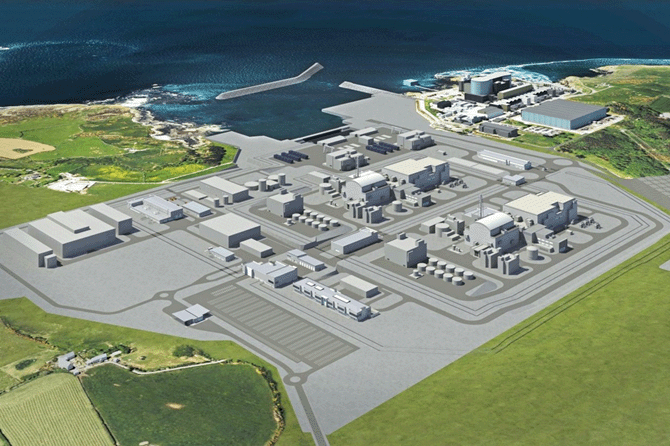 Hitachi Abandons $26 Billion Nuclear Power Project in U.K. Bloomberg Green, By Stephen Stapczynski and Rachel Morison16 September 2020,
-
U.K. due to make statement on financing model next month
- U.K. government says still committed to building new nuclear
Hitachi Ltd. exited a long-planned U.K. nuclear power project despite the most generous support package for an atomic station in Britain, a bad omen for future projects.
The Japanese company announced Wednesday that it decided to withdraw from the Wylfa power project in Wales, citing a worsening investment environment due to the Covid-19 pandemic. Work has been suspended on the 20 billion-pound ($26 billion) venture since January 2019 after the company failed to reach a financing agreement with the U.K. government.
The decision is the latest setback for nuclear’s revival, which supporters promote as the carbon-free solution for reliable power at a time of growing climate change concerns. Cost overruns and cheaper competition is stifling projects and developers in Japan, the U.S. and the U.K.
Britain is one of a handful of developed countries still building nuclear reactors, with the government putting them at the middle of an effort to attract billions of pounds of investment in new low-carbon power plants and create thousands of jobs. However, financing these prohibitively expensive infrastructure projects has become a hurdle, especially in the face of cheaper natural gas and renewables.
A financing package offered to Hitachi in 2019 wasn’t enough to attract additional private investor interest. The U.K. has been considering a funding model that would have seen the state shouldering more of the construction risk. The outcome of that consultation has been delayed.
The U.K. said it had offered a package that “went well beyond what any government has been willing to consider in the past.” Atomic energy still forms a key plank of energy policy including in small and advanced modular reactors.
A financing package offered to Hitachi in 2019 wasn’t enough to attract additional private investor interest. The U.K. has been considering a funding model that would have seen the state shouldering more of the construction risk. The outcome of that consultation has been delayed.
The U.K. said it had offered a package that “went well beyond what any government has been willing to consider in the past.” Atomic energy still forms a key plank of energy policy including in small and advanced modular reactors.
Prospects for the Wylfa plant looked more optimistic last month when Horizon Nuclear Power Ltd., Hitachi’s subsidiary developing the project, said it was engaged with the U.K. government on reviving the project.
The future of how the U.K. finances new nuclear is expected to be announced in the government’s long anticipated energy white paper next month……… https://www.bloomberg.com/news/articles/2020-09-16/hitachi-abandons-u-k-nuclear-power-project-in-blow-to-industry
Huge costs of decommissioning Britain’s ”Magnox” nuclear failities just keep going up
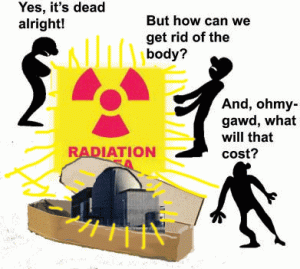 UK spending watchdog warns on costs of cleaning up old nuclear plants
Decommissioning charge has risen by £3bn since 2017 and there remains ‘inherent uncertainty’ over final bill, NAO finds, Nathalie Thomas in Edinburgh, SEPTEMBER 11 2020, Estimates of the cost to clear up 12 of the UK’s earliest nuclear power sites have increased by nearly £3bn since 2017 and there remains “inherent uncertainty” over the final bill, the country’s public spending watchdog has warned.
Long nuclear convoy near Glascow

|
Nuclear convoy passes near Glasgow ‘laden with six warheads’ A 26-vehicle convoy passed through Balloch and by Loch Lomond this morning, a Nukewatch UK campaigner told Glasgow Live
https://www.glasgowlive.co.uk/news/glasgow-news/nuclear-convoy-passes-near-glasgow-18940177 ByCraig Williams 15 SEP 2020 A nuclear weapons convoy passed near Glasgow this morning carrying what is believed to have been six Trident nuclear warheads. Nukewatch UK claims the convoy left RNAD Coulport this morning on its way to Atomic Weapons Establishment Burghfield near Reading – taking a route which saw it travel over Haul Road to the A82 near Cameron House, before passing through Balloch on the A811 to Stirling. Including an estimated 26 vehicles, the unmarked convoy is then said to have travelled along the M9 towards Edinburgh, taking the Edinburgh Bypass and then the A68 towards Jedburgh. Nukewatch UK Campaigner Jane Tallents followed the convoy from the Edinburgh Bypass onto the A68. She told Glasgow Live: “The convoy took the Haul Road and travelled onto the A82 before passing through Alexandria and Balloch. It was then spotted in Drymen as it made its way along the A811 towards Stirling.” Having studied convoys like it for the last 30 years, Jane believes it was travelling with approximately six nuclear warheads to AWE Burghfield for the weapons to undergo repair works prior to being returned to RNAD Coulport and put back on the Royal Navy’s nuclear submarines. “The convoy, which numbered around 26 vehicles, included huge lead-lined lorries carrying the nuclear warheads, along with a fire engine in case of a fire, a moving workshop, a decontamination unit, tow truck and loads of MOD police. “The journey is usually made six times per year when they take the warheads down to refurbish them and then transport them back up again.” Nukewatch UK tracks and monitors the convoys that transport the UK’s Trident nuclear warheads by road from Burghfield to Coulport. Campaigner Jane believes that more people show know of the convoys that travel from Scotland to England via motorways and on small country roads. She added: “We campaign for an end of nuclear weapons. The fact there is such a risk taken with these convoys is reason enough to get rid of them. The convoys travel on small roads at various points of the journey and pass peoples’ houses – today it went through the village of Buchlyvie (around 18 miles north of Glasgow). “Residents in the village could stand on their doorsteps and the nuclear convoy travels about four feet by their doors.” |
Hitachi definitely exits UK nuclear power project
Hitachi decides to exit UK nuclear power project – Mainichi newspaper https://www.reuters.com/article/hitachi-nuclear/hitachi-decides-to-exit-uk-nuclear-power-project-mainichi-newspaper-idUKT9N2FQ03Y– Reporting by Makiko Yamazaki; Editing by Chang-Ran Kim , By Reuters Staff, TOKYO (Reuters) –14 Sept 20, Japanese conglomerate Hitachi Ltd 6501.T will completely exit from a stalled British nuclear power project, the Mainichi newspaper reported on Tuesday.
The board of directors could make a formal decision as early as at their planned meeting on Wednesday, the paper said, citing sources.
A Hitachi spokeswoman said the reported decision was not something the company announced.
Suffolk County Council unable to back £20billion Sizewell new nuclear power station as the present plan stands
regarding many of these issues is “very disappointing” considering how early in the development process the council raised its concerns. The draft Relevant Representation lists the areas where it believes EDF Energy needs to undertake further work. Council leader Matthew Hicks added: “Suffolk County Council has always supported the principle of a new nuclear power station at Sizewell, recognising the important contribution to the national energy strategy and the large economic boost such a development could bring
to our county.
https://www.eadt.co.uk/news/sizewell-c-not-supported-by-suffolk-county-council-1-6833606
Magnox nuclear clear-up cost soars to £9bn
|
Magnox nuclear clear-up cost soars to £9bn https://www.constructionenquirer.com/2020/09/11/magnox-nuclear-clear-up-cost-soars-to-9bn/ Aaron Morby, 13 Sept 20, The cost of decommissioning the Magnox nuclear reactor estate has continued to soar despite efforts to control the budget. Fresh estimates of the cost of getting all Magnox sites cleared and safely enclosed has increased by £2.7bn to £8.7bn since 2017. An investigation by the National Audit Office warns that while the Nuclear Decommissioning Authority has made major progress sorting out its delivery procedures, costs are likely to continue to rise as it gets to grips with the scope of work. The expected cost is now double the original contract price when the initial clean-up deal was signed in 2014 with Cavendish Fluor Partnership to decommission two nuclear research sites and 10 Magnox sites. Since then the Nuclear Decommissioning Authority terminated the contract more than nine years early following a high court challenge to both the procurement by losing bidder Bechtel and changes in scope of work. The NAO this morning warned that costs are likely to be subject to further change, largely because of the inherent uncertainties involved in cleaning up the UK’s nuclear sites. It recommended that the NDA needs to increase its understanding of the condition of sites and the volume and complexity of remaining decommissioning work. It also said the NDA needed to explore with its subsidiaries how future contracts can better support the timely and effective management of underperformance. Gareth Davies, the head of the NAO, said: “Since the failure of the original Magnox contract in 2017, the NDA has made progress in a number of areas. “It renegotiated the contract, avoided further legal disputes and got on with decommissioning the power plants. “However, the NDA now knows that it will cost significantly more to take the sites to the care and maintenance stage of the decommissioning process, though there remains inherent uncertainty about the final cost. “It still needs to ensure it has a solid understanding of the condition of each Magnox site and the costs of cleaning them up.” |
|
|
1 This Month




PLEASE OPPOSE HR 8255 AND S.3639 – bills would accelerate satellite deployment, with no environmental review or safeguards – https://ncstd5li.quorum.us/campaign/169331/
To see nuclear-related stories in greater depth and intensity – go to https://nuclearinformation.wordpress.com
-
Archives
- September 2026 (330)
- August 2026 (330)
- July 2026 (355)
- June 2026 (287)
- May 2026 (306)
- April 2026 (356)
- March 2026 (251)
- February 2026 (267)
- January 2026 (308)
- December 2025 (358)
- November 2025 (359)
- October 2025 (375)
-
Categories
- 1
- 1 NUCLEAR ISSUES
- business and costs
- climate change
- culture and arts
- ENERGY
- environment
- health
- history
- indigenous issues
- Legal
- marketing of nuclear
- media
- opposition to nuclear
- PERSONAL STORIES
- politics
- politics international
- Religion and ethics
- safety
- secrets,lies and civil liberties
- spinbuster
- technology
- Uranium
- wastes
- weapons and war
- Women
- 2 WORLD
- ACTION
- AFRICA
- Atrocities
- AUSTRALIA
- Christina's notes
- Christina's themes
- culture and arts
- Events
- Fuk 2022
- Fuk 2023
- Fukushima 2017
- Fukushima 2018
- fukushima 2019
- Fukushima 2020
- Fukushima 2021
- general
- global warming
- Humour (God we need it)
- Nuclear
- RARE EARTHS
- Reference
- resources – print
- Resources -audiovicual
- Weekly Newsletter
- World
- World Nuclear
- YouTube
-
RSS
Entries RSS
Comments RSS

