Rolls Royce “Small” nuclear reactors are not at all small!
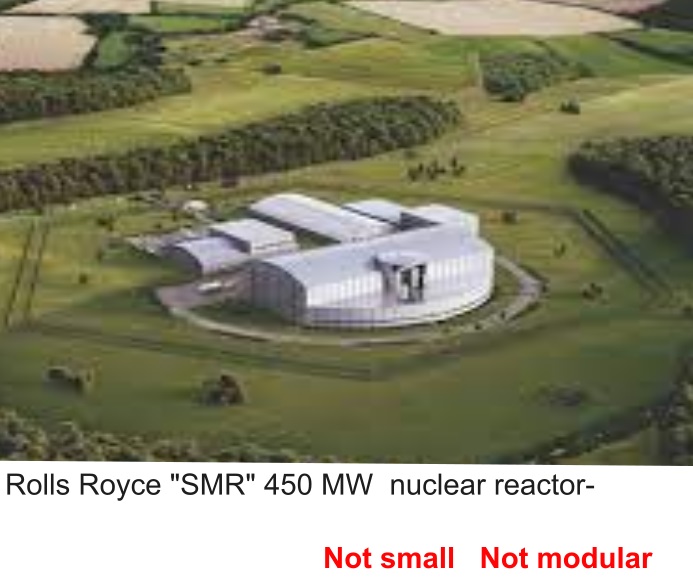
Dr Paul Dorfman Letter: Further to your report “Deal with US to
fast-track mini nuclear reactors” (Sep 15; letter, Sep 16), small modular
reactors (SMRs) are defined by the International Atomic Energy Agency as
reactors that generate up to 300MW power.
At 470MW, the Rolls-Royce design is not an SMR: it is larger than the UK Magnox reactor, more than half the size of the 900MW reactors that make up the bulk of the French nuclear fleet, and about a third the size of the very large EPR reactor design at Hinkley Point C.
This matters because the Rolls-Royce design will need big
sites, standard nuclear safety measures, exclusion zones, core catchers,
aircraft crash protection and security. All this is important because in
calling its design an SMR, or small, Rolls-Royce appears to me to have been
economical with the truth — and all that implies for its other claims,
especially about time and cost.

As for the nuclear waste problem, the former chair of the US government Nuclear Regulatory Commission reports
that SMRs would produce more reactive waste per kWh — the key parameter — than large reactors.
Times 17th Sept 2025. https://www.thetimes.com/comment/letters-to-editor/article/times-letters-ethics-of-danny-krugers-defection-to-reform-uk-3rbg90m3b
UK Ministry of Defence dismiss MP’ s call for inquiry into trident bases nuclear leaks.

THE Ministry of Defence (MoD) has dismissed calls from an SNP MSP for a
public inquiry into nuclear leaks at Trident bases, claiming it is
“factually incorrect” to suggest they posed a safety risk.
Earlier this week Bill Kidd, the Glasgow Anniesland MSP, held a debate on reported nuclear safety incidents at Faslane and Coulport, where Britain’s nuclear fleet and arsenal are stored.
Kidd secured the backing of 28 MSPs from the
SNP, Scottish Greens, Scottish Labour, Alba, and one independent. However,
the motion was not voted on as it was debated as member’s business after
decision time.
It comes after The Ferret revealed that nuclear waste leaked
into Loch Long, in Argyll and Bute. The outlet reported that pipe bursts
were recorded in 2010, two in 2019, and two more in 2021. After an FOI
battle that lasted six years, the Scottish Environment Protection Agency
(Sepa) – the environment watchdog – stated the Royal Navy failed to
properly maintain a network of 1500 pipes at the Coulport armaments depot,
on the banks of Loch Long.
The National 19th Sept 2025, https://www.thenational.scot/news/25481047.mod-dismiss-snp-msp-call-inquiry-trident-bases-nuclear-leaks/
U.S. Firms Boost UK Nuclear Sector with Major Deals

Oil Price By City A.M – Sep 16, 2025
- The UK and US have agreed to reduce the licensing time for nuclear projects from four years to two and broaden US companies’ access to the UK energy market.
- Several US companies have struck significant deals with UK partners, including X-Energy to build advanced modular reactors in Hartlepool, Holtec to develop data centers powered by small modular reactors, and Last Energy for a micro modular nuclear plant at London Gateway.
- The initiative aims to kickstart a “golden age of nuclear” in the UK, providing clean, homegrown energy, creating skilled jobs, and addressing high energy bills, though critics question the effectiveness of potential VAT cuts on energy bills.
…………………………………………………………………………………. Energy bills woes
The announcement comes as the government battles to bring down energy bills, which have almost doubled costs for households over the past eight years.
Alongside increasing the domestic supply of energy, Chancellor Rachel Reeves is reportedly weighing cutting VAT on energy to help lower consumer prices.
However, critics have questioned whether the move, which could cost the government nearly £2bn, would deliver tangible improvements to household budgets, warning that wealthy families with larger homes would disproportionately benefit from the tax break. https://oilprice.com/Alternative-Energy/Nuclear-Power/US-Firms-Boost-UK-Nuclear-Sector-with-Major-Deals.html
US and UK companies ink nuclear deals ahead of Trump visit

Transatlantic nuclear energy deals estimated to be worth over $100 billion
have been announced ahead of President Donald Trump’s state visit to the
United Kingdom this week. TerraPower, a Bill Gates-backed developer of
small nuclear reactors, announced Monday that it would work with
engineering firm KBR to study potential sites in the U.K. to deploy its
advanced Natrium reactors. Rockville, Maryland-based X-energy and British
energy company Centrica also announced plans to deploy up to 72 small
reactors for electricity and industrial heat in the U.K.
E&E News 16th Sept 2025, https://www.eenews.net/articles/us-and-uk-companies-ink-nuclear-deals-ahead-of-trump-visit/
What You Need to Know About the £38 Billion Sizewell C Nuclear Project inthe UK.

Project Timeline: Development Consent Order (DCO) approved: July
20, 2022; Groundworks commenced: January 15, 2024; Final Investment
Decision (FID) reached: July 22, 2025; Construction duration: Expected to
take between nine and twelve years; Operational date: Expected in the
2030s.
Construction Review 15th Sept 2025, https://constructionreviewonline.com/construction-projects/uk-government-approves-38-billion-sizewell-c-nuclear-project/
Academic agrees with NFLA’s position on management of deadly radioactive waste.

NFLA 9th Sept 2025, https://www.nuclearpolicy.info/news/academic-agrees-with-nflas-position-on-management-of-deadly-rad-waste/
Following on from last weeks joint media release with Lakes against the Nuclear Dump (LAND) https://www.nuclearpolicy.info/news/volatile-boiling-geysers-the-latest-on-nuclear-waste-plans/, the UK/Ireland Nuclear Free Local Authorities were delighted to hear that the views of another senior academic chimed with our own policy on the management of high-level radioactive waste.
David K. Smythe, Emeritus Professor and former Chair of Geophysics, University of Glasgow, said he agreed with Professor Stuart Haszeldine about the danger of trying to bury High Level Waste, whether it was conditioned or not: “The waste should be kept on the surface of the earth, and immobilised beyond any possibility of re-use, until a proper long-term solution is found.”
This concept of ongoing active stewardship pending the discovery of future treatment methods, rather than disposal and abandonment in a subterranean repository, accords with the position of the NFLAs and that of the Scottish Government.
Scottish Government Policy is that Higher Activity Radioactive Waste ‘should be managed in the long-term in near-surface facilities where it can be monitored and where there is the capability of retrieving it.’
The NFLAs have a similar long-standing policy on the management of nuclear waste; this comprises a set of clear principles which we are confident have stood the test of time and remain as relevant now as when they were originally agreed in 2004
- The idea that radioactive waste can be ‘disposed’ of be rejected in favour of radioactive waste management.
- Any process or activity that involves new or additional radioactive discharges into the environment be opposed, as this is potentially harmful to the human and natural environment.
- The policy of ‘dilution and dispersion’ of radioactive materials as a component of waste management, which leads to discharges into the estuaries, seas or atmosphere or the diversion of waste to landfill, metal recycling plants and incineration, be rejected in favour of a policy of ‘concentration and containment’, storing the waste safely on-site in isolation from the environment in bespoke facilities.
- The principle of waste minimisation be supported.
- The unnecessary transport of radioactive and other hazardous wastes be opposed.
- Wastes should ideally be managed on-site where produced (or as near as possible to the site) in a facility that allows monitoring and retrieval of the wastes.
‘Sizewell C oak tree felling would be devastating’
Campaigners say chopping down century-old oak trees as part of the
Sizewell C nuclear power station build would be “the straw that broke the
horse’s back”. Sizewell C has notified residents in Middleton, Suffolk,
that vegetation on the B1125 at Leiston Road could be cleared between the 6
and 10 October – after permission was granted. But locals fear it will mean
the loss of 10 oaks – each more than 100 years old – to improve the sight
line of the 60mph stretch, which could become part of the Sizewell C Link
Road system. It remains unclear at this stage if all or any of the trees
will be cut down, as project bosses say they will “only ever remove trees
when we absolutely have to”.
BBC 9th Sept 2025, https://www.bbc.co.uk/news/articles/cgknxezy2vno
Campaigners continue to need their day in court, says NFLA Secretary
In a personal appeal, NFLA Secretary Richard Outram has called on members
of the Government-appointed Nuclear Regulatory Taskforce not to recommend
to Ministers that the rights of campaign groups to seek Judicial Review be
curtailed.
The NRT established to look at the operation of Britain’s
current regulatory and permitting regime within the nuclear sector, both
civil and military, has recently published its Interim Report. The
taskforce has declared that it is intent upon introducing
‘once-in-a-generation change’, but the NFLAs and other campaign bodies
are convinced that this simply represents industry speak for wholesale
deregulation with fears that standards in public safety and environmental
protection will be sacrificed on the altar of business expediency and
profit.
NGOs which are members of the Office for Nuclear Regulation NGO
Forum – including the NFLAs – have submitted a joint response to a
consultation which closed yesterday on the findings outlined in the NRT’s
Interim Report. Richard also submitted his own comments on one element of
the Interim Report that most concerned him – a suggestion that the rights
of campaign groups to seek Judicial Review be curtailed on the grounds that
their applications were ‘vexatious’, increasing costs and causing
delays to nuclear developers. This was a clear reference to recent actions
concerning Sizewell C.
NFLA 9th Sept 2025, https://www.nuclearpolicy.info/news/campaigners-continue-to-need-their-day-in-court-says-nfla-secretary/
Two down: Whicham joins Millom in withdrawing from undemocratic and discredited community partnership
In a show of defiance, Whicham Parish Council last week voted unanimously
to withdraw from the South Copeland GDF Community Partnership, joining
Millom Town Council in saying no to further collaboration with plans to
bring a nuclear waste dump to Haverigg and Millom.
Meanwhile at Millom
Without Parish Council, Chair Councillor Carl Carrington has resigned as
the Council’s representative, with the Council resolving in July that
Parish Councillors should take it in turns to attend future Community
Partnership meetings on a ‘rotational basis’. Millom Town Council,
Whicham Parish Council and Millom Without Parish Council, along with the
Friends of the Lake District and Sustainable Duddon, have also submitted a
statement ‘rebutting the NWS report on the Partnership’. This refers to
the report published following the external review conducted by the former
Chair of the now defunct Allerdale GDF Community Partnership, in which the
South Copeland GDF Community Partnership was described as
‘dysfunctional’.
Whicham Parish Council’s decision to withdraw from
the community partnership does not derail the process. Unlike Cumberland
Council, neither Whicham nor Millom are deemed to be Relevant Principal
Local Authorities and so cannot exercise the Right to Withdraw. But the
decisions of Millom and Whicham to withdraw, that of Millom Without to
cease to have a permanent representative, and the collective condemnatory
response to the external review all represent clear signals that local
elected representatives no longer wish to be associated with a discredited
project.
NFLA 9th Sept 2025, https://www.nuclearpolicy.info/news/two-down-whicham-joins-millom-in-withdrawing-from-undemocratic-and-discredited-community-partnership/
UK Labour must not award Elbit a £2 billion military deal
Why are Israel’s largest arms firm and a company mired in a corruption scandal even being considered for training British troops?
DECLASSIFIED UK, ANDREW FEINSTEIN, PAUL HOLDEN and JACK CINAMON, 28 August 2025
Britain’s Ministry of Defence might imminently award a 15 year contract, worth £2.5bn, to a consortium headed by the British subsidiary of the Israeli arms firm Elbit Systems and including the US management consultancy firm, Bain and Company.
If successful, Elbit’s consortium would be responsible for training as many as 60,000 members of the UK military.
The consortium seems well-placed to win the contract; it is, in fact, one of only two shortlisted and preferred bidders.
The Ministry of Defence has already given the consortium a £2m contract so that it can develop its proposals further.
This is unacceptable. And it is frankly unbelievable that this consortium is even in the running considering its track record.
Elbit Systems UK is the fully-owned subsidiary of Elbit Systems Limited. Elbit Systems Limited is headquartered in Tel Aviv and is listed on both the Israeli and US stock exchanges.
Elbit is one of the two largest Israeli weapons manufacturers and is central to the IDF’s operations, providing 85% of its drones. Elbit International is also a major contributor to the F-35 fighter jet program, bragging that it plays a ‘critical role’ in the ‘success of the world’s most advanced fighter jet.’
In July 2025, Francesca Albanese, the UN Special Rapporteur for the Occupied Palestine Territories, published an excoriating report setting out corporate complicity in Israel’s “plausibly” genocidal conduct in Gaza – for which she was subsequently sanctioned by Donald Trump.
Her report is clear that Elbit forms a central part of Israel’s military-industrial complex, which has become “the economic backbone of [Israel].”
“Elbit has cooperated closely on Israeli military operations, embedding key staff in the Ministry of Defence,” Albanese points out, further noting that Elbit provides “a critical domestic supply of weaponry.”
Bain
But we’re also deeply concerned about Elbit’s partner, Bain and Company.
Bain and Company (not to be confused with the mega hedge fund Bain Capital, which confirmed to us that it is not involved in the Elbit consortium) is a US-based management consultancy firm.
Bain’s inclusion in the consortium’s bid was first reported in 2023 by the UK military magazine, Shephard News, based on unpublished behind-the-scenes documents.
Bain has a sordid and shocking history. In August 2022, the Cabinet Office placed Bain and Company on a ‘blacklist’, preventing it from getting any Cabinet Office contracts. ………………………………………………………………………………………………
In July this year it was confirmed that Bain had shut down its South African consultancy operations, with the Financial Times reporting insiders saying that the company’s local reputation had been destroyed by the scandal.
The carcass of Bain’s South African business would be repurposed as a ‘hub’ to support Bain’s other international work.
These are the types of companies that the UK is poised to mainline into the very DNA of the British military and the British state: Elbit, its parent company one of the most important partners to the IDF in Gaza; and Bain and Company, only recently blacklisted for serious professional misconduct for its role in undermining the fabric of South Africa’s democracy.
The idea that the UK would award this consortium, and these companies, any sort of contract, never mind a 15 year contract of such importance, is an outrage. It must be stopped. https://www.declassifieduk.org/labour-must-not-award-elbit-a-2-billion-military-deal/
The Nuclear Waste Problem Haunting UK Energy Expansion
Oil Price, By Felicity Bradstock – Sep 07, 2025
Effective nuclear waste management is a critical global challenge, particularly for countries like the UK looking to expand their nuclear power sectors.- The UK has a substantial amount of existing radioactive waste and is struggling to implement a long-term disposal solution, with the proposed underground geological disposal facility facing significant hurdles and cost concerns.
- Public and local community pushback against potential nuclear waste sites further complicates the development of new disposal facilities, making finding a solution an ongoing and difficult process.
One of the biggest hurdles to expanding the global nuclear power sector is the concern over how best to manage nuclear waste. While some believe they have found sustainable solutions to dispose of nuclear waste, there is still widespread debate around how safe these methods are and the potential long-term impact of waste disposal and storage. In the United Kingdom, the government has put nuclear power back on the agenda, after decades with no new nuclear developments; however, managing nuclear waste continues to be a major barrier to development.
There are three types of nuclear waste: low-, intermediate-, and high-level radioactive waste. Most of the waste produced at nuclear facilities is lightly contaminated, including items such as tools and work clothing, with a level of around 1 percent radioactivity. Meanwhile, spent fuel is an example of high-level waste, which contributes around 3 percent of the total volume of waste from nuclear energy production. However, this contains around 95 percent of the radioactivity, making adequate waste management of these products extremely important.
In the U.K., the government continues to battle with how best to dispose of its nuclear waste,……………………………………………..
the U.K. Treasury believes the government’s plan for the waste dump is “unachievable”, rating the project as “red”, or not possible, in a recent assessment. ……………………………….. https://oilprice.com/Alternative-Energy/Nuclear-Power/The-Nuclear-Waste-Problem-Haunting-UK-Energy-Expansion.html
Nuclear industry says waste site is key
Jason Arunn Murugesu, BBC News, North East and Cumbria, 6 Sept 25
A functioning nuclear waste site is “key to the credibility and sustainability” of the UK’s nuclear programme, the nuclear industry has said.
Two area in Cumbria have been identified as possible locations for a geological disposal facility (GDF) by government body Nuclear Waste Services (NWS).
Sellafield in Cumbria holds the world’s largest stockpile of radioactive plutonium. Earlier this year the government said the material would be made ready for permanent disposal deep underground and put “beyond reach”.
The Nuclear Industry Association (NIA) said: “A functioning GDF is key to the credibility and sustainability of the UK’s nuclear programme.”
“Developers need confidence that the back end of the fuel cycle is being responsibly and sustainably managed, not just for regulatory compliance but also to secure investor confidence and public trust.”
The Department for Energy Security and Net Zero (DESNZ) said any potential GDF site would be subject to agreement with the community and “won’t be imposed on an area without local consent”.
The NIA also said it strongly supported this “partnership” approach.
Mid Copeland and south Copeland in Cumbria are the only two sites in the UK currently being considered by the government to host a nuclear waste disposal site.
A recent report by the National Infrastructure and Service Transformation Authority (Nista) said the GDF’s overall expected costs of between £20bn and £53bn would make it “unaffordable”.
Jellyfish cause partial shutdown at French nuclear plant
EDF considered installing a so-called “fish disco” at Hinkley Point C,
the reactor under construction in Somerset, south-west England, to ward off sea life from the site, after protesters criticised the project’s fish protection measures. EDF is now exploring whether it can use new fish deterrent technology involving devices that make very high frequency sounds, having decided against its earlier plan to install underwater loudspeakers.
FT 4th Sept 2025, https://www.ft.com/content/dadaa032-55a3-4c09-9fc5-3bcaf2b90fe4
£154m plan hatched to move UK’s 140-tonne cache of powdered plutonium from nuclear reactor waste at Sellafield.

Britain could finally solve the problem of
what to do with its radioactive waste by converting it into ceramic
pellets, The Telegraph can reveal. Government scientists want to store the
radioactive plutonium, which is a national security risk because it can be
used to make nuclear weapons, in an underground nuclear graveyard. The
UK’s cache of 140 tonnes of powdered plutonium from nuclear reactor waste
is currently under armed guard at Sellafield in Cumbria.
Telegraph 28th Aug 2025 https://www.telegraph.co.uk/news/2025/08/28/britain-solution-radioactive-waste-problem-cumbria/
Rolls-Royce denies report of IPO ( Initial Public Offering) plans for small nuclear reactor unit
By Reuters, August 31, 2025
Aug 30 (Reuters) – Rolls-Royce Holdings (RR.L), opens new tab on Saturday denied a report it was exploring an initial public offering for its small nuclear reactor unit.
The Financial Times, citing people familiar with the situation, reported on Saturday the company was considering an IPO as well as other funding options. It said talks with investment houses and banks were at an early stage.
“Rolls-Royce SMR is not planning for, or in the process of launching, an initial public offering,” a spokesperson for the unit said in an emailed statement to Reuters.
In June, the Rolls-Royce SMR unit was selected to build Britain’s first Small Modular Reactors as part of its plan to speed up the decarbonisation of the power network from the mid-2030s. The unit, majority-owned by the British engineering firm, plans to build three reactors.
The British government pledged 2.5 billion pounds ($3.4 billion) for the SMR programme over the next four years, aiming to launch one of Europe’s first small-scale nuclear industries…. https://www.reuters.com/business/energy/rolls-royce-denies-report-ipo-plans-small-nuclear-reactor-unit-2025-08-30/
1 This Month

of the week – Shut Down Drone Warfare!


Tell the Ukrainian Government to Drop Prosecution of Peace Activist Yurii Sheliazhenko

Petition to revoke the licensing of the Near Surface Nuclear Disposal Facility (NSDF) at Chalk River. https://www.ourcommons.ca/petitions/en/Petition/Details?Petition=e-7247
To see nuclear-related stories in greater depth and intensity – go to https://nuclearinformation.wordpress.com
-
Archives
- April 2026 (7)
- March 2026 (251)
- February 2026 (268)
- January 2026 (308)
- December 2025 (358)
- November 2025 (359)
- October 2025 (376)
- September 2025 (257)
- August 2025 (319)
- July 2025 (230)
- June 2025 (348)
- May 2025 (261)
-
Categories
- 1
- 1 NUCLEAR ISSUES
- business and costs
- climate change
- culture and arts
- ENERGY
- environment
- health
- history
- indigenous issues
- Legal
- marketing of nuclear
- media
- opposition to nuclear
- PERSONAL STORIES
- politics
- politics international
- Religion and ethics
- safety
- secrets,lies and civil liberties
- spinbuster
- technology
- Uranium
- wastes
- weapons and war
- Women
- 2 WORLD
- ACTION
- AFRICA
- Atrocities
- AUSTRALIA
- Christina's notes
- Christina's themes
- culture and arts
- Events
- Fuk 2022
- Fuk 2023
- Fukushima 2017
- Fukushima 2018
- fukushima 2019
- Fukushima 2020
- Fukushima 2021
- general
- global warming
- Humour (God we need it)
- Nuclear
- RARE EARTHS
- Reference
- resources – print
- Resources -audiovicual
- Weekly Newsletter
- World
- World Nuclear
- YouTube
-
RSS
Entries RSS
Comments RSS
 nuclear-news