The revolving door between government members and the nuclear industry
New nuclear role for former Cabinet minister, News and Star , By Federica BedendoReporter A former Cabinet minister has been appointed as the Nuclear Decommissioning Authority’s social value specialist.18th September
Hazel Blears will provide advice to the whole of the NDA group on how to increase the social, economic and environmental impact of its work to decommission and clean up the UK’s oldest nuclear sites.
She is a nationally recognised expert in this field and is chairman of the Social Investment Business and a trustee of the Social Mobility Foundation. Ms Blears is also a former cabinet minister and, during her time as an MP, was one of the authors of the Social Value Act……. https://www.newsandstar.co.uk/news/18725570.new-nuclear-role-former-cabinet-minister/
Plutonium in Hinkley nuclear mud dumping, but National Resources Wales’ call for full testing is ignored

 Campaigners claim NRW has been ignored as mud sampling from nuclear plant gets underway, https://nation.cymru/news/campaigners-claim-nrw-has-been-ignored-as-mud-sampling-from-nuclear-plant-gets-underway/ Campaigners claim NRW has been ignored as mud sampling from nuclear plant gets underway, https://nation.cymru/news/campaigners-claim-nrw-has-been-ignored-as-mud-sampling-from-nuclear-plant-gets-underway/
17th September 2020 EDF Energy has commenced taking samples of mud from the construction of a new nuclear power plant without the agreement of National Resources Wales, according to the group opposing plans to dump the sediment in the sea off Cardiff Bay.In February NRW received an application from EDF, who want to dump 800,0000 tonnes of mud dredged as part of building work for the new plant at Hinkley Point, the site of the disused Hinkley Point A facility near Bridgwater in Somerset. Two years ago, EDF were given permission to dump 300,000 tonnes of mud from the site off the Cardiff coast, despite protests and following a Senedd debate. GeigerBay, a coalition of scientists, experts, individuals and organisations formed to oppose the plans, are pressing for extensive testing of the sediment following what they say is evidence of plutonium contamination, a claim that Westminster’s Environment Agency (EA) denies. A notice published last month confirmed sedimentation survey sampling is now underway despite the lack of an agreement on the scope and location of the testing. In a letter to the Expert Committee set up by the Welsh Government to examine the issues around the proposed dump, GeigerBay say: “EDF have proceeded with the sampling (core extraction) operations by the Jack up Barge Excalibur, disregarding the lack of approval. “They apparently think they can ignore NRW as the operations are in English waters and approved by the Marine Management Organisation (the government body that regulates and plans marine activities in the seas around England). “With uncertainties surrounding the planning, licensing and scoping we reiterate our point that testing must include at the very least toxicity testing, a full assessment of the nuclides present in the sediment, and a full exploration of the likelihood of transfer of nuclear pollutants onto land because of the risk to humans and wildlife. “Is the Expert Committee aware that sampling has commenced, and considered everything that that entails?” A petition against the dumping has secured over 10,000 signatures, triggering another debate in the Senedd. |
|
As Hitachi exits the project, UK government to announce funding for Wylfa nuclear project next month
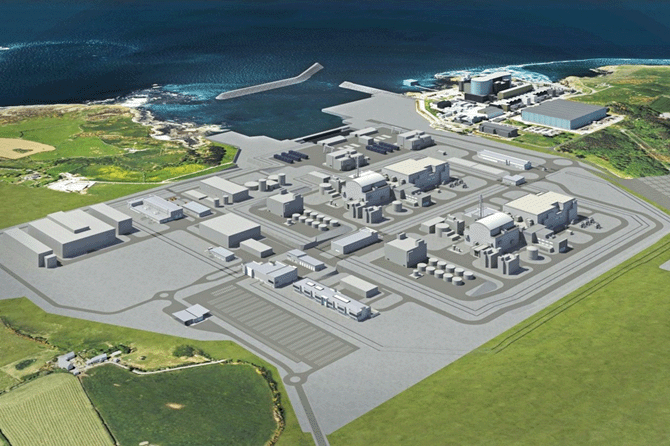 Hitachi Abandons $26 Billion Nuclear Power Project in U.K. Bloomberg Green, By Stephen Stapczynski and Rachel Morison16 September 2020,
-
U.K. due to make statement on financing model next month
- U.K. government says still committed to building new nuclear
Hitachi Ltd. exited a long-planned U.K. nuclear power project despite the most generous support package for an atomic station in Britain, a bad omen for future projects.
The Japanese company announced Wednesday that it decided to withdraw from the Wylfa power project in Wales, citing a worsening investment environment due to the Covid-19 pandemic. Work has been suspended on the 20 billion-pound ($26 billion) venture since January 2019 after the company failed to reach a financing agreement with the U.K. government.
The decision is the latest setback for nuclear’s revival, which supporters promote as the carbon-free solution for reliable power at a time of growing climate change concerns. Cost overruns and cheaper competition is stifling projects and developers in Japan, the U.S. and the U.K.
Britain is one of a handful of developed countries still building nuclear reactors, with the government putting them at the middle of an effort to attract billions of pounds of investment in new low-carbon power plants and create thousands of jobs. However, financing these prohibitively expensive infrastructure projects has become a hurdle, especially in the face of cheaper natural gas and renewables.
A financing package offered to Hitachi in 2019 wasn’t enough to attract additional private investor interest. The U.K. has been considering a funding model that would have seen the state shouldering more of the construction risk. The outcome of that consultation has been delayed.
The U.K. said it had offered a package that “went well beyond what any government has been willing to consider in the past.” Atomic energy still forms a key plank of energy policy including in small and advanced modular reactors.
A financing package offered to Hitachi in 2019 wasn’t enough to attract additional private investor interest. The U.K. has been considering a funding model that would have seen the state shouldering more of the construction risk. The outcome of that consultation has been delayed.
The U.K. said it had offered a package that “went well beyond what any government has been willing to consider in the past.” Atomic energy still forms a key plank of energy policy including in small and advanced modular reactors.
Prospects for the Wylfa plant looked more optimistic last month when Horizon Nuclear Power Ltd., Hitachi’s subsidiary developing the project, said it was engaged with the U.K. government on reviving the project.
The future of how the U.K. finances new nuclear is expected to be announced in the government’s long anticipated energy white paper next month……… https://www.bloomberg.com/news/articles/2020-09-16/hitachi-abandons-u-k-nuclear-power-project-in-blow-to-industry
Huge costs of decommissioning Britain’s ”Magnox” nuclear failities just keep going up
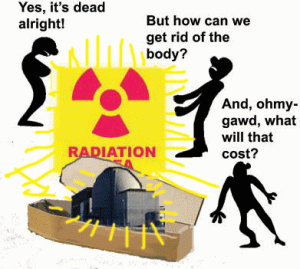 UK spending watchdog warns on costs of cleaning up old nuclear plants
Decommissioning charge has risen by £3bn since 2017 and there remains ‘inherent uncertainty’ over final bill, NAO finds, Nathalie Thomas in Edinburgh, SEPTEMBER 11 2020, Estimates of the cost to clear up 12 of the UK’s earliest nuclear power sites have increased by nearly £3bn since 2017 and there remains “inherent uncertainty” over the final bill, the country’s public spending watchdog has warned.
Long nuclear convoy near Glascow

|
Nuclear convoy passes near Glasgow ‘laden with six warheads’ A 26-vehicle convoy passed through Balloch and by Loch Lomond this morning, a Nukewatch UK campaigner told Glasgow Live
https://www.glasgowlive.co.uk/news/glasgow-news/nuclear-convoy-passes-near-glasgow-18940177 ByCraig Williams 15 SEP 2020 A nuclear weapons convoy passed near Glasgow this morning carrying what is believed to have been six Trident nuclear warheads. Nukewatch UK claims the convoy left RNAD Coulport this morning on its way to Atomic Weapons Establishment Burghfield near Reading – taking a route which saw it travel over Haul Road to the A82 near Cameron House, before passing through Balloch on the A811 to Stirling. Including an estimated 26 vehicles, the unmarked convoy is then said to have travelled along the M9 towards Edinburgh, taking the Edinburgh Bypass and then the A68 towards Jedburgh. Nukewatch UK Campaigner Jane Tallents followed the convoy from the Edinburgh Bypass onto the A68. She told Glasgow Live: “The convoy took the Haul Road and travelled onto the A82 before passing through Alexandria and Balloch. It was then spotted in Drymen as it made its way along the A811 towards Stirling.” Having studied convoys like it for the last 30 years, Jane believes it was travelling with approximately six nuclear warheads to AWE Burghfield for the weapons to undergo repair works prior to being returned to RNAD Coulport and put back on the Royal Navy’s nuclear submarines. “The convoy, which numbered around 26 vehicles, included huge lead-lined lorries carrying the nuclear warheads, along with a fire engine in case of a fire, a moving workshop, a decontamination unit, tow truck and loads of MOD police. “The journey is usually made six times per year when they take the warheads down to refurbish them and then transport them back up again.” Nukewatch UK tracks and monitors the convoys that transport the UK’s Trident nuclear warheads by road from Burghfield to Coulport. Campaigner Jane believes that more people show know of the convoys that travel from Scotland to England via motorways and on small country roads. She added: “We campaign for an end of nuclear weapons. The fact there is such a risk taken with these convoys is reason enough to get rid of them. The convoys travel on small roads at various points of the journey and pass peoples’ houses – today it went through the village of Buchlyvie (around 18 miles north of Glasgow). “Residents in the village could stand on their doorsteps and the nuclear convoy travels about four feet by their doors.” |
Hitachi definitely exits UK nuclear power project
Hitachi decides to exit UK nuclear power project – Mainichi newspaper https://www.reuters.com/article/hitachi-nuclear/hitachi-decides-to-exit-uk-nuclear-power-project-mainichi-newspaper-idUKT9N2FQ03Y– Reporting by Makiko Yamazaki; Editing by Chang-Ran Kim , By Reuters Staff, TOKYO (Reuters) –14 Sept 20, Japanese conglomerate Hitachi Ltd 6501.T will completely exit from a stalled British nuclear power project, the Mainichi newspaper reported on Tuesday.
The board of directors could make a formal decision as early as at their planned meeting on Wednesday, the paper said, citing sources.
A Hitachi spokeswoman said the reported decision was not something the company announced.
Suffolk County Council unable to back £20billion Sizewell new nuclear power station as the present plan stands
regarding many of these issues is “very disappointing” considering how early in the development process the council raised its concerns. The draft Relevant Representation lists the areas where it believes EDF Energy needs to undertake further work. Council leader Matthew Hicks added: “Suffolk County Council has always supported the principle of a new nuclear power station at Sizewell, recognising the important contribution to the national energy strategy and the large economic boost such a development could bring
to our county.
https://www.eadt.co.uk/news/sizewell-c-not-supported-by-suffolk-county-council-1-6833606
Magnox nuclear clear-up cost soars to £9bn
|
Magnox nuclear clear-up cost soars to £9bn https://www.constructionenquirer.com/2020/09/11/magnox-nuclear-clear-up-cost-soars-to-9bn/ Aaron Morby, 13 Sept 20, The cost of decommissioning the Magnox nuclear reactor estate has continued to soar despite efforts to control the budget. Fresh estimates of the cost of getting all Magnox sites cleared and safely enclosed has increased by £2.7bn to £8.7bn since 2017. An investigation by the National Audit Office warns that while the Nuclear Decommissioning Authority has made major progress sorting out its delivery procedures, costs are likely to continue to rise as it gets to grips with the scope of work. The expected cost is now double the original contract price when the initial clean-up deal was signed in 2014 with Cavendish Fluor Partnership to decommission two nuclear research sites and 10 Magnox sites. Since then the Nuclear Decommissioning Authority terminated the contract more than nine years early following a high court challenge to both the procurement by losing bidder Bechtel and changes in scope of work. The NAO this morning warned that costs are likely to be subject to further change, largely because of the inherent uncertainties involved in cleaning up the UK’s nuclear sites. It recommended that the NDA needs to increase its understanding of the condition of sites and the volume and complexity of remaining decommissioning work. It also said the NDA needed to explore with its subsidiaries how future contracts can better support the timely and effective management of underperformance. Gareth Davies, the head of the NAO, said: “Since the failure of the original Magnox contract in 2017, the NDA has made progress in a number of areas. “It renegotiated the contract, avoided further legal disputes and got on with decommissioning the power plants. “However, the NDA now knows that it will cost significantly more to take the sites to the care and maintenance stage of the decommissioning process, though there remains inherent uncertainty about the final cost. “It still needs to ensure it has a solid understanding of the condition of each Magnox site and the costs of cleaning them up.” |
|
|
A powerful message on the seismic dangers in Hinkley Point C nuclear construction. It would be cheaper to pull out now.
Radiation Free Lakeland 12th Sept 2020, Seismic Warnings – if not now when will the Government Scrap Hinkley C? This week there was yet another earthquake recorded in the Bristol area. It was small but significant, contributing to the well documented seismic activity of the area. If eyewatering costs, long delays, a mental and physical health crisis among the employees building Hinkley Point C are not enough to scrap this hubristic nuclear new build plan then the seismic warnings should be.
This insane project next to operational reactors has seen the geological stresses of the biggest pours of concrete in the UK
alongside three huge tunnels being bored below the seabed. German based multi-national company Herrenknecht built the hugely expensive tunnel boring machines which will be dumped under the Bristol Channel once done.
A total of 38,000 concrete segments are needed to support the tunnels, which would transfer 120,000 litres of water per second for the new nuclear plant when finished. The Bristol area is seismically active so to put increased geological stress deliberately in the vicinity of existing nuclear reactors is the kind of hubris that disaster movies are made of.
Scrapping Hinkley C now and paying off the developers would be far cheaper and far safer than continuing down this route to nuclear disaster.
Unmarked ?nuclear convoy with strong military police guard sweeps through Bristol city centre
This is the moment an unmarked military and police convoy stopped the traffic and stunned drivers and commuters as it swept through the city centre of Bristol this week.
The 14-vehicle convoy was captured on camera as it held up traffic on a main road into Bristol, and then headed out of the city on the M32.
The convoy began with a military police 4×4 car and then went on to include two police cars, three large police vans, another police 4×4, three large army people carriers and what appeared to be the subject of the guard of the convoy – four large LGV lorries with large unmarked containers on the trailers.
The brief video of the convoy was posted on social media within minutes of being spotted at around 7.50am on Wednesday, September 9 this week, and prompted a range of speculation as to what exactly was going on.
There was speculation that the convoy was operated by the AWE, the Atomic Weapons Establishment, an organisation which handles all the nuclear fuel for submarines and material for Britain’s nuclear weapons.
The AWE is based at Aldermaston, at a base just the other side of Newbury in Berkshire. People commenting on the video, which went viral on Facebook, said they had seen many similar convoys around that area, but they usually took place in the middle of the night so did not attract attention……… https://www.bristolpost.co.uk/news/watch-moment-unmarked-nuclear-convoy-4510383
Your Man in the Public Gallery – Assange Hearing Day 8
 Your Man in the Public Gallery – Assange Hearing Day 8, Craig Murray September 10, 2020 The great question after yesterday’s hearing was whether prosecution counsel James Lewis QC would continue to charge at defence witnesses like a deranged berserker (spoiler – he would), and more importantly, why? Your Man in the Public Gallery – Assange Hearing Day 8, Craig Murray September 10, 2020 The great question after yesterday’s hearing was whether prosecution counsel James Lewis QC would continue to charge at defence witnesses like a deranged berserker (spoiler – he would), and more importantly, why?
QC’s representing governments usually seek to radiate calm control, and treat defence arguments as almost beneath their notice, certainly as no conceivable threat to the majestic thinking of the state. Lewis instead resembled a starving terrier kept away from a prime sausage by a steel fence whose manufacture and appearance was far beyond his comprehension. Perhaps he has toothache. PROFESSOR PAUL ROGERS The first defence witness this morning was Professor Paul Rogers, Emeritus Professor of Peace Studies at the University of Bradford. He has written 9 books on the War on Terror, and has been for 15 years responsible for MOD contracts on training of armed forces in law and ethics of conflict. Rogers appeared by videolink from Bradford. Prof Rogers’ full witness statement is here. Edward Fitzgerald QC asked Prof Rogers whether Julian Assange’s views are political (this goes to article 4 in the UK/US extradition treaty against political extradition). Prof Rogers replied that “Assange is very clearly a person of strong political opinions.” Fitzgerald then asked Prof Rogers to expound on the significance of the revelations from Chelsea Manning on Afghanistan. Prof Rogers responded that in 2001 there had been a very strong commitment in the United States to going to war in Afghanistan and Iraq. Easy initial military victories led to a feeling the nation had “got back on track”. George W Bush’s first state of the union address had the atmosphere of a victory rally. But Wikileaks’ revelations in the leaked war logs reinforced the view of some analysts that this was not a true picture, that the war in Afghanistan had gone wrong from the start. It contradicted the government line that Afghanistan was a success. Similarly the Wikileaks evidence published in 2011 had confirmed very strongly that the Iraq War had gone badly wrong, when the US official narrative had been one of success. Wikileaks had for example proven from the war logs that there were a minimum of 15,000 more civilian deaths than had been reckoned by Iraq Body Count. These Wikileaks exposures of the failures of these wars had contributed in large part to a much greater subsequent reluctance of western powers to go to war at an early stage. Fitzgerald said that para 8 of Rogers’ report suggests that Assange was motivated by his political views and referenced his speech to the United Nations. Was his intention to influence political actions by the USA? Rogers replied yes. Assange had stated that he was not against the USA and there were good people in the USA who held differing views. He plainly hoped to influence US policy. Rogers also referenced the statement by Mairead Maguire in nominating Julian for the Nobel Peace Prize:
Rogers stated that Assange had a clear and coherent political philosophy. He had set it out in particular in the campaign of the Wikileaks Party for a Senate seat in Australia. It was based on human rights and a belief in transparency and accountability of organisations. It was essentially libertarian in nature. It embraced not just government transparency, but also transparency in corporations, trade unions and NGOs. It amounted to a very clear political philosophy. Assange adopted a clear political stance that did not align with conventional party politics but incorporated coherent beliefs that had attracted growing support in recent years. Fitzgerald asked how this related to the Trump administration. Rogers said that Trump was a threat to Wikileaks because he comes from a position of quite extreme hostility to transparency and accountability in his administration. Fitzgerald suggested the incoming Trump administration had demonstrated this hostility to Assange and desire to prosecute. Rogers replied that yes, the hostility had been evidenced in a series of statements right across the senior members of the Trump administration. It was motivated by Trump’s characterisation of any adverse information as “fake news”. Fitzgerald asked whether the motivation for the current prosecution was criminal or political? Rogers replied “the latter”. This was a part of the atypical behaviour of the Trump administration; it prosecutes on political motivation. They see openness as a particular threat to this administration. This also related to Trump’s obsessive dislike of his predecessor. His administration would prosecute Assange precisely because Obama did not prosecute Assange. Also the incoming Trump administration had been extremely annoyed by the commutation of Chelsea Manning’s sentence, a decision they had no power to revoke. For that the prosecution of Assange could be vicarious revenge. Several senior administration members had advocated extremely long jail sentences for Assange and some had even mooted the death penalty, although Rogers realised that was technically impossible through this process. Fitzgerald asked whether Assange’s political opinions were of a type protected by the Refugee Convention. Rogers replied yes. Persecution for political opinion is a solid reason to ask for refugee status. Assange’s actions are motivated by his political stance. Finally Fitzgerald then asked whether Rogers saw political significance in the fact that Assange was not prosecuted under Obama. Rogers replied yes, he did. This case is plainly affected by fundamental political motivation emanating from Trump himself. James Lewis QC then rose to cross-examine for the prosecution. His first question was “what is a political opinion?” Rogers replied that a political opinion takes a particular stance on the political process and does so openly. It relates to the governance of communities, from nations down to smaller units………. https://www.craigmurray.org.uk/?fbclid=IwAR1SSVvRVbh8_y-5pargeR-U2E6JHQDcGUq_752VyejbktpjIbMY-g-MdnA |
Scottish peace activist calls for timetable for the removal of nuclear weapons and submarines if independence is achieved
FRIDAY, SEPTEMBER 11, 2020 https://morningstaronline.co.uk/article/b/scottish-peace-activist-calls-timetable-removal-nuclear-weapons-and-submarines-if
A LEADING peace activist in Scotland has urged the government to produce a timetable for the removal of British nuclear weapons and submarines from their Scottish base if independence is achieved.
Isobel Lindsay, a long-time Campaign for Nuclear Disarmament campaigner, warned that the Westminster Parliament would attempt to “buy time” and maintain its Trident submarine base at Faslane on the west coast of Scotland in the event of a vote for independence.
Writing in pro-independence newspaper The National, Ms Lindsay said: “It is obvious what the Trident negotiating pitch of the UK
government will be in independence negotiations.
“Buy time, and as soon as they get a concession on that, they know they won’t have to worry. Scotland yields to pressure and they will keep on getting their lease extended.
“This is why a very clear and tight timetable for removal is essential from the start.”
Ms Lindsay said that before the 2014 referendum, a scenario was being prepared using the threat of vetoing Scotland’s EU membership as the bargaining chip for retaining Trident on the Clyde.
“That bargaining chip is no longer there, so there is talk about buying off the Jocks by paying for their lease,” she said.
“I think we know about being bought and sold.”
Faslane and the nuclear-weapons storage facility eight miles away at Coulport have been frequently targeted for protests by disarmament campaigners.
The SNP has said that support for independence is growing in the face of Westminster chaos and incompetence, with a Survation poll today putting support for independence at 53 per cent – the seventh poll in a row showing “Yes” ahead.
Britain’s National Audit Office warns on costs of cleaning up old nuclear plants
|
Estimates of the cost to clear up 12 of the UK’s earliest nuclear power sites have increased by nearly £3bn since 2017 and there remains “inherent uncertainty” over the final bill, the country’s public spending watchdog has warned. The National Audit Office on Friday published its latest report into the long-running saga around the decommissioning of two research sites and 10 early nuclear power stations in Britain, which came to be known as the “Magnox” plants due to the magnesium alloy that was used to cover the fuel rods inside their reactors. The spending watchdog also found that the costs to the taxpayer of a botched 2014 tender process to outsource the decommissioning to the private sector was £20m higher than when it last investigated three years ago.
Cleaning up the Magnox sites, which were built before privatisation and include Hunterston A in Scotland and Hinkley Point A in Somerset, has turned into a costly and torturous affair. In 2016 the High Court ruled the 2014 competition for a 14-year contract to decommission the sites — which had been awarded to Cavendish Fluor Partnership, or CFP, a joint venture between UK-based Babcock International and Fluor of the US — had been “fudged” by the Nuclear Decommissioning Authority, a body attached to the Department for Business, Energy and Industrial Strategy.
A year later ministers, acting on legal advice, terminated the arrangement with CFP nine years early and renegotiated a shorter contract that ran until the end of August 2019. Decommissioning of the sites was then brought in-house by the NDA. ………. https://www.ft.com/content/6f313c84-d314-4160-b124-a68c4e85be09
|
|
|
Professor Paul Rogers – a witness explaining how Julian Assange is to be extradited for POLITICAL REASONS
 Julian Assange clearly political, says extradition trial witness, https://www.theaustralian.com.au/world/julian-assange-clearly-political-says-extradition-trial-witness/news-story/735ef7d40551d52f4f7f12d9d6c318d7 JACQUELIN MAGNAY, FOREIGN CORRESPONDENT@jacquelinmagnay, THE TIMES, SEPTEMBER 10, 2020
Julian Assange’s nomination for the Senate during the 2013 federal election campaign and the establishment of the WikiLeaks political party the year before “clearly shows’’ the WikiLeaks founder has a political view and a libertarian standpoint, a witness has told the Old Bailey.
Professor Paul Rogers, the emeritus professor of peace studies at Bradford University, was called as a witness by Assange’s team to persuade the judge that Assange is being targeted for political means, and thus an extradition to the US should not be permitted under the Anglo-US extradition treaty.
In day three of the court hearing where Assange, 49, is objecting to extradition to the US, Professor Rogers said in written testimony that Assange’s expressed views, opinions and activities demonstrate very clearly “political opinions”. He cited how Assange had formed the political party to contest the Australian general election and “central of this is his view to put far greater attention to human rights’’.
He added: “The clash of those opinions with those of successive US administrations, but in particular the present administration which has moved to prosecute him for publications made almost a decade ago, suggest that he is regarded primarily as a political opponent who must experience the full wrath of government, even with suggestions of punishment by death made by senior officials including the current President.’’
But US prosecutor James Lewis QC said: “Assistant US Attorney Gordon D. Kromberg explicitly refutes that this is a political prosecution but rather an evidence-based prosecution.’’
In documents to the court, the prosecution says the investigation into Assange had been ongoing before the Trump administration came into office.
“Assange’s arguments are contradicted by judicial findings, made in the US District Court of the District of Columbia, that the investigation into the unauthorised disclosure of classified information on the WikiLeaks website remained ongoing when the present administration came into office,” the prosecution says.
Mr Lewis added: “If this was a political prosecution, wouldn’t you expect him to be prosecuted for publishing the collateral murder video?’’https://www.theaustralian.com.au/world/julian-assange-clearly-political-says-extradition-trial-witness/news-story/735ef7d40551d52f4f7f12d9d6c318d7
He said Assange was being extradited to face charges relating to complicity in illegal acts to obtain or receive voluminous databases of classified information, his agreement and attempt to obtain classified information through computer hacking; and publishing certain classified documents that contained the unredacted names of innocent people who risked their safety and freedom to provide information to the United States and its allies, including local Afghans and Iraqis, journalists, religious leaders, human rights advocates, and political dissidents from repressive regimes.
Professor Rogers told the court the motivation of Assange and WikiLeaks was to achieve greater transparency and was political. The trial continues.
Julian Assange’s extradition hearing in London. What can we expect?
 What’s at stake at Julian Assange’s long-awaited extradition hearing?, ABC 8 Sept 20, Julian Assange is fighting an attempt by the United States to extradite him to face charges on what it says was “one of the largest compromises of classified information in the history of the United States”.
It marks the culmination of a nearly decade-long pursuit by US authorities of the Australian-born WikiLeaks founder over the publication of secret documents and files in 2010 and 2011.
Assange’s extradition hearing had initially begun in February but was delayed for several months, and the coronavirus pandemic added additional delays, meaning Assange has been kept on remand in Belmarsh prison in south-east London since last September.
As reported by Background Briefing, Assange’s defence team will attempt to persuade the court he is unfit to travel to the US to face trial, and that the attempt to send him there is essentially an abuse of process.
How did he get to this point?
WikiLeaks made international headlines in April 2010 when it published a classified US military video showing an Apache attack helicopter gunning down 11 civilians, including two Reuters journalists, on a street in Baghdad in 2007.
Later that year, WikiLeaks released hundreds of thousands of US military messages and cables, a leak that saw former US Army intelligence analyst Chelsea Manning jailed……..
Assange, 49, has always denied the allegations, saying they were part of a US plot to discredit him and eventually extradite him to the US, and the investigation was eventually dropped in 2017.
He remained holed up in the embassy for seven years until April 2019, when the Ecuadorian government withdrew his asylum and Metropolitan Police officers arrested him for failing to surrender to the court over an arrest warrant issued in 2012……..
In May 2019, Assange was sentenced to 50 weeks in jail for breaching bail conditions, and during that time the US Justice Department brought 18 charges against him.
What is Assange accused of?
Assange is facing 17 charges relating to obtaining and disclosing classified information, and one charge concerning an alleged conspiracy to crack passwords on government servers.
The US alleges he conspired with Chelsea Manning to hack into US military computers to acquire the classified information published by WikiLeaks.
What can we expect from this hearing?
The court must examine a series of factors before any extradition can be granted, such as if the alleged crimes have equivalent offences in the UK and could lead to trial.
“It’s what’s called double criminality, in other words, whether the offences for which Assange is being sought in under US law are broadly being recognised under UK law,” Professor Don Rothwell, from the Australian National University, told Background Briefing.
Prosecutors have argued there is no doubt his actions would amount to offences under the UK’s Official Secrets Act.
If the court agrees, it must then consider how extradition would affect Assange’s health.
Previous court appearances this year have been delayed due to health issues, and his lawyers say his efforts to protect himself from US extradition and being stuck inside the Ecuadorian embassy for seven years had taken its toll.
If the court accepted it would be detrimental to his health, it could open up the possibility of protecting Assange in the UK under European human rights law.
The magistrate may also take issue with how the prosecutors are seeking to impose American law on what Mr Assange is alleged to have done outside of US territory.
“In this matter, US law is seeking to extend all the way, not only from the United States, but into the United Kingdom and into parts of Europe and basically impact upon the activities that Assange has undertaken associated with WikiLeaks over 10 years ago,” Professor Rothwell said…….
Assange’s legal team contends the US is seeking to prosecute Assange for political offences and that he is thereby exempt from extradition under the terms of the UK-US extradition treaty…….
What happens next?
The hearing is expected to last between three and four weeks, with any decision made likely to be appealed and go to a higher court, meaning the legal battle would likely drag into next year and possibly beyond that.
If Assange is eventually extradited to the United States and found guilty, he faces a maximum 175 years imprisonment for the 18 offences listed in the indictment. https://www.abc.net.au/news/2020-09-09/julian-assange-what-does-extradition-hearing-mean/12642972
1 This Month


of the week– Nuclear Reactor Information Task Force

14 May – online event From Bombs to Data Centres: the Face of Nuclear Colonialism
To see nuclear-related stories in greater depth and intensity – go to https://nuclearinformation.wordpress.com
-
Archives
- May 2026 (180)
- April 2026 (356)
- March 2026 (251)
- February 2026 (268)
- January 2026 (308)
- December 2025 (358)
- November 2025 (359)
- October 2025 (376)
- September 2025 (257)
- August 2025 (319)
- July 2025 (230)
- June 2025 (348)
-
Categories
- 1
- 1 NUCLEAR ISSUES
- business and costs
- climate change
- culture and arts
- ENERGY
- environment
- health
- history
- indigenous issues
- Legal
- marketing of nuclear
- media
- opposition to nuclear
- PERSONAL STORIES
- politics
- politics international
- Religion and ethics
- safety
- secrets,lies and civil liberties
- spinbuster
- technology
- Uranium
- wastes
- weapons and war
- Women
- 2 WORLD
- ACTION
- AFRICA
- Atrocities
- AUSTRALIA
- Christina's notes
- Christina's themes
- culture and arts
- Events
- Fuk 2022
- Fuk 2023
- Fukushima 2017
- Fukushima 2018
- fukushima 2019
- Fukushima 2020
- Fukushima 2021
- general
- global warming
- Humour (God we need it)
- Nuclear
- RARE EARTHS
- Reference
- resources – print
- Resources -audiovicual
- Weekly Newsletter
- World
- World Nuclear
- YouTube
-
RSS
Entries RSS
Comments RSS
 nuclear-news