Bristol Airport generates record amount of renewable energy.

Bristol Airport has generated a record amount of renewable energy from its solar arrays, totalling more than 1,425,000 Kwh so far this year. The
energy output is equivalent to the annual electricity use of almost 400
homes and already surpasses last year’s total.
South Wales Argus 17th Oct 2025, https://www.southwalesargus.co.uk/news/25552365.bristol-airport-generates-record-amount-renewable-energy/
Fears raised that specialist Vulcan MoD work could shift to Sellafield
By Iain Grant, John O’Groat Journal, 16th Oct 2025
Concern has arisen that the plans to put the clean-up of Vulcan in the hands of next-door Dounreay could lead to the break-up of a long-time, specialist Ministry of Defence (MoD) support team in the far north.
The MoD has yet to comment on speculation that the intended transfer of the Rolls-Royce workforce to NRS Dounreay could lead to future work in support of the UK nuclear submarine fleet being switched to the Sellafield plant in west Cumbria.
The suggestion has emerged in the wake of the UK government’s confirmation that the decommissioning of Vulcan is to be undertaken by the Nuclear Decommissioning Authority (NDA), which currently oversees only the clean-up of redundant civil nuclear reactor sites.
A Vulcan worker has told the Caithness Courier that the transfer has triggered a lot of disquiet.
“The majority of the workforce don’t want transferred to the NDA as they would have to re-train to support a general decommissioning role,” said the individual, who wants to remain anonymous.
“They would much rather continue to work on the existing MoD contract to make best use of their specialist skills that they have taken years to develop.”
Rolls Royce had earlier this year been informed by the MoD to expect more work involved with the current submarine programme to come to Vulcan.
But the worker claims that the site management has since been told that this is now scheduled to go to Sellafield.
“We don’t think that is right as it is unlikely that Sellafield will deliver the work on time,” said the individual. “The Sellafield programme has slipped for the last few years whereas Vulcan has been consistently hitting its delivery targets and we have been praised for it.
“If this work goes to Sellafield, the great specialist team that has been built up at Vulcan will be broken up and forced to move into a decommissioning role which does not need the same specialist skill set.”
The worker maintains retaining the work in Caithness represents the best value for the taxpayer.
“The workforce don’t think that it is right that the MoD are going to break up the team at Vulcan when highly skilled people are desperately needed in the nuclear sector and it will take many years to train any other team up to this level of specialism.
“We don’t think that delivers best value to the taxpayers of this country. We think that highly skilled jobs being taken from Scotland to England would be unjustifiable if publicly challenged.
“This work is the next phase of the programme that has already been safely and efficiently been conducted at Vulcan over the last 60 years.”
At the end of March, then-junior defence minister Maria Eagle announced that Vulcan’s nuclear submarine support role would continue until at least April 2027…………………………
Both the MoD and Rolls-Royce declined to respond to the speculation about work being redirected to Sellafield. https://www.johnogroat-journal.co.uk/news/fears-raised-that-specialist-vulcan-mod-work-could-shift-to-416873/
Exposed! The University of Sheffield’s role in Britain’s nuclear weapons

“It’s disappointing that there has been no public discussion of the university’s participation in Britain’s nuclear weapons system.”
By Sam Legg, 15 Oct 25, https://labouroutlook.org/2025/10/15/exposed-the-university-of-sheffields-role-in-britains-nuclear-weapons/
Working with local peace groups (such as Sheffield Action Group and Rotherham Friends of Palestine) we organised a protest outside the gates of the University of Sheffield’s Advanced Manufacturing Research Centre (AMRC). This is because of what was uncovered in the Sheffield Tribune’s article. So far, we know the following about the role of the AMRC in Britain’s nuclear weapons system:
- The AMRC is working with the Atomic Weapons Establishment (AWE) to design the Astraea, a new generation nuclear warhead.
- This research has been taking place for at least the past three years.
- The weapon being designed with AWE is expected to be 30 times as powerful as the bomb that was dropped on Hiroshima.
- This research is receiving government support from the South Yorkshire Mayoral Authority and 10 Downing Street.
Sheffield University was built thanks to the generosity of local residents (including steel and factory workers) in 1904, establishing itself as a civic university that aims to deeply connect and engage with its local community. Therefore, it’s disappointing that there has been no public discussion of the university’s participation in Britain’s nuclear weapons system. We are supporting calls for the AWE and AMRC to provide the public with an explanation.
One of the signs at the protest read ‘Make something useful instead’, harking back to the ideas laid out in the Lucas Plan and by Common Wealth to emphasise that the engineering skills being developed at the University of Sheffield should be put to better use. Minesh Parekh, a local councillor who attended the protest, told The Sheffield Tab that “there are so many areas that need cutting-edge research that could drive forwards our health and wellbeing, our net-zero transition, that are needed far more than nuclear weapons”.
With this year marking 80 years since the first atomic bombs were dropped on the cities of Hiroshima and Nagasaki, we need to urgently reflect on whether more weapons of mass destruction is what we want the skills of our talented researchers and workers to be used for. Sheffield was once a nuclear-free zone (declared in the 1980s), yet today we are concerned that the message of the film Threads (based in the city) is being forgotten by the people of Sheffield.
Yorkshire CND will continue to discuss future action to be taken. Alongside this, we are supporting efforts for local councils to adopt motions in favour of a world without nuclear weapons. Get in touch if you would like to find out more – info@yorkshirecnd.org.uk
The astronomic costs of decommissioning Sellafield

First Annual Report of the Chair of the Committee of Public Accounts.
(Paras 55&56) We were informed that the estimated cost of decommissioning the site was £136 billion, an increase of 18.8% since March 2019.
When the previous Committee last took evidence on Sellafield in 2018, the nine major projects that were underway then were between them delayed by 165 months and expected to cost £913 million more than originally budgeted.
However, the Committee heard that the combined costs of four of these projects are now expected to cost £1.15 billion more than when the previous Committee reported. Each of these four projects will also be delayed further by between 58 and 129 months each.
Sellafield Ltd has begun retrieving
hazardous waste from the site, and in the longer term, this waste will be
stored in an underground offsite Geological Disposal Facility (GDF) capable
of storing the waste for thousands of years. However, the Committee found
that the opening date of the GDF has slipped from 2040 to the late 2050s.
For every decade of delay, additional buildings could need to be
constructed to accommodate short-term storage of the waste at a cost of
£500–760 million.
As well as the serious implications for the value for
money of the project, this delay makes the ambition to completely
decommission the Sellafield site in the next hundred years even more
challenging.
In addition to this, in August the GDF project was rated red
in its Delivery Confidence Assessment by NISTA, meaning “successful
delivery of the project appears to be unachievable.” DESNZ has since
acknowledged that the NDA is “undertaking some replanning to mitigate
risks and support ongoing progress” across all of its programmes,
including the GDF. We will be following any further developments closely
over the coming months.
House of Commons 15th Oct 2025,
https://publications.parliament.uk/pa/cm5901/cmselect/cmpubacc/1300/report.html#heading-5
Exempt charities from nuclear levy on energy bills, government urged
Third Sector UK, 14 October 2025 by Emily Harle
Some charities could see their bills rise up to £2,500 a year
The government has been urged to provide an exemption for charities from a new levy that could cost some voluntary sector organisations up to £2,500 a year.
The nuclear regulated asset levy, which will be introduced in November, was developed by the previous government to provide a return to investors in Sizewell C, a new nuclear power station that is being built in Suffolk over the next decade.
Although industries that use the most electricity have been exempted from the levy by the government, the energy regulator Ofgem said this week that local charities, including youth clubs and community centres, will have to pay the full amount.
The Social Investment Business estimates that the average charity with a building could see their bills rise by up to £240 annually, but added that some will face an increase of more than £2,500 per year as a result of the levy.
This rise in electricity bills “will add even more pressure to charities”, SIB said, adding that the sector was particularly vulnerable to increasing prices due to the low income of volunteer-led clubs and the “often-draughty” buildings available for community groups.
In April, SIB’s research found that local youth charities were paying as much as half of their entire budget just to cover utilities.
Nick Temple, chief executive of the SIB, said: “Adding yet more charges on top of charity electricity bills penalises our most vital community spaces at a time when they are already struggling.
“The government must urgently provide an exemption to this new levy for charities, who are particularly vulnerable to rising costs.
“They should drop this model of adding charges onto electricity all together, which is no longer fit-for-purpose and is slowing down the country’s transition to renewables and inflates everyone’s bills.”
SIB have also urged charities to contact their energy providers, adding that if a charity is on a variable tariff, it will see charges introduced from 1 November, while those on fixed tariffs will need to check with their provider.
Wellspring Settlement, a charity based in Bristol delivering a range of community services to local families and young children, is one charity under threat due to the new levy costs, facing a potential uplift of more than £2,500 per year…………………………………….https://www.thirdsector.co.uk/exempt-charities-nuclear-levy-energy-bills-government-urged/finance/article/1936061
Could Trump’s peace capsize the undead British Empire?
Peace in the Middle East and the defeat in Ukraine will prove extremely embarrassing for Britain.
Alex Krainer, Oct 14, 2025, https://alexkrainer.substack.com/p/could-trumps-peace-capsize-the-undead?utm_source=post-email-title&publication_id=1063805&post_id=176048481&utm_campaign=email-post-title&isFreemail=true&r=1ise1&triedRedirect=true&utm_medium=email
It’s only been four days since the Israeli cabinet approved Donald Trump’s Middle Eastern peace deal. In spite of much entrenched pessimism and incidents like the suspicious death of four Qatari negotiators in Egypt, so far the regional players have taken the deal seriously and it seems that their commitment is for real. My hunch, which I shared in Friday’s TrendCompass report, was that this development could turn out to be a “massive defeat for the Empire,” and that if the peace holds “the implications for the region would be nothing short of massive.”
Apart from repurposing the region’s “unsinkable aircraft carrier,” which could complicate the Empire’s efforts in prevention of peace, it seems that Trump has now wrested the loyalty of states like Qatar, Egypt and Saudi Arabia away from the Empire. Here’s what I mean by that: it is important for us not to regard the United States as a monolith. By “the Empire” I’m referring to the City of London with its satellites on Wall Street, in Paris, Frankfurt, Basel, Tokyo, etc. Also, its lackeys in the British government along with the American Neocons Jake Sullivan, Victoria Nuland and Antony Blinken. It also includes the Empire’s minions staffing the key positions in the EU and NATO.
I believe that President Trump and his government (some of them at least), are NOT part of this imperial cabal. Of course, it is possible, as some say, that Trump is “controlled opposition” and that we’re witnessing an elaborate deception. However, I believe that this is unlikely. Such deception would be needless and overly elaborate; I can’t imagine why keeping it up would even be necessary. At any rate, Trump’s peace deal in the Middle East indicates that his government is real, not controlled, opposition and it has now put the imperial cabal in a bind: where were they while Trump and other leaders in the region worked to stop the genocide? Suddenly, they seem to be in a damage-control mode.
Scrambling for moral high grounds
UK’s education secretary Bridget Phillipson, who had vocally opposed any ceasefire in Gaza, went to SkyNews yesterday (Sunday, 12 October 2025) to claim credit for the Middle East peace deal:
“We have played the key role behind the scenes in shaping this. It’s right that we do so because it’s in all of our interests, including our own national interest, that we move toward a lasting peace in the region.”
When her interviewer asked her to specify, “when you say, ‘behind the scenes,’ – like what?” Phillipson launched into an eloquent-sounding but hollow word salad that sounded like a student explaining the plot of “Ana Karenina” after she never read the book:
“These are complex matters of diplomacy that we are involved in, but we do welcome and recognize the critical role that the American government played in moving us to this point…”
It’s complex, you see, so I don’t want to burden you with the details, but look how noble and magnanimous we are in welcoming and recognizing the role of the American government: they too contributed a little bit. But it seems that Ms. Phillipson either doesn’t know, or pretended she didn’t, that the Empire created Israel precisely for the purpose of preventing a lasting peace from breaking out in the region. If you’re in the Empire’s camp, you don’t want peace and that’s why you exerted no effort towards it. Then you explain the perpetual war you engineered as something that’s near-impossible to solve: it’s the “centuries-old hatreds” that are incomprehensible to us pure-hearted Westerners.
Then Trump swaggered into the region and solved it (at least for now), forcing the obvious question: why wasn’t this done at any point after 7 October 2023, hundreds of thousands of dead Palestinians ago? If it wasn’t too complicated for Trump, how was it too complicated all the sophisticated folks with posh accents in London? These uncomfortable questions are reason why Bridget Phillipson went to SkyNews yesterday. She herself spent months explaining why her government was staunchly against any ceasefire and did less than nothing to de-escalate the conflict.
Nobody’s buying it anymore
But her disingenuous attempt to usurp credit for the peace deal didn’t go unnoticed and it was torpedoed in very undiplomatic terms. U.S. Ambassador to Jerusalem, Mike Huckabee posted the clip of her statement on X and commented that, “I can assure you that she’s delusional. She can thank @realDonaldTrump just to set the record straight.” That post got 2.4 million views in under 24 hours. Even if it’s from Mike Huckabee, it’s not bad. For the British government, that was a humiliating rebuke, and it wasn’t the only one!
Italy’s Giorgia Meloni was sharper still, publicly blasting Phillipson’s boss Sir Keir: “If anything [Keir Starmer] harmed peace negotiations, trying to impose his master Tony Blair on Palestinians. Now he wants to get a photo op and claim he helped.” She added: “He should stop wasting his time meddling in international affairs and sort out his own country, the people are fed up.”
Namely, documents have been leaked online showing that Johnson has profited from the ongoing conflict in Ukraine. According to The Guardian reports published on Friday, 10 October, Johnson visited Ukraine in September 2023 together with his billionaire donor Christopher Harborne, who donated £1 million to a private company he founded after resigning as Prime Minister. For Johnson, that was killing one stone with three birds: striking at Russia, contributing to depopulation (-1.7 million Ukrainian men) and making a buck quid in the process. No wonder Johnson felt as jubilant at the time (video at link):
It’s only a few bad apples, you see…
But the Middle East peace isn’t the only piece of bad news for London. There’s also Ukraine, which is being lost… Inevitably, if the Empire loses in Ukraine, it will also lose the opportunity to craft the dominant narrative. Britain’s role there, and particularly Boris Johnson’s consistent efforts to sabotage peace in April 2022, after only 5 weeks of hostilities, will prove extremely embarrassing. To contain the damage, it seems that the cabal is ready to throw Johnson overboard and cast the blame for the whole fiasco on him and another few bad apples.
Namely, documents have been leaked online showing that Johnson has profited from the ongoing conflict in Ukraine. According to The Guardian reports published on Friday, 10 October, Johnson visited Ukraine in September 2023 together with his billionaire donor Christopher Harborne, who donated £1 million to a private company he founded after resigning as Prime Minister. For Johnson, that was killing one stone with three birds: striking at Russia, contributing to depopulation (-1.7 million Ukrainian men) and making a buck quid in the process. No wonder Johnson felt as jubilant at the time (video at link):
Johnson dismissed this report, calling it a “pathetic non-story” derived from an “illegal Russian hack.” Of course: everything we hate is Russian, so please disperse, there’s nothing to see here… But through history, losing a war came with severe costs, and today may be no different. However, rather than taking the pain itself, the Empire will attempt to cast the blame to its unruly minions and push them under the bus.
Then, the narrative will be changed once more: we’ve always only wanted to be at peace with Eurasia but for a handful of corrupt bad apples… Once we’ve dealt with them, we’ll join the victory parade and celebrate the peace in which we ourselves played the key role, you see, behind the scenes we did, of course. By now however, anyone who’s paid any attention can see through this sinister game.
We want to keep Ukraine fighting and desire an all-out war with Russia!
In all this, the Empire’s scriptwriters and propagandists always counted on the public having low IQs and a short attention spans. But in the age of the Internet and social media, the same formula no longer works. In addition to throwing Boris Johnson and Christopher Harborne overboard, they’ll also have to explain Lieutenant General Charlie Stickland’s Project Alchemy which brought together a whole group of bad apples from Britain’s academic, military and intelligence institutions to put forward an array of plans “to keep Ukraine fighting,” along with plans to “aggressively pursue” and “dismantle” independent media outlets.
Project Alchemy’s “elders” were united by a desire for an all-out war between Russia and the West. That’s a very monstrous and sinister desire: the last time they orchestrated such a war, some 60 million people perished across Europe. What could possibly be the reason for desiring such a thing? The elders were kind enough to spell it out: in order to “defeat Putin in Ukraine and set the conditions for the reshaping of an open international order of the future.” Here are the full 36 pages of their monstrous recommendations:
Ukraine’s Next Chapter – Elders Grand Strategy Options Paper.
The fact that any group of “elders” would take such a cavailer attitude with a world war begs the question of whether there are any good apples in their ranks at all? Or is being a degenerated genocidal maniac a job requirement where they work? Judging by the quality of characters that have floated up to the top in the British institutions of power, and by the enterprise’s track record around the world over the past 300 years, this definitely seems to be the case.
The same system promotes individuals like Tony Blair and Boris Johnson to the very top while mercilessly destroying those like Andrew Bridgen, George Galloway and Jeremy Corbyn is selecting for dishonesty, degeneracy, and ruthlessness. Being a bad apple is par for the course and probably has been for centuries.
Hopefully, with the Empire’s defeat in Ukraine and Trump’s peace in the Middle East, the old, undead Empire will finally capsize along with its cabal’s dreams of an all-out war against Russia. That should be a good day for the rest of humanity, including for the people of the British isles.
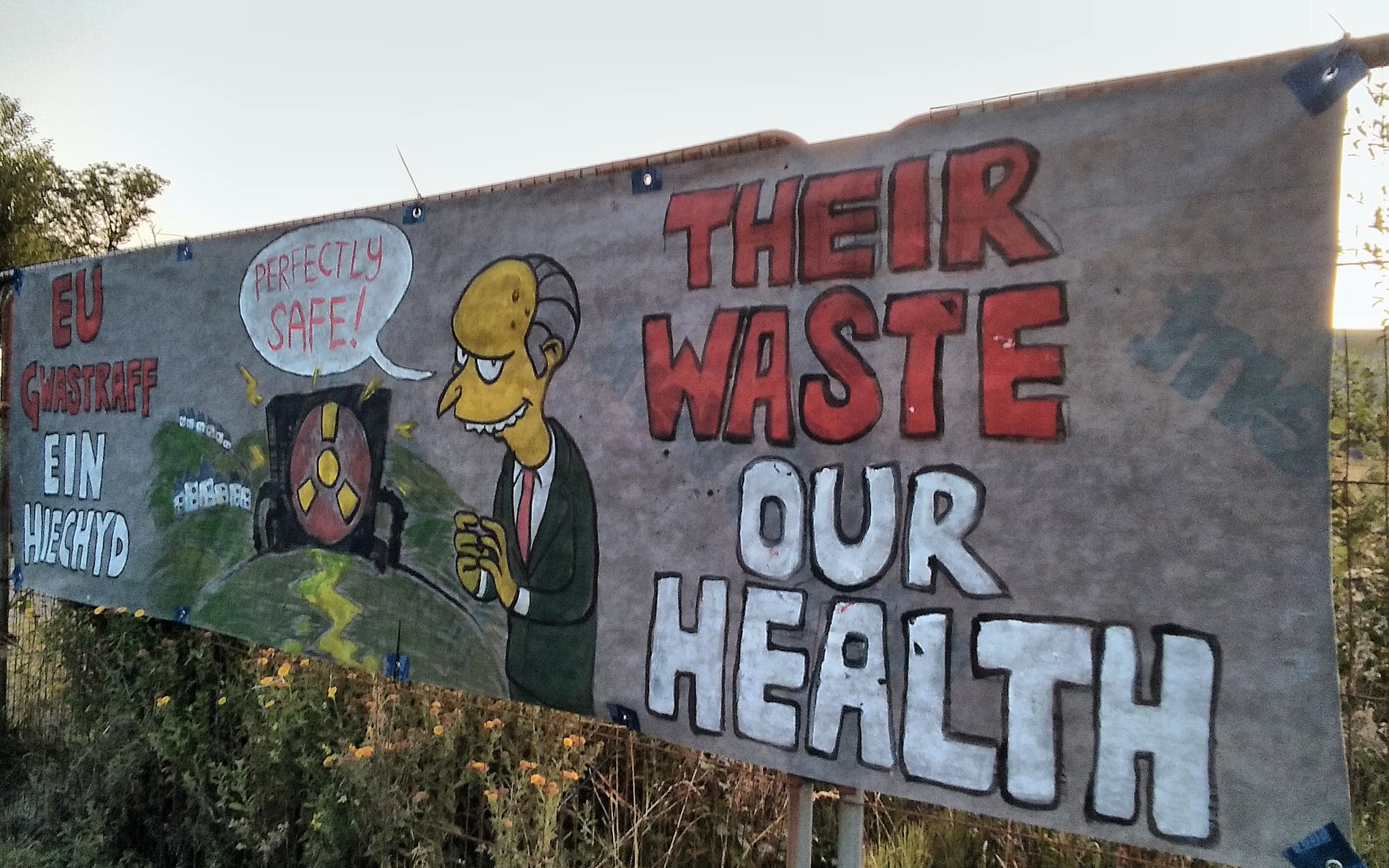
Campaigners warn of ‘dangerous experiment’ as nuclear plans face backlash.
Tom Sinclair, 10 Oct 25, https://pembrokeshire-herald.com/124146/campaigners-warn-of-dangerous-experiment-as-nuclear-plans-face-backlash/
Climate Camp Cymru supports Llynfi Valley protest against small modular reactors – campaigners urge Pembrokeshire to stay alert
ENVIRONMENTAL activists from across Wales – including several from Pembrokeshire – joined forces with Climate Camp Cymru this summer to support the No Nuclear Llynfi campaign near Llangynwyd in the Llynfi Valley, South Wales.
The group is opposing plans by American company Last Energy to build four small modular nuclear reactors (SMRs) on land within a mile of residential homes and two schools.
The company, a venture capital-backed start-up that has never built a reactor before, is currently seeking UK planning approval. Campaigners say it is deeply concerning that Last Energy is also suing the US Nuclear Regulatory Commission, claiming its safety regulations are “overburdensome” – while applying similar pressure in the UK to reduce oversight and speed up development.
Concerns over waste and flood risk
No Nuclear Llynfi campaigners have highlighted several risks, including plans to store radioactive waste on-site indefinitely, and the fact that the proposed location lies below the water table in a Zone 3 flood risk area – the highest flood designation.
Other worries include the need for 24-hour armed security, the site’s proximity to homes and schools, and the potential use of generated power for data centres running artificial intelligence systems, rather than for local homes or industry.
spokesperson for Climate Camp Cymru said the project “treats post-industrial communities as expendable,” adding that “people in the valleys, and in places like Pembrokeshire too, are being used as testing grounds for risky new energy technologies.”
Raising awareness
The summer camp, set up over the August bank holiday weekend, occupied open land near the proposed nuclear site. Volunteers raised banners along the A4063, distributed flyers, and knocked on around 1,000 doors to alert residents.
Most locals, campaigners said, were unaware of the nuclear proposal – despite claims by Last Energy that it had consulted the community. “There’s a legal duty to inform residents, and that simply hasn’t been met,” organisers said.
An open meeting at Maesteg Rugby Club on September 25 drew strong attendance and marked the beginning of organised local opposition.
Workshops and wider links
Throughout the weekend, the camp hosted workshops and talks from campaigners behind Save Kilvey Hill in Swansea – where activists are fighting a proposed adventure park development – and from CND, the Initiative for Nature Conservation Cymru (INCC), and academics from Cardiff University.
Discussions focused on linking environmental struggles across Wales, from open-cast mining and deforestation to speculative energy projects. Evenings featured live music and Welsh-language sessions celebrating Wales’ radical protest heritage.
Call for local action
Organisers say the success of the Llynfi camp shows the power of grassroots resistance. The camp was left clean and intact, with the landowner’s permission granted after the first day and support from nearby residents.
Pembrokeshire campaigners are now being encouraged to stay alert to similar proposals in the west. Sites such as Trawsfynydd and Wylfa are already under consideration for future SMR projects, and environmental groups warn that West Wales could be next.
Anyone interested in hosting or seeking support from next year’s Climate Camp Cymru can contact the group via email at climatecampcymru@proton.me.
UK small businesses and charities say nuclear levy could add thousands to bills.
Charge from next month expected to have disproportionate impact after energy-intensive industries given exemption.
Jillian Ambrose Guardian, 13 Oct 25
British charities and small businesses have warned that a new levy on energy bills, intended to support the government’s nuclear power ambitions, could raise their costs by thousands of pounds a year.
The extra charge could mean a significant cost hike for charities and small businesses with high energy use, meaning community services may be cut and economic growth curtailed, according to trade groups.
For most charities, the levy, which takes effect in November, will mean an increase in costs of between £100 and £240 a year, but some could experience increases of up to £2,500, according to Social Investment Business, an organisation that offers loans and financial support to charities.
Nick Temple, the chief executive of Social Investment Business, said: “Adding yet more charges on top of charity electricity bills penalises our most vital community spaces at a time when they are already struggling.”
For small business, including those in hospitality, the extra costs could undermine growth in the UK economy and make the shift from fossil fuels to low-carbon electricity more expensive, according to trade associations.
The levy is designed to pay back investors in the Sizewell C nuclear project in Suffolk while the power plant is under construction.
Households can expect the levy to add about £12 a year to their energy bills, but organisations with high energy use will shoulder a greater cost burden. This will have a disproportionate impact on smaller businesses and charities with high energy demands because energy intensive industries such as steel, cement and glass-making have been granted exemption.
A Bristol-based community arts organisation, Spike Island, has been told to expect a hike of £1,ooo a year from the nuclear levy alone. The company, which provides subsidised studios for underrepresented artists, expects the extra costs to put a strain on its work……………………………………………………..
Business groups have also said that the costs are a “huge concern” for smaller companies, which they say will be forced to carry a disproportionate cost burden because larger companies were given exemptions………………………………………………………. https://www.theguardian.com/business/2025/oct/12/uk-small-businesses-and-charities-say-nuclear-levy-could-add-thousands-to-bills
Labour investing in nuclear due to fear of Scottish independence.
LABOUR may be investing hard in nuclear energy due to the fear of Scottish
independence, Stephen Flynn has suggested.
The SNP Westminster was speaking
at an event at SNP conference and took aim at the amount of cash the UK
Government has diverted from funding GB Energy to nuclear projects in
England.
Labour’s General Election manifesto in 2024 pledged £8.3
billion to GB Energy but Rachel Reeves effectively cut billions in funding
from the energy company — which is officially headquartered in Aberdeen,
although most jobs so far are in England – in June.
The Chancellor’s
spending review said a new body tasked with spearheading Britain’s
nuclear renaissance would receive £2.5bn of that funding for small modular
reactors (SMRs). She also confirmed a further £14.2 billion UK Government
investment in the Sizewell C nuclear power station in Sussex.
“I understand from a UK Government perspective why they might seek to go down that route because of the lack of indigenous energy production that they have,” Flynn told delegates. “And maybe there’s a fear in the back of their mind that if Scotland goes, they’re going to have to find some
electricity tonto to meet their own energy security requirements.”
In 2024, renewable energy accounted for about 70% of Scotland’s electricity
generation, which is significantly higher than England – which relies
more heavily on a mix that includes fossil fuels and nuclear power. Swinney
also hit out at the amount of Scottish families who are living in fuel
poverty despite Scotland being energy rich. “Scotland produces 6 times
more gas than it consumes, and 70% of our electricity comes from renewable sources,” he said. “So, I think all of us should be should be
questioning why we are such an energy originator and so many of our people are living in fuel poverty and why we’re not able to maximise that energy production in order to attract businesses and then, therefore, grow our economy.”
The National 12th Oct 2025, https://www.thenational.scot/news/25536897.labour-investing-nuclear-due-fear-scottish-independence/
Boldness is needed to take on toxicity of nuclear power.

SCOTLAND’S nuclear facilities, civilian and military, are leaking. Is
this an occasional hazard to bear, as we resolutely defend and power
ourselves? Or another indicator of how much independence has to clean up the modernity of Scotland?
This week’s reports of radioactive water
rushing into the Caithness shore at Dounreay – containing Caesium-137, as
well as alpha- and non-alpha-emitting radionuclides – admittedly came
from a clean-up situation, the decommissioning of the plant itself. But the
context makes you shudder. These “accidental” releases – spewing from
some “underground facility” – were deemed a “very small fraction of
our normal discharges via authorised discharge routes”, says Nuclear
Restoration Services (NRS), the firm responsible. (By the way, according to
the Scottish Pollutant Release Inventory – a chilling vista of our
nation’s industrial filth – the “authorised” routes contain
Strontium-90 and tritium, some of the most dangerous by-products of nuclear generation).
Consider also last year’s leaks. They identified “corroded
steelwork in a building being used to store drums of radioactive sodium,
and leaks from low-level radioactive waste pits”, as reported in this
paper. It’s all a demonstration of the sheer toxicity of nuclear power
– as evident in its disassembly, as in its installation. And I can’t
not mention the 585 cracks in the graphic reactor core of the ageing
Torness nuclear plant in East Lothian, reported by The Ferret earlier this
year. This is a tiny bit less than the amount – counted across two
reactors – that compelled the shutdown of Hunterston B in 2022. Much
technocratic reassurance from the French owner-operators EDF about safety, until some projected cessation in the early 2030s.
But I’m not exactly
consoled. Are you? And if we need investigative reporting to unearth leaks
in the notoriously defensive nuclear energy sector, imagine the digging
required to get the same from our nuclear warfare facilities.
The Ferret again triumphed in August after a six-year battle, releasing proof of a 2019 irradiated spill from burst pipes at Royal Navy’s Coulport nuclear bombstore, pouring deep into Loch Long.
The National 11th Oct 2025, https://www.thenational.scot/politics/25535392.boldness-needed-take-toxicity-nuclear-power/
RADIOACTIVE material was accidentally released at Scotland’s Dounreay nuclear.
An investigation was launched in June 2024 after Nuclear Restoration Services
(NRS) – the firm which is responsible for the north Caithness complex’s
clean-up and demolition – informed the Scottish Environmental Protection
Agency (Sepa) of a potential leak of contaminated water. Scotland’s
environmental regulator confirmed that a “small leak” from a carbon bed
filter had occurred. Three different radioactive substances –
alpha-emitting Radionuclides, alpha-emitting Radionuclides and Caesium-137
– were all released, according to the Scottish Pollutant Release
Inventory (SPRI) data. Monitoring from NRS didn’t detect any increase in
radioactivity in groundwater downstream. But Sepa found that the firm had
breached environmental regulations and has ordered it to review its
groundwater monitoring arrangements and “establish the extent of
contamination” which has arisen from the leak.
The National 7th Oct 2025, https://www.thenational.scot/news/25525191.radioactive-water-highland-nuclear-site-leaked-major-breach/
University of Stirling hosts Hiroshima and Nagasaki exhibition
The University of Stirling is hosting the UK debut of Remembered: 80 years
since the bombing of Hiroshima and Nagasaki, marking eight decades since
the atomic bombings of Japan at the end of the Second World War.
The exhibition, curated by the Nagasaki National Peace Memorial Hall for the
Atomic Bomb Victims, offers a deeply moving account of the destruction
caused by the bombings and their long-term human and environmental
consequences.
Stirling News 8th Oct 2025, https://www.stirlingnews.co.uk/news/25528466.university-stirling-hosts-hiroshima-nagasaki-exhibition/
Poll suggests most Reform UK voters back investment in renewable energy
More than half of Reform UK voters approve of their pensions being
invested in green energy despite the party recently launching a
“renewables war”, a poll suggests.
A survey by YouGov found 79% of
voters overall are in favour of their pensions being invested in renewable
energy, including 53% of Reform UK supporters. The findings have led to
claims that politicians who oppose investment in the sector “have grossly
misjudged” voters’ views. Reform UK deputy leader Richard Tice launched
a campaign group called UK Opposes Renewable Eyesores in July, decrying the
“the madness of net stupid zero” and pledging to “go into battle”
against Energy Secretary Ed Miliband.
Nation Cymru 8th Oct 2025, https://nation.cymru/news/poll-suggests-most-reform-uk-voters-back-investment-in-renewable-energy/
UK Parliament blocks Declassified, citing our Gaza ‘standpoint’

MPs condemn ‘sinister move’ to deny access to Declassified reporters.
Martin Williams, Declassified UK, 23 September 2025
Parliament has been accused of an “outrageous abuse” that is “worthy of the Trump White House”, after blocking Declassified from holding a media pass.
Internal emails reveal that officials cited our “in-depth investigations… from a particular standpoint”, when rejecting our application.
They also flagged a recent investigation we published that raised concerns over pro-Israel bias in Westminster.
This is despite parliamentary authorities having a duty to remain politically impartial. Guidelines say that passes should be granted with “fair access across a range of outlets”.
The decision to deny Declassified access has been criticised by politicians across the political spectrum, including Labour, the Green Party, Plaid Cymru, and the Independent Alliance.
Almost 500 journalists currently hold a pass, which provides unfettered access to Westminster and daily government briefings. They include many from right-wing outlets like Guido Fawkes and GB News.
When Declassified’s application for a pass was first rejected, officials blamed space and capacity “due to limitations within the Parliamentary estate”.
But documents released under the Freedom of Information Act now reveal there is no limit to the number of press passes that can be issued – and capacity was not even discussed as a consideration.
In fact, at least three other journalists have been granted parliamentary passes since Declassified’s application was rejected.
In a bizarre attempt to justify the ban, documents also reveal that officials claimed Declassified’s focus on UK foreign policy does not count as “politics”.
An internal email said: “They are not specifically a politics organisation, as their main focus is around foreign affairs.”
‘Outrageous abuse’
Several politicians condemned the decision by parliament – and warned against “selectively silencing journalists”.
Jeremy Corbyn, the former Labour leader, said: “Declassified have done outstanding, vital work exposing the scale of British complicity in Israeli war crimes.
“A healthy democracy rests on transparency and accountability. What does Britain have to hide?”
Liz Saville-Roberts, the leader of Plaid Cymru, said that parliament “should be proud to make itself open to investigative journalists”……………………………………………………………………………………………………..
Threats
The decision to reject Declassified‘s media pass application was finalised by the Sergeant At Arms, Ugbana Oyet. But records suggest it was based on advice from the House of Commons press office, who highlighted the “standpoint” of Declassified’s coverage.
When we sent a “right of reply”, with advance notice of this article, the press office flatly denied the evidence contained in the internal emails. This is despite the fact they were disclosed by parliament itself, under the Freedom of Information Act.
Officials even threatened regulatory action against Declassified if we failed to publish a lengthy and misleading statement from a parliamentary spokesperson.
The statement claimed that decisions around press passes “are not based on an outlet’s editorial stance or coverage of any one issue, and any suggestion to the contrary is wholly untrue”.
And when Declassified said we were not prepared to quote from a misleading statement, parliament’s head of media responded: “We’d expect any outlet to use the full response we provide them – and would strongly dispute any suggestion that the statement provided is untrue.”
He added: “We would be happy to follow up with Impress [the media regulator] if our response is not reflected in your coverage.”
He also claimed that our article was based on “incomplete material [which] does not reflect the full picture”. However, if this is true, it suggests that parliament failed to fully comply with Declassified’s Freedom of Information request.
The press office proceeded to ignore further questions and provided no further information.
The spokesperson had said: “The House of Commons supports the work of a free and independent press – providing access and facilities to the Parliamentary Press Gallery. Demand far exceeds capacity here, hence numbers are required to be strictly controlled, whilst ensuring fair access across a range of outlets.
“For applications from an outlet that does not already have a pass, or for a request to increase the allocation given to an outlet, we require a business case to be submitted, details of which are available on our website. Unsuccessful applicants may reapply for a pass one year after their original application, and as Parliament is a public building, journalists are still able to visit, attend and report on proceedings and meet Members without a media pass. Decisions around accreditation are applied consistently across all applications.”
They added: “The range of media outlets currently granted access — spanning the full spectrum of political opinion and including a wide variety of independent and critical journalism — clearly demonstrates that the accreditation process is impartial and rooted solely in operational considerations and editorial relevance to parliamentary proceedings.”
The emails obtained by Declassified strongly suggest this claim is misleading.
We’ve written an open letter calling on parliamentary authorities to urgently review this decision and issue Declassified with a press pass. We also urge parliamentary authorities to review the way that future applications are processed, to avoid any partisan interference with future applications. Please add your name below – [Petition on original] https://www.declassifieduk.org/parliament-blocks-declassified-citing-our-gaza-standpoint/
UK aerospace firm supplying Israel’s defence ministry
Moog in Wolverhampton was targeted by pro-Palestine activists in August. We can now reveal the company has been exporting aircraft components to Israel’s ministry of defence.
JOHN McEVOY, 22 September 2025, https://www.declassifieduk.org/uk-aerospace-firm-supplying-israels-defence-ministry/
Published in partnership with Irish investigative news site The Ditch
On 26 August, four activists from the group ‘Palestinian Martyrs for Justice’ crashed through the gates of a factory in Wolverhampton and climbed onto its rooftop.
The target was Moog, a US-owned engineering company which designs and manufactures components for military aircraft worldwide.
Wearing t-shirts with the faces of Palestinians killed by Israel, the activists proceeded to cut through Moog’s roof covering and peer into the factory floor below.
They accused the company of supplying Israel’s largest arms firm Elbit Systems with aircraft parts “used to train Israeli pilots to fly F-16 and F-35 fighter jets”.
Declassified and The Ditch had previously reported how Moog sent at least ten shipments of trainer aircraft parts to an Elbit Systems site in Israel between December 2024 and July 2025.
But it can now be revealed that Moog has also been directly supplying Israel’s ministry of defence with components used to train Israeli pilots to fly advanced fighter jets.
Cargo documents expose how the aerospace firm sent two shipments for the M-346 Lavi programme in July 2025, with the address corresponding to Israel’s defence ministry in Tel Aviv.
The M-346 Lavi is a high-performance aircraft designed to train Israeli pilots to fly jets including the F-16 and F-35.
It is estimated that the value of the two shipments could be over £200,000. The total value of Moog exports to Israel since December 2024 is likely in excess of £1m.
2,000lb bombs
The revelation details how the UK government, through its arms export regime, is facilitating the training of Israeli pilots to fly the aircraft dropping 2,000lb bombs on civilians.
This is despite the government having claimed it suspended export licences for equipment that could be used by Israeli forces in Gaza.
Last week, trade minister Chris Bryant attempted to justify this approach, saying: “The assessment is that the training of an aircraft pilot on such equipment would take so long that they wouldn’t be the people that would be engaged in fighter combat in Gaza”.
Bryant did not clarify how the government reached this conclusion, but it appears to be misleading.
A US air force report recently estimated that it could take four to six months to train Ukrainian fighter pilots to fly F-16 fighter jets. These same aircraft have been used by Israeli forces in Gaza, including in an attack on British doctors in January 2024.
Moreover, Bryant’s argument falsely suggests a known end date of the Gaza genocide, and appears to assume that Israeli pilots will only be using UK-made equipment at the beginning of their training.
Declassified approached the Department for Business and Trade as well as the Foreign Office for clarification on Bryant’s comments.
We specifically asked whether Bryant’s comments accurately reflected the government’s position, and on what basis it is estimated that Israeli pilots training on UK-made components will not go on to use fighter aircraft in Gaza.
The trade department failed to provide any meaningful answers, while the Foreign Office did not respond at all.
M-346 Lavi
Israel received its first M-346 Lavi in 2014, with an additional 29 arriving over the following two years. They are hosted at Hatzerim airbase near Be’er Sheva.
Promotional content shows how the jet not only trains pilots to fly, but also helps them master combat techniques. It is equipped with a “digital avionics system” which is modelled on advanced military aircraft such as the F-16, F-22 and F-35.
Its cockpit includes a head-up display which is common in fighter jets, and the aircraft can be armed with practice air-to-ground bombs and a gun pod for live fire training.
One of the first instructors to use the jet, Brigadier General Avi Maor, has said: “It’s very easy to make the transition from the M-346 to a real jet fighter because it’s very similar to the fighters.
“You learn how to fight and then do the transition to the real fighter. You don’t need to learn how to fight again with the real fighter, so you save a lot of hours”.
By 2022, the Israeli air force had racked up 50,000 flight hours with the M-346 Lavi, making it the largest user of the jet in the world.
In addition to supplying parts for the M-346, Moog has contributed to the global F-35 programme.
Previous company annual reports note how Moog “provides actuators, power drive electronics, control electronics and software” for the F-35 fighter jet.
Moog was approached for comment.
1 This Month

of the week – Shut Down Drone Warfare!


Tell the Ukrainian Government to Drop Prosecution of Peace Activist Yurii Sheliazhenko

Petition to revoke the licensing of the Near Surface Nuclear Disposal Facility (NSDF) at Chalk River. https://www.ourcommons.ca/petitions/en/Petition/Details?Petition=e-7247
To see nuclear-related stories in greater depth and intensity – go to https://nuclearinformation.wordpress.com
-
Archives
- April 2026 (7)
- March 2026 (251)
- February 2026 (268)
- January 2026 (308)
- December 2025 (358)
- November 2025 (359)
- October 2025 (376)
- September 2025 (257)
- August 2025 (319)
- July 2025 (230)
- June 2025 (348)
- May 2025 (261)
-
Categories
- 1
- 1 NUCLEAR ISSUES
- business and costs
- climate change
- culture and arts
- ENERGY
- environment
- health
- history
- indigenous issues
- Legal
- marketing of nuclear
- media
- opposition to nuclear
- PERSONAL STORIES
- politics
- politics international
- Religion and ethics
- safety
- secrets,lies and civil liberties
- spinbuster
- technology
- Uranium
- wastes
- weapons and war
- Women
- 2 WORLD
- ACTION
- AFRICA
- Atrocities
- AUSTRALIA
- Christina's notes
- Christina's themes
- culture and arts
- Events
- Fuk 2022
- Fuk 2023
- Fukushima 2017
- Fukushima 2018
- fukushima 2019
- Fukushima 2020
- Fukushima 2021
- general
- global warming
- Humour (God we need it)
- Nuclear
- RARE EARTHS
- Reference
- resources – print
- Resources -audiovicual
- Weekly Newsletter
- World
- World Nuclear
- YouTube
-
RSS
Entries RSS
Comments RSS
 nuclear-news