Britain to sell mini nuclear reactors to Sweden.

Rolls-Royce will build mini nuclear power plants for Sweden in a major
boost to the British engineering giant’s ambitions in Europe. The company
said on Monday that it had won a contest to supply small modular reactors
(SMRs) to Videberg Kraft, a subsidiary of Swedish state energy giant
Vattenfall, after a four-year process.
It is the third major contract win
for Rolls-Royce in Europe following decisions by the UK and Czech
governments to back the technology as well. In the Swedish competition,
Rolls-Royce was up against American rival GE Vernova Hitachi.
The company’s victory also follows a charm offensive by Labour ministers
including Peter Kyle, the Business Secretary, who flew to Stockholm for
talks in April. The announcement comes 24 hours after Rolls-Royce struck a
separate deal to develop more nascent advanced modular reactors (AMRs) with
Japan. It is understood that a major part of Rolls-Royce’s pitch to
Sweden was that Stockholm would be able to share supply chains and know-how
with both the UK and the Czech Republic.
Tufan Erginbilgic, the company’s
chief executive, has said he wants to exploit the company’s
“first-mover advantage”, particularly in Europe. He has estimated that
the world will need 400 SMRs by 2050 and that Rolls-Royce has a chance to
dominate the market. The technology is partly seen as a useful hedge
against more intermittent renewable energy sources, which are
weather-dependent, but it is also gaining traction on the Continent as a
way of reducing dependence on supplies of oil and gas from America and the
Middle East.
Ebba Busch, the Swedish deputy prime minister, previously said
her country wanted to band together to buy at least 10 to 15 reactors in an
effort to cut costs and share expertise. Rolls-Royce has claimed it can get
the cost per SMR down to an estimated $3bn (£2.2bn) per unit once
production is up and running.
Telegraph 15th June 2026, https://www.telegraph.co.uk/business/2026/06/15/britain-to-sell-mini-nuclear-reactors-to-sweden/
UK powers up Ukraine with £210 million nuclear fuel deal
The deal, announced by
the Prime Minister at the G7, sees UK Export Finance (UKEF) guarantee a
loan enabling Urenco, a UK-headquartered uranium enrichment company, to
supply enriched uranium to Ukraine’s national nuclear power producer,
Energoatom, powering the country’s nuclear plants for the next two years.
UK Export Finance 16th June 2026, https://www.gov.uk/government/news/uk-powers-up-ukraine-with-210-million-nuclear-fuel-deal-and-boosts-british-jobs
Legal Profession Revolt Against The UK Judge Whose Job Is To Protect Israel’s Genocide

Proscription has led to thousands of people, most of them elderly and including upstanding members of British society – from magistrates and doctors to army veterans – facing convictions for “supporting terrorism” for holding up placards stating: “I oppose genocide. I support Palestine Action.”
Judge Johnson so rigged the trial of anti-genocide activists that 1000s of legal professionals have urged him to step down from the sentencing hearing. But Johnson’s dirty work is not yet complete
SCHEERPOST, Jonathan Cook Substack, June 11, 2026
The trial of the Filton Four reaches its climax on Friday. Judge Jeremy Johnson will decide the sentences of four Palestine Action activists found guilty of criminal damage – after two juries refused to convict them of far more serious charges brought by the British government, via the Crown Prosecution Service.
Keir Starmer’s government failed to secure the convictions for aggravated burglary and violent disorder it so desperately needed. They would have helped retroactively justify its decision to proscribe Palestine Action as a terrorist organisation – the first time in British history that a direct action group, which targets property, has been proscribed.
Starmer’s hostility towards Palestine Action is personal. It has been a massive thorn in his side during Israel’s near three-year genocide in Gaza.
From the outset, Starmer suggested that Israel had the “right” to withhold food, water and power from the 2 million Palestinian residents of Gaza – a crime against humanity for which the Israeli prime minister, Benjamin Netanyahu, is wanted by the International Criminal Court.
Starmer’s complicity in the genocide has only been underscored by Palestine Action, which has targeted Israeli factories operating in the UK run by Elbit Systems that supply Israel’s genocidal army with killer drones for use in Gaza.
The so-called Filton trial derives its name from an Elbit factory in the Filton neighbourhood of Bristol that Palestine Action targeted in August 2024. Efforts to destroy these Israeli drones came at a time when Starmer was under enormous popular – if little political – pressure to end British arms sales to Israel.
PR crisis
Proscription, however, has not worked out well for Starmer. It has entangled him in a self-inflicted public relations crisis of almighty proportions.
Palestine Action activists have been held in remand without trial for an unprecedented period of time, far in excess of the normal maximums, and in especially harsh conditions that have treated them as if they were terrorism suspects, even though their arrests long precede the group’s proscription last year.
These sustained abuses led to a prolonged hunger strike, and a desperate government and media campaign to justify their mistreatment.
Proscription has led to thousands of people, most of them elderly and including upstanding members of British society – from magistrates and doctors to army veterans – facing convictions for “supporting terrorism” for holding up placards stating: “I oppose genocide. I support Palestine Action.”
This popular backlash cornered the High Court into declaring the proscription unlawful – a decision the government is appealing. That has led to another unprecedented situation: police are still arresting people for holding the placards, despite the courts ruling that the basis for such arrests is unlawful.
The law has never looked more of an ass………………………………………………………………………………………………………………
Rigged trials
Judge Johnson has done precisely nothing to counter the overwhelming impression that the Filton activists’ prosecutions were entirely political. He quite openly rigged both trials in manifold ways, as former British ambassador Craig Murray has set out………………………………………………………………………………………………………………………………………………………………………………..
Gagging order
But even with the convictions for criminal damage secured under these rigged conditions, Judge Johnson is still in a position to cause more harm to the rule of law. He is due to sentence the Filton Four on Friday……………………………………………………………………………………..
Remember, all this is happening as Starmer’s government makes unprecedented moves to end many jury trials in Britain, leaving us to the mercy of judges like Jeremy Johnson……………………………………………………………………………..
If this is all starting to look like theatre, that is because it is. In dictatorships, these are called show trials. Everyone understands that the outcome is predetermined. Everyone understands that justice is non-existent. The verdict is entirely political. It is a faux-legal rationalisation of what the security state wants.
Judge Johnson is the perfect judge to play that part…………………….https://scheerpost.com/2026/06/11/legal-profession-revolt-against-the-uk-judge-whose-job-is-to-protect-israels-genocide/
While Britain’s defence strategy comes under fire, the nuclear arms race continues

By Laura Tingle, Sat 13 June, https://www.abc.net.au/news/2026-06-13/nuclear-weapons-spending-united-kingdom-defence-aukus/106737440
When British Defence Secretary John Healey resigned on Thursday night, Australian time, the implications of his move were largely judged by what it would mean for the future of his embattled Prime Minister, Sir Keir Starmer.
Healey was followed out the door hours later by the armed forces minister, Al Carns, and two ministerial aides.
The future shape of the British government is, of course, of great interest. And political battles are always a subject of public fascination.
But, in an increasingly rare event these days, Healey’s resignation was on a matter of principle.
That matter of principle helps shine a light on a much bigger story about the state of the world, geopolitics and war preparedness than the implications of resignations at Whitehall.
“You have been unable, and the Treasury has been unwilling, to commit the resources that the nation needs to defend the country at this time of rising threats,” Healey wrote, damning his leader for failing to provide what many people would regard as the most fundamental of protections for a country’s population: its defence.
Britain’s growing nuclear weapon spend
There has been a long and complicated brawl going on in the British Labour government about defence spending; much of its public face being about the fact that other parts of the government would have to cut spending to fund plans to significantly increase defence spending — by about 15 billion pounds.
The debate has dragged on for some time since a strategic review of Britain’s defence needs was completed last year.
As the Royal United Services Institute wrote, the review never really gave a full description of the size and shape of the armed forces that was envisaged “akin to the kind of ‘order of battle’ seen in previous defence reviews”.
In other words, while the overall size of the British defence budget has been fought over, there is little known about how exactly it will be spent. Questions linger — does the UK aim to have a land army to fight a war in Europe? (Answer: unlikely). Does it need more conventional missiles and drones for such a war? And what’s the role of manned and unmanned naval power?
But one capability that seems to just blunder on with little scrutiny and increasingly little strategy is Britain’s nuclear capacity.
Two reports released this week document a surge in the number of nuclear weapons around the world in the past year. And not just their growth in number but a seemingly growing reliance on them, in an environment where most of the deterrence and detente architecture which kept things manageable in the past has been eroded.
The nature of nuclear weapons is changing. Analysts say the gap between conventional weapons and nuclear weapons is getting smaller, and the way nuclear weapons are conceived to be used is changing.
What makes the UK’s role in this story so compelling is that the current fracas has highlighted the fact that nuclear weapons will soon represent 25 per cent of Britain’s defence spend.
Not only that, but the small island nation has overtaken Russia in the past year as the third biggest spender on nuclear weapons.
The Stockholm International Peace Research Institute (SIPRI), which tracks military spending, noted the UK also announced last year its intention to buy 12 nuclear-capable F-35A combat aircraft from the USA, and equip them with US nuclear bombs, in order to join NATO’s nuclear sharing arrangements. The plan walks back the decision from the 1990s to denuclearise the Royal Air Force.
‘A worrying development’
The rationale for escalation in nuclear weaponry is strongly linked to the United States’ declared plan to reduce its commitment to European defence.
So it is hardly surprising that the UK might be seeking to compensate for this.
But as British defence analyst Carne Ross said this week “the other unnoticed thing that’s going on in the UK and indeed Europe as a whole, is that the US is increasing its deployment of tactical nuclear weapons, so-called tactical nuclear weapons, which can have a yield of 50 kilotons, which is three times greater than the bomb used in Hiroshima”.
“There appears to be a rapid increase in the deployment of these tactical weapons in Britain, but also on continental Europe, maybe Turkey and elsewhere — bizarrely in response to the fact that Trump is less committed to the conventional military defence of Europe,” he told Al Jazeera podcast The Inside Story.
Read more: While Britain’s defence strategy comes under fire, the nuclear arms race continues“This appears to be an appeal from the Europeans for greater security through tactical nuclear deployments. This is a very bizarre and paradoxical and indeed worrying development.”
But more than the usual difficulty in knowing just how defence dollars are being spent, anything specifically related to nuclear weapons has a tradition of being particularly opaque.
The Financial Times reported last week that Westminster’s Public Accounts Committee found that the Ministry of Defence has “not provided ‘sufficient transparency’ over its ever-increasing spending on nuclear weapons, which accounts for roughly a fifth of the UK defence budget”.
“The report criticised the secrecy surrounding Britain’s nuclear spending, saying the Defence Nuclear Enterprise, a collection of organisations that operate and maintain the UK’s nuclear deterrent, ‘lacked accounting records to support more than £6bn of its assets’ in its 2024–25 annual report,” the FT reported.
Britain’s nuclear deterrent consists of submarines carrying US-made Trident nuclear missiles. Creating a new class of four Dreadnought nuclear submarines to take the place of the ageing Vanguard-class subs is expected to cost £41bn.
Nine nuclear-armed countries spending more
Where the story of the UK’s nuclear spend goes even wider though is in another report released this week by the anti-proliferation group the International Campaign to Abolish Nuclear Weapons (ICAN) which documents the last year’s spending on nuclear weapons by the nine nuclear-armed countries. (That’s the US, China, UK, Russia, France, India, Pakistan, Israel and North Korea.)
ICAN says those nine states spent just under US$119 billion ($168 billion) on their nuclear arsenals in 2025, a staggering increase of 19 per cent from the previous year.
The US had the biggest increase (US$12.4 billion) and spent more than all the others combined — US$69.2 billion.
China remained in second place. But the UK came in third at US$12.6 billion, overtaking Russia.
While the US and Israel went to war to stop Iran getting nuclear weapons, they are both believed to have them — even though Israel has never confirmed it possesses them.
ICAN’s Susi Snyder told the same Al Jazeera podcast this week: “On average, we see an increase of about 10 per cent. Last year, it was almost double that. So it is by far one of the largest increases we have ever seen.”
Nuclear war and weapons have historically been seen as a threat of missiles exchange over continents in a showdown between the “great” powers.
But the sheer cost and difficulties of warfare in modern times gives too many countries some sense of relatively easy security in having a nuclear “deterrent”.
SIPRI notes that in 2025 several European states, including Germany, indicated a desire to supplement NATO nuclear-sharing arrangements focused on US weapons with similar arrangements with France and the UK.
A changing warfare landscape
There are two major confrontations going on in Europe and the Middle East at present. (The conflicts in Africa seem beyond the reach of nuclear stand-offs at present).
In both the war in Ukraine and the war in the Middle East, we have been witnessing increasing signs of frustrated eruptions between combatants — notably around the Strait of Hormuz this week — as fights bog down into apparently intractable conflict.
The risks of an accident have seemed all too clear.
The prospect of nuclear weapons being used in either Ukraine or the Middle East, rather than being fired between Moscow, Washington or Beijing has risen.
SIPRI Director Karim Haggag says that “influential voices, including some world leaders, are advocating nuclear weapons as a guarantee against attack by a hostile state. But making national defence and security strategies dependent, or more dependent, on nuclear weapons could significantly increase nuclear risks.”
Tariq Rauf, the former head of verification and security at the International International Atomic Energy Agency agrees.
“First of all, we have new types of delivery systems, supersonic delivery systems, hypersonic delivery systems,” Rauf told Al Jazeera.
“The gap between large conventional weapons and small-yield nuclear weapons is now largely disappearing. So, we can now have conventional weapons used with strategic effect to even try to take out nuclear bases and decision makers.”
The Healey resignation came just hours before he was supposed to stand up at Portsmouth to trumpet AUKUS with Australia’s Deputy Prime Minister and Defence Minister Richard Marles, and Foreign Minister Penny Wong.
Like much of the British media, Marles chose to focus on the personnel change, rather than what might have driven it, in his comments.
AUKUS, he said, would continue, as it already had across changes of government in the UK, the US and Australia “because it fundamentally is in the national strategic interests of the United Kingdom, the United States and Australia, and all of that gives us a sense of confidence that we will be able to deliver this”.
The only question is over the value of delivering “this” at a time when the threats and means of warfare are changing by the day, in ways most of us can’t easily see.
Laura Tingle is the ABC’s Global Affairs Editor.
Campaigners demand answers over Sizewell C costs and completion date

It comes one year after £14bn Government backing for the nuclear power plant
Author: Jasmine Oak, 10th Jun 2026
Anti-nuclear campaigners are calling on the Government to release more information about the future of Sizewell C, arguing that key questions about the project’s costs and completion date remain unanswered a year after ministers committed £14.2 billion to the Suffolk development.
Campaign group Stop Sizewell C has published a new report to mark the first anniversary of the Government’s investment in the power station, claiming there is still insufficient transparency around how much the project will ultimately cost and when it will begin generating electricity.
The group is urging ministers to publish what it describes as an unredacted Full Business Case and a detailed delivery plan, arguing that both local communities and bill payers deserve greater clarity.
What questions they want answered
Alison Downes, founder of Stop Sizewell C, said the most significant unanswered question was when the power station would be completed.
“It’s been a year since the government committed £14 billion pounds to Sizewell C and that paved the way for a final investment decision and there’s still a lot we don’t know,” she said.
“The biggest single question is when Sizewell C will be finished and the government seems absolutely determined to keep this a secret.
“Local people need to know how long this nightmare is going to go on for. The British public needs to know how long they have to pay for it until they get any electricity.”
The Government and Sizewell C have previously said the project is expected to begin generating electricity in the mid-2030s. However, Ms Downes questioned whether that timeline remained realistic, citing references contained within reports examining the project.
The campaign group is also seeking greater transparency over the financial implications of the development.
Under the Regulated Asset Base funding model, consumers contribute towards the cost of constructing the power station before it begins generating electricity.
Ms Downes said uncertainty remained over the eventual impact on household energy bills.
“The reality is we don’t know what the impact of Sizewell C on energy bills is going to be because we don’t know what it ultimately will cost,” she said.
“We don’t know how long we’ll be paying for it before it’s even generating any electricity.”
They’re seeking transparency
The report also calls on ministers to publish further project documentation, including a full business case and delivery strategy.
“The government needs to publish the unredacted Sizewell C full business case so we can all see the information withheld when only a summary was published last year,” Ms Downes said.
“We also need to see a strategy and delivery plan. It needs to be transparent about the costs and schedule in a way that’s easy for people to understand.”
The campaign group argues ministers should be prepared to reconsider the project if costs or delays escalate significantly.
“The Secretary of State has the power to cancel Sizewell C under certain circumstances and we want more assurances that the government is actually prepared to do this,” Ms Downes said.
“It would be completely immoral to force the public to carry on paying for something that spiralled out of control.”
Sizewell C is expected to provide enough low-carbon electricity to power around six million homes and is one of the Government’s flagship infrastructure projects aimed at improving the UK’s energy security and reducing carbon emissions.
Ministers have consistently argued that Sizewell C will play a vital role in the UK’s future energy mix. The Government says the power station will help strengthen energy security, reduce exposure to volatile international gas markets and provide enough low-carbon electricity to power around six million homes for decades to come…………………………………….. https://www.hellorayo.co.uk/hits-radio/suffolk/news/campaigners-demand-answers-over-sizewell-c-costs-and-completion-date
Britain has become third-largest nuclear weapons spender – CND

, https://labouroutlook.org/2026/06/10/britain-has-become-third-largest-nuclear-weapons-spender-cnd/
The Campaign for Nuclear Disarmament (CND) has called on the government to cut wasted billions on nukes ahead of its Defence Investment Plan announcement.
CND is calling on the government to stop wasting public money on its nuclear black hole, after the latest nuclear weapons spending report from the International Campaign to Abolish Nuclear Weapons (ICAN) reveals that Britain is now spending more on its nuclear weapons than Russia.
Collectively, the nine nuclear-weapon states spent a record $119 billion in 2025 on maintaining, modernising, and expanding their nuclear arsenals, an increase of 19% ($16.8 billion) on their 2024 bill.
Britain overtook Russia as the world’s third biggest spender, spending $12.6 billion (£9.6 billion), an increase of 17%.
This spending includes:
- operating costs of Britain’s current four Vanguard nuclear-armed submarines
- building the replacement to Vanguard – the Dreadnought submarine
- maintenance of Britain’s nuclear weapons stockpile
- development of a new nuclear warhead, Project Astraea
It does not include the costs of the 12 F-35A nuclear-capable fighter jets that the government announced it was purchasing in June 2025. This shocking surge in nuclear spending comes as the government’s own Public Accounts Committee criticised the MoD for a lack of transparency over its ‘ever-increasing nuclear expenditure’, which is expected to rise to 20% of the total MoD budget for 2025–26, and again increase further to up to 25% in the coming years.
According to ICAN, the top nuclear spender globally was again the US, which spent $69.2 billion, an increase of 22% from 2024, outspending all other nuclear weapons states combined. China was second, spending $13.5 billion, an increase of 7%. Behind Britain was Russia, with an increase by 6% to $9.5 billion. Of the others, France spent $7.7 billion, India spent $2.8 billion, Pakistan spent $1.5 billion, Israel spent £1.2 billion, and North Korea spent $656 million.
The report also found that arms companies involved in the manufacture of Britain’s weapons had sought to influence government policy. According to Open Access data cited in the report, senior government figures met with representatives of the following arms companies: Airbus, Amentum, Babcock International, BAE Systems, Bechtel, Boeing, General Dynamics, Honeywell International, Leidos, Leonardo, Lockheed Martin, Peraton, Rolls Royce, RTX (Raytheon), Safran and Thales. The report noted that Airbus and BAE Systems, which had 44 and 35 meetings respectively, also included meetings with the Prime Minister’s office.
CND General Secretary Sophie Bolt said:
“This is a timely report that comes when the British government is planning to make savage cuts to public spending in order to fund more hikes to military spending. Britain’s nuclear weapons are a black hole, swallowing up even greater proportions of the Ministry of Defence’s already ballooning budget.
“It is Britain’s replacement of its nuclear weapons system which is driving these huge nuclear weapons spending increases. This is contributing to a much more dangerous world where the threat of these world-ending weapons being used in war is the highest it has been since the Cold War.
Far from keeping us safe, Britain’s nuclear-armed submarines are totally dependent on the US administration, which ties us even more closely to Trump’s reckless leadership that is dragging the world into more and more reckless wars that could go nuclear.
“With the government’s upcoming Defence Investment Plan expected to give at least £15 billion more to the military, it’s time to end the wasteful spending on war and nuclear weapons and redirect it into tackling the real security issues we face – from climate breakdown and the looming cost of living crisis.”
Are the Sizewell C financing arrangements a model for other European countries?

Steve Thomas, Presentation to AT OM Day, May 22, 2026, TUB, Berlin
Government claimed Sizewell RAB could be funded by
institutional investors, mostly UK-based.
Government took 49.5%,
institutional investors 23%, UK private investors 15%/. Government talked
about seeking a balance of risk & reward between investors & consumers, but
risk is with consumers/taxpayers, rewards are with investor. The government
strategy appears to have been to offer whatever terms were needed with no
regard for cost & risk to the public. Still, investors will only finance
half the cost. The model will not be used again so the huge effort
completing the Sizewell deal was wasted
TUB Berlin 22nd May 2026, https://www.static.tu.berlin/fileadmin/www/10002415/WIP_Vortraege_PDF/veranstaltung_atom_day_2026/EB414a_Fr_10-15_Thomas_Stephen.pdf
United Kingdom Atomic Energy Authority (UKAEA) commits £20M to UKI2S fund for fusion innovation

The UK Atomic Energy Authority (UKAEA) has contributed a further £20
million to the UK Innovation & Science Seed Fund (UKI2S) to back UK-based
spinouts and early-stage companies. UKI2S is a government-backed seed fund
managed by Future Planet Capital that invests in and grows early-stage deep
tech companies emerging from UK research, helping turn science into
commercially viable businesses.
The investment forms part of a wider
£33.25 million funding increase across three UKI2S sub-funds (Space,
Defence and Fusion), taking the fund’s total capacity to £150 million.
The capital includes £9.25 million from the UK Space Agency, £4 million
from the Ministry of Defence and £20 million from UKAEA. The cumulative
investment from UKAEA in the UKI2S fund is £28 million.
UKAEA 10th June 2026, https://www.gov.uk/government/news/ukaea-commits-20m-to-uki2s-fund-for-fusion-innovation
Shipment of nuclear waste from Sellafield heads to Germany, raising safety concerns
11th June, By Gareth Cavanagh
A SHIPMENT containing ‘higher level’ nuclear waste has been seen making
its way through Barrow from the Sellafield site bound for Germany – and is
a source of concern for protest groups both at home and abroad. Sellafield
Ltd has confirmed that flasks, seen at Barrow Docks Rail Terminal on
Tuesday June 9, contain residue from reprocessed radioactive waste, which
is set to be returned to Germany. Waste contained in the flasks, carried by
Nuclear Transport Solutions (NTS), is the result of spent fuel which has
been reprocessed and recycled at Sellafield site. It was previously used by
utilities in Germany to produce electricity.
Whitehaven News 11th June 2026,
https://www.whitehavennews.co.uk/news/26183018.shipment-nuclear-waste-sellafield-heads-germany/
Sizewell C to move work offsite ‘as much as possible’ amid skills crisis
The National Audit Office (NAO) last month questioned whether investors in the Sizewell C nuclear power station were sufficiently incentivised to keep construction costs under control.
The public spending watchdog said it was “not clear” whether the project’s funding structure would motivate backers to keep costs down below the project’s “higher regulatory threshold” of £47.7bn.
09 Jun 2026 By Greg Pitcher, https://www.constructionnews.co.uk/civils/sizewell-c-to-move-work-offsite-as-much-as-possible-amid-skills-crisis-09-06-2026/
Sizewell C chief executive Nigel Cann has outlined plans to maximise offsite working on the £38bn nuclear project amid a looming construction skills shortage.
He told MPs on the Public Accounts Committee (PAC) this week that productivity was a key risk to the programme and budget of the Suffolk scheme.
Sizewell C, which is backed by Hinkley Point C developer EDF as well as the UK Government and other investors, reached financial close last year.
Asked by PAC chair Sir Geoffrey Clifton-Brown whether he was confident the Suffolk nuclear plant would be delivered on time and at its lower ‘regulatory cost’ of £40.5bn, Cann replied: “Absolutely.”
But he admitted there was work to do to achieve this.
“You need to manage your risk as a long project; it’s over 10 years,” Cann told the committee. “So we absolutely need to focus.”
He said his first challenge was to get as much equipment as possible built and stored in the company’s 92,900 square metre warehouse ready for the start of main construction. Enabling works including excavation and infrastructure tasks had to be carried out efficiently as well, he added.
“All that [risk] will be retired by 2029 and then we look forward,” said Cann. “It’s [then] about really managing productivity. The UK currently has got a challenge around making sure productivity rates are high.
“It’s about working with all the bodies concerned, including trade unions, including the workforce, making sure we’ve got enough trained people to do the work, and really optimising that productivity.
“Our big challenge between now and [the start of main construction] to make that happen is to modulise as much as possible. So we want to take as much welding off site, we want to take as much stuff into factories as we can, so that when we get to the construction on site, it’s absolutely optimised.”
The first-ever Annual Skills Report 2026 from Skills England this month predicted a sharp increase in labour demand alongside an exodus of existing workers from the construction industry, warning that a million more people were needed over the next decade to meet UK infrastructure commitments.
Cann said all big infrastructure projects contained uncertainty.
But he added: “If I go back to what are the cornerstones that make a project successful, [they are] stable design at the beginning; a very good bill of quantities; a supply chain [that] has done it before, in contract – we plan to have all our equipment contracts signed up by the end of next year. All that gives you confidence that you can deliver a project on time, on budget.”
The National Audit Office (NAO) last month questioned whether investors in the Sizewell C nuclear power station were sufficiently incentivised to keep construction costs under control.
The public spending watchdog said it was “not clear” whether the project’s funding structure would motivate backers to keep costs down below the project’s “higher regulatory threshold” of £47.7bn.
Jonathan Brearley, permanent secretary at the Department for Energy Security and Net Zero, told the PAC this week: “If we’d gone for a contract for difference, and purely private finance, we think this wouldn’t deliver either the best value for customers or indeed be affordable for customers.
“And we’ve learned lessons from High Speed 2 (HS2). We are not replicating HS2. We are not putting in a fixed price because of the cost that’s involved. We have created a regulatory system that balances those risks.
“I’m not sitting here saying there is no risk… but I think we’ve put a structure in place that best allows us to manage those risks.”
UK to Extend Life of Sizewell B Nuclear Plant by 20 Years !

Electricite de France SA and Centrica Plc are poised to agree on a draft
deal with the UK government to extend the life of the Sizewell B nuclear
power station by two decades, according to people familiar with the matter.
The companies are on the verge of agreeing a heads of terms agreement with
the Department for Energy Security and Net Zero, and will announce the deal
within weeks, two of the people said. The final deal is expected to be
agreed later this year.
Bloomberg 10th June 2026, https://www.bloomberg.com/news/articles/2026-06-10/uk-poised-to-extend-life-of-sizewell-b-nuclear-plant-by-20-years
Hinkley Nuclear plant could be delayed again by demands to protect fish
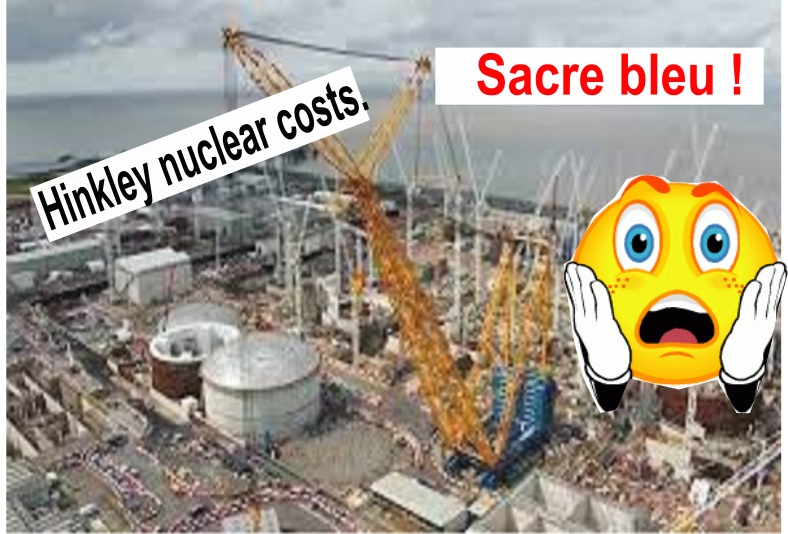
Britain’s first new nuclear power station in more than three decades is
facing years of further delays after an environmental quango said it still
posed a danger to fish.
Hinkley Point C has already spent more than £700
million to offset concerns about its impact on wildlife, including paying
for acoustic deterrents to stop fish from the Severn Estuary being sucked
into the plant’s cooling pipes. But now Natural England has told the
company behind the project that its plans are not good enough and it will
have to pay to create salt marshes in the estuary to boost the fish
population before it can begin generating power.
The demand has led to
warnings that Hinkley’s already delayed 2030 opening date will have to be
put back still further, alongside millions of pounds in additional costs,
which will ultimately be paid for through energy bills.
Any delay would
also in effect kill off Ed Miliband’s signature pledge to decarbonise
electricity supplies by 2030 because it is due to supply between 7 and 10
per cent of the UK’s total power needs. In a letter to local residents
EDF said Natural England had told the company it would not be allowed to
start energy generation unless it did more to protect fish.
The pro-growth
campaign Britain Remade said the case highlighted a system where regulators
and arms-length bodies could demand “endless bespoke surveys, mitigations
and design changes, with little regard for the national interest, energy
security or the cost to billpayers”. “Britain desperately needs more
clean, reliable power, but the system we have built is making it harder and
more expensive to get it,” said Sam Richards, the group’s chief
executive.
Natural England said that under its original development consent
EDF was required to show that its impact on protected species was “fully
mitigated” and said it was applying “the same legal tests that apply to
every major infrastructure project in the UK.“Our advice is grounded in
statutory duties under the habitats regulations, the best available
scientific evidence and the government’s established policy framework,”
it said.
Dave Slater, regional director for Natural England added:
“Development and nature are not competing interests. Building the UK’s
largest nuclear power station is a major undertaking which brings
significant environmental challenges and we are playing our part in finding
solutions to enable this vital infrastructure development to go ahead while
improving environmental outcomes.”
Times 10th June 2026,
https://www.thetimes.com/uk/politics/article/hinkley-point-c-nuclear-delays-environmental-demands-l33cp90n2
Rolls-Royce strikes nuclear deal with Japan, likely to be tax-payer funded
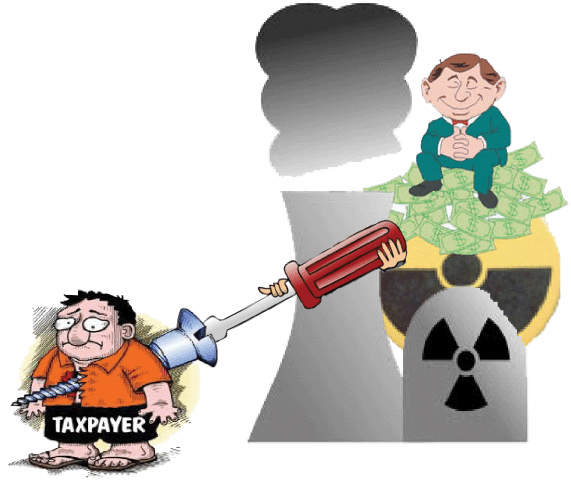
potential support that could eventually include
taxpayer-backed loans, debt financing or direct investments from the
National Wealth Fund.
Sir Keir Starmer and Sanae Takaichi set to sign agreement to develop advanced modular reactors
Matt Oliver, Industry Editor
Britain will join forces with Japan to build mini nuclear reactors capable
of powering factories, data centres and military bases. Sanae Takaichi,
Japan’s prime minister, and Sir Keir Starmer will sign an agreement at a
ceremony in Downing Street on Sunday, as part of a push to strengthen
energy cooperation between Tokyo and London.
The tie-up will lead to
British engineering giant Rolls-Royce working with the National Nuclear
Laboratory and its Japanese counterpart to develop advanced modular
reactors (AMRs) and the fuel needed to power them, The Telegraph can
disclose.
Japan has been testing a high-temperature, gas-cooled reactor for
decades, but the technology remains unproven commercially. Under the
partnership, the Japan Atomic Energy Agency will share its extensive safety
data with Rolls-Royce to help the company build a demonstrator AMR in the
UK by the mid-2030s.
Rolls is understood to have held discussions with the
Government about potential support that could eventually include
taxpayer-backed loans, debt financing or direct investments from the
National Wealth Fund.
Under the agreement, Rolls-Royce, the UK and Japanese
national laboratories have also agreed to explore options for supplying the
novel kind of fuel the AMRs will use. Known as tri-structural isotropic
particle fuel (TRISO), it is seen by scientists as inherently safer than
more conventional nuclear fuel because it can be left to cool on its own.
TRISO fuel is made by taking poppy seed-sized pieces of uranium and
wrapping them in layers of ceramic material that are almost as tough as
diamond. These pellets are then compacted into hexagonal blocks or billiard
ball-sized “pebbles”, which can be loaded into a nuclear reactor. The
Government has already announced a £300m programme with Urenco, a nuclear
fuel company, to build a UK enrichment facility capable of providing the
uranium needed to make TRISO pellets.
Telegraph 14th June 2026, https://www.telegraph.co.uk/business/2026/06/14/rolls-royce-strikes-nuclear-deal-with-japan/
Planned strikes suspended at nuclear site
Planned strike action at a nuclear site has been suspended, union
officials have confirmed. About 2,000 construction workers employed by
contractors to work at Sellafield, in Cumbria, were set to down tools
between 15 and 21 June because of a dispute over pay. The workers argued
they should receive “a site-specific allowance due to the specialist skills
needed to work at a nuclear site and the hazardous nature of that site”.
Ryan Armstrong, regional officer at the union Unite, said industrial action
had been suspended as an “act of goodwill” to allow “meaningful talks” to
take place between the union and employers.
BBC 11th June 2026
https://www.bbc.co.uk/news/articles/c70y88lzel7o
UK overtakes Russia as Labour hike nuclear weapon spend by 17 per cent

the private sector earned at least $38bn from nuclear weapons contracts in 2025.
“This money is being wasted given the nuclear-armed states agree a nuclear war can never be won and should never be fought. It is also diverting resources from acute human needs.“
By Xander Elliards, https://www.thenational.scot/news/26176024.uk-overtakes-russia-labour-hike-nuclear-weapon-spend-17-per-cent/
THE UK Government increased its spending on nuclear weaponry by 17 per cent in the first full year of Labour in power, according to new statistics.
The data, published by the International Campaign to Abolish Nuclear Weapons (ICAN), shows that spending on nuclear weapons rose globally in 2025 by 19% to reach its highest levels ever.
In total, eight countries other than the UK have nuclear weapons: France, the US, Russia, India, China, Pakistan, Israel, and North Korea.
The ICAN report said that in total the nine nations had spent $118.8 billion in 2025, up 19% on 2025. The US spent $69.2bn, an increase of 22%, while Pakistan spent £1.5bn, an increase of 18%.
The UK spent a total of $12.6bn on nuclear weaponry in 2025, up 17% on 2024.
The UK was also third in terms of absolute spend, behind China in second place on $13.5bn, an increase of 7% on 2024.
Russia, who had been third in 2024, dropped to fourth, upping spending by 6% to $9.5bn.
Elsewhere, the report from ICAN, which produces the most authoritative figures on annual nuclear weapons expenditure, found that the private sector earned at least $38bn from nuclear weapons contracts in 2025.
ICAN said: “This money is being wasted given the nuclear-armed states agree a nuclear war can never be won and should never be fought. It is also diverting resources from acute human needs.
“A minute of nuclear weapons spending could provide access to clean water and sanitation for 3478 people. A day of this spending could save two million people from food insecurity. A week could protect more than 12 billion people from measles, mumps and rubella. A year’s spending could provide more than six million homes with solar power.”
ICAN also noted that the increase in spending on nuclear weaponry is happening alongside cuts to the humanitarian and development sector.
In the UK, the Government had pledged the UN target of 0.7% of Gross National Income (GNI) to the international aid budget each year. However, the Tories cut this to 0.5% in 2021, and Labour will cut it again to 0.3% from 2027.
The UK spent more than triple the UN’s entire annual budget for 2025 ($3.72bn) on nuclear weaponry. The US spent more than 19 times the UN budget.
Susi Snyder, ICAN’s director of programmes and co-author of the report, said: “At a time when the cost of living is skyrocketing and food and fuel are unaffordable for so many, it is unthinkable that these nine countries are spending billions on a false promise of security.
“Nuclear weapons cannot be used without causing catastrophe, and the false logic of nuclear deterrence requires us to trust our enemies with our very survival.”
Alicia Sanders-Zakre, a second co-author of the report and ICAN’s head of policy, added: “Our research is annual, but nuclear weapons spending is not.
“The nine nuclear-armed states are planning to maintain and modernise their nuclear forces for decades to come, diverting untold billions of dollars away from real human security needs.”
1 This Month



Shut down the radiation-damaged Heysham nuclear reactors now
To see nuclear-related stories in greater depth and intensity – go to https://nuclearinformation.wordpress.com

Say No to NASA’s Reckless Nuclear Reactor on the Moon
Say No to NASA’s Reckless Nuclear Reactor on the Moon
-
Archives
- October 2026 (256)
- September 2026 (339)
- August 2026 (330)
- July 2026 (355)
- June 2026 (287)
- May 2026 (306)
- April 2026 (356)
- March 2026 (251)
- February 2026 (267)
- January 2026 (308)
- December 2025 (358)
- November 2025 (359)
-
Categories
- 1
- 1 NUCLEAR ISSUES
- business and costs
- climate change
- culture and arts
- ENERGY
- environment
- health
- history
- indigenous issues
- Legal
- marketing of nuclear
- media
- opposition to nuclear
- PERSONAL STORIES
- politics
- politics international
- Religion and ethics
- safety
- secrets,lies and civil liberties
- spinbuster
- technology
- Uranium
- wastes
- weapons and war
- Women
- 2 WORLD
- ACTION
- AFRICA
- Atrocities
- AUSTRALIA
- Christina's notes
- Christina's themes
- culture and arts
- Events
- Fuk 2022
- Fuk 2023
- Fukushima 2017
- Fukushima 2018
- fukushima 2019
- Fukushima 2020
- Fukushima 2021
- general
- global warming
- Humour (God we need it)
- Nuclear
- RARE EARTHS
- Reference
- resources – print
- Resources -audiovicual
- Weekly Newsletter
- World
- World Nuclear
- YouTube
-
RSS
Entries RSS
Comments RSS

