Fusion delusion – unsafe, too uncertain, too expensive, and too late – even if it worked
Fusion delusion no answer to climate emergency or cost-of-living crisis https://www.nuclearpolicy.info/news/fusion-delusion-no-answer-to-climate-emergency-or-cost-of-living-crisis/ 13 Feb 22,
Fusion is unsafe, too uncertain, too expensive and, if it is even possible, will still come far too late to address either climate change or Britain’s energy needs, says the UK’s Nuclear Free Local Authorities.
Slamming claims of a ‘major break-through’, Councillor David Blackburn, Chair of the NFLA, noted that scientists have made similar claims for decades when it has come to fusion. Commenting he said:
“Fusion has since the Second World War been heralded as the next big evolutionary development in our energy supply, and scientists have made similar claims for decades when it has come to fusion leading to countless billions being invested in this illusionary technology.”
Emeritus Professor of Energy Policy Stephen Thomas of the University of Greenwich suggested a motivation for the latest claims:
“It has always been said that fusion breakthroughs occur when there is a need for more public funding.”
Fusion is a complex technology to master, representing an attempt to reproduce on Earth the nuclear reactions that take place in the sun. As the Earth lacks the immense gravity of the Sun, the interior of the reactor must be superheated to 100 million degrees centrigrade (or six times the temperature of the Sun). Generating fusion reactions to date have used many times more energy than the energy produced, making fusion a technology that remains economically unviable. The reactor also requires intricate cooling and containment systems which ‘gobbles up’ much of the energy it produces; if these failed at any time reactor safety would be compromised.
Fusion is neither green nor safe. Neutrons produced by the reaction would bombard the walls of the reactor and its housing which over time would threaten the integrity of the structure. The radioactive tritium gas that is produced poses a real danger to public health even at very low levels if it enters the air or our water supply. And, like fission power, fusion would result in radioactive waste that will need to be safely stored and managed for countless years.
The UK Government is currently looking at five sites, one of which will soon be chosen to host a new experimental fusion reactor and has pledged £200 million towards its development.
Councillor Blackburn is sceptical there will be any result anytime soon:
“The earliest estimates that any fusion reactor could come on stream is in the late 2040’s, and that even assumes the technology will ever be mastered or economically viable. There is a need for humanity to address climate change and a need for Britons to address the energy crisis now. Fusion will come 30 years too late if at all. All of us are facing huge hikes in our energy bills, and we need power sources that are green, available now and affordable to keep our lights on and heat our homes.
“The UK Government has foolishly continued to pour billions of taxpayer money into the fusion delusion and other grandiose nuclear projects, whilst strangling financial support for renewables that work. We need a complete about-face in energy policy with the government instead investing massively in insulating Britain’s homes to reduce energy demand and energy bills and address fuel poverty, and also to finance the proven renewable technologies that can provide power now at an affordable price to Britain’s citizens, including solar generation, a renewable technology already available to us which harnesses the energy of the Sun.”
The radioactive ‘Cumbrian mud patch’ would be shaken up by a coal mine at theSellafield site

A tsunami of radioactive wastes now largely inert (apart from tidal processes) would be resuspended in the water column – returning to the shores and to the rest of the world. It takes only 4 years for Sellafield’s seaborne waste to reach the Arctic. The coal mine would cause subsidence and resulting resuspension of nuclear wastes.
| *Sellafield** A great article by Paul Brown below – there is however a big elephant in the room regarding this story. The elephant in the room is the Cumbrian Mud Patch – the radioactive silts on the Irish Sea bed resulting from decades of reprocessing. The coal mine due to be decided upon soon by Government (after Planning Inspector Stephen Normington makes his recommendation) would churn up this nuclear crapola on the seabed. A tsunami of radioactive wastes now largely inert (apart from tidal processes) would be resuspended in the water column – returning to the shores and to the rest of the world. It takes only 4 years for Sellafield’s seaborne waste to reach the Arctic. The coal mine would cause subsidence and resulting resuspension of nuclear wastes. The coal mine would cause earthquakes. Both these outcomes are not “likely” they are certain. The coal mine CEO is also employed by government as advisor on the plans for a deep (and not so deep) nuclear dump for heat generating nuclear wastes – you couldn’t make it up. Keep Cumbrian Coal in the Hole 12th Feb 2022https://keepcumbriancoalinthehole.wordpress.com/2022/02/12/decades-of-sellafields-reprocessing-waste-on-irish-sea-bed-could-be-churned-up-by-coal-mine-subsidence/ |
UK SPENDS OVER £80M ON MEDIA IN 20 COUNTRIES AROUND RUSSIA
The project is likely part of the ongoing information war between Russia and Nato.
The British government is spending tens of millions on media projects in Eastern Europe which are often presented as fighting “Russian disinformation”, but which may involve the UK’s own information operations. DECLASSIFIED UK , MATT KENNARD, 8 FEBRUARY 2022 The British government ploughed at least £82.7m of public money into media projects in countries bordering or near Russia in the four years to 2021.
The projects, which take place across 20 countries in Eastern Europe and Central Asia, are run through the Conflict, Stability and Security Fund (CSSF), a cross-government pot of money with the stated aim of preventing “instability and conflicts that threaten UK interests”.
The National Security Council, which is chaired by the prime minister, sets the fund’s strategic direction. But a parliamentary committee found the CSSF was “being used as a ‘slush fund’ for projects” which “do not meet the needs of UK national security.”
The findings come as tensions between Britain and Russia are high over Ukraine. The UK has accused Russia of planning to invade or launch a coup in Ukraine to install a pro-Moscow government.
Last month Britain began supplying the eastern European country with new anti-tank weapons. Some of the UK-funded media projects appear focused on Ukraine.
‘Counter-disinformation’
The project most clearly directed at Russia is the Counter Disinformation and Media Development programme. It is run around Russia’s western border, from the Baltic States to Central and Eastern Europe, although project documents do not disclose specific countries.
It cost £60.4m in the four years to 2021. …….
The project is likely part of the ongoing information war between Russia and Nato. The funds, UK documents note, aim to “understand and expose disinformation across the North Atlantic Treaty Organisation (Nato) space.”
The project was launched in 2016 and initially called the Russian Language programme. ………
,,,,,,,,, the programme may be a cover for the UK’s own information operations in the region. The UK Ministry of Defence is one of the implementing departments in the counter-disinformation programme. It is not obvious what role the UK armed forces would have in a media support project.
……….In the four years to 2021, the programme cost the UK public £140.5m, although a breakdown of the media component is not provided by the government.
The UK is also “working closely with the US on media reform” through the programme……………
Judicial review on the dumping of Hinkley Point C radioactive mud
A group campaigning against the dumping of sediment from the site of a
decommissioned nuclear power station has succeeded in securing a judicial
review challenging the legality of a licence to dump waste into the River
Severn.
The Save the Severn Estuary / Cofiwch Môr Hafren campaign involves
the Geiger Bay coalition and groups from the English side of the estuary
and is seeking to halt the dumping of sediment from the construction of the
Hinkley C power station in the Marine Protected Area (MPA) near Portishead,
Bristol.
In 2018, EDF, which is building the plant, dumped mud and sediment
off the coast of Cardiff despite fierce objections. The Campaign group says
that millions of tonnes of contaminated mud and sediment will contaminate
the waters and beaches used by local communities, and that by choosing to
ignore legal safeguards, energy giant EDF is threatening the health of
families and animal life.
Save the Severn Estuary / Cofiwch Môr Hafren say
that EDF are now trying to avoid further opposition and negative media
attention by moving the operation to Portishead, Bristol as a ‘soft
touch’ location after initially applying for a new license to dump more
waste off the Cardiff coast. At the judicial review on 8 March the campaign
group will challenge the legality of the licence granted by the Marine
Management Organisation (MMO), stating that several important procedures
haven’t been met and that an alternative to dumping at Portishead should
be adopted.
Nation Cymru
Nation Cymru 12th Feb 2022
Amid Ukraine Tension, US Deploys Nuclear-Ready B-52 Bombers to UK
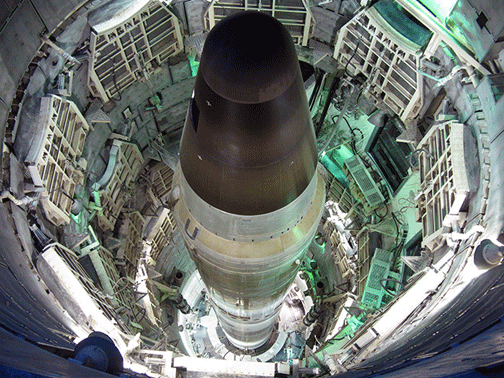
Amid Ukraine Tension, US Deploys Nuclear-Ready B-52 Bombers to UK “The West is trying to make a tragedy out of this,” said Russia’s foreign minister. Common Dreams, JULIA CONLEY February 11, 2022 Despite repeated warnings from Ukrainian President Volodymyr Zelensky that the U.S. is driving the rise of tensions at Ukraine’s eastern border, the U.S. Air Force has deployed four B-52 bombers with nuclear capabilities to the U.K., where one official acknowledged that the deployment is at least partially connected to Russia’s recent military activities.
Two B-52 Stratofortress aircrafts arrived at Royal Air Force Fairford on Thursday, with two more following. The bombers integrated with other NATO members’ forces en route to Fairford, according to the Air Force, including “British Typhoon aircraft and Portuguese F-16s currently assigned to NATO’s Icelandic Air Policing mission.”………
According to The Telegraph, a former British intelligence official noted that the Pentagon could launch air strikes from Fairford as it has before.
“From Fairford they could operate against a range of targets: troop concentrations in southern Russia and Belarus, Moscow/St. Petersburg, even the naval bases in the White Sea,” the former official told the outlet. “In 1991 they hit Baghdad from Fairford, flew on to Diego Garcia, refueled and rearmed, bombed Baghdad again on the way back, and returned to Fairford.”
The bombers sent from Minot Air Force Base in North Dakota are capable of carrying precision-guided and nuclear weapons…………………………….. https://www.commondreams.org/news/2022/02/11/amid-ukraine-tension-us-deploys-nuclear-ready-b-52-bombers-uk
BBC Cons the Public with Reports of “Sadness as Somerset nuclear power station nears closure” Tell us the Truth.

BBC Cons the Public with Reports of “Sadness as Somerset nuclear power station nears closure” Tell us the Truth, https://mariannewildart.wordpress.com/2022/02/11/bbc-cons-the-public-with-reports-of-sadness-as-somerset-nuclear-power-station-nears-closure-tell-us-the-truth/ The following is a Guest Blog by Jim Duffy former co-ordinator of Stop Hinkley republished with permission from a social media post. This lifts the veil on Hinkley Point B in a way that the BBC are wilfully neglecting to do.
No sadness on my part. It all started badly with bodged welds in the cooling circuit which luckily a welder owned up to some years later when the Chernobyl accident made him worry about the defects he and others made. A regulator told me that the whole cooling system had to be rebuilt while the welder was threatened with prosecution for his honesty and not allowed on site to show the faulty areas.
In 1995 a new low level waste incinerator was refused permission from the Environment Agency after Somerset Green Party campaigned against it with Dr Chris Busby ‘s help. It already had planning permission from the local council but Somerset County Council was worried it would pave the way for a regional incineration centre for radioactive waste. We argued it would harm people’s health.
Chris Busby researched local cancer rates from 2000 onwards which Stop Hinkley commissioned and publicised. He found a doubling of breast cancer mortality in downwind Burnham on Sea together with raised leukaemia and other cancers. BNFL announced the closure of Hinkley ‘A’ when Dr John Large also lambasted the plant for dangerous corrosion. Hinkley ‘B’ carried on running despite evidently contributing to the radioactive discharges.
In the 2000’s Dr John Large supported Stop Hinkley’s campaign to shut it down after worrying cracks and weight depletion were discovered in the graphite reactor core. The regulators forced it to operate at lower temperature and radiation levels to try to maintain safety thus generating less electricity.
At the same time we discovered that one of the three vital safety systems was never fitted to the twin reactors. The boron beads system is designed to slow down the nuclear reactions if the reactors overheat. For some unexplained reason the system was not fitted nor added later despite our protests at the increased risks from the cracks in the reactor cores.
In the mid 2000’s a 20 by 20 metre patch of radiation was found on nearby Kilve beach by a retired submarine engineer with his Geiger counter. His two dogs had died unexpectedly after digging and playing in the sand. The Environment Agency refused to visit the site for five weeks by which time they couldn’t detect the patch. It wasn’t clear if the leak came from Hinkley ‘A’ or ‘B’.
So I can’t cheer at the closure of the plant as it has caused so much worry and concern over the years. Relief is more my feeling although the story isn’t over by a long chalk with all the spent fuel and radioactive waste to take care of for hundreds of thousands of years…”
Government approval for Bradwell B project does not really give a green light for nuclear reactors to be built.
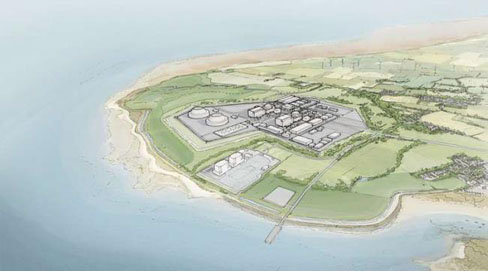
“This absolutely does not give a green light for reactors to be built at Bradwell. “And, given the problems of the Bradwell site and the fierce local opposition, CGN would surely struggle to gain the permits, licences and planning permission that it will need over coming years.
A MAJOR milestone has been reached for a nuclear reactor intended for a new power plant in Essex, but campaigners say the approval shouldn’t be seen as a go-ahead for the plant. The Office for Nuclear Regulation (ONR) and the Environment Agency (EA) have confirmed the UK HPR1000 nuclear reactor is suitable for construction in the UK after completion of an in-depth assessment of the design, marking the end of a five year process.
The technology has been developed by China General Nuclear Group (CGN) and its adaptation to the UK has been jointly performed by CGN and EDF. It is intended to be used in their Bradwell B project.
However. the approval by the regulators should not be read as a go-ahead for a new nuclear power
station at Bradwell, according to the Blackwater Against New Nuclear Group (BANNG). Prof. Andy Blowers, BANNG’s chairman, said: “This absolutely does not give a green light for reactors to be built at Bradwell. “And, given the problems of the Bradwell site and the fierce local opposition, CGN would surely struggle to gain the permits, licences and planning permission that it will need over coming years.
Prof. Blowers said the approval does not recognise the “serious long-term risks” the impacts of
climate change pose to “people and environments from reactors and radioactive waste stores on vulnerable low-lying coasts threatened by flooding, storm surges and sea level rise”. He added: “If Bradwell B ever comes to pass, the ONR and EA will have to grant permits and licenses and we must hope that they will then apply their ‘rigorous and detailed asesssment’ to the issues of radioactive waste, decommissioning, cooling, environmental impact and climate change at the Bradwell site.
Maldon Standard 10th Feb 2022
In the UK, local Councils are signing up to the UN Treaty on the Prohibition of Nuclear Weapons
| Having campaigned for decades for the global abolition of nuclear weapons, CND supporters had reason to celebrate in 2021 when the Treaty on the Prohibition of Nuclear Weapons (TPNW) entered into force. This United Nations treaty was supported by most of the world’s states and makes nuclear weapons illegal in the countries that sign it. 86 countries have already signed up to the Treaty, but shamefully the British government will not even engage with this historical agreement. There was a particularly memorable moment when the UK representative at the UN stood alongside former US President Trump’s Ambassador outside the building denouncing the talks (which eventually led to the agreement), while the more mature countries got on with the business of negotiating inside. CND groups are already taking matters into their own hands in regards to the TPNW by getting local councils to support the Treaty and building support from the ground up. And now we’re asking our supporters to help us with a campaign to get the UK government to engage with the global majority who support the Treaty. Labour Outlook 10th Feb 2022 https://labouroutlook.org/2022/02/10/talks-not-bombs-campaign-for-nuclear-disarmament-cnd/ |
Hinkley nuclear mud

500 000 tonnes of Hinkley mud are now to be dumped at Portishead. Thisdumping was licensed by @The_MMO – the English Marine Management Organisation – on the basis of EDF’s skimped EIA that brushed over the key issues of *what* contaminants, and where they *go*.
@cianciaran 6th Feb 2022
UK court should slap down the US Justice Department in the Assange case

UK court should slap down the US Justice Department in the Assange case https://thehill.com/opinion/judiciary/591776-uk-court-should-slap-down-the-us-justice-department-in-the-assange-case?fbclid=IwAR1FwC11pSY_hGdiCvIdBqIj6mttfTheEDtcNR3EUpQG38xWS3-ZRC6TLhw
BY JAMES C. GOODALE, 6 Feb 22, As the lead attorney for the New York Times in the “Pentagon Papers” case in 1971, I’ve been doing a slow burn ever since over the government’s behavior in that instance: lies, disregard of court rules, arrogance, destruction of documents. All of this was brought to mind earlier this week when a British court hinted in the Julian Assange case that the U.S. government has acted in the same way once again.
It asked Britain’s supreme court to determine the appropriateness of a late filing by the government that completely undercut a ruling that Assange could NOT be extradited to the U.S. This followed British trial court Judge Vanessa Baraitser, who was hearing Assange’s extradition case, ruling that Assange might commit suicide if held in a U.S. prison in solitary confinement under what is called Special Administrative Measures (SAMs) and, so, he could not be extradited.
As soon as she announced her decision, the U.S. government filed assurances that Assange would not be held in that kind of detention, although it reserved the right to revoke the assurance if circumstances changed.
The judge was unmoved by this assurance, but she was reversed on appeal. The U.K.’s supreme court has now asked to consider the timeliness of this filing.
I do not believe the U.S. government’s assurances are worth the paper on which they have been written. Its behavior in this case has been rampant. Most outrageously, the CIA discussed a plot to kidnap Assange from the Ecuadorian Embassy in London, where he was holed up, and to kill him. The CIA also tapped into conversations in the Ecuadorian Embassy, including those with Assange’s lawyers.
There is not much question whether all of this is true. There was testimony about it in open court, and Mike Pompeo, the CIA director at the time and later secretary of State during the Trump administration, has conceded that there is “some truth” in the foregoing.
I do not pretend to be particularly familiar with the extradition laws of the U.K. But common sense tells me that you deliver highly important documents about a case — such as government assurances — before the case begins, not after it has been decided. U.K. counsel representing the U.S. disagrees, saying he can deliver documents when he wants and if he loses the appeal, he will start the extradition proceedings all over again.
This is the very same arrogance that was on display in the Pentagon Papers case, in which then-U.S. Solicitor General Erwin Griswold said the usual rules of evidence did not apply. His view of the law manifested itself in his introduction of new evidence in the case anytime the government was so moved. The claims were always extravagant: Publication of the new evidence would be a disaster for the country’s national security, etc., etc. They never were. Indeed, most of them turned out to be previously published.
The other principal fallacious claim made by the government back then was that the Times had revealed that the United States had broken the Vietnamese code. This also proved to be so much hogwash.
The government also destroyed — or, in its words, “lost” — New York Times briefs in the case. It prevailed upon me to give them these briefs to protect national security and to be returned if the government indicted the Times. A later research request evoked the response “they were lost.”
We do not know if the U.K.’s supreme court will take the Assange case to determine the issue of the timing of the U.S. government’s filing. Let’s hope that it does and then decides the U.S. government should not get away with the latest example of its less than appropriate behavior in a national security case.
James C. Goodale is the former general counsel and vice chairman of the New York Times and the author of “Fighting for the Press: The Inside Story of the Pentagon Papers and Other Battles.”
A big pile of Plutonium – UK reprocessing ceases, leaving deadly waste and no plan

in the end, reprocessing became a commercial venture rather than producing anything useful. Nine countries sent spent fuel to Sellafield to have plutonium and uranium extracted for reuse and paid a great deal of money to do so. In reality, very little of either metal has ever been used because mixed oxide fuels were too expensive, and fast breeder reactors could never be scaled up sufficiently to be economic.
UK reprocessing ceases, leaving deadly waste and no plan
A big pile of PU — Beyond Nuclear International https://beyondnuclearinternational.org/2022/02/06/a-big-pile-of-pu/120 tons of plutonium is legacy of Britain’s dirty decades of reprocessing, By Paul Brown, The Energy Mix
Seventy years after the United Kingdom first began extracting plutonium from spent uranium fuel to make nuclear weapons, the industry is finally calling a halt to reprocessing, leaving the country with 120 tons of the metal, the biggest stockpile in the world. However, the government has no idea what to do with it.
Having spent hundreds of billions of pounds producing plutonium in a series of plants at Sellafield in the Lake District, the UK policy is to store it indefinitely—or until it can come up with a better idea. There is also 90,000 tons of less dangerous depleted uranium in warehouses in the UK, also without an end use.
Plans to use plutonium in fast breeder reactors and then mixed with uranium as a fuel for existing fission reactors have long ago been abandoned as too expensive, unworkable, or sometimes both. Even burning plutonium as a fuel, while technically possible, is very costly.
The closing of the last reprocessing plant, as with all nuclear endeavours, does not mean the end of the industry, in fact it will take at least another century to dismantle the many buildings and clean up the waste. In the meantime, it is costing £3 billion a year to keep the site safe.
Perhaps one of the strangest aspects of this story to outside observers is that, apart from a minority of anti-nuclear campaigners, this plutonium factory in one of prettiest parts of England hardly ever gets discussed or mentioned by the UK’s two main political parties. Neither has ever objected to what seems on paper to be a colossal waste of money.
Continue readingUK close to opening coal mine under Marine Conservation Zone just 5 miles from Sellafield nuclear facility!
The Coal Mine planning inspector Stephen Normington will, any day now, be
making his recommendation to government (the same government who have
appointed the coal boss as nuclear dump advisor). Then the final decision
will be with Secretary of State Michael Gove on whether or not to open a
new coal mine under the Marine Conservation Zone off St Bees and just five
miles from Sellafield. Concerns, aside from climate, raised by Keep
Cumbrian Coal in the Hole since 2017, regarding seismic, nuclear and marine
impacts have been well and truly ‘talked over’ despite our vehement
campaigning.
Keep Cumbrian Coal in the Hole 5th Feb 2022
In New Mexico, two Bills to block the storage of high level nuclear waste

Efforts by New Mexico lawmakers to block the storage of high-level nuclear
waste in the state built momentum this week as two bills in the House and
Senate advanced in legislative committees.
Senate Bill 54 and House Bill
127 contain identical language that would prohibit State agencies from
issuing permits for high-level nuclear waste storage facilities, introduced
in direct opposition to the project proposed by Holtec International in
southeast New Mexico near Carlsbad and Hobbs. The Holtec project would see
about 100,000 metric tons of spent nuclear fuel rods from generator sites
across the U.S. shipped via rail to the location on about 1,000 acres in a
remote area by the Eddy-Lea county line.
Carlsbad Current-Argus 5th Feb 2022
BBC Inside Science Nuclear Waste Podcast Kicks Off With a Big Fat Lie – Fact Check!?

BBC Inside Science Nuclear Waste Podcast Kicks Off With a Big Fat Lie – Fact Check!? https://www.lakesagainstnucleardump.com/post/bbc-inside-science-nuclear-waste-podcast-kicks-off-with-a-big-fat-lie-fact-check
Listen to BBC Inside Science Here Reporting from the BBC which holds the newly “green” nuclear industry to account has been in short supply and this was no exception despite the promising headline.
Listen to BBC Inside Science Here Reporting from the BBC which holds the newly “green” nuclear industry to account has been in short supply and this was no exception despite the promising headline. The podcast kicked off with some big fat lies about nuclear being low carbon (radioactive carbon it produces in spades) and stating that “Sizewell C will produce 7% of the UKs energy needs.” “Inside Science” is the arbiter of truth for many people including Cumbrian politicians who have repeated these lies. Sizewell C would only produce 2% of the UKs energy needs – an amount that could easily be saved by insulating houses. What the podcast presenter should have said was that Sizewell C may produce up to 7% of the UK’s ELECTRICITY – rather different from ENERGY and a big fat lie that the nuclear industry likes to promote.
Professor Claire Corkhill did reveal some home- truths about nuclear such as reprocessing produces a net result of more hazardous waste and that low level waste does not equate to low hazard “it is still hazardous.” When the interviewer asked Professor Corkhill if digging a big hole for nuclear waste was expensive the reply was that ‘its the right thing to do and it means that future generations won’t have the expense.’ This is the mantra that the Committee on Radioactive Waste Management like to promote as a truism. It is the wrong thing to do and denies future generations the ability to protect themselves from nuclear waste. Professor Corkhill was appointed to the Committee on Radioactive Waste Management ( CoRWM) in January 2020. Mark Kirkbride the CEO of West Cumbria Mining was appointed to CoRWM in November 2019 and has been putting together costings for the digging of a big hole or two. The total cost of decommissioning is around £132 Billion and counting. The eyewatering amounts of money are the very least of the bottomless Bill that this and future generations will be picking up from the nuclear experiment in any event.
Nuclear Free Local Authorities (NFLA) demands deadly plutonium stockpile be placed ‘out of use’

The Nuclear Free Local Authorities (NFLA) of the UK and Ireland has called for Britain’s deadly Plutonium stockpile to be placed ‘out of use’, for an early end to reprocessing, and for greater accountability and more transparency about the long-term management of radioactive materials arising from decommissioning operations at the UK’s former nuclear power plants.
The Nuclear Decommissioning Authority (NDA) is the agency charged with making safe and cleaning closed civil nuclear plants. It has just published a draft Business Plan for 2022-5 and invited comments.
In its response, the NFLA also expressed its disappointment that reprocessing at Sellafield did not end in 2020 as was originally promised and that there isstill no clear end date.
The NFLA also wants to see a comprehensive inventory of all radioactive materials created for each site, including those arising from decommissioning operations, and for local authorities to be consulted over arrangements for their transport and management.
NFLA 3rd Feb 2022
1 This Month
26 September – International Day for the Total Elimination of Nuclear Weapons





PLEASE OPPOSE HR 8255 AND S.3639 – bills would accelerate satellite deployment, with no environmental review or safeguards – https://ncstd5li.quorum.us/campaign/169331/
To see nuclear-related stories in greater depth and intensity – go to https://nuclearinformation.wordpress.com
-
Archives
- September 2026 (313)
- August 2026 (330)
- July 2026 (355)
- June 2026 (287)
- May 2026 (306)
- April 2026 (356)
- March 2026 (251)
- February 2026 (267)
- January 2026 (308)
- December 2025 (358)
- November 2025 (359)
- October 2025 (375)
-
Categories
- 1
- 1 NUCLEAR ISSUES
- business and costs
- climate change
- culture and arts
- ENERGY
- environment
- health
- history
- indigenous issues
- Legal
- marketing of nuclear
- media
- opposition to nuclear
- PERSONAL STORIES
- politics
- politics international
- Religion and ethics
- safety
- secrets,lies and civil liberties
- spinbuster
- technology
- Uranium
- wastes
- weapons and war
- Women
- 2 WORLD
- ACTION
- AFRICA
- Atrocities
- AUSTRALIA
- Christina's notes
- Christina's themes
- culture and arts
- Events
- Fuk 2022
- Fuk 2023
- Fukushima 2017
- Fukushima 2018
- fukushima 2019
- Fukushima 2020
- Fukushima 2021
- general
- global warming
- Humour (God we need it)
- Nuclear
- RARE EARTHS
- Reference
- resources – print
- Resources -audiovicual
- Weekly Newsletter
- World
- World Nuclear
- YouTube
-
RSS
Entries RSS
Comments RSS

