UK’s ”low carbon” strategy relies too much on unproven technologies – what we need is energy conservation
| Finally, we have a plan to reduce emissions, but much of it rests on technology that is yet to be tested at scale. The PM confidently claimed that we will be flying and driving everywhere, guilt-free, with zero-emission technology. This optimism – based on a techno-centric, market-driven vision of the future low carbon society – is what underlines the entire net zero strategy. Take for instance the reliance on greenhouse gas removal technologies that remain untested at scale. Between now and 2050, the government envisions removing and storing more carbon than we currently emit from all our homes today. It would of course be a mistake to dismiss out of hand the possibilities that these technologies offer, but to have them play such a central role in our strategy is a gamble. To make it work would require careful planning. A similar reliance is placed on hydrogen, which the strategy foresees us using a tremendous amount of, though we barely have any production facilities in the UK today. None of this is impossible, but climate change offers very little slack for policymakers to try to fail, so getting it right the first time is paramount. The headline-grabbing announcement of a £5,000 subsidy for heat pumps distracts us from the lack of investment in insulation and making our homes warmer. At the New Economics Foundation, we estimate that the scale of finance committed by the government in decarbonising our leaky housing stock is less than a quarter of what is actually needed by 2025. That is why we launched a campaign called the Great Homes Upgrade, calling on the government to retrofit 19m homes by 2030. Without an investment of at least 2% of GDP annually, the strategy could well remain a non-starter, but the chancellor has an opportunity to fix that in his upcoming budget and spending review. Guardian 19th Oct 2021 https://www.theguardian.com/commentisfree/2021/oct/19/government-net-zero-technology-emisssions |
ALL UK energy can be obtained from renewables – Prof Mark Barrett
How we can get ALL our energy from renewables – a talk by Professor Mark
Barrett- talk slides published! Professor Mark Barrett from UCL has given a
talk about how ALL UK energy can be supplied by renewables. He focused on
heat in particular.
100% Renewables 18th Oct 2021
The value of energy efficiency in UK’s emissions reduction programme

Improving the energy efficiency of homes in deprived areas would cut seven
million tonnes of CO2 emissions per year, a Times investigation can reveal.
Despite much of the housing being older, insulating leaky boilers,
replacing inefficient lighting and installing solar panels in the poorest
30 per cent of neighbourhoods in England and Wales would be about as cost
effective as making the same improvements in the richest areas. It would
also reduce energy bills for those struggling the most. According to
analysis of Energy Performance Certificates (EPCs), for every £1,000 spent
in poorer parts of the country, 166kg of CO2 would be saved. Boris Johnson
has put both levelling up the country and a commitment to improving the
environment at the heart of his premiership.
Times 24th June 2021
UK’s ”Net Zero” climate strategy fails to give concrete commits to reduce energy use, promote renewables.

| In reaction to the government’s Net Zero Strategy, Rebecca Newsom, Greenpeace UK’s head of politics, said “This document is more like a pick and mix than the substantial meal that we need to reach net zero. Extra cash for tree planting and progress on electric vehicles doesn’t make up for the lack of concrete plans to deliver renewables at scale, extra investment in public transport, or a firm commitment to end new oil and gas licences. There are only half-hearted policies and funding commitments to decarbonise our draughty homes at the speed necessary, and it fundamentally fails to grapple with the need to reduce our meat and dairy consumption to stop global deforestation. With just eight years left to halve global emissions, the government can’t just keep dining out on its ‘ambitious targets’. Until the policy and funding gaps are closed, Boris Johnson’s plea to other countries to deliver on their promises at the global climate conference next month will be easy to ignore.” Greenpeace 19th Oct 2021 https://www.greenpeace.org.uk/latest-updates/?news_type=press-release |
Rolls Royce ”small” nuclear reactors – not really small, not useful against climate change, but useful for military purposes

Answers to the energy and climate crises are needed NOW. These answers are available based on a comprehensive programme of developing renewable energy and energy conservation technologies.
Every pound wasted on nuclear power will be a pound taken away from faster and more effectivesolutions offered by renewable energy and energy conservation.
It is reported that the Tory government will restate its support on Monday, 18 October to buiding a fleet of modular nuclear reactors. The favoured reactor is the Rolls Royce SMR, namely ‘Small ModularReactor’. This term is very misleading as the Rolls Royce reactor would produce 450MW of electricity, which is more than the output of the old Magnox station at Trawsfynydd, and the same size as one of old big Magnox reactors at Wylfa.

It is known that Rolls Royce are asking for huge public subsidies to realise their nuclear ambitions. This movement towardsbuilding reactors to produce electricity is closely related to their wish to safeguard skills in the reactors they provide for submarines carrying nuclear weapons. Civil and military nuclear are two sides of the same coin. Rolls Royce claim they would like to build 18 SMRs.
How far will the government be prepared to go to fund a far from new technology and like larger nuclear reactors, is open to accidents and radioactive leaks, and produces poisonous and lethal radioactive waste.
Also mentioned is the possibility of Bechtel/Westinghouse trying to push the Westinghouse AP1000 reactor on the Johnson government to be developed at the Wylfa site. This is the very reactor on the V.C.Summer site in South Carolina that
bankrupted Toshiba Westinghouse in 2017. That happened due to huge overspending and the project was abandoned 40% of the way into construction. It was therefore no surprise that the NUGen Consortium project to build three AP1000s at Moorside near Sellafield collapsed in 2018. Nobody was prepared to invest in it. Exactly the same fate as the Hitachi/Horizon plan at Wylfa. Johnson and his ministers in the Treasury and the Business,
Energy and Industrial Stratregy Department are missing the point entirely as they cling on to past imperial grandeur by blindly
promoting nuclear power. Nuclear power is dirty, dangerous, extortionately expensive, and a threat to environmental and human health. Nuclear power will do nothing to tackle the present energy crisis, nor will it effectively counteract the effects of climate change., and we certainly cannot afford to waste the fifteen years needed to build large new nuclear stations
Answers to the energy and climate crises are needed NOW. These answers are available based on a comprehensive programme of developing renewable energy and energy conservation technologies. Every pound wasted on nuclear power will be a pound taken away from faster and more effectivesolutions offered by renewable energy and energy conservation.
People Against Wylfa B 18th Oct 2021
British government’s enthusiasm for mini nuclear reactors, led by Rolls Royce and 8 other organisations

Brexit Britain strikes historic £210m deal with Rolls-Royce to create nuclear reactors
BREXIT Britain is set to see its emissions slashed as the Government is poised to make a landmark deal with Rolls-Royce to fund a fleet of nuclear mini-reactors.
Express UK, By JACOB PAUL, Mon, Oct 18, 2021 The move is set to help Prime Minister Boris Johnson race to his target of zero-carbon electricity by 2035 in a move set to impress ahead of the COP26 climate summit in Glasgow in less than two weeks time. Mr Johnson visited Rolls-Royce’s Bristol factory on Friday, where he was shown their state-of -the-art facility by their CEO, Warren East. A consortium led by Rolls-Royce had already secured £210million in backing from private investors for the small modular reactor (SMR) project, a sum that the Government is expected to match and even surpass.
Confirmation is expected before the spending review on October 27.
The consortium called UK SMR, is set to rebrand British engineering firm Rolls-Royce SMR under a request from the Government. Tom Greatrex, chief executive of the Nuclear Industry Association (NIA), said: “Match-funding for Rolls-Royce would be a huge signal to private investors that the government wants SMRs alongside new large-scale stations to hit net zero.
It would also show investors that the Government believes in nuclear as a green technology.”
Government support will help with the consortium’s multi-billion pound plans to build 16 SMRs up and down the country……………… Rolls-Royce is also being advised by HSBC, which has helped it secure £210million from private investors, which was a condition set by the government for them to hand out at least the same amount of funding.
This move could also signal a possible U-turn from the Government on their scheduled phasing out of nuclear power in the UK.
13 nuclear reactors capable of producing 7.8GW of power currently produce around 20 percent of the nation’s electricity.
But over half of that capacity comes from reactors that are scheduled to be replaced or halted by 2025. https://www.express.co.uk/news/science/1507881/brexit-britain-rolls-royce-nuclear-power-boris-johnson-cop26-climate-change
Clyde nuclear base emergency staff to strike from tomorrow over safety fears
Clyde nuclear base emergency staff to strike from tomorrow over safety fears, Herald Scotland, By Martin Williams @Martin1Williams, Senior News Reporter 18 Oct 21, EMERGENCY workers at the home of Britain’s nuclear weapons on the Clyde are set to strike over “major safety concerns” after managers slashed firefighter numbers.
Action has been previously been given the go-ahead following a ballot of workers after managers proceeded with cuts to eight posts from the specialist fire safety crew at HM Naval Base Clyde, a reduction in strength of 15 per cent, with the a union describing it as an “an accident waiting to happen”.
Unite members working for outsourcing services firm Capita Business Services will now start strike action from Tuesday in a dispute over cuts to fire and rescue crew levels, and a lack of consultation………………
Workers believe the cuts impair the abilities of the onsite fire crews to do their jobs properly, particularly, in relation to incidents that would involve wearing breathing apparatus.
Capita has previously stated that they intend to mitigate safety risks due to the cuts through an investment in new technology to reduce fire risk”.
But workers have said they are not aware of any new technology which would address ongoing safety concerns…………………………… https://www.heraldscotland.com/news/homenews/19655524.clyde-nuclear-base-emergency-staff-strike-tomorrow-safety-fears/
UK government’s grand energy plan – focus is on saving the nuclear industry
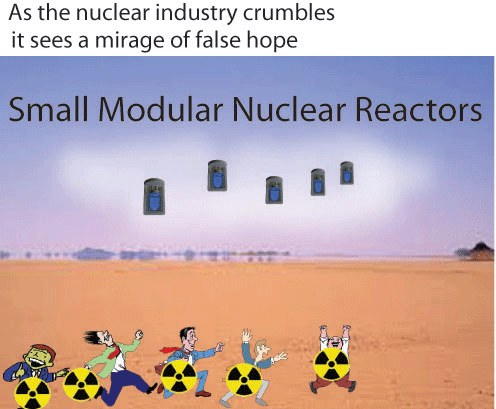
”Nuclear power is slow, dangerous and extortionately expensive. It will do nothing to address the current energy crisis, neither will it be effective to counter climate change”
Reviving nuclear power station projects such as Wylfa B on Anglesey and Trawsfynydd in Gwynedd is at the heart of the UK Government’s ambitions to attain net zero carbon emissions by 2035, government sources have said.
The UK Government is expected to reveal its new nuclear strategy in documents to be published next week, alongside a plan for how to pay for the new array of nuclear plants. US nuclear company Westinghouse is planning to revive plans for a nuclear power plant at Wylfa that was abandoned by Japan’s Hitachi in 2019, and the UK Government has indicated that it is keen to see the plan come to fruition.

Ministers are also expected to back smaller modular reactors which are being developed by a consortium led by Rolls-Royce. One of these is planned for installation in the now-decommissioned Trawsfynydd nuclear plant. Kwasi Kwarteng, the business secretary who has been under fire from industry this week due to
the rising cost of energy prices, is to unveil the overarching ‘Net Zero Strategy’ paper on Monday.
According to the Financial Times, the strategy will have a “heavy focus” on Britain’s languishing nuclear power
programme. Under the plans, an energy levy on consumers by the UK Government finance the cost of producing the power before the nuclear energy plants are built. Kwasi Kwarteng has set a target of 2035 to reach
‘net zero’ based on nuclear power, renewables and carbon capture and storage.
Anti-nuclear groups have already criticised the plans, saying that the emphasis should be placed on green renewable energy instead. Dylan Morgan of PAWB (People Against Wylfa B) said: “We have an immediate crisis now. Building huge reactors at a nuclear power station take at least 15 years. “Nuclear power is slow, dangerous and extortionately expensive. It will do nothing to address the current energy crisis, neither will it be effective to counter climate change”
Nation Cymru 16th Oct 2021
Sizewell C nuclear station – a white elephant that will irreversibly damage the environment

Campaigners protesting the building of Sizewell C have responded with
frustration to EDF’s £250 million package of funding to mitigate the
impacts of the proposed site. The biggest concern for those against the
project was the money put towards environmental causes – £78 million for
an independent environmental body to enhance the landscape of the area and
£22 million for investment in landscape impact mitigation and creation of
wildlife and habitat areas.
“It’s notable that by far the biggest sum –
£100 million – is for environmental projects,” said Alison Downes from
Stop Sizewell C. “This work will have to be ongoing for decades – through
the life of the station and potentially decommissioning – to make any
significant difference.”
“The environmental funding is simply a
recognition of the long term and irreversible damage they will do to the
environment,” said Pete Wilkinson of Together Against Sizewell C. “The
rest is a measure of the damage to this community EDF intends to inflict
for what will be a huge white elephant on our eroding, heritage coast.”
East Anglian Daily Times 15th Oct 2021
https://www.eadt.co.uk/news/sizewell-c-campaigners-react-to-money-plans-8415128
Demonising China is unhelpful while encouraging China to participate in Cop26
As Britain prepares to host the Cop26 climate conference in Glasgow next month, it is pursuing two contradictory policies that undermine its chances of success. On the one hand, it is seeking a unified global response to the climate crisis with nations agreeing to targets for the reduction of their coal and petroleum emissions.
But at the same time, it has joined the US in escalating a new cold war directed at confronting China and Russia at every turn. The two policies have polar opposite objectives in trying to persuade China, responsible for 27 per cent of global carbon emissions, to cut back on building new coal-fuelled power stations, but at the same time demonising China as a pariah state with whom political, commercial and intellectual contacts should be as limited as possible.
Independent 15th Oct 2021
https://www.independent.co.uk/climate-change/opinion/china-russia-climate-cop26-b1939164.html
Opposition to UK’s plans for nuclear fusion
ANTI-NUCLEAR campaigners have hit out at the UK Government’s plan to
create a prototype nuclear fusion power plant that is being developed with
hopes to sustain moves away from fossil fuels.
The Scottish Campaign for Nuclear Disarmament (CND) has said that this latest effort to extol the
virtues of nuclear fusion as a “low carbon” source of energy is to keep the
industry “alive” due to the UK being a “nuclear weapon state”.
The National 15th Oct 2021
UK to push for nuclear power: households to pay up long before the reactors are built
UK to put nuclear power at heart of net zero emissions strategy. British
ministers will put nuclear energy at the heart of Britain’s strategy to
reach net zero carbon emissions by 2050 in government documents due as
early as next week, along with new details on its funding model.
Kwasi Kwarteng, business secretary, is due to unveil the “Net Zero Strategy”,
as well as a “Heating and construction strategy” and an assessment of
the Treasury of the cost to reach the 2050 target. The main strategy will
be heavily focused on the long overdue and slow British nuclear program.
The country’s existing reactors are expected to be phased out by 2035,
with construction of a single large plant, Hinkley Point C, already
underway.
The creation of a “regulated asset base” (RAB) model will be
the key to the delivery of a future fleet of large nuclear power plants.
Under this program, households will be billed for the cost of the plant via an energy
tax long before it starts producing electricity, which could take a decade
or more from the time. where the final investment decision is made.
FT 16th Oct 2021
https://www.ft.com/content/e6426194-21e6-49c4-9520-97c337b350fd
Prince William: Saving Earth should come before space tourism
William told Newscast’s Adam Fleming he had “absolutely no interest” in going as high as space, adding there was a “fundamental question” over the carbon cost of space flights.
Prince William: Saving Earth should come before space tourism https://www.bbc.com/news/uk-5890307816
By George Bowden, 15 Oct 21,
BBC News Prince William has suggested entrepreneurs should focus on saving Earth rather than engaging in space tourism.
The Duke of Cambridge said great brains and minds should be “trying to repair this planet, not trying to find the next place to go and live”.
He also warned about a rise in “climate anxiety” among younger generations.
William spoke to the BBC’s Newscast ahead of the first Earthshot Prize to reward those trying to save the planet.
The prize’s name is a reference to the “moonshot” ambition of 1960s America, which saw then-President John F Kennedy pledge to get a man on the moon within a decade.
Speaking about the current space race and the drive to promote space tourism, William said: “We need some of the world’s greatest brains and minds fixed on trying to repair this planet, not trying to find the next place to go and live.”I think that ultimately is what sold it for me – that really is quite crucial to be focusing on this [planet] rather than giving up and heading out into space to try and think of solutions for the future.”
On Wednesday, Hollywood actor William Shatner became the oldest person to go to space as he blasted off aboard the Blue Origin sub-orbital capsule developed by billionaire Amazon founder Jeff Bezos.
Sir Richard Branson and Elon Musk are also building up space businesses.
He warned there was “a rise in climate anxiety” among young people who whose “futures are basically threatened the whole time”.
“It’s very unnerving and it’s very, you know, anxiety making,” he said.
The father-of-three challenged adults to channel their inner child to “remember how much it meant to be outdoors and what we’re robbing those future generations of”.
William also said his father, Prince Charles, had a “rough ride” when warning about climate change, adding: “It’s been a hard road for him.”
He said Charles, inspired by his father, the late Duke of Edinburgh, “talked about climate change a lot more, very early on, before anyone else thought it was a topic”.
The duke added that “it would be an absolute disaster if [Prince] George is sat here talking” about saving the planet in 30 year’s time.
Five winners of the Earthshot Prize, each receiving £1m, will be announced in a ceremony later this month.
William told Newscast’s Adam Fleming he had “absolutely no interest” in going as high as space, adding there was a “fundamental question” over the carbon cost of space flights.
Rebranded – ROLLS-ROYCE SMR , a new conglomerate of 9 groups (to spread the risks of uneconomic small nuclear reactors?)
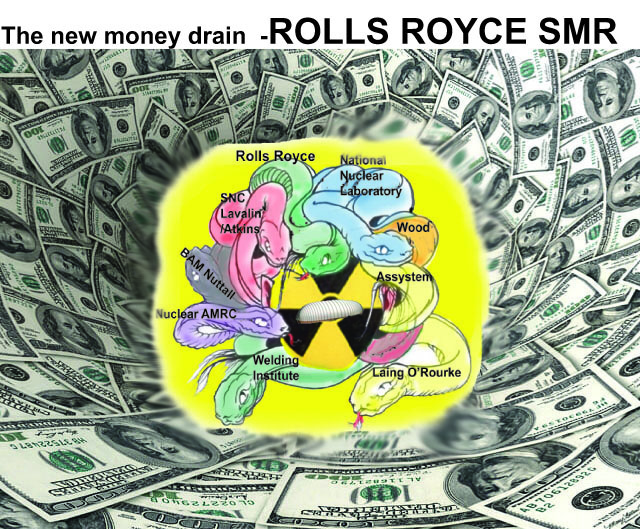
The nine-strong consortium also includes the National Nuclear Laboratory and Laing O’Rourke, the construction firm, alongside Assystem, SNC Lavalin/Atkins, Wood, BAM Nuttall, the Welding Institute and Nuclear AMRC.
UK poised to confirm funding for mini nuclear reactors for carbon-free energy Guardian,
Rolls-Royce-led consortium already has £210m in private backing for plans to build 16 reactors across the country, The government is poised to approve funding for a fleet of Rolls-Royce mini nuclear reactors that the prime minister hopes will help the UK reach his target of zero-carbon electricity by 2035.
A consortium led by the British engineering firm had already secured £210m in backing from private investors for the small modular reactor (SMR) project, a sum that the government is expected to match or better. Confirmation is expected before the spending review on 27 October, according to well-placed sources.
The consortium, known as UK SMR, will rebrand as Rolls-Royce SMR to coincide with Westminster’s blessing.
Tom Greatrex, the chief executive of the Nuclear Industry Association (NIA), said: “Match-funding for Rolls-Royce would be a huge signal to private investors that the government wants SMRs alongside new large-scale stations to hit net zero. It would also show investors that the government believes in nuclear as a green technology.”
Backing from the government will pave the way for the consortium’s multibillion-pound plan to build 16 SMRs around the country, the first of which could be plugged into the grid by 2031…………..
Confirmed support for SMRs could signal a concerted effort within government to reverse the scheduled decline in the UK’s nuclear power capacity. About 20% of the nation’s electricity comes from 13 nuclear reactors capable of producing 7.8GW of power. But more than half of that capacity comes from reactors due to retire by 2025, and plans to replace them have stalled.
Toshiba pulled out of a plant at Moorside in Cumbria in 2020, and Hitachi withdrew planning consent for a project at Wylfa Newydd, on Anglesey, this year. While Hinkley Point C is due to start generating electricity from 2026, only one new project, Sizewell C, is now in the works, with no final investment decision yet made.
Britain’s ability to build new nuclear reactors has been further complicated by the government’s unwillingness to allow any further involvement from the state-backed China General Nuclear. CGN has a 20% stake in Sizewell C but ministers have been looking into ways to remove it from the project before it moves to the construction phase. The Chinese company was due to take a lead role in the Bradwell reactor in Suffolk, which is now highly unlikely to go ahead.
Industry players are keen to see the government legislate to approve the regulated asset base (RAB) model, which allows private investors a more reliable stream of revenues from nuclear power plants – which typically require tens of billions of pounds to build – by piling costs on to household energy bills……..
The nine-strong consortium also includes the National Nuclear Laboratory and Laing O’Rourke, the construction firm, alongside Assystem, SNC Lavalin/Atkins, Wood, BAM Nuttall, the Welding Institute and Nuclear AMRC. https://www.theguardian.com/business/2021/oct/15/uk-poised-to-confirm-funding-for-mini-nuclear-reactors-for-green-energy
Waste Isolation Pilot Plant adds space for nuclear waste disposal near Carlsbad
Waste Isolation Pilot Plant adds space for nuclear waste disposal near Carlsbad Adrian Hedden, Carlsbad Current-Argus, 12 Oct 21, An eighth panel to store nuclear waste at the Waste Isolation Pilot Plant’s underground repository near Carlsbad was completed with waste expected to go in next year . At WIPP, low-level transuranic (TRU) nuclear waste made up of clothing materials and equipment irradiated during nuclear activities, is stored in an underground salt deposit about 2,000 feet underground.The facility stores the waste in panels, with each panel containing seven rooms where workers emplace drums of it and allow the salt to gradually collapse in for permanent disposal.WIPP has emplaced waste in seven panels so far but lost some capacity due to contamination from an accidental radiological release in 2014 that also disrupted mining and emplacement activities during a three-year shutdown of the WIPP’s core operations. But seven years since mining Panel 8 began, WIPP officials reported the work was complete in Tuesday announcement.Panel 7 was expected to be full by April 2022, per the announcement, and Panel 8 will be ready to accept waste immediately……………… The utility shaft project was paused last year when the New Mexico Environment Department denied extending a temporary authorization for construction ahead of a modification to WIPP’s permit to allow its use, citing concerns with COVID-19 infections at the site.The permit modification is under review by NMED.Also under review by NMED was a proposal by WIPP to construct two additional panels needed to restore the facility’s capacity from losses associated with the 2014 incident………. https://www.currentargus.com/story/news/local/2021/10/13/wipp-adds-space-nuclear-waste-disposal-near-carlsbad/6092842001/ |
1 This Month


of the week– Nuclear Reactor Information Task Force

14 May – online event From Bombs to Data Centres: the Face of Nuclear Colonialism
To see nuclear-related stories in greater depth and intensity – go to https://nuclearinformation.wordpress.com
-
Archives
- May 2026 (163)
- April 2026 (356)
- March 2026 (251)
- February 2026 (268)
- January 2026 (308)
- December 2025 (358)
- November 2025 (359)
- October 2025 (376)
- September 2025 (257)
- August 2025 (319)
- July 2025 (230)
- June 2025 (348)
-
Categories
- 1
- 1 NUCLEAR ISSUES
- business and costs
- climate change
- culture and arts
- ENERGY
- environment
- health
- history
- indigenous issues
- Legal
- marketing of nuclear
- media
- opposition to nuclear
- PERSONAL STORIES
- politics
- politics international
- Religion and ethics
- safety
- secrets,lies and civil liberties
- spinbuster
- technology
- Uranium
- wastes
- weapons and war
- Women
- 2 WORLD
- ACTION
- AFRICA
- Atrocities
- AUSTRALIA
- Christina's notes
- Christina's themes
- culture and arts
- Events
- Fuk 2022
- Fuk 2023
- Fukushima 2017
- Fukushima 2018
- fukushima 2019
- Fukushima 2020
- Fukushima 2021
- general
- global warming
- Humour (God we need it)
- Nuclear
- RARE EARTHS
- Reference
- resources – print
- Resources -audiovicual
- Weekly Newsletter
- World
- World Nuclear
- YouTube
-
RSS
Entries RSS
Comments RSS
 nuclear-news