London. Anti-nuclear campaigners have won a victory for free expression
ANTI-NUCLEAR campaigners have won a victory for free expression after
forcing Transport for London (TfL) to back down from refusing to consider a
peace advert on the network.
TfL initially refused an application from the
Campaign for Nuclear Disarmament (CND) for advertising space across the
capital but has been forced to reconsider following a threat of legal
action by the Public Interest Law Centre.
The application, originally
submitted in 2021, is for an advert showing a nuclear weapon broken in two
by CND’s famous peace symbol. It asks: “Why are we getting more nuclear
weapons when we could be investing in healthcare, renewable energy,
education?”
TfL had ruled the advert could not be carried because it
“promotes a party political cause or electioneering.” Acting for CND,
the law centre argued that the advertisement was not party political and
that TFL’s refusal to carry it was potentially in breach of the right to
free expression under Article 10 of the European Convention on Human
Rights. TfL has acknowledged that the original decision was incorrect, that
the advert was not party political, and have invited CND to resubmit the
advert for consideration.
Morning Star 24th March 2022
https://morningstaronline.co.uk/article/b/anti-nuclear-campaigners-win-victory-for-free-expression
Residents react after huge military convoy spotted travelling through Preston, UK
| Residents react after huge military convoy spotted travelling through Preston. An unmarked military convoy was spotted passing through Preston, sparking lots of speculation about what it was for. Residents reported seeing the convoy travelling along Eastway in Fulwood at around 4.25pm on Wednesday (March 23). Footage of the convoy showed the fleet of dark green military vehicles was escorted by police and fire crews. Lancashire Post 24th March 2022 https://www.lep.co.uk/news/transport/residents-react-after-huge-military-convoy-spotted-travelling-through-preston-3625257 |
As UK government touted ”media freedom”, Julian Assange in high security Belmarsh Prison was an embarassment
JULIAN ASSANGE POSED PR PROBLEM FOR UK GOVERNMENT’S MEDIA CAMPAIGN https://declassifieduk.org/julian-assange-posed-pr-problem-for-uk-governments-media-campaign/
UK officials were worried about public reaction to their hosting a media freedom event a few miles from Belmarsh prison, where Assange is incarcerated. The Foreign Office monitored activity online, developed ‘lines to take’ and warned ‘we should be ready’, emails show.
JOHN MCEVOY23 MARCH 2022 The UK’s treatment of Julian Assange posed a public relations problem for the Foreign Office’s media freedom campaign, files seen by Declassified UK show.
In July 2019, the UK co-hosted a Global Conference for Media Freedom, a first-of-its-kind event where 50 countries gathered to form a Media Freedom Coalition.
Costing £2.4 million, the event was hailed as “a major milestone” in the UK government’s “campaign to protect journalists doing their job”.
The conference was held just months after WikiLeaks editor Julian Assange was dragged out of the Ecuadorian embassy in London.
He was transferred to Belmarsh prison, “the closest comparison in the United Kingdom to Guantánamo”, as a UK parliamentary report has described it.
Addressing the media conference, then foreign secretary Jeremy Hunt declared: “If we act together, we can shine a spotlight on abuses and impose a diplomatic price on those who would harm journalists or lock them up for doing their jobs”.
‘We should be ready’
The hosting of a media freedom event within miles of Belmarsh prison in southeast London was seen as a public relations problem. Internal Foreign Office emails show UK officials monitored online behaviour accordingly.
After Hunt announced plans for the conference in February 2019, one official complained about “a few individual crazy responses to the FS’ [Foreign Secretary’s] tweet”.
By June, officials were requesting “Lines to Take on how best to respond to questions we expect to be raised on this occasion about the UK handling of the case of Julian Assange”.
In particular, “Icelandic criticism of UK handling of [the] Assange case” was seen to be “affecting messaging on media freedom”.
This email was likely related to former Icelandic Interior Minister Ögmundur Jónasson, who had asserted in June that the Assange case put “the British justice system…on trial”
On 8 July, two days before the conference began, an unnamed official wrote about “a ramp up in activity by Assange campaigners”.
One cause for concern was Assange’s mother Christine, who had “joined calls for a tweetstorm during the conference”, as well as “accounts [which] are small scale or are run by active trolls and provocateurs”.
The official outlined rules for engagement, noting “our current approach is right and we shouldn’t engage…However, we should be ready. I’m keen that we agree ahead of time how and when our approach would evolve”.
In an email with the subject line “Media Freedom Conference – online register of interest form”, one official even questioned: “what if someone like Assange applied to attend?”
The Foreign Office emails discussing Assange remain heavily redacted for reasons of “national security”.
‘No communications strategy can make this go away’
According to a recent academic study, Julian Assange “was by far the most frequently discussed individual on Twitter” with regards to the Media Freedom Coalition.
“Numerous tweets highlighted the apparent irony that the UK was establishing and leading an international initiative on media freedom, while simultaneously undermining free media…in their handling of Assange”, the researchers found.
Since 2019, the UK has nonetheless continued to use the Global Conference for Media Freedom as a vehicle through which to claim it supports press freedom.
Rebecca Vincent, the Director of International Campaigns for Reporters Without Borders (RSF), commented:
“It is disappointing that rather than looking to address the very serious substantive concerns about the case of Julian Assange, the UK Foreign Office seems to have treated the matter as only a public relations inconvenience as it prepared to host the Global Media Freedom Conference and launch the Media Freedom Coalition.
“But the truth is that no communications strategy can make this go away. As long as Assange remains detained in the UK and as long as the US continues to seek his extradition and prosecution for publishing information in the public interest, this case will serve as a thorn in the sides of both governments and the Media Freedom Coalition itself.”
She added: “They should instead lead by example by dropping the charges, releasing Assange, and putting an end to his persecution once and for all”.
Sceptism over Boris Johnson’s plan for ”Britain carpeted in mini-nukes
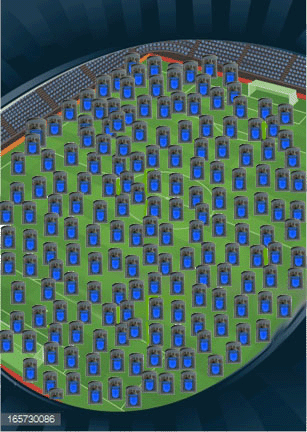
Amid this seismic structural shift, it is reassuring to know that our
Prime Minister has lost none of his world-renowned vision. According to
reports, Boris Johnson wants to see Britain carpeted in so many mini-nukes
that he foresees “not quite everyone having their own small modular
reactors in their gardens, but close to it”.
Those were the words of one government aide, who sensibly chose to remain anonymous, following a summit between the Prime Minister and nuclear industry figures on Monday as
ministers ramp up plans for greater domestic production. Like much of what
comes out of Boris’s mouth, it’s genuinely hard to know where to start
with such a statement, other than to say surely he can’t be serious?
New energy schemes are a bit like higher taxes – people are in favour of them
until they are asked to bear the cost. So in a country where an application
for a new conservatory is likely to provoke a flood of letters to the
council from angry neighbours and a lengthy planning row, does anyone
genuinely believe that the average homeowner is going to allow the
Government to build a mini nuclear plant at the bottom of the garden?
It might help produce those elusive prize tomatoes, but the likelihood is
Boris’s nuclear plans will prove too radioactive for Britain’s army of
Nimbys.
It’s not as if the average small modular reactor (SMR) is
actually that small. Rolls Royce says one of its SMRs will be roughly the
size of two football pitches.
Good luck fitting that into a shed. Like any
major infrastructure project that has Boris’s name on it, it sounds like
it was dreamt up at a No 10 lockdown party. Remember the Garden Bridge,
one of many hare-brained schemes Boris dreamt up as mayor of London? It was
scrapped in 2017 at a cost of £53m.
Reported plans for a fivefold increase
in nuclear capacity by 2050 imply the construction of at least half a dozen
big new nuclear stations in that time, but how exactly? Hinkley C,
Britain’s first new nuclear plant in three decades, will soon be nine
years overdue and £7bn over budget. Toshiba has scrapped plans for a new
plant in Cumbria, Hitachi has mothballed two new plants at Wylfa, Anglesey,
and Oldbury, Gloucestershire, and the future of Sizewell C and Bradwell are
both in doubt because they were too reliant on the Chinese.
Telegraph 23rd March 2022
Some Brits not very impressed with their government’s newbound love affair with nuclear power.
Nuclear energy push is not powered by sense https://www.theguardian.com/environment/2022/mar/23/nuclear-energy-push-is-not-powered-by-sense Readers fail to see the logic behind the government’s drive to go for the nuclear option to generate electricity
There is much about this government’s – and, to its shame, Labour’s – newfound love affair with nuclear power that makes no sense (Johnson announces aim for UK to get 25% of electricity from nuclear power, 21 March).
First, you cannot just turn off a nuclear power station. If we have 25% of our electricity generated by nuclear, then on days when all our needs can be met by renewables we will have to turn off 25% of our much cheaper renewable feed while using expensive, taxpayer-subsidised nuclear generation.
Second, we have no way of dealing with the mountains of dangerous high-level and intermediate-level waste that has been accruing since the 1950s. To generate more is sheer madness.
Third, nuclear power stations are vulnerable to the elements and to hostile attack – cyber, terrorist, state actors etc. Recent events in the Ukraine make this very real.
Fourth, the old argument about what we do when the wind isn’t blowing and the skies are overcast over the whole of the UK, which doesn’t stand up to much scrutiny now, falls away completely if we were to invest just a small amount of the taxpayer money that will go to the nuclear industry into research and development of electricity storage.
Finally, given the nuclear industry’s track record of bringing in plants well over budget, decades late, the proposed programme is not going to be realised until 2060 at the earliest. Why on earth are we contemplating it?
John French
Brockweir, Gloucestershire
Your report states that “electricity demand is expected to rise steadily in the next decade”. The same justification was used in 2006, when the Labour government first committed to further nuclear power stations. Based on the official forecasts issued in 2006, we should by now be consuming at least 15% more electricity than we were then.
But we are not. UK electricity consumption has in practice gone down by more than 15% since 2006. In the interim, no new nuclear power stations have been added to the system. It hasn’t collapsed, and is far less carbon-intensive.
Surely we aren’t getting fooled again by the same spurious rhetoric about endless consumption growth? In that immortal phrase of the 1970s: “Save it. You know it makes sense.”
Andrew Warren
Chairman, British Energy Efficiency Federatio
The dash to fossil fuels is not the environmental disaster set out by António Guterres (Ukraine war threatens global heating goals, warns UN chief, 21 March). It is, at worst, the replacement of existing hydrocarbons purchased from Russia. In the longer term, it is clear that alternative renewable energy sources will displace fossil fuels and most countries will wish to do this as quickly as possible.
he government’s desire, supported by Labour, for increased nuclear power generation is bizarre. A wind turbine capable of producing 15MW can be installed offshore for £10m. Sizewell C is expected to cost £20bn and produce 3.2GW of electricity – this does not include decommissioning costs. To generate 3.2GW would need 214 turbines costing £3.2bn, albeit some money would need to be spent on storage capacity. The government plans to invest £1.7bn in Sizewell C. How is spending more than five times as much on a controversial power source that takes 10 years to build a good idea?
John Blanning
Canterbury
UK Tories split over nuclear power.
Boris Johnson’s energy strategy delayed AGAIN as top Tories ‘split over
nuclear power’. It is the second time the Prime Minister’s much-hyped
long-term energy strategy in the wake of the Ukraine-Russia war has been
delayed. Boris Johnson and Rishi Sunak are thought to be at loggerheads
over investment UK nuclear production. The Government has admitted the
strategy will not be published this week as previously planned.
Mirror 21st March 2022
https://www.mirror.co.uk/news/politics/boris-johnsons-energy-strategy-delayed-26518640
Boris Johnson government to put limits on local community opposition to nuclear power
Boris Johnson prepares planning overhaul to speed up nuclear power plants.
Prime Minister considering reforms that would make it easier to build new
reactors after meetings with industry.
At a meeting with senior energy executives in Downing Street, ministers indicated that they were
considering reforming rules to make it more difficult for residents and officials to object to the construction of new nuclear sites.
Mr Johnson has previously pledged to put “big bets on nuclear power” as a way of
shoring up UK energy security following the Russian invasion of Ukraine and
concerns about the cost of imported fossil fuel.
Local people may have their ability to oppose new plants stripped away under proposals being
considered by ministers, but industry bosses are more concerned about the
Environment Agency and Marine Management Organisation wrapping their
projects in red tape and slowing them down, The Telegraph understands.
Telegraph 21st March 2022
Boris Johnson’s splashy style still avoids the costs, lack of financial commitments for nuclear power development
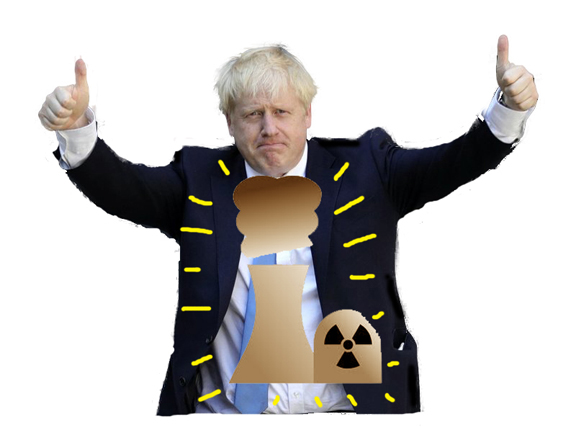
Garden bridges, routemaster buses, oven-ready Brexit deals…Prime
Minister Boris Johnson is no stranger to eye-catching pledges and, in
fairness, he occasionally achieves them. His latest media-friendly
commitment for “big new bets” on nuclear is typical Johnsonian
politics: brash, bold and intentionally vague.
This is reflected in the UK’s nuclear strategy – which is powered by enthusiasm but weakened by
a lack of details. On the one hand, Business Secretary Kwasi Kwarteng has
brought in the Regulatory Asset Base (RAB) model to power the construction
of projects with public money.
The government has also encouraged
Rolls-Royce’s plan to build small modular reactors (SMRs) across the
country, and has approved plans for light water reactor Sizewell C, while
the much-delayed Hinkley Point C is expected to open in 2026.
However – there remains no specific target for the UK’s nuclear capacity – and
the financial commitments remain threadbare. Its net zero ten-point plan
published last October only includes up to £385m for an Advanced Nuclear
Fund, and £170m for research and development on next-gen technology such
as Advanced Modular Reactors (AMRs) that could unlock hydrogen and
synthetic fuels. For context, Hinkley Point C is estimated to have cost
£23bn. The hesitancy from the Chancellor raises a key question: is bulking
up nuclear power to ensure supply security even a feasible goal?
City AM 22nd March 2022
UK’s Green Party calls for big effort on energy efficiency and renewables – nuclear is an ”expensive distraction”
Nuclear power is a distraction from cleaner, cheaper solutions, say
Greens. Responding to the announcement by the government that it plans for
the UK to get 25% of its electricity from nuclear power, co-leader of the
Green Party, Adrian Ramsay, responded: “Nuclear energy is an expensive
distraction at a time when we face the dual challenges of spiralling energy
costs and concerns over energy security.
“Our focus needs to be on
developing renewable energy technologies and a big push on energy
efficiency. Both are cleaner and cheaper solutions that can be delivered
far quicker than nuclear ever can. “That’s why we are calling for a
£250 billion investment plan for a nationwide home retrofit scheme and
renewables in tomorrow’s Spring statement.
Green Party 22nd March 2022
Greenpeace scathing about Boris Johnson’s plan for nuclear power.
| In response to reports that the Prime Minister wants to generate 25% of the UK’s electricity from nuclear power, Dr Doug Parr, Chief Scientist for Greenpeace UK, said –“Aside from the still-unresolved hazards particular to nuclear power, the Prime Minister’s plan for 25% of power from nuclear suggests some short memories – both Thatcher and Blair had big plans for nuclear which ran into the sand because the technology was expensive, slow, and prone to mishaps. This initiative will result in lots of time, effort and ministerial bandwidth being spent on things that don’t deliver whilst the real solutions to our energy and climate crisis languish with inadequate support.” Greenpeace 22nd March 2022https://www.greenpeace.org.uk/press-centre/ |
Greens firm on Scotland’s opposition to nuclear power.
THE Greens have hit back at claims the Scottish Government should rethink
its opposition to building new nuclear power stations. Greg Hands, the UK
energy minister, insisted in an interview this morning he hoped the war in
Ukraine had given Scotland a “pretext” to get behind nuclear power and be
part of its development.
The National 21st March 2022
https://www.thenational.scot/news/20008191.greens-say-no-building-new-nuclear-power-stations/
Energy efficiency and renewables – faster, safer, than nuclear power, to move away from Russian fuel, and combat climate change.
A recent paper by the Tony Blair Institute for Global Change says reducing
our oil and gas consumption could be an important tool to help Europe
through the medium-term challenge of moving away from Russian energy.
There is a need to address energy demand now, according to Prof Nick Eyre,
director of the Centre for Research into Energy Demand Solutions at Oxford
University, both as a result of the Ukraine crisis and to tackle climate
change.
Reducing demand and decarbonising our energy systems is something
we should be doing anyway for climate reasons, said Eyre, in order to meet
our targets for net zero. “This energy security and price crisis is
another prompt to do this,” he said. “It will be expensive – but a
windfall tax on companies who, at best, have had a pretty dubious
relationship with Russia, would help pay for it.”
Eyre said collective
action was needed, driven by government, who should bring forward immediate
detailed policies on decarbonising domestic heating in the UK. Domestic
heating produces about 14% of UK emissions, and decarbonising the way homes
are heated – meaning more efficient homes and the electrification of most
heating systems – would cost an estimated £200bn over the next 30 years,
according to the Institute for Government. Between now and 2050, emissions
from residential buildings need to fall to zero at a rate of 3.4% a year
based on current emission levels, according to the Department for Business,
Energy and Industrial Strategy.
Eyre believes any new energy supply policy
– expected to be announced by Boris Johnson in the coming days – will
make no sense if it does not include energy reduction measures and the
bringing forward of detailed plans to decarbonise our homes.
“If it’s
all about building nuclear power stations, this would take 10 years, so
it’s not a very sensible strategy,” said Eyre. “Energy efficiency and
renewable energy can provide what we need more quickly and less
dangerously.” Molly Scott Cato, former Green MEP and professor of
economics at the University of Roehampton, says the UK government should
launch a massive, nationwide, and publicly funded home insulation programme
backed up by information campaigns about how to use energy efficiently,
including reducing the thermostat settings on central heating systems and
introducing a 55mph speed limit on the national road network to cut energy
demand.
Guardian 23rd March 2022
British public in the dark about what ”Modular” nuclear reactors really means (hint -they’re like Lego pieces)

What does “modular” mean here? I haven’t the faintest. Isn’t it to
do with university courses? I’ve been quizzing friends and so far only
two even took a stab: one thought it might mean being able to have them
together, or not, or something. The other thought it might mean
“portable”. My guess is that the British population shares my
ignorance, but thinks you don’t say “small reactors” without
inserting “modular”. Obviously, we’ll have to ramp these modularities
up. On multiple occasions. Onwards, then, to my next small, modular item.
Times 23rd March 2022
https://www.thetimes.co.uk/article/this-craze-for-modular-must-be-a-fission-thing-s35qx0ktq
Boris Johnson determined to show ‘leadership’ on nuclear power
Johnson announces aim for UK to get 25% of electricity from nuclear power. PM meets industry bosses to discuss new power stations, with several reactors slated for closure as energy demand rises, Guardian, Jasper Jolly and Rob Davies 22 Mar 22,
Boris Johnson has told nuclear industry bosses that the government wants the UK to get 25% of its electricity from nuclear power, in a move that would signal a significant shift in the country’s energy mix.
Johnson on Monday met executives from major nuclear utilities and technology companies including the UK’s Rolls-Royce, France’s EDF, and the US’s Westinghouse and Bechtel to discuss ways of helping to speed up the development of new nuclear power stations.
The UK generates about 16% of its power from nuclear power stations, but several reactors are slated for closure, while electricity demand is expected to rise steadily in the next decade. That would mean large investments in new power stations would be required just to keep the share of nuclear constant, let alone increase it to a record level of just over a quarter of electricity use.
Also present at the meeting were a series of big pension companies and insurers, including Aviva, Legal & General and Rothesay Life, alongside major foreign investors including Australia’s Macquarie and the Canada Pension Plan Investment Board. Ministers have wrestled for years with how to attract private capital to invest in nuclear – but companies have balked at putting pension and insurance cash at risk.

The government is considering changes to insurance rules set by the EU and copied by the UK to make it easier for insurers and pensions to invest. The UK is switching to a “regulated asset base” model, which it hopes will give long-term investors more certainty on returns, a change it hopes will address limitations to the current rules, known as Solvency II.
The government wanted to show the nuclear and investment industries that it had a “clear ambition for more nuclear” in part to balance out intermittent renewable power sources, according to a government source briefed on the discussion.
………………..According to an aide who was present at the meeting, Johnson told industry heads and financiers that there had been a “chronic absence” of leadership by successive British governments on nuclear energy and that the country was “being left for dead” by other nations, such as France, on the issue.
Speaking after the meeting, Tom Greatrex, the chief executive of the Nuclear Industry Association (NIA), said: “Accelerating nuclear projects is absolutely essential to keep energy costs down, cut expensive gas imports and strengthen our energy security as we move towards net zero.
“That means urgently investing in a fleet of large and small nuclear stations, alongside renewable investment, to deliver the clean, sovereign power we need.”
The UK has struggled to build new nuclear power stations in recent decades, with the Japanese conglomerate Hitachi in 2020 pulling out of plans to build a new reactor at Wylfa, north Wales, and geopolitical tensions making the government less keen on attracting Chinese investment to Sizewell C on the Suffolk coast.
Meanwhile the existing nuclear fleet has been in steady decline, with Hunterston B in Scotland retiring earlier this year, Hinkley Point B in Somerset due to follow suit in the summer, and Heysham I and Hartlepool I due to shut down in 2024.
At that point, nuclear capacity is expected to fall as low as 3.6GW.A cross-party group of MPs that campaigns on nuclear issues has called for the government to increase its annual nuclear power capacity to 15GW by 2030 and 30GW by 2050, far above the 12.7GW installed at nuclear power’s peak in 1995.
Major obstacles include difficulty in securing funding from private investors and a ban on new nuclear projects, which was among the factors that scuppered the Wylfa project in north Wales.projects in Scotland, imposed by the devolved government, which prevents Hunterston B being replaced.
The government is examining a plan to revise the financing model for major projects, which was among the factors that scuppered the Wylfa project in north Wales.
Under plans for Sizewell being discussed by Whitehall officials and EDF, the government could take a stake in a development company that will push it through various stages of planning and bureaucracy, sharing the costs with EDF.
Private sector investors such as the insurance funds L&G and Aviva would then be lured in at a later stage in return for a government-backed funding model called the regulated asset base (Rab), diluting the taxpayer and EDF.
Legislation on Rab funding – the same model used to fund airports such as Heathrow and water companies – is due to progress through parliament next month. https://www.theguardian.com/environment/2022/mar/21/johnson-announces-aim-for-uk-to-get-25-of-energy-from-nuclear-power
UK’s Business secretary Kwasi Kwarteng considering launching State-owned nuclear company

Government ministers are mulling over plans to launch a state-owned
nuclear company, which would assume stakes in future domestic projects.
Business secretary Kwasi Kwarteng is considering the move as he looks to
speed up the development of nuclear plants – which have suffered years of
delays- and reduce the UK’s reliance on foreign energy, according to The
Sunday Times.
City AM 20th March 2022
1 This Month
26 September – International Day for the Total Elimination of Nuclear Weapons





PLEASE OPPOSE HR 8255 AND S.3639 – bills would accelerate satellite deployment, with no environmental review or safeguards – https://ncstd5li.quorum.us/campaign/169331/
To see nuclear-related stories in greater depth and intensity – go to https://nuclearinformation.wordpress.com
-
Archives
- September 2026 (313)
- August 2026 (330)
- July 2026 (355)
- June 2026 (287)
- May 2026 (306)
- April 2026 (356)
- March 2026 (251)
- February 2026 (267)
- January 2026 (308)
- December 2025 (358)
- November 2025 (359)
- October 2025 (375)
-
Categories
- 1
- 1 NUCLEAR ISSUES
- business and costs
- climate change
- culture and arts
- ENERGY
- environment
- health
- history
- indigenous issues
- Legal
- marketing of nuclear
- media
- opposition to nuclear
- PERSONAL STORIES
- politics
- politics international
- Religion and ethics
- safety
- secrets,lies and civil liberties
- spinbuster
- technology
- Uranium
- wastes
- weapons and war
- Women
- 2 WORLD
- ACTION
- AFRICA
- Atrocities
- AUSTRALIA
- Christina's notes
- Christina's themes
- culture and arts
- Events
- Fuk 2022
- Fuk 2023
- Fukushima 2017
- Fukushima 2018
- fukushima 2019
- Fukushima 2020
- Fukushima 2021
- general
- global warming
- Humour (God we need it)
- Nuclear
- RARE EARTHS
- Reference
- resources – print
- Resources -audiovicual
- Weekly Newsletter
- World
- World Nuclear
- YouTube
-
RSS
Entries RSS
Comments RSS

