UK government’s nuclear dream likely to fade away, as private investors resist that risky call

Private investors are yet to be convinced that the returns from nuclear
power are sufficiently attractive to plow billions of pounds into a new
fleet of reactors that is being pushed by the U.K. government.
Unclear policy, competition from renewables and concerns about how attractive the
financial returns will be all make the investment case for nuclear less
compelling, according to people involved in the discussions.
That could be a major stumbling block for the government as it seeks to enlist private
capital to help fund projects like Electricite de France SA’s Sizewell C
plant.
Financial Post 29th March 2022
Getting bigger but not safer or cheaper – the myth of Rolls Royce and its very big non-modular reactor

Rolls Royce are now starting a ‘Generic Design Assessment’ (GDA) process with the ONR which will take around 5 years. After then they will be asking the UK Government for a blank cheque for the project.
https://100percentrenewableuk.org/getting-bigger-but-not-safer-or-cheaper-the-myth-of-rolls-royce-and-its-very-big-non-modular-reactor By David Toke, 30 Mar 22, Rolls Royce’s so-called small modular reactor (SMR) is getting bigger, but is likely to have fewer special safety features compared to EDF’s increasingly pricey design for Hinkley C.
In 2017 Rolls Royce said that its small modular reactor would be between 220 and 440 MW, but the latest design is bigger, at 470 MW. It is strange to call this small. Reactors in service at the moment (the so-called AGR reactors) were around the 600 MW size for each unit and, strange as it might seem, most of the first generation of so-called ‘Magnox’ nuclear reactors built in the UK were actually smaller than 470 MW. They were not called ‘small’. So why is Rolls Royce calling this a SMR? There’s no reason for this other than public relations.
Rolls Royce claim that the parts will be mainly built in factories. Well, of course they will, that’s always the case with nuclear power plant. The difference with building a relatively smaller plant of course is that you get less of the economies of scale in doing this. That is why nuclear power plant have got bigger.

So the fact that the Rolls Royce unit will be about a third the size of the EPR is likely to make them cost more. But there is one way that Rolls Royce will be able to economise compared to the European Pressurised Reactor (EPR) being built at Hinkley C, and that is because I have seen no sign that Rolls Royce will include some special safety features that have been included in the EPR.
The best known of these safety features are a) a ‘double containment’ feature that is designed to stop material from the inside getting out (as well as another external shell to shield from aircraft) and b) a ‘core catcher’ to stop a melting core eating its way into the ground and potentially contaminating water courses. I am assuming Rolls Royce will not be including either of these features, although it will have to satisfy the Office for Nuclear Regulation (ONR) that it has other ways of stopping radioactive releases from accidents.
Rolls Royce are now starting a ‘Generic Design Assessment’ (GDA) process with the ONR which will take around 5 years. After then they will be asking the UK Government for a blank cheque for a project.
Of course there is another factor and that is that EDF have some experience (admittedly not very successful of late) of building nuclear power plant. Rolls Royce do not have experience of building large nuclear power plant (which is what they are really hoping to do). Producing small (and, it must be said extremely expensive) genuinely small reactors for nuclear submarines is not the same thing at all! So Rolls Royce are likely not to have the skills to build large nuclear power plant. That is a bad sign!
The so-called SMRs proferred by Rolls Royce will just be the latest in a long line of very expensive, very lately delivered nuclear power stations in the UK. It is unlikely to be any cheaper than the reactor that EDF is building at Hinkley C (becoming more expensive as time goes on). But it will have fewer safety features.
Robert (Bob) Hoggar comments: Small Mod Reactors scattered about Britain will also have lots of nuclear waste scattered about Britain which will need careful looking after and that is guaranteed to be an additional rusk to the nation.
UK’s energy security strategy delayed, as Cabinet split on nuclear power, and the Regulated Asset Base plan to pay for it.
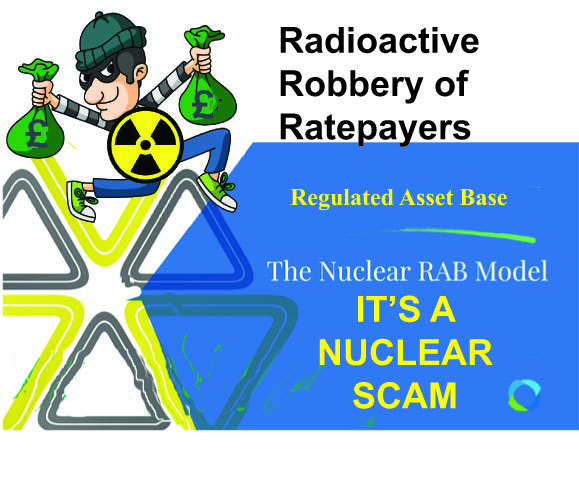
| Disagreements between Boris Johnson and Rishi Sunak over the cost of investment in new nuclear power stations have forced the government to again delay its energy security strategy. The prime minister promised to publish the strategy this month after Russia invaded Ukraine. Its publication has been repeatedly put back amid cabinet disagreements over fracking, onshore wind and the extent of government support for energy efficiency projects. Senior sources told The Times that while most issues had been settled, disagreements between No 10 and the Treasury over the extent to which new nuclear power should feature in the plan caused the latest delay. Last week Johnson told nuclear industry bosses that the government wanted the UK to get 25 per cent of its electricity from nuclear power, requiring up to six new large-scale stations. Sunak is understood to be concerned at the cost of such a commitment, arguing it represents poor value and would lead to substantial long-term increases in energy bills. He is thought to be pushing Johnson to limit the government’s commitment to two plants on top of one being built at Hinkley Point. The Treasury’s argument has been boosted by the National Infrastructure Commission that has warned large-scale nuclear power plants are “incredibly difficult to deliver on short timescales”. It has pointed out that even if the government gave the go-ahead for more nuclear power stations and they took as long as the Hinkley Point C project is expected to take, they would not come online until the mid-2040s. They have urged ministers to look at “alternatives” that are more likely to be deliverable at scale in the next 15 years. Ministers are legislating for a new model to fund nuclear power plants to make them attractive to investors. But critics say the regulated asset system would place the burden for delays and cost overruns on consumers and increase energy bills. Supporters of new nuclear power, including Johnson and Kwasi Kwarteng, the business secretary, argue that investing now is a “no regret” policy as demand for electricity is forecast to double in the transition to net zero. It is understood the strategy is now due next week. If that slips, the Easter recess and rules on what the government can say before the May elections could push it beyond the Queen’s Speech. Times 29th March 2022 https://www.thetimes.co.uk/article/cabinet-split-on-nuclear-power-delays-uk-energy-strategy-nmfznj377 |
UK’s Treasury and Chancellor of the Exchequer srongly resisting Boris Johnson’s push for costly nuclear power.
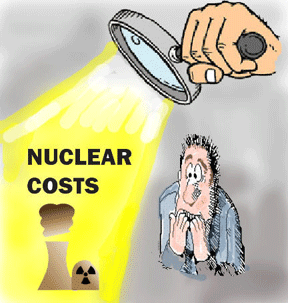
Boris Johnson and Rishi Sunak’s nuclear fallout sparks fresh delays to
UK energy security strategy. The Prime Minister is pushing for six to seven
new large nuclear power stations, but the Chancellor is concerned about the
massive cost. The proposals are being strongly resisted by the Treasury,
with the Chancellor concerned that the vast investment in nuclear would not
provide the taxpayer with value for money.
It has meant that the energy
package has been kicked further down the road, despite Mr Johnson having
previously pledged to publish the proposals at the start of the month. The
plans are also expected to include ways to produce more energy from
renewables, and increase North Sea oil and gas production. The Prime
Minister’s spokesman denied that they were being delayed because of a
disagreement, instead stating that it was “important we get these things
right”.
iNews 28th March 2022
Spending £4bn on a new nuclear station at Sizewell will not solve the government’s energy problems
Spending £4bn on a new nuclear station at Sizewell will not solve the government’s energy problems
Instead of sensible short-term measures to help those facing energy poverty, the government is focusing on a technology with a track record of failure Prospect Magazine
ByNick Butler March 30, 2022In the face of surging energy prices and the prospect of more problems as Europe turns off Russian gas supplies, the UK government is struggling to find a coherent energy policy. The latest move, a £4bn investment in the proposed new nuclear station at Sizewell, is both a mistake and an irrelevance. Private investors who are being asked to stump up the majority of the £20bn total cost should politely decline the offer
……………………………………………………………..There are no instant solutions but on and offshore wind and solar power could be increased relatively quickly at a reasonable cost. The government could also accelerate its investment in developing the crucial technology for energy storage. This would capture more of the power produced by every wind turbine and limit the need for back-up plants (usually requiring more gas) to deal with the times when the wind is not blowing. On top of this, direct support for simple measures to enable people to use energy more efficiently would limit demand and cut bills.
Instead of such sensible short-term measures, ministers have chosen to focus on a technology which has a track record of failure and which, even if it could be made to work, will take at least a decade to provide any new electricity supplies………….
Of all the available options, however, the choice of EDF’s European Pressurised Reactor (EPR) technology is the worst from any perspective.
In 2009, EDF promised investors and the government at the time that the EPR to be built at Hinkley would produce power at a cost of less than £50 per MWhr. By Christmas 2017, we were told Hinkley would be onstream and providing the power to cook our Christmas turkeys. We were the turkeys for believing such claims.
Hinkley is still being built and 2027 now looks like the earliest date for production to begin. In France, the comparable EPR development at Flamanville—which was due onstream in 2013—is still unfinished, having experienced a series of crucial technical problems. In both cases the costs have overrun the original budgets by many billions.
Hinkley, if it ever comes onstream, will charge consumers £92.50 per MWhr index linked from 2013 when the deal was agreed. While the costs of renewables such as offshore wind have fallen dramatically over the last decade, the costs of nuclear power from Hinkley have continued to rise. After almost a decade of inflation, that price has already risen to around £110. Who knows what it will be in 2027?………….. https://www.prospectmagazine.co.uk/science-and-technology/spending-4bn-on-a-new-nuclear-station-at-sizewell-will-not-solve-the-governments-energy-problems
EDF announces another delay and cost overruns to Hinkley Point C nuclear project
French energy giant EDF has revealed it will have to announce new delays
and cost overruns for its Hinkley Point C nuclear plant project in the UK.
The latest setback follows conflict in Ukraine, supply chain disruption and
inflationary pressures.
EDF last updated its construction schedule in
January 2021, when it said the UK’s first new nuclear plant to be built
in decades would be delayed by six months to June 2026. It revealed costs
would rise by an additional £500m to £23bn.
Originally, the plant was
expected to open in 2025 and had a construction budget of £18bn. However,
like similar nuclear new-build projects in Flamanville, France and
Olkiluoto, Finland, it has been subject to repeated delays and spiralling
costs. In a note to its 2021 annual report, EDF arued risks to schedule and
cost at completion targets had increased. The energy firm cited the ongoing
impact of the pandemic, Brexit, lower-than-expected civil performance and
tensions in global building materials markets.
22 Mar 22, https://www.cityam.com/edf-announces-another-delay-to-hinkley-point-c-nuclear-plant/
City AM 28th March 2022
Boris Johnson beholden to the nuclear industry. That’s going to cost UK bigtime – Chancellor Sunak not happy.
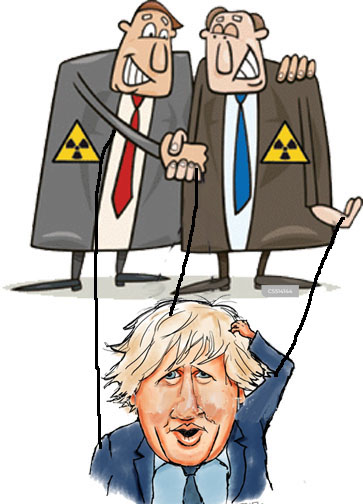
Boris Johnson’s flagship energy strategy has been held up over a row
with Rishi Sunak about funding a new generation of up to eight nuclear
power stations costing the public more than £13bn.
The strategy, which has
been delayed for a month, was due to be published this week but has now
been pencilled for 5 April after disagreement about the multibillion-pound
cost of new nuclear plants and amid ongoing tensions between the prime
minister and his chancellor, as well as the wider cabinet.
Johnson has told the nuclear industry that he wants 25% of electricity generation to come
from nuclear power by 2050, up from 16% now. Whitehall sources told the
Guardian this shift could require the building of about eight new nuclear
power stations. Draft targets suggest ministers are looking at 30GW of
nuclear power capacity, meaning a huge building programme would be needed,
as capacity is due to fall to 3.6GW as plants are decommissioned.
Of the eight UK plants currently in operation, all but one are due to be switched
off by 2030. Each new plant would require the government to take a minority
stake in the project to reduce the risk to developers, and substantial cash
outlay to encourage investment.
Despite Johnson’s keenness for new
nuclear power, Sunak is concerned about the cost to the taxpayer, or extra
costs added to soaring energy bills. The Treasury has already promised
£1.7bn of direct cash for a single large-scale nuclear project – the
£20bn Sizewell C – as well as £120m for a new Future Nuclear Enabling
Fund, which aims to address barriers to entering the sector.
Building eight plants could cost more than £13bn in initial investment costs from the
government if the same amount of investment were to be put in, according to
a Whitehall source. However, the government is also pushing for the nuclear
industry to reduce its build costs.
Guardian 28th March 2022
Stop Sizewell C campaigners query the government’s planning judgment , especially on costs

Stop Sizewell C campaigners yesterday questioned how the Government can
make an impartial planning judgement on the project if it is intending to
invest in it. The Planning Inspectorate’s report containing its
recommendation on the proposals is expected to be made public in late May.
Previous estimates have put the cost of Sizewell C at about £20bn – less
than the plant being built at Hinkley Point in Somerset – though the figure
could rise with global inflationary pressures.
East Anglian Daily Times 27th March 2022
https://www.eadt.co.uk/news/business/sizewell-c-government-to-take-stake-8785356
Hinkley Point C nuclear project faces mor.e delays, increased costs
 |
| Hinkley Point C faces more delays amid Ukraine crisis. Developer EDF warns war may trigger even higher costs for Britain’s flagship nuclear power station. The UK’s £23bn new flagship nuclear power plant is at risk of becoming more expensive and being plagued by delays as its developer EDF blamed challenges including the conflict in Ukraine. EDF is carrying out a “new comprehensive review” of the costs and timeframes of Hinkley Point C, which it is building in Somerset with updates expected in the summer. The majority French state-owned company had already raised cost estimates in 2017, 2019 and again in 2021 amid the pandemic, with the project currently set to cost between £22bn and £23bn and start generating power in mid-2026. It was originally forecast to cost £18bn. The developers have to foot the bill for cost overruns at the project, but it comes as EDF is in talks with the UK Government about building a second new power plant, Sizewell C in Suffolk, which could see households take on more risk for overruns. The Prime Minister is believed to want nuclear power to supply about a quarter of Britain’s electricity by 2050. That could imply about six large stations similar to Hinkley will be needed by 2050. In a sign of its commitment to the technology, the Government is planning to take a 20pc equity stake in the Sizewell C project. In documents filed with French financial authorities, EDF said of Hinkley Point C: “Due to the difficulties encountered by the project, notably on civil performance and marine works, and the increase in risks such as the Ukrainian conflict, Brexit, Covid, supply chain disruption and inflation, a new comprehensive review to update the costs and schedule estimates announced in January 2021 is underway and is expected to be finalised by summer 2022.” Telegraph 27th March 2022https://www.telegraph.co.uk/business/2022/03/27/hinkley-point-c-faces-fresh-cost-overrun-ukraine-crisis/ |
Boris Johnson’s enthusiasm for UK nuclear power should raise huge red flags for Scotland
Boris Johnson’s enthusiasm for UK nuclear power should raise huge red flags for Scotland, BY DOUGLAS CHAPMAN, 27th March ONLY last week we had the UK Government Energy Minister Greg Hands use the suffering of the Ukrainian people to encourage the Scottish Government to reconsider their opposition to nuclear power as a way of bolstering our UK energy security.
Hands must have missed the memo entitled “Scotland Has Options” detailing the far safer and cheaper alternatives than nuclear power that we have. We are not dependent on Russian gas because we are already self-sufficient in domestic gas. In fact, we supply the rest of the UK with gas from the North Sea. Then there’s the not so small matter of the pillaging of oil and the vast profits that we have lost as Scots thanks to Tory policy. And now, as we accelerate the transition away from fossil fuels, we also produce almost 100% of our own electricity from renewables…. (subscribers only) https://www.thenational.scot/politics/20023807.boris-johnsons-enthusiasm-uk-nuclear-power-raise-huge-red-flags-scotland/
Over 1000 tonnes of steel drums full of nuclear waste dumped at Drigg, Cumbria
The Nuclear Decommissioning Authority trumpet their latest “success”
– the dumping of more than 1000 tonnes of steel drums filled with nuclear
wastes at the “Low Level Waste Repository in Drigg, Cumbria – from the
redundant Magnox site at Winfrith, Dorset. This is their triumphant
announcement…..“A major project to dispose of more than 1,000 stainless
steel drums of waste has successfully completed its initial rail transfer.
From: Nuclear Waste Services, Magnox Ltd, and Nuclear Decommissioning
Authority Published 25 March 2022.
Radiation Free Lakeland 26th March 2022
Campaigners lose legal challenge to stop Hinkley Point C mud being dumped in the Bristol Channel
Campaigners have lost a legal challenge to stop mud from alongside Hinkley
Point C being dumped in the Severn Estuary. The nuclear plant’s
developers, EDF, were using a licensed disposal site near Cardiff but this
led to extensive protests. The campaigners argued a marine licence for the
work was unlawfully amended, without proper scrutiny. But a High Court
judge has this week dismissed their case on all grounds.
EDF dubbed the decision “good news” for thousands of workers at the site. It was
granted permission for the latest mud dumping by England’s Marine
Management Organisation (MMO) in August. The switch from Cardiff to
Portishead, on the English side of the estuary, was challenged by activists
who argued the company should not have been able to vary an existing
licence it had for work at sea.
At a two-day hearing this month, judge Mr
Justice Holgate said he considered the claimant’s approach “to involve
an impermissible gloss” on the relevant legislation and that “there was
nothing unlawful in the MMO’s decision”. An EDF spokesman told
Burnham-On-Sea.com: “The decision is good news for people who care about
the environment and climate change.” “It will enable thousands of
workers to get ahead building a project that will protect the environment
from climate change and provide Britain with reliable low carbon
electricity for decades to come.”
The previous dumping proved
controversial because of fears the mud could be contaminated with nuclear
waste from the Hinkley A and B reactors, which used to be on the site. But
those claims were dismissed by the company, Welsh and English environmental
authorities and the Welsh government as tests showed the sediment was
similar to that found elsewhere in the Bristol Channel.
Burnham-on-sea.com 26th March 2022
Big ‘doomsday plane’ for the Big Nobs, in the event of nuclear war, arrives in Britain
US ‘Doomsday Plane’ capable of surviving nuclear war arrives in Britain
Boeing aircraft can fly non-stop for six days with equipment designed to withstand electromagnetic blast https://www.thenationalnews.com/world/uk-news/2022/03/25/us-doomsday-plane-capable-of-surviving-nuclear-war-arrives-in-britain/ Thomas Harding. Mar 25, 2022
An aircraft known as the “Doomsday Plane” that is capable of enduring the aftermath of a nuclear detonation has landed in Britain.
The arrival of the US Nightwatch plane from Andrews Air Force Base, Washington, comes amid fears of a nuclear strike by Russia, with its invasion of Ukraine stalled.
The aircraft, call sign GRIM99, is described as the Flying Pentagon and could be used as a centre of operations during a nuclear war.
Capable of flying 150 hours non-stop with the aid of airborne refuelling, the Boeing 747 is officially known as the National Emergency Airborne Operations Centre and is one of four such planes on constant standby.
Much of the aircraft’s equipment is secret, but it is known to carry nuclear and thermal shielding and enough communications for a US defence chief to direct a war.
It is used to transport the US defence secretary during a conflict, providing a back-up to the Pentagon. Its livery paintwork is similar to the US president’s Air Force One.
The four aircraft are based in Nebraska and have been operational since 1980. Each stands six storeys high and has four powerful General Electric engines equipped with huge fuel tanks to avoid the need to land and refuel during a nuclear exchange.
The plane’s flight deck equipment is analogue, so it can withstand jamming or the electromagnetic pulse that follows a nuclear detonation.
The “radome” hump on its back contains 67 different satellite dishes and antennae, giving the defence secretary and his commanders the ability to contact warships, submarines, aircraft and landlines around the world.
A crew of 112 people has the use of three decks, with 18 bunks beds, six bathrooms, a kitchen, conference room, briefing room and an operations centre.
The interior design is basic, with few modern-day comforts and no touch screens, as digital technology would be almost completely disabled during a nuclear exchange. However, the conference centre does have two 80-inch flat screen televisions.
It has a maximum speed of 969kph, can fly at 14,000 metres and has a take-off load of 377,000kg. The aircraft will remain in service until 2039.
UK does NOT need more nuclear power. Electricity demand has fallen
| Andrew Warren: In seeking justification for “rigging” the UK electricity market in favour of more nuclear power, It is beingcategorically argued that electricity demand is expected to rise over the next decade (“Johnson in ‘gung ho’ push for more nuclear power as energy crisis bites”, Report, March 21). Strangely enough, that was precisely the reason given back in 2006, when the then Labour government first committed to a “family” of further nuclear power stations. Based on the official forecasts issued in 2006, we should by now be consuming at least 15 per cent more electricity than we were then. But we are not. Right now, UK electricity consumption has in fact gone down by over 15 per cent since 2006. In other words, all that expectation of demand growth which was used to justify new nuclear power stations was grossly exaggerated, in practice by over 30 per cent. In the interim, no new nuclear power stations have been added to the system. The system hasn’t collapsed, and it’s also far less carbon intensive. Surely, we aren’t getting fooled again by the same spurious rhetoric about endless consumption growth? In that immortal phrase of the 1970s: “Save it. You know it makes sense”. FT 24th March 2022https://www.ft.com/content/41942796-1da4-469a-af7c-a331673ae494 |
In UK, some welcome news, in Government support for energy saving

Welcome green tax cuts struggled to counter the sense of a Chancellor that
does not fully understand the scale of the interlocking environmental, cost
of living, and security crises the UK is facing. First, the good news,
because we could certainly do with some. Chancellor Rishi Sunak’s decision
to make the scrapping of VAT on energy-saving materials one of the central
planks of his Spring Statement is hugely welcome news. The fact
energy-saving materials has been defined to include clean technologies such
as solar panels and heat pumps, as well as insulation is similarly welcome.
And the decision to extend this tax cut for at least five years, giving
installers and manufacturers a clear signal that demand is likely to soar
and they should rapidly scale up capacity accordingly, is arguably most
welcome news of all. In addition, the doubling of the support fund for
Local Authorities to £1bn to help households in fuel poverty is also
undoubtedly welcome, even if it smacks a little of providing two buckets,
rather than one, to help tackle a forest fire. There was no grand vision
for driving sustainable growth, insulating the UK from surging global
fossil fuel prices, or helping people manage the transition to a net zero
emission economy. There was little sense of the UK’s place in an
increasingly dangerous world and how it could become a trailblazer for the
shift away from hydrocarbons that can help defang petrostate autocracies.
Most surprisingly of all, there was far too little to help the millions of
households that through no fault of their own are facing the looming shadow
of genuine poverty. It was, just like Sunak’s eve of COP26 Budget, a
significant opportunity missed.
Business Green 23rd March 2022
https://www.businessgreen.com/blog-post/4047134/spring-statement-bad-deeply-worrying
 | ReplyForward |
Welcome green tax cuts struggled to counter the sense of a Chancellor that
does not fully understand the scale of the interlocking environmental, cost
of living, and security crises the UK is facing.
First, the good news,
because we could certainly do with some. Chancellor Rishi Sunak’s decision
to make the scrapping of VAT on energy-saving materials one of the central
planks of his Spring Statement is hugely welcome news.
The fact energy-saving materials has been defined to include clean technologies such
as solar panels and heat pumps, as well as insulation is similarly welcome.
And the decision to extend this tax cut for at least five years, giving
installers and manufacturers a clear signal that demand is likely to soar
and they should rapidly scale up capacity accordingly, is arguably most
welcome news of all.
In addition, the doubling of the support fund for
Local Authorities to £1bn to help households in fuel poverty is also
undoubtedly welcome, even if it smacks a little of providing two buckets,
rather than one, to help tackle a forest fire.
There was no grand vision
for driving sustainable growth, insulating the UK from surging global
fossil fuel prices, or helping people manage the transition to a net zero
emission economy. There was little sense of the UK’s place in an
increasingly dangerous world and how it could become a trailblazer for the
shift away from hydrocarbons that can help defang petrostate autocracies.
Most surprisingly of all, there was far too little to help the millions of
households that through no fault of their own are facing the looming shadow
of genuine poverty. It was, just like Sunak’s eve of COP26 Budget, a
significant opportunity missed.
Business Green 23rd March 2022
https://www.businessgreen.com/blog-post/4047134/spring-statement-bad-deeply-worrying
1 This Month
26 September – International Day for the Total Elimination of Nuclear Weapons





PLEASE OPPOSE HR 8255 AND S.3639 – bills would accelerate satellite deployment, with no environmental review or safeguards – https://ncstd5li.quorum.us/campaign/169331/
To see nuclear-related stories in greater depth and intensity – go to https://nuclearinformation.wordpress.com
-
Archives
- September 2026 (313)
- August 2026 (330)
- July 2026 (355)
- June 2026 (287)
- May 2026 (306)
- April 2026 (356)
- March 2026 (251)
- February 2026 (267)
- January 2026 (308)
- December 2025 (358)
- November 2025 (359)
- October 2025 (375)
-
Categories
- 1
- 1 NUCLEAR ISSUES
- business and costs
- climate change
- culture and arts
- ENERGY
- environment
- health
- history
- indigenous issues
- Legal
- marketing of nuclear
- media
- opposition to nuclear
- PERSONAL STORIES
- politics
- politics international
- Religion and ethics
- safety
- secrets,lies and civil liberties
- spinbuster
- technology
- Uranium
- wastes
- weapons and war
- Women
- 2 WORLD
- ACTION
- AFRICA
- Atrocities
- AUSTRALIA
- Christina's notes
- Christina's themes
- culture and arts
- Events
- Fuk 2022
- Fuk 2023
- Fukushima 2017
- Fukushima 2018
- fukushima 2019
- Fukushima 2020
- Fukushima 2021
- general
- global warming
- Humour (God we need it)
- Nuclear
- RARE EARTHS
- Reference
- resources – print
- Resources -audiovicual
- Weekly Newsletter
- World
- World Nuclear
- YouTube
-
RSS
Entries RSS
Comments RSS

