Hinkley Point C nuclear supply engineers go on strike
| Plating engineers creating products to supply to the Hinkley Point C nuclear power station go on strike today [13 June] in a pay dispute. Dozens of workers at Darchem Engineering, in Stockton-Upon-Tees, will walk out today after welders working for same firm were given an additional pay supplement, while the engineers weren’t. Further strikes are planned for 20,21,28 and 29 June. Industrial action could lead to big delays at Hinkley Point C – the £25 billion nuclear reactor in Somerset. GMB 14th June 2022 https://www.gmb.org.uk/news/hinkley-point-supply-engineers-strike |
UK government’s new financing plan for %20 tax-payer funded Sizewell C nuclear project will increase costs and delays, – is aimed to cut China out.

The government has bought an option to take a 20% stake in the Sizewell C nuclear power plant in a move that could ease China’s state nuclear company out of the project. Ministers took a £100m option to invest in Sizewell C’s holding company in January and said on Tuesday it would convert that into equity if the project reaches a final investment decision.
The venture on the Suffolk coast is jointly owned by EDF and China General Nuclear Power. The government is understood to be keen toremove CGN from the project amid concerns over China’s involvement in critical UK infrastructure. The business secretary, Kwasi Kwarteng, set out the taxpayer-funded financing model for Sizewell C and future projects on Tuesday.
The strategy the government plans to use – a regulated asset
base model – involves taxpayers taking on risk alongside private investors. The government is
attempting to inject urgency into a notoriously slow-moving industry amid a
drive to boost Britain’s domestic energy supplies.
In April Boris Johnson set out plans to approve up to eight reactors by the end of the decade. A
decision on whether to grant Sizewell C planning consent was last month delayed until 8 July. Research by the University of Greenwich Business School seen by the Guardian last month showed the project could cost UK taxpayers more than double government estimates and take five years longer to build.
Guardian 14th June 2022
UK government’s outrageous secrecy on the costs to consumers of the Regulated Asset Base model for funding new nuclear reactors – Stop Sizewell C Group.

The new Sizewell C nuclear power station could receive funding through a
new Government scheme that enables companies to charge consumers to cover
construction costs. Business and Energy Secretary Kwasi Kwarteng has
announced that the £20billion twin reactor will be considered to receive
finance through the Regulated Assets Base (RAB) model……………
However, Alison Downes, of campaign group
Stop Sizewell C, which is opposed to the plans, said: “It’s outrageous that
ministers are hiding the cost to electricity bill payers and the public
purse of Sizewell C, while claiming to be transparent. “By redacting the
finances, it is impossible to know if the secretary of state’s judgement on
value for money is sound.
East Anglian Daily Times 14th June 2022
Fear the fallout of UK government’s unwise Regulated Asset Base funding for new nuclear reactors
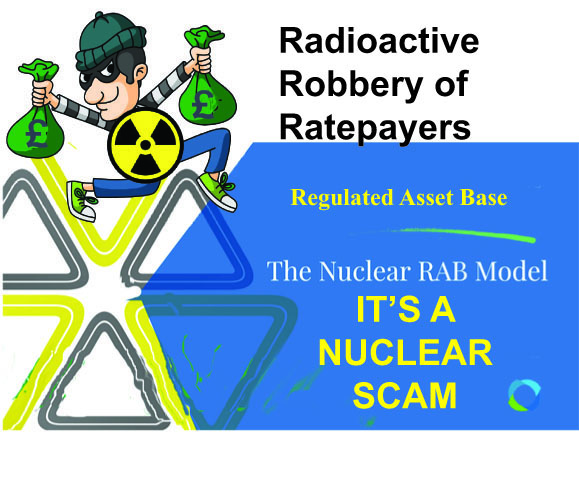
As if consumer energy bills aren’t high enough already. The government
seems hell bent on pushing them up some more. It’s poised to press the
button on its regulated asset base funding model for new nuclear power
plants: the financial bedrock of Boris Johnson’s fantasy plans to approve
eight new reactors by 2030.
The prototype is EDF’s Sizewell C, the £20
billion project nicely located on a Suffolk flood plain. By July 8
ministers will decide whether to approve the development consent order for
the 3,200MW nuke, said to be capable of powering six million homes. The
prelude to that?
Business secretary Kwasi Kwarteng going into overdrive on
the techie document front, not least over the joys of the RAB financing
model. As the law firm Slaughter and May noted in a briefing document, “a
major criticism is that . . . risk is passed on to the end consumer during
the construction phase and in a manner that may not best incentivise
developers to minimise the risk of cost overruns”.
Times 15th June 2022
https://www.thetimes.co.uk/article/fear-the-fallout-of-nuclear-funding-hszhd8lfz
An imminent radiological threat – UK’s planned Hinkley and Sizewell nuclear reactors – same design as flawed EPR reactor in China

June 14 marks the first real public reports of the accident at the
Taishan-1 nuclear reactor in China, and the Nuclear Free Local Authorities
have questioned whether the recent findings from the ongoing investigation
indicate that the EPR reactor design intended for Hinkley Point C and
Sizewell C has a ‘fatal flaw’.
Located almost 90 miles west of Hong
Kong, the Taishan-1 and 2 reactors were the first of their kind to enter
service, being of the same EPR (European Pressurised Reactors) design
intended for the Hinkley Point C and Sizewell C plants.
Designed and installed by EDF-subsidiary Framatome, building work started in 2009 and
they began commercial operations in December 2018 and September 2019,
respectively. The project is operated by Taishan Nuclear Power Joint
Venture Co. Ltd, which is jointly owned by CGN (70%) and Framatome, a
subsidiary of EDF (30%).
In late May 2021, American media outlets reported
the venting of radioactive gas at Taishan-1 following an equipment failure.
Rather than authorising an immediate shutdown, Chinese authorities
responded with obfuscation by increasing the safety limits at which the
reactor could operate. Frustrated the French operator reached out to the
international community for technical know-how and equipment to address the
problem, and in memo to the Department of Energy EDF described the
situation at Taishan-1 as ‘an imminent radiological threat to the site
and to the public’.[1]
International pressure finally prevailed and
Taishan-1 was shut-down. The reactor has ever since remained offline whilst
investigations have continued. Information remains hard to come by, but
French nuclear regulators – the ASN or Autorité de sûreté nucléaire
– have revealed that Taishan-1 suffered from two deficiencies which are
unrelated – the failure of springs in the fuel rods and excessive
vibration due to the design of the pressure vessel.
NFLA 14th June 2022
Julian Assange’s wife Stella Moris reveals how they raise children together while he is in jail waiting an extradition decision
In court, Julian has not been permitted to sit with his lawyers. And despite many applications since January 21, he has not been allowed to attend his own court hearings in person. https://www.abc.net.au/news/2022-06-08/stella-moris-my-life-with-julian-assange-extradition/101132624, My Australian husband Julian Assange is fighting for his life from within the confines of a three-by-two-metre cell in Britain’s harshest prison, Belmarsh.
The US has accused him of espionage as a result of his work with WikiLeaks in 2010-2011 and wants to extradite him to face court.
If his extradition goes ahead, Julian faces a maximum 175-year prison sentence. As his wife, I fear he will be buried in the deepest, darkest corner of the US prison system until he dies.
During another extradition hearing last year a UK magistrate blocked Julian’s transfer to the US over fears of “oppressive” conditions that could drive him to take his life.
On July 3, Julian turns 51. It will be the fourth year he has spent his birthday alone in a cell, without conviction.
Is our time together running out?
When Julian is taken from his cell to the prison yard he tilts his head up so his eyes can focus on the distance. If he narrows his eyes, the double razor wire above becomes a blur. Beyond is the open sky.
Julian recently discovered a family of nesting magpies. He spotted their home subversively nestled between the razor wire. I think our family is like those magpies.
When we are together, we are always a few metres from their nest. Our children — Gabriel, who is five, and Max, three — only have memories of their father within the brutal surroundings of Belmarsh prison.
We don’t know how long our children have left with their father. We don’t know if we can visit him or even talk to him on the phone. If the extradition goes ahead, US authorities retain the right to put Julian in conditions so cruel that no one in his position is likely to survive.
It is impossible for Julian and me to escape a feeling that he is on death row. Our weekly visits may be the only time we have left together. But for how much longer? A few months more, a few weeks, a few days and then only a few hours? I fear in the end we will count the minutes and the seconds.
Guards search inside my children’s mouths
Were it not for our children, this approaching catastrophe would be all-consuming. But Julian and I know these may be the only memories that our children will have of their father. We make our visits as joyous as possible.
I don’t need to explain to Gabriel and Max the reality of this place where we go to visit their father. They live it. The children walk under razor wire and past layers and layers of security to reach their daddy.
Guards search inside their mouths, behind their ears and under their feet. The prison dogs sniff them head to toe, front and back.
Last week, Gabriel slipped some daisies he had picked by the prison walls into his pocket to give to his father. After he passed through the metal detector his daisies were confiscated during the pat-down search by one of the guards, albeit reluctantly.
During visits, our family is allowed to embrace at the beginning and end. We can hold each others’ hands across the table. Julian and I are not allowed to kiss. But Julian would rather kiss his wife and be penalised than have that taken away from him too. So, we kiss.
Precious moments for life lessons
The children love visiting their daddy. Julian reads them stories. Gabriel shares his father’s fascination with numbers. Julian teaches them nifty tricks: the best way to peel an orange, how to open chips without losing any of the contents.
These things may sound small to most people, but they are our precious moments together. A canteen selling chips and oranges and the prison’s collection of children’s books are all that is on offer in the visitor’s hall we share with 30-or-so prisoners and their families once or twice a week.
On March 23, we were married in Belmarsh. The prison – normally filled with tragedy and isolation – was turned on its head for a few hours to celebrate our love and commitment. Our nest in the razor wire.
The last time the media photographed Julian was in 2019, through the scratched windows of a prison van. The UK Authorities insist that our wedding photos not be made public ‘on security grounds’. In court, Julian has not been permitted to sit with his lawyers. And despite many applications since January 21, he has not been allowed to attend his own court hearings in person.
Seismic blasting in Irish Sea for nuclear waste dump will be devastatingto marine life.
Seismic blasting in Irish Sea for nuclear waste dump will be devastating
to marine life. In a little-known project, the government’s Nuclear Waste
Services is to blast undersea seismic airguns off the Cumbria coast this
summer in the name of ‘scientific research’ – paid for at public
expense. LINDA PENTZ GUNTER reports. IMAGINE being subjected to
ear-shattering blasts every 10 seconds, 24 hours a day for four straight
weeks? By any metric, that would qualify as the most appalling form of
torture. But that is exactly what is about to be inflicted on whales,
dolphins, seals and other marine creatures in the Irish Sea if a new wave
of opposition cannot stop it. The Irish Sea is already the most radioactive
sea in the world, in large part a result of decades of radioactive
discharges from the Sellafield reprocessing facility on the Cumbrian
shoreline. Now, Nuclear Waste Services (NWS) has contracted a company
called Shearwater Geosciences to blast its undersea seismic airguns off the
Cumbria coast this summer, calling it “scientific research.”
Morning Star 12th June 2022
Another episode in the unlawful spying and harassment of Julian Assange and his legal team, by the UK and USA governments
Julian Assange’s Australian lawyer who counts Amal Clooney and Amber Heard as friends says she has reached settlement with government ‘over breach of her human rights after it admitted she was likely put under covert surveillance’
- Jennifer Robinson has reached settlement with Government over surveillance
- She said it accepted covert surveillance of her ‘likely breached her human rights’
- She was one of the three lead claimants in a complaint against the Government
- She said it raises ‘grave concerns’ over interference with ‘journalistic material
By JESSICA WARREN FOR MAILONLINE, DAILY MAIL, 10 June 2022
One of WikiLeaks founder Julian Assange‘s lawyers has reached a settlement with the Government after it accepted it was likely she was the subject of ‘covert surveillance which breached her human rights’, she said.
Jennifer Robinson welcomed a statement by the European Court of Human Rights which she said meant the UK Government has ‘accepted her rights were breached by surveillance’.
She was one of the three lead claimants in a complaint against the UK Government which went to the court.
Ms Robinson said the UK Government has reached a ‘friendly settlement’, admitting there was reasonable cause to believe she was the subject of surveillance.
She said: ‘The UK Government has now admitted that its surveillance and information-sharing arrangements with the US violated my rights. That includes in relation to the protection of confidential journalistic material.
‘This follows a pattern of unlawful spying on Julian Assange and his legal team, and it raises grave concerns about government interference with journalistic material and privilege.
‘It also raises serious questions about what information the UK and US governments have been sharing about Mr Assange’s case against extradition to the US.’
The development came as Mr Assange awaits a decision by Home Secretary Priti Patel on whether he should be extradited to the United States.
Ms Robinson, who works from the respected Doughty Chambers in London, has represented Assange for some 12 years.
She is the go-to barrister for the rich and famous, and counts the Hollywood elite among her inner circle, travelling to George and Amal Clooney’s wedding on a speedboat with actor Bill Murray.
In 2019, she was named international pro bono barrister of the year and prior to lockdown, was pictured at events with Prince Charles and Cherie Blair.
She has also appeared on BBC Question Time and supported Amber Heard during the Johnny Depp’s libel case against The Sun newspaper in 2020…………………. https://www.dailymail.co.uk/news/article-10901023/Julian-Assanges-lawyer-reached-settlement-government-breach-human-rights.html
Nuclear Free Local Authorities (NFLA) join the call for UK to join the nuclear ban Treaty Summit
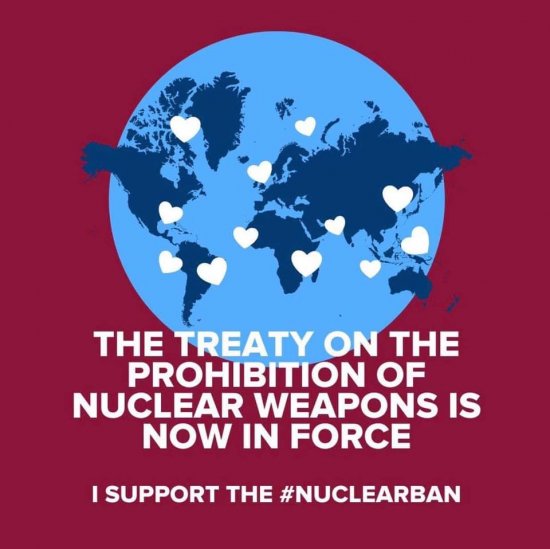
| The Nuclear Free Local Authorities have joined with campaign groups opposed to nuclear weapons in calling on the British Foreign Secretary to ensure that the UK is represented at the forthcoming nuclear treaty ban conference to be held later this month in Vienna. Sixty-one member states of the United Nations have so far signed and ratified the UN Treaty on the Prohibition of Nuclear Weapons, the first international law to prohibit the manufacture, stockpiling, transfer and use of nuclear weapons which entered force in January 2021. A further twenty-five states have signed the Treaty in readiness to ratify it. These member states will meet at the UN in Vienna between 21 – 23 June to discuss the progress so far in creating a nuclear weapons free world, and, in light of the recent conflict in Ukraine, the next best steps to get there. None of the world’s nuclear weapons states have so far engaged with the treaty, and the UK has steadfastly refused to recognise it, despite five of the states, including the UK, making a commitment as signatories to the Nuclear Non-Proliferation Treaty to work in ‘good faith’ to achieve global nuclear disarmament at the earliest possible date. Britain made this commitment as one of the first signatories to the NPT in 1968. NFLA 8th June 2022 https://www.nuclearpolicy.info/news/nuclear-free-local-authorities-join-call-for-uk-to-attend-nuclear-ban-summit/ |
Nuclear Free Local Authorities oppose Nuclear Waste Authorities’ seismic testing in the Irish Sea
| On World Oceans Day (8 June), the Nuclear Free Local Authorities have joined environmental and anti-nuclear campaigners in opposing proposals to carry out seismic testing in the Irish Sea as part of plans to develop an offshore, undersea nuclear waste dump. A joint letter, whose signatories include renowned environmentalist Jonathan Porritt, has been sent to the head of the Marine Management Organisation opposing an exemption to the requirement to obtain a Marine Licence which has been claimed by Nuclear Waste Services to enable them to plough ahead with their summer plans to carry testing in the waters off West Cumbria. The NWS, an operating division of the Nuclear Decommissioning Authority, is responsible for finding a site for a so-called Geological Disposal Facility, either below ground or beneath the seabed. This nuclear waste dump will be filled with the toxic radioactive waste that is the legacy of Britain’s seven decades of the civil nuclear power production; much of it will remain radioactive for many tens of thousands of years. Three search areas in Cumbria, falling within the local authority areas of Allerdale and Copeland and offshore up to 22kms, are under consideration. Seismic testing will enable NWS to determine if the geology beneath the bed of the Irish Sea is suitable to host a repository for the nuclear waste. This involves firing blasts of sound from air guns below the waves every 10 seconds for four weeks or longer. This sound penetrates under the ocean floor to help scientists discover more about the suitability of the geology to store nuclear waste. Seismic testing can seriously impair the health of marine life, which in the Irish Sea includes whales, dolphins, porpoises, and seals, but some scientific reports also suggest that even tiny shellfish and plankton can be adversely impacted, hazarding the whole marine ecosystem. NFLA 8th June 2022, https://www.nuclearpolicy.info/news/nuclear-free-local-authorities-oppose-seismic-testing-on-world-oceans-day/ |
Co-Founder of Green and Blacks Calls Out Small Modular Reactors: They Would Produce 30 Times As Much Nuclear Waste
While Nuclear Luvvies and Lords in Cumbria Big Up Small Modular Reactors being touted by Rolls Royce, science is stacked against them. IF science is genuinely allied to ethics and a living planet then Small Modular Reactors (or any nuclear fuelled plan ) should not even be on the table.
Co-Founder of Green and Blacks Calls Out Small Modular Reactors: They Would Produce 30 Times As Much Nuclear Waste — RADIATION FREE LAKELAND
ular Reactors
(or any nuclear fuelled plan) should not even be on the table. Craig Sams
the co-founder of Green and Blacks has written on social media: “This was
what I wrote 12 years ago. The New Scientist now reports that SMRs (Small
Modular Reactors) produce 30 times as much nuclear waste for the amount of
electricity produced and its more complex. I realise Boris upset everyone
by boozing when he should’ve been following his own rules, but condemning
future generations to even worse nuclear waste problems than we already
have is the real crime against humanity. No more nuclear. The French
nuclear power stations are corroding badly and nobody’s sure what to do.
The Irish Sea is still contaminating fish. We had to stop serving laver
bread in our restaurant Seed back in 1970 because of radioactive waste
contamination and things have only got worse since then. Wind, solar,
geothermal, oil,gas, anything but nuclear”
Radiation Free Lakeland 2nd June 2022
UK government urged to end its obsession with nuclear power

THE UK Government has been urged to end its “obsession” with nuclear
power and focus on renewable energy. The SNP have said it is “abundantly
clear” nuclear will cost more and will send energy bills soaring even
further, while people in Scotland “can see clean energy being produced in
their own backyards”.
It comes as a written response to a parliamentary
question confirms further delays to the UK’s Hinkley Point C nuclear
power station, which reports suggest could cost the taxpayer up to £26
billion – opening four years later than scheduled. MP Alan Brown, the party’s Shadow Minister for Energy and Climate change, said the delays added “insult to injury” for consumers, after UK
Government Business Secretary Kwasi Kwarteng admitted recently the
construction of new nuclear plants would initially raise household energy
bills.
Based on the contract awarded by the Westminster government to
Hinkley Point C, the electricity that will be generated by that existing
nuclear station will be priced at £92.50 per megawatt hour, for a 35-year
contract, whereas the electricity being generated from offshore wind is
currently priced at £39.65 per megawatt hour on a 15-year concession. This
means Hinkley Point C alone could add up to £40 a year to consumer bills,
compared to wind power, which could reduce bills by £8 a year. Brown said:
“This latest admission shows the Westminster government’s obsession
with nuclear power will do absolutely nothing to help people cope with the
spiralling Tory-made cost of living crisis. “For months we’ve heard
endless lectures and bleatings from the Tories on their nuclear obsession,
yet every week we’re treated to new reports and estimates of the true
cost of prioritising a massive shift towards nuclear.
“The latest reports simply add insult to injury for the consumers whose energy bills have
skyrocketed in recent months and who were promised a great reprieve when
the UK shifts its reliance to nuclear.
The Scottish Greens have also branded the UK Government’s drive towards nuclear as nonsensical. The
party’s climate change spokesperson, Mark Ruskell, said: “Both the Tory
Government and Labour Party’s ideological obsession with nuclear power
doesn’t make sense either economically or environmentally. “Nuclear is
hugely expensive and leaves a toxic waste legacy for generations. Instead
of investing in toxic white elephants, investment should be focused in
Scotland’s massive renewable potential.”
Lynn Jamieson, chair of the Scottish Campaign for Nuclear Disarmament (CND), said she rejected the UK
Government’s claims nuclear was good for the planet, and insisted we
should be transitioning away from it. She said: “The UK Government’s
claims that nuclear is good for the environment ignores the harms of
uranium mining, the radioactive waste, the risks of cancers and
catastrophic accident – irrationally favouring nuclear industries over
cheaper, safer and more quickly available renewables.
The National 1st June 2022
Nuclear safety warning threatens to derail Boris Johnson’s energy revolution
Austria objects to Sizewell C plant in its latest attack on British energy policy, Telegraph, By Helen Cahill 29 May 2022 . Boris Johnson’s plans for a nuclear energy revolution are facing a fresh hurdle after the Austrian government officially raised concerns about the safety of a new reactor design.
In a letter to the Business Department, Austria’s energy ministry raised the spectre of “severe accidents with high releases” at the Sizewell C plant to be built in Suffolk.The warning, made under the Espoo convention in which nearby countries are allowed to comment on nuclear projects, raises the prospect of legal action to derail Sizewell and will be considered by the Government as part of a planning decision in coming months.
…………………… The Austrians said that it is “questionable” whether the Sizewell design could guarantee that radioactivity will be retained within the reactor’s core.
They warned that the high power of the EPR reactor reduces the time available for an operator to react to any fault and prevent a major accident, and added: “At this time, it cannot be proven beyond doubt that severe accidents with high releases cannot occur.”
The intervention comes after Britain put nuclear power at the heart of its long-term energy strategy. https://www.telegraph.co.uk/business/2022/05/29/nuclear-safety-warning-threatens-derail-johnsons-energy-revolution/
Boris Johnson promised ”1 nuclear reactor a year for 8 years” – one by 2040 if he’s lucky!
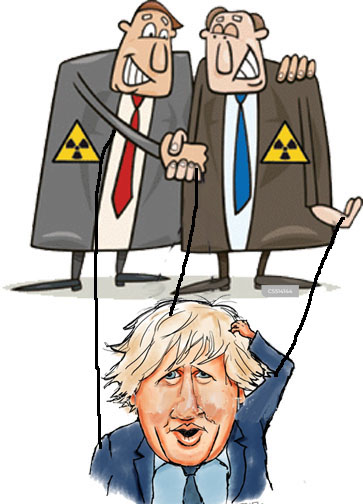
With the weather changing dramatically across the world, will politicians
finally take the climate crisis seriously? With a concerted effort, there
could still be time. But time is the critical thing. And on the campaign
trail in “red wall” seats before the May elections, the prime minister,
Boris Johnson, repeatedly promised building nuclear reactors “one a year
for eight years”.
Last week at the Conservative conference in Wales he
was at it again – this time promising one on Anglesey and another at
Trawsfynydd in Mid Wales.
Anyone who knows a little about nuclear reactors
(current designs 10 years late and £10bn over budget) or about the prime
minister’s other mega-projects – bridges across the Thames and Irish
Sea, and an airport in the Thames estuary – is confident that this
won’t happen.
A protest via my MP brought a measured response from Greg
Hands, the minister responsible for energy policy. He said provided
reactors were value for money and technically sound, the government’s
target for nuclear projects was to give one a final investment decision
this parliament, and two in the next – so maybe three building starts by
2030. On current trends that means one reactor possibly ready by 2040 and
two others much later. Far too late to heal the climate.
Guardian 27th May 2022
Another university infiltrated by the nuclear industry – University of Derby and Rolls Royce

| Rolls-Royce Submarines announced plans recently to open a new academy dedicated to nuclear training within the city. The academy forms part of their Rolls-Royce Submarines’ plans to boost nuclear capability in the UK and create a pipeline for nurturing talent. In partnership with the University of Derby, the site will create 200 new apprenticeships every year for at least the next 10 years. The academy is set to open in September 2022. The Council’s iHub – managed by Connect Derby – will become the home of the new academy, taking centre-stage at the manufacturing-focused innovation and technology site, Infinity Park. Derby City Council 26th May 2022 https://www.derby.gov.uk/news/2022/may/ihub-rolls-royce-nuclear-skills-academy/ |
1 This Month
26 September – International Day for the Total Elimination of Nuclear Weapons





PLEASE OPPOSE HR 8255 AND S.3639 – bills would accelerate satellite deployment, with no environmental review or safeguards – https://ncstd5li.quorum.us/campaign/169331/
To see nuclear-related stories in greater depth and intensity – go to https://nuclearinformation.wordpress.com
-
Archives
- September 2026 (305)
- August 2026 (330)
- July 2026 (355)
- June 2026 (287)
- May 2026 (306)
- April 2026 (356)
- March 2026 (251)
- February 2026 (267)
- January 2026 (308)
- December 2025 (358)
- November 2025 (359)
- October 2025 (375)
-
Categories
- 1
- 1 NUCLEAR ISSUES
- business and costs
- climate change
- culture and arts
- ENERGY
- environment
- health
- history
- indigenous issues
- Legal
- marketing of nuclear
- media
- opposition to nuclear
- PERSONAL STORIES
- politics
- politics international
- Religion and ethics
- safety
- secrets,lies and civil liberties
- spinbuster
- technology
- Uranium
- wastes
- weapons and war
- Women
- 2 WORLD
- ACTION
- AFRICA
- Atrocities
- AUSTRALIA
- Christina's notes
- Christina's themes
- culture and arts
- Events
- Fuk 2022
- Fuk 2023
- Fukushima 2017
- Fukushima 2018
- fukushima 2019
- Fukushima 2020
- Fukushima 2021
- general
- global warming
- Humour (God we need it)
- Nuclear
- RARE EARTHS
- Reference
- resources – print
- Resources -audiovicual
- Weekly Newsletter
- World
- World Nuclear
- YouTube
-
RSS
Entries RSS
Comments RSS

