Anti-radiation pills given out to residents, nurseries, schools, care homes and clinics near UK’s nuclear submarine ports.
EARLY 100,000 anti-radiation pills have been handed out to residents of three English ports in case nuclear submarines go into meltdown, Declassified UK has found. The medication, issued between 2016 and 2021 in Plymouth, Portland and Barrow-in-Furness, went to nurseries, schools, care homes and clinics near naval docks.
The figures were revealed in a freedom of information request by the investigative website. Nuclear-powered submarines are built for the Royal Navy by arms company BAE Systems at Barrow-in-Furness in Cumbria, and the vessels moor at sites such as Devonport dockyard in Plymouth and Dorset’s Portland harbour.
Campaign for Nuclear Disarmament (CND) general secretary Kate Hudson said: “The production, servicing and berthing of nuclear powered submarines in or near population centres presents an unacceptable health risk. “Safeguarding our communities cannot be achieved through limited distribution of pills.”
Morning Star 18th Jan 2022
Rolls Royce aims to market its Small Nuclear Reactors to Saudi Arabia (a good step towards nuclear weapons?)
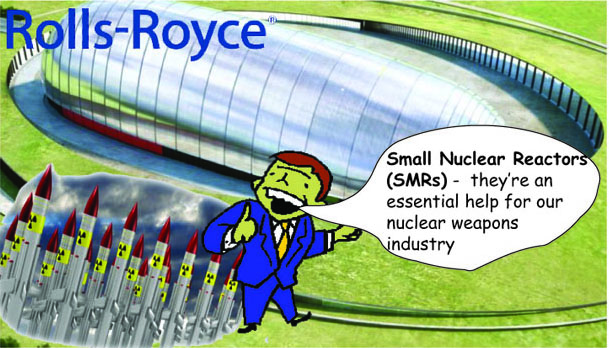
Rolls-Royce heads to Middle East as Saudi Arabia plots £74bn nuclear investment,
ROLLS-ROYCE is looking to the Middle East to export its new [so-called] green technology while Saudi Arabia is reportedly eyeing up a £74billion nuclear investment.
Express UK By JACOB PAUL, Wed, Jan 19, 2022………….. Rolls-Royce looks set to bring its SMR technology to the World Future Energy Summit. This is a global conference showcasing green energy technology. Mr Samson said the company is hoping to start talks with government representatives and large industrial in the Middle East……
And this comes as Saudi Arabia is reportedly exploring options of investing $100 billion (£73.55billion) in several nuclear plants with a combined capacity of 22 gigawatts………
It comes as Rolls-Royce looks set to bring its SMR technology to the World Future Energy Summit.
This is a global conference showcasing green energy technology.
Mr Samson said the company is hoping to start talks with government representatives and large industrial in the Middle East.
And this comes as Saudi Arabia is reportedly exploring options of investing $100 billion (£73.55billion) in several nuclear plants with a combined capacity of 22 gigawatts……..
Mtr Samson – “We have opened up a whole spectrum of customers.”
And Rolls-Royce has already been looking for opportunities to sell its technology to potential UK customers.
But the first SMR units are not expected to come online before the early 2030s. Mr Samson said the company needs to first go through the regulatory processes in Britain. It also needs time to build factories, certify its designs and move on to the production process………… https://www.express.co.uk/news/science/1552184/rolls-royce-middle-east-Saudi-arabia-smr-nuclear-world-future-energy-summit
Anglesey does not need nuclear energy – Nuclear Free Local Authorities (NFLA)
Anglesey does not need nuclear energy, says Welsh NFLA chair https://www.northwaleschronicle.co.uk/news/19853825.anglesey-not-need-nuclear-energy-says-welsh-nfla-chair/
By Matthew Chandler @chandler98_ 17 Jan 22, Report THE chair of the Welsh Forum of Nuclear Free Local Authorities (NFLA) has countered the recent suggestion by Isle of Anglesey County Council’s leader that nuclear energy is needed ‘now more than ever’.
Councillor Llinos Medi, made this claim to Guto Harri on S4C’s current affairs series, Y Byd yn ei Le.
Responding, the chair of the NFLA Welsh Forum, Councillor Ernie Galsworthy, said: “The council leader seems unaware of the reality that is nuclear power and unaware of her own party’s (Plaid Cymru’s) position on the subject.
“Nuclear energy projects are notorious for being delivered years late, being delivered massively over budget, and on occasions – as we have seen at Wylfa in the recent past – being delivered not at all.
“If the council leader really does want to keep the lights on for her electors then it is pointless looking to nuclear energy to deliver the goods.
“The small modular reactors that Councillor Medi talks of are reliant upon designs that are not yet proven and will not be operational until the mid-2030s at the earliest, and we need to tackle energy insecurity and climate change now.
“They would also be delivered at a massive cost to the Welsh taxpayer as everyone will face a ‘nuclear tax’ on their electricity bills to fund it, thanks to the Conservative Government’s Nuclear Energy (Financing) Bill.”
The NFLA is clear on its own position: Wales should move away from nuclear and make a commitment to powering the nation using 100 per cent renewables.
Councillor Galsworthy added: “The Scottish Government has set itself a target of meeting 100 per cent of their nation’s energy needs through renewables alone, and they are now up to 96 per cent, and the Welsh Government should look to do the same.
“Our nation is blessed with natural resources that can, and should, be utilised to meet our current and future energy needs.
“I would urge Councillor Medi not to become another Atomic Kitten. Wales does not ‘need’ nuclear and we do not have to ‘have’ it.
Solar, tidal, wind and hydro-electric power projects can all be delivered now using proven technology far more quickly and at much less cost than nuclear, and without the dangers associated with nuclear power or the need to store safely the resultant radioactive waste.
“Anglesey as the ‘energy island’ could be at the forefront of that renewables’ revolution bringing the many jobs, far more than nuclear, for that island community that would result.
“If Councillor Medi wishes to have a ‘conversation’ about bringing that vision to the island, the Welsh NFLA will be happy to have it.”
Labour tries to curb cost overruns from Sizewell C development
Bill Bordass, Research and Policy Adviser for the Usable Buildings Trust said: ‘Surely the only sensible way to curb Sizewell C is to scrap it entirely? It is just good money after bad.’
Labour bids to curb cost overruns from Sizewell C development, https://100percentrenewableuk.org/labour-bids-to-curb-cost-overruns-from-sizewell-c-development, David Toke, 16 Jan 22, The Labour frontbench has put down an amendment to the Nuclear Financing Bill which would stop the automatic reimbursement of EDF for excess construction costs of the planned Sizewell C nuclear power plant. The amendment, put forward by Shadow Green New Deal and Energy Minister Alan Whitehead, has been defeated by the Conservative majority in the Commons, but will soon come up for a vote in the House of Lords.
The Nuclear Financing Bill sets up a so-called Regulated Asset Base (RAB) means of funding nuclear power. This means the constructors would be be paid for the construction costs before the plant was generating anything. It would save the constructors money whilst making the project a lot more expensive for the energy consumer in the (most likely) event that the project experienced considerable cost overruns.
Although the SNP has also put down useful amendments to make the Government publish details of the costs of the project, Labour’s proposed amendment is potentially significant in that it could, if taken literally, dissuade EDF from moving ahead with any deal to build Sizewell C. As Whitehead told the Commons, analysis of historical experience of building nuclear power plant it is a near certainty that there will be cost overruns on the project.
In fact Whitehead implied he was not trying to stop the project, but merely argued that cost overruns should not automatically be added to consumer bills. If there were cost overruns then the Government could find the extra money to pay for the project from some other source.
Amongst other things, the SNP amendments asked that the Government should have to make public whether Sizewell C was being given a guarantee that its generation would be paid a minimum price for each MWh produced. Labour also sought to block nuclear power plant being owned by foreign companies, although it was argued this would not affect Sizewell C.
Labour joined forces with the Conservatives to vote through the Bill on the Third Reading, with the SNP, the Liberal Democrats and the Green Party whipping against the Bill.
It ought to seem strange that at the very time there is concern about increased energy bills and strident calls to cut back on green levies from some Tory MPs, the very same MPs are unquestioningly voting through a piece of legislation that will add substantial sums onto consumer bills. EDF has said that Sizewell C will cost £20 billion. Considering that interest charges and also cost overruns will have to be added to this sum the total cost may very plausibly amount to £30 billion or more – and that represents more than £1000 for each household in the UK.
The amount of energy generated by Sizewell C will only be of the order of the next tranche of renewable energy projects (to be issued in the coming moths) that will cost the consumer effectively nothing. By contrast Sizewell C will likely not even be seriously begun until Hinkley C is completed (2027?) which means a 2035 or later start. The UK could have deployed a lot more renewable energy by then of course at much lower cost. The current nuclear crisis in France demonstrates how unreliable nuclear power can be.
Bill Bordass, Research and Policy Adviser for the Usable Buildings Trust said: ‘Surely the only sensible way to curb Sizewell C is to scrap it entirely? It is just good money after bad.’
The Commons debate details can be seen here. The House of Lords is due to vote on the Bill in the coming days.
Regulated Asset Base – UK’s nuclear tax on electricity consumers – supposed to attract foreign investment

Energy costs and energy investment, Renew Extra Weekly, January 15, 2022 ”……………………… Energy prices are accelerating seemingly out of control. But actually the way the Contracts for Difference (CFD) is structured, with competition for capacity slots and a claw back of any excess income over strike price costs, it may not be too bad- it does seem to limit excess cost pass-though, unlike the old Renewables Obligation system, which some now see as much less attractive. So, with the CfD apparently doing well, it might be thought to be a bit odd that the government has shifted away from using it for nuclear, to a new Regulatory Assets Base (RAB) system for new large plants. The CfD was used to finance Hinkley Point C EPR, but it did so excessively, with a £92.5/MWh index linked contract being awarded to EDF without competitive bids being considered.
The CfD could in theory have been used again for the next big nuclear project, this time with a competition, but evidently the high project costs, and the high resultant strike prices likely, made it less attractive. So instead the government is going for Regulated Asset Base (RAB), basically a nuclear tax on electricity consumers, raising capital to fund construction of new plants, so that income starts flowing before construction starts.
It’s claimed that this element of RAB will make it easier for companies to finance nuclear, so that they can eventually charge consumers less. Well, we will see. But equally, if there’s a cost overshoot or delay, consumers will get hit hard, and, if the project is abandoned, their involuntary investment will be lost. Interestingly that includes Scottish consumers, despite anti-nuclear Scotland not being likely to allow any new plants to be built there. So Scots would be subsidising projects in England and Wales.
That won’t go down well with the SNP.
The RAB plan, which, even if all goes well, will put some extra costs on power bills, does in any case look odd for all consumers, given that the government says it wants to remove energy taxes from electricity and impose them instead on domestic gas heating. That may be sensible, but, with RAB, it’s going the wrong way.
A subsidy too far?
So why is government adopting for RAB for new nuclear? Evidently it’s to attract foreign investors! The Regulated Asset Base nuclear finance bill has just got through a House of Commons vote unamended.
During the debate, Business & Energy Secretary Kwasi Kwarteng said: ‘The existing financing scheme has led to too many foreign nuclear developers walking away from projects, setting our nuclear industry back a number of years. While the existing Contracts for Difference model was right for Hinkley Point C, the lack of alternative funding models has significantly contributed to the cancellation of recent potential large-scale projects. And this includes Hitachi’s project at Wylfa and Toshiba’s project at Moorside. We urgently need a new approach to attract capital into the sector.’
Somehow that seems to clash with what Energy and Climate Minister Greg Hands said: ‘The Bill will finance new nuclear power stations, making us less dependent on foreign-owned developers and bringing in the private sector and institutional funding.’
All of this, remember.. is because nuclear projects are too costly to win under normal competitive markets terms, whereas, increasingly, mainstream renewables like wind and solar can do that……….
there are some urgent infrastructure projects that could help cut energy costs quite quickly, the most obvious being investment in energy efficiency. For example, the Energy Efficiency Infrastructure Group said that improving insulation on the UK’s least efficient homes would save households around £500 a year on energy bills, totaling £8bn p.a. nationally. ……………
RAB funding might make it cheaper to build new gas stores rather than relying on imports…………
All of which seems to make more sense that using RAB for nuclear, which shows little sign of getting cheaper no matter how much money is chucked at it. Instead it seems to just soak up money, as with the much delayed EPR still being built at Flamanville in France, currently not scheduled for completion until 2023 and full operation in 2024, at an expected cost now put at Euro12.5bn. That is well over three times the original Euro 3.3bn estimate made when work started on it in 2007. And that assumes there are no further problems, like the fault that has shut down the Chinese version of the EPR, just at the point when China is desperate for power. An odd sort of asset that…and a problem that may rebound on the French EPRs. https://renewextraweekly.blogspot.com/2022/01/energy-costs-and-energy-investment.html
Scots plan to celebrate anniversary of Treaty on the Prohibition of Nuclear Weapons (TPNW)
Janet Fenton: SCOTS are getting ready to mark the anniversary of the entry
into force of the Treaty on the Prohibition of Nuclear Weapons (TPNW) on
January 22 with events across the country on the day itself and in the
lead-up to it, reflecting a global movement for a response to the
escalating dangers presented by nuclear weapons, climate change and
pandemics.
A motion supporting the TPNW has attracted cross-party support
and will be debated in the Scottish Parliament on Thursday. This will also
highlight the first meeting of those who are signed up to the TPNW which is
due to take place in Vienna this March, and Scottish Parliamentarians will
be in attendance along with representatives from the majority of UN member
countries. The UK Government is choosing to boycott the negotiations.
The National 15th Jan 2022
https://www.thenational.scot/news/19850719.scotlands-role-key-mark-anniversary-tpnw/
Scotland’s electricity consumers will pay up for UK’s Hinkley nuclear plant, though it’s not even built
The UK Government’s commitment to new nuclear power stations in England
will push up energy bills for consumers in Scotland. Although Scotland has
used planning laws to prevent any new nuclear south of the border, the UK
Government has pressed ahead with projects like Hinkley Point, which will
charge bill payers upfront to subsidise nuclear power stations that
haven’t even been built yet.
The issue was raised in the Scottish
parliament this week by Scottish Greens energy spokesperson Mark Ruskell,
prompting the Net Zero secretary Michael Matheson to confirm that “in
2030 alone Hinkley could add almost £40/year to a consumer bill whereas an
equivalent offshore wind farm would reduce bills by £8/year.”
Commenting, Mark Ruskell said: “As well as leaving a toxic legacy for
generations to come, nuclear power is a bad deal for consumers now, at a
time when energy bills are pushing more and more households into fuel
poverty.
“Renewable energy is far cheaper, and since it doesn’t result
in toxic waste which will remain deadly for hundreds of thousands of years,
better for the environment too. That’s why with Greens in government
Scotland is doubling our onshore wind capacity and investing in offshore
wind and marine renewables too. “The UK Government’s energy policy is
more about helping its friends than following the science or tackling fuel
poverty. It’s important we do things differently in Scotland, which would
be helped with the greater powers of independence.”
Scottish Greens 14th Jan 2022
UK’s Advanced Gas Cooled (AGRs) reactors should be shut, as they are vulnerable to cracking
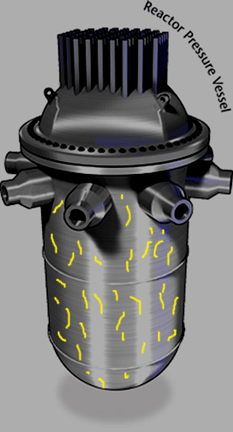
“The AGRs have already had a good run operating way beyond their intende 30-year lifecycle, but the fact is that as the reactors age so does the integrity of their graphite cores which moderate the nuclear reaction.
| EDF case for continued AGR reactor operations ‘cracking up’, says NFLA. The early closure of the final reactor at Hunterston B Nuclear Power Station last Friday (7 January) signalled yet another step towards the long-overdue demise of the outdated Advanced Gas Cooled (AGRs) reactors operated by EDF Energy, a subsidiary of French state owned EdF (Électricité de France), across the UK. After being shut down for much of 2019, EDF hoped to continue operations at Hunterston B until 2023 but increasing instances of cracks in the graphite cores of the reactor brought forward closure plans by a year. The problem of cracks in the graphite cores which compromises safety has long been an issue of concern to the Nuclear Free Local Authorities (NFLA). Councillor Blackburn said “The AGRs have already had a good run operating way beyond their intende 30-year lifecycle, but the fact is that as the reactors age so does the integrity of their graphite cores which moderate the nuclear reaction. Although EDF plans to close the last AGR in 2028, this is way too long and the timescale for closure needs to be brought forward in the interests of plant and public safety NFLA 12th Jan 2022 https://www.nuclearpolicy.info/news/edf-case-for-continued-agr-reactor-operations-cracking-up-says-nfla/ |
‘Nuclear obsession’: Tory bill to let firms charge customers to build plants
‘Nuclear obsession’: Tory bill to let firms charge customers to build plants https://www.thenational.scot/news/19837771.nuclear-obsession-tory-bill-let-firms-charge-customers-build-plants/?fbclid=IwAR2qOsgM6f-vP8Y1Ieh4N2fAPD-00KK5j2I8Megxd7BEfa0hlLs-FmBI2ss
Gregor Young, 14 Jan 22, ONLY independence will rid Scotland of Westminster’s nuclear obsession ahead of a bill that will allow energy companies to increase consumer bills to build nuclear plants, the SNP have warned.
The Tories’ Nuclear Energy (Financing) Bill, which received its third reading in the House of Commons yesterday, would allow energy companies to pass the cost of a future nuclear power station to their current consumers.
The bill comes amidst a Tory-made cost-of-living crisis as energy bills and food prices continue to soar, after a £1000 cut to Universal Credit, and ahead of a regressive National Insurance hike.
The SNP Scottish Government has made it clear that it is committed to opposing new nuclear power plants and prioritising renewable and low carbon sources of energy, with Scotland producing nearly all of its electricity from renewable sources.
SNP energy spokesperson Alan Brown MP said: “Scotland has made it clear time and again that we do not want nuclear power stations – yet we will foot the bill for them anyway as the Tory government hammer on with their nuclear obsession.
“It is madness that during a cost of living crisis, the Tories are pushing through a bill that could see energy bill consumers forced to pay for another Tory vanity project.
“We do not need nuclear energy to decarbonise and there are better, and cheaper, ways to produce energy. The experts have made this clear.
“The only way for Scotland to escape the Tories’ costly nuclear obsession is through independence.”
UK’s Nuclear Financing Bill – very strange logic – with £40 billion to £60 billion for a new nuclear power station seen as a good thing.
Last week Tim Farron MP sent the following reply to Radiation Free Lakeland when we urged him to vote NO to the public paying for new nuclear build in the Nuclear Financing Bill yesterday. Our MP’s opposition to new nuclear is heartening. But this opposition was not reflected in the vote of
458 for to 53 against (how many others opposed did not vote?) the Bill at third reading.
The Bill will now be considered in the House of Lords. This vote is truly shocking. Alan Brown MP said during the debate Government “has been very good at telling us about the mythical savings that will
accrue via the regulated asset base funding model introduced by this Bill—they are estimated at between £30 billion and £70 billion. What the Government are not so good at is telling us what money they want to commit for the likes of Sizewell C. In effect, they are telling us, ”Let’s save money for bill payers by signing up to a less bad deal for a new nuclear project.”
According to the impact assessment, the capital and financing cost is going to be in the region of £40 billion to £60 billion for a new nuclear power station.
It is a strange logic to tell us that £50 billion being added to our energy bills at the time of a cost of living energy crisis is somehow a good thing. By default, the Government are also confirming just how much of a stinking, rotten deal Hinkley Point C was for bill payers if we are saying that we can save that much money compared with the contracts for difference model for Hinkley C.”
Radiation Free Lakeland 11th Jan 2022
UK’s Nuclear Energy (Financing) Bill passes in House of Commons

New funding plan for Sizewell C station clears final hurdle in Commons https://www.eadt.co.uk/news/business/funding-plan-sizewell-c-suffolk-clears-commons-8612482
Matthew Earth January 10, 2022
Plans for a new way of funding nuclear power plants – including Sizewell C on the Suffolk coast – have cleared their final hurdle in the House of Commons.
Business Secretary Kwasi Kwarteng described the passing of the Nuclear Energy (Financing) Bill on Monday evening as the “path to leadership and innovation”.
The Bill creates a new framework for funding nuclear power plants, after worries from investors have led to current projects stalling.
It would allow pension funds and other institutional investors to provide cash for power stations through a regulated asset base funding model.
Energy bill payers would contribute towards the cost of new power stations during construction through their bills, with the aim of giving investors greater certainty after projects such as Sizewell C faced delays due to concerns over the financial risks of construction.
However, Labour has said bill payers could be exploited as a “milk cow” under the new scheme if power stations face delays during building work.
MPs voted 458 to 53 in favour of the Bill at third reading, and it will now be considered in the House of Lords.
The government has recently agreed a six-week delay to the final decision A final decision on whether the station will be built is expected later this year.
Factoring in the full cost of the radioactive wastes, the price to pay for nuclear power is astronomic.
The price to pay for nuclear power is too high, https://www.scotsman.com/news/opinion/letters/the-price-to-pay-for-nuclear-power-is-too-high-readers-letters-3520498 Tim Flinn, Garvald, East Lothian, 10 Jan 22,
It doesn’t seem 30-odd years since I went with a group of sixth form A Level physics students on a tour of Dunbar’s Torness nuclear power station, now scheduled for decommissioning.
Most of them now have their PhDs and families of their own, but hopefully they all share my view that nuclear electricity remains the most toxic and expensive domestic fuel in regular use – and will remain so unless and until the problems associated with its deadly wastes are finally solved.
As things stand now the next 500 human generations will be stuck with the human and financial costs consequent upon coping with the radioactive detritus of the very first nuclear electricity generated some 80 years ago. Factoring in inflation the final price of just a single nuclear kWh will total more £s than there are particles in the universe. If anyone doubts that, let them do their own sums, or get a copy of mine (I hope they can cope with logarithms and discounting cash flows).
If the investment into nuclear energy (originally so we could keep up with the Jonses and have our own A and H bombs) had instead been ploughed into research and development of clean, safe, renewables we would long ago have had endless energy to spare and green devices to export. But we didn’t and so we haven’t. To replace one nuclear power station with yet another is to refuse to learn. Are we that stupid still?
Just the bare 144 years of above-ground storage for UK’s Chapelcross Intermediate Level Nuclear Waste
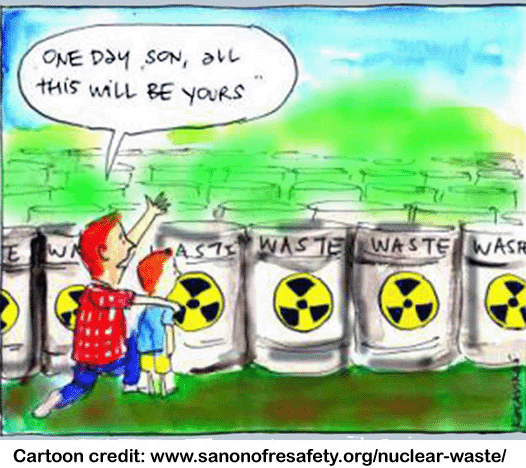
The question for policy makers is do we really want to contemplate building new nuclear power stations when the legacy will be with future generations for 102 years, nearly two and a half times beyond any new nuclear plant’s operational life. The cost of nuclear electricity generation is high and future costs of dealing with the legacy are also passed on to at least four future generations.
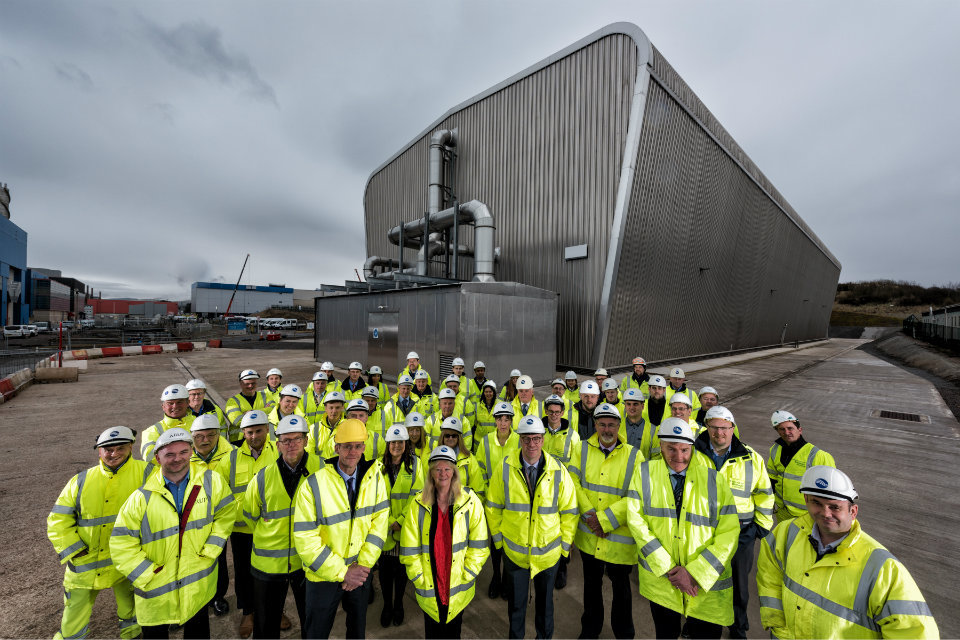
| Following on from a previous article on Hunterston B which was shut down last Friday I decided to have a look at one of the smaller nuclear power stations in Scotland to see how work was progressing on decommissioning. Chapelcross nuclear power station occupies a 92 hectares site on the location of a former World War II training airfield in Annan. Chapelcross had 4 Magnox reactors, each with a 48MW output. Chapelcross was linked to sister plant Calder Hall in Cumbria which is now the site of the NDA’s Sellafield operation. Calder Hall closed in 2003 and Chapelcross in 2004. Both plants were originally operated by the UK Atomic Energy Authority. Their main purpose was to produce weapons-grade plutonium although they also generated electricity for the National Grid. By 1st April 2019, Chapelcross had been defuelled and all High Level Waste moved to Sellafield. At that point, almost three years ago, the Intermediate Level Waste as well as LLW had still to be dealt with. The VLLW would appear to be close to the end of the decommissioning process. The LLW is destined for containers in Cumbria and the estimated 4,900 cublic metres of Intermediate Level Waste will be left onsite in specially constructed containers for a period of 120 years, pending a Scottish Government decision around 2145 on disposal of the containers and contents. The interim storage facility for storing Intermediate Level Waste at Chapelcross began 2014 and was completed by May 2021 when the first ‘package’ was placed in the facility. In announcing this progress Magnox Ltd and the NDA said in a news release; “The Interim Storage Facility (ISF) can hold over 700 waste packages of four different approved package types, and will be filled over the next five years as part of decommissioning work. Standing at 57m long and 23m wide, it has been constructed to safely and securely store packages for 120 years.” Work on the Intermediate Level Waste which is due to complete in 2026. The storage facility is then sealed for 120 years when a decision will be made by the Scottish Government on final disposal of ILW storage and contents. Whilst it can be argued that the core decommissioning work will take around 22 years, the end game is still 120 years away making 144 years in total for final clearance at the site. Chapelcross operated for 44 years. The ILW will remain on the site until 2146 although the buildings will be long gone by then. It is essential we deal with the legacies of the past and do so to the highest possible standard because we owe that to our own and future generations. The question for policy makers is do we really want to contemplate building new nuclear power stations when the legacy will be with future generations for 102 years, nearly two and a half times beyond any new nuclear plant’s operational life. The cost of nuclear electricity generation is high and future costs of dealing with the legacy are also passed on to at least four future generations. Newsnet 10th Jan 2022 https://newsnet.scot/news-analysis/nuclear-decommissioning-chapelcross-a-timeline/ |
Cracked’ nuclear power station retired.
Cracked’ nuclear power station retired. The Ecologist, Katrine Bussey | 10th January 2022 ‘As the expensive and hazardous job of cleaning up the radioactive legacy Hunterston leaves in its wake now begins, Scotland must press on with plans to harness more clean, renewable energy.’
One of Scotland’s two nuclear power plants has been shutdown, bringing an end to almost 46 years of it generating electricity.
Environmental campaigners said the final shutdown of Hunterston B, near West Kilbride – which started producing electricity 45 years and 11 months ago – was “inevitable”.
Lang Banks, the director of WWF Scotland, said the plant had become increasingly unreliable, and argued that growth in renewable energy means nuclear power is no longer required.
Technologies
Mr Banks said the “repeated failure to solve the problem of hundreds of cracks in the graphite bricks surrounding the reactor core means the closure of Hunterston B was inevitable”.
He added: “Thankfully Scotland has massively grown its renewable power-generating capacity, which means we’ll no longer need the electricity from this increasingly unreliable nuclear power plant.
“As the expensive and hazardous job of cleaning up the radioactive legacy Hunterston leaves in its wake now begins, Scotland must press on with plans to harness more clean, renewable energy.”
A Scottish Government spokesperson said: “Hunterston B, its operators and in particular the workforces who have staffed the plant for more than 40 years, have played an important role in supporting Scotland’s energy requirements.
“We do however remain clear in our opposition to the building of new nuclear power plants in Scotland under current technologies.
Transition
“Significant growth in renewables, storage, hydrogen and carbon capture provide the best pathway to net zero by 2045, and will deliver the decarbonisation we need to see across industry, heat and transport.
They added: “We recognise that planning will be crucial to ensure that economic and social opportunities from the transition are not missed.
“Our National Just Transition Planning framework sets out the consistent, ambitious approach we will take to developing transition plans.
We have committed to delivering our first Just Transition Plan as part of the forthcoming refreshed Scottish Energy Strategy, and will work in partnership with businesses, workers and communities to ensure this provides the certainty needed for investment in our net zero journey.
“As part of the jointly Scottish and UK Government funded Ayrshire Growth Deal, regional partners are developing a business case for the Hunterston Strategic Development Area to support a long-term strategic plan for the Ayrshire region, its people and businesses.”………………. https://theecologist.org/2022/jan/10/cracked-nuclear-power-station-retired
To bankroll the failing nuclear industry, the UK government will push thousands into fuel poverty, with its Nuclear Energy (Financing) Bill

Bad for fuel poverty, bad for climate action: why MPs should vote against the Nuclear Energy Bill on Monday.
Controversial legislation is being rushed through parliament which will transfer billions of pounds onto
individual consumers, whilst affording them no protection from the spiralling construction costs of nuclear power. Introduced at the end of October when attention was rightly focused on COP26, the Bill has received little attention.
Yet it will have a profound impact on millions of families forced to foot the bill and will push thousands more into fuel poverty. So why is the government forcing more families into fuel poverty?
To bankroll a failing industry. With all 15 British nuclear power plants set to be closed by 2030, funding for eight new ones is in a state of collapse. Only one plant – Hinkley Point C – is under construction and
this is running ten years late and £4.5 billion over budget. The Bill enables energy companies to use a regulated asset base (RAB) model to transfer the construction costs – and financial risks – onto consumers
and start making a profit even before the plants generate any electricity.
Labour Outlook 9th Jan 2022
1 This Month


of the week– Nuclear Reactor Information Task Force

14 May – online event From Bombs to Data Centres: the Face of Nuclear Colonialism
To see nuclear-related stories in greater depth and intensity – go to https://nuclearinformation.wordpress.com
-
Archives
- May 2026 (156)
- April 2026 (356)
- March 2026 (251)
- February 2026 (268)
- January 2026 (308)
- December 2025 (358)
- November 2025 (359)
- October 2025 (376)
- September 2025 (257)
- August 2025 (319)
- July 2025 (230)
- June 2025 (348)
-
Categories
- 1
- 1 NUCLEAR ISSUES
- business and costs
- climate change
- culture and arts
- ENERGY
- environment
- health
- history
- indigenous issues
- Legal
- marketing of nuclear
- media
- opposition to nuclear
- PERSONAL STORIES
- politics
- politics international
- Religion and ethics
- safety
- secrets,lies and civil liberties
- spinbuster
- technology
- Uranium
- wastes
- weapons and war
- Women
- 2 WORLD
- ACTION
- AFRICA
- Atrocities
- AUSTRALIA
- Christina's notes
- Christina's themes
- culture and arts
- Events
- Fuk 2022
- Fuk 2023
- Fukushima 2017
- Fukushima 2018
- fukushima 2019
- Fukushima 2020
- Fukushima 2021
- general
- global warming
- Humour (God we need it)
- Nuclear
- RARE EARTHS
- Reference
- resources – print
- Resources -audiovicual
- Weekly Newsletter
- World
- World Nuclear
- YouTube
-
RSS
Entries RSS
Comments RSS
 nuclear-news