The UK’s £1 billion Thank You to Uncle Sam

The UK is set to buy a fleet of US fighter jets that can drop nuclear bombs. The purchase is purely political, say watchdogs
RICHARD NORTON-TAYLOR, 6 November 2025, https://www.declassifieduk.org/the-uks-1-billion-thank-you-to-uncle-sam/
Keir Starmer’s plan to buy American fighter jets armed with nuclear bombs whose use will be entirely under the US president’s control makes no military sense, nuclear weapons monitors warn.
In a report released today, the Nuclear Information Service and Nukewatch UK make clear that the deal, announced by the prime minister on the eve of a Nato summit in June, is a blatant attempt to appease President Trump.
The new fleet of F-35 As is estimated to cost about £1 billion. That does not include the cost of the nuclear bombs which the aircraft would carry.
But the cost is only one of many uncertainties surrounding the project.
The decision to buy twelve F-35 A aircraft for the Royal Air Force capable of dropping US B61 gravity, “free fall” nuclear bombs – so-called “tactical” nuclear weapons – risks triggering a dangerous nuclear escalation, increasing the threat to British citizens, says the report.
And because their role would be dependent on the US, it would do nothing to address European concerns about America’s commitment to the Nato alliance, it adds.
The report says the decision “was made for purely political purposes rather than to provide a military capability that will play any meaningful role in defending Nato”. The move also undermines the nuclear non proliferation treaty (NPT).
UK picks up the tab
The nuclear bombs provided to RAF aircraft would replicate capabilities already provided by other European Nato members, says the report.
Moreover, the monitors find there is no guarantee that the weapons carried by F-35s with a limited range would succeed in any conflict.
The decision to buy the fleet of nuclear bombers from the US “reflects a long-standing trend by the UK government to prioritise trans-Atlantic politics over genuine military needs”, the report emphasises.
It quotes Bernard Gray, a former top Ministry of Defence official responsible for weapons procurement who said: “If money was no object, we could view the £2 bn price tag for doing this as a Thank You to Uncle Sam.”
Gray, who was referring to the potential price of both the planes and the bombs, added: “The UK is in effect picking up part of the cost of the mission that would otherwise fall on the US. In a world that wants to please President Trump, it’s easy to see how it plays well to buy aircraft primarily built in Texas.”
The authors of this year’s Strategic Defence Review, led by former Labour defence secretary Lord George Robertson, have downplayed the idea of Britain joining a Nato “tactical nuclear” weapons mission.
Robertson has suggested that a perceived capability gap between strategic nuclear deterrence and tactical nuclear weapons could be bridged by investing, instead, in heavy long-range conventional weapons.
His caution was echoed by Fiona Hill, British-born former national security adviser to Trump, during a Defence Committee evidence session in June.
Pointing to how Germany, Belgium, the Netherlands, Italy and Turkey host US nuclear weapons, she added: “There are other allies who already have dual capable aircraft as part of their arsenal”.
In a reference to Britain’s Trident nuclear missile system, she made the point that Britain already played a “unique role” in Nato.
Concerns over Trident reliance
But today’s report also points to potential vulnerability of Trident, Britain’s strategic nuclear weapons system which relies heavily on US support, and serious mechanical problems affecting the new Dreadnought fleet of submarines designed to carry the missiles.
The report points to widespread scepticism about the role of theatre nuclear weapons, and the misleading assumption that using them would not escalate a conflict leading to the use of longer range and larger nuclear weapons systems.
It quotes Sir Lawrence Freedman, one of Britain’s foremost military strategists, as saying: “There are lots of ways of hurting countries without actually having to use nuclear weapons yourself”.
“The idea that the further proliferation of theatre nuclear weapons is necessary or will make the world safer in any way is clearly absurd,” says the report.
“When looked at objectively, they are merely a ‘solution’ looking for a problem.”
The report also makes the point that while the theatre nuclear weapons proposed for the RAF would be entirely dependent on the US, Trident is far from being the independent deterrent as successive British governments have persistently claimed.
Britain relies entirely on the US for Trident missiles as well as the design of modern nuclear warheads.
There are also growing concerns about the reliability of Trident submarines leading with longer and longer patrols at sea, while the timetable for replacing the existing Vanguard class with Dreadnought class is slipping.
Turning back the clock
Okopi Ajonye, research manager at Nuclear Information Service told Declassified: “The UK government went to a lot of trouble to denuclearise the RAF at the end of the Cold War. This move was welcomed by the service, as it allowed the air force to focus on more important and relevant roles.
“Starmer and Healey now want to turn the clock back and commit the RAF to an entirely unnecessary nuclear mission that will have major implications for the service and considerable hidden costs.”
Ajonye added that the proposal “has all the hallmarks of having been pulled together in a hurry without any thought about its practicalities or consequences” and guided by the politics of the Nato alliance rather than military need.
“The government’s plan is basically just political smoke and mirrors to deceive the public and politicians from other Nato countries into thinking that the UK is taking a significant step to strengthen its nuclear forces when in reality it is doing next to nothing,” he said
“The UK’s entry into Nato’s nuclear mission is driven less by strategic or military necessity and more by a desire to reassure two audiences: domestic political concerns over the crumbling Trident programme, and international concerns about the credibility of US security guarantees to Europe”.
Costs add up
There are also concerns over the management of the existing F-35 fleet with a recent report by the Commons Public Accounts Committee expressing serious concerns about the MoD’s handling of the warplanes, including what it calls an unacceptable shortage of engineers.
It added: “There are also questions over the additional costs of operating nuclear-capable F-35As, and how long the necessary arrangements will take to prepare.
“The deal would add new requirements to training, personnel and possibly infrastructure yet discussions in this area are at an early stage, and no indication of forecast costs has been provided by MoD.
Sir Geoffrey Clifton-Brown, chair of the committee, commented: “Making short-term cost decisions is famously inadvisable if you’re a homeowner with a leaky roof, let alone if one is running a complex fighter jet programme – and yet such decisions have been rife in the management of the F-35.”
He added: “There are basic lessons here that MoD has been worryingly slow to learn. Its appraisal of the F-35’s whole-life cost is unrealistic, which it currently gives as at almost £57bn through to 2069.”
The message from MPs is that the total cost to British taxpayers of taxpayers of the nuclear-armed American F-35s will be significantly more than that.
Nuclear Information Service and Nukewatch UK will hold a webinar about the report and F-35 nuclear-armed aircraft on 11 November.
Bpifrance helps UK nuclear reactor to financial close.
6 November 2025 By Jacob Atkins
French export credit agency Bpifrance is covering a £5bn loan from 13
commercial banks to help finance the construction of the Sizewell C nuclear
power station in England. The facility, structured as a green loan, sits
alongside a £36.5bn term loan from the UK’s National Wealth Fund, which
was announced earlier this year, as well as a £500mn working capital
facility. Bpifrance has secured refinancing from French public development
bank Sfil, according to a November 4 statement. BNP Paribas acted as joint
debt advisor to Sizewell C, with HSBC as French authorities and green loan
co-ordinator, and Santander as documentation co-ordinator on the Bpifrance
facility. The other lenders on the Bpifrance loan are ABN Amro, BBVA,
Crédit Agricole, CaixaBank, Citibank, Crédit Industriel et Commercial
(CIC), Lloyds Bank, Natwest, Natixis and Société Générale.
Global Trade Review 6th Nov 2025, https://www.gtreview.com/news/europe/bpifrance-helps-uk-nuclear-reactor-to-financial-close/
Scottish National Party reject UK Government’s ‘nonsense’ national security threat smear
THE SNP have rejected the UK Government’s “nonsense” accusations
that they are a threat to national security. Three Cabinet ministers have
levelled the accusation against the party three times since the beginning
of the week.
Speaking in the Commons on Monday, Defence Secretary John
Healey said: “The continuation of the Scottish nationalist Government in
Scotland is a threat to our security and to future prosperity and jobs in
that country.”
Asked about those claims at a meeting of the Scottish
Affairs Committee on Wednesday, Scottish Secretary Douglas Alexander
replied: “I find myself, as usual, in agreement with the Defence
Secretary.” He pointed to the SNP’s opposition to nuclear weapons and
to its historic ban on public money being spent on weapons manufacture.
North East Green MSP Maggie Chapman said: “Trident is a moral abomination that swallows huge sums of money that we could spend instead on improving people’s lives, on tackling poverty, on funding our public services.
The Scottish Government should not be offering even more funding for
multibillion pound weapons giants who have armed and supported Israel’s
genocide against Gaza. These are not extreme statements. They are views
held by large numbers of people, including me. The military industrial
complex does not ensure our security: it lays the foundations for future
conflict and misery.”
The National 5th Nov 2025, https://www.thenational.scot/news/25599877.snp-reject-uk-governments-nonsense-national-security-threat-smear/
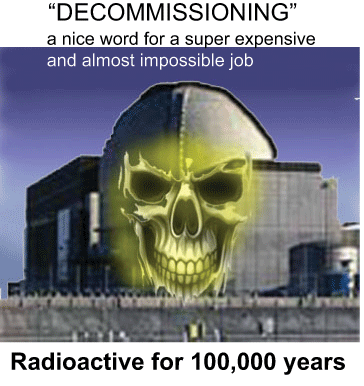
Hinkley Point B to begin 95-year decommissioning plan
Clara BullockSomerset, 5 Nov 25, https://www.bbc.com/news/articles/c986pvg41y2o
A former nuclear power station will begin its 95-year decommissioning process after regulators granted formal consent.
EDF’s Hinkley Point B, which lies on the Somerset coast near Stogursey, has been given the green light to be demolished by the Office for Nuclear Regulation (ONR).
In August 2022, Hinkley Point B reached the end of its operating life after nearly 46 years of generating electricity.
Dan Hasted, ONR director of regulation, said: “We will continue to proportionately regulate the Hinkley Point B site throughout the decommissioning phase to safeguard workers and the public.”
The nuclear site will transfer from EDF to the Nuclear Restoration Services next year, which will oversee the site’s dismantling.
Under the proposals, Hinkley Point B, which opened in 1976, could be decommissioned in three phases.
The first phase, which will last until 2038, includes the dismantling of all buildings and plant materials except for the site’s safestore structure. This facility will be used to store and manage the residential nuclear waste from the power station.
The second phase will see “a period of relative inactivity” of up to 70 years from 2039, to allow for the radioactive materials within the safestore to safely decay.
The final phase will see the former reactor and debris vaults being dismantled and removed.
Meanwhile, a new nuclear power station, Hinkley Point C, is being constructed near Hinkley B.
UK Government rapped as billions unaccounted for in nuclear spending

THE UK spending watchdog has raised serious concerns about the Ministry of Defence’s (MoD) finances after auditors found it was “unable” to
explain billions of pounds of expenditure listed as going towards nuclear
weapons programmes.
As a result, the National Audit Office (NAO) has issued
qualified opinions on the MoD’s 2024–25 financial statements, meaning
the accounts do not meet normal standards of accuracy and transparency.
Crucially, the NAO found that the UK Government has “not provided
accounting records for ongoing capital projects” carried out on its
behalf by the Atomic Weapons Establishment (AWE), a non-departmental public body that helps deliver the UK’s nuclear weaponry. Auditors found that AWE projects on behalf of the MoD “constituted £6.13 billion of the
value of the department’s assets under construction”.
Of this total, £1.5bn was said to relate to “legacy projects” – but the MoD was found to be “unable to provide supporting evidence” that this figure
was appropriate. The NAO also said it had found “several other
balances” within the £6.13bn figure that did not meet the standard
required to be signed off by auditors, without going into specifics.
The National 4th Nov 2025,
https://www.thenational.scot/news/25595083.uk-government-rapped-billions-unaccounted-nuclear-spending/
No to Nuclear, Yes to Renewables for Wales

28th October 2025, Nuclear Free Local Authorities
Anti-nuclear campaigners meeting last weekend in Wrexham (25 October) issued a declaration calling on politicians representing Welsh constituencies in parliaments in Cardiff and Westminster to work for a nuclear free, renewables powered Wales.
Attendees at the screening of the award-winning film SOS: The San Onofre Syndrome organised by PAWB (Pobol Atal Wylfa-B, People against Wylfa B) hosted at the Ty Pawb Arts Centre in Wrexham also saw a special video message sent by the Californian filmmakers and heard from Stephen Thomas, Emeritus Professor in Energy Policy at Greenwich University and Richard Outram, Secretary of the Welsh Nuclear Free Local Authorities, who both joined the meeting online.
Welsh campaigners are working with US, Canadian and other UK activists to establish a Transatlantic Nuclear Free Alliance to campaign on issues of common concern. The film (https://sanonofresyndrome.com/) highlights the impact of the decommissioning and the legacy of managing deadly radioactive waste faced by the neighbours of the San Onofre nuclear power plant in California.
The film’s messages resonate with international audiences faced with identical threats and challenges. Commenting Professor Thomas said:
“The nuclear industry tries to assure us the radioactive waste disposal and reactor decommissioning are established processes with easily affordable costs. The truth is that we are three or more decades away from permanent disposal of waste and of carrying out the most challenging stages of decommissioning. The cost will be high, and the failure of previous funding schemes means the burden will fall on future taxpayers, generations ahead”.
28th October 2025
No to Nuclear, Yes to Renewables for Wales

Joint Media Release
Anti-nuclear campaigners meeting last weekend in Wrexham (25 October) issued a declaration calling on politicians representing Welsh constituencies in parliaments in Cardiff and Westminster to work for a nuclear free, renewables powered Wales.
Attendees at the screening of the award-winning film SOS: The San Onofre Syndrome organised by PAWB (Pobol Atal Wylfa-B, People against Wylfa B) hosted at the Ty Pawb Arts Centre in Wrexham also saw a special video message sent by the Californian filmmakers and heard from Stephen Thomas, Emeritus Professor in Energy Policy at Greenwich University and Richard Outram, Secretary of the Welsh Nuclear Free Local Authorities, who both joined the meeting online.
Welsh campaigners are working with US, Canadian and other UK activists to establish a Transatlantic Nuclear Free Alliance to campaign on issues of common concern. The film (https://sanonofresyndrome.com/) highlights the impact of the decommissioning and the legacy of managing deadly radioactive waste faced by the neighbours of the San Onofre nuclear power plant in California.
The film’s messages resonate with international audiences faced with identical threats and challenges. Commenting Professor Thomas said:
“The nuclear industry tries to assure us the radioactive waste disposal and reactor decommissioning are established processes with easily affordable costs. The truth is that we are three or more decades away from permanent disposal of waste and of carrying out the most challenging stages of decommissioning. The cost will be high, and the failure of previous funding schemes means the burden will fall on future taxpayers, generations ahead”.
Despite this, the UK Government will introduce developer-led siting plans, permitting nuclear operators to apply to locate new plants in sites throughout Wales, and intends to reduce regulation in the nuclear industry. A recent Memorandum of Understanding was also signed with the United States which could lead to British regulators being obliged to accept US reactor designs not currently approved for deployment in the UK. Great British Energy – Nuclear has also acquired land at Wylfa in Anglesey (Ynys Mon) as a potential site for the deployment of one or more so-called Small Modular Reactors being commissioned from Rolls Royce and the US company Westinghouse has also expressed interest in constructing a larger nuclear plant there. The Welsh Government specifically created Cwmni Egino to develop a new nuclear plant on the Trawsfynydd site at the heart of the beautiful Eryri National Park. And in South Wales, US newcomer Last Energy is seeking permission to deploy multiple micro reactors on a former coal power station site at Llynfi outside Bridgend.
Now eight leading campaign groups have backed the Wrexham Declaration which denounces the continued political obsession with the pursuit of nuclear power as a ‘fool’s errand’.
NFLA Secretary Richard Outram explains why: “Nuclear is too slow, too costly, too risky, contaminates the natural environment compromising human health, and leaves a legacy of nuclear plant decontamination and radioactive waste management lasting millenia that is ruinously expensive and uncertain. And nuclear plants represent obvious targets to terrorists and, as we have seen in Ukraine, to hostile powers in times of war”.
Campaigners are also convinced that nuclear will worsen fuel poverty or climate change……………………………………………………………………………………………………………………………………………………………………………………. https://www.nuclearpolicy.info/news/no-to-nuclear-yes-to-renewables-for-wales/
UK’s nuclear waste problem lacks a coherent plan.

The [GDF] will comprise vaults and tunnels of a size that may be
approximate to Bermuda, but without the devilish tax evaders, coupled with
a 1 km square surface site that will periodically swallow up trainloads of
toxic radioactive waste. It would be unsurprising if Nuclear Waste
Services, the agency charged with finding and building the site, placed a
job advert for its own Hades to manage this dystopic underworld and if the
postholder engaged Cerberus to guard the entrance.
The plan comes with an enormous bill for taxpayers which will scare the ‘bejeebers’ out of taxpayers. Previously the Government’s new National Infrastructure and Service Transformation Authority (NISTA) had identified in its August 2025 report that the GDF facility may have a whole life cost estimated to range from £20 billion to £53 billion.
Now PAC members have had a further frightener placed on them because these headline figures were based on 2017/18 prices and they have found that, when adjusting to the present, the undersea radioactive monster might cost over £15 billion more. It would be far cheaper to hire Godzilla.
The Public Accounts Committee Chair Geoffrey Clifton-Brown has called on the Government to produce a ‘coherent plan’ to manage the UK’s stockpile of radioactive waste
NFLA 31st Oct 2025, https://www.nuclearpolicy.info/news/trick-not-treat-nuclear-dump-is-full-of-nasty-surprises-not-sweet-treats/
Ministry of Defence still unclear on cost of RAF nuclear jet plan, MPs say

“Making short-term cost decisions is famously inadvisable if you’re a homeowner with a leaky roof, let alone if one is running a complex fighter jet programme – and yet such decisions have been rife in the management of the F-35.”
Sir Keir Starmer announced at the Nato summit in June that the UK would purchase 12 F-35A jets
Christopher McKeon, Friday 31 October 2025
Ministers still do not know when RAF jets will be able to carry nuclear weapons or how much the project will cost, the Commons spending watchdog has found.
In a report published on Friday, the influential Commons Public Accounts Committee (PAC) said the Ministry of Defence (MoD) had still not set out how much it would cost to operate new F-35A jets.
Sir Keir Starmer announced at the Nato summit in June that the UK would purchase 12 of the jets, which could join the alliance’s airborne nuclear mission.
The committee said the project was still “at an early stage”, with the MoD “starting to understand” the requirements of being certified for the Nato nuclear mission.
The MoD told the committee that the F-35As were “20 per cent to 25 per cent cheaper” than the F-35Bs currently operated by the RAF and Royal Navy “and slightly cheaper to support”.
But with the additional training and personnel required to join the nuclear mission, the committee said it was a “reasonable assumption that this may end up proving more expensive”.
The MPs added that the MoD had yet to set out how long it would take to make the necessary arrangements for equipping the jets with nuclear weapons.
The F-35 is the most advanced fighter jet the UK has ever possessed, and the MoD expects the overall programme to cost £57 billion over its 56-year lifespan.
That figure is already triple the original estimate, but the committee said it did not include the costs of personnel, infrastructure and fuel, with the National Audit Office (NAO) suggesting an overall cost of £71 billion.
In July, the NAO issued a wide-ranging criticism of the F-35 programme, saying its return on investment had been “disappointing” and its capability remained below the MoD’s expectations.
The watchdog also criticised severe personnel shortages and “short-term affordability decisions” that hindered the delivery of the aircraft and its full capabilities.
On Friday, the PAC reiterated many of these findings, accusing the MoD of “a pattern of short-term decision-making” that had led to increased costs.
The committee cited delays to investment in a facility to test the jet’s stealth capability, which saved £82 million in 2024-25 but added an extra £16 million to the overall cost; and delayed investment in infrastructure at 809 Naval Air Squadron until 2029, which both reduced capability and added almost £100 million in extra costs.
MPs also found the MoD had miscalculated the number of engineers needed per plane, as it had failed to take into account staff taking leave or performing other tasks.
And they questioned the department’s intention to declare the F-35 to be at full operating capability by the end of the year, despite still not having a missile to attack ground targets from a safe distance.
Committee chairman Sir Geoffrey Clifton-Brown said: “Making short-term cost decisions is famously inadvisable if you’re a homeowner with a leaky roof, let alone if one is running a complex fighter jet programme – and yet such decisions have been rife in the management of the F-35.”
He added that the MoD had been “worryingly slow” to learn “basic lessons” from the project, and described its appraisal of the F-35’s overall cost as “unrealistic”.
Sir Geoffrey said: “The F-35 is the best fighter jet this nation has ever possessed. If it is to be wielded in the manner in which it deserves, the MoD must root out the short-termism, complacency and miscalculation in the programme identified in our report………………………….https://www.independent.co.uk/news/uk/politics/raf-fighter-jets-f35a-nato-b2855616.html
Officials launch investigation after hazardous incident at shut-down nuclear plant: ‘Deeply concerning’
A government investigation got underway after radioactive water leaked from Scotland’s Dounreay nuclear site. In June 2024, NRS alerted the Scottish Environment Protection Agency (SEPA) to “a potential leak of radioactively contaminated water from a carbon bed filter on the Dounreay site,” an agency spokesperson described, according to The National, a Scottish paper.
SEPA later confirmed a “small leak” that released different radioactive
substances, including Caesium-137 and alpha-emitting radionuclides. While NRS reported no increase in groundwater radioactivity downstream of the event, SEPA found the company had breached regulations and ordered a full review of its monitoring systems.
The Cool Down 29th Oct 2025, https://www.thecooldown.com/green-business/dounreay-nuclear-site-radioactive-water-leak/
EDF’s plan to decommission Hinkley Point B approved despite regulator’s concerns
31 Oct, 2025 By Tom Pashby
The Office for Nuclear Regulation (ONR) has approved EDF’s plans for the
decommissioning of its Hinkley Point B nuclear power station, despite
wide-ranging concerns raised by organisations, including the Environment
Agency, which regulates the nuclear sector.
New Civil Engineer 31st Oct 2025, https://www.newcivilengineer.com/latest/edfs-plan-to-decommission-hinkley-point-b-approved-despite-regulators-concerns-31-10-2025/
Nuclear waste removal under way at silo.

“Because the removal of the waste had not been planned when the building was opened, engineers had to retrofit an exit route for it.“
COMMENT. Doesn’t that tell you everything about the stupidity of the men who design the nuclear industry?
Jonny Manning, Local Democracy Reporting Service, 1 Nov 25, https://www.bbc.com/news/articles/cvgvq930vwpo
Seventy tonnes of radioactive waste have been removed from a nuclear site’s most hazardous building.
Teams at Sellafield in Cumbria have removed the waste from the Magnox Swarf Storage Silos with the company saying it has placed it into safe storage.
The work began in 2022 after two decades of preparation, because when the building was constructed in the 1960s no-one had considered how the waste would be removed.
Sellafield’s head of legacy silos Phil Reeve said so much waste had been removed that a 7m (23ft) crater had been dug in the middle of the pile.
However, the crater presents a risk of the waste around the edges collapsing inwards.
To fix the issue, Sellafield has created its own version of a garden rake – a 1.4 tonne machine which uses its stainless steel arms to pull the nuclear waste into the centre.
“It’s a big moment to see it successfully deployed in an active environment for the first time,” said Mr Reeve.
“It allows us to crack on with confidence.”
Because the removal of the waste had not been planned when the building was opened, engineers had to retrofit an exit route for it.
This involved assembling huge retrieval machines on top of the building’s 22 waste compartments.
One machine is currently up and running with another two set to start soon.
But while work is well under way, the Sellafield team still has about 10,000 tonnes of waste to remove.
Remediation work through £4.6bn Sellafield framework
US engineering and technology firm Amentum and a joint venture of Altrad
Support Services and Atkins Réalis will deliver remediation work at the
Sellafield nuclear power station over the next 15 years. The two bidders
were named for Lot 1 of a £4.6bn Decommissioning and Nuclear Waste
Partnership (DNWP) framework, which covers four lots. Procured by
Sellafield Ltd, the agreement will see chosen contractors support
high-hazard risk reduction programmes at the Cumbrian plant.
Ground Engineering 3rd Nov 2025. https://www.geplus.co.uk/news/pair-bag-remediation-work-through-4-6bn-sellafield-framework-03-11-2025/
Escalating nuclear waste disposal cost leads senior MP to demand ‘coherent’ plan.
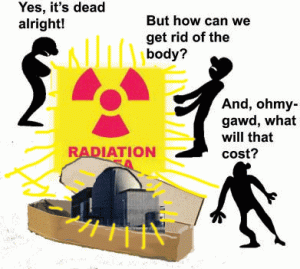
The escalating costs of the geological disposal facility (GDF) have led the Public Accounts Committee (PAC) chair to demand that the government produce a “coherent plan” to manage the country’s nuclear waste legacy
29 Oct, 2025 By Tom Pashby
https://www.newcivilengineer.com/latest/escalating-nuclear-waste-disposal-cost-leads-senior-mp-to-demand-coherent-plan-29-10-2025/
A GDF represents a monumental undertaking, consisting of an engineered vault placed between 200m and 1km underground, covering an area of approximately 1km2 on the surface. This facility is designed to safely contain nuclear waste while allowing it to decay over thousands of years, thereby reducing its radioactivity and associated hazards.
PAC chair Geoffrey Clifton-Brown’s comments were made in reaction to the revelation that the total life cost of the GDF is up to £15bn more than the sum listed in the National Infrastructure and Service Transformation Authority’s (Nista’s) recent annual report. Nista is a government body and works with the Cabinet Office and Treasury and its August 2025 report published figures from Nuclear Waste Services (NWS), the government body responsible for the GDF, showing the GDF as having a whole life cost of from £20bn to £53.3bn.
However, Nista’s Infrastructure Pipeline dashboard lists the GDF’s CapEx (capital expenditure) range for new infrastructure in 2024/2025 prices as being from £26.2bn to £68.7bn, with the top end being slightly over £15bn higher than the figure published in the annual report.
A government source explained to NCE earlier that the discrepancy is because the figures published in Nista’s annual report was based on 2017/2018 prices, meaning the effects of long-term inflation were not accounted for.
Criticism has previously been levied at High Speed 2 (HS2) because of its use of historic pricing figures to reduce the impact of inflation on budget projects and make the total cost of the project appear to be lower than it would end up being.
Government must have coherent plan to manage nuclear waste – senior MP
The House of Commons PAC is one of the most active and powerful select committees in Parliament, able to formally request that the National Audit Office carry out investigations into government projects.
Nuclear decommissioning is a key area of focus for the Committee because of the high total costs, which will hit the public purse into the far future. Sellafield is seen as the government’s flagship project within the wider nuclear decommissioning programme.
The scale of future nuclear decommissioning is clear in the Nuclear Decommissioning Authority: Annual Report and Accounts 2024 to 2025, which says: “the discounted best estimate of the future costs of the decommissioning mission of £110.1bn”. This is a £5bn increase on the previous year.
Nuclear power in Scotland would have same problems as fossil fuels

NUCLEAR power has the “same fundamental challenges” as fossil fuels, international experts have said, as they criticised the UK Government’s embrace of the nuclear industry.
Four academics, from the UK and the US,
argued that costs for nuclear power are “huge” and “rising” and
that “significant delays” in getting projects online are the norm.
They also described how in the space of a year nuclear “adds as much net
global power capacity as renewables add every two days”, and criticised
the drive by Labour ministers to deregulate the industry. The group of
academics includes Amory Lovins and Professor Mark Jacobsen, from the
University of Stanford, Professor Stephen Thomas, from the University of
Greenwich, and Dr Paul Dorfman, Bennett Scholar at the University of
Sussex.
In a joint statement, published in The National, they say that Ed
Miliband’s plans to assess Scottish sites for nuclear projects and Keir
Starmer’s plans to usher in a “golden age of nuclear” with Donald
Trump are hampered by a “few awkward facts”. They said: “The reason
is simple. Nuclear costs are huge, rising, and significant delays are the
norm.
The National 29th Oct 2025,
https://www.thenational.scot/news/25579222.nuclear-power-scotland-problems-fossil-fuels/
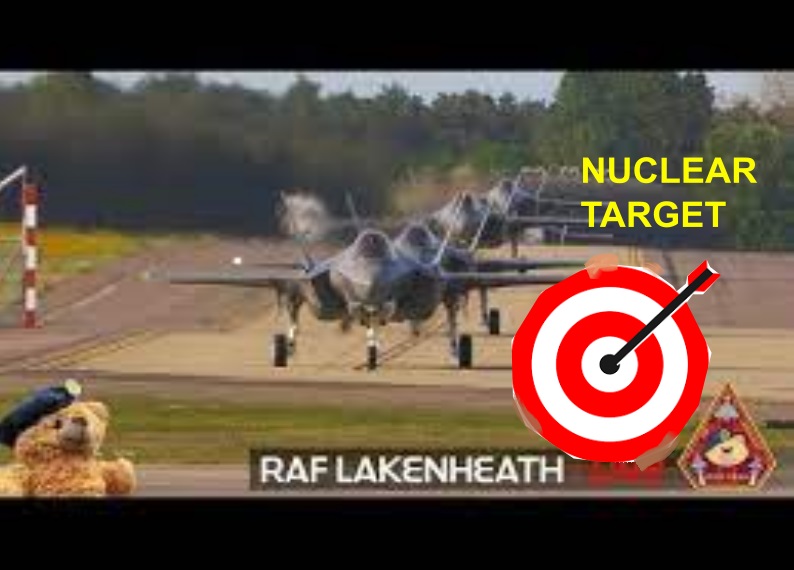
The UK is at risk of a nuclear attack as the US is set to house nuclear weapons in Suffolk, England, which would make the country a target in a US and Russia war
Emily Malia Mirror UK, GAU Writer, 27 Oct 2025
RAF Lakenheath in Suffolk, operated by the United States, is expected to house US/ NATO nuclear weapons in the near future. This development places the UK on the frontline of potential conflict between America and Russia.
The presence of American nuclear weapons on British soil significantly increases the nation’s risk of becoming a target. Military analysts suggest that in the event of war, Lakenheath would likely face strikes before attacks spread to other parts of the country.
Whilst experts acknowledge that nuclear conflict between the US, NATO and Russia would prove devastating globally, it’s crucial to grasp the direct consequences for British towns and cities. The Campaign for Nuclear Disarmament warns: “A single nuclear strike on any town or city would be catastrophic for the local community and environment, and the radioactive impact would spread much further.
“But a nuclear war would be catastrophic for all humanity, forms of life, and the entire planet. Yet the possibility of nuclear war is the greatest for many decades.”
Casualties
Their report reveals if a Russian warhead, such as an SS-25 or SS-27, were to strike the heart of London, nearly a million people would die. Similarly, a hit on Glasgow could result in 326,000 casualties, while in Cardiff, 196,000 lives would be lost.
The epicentre of the nuclear explosion is believed to reach a staggering temperature of several million degrees centigrade. Consequently, a heat flash would obliterate all human tissue within a 1.5 square mile radius.
Back in 1945, when the United States unleashed two atomic bombs over Hiroshima in Japan, all that was left within a half-mile radius were shadows seared into stone. The aerial bombings claimed up to 200,000 lives, most of whom were civilians………………………………………..
Further afield from the zone of instant devastation, there would be a gradual rise in fatalities among those who endured the initial explosion. Approximately seven miles from the blast site, individuals would sustain lethal burns or even require amputations, while others would be blinded or suffer internal injuries.
Unlike a typical disaster, the mortality rate would be shockingly high as most emergency services would be unable to respond due to their own personnel being killed and equipment destroyed. The sheer number of casualties would simply swamp the UK’s medical resources, with people as far as 11 miles away potentially suffering injuries from shattered windows or structural damage.
The long-term impact
In the ensuing days, even those fortunate enough to survive would now be impacted by the radioactive fallout, with the majority succumbing within a week. This would manifest in various ways, from hair loss to bleeding gums, fever, vomiting, delirium and even internal bleeding.
Those with lower levels of exposure would still face complications, including pregnant women who are at a high risk of miscarriage and birth complications. In addition, long-term effects could include radiation-induced cancers affecting many civilians, up to two decades after the event.
It’s believed that children of those exposed to radiation are statistically more likely to be born with abnormalities and suffer from leukaemia. Aside from public health, nuclear weapons are known to cause severe damage to the environment and climate on an unprecedented scale.
Predictions suggest that in the aftermath of a nuclear war, two billion people could face starvation due to climate disruption and its impact on food production. https://www.mirror.co.uk/news/world-news/horrifying-number-people-who-could-36139768
1 This Month

of the week – Shut Down Drone Warfare!


Tell the Ukrainian Government to Drop Prosecution of Peace Activist Yurii Sheliazhenko

Petition to revoke the licensing of the Near Surface Nuclear Disposal Facility (NSDF) at Chalk River. https://www.ourcommons.ca/petitions/en/Petition/Details?Petition=e-7247
To see nuclear-related stories in greater depth and intensity – go to https://nuclearinformation.wordpress.com
-
Archives
- April 2026 (7)
- March 2026 (251)
- February 2026 (268)
- January 2026 (308)
- December 2025 (358)
- November 2025 (359)
- October 2025 (376)
- September 2025 (257)
- August 2025 (319)
- July 2025 (230)
- June 2025 (348)
- May 2025 (261)
-
Categories
- 1
- 1 NUCLEAR ISSUES
- business and costs
- climate change
- culture and arts
- ENERGY
- environment
- health
- history
- indigenous issues
- Legal
- marketing of nuclear
- media
- opposition to nuclear
- PERSONAL STORIES
- politics
- politics international
- Religion and ethics
- safety
- secrets,lies and civil liberties
- spinbuster
- technology
- Uranium
- wastes
- weapons and war
- Women
- 2 WORLD
- ACTION
- AFRICA
- Atrocities
- AUSTRALIA
- Christina's notes
- Christina's themes
- culture and arts
- Events
- Fuk 2022
- Fuk 2023
- Fukushima 2017
- Fukushima 2018
- fukushima 2019
- Fukushima 2020
- Fukushima 2021
- general
- global warming
- Humour (God we need it)
- Nuclear
- RARE EARTHS
- Reference
- resources – print
- Resources -audiovicual
- Weekly Newsletter
- World
- World Nuclear
- YouTube
-
RSS
Entries RSS
Comments RSS
 nuclear-news