France’s Macron and UK’s Sunak agree on nuclear energy cooperation
https://www.reuters.com/business/energy/frances-macron-uks-sunak-agree-nuclear-energy-cooperation-2022-11-07/ PARIS, Nov 7 (Reuters) – French President Emmanuel Macron and Britain’s Prime Minister Rishi Sunak on Monday pledged “ambitious cooperation” in the field of nuclear energy to cope with the impact on energy supplies of Russia’s invasion of Ukraine.
Reporting by Michel Rose; Writing by Benoit Van Overstraeten; Editing by Andrew Heavens
The two leaders met on the sidelines of climate talks in Egypt, their first meeting since Sunak became prime minister.
The French presidential palace also said Macron and Sunak wanted better coordination on migration.
UK government denies reports that the Sizewell C nuclear project is in doubt
The UK government has denied plans for Sizewell C are currently under
review, reiterating its commitment in supporting the acceleration of the
nuclear industry. This is contrary to reports that emerged from the BBC in
which it was stated a “government official had disclosed that every major
project was under review including Sizewell C”.
It was reported that the
primary reason behind this was to cut costs as the UK enters the bleak
winter period amid the energy crisis. Dispelling these reports, a
government spokesperson told Current± that its position on the Sizewell C
project “has not changed” and it will continue to support the
development of the nuclear industry as a means to reach net zero.
Current 4th Nov 2022
https://www.current-news.co.uk/news/uk-government-squashes-claims-sizewell-c-is-under-review
Radioactive Waste Flasks to Share Arnside Viaduct with Walkers and Cyclists ?
Movers and Shakers including green minded and not so green minded folk are
pushing ahead with the plan to open the Arnside Viaduct to walkers and
cyclists. Whats wrong with that? Nothing apart from the fact that
radioactive waste travels this route to Sellafield on a regular basis.
Several flasks are sometimes taken across the viaduct at a time with at
least two deisel engines required just in case one breaks down as the load
is so very dangerous to the public ..and a target for goodness knows what.
Along with Nuclear Free Local Authorities and Close Capenhurst, Radiation
Free Lakeland recently put a series of questions to Direct Rail Services
who operate the nuclear waste trains on behalf of UK Government. The
replies have so far been unsatisfactory to say the least given that UK
Government is putting public money into ever increasing nuclear waste
flasks journeying to Sellafield alongside public access for walkers and
cyclists sharing the same route over the Arnside Viaduct.
Radiation Free Lakeland 6th Nov 2022
Does the UK need new nuclear plants like Sizewell C to reach net zero?
Does the UK need new nuclear plants like Sizewell C to reach net zero?
With the cost of renewables and batteries plummeting, some academics argue
that the UK doesn’t need to build new nuclear power stations to achieve its
net zero goal.
Eight months ago, the UK government made a big bet on
nuclear, promising to treble the size of the country’s nuclear fleet
between now and 2050. Delivering on that promise would require huge
investment in both large-scale new nuclear plants and small-scale modular
reactors. This follows years of government delay and prevarication.
Ministers at the time told the public this push for nuclear was essential
to achieve the UK’s aim to have net-zero carbon emissions by 2050.
That nuclear-fuelled zero-carbon future could now be in doubt, according to news
reports. A government official told the BBC that plans for the nuclear
power plant Sizewell C, which would supply around 7 per cent of the UK’s
electricity, are “under review” as the government looks to cut
spending.
The prime minister’s spokesperson later denied that it was
under review, saying that negotiations with private firms over funding were
ongoing and the government “hoped to get a deal over the line as soon as
possible”.
However, some academics are questioning whether new nuclear is
even necessary. For years it has been energy orthodoxy to argue that
nuclear will be an essential component of the UK’s energy mix to meet its
net zero goal. Wind and solar would supply most of the country’s energy,
so the thinking went, but some back-up power would be needed for when the
wind doesn’t blow and the sky is cloudy. It is an argument broadly
accepted by the UK government, the Climate Change Committee that advises it
and, reluctantly, many environmental campaigners.
But that is now changing,
says James Price at University College London, author of a study published
in September that suggests the government’s backing for new nuclear is
“increasingly difficult to justify”
New Scientist 4th Nov 2022
Councillor wants to know why there has been an increase in radioactive particles found on Dounreay foreshore.
A Caithness councillor wants to know
why there has been an increase in the number of radioactive particles found
on the foreshore at Dounreay this year. Struan Mackie, a Thurso and
Northwest Caithness Highland councillor and chairman of the Dounreay
Stakeholder Group (DSG), made the call after 15 irradiated particles were
discovered on the foreshore area between February and March. It is
understood to be the highest number since 17 were found in 1996.
Mr Mackie
said: “We wish to ascertain why there has been an increase in particle
detections and whether this was preventable. “Regular public updates are
provided to the Dounreay Stakeholder Group through our Site Restoration
sub-group, and it is of the utmost importance that these matters are dealt
with in a robust but transparent manner.”
Dounreay confirmed there has been
an increase in the number of particles found on the foreshore. A
spokeswoman said: “We closely monitor the environment around the site and
have seen an increase in particles found on the Dounreay foreshore this
year. “The foreshore is not used by the general public. We are looking at
wind and wave data to see if we can pinpoint a trend, and will report our
findings when they are complete. Safety is our number one priority and we
continue to monitor the foreshore on a regular basis.
John O’Groat Journal 4th Nov 2022
UK government might scrap Sizewell nuclear plan

A new nuclear power plant in Suffolk is under review and could be delayed or even axed, as the government tries to cut spending, the BBC has been told. Sizewell C was expected to provide up to 7% of the UK’s total
electricity needs, but critics have argued it will be expensive and take years to build. A new high speed rail line in the north of England could also be axed.
“We are reviewing every major project – including Sizewell C,” a government official told the BBC. The government is due to unveil its tax and spending plans under new Prime Minister Rishi Sunak at the Autumn
Statement on 17 November. Negotiations on raising funds for Sizewell C are understood to be ongoing. It is not expected to begin generating electricity until the 2030s. A Treasury spokesperson said delivering
infrastructure projects was “a priority”.
There was confusion on Thursday as executives at the French energy contractor EDF – already building a new plant at Hinkley in Somerset – and the Business and Energy department seemed blindsided by a potential change in tack on existing government policy, which promises to press ahead with both large and smaller scale nuclear projects. “As far we know, it’s still on”, said one nuclear industry executive close to the matter. New large-scale nuclear plants have been a key part of a government strategy to help reduce the UK’s reliance on fossil fuels. Boris Johnson whilst PM declared it was his intention to build eight new reactors in the next eight years.
A shift away from that position would represent a major change in UK energy policy that some will
lament and some will celebrate. But it would do little to convince investors in the UK – domestic and foreign – that they are dealing with a government with stable policy priorities.
BBC 4th Nov 2022
‘Will they, won’t they – great uncertainty over government go ahead for Sizewell C.

It has been a day of mixed messages with reports in the national press and on the BBC that government funding for Sizewell C may be axed being contradicted by a statement issued from the Prime Minister’s office.
The Nuclear Free Local Authorities would sincerely like the costly Suffolk white elephant culled and the money spent instead on insulating cold and damp British homes to reduce energy demand and lower fuel bills. In a letter to Jeremy Hunt MP last month, the organisation urged the Chancellor to ‘leave Sizewell C well-alone’ and to withdraw from the £700 million commitment made by outgoing Prime Minister Boris Johnson and from the concordat agreed between Prime Minister Truss and President Macron to each take a 20% stake in the project.
As the estimated cost to completion is at least £30 billion, this represents a tremendous commitment of taxpayers’ cash, and there is considerable doubt over whether operator EDF Energy, already in huge debt, will be in a financial position to complete the plant or if private-sector players will step in to take the remaining 60% share. Nuclear power projects are notorious for being delivered late and massively over budget so the risk is great that Sizewell C will represent both a lumbering folly and a financial bottomless pit for beleaguered consumers, who would have to pick up the tab through a ‘nuclear tax’ levied through electricity bills.
For the NFLA then, there was great disappointment when in his response to the letter, Climate Minister Graham Stuart, said that ‘commercial discussions have been constructive but are ongoing, and no decisions have been made’ and in a statement made today, a spokesperson for the Prime Minister said ‘Britain’s Sizewell C nuclear power plant project is not being scrapped and negotiations on its funding are progressing’.
So optimistic noises that the project is on track, but there has been speculation that there is an ongoing internal conflict between Whitehall mandarins in the Treasury and the Department of Business Energy and Industrial Strategy as to whether Sizewell C should be in the mix as a project that must be cut alongside HS2 and the Northern Powerhouse Rail as part of the government’s plan to reduce the deficit by £35 billion as Britain enters a new recession.
For the NFLA then, there was great disappointment when in his response to the letter, Climate Minister Graham Stuart, said that ‘commercial discussions have been constructive but are ongoing, and no decisions have been made’ and in a statement made today, a spokesperson for the Prime Minister said ‘Britain’s Sizewell C nuclear power plant project is not being scrapped and negotiations on its funding are progressing’.
French nuclear corporation EDF – facing huge debts, but cosily enmeshed with UK government
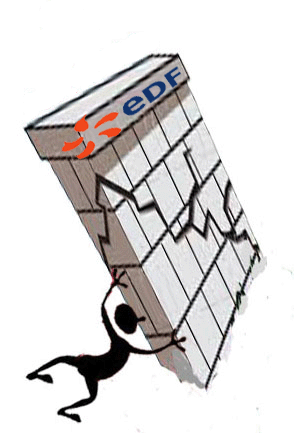
But what about the future? EDF is predicted to stack up 100 billion Euros (£87.8 billion) in debt this year and the French government already pumped €3 billion (£2.6 billion) into the company in Spring.
But as you’ll see below, no matter how bad things are there’s always room to give the CEO a pay rise.
In 2020, CEO Lévy was listed as the 9th highest-paid CEO in the utility sector worldwide taking home a salary of €450,000 (£389,500) and €3,660 (£3,150) in benefits.
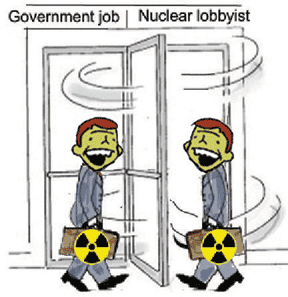
EDF has been getting cosier and cosier with the government.
And the cosiness isn’t set to end anytime soon, EDF stands in good stead under Liz Truss. The new PM nominated former EDF lobbyist Michael Stott as Downing Street’s new business liaison. Stott, who is also an ex-Tory press officer, is expected to lead the government’s new-build nuclear programme.
EDF: WHEN THE STATE GOES FULL CAPITALIST. https://newint.org/features/2022/10/31/edf-when-state-goes-full-capitalist 31 October 2022
What happens when a state energy company goes multinational? In the second installment of its Heat the Rich series on Britain’s big six energy giants, Corporate Watch puts the spotlight on EDF Energy.
EDF is the fifth biggest energy supplier in the UK currently controlling over 10% of the market. The French multinational is best known for “leading the UK’s nuclear renaissance” operating all eight of the UK’s nuclear power stations.
It’s owned by Electricity of France S.A. (Électricité de France, EDF). A multinational energy producer and supplier primarily (and soon to be solely) owned by the French government. It is one of the world’s top five utility companies.
Created in 1946 by the French government, EDF was set up with the intention of rebuilding France’s power grid following World War Two. Now, 70 years on, EDF has branched out a lot further than France, cashing in on energy users from the USA to India. The group is now made up of 144 subsidiaries.
Despite its name, EDF isn’t just in the energy business. EDF is also involved in the data software, vehicle traceability, investment, and real estate sectors, to name just a few.
EDF uses strategic partnership deals to build its brand, for example, the company is a ‘premium partner’ (and official energy supplier) for the Olympic and Paralympic Games in Paris in 2024.
HOW MANY UK ENERGY CUSTOMERS DOES EDF HAVE?
Electricity (excluding pre-payment): 3 million
Gas (excluding pre-payment): 2.1 million
WHO OWNS IT?
EDF Energy (UK) Ltd is ultimately owned by EDF SA, a French company which is majority owned (84%) by the French government and listed on Euronext, the French stock exchange.
In July 2022, the French government announced it would buy out the outstanding 16% of EDF’s shares, reversing the partial privatization of the company in 2005. But it hit a brick wall when investors threatened to sue the government for losses. The French state started finalising their buyout of 100% shares in EDF in September. But at what price? The other shareholders are demanding a fortune, with the government set to pay a total of 9.7 billion euros (£8.7 billion) of French taxpayers’ money. It’s worth noting that the shareholders set to cash in from this nationalization are investment giants Blackrock and Vanguard Group.
IS EDF SUFFERING AS A RESULT OF THE COST OF LIVING CRISIS?
On the face of it, it does seem like EDF profits have nose-dived in recent years. According to EDF Energy (UK) Ltd’s 2021 accounts, EDF operated a €4.8 billion (£4.2 billion) loss compared to €268 million (£239 million) in 2020. No dividends were paid by EDF Energy (UK) Ltd. in 2021 nor in 2020. However, another UK subsidiary, EDF Energy Holdings Ltd did pay dividends of £1 million in 2021, and £60 million in 2020.
Despite these losses, at the end of 2021 EDF Energy (UK) Ltd still had net assets of €17.9 billion (£16 billion).
Regardless of the UK subsidiary’s accounts, the EDF Group achieved all its financial targets in 2021. Group sales for the year amounted to £8,720m, an increase of 8%. The Group reaped profits of €360 million (£324 million) in 2021, a total reverse in performance from 2020 when the Group made a loss of €2.6 billion (£2.3 billion).
But what about the future? EDF is predicted to stack up 100 billion Euros (£87.8 billion) in debt this year and the French government already pumped €3 billion (£2.6 billion) into the company in Spring. But as you’ll see below, no matter how bad things are there’s always room to give the CEO a pay rise.
WHO RUNS EDF?
Jean-Bernard Lévy, the current CEO of the Group, is due to leave six months early after a fallout at the top between Lévy and French president, Emmanuel Macron, over nuclear energy. Lévy is – however – unlikely to be out of a job after EDF. He was formerly CEO of weapons company Thales, and media company Vivendi, and even did a stint as a technical adviser to a government ministry. In 2020, Lévy was listed as the 9th highest-paid CEO in the utility sector worldwide taking home a salary of €450,000 (£389,500) and €3,660 (£3,150) in benefits.
Moreover, Lévy’s probable successor, Luc Remont, cherrypicked by Macron (whose appointment is just waiting for parliamentary approval), will start on on a lucrative footing after the French Government announced that it would like to increase the new EDF CEO’s salary to attract more candidates. The company CEO’s salary is currently capped at €450,000 (£389,500). Whilst no figure has been publicly stated, the EDF Group is known to pay high salaries. In 2013 it was revealed that former UK CEO, Vincent de Rivaz, received a pay package of £1 million annually in remuneration.
Simone Rossi has been at EDF since 2004, Rossi switched roles from Head of the International Division to UK CEO in 2017. But Rossi’s influence goes far beyond the British Isles. As a member of the Executive Committee, Rossi is at the very top of the EDF Group. At first it appears Rossi accepted a big pay cut, with a 2017 payment package capped at just over £100,000. A modest salary in comparison to his predecessor, de Rivaz, who was on £1 million a year. But it is highly probable that Rossi’s remuneration is now identical to de Rivaz at £1 million, as the highest-paid director in EDF Energy Holdings Ltd.
EDF
It’s not just customers at the receiving end of EDF’s profit-led strategy. Kashmir Singh, a Prospect trade union organizer, has been fighting against workplace racism and discrimination for half a century. Singh was presented with a 50-year long-service award in 2021 by Simone Rossi. But Singh’s union released a statement explaining how, during his career, he had been subject to two grievance and disciplinary proceedings for daring to raise EDF’s failure to hire and promote staff from Asian or Black Ethnic (ABLE) backgrounds.
SUBSIDIARIES IN TAX HAVENS
EDF Energy (UK) Ltd owns EDF Energy Holdings Ltd, the top holding company for EDF’s UK subsidiaries. Whilst EDF Energy (UK)’s accounts from 2021 detail tax payments of €905m (£780m) of corporation tax in 2021, some of its subsidiaries are registered in notorious tax havens including a holdings company registered in Hong Kong and an insurance company in Guernsey.
Over the last two decades, EDF has funded the Conservative party to the tune of £38,499.
Most recently, last October EDF Energy Renewables Ltd donated £4,999 to the Conservative Tees Valley Mayor, Ben Houchen. And like clockwork, by March 2022, EDF announced its plan to construct a new hydrogen production centre near the former Redcar steelworks in Teeside. The centre is called Tees Green Hydrogen.
EDF also made two £6,000 in donations to the Labour Party in October 2003 and September 2005. The timing of these donations coincided with Labour PM Tony Blair’s announcement in November 2005 that the government was looking into new nuclear for the UK’s future energy supplies. This set the ball rolling for EDF’s £18 billion government contract for the construction of Hinkley Point C power station.
Over the last decade, EDF has been getting cosier and cosier with the government. The company has had at least five independent opportunities to promote its agenda in meetings with UK prime ministers, once with David Cameron and four times with Boris Johnson. Company representatives even had an intimate one-to-one with Johnson in January 2022 to chat about the UK’s nuclear energy supply, which EDF holds the monopoly over.
Since 2012, company representatives have also attended at least 151 meetings with government ministers, including 24 solo meetings with the former Secretary of State for Business, Energy and Industrial Strategy, Kwasi Kwarteng, who is now the Chancellor of the Exchequer, the person in charge of UK economic policy.
And the cosiness isn’t set to end anytime soon, EDF stands in good stead under Liz Truss. The new PM nominated former EDF lobbyist Michael Stott as Downing Street’s new business liaison. Stott, who is also an ex-Tory press officer, is expected to lead the government’s new-build nuclear programme.
Failure of the “nuclear renaissance” leaves Britain with super-costly closures of reactors, and electricity shortage
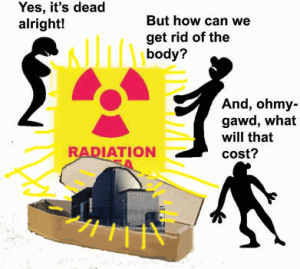
UK facing electricity supply woes after nuclear power stations shut, MPs told
Larger and smaller reactors carry risks, island nation failed to keep pace with nuclear fleet closure
Lindsay Clark, 1 Nov 2022 , Electricity shortages appear inevitable for the UK due to the decommissioning of the nation’s aging estate of nuclear power stations, according to evidence submitted by industry to politicians.
…….. Writing to the Commons Science and Technology Committee, Manchester University’s Dalton Nuclear Policy Group said: “Sadly, it is now much too late to avoid a negative impact on the UK’s electricity supply due to the closure of our nuclear fleet. All eleven of Britain’s Magnox plants have been shut down for many years – the last being the Wylfa plant on Anglesey which ceased operation on New Year’s Eve 2015.
It added: “The fleet of Advanced Gas-cooled Reactors (AGRs) operated by [French energy firm] EDF is also now seeing closures.”
In February, the UK government was warned taxpayers would have to make up a multibillion-pound shortfall to decommission nuclear power stations unless a history of overspending is reversed. EDF Energy runs seven AGR stations in the UK, part of eight second-generation reactors set to be decommissioned which provide 16 percent of the nation’s electricity. The AGR stations are scheduled to stop producing electricity by 2028.
Last year the government injected £5.1 billion ($5.8 billion) into the Nuclear Liabilities Fund – now valued at £14.8 billion ($17 billion) – which it set up in 1996 to meet the costs of decommissioning AGR and Pressurized Water Reactor stations. But EDF’s latest cost estimate to decommission the stations in March last year was £23.5bn ($27 billion). Public spending watchdog the National Audit Office has warned more money will be needed unless the government and EDF avoid overspending.
But as well as overspending, decommissioning also presents a problem for electricity supply.
“It is unlikely that there will be any significant extension to these projected dates, although there may be scope for some slight delays in closure. Once the AGRs are all closed, the UK will only have one reactor from the current nuclear fleet still operational – the pressurised water reactor at Sizewell B,” Dalton Nuclear Policy Group said.
……. “it is due to the failure since 2008 – with the exception of the long-delayed Hinkley Point C – of all proposals for a nuclear renaissance in the UK to move from plans to reality,” the group said.
In May, EDF admitted to another year’s delay and £3 billion ($3.5 billion) extra cost in Hinkely Point C – the UK’s first nuclear power station to be built in 20 years. The revised operating date for the site in Somerset is now June 2027 and total costs are estimated to be in the range of £25 billion to £26 billion ($29 billion).
EDF said it would have no cost impact on British consumers or taxpayers. The power station had been due online by 2017 at a cost of around £20 billion ($22 billion)………………….. The Science and Technology Committee is set to hear oral evidence for its inquiry on Delivering Nuclear Power during hearings this week.
The Register 1st Nov 2022
https://www.theregister.com/2022/11/01/electricity_shortages_uk/
‘Swarm’ of drones spotted flying above UK nuclear plant

https://metro.co.uk/2022/10/31/swarm-of-drones-spotted-flying-above-uk-nuclear-plant-17666304/ Josh Layton 31 Oct 2022,
Up to six drones were seen flying over a nuclear plant, it has been revealed.
The unidentified aerial vehicles (UAVs) spotted above the Capenhurst facility in Cheshire were reported to the Civil Nuclear Constabulary (CNC).
The sighting – logged as a ‘report of 5 – 6 drones flying over and around the site’ – was one of two in the space of four days in 2019.
A note on the second incident simply states: ‘Report of a drone overflying the site.’ A log previously released by the government suggested that there had been a ‘swarm’ incident – where interlinked drones take part in the same operation or attack – at an unnamed nuclear facility.
Capenhurst enriches toxic uranium, allowing nuclear plants around the world to generate electricity.
The sightings were among 11 reports of ‘unauthorised aerial incursions’ at UK nuclear facilities between May 2019 and last November. The latest was at Springfields, near Preston.
Peter Burt, of the Drone Wars UK website, said: ‘Some of the incidents are probably just cases of careless flying by individual drone operators. But others, if accurate, seem far more malicious in their intent, such as the report of several drones flying over and around the Capenhurst uranium enrichment site in July 2019.’
The reports come at a time of heightened tensions between the West, China and Russia, which have both been linked to physical and cyber spying operations in the UK.
A spokesman for the CNC said: ‘To our knowledge, there has been no confirmed malicious use of a drone in relation to the UK’s civil nuclear sites.’
Sizewell C nuclear station to be funded 20% by French taxpayers, and 20% by British taxpayers.
French government officials have officially approved the involvement of
state-owned company EDF in the development of Britain’s Sizewell C nuclear
power plant, Boris Johnson’s last flagship program as Prime Minister. I can
reveal. In his last keynote address as Prime Minister, Mr Johnson had urged
his successors to “go nuclear and go big and go with Sizewell C”.
While questions remain about how the project will be funded, with I After
previously revealing how it has approached investors in the UAE, Australia
and Saudi Arabia for financial backing, the UK has now secured the full
backing of French officials – a big step forward for the plant. The UK is
expected to plan a 20 per cent stake in Sizewell C, with EDF taking a
further 20 per cent – leaving 60 per cent of the project dependent on
investors.
UK Daily News 28th Oct 2022
Dounreay nuclear plant radiation scare over high numbers of ‘harmful’ radioactive particles.

Highest number of nuclear particles found in 26
years and ‘they may pose risk’. A public health warning has been issued
after harmful radioactive particles were discovered to have leaked out in
the area surrounding Dounreay nuclear plant, in Caithness. Fragments of
irradiated nuclear fuel have been detected at the shoreline near the power
plant and nuclear testing facility, with experts from independent Dounreay
Particles Advisory Group saying they “pose a realistic potential to cause
harm to members of the public”.
The radioactive material is said to be the
at the highest levels almost three decades – with 73 per cent of the
particles found deemed “significant”, according to a report. A survey found
15 particles on the shoreline, the most since 1996 when 17 were found, The
Daily Mail reported.
It comes after research suggested the leaks occurred
sometime between 1958 and 1984. In response to ongoing concerns, Dounreay
Site Restoration Ltd, which is in charge of the plant’s clean-up, said it
was closely monitoring the situation.
It comes as Shaun Burnie of
Greenpeace Asia, a nuclear specialist who formerly worked at Dounreay, also
warns of the risk to public health. He said: “The scale of the radiological
hazard from the Dounreay particles is enormous, with hundreds of thousands
and more highly radioactive nuclear fuel particles on the sea bed.
Express 29th Oct 2022
Academics and industry questioned on UK nuclear power supply.

The Science and Technology Committee begin its Delivering Nuclear Power evidence
sessions on National Engineering Day in the UK. This session examines how
UK nuclear energy production will be maintained and increased. The
Government has said nuclear power will play a key part in the UK’s energy
security and goal of reaching Net Zero emissions by 2050, setting the
intention to triple the current electricity output by 2050.
However, all but one civil nuclear reactor in the UK will be decommissioned by 2028
under current plans. And only one new reactor, Hinkley point C in Somerset,
is currently expected to be operational before 2030. In the final panel,
the Committee will question EDF executives on the four-year delay in the
construction of Hinkley Point C, completion of which is expected in 2027.
The progress in plans for a new reactor in Sizewell C in Suffolk will also
be discussed.
UK Parliament 28th Oct 2022
Sizewell C nuclear could become low on the priority list of UK government projects
Therese Coffey’s appointment as the new Environment Secretary came as a
surprise to those who expected her to return to the backbenches after the
departure of her close friend Liz Truss from Downing Street.
But actually it looks like quite an astute move by new Prime Minister Rishi Sunak if he
wants to keep all wings of his party onside.
What it also does is throw up
a very real challenge for her – the Environment Secretary has one of the
most controversial green issues in the country sitting in the middle of her
constituency and an electorate divided about what the government could do.
Dr Coffey is now in charge of the Department for the Environment, Food and
Rural Affairs – it’s effectively the old Min of Ag with environmental
issues tagged on.
What happens at Sizewell is not up to the Environment
Secretary, but the department has a very big input into the decision. It
would probably have to be one of her more junior ministers who actually
makes its case in the Sizewell debate – but as Secretary of State she will
always be closely identified with that by the public.
Of course, it remains
to be seen how much of an issue Sizewell C is likely to be for the Sunak
government. It is a very expensive project and would require a great deal
of government capital expenditure to get it under way. Given that we’re
facing a second era of austerity in 15 years and that any investment now
will not pay off for a decade, I can’t help feeling that any moves towards
progressing Sizewell C are likely to proceed in first gear (or even be left
in neutral) for the next two or three years.
East Anglian Daily Times 27th Oct 2022
https://www.eadt.co.uk/news/23080960.will-coffeys-new-job-mean-sizewell-suffolk-coast/
Reporters Without Borders leads 16 organisations urging UK Home Secretary to intervene in extradition of Julian Assange.

UK: RSF leads a coalition of 16 organisations in urging Home Secretary Suella Braverman to urgently intervene in Assange extradition
Reporters Without Borders (RSF) has led a coalition of 16 organisations in urging the new UK Home Secretary, Suella Braverman, to intervene in the US government’s request to extradite Wikileaks publisher Julian Assange. These groups, representing press freedom, free expression, and journalists’ organisations, have also requested a meeting with Braverman to discuss concerns in the case, after a request for a meeting with former Home Secretary, Priti Patel, went unanswered. The full text of the letter is below.
The Rt. Hon Suella Braverman
Secretary of State for the Home Department
2 Marsham Street
London
SW1P 4DF
7 October 2022
Dear Home Secretary,
We, the undersigned press freedom, free expression and journalists’ organisations, are writing to raise the case of WikiLeaks publisher Julian Assange and request you to urgently intervene to ensure he is not extradited to the United States.
In June your predecessor, Priti Patel, signed the order to extradite Mr Assange, despite widespread international concern that his extradition would have alarming implications for journalism and press freedom. In fact, many of the signatories in this letter wrote to Ms Patel warning that Assange’s prosecution “would set a dangerous precedent that could be applied to any media outlet that published stories based on leaked information, or indeed any journalist, publisher or source anywhere in the world.”
Our request for a meeting was unfortunately left unanswered. We are therefore now asking you, Home Secretary, to meet with the signatories of this letter to discuss the case in detail.
We urge you, Home Secretary, to intervene in this extradition request as a matter of priority. In the US, Mr Assange would face trial on 17 counts under the Espionage Act and one count under the Computer Fraud and Abuse Act, which combined could see him imprisoned for up to 175 years. He is highly likely to be detained there in conditions of isolation or solitary confinement despite the US government’s assurances, which would severely exacerbate his risk of suicide.
Further, Mr Assange would be unable to adequately defend himself in the US courts, as the Espionage Act lacks a public interest defence. This would not align with the values of fairness, justice and a public commitment to media freedom that the UK continues to promote.
You now have an opportunity to ensure that this extradition does not proceed. An opportunity to demonstrate through action that the UK means what it says in its commitment to media freedom. And most importantly, the opportunity to reunite Mr Assange with his young family after many years of separation – an act that may ultimately save his life. We ask you to seize this opportunity as a matter of urgency and ensure that the UK government acts in the interest of journalism and press freedom and does not enable the US government to continue to pursue this more than decade-old, politically motivated case.
We look forward to hearing from you and discussing the case further. We would be grateful for a prompt response. Please reply via Azzurra Moores at Reporters Without Borders (RSF) at amoores@rsf.org.
Sincerely,
Rebecca Vincent, Director of Operations and Campaigns, Reporters Without Borders (RSF)
Laurens Hueting, Senior Advocacy Officer, European Centre for Press and Media Freedom (ECPMF)
Séamus Dooley, Assistant General Secretary, National Union of Journalists
Ricardo Gutiérrez, General Secretary, European Federation of Journalists (EFJ)
Ruth Smeeth, Chief Executive, Index on Censorship
Mark Johnson, Legal & Policy Officer, Big Brother Watch
Peter Tatchell, Director, Peter Tatchell Foundation
Dr Suelette Dreyfus, Executive Director, Blueprint for Free Speech
Romana Cacchioli, Executive Director, PEN International
Daniel Gorman, Director, English PEN
Ricky Monahan Brown, President, Scottish PEN
Alix Parodi, President, PEN Suisse Romand
Tanja Tuma, President, Slovene PEN
Alix Parodi, President, PEN Suisse Romand
Zoë Rodriguez, joint President, PEN Sydney, and Chair of the PEN International Women Writers
Jesper Bengtsson, President, Swedish PEN


1 This Month

of the week – Shut Down Drone Warfare!


Tell the Ukrainian Government to Drop Prosecution of Peace Activist Yurii Sheliazhenko

Petition to revoke the licensing of the Near Surface Nuclear Disposal Facility (NSDF) at Chalk River. https://www.ourcommons.ca/petitions/en/Petition/Details?Petition=e-7247
To see nuclear-related stories in greater depth and intensity – go to https://nuclearinformation.wordpress.com
-
Archives
- April 2026 (114)
- March 2026 (251)
- February 2026 (268)
- January 2026 (308)
- December 2025 (358)
- November 2025 (359)
- October 2025 (376)
- September 2025 (257)
- August 2025 (319)
- July 2025 (230)
- June 2025 (348)
- May 2025 (261)
-
Categories
- 1
- 1 NUCLEAR ISSUES
- business and costs
- climate change
- culture and arts
- ENERGY
- environment
- health
- history
- indigenous issues
- Legal
- marketing of nuclear
- media
- opposition to nuclear
- PERSONAL STORIES
- politics
- politics international
- Religion and ethics
- safety
- secrets,lies and civil liberties
- spinbuster
- technology
- Uranium
- wastes
- weapons and war
- Women
- 2 WORLD
- ACTION
- AFRICA
- Atrocities
- AUSTRALIA
- Christina's notes
- Christina's themes
- culture and arts
- Events
- Fuk 2022
- Fuk 2023
- Fukushima 2017
- Fukushima 2018
- fukushima 2019
- Fukushima 2020
- Fukushima 2021
- general
- global warming
- Humour (God we need it)
- Nuclear
- RARE EARTHS
- Reference
- resources – print
- Resources -audiovicual
- Weekly Newsletter
- World
- World Nuclear
- YouTube
-
RSS
Entries RSS
Comments RSS
 nuclear-news